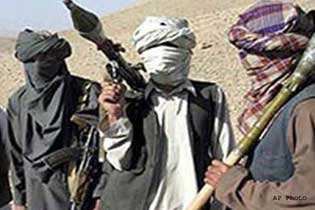
Taliban Spread Terror as New Gang in Town

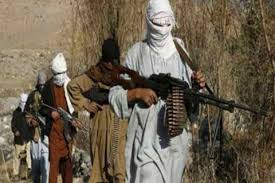
Taliban in Karachi (Credit: nitcl.com)

KARACHI, March 28 — This seaside metropolis is no stranger to gangland violence, driven for years by a motley collection of armed groups who battle over money, turf and votes.

But there is a new gang in town. Hundreds of miles from their homeland in the mountainous northwest, Pakistani Taliban fighters have started to flex their muscles more forcefully in parts of this vast city, and they are openly taking ground.

Taliban gunmen have mounted guerrilla assaults on police stations, killing scores of officers. They have stepped up extortion rackets that target rich businessmen and traders, and shot dead public health workers engaged in polio vaccination efforts. In some neighborhoods, Taliban clerics have started to mediate disputes through a parallel judicial system.

The grab for influence and power in Karachi shows that the Taliban have been able to extend their reach across Pakistan, even here in the country’s most populous city, with about 20 million inhabitants. No longer can they be written off as endemic only to the country’s frontier regions.

In joining Karachi’s street wars, the Taliban are upending a long-established network of competing criminal, ethnic and political armed groups in this combustible city. The difference is that the Taliban’s agenda is more expansive — it seeks to overthrow the Pakistani state — and their operations are run by remote control from the tribal belt along the Afghan border.

Already, the militants have reshaped the city’s political balance by squeezing one of the most prominent political machines, the Pashtun-dominated Awami National Party, off its home turf. They have scared Awami operatives out of town and destroyed offices, gravely undercutting the party’s chances in national elections scheduled for May.

“We are the Taliban’s first enemy,” said Shahi Syed, the party’s provincial head, at his newly fortified office. “They burn my offices, they tear down my flags and they kill our people.”

The Taliban drift into Karachi actually began years ago, though much more quietly. Many fled here after a concerted Pakistani military operation in the Swat Valley in 2009. The influx has gradually continued, officials here say, with Taliban fighters able to easily melt into the city’s population of fellow ethnic Pashtuns, estimated to number at least five million people.

Until recently, the militants saw Karachi as a kind of rear base, using the city to lie low or seek medical treatment, and limiting their armed activities to criminal fund-raising, like kidnapping and bank robberies.

But for at least six months now, there have been signs that their timidity is disappearing. The Taliban have become a force on the street, aggressively exerting their influence in the ethnic Pashtun quarters of the city.

Taliban tactics are most evident in Manghopir, an impoverished neighborhood of rough, cinder-block houses clustered around marble quarries on the northern edge of the city, where illegal housing settlements spill into the surrounding desert.

In recent months, Taliban militants have attacked the Manghopir police station three times, killing eight officers, said Muhammad Aadil Khan, a local member of Parliament.

In interviews, residents describe Taliban militants who roam on motorbikes or in jeeps with tinted windows, delivering extortion demands in the shape of two bullets wrapped in a piece of paper.

A factory owner in Manghopir, speaking on the condition of anonymity out of fear for his safety, said that several Pashtun businessmen had received demands for $10,000 to $50,000. The figure was negotiable, he said, but payment was not: resistance could result in an assault on the victim’s house or, in the worst case, a bullet to the head.

Mr. Khan said he had not dared to visit his constituency in months. “There is a personal threat against me,” he said, speaking at the headquarters of his party, the Muttahida Qaumi Movement, which represents ethnic Mohajirs, in the city center.

The militant drive has even distressed Manghopir’s most revered residents: the dozens of crocodiles who inhabit a pool near a Sufi shrine here.

The Muslim pilgrims who come here to pay homage to the shrine’s saint have long also brought scraps of meat for his reptile charges.

But lately, as visitor numbers have dwindled from hundreds per day to barely a few dozen, the roughly 120 crocodiles here have grown hungry, according to the animals’ elderly caretaker.

Police officials, militant sources and Pashtun residents say that three major Taliban factions operate in Karachi — the most powerful one, which is rooted in South Waziristan and dominated by the Mehsud tribe, and two others from the Swat and Mohmand areas.

A senior city police officer, speaking on the condition of anonymity, said that militant commanders with those factions send operational orders to Karachi from the tribal belt; while some captured militants have tried to justify their activities by citing the authorization of religious clerics in the northwest.

In cases, he added, regular criminal groups have posed as Taliban fighters in a bid to increase their power of intimidation.

Just why the Taliban are adopting such an aggressive profile in Karachi right now is unclear. Some cite the greater number of militants fleeing Pakistani military operations in the northwest; others say it may be the product of dwindling funds, as jihadi donors in the Persian Gulf states turn to the Middle East.

In any event, it has shaken the city’s bloody ethnic politics.

Since the 1980s, armed supporters of the Mohajir-dominated Muttahida Qaumi Movement have engaged in tit-for-tat violence with those of the Pashtun-dominated Awami National Party. In the worst periods, dozens of people have died in a day. Now, faced with a common enemy, figures in both parties say they have declared an uneasy, unofficial truce.

As well as the attack on the Awami party — which have seen it close 44 of its district offices across the city — the Pakistan Taliban claimed responsibility for two attacks on the Muttahida Qaumi Movement — first, a bombing that killed four people, then the assassination of a party parliamentarian.

In a recent interview with The New York Times in North Waziristan, the Taliban spokesman Ehsanullah Ehsan said the group was targeting both parties — as well as President Asif Ali Zardari’s Pakistan Peoples Party — for their “liberal” policies.

The security forces, shaken out of complacency, have begun a number of major anti-Taliban operations. The latest of those occurred on March 23 when hundreds of paramilitary Rangers raided a residential area in Manghopir, near the crocodile shrine, confiscating a cache of more than 50 weapons and rounding up 200 people, 16 of whom were later identified as militants and detained.

“I don’t think the Taliban would like to set Karachi aflame, because they fear the reaction against them,” said Ikram Seghal, a security consultant in Karachi. “The police and intelligence agencies have very good information about them.”

Other factors limit the Pakistani Taliban’s ingress into Karachi. One of the more provocative ones is that allied militants — particularly the Afghan Taliban — might not like the added publicity. The Afghan wing has long used the city as place to rest and resupply. There are longstanding rumors that the movement’s leader, Mullah Muhammad Omar, is taking shelter here, and that his leadership council, known as the Quetta Shura, has met in Karachi.

In such a vast and turbulent city, the Taliban may become just another turf-driven gang. But without a determined response from the security forces, experts say, they could also seek to become much more.

Ihsanullah Tipu Mehsud contributed reporting from North Waziristan, Pakistan.


View: The War ‘Within’

Shabnam Baloch (Credit: dailytimes.com.pk)

It is so much easier to blame others for our problems than to accept responsibility ourselves. What others are doing now or they did in the past (colonialism) should not account for the quality of life for Muslims today. What accounts is so much anger that is always diverted against the external enemies and leaves no room to analyse the internal causes of our social, economical, political, moral and intellectual decline today.

Our determination to decline modernity and a will to embrace values of Stone Age with the sheer assumption that this is the only way to eternal salvation is so overwhelming that we are in the state of total refusal to see how the rest of the civilised world has been developed with adopting the principles of modernity and innovation. We are continuously on the path of decline while the rest of world is climbing up fast on the ladder of prosperity, economic, social, political, technological and intellectual development. The vicious circle of self-imposed isolation, self pity and exile has poisoned our mindset to see the rest of world with the sentiments of enmity and disapproval. We have our own justifications for holding such thoughts about world; after all, we have been oppressed for centuries.

Our enmity with western, un-Islamic world has many explanations. We see west as a ‘threat to Islam’ but we do not have much to say about Muslims killing Muslims today. The war ‘within’ is leading to a genocide of other Muslim sects; killing people who are innocent, peaceful and are not a potential threat to the integrity of a nation or a so-called ‘Muslim brotherhood’.

If all of this is termed as ‘jihad’, a ‘holy war’, who is this war declared against? Is this holy war directed against poverty, social injustice, corruption, illiteracy, violation of human rights and all other social and moral evils? The answer is sadly no. Than who is the target of this holy war. Is it only the innocent people who are being killed as a result of this self-imposed sacred battle, people who are armless and peaceful? Ironically, the answer this time is yes.

By doing all this, what message are we posting to the rest of the world? There is a huge discrepancy when we claim Islam is a religion of peace, and contrary to that we are engaged to gain that peace through proclaiming a war. With the hijacking of US planes and attacking the World Trade Centre on September 11, 2001, the message of Islam as a religion of peace was also being hijacked by those hijackers. The resulting war is against civilisation, it is against human rights and a constant threat to humanity, no matter whatever name is given to that war.

It is true that the condition of world today clearly requires a jihad, a holy war, but that should be directed to eradicate social and moral evils. That should be directed to restore peace of the world and a fight against hunger, HIV-AIDS and extreme poverty. Islam has clearly asserted that the super degree of jihad is to fight with your own self, the evil inside you.

The notion to fight ‘the evil inside’ is a clear way to restore our dignity and peaceful profile in world. Greater levels of tolerance and respect to others are the only ways to regain that reputation. ‘You shall have your religion and I shall have mine’ should be the way of life.

Time has come to think and reflect upon the message we are giving to world. It is time to reconstruct our message and re-direct this holy war against social and moral evils within first and then to rest of the world. Taking pride in a glorious past is good thing but denial of today’s realities and unclear path to future will lead nowhere. Extremism in any form has no vision, and has no clear path and destination. It merely has darkness; darkness of the age of Abu Jehal. The way to come out of this vicious circle is to disregard the clash of civilisations and embrace the global civilisation of human dignity and human brotherhood.

It is never too late to rethink and re-adopt the genuine path to salvation.

The writer is the Provincial Manager at the Strengthening Participatory Organisation (SPO), Sindh and can be reached at shabnambalouch@yahoo.com

Khoso’s designation as Prime Minister widely hailed

Pakistan's caretaker prime minister Mir Hazar Khan Khoso (Credit: onlinenews.com.pk)

ISLAMABAD, March 27: Despite being a nominee of the formerly ruling party, almost all the mainstream political parties, including those in the opposition camp, have welcomed the designation of Mir Hazar Khan Khoso as the country’s sixth caretaker prime minister.

However, most of the political leaders are of the view that the matter should not have gone to the Election Commission of Pakistan (ECP) and the decision should have been taken by the parliamentary committee comprising the government and opposition representatives.

All the five previous caretaker prime ministers had remained the target of criticism by major political parties for their past roles and association with a particular political party and this is for the first time that almost all of the parties are unanimously expressing confidence in the caretaker set-up.

The main opposition Pakistan Muslim League-N (PML-N), which had rejected Mr Khoso’s nomination by Prime Minister Raja Pervez Ashraf and later opposed his appointment at the parliamentary committee level, has also accepted the ECP’s decision.

“We respect the election commission’s decision on the nomination of the caretaker prime minister,” said PML-N President Nawaz Sharif in a one-line statement issued by the party.

When contacted, PML-N’s Information Secretary Mushahidullah Khan said: “Everyone should accept the ECP’s decision with an open heart and we also accept it.”

Mr Khan said that even though the ECP did not chose the PML-N’s nominee, the party was happy that a legal and constitutional path had been followed for the appointment of the caretaker prime minister for the first time in the country’s political history.

He said that credit for the constitution amendment ensuring setting up of a neutral caretaker regime in the country for holding of elections in free, fair and transparent manner must be given to the PML-N.

The PML-N leader regretted that at a time when the ECP was discussing the nominees for the caretaker prime minister, the PPP’s information secretary Qamar Zaman Kaira had openly stated that his party would not accept the nomination of retired Justice Nasir Aslam Zahid at any cost.

On the other hand, he said, the PML-N had always stated that it would accept any decision of the ECP.

The Pakistan Tehreek-i-Insaf (PTI), led by cricketer-turned-politician Imran Khan, in its cautious reaction termed Mr Khoso’s appointment a “constitutional verdict”.

“This is a constitutional verdict and we accept it,” said PTI’s vice-chairman Makhdoom Shah Mehmood Qureshi, when contacted.

Mr Qureshi said the PTI expected that Mr Khoso would “strengthen” and “assist” the ECP to ensure elections in a transparent manners. The PTI, he said, also expected from Mr Khoso that he would remove the impression that he was a nominee of a particular political party.

Similarly, the Jamaat-i-Islami (JI) which had boycotted the previous polls along with the PTI, termed Mr Khoso’s appointment “a correct decision of the ECP.”

JI Spokesman Shahid Shamsi said that since all the opposition parties had complete confidence in the ECP, the party also respected its decisions. He, however, was of the view that it would have been better if the political leadership had made this decision.

When contacted, deputy convener of the Muttahida Qaumi Movement (MQM) Dr Farooq Sattar said that his party was completely “satisfied” with Mr Khoso’s appointment that had come as a result of a constitutional process. The MQM leader said the ECP’s decision had also ended the uncertainty in the country and now the whole nation would enter the election phase.

Meanwhile, President Asif Ali Zardari also welcomed the nomination of Mr Khoso as the caretaker prime minister, terming it a “very significant and welcome development”.

President’s Spokesman Farhatullah Babar quoted Mr Zardari as saying that the nomination of Mr Khoso was a culmination of a part of the constitutional process to ensure free and fair elections and would be welcomed by all across the political divide.

The president said the forthcoming general elections under a caretaker neutral set-up selected under the constitutional process and an independent and empowered ECP duly empowered by the parliament for the first time in the country’s history was a very significant and welcome development that should help in banishing the spectre of “manipulated power transfer”.

The president also asked the people to exercise their right to vote and elect their representatives who best represented their hopes, aspirations and priorities.

Prime Minister Raja Pervez Ashraf, who also telephoned Mr Khoso to congratulate him, expressed the confidence that the country would benefit from his knowledge, capabilities and experience as it moved towards general elections.

Mr Ashraf, who is also the secretary general of the PPP-Parliamentarians, hailed Mr Khoso’s appointment as “a commitment towards democratic process and upholding of rule of law and constitution of the country.”

Justice Khoso, who is scheduled to take oath of the office on Monday, is the second non-political figure to get the office of the caretaker prime minister. Earlier, a former vice-president of the World Bank Moin Qureshi had served as the caretaker prime minister from July 8, 1993 to October 19, 1993 after resignation of former prime minister Nawaz Sharif as a result of his tussle with the then president Ghulam Ishaq Khan.

The politicians who had served as the caretaker prime minister are Ghulam Mustafa Jatoi (1990); Mir Balkh Sher Mazari (1993); Malik Meraj Khalid (1996-97) and Muhammadmian Soomro (2008).

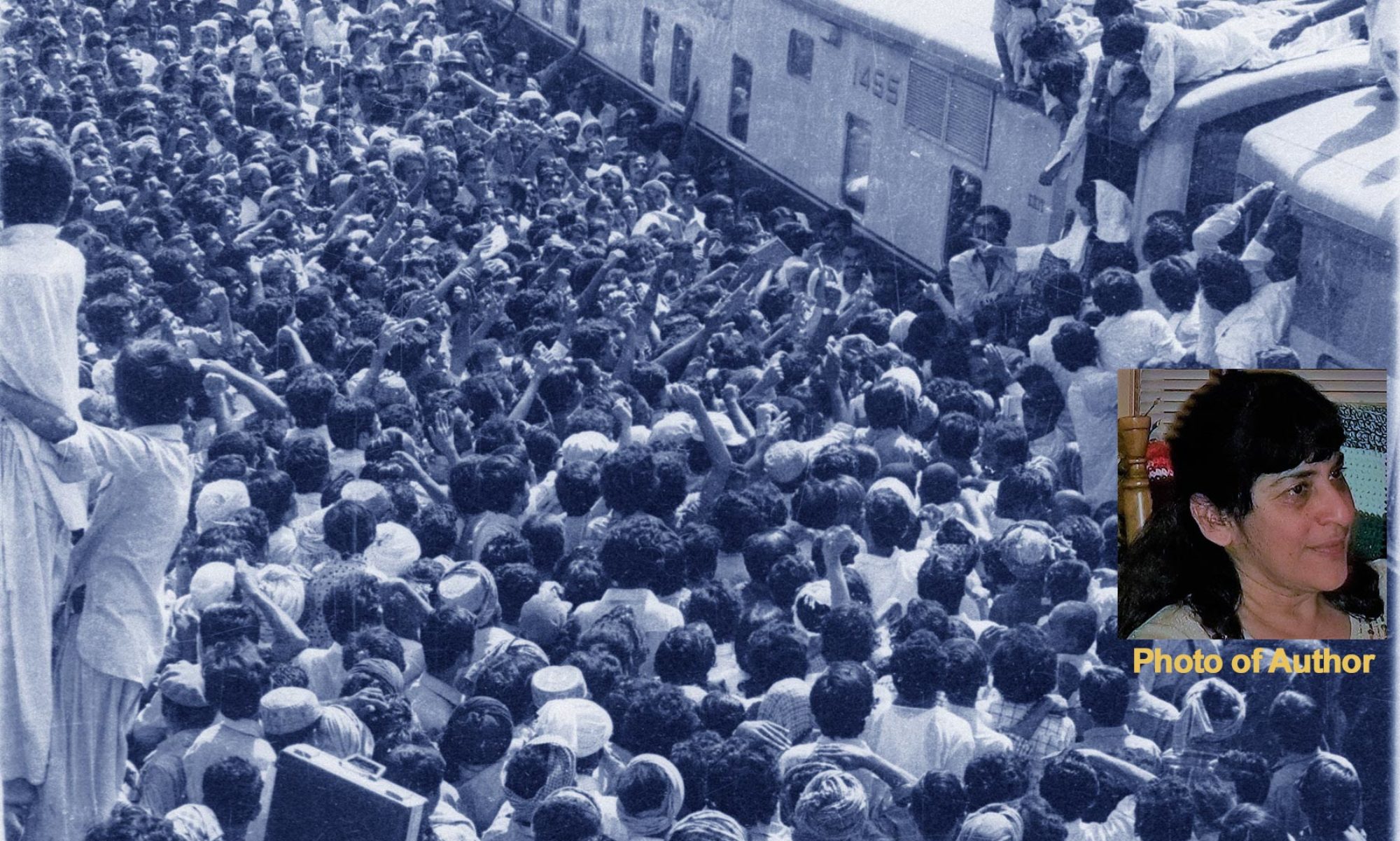
Islamabad Crowns Democracy Train’s Journey to Capitol (See Reports)

Fall of Tirah Valley

Tirah Valley falls to Militants (Credit: nation.com.pk)

The fall of the Tirah Valley to the Tehreek-e-Taliban Pakistan (TTP) and the Lashkar-e-Islam (LI) is not sudden; the valley, which remains excommunicated from the rest of the country, has been a war zone for three militant outfits — the TTP, the LI and the Ansarul Islam (AI). The LI and the AI have been battling each other for over seven years in the Bara tehsil of Khyber Agency, with turf wars being waged based on sectarian grounds. The area became a stronghold of the TTP after operations were launched in the nearby Orakzai and Kurram tribal agencies. The LI then sought an alliance with the TTP and the AI, previously a banned outfit, which was later considered a tribal militia that was protecting boundaries of the valley from “foreign influence”. In June last year, the TTP took over the majority area held by the Kukikhel tribe, while reports of the presence of the Taliban from as far as the Mohmand Agency also surfaced. Hundreds of people were reportedly killed; however, because of the area being isolated, little information made it to the mainstream media, till almost 90 per cent of the valley went into the TTP’s hands.

On March 16, two press conferences were held at Peshawar Press Club. While the AI spokesperson demanded that the surrounding areas of Peshawar be handed over to the AI because they could protect them “better”, the head of the ANP’s jirga for the tribal areas claimed that there were Uzbeks, Chechens and Arabs who had their bases in the area. Ironically, two days later, the TTP took over the Tirah Valley.

As general elections approach, security officials are now concerned that the routes that lead to Peshawar are also under the control of militants. While opening up a new front for a renewed operation in Tirah is inevitable, there is a serious threat that elections may not be held in a peaceful manner. Even though the Peshawar High Court has ordered the election commission to hold election at the IDP camps, the recent bombing at the Jalozai camp is a grim reminder of the volatile security situation.

Published in The Express Tribune, March 28th, 2013.


Pashtun Women Viewpoint – Pakistan: Torn Between Bhutto and Zia

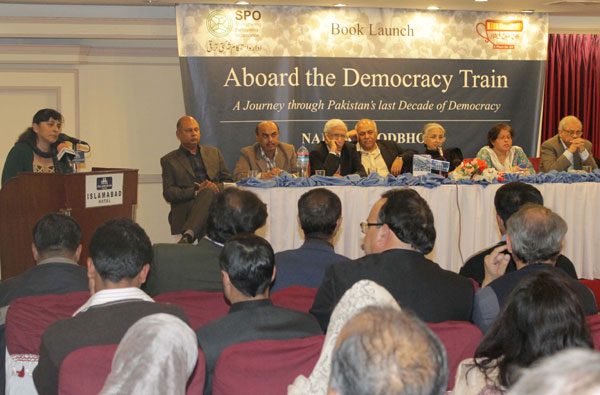
NH book launch in Islamabad (Credit: Strengthening Participatory Organization)

At the book launch of Nafisa Hoodbhoy ‘Aboard the Democracy Train’ in Islamabad, the speakers who mostly belonged to Karachi and had seen the Pakistan that was before Zia-ul-Haq’s Marshal Law in 1977 reminisced the events led to Marshal Law, life during Zia’s brutal regime, the emergence of MQM and the ruthless tactics used by Jamat-i-Islami, one of the Islamist parties of Pakistan, using its student wing at Karachi University.

Dr. Ayesha Siddiqa argued and believed that the situation might have been the same today if Zia had not grabbed power through a military coup. “We blame Zia for everything but what would we do if Zia had not imposed Marshall Law and dethroned a political government? Who would we blame then for the current mess Pakistan is in?” To which Khawar Mumtaz, chairperson on the status of women said that things would not have been that bad if Zia had not toppled a democratically elected government and brought a reign of terror that fed on religiosity. The speakers and the attendants seemed to agree with Ms. Mumtaz.

There is no doubt that after the demise of General Zia, Pakistan remains clearly divided between two distinct blocks; one associating itself with Bhutto, the other linking with Zia.

The block representing Zia is taking hold of Pakistan when the space for Bhutto is shrinking. The incident of Badami Baagh in Lahore, where the entire locality of Christians was turned into ashes on the spur of a moment, is a manifestation of that reality. The incessant attacks on Shias, Hindus and Ahmadis in Pakistan indicate that people belonging to Zia’s block hold the strings of lives of ordinary Pakistanis in their hands. The militancy and religious extremism nurtured by Zia is making it impossible for people of other faiths to live in Pakistan. The sunlight is receding and the shadows increasing.

The word ‘liberal’ and ‘secular’ has become an abusive term in Pakistan, which can explain the dominance of Zia’s followers better, is the weakness of Bhutto’s own party. They could not challenge or confront the radical elements belonging to Zia’s block on matters as small as, for instance, unblocking access to the popular video sharing website, Youtube. Who could have foreseen during the time of Zulfiqar Ali Bhutto that one day his own party, with liberal inclinations running the government, would feel so weak and powerless against radical forces that it would dither in its decision of opening the website.

Bhutto was a symbol of modernity for the state of Pakistan; Zia represented extremism and dictatorship and made Pakistan an entity of hatred where only Muslims of a certain school of thought could live and where the more illogical is the most appreciated and accepted. He clearly turned Pakistan into a laboratory of a radical Islam, which the religious forces had dreamed of; a laboratory which produces militant groups that silence any voice remotely connected with modernity and liberalism. What crime had hundreds of Shias committed? What crime had Salman Tasir and Shahbaz Bhatti committed, who got killed in Islamabad and then the killer of Salman Tasir was garlanded with flowers not by people in the tribal belt or Baluchistan, who are portrayed as the barbaric ones in love with backwardness and terrorisms and away from any signs of modernity, but in the heart of Pakistan, Rawalpindi.

The armed groups, the Sipahs and the lashkars are so many that at times it feels as if these groups are the defenders of security in Pakistan, not the military of that country. And why not so, when the military is more into its commercial enterprises and money making, than doing its duty to defend the country and its people. The military in Pakistan runs businesses ranging from Banks to cement factories and its economy is worth more than 10 billion dollars. Dr. Ayesha Siddiqa wrote a book on military economy ‘Military Inc’ Inside Pakistan’s Military Economy.

When I see campaigns and banners demanding for Jinnah’s Pakistan, I ask myself, isn’t today’s Pakistan, in fact, Jinnah’s Pakistan, as confused and disoriented as Jinnah himself was. He had no idea what kind of Pakistan he wanted, a theocratic State of which he expressed his desire several times or a liberal democratic State of which he mentioned in his speech right before the birth of Pakistan in 1947. His decision to declare Urdu as the national language awarded a tool in the hands of oppressors who set the ground for alienation and separation. The language was later used by the Punjab dominated ruling elite, led by Pakistani military, against other ethnicities like the Pashtuns and the Balochs.

Because of the poor vision and short sightedness of the founding fathers of Pakistan, millions were uprooted from their origin, their villages, cities, their hearths and homes, their friends and their dreams. Ironically, those who were uprooted and who actually steered the Pakistan movement, are to this day called Muhajir which means refugees and more derogatively Biharis—the people from Bihar.

Bhutto can never be more relevant than in today’s Pakistan. When I say “Bhutto” I do not refer to the person “Bhutto” or his party but the philosophy of modernity, liberalism and secular beliefs that existed in the pre-Zia Pakistan. With the arrival of Zia, a raj of shadows descended on Pakistan. Time for change has come as it is the only permanence in the world. What the shrinking majority of Pakistan wants is the Pakistan of Bhutto, clear in its direction and outlook, a modern, democratic and secular Pakistan that is unfortunately losing its ground to the onslaught of Zia’s block.

Pakistani girl defied Taliban to play squash – as a boy

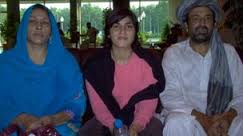
Maria Toorpakai with parents (Credit: bbc.co.uk)

Maria Toorpakai received death threats from the Taliban for playing sports, which it considers un-Islamic. Now she is determined to return to Pakistan and change their minds.

Maria Toorpakai was born in what is called “the most dangerous place on earth” — Waziristan, Pakistan

Long a stronghold for militant groups and warlords, including the Taliban, this remote tribal region is also one of the most conservative and uneducated parts of Pakistan.

But Toorpakai’s courage and determination to fight for social change in Waziristan has helped her to overcome numerous challenges and become something no woman there would ever be allowed to become — a squash champion.

Growing up in Waziristan, she had to pretend to be a boy to play the sport she loved, receiving death threats from the Taliban when her secret was exposed.

“I DRESSED AS A BOY SO I COULD PLAY SQUASH”

“Girls don’t have any rights. They cannot go out from their house, they cannot do what they want to do, they cannot play sports. They have to stay covered up, or they will be killed,” Toorpakai, now 22, recalled during an interview with MSN News from Toronto, where she moved two years ago to train under Canadian squash champion Jonathan Powers. “But I want to go back one day and change that.”

Even though she is more than 6,000 miles away from home, Toorpakai still talks about how she wants to go back to Waziristan one day and help girls who have no access to education and are often forced to join militant groups or engage in criminal activity.

Her introduction to squash, which would ultimately help her to get out of Waziristan, came through her father, Shamsul Qayyum Wazir, an outspoken advocate of women’s rights in the Pashtuni community, a stance which landed him in prison.

Wazir had always believed his daughter was different.

“I was 4 when I realized that I didn’t want to sit at home and play with dolls,” Toorpakai said. “I wanted to go out and play sports. One day when my parents were away, I burned all my frocks, shaved my head and wore my brother’s clothes. I became a boy.”

This little act of rebellion led to Toorpakai’s father naming her Genghis Khan.

When she was 12, Toorpakai’s family moved from one city to another to escape the Taliban, finally settling in Peshawar, Pakistan, where her father enrolled her in weightlifting.

She went on to rank second in weightlifting in Pakistan in the junior division.

Soon after that, Toorpakai discovered squash.

THE NO. 1 PLAYER IN PAKISTAN

Within three years, Toorpakai went on to become Pakistan’s national champion and was ranked No. 3 in the world in the juniors division.

But she continued to live in fear of the Taliban.

Whenever she traveled for tournaments locally, she carried a gun and a cyanide pill in case she was kidnapped.

“People saw me on TV wearing shorts, playing sports and didn’t like it,” Toorpakai said. “They told me, ‘You are causing us dishonor.'”

“Think about what the Taliban did to Malala Yousafzai, and she just wanted to go to school, and she was in a veil … and I’m wearing shorts,” Toorpakai said.

Related: Pakistani girl shot by the Taliban returns to school

One day, her father received a note from the Taliban that said if his daughter continued to play squash, his family would be killed.

“I stopped playing in tournaments and appearing on TV,” Toorpakai said.

SNIPERS IN THE SQUASH COURT

Toorpakai’s plight was discussed in the Pakistani parliament. The government placed security checkpoints around her house and even provided snipers to protect her in the squash courts.

“I realized that it’s not possible being a girl and playing sports,” she said. “I was afraid that I would be kidnapped or killed. Every day, army officers and ministers are killed, and who am I? I would be easily killed.”

Toorpakai was also worried about the safety of the other children who played in the squash courts.

“I decided to play in my room. I didn’t want to be the reason behind someone’s death,” she said. “I believed in my squash. I kept hitting and hitting while everyone slept at night, until my hands were swollen.”

But the confinements of a small room became too much to bear, and Toorpakai started looking for a way out.

She sent hundreds of emails to universities and squash clubs explaining how it was becoming increasingly difficult for her to train in Pakistan.

“I offered my services as a part-time squash coach, but I had one condition — I wanted time for myself to train,” she said.

She didn’t hear back anything for three years, but then received an email from Powers.

“FIELD OF DREAMS”

“I couldn’t believe Jonathan Powers wanted me to train with him,” said Toorpakai, whose first squash racket had come inscribed with Powers’ signature.

“To me, it wasn’t that complicated,” Powers said. “I had grown up training with a famous Pakistani squash player’s family and knew how difficult life there could be. In Maria’s email, I saw a girl who wanted to follow her dreams.”

It took Powers eight months and a lot of convincing to get Toorpakai to move to Toronto.

When she finally arrived March 22, 2011, she was 20.

“She came here with a one-way ticket, 200 bucks in her pocket and a promise from me to train and become a world champion,” Powers said. “When I asked her if she was willing to remain in Canada until she became world champion, she replied, ‘Inshallah,’ meaning ‘God willing.'”

Powers said he opened the Power Squash Academy in Toronto to help inner-city kids who would never otherwise have access to squash.

“Squash in North America is a private club sport, and the doors are closed,” he said. “I wanted to integrate young people who didn’t have the means with top junior players from around the city. Kids can meet the best players in the world here. You can come here and play just for fun or if you want to train all day and become the best in the world, you can do so. It’s like a field of dreams.”

Powers said Toorpakai’s confidence has improved tremendously since she came to Canada.

“She’s doing great,” he said. “We play daily, and she’s absolutely phenomenal on the court — her raw ability to hit the ball was incredible, and I’ve been constantly working with her to improve it.”

Toorpakai is part of the high performance group in Powers’ academy that includes players from around  the world. She is getting ready to head back to Pakistan for the Asian squash championships in May.

Once that is over, Toorpakai will be setting her sights on the world championship.

GOING BACK HOME

“There’s always a security concern, but the Pakistani Air Force will be bringing her back there, and they will have players from all over the world, so I’m hoping it will be safe,” Powers said.

“I am not frightened anymore,” Toorpakai said. “Maybe God chose me to bring change to my community. Once I am world champion, I want to go back and help the men, women and children who are living like refugees in their own country.”


Historic moment as Pakistan’s elected civilian government completes full five year term

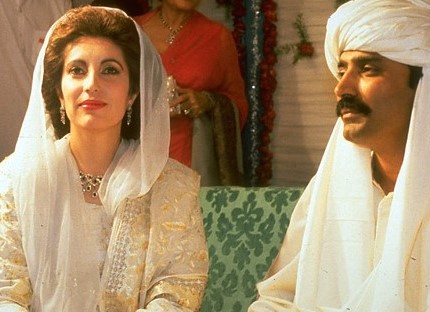
The Way We Were Benazir Bhutto & Asif Zardari (Credit: Pakmag.com)
This weekend saw a historic moment for Pakistan, as a democratically elected civilian government completed its full five year term for the first time ever. In the past, governments have been ousted by the military or by rivals. The moment passed relatively quietly, with a televised farewell address from the prime minister Raja Pervaiz Ashraf on Sunday. In an understated address, he conceded that his government had not done enough during the last five years, but maintained that it had lessened the problems it had inherited. He also said that the historic completion of a full term marked the end of a “sinister chapter” of attacks on democracy. “We have strengthened the foundations of democracy to such an extent that no one will be able to harm it in future,” he said.

Many judge the government’s main achievement to be surviving at all. This was no small feat. At the beginning of the five year term, few observers thought that the leading coalition would last more than a year. Asif Ali Zardari was seen as an accidental president, who ended up in this position of power only because of the assassination of his wife, Benazir Bhutto. While Zardari remains unpopular, he has gained a reputation as a canny politician and dealmaker, who kept an unruly coalition together against the odds, despite junior partners frequently breaking away or demanding greater concessions.

There has been a lot of focus on the negative legacy that this government has left behind. Pakistan is in the throes of an energy crisis, with power cuts plaguing large swathes of the country. (As I write this, from the capital city Islamabad, the power has gone off for the fourth time today). Terrorist violence has increased, not reduced, a trend which has not been helped by the lack of a coherent government anti-terrorism strategy. Attacks against religious minorities continue with impunity – from mob attacks against Christian communities to targeted militant violence against Shias. Economic growth is sluggish, while corruption is rife and tax bills low.

Yet on the flipside, the positives should not be overlooked. The level of media freedom enjoyed in the last five years has been unprecedented. Although there were some exceptions, in general, the political opposition and media organisations have been able to say what they want. This has resulted in a lot of mockery and criticism of the present government, to a degree that would have been unthinkable in the past. There have also been significant steps forward in the area of constitutional reform, with greater devolution of power to provincial governments and changes to improve electoral practice.

For months, rumours have circulated that the election will be delayed or cancelled altogether. While I was living in Karachi last year, practically every social gathering featured someone declaring that they knew the election wouldn’t be happening for some reason or another. This demonstrates deep-seated public disbelief that this moment would ever come to pass; a psyche borne of decades of last minute interceptions and power grabs.

The challenge is far from over. Now that the National Assembly has dissolved, the ruling parties are in the process of establishing a caretaker government which will run the country while the Election Commission gets things in order. Shoring up the security situation to reduce bloodshed from terrorist attacks during the polls will be a priority. The election schedule has not yet been announced and rumours still proliferate that the caretaker set up will be extended and elections held off for a year or even two.

The crucial point is that for all the misgivings about the present government, the Pakistani public will, for the first time ever, have the chance to express these feelings through the ballot box. The significance of that cannot be underestimated.

My Last Meeting with Slain Parveen Rehman

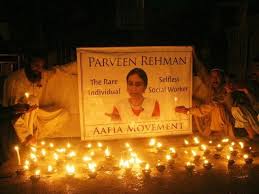
Tribute to Parveen (Credit: blogs.tribune.com.pk)

“Did you find that religious extremism has grown in Pakistan on this trip?” asked Sheema Kirmani, sitting cross-legged in the front of the crowd, after I had finished presenting my book at a session of the Karachi Literary Festival.

“Oh yes,” I responded. “But its not just religious, but also ethnic extremism that’s taken hold of Karachi. I think that the more violence permeates society, it causes individuals to fall back on the groups that give them a sense of identity.”

Sitting in the audience was Parveen Rehman. She had promised to attend after I went to her sister, Aquila Ismail’s presentation of her book “Martyrs and Marigolds,” a couple of hours before my launch.

During Aquila’s presentation, the moderator mentioned her family was also present in the audience, I  turned to meet Parveen’s glance. She waved back to me enthusiastically, with that warm smile that I knew from back in the 80s, when I visited the Orangi Pilot Project to report for Dawn.

After her sister’s presentation, we went outside, where Parveen hugged me and we exchanged notes. “I thought you resembled Aquila,” I had said, as we parted… not knowing it was for the last time.

Barely a month later, March 13, Parveen was murdered at a roundabout in Orangi Town, Karachi. The administration has since claimed to have arrested her killer – a Tehrik-i-Taliban commander – whose party affiliates have ensconced themselves in this outskirt of Karachi, where Parveen worked for 25 years.

Unlike Malala – who rose to world fame – had the bullets missed Parveen, she might have become known to the world for her pioneering work for the voiceless poor.

There was no shortage of death threats for Parveen, who grew to become director of the OPP — begun by  late Dr Akhter Hameed Khan. Amongst her pioneering work was to take a stand against land grabbing mafias – patronized by city officials.

Under Parveen, OPP compiled a report on 1500 Sindhi villages where the inhabitants were forcibly evicted by the land mafia – – and their land divided into plots for commercial usage. Although she shunned the limelight, Parveen took a clear stand against forced eviction of indigenous Sindhi and Baloch from their native villages and worked to enable them to acquire tenant rights.

The land grabber mafia even had an eye on the prized land on which OPP was built. Only a year ago armed gun men had burst into its building with the aim of occupying it.

Parveen told an interviewer that in order to save the building they engaged a “thug,” who scared off the occupants by threatening retaliatory fire.

Despite death threats, Parveen characteristically dismissed them, saying, “At the most what will they do. Kill me?”

And kill her they did.

In losing Parveen, the world has lost a courageous woman who fought for justice under the most difficult circumstances. The next government needs to pause and reflect on the tentacles being wrapped by land grabbing mafias on prized land in urban settings — where they will not stop even if it means killing an innocent woman like Parveen.


Parveen Rahman – Pakistan Loses a Courageous Woman Working for Upliftment of the Poor

Sketch of Parveen (Credit: tribune.com.pk)

KARACHI, March 15: A media-shy social worker who devoted her life to the development of the impoverished neighbourhoods across the country, was gunned down near her office in Orangi Town on Wednesday. She was 56.

Parveen Rehman was born in Dhaka in 1957. She did part of her schooling in the former East Pakistan and migrated to Karachi after the fall of Dhaka.

She received a bachelor’s of engineering in architecture from Karachi’s Dawood College of Engineering and Technology in 1981 and joined a private architect’s firm.

A few months later, she left the job and joined the Orangi Pilot Project initiated by Akhtar Hameed Khan to bring healthy changes to the lives of impoverished residents of Orangi.

“The late Akhtar persuaded her to join the OPP. We both joined the OPP in 1982 and since then we worked in close association,” said Anwer Rashid, co-director of the OPP-RTI (Orangi Pilot Project-Research and Training Institute).

Mr Rashid choked on words as he described his working relationship with Ms Rehman.

Noted town planner Arif Hasan, who is member of the OPP’s board, briefly visited Ms Rehman’s home and left early as he was deeply distressed like dozens of her friends and colleagues who had gathered at her house in Safari Boulevard in Gulistan-i-Jauhar.

“She was a courageous and brave lady. She was a true pupil of Akhtar Hameed Khan who worked in an environment where most people will avoid to work,” said Mr Rashid.

Soon after the private TV networks flashed news of her death, a large number of people flocked to the Abbasi Shaheed Hospital, where her body had been shifted.

Eyewitnesses said those who gathered in the hospital and outside her home, where she was living alone with her octogenarian mother, included dozens of residents of Orangi who were mourning her death.

“She was a great help for us. She was just like an elder sister to whom we would go whenever a problem struck us,” said a middle-aged man who identified himself as Azmat Ali.

Arif Pervez, development professional and a friend of hers, said Ms Rehman had been receiving death threats for a long time, apparently from the mafia involved in grabbing precious land on the fringes of the city.

“She had been receiving threats on her life for a long time. We had discussed this several times but every time I advised her to take care of herself, she smiled, waved her hand and said what will they do, I have to work a lot and that too in the middle of the people,” Mr Pervez said.

Ms Rehman was an ardent compiler of the record of precious lands, which were on the fringes of the city in shape of villages but were speedily vanishing into its vastness because of ever-increasing demand by thousands of families who were shifting to Karachi every year from across the country.

She said on record that around 1,500 goths (villages) had been merged into the city since 15 years. Land-grabbers subdivided them into plots and earned billions by their sale.

“She documented everything about the lands that have been grabbed. Another sin of her was to help those whose lands had been grabbed. Yet, she never hesitated to go to the area where her life was constantly under threat,” Mr Pervez said.

“Many people certainly have lost their elder sister,” he said.

Noman Ahmed of NED University said Ms Rehman’s great achievement was to get involved and empower communities in development work.

“She involved communities in development work and her cautious endeavour was to empower people and lessen their sense of deprivation. Her motto was way forward. She saw it as a defeat to terrorists by not changing her routine to help people,” Mr Ahmed said.

Besides her mother, Ms Rehman is survived by her two brothers and a sister, living abroad.


Violent backdrop for crucial Pakistan elections

The most critical elections in Pakistan’s history are taking place amid an orgy of killings – minority groups, civilians and military personnel have all been targeted by a variety of extremists.

With the number of targeted assassinations of leading politicians expected to increase by the time of the elections in the second week of May, there are no signs that the government or the army are prepared for a deterioration of security.

The sense of instability is not made any better by the worsening economic crisis.

An average of 10 to 20 people a day are being killed in the major cities – Karachi, Quetta, Lahore and Peshawar – as the country is gripped by violence. On a bad day as many as 100 people can be killed by suicide or car bombs.

Intolerance unchecked

Those suffering most are the minority Shia population, who are being targeted by Sunni extremists. On 9 March, Christians were attacked and their homes ransacked in a poor locality of Lahore by a rampaging mob.

Pakistan endured one of its worst days of violence on 10 January when 115 people were killed – including 93 Shias belonging to the Hazara ethnic group in Quetta.

A month later on 16 February another 84 were killed and 200 wounded in a similar massacre in the city. For days Shia Hazaras refused to bury their dead and many prepared to leave Pakistan for ever.

The plight of some Hindus, Sikhs, Christians, Ahmedis and Shias has forced many to flee the country as intolerance unchecked by the government escalates.

On 3 March another 50 Shias were killed and over 100 wounded in a massive truck bomb that exploded in a Shia locality of Karachi.

Pakistani Shia naval officers and Shia doctors have likewise been killed. Last year more than 400 Shias were killed in Pakistan by Sunni hardliners. Already more than 200 Shias have been killed in the first two months of 2013.

The killings are being carried out by Lashkar-e-Jhangvi – a Sunni militant group which has already been declared a terrorist organisation.

But the government’s only reaction so far has been to place its former leader Malik Ishaq under house arrest. He has been arrested and freed several times before.

Test of democracy

It appears to many Pakistanis that the militants are more powerful than the army or the government.

The elections come as fears are rising over sectarian violence

Yet these elections are critical, for it will be the first time in Pakistan’s history that an elected government will hand over power to another elected government.

It will be the biggest test of Pakistan’s democracy, but at the same time none of the major political parties is prepared to take on the extremists.

Karachi is dissolving into chaos. It is not only besmirched by the Shia killings, but also by a vicious, multi-sided turf war between ethnic and sectarian groups, mafias and land grabbers.

Almost every day some part of the sprawling metropolis is shut down because of gunfire, murders or citizens’ protests.

On 13 March one of the country’s top aid workers – Karachi-based sanitation expert Parveen Rehman – was shot and killed in the city.

According to the independent Human Rights Commission of Pakistan (HRCP), at least 2,284 people died in violence in Karachi in 2012.

Meanwhile, journalists continue to be targeted across the country – two were killed within 72 hours in early March.

In Khyber Pakhtunkhwa province the Taliban carries on bombing civilians in Peshawar and attacking army posts in the mountains.

The militants have launched multiple suicide bombers against police stations in populated areas.

On 28 February militants in the north-western tribal areas bombed four boys’ schools in the Mohmand agency – bringing to more than 100 the number of schools they have destroyed in the tribal areas since 2011.

In Balochistan a separatist insurgency claims more lives every day.

Not surprisingly there are serious doubts as to how elections will take place in many areas where there is no law and order.

The army has made it clear that it cannot deploy at every polling station and the police appear to be demoralised and unwilling to ensure law and order in many parts of the country.

Electioneering will be muted and large gatherings will be impossible because of the fear of suicide bombings.

HRCP head IA Rehman has pointed out that half of the National Assembly seats fall in “the fear zone” where voters will be too scared to turn out in sufficient numbers or candidates may withdraw.

In other areas candidates may seek endorsement from the extremists to avoid getting killed.

Moreover, according to the constitution, the government must resign by mid-March and dissolve the national and provincial parliaments. It must nominate a caretaker government and a prime minister to oversee the elections.

But such an interim government will be weak and will not be mandated to go after the extremists.

Covert support

People are asking why the army does not do more.

Malik Ishaq has been repeatedly arrested and freed

Army chief General Pervez Kayani says the civilian law enforcement authorities controlled by the Pakistan People’s Party (PPP) government needs to carry out its tasks more efficiently.

Gen Kayani says that the army will only act if it is requested to do so by the government – something the PPP is loathe to do because it will show abject weakness just before the elections.

The PPP-led government has over the years allowed the extremists to flourish by refusing to go after them.

Other political parties have given them refuge and covert support.

Almost all the extremist groups have a home in Punjab province, run by the opposition Pakistan Muslim League (PML). It has had no scruples about forging electoral alliances with religious groups known for extremist views.

If the PML comes to power on the back of such alliances, it will be even more unlikely to crack down on them.

Meanwhile, the Asian Development Bank has warned that Pakistan faces a severe balance of payments crisis and would need to borrow at least US $9bn (£6bn) from the IMF before the year is out.

The country’s foreign exchange reserves have fallen to cover only two months of imports.

Ultimately elections will take place. So it behoves all parties – the army, the politicians, the police and the media – to ensure that violence is reduced so that the vote is as free and fair as is possible.

But even that looks like a long shot at the moment.