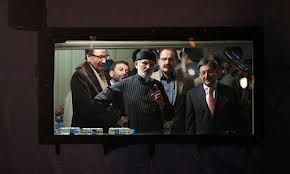
Qadri flanked by negotiators addresses supporters (Credit: guardian.co.uk)
ISLAMABAD, Jan 18: The Tehreek-e-Minhaj-ul-Quran chief Dr. Tahir-ul-Qadri late Thursday called off his mass protest in Islamabad, averting a major political crisis and reaching a deal with the government that paves the way for elections within months.
The decision, hours after the Supreme Court adjourned an alleged corruption case against Prime Minister Raja Pervez Ashraf having earlier ordered his arrest, gives the government breathing space after three days of high tensions.
Tension had been at fever pitch since Tuesday, when the court ordered Ashraf’s arrest and Tahir-ul Qadri arrived in Islamabad with tens of thousands of supporters, denouncing politicians and praising the armed forces and judiciary.
There were few signs of any significant government concessions in the deal reached on Thursday, which stated that parliament would be dissolved at any time before March 16 so that elections can take place within 90 days.
The government had previously said parliament would dissolve on March 17.
But Qadri hailed it as victory for the protesters, estimated to number around 25,000 in the largest ever demonstration in the capital since the current government took office in 2008.
“I congratulate you. Today is the day of victory for the people of Pakistan. You should go home as peacefully as you came here,” Qadri told participants after signing the deal with the prime minister.
Qadri’s supporters danced and cheered in a carnival-style atmosphere despite the chilly winter night, before packing their bags, collecting up mattresses and blankets, and getting in their vehicles to leave, an AFP reporter said.
“I am very happy. I can’t explain it. We felt the cold very badly in the last few days but we’re happy that we’ve been successful in our mission and we want rights for the next generation,” said 26-year-old housewife Muqaddas Zulfiqar, holding her two-year-old son.
“If we had to stay here longer, we would have stayed.”
Qadri, cabinet ministers and members of the coalition negotiated for hours in the bullet-proof container where the cleric has been holed up since early Tuesday while his supporters have slept on the ground outside.
“I congratulate you. Today this is another victory for democracy,” Information Minister Qamar Zaman Kaira told the crowd, standing alongside Qadri.
“This is your victory. This is Qadri’s victory. This is my victory and this is the people’s victory. This is the real face of Pakistan,” he added.
Qadri had called for parliament to be dissolved immediately and for a caretaker government to be set up in consultation with the military and judiciary to implement reforms before elections.
Chief Justice Iftikhar Muhammad Chaudhry adjourned until January 23 the case being heard against Ashraf and 15 others accused of corruption over power projects that date back to his time as water and energy minister.
Chairman of the National Accountability Bureau Fasih Bokhari said it would take time to find evidence to prosecute anyone despite the court ordering in March 2012 legal proceedings against Ashraf.
Political analyst Hasan Askari warned that it was only a temporary reprieve.
“Even if they come up with a solution to the present problems, they may get another crisis… So the government should announce elections now,” he said.
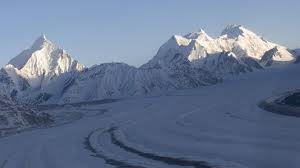
Karachi, Jan. 4: The Siachen Glacier has reduced by 5.9 km in longitudinal extent between 1989 and 2009 because of rising temperatures, researchers say.
Human presence at Siachen may also be affecting the neighbouring glaciers of Gangotri, Miyar, Milan and Janapa which feed Ganges, Chenab and Sutlej rivers, the Dawn reported.
According to the study by Dr Ghulam Rasul of the Pakistan Meteorological Department, Himalaya, Karakoram and Hindukush together make the largest mountain chain on earth and they are the custodian of the third largest ice reserves after the Polar Regions.
The glaciers in these mountain ranges feed 1.7 billion people through seven large Asian river systems, including the Indus, Ganges, Brahmaputra, Mekong and Yangtze.
These ranges are a blessing for South Asia as they protect it from the cold surges in winter associated with northerly winds.
The study says that since temperature maxima has been increasing at a greater rate, the thinning of ice and retreat of glacial extent has taken place simultaneously at an alarming rate. The decay estimates calculated by remote sensing techniques show that Siachen Glacier has reduced by 5.9km in longitudinal extent from 1989 to 2009. Thinning of its ice mass is evaluated at 17 percent.
A sharp decline in the mass of all glaciers has been seen since the 1990s. Accelerated melting process of seasonal snow and that of glacier ice from mountain glaciers have been adding to greater volume of water into the sea than normal discharges, it says.
Both precipitation and thermal regimes in Pakistan have suffered changes, especially in the recent two decades in line with a sharp jump in global atmospheric temperatures.
Visible changes in hydrological cycle have been observed in the form of changing precipitation patterns, cropping patterns, droughts, water availability periods, frequency and intensity of heat waves, precipitation events and weather-induced natural disasters.
According to the study, both minimum and maximum temperatures have increased in summer and winter almost throughout Pakistan.
Late onset and early winter ending will reduce the length of growing season for crops which will complete their biological life quickly causing reduction in yields as plants will gain accelerated maturity without reaching proper height and size.
Early winter means that temperatures will start rising in February when wheat crop reaches the grain formation stage.
The study lists recent extreme weather events which caused great losses to the socio-economic sector. They are: cloudburst events (2001, 2003, 2007, 2008, 2009, 2010, 2011), prolonged droughts (1999-2002), historic river flooding (2010), tropical cyclones (1999, 2007, 2009, 2010, 2011), severe urban flooding (2001, 2003, 2007, 2008, 2009, 2010, 2011), heatwaves in spring (2006, 2007, 2010), snowmelt flooding (2005, 2007, 2010) and drought at sowing stage (2004, 2006, 2007, 2009, 2010, 2011).
About the floods of 2010 and 2011, the study says that such back-to-back occurrence of the history’s worst flooding is at least a unique phenomenon in case of Pakistan.
In 2010, intense precipitation concentrated over the elevated plains of Khyber Pakhtunkhwa due to interaction of three weather systems from east, south and north.
Similarly, another historic climatic anomaly occurred in 2011 when the monsoon axis set its orientation from head of Bay of Bengal to southern Sindh which was commonly found parallel to the Himalayas in case of heavy precipitation in Pakistan.
Jan 6, Thatta: Zulfikarabad, the dream city of the president of Pakistan, has sparked another controversy in Sindh. In spite of tooth and nail opposition, the government seems ready to proceed with its plans. The project, originally named as Jheruk, was first heard of in 2009. The scheme was later relocated to further south of Thatta district in Jati, Shah Bunder, Keti Bunder and Kharo Chaan talukas.
A meeting chaired by President Asif Zardari on 28th January 2011 was told that the project would require some 1.6 million acres of land in the four coastal talukas of Thatta district. More than 1.2 million acres of the earmarked land is presently under sea and would require huge amount of money to reclaim. Sindh Land Management and Development Company has been established to acquire land for the project.
An autonomous body, Zulfikarabad Development Authority (ZDA) has been established to steer the project. The authority enjoys rare powers of approving any scheme even without seeking approval from the provincial Planning and Development Department. A high powered Executive Committee of the Authority has been empowered to take decisions. The chief secretary of the province would be just an ordinary member of the authority, ceremonially chaired by the chief minister and practically operated by the managing director. This is probably the only development scheme of its kind, for which key decisions are taken in meetings chaired by not less than the president of Pakistan.
Coastal strip is globally considered as an enticing location for commercial investments e.g. housing, tourism, industry and trade. Most expensive residential schemes are developed along coastal towns and cities. According to some estimates, approximately three billion people on earth live within 200 kilometres of coast and 14 out of 17 biggest cities of the world are located on coastline. This development is often materialised at the cost of indigenous communities. Against this backdrop, civil society has expressed its serious reservations on social and environmental implications of this scheme. Involuntary displacement of thousands of people from coastal villages is afoot.
China has shown its keen interest in the scheme. Delegations of Chinese investors frequently meet the president to lobby for major contracts in the project. The president has also recently visited China and the two countries have signed MoU to implement the project through Chinese companies.
Such high value projects nest hefty profits and poor communities become their casualty in numerous ways. Pakistan does not have impressive track record in this context. Resettlement of few thousand people of much smaller projects like Chotiari reservoir reeked with massive embezzlements and nepotism. Plight of the would-be displaced communities of Zulfikarabad is a foregone conclusion.
Key reason for Sindhis to oppose this project is lurking fear of being turned into a numeric minority in their own province. According to the 1998 census, Sindhi speaking population was 60 per cent. Sindhi speaking population in urban areas was 25.8 per cent against 78.75% Punjabi speaking in urban Punjab and 73.55% Pashto speaking in Urban KP. Demography of Karachi was even worse with Sindhi speaking population standing at 7.7%. Against this backdrop, any new city of expected population of 10 million would easily convert Sindhis into a minority within a decade. Nationalist parties in Sindh consider Zulfikarabad a tool of demographic genocide of Sindhis.
The project is also impregnated with environmental risks. Indus Delta is jewel in the crown of Pakistan’s ecological heritage. For its rich biodiversity, the Delta is declared as a Ramsar site and attains great environmental significance. According to WWF Pakistan, the area where the city is proposed houses about 50 per cent of the country’s remaining mangroves cover most of which is declared as ‘protected’ since 1950s.
Recent studies on the existing land use of the location indicate that mangrove forests, wet mudflats and seawater in various major and minor creeks cover 7.2, 40.2 and 20 per cent of the total area of the site, respectively (WWF Pakistan). The remaining one third is the inland area which comprises agriculture and inland vegetation on about 9 per cent and uncultivated agricultural land and residential areas on 24 per cent of the total area of proposed Zulfikarabad site. More than 50,000 hectors of the proposed site are covered with mangroves forests, most of which are under the administrative jurisdictions of Sindh Forest Departments. Pakistan’s Environmental Protection Act requires an Environmental Impact Assessment (to which Social Impact Assessment is a component) of such projects. Considering the scope of the project, ideally a Strategic Impact Assessment should be conducted. However, all these requirements have been violated flagrantly.
Coastal cities are no more considered salubrious locations. Environmental hazards and coastal disasters have made such cities more vulnerable. Tsunamis of East-Asian coast in 2004 and of Japan in 2011 provide ample evidence of alarming vulnerability of coastal cities. Tourism, industry, shipping and aqua-culture are some of the prime areas of interest for investors. Natural ecosystem is gradually encroached and eventually replaced by concrete and steel in such areas.
Tsunami hit East-Asian countries developed shrimp farming into a $9 billion industry by erasing mangroves forests in vast swathes. The massive wave of destruction caused by the 2004 tsunami dwarfed all economic gain that the shrimp industry claimed. According to some reports, Sindh coast witnessed an average of four cyclones in a century. However, the frequency and intensity has increased manifold and the period of 1971-2001 records 14 cyclones. From 2001 to 2010, two high intensity cyclones i.e. cyclone Yemyin and cyclone Phet narrowly missed Sindh coast. Thus, Zulfikarabad would be exposed to serious potential hazards.
The proposed city is located in an active seismic zone, where exists Allah Band Fault, a potential threat of severe earthquake. In its southeast lies Gujarat Seismic Zone (GSZ) and in north-west Makran Subduction Zone (MSZ) that pose serious threat to the proposed city. Bhuj earthquake of 2001 caused devastation in the adjoining areas across the border.
Looking at shambolic infrastructure and substandard quality of services in Sindh, one wonders why these resources cannot be veered to improve the existing system. Most of the province is devoid of vehicle-worthy highways, link roads and basic infrastructure in secondary cities. Housing, drinking water and sanitation facilities are not available in large parts of big cities and secondary towns of Sindh. Thousands of schools and health facilities are without basic facilities. According to official data, 10,722 schools are without building and 24,559 are without drinking water facility in the province (Sindh Economic Survey 2009-2011). The same document acknowledges that provision of health facilities in Sindh is grossly inadequate. The province has only 3.5 doctors per 10,000 people and only 1.1 nurses against the same number of people. Against this backdrop, the decision to pour billions of dollars to build another big city lacks prescience.
Pakistan’s growth rate of internet users is second highest in SAARC countries in accordance with its population, as it standing at 16.8 percent as compared with 28.3 percent of Maldives.
According to the State Bank of Pakistan (SBP) publications quoted World Bank statistics by July 2012, Pakistan internet users showed double digit growth from past five years. The growth rate stood at 10 percent in 2007, which is now more than 16 percent.
The internet users growth rate in India is standing at 7.5 percent; 12.1 percent in Sri Lanka, 13.6 percent in Bhutan with respect to their populations, World Bank statistics said.
In Pakistan, the internet users’ growth rate is on the rise through the services of broadband internet and mobile phone services.
According to Internet Service Providers Association of Pakistan (ISPAK), the estimated internet users have reached 25 million in the country thanks to broadband and mobile phone operators
The internet users having demand of high speed services are also increasing particularly through broadband operators exploiting various technologies such as Wimax, EvDO, FTTH.
As per industry estimate, there are more than five million broadband users in the country through connections of 2 million. The internet users mainly do connect with one IP or connections and consume internet services through sharing at home, office and educational institutions.
There are 50 internet services providers in which 10 are broadband companies exploring untapped market in big cities, making it available for people to use internet with only Rs 100.
Among 25 million internet users, more than 15 million of them avail internet services trough mobile phones thanks to cellular operators’ packages and awareness drive.
The mobile phone subscribers go online through different internet services including, EDGE, GPRS and Blackberry Internet Services (BIS).
Majority of the mobile phone subscribers use internet services for browsing, emails, Facebook and Twitter as cellular phone operators introduced different affordable packages to their subscribers. Moreover low cost handsets also facilitate a large number of people to connect online 24 hours.
The cellular phone companies have been working aggressively on the promotion of Internet services for last two years mainly for earning extra revenues besides voice calls and text messages. These companies introduced different bundle packages of Internet services in their youth brands to promote Internet services as an essential for young customers for education and entertainment purposes.
The trend of using Internet is increasing rapidly with the arrival of smartphones of different handset makers though low-cost handsets are available in the market having options of online connectivity. It was further given impetus through providing easy connectivity to users for using Facebook and Twitter.
Mobile phone companies and handset makers alike have provided easy connectivity of Facebook and Twitter Internet users that gave further impetus to Internet usage among the customers
Officials of the mobile phone companies said the Internet consumption of their subscribers varies due to different needs of individuals in their daily life. They said the customers having postpaid connection are large users of Internet services due to their business and professional demands. Besides youngsters usage of Internet is limited on mobile phone as they usually avail Internet services for social networking sites, informative webs and browsing.
The cellphone operators have created demand of Internet usage among customers through different tools like applications of education, infotainment and entertainment by their own portals.
The excessive branding and marketing campaigns of mobile phone companies are generating positive results on their business in fact creating awareness among the customers before the launch of high data service—3G technology.
The rising internet utility among the masses have increased the living standard of the people not only for communications and information purpose but for commercial means such as credit and money transactions by branchless and mobile banking.
The growth in internet users pave the way towards growth in different sector particularly the access of information and entertainment at affordable purpose but it should be controlled by the watchdog, Pakistan Telecommunication Authority (PTA).
In this regard, the government should install a Firewalls system to control the objectionable and indecent material on the internet as if many countries like China, UAE and KSA have done earlier.
In this way, the government can minimize the harmful impacts of internet on its users throughout the country and the online landscape will be exploited for constructive and meaningful purposes.
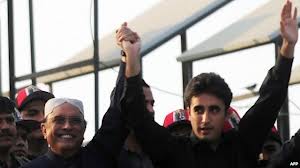
President Zardari with son Bilawal (Credit: bbc.co.uk)
He stood yards from the tomb of his mother, a two-time prime minister killed by Islamic militants exactly five years before, and that of his grandfather, a prime minister and president ousted in a military coup and hanged by a dictator, and told the huge crowd filling the open ground in front of the white domed mausoleum that there were “two powers” in his homeland, “those on the right path and those on the path of lies”.
On Thursday Bilawal Bhutto Zardari, the 24-year-old only son of Benazir Bhutto and the heir to one of the most powerful, famous and controversial political dynasties in the world, made his formal debut in the turbulent and often lethal world of Pakistani politics at an emotional rally in a small village which is his family’s ancestral home in the south of the country.
“Bilawal has arrived. This was a huge step. It was make or break for him,” said Nadeem F Paracha, a well-known columnist with Dawn newspaper after the speech.
Less than three years ago, Bhutto junior was studying history and politics at Christ Church college, Oxford, a target for tabloid journalists but few others. Now he is probably the most high-profile target in a country hit by wave after wave of extremist violence.
Bhutto spoke of the sacrifices made by members of his family, workers of the Pakistan People’s party (PPP), and others such as Shia Muslims shot dead in ongoing sectarian violence and Malala Yusafzai, the 15-year-old schoolgirl and activist for girls’ education who was shot and badly injured by militants in October and is now recovering in a British hospital.
“How long you will go on killing innocent people? … if one Malala will be killed, thousands will replace her. One Benazir was killed; thousands have replaced her,” Bhutto told the crowds.
Observers noted that Bhutto’s Urdu, the national language which he has had to hastily learn since his return to Pakistan to take up his political heritage, was, if still accented, much improved.
“He does not believe in being the anointed prince. He wants to earn the respect of the party workers and of the people of Pakistan,” said Farnahaz Ispahani, a former PPP member of parliament and a confidant of the Bhutto family.
More than 5,000 police had been deployed to protect the event. Helicopters hovered overhead.
Parliamentary elections due this spring are likely to test the ruling PPP-led coalition, hit by an ailing economy, rising prices for basic foodstuffs, continuing violence, anger at endemic graft and an ongoing power crisis that brings daily electricity cuts.
Bhutto’s father, Asif Ali Zardari, has been the president of Pakistan since 2008. A controversial figure who was jailed on corruption charges that he has said were politically motivated from 1996 to 2000 but who has proved a skilful tactical politician, Zardari has been described as a “transitional leader” for the PPP.
Though only able to contest elections in September after his 25th birthday, Bhutto’s presence will nonetheless be a powerful boost in campaigning over the coming months.
“Bilawal grew up with his mother as his father was in jail for a long time. He went with her to rallies and was with her in top-level meetings. His beliefs – in pluralism, democracy, human rights – mirror hers,” said Ispahani.
However, doubts remain over Bhutto’s appeal to new, younger, urbanised and often more religiously minded voters. Osama Siddique, a professor at Lahore University of Management Science, said it was hard to “visualise Bilawal” in a key position in the immediate future.
“Putting Benazir’s son on a stage makes political sense. It’s a very poignant and emotional moment still for many people,” he said.
Cyril Almeida, analyst and editorialist in the southern city of Karachi, said that though Bhutto’s personal courage was unquestionable it was less certain that a political novice could “solve the problems faced by the country … whatever his last name”.
Benazir Bhutto died when leaving a political rally in the northern city of Rawalpindi while campaigning for elections in 2007 after nearly 10 years in exile. Her killers have never been conclusively identified, though most experts and intelligence services believe Islamic extremists were responsible. The PPP won the postponed polls held after her assassination to gain power.
Party officials told the Guardian on Thursday that Bilawal, who was educated at private English-medium schools in Pakistan and in Dubai after his mother went into self-imposed exile in 1999, would contest his mother’s parliamentary seat when he was old enough.
Last year Fauzia Wahab, a presidential aide and Bhutto family friend, said Bilawal carried “a heavy burden” as he “had the Bhutto genes”.
Benazir Bhutto’s father, Zulfiqar, rode to power on an anti-poverty platform before being deposed and eventually executed in prison by the military dictator Muhammed Zia-ul-Haq in 1979. Both he and his daughter are routinely referred to as “shaheed” or “martyred” in Pakistan.
Bhutto told the crowd on Thursday that the PPP stood for “food, clothes and shelter” for the common man, purposefully using a slogan from his grandfather’s campaigns. Bhutto, who friends say reads history avidly, also appeared well aware of the potential cost of his new role.
“The PPP is not just a political party. This is our life,” he said.
Dynastic politics
In an uncertain south Asia, it is always nice to have something you can rely on. In Pakistan it is that a Bhutto will be either in power or leading the opposition. Zulfiqar Ali Bhutto dominated the early 1970s with his brand of populist, leftwing, nationalist and increasingly autocratic politics. His daughter was prime minister twice. Now it’s her son’s turn to enter the fray.
In India, the great local democracy, the Nehru-Gandhi dynasty is as dominant as it has ever been with Rahul Gandhi, 42, hoping to become a fourth-generation prime minister, or at least principal candidate, and his mother, Sonia, currently the president of the ruling Congress party.
In Bangladesh, the decades-old rivalry between Begum Khaleda Zia and Sheikh Hasina Wajed for control of the country continues that between the late husband of one and the father of the other. Bhutan is still a monarchy.
In Burma, the Nobel-prize-winning democracy campaigner Aung San Suu Kyi, the daughter of the assassinated nationalist leader and effective founder of the modern country Aung San, is leader of the opposition and spoken of as a potential president in the future.
In Sri Lanka, the son of the president, Mahinda Rajapaksa, himself the son of a prominent politician, has won a seat in the family fief of Hambantota and significant numbers of family members fill posts across the country’s administration.
At state or provincial level in all these countries, similar dynamics are at work. Why are dynastic politics so tenacious on the subcontinent? In an often mercenary world, there is the obvious need for any successful politician to bolster his or her hold on power by recruiting loyal retainers who will not defect for material gain. This means family first. Then there is simple inheritance of power, influence, money and, especially in India and Pakistan, land. A key factor is the importance of personalities in contests largely stripped of ideological content. Finally there are the high levels of illiteracy, which make a famous name a determining factor for tens of millions of voters.
One common strand uniting the dynasties is that most of them speak English as a first language. Along with railways and a swollen bureaucracy, it may be that British rule bequeathed something else too: a taste for hereditary power and deference. There are one or two exceptions to the rule. The Maldives has all sorts of political woes but dynastic rule is not one of them. Nepal has recently done away with its kings, though it is hardly a model of stability either. As for Afghanistan, a relative replacing the president, Hamid Karzai, as a candidate, possibly a successful one too, in coming polls is far from impossible. After all, in south Asia, politics is a family affair.
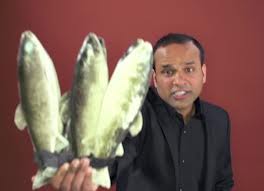
Pakistan, Dec 25 – Even in an age of instant Internet singing sensations, Muhammad Shahid Nazir’s tale might seem fishy.
After all, it’s not every day that an unsung immigrant from Pakistan makes a respectable challenge to the top of Britain’s Christmas pop chart with a ditty about the “very, very good” fish he hawks on the streets of London. But the millions who have heard Nazir crooning on YouTube can understand: It’s easy to get hooked on his song “One Pound Fish,” named not after the weight of the day’s catch but its cost in British currency.
“I never thought my song would become famous,” the 31-year-old newly minted recording artist said. “My real name is Muhammad Shahid, but the people call me the ‘One Pound Fish Man,’ and I’m so happy.”
Nazir, a father of four who hails from the little-known Punjab town of Pattoki, set out for Britain on a student visa a year and a half ago, hopeful, like many Pakistanis, of forging a better future for his family. He landed a job as a fish monger but says he soon knew he would not be a very competitive salesman. He didn’t like to shout about his wares, as many fish sellers do to attract customers.
But through a stroke of divine intervention, a new approach to advertising his fish came into being. “On the spot, God put the song in my mind,” he said.
The simple sales ditty goes: “Come on ladies, come on ladies! One pound fish. . . . Very, very good and very, very cheap. One pound fish!”
That’s pretty much it. But a large part of Nazir’s charm lies in the sheer earnestness with which he belts out the tune to the female shoppers within earshot at Queens Market in London, entreating them to “have a, have a look” at his wares.
Soon enough, somebody made an amateur video of his jingle and posted it on YouTube. As the views mounted to 6 million, Nazir joined the likes of Rebecca Black of hyper-annoying “Friday” fame and Psy, the South Korean pop star whose “Gangnam Style” video had millions around the world dancing as if they were riding imaginary horses.
An enterprising producer decided to polish and expand “One Pound Fish.” The latest rendition took on added zest in a music video that features sexy dancers in Bollywood-inspired outfits, flying fish and, of course, a splash of Autotune. That version had nearly 7 million views as of Monday.
Nazir’s song made it into the U.K. Top 40 after just two weeks on the charts. That gave it a shot at joining the ranks of fabled No. 1 Christmas singles — those songs that top the charts in the week that the holiday falls.
Past Christmas singles have included the predictable and improbable. The Beatles’ “I Want to Hold Your Hand” was No. 1 in 1963 (one of the group’s four Christmas chart-toppers); Queen’s “Bohemian Rhapsody” succeeded twice, in 1975 and 1991; Band Aid’s “Do They Know it’s Christmas,” also twice, in 1984 and 2004. Then there are only-in-England novelties like comedian Benny Hill’s 1971 “Ernie (The Fastest Milkman in the West)” and Mr. Blobby’s “Mr. Blobby” in 1993.
This year, Nazir’s novelty number faced tough competition against stars such as Rihanna and Justin Bieber. The top tune was announced Sunday: A version of the Hollies’ “He Ain’t Heavy, He’s My Brother” by the Justice Collective, a group of stars who recorded the charity single for victims of a 1989 soccer-stadium stampede that claimed 96 lives.
“One Pound Fish” remained in the wallows, reaching just 29 on the chart, but not bad for a singer who got booted off of television talent show “The X Factor.”
This week Nazir returns home to Pattoki with his visa status in question, but in triumph: He is most certainly Pakistan’s first viral video singing sensation. Everyone in the town an hour’s drive southwest of Lahore has heard of his fame and fortune.
“You can go to any street or market of this town and will see small children singing this ‘One Pound Fish’ song,” said one of Nazir’s brothers, Saith Khalid Nazir, a lawyer. “Almost everybody has seen it on the Internet, and they are crazy about it.”
As a child, Muhammad Shahid Nazir was known for singing religious songs as a member of a devout family that prayed at the mosque five times a day. Sometimes other congregations requested his vocal talents.
“Nevertheless, the entire family had never thought or imagined that he would become a singer,” his brother said.
Muhammad Shahid Nazir said he will spend the Christmas holiday with his family. He described his town as a tolerant one where Christians are welcomed and their religious practices respected. After the holiday, he will apply for a visa to work as an entertainer in Britain.
It’s pretty clear that he’s become a better self-promoter than fishmonger.
“Now my song is available on iTunes in the U.K.,” he said in an interview from London. “My song is becoming famous in France, in Germany, in Canada, in America.”
Then, unprompted, he burst into a joyful rendition of his signature tune
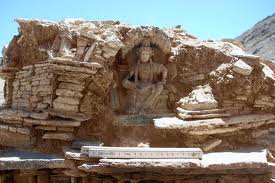
Mes Aynek site in Afghanistan (Credit: penn.museum)
Kabul, Dec 22: WHEN the Taliban blasted the famous Bamiyan Buddhas with artillery and dynamite in March 2001, leaders of many faiths and countries denounced the destruction as an act of cultural terrorism. But today, with the encouragement of the American government, Chinese engineers are preparing a similar act of desecration in Afghanistan: the demolition of a vast complex of richly decorated ancient Buddhist monasteries.
The offense of this Afghan monument is not idolatry. Its sin is to sit atop one of the world’s largest copper deposits.
The copper at the Mes Aynak mine, just an hour’s drive south of Kabul, is to be extracted under a roughly $3 billion deal signed in 2007 between Afghanistan and China’s Metallurgical Group Corporation. The Afghan finance minister, Omar Zakhilwal, recently said the project could pump $300 million a year into government coffers by 2016. But the project has been plagued by rumors of corruption; there was widespread talk of a $30 million kickback involving the former minister of mines, who resigned.
In 2009, archaeologists were given a three-year deadline to salvage what they could at Mes Aynak, but raising money, securing equipment and finding experienced excavators took up more than half of that time. So the focus now is solely on rescuing objects. An international team of archaeologists is scrambling to save what it can before the end of this month, when it must vacate the central mining zone, at the heart of the Buddhist complex.
The task is herculean: more than 1,000 statues have been identified, along with innumerable wall paintings, fragile texts and rare wooden ornamentation. And the excavators can only guess at what may lie in older layers. There is no time to dig deeper.
From about the third century until the ninth century, Afghanistan served as a bridge between India and China and played a key role in shaping the Buddhism that swept across Central Asia. At Mes Aynak, monks and artisans built an astonishing array of temples, courtyards and stupas, as well as whole towns of workshops and homes for miners. (Even then, Mes Aynak was exploited for its copper.)
Afghanistan was home to an extraordinary mix of Nestorian Christians, Persian Zoroastrians, Hindus, Jews and, eventually, Muslims. New scholarship based on finds at ancient sites like Mes Aynak suggests that Islam arrived here not with sudden fire and sword, but as a slowly rising tide. This was an Afghanistan of cosmopolitan wealth and industry, and of religious innovation, devotion and tolerance, at a time when Europe was mired in the Dark Ages.
Many statues and paintings will be saved for museum exhibitions, but the potential for understanding a key piece of Afghan history — and for drawing future tourists — will soon be lost. Deborah Klimburg-Salter, a scholar of art and archaeology who recently visited the site, told me that Mes Aynak “would be of great historical value not only for the history of Afghanistan but the whole region — if they could slow down, excavate and document properly.”
It’s ironic: a company based in China, which received Buddhism via Afghanistan, will destroy a key locus of that transmission. Washington, which condemned the destruction of the Bamiyan Buddhas, is standing by as Kabul sacrifices its cultural heritage for short-term revenue.
The destruction is not just a cultural travesty. It may not even result in the advertised economic benefits for some time to come. World Bank experts told me that large-scale mining is not likely to take place at Mes Aynak for years. For one thing, there is no smelter to process the ore and no railroad to carry the material to China. An August rocket attack by Taliban militants on the mining camp prompted the Chinese workers to evacuate the heavily guarded site. The tenacious archaeologists, mostly Afghans, stayed behind.
There is still hope that the Afghan government might allow archaeologists to remain at the central complex past Dec. 31. “We’re hoping we get more time,” Philippe Marquis, the director of the French archaeological mission in Afghanistan and a lead scientist on the project, told me. There is no reason archaeology and mining operations can’t coexist at the site. But archaeologists fear the government wants to close the site to researchers and reporters to avoid embarrassing images of dynamited monasteries.
The looming deadline is not Mr. Marquis’s only worry. New Taliban attacks might prompt the Chinese to abandon the site and stop paying for the security forces that protect the area. That could invite looting by desperately poor Afghans. An ancient Buddhist statue can sell for tens of thousands of dollars in the dark, unregulated corners of the international art market.
Last month, Buddhist protesters marched in Bangkok, denouncing the planned demolition of Mes Aynak. An American filmmaker has raised $35,200 on Kickstarter to document the controversy. Afghanistan’s ambassador to Pakistan recently said it was “the duty of all” Afghans to preserve what remains of the country’s Buddhist heritage.
But there are few scholars with the political pull to bring the matter into the international spotlight, and the United Nations has all but ignored the matter. A Unesco official told me he hoped that “some accommodation could be made for the parallel activities of archaeology and mining,” but the organization hasn’t held the government and company accountable.
The looming devastation at Mes Aynak is but the latest example of threats to cultural treasures. Recently, the Egyptian Islamist leader Murgan Salem al-Gohary caused an international stir when he mused that the Sphinx and the pyramids at Giza should be flattened. And this summer, Islamist rebels smashed Sufi tombs in Timbuktu, Mali, an act some have called a war crime.
Whether for economic gain or ideological purity, destroying humanity’s common heritage limits our understanding of one another, as well as of our past — something we can ill afford in today’s fractious world. “We are only breaking stones,” the Taliban leader Mullah Muhammad Omar said dismissively in 2001, when he heard the international outcry over the statues’ destruction. Even given Afghanistan’s dire financial plight, it’s not a position to accept, much less emulate.
WASHINGTON, Dec 17 — Democrats say meaningful action in the wake of the school shootings in Connecticut must include a ban on military-style assault weapons and a look at how the nation deals with individuals suffering from serious mental illness.
Several Democratic lawmakers and Independent Sen. Joe Lieberman said it was time to take a deeper look into the recent spate of mass shootings and what can be done to prevent them. Gun control was a hot topic in the early 1990s, when Congress enacted a 10-year ban on assault weapons. But since that ban expired in 2004, few Americans have wanted stricter laws and politicians say they don’t want to become targets of a powerful gun-rights lobby.
Gun-rights advocates said that might all change after the latest shooting that killed 20 children aged 6 or 7. Police say the gunman, Adam Lanza, was carrying an arsenal of ammunition and used a high-powered rifle similar to the military’s M-16.
On Monday, Sen. Joe Manchin, a lifelong member of the National Rifle Association, said it was time to discuss gun policy and move toward action on gun regulation. The conservative West Virginia Democrat said Monday he agrees with New York City Mayor Michael Bloomberg, who has advocated banning the sale of assault weapons.
Manchin is the most prominent gun rights advocate to speak after the shooting, telling MSNBC that he is a “proud outdoorsman and hunter, but this doesn’t make sense.”
At a Sunday night service in Newtown, Conn., the site of Friday’s massacre, President Barack Obama did not specifically address gun control. But he vowed, “In the coming weeks I’ll use whatever power this office holds to engage my fellow citizens, from law enforcement to mental health professionals to parents and educators in an effort aimed at preventing more tragedies like this.”
He added: “Are we really prepared to say that we’re powerless in the face of such carnage, that the politics are too hard? Are we prepared to say that such violence visited on our children year after year after year is somehow the price of our freedom?”
Sen. Chuck Schumer, D-N.Y., said the nation “could be at a tipping point … a tipping point where we might actually get something done” on gun control. He and other Democrats, as well as Lieberman, said they want to ban the sale of new assault weapons and make it harder for mentally ill individuals to obtain weapons. Lieberman said a new commission should be created to look at gun laws and the mental health system, as well as violence in movies and video games.
“Assault weapons were developed for the U.S. military, not commercial gun manufacturers,” Lieberman said before the Newtown vigil Sunday night.
“This is a moment to start a very serious national conversation about violence in our society, particularly about these acts of mass violence,” said the Connecticut senator, who is retiring at the end of the year.
Sen. Dianne Feinstein, D-Calif., said she will introduce legislation next year to ban new assault weapons, as well as big clips, drums and strips of more than 10 bullets.
“It can be done,” Feinstein told NBC’s “Meet the Press” of reinstating the ban despite deep opposition by the powerful National Rifle Association and similar groups.
Bloomberg said Obama could use executive powers to enforce existing gun laws, as well as throw his weight behind legislation like Feinstein’s.
“It’s time for the president, I think, to stand up and lead and tell this country what we should do – not go to Congress and say, `What do you guys want to do?'” Bloomberg said.”
Gun-rights activists had remained largely quiet on the issue since Friday’s shooting, all but one declining to appear on the Sunday talk shows.
David Gregory, the host of “Meet the Press,” said NBC invited all 31 “pro-gun” senators to appear on Sunday’s show, and all 31 declined. All eight Republicans on the Senate Judiciary Committee were unavailable or unwilling to appear on CBS’ “Face the Nation,” host Bob Schieffer said.
Rep. Louie Gohmert, R-Texas, was the sole representative of gun rights’ activists on the various Sunday talk shows. In an interview on “Fox News Sunday,” Gohmert defended the sale of assault weapons and said that the principal at Sandy Hook Elementary School, who authorities say died trying to overtake the shooter, should herself have been armed.
“I wish to God she had had an M-4 in her office, locked up so when she heard gunfire, she pulls it out and she didn’t have to lunge heroically with nothing in her hands. But she takes him (the shooter) out, takes his head off before he can kill those precious kids,” Gohmert said.
Gohmert also argued that violence is lower in cities with lax gun laws, and higher in cities with stricter laws.
“The facts are that every time guns have been allowed – conceal-carry (gun laws) have been allowed – the crime rate has gone down,” Gohmert said.
Gun-control advocates say that isn’t true. A study by the California-based Law Center to Prevent Gun Violence determined that 7 of the 10 states with the strongest gun laws – including Connecticut, Massachusetts and California – are also among the 10 states with the lowest gun death rates.
“If you look at the states with the strongest gun laws in the country, they have some of the lowest gun death rates, and some of the states with the weakest gun laws have some of the highest gun death rates,” said Brian Malte of the Brady Campaign to Prevent Gun Violence.
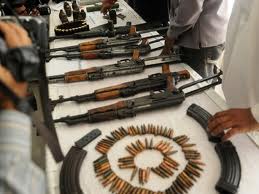
Guns & Bullets Seized in Pakistan (Credit: tribune.com.pk)
While it is normal practice for Pashtuns to bear arms, the Cold War gave them unprecedented access to the weapons that transited from Karachi to their native Khyber Pakhtunkhwa, which borders Afghanistan. It was a time when the former Soviet Union’s invasion of Afghanistan in 1979 had forced three million Afghans to cross the porous borders into Khyber Pakhtunkhwa, formerly known as the North West Frontier Province. These were Pashtun Afghans who lived on both sides of the border and who followed their relatives in Karachi to look for work.
In Karachi, the Afghan refugees had congregated in Sohrab Goth – a tented village erected by the United Nations along the remote dusty wastelands of the city’s Super Highway. In those Cold War days, I reported from the tented village after it became notorious as a drugs and weapons hotspot. The turbaned Afghan Mujahideen, who toured the camps, hunted for young recruits for the US-funded jihad against the former Soviet Union. Sohrab Goth was a home for Afghan refugees and a depot for heroin. The army’s National Logistics Cell (NLC) trucks, which carried US arms and ammunition to the Mujahideen in the north, were widely rumored to return carrying heroin to be sold in Karachi.
By December 1986, Karachi’s Pashtuns – flush with drug money – had stocked a sizeable cache of weapons in a desolate area north of Karachi called Orangi Town. The Pashtuns lived here in brick and stone homes atop the rugged cliffs, much as they did in the hilly tribal regions that border Afghanistan. Their homes jutted menacingly over a sea of Mohajirs – including almost a million Biharis who had settled here after 1971, when Pakistan’s eastern wing, “East Pakistan,” seceded and became Bangladesh.
My early recollections of Orangi Town go back to 1972, when as a schoolgirl I was brought by my father to work with humanitarian organizations in order to help the Biharis resettle in Karachi. The Bengali nationalists accused the Biharis of collaborating with the Pakistani army during the 1971 war. In fact in 1947 many Muslim Biharis had opted to migrate from India’s Bihar state to what was then East Pakistan. They ended up making a double migration in 1971 when they opted to join the Urdu speaking community in Karachi. Subsequently, 1 million Biharis were resettled in Orangi town by Zulfikar Ali Bhutto’s government.
As a teenager, I made trips with my father to the deserted area in the north of Karachi to help an exhausted paramedic serve the poor, malnourished Bihari patients. Hundreds of refugees queued outside our makeshift clinics for cough and cold medicines. As the overworked dispenser dished out the medicines that I handed to him, his fantastic claim sparked my imagination: “I’m so busy I don’t even have the time to die!”
Fifteen years later, these poor Biharis – who had left war- ravaged Bangladesh to become Karachi’s newest Mohajirs – faced the wrath of angry Pashtuns. It was mid-December in 1986 and well past our newspaper deadline when an army of Pashtuns equipped with machine guns charged down the Orangi hills. They made use of the mud walls erected on the hills, shooting and ducking for cover. As the aggressors rained fireballs from their fortresses, the Mohajir areas below them – the Aligarh and Qasbah colonies – went up in flames.
The violence continued into the wee hours as both ethnic groups displayed the worst of human nature. It was reported that Mohajir babies were snatched and thrown into burning oil while Pashtuns were tied up and sliced to pieces in revenge killings. The cycle of violence raged for the next few days and cut off Orangi from the rest of Karachi.
Late at night, as the fires raged in Orangi Town, I got a phone call from a national public radio station in the US asking for the news. I filed my report, thousands of miles from America. It filled me with awe that Orangi Town – which I knew as acres of hilly desert with mud homes and little access to clean drinking water and sewerage – had made international headlines.
It was no less amazing that Orangi had become the scene of clashes between two very different refugee groups – the Biharis from South Asia and the Afghans from Central Asia – separated by thousands of miles of territory. Their peoples had migrated to Karachi to find peace because of the wars that had uprooted them from their respective countries. And now once again their lives were being turned around by bloody ethnic warfare.
Dec 19, 2012: Three more health workers vaccinating children against polio have been shot dead in Pakistan in attacks blamed on Islamic militants, bringing the total killed this week to eight.
Wednesday’s attacks all took place in the restive western frontier province of Khyber Pakhtunkhwa – one just outside the city of Peshawar and two others in the town of Charsadda. Two men and a woman have been killed.
The volunteers were taking part in a three-day government-led drive, supported by the World Health Organisation and Unicef, to vaccinate tens of millions of children at risk from polio in Pakistan.
After a decades-long struggle by multilateral organisations, governments and NGOs worldwide, the disease is now endemic only in three countries: Pakistan, Afghanistan and Nigeria.
It was not clear who was behind the shootings but Taliban insurgents have repeatedly denounced the anti-polio campaign as a western plot. Relatives of those shot earlier this week said several of the victims had received death threats in recent days.
Some confusion has emerged about whether and to what extent the anti-polio drive has been halted after a security meeting between officials in the hours following Tuesday’s killings.
The United Nations in Pakistan has pulled all staff involved in the campaign off the streets, Michael Coleman, a spokesman, said. However, the Pakistani government said immunisation had continued in some areas without UN support, although many workers refused to go out.
Women health workers held protests in Karachi and the capital, Islamabad. “We go out and risk our lives to save other people’s children from being permanently handicapped, for what? So that our own children become orphans?” Ambreen Bibi, a health worker, said at the Islamabad protest.
Government officials admit they have been caught off guard by the violence, saying they had not foreseen attacks in areas far from the Taliban strongholds in the north-west of the country. “We didn’t expect such attacks in Karachi,” said Mustafa Nawaz Khokhar, minister for human rights, who oversees the polio campaign.
Some Islamists and Muslim preachers in Pakistan say the polio vaccine is a western plot to sterilise Muslims to stop population growth. Other religious leaders have tried to counter that myth.
However there has been a severe backlash against immunisation for polio and other diseases in Pakistan since the CIA used a local doctor to set up a fake vaccination programme as the agency closed in on Osama bin Laden in his hiding place in the northern town of Abbottabad last year.
Statistics released in October showed an improvement in the polio situation in Pakistan, with 47 children paralysed in 27 districts compared with 154 in 48 districts in 2011. However, in 2005 only 28 new cases were registered.
Officials and campaigners say there is reason to be optimistic that polio can be eradicated in Pakistan if a “final push” can be made. In neighbouring India, a mass vaccination campaign involving more than a million volunteers reduced cases nationally from 741 to 42 between 2009 and 2010, and down to a single case last year.