This website completes one year on September 11, 2012. That coincides with the 11th anniversary of the biggest terrorist attacks on US soil – and which have also turned into America’s longest serving war.
The 9/11 attacks fetched me an offer by a US based publishing giant to write a book on Pakistan. For me, the motivation to write a book was always present. However, to write a book through the prism of how the West sees Pakistan or to pander to stereotypes of how emancipated I felt as a woman emerging from a Muslim society… would have defeated my original motivation.
And so, ‘Aboard the Democracy Train,’ is a nuanced book that seeks to both educate and inform global audiences about Pakistan’s inside story. Doubtless, the Western reader today is far more informed about the Pak-Afghan region than before it went to war in Afghanistan. However, even while Pakistan’s geography has been critical to its destiny, the country is so much more than an epicenter for the 9/11 attacks or a conduit for bringing the Taliban to power in neighboring Afghanistan
This website has brought Pakistanis and Americans (and readers from some 60 countries around the world) to catch up on the region’s current affairs. That is a testimony to openness among individuals, ready to go beyond the mainstream media to non traditional internet resources. As someone invested on both sides of the Atlantic, I see the website as a means of promoting greater understanding between people around the globe.
Eleven years to date, the US is now focused on bringing the troops back home and rebuilding its stressed economy. A badly battered Pakistan seeks to foster trade ties with its neighbors. With the world community involved in the US’s longest war, it doesn’t take a genius to figure out that the longer the war, the greater its toll. In particular, the three nations most involved, the US, Afghanistan and Pakistan have the greatest to lose. If greater numbers of US soldiers returning from war are committing suicide or suffer post traumatic stress disorder, the war has shattered the lives of millions of Pak-Afghan people for generations to come.
But as nations turn inward to pursue their policies of self interest, its absolutely critical that people don’t scapegoat peoples of other ethnicities, nationalities or faith, in tribal vendetta or failed policies of their governments. This is where education safeguards against agent provocateurs who use religion to drive a wedge between people. Submitting to such provocateurs, as is happening in the Middle East, only breeds terrorism, wars and a state of perpetual conflict. Despite its advanced state of evolution, if humanity continuously engages in this type of behavior, it will only drive its own kind of species toward extinction.
This is where the internet and constructive websites bring people across the globe to understand the “other.”
US ambassador to Libya Christopher Stevens (Credit: telegraph.co.uk)
The U.S. Ambassador to Libya, Christopher Stevens, was killed when suspected Libyan religious extremists stormed the U.S. Consulate in Benghazi late Tuesday night, according to Libyan Deputy Prime Minister Mustafa Abushagour. Margaret Coker has the latest on The News Hub.
The killing of the U.S. ambassador to Libya and three other Americans, in one of the most brazen attacks on a U.S. diplomatic compound in a generation, sparked a security crisis in the North African country, elevated tensions across the Middle East and raised concerns about how well the U.S. can protect its diplomats abroad.
The U.S. responded to the assault by dispatching two Navy destroyers, dozens of Marines, federal investigators and intelligence assets to Libya to protect Americans and hunt the suspected religious extremists who carried out the attack late Tuesday. U.S. officials described the attack that killed Ambassador Christopher Stevens as complex and possibly premeditated.
The assault, along with a protest at the American embassy in Cairo, created a crisis atmosphere in Washington just as the presidential campaign is hitting its stretch run and fueled a harsh exchange between President Barack Obama and Republican Mitt Romney.
Mr. Obama said the U.S. will work with the Libyan government to bring attackers to justice, but he and other officials didn’t rule out a unilateral U.S. strike. “Make no mistake, justice will be done,” the president said.
What’s the likely fallout from the killing of the U.S. ambassador to Libya as well as the storming of U.S. embassies in Libya and Egypt? Eurasia Group Middle East and North Africa Analyst Hani Sabra discusses on The News Hub. Photo: Reuters.
The attack took place on the anniversary of the Sept. 11 attacks, a day when security officials are typically on heightened alert. American officials, who debriefed survivors, described a horrifying scene in the consulate where, amid thick smoke and gunfire, Mr. Stevens became separated from his security officer.
As the flames grew and attacks increased, personnel were forced to abandon the building without the ambassador. American officials retrieved his body when it was brought to the airport the next day by Libyans.
An Obama administration official declined to comment on the ambassador’s security measures but said a review conducted ahead of the anniversary found “no information and there were no threat streams to indicate that we were insufficiently postured.”
U.S. officials were still piecing together the day’s events, which followed protests at the U.S. embassy in Cairo over an anti-Islamic video. In contrast to the Cairo protest, which appeared to be spontaneous, U.S. officials said the attack in Benghazi late Tuesday night might have been planned by militants who used the protests as cover.
American intelligence agencies were poring over information that could help indicate what groups may have taken part. Officials said intelligence agencies are looking specifically at the pro-al Qaeda group Ansar al Shariah but cautioned they didn’t have solid evidence.
Nearly 24 hours after the start of the shooting, officials struggled to piece together details about what transpired through hours of chaos and terror inside the darkened consulate and a nearby annex. They warned that their preliminary version of events could change as more information became available.
Nearby, Benghazi residents described a harrowing scene of destructive mob violence. A Libyan doctor said he and several neighbors attempted to get the gang of about 200 armed men to leave as they marched toward the U.S. compound. “We told them to leave our homes alone and one [of the militants] replied, ‘The Americans are infidels and we are going to finish them,’ the doctor said. “Many of us then fled because the shooting started.”
Ali Ben Saud, the Libyan owner of the villa leased to the U.S. for the consulate, said the men arrived in the neighborhood around 8 p.m. local time, carrying weapons including rocket-propelled grenade launchers and automatic rifles.
The handful of local security forces were overwhelmed. “We couldn’t stop them. They were multiplying, minute by minute. There were hundreds of them,” said Saleheddine al-Arghoubi, a neighborhood resident. “They didn’t come to talk. They came to fight.” The first shots were fired at around 10 p.m. local time, or 4 p.m. Eastern time, according to a preliminary U.S. account.
The attackers gained access to the compound and began firing into the main building, setting it afire. A senior administration official said three people were inside the compound at the time: Mr. Stevens; Sean Smith, a foreign service information-management officer; and a U.S. regional security officer.
As the three tried to leave the burning building, they became separated from each other in heavy smoke. The regional security officer, whose name hadn’t been disclosed by late Wednesday, made it outside, and then he and other security personnel rushed back into the burning building to try to rescue Mr. Stevens and Mr. Smith. They found Mr. Smith, already dead.
They were unable to find the ambassador before being forced to flee the building because of the heavy flames and continuing small-arms fire.
Around 10:45 p.m. local time, U.S. security personnel assigned to a nearby annex tried to regain control of the main building but came under heavy fire and returned to the annex. At around midnight, the mission annex came under fire. Two U.S. diplomats were killed during that attack and two others were wounded.
At around 2:30 a.m. local time, Libyan security forces regained control of the situation, according to the preliminary U.S. account. Mr. Obama was told Tuesday night that Mr. Stevens was unaccounted for.
According to Mr. Ben Saud, the landowner, Libyan security guards jumped into the compound and pulled Mr. Stevens from the burning building at around 1 a.m. local time. Libyans then drove him to Benghazi Central Hospital, where the staff there tried unsuccessfully to revive him. One Libyan doctor said the diplomat died of asphyxiation and that he tried for 90 minutes to revive him, according to the Associated Press
Obama administration officials said they didn’t know what condition the ambassador was in when he left the compound. “His body was later returned to U.S. personnel at the Benghazi airport,” an administration official said. A chartered aircraft evacuated U.S. personnel back to Tripoli, including the remains of those killed.
Secretary of State Hillary Clinton said the attack should “shock the conscience” of people of all faiths, but wouldn’t alter U.S. policy in Libya. The “mission in Libya is noble and necessary…and will continue,” she said from Washington. The U.S. also announced increased security measures for all U.S. diplomatic facilities.
Libyan officials, many of whom led the rebel government based in Benghazi and worked with Mr. Stevens during that time, condemned the killings. The head of the new congress, Mohammed Magarief, apologized to the American public for the tragedy. By late Wednesday, no one had been arrested. Officials in Tripoli were scrambling to implement a response to what they admitted was a monumental security breach.
Egyptian protesters climbed the walls of the U.S. Embassy in Cairo and replaced the flag with a black standard bearing an Islamic inscription, in protest of a film deemed offensive to the Prophet Muhammad. Matt Bradley has details on The News Hub.
The U.S. responded by sending two destroyers, the U.S.S. Laboon and the U.S.S. McFaul, to the Libyan coast to aid in any evacuations or humanitarian missions, said a U.S. official.
In addition, a U.S. Marine team was sent to supplement security at the U.S. embassy in Tripoli, arriving there Wednesday. The unit is known as a Fleet Antiterrorism Security Team, or FAST team, and typically numbers 50 Marines.
Mr. Stevens is the first ambassador killed by hostile forces since 1979, when the U.S. ambassador to Afghanistan was murdered in Kabul. Officials said intelligence agencies were now trying to determine if any threads of information may have been missed.
American intelligence agencies are poring over threat information that could help indicate what groups may have taken part in the attack.
Members of the Ansar al Shariah militant group gave an interview to the local television station from the hospital early Wednesday morning, praising the men who attacked the consulate, calling them “the top layer of Libyan society.” However, the members told Benghazi TV that their organization, a group of religious fighters who battled to help oust Moammar Gadhafi from power, didn’t plan the attack against the Americans.
Mr. Stevens, 52, who is usually based in the capital Tripoli, apparently was visiting Benghazi ahead of the planned opening of a U.S. cultural center there, said a Libyan official.
The attack on the U.S. consulate was the second this year. In June, suspected Islamic militants detonated an improvised explosive device at the same compound. A Libyan guard was injured, but no Americans were harmed. In the spring, the International Committee for the Red Cross offices in Benghazi were also targeted.
Washington has long been leery of the radical Islamic fringe in Libya. The largest number of foreign fighters in Iraq waging battles against U.S. soldiers were from two towns in eastern Libya, and U.S. drones have monitored those locations since the Libyan uprising last year.
—Siobhan Gorman, Devlin Barrett and Carol E. Lee contributed to this article.
KARACHI, Sept 12— Fire ravaged a textile factory complex in the commercial hub of Karachi early Wednesday, killing almost 300 workers trapped behind locked doors and raising questions about the woeful lack of regulation in a vital sector of Pakistan’s faltering economy.
It was Pakistan’s worst industrial accident, officials said, and it came just hours after another fire, at a shoe factory in the eastern city of Lahore, had killed at least 25.
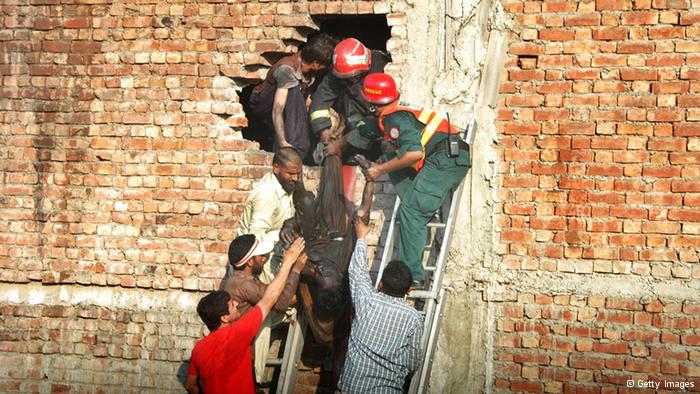
Flames and smoke swept the cramped textile factory in Baldia Town, a northwestern industrial suburb, creating panic among the hundreds of poorly paid workers who had been making undergarments and plastic tools.
They had few options of escape — every exit but one had been locked, officials said, and the windows were mostly barred. In desperation, some flung themselves from the top floors of the four-story building, sustaining serious injuries or worse, witnesses said. But many others failed to make it that far, trapped by an inferno that advanced mercilessly through a building that officials later described as a death trap.
Rescue workers said most of the victims died of smoke inhalation, and many of the survivors sustained third-degree burns. As firefighters advanced into the wreckage during the day, battling back flames, they found dozens of bodies clumped together on the lower floors.
One survivor, Muhammad Aslam, said he heard two loud blasts before the factory filled first with smoke, then with the desperate screams of his fellow workers. “Only one entrance was open. All the others were closed,” he said at a hospital, describing scenes of panic and chaos.
Mr. Aslam, who was being treated for a broken leg, said he saved himself by leaping from a third-floor window.
Hundreds of anguished relatives gathered at the site, many of them sobbing as they sought news. Some impeded the rescue operation, and baton-wielding police officers tried to disperse the crowd but failed.
“If my son does not return, I will commit suicide in front of the factory,” one woman shouted before news cameras as relatives tried to console her.
The death toll rose quickly. By evening, the Karachi commissioner, Roshan Ali Sheikh, said that 289 people had died, most of them men. The provincial health minister, Sagheer Ahmed, put the toll at 248, which he said was the number of bodies accounted for at major hospitals. The number was expected to rise further.
In the shoe factory fire in Lahore, 25 people were reported killed and dozens wounded. Officials said that blaze had been set off by a generator that caught fire and ignited chemicals stored nearby in the factory, illegally located in a residential neighborhood. Most of the victims were men under 25.
The fires immediately revived long-running questions about the regulation of Pakistan’s manufacturing sector, centered in Karachi, and of the vital textiles industry in particular.
Textiles are a major source of foreign currency for Pakistan, accounting for 7.4 percent of its gross domestic product in 2011 and employing 38 percent of the manufacturing work force. Pakistani cotton products are highly sought in neighboring India and form the backbone of a burgeoning fashion industry that caters to the elite. President Asif Ali Zardari’s government has often called on the United States to drop tariff barriers to Pakistani textile imports, which it says would be preferable to traditional aid.
But the industry suffers from weak regulation, characterized by lax oversight and corruption. Business owners often put profits over safety, workers’ rights advocates say.
On Wednesday evening the police raided the home of the owner of the Karachi factory, Abdul Aziz, who appeared to have gone into hiding. According to an online business information service, his company, Ali Enterprises, manufactured denim, knitted garments and hosiery and had capital of between $10 million and $50 million.
His nephew, Shahid Bhaila, the chief executive officer of the company, was also being sought for questioning. The police said both men had been placed on the exit control list, barring them from leaving the country.
The Muttahida Qaumi Movement, the most powerful political party in Karachi, announced three days of mourning. The city electricity company said it would cancel all outstanding bills for the families of those affected as a good will gesture.
The cause of the fire remained unclear. Geo News, the largest news channel, speculated that it had been started by extortionists, reporting that Mr. Aziz had previously faced a demand for a shakedown payment of more than $100,000, which he refused.
But others said an electrical fire was more likely. Wali Muhammad, a former electrical inspector, said that most accidental fires are caused by short circuits in equipment. But since 2003, he said, inspectors had been forbidden by law from visiting factories in Karachi and Punjab; it was not immediately clear why.
“This is criminal negligence,” he told Geo News, referring to the ban.
Another mystery surrounded the locked factory doors. Some survivors said the exits had been shuttered to prevent workers from slipping out early; others said it was the consequence of a recent break-in.
A majority of the garment workers came from Orangi Town, a poor working-class neighborhood in Karachi. Seventeen of the victims came from the same street, local news media reported.
The factory building suffered severe structural damage in the blaze, and officials feared it would collapse on rescue workers during the day.
While many distraught family members set up camp near the factory, others moved between city hospitals, seeking news of loved ones. One man said he was looking for his cousin, who earned $70 a month as a cashier. “He’s still missing. I’m afraid he may have been working in the basement,” the man said.
The Human Rights Commission of Pakistan called on the government to mount an immediate investigation. “The head of the firefighting operations in Karachi has noted that the factory was dangerous, flimsily built and had no emergency exits,” said Zohra Yusuf, chairwoman of the rights group. “Why did all of that escape official attention earlier?”
Workplace safety is guaranteed under Pakistan’s Constitution, but labor leaders say that government oversight has crumbled rapidly in recent years, along with a general decline in governance.
Sharafat Ali of the Pakistan Institute of Labor Education and Research, a labor rights group, said that 151 workers died in accidents in 2011. The state was partly responsible for the deaths, he said, because its civil servants “silently and criminally allow violation of laws and regulations established to ensure health and safety provisions at work.”
Waqar Gillani contributed reporting from Lahore, Pakistan.
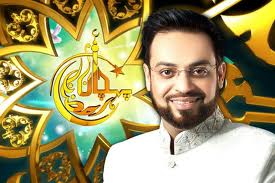
THE audience erupted as Aamir Liaquat Hussain, Pakistan’s premier televangelist, darted around the television studio, firing off questions about Islam. “How many gates are there to heaven?” he challenged.
Children leapt from their seats, their mothers yelled answers, fathers strained forward, all hoping to catch the eye of Mr. Hussain, who worked the crowd like a circus ringmaster — cajoling, teasing, rewarding.
“Show me the tongue of a snake!” he commanded a bearded man, as part of a question about symbolic serpents. The man obediently stuck out his tongue, prompting hoots of laughter.
To the victors, Mr. Hussain tossed prizes: mobile phones, tubs of cooking oil, chits for plots of land, shirts from his own clothing line. Then he vanished, briefly, only to return on a purring motorbike — also up for grabs.
When a shy-looking man answered Mr. Hussain’s theological teaser correctly, the preacher grabbed the man’s hand and thrust it high, in the manner of a prizefighter. The audience applauded.
“It’s the Islamic version of the ‘The Price is Right,’ ” said the studio manager, standing behind a camera.
Mr. Hussain, 41, is a broadcasting sensation in Pakistan. His marathon transmissions during the recent holy month of Ramadan — 11 hours a day, for 30 days straight — offered viewers a kaleidoscopic mix of prayer, preaching, game shows and cookery, and won record ratings for his channel, Geo Entertainment.
“This is not just a religious show; we want to entertain people through Islam,” Mr. Hussain said during a backstage interview, serving up a chicken dish he had prepared on the show. “And the people love it.”
Yet Mr. Hussain is also a deeply contentious figure, accused of using his television pulpit to promote hate speech and crackpot conspiracy theories. He once derided a video showing Taliban fighters flogging a young woman as an “international conspiracy.” He supported calls to kill the author Salman Rushdie.
Most controversially, in 2008 he hosted a show in which Muslim clerics declared that members of the Ahmadi community, a vulnerable religious minority, were “deserving of death.” Forty-eight hours later, two Ahmadi leaders, one of them an American citizen, had been shot dead in Punjab and Sindh Provinces.
Many media critics held Mr. Hussain partly responsible, and the show so appalled American diplomats that they urged the State Department to sever a lucrative contract with Geo, which they accused of “specifically targeting” Ahmadis, according to a November 2008 cable published by WikiLeaks.
Now, Mr. Hussain casts himself as a repentant sinner. In his first Ramadan broadcast, he declared that Ahmadis had an “equal right to freedom” and issued a broad apology for “anything I had said or done.” In interviews, prompted by his own management, he portrays himself as a torchbearer for progressive values.
“Islam is a religion of harmony, love and peace,” he said, as he waited to have his makeup refreshed. “But tolerance is the main thing.”
IN some ways, Mr. Hussain is emblematic of the cable television revolution that has shaped public discourse in Pakistan over the past decade. He was the face of Geo when the upstart, Urdu-language station began broadcasting from a five-star hotel in Karachi in 2002. Then he went political, winning a parliamentary seat in elections late that year. The station gave him a religious chat show, Aalim Online, which brought together Sunni and Shiite clerics. The show received a broad welcome in a society troubled by sectarian tensions; it also brought Mr. Hussain to the attention of the military leader Gen. Pervez Musharraf, who was reportedly touched by its content. In 2005, General Musharraf appointed him junior minister for religious affairs, a post he held for two years.
Mr. Hussain’s success, with his manic energy and quick-fire smile, is rooted in his folksy broadcasting style, described as charming by fans and oily by critics. By his own admission, he has little formal religious training, apart from a mail-order doctorate in Islamic studies he obtained from an online Spanish university in order to qualify for election in 2002.
“I have the experience of thousands of clerics; in my mind there are thousands of answers,” he said.
That pious image was dented in 2011 when embarrassing outtakes from his show, leaked on YouTube, showed him swearing like a sailor during the breaks and making crude jokes with chuckling clerics. “It was my lighter side,” Mr. Hussain said. (Previously, he had claimed the tapes were doctored.)
But that episode did little to hurt his appeal to the middle-class Pakistanis who form his core audience. “Aamir Liaquat is a warm, honest and soft-natured person,” said Shahida Rao, a veiled Karachi resident, as she entered a recent broadcast, accompanied by her 6-year-old grandson. “We like him a lot.”
Senior colleagues at Geo are less enthusiastic. After an accumulation of controversies, including the Ahmadi show and on-air criticism of sex education material in school textbooks, he left the station in 2010. But Geo struggled to find a replacement and last June brought him back, causing consternation among senior anchors and managers, several of whom threatened to resign, senior executives said.
“It created a lot of noise,” said one, speaking on the condition of anonymity. “Many of us wanted to know what he was coming back as.”
The answers were provided by the network’s chief executive, Mir Ibrahim Rahman, a 34-year-old Harvard graduate who argues that Pakistan needs people like Mr. Hussain, who hold water with Islamic conservatives, to incrementally change society.
“We are still recovering from the Zia years; we can’t move too fast,” Mr. Rahman said, referring to the excesses of the Islamist dictator Gen. Mohammad Zia ul-Haq in the 1980s. “We need people like him to ease us down the mountain.”
To placate internal critics, Geo has just published a code of conduct for its journalists. “We’ve taken stock of the excesses that have been committed,” said the channel’s president, Imran Aslam, referring to a variety of controversies involving the station. “It’s an important start.”
But commercial imperatives also loom large, and in that arena, Mr. Hussain’s value is unquestioned.
COMPETITION for ratings at Ramadan is fierce among Pakistan’s television stations, and this year the race had a feverish feel. One station hired Veena Malik, a racy actress better known for posing seminude for an Indian magazine, to present its religious programs. One of her shows featured a live exorcism of a supernatural spirit that, conveniently enough, had called the station by telephone. Another station broadcast the conversion of a Hindu boy to Islam, drawing wide criticism.
By contrast, Mr. Hussain’s show seemed a model of restraint, though the set’s extravagance may have suggested otherwise.
The centerpiece was a giant boat that represented Noah’s Ark, but closely resembled a craft from the “Pirates of the Caribbean” movie franchise. Live animals wandered the set, including flamingos, peacocks and deer. Studio guests included Abdul Qadeer Khan, the father of Pakistan’s nuclear weapon program, and Imran Khan, the cricketer-turned-conservative politician. Ratings peaked on Aug. 12 when the studio moved to a cavernous exhibition hall that held 30,000 people — the largest studio audience in Pakistan’s history, executives said.
Mr. Hussain, unsurprisingly, has become rich.
Although his salary is a closely guarded secret, Geo sources said top names can earn $30,000 a month — income that, in Mr. Hussain’s case, is increased by lucrative product sponsorship deals, his clothing line and by leading religious pilgrimages to Saudi Arabia.
He keeps tight security, including bodyguards and an armored vehicle, since his acrimonious departure from the Muttahida Qaumi Movement, a political party at the center of Karachi’s often violent power struggles, in 2008. A senior party official said Mr. Hussain had “nothing to fear” from the party.
Mr. Hussain hopes to shrug controversy off in his latest incarnation. “Even the liberals will love me,” he said, a touch optimistically. He has even developed a soft spot for the United States, the bête noir of Pakistani conservatives. After a family vacation in New York last year, he returned with a honey sauce that he uses during his cooking broadcasts.
At any of the countless secular universities she might have chosen, religion — at least in theory — would be beside the point. But she picked one that would seem to underline her status as a member of a religious minority. She enrolled at the University of Dayton, a Roman Catholic school, and she says it suits her well.
“Here, people are more religious, even if they’re not Muslim, and I am comfortable with that,” said Ms. Alhamad, an undergraduate in civil engineering, as several other Muslim women gathered in the student center nodded in agreement. “I’m more comfortable talking to a Christian than an atheist.”
A decade ago, the University of Dayton, with 11,000 undergraduate and graduate students, had just 12 from predominantly Muslim countries, all of them men, said Amy Anderson, the director of the school’s Center for International Programs. Last year, she said, there were 78, and about one-third of them were women.
The flow of students from the Muslim world into American colleges and universities has grown sharply in recent years, and women, though still far outnumbered by men, account for a rising share.
No definitive figures are available, but interviews with students and administrators at several Catholic institutions indicate an even faster rate of growth there, with the Muslim student population generally doubling over the past decade, and the number of Muslim women tripling or more.
At those schools, Muslim students, from the United States or abroad, say they prefer a place where talk of religious beliefs and adherence to a religious code are accepted and even encouraged, socially and academically. Correctly or not, many of them say they believe that they are more accepted than they would be at secular schools.
“I like the fact that there’s faith, even if it’s not my faith, and I feel my faith is respected,” said Maha Haroon, a pre-med undergraduate at Creighton University in Omaha, who was born in Pakistan and grew up in the United States. “I don’t have to leave my faith at home when I come to school.”
She and her twin sister, Zoha, said they chose Creighton based in part on features rooted in its religious identity, like community service requirements and theology classes that shed light on how different faiths approach ethical issues.
Many Muslim students, particularly women, say they based their college choices partly on the idea that Catholic schools would be less permissive than others in the United States, though the behavior they say they witness later can call that into question.
They like the prevalence of single-sex floors in dorms, and even single-sex dorms at some schools. “I thought it would be a better fit for me, more traditional, a little more conservative,” said Shameela Idrees, a Pakistani undergraduate in business at Marymount University in Arlington, Va., who at first lived in an all-women dorm.
Some of the women land at Catholic schools more or less accidentally — some are married and simply enroll where their husbands are going, while others are steered toward particular schools by their home countries’ governments.
But for others it is a conscious choice, based on recommendations from friends or relatives, or impressions gained from growing up in places, like Lebanon, with strong traditions of church schools.
Most of the schools say they do not specifically recruit Muslim students.
“There’s no conscious effort,” said the Rev. Kail Ellis, a priest and vice president for academic affairs at Villanova University, near Philadelphia. “It’s basically something that happened through word of mouth and reputation.”
Muslim students here cite the accommodations Dayton has made, like setting aside spaces for them to pray — a small room for daily use, and two larger ones for Fridays — and installing an ablution room for the traditional preprayer washing of hands and feet.
The university also helps students arrange celebrations of major religious holidays, and it contracts with a halal meat supplier for special events.
Manal Alsharekh, a Saudi Arabian graduate student in engineering at Dayton, said, “I was in another university before that did not respect us so much.”
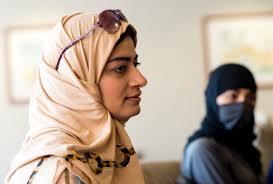
Even so, the adjustment to an American school can be jarring, especially for women. They are a minority even within the minority of Muslim students. Many of them follow restrictions on interaction with nonrelatives, and the head coverings most of them wear make it impossible to blend in.
The degree of culture shock students experience varies as widely as the traditions they grew up in. Some eat the nonhalal meat served daily in school cafeterias, some eat it only after saying a blessing over it and others do not eat it at all.
In a gathering of foreign-born Muslim women here, traditional attire varied widely, from Ayse Cayli, a graduate student from Turkey who does not cover her head and wore shorts and a T-shirt, to Mrs. Alsharekh, who while in public wears a floor-length cloak over her clothes and a veil across most of her face. Most wear a hijab, or head covering, and stylish but fairly conservative Western clothes extending to the ankles and wrists, even in warm weather.
The prospect of walking into an identifiably Christian institution, often for the first time in their lives, can be intimidating.
“I was afraid they will not like me because I am Muslim, or they will want me to go to church,” said Falah Nasser Garoot, a male Saudi graduate student in business at Xavier University in Cincinnati. “At first, when I saw the crosses on the classroom walls, it was very strange for me.”
Fatema Albalooshi, a graduate student from Bahrain who is studying engineering at Dayton, said that when she first looked into the school, “I thought it was going to be compulsory to take Catholic courses.”
And for the women, especially, identifiable by their head scarves, there are always questions. “People stop and ask me questions, total strangers, about my head covering, they’re curious about how I dress,” said Hadil Issa, an undergraduate here who grew up in the Palestinian territories and the United States. The more covering they wear, the more women are asked if they get hot in the summer. Muslims are consulted on etiquette by students planning to visit the Middle East. And often, they are asked why they attend a Catholic school.
“I tell people the atmosphere is very warm and supportive,” Ms. Issa said. “I feel accepted here, and that’s what matters.”
Lahore, Aug 31: Hate content in textbooks used in the Punjab has increased from ‘45 lines in 2009 to 122 in 2012’, a content analysis report published by the National Commission for Justice and Peace (NCJP) said on Thursday. The report titled Education or Promotion of Hatred was distributed at a conference, Biases in Textbooks and Education Policy, organised by the NCJP on Thursday.
The study examined 22 textbooks for the academic year 2012-13 in the Punjab and Sindh from classes 1 to 10.
The report says that one of the 30 chapters in the general knowledge textbooks for class 1 has content advocating intolerance. It says there has been a ‘marked increase’ in hate content in the curricula of classes 7 to 10.
In 2009-2011, it says, 12 chapters in various textbooks at these levels contained hate material. The number of such chapters has increased to 33.
As many as seven lessons with hate content are part of the 8th class Urdu curriculum for 2012-2013, compared to none in 2009, it says. It also says said that the number of such lessons in the Pakistan studies textbooks for classes 9 and 10 had increased to three in 2012 from none in 2009. It says that hate lessons that were part of the class 6 social studies and class 7 Islamiat books in 2009 had been excluded from the 2012 curricula.
Speaking at the launch Dr Mehdi Hasan, the School of Media and Communication dean at the Beaconhouse National University, said Muslims posed a greater danger to their fellow Muslims then to non Muslims in Pakistan.
He said, seminaries, where less than 4 per cent of the Pakistani children studied in Pakistan, did not pose a greater threat than schools, where hate material was being taught to students as young as to be in class 1.
He said, “Teaching students that a certain religion teaches ‘bad things’ is not just a violation of human rights but also a severe ethical violation.”
Dr Hasan said that a religious state was not a democratic state. He said that Pakistan had been established through a democratic process.
Wajahat Masood, an assistant professor at BNU, said future generations will likely judge the present as ‘sub-human and insensitive’.
He said hate content and distortion of history was evident in curricula as well as in Pakistani literature. Masood said that sectarian and religious discrimination should be recognised as ‘vulgar’ and discouraged.
Irfan Mufti, deputy director at the South Asia Partnership Pakistan, said that hate content in school syllabi spoke volume of an intolerant society.
“Hate content will turn our children into intolerant individuals,” he warned.
Dr Baela Raza Jamil, director of programmes at the Idara-i-Taleem-O-Aagahi highlighted the Compulsory Education Act that was passed recently by the Senate for Islamabad. She said the Act had failed to mention religion as a reason for which no discrimination would be allowed in provision of education.
‘She said after the devolution of powers to the provinces, each province was responsible for regulating its curricula.
Dr AH Nayyar, visiting professor at the Lahore University of Management Sciences, regretted that many such reports had been issued previously, but the matters had become worse instead of improving.
NCJP Executive Director Peter Jacob regretted that textbooks were being used to promote hatred in the country.
“Religious discrimination cannot be eliminated unless people working for it are demotivated,” he said.
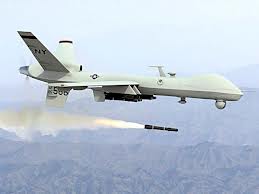
Washington/Islamabad, August 25 – Badruddin Haqqani, the key operational commander of the al Qaeda linked Haqqani network, and top Pakistani Taliban commander Mullah Dadullah are believed to have been killed in US drone and air strikes in the tribal region of Pakistan and Afghanistan. Badruddin, the son of Afghan warlord.
Jalaluddin Haqqani, is ranked as a deputy to his elder brother and the network’s chief Sirajuddin and was believed to be killed in one of the five volleys of drone strikes in Pakistan’s Taliban-controlled tribal agency of North Waziristan since August 18.
Four of the missiles hit took place in Shawal Valley, considered to be traditional area of operations of Haqqani network in North Waziristan, and US reports said he may have been killed in the August 21 strike near Miranshah.
The wave of attacks drew strongest protest from Islamabad in recent years when a senior US diplomat was summoned by the Foreign Ministry to lodge their opposition to the attacks.
Badruddin, thought to be in his mid-30s, was a member of the Miranshah Shura Council, one of the Afghan Taliban’s four regional commands, which controls all activities of the militant group in Afghanistan and Pakistan.
Senior US officials were quoted by the New York Times as saying that they had strong indications that Badruddin, the key commander of the Haqqani network which is responsible for most of the spectacular assaults on American bases and Afghan cities in recent years, was killed in a drone strike
Meanwhile, a statement by coalition forces in Afghanistan said that Tehrik-e-Taliban Pakistan leader Mullah Dadullah was among 20 militants killed in a “precision airstrike in Shigal wa Sheltan district (of) Kunar province yesterday.” Dadullah, whose real name is Maulana Mohammad Jamaluddin, was made the commander of Taliban in Pakistan’s Bajaur Agency in 2010. He fled to Afghanistan to escape an operation launched by the Pakistan Army. His deputy Shakir too was killed in the airstrike, the statement said.
Badruddin is one of the nine Haqqani family members who have been designated by the US as global terrorists. His brother Sirajuddin is the overall leader of the Miramshah Shura.
Siraj was designated by the State Department as a terrorist in March 2008 and in March 2009, the State Department put out a bounty of USD 5 million for information leading to his capture.
Giving details about the operation, American intelligence officials indicated to the Long War journal yesterday that the remotely piloted Predators and Reapers were targeting an “important Jihadi leader” in the region but his name was not disclosed.
“There are indications that Haqqani has met his demise,” a senior US official said in Washington yesterday.
He said officials were waiting to sift through evidence, including information on jihadist websites, before they could be certain that Haqqani had been killed.
The report said their caution stemmed from previous erroneous claims by American and Pakistani officials about militant deaths in Waziristan, a difficult place to get reliable information. But if confirmed, Haqqani’s death would be a “major benefit to the military coalition in Afghanistan.”
“Badruddin has been at the centre of coalition attacks in Afghanistan as well as mischief in Pakistan,” said the official. The Haqqani network has been blamed for some of the most spectacular assaults on US bases and Afghan cities in recent years.
By Friday evening, reports of Badruddin Haqqani’s death were circulating in Pakistan’s tribal belt.
In Washington, the White House and the CIA, which carries out drone strikes in Pakistan, declined to comment.
The latest string of drone attacks, most of them carried out in Shawal area of North Waziristan Agency, has renewed tensions between Pakistan and the US.
Nearly 40 suspected militants have been killed in these attacks, including a Kashmiri jihadi named “Engineer” Ahsan Aziz. Former Jamaat-e-Islami chief Qazi Hussain Ahmed recently led funeral prayers in Mirpur for Aziz, who was killed in a drone strike on August 18.
Badruddin Haqqani runs the Haqqani network’s day-to-day militant operations, handles high-profile kidnappings and manages its lucrative smuggling operations, according to a report by the Combating Terrorism Center at West Point.
In August last year, Afghan intelligence released intercepts of Badruddin Haqqani directing a daring assault on Kabul?s Intercontinental Hotel. Three years before that, he held a reporter for The New York Times, David Rohde, hostage.
The last major successful drone strike in Pakistan was the killing of al-Qaeda deputy leader Abu Yahya al-Libi in June.
US drones yesterday fired six missiles at three locations in Shawal Valley, destroying mud-walled compounds and two vehicles, Pakistani security officials and a Taliban commander said.
Among the 18 people killed was Emeti Yakuf, a senior leader of the East Turkestan Islamic Movement, a group from western China whose members are Chinese Uighur Muslim militants.
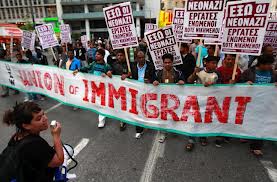
Immigrant protests in Greece (Credit: eutimes.net)
ATHENS, Aug 24: Greek police say up to 3,000 people have participated in a peaceful demonstration by immigrant groups in Athens on Friday to protest racist attacks in the crisis-struck country.
Protesters, most of who were from Pakistan, marched to Parliament shouting slogans and brandishing banners.
Friday’s march was held to protest increasing racist attacks and alleged cases of police brutality against immigrants.
Greece is the main entry point for illegal immigrants seeking a better life in the European Union.
The massive influx coincided with a spike in crime, and contributed to the sharp rise of the extreme-right, anti-immigrant Golden Dawn group that won 18 of Parliament’s 300 seats in June’s national elections.
Golden Dawn supporters have been repeatedly accused of violent attacks on immigrants, which the group says it does not condone.
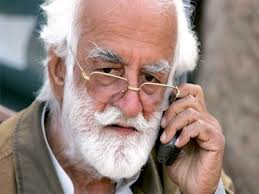
Baloch tribal chief Nawab Akbar Bugti (Credit: nation.com.pk)
After 9/11, the Musharraf administration’s alliance with the U.S. in the `War on Terror,’ allowed the army to clamp down on a simmering Baloch insurgency with the type of secrecy they used to hunt down Al Qaeda militants. While the Afghan Taliban was left free to operate in Balochistan, the administration made Baloch secessionists disappear under the smokescreen of combating terrorists.
Fuelling Balochistan’s insurgency was the fact that its disarming barren exterior hides rich deposits of minerals, coal and natural gas, which make a significant contribution to the nation’s energy needs. Islamabad’s failure to pay royalties and subsidies to Balochistan and its tight fisted control of the provincial government has fanned the tribal and secessionist movement, which reached a new pitch under Musharraf.
In 2005 when tribal leaders Nawab Akbar Bugti and Khair Baksh Marri mounted an insurgency against Musharraf, the army hunted down and killed their tribal fighters in the mountainous strong holds of Dera Bugti and Kohlu districts. In turn, the militant tribesmen ambushed and killed constabulary from the Frontier Corp, blew up gas pipelines and sabotaged train supplies to the province.
As rocket attacks accelerated, the Musharraf government set up a new military base and camps for army officers along the Sui gas field. The military and Baloch militant nationalists now engaged in a full scale war, backed by missiles and propaganda from both sides. From the government side, the District Coordination Officer Dera Bugti Abdus Samad Lasi told me that the tribal leaders like Nawab Akbar Bugti were responsible for keeping their people poor and backward, even as they used their tribesmen to fight their wars.
Enter a young woman doctor from Karachi, Dr Shazia Khalid, who then worked in Pakistan Petroleum Ltd, which manages the gas fields in Balochistan. Living alone at the company’s onsite hospital, she was woken one night in January 2005 and reportedly raped at gunpoint by an army officer. Despite company directives to stay quiet, she testified against the offending captain.
Shazia’s testimony to the media sent a match through the smoldering Bugti insurgency. Baloch insurgents intensified their attacks on army personnel and blew up gas pipelines, severing gas supply to the rest of the country.
Hustled into exile into London, Shazia spoke to me from her new location. Gen. Musharraf had rejected insinuations that any army man could be involved. However, annoyed by the negative publicity, Pakistan’s officials had arranged for her to go abroad. As she awaited an immigration visa for Canada, Musharraf added insult to injury with his remark quoted in the Washington Post in September 2005: “If you want to go abroad and get a visa for Canada or citizenship and be a millionaire, get yourself raped.” The remark, obviously intended for a victim of rape, hurt the young woman. “It has made me lose hope of receiving any justice in Pakistan,” Shazia told me in a voice muted with pain.
From his hiding place in Dera Bugti, the former governor of Balochistan and tribal chieftan, Nawab Akbar Bugti was livid that Shazia had been raped by an army man – and that he was being protected by the military president. In a voice that shook with anger, he told me that Baloch tribesmen would not rest until Shazia’s rapist was brought to trial. Without waiting to differentiate, he declared, “You in the West may take rape lightly but we in Balochistan consider it a grave human rights violation of women.”
The army used satellite telephones to trace Bugti to an elaborate complex of caves he inhabited in Dera Bugti, where he was killed in a massive army operation.
In the US, where President Musharraf had managed to blur the lines between the terrorism launched by the Taliban and insurgency by Baloch nationalists, Bugti’s murder was lumped with Pakistan’s ongoing war against the Taliban and Al Qaeda. The day after Nawab Akbar Bugti was murdered, an influential US newspaper cited Bugti’s murder as the death of a “terrorist.”
For a while Musharraf’s operation against the Baloch nationalists broke the back of the insurgency. But in death, Bugti became a martyr. It rekindled memories of Balochistan’s forced annexation to Pakistan and further provoked Baloch militants to seek arms and money from other countries in order to secede from the federation.
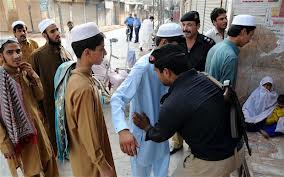
Security Search over Eid in Pakistan (Credit: telegraph.co.uk)
The draconian security measure was imposed on Sunday at 8:00 pm, at a time when millions ordinarily telephone friends and relatives with greetings for Eid al-Fitr. Networks were working again on Monday mid-morning.
Karachi and Lahore, Pakistan’s two largest cities, and the troubled city of Quetta, in the insurgency-torn province of Baluchistan, were among the places where networks were suspended.
“We regret that it had to be suspended in some cities due to the risk of terrorist attacks,” Rehman Malik, the country’s interior minister, was quoted as saying by state TV.
“We regret inconvenience caused to youths and children.”
Terrorists were plotting to target “a few areas of Punjab province”, of which Lahore is the capital, the minister said. Sindh province, where Karachi is the capital, and Baluchistan were also targets, he added.
Authorities feared that mobile telephones could be used to coordinate attacks or trigger a remote-controlled bomb.
The Eid festival marks the end of the holy fasting month of Ramadan and, in Pakistan, is accompanied by a three-day public holiday, until Thursday.
The country has been on alert for Eid and security forces stepped up their presence in major cities as celebrations got under way.
On the same day, gunmen in military uniforms pulled 20 Shi’ite Muslim travellers from vehicles and shot them dead in the northwestern district of Mansehra.
Pakistan says 35,000 people, including more than 3,000 soldiers, have been killed as a result of terrorism since the 9/11.