Russia keeps door open to Pakistan after Putin cancels trip

Moscow, Oct. 4: It would have been the first visit to Pakistan by any Soviet or Russian head of state, and a strong signal that something might be changing in the foreign policy calculus of a country that has always strictly regarded India as its No. 1 regional partner.

The Kremlin says Mr. Putin’s trip to Pakistan was never officially confirmed and his working schedule this week is “too tight” to accommodate the two-day visit, which was to have included participation in a regular summit of regional leaders on Afghanistan and bilateral talks on trade, technical, and military cooperation with Pakistani President Asif Ali Zardari.

However, Putin dispatched Foreign Minister Sergei Lavrov to Islamabad Wednesday in what looked like a hastily arranged effort to explain the change to Pakistani leaders and keep the door open for future warming of ties. Experts say that an increasingly anxious Russia wants very much to engage with Pakistan, and sees it as an indispensable regional player in dealing with whatever emerges in Afghanistan following NATO’s pullout in barely two years. The Russians fear a repeat of the turbulent 1990s, when narco-trafficking exploded across former Soviet Central Asia and militant Islamist movements based in Afghanistan triggered major civil strife in Uzbekistan, Tajikistan, and Kyrgyzstan.

“It remains to be seen what will happen, of course, but most in Moscow tend to view it through the prism of how things went when the USSR pulled its forces out of Afghanistan in 1989. There followed a string of disasters which nobody would like to see repeated,” says Fyodor Lukyanov, editor of Russia in Global Affairs, a leading Moscow foreign policy journal.

“Pakistan will be a key player, and it follows that Russia must have an open channel to Pakistan, at the very least to know how they will react and what they will do,” he adds.

A Russian take on Afghanistan

Not everyone agrees that the outlook for Afghanistan after 2014 is chaos. Gen. Makhmud Gareyev, president of the Russian Academy of Military Sciences and a former adviser to the pro-Soviet leader of Afghanistan, President Najibullah, following the withdrawal of Soviet forces, argues that things are quite different now.

“The fact is that the new post-Soviet Russian government established contacts with the rebels, and left Najibullah without ammunition,” says General Gareyev.

“I firmly believe that Afghanistan could have been normalized if not for that…. The Americans talk about leaving, but they aren’t really going to go. They’ll do what they did in Iraq, leave some forces and regroup them. They’ll try to keep bases in Central Asia and reinforce their presence in Pakistan. The Americans will still be around,” he says.

“Which doesn’t mean things will be OK. The Taliban will continue killing, and drugs will still pour out of Afghanistan. There will be lots of problems,” he adds.

Putin’s planned visit this week would have been the perfect opportunity to officially begin building bridges with Pakistan. He was to have attended the regular quadrilateral meeting on Afghanistan, which includes the leaders of Russia, Tajikistan, Afghanistan, and Pakistan. Previous summits, held in various regional capitals, were always attended by then-President Dmitry Medvedev, who has met with Mr. Zardari six times in the past three years – though never in Pakistan.

Uncertainty why Putin cancelled

Russian experts say they are at a loss to explain why Putin ducked out of the meeting, a move that seems to have seriously set back Moscow’s timetable and led to a wave of injured feelings and perplexed speculation in the Pakistani media.

“One possible explanation is that Putin is a very specific guy, who feels like he can write his own rules and do things his own way,” says Sergei Strokan, foreign affairs columnist for the Moscow daily Kommersant. He points out that Putin last May refused to attend a summit of the Group of Eight advanced countries, despite the fact that President Barack Obama had specifically moved the meeting’s venue to accommodate him. Putin never offered any more detailed explanation other than that he was “too busy.”

“So far there is no clear statement from the Kremlin as to when, if ever, the visit will take place. It’s hard to see what’s going on here, but the fact that Lavrov has gone to Pakistan suggests that there is a strong feeling in Moscow that if we miss the chance to develop stronger relations with Pakistan now, we may pay for it with deep complications down the road,” Mr. Strokan adds.

Pipeline politics?

Some experts suggest that pipeline politics may lie at the root of the mystery. Russia’s powerful state-run natural gas monopoly, Gazprom, is seen as deeply involved in plans to export Iranian, Russian, and Central Asian gas to the lucrative markets of South Asia via two projects that are currently on the drawing boards. First, the Iran-Pakistan-India (IPI) pipeline, which analysts say Gazprom has a strong interest in, has apparently been stalled by Pakistan due to US objections. Second, the Tajikistan-Afghanistan-Pakistan-India (TAPI) pipeline, which experts say Gazprom wants to build and own, may also be an unresolved issue between Moscow and Islamabad.

“There is a lot of talk behind the scenes about these pipelines, and it’s obvious that interests are lining up. It may be a hidden explanation for the confused diplomacy we’re seeing at the moment,” says Strokan. “But everything will depend upon regional stability. You can’t build pipelines through Afghanistan if there isn’t reliable security there.”

Experts say that time may be running out to find some kind of regional formula to handle the worst-case scenario for post-NATO Afghanistan that Moscow seems to believe in.

“From the moment NATO troops are partially withdrawn from Afghanistan, Russia wants that country to be controllable,” says Alexander Konovalov, president of the independent Institute of Strategic Assessments in Moscow.

“The fear in Moscow is that radical Islamism will spread, drug trafficking with explode, and Russia will be left to pick up the pieces. We know there’s no hope for stability there without Pakistan’s active participation, and we need to be talking seriously with them,” he adds.
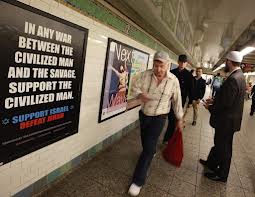
 

Anti-Muslim subway ads throughout New York City: Fighting for faith?

NY ad on subway stops (Credit: cair.ny.org)

Early in first grade, one of the nuns advised our class not to associate with children who attended other schools and believed other religions. My teacher, a younger nun, looked uncomfortable and quickly changed the topic. Later that day, I asked my mother about playing with friends who worshiped at other churches.

“Playing with other friends won’t change your beliefs,” my mother said. She was beautiful, devout and confident that her children knew right from wrong at an early age.

I have often wondered if those beliefs could have survived the Catholic Church’s child-abuse scandal, but she died long before the worst reports emerged.

Religions that insist that their adherents cannot read or explore other beliefs, testing their values, are insecure. Religions that try to thrive by insulting other religions are insecure.

The American Freedom Defense Initiative (AFDI) has purchased ads for the New York subway system that read:

“In any war between civilized man and the savage, support the civilized man. Support Israel. Defeat Jihad.”

New York City’s Metropolitan Transportation Authority originally rejected the ads, asking for modifications, but a U.S. District Court intervened.

The Interfaith Center of New York rejected the ads. The Jewish Community Relations Council of New York released a statement:

“While agreeing with U.S. District Court’s ruling that the placement of the AFDI ad in the New York Subway system is protected under the First Amendment to the Constitution, nonetheless, we find the ad’s content to be decidedly prejudiced and dangerously inflammatory. The broad mainstream of the New York Jewish community does not equate its unwavering support for Israel with intolerance for Muslims or their faith. We will continue our work with leaders of the Muslim and other faith and ethnic communities within the demographic diversity of New York to strengthen the communal collective and improve the quality of translife for all.”

Intolerance, an ugly quest for power and control, relying on fear to motivate – the certainty of some in proving to another that his or her frame of meaning has no value – these all cheapen spirituality. Clamoring is increasingly loud and insistent, overwhelming the power of example, in a shrinking world that cannot escape globalization.

Religious leaders bemoan a loss of faith, driving some to desperate measures. The AFDI Web site claims that it’s “Fighting for Faith,” and most of us prefer faith fighting for peace. Ruthless, mean competition for adherents and power, insults and violence, give reason to Americans to distance themselves from religion and explore spirituality alone or among a diverse and comfortable group of friends.

Susan Froetschel is the author of Fear of Beauty, a novel set in Afghanistan, about a woman’s struggle to learn to read with the help of the Koran.

Do not ask Pakistan to do more on terror: Zardari

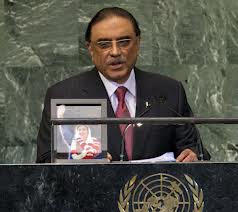
Asif Zardari with Benazir Bhutto's photograph (Credit: englishalarabiya.net)

UNITED NATIONS, Sept 25 : Pakistan’s President Asif Ali Zardari declared Tuesday before the United Nations that his country had suffered enough in its fight against extremist terror and should not be asked to do more.

“No country and no people have suffered more in the epic struggle against terrorism than Pakistan,” he insisted.

“To those who say we have not done enough, I say in all humility: Please do not insult the memory of our dead, and the pain of our living. Do not ask of my people what no one has ever asked of any other peoples,” he said.

“Do not demonize the innocent women and children of Pakistan. And please, stop this refrain to ‘do more’.”

Beginning his address to the UN General Assembly with a denunciation of the recent American-made movie trailer and French cartoons that insulted the Prophet Mohammed (PBUH), he demanded that such material be banned worldwide.

Then, speaking next to a photograph of his late wife — Pakistani politician Benazir Bhutto, who was murdered by militants — he set about defending the Pakistani people’s record in the war on violent extremism.

Zardari said regular US drone strikes against targets in his country made his task of selling the fight against terror to his people harder, as did the massive increase in Afghan drug exports since the US-led invasion.

“There are a lot of questions that are asked of Pakistan these days,” he said, his voice rising as he warmed to his theme.

“I am not here to answer questions about Pakistan. The people of Pakistan have already answered them. The politicians of Pakistan have answered them. The soldiers of Pakistan have answered them,” he declared.

“We have lost over 7,000 Pakistani soldiers and policemen, and over 37,000 civilians,” he added. “And I need not remind my friends here today, that I bear a personal scar.”

Pakistan has long been seen as a safe haven for myriad armed groups, whether Taliban fighting along the Afghan border, domestic extremists or Kashmiri Muslims bent on capturing Indian-held territory.

“I remember the red carpet that was rolled out for all the dictators,” he said. “These dictators and their regimes are responsible for suffocating and throttling Pakistan, Pakistan’s institutions and Pakistani democracy.

“I remember the jailing of Pakistan’s elected leaders. I remember the 12 years I myself spent in prison. And I remember the billions provided by the international community to support those dictatorships,” he said.

“My country’s social fabric, its very character has been altered. Our condition today is a product of dictatorships.”

Zardari’s government has often been accused in the West of not doing enough to fight armed extremism, and since bin Laden was found — in a garrison town near the capital — some in Washington have called for aid to be cut.

Taliban remove minister offering bounty for film maker from hit list

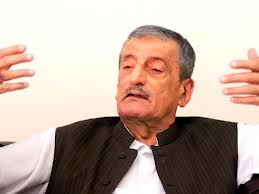
ANP MInister Ghulam Ahmed Bilour (Credit: tribune.com.pk)

PESHAWAR, Sept 26: The Pakistani Taliban say they are granting an “amnesty” to a Cabinet minister who is offering a $100,000 reward to anyone who kills the American maker of an anti-Islam film sparking deadly riots in the Muslim world.

Pakistani Taliban spokesman Ehsanullah Ehsan told reporters on Wednesday that the minister’s views represent the true spirit of Islam. Consequently, the militants have removed him from their hit list.

“We have totally forgiven him and removed his name from our hit list,” the Taliban spokesman said in a phone call from an unknown location.

Ehsan said that Taliban shoora, a top consultative body, had met on Tuesday and “praised Bilour for his sacrifice for the cause of Islam”.

“The shoora paid rich tributes to Bilour and endorsed his bounty announcement,” he said.

But Ehsan clarified that others in Bilour’s secular party – The Awami National Party (ANP), which opposes the Taliban – won’t enjoy the reprieve.

Railways Minister Ghulam Ahmad Bilour had announced a $100,000 bounty for the killing of the maker of “Innocence of Muslims” – a film which has sparked deadly protests throughout the Muslim world. Bilour had also sought the Taliban’s and al Qaeda’s help in the “noble cause” of killing the filmmaker.

Pakistan’s government says Bilour’s bounty doesn’t represent official policy, and his party, the ANP, has also distanced itself from the minister’s comments.

Bilour, however, insisted public opinion was behind him in Pakistan, which has seen widespread protests against the film including nationwide rallies on Friday that ended in bloodshed and looting, with at least 23 people killed.

“I expressed my personal view and faith. I stand by my declaration,” the 72-year-old Bilour had said on Tuesday. “My faith is non-violent, but I cannot forgive and tolerate (this insult),” he said.

Bilour had added that a businessman from Lahore had offered to put up a further $400,000 for the reward and said that freedom of speech should not be used as an excuse to insult Islam.

“Killing is not a good way, but right now it is the only way, because no action has been taken from Western countries (against the filmmaker),” he said.

Washington condemned Bilour’s reward offer as “inflammatory and inappropriate”, while the EU said it deplored it.

Bilour could not be reached for comment on Wednesday.


Op-Ed: Anti-Islam Film an Exception to Free Speech Protection

17 September 2012: THE anti-Muslim film produced by Christian extremists may have sparked the violence that spread across the Middle East and South Asia this week. But the core issues in the following days of protests were unemployment, politicizing religion and the deep resentment against the United States for its wars that cost thousands of innocent lives in Iraq and Afghanistan.

Protest organizers just got a lucky break when Egyptian television aired and dubbed in Arabic the “Innocence of Muslims” film trailer. The movie simply got the ball rolling.

The debate in America is not whether rage against the US government’s meddling in Arab affairs is justified, but why Muslims get so riled up when the Prophet Muhammad is ridiculed. After all, other prophets get the same treatment in a secular society in which free speech rights are sacrosanct.

Muslims in the Middle East get the free speech thing, but often wonder why its advocates take such great pleasure in beating them over the head with it.

On Al Jazeera television the other day the news host brought in Arab and Western media types to talk about “Innocence of Muslims” and its impact in the Middle East. TJ Walker, a media-training consultant who works with Bloomberg TV and Fox News among other outlets, gave Al Jazeera’s mostly Arab and Muslim audience a brief lesson on the First Amendment, its importance to Americans and why all religious figures are equal opportunity targets for mockery and ridicule. Really, Walker implied, what’s the big deal about making fun of religious figures? We do it all the time. His tone and message was clear: Muslims should lighten up and accept the American standard of free speech.

Walker’s cluelessness about sensibilities of the audience he was addressing can be forgiven. His experience is how to train people to deal with the American media and not interpreting global news events. But he encapsulates many Americans’ “live and let live” approach to free speech.

Yet the extremists who made the film are not clueless, and have much darker goals in mind. It’s one thing to parody religious figures on “South Park” and quite another to deliberately produce a film filled with falsehoods with the intention to provoke violence.

Steve Klein, the Californian who provided technical assistance for the film, acknowledged in interviews that he knew the film was provocative. He announced that it was a success.

“We have reached the people that we want to reach,” Klein told the New York Times. “And I’m sure that out of the emotion that comes out of this, a small fraction of those people will come to understand …, and also for the people who didn’t know that much about Islam. If you merely say anything that’s derogatory about Islam, then they immediately go to violence, which I’ve experienced.”

Most people wouldn’t admit to falsely shouting fire in a crowded theater, but Klein seems to be proud of this accomplishment, even if it helped lead in some way to the deaths of four American citizens in Libya.

We are seeing a rise in violence prompted by hate speech. Norway mass murderer Anders Behring Breivik cited the writings of America’s leading Islamophobes as inspiration. The same Islamophobic gang and their confederates are now boasting of their success. They continue to defend their right to pursue objectives that result in violence.

The US Supreme Court had addressed the issue of false and dangerous speech in 1919. Justice Oliver Wendell Holmes Jr. used the metaphor of “shouting fire in a crowded theater” when considering whether distributing anti-military draft leaflets during World War I was imminently dangerous to the nation’s security.

The court ruled there was no violation of free speech because the leaflets presented a clear and present danger to the US government’s efforts to recruit soldiers during wartime. Although subsequent decisions watered down the ruling, the issue of speech posing a “imminent lawless action” remains an exception to free speech rights.

Columbia University law professor Tim Wu told the Washington Post that, “Notice that Google (which posted the film on its website) has more power over this than either the Egyptian or the US government. Most free speech today has nothing to do with governments and everything to do with companies.”

Google, according to legal experts interviewed by the Post, “implicitly invoked the concept of ‘clear and present danger’ ” when it blocked access to the film in Egypt and Libya.

“Innocence of Muslims” is a perfect candidate as an exception to free speech rights since its creators deliberately focused on fermenting violence. But rather than leave it to corporations, the US government must take the initiative to prosecute future purveyors of violence.

Drones Capture Pakistan’s Stunning Scenic Beauty

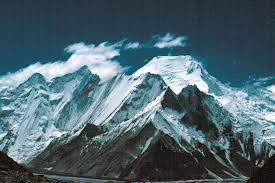
Karakorum mountains (Credit: bgrg.org)

ISLAMABAD, Sept 23: The use of drones in Pakistan normally brings to mind images of US spy planes attacking tribal areas. But drones now are being used to capture a different kind of picture in the country – showing some of the world’s highest mountains being scaled by world-class climbers through some of Earth’s thinnest air.

Drones, or remote-controlled aircraft, have long been the domain of the American military and are used extensively in Pakistan’s tribal areas near the Afghanistan border to spy on and target militants.

Recently, however, civilians have increasingly turned to drones to shoot ground-breaking footage of adventure sports.

This summer a Swiss expedition used remote-controlled helicopters to shoot rare footage of climbers on the Karakoram, one of the world’s most demanding and formidable mountain ranges.

“People are going to see footage from the Karakoram that no human being has ever seen,” said Corey Rich, a photographer and videographer from Lake Tahoe, California, who was on the expedition.

The expedition was a joint project between outdoor clothing and equipment company Mammut, and Dedicam, a firm that specialises in using remote-controlled helicopters to shoot video. Their goal: to document world-class mountaineer David Lama and his climbing partner Peter Ortner as they climbed Trango Tower.

The sheer granite tower in the Baltoro Glacier is more than 6,000 metres above sea level and is one of the most technically difficult climbs in the world.

Filmmakers long have used helicopters to capture aerial footage of climbers – as well as other extreme sport athletes like surfers and skiers –that is hard to capture from the ground. But helicopters are costly and can be dangerous if they crash or get too close to the people on the ground.

Additionally, their beating rotors often kick up dust, snow and wind – and can push climbers off balance.

Drones, which can weigh just a few kilograms and cost between $1,000 and $40,000, are a fraction of the size and cost of the helicopters traditionally used in adventure photography.

Newer models tend to have all of their rotors facing into the sky, making them look a bit like a mechanical flying spider or insect.

The main concern for the summertime expedition was how – and if – the drone would perform in Pakistan’s rugged conditions and high altitude.

“The main challenge was that the air is much thinner, and we didn’t know how the flight controls would work with this and the propellers and motors,” said drone operator Remo Masina, from Lucerne, Switzerland.

He brought two on the Pakistan expedition – one with four propellers and another with six. From the ground, he flew them with a handheld console that resembles a video game console, and wore goggles to let him see the camera’s view.

Another challenge was to find the climbers on the mountain. Tracing the planned trek route, Masina directed the drone up the mountain until he spotted them – more than a mile (roughly 2,000 metres) away.

The result was stunning images of the Karakoram and the climbers making it to the top.

Experienced climbers say the Karakoram puts the rest of the world’s mountain ranges to shame. Neighboring Nepal has Everest, the tallest mountain in the world, but Pakistan has four of the world’s 14 peaks that soar to more than 8,000 metres above sea level, including the second highest mountain on earth, K-2.

Lama and Ortner said climbing the legendary Pakistan mountains was an amazing experience.

“Here there are so many mountains, and so many difficult mountains, and mountains that haven’t been climbed,” said Lama.

“That’s probably why the Karakoram is known as paradise for us.”

This year has been particularly successful for Pakistan’s climbing industry, which plummeted in the wake of the Sept. 11, 2001 terror attacks in the US.

In addition to hosting the renowned Lama for the first time, Nazir Sabir, Pakistan’s elder statesman of climbing who was the country’s first person to scale Everest, said 30 climbers summited K-2 in 2012, the first summits from the Pakistani side of the mountain since 11 people died trying in 2008.

And the drone footage obtained during Lama and Ortner’s climb will expose even more viewers to the legendary Karakoram mountain range.

Drones also increasingly are being used in other adventure sports to push conventional photography boundaries. Cameras on drones have been used to capture video of surfers on Hawaii’s North Shore and to chase mountain bikers speeding down mountain trails.

“I’ve filmed anything from kayaking, rock climbing, mountain biking, to track and field to just casual walking,” said photographer and videographer Mike Hagadorn, who has begun to build his own drones to support his Colorado-based firm, Cloud Level Media.

“Anything you can dream of – and as long as you don’t crash – you can make it happen.”

Experts predict drone cameras eventually will become an integral part of every sports shoot. But for now, they re definitely a novelty. The Swiss team filming Lama said villagers in Pakistan stood in awe, staring at the drones as they buzzed around, whenever he used one on the expedition.

“We were trying to do this shot that showed this quaint village,” Rich said. “But every single person in the shot is standing, stopped in the street, looking up at the helicopter.


Army Stops Anti Film Protestors from Breaking into Diplomatic Enclave

Protestors overturn container blockade
ISLAMABAD, Sept 20: The Army was called in on Thursday to prevent close to 3,000 angry protesters from entering the diplomatic enclave in Islamabad during a protest against the anti-Islam film.

The US Embassy is one kilometre away from the entrance of the diplomatic enclave and there are no barriers inside. According to Express News correspondent Qamarul Munawar, if the protesters, who are present at the gate of the enclave, manage to break through, then it will result in chaos.

He added that the Army was called in as the police shelling remained ineffective in controlling the protesters.

Express News correspondent Haider Naseem reported that the protesters coming from Rawalpindi to Islamabad headed back after the police hurled tear gas at them.

Around 50 protesters and 38 police officials were injured during the riots who were shifted to the Polyclinic hospital.

An ulema delegation met with the IG Police and chief commissioner and agreed on a deal. Maulana Zahoor Alvi confirmed that the arrested protesters were also released.

SSP Traffic Police Islamabad Dr Moeen Masood told Radio Pakistan that the red zone of Islamabad will remain closed on Friday for traffic.

He said that the normal traffic would ply between the twin cities of Islamabad and Rawalpindi as well as within Islamabad.

Dr Masood added that 274 Islamabad police personnel were deployed for controlling traffic and they would remain alert on Friday as well.

Mobile services will also remain suspended in Islamabad tomorrow (Friday) from 9am-11pm to avoid any untoward incident.

Islamabad’s heavily-guarded diplomatic enclave is home to most Western embassies, including the US, British and French missions.

Earlier during the protest, police fired live rounds and tear gas to break up a crowd of students, many armed with wooden clubs.

The crudely made Innocence of Muslims has triggered protests in at least 20 countries since excerpts were posted online, and more than 30 people have been killed in violence linked to the film.

There have been dozens of protests around Pakistan over the past week and at least two people have been killed, but Thursday is the first time protests in the capital have turned violent.

Police fired tear gas and live rounds as the protesters, chanting “We are ready to die to safeguard the Prophet’s (pbuh) honour,” tried to break through a barrier of truck containers set up to block access to the diplomatic enclave.

“I was ordered by my boss to disperse the crowd and that is why I had to open live fire but the aim was nearby trees and not the demonstrators,” Zaman Khan, a police officer deployed at the picket said.

The firing forced the protesters to scatter, but they returned later to pelt the police picket with stones.

Student Asif Mehmood demanded police let the protesters through to the US embassy and urged harsh treatment for American pastor Terry Jones, notorious for past Quran-burning episodes and who is reportedly connected to the film.

“Terry Jones and the filmmaker should be sternly punished for playing with the feelings of Muslims. We will not tolerate this blasphemy,” Mehmood said.

Fellow protester Rehan Ahmad said: “Islam is often ridiculed by America and the West and blasphemy is committed against our Prophet (pbuh) in the name of freedom of expression.”


French Magazine Sets off New Outrage among Muslims

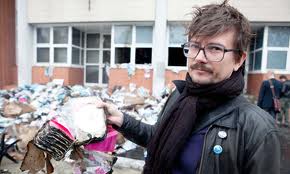
Charlie Hebdo Firebombed last year (Credit: guardian.co.uk)

PARIS, Sept 19 — A French satirical magazine on Wednesday published a series of cartoons mocking the Prophet Muhammad, setting off a new wave of outrage among Muslims and condemnation from French leaders amid widening unrest over an amateur video that has provoked violence throughout the Islamic world. The illustrations were met with a swift rebuke from the government of François Hollande, which had earlier urged the magazine, Charlie Hebdo, not to publish the cartoons, particularly in the current tense environment.

“In France, there is a principle of freedom of expression, which should not be undermined,” Laurent Fabius, the foreign minister, said in a French radio interview. “In the present context, given this absurd video that has been aired, strong emotions have been awakened in many Muslim countries. Is it really sensible or intelligent to pour oil on the fire?”

In the interview on France Info radio, Mr. Fabius announced that, as a precaution, France planned to close its embassies in 20 countries on Friday, the Muslim day of prayer, which has become an occasion for many to express their anger although “no threats have been made against any institutions.” A Foreign Ministry spokesman said the closings would affect French consulates, cultural centers and schools as well.

In Egypt, representatives of the Muslim Brotherhood denounced the cartoons as blasphemous and hurtful, and called upon the French judiciary to condemn the magazine.

Mahmoud Ghozlan, a spokesman for the group, noted that French law prohibits Holocaust denial and suggested that similar provisions might be made for comments deemed blasphemous under Islam.

“If anyone doubts the Holocaust happened, they are imprisoned,” Mr. Ghozlan told Reuters. “It is not fair or logical” that the same not be the case for insults to Islam, he said.

Religious and political leaders in other majority Muslim nations also denounced the cartoons but called for calm. Tunisia’s governing Islamist party, Ennahda, warned believers against falling into a trap set by “suspicious parties to derail the Arab Spring and turn it into a conflict with the West,” Reuters reported.

Charlie Hebdo’s Web site was not functioning on Wednesday, the result of a computer attack, according to the editorial director, Stéphane Charbonnier. A Pakistani technology news outlet, ProPakistani, reported that a Pakistani hacker group claimed it had blocked the site because of its “blasphemous contents” about Muhammad. The violence provoked by the video disparaging the prophet began on Sept. 11 when a mob attacked the American Embassy in Cairo. The unrest quickly spread to Libya, where an attack on an American diplomatic mission in Benghazi claimed the lives of the American ambassador, J. Christopher Stevens, and three staff members.

On Wednesday, police officers were dispatched to guard the offices of Charlie Hebdo in eastern Paris.

The magazine’s headquarters, not far from its present offices, were gutted by a firebomb in November after it published a spoof issue “guest edited” by Muhammad to salute the victory of an Islamist party in Tunisian elections. Mr. Charbonnier, the editorial director, has been under police protection since.

Neither he nor the publication had received threats as a result of the most recent issue of the magazine, he said.

Prime Minister Jean-Marc Ayrault said the government would prohibit a series of protests that had been planned in several French cities for Saturday — one week after a group of around 250 people staged a largely nonviolent protest of the American-made amateur film, “Innocence of Muslims,” outside the American Embassy here.

“There is no reason for us to let a conflict that doesn’t concern France come into our country,” Mr. Ayrault told RTL radio. “We are a republic that has no intention of being intimidated by anyone.”

Mr. Charbonnier contested that decision, which he called “shocking.”

“The government needs to be consistent,” he said. “Why should they prohibit these people from expressing themselves? We have the right to express ourselves, they have they right to express themselves, too.”

In a statement, the main body representing Muslims in France, the French Muslim Council, expressed its “deep concern” over the cartoons and warned that their publication risked “exacerbating tensions and provoking reactions.” The council urged French Muslims to express their grievances “via legal means.”

Mr. Charbonnier said the weekly published the cartoons in defense of freedom of the press, adding that the images “would shock only those who wanted to be shocked.”

Gérard Biard, the magazine’s editor in chief, said: “We’re a newspaper that respects French law. Now, if there’s a law that is different in Kabul or Riyadh, we’re not going to bother ourselves with respecting it.”

This week as every other week, Mr. Biard insisted, “We’ve simply commented on the news.” The caricatures are meant to satirize the video that has stirred violence across the Muslim world, he said, and to denounce that violence as absurd.

“What are we supposed to do when there’s news like this?” Mr. Biard asked. “Are we supposed to not do that news?”

Known for its sharply ironic and often vulgar tone, Charlie Hebdo has a reputation for being an equal-opportunity provocateur. In addition to episode in November, the magazine was criticized for a decision in 2006 to republish cartoons of Muhammad that first appeared in a Danish newspaper.

In an editorial on Wednesday, Le Monde, France’s newspaper of record, defended the magazine’s right to publish what it pleases, within the limits of French law. But it called the most recent caricatures “in poor taste, or even appalling” and questioned the “sense of responsibility of their authors and editors.”

Mr. Charbonnier held firm.

“I’m sorry for the people who are shocked when they read Charlie Hedbo,” Mr. Charbonnier said. “But let them save 2.50 euros and not read it. That’s the only thing I have to say.

“They can’t hold us responsible for the closure of the embassies, they can’t hold us responsible for the violence and the deaths,” he said. “We’re not provoking anything.” Religious radicals can use “any pretext to start the fire,” he said.

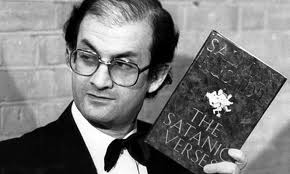
Salman Rushdie – A Wanted Man in the Muslim World

Rushdie's Road to Notriety (Credit guardian.co.uk)

Valentine’s Day 1989 had nothing to do with love for Salman Rushdie. He “hadn’t been getting on with his wife, the American novelist Marianne Wiggins,” but that was nothing compared with the news from Iran, where the Ayatollah Khomeini made an announcement that plunged Rushdie into more than a decade of fear, sequestration and flight. “I inform the proud Muslim people of the world,” Khomeini said, “that the author of the ‘Satanic Verses’ book, which is against Islam, the Prophet and the Koran, and all those involved in its publication who were aware of its content, are sentenced to death.”

Not long after the proclamation of this fatwa, the British police who had been protecting Rushdie told him that he needed an alias, not only for receiving payments and writing checks without being identified but “for the benefit of his protectors,” who “needed to get used to it, to call him by it at all times, when they were with him and when they weren’t, so they didn’t accidentally let his real name slip . . . and blow his cover.” After some thought Rushdie “wrote down, side by side, the first names of Conrad and Chekhov, and there it was, his name for the next eleven years”: Joseph Anton. These “were his godfathers now,” and “it was Conrad who gave him the motto to which he clung as if to a lifeline . . . ‘I must live until I die, mustn’t I?’ ”

Thus the title of this, Rushdie’s memoir of his entire life, but mainly of those more than 11 years of torment, years often made bearable by the friendship and love of others, yet years unceasingly under the threat of the dire unknown, while Rushdie was squirreled away in secret London hideaways and remote farmhouses. For anyone it would have been terrifying, but for this proud and passionately sociable man it was degrading as well:

“To hide in this way was to be stripped of all self-respect. To be told to hide was a humiliation. Maybe, he thought, to live like this would be worse than death. In his novel ‘Shame’ he had written about the workings of Muslim ‘honor culture,’ at the poles of whose moral axis were honor and shame, very different from the Christian narrative of guilt and redemption. He came from that culture even though he was not religious, and had been raised to care deeply about questions of pride. To skulk and hide was to lead a dishonorable life. He felt, very often in those years, profoundly ashamed. Both shamed and ashamed.”

As that passage indicates, Rushdie has chosen to tell his story in the third person: to write not about Salman Rushdie but about Joseph Anton, the person who for more than a decade was himself yet not quite himself. It takes a few pages for the reader to get used to this, but it works: It eliminates the temptations of self-pitying bathos (temptations that surely must have been severe) and allows Rushdie to maintain a certain clinical distance from himself. He further intensifies this effect by abandoning, for the most part, the elaborate, fanciful, quasi-poetic style that characterizes most of his previous work (including “The Satanic Verses”) and to write, instead, in a plain prose that by its severity makes his ordeal all the more palpable.

Anger Rolls Across Pakistani City in Aftermath of Factory Fire

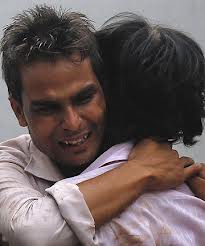
Relatives mourn Karachi factory fire (Credit stuff.co.nz)

KARACHI, Sept 13 — The towering metal door at the back of the burned-out garment factory could have been an escape for many of the low-paid textile workers caught in the fire here on Tuesday. Instead, it stands as a testament to greed and corruption at a factory where 289 trapped employees died. .

As hundreds of workers scrambled to escape the flaming factory after a boiler explosion, they found the main sliding door — 30 feet high, big enough for a truckload of cotton — firmly locked. Instead of letting the workers escape, several survivors said Thursday, plant managers forced them to stay in order to save the company’s stock: piles of stonewashed jeans, destined for Europe.

“They prevented people from leaving, so they could save the clothes,” said Shahzad, a stone-faced man in sweat-drenched clothes, standing in the blacked corridors of the factory.

His voice trembling, Shahzad, who goes by just one name, said he had already recovered the body of a 15-year-old cousin; now he was looking for his 23-year-old brother, Ayaz. He figured he was buried under the mounds of ash and twisted metal.

“He’s gone,” he said quietly.

Karachi buried its dead on Thursday amid grief and recrimination over the deadliest industrial accident in Pakistan’s 65-year history.

Sounds of mourning filled working-class neighborhoods as emotionally charged funeral processions wound through the narrow streets. Amid such a high death toll, the stories of misfortune competed for pathos — one street lost eight residents; a mother said she lost three daughters to the inferno, then a son who tried to rescue them.

At the factory, known as Ali Enterprises, rescue workers quenched the last flames 48 hours after they started. Volunteers cast bundles of smoldering jeans from a first-floor window.

Meanwhile, the police spent a second day hunting for the factory’s three owners, who now face possible charges of conspiracy to commit murder.

Mirza Ikhtiar Baig, the prime minister’s adviser on textiles, noted in a statement that after the first fire engine reached the scene on Tuesday, firefighters found that the manager had ordered the gates to be closed, “not allowing anyone to leave the premises without checking.”

Instead, up to 600 factory workers were left with just one open exit, or forced to take their chances plunging from windows considered too high to require bars.

Inside the factory, warmth still glowed from the pitch-black basement where many workers perished from smoke inhalation.

Muhammad Raheel, a rescuer, said he helped recover 30 bodies before fainting and having to be carried out on a stretcher. “I still have visions in my head,” he said. “It is impossible to forget.”

The disaster was a blow to an already struggling city: Karachi, a bustling megalopolis of an estimated 18 million people that has come to represent both the immense promise of Pakistan and its tragic failings.

For decades, Karachi and its growing factory sector have been a magnet for migrants, both from outside Pakistan’s borders and within them.

Afghans and Iranians arrived in huge numbers in the 1980s, fleeing war in their homelands. Recent years have seen a strong flow of ethnic Pashtuns from the Taliban-affected areas of northwestern Pakistan, as well as refugees from surrounding areas of Sindh Province displaced by the floods of 2010 and 2011.

The Ali Enterprise factory was a microcosm of Karachi. “We had Biharis, Gujratis, Baloch, Sindhi, Pashtuns, Urdu-speakers, Punjabis,” one survivor said. “Everyone worked here in peace.”

But that harmony has often been missing from the city’s streets, plagued by increasing violence in recent years: sectarian blood baths, criminal score-settling, militant atrocities and the bloody rivalry among the city’s ethnically divided political parties.

Activists from the Muttahida Qaumi Movement, the city’s most powerful and muscular political party, led cleanup efforts at the stricken factory on Thursday.

Karachi’s ambitions have also been thwarted by the faltering authority of the local or federal governments, which have failed to enforce the most basic workplace standards.

In theory, Pakistan’s laws offer strong protections to workers, but application is notoriously weak. In textiles, which account for 53 percent of exports, employers routinely sidestep health and safety regulations through bribery and corruption.

“The state inspectors can make a lot of extra money,” said Sharafat Ali, an activist with the Pakistan Institute of Labor Education and Research, which has documented abuses in the textile industry. “They have lifestyles that go beyond their wages.”

The lack of regulation was apparent inside the factory, which contained space for fire extinguishers that had failed and directions to emergency exits that were locked.

“There was no safety in there, no fire equipment,” said Khwaja Sohail Mansoor, a local lawmaker, who stood near a fire truck outside the factory.

Survivors of the blaze said rule-breaking was the norm at the plant, where many worked 12-hour shifts and were paid as little as $58 per month — one-third less than the statutory minimum.

German-language labels on bundles of denim that survived the blaze carried a brand named “Okay Men.” And workers at the factory said they had been forced to lie about their working conditions to auditors representing foreign buyers.

Hafeeza Bano, a 35-year-old with burn wounds on her leg and arm, said she had to misrepresent her working hours and pay or face the threat of dismissal. “The owners were very cruel, and very greedy,” she said.

Those men — identified as Abdul Aziz, Mohammad Arshad and Shahid Bhaila, and sought for arrest — have yet to be found.

A thread of outrage ran through news coverage. “Hundreds saw hell on Earth” read the banner headline in Dawn, the leading English-language paper.

On Thursday, the Sindh Province labor minister resigned. Hours later, the government announced that a retired judge would lead an investigation tasked with delivering initial findings next week. But few here believed it would amount to much.

“We need to do more than change the faces — we need to change the policies,” said Farida Bibi, who lost her 26-year-old son. “Then we need to hang the men who owned this factory.”

Alarmed at the wave of public anger, other textile manufacturers sought to distance themselves from their actions.

“We are shellshocked by what happened, and these people need to be held accountable,” said Shehzad Saleem, chairman of the Pakistan Garment Exporters and Manufacturers Association. “But everyone needs to calm down and let the investigation take place.”

The Muttahida Qaumi Movement called for three days of mourning, but the city is expected to be back on its feet soon. Karachi’s resilience is a point of pride, and normal life, of a sort, has tended to quickly resume after floods and bombings.

But Parween Rahman, the head of a major aid project in Orangi, the city’s largest slum, said that resilience may be a product of circumstance as much as a triumph of the human spirit. “Where do they go? They have to live their lives. They have to survive,” she said. “They have little other option.”