ISLAMABAD, Aug 7: The government is considering a plan to strengthen, monitor and coordinate inflows of foreign aids to international non-government organisations (NGOs) to carry out development work in the country.
The new expected rules might reduce the freedom of action of NGOs for spending on priority sectors of the country.
Massive inflows of foreign aid to NGOs had been witnessed during the last many years, which mostly remained unaccounted for and out of government ambit.
To regulate the mushroom growth NGOs, the Economic Coordination Committee (ECC) of the Cabinet had constituted a high level committee at its meeting held last week to review regulatory framework for NGOs working in Pakistan for facilitation of the humanitarian and development work.
On Tuesday, the committee held its first meeting on the issue which was chaired by Federal Minister for Science and Technology Zahid Hamid. The meeting was briefed about the current policy and legal framework and the proposals to bring improvements in this framework.
The committee decided that in line with the present government’s policy of good governance and transparency, it would undertake a transparent consultative process with all stakeholders in public and private sectors before finalising its recommendations for consideration of the government.
The chairman of the committee Mr. Zahid noted that the objective of these improvements was to ensure that maximum transparency was achieved in the work of these international organisations and their work was in line with the reform initiatives of the government and humanitarian and development requirements of the country.
The minister further observed that the regulatory framework must facilitate the flow of resources to the appropriate sectors and must act as a help to these organisations who provide relief and development assistance to Pakistan.
A well-placed source told Dawn that focus of the regulation would be to bind these NGOs to carry out development work in national priorities areas. Currently, the NGOs implement their own agenda for their so called development works.
In 2010, India also carried out extensive reforms to regulate inflows of foreign assistance to NGOs and made them bound to spend on government identified priorities areas.
The proposed reforms of the law are expected to increase government control on the economy that revolves around NGOs. Many legislators had requested the previous government to carry out audit of the spending of these NGOs, but no attention was paid to their demand.
Experts suggested that government should do away with the permanent registration of these NGOs and make it time bound. Similarly, organisation of political nature should not receive foreign funds.
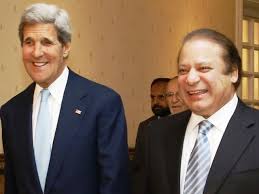
Kerry meets Sharif (Credit: tribune.com.pk)ISLAMABAD, Aug 1 — U.S. Secretary of State John Kerry and his Pakistani counterpart, Sartaj Aziz, said Thursday that the two countries will resume high-level negotiations over security issues.
Kerry also said he had invited Pakistan’s newly elected Prime Minister, Nawaz Sharif, to come to Washington to meet with President Barack Obama.
“I’m pleased to announce that today, very quickly, we were able to agree to a resumption of the strategic dialogue in order to foster a deeper, broader and more comprehensive partnership between our countries,” Kerry said at a press conference with Aziz in Islamabad.
He said the talks will cover “all of the key issues between us, from border management to counterterrorism to promoting U.S. private investment and to Pakistan’s own journey to economic revitalization.”
The U.S. and Pakistan launched high-level talks on a wide swath of security and development programs in 2010. But the talks stalled in November 2011 after U.S. airstrikes on a Pakistani post on the Afghan border accidentally killed 24 Pakistani soldiers. Even before that, the bilateral relationship was severely damaged by a variety of incidents, including a CIA contractor shooting to death two Pakistanis in the eastern city of Lahore and the covert U.S. raid that killed Osama bin Laden in Pakistani town of Abbottabad.
The resumption of the strategic dialogue indicates that the relationship between the two countries has improved since that low point. But there is still significant tension and mistrust between the two countries, especially regarding U.S. drone strikes and Pakistan’s alleged ties with Taliban militants using its territory to launch cross-border attacks against American troops in Afghanistan.
“It is also no secret that along this journey in the last few years we’ve experienced a few differences,” Kerry said. “I think we came here today, both the prime minister and myself, with a commitment that we cannot allow events that might divide us in a small way to distract from the common values and the common interests that unite us in big ways.”
Kerry was also asked about progress on a bilateral security agreement with Afghanistan that would keep some U.S. forces in that country after 2014.
“I am personally confident that we will have an agreement, and the agreement will be timely,” he replied. “And I am confident that the president has ample space here within which to make any decisions he wants to make regarding future troop levels.”
While this is Kerry’s first visit to Islamabad as secretary of state, he has a long history of dealing with Pakistan as former chairman of the Senate Foreign Relations Committee. Sharif described him as “a wonderful friend,” and Kerry said, “I have had the pleasure of visiting (Sharif’s) home and having a number of meals with him.”
Before heading into a closed-door meeting, Sharif asked Kerry about his wife, Teresa Heinz Kerry, who was hospitalized after a seizure last month.
“She’s doing better,” Kerry said.
Sharif came to power in an election that marked the first time in Pakistan that a civilian government completed its full five-year term and transferred power in democratic elections. The country has a history of civilian leaders being overthrown in military coups.
“This is a historic transition that just took place,” Kerry told U.S. Embassy employees. “Nobody should diminish it.”
Senior administration officials traveling with Kerry told reporters that while relations with Pakistan have grown touchy in recent years, there is the prospect of resetting those ties with Sharif’s government and working together on major issues – counterterrorism, energy, regional stability, economic reforms, trade and investment. The officials spoke on condition of anonymity because they weren’t authorized to publicly discuss Kerry’s agenda.
The U.S. wants to help strengthen the role of the civilian government in Pakistan, where the military long has been dominant, and wants Sharif to tackle rising extremist attacks inside his country.
The prison break this week that freed hundreds of inmates raises serious questions about Pakistan’s ability to battle an insurgency that has raged for years and killed tens of thousands. Suspected Islamic militants killed at least 160 people during the new government’s first month in office. Sharif’s government has not articulated an alternate strategy.
The U.S. also wants Pakistan to pressure leaders of the Afghan Taliban to negotiate with Afghan President Hamid Karzai’s government, renounce violence and sever ties with al-Qaida.
Officials in neighboring Afghanistan are demanding that Pakistan dismantle extremists’ havens inside Pakistan and push the Taliban to join the peace process. Both the U.S. and Afghanistan say that if attacks are allowed to continue, the region will never become stable. Pakistani officials say they do not control the Taliban, but Karzai’s government isn’t convinced.
Drone strikes are another point of contention.
Washington says it needs to attack dangerous militants with drones because Pakistan’s government refuses to engage them militarily. Pakistan contends the drone strikes are a fresh violation of its sovereignty, and they have increased widespread anti-American sentiment in the country.
The United States has reduced the number of drone attacks against militants in Pakistan and limited strikes to top targets. These moves appear to have appeased Pakistan’s generals for now, U.S. officials said. But some officials worry about pushback from the new civilian officials, including Sharif, who wants the attacks ended.
There have been 16 drone strikes in Pakistan this year, compared with a peak of 122 in 2010, 73 in 2011 and 48 in 2012, according to the New America Foundation, a U.S.-based think tank.
After Kerry wraps up his meetings in Islamabad, he is scheduled to fly to London. The State Department said he will meet there with United Arab Emirates Foreign Minister Abdullah bin Zayed Al-Nahyan to discuss Egypt, Syria and Middle East peace.
___
Associated Press writer Sebastian Abbot contributed to this report.
Taliban jail break in DI Khan (Credit: ibtimes.com)DERA ISMAIL KHAN/PESHAWAR, July 31: In one of the two biggest jailbreaks in the history of Pakistan, the militants on Tuesday helped 243 prisoners escape from the British-era Dera Ismail Khan Central Prison after killing 12 people, including six policemen, while five attackers were also killed. Around 300 prisoners had escaped in a similar jailbreak in Bannu when scores of militants stormed the dungeon in April last year.
Inspector General Police (IGP) Khyber Pakhtunkhwa Ihsan Ghani told The News that 60 to 70 men, armed with heavy weapons and explosives, carried out the attack during which around 250 prisoners managed to escape.
A number of hardened militants were among the inmates of the Dera Ismail Khan Central Prison. Among them was Walid Akbar, who had been awarded 1,616 years jail sentence for his involvement in bombing of the Ashura procession in the city last year.
The IGP KP, along with Inspector General Prisons Khalid Abbas and other senior officials of the Home and Tribal Affairs Department, on Tuesday reached Dera Ismail Khan from Peshawar to visit the prison.
Officials and eyewitnesses said over 100 attackers came in vehicles and also on motorbikes to storm the prison from all the four sides simultaneously as one group opened fire on a security checkpost near the jail that was built in 1854.
“The attackers killed six policemen including Mazhar Hussain, Saifullah, Rustam, Mir Zaman and Piao Sardar. Two prisoners from Multan, Sajid and Juma Malang, who had been awarded death sentences, as well as two other inmates, Akhtar Abbas and Muhammad Aslam were also killed inside their barracks,” said an official.
The official said three other people, including the watchman of a bakery, a passerby and an unknown person, were also killed while 16 persons were wounded.Curfew was clamped in Dera Ismail Khan and Tank districts after the attack and a massive search operation was launched.
Locals said they heard dozens of huge and minor explosions starting from 11:15pm on Monday that continued till 2:30am on Tuesday. “I could count over 30 explosions and it continued after that,” said a resident in Dera Ismail Khan. Due to expansion of the city and increase in the population, the prison is now located in densely populated part and the bomb blasts could be heard in the nearby localities all night. It also scared the people and prompted them not to venture outside.
Dozens of improvised explosive devices (IEDs) and other explosives were defused during an operation to sweep the prison. “The bomb disposal unit (BDU) experts defused 28 time bombs, four remote-control IEDs, a suicide jacket, five rockets and eight grenades during the search operation. The area has been cleared now,” the chief of the BDU Shafqat Malik told The News. The inmates who escaped from the cell included around 30 militants. Five women prisoners were also among those who fled during the jailbreak.
Expressing anger over the jailbreak, Khyber Pakhtunkhwa Chief Minister Pervez Khattak termed it a failure of the intelligence agencies. He ordered a probe into the jailbreak, vowing to take the strictest action against those found negligent. The joint inquiry committee that he constituted to probe the incident was asked to submit the report within 15 days.
The committee will comprise Senior Member Board of Revenue (SMBR) Waqar Ayub, Special Secretary Home Department Syed Alamgir Shah, Additional Inspector General Police (Special Branch) Akhtar Ali Shah and representative of Pakistan Army (Headquarters 11 Corps).
The chief minister said he was told by the authorities recently that adequate measures had been taken for the security of the prison. He said he would visit the jail. He directed the authorities to increase security of the prisons.
Furthermore, 27 cops, including a superintendent of police (SP), were suspended for showing negligence during the whole episode.The authorities had reportedly got reports that the militants were planning to attack the prison. Ominously, a clash inside the Dera Ismail Khan Central Prison a day earlier had resulted in injuries to two cops.
“We had taken shelter in a nearby bakery. The attackers also shot dead the watchman of the bakery when he fired two shots in the air,” said an eyewitness.
Some eyewitnesses said the police arrived too late as armed men had taken positions on all the four sides to counter them.Commissioner Dera Ismail Khan Mushtaq Jadoon told reporters that 242 prisoners had escaped during the attack. He said people were told not to come out of homes as the police and army were clearing the area.
The deputy inspector general (DIG) police, commissioner and deputy commissioner Bannu, IG Prisons and superintendent Bannu Prison were suspended over the Bannu jailbreak in April last year. Militants had helped free around 300 prisoners during the attack. Those who escaped at the time included Adnan Rashid, convicted for his involvement in the attack on the then President General Pervez Musharraf.
Taliban spokesman Shahidullah Shahid claimed that more than 250 prisoners escaped from the jail.“Majority of our people along with the freed prisoners reached a secure place. Some of our very senior people also succeeded to escape,” the spokesman claimed.
The IGP along with home secretary and an additional IG visited the prison and heard the account of the incident from the cops. The IGP suspended SP, DSP of the Elite Force and their subordinates in the area.
An inquiry committee was constituted that comprised additional inspector general of Special Branch and senior member of the Board of Revenue.The IGP also posted Ijaz Ahmad as DIG of Dera Ismail Khan. The DIG was transferred a couple of days back to Mardan.SP Elite Force Toheed and DSP Behram were among 27 cops suspended in Dera Ismail Khan.An investigation team headed by SP Investigation Dera Ismail Khan was also formed.
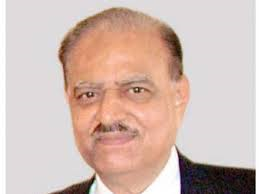
KARACHI, Aug 1: Mamnoon Hussain, president elect of Pakistan, told the BBC Urdu website that political parties were backing groups of criminals, land-grabbers, and extortionists and that this fact had been highlighted in various decisions of the courts.
In his first interview after getting elected as the 12th president of Pakistan, the Karachi-based senior politician said that whenever he thinks of resolving the law and order issue of Pakistan his mind comes to Karachi first adding that he was well aware of the practical situation in the city.
Elaborating further on the topic he said that Karachi would have to be given special attention as it was the driving force of the entire country and that the city was vital to the country not just from the economic aspect but from every angle.
Talking about the deteriorating law and order situation of Karachi Hussain said that full fledged action to eradicate crime was not taken in the past as the criminals, land-grabbers, and extortionists had the backing of political parties and that this fact had been mentioned in various court verdicts.
He added that the situation could not improve until the practice was ended and criminal elements were brought to justice.
Hussain said that there was need for intelligence agencies to come together under one platform and for political parties to stop backing criminals.
Reminiscing about Agra the president elect said that if the Pakistan Muslim League – Nawaz (PML-N) government initiated peace talks with neighbouring India, he wished to be part of the process and hoped to play a role in this regards, as Agra was his birthplace.
He further said that he wished to visit Agra, especially, to see the Taj Mahal.
Mamnoon Hussain was born in India’s Agra city on 1940 and he migrated from India with his family to Pakistan during the 1947 partition of the sub-continent.
CIA closing bases (nytimes.com)Washington, July 24: The CIA has begun closing clandestine bases in Afghanistan, marking the start of a drawdown from a region that transformed the agency from an intelligence service struggling to emerge from the Cold War to a counter¬terrorism force with its own prisons, paramilitary teams and armed Predator drones.
The pullback represents a turning point for the CIA as it shifts resources to other trouble spots. The closures were described by U.S officials as preliminary steps in a plan to reduce the number of CIA installations in Afghanistan from a dozen to as few as six over the next two years — a consolidation to coincide with the withdrawal of most U.S. military forces from the country by the end of 2014.
Senior U.S. intelligence and administration officials said the reductions are overdue in a region where U.S. espionage efforts are now seen as out of proportion to the threat posed by al-Qaeda’s diminished core leadership in Pakistan.
The CIA faces an array of new challenges beyond al-Qaeda, such as monitoring developments in the Middle East and delivering weapons to rebels in Syria. John O. Brennan, the recently installed CIA director, has also signaled a desire to restore the agency’s focus on traditional espionage.
“When we look at post-2014, how does the threat in Afghanistan and Pakistan measure against the threat in North Africa and Yemen?” said a senior administration official who spoke on the condition of anonymity to discuss government deliberations. “Shouldn’t our resources reflect that?”
U.S. officials stressed that the CIA is expected to maintain a significant footprint even after the pullback, with a station in Kabul that will remain among the agency’s largest in the world, as well as a fleet of armed drones that will continue to patrol Pakistan’s tribal belt.
The timing and scope of the CIA’s pullback are still being determined and depend to some extent on how many U.S. troops President Obama decides to keep in the country after 2014. The administration is expected to reduce the number from 63,000 now to about 10,000 after next year but recently signaled that it is also considering a “zero option,” in part because of mounting frustration with Afghan President Hamid Karzai.
The CIA may be in a unique position to negotiate with Karzai, who has publicly acknowledged accepting bags of money from the agency for years. The CIA also has provided much of the budget and training for the Afghan intelligence service. The agency wants to maintain the strength of those ties.
Even so, a full withdrawal of U.S. troops would probably trigger a deeper retrenchment by the CIA, which has relied on U.S. and allied military installations across the country to serve as bases for agency operatives and cover for their spying operations. The CIA’s armed drones are flown from a heavily fortified airstrip near the Pakistan border in Jalalabad.
The CIA’s presence in the country has already dropped well below the peak levels of several years ago, when more than 1,000 case officers, analysts and other employees had been deployed to support the war effort and hunt al-Qaeda leaders, including Osama bin Laden.
The CIA declined to comment on the withdrawal plans.
“Afghanistan fundamentally changed the way the agency conducts business,” said Richard Blee, who served as the CIA’s senior officer in Afghanistan and Pakistan before he retired in 2007. “We went from a purely espionage organization to more of an offensive weapon, a paramilitary organization where classic spying was less important.”
Some of the bases being closed served as important intelligence-gathering nodes during the escalation of the agency’s drone campaign, raising the risk that U.S. counterterrorism capabilities could deteriorate and perhaps allow remnants of al-Qaeda to regenerate.
U.S. officials played down that danger. “There’s an inherent imbalance,” the administration official said. “The effectiveness of our operations has reduced the threat to the point that it’s entirely appropriate that we have a smaller counterterrorism footprint.”
White House officials have been weighing a shift of some of those resources to other regions, including Yemen and North Africa, where al-Qaeda affiliates are now seen as more dangerous than the network’s base. The White House discussions have been part of the overall deliberations over U.S. troop levels in Afghanistan.
The CIA drawdown coincides with Afghanistan-related personnel moves. The agency recently appointed a new station chief in Kabul, a selection that raised eyebrows among some because the veteran officer is known mainly for his tours in Latin America and had not previously served in Afghanistan.
The top military post at CIA headquarters is also changing hands. U.S. Army Maj. Gen. Tony Thomas, who was in charge of Special Operations units in Afghanistan, is set to begin serving as associate CIA director for military support in September, replacing an Air Force general with drone expertise.
Current and former U.S. officials familiar with the agency’s plans said they call for pulling most agency personnel back to the CIA’s main station in Kabul, plus a group of large regional bases — known as the “big five” — in Bagram, Kandahar, Mazar-e Sharif, Jalalabad and Herat.
“The footprint being designed involves six bases and some satellite [locations] out of those,” said a former senior CIA officer who also spoke on the condition of anonymity. The agency may also rely on “mobile stations” in which a small number of operatives move temporarily into remote locations “where they trust the tribal network,” the former officer said. “Protection issues are going to be critical.”
The base closures involve compounds along the Pakistan border, part of a constellation used by CIA operatives and analysts to identify drone targets in Pakistan. The bases, including locations in the provinces of Zabul, Paktika and Khost, have relied heavily on U.S. military and medical evacuation capabilities and were often near larger military outposts.
Among them is Forward Operating Base Chapman, in Khost, where seven CIA employees were killed by a suicide bomber posing as a potential informant in 2009. It is unclear whether the CIA will pull its personnel out of Chapman, which remained active even after that attack.
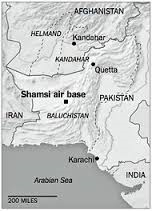
Administration deliberations over troop levels could also determine where the agency operates its drones. During the early years of the campaign, the aircraft were flown from Shamsi Air Base in Pakistan, but the agency moved most of its fleet to Jalalabad as public opposition to strikes mounted in Pakistan and relations with the government broke down.
The tempo of the CIA’s drone campaign has already tapered off. The 17 strikes this year in Pakistan are far off the peak pace of 2010, when there were 117 strikes, according to the Long War Journal, a Web site that tracks drone attacks. Over the past decade, the campaign has killed as many as 3,000 militants and dozens if not hundreds of civilians, according to independent estimates.
U.S. officials said that preferred troop-level options would allow U.S. forces to remain at Jalalabad, in part so that the CIA’s flights could continue. But officials said the drones could also be shifted to airstrips at Bagram or Kandahar. The latter has already served as a base for stealth drones used to conduct secret surveillance flights during the bin Laden raid and over Iran.
This year, President Obama approved new counterterrorism guidelines that call for the military to take on a larger role in targeted killing operations, reducing the involvement of the CIA.
But the guidelines included carve-outs that gave the agency wide latitude to continue armed Predator flights across the border and did not ban a controversial practice known as “signature strikes,” in which the agency can launch missiles at targets based on patterns of suspicious behavior without knowing the identities of those who would be killed.
The senior Obama administration official said the United States may propose a shift to military drone flights inside Pakistan as part of the discussions with Afghanistan and Islamabad over U.S. troop levels.
The negotiations are seen as the “one shot you have” to raise the issue, the official said, adding that it was doubtful but “not impossible” that Pakistan would consent. Islamabad has never formally acknowledged its cooperation on the drone program and is seen as unlikely to allow a covert — if not exactly secret — CIA operation to give way to an overt campaign involving U.S. military flights.
Despite the pullout of U.S. troops and CIA operatives, officials said the drone campaign in Pakistan and elsewhere is expected to continue for years. Mike Sheehan, the assistant defense secretary for Special Operations, testified recently that such counterterrorism operations will probably last an additional 10 years or more.
The administration official said others believe the end is closer. The strikes will probably last “some period of years,” the official said. “But I don’t think you can project out five or 10.”
ISLAMABAD: Suleman spent years targeting members of the Shia community in his home country of Pakistan as a member of sectarian terrorist group Lashkar-e-Jhangvi (LeJ). Now he is on his way to a new sectarian battleground, Syria, where he plans to join rebels battling President Bashar Assad’s regime.
The short and stocky man, who identified himself using only his first name for fear of being targeted by authorities, is one of an increasing number of militants who have left Pakistan for Syria in recent months.
The fighters have contributed to a growing presence of extremists and complicated US efforts to help the rebels. Many fighters like Suleman believe they must help Syria’s Sunni majority defeat Assad’s Alawite regime.
The presence of religious extremists in Syria looms large over US efforts to help the rebels, especially when it comes to providing weapons that could end up in the hands of America’s enemies. The extremists have also sparked infighting with more secular rebels concerned about their increasing power. Most of the foreign fighters in Syria are from Arab countries, including Al Qaeda militants from Iraq on the rebel side and Hezbollah fighters from Lebanon on the regime’s side. The flow of militants from Pakistan adds a new element to that mix.
Pakistani Interior Ministry spokesman Omar Hamid Khan said provincial authorities throughout Pakistan deny that militants have left the country for Syria. But three Pakistani intelligence officials based in the tribal region that borders Afghanistan, as well as militants themselves, say the fighters leaving Pakistan for Syria include members of Al Qaeda, the Pakistani Taliban and the LeJ.
The fighters fall mainly into two categories. One includes foreign combatants from places like Uzbekistan, Turkmenistan and likely the Middle East who came to Pakistan’s tribal region to fight US-led forces in neighbouring Afghanistan and are now heading to Syria because they view it as the most pressing battle, said the Pakistani intelligence officials, speaking on condition of anonymity because they were not authorised to talk to the media. This group includes members Al Qaeda who trained the Pakistani Taliban in areas such as bomb-making and are now moving on to the battlefield in Syria, said Pakistani Taliban fighters, speaking on condition of anonymity.
Neither the intelligence officials nor the Pakistani militants were able to provide the total number of fighters who have left the country for Syria, or the route they were taking to get to the Middle East. An activist based in northern Syria, Mohammad Kanaan, said there are Pakistanis fighting in his area but not in large numbers. ”Most … are Arab fighters from Tunisia, Algeria, Iraq and Saudi Arabia,” he said Sunday. ”But we have seen Pakistanis and Afghans recently as well.”
The second group leaving Pakistan includes mostly domestic members of the Pakistani Taliban and LeJ who are heading to Syria, saying they are being so closely monitored by Pakistani authorities that it makes it difficult for them to carry out operations at home, said a Pakistani Taliban fighter who identified himself only as Hamza.
These militants are under surveillance because they have been detained previously in connection with attacks, or are on Pakistan’s radar because of their importance in their organisations, Hamza said. The group includes Suleman, who was detained during a 2009 attack on an intelligence building in the eastern city of Lahore that killed at least 35 people. He was eventually released, he told the AP in an interview before leaving for Syria more than a week ago.
Suleman is one of about 70 militants who have been sent to Syria in the last two months by a network jointly run by the Pakistani Taliban and LJ, Hamza said. The militants came from various parts of Pakistan, including the provinces of Balochistan, Punjab and Khyber Pakhtunkhwa (KP), and the southern city of Karachi, Hamza said.
Another group of 40, including Hamza, is expected to leave in the coming weeks, he said. These militants are not going to fight with Jabhat al-Nusra, or the Nusra Front, the most powerful Islamic militant group in Syria, Hamza said. But he did not know which group they would join. The head of the network sending these militants is a former leJ leader named Usman Ghani, Hamza said.
Another key member is a Pakistani Taliban fighter named Alimullah Umry, who is sending fighters to Ghani from KP, Hamza said.The militants are traveling to Syria by various routes, and some are taking their families. The most closely watched are secretly taking speed boats from Balochistan’s coast to the Omani capital of Muscat and then traveling onward to Syria, Hamza said.
Others are flying from Pakistan to various countries, including Sri Lanka, Bangladesh, the United Arab Emirates and Sudan, and then making their way to Syria. The financing is coming from sources in the United Arab Emirates and Bahrain, Hamza said. Suleman flew to Sudan with his wife and two children using fake passports, he said. He will leave his family in Sudan and then travel to Syria. There are families of other Pakistanis who have gone to Syria already living in Sudan and being taken care of, Suleman said. A member of Jamaat-e-Islami said a small number of its followers have also gone to fight in Syria, but not through any organised network. He spoke on condition of anonymity for fear of being persecuted by the government.
KARACHI, Pakistan — Usman, who limps on a leg bowed by the polio he caught as a child, made sure that his first three children were protected from the disease, but he turned away vaccinators when his youngest was born.
He was furious that the Central Intelligence Agency, in its hunt for Osama bin Laden, had staged a fake vaccination campaign, and infuriated by American drone strikes, one of which, he said, had struck the son of a man he knew, blowing off his head. He had come to see the war on polio, the longest, most expensive disease eradication effort in history, as a Western plot.
In January, his 2-year-old son, Musharaf, became the first child worldwide to be crippled by polio this year.
“I know now I made a mistake,” said Usman, 32, who, like many in his Pashtun tribe, uses only one name. “But you Americans have caused pain in my community. Americans pay for the polio campaign, and that’s good. But you abused a humanitarian mission for a military purpose.”
Anger like his over American foreign policy has led to a disastrous setback for the global effort against polio. In December, nine vaccinators were shot dead here, and two Taliban commanders banned vaccination in their areas, saying the vaccinations could resume only if drone strikes ended. In January, 10 vaccinators were killed in Nigeria’s Muslim-dominated north.
Since then, there have been isolated killings — of an activist, a police officer and vaccinators — each of which has temporarily halted the campaign.
The war on polio, which costs $1 billion a year and is expected to take at least five more years, hangs in the balance. When it began 25 years ago, 350,000 people a year, mostly children, were paralyzed. Last year, fewer than 250 were, and only three countries — Afghanistan, Nigeria and Pakistan — have never halted its spread at any point.
While some experts fear the killings will devastate the effort here, Pakistan’s government insists that they will not, and has taken steps to ensure that. Vaccinators’ pay was raised to $5 a day in the most dangerous areas, police and army escorts were increased and control rooms were created to speed crisis responses.
But the real urgency to finish the job began earlier, for a very different reason. Two years ago, India, Pakistan’s rival in everything from nuclear weapons to cricket, eliminated polio.
“Nothing wounded our pride as much as that,” said Dr. Zulfiqar A. Bhutta, a vaccine expert at Aga Khan University’s medical school.
Bill Gates, who is the campaign’s largest private donor and calls beating the disease “the big thing I spend the majority of my time on,” said that Pakistan’s desire to not be further humiliated “is our biggest asset.”
After India’s success and hints from the World Health Organization that it might issue travel warnings, Pakistan’s government went on an emergency footing. A cabinet-level “polio cell” was created. Vaccinators’ routine pay doubled to $2.50. More than 1,000 “mobilizers” were hired to visit schools and mosques to counter the ever-swirling rumors that the vaccine contained pork, birth control hormones or H.I.V., the virus that causes AIDS.
Mullahs were courted to endorse vaccination. They issued 24 fatwas, and glossy booklets of their directives were printed for vaccinators to carry.
Perhaps most important, local command was given to deputy commissioners, who have police powers that health officials lack.
Pakistan is closer than ever. Although cases will not peak until after the summer monsoons, there have been only 21 so far this year. A few years ago, 39 substrains of the polio virus circulated; now only two do. About 300,000 children live in areas too dangerous for vaccinators, but almost all the sewage samples from those areas are clear of the virus.
Ultimately, though, success will depend on more than political will and the rivalry with India. In the wake of the recent killings, it will rely most of all on individual acts of courage, like those by prominent imams who pose for pictures as they vaccinate children.
Or by Usman, who appeared with his polio-stricken son, Musharaf, in a fund-raising video asking rich Persian Gulf nations to buy vaccines for poor Muslims elsewhere.
Or by volunteers, like the women of the Bibi family, in Karachi, who formed a vaccination team. Two of them, Madiha, 18, and Fahmida, 46, were gunned down in December. Television news showed female relatives keening over their bodies. Not only are those women still vaccinating, but Madiha’s 15-year-old sister also volunteered for her spot.
“All the children of Pakistan are our children,” said Gulnaz Shirazee, 31, who leads the team. “It’s up to us to eradicate polio. We can’t stop. If we’re too afraid, then who will do it?”
A Moving Target
If there is one spot on earth where polio may make its last stand, it is a cramped slum called Shaheen Muslim Town No. 1 in Peshawar, a hotbed of anti-Western militancy. Since sampling began, its sewers have never tested negative for the virus.
It is a neighborhood of migrant Pashtun families who rent rooms briefly and move on, looking for menial jobs picking fruit or making bricks. On a recent sunny afternoon, its alleys were full of carts drawn by donkeys whose faces were decorated with the red prints of hands dipped in henna. Many women wore the full burqa popular in Afghanistan.
In this part of the world, virtually all those with polio are from the Pashtun tribe, in which resistance to vaccination is highest. It is Afghanistan’s largest ethnic group and the wellspring of the Taliban, but a minority in Pakistan. Pakistani Army sweeps and American drone strikes have driven many Pashtuns from their mountain valleys into crowded cities.
Peshawar worries even Dr. Elias Durry, a normally optimistic polio specialist with the W.H.O. “You can get 90 percent vaccine coverage, and come back a few months later, and it’s 50 percent,” he said. “People just move so quickly.”
Shaheen’s sewers are concrete trenches about a foot deep, into which wastewater, rendered milky white by dish soap, flows from pipes exiting mud-brick houses. A child reaching into one for a stick to play with showed how easily the virus, carried in fecal matter, could spread.
Though the area has clean water from a well, the steel pipe it flows through at times dips inside the sewerage trench. It has dents where trucks have banged it, and it is pierced by connectors, some attached just to rubber hoses.
“Piped water with sewage mixed in is worse than no piped water,” said Dr. Bhutta of Aga Khan. “Sometimes rural populations have it better. They carry water from the river, and they defecate in open fields, so there’s no mixing.”
Pakistani children suffer diarrhea so often that half the country’s young are stunted by it. Polio immunity is low, even in vaccinated children, because other viruses crowd the gut receptors to which the vaccine should attach.
At the clinic in Shaheen, the doctor running the polio drive, an ophthalmologist, complained that he got too little police help.
“I have 28 teams, so I requested 56 constables,” he said. “I was given 12.”
He said the underpaid officers inevitably knocked off at midday because their station house serves a hot meal.
The same problem was echoed in Gadap Town, a Karachi neighborhood where vaccinators were killed in December. As a team worked its way from house to house with a reporter, it had every reason to feel secure: because the visit was arranged by an official, six officers with AK-47s came along.
But another team passing by was guarded only by an aged sergeant with a cudgel.
“Yes, we have a security problem,” Dr. Syed Ali, a local official, said quietly on a side street. “What is a stick in front of a gun?”
The isolation and poverty of the Pashtun tribe underlie its resistance. Many of its imams are from Islam’s fundamentalist Deobandi sect, which emerged in the 19th century as a reaction to the British conquest.
Many Pashtun neighborhoods receive few government services like health clinics, paved streets or garbage pickup, but get shiny new billboards trumpeting the polio fight paid for by Western donors.
“People tell us, ‘We need schools, we need roads, we need housing, and all you bring our children is polio, polio, polio,’ ” said Madiha, a black-veiled Gadap vaccinator.
In the middle of last year, it became known that in 2011, the C.I.A. had paid a local doctor to try to get DNA samples from children inside an Abbottabad compound to prove they were related to Bin Laden.
Even though the doctor, Shakil Afridi, who is now serving a 33-year sentence for treason, was offering a hepatitis vaccine, anger turned against polio drops.
Leaders of the polio eradication effort could not have been more frustrated. They were already fighting new rumors that vaccinators were helping set drone targets because they have practices like marking homes with chalk so that follow-up teams can find them. Now, after years of reassuring nervous families that the teams were not part of a C.I.A. plot, here was proof that one was.
“It was a huge, stupid mistake,” Dr. Bhutta said.
Anger deepened when American lawmakers called Dr. Afridi a hero and threatened to cut off aid if he was not released. The W.H.O. and the Unicef, afraid of offending the United States, did not protest publicly. Unicef’s executive director, Anthony Lake, is a former White House national security adviser, which put the agency in an awkward position, an agency official said on the condition of anonymity because of the sensitivity of the issue.
But the deans of a dozen top American public health universities wrote a letter of protest to the Obama administration. Mr. Gates said he endorsed it, though he was not asked to sign. He also said he discussed the issue with Tom Donilon, the former national security adviser, though he would not give details of the conversation.
Fistfuls of Rupees
New opposition has forced the adoption of new ground tactics.
Dr. Qazi Jan Muhammad, the former deputy commissioner of Karachi East, called his approach “a mix of carrots and sticks.”
Whole apartment buildings were missed, he discovered, because Pashtun watchmen were shooing away vaccinators.
“I had the police tell them: ‘Either you let them in, or you go behind bars,’ ” he said.
He had traffic circles blocked so teams could approach each car, and he led some teams himself holding fistfuls of rupees, worth about a penny each.
“I saw a girl, about 11, carrying her 2-year-old sister,” he said. “I gave her a 10-rupee note and said, ‘Will you allow me to give drops to your sister? You can get sweets for yourself.’ ”
“She told all the children, ‘A man is giving away 10 rupees,’ and they all came rushing. I vaccinated 400 kids for only 4,000 rupees.”
The sewers of his district, which has several million inhabitants, are now virus-free.
At the Front Lines Again
The country’s new determination has also brought Rotary International back to the front lines.
The club, founded in Chicago in 1905, started the global polio eradication drive in 1988. It has had chapters in what is now Pakistan since 1927, and is now led by Aziz Memon, a hard-driving textile magnate.
Mr. Memon, 70, and other Rotary-affiliated executives have used their money and political connections to keep the pressure on. They compensated the killed vaccinators’ relatives and held news conferences at which the families urged others to continue fighting.
Rotarians also work in places that terrify government officials. In an industrial neighborhood in Karachi, where both gangs and the Taliban hold sway after dark, Abdul Waheed Khan oversaw a Rotary polio clinic in his school, Naunehal Academy. A big, gregarious man, he angered the Taliban by admitting girls to his academy and offering a liberal arts education instead of only Koran study. His only security was local teenagers who ride motorcycles beside his car to keep anyone from pulling up alongside.
In March, he hosted Dr. Robert S. Scott, the 79-year-old Canadian chairman of Rotary’s polio committee, who flew in to vaccinate children to prove that the fight would go on despite the December killings.
“I had a fatwa put on my head,” Mr. Khan said in April as he led a tour of the clinic. “They said I was Jewish. I had a friend issue a counter-fatwa saying I was a good Muslim.”
On May 13, Mr. Khan was killed by gunmen who also wounded his 1-year-old daughter.
His clinic will not close. “No one can replace Waheed, but life has to go on,” Mr. Memon said.
‘This Is Good Work’
Rotary also sponsors a tactic used to reach children from areas too dangerous for home visits: “transit point” vaccinating.
At a tollbooth on the highway into Karachi, Ghulam Jilani’s team takes advantage of an army checkpoint. As soldiers stop each bus to search for guns, Rotary vaccinators hop aboard. On a typical day, they reach 800 children.
Yes, Mr. Jilani said, the soldiers’ presence may intimidate some resistant families into complying. Also, he added brightly: “We scare them a little. We say, ‘You are entering a city with the disease. Don’t you want your children safe?’ ”
About 90 percent comply, he said, sometimes after a public argument between a father who believes the rumors and a mother, outside their home and at times backed by other women on the bus, insisting the children be protected.
Near the Afghan frontier, where thousands of children live in valleys under Taliban control, teams do the same at military roadblocks. At hospitals, which are usually guarded by soldiers, nurses will pack extra doses of the vaccine on ice for families willing to smuggle it to neighbors.
Some frontier clan chiefs have lost their government stipends for opposing vaccination, and officials have threatened to deny national identity cards to their clans. But the chiefs are in a bind; the Taliban have assassinated many for cooperating with the government.
Mr. Memon of Rotary opposes what he called “these coercive gimmicks.”
“We can’t twist arms,” he said. “We want to win them over with love and affection.”
Among hundreds of men wearing turbans and topees at Karachi’s main train station, Muhammad Arshad stood out in his blue baseball cap with Rotary’s bright yellow gearwheel.
Threading his way through the crowd squatting on Platform 1, he picked out children under age 5.
“What a nice boy,” he said to Sohail Ameer, chucking his infant, Abadur Rahann, under the chin. “May I give him drops against polio?”
Mr. Ameer agreed, and it was over in seconds. Abadur looked nervous, but he did not howl and squirm like some.
After the December killings, Mr. Arshad worried briefly, he said. “But then I thought: This is good work, and God will protect me.”
Friendly strangers came up to the Rotary table to suggest he play it safe and quit. He replied that the railroad police would protect him.
His wife tried the hardest.
“But I told her,” he said. “If a man has to die, he can die even at home. I’m going back to work.”
ISI office targeted in Sukkur (Credit: tribune.com.pk)
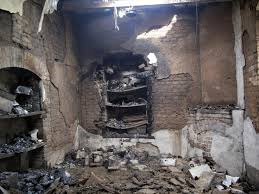
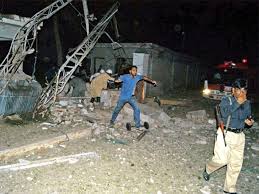
KARACHI, July 25: A series of blasts rocked the southern town of Sukkur late Wednesday as militants rammed an explosive-laden vehicle into a compound of Pakistan’s premier intelligence agency, security officials said.
At least nine people were killed, including five attackers and four agency officials in what was an unprecedented attack in the otherwise peaceful town.
Police said the attackers detonated two bombs — one outside a police building and a car bomb outside the ISI office in the town, located around 500 kilometres from Karachi, the main city of Sindh province.
A police official said apparently a suicide bomber first blew himself up in front of a police building and then a second suicide bomber detonated the explosive-filled car outside the ISI office.
The terrorists had seized control of one government building, sparking a shoot-out between the militants and security forces in the high-security Barrage Colony area.
The exact number of casualties was still unclear as TV channels put the death toll between seven to ten but there was no confirmation from the hospital.
Sources told Dawn that four agency officials were among the dead including ISI’s deputy director Maj Zeeshan, Azizullah, Asghar Ali and Nazeer Ahmed. There was no official confirmation of the death of the agency officials.
Major General Rizwan Akhtar, head of the paramilitary force, Sindh Rangers said that all attackers had been killed and the ISI compound had been cleared of the militants.
“All three militants who seized the compound have also been killed and the building completely cleared of terrorists,” said Akhtar.
He said the front wall and gate of the ISI office had been blown away by the impact of the first blast.
A senior police official said it appeared to be “an organised terrorist attack”. Militants have launched such sophisticated attacks before, but Sukkur has been traditionally immune from such violence.
No group has claimed responsibility for the attack so far.
In May 2009, a suicide attack outside a police building next to the local ISI headquarters in the eastern city of Lahore killed 24 people.
In November that year a powerful car bomb ripped through ISI’s headquarters in the northwestern city of Peshawar, killing 10 people and destroying part of the fortified building.
A month later in the central city of Multan two suicide attackers fired at soldiers while driving a truck bomb past security checkpoints in an attempt to approach the local office of the ISI.
In another elaborately planned attack last year, militants attacked Kamra, a major airbase, and damaged an aircraft.
The year before, Pakistani Taliban gunmen attacked a naval base in Karachi, the country’s biggest city. Ten military personnel were killed in the 16-hour assault.
In 2009, they attacked the national army headquarters in the garrison town of Rawalpindi, close to the federal capital.
Prime Minister Nawaz Sharif has strongly condemned the attack, which he said resulted in the “loss of precious human lives and injured many”.
—DawnNews correspondent Asif Mehmood contributed to reporting.
First women paratroopers (Credit:thenewnational.com)
ISLAMABAD, July 15: Pakistan’s first group of female paratroopers completed their training on Sunday, the military announced, hailing it as a “landmark achievement” for the country.
Captain Kiran Ashraf was declared the best paratrooper of the batch of 24, the military said in a statement, while Captain Sadia, referred to by one name, became the first woman officer to jump from a MI-17 helicopter.
Women have limited opportunities in Pakistan’s highly traditional, patriarchal society. The United Nations says only 40 per cent of adult women are literate, and they are frequently the victims of violence and abuse.
But in 2006 seven women broke into one of Pakistan’s most exclusive male clubs to graduate as fighter pilots — perhaps the most prestigious job in the powerful military and for six decades closed to the fairer sex.
After three weeks’ basic airborne training, which included exit, flight and landing techniques, the new paratroopers completed their first jump on Sunday and were given their “wings” by the commander of Special Services Group, Major General Abid Rafique, the military said.
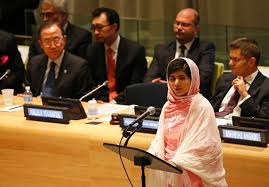
WHY has Malala Yousufzai’s speech at the UN on July 12, her 16th birthday, created such admiration all over the world, only to be met with a nasty backlash against the young education activist in Pakistan?
Perhaps the negative reaction of many Pakistanis to the young girl is the carping of jealous nobodies, but it bears examining because it says something profound about Pakistan.
The reaction to Malala’s words was swift in Pakistan; barely hours after she made her inspirational speech, people began complaining about its contents, the fact that the UN had dedicated an entire day to her, and the adulation she was receiving from world leaders by her side. Ignoring the text of her speech, which spoke out for the rights of girls and women and implored world leaders to choose peace instead of war, the naysayers tore down the young woman, her father, and Western nations for supporting her in her quest for education.
The insults flowed freely: Malala Dramazai was a popular epithet that popped up on Facebook pages and Twitter. The whole shooting was staged by “the West” and America, who control the Taliban. She was being used to make Pakistan feel guilty for actions that were the fault of the Western powers in the first place. Posters were circulated that showed Mukhtaran Mai and Malala with Xs through their faces, and berated the two women for speaking out about their experiences in order to receive money, popularity and asylum abroad.
Another popular refrain was “drone attacks”. Why had Malala not spoken out about drones at the UN? Why did everyone care so much about Malala and not the other girls murdered by drones? Why did America kill innocent children with drones and then lionise the young Malala to make themselves feel good that they actually cared about the children of Pakistan and Afghanistan?
It was a shameful display of how Pakistanis have a tendency to turn on the very people they should be proud of. Prof Abdus Salam fell victim to this peculiar Pakistani phenomenon, as well as the murdered child labour activist Iqbal Masih, Rimsha Masih, who recently received asylum for the threats to her life after the blasphemy case, and Kainat Soomro, the brave child who had been gang-raped and actually dared to take on her attackers. Pakistanis have very deliberately abandoned these brave champions of justice, and each time one more joins their ranks, the accusations of fame mongering, Western agendas, and money ring out louder and louder.
The insults to Malala had a decidedly sexist tone, the comparison to Mukhtaran Mai — another Pakistani hero — making it obvious that rather than embracing female survivors of hideous, politically motivated violence, Pakistanis prefer them to shut up and go away, not to use their ordeals as a platform to campaign for justice.
What does this say about Pakistani mentality? Firstly, it illustrates the fact that most Pakistanis are very confused. As British journalist Alex Hamilton said, “Those who stand for nothing fall for anything”. Because we don’t know what to stand for, we fall victim to conspiracy theories, wild imaginings, and muddled thinking about what is so clearly right and wrong.
Secondly, people who deflect from Malala’s speech to the issue of drone attacks may believe they care about drone victims, but it is hard to find what if anything they have actually done for those drone victims besides register their displeasure on social media. Instead, it is a way of deflecting the guilt they feel about their own impotence, their own inability to make any substantial change or impact in this country.
In psychology this is called displacement: these people who feel anger and frustration about themselves channel it into feeling angry about drone victims, or angry against Malala Yousafzai, or anyone who challenges their firmly held belief that this world is controlled by forces greater than themselves. They dislike the challenge to the justification for their own inertia and inactivity, and so they strike out.
Critics are ignoring how Malala pointed out that terrorists are misusing Islam for their own selfish ends: power and control. She rightly stated that Pakhtun culture is not synonymous with Talibanism; a popular narrative used to justify the marginalisation of tribal peoples (and the use of drones and human rights excesses by the military in carrying out operations in the tribal areas of Pakistan).
These statements contradict the political arguments offered by Pakistan’s incompetent leadership in lieu of real solutions to the militancy, and the justification for acts of aggression perpetrated by Western and Nato forces on the Pakhtuns of Afghanistan and Pakistan.
A note of warning: Malala and her cause must not be hijacked by opportunists, money-makers, politicians, or those who wish to use this pure young woman for their own selfish ends. In celebrating Malala, the world should not forget about the thousands of girls who are still in danger from extremist violence in Pakistan. Nor should she be taken up as a cause célèbre by celebrities and other do-gooders to feel smug satisfaction that they are helping her cause by posing for a photograph or attending a dinner with her (Personally, I feel that a young girl who can survive being shot in the head by the Taliban is strong enough to withstand being exploited by anyone).
Malala’s beautiful words must be a source of inspiration for solid action on the ground in the areas most affected by the conflicts she describes. Whether you support her or not, nobody can deny the urgent need to bring education and peace to Pakistan. Don’t ignore this message, even if you feel like shooting the messenger all over again.