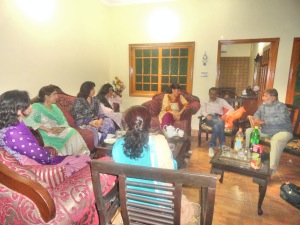
Meeting in Hyderabad (Credit: Sahar Gul Bhatti)Hyderabad, Aug 21: ATDT author was feted at a gathering of the Women’s Action Forum, hosted by Sindh University lecturer and media personality Irfana Mallah in Hyderabad.
The gathering, which included male contemporaries, discussed the situation pertaining to Sindh and the expectations that have evolved since this year’s election. Speakers said that the PPP’s set-back nationwide had confined them to their home province, where they had been voted in to resolve people’s local problems.
According to the speakers, over the last five years, the intrusion of big money in politics – including the recent election campaign – had facilitated the culture of corruption. Education had deteriorated, while employment was based on ethnicity and patronage rather than merit.
There was discussion about the involvement of major power players (including political parties) in patronizing criminal elements. They said that the phenomenon of kidnappings for ransom had particularly set back development initiatives in Sindh.
In the course of frank discussions, the women acknowledged the need for support from male members in order to end marginalization, and to work together for socio economic advancement and justice within society.
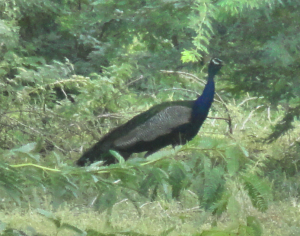
Peacock in Thar (Credit: Fayyaz Naich)The secret to the spiritual tranquility of rural Sindh appears to emanate from deep inside the Tharparkar desert, that straddles the Indo Pak border. Although Hindus make up some 40 percent of the desert, their shrines and idols – as well as Jain temples, are as much a part of the landscape as the mosques for the majority Muslim populace. Indeed, the sacredness with which local people treat all life, appears to draw from ancient Sindhi civilization that existed long before Pakistan was carved out of India.
Although the Indian and Pakistan army patrols both sides of the Thar border, there is commonality between the religious groups that have stayed behind since 1947. The Tharis share grinding poverty — living as they do, in cone shaped huts, drinking shallow ground water and subsisting on wild plants and herbs. They are herders and growers in a small market economy, where there is little money to buy the goods found in the cities.
While much of Pakistan suffers from communal and sectarian killings, there is a sanctity for life in the desert. In Bhodesar, mosque and mandir (Hindu temple) coexist side by side, and are visited by people of both religions. In the mandir’s the Hindu way of life is present, with women praying indoors… while men play devotional songs in more open spaces. Water and food is shared among the creatures that live around; big dodo birds that are extinct elsewhere, mix with the common crows with impunity.
In Islamkot, there is a water fountain, where peacocks come to drink water in the early mornings and evenings, even as they sit on top of trees under the blazing sun.
It is in the poetry and songs sung by faqirs (dervishes) in undulating sands lit by the moon, that carries the message of peace between the communities. Whether it is the songs of Shah Abdul Latif Bhitai or Shaikh Ayaz, the intoxication with which the sufis render their songs, to the accompaniment of harmonium and drums, carries away listeners. The peacocks crying out from behind the veil of darkness seem to be as much part of the music troupe.
We witnessed one such performance near the desert’s border with India.. where a sturdy rows of lights were the only evidence of the division of Sindh. We had crossed the salty lowland that stretches to the Rann of Kutch… which was invaded by Indian troops in the 1965 war and only partially returned to Pakistan. It was a reminder of the territorial hostility that remains between the two neighbors. Lurching over ditches and marshes, our four wheel drive rumbled near the Indo Pak border and settled on the sands to hear musicians.
The verses I had heard earlier from our hosts came to mind,
“Hindu banay ga, na Musalman banay ga
Insaan ki aulad hai, insaan banay ga”
(You will be neither a Hindu, nor a Muslim
You are descended from a human, you will be a human)
But these ideals aside, it is the realpolitik of partition that dominates the reality for Hindus and Muslims on both sides. Over the last decade, the army transformed the Tharparkar desert from undulating sand dunes — formerly traversed by giant crab like vehicles — into a region accessible by metal roads. The roads from Mithi, Islamkot to Nangarparkar have brought security check posts and Rangers , and restrictions on cameras, laptops and other equipment.
In this border race, India has reportedly acquired more sophisticated equipment to monitor border activity. It is this technological race that is keeping Pakistan’s armed forces on its toes.
For the ordinary Tharis, life goes on as it might have centuries ago. As a local medical practitioner, Dr Khatau Mal puts it, new roads means that he now receives more victims of motor bike accidents as compared to snake bite. With endemic poverty, the doctor says the only reason more Hindus don’t migrate to India is that they are too poor to afford the journey.
Today, drinking water is still a precious commodity. Those with access to underground wells are lucky. The Tharis use donkeys, or people to turn pulleys.. tied with ropes to a bucket.. turning it clock wise and anti clockwise to draw water from the deep wells.
There is a well in Bhalva that would have been common place, but for the legend that it was the spot where Marvi filled water when Umar Soomro — the King of Umarkot — kidnapped her in the 14th century. That became the inspiration for Bhitai’s poetry of the young woman’s resistance to Umar’s wealth and power, and her success in eventually returning to her own people in Thar.
In the last three years, the heavy downpours in Sindh have changed the desert into large swathes of green. It has led to mushrooming of wild plants, which provide fodder for animals and food for people. The rains have left streams of water trickling down from the Karoonjhar hills – filling the dams and lakes below.
It is also the non governmental organizations that are starting to make a difference. Thardeep Rural Development Program is one such NGO that is putting down roots here. It has earmarked villages throughout the desert where people are being empowered to improve their access to water sources, education and the means of earning a livelihood.
The TRDP has a model rest house in Nangarparkar, which is already implementing environmentally friendly policies like using solar power, water conservation and local building materials. The impressive building – which opens up to the Karoonjhar hills – will have a convention center as well. It is a work in progress that promises to improve the quality of life for all the desert people.
Meanwhile, in a country wracked by sectarianism and intolerance , there is much to be learnt from Tharparkar. This “green desert,” that stretches to the Indian border, embodies the spiritual strength with which Sindh has learnt to deal with its adversities.
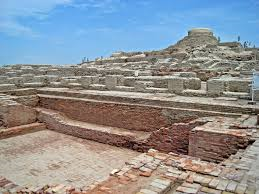
The trip to Mohenjo-Daro is assuredly arduous, but it is nonetheless worthwhile. Rising tall above the mist enveloped and fertile plains of rural Sindh, Mohenjo-Daro is a breathtaking spectacle, a reminder of the historical might and significance of our country.
Startling a person at first sight by its immense splendor, Mohenjo-Daro compels us to imagine for a moment the sheer intellect the ancient dwellers of this city had for their times. If the ruins are this majestic, one imagines, how magnificent would the city have been at its zenith?
Striking Grandeur and Magnificence:
Mohenjo-Daro, once a symbol of the wealth and grandeur of the Indus Valley civilization, is slowly reducing to dust, and if it stands unattended for another few years, we might lose one of the most treasured assets of our nation’s historical legacy.
Mohenjo-Daro was constructed around 2600 BC and many experts believe that a considerable portion of it is still buried, about 65-70% of it. Mohenjo-Daro was discovered in 1922, much to the astonishment of European scientists who had downplayed the theory of ancient civilizations originating in South Asia for a long time.
Yesterday’s Best Preserved Ancient Settlement:
It was, at least when discovered, considered the best-preserved ancient settlement in the Indian Subcontinent. This 5000-year-old city stands as a testament to the great Indus Valley Civilization. The Civilization flourished on both sides of the Indus River across the vast Indus river plateau and beyond it.
At its peak, hundreds of cities flourished in the Indus Plateau, crammed with complex structures such as dams and aqueducts, inhabited by up to 40000 people. It is nothing less than thrilling to walk through 5000-year-old rooms that are still surprisingly discernible.
One is amazed to walk through the splendid wide streets lined with precisely cut bricks baked thousands of years ago yet still astonishingly sturdy. A rare commodity in even modern villages of Pakistan, bathrooms existed in just about every dwelling, connecting to one of the most elaborate and complex ancient drainage systems, almost all of them underground. One can’t help but think how intelligent these people would’ve been, after all, we are talking of a time 5000 years ago.
As one walks through the city, fragments of brick can be seen scattered across the ruins and now one side of the wall of the city’s center, the Great Bath, a symbol of purity, is also dilapidating. Before long, this side of the bath will crumble, and would eventually weaken the most remarkable and marvelous structures of the ancient city.
Our Brave Ancestors:
The thing that surprises many archaeologists is the ingenuity of the residents of this Bronze Age city, an attribute that perhaps allowed these ancient people to brave through the harsh conditions of Sindh and Indus Delta in general.
At a time when other civilizations struggled at producing weapons out of metal, the people of this civilization made sophisticated razors and scissors for every day use. The residents of Mohenjo-Daro planted wheat and barley. At a time when the concept of jewelry was limited to metals such as copper elsewhere,the people of this civilization encrusted gold and silver with precious stones.
The unusually advanced human ingenuity of these people still embezzles many. The extent of the development of this ancient civilization has made many experts to make the Indus valley civilization a contender for the title of “cradle of civilization”, rivaling the civilizations of Mesopotamia and the Ancient Egypt.
Incompetence of PPP Government to Preserve the Asset:
In 2011, the responsibility of the conservation of the ruins was laid at the shoulders of the Sindh government along with $ 10 Million worth of funds being donated by UNESCO for preservation. By this time, the salinity of the soil below had led to salt encrustation on the brickwork.
As a last resort to protect the already decaying brickwork, the decision of applying mud slurry on the decaying brickwork was made. It was a disaster. As soon as the mud dried, it crumbled and with it, the millenniums old bricks chipped off as well. The incompetency of the government to handle the issue could be comprehended by the fact that rather than preserving old bricks in some parts of the city, they were simply removed and newly baked bricks were placed to replace them.
A Fraction of Investment over Bhutto Family Tomb is Enough to Preserve MJD:
The city is a few miles away from Larkana, the stronghold of the current ruling party of Sindh, the PPP. In Larkana, a colossal tomb has been constructed over the graves of the Bhutto family that has become a rather insipid mockery of Mughal and Sindhi architecture. Only a fraction of the cost required to construct this monument to the Bhuttos is required to preserve Mohenjo-Daro.
Where is Benazir’s Ideology Lost?
The former Prime Minister of Pakistan, Mohtarma Benazir Bhutto in her autobiography, Daughter of East, fondly recalled her fascination with the city, “As a small child I thought the ancient city was called ‘Munj Jo Dero,’ which in Sindhi means ‘my place.’ My brothers, sister, and I took great pride that we had been raised in the shadow of Moenjodaro, that we lived on the bank of the Indus, which had been bringing life to the land since the beginning of time”.
Had she been alive today, perhaps she herself would’ve made sure that this essential part of her country’s heritage was preserved. It is absolutely horrible to see the PPP, which claims to be the flag-bearer of Miss Bhutto’s legacy, allowing what she considered a cultural and historical asset of Pakistan be left to ruin.
Precious Artifacts Stolen:
In 2004, 40 precious artifacts found in the city were stolen from a nearby museum and were never returned. An old man and once a farmer Ahmed Bashir recalls “Our parents used to tell us that when the foreigners excavated the city, many of the precious items made out of gold and silver were already stolen by the locals”.
Some of these stolen pieces still adorn the showcases of local landlords. At a time when our monuments and heritage sites face the ever-growing threat of terrorism, Mohenjo-Daro is no exception. Security arrangements at the site are next to nothing.
Not every country is blessed enough to be the inheritor of so rich a historical heritage and we ought to protest again the blind eye consecutive governments of Pakistan as well as the opposition parties have turned towards this issue.
As a 16-year-old, perhaps I’m too young to comprehend the political dimension to this, too young to understand why political parties hesitate to bring up this issue in all the numerous heated debates on a plethora of Pakistani news channels. Perhaps it is not politically rewarding, perhaps it is irrelevant, i don’t know.
Nevertheless, I do know that it is simply painful for any true Pakistani to see Mohenjo-Daro, an asset of our nation, a city that once rivaled the great cities of civilizations of the likes of Mesopotamia and ancient Egypt losing its greatness, its glory, its beauty, in an utterly degrading manner.
The 16-year-old author, Bilal Akbar, an overseas Pakistani, was part of a recent campaign to raise funds for the cause of the preservation of Pakistan’s historical sites. He was also a youth representative at United Nations COP 18.
ISLAMABAD, Aug 28: In a major development, the Energy Information Administration (EIA), the American federal authority on energy statistics and analysis, has estimated fresh recoverable shale gas reserves of 105 trillion cubic feet (TCF) and more than nine billion barrels of oil in Pakistan.
These estimates of recoverable hydrocarbon reserves are many times larger than so far proven reserves of 24 TCF for gas and about 300 million barrels for oil. Pakistan currently produces about 4.2 billion cubic feet of gas and about 70,000 barrels of oil per day.
A government official said the new estimates appeared to be ‘very very encouraging’ but it had not been shared with the government of Pakistan. He said the shale gas had seen tremendous developments in the United States and a couple of other countries were trying to use the latest technology. Pakistan, he said, was also encouraging exploration and production companies to venture into the fresh horizon.
According to a June 2013 estimates of the EIA based on surveys conducted by Advanced Resources International (ARI), a total of 1,170 TCF of risked shale gas are estimated for India-Pakistan region –584 TCF in India and 586 TCF in Pakistan.
In case of Pakistan these estimates are backed by proven studies and verified technical data “The risked, technically recoverable shale gas resource is estimated at 201 TCF, with 96 TCF in India and 105 TCF in Pakistan,” said the EIA.
The EIA also estimated risked shale oil in place for India/Pakistan of 314 billion barrels, with 87 billion barrels in India and 227 billion barrels in Pakistan. “The risked, technically recoverable shale oil resource is estimated at 12.9 billion barrels for those two countries, with 3.8 billion barrels for India and 9.1 billion barrels for Pakistan,” the EIA said.
The southern and central Indus basins are located in Pakistan, along border with India and Afghanistan which are bounded by the Indian shield on the east and highly folded and thrust mountains on the west.
The lower Indus basin has commercial oil and gas discoveries in the Cretaceous-age Goru Fm sands plus additional gas discoveries in shallower formations. The shales in the Sembar Formation are considered as the primary source rocks for these discoveries.
The EIA said that while oil and gas shows have been recorded in the Sembar Shale on the Thar Platform, no productive oil or gas wells have yet been drilled into the Sembar Shale.
About the resource assessment, the EIA said that within 31,320 sq miles of dry gas prospective area, the Sembar Shale in the lower Indus basin had a resource concentration of 83 billion cubic feet per square mile. Within the 25,560 square mile wet gas and condensate prospective are, the Sembar shale has resource concentration of 57 BCF per sq. miles of wet gas and nine million barrels per square mile of condensate. Within the 26,700 square miles oil prospective area, the Sembar Shale has a resource concentration of 37 million barrels per square mile.
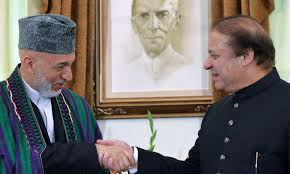
Islamabad, Aug 28: Afghanistan President Hamid Karzai is looking to Pakistan to help in the peace process and provide an opportunity for talks involving the Afghan High Peace Council and the Taliban.
Reading out a statement to the media after his one-on-one meeting with Pakistan Prime Minister Nawaz Sharif, Mr. Karzai said, “We discussed in this regard primarily and with emphasis, the issue of joint fight against extremism and reconciliation and peace building in Afghanistan with the expectation that the government of Pakistan will facilitate and help in manners it can to the peace process in Afghanistan and in providing opportunities or a platform for talks between the Afghan High Peace Council and the Taliban movement.”
On his part, Prime Minister Nawaz Sharif assured Mr Karzai of Pakistan’s strong and sincere support for peace and reconciliation. He also agreed that this process had to be inclusive, Afghan-owned and Afghan-led.
Mr. Karzai arrived on Monday with his official delegation which met government and military officials and also signed agreements on trade and economic issues. In June Mr. Karzai had refused to be part of the U.S. talks with the Taliban after it opened an office in Doha as he wanted the process to be Afghan-led.
While publicly the two leaders did not refer to the Afghan President’s demand for release of Taliban prisoners, it is an important issue for Mr. Karzai and did form part of the discussion, it is learnt.
Mr. Sharif in his statement said Pakistan’s security and future prosperity is linked to that of Afghanistan in multiple ways. The year 2014 is particularly crucial for Afghanistan and this region, he pointed out saying he hoped this milestone would be crossed peacefully and extended all possible support.
The Finance Ministers met on Sunday to discuss various projects and finalise trade and economic agreements. The two countries have agreed to the early and full implementation of Afghanistan Pakistan Transit Trade Agreement.
Mr. Karzai’s visit has been marked by scepticism in his own country and contempt from the Taliban. Former Pakistan ambassador to Afghanistan Rustom Shah Mohmand said Mr. Karzai knew that the U.S. was an indispensable partner in the peace process but he wanted to assert his Afghan nationality. There are powerful forces against reconciliation in Afghanistan and the true potential of the relationship will be realised after the coalition forces leave next year and Pakistan too is free of the overarching U.S. influence, he said.
Support
President Asif Ali Zardari on Monday said Pakistan had been consistently extending every possible support for promotion of peace and stability in Afghanistan as a peaceful, stable and united Afghanistan was in Pakistan’s own interest.
Speaking to Mr. Karzai at a meeting , Mr. Zardari stressed the need for joint efforts and close coordination to cope with the evolving situation in the region.
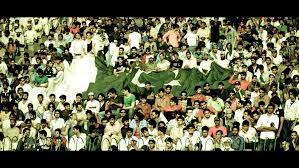
Bangalore, Aug 14: The separate states of India and Pakistan were created at midnight on August 15, 1947. Yet while India celebrates that day as its independence day, Pakistan celebrates its independence day a day before. Why it is so?Reason 1:Pakistan’s first independence day was also celebrated on August 15 but later on it was advanced to August 14. One of the reasons is that British Viceroy Lord Mountbatten, who had chosen August 15 to commemorate the surrender of Japan to the Allies Power marking the end of World War II in 1945, sought to transfer power to Pakistan on August 14 so that he could be present in New Delhi to observe India’s maiden independence day celebrations.
Reason 2:Also in 1948, Pakistan decided to celebrate its Independence Day on August 14 because 27 Ramadan, an auspicious date of the Islamic lunar calendar, coincided with it. Hence the Pakistanis decided to celebrate their Independence Day a day before the actual date. But otherwise, August 15 is the actual Independence Day for both India and Pakistan (Even South Korea observes its Liberation Day on August 15). The Indian Independence Act of 1947 clearly said: “As from the fifteenth day of August, nineteen hundred and forty-seven, two independent Dominions shall be set up in India, to be known respectively as India and Pakistan.
“Even Pakistan’s founding father Muhammad Ali Jinnah had declared August 15 as the birthday of the independent and sovereign state of Pakistan. The first commemorative postage stamps of Pakistan which were released in July 1948 also mentioned 15 August 1947 as its Independence Day.OneIndia News
Indo Pak peace process threatened (Credit: thenewstribe.com)
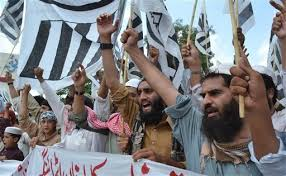
ISLAMABAD: Deadly violence over the last week along the disputed Kashmir border between Pakistan and India threatens to sabotage recent efforts by the nuclear-armed rivals to improve ties, illustrating how vulnerable the normalization process is to spoilers from both sides.
The most dangerous of these potential spoilers are Islamic militants who have historically been nurtured by the Pakistani military to fight a covert war over Kashmir and may feel threatened by any indication the government is cozying up to India.
The Pakistani army and its militant proxies have a history of using violence to sabotage outreach to India by civilian leaders, and suspicion about the generals’ intentions still runs high in New Delhi.
But many Pakistani analysts believe the army’s leaders have little interest in rocking the boat now, raising the worrying possibility that the recent violence was sparked by militants who have gone rogue or are operating in cooperation with lower level military officials sympathetic to their cause.
”This has really pulled the rug from under the feet of Nawaz Sharif and Manmohan Singh,” the prime ministers of Pakistan and India, said Moeed Yusuf, a Pakistan expert at the United States Institute of Peace. Both leaders have expressed a desire to improve ties, especially to increase cross-border trade.
The US is likely watching the current tension closely, both because of the nuclear arms on both sides and the spillover effect that conflict between the two countries has in neighboring Afghanistan.
The US has long suspected Pakistan of supporting Taliban militants in Afghanistan to counter Indian influence.
Majority Muslim Pakistan and predominantly Hindu India have fought three major wars since they both gained independence from Britain in 1947, two of them over Kashmir. The disputed territory is divided between the two countries but claimed in its entirety by both.
A 2003 cease-fire agreement has largely calmed the disputed border between the countries, although they occasionally accuse each other of violating it by firing mortars or gunshots, and several soldiers were killed on each side in January in cross-border attacks.
The latest round of violence began last Tuesday when, according to the Indian military, 20 heavily-armed militants and Pakistani soldiers crossed the Kashmir border and killed five Indian troops.
The Pakistani military has denied that its soldiers killed any Indian troops and accused Indian soldiers of killing a pair of civilians and wounding two others along the border over the last week.
The latest accusation came Wednesday when a Pakistani military official said Indian troops shelled the Battal sector of Pakistan-held Kashmir on Tuesday night, killing one civilian and seriously wounding another.
An Indian army officer denied the allegation, saying there was no shelling or exchange of gunfire in the sector. Both the Pakistani and Indian officials spoke on condition of anonymity in line with military policy.
Pakistan’s new prime minister, Sharif, took office in June with a pledge to improve relations with India to help turn around his country’s stuttering economy.
Trade between the two countries is around $2 billion per year and could go as high as $11 billion once trade is normalized, according to some estimates.
Pakistani Finance Minister Muhammad Ishaq Dar indicated earlier this week that the government was backing off granting most favored nation trading status to India in the wake of the violence on the Kashmir border.
But Sharif has expressed hope that the normalization process would continue and said he looks forward to meeting with his Indian counterpart on the sidelines of the U.N. General Assembly meeting in New York in September.
”Pakistan will continue to respond to the situation with restraint and responsibility in the hope that steps would be taken by India to help reduce tensions,” Sharif said Wednesday. ”Our objective is peace. For that, what we need is more diplomacy.”
Sharif, who has served as prime minister twice before, has experience being undermined in his efforts to reach out to India.
He signed a landmark agreement with the country in February 1999 that sought to avoid nuclear conflict, but the goodwill didn’t last long.
In May 1999, the Pakistani army chief at the time, Gen. Pervez Musharraf, quietly sent soldiers into an area of Indian-held Kashmir called Kargil, sparking a conflict that cost hundreds of lives and could have led to nuclear war.
Sharif said the army acted without his knowledge. Five months later, Musharraf toppled Sharif in a coup and sent him into exile in Saudi Arabia, not allowing him to return until 2007.
Yusuf, the Pakistani expert, said he believes the army’s leaders are now on the same page as Sharif in terms of gradually improving ties with India because the military has its hands full fighting a deadly Taliban insurgency.
ISLAMABAD: As Al Qaeda marks its 25th anniversary this month, analysts say the recent security threat in Yemen shows the organisation’s centre of gravity is shifting away from its base in Pakistan.
US President Barack Obama has cautioned that affiliates such as Al Qaeda in the Arabian Peninsula (AQAP), a unit of the extremist group that effectively controls parts of Yemen, still pose a threat despite successful efforts to disrupt the organisation’s core leadership.
His warning came after the United States closed 19 diplomatic missions in the Middle East and Africa last week after reported intelligence intercepts from Al Qaeda suggested an attack was imminent.
Reports indicated the intercepts involved some kind of group communication between Al Qaeda supremo Ayman al-Zawahiri, and AQAP leader Nasser al-Wuhayshi.
Zawahiri assumed Al-Qaeda leadership when Osama bin Laden was killed in a US special forces raid in Pakistan in 2011 and the 62-year-old Egyptian is believed to be hiding in the border region with Afghanistan.
Rahimullah Yusufzai, an expert on Islamist groups in Pakistan, said that while the traditional core leadership of Al-Qaeda — which was was founded in Peshawar, northwest Pakistan, in 1988, still retains symbolic importance, its operational centre of gravity has moved.
“In terms of strength, of power, of effectiveness, we can say it has shifted,” he told AFP. “It is no longer Pakistan or Afganistan, so most of the fighters, most of the affiliates, are not in Pakistan and Afghanistan. By and large, the plans are not coming from Zawahiri.”
Zawahiri, who has a $25 million US government bounty on him, lacks the charisma of bin Laden but has long been seen as the brains of Al Qaeda.
Pakistani author and security analyst Imtiaz Gul said that while Al Qaeda’s operational leadership had spread into regional franchises, Zawahiri remained an “inspirational force.”
”They don’t need someone as charismatic as Osama bin Laden was and they have I think ideological ammunition, ideological fuel which is helping them stay afloat,” he told AFP.
The recent revelation of an ambitious plot in Yemen to seize control of two cities, as well as an oil export terminal, showed AQAP to be highly motivated, and Wuhayshi is believed to have been promoted to second in command of the global organisation behind Zawahiri.
Daveed Gartenstein-Ross, senior fellow at the Foundation for Defence of Democracies, in Washington, said Wuhayshi’s promotion indicated Al Qaeda was broadening the ‘core’ leadership as AQAP grew in expertise.
“When we talk about Al-Qaeda core there’s no reason it can only exist in Afghanistan-Pakistan, Wuhayshi being made the general manager, that very clearly makes him part of the core,” Gartenstein-Ross told AFP.
“We see a geographic shift towards Yemen but that’s not necessarily a shift to AQAP and away from the core, the way I see it, the core is expanding.”
Al Qaeda was established when the Soviet Union withdrew from Afghanistan, to unite disparate groups of fighters who had come to battle the occupation, with the aim of taking the jihad to a bigger, more global scale, attacking targets around the world.
But Al Qaeda franchises across the Middle East and north Africa have been increasingly active in recent years and Yemen’s geographical location makes it a more convenient base than Pakistan or Afghanistan for communicating with these groups, Gartenstein-Ross noted.
Washington has been keen to trumpet its successes against Al Qaeda’s central leadership, pointing to the bin Laden raid and commanders killed in the long-running US drone campaign in northwest Pakistan and more recently Yemen.
But a recent report by Canadian intelligence gave a more cautious assessment, pointing out Al Qaeda leadership’s resilience and adaptability in surviving for a quarter of a century in the face of a concerted onslaught.
The report also warned the withdrawal of US-led forces from Afghanistan next year, coupled with the Pakistani authorities’ apparent inability or unwillingness to crack down on the organisation, could give it the cross-border physical sanctuaries it needs to survive.
Saifullah Khan Mehsud of Islamabad’s FATA Research Center, an expert on Pakistan’s tribal belt along the Afghan border that has been an important haven for Islamist militants since the 1980s, agreed.
“If Afghanistan is able to come to a common platform, if they agree with each other to have a common political vision for the country in some kind of alliance between different groups, then it will be very difficult for Al-Qaeda to find sanctuaries there,” he said.
“But if there is civil war Al Qaeda will be in a better position to find sanctuary there.”The Taliban, which sheltered bin Laden until the US-led invasion in the wake of 9/11, has said it will not let Afghan territory be used to attack other countries.
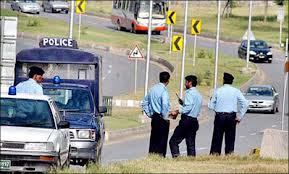
Eid security (Credit: thenews.com.pk)Islamabad, Aug 8: The Islamabad Capital Territory (ICT) Police have finalised a comprehensive security and patrolling plan on the eve of Eidul Fitr and also augmented the security at public places, worship places and other important buildings to thwart any untoward incident, a police spokesman said.
IGP Islamabad Sikandar Hayat has directed all officials to remain on high alert and fully prepared during Eid days. As per security plan chalked out by SSP Islamabad Muhammad Rizwan, more than 2,500 policemen would perform security duties. Patrolling would be made in various sectors to check possible house burglaries during Eid holidays. However, people have also been appealed to inform relevant police stations before their departure to native areas.
Eid prayers will be offered at 507 places in Islamabad including Masajid, Imambargahs and open places which will be covered by armed guards and policemen. Four SPs, nine ASPs/DSPs, 17 Inspectors will overall look after security arrangements in their respective jurisdictions.
Special Quick Response Force (QRF) teams have been constituted for immediate assistance to citizens while vehicles, earlier serving with various squads, will be on patrolling duty to ensure vigilance during Eid days.
Falcon squads and police commandos including contingents of lady police will also patrol in the city to ensure sense of complete security to citizens on Eid occasion.
According to the plan, policemen would also patrol in the various sectors and police in charges of circles would ensure proper security at the Eid congregations in various locations.
Superintendents of Police (SPs) will conduct checking of security and patrolling duties in their respective areas and to ensure coordination among all the mobile police teams.
More than 140 policemen lead by two SPs, two ASP/DSP, four Inspectors would be only deputed for the security at Faisal Mosque on Eid day while walk through gates and scanners would be installed as a part of security measure.
Sub-Divisional Police Officers and Station House Officers would be responsible of the security around worship places. They may be provided additional force on their request for the effective patrolling and security at Eid congregations in various sectors.
Duty rosters have been prepared by the in charges of police stations and policemen would patrol in various sectors during day and night timings to ensure protection to properties during Eid holidays.
The mobile officers and police guard posted at Mosques, Imambargahs, public/picnic places will take notice of the beggars hovering around the premises and will take legal action against them.
Special focus is to ensure safety to properties and stop incidents of theft and car-lifting during Eid holidays. As a part of security measures, police pickets would be erected at all important entry and exit points for checking of vehicles and SPs of each Zone will visit these points to brief the deployed cops about effective checking and security.
The mobile patrols and squads of Islamabad Traffic Police would also remain present in markets, shopping plazas and at prominent points during Eid congregations. Bomb disposal squad will remain available at short notice and all public places, parks, play grounds will be kept under strict vigilance and security cover.
Islamabad Traffic Police (ITP) on special directions of SSP (Traffic) Dr. Moeen Masood has made a special plan and 250 traffic personnel will be deputed at various locations lead by SP, three DSPs and 9 Inspectors. Traffic deployment in shopping areas, markets will be augmented while the patrol cars and pairs will patrol in their respective areas to facilitate the general public.
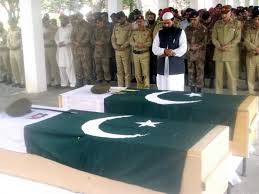
GILGIT, Aug 8: Security forces intensified search on Wednesday for militants of the Tehreek-i-Taliban Pakistan in the remote northern town of Chilas, headquarters of the Diamer district, after the killing of three high-profile security officials in the area the previous day. The TTP had claimed responsibility for the shooting.
The slain officials — an army colonel, a captain and a senior superintendent of police (SSP) — were investigating the June 23 killing of nine foreign tourists and one of their Pakistani guides in the area.
Victims of the mountain assault included climbers from China, Lithuania, Nepal, Slovakia, Ukraine and one person with joint US-Chinese citizenship. One Chinese climber had escaped the attack.
“We are at present engaged in a search operation against murderers and are very much hopeful of arresting them soon because 14 suspects have already been taken into custody and are being interrogated,” Ali Sher, Deputy Inspector General of Police who is heading the operation in the area, told Dawn.
Police said hideouts of Taliban were being raided.
Law-enforcement agencies, backed by Pakistan Army, have sealed all entry and exit points of the small town which has a population of 40,000. The town is visited by people of the entire district for different purposes.
The police official said that a rally was also held in the area to condemn the murder of the security officials.
People of the area were in a state of shock and an air of gloom and fear enveloped the area because of the rising number of acts of terror which were previously unknown to them.
The DIG said the entire populace of the area should not be linked with terrorism as this would bring nothing but destruction.
Mr Sher pointed towards activists of banned outfits, but did not say which organisation is behind the attack.
“They (militants) have undergone training at various places and are now totally brainwashed,” he said, adding that they could only be stopped if a political solution was found out.
He said that some possible attacks on other police officials were foiled after a tip-off.
“We arrested a man along with weapons who was trying to kill a superintendent of police in Astore and another in Gilgit. Both are now behind bars and they have confessed before courts. Their cases are being heard,” Mr Sher said.
He said hundreds of houses had already been searched to arrest militants wanted by police.
“Do you know I was also a target in some other areas, but Allah Almighty saved me, but the SSP fell victim,” he said.
The DIG spoke kindly about the people of Diamer, saying they had nothing to do with acts of terrorism, but some hidden powers wanted them in the arena.