Clash Between NATO and Pakistani Troops Defused

KABUL, Afghanistan, Nov. 30 — A cross-border incident involving NATO and Pakistani forces was quickly defused early on Wednesday with no loss of life, according to Brig. Gen. Carsten Jacobson, the spokesman for the American-led international coalition here.
Few details of the incident were immediately available but it apparently involved heavy artillery fire across the Afghanistan-Pakistan border in Afghanistan’s Paktika province.

The firing broke out at a time of Pakistani anger over the killing of 24 of its soldiers in a United States air strike on Saturday. Pakistan closed its border to NATO supply convoys and pulled out of an international conference on Afghanistan next week in Bonn in protest at the killings.

Separately, Secretary of State Hillary Rodham Clinton expressed regret at Pakistan’s decision to stay away from the Bonn conference.

“Frankly, it is regrettable that Pakistan has decided not to attend the conference in Bonn, because this conference has been long in the planning,” Mrs. Clinton said in Busan, South Korea before flying to Myanmar on Wednesday.

“Pakistan, like the United States, has a profound interest in a secure, stable, increasingly democratic Afghanistan. Our gathering in Bonn this coming Monday is intended to further that goal.”

In the latest border incident, General Jacobson said it was reassuring that normal channels of cooperation and communication had been opened to resolve the issue.

“We haven’t got the details yet but the most important thing is the normal methods of cooperation worked and there were no casualties, no damage despite heavy firing,” he said.

Steven Lee Myers contributed reporting from Nay Pyi Daw, Myanmar.

Pakistan Extends Business Handshake to Neighboring Iran

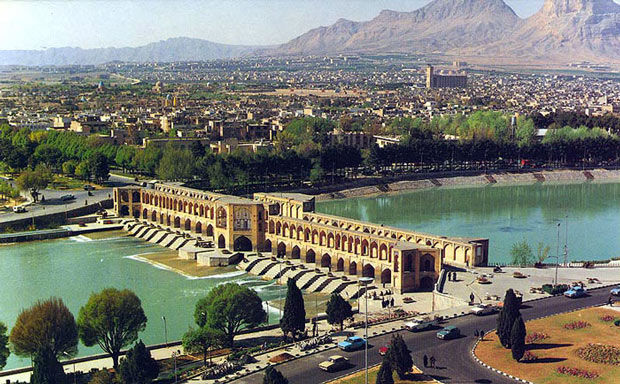
Isfahan (Photo Credit: irangashttour.com)

PESHAWAR, Nov 6: The governments of Khyber Pakhtunkhwa and Isfahan, a central Iranian province, have signed a Memorandum Of Understanding (MOU) to establish a joint chamber of commerce and promote cultural relations, according to an official handout.

As per MOU, the two sides will jointly implement a strategy to promote economic ties, strengthen industrial relationship, encourage investment, and improve services through mutual cooperation and sharing of knowledge, according to the handout.

The document was signed by Khyber Pakhtunkhwa Chief Minister Ameer Haider Khan Hoti and Governor of Isfahan Dr Zakir Isfahani at the latter’s official residence at Isfahan on Friday night.

The KP chief minister is on an official visit to Isfahan. The other members of his delegation include Senior Minister Bashir Ahmad Bilour, Information Minister Mian Iftikhar Hussain and additional chief secretary Attaullah Khan. The visit is meant to strengthen mutual ties between the two provinces, explore economic and business opportunities, and enhance cultural and social relations between the peoples of the two sides.

An official handout said the MOU would help facilitate the public and private sectors of the two provinces by strengthening bilateral cooperation. KP would work to receive Iranian cooperation in the field of hydel and thermal power generation.

The two sides would also conduct training courses and workshops to raise workforce skill levels in the fields of textile, food production and wood manufacturing, carpet manufacturing, fruit processing, chemicals and petro-chemicals, steel rolling and production of PVC/HTP pipes used for supplying gas.

The MOU would seek to arrange trade exhibitions and industrial shows as part of their strategy to promote economic cooperation and create opportunities for private investment. Similarly, in the mineral sector, exchange of information and technical know-how gained through research would be shared by holding training courses.

The two sides agreed to facilitate machinery and technology exchange for research in the fields of granite, marble, and precious stones. They agreed to strengthen trade and business between the two provinces by encouraging private sectors.

In this respect, international exhibitions would be arranged and the practice of international tenders and auctions would be pursued.


Pak Businessmen Welcome Trade Concessions for India

Karachi and Mumbai Ports

The recent trip made by a large 80 plus delegation of Pakistani businessmen and government officials led by Commerce Minister Makhdoom Amin Faheem to India, the Foreign Minister Hina Rabbani Khar’s visit to New Delhi to hold wide-ranging talks with her Indian counterpart, the upcoming second round of negotiations between the two Commerce Secretaries, and the unequivocal announcement by the Foreign Minister on the floor of the National Assembly, all combined to bring up for intense debate the  issue of granting of Most Favored Nation status to India.

It should be noted that India unilaterally granted MFN to Pakistan over 15 years ago.

Pak Business Delegation in Mumbai

What is this sacrosanct clause that is really not being accepted nor understood by hawks and naysayers in Pakistan. The Most Favored Nation Clause stipulates that “with respect to custom duties and charges of any kind imposed on, or in connection with, importation or exportation, or imposed on the international transfer of payments for import or exports, and with respect to the method of levying such duties and charges, and with respect to all rules and formalities in connection with the importation and exportation, any advantage, favor, privilege or immunity granted by any contracting party to any product originating in, or destined for, any other country shall be accorded immediately and conditionally to the like product originating in, or destined for, the territories for all contracting parties.”


Indo-Pak business council's meeting

It may sound mumbo-jumbo or confusing to read this but all it says is equal treatment for all countries.

I was a member of the Pakistan delegation to India, and at the meeting with CEOs in Mumbai, I posed a direct question to them. I asked them what do the Indian CEOs want from Pakistan and one gentleman straightaway remarked “MFN”! The Pakistani delegation did not respond to this immediately but during the tea break, I nonchalantly mentioned to Ms Meera Sanyal, Country Head of Royal Bank of Scotland and the leader of the Indian side, that Pakistan has already accorded MFN to Indians decades ago.

I stated that over $ 2.50 to $ 3.00 billion worth of Indian goods make their way into Pakistan through undocumented sources.

It is safe to assume that there is a distinctive bias against Pakistani products in Indian officialdom. Moreover, the advantage of economies of scale that Indian manufacturers have due to a burgeoning and vibrant middle class assures them of a strong market and enables them to produce more at a comfortable price.

Indo-Pak moot in progress

Of course, whenever Pakistani businessmen or even government officials attempt to promote trade concessions to India, the vocal anti-business elements loudly proclaim that it would seriously affect Pakistan’s avowed position on Kashmir and that all this talk about cordial and bilateral relations between the two SAARC nations is directly aimed at diluting the intensity of the Kashmir cause.

The anti-MFN lobby counter with the argument that since India has formidable engineering, computers, petrochemicals, and heavy metal industries, etc, it would be difficult for the Pakistani enterprises to compete on an equal footing.

The concept of two religions also is a motivating force for the anti-MFN lobby. They also refer to the concentrated campaign on Kashmir by the government, not only within the country but also among the Islamic nations. They state that on the one hand, the government is highlighting the Kashmir cause and on the other hand, there are no qualms about granting preferential trade privileges. They do not appreciate the idea of a negative trade balance as they feel that the Indian importers will not reciprocate in the same spirit.

Meeting of Business heads in Mumbai

One must then also acknowledge that even though Pakistan does not recognize Taiwan, yet there is a beeline of Pakistani traders conducting business with Taiwanese businessmen. This is one solid case of doing business with those whom Pakistan’s “all-weather” friend does not recognize or accept. Here, trade took precedence over political compulsions. Then why not unshackle the Indo-Pak trade regime?

Pakistan must at all costs talk about regional peace, regional trade, and regional interaction. The country must take the lead to bring about an enabling environment to achieve these objectives. All efforts must be made to increase economic activities because deliverance only lies through massive industrialization and commercial activities.

The policy to club all polemical issues between Pakistan and India and demanding their resolution first has not worked but, in the process, has resulted in sacrificing profitable economic contacts and damaging the one chance to stimulate economic activity in the present recessionary scene.

Pakistani and Indian leadership must stop this ego-trip and blatant propaganda. The leaders must put the welfare of people paramount. Efforts such as Amn ki Asha are commendable initiatives. The political hierarchy must work for the prosperity of the region. Only through trade and industry could this roadmap be achieved. The destiny of millions depends on how the national leaders in India and Pakistan weave their decisions and actions.

The writer is the former president of Karachi Chamber of Commerce and Industry


What Does it Mean to Grant ‘Most Favored Nation’ Status to India?

Nov 1, 2011: The Pakistani cabinet decided to ‘grant’ Most Favoured Nation (MFN) status to India. MFN is the most misunderstood concept in trade legislation.

All it means is that a World Trade Organisation (WTO) member will treat every other member equally in terms of tariff and other trade conditions. In fact, the Charter of the GATT (General Agreement on Tariffs and Trade), WTO’s predecessor, envisaged trade relations between the newly independent ‘dominions’ of India and Pakistan as a customs union — a more intimate, duty-free trade arrangement.

However, history conspired to create a very different trade relationship between Pakistan and India. First, their currencies were de-linked and then progressive barriers — tariff and non-tariff — erected to restrain bilateral trade. After the 1965 war, trade was banned altogether by both sides. Such restriction is also legally sanctioned by the Gatt/WTO charter, in its ‘national interest’ clause.

The road since 1965 has been long and hard. It was only in the 1980s that Pakistan and India took baby steps to open up trade, item by item, with lists numbering less than 50 items. It was only a decade ago, when India gained confidence in its ability to compete against Pakistani goods, that it offered MFN status to Pakistan.

Pakistan did not reciprocate, for economic and political reasons. On the one hand, there were (and still are) fears that cheaper Indian manufactures — textiles, engineering goods — would put Pakistani producers out of business. More importantly, Pakistani leaders did not want to be seen normalising trade while the Indian army was engaged in brutal repression in Kashmir. Trade normalisation was explicitly linked to progress on Kashmir and other outstanding issues.

Clearly, this linkage has now been jettisoned. On Kashmir, peace and security, Siachen and Sir Creek any change in India’s position has been for the worse. Of course, it is no secret that the western powers have strongly pressed Pakistan to normalise trade with India, arguing that this will contribute to improving political relations — the reverse of Pakistan’s long-standing position.

India’s only ‘gesture’ was to drop its mean-minded veto in the WTO against the trade preferences the EU agreed to offer Pakistan to help it recover from last year’s devastating floods.

How will the reciprocal acceptance of MFN impact on bilateral trade?

Trade between Pakistan and India remains minuscule. Last year, India exported $1.5bn to Pakistan, while Pakistan’s exported $275m to India. Informal (illegal) and indirect trade is estimated to be another $3bn-$4bn. Total trade is thus around $6bn-$7bn. This is much lower than India’s $60bn two-way trade with China, but roughly the same as Pakistan’s $7bn trade with China.

It is not at all certain that two-way trade will expand significantly with reciprocal MFN treatment. Apart from the restrictions, what has constrained trade between Pakistan and India is the similarity of the two economies, which are, therefore, competitive rather than complementary. Of course, in recent years, the Indian economy has become more diversified and globally competitive. India, therefore, will have greater possibilities to enlarge exports to Pakistan than the other way around.

At present, sadly, Pakistan is unlikely to gain very much from trade liberalisation with India, or any other developing country. Simply put, Pakistan does not produce very much that it can sell abroad. It does not enjoy a price advantage in more than a handful of products. Trade is only 10 per cent of its GDP. Its volume is one-tenth that of Mexico and Brazil, countries of comparable size.

Pakistani manufacturers of textiles, pharmaceuticals and automotive parts are reportedly concerned that cheaper Indian goods — some benefiting from subsidies — could damage their industries significantly. Admittedly, the weaknesses in each of these sectors are the consequence mostly of Pakistani mistakes. Value-addition in textiles has been deliberately retarded by decades of easy earnings from yarn and fabric ‘quotas’ in the US and EU markets. In pharmaceuticals, Pakistan — unlike India — has been held back by multinationals from producing its own generic drugs. In the automotive sector, Pakistan gave in too early to demands under WTO agreements to remove infant-industry support.

Apart from this, there is genuine concern among Pakistani traders about Indian non-tariff barriers (NTBs). India is also one of the most prolific users of the WTO’s anti-subsidies and anti-dumping mechanisms designed to block or hold back artificially cheap imports. At the same time, many Indian products benefit from government subsidies, such as free electricity. Pakistan does not have in place the bureaucratic machinery to implement the trade ‘defence’ measures allowed under WTO rules. Nor does the Pakistani exchequer have the financial capacity to support production subsidies and other official mechanisms for export expansion.

Pakistan’s aim should be to negotiate special arrangements — as it has done with China — to take into account India’s advantages, especially in certain industrial and other manufactured goods sectors, and thus level the playing field.

In the short term, Pakistan’s advantage over India will be in certain food and agriculture sectors. Over the years, Pakistan’s wheat, rice and other agricultural commodities — whose prices were at times artificially restricted at home — have been smuggled to India (and Afghanistan), depriving benefits to both the Pakistani farmer and consumer. It is rumoured that some of the high-grade Basmati rice sold by Indian companies abroad originates in Pakistani Punjab. The ‘regularisation’ of agricultural trade should seek to prevent such abuses, including measures to prevent and punish ‘cross-border’ smuggling.

Another issue which Pakistani policymakers will need to consider is how to respond to Indian investment in Pakistan. Like others, Indians can invest in Pakistan’s publicly listed companies (and vice versa). Pakistan-India joint ventures could be mutually beneficial in some sectors. But some investment can be sensitive. To avoid strategic mistakes and future disputes, Pakistan will need to evolve guidelines that prescribe conditions for Indian investment and determine where it would not be acceptable for strategic reasons.

The writer is a former Pakistan ambassador to the UN.


Fight Hard, Talk Hard

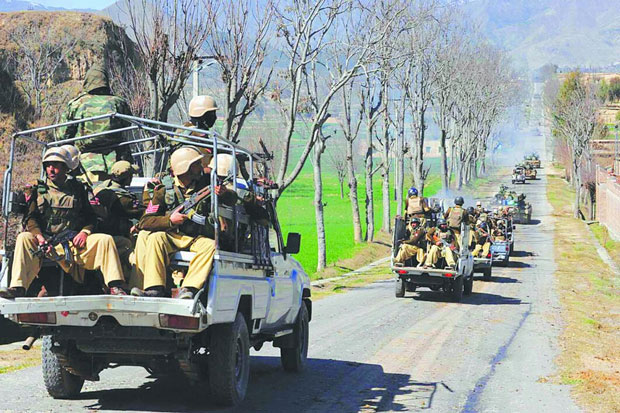
Paramilitary Troops Patrol Bajaur in Pakistan's tribal belt - Photo Courtesy: Dawn

It is an axiom that Americans work hard and play hard.

What is less known, and at times baffling, are US moves that entail crushing the enemy on the battle field while engaging with its high profile leaders in private.

This fight hard, talk hard strategy – designed to do whatever it takes to succeed, is the hall-mark of a nation moving forward with super power strides. In this scenario, the US finger points to Pakistan’s spy agencies ties with the Haqqani network, even while enlisting its help to negotiate with the Taliban militants.

The Obama war strategy has come full circle as the battle for Kabul enters a decisive stage. With the withdrawal of US surge troops from Afghanistan set in near stone for 2012 – the region has gone into a wait for the Americans to leave type of mode.

With winter fast approaching the fighting season for conventional NATO warfare has shrunk, even while the Taliban keep up their suicide attacks. In examples of guerrilla warfare, they are able to put down a rifle and pick up a plow… to return to fight another day.

Amid this seemingly unending war, the US is zeroing in on Pakistan to dissuade it from supporting Taliban militants who allegedly use the neighboring federally administered tribal areas to attack NATO troops in Afghanistan and return to their safe havens.

The murder of Afghan peace council chief, Burhanuddin Rabbani in September – for which Afghanistan blamed Pakistan – has shifted the strategy all round from talk hard to fight hard.

In her recent visit to Pakistan, US Secretary of State Hillary Clinton let out the frustration that America has been feeling in its inability to rein in Pakistan:
“You can’t keep snakes in your back yard and expect it to only bite neighbors.”

The reference was to Pakistan’s policy of strategic depth, where the US claims that Pakistan backs Taliban militants like the Haqqani network in order to guarantee a friendly Afghanistan vis-à-vis its arch rival, India.

Clinton also played to the naiveté displayed by a member of the audience which met her on the occasion. The woman told the visiting Secretary of State that the US was like a “mother-in-law” that was never satisfied with what her “daughter in law” i.e. Pakistan did.

Laughter is of course the best remedy for tensions, even diplomatic ones – though it has little to do with the underlying causes.

Indeed, there have been major setbacks to US forces lately – topped last week by the deaths of 13 Americans hit by a suicide bomb attack in Kabul. These have occurred as NATO intensifies its assault on Taliban strongholds in southern Afghanistan that border Pakistan.

Bolstered by the US, the Karzai government has recently done a diplomatic dance with “brotherly Pakistan” – that involves signing a defense deal with India while assuring Pakistan of continuing neighborliness.

The Nov. 2 Istanbul conference on Afghanistan brought President Karzai to appeal to all nations to rein in militants, without singling any one of them.

Pakistan has still not recovered from the shock waves it suffered in May, when the US picked up Osama Bin Laden from under its nose in Abbotabad. Since then, the state has loosened the pressure valve on anti-Americanism. That has enabled politicians to hold rallies of the type held by Islamic parties under former president Gen. Pervaiz Musharraf.

At the same time, Pakistan sanctions US drone attacks in its tribal areas. In recent weeks, the US has intensified and diversified drone attacks here – from North Waziristan to chasing Haqqani fighters in the south of this belt.

For now, it is the interplay of military intelligence and diplomacy that swirls around the longest and most complex war of our times.

Human Rights body Condemns Mastung Massacre

September 21: The Human Rights Commission of Pakistan (HRCP) has slammed the killing of at least 29 Shia pilgrims in Tuesday’s attack on their bus near Mastung, calling the absence of security for them outrageous and adding that the killers had been emboldened by a persistent lack of action against sectarian militant groups.

A statement by the Commission said on Wednesday: “HRCP is appalled by the gruesome killing of Shia pilgrims near Mastung and finds the utter lack of protection for them outrageous, particularly when pilgrims travelling in the area had been attacked previously and were known to be at risk. HRCP is equally shocked by the official line that the authorities were not given prior intimation about the pilgrims’ bus. How convenient that instead of finding those who failed to perform their duty, the victims have been blamed. This just adds insult to injury. What good are the checkpoints set up everywhere if they cannot even find out if a vehicle using the road needs additional security?

Tuesday’s attack is a failure on many levels and exposes once again the diminishing writ of the state. HRCP believes that continued sectarian bloodshed across the country, particularly in Balochistan, is a direct consequence of the authorities’ perpetual failure to take note of sectarian killings in Quetta which have been going on for many years. It is difficult to comprehend why no action has been taken against the banned militant group that has claimed responsibility for this ghastly attack and for numerous sectarian killings earlier. How do they still manage to roam free with their weapons and vehicles?

The official condemnations that have followed the attack give little comfort to the bereaved families and no one buys the oft-repeated vows of action which never materialise. There is a complete breakdown of writ of the state with the citizens finding themselves increasingly on their own. We fear that the utter lack of competence and inability to adequately respond to the security situation is bound to contribute to further bloodshed. The government must move beyond rhetoric and its current casual and reactive approach to law and order challenges and start functioning as a responsible authority.”

Zohra Yusuf
Chairperson

Proxy Wars Fan Sectarian Massacre in Balochistan

The proxy wars between Saudi and Iran backed militant groups in Pakistan – linked to the US battle against the Al Qaeda and Taliban in Afghanistan – took an ugly turn this week in the lawless province of Balochistan.

On Sept 20, pilgrims traveling on a bus to Iran, were stopped by armed men near Mastung, some 30 km southeast of Quetta. Some 26 pilgrims were forced to disembark… and shot point blank after being identified as Shias. Two family members of the victims who rushed to the scene to help, were chased by gunmen and shot dead.

The Lashkar-i-Jhangvi (LEJ) a Sunni Deobandi group affiliated with the Taliban, claimed responsibility. In recent months, Mastung has become a strong hold for the LEJ – whence the sectarian group emerges to inflict lethal attacks on Shias and non Muslims.

The administration’s response was mild. In Balochistan, authorities hunkered down and advised tour buses not to move around without security.

Ten years after the US toppled the Taliban in Afghanistan, today their resurgence has given the LEJ an umbrella to inflict repeated pain on Shias in Pakistan. The Iran backed Tehrik-i-Jafria, sometimes engages against the LEJ, but is no match for the antagonists.

In the last few months, the LEJ and its parent organization – Ahle Sunnat Wal Jamaat (formerly Anjuman Sipah Sahaba Pakistan) have found a soft target in the Hazara community in Balochistan. These Shias, originally from Afghanistan, have been repeatedly killed on sectarian grounds. This week’s massacre brought nationwide protests, including Hazara women to demonstrate against the lack of safety.

Sectarian strife has escalated since LEJ chief Malik Ishaq was released from Kot Lakhpat prison, Punjab in July 2011. Although wanted in the murders of some 70 Shias, the Supreme Court reportedly released him because of the absence of witnesses. Prima facie, this seemed logical in a country where witnesses in heinous crimes have little or no protection.

But the Punjab administration failed to act against the LEJ chief even after he moved around giving hate speeches on sectarian grounds.

Victims families found cold comfort in the fact that Malik Ishaq has been temporarily detained at home after the massacre in Mastung.

Interestingly, in recent months the paradigm of sectarian violence has moved out of the Punjab into Balochistan. That comes on the heels of a blooper by the Punjab chief minister, Shahbaz Sharif… when he apparently spoke his mind in telling militants to “at least leave my province alone.”

Today, lawlessness and poor governance in Balochistan has turned it into ideal ground for sectarian outfits. Despite being declared terrorists, the organizations constantly rename themselves and avail of the type of protection they enjoyed since the days of Gen. Zia ul Haq.

The Shia massacres in Mastung mirror the brutal pattern in which Christians were killed nine years ago in Karachi. In September 2002, as the US invasion of Afghanistan dislodged the Taliban, their LEJ affiliates headed straight to the Institute for Peace and Justice in Karachi. Here, the activists – mostly Christians – were bound and gagged and shot point blank after being identified by their faith.

Today, while US presence in Afghanistan fuels national resistance, it also spawns violent extremists. As experience shows, the attempts to use militants for political gain invites more blow-back. With neighboring countries fighting their proxy wars in Pakistan, the ingredients in the cauldron turn the mix into a matter for global concern.

Appeal by Embassy of Pakistan in Washington DC

Floods in Nawabshah. (Courtesy Manzoor Mirani)

As you are aware the southern parts of Pakistan, particularly the Sindh province, has been devastated with severe rains and floods. In the past few days the affected areas have received 142% more rains than normal. Twenty one districts of the Sindh province are particularly severely affected and 4.1 million acres of land have been inundated. The estimated number of flood affectees is more than 5 million. One hundred and forty one lives have been lost. The Government of Pakistan has established 4,000 relief camps where more than 150,000 people are being provided relief and refuge.

The Government of Pakistan has mobilized all its resources to help the affected people. Unfortunately, the devastation caused by rains and floods is such that the Government of Pakistan is constrained to request international assistance. The President of Pakistan has, therefore, appealed to the international community and to the Pakistani Diaspora to provide relief and assistance for the affected people.

You are requested to kindly step forward and help Pakistan overcome this latest challenge. The most immediate needs are tents, aqua tablets, water purifiers, food, de-watering plants and medicines.

Report by UN Office for the Coordination of Humanitarian Affairs Pakistan Monsoon 2011

Tando Allah Yar, Sept. 7, 2011. AP Photo by Pervez Masih

The joint UN / Government assessment has been completed in 16 districts of Sindh. According to the initial findings:

The monsoon rains have so far affected over 5.4 million people (49 percent women) or some 1 million households of which 56,000 (5%) households are headed by females.

Some 42,431 (4%) affected households are headed by disabled persons.

A total of 665,821 houses have been damaged of which 54% are fully destroyed.

The number of deaths has increased to 248 (67 women and 52 children).

72.65 % of the crops in Sindh have been damaged or destroyed while 36.2% of livestock has been lost or sold.

Out of 824,000 displaced people, 66% are currently living in temporary settlements.

20.4% affected people are living in open air, 34.1% use plastic sheets as shelter and only 0.2% are living in houses.

Revealing a Gap Between the Leaders and the People

WESTFIELD, Mass. – A group of women from India and Pakistan who came here for a peace conference in April returned home to find their countries on the brink of a nuclear catastrophe. One of the delegates wrote back to me about the “horrific atmosphere of war,” which can be averted, she said, only through “sheer good luck.”

Luck, of course, plays a magnified role in the lives of many on the subcontinent who cannot rely on receiving the staples that most Westerners take for granted. But sheer chance is not what anybody wants to think is the only thing between rice-for-lunch-as-usual and a nuclear conflagration that U.S. experts estimate could kill as many as 12 million people.

Yet that is what the escalating political rhetoric has made women like these believe — that the tensions, the saber-rattling, the missile tests and the brutal deaths on either side of the Line of Control in predominantly Muslim Kashmir have less to do with the hopes of the ordinary people than with the self-serving and mercurial goals of their leaders. With a leader like President Gen. Pervez Musharraf, who came to power in 1999 in a military coup, Pakistanis fear all the more that their country’s response will be a military one. How ironic it was, one Indian delegate pointed out during the conference, that with flights and overland travel between their countries cut off, these women had to travel to the United States — more than 7,000 miles away from home — in order to meet face to face with their counterparts.

The delegates had gathered at the conference, titled “Women of Pakistan and India: Rights, Ecology, Economy and Nuclear Disarmament,” at Westfield State College just as the war clouds were forming over the subcontinent. Tensions had been building since January, when India accused Pakistan of supporting the Kashmiri militants’ attacks on its parliament in Dehli on Dec. 13 — and retaliated by massing its troops on the border. The potential for a nuclear exchange has since been triggered by the Islamic militants’ attack on an army camp in mid-May. The raid killed more than 30 soldiers and family members. That’s when Indian Prime Minister Atal Bihari Vajpayee rallied troops for an all-out war. In a show of defiance, Pakistan tested three missiles last week (all of them named after Muslim conquerors of India) that are capable of launching a nuclear attack on the Indians. The United States is taking all of this seriously, urging Americans to get out of India and withdrawing all but essential embassy personnel.

For the 10 women from India and Pakistan, coming to Westfield was an occasion to analyze how governments on each side had hijacked discourse to portray the other as the “enemy.” Growing up in Pakistan, I was a witness to the constant hammering by state-controlled television about “Indian atrocities in occupied Kashmir.” In fact, the phrase masla-i-Kashmir (“the problem of Kashmir”) has for me become a metaphor for any problem that can never be solved.

I heard those thoughts echoed in the views of the Indian women at the conference. Journalist Kalpana Sharma blamed her nation’s worsening relations with Muslims, and by association with Pakistan, on the rise of the Hindu fundamentalists in India — the ruling Bharatiya Janata Party (BJP) and its coalition partner, the Vishwa Hindu Parishad (VHP). India, Sharma said, had buckled under fundamentalist pressure and escalated its military budget after the disastrous conflict near the Kargil area of Kashmir that nearly led to war in 1999. And the costs for ordinary people are clear. India has cut back on the social sector, she said, and instituted higher taxes on its people.

For Anis Haroon, director of a women’s non-governmental organization in Karachi, the U.S. support for Musharraf after Sept. 11 “had carved out a permanent role for the army in Pakistan.” This, she said, had come with costs, strengthening the military crackdown on demonstrations by political parties, civil liberties groups and women protesting against discriminatory laws. In early May, for example, Pakistani authorities arrested women gathering to oppose the Hudood Ordinances, which demonstrators say end up punishing female victims of rape.

Civil liberties have taken a beating inside India as well, agreed the Indian women. Ruchira Gupta, a member of a women’s group in Bombay, pointed to the Indian parliament’s passage of the Prevention of Terrorism Act (POTA) on March 26 as an example. POTA was advocated by BJP Home Minister L.K. Advani to counter what he called “the terrorism” launched by Pakistan. But Gupta argued that the act would cramp the press, militarize the society and lead to injustices for Muslim minorities.

Both governments, these women believed, were responsible for recent atrocities. The Indians blamed the massacre of Muslims in Gujarat in February following an attack on Hindus in a train on the “frenzy whipped up by the BJP” which forms the central government in Gujarat. The Hindu delegates said that organizations they belonged to had visited the area to distribute food and clothing to Muslim victims. Correspondingly, Pakistani delegates said that the Gujarat violence had not resulted in reprisals against Hindus in Pakistan — showing that such violence is not supported by ordinary people.

Indeed, my experience shows that all too often it is the self-serving leaderships in the two countries that thwart the people’s desire for peace. I saw this firsthand in 1995. As a journalist, I was invited to join the official Pakistan delegation to the Fourth World Women Conference in Beijing. The country was then ruled by Prime Minister Benazir Bhutto, who was keen to portray a liberal image at the conference. But we were instructed by a male leader of our group to counter the Indian delegates each time the subject of Kashmir came up. I watched as the leaders of both the Indian and Pakistani delegations engaged in allegations and counter-allegations over Kashmir. Slowly the hall began emptying as U.N. delegates walked out of a meeting that was supposed to unite the women of the world.

The discussions at Westfield did not fracture along these lines because the women were not here to promulgate their governments’ policies. Instead, they discussed how Sept. 11 has caused India and Pakistan to vie for U.S. attention over Kashmir. Even as India conducts its propaganda war against militants, it stopped Kashmiri women from attending our conference. The pressure was coming from the Hindu right wing, who, as Indian delegate Urvashi Batalia noted, had been cashing in on the “demonizing of Muslims.”

U.S. dependence on Pakistan in its fight against terrorism appears to have given legitimacy to the military government, argued Zubeida Mustafa, a senior editor from Pakistan’s daily Dawn newspaper. In Pakistan’s April referendum, journalists observed few voters at the polling booths. A colleague wrotethat a polling officer he visited had recorded only 125 votes by closing time. The officer told him rather casually that he forged the remaining votes after deadline because the local police directed him to show a voter turnout of nearly 900 and to ensure a “yes” vote of around 98 percent, giving Musharraf five more years in office.

With only the facade of being elected, Pakistan’s military government has not had to answer to its people about the failure to improve law and order. Earlier this year, targeted killings of Shia doctors by Sunni extremist groups forced physicians to flee the country. However, no action was taken until last month, when a suicide bomber killed 14 people in Karachi, including 11 French men working on a submarine project. Under severe international pressure, the Musharraf government cracked down on the Sunni militant groupLashkar-i-Jhangvi — which has been linked to the killings of Shia doctors. Later, three members of this same group were accused in the brutal murder of American journalist Daniel Pearl.

In December, when I last visited Pakistan, I was curious to see how the Musharraf government would rein in Kashmiri militants. The Islamic militants who were brought into the region by the United States during the Cold War had turned to jihad in Kashmir after the Soviets withdrew from Afghanistan in 1989. Since then about two dozen militant Islamic groups fighting for Kashmir under the United Jihad Council have established headquarters in Pakistan.

It’s not as if Kashmiris welcome such support. One Kashmiri from Srinagar, Farooq Lone, who now lives in Islamabad, told me that Kashmiris are “fed up” with Pakistan-based militants who attack Indian forces and leave the Kashmiris to face the vengeance of the repressive Indian troops. More than 35,000 people have been killed in Kashmir since the militants entered the fray 13 years ago. Lone’s family supports the All Parties Hurriyet Conference, whose moderate Kashmiri separatist leader, Abdul Ghani Lone, was recently assassinated. Although India has never allowed a plebiscite in which the Kashmiris could decide their own fate, the Indian government had been wooing moderates such as Lone for elections planned in Kashmir in September. His murder deals a further blow to any peace prospects. And it is a further example of the voice of the people being stifled.

The issue of Kashmir — left dangling by the British in 1947 when they divided India and then departed without forcing a plebiscite — has come to haunt the United States almost 55 years later. It is an issue that is not going be resolved by luck or through a U.S. admonition to Pakistan to stop abetting militants. Instead, the United States will have to throw its weight behind the United Nations to enable the people of Kashmir to decide their own fate. That appears to be the only choice if the world is to be successful in fighting the roots of terrorism.

Source: Washington Post