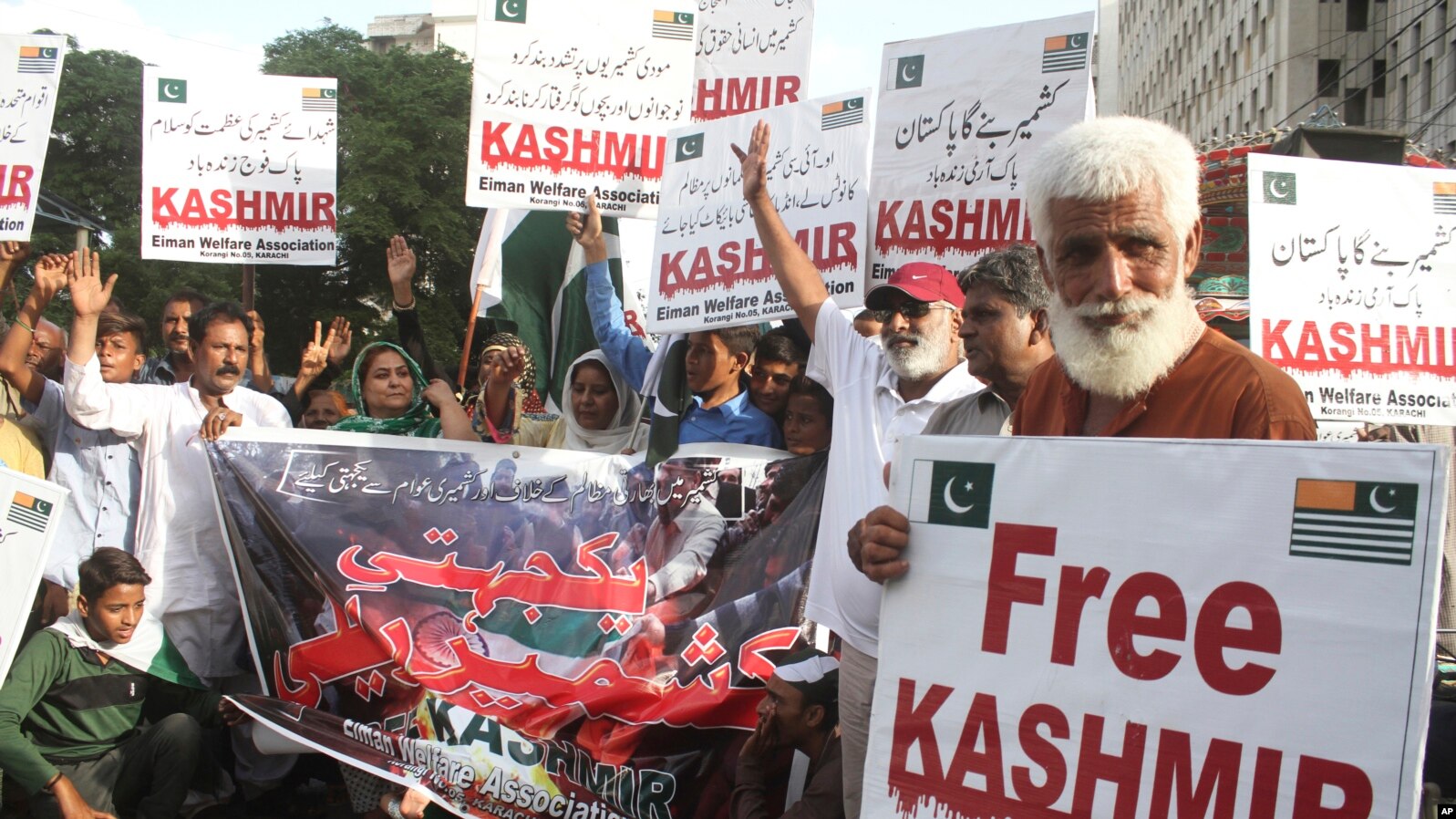
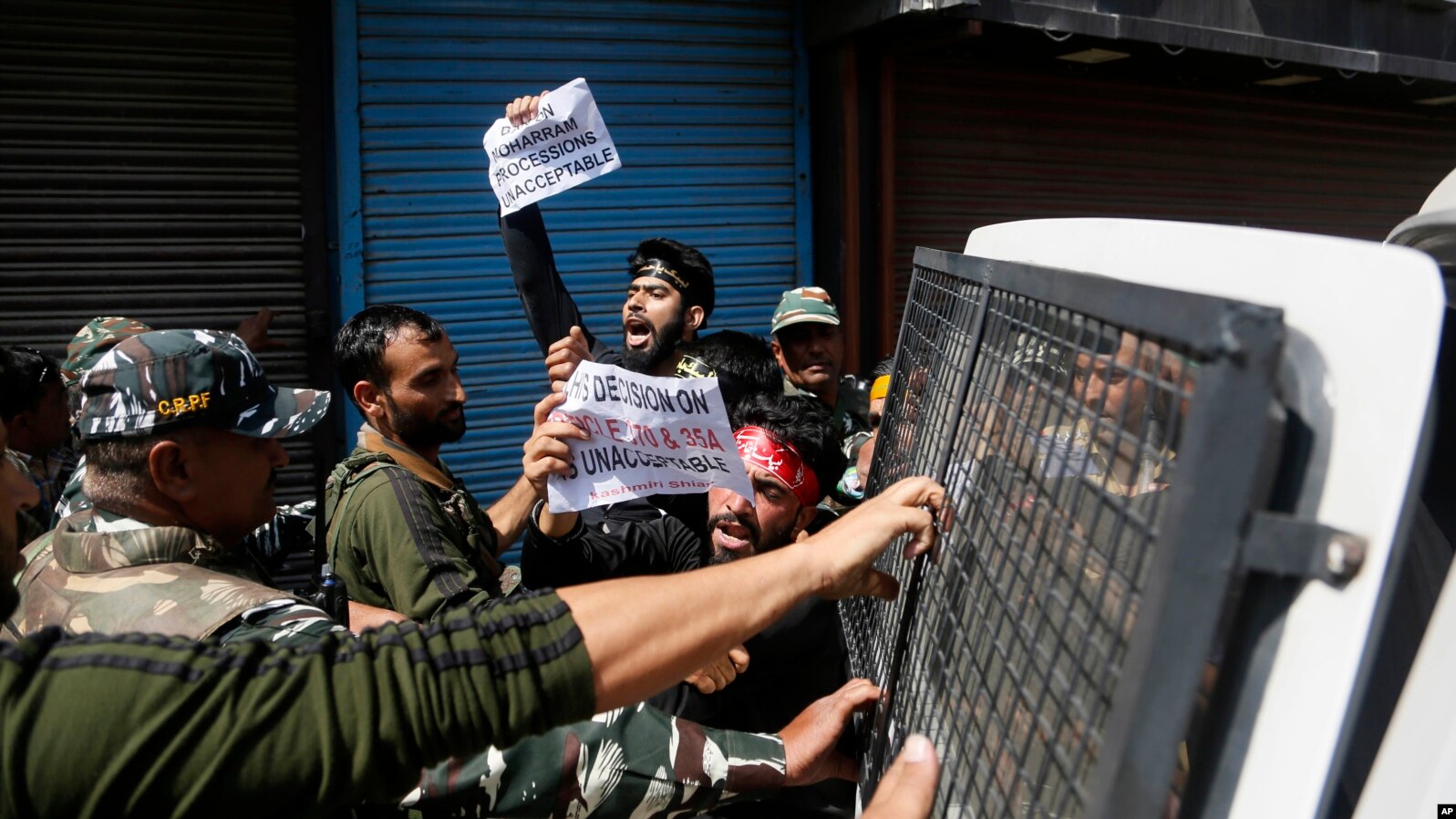
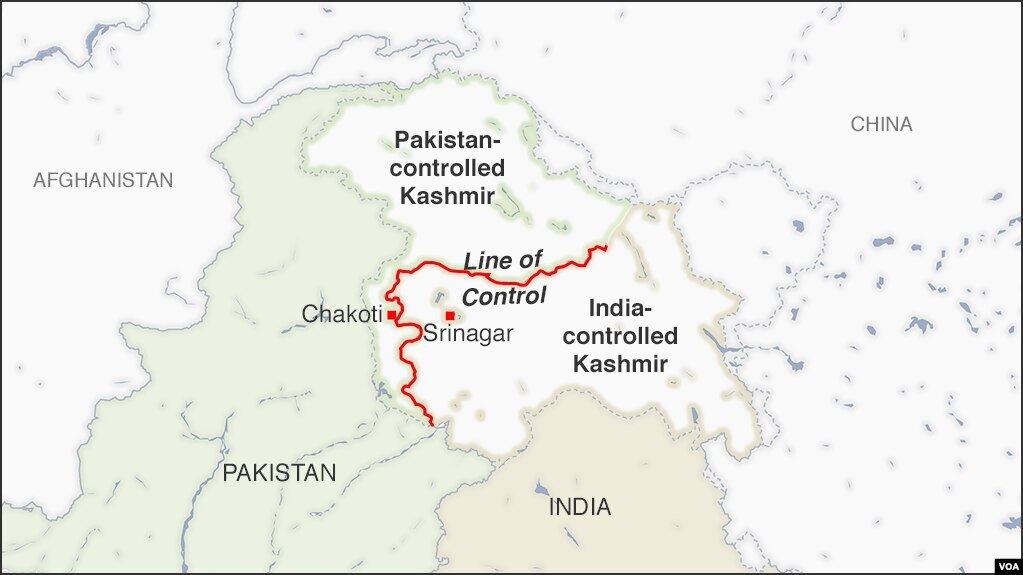
India’s recent decision to revoke the special status of Indian-controlled Jammu and Kashmir, a Muslim-majority state, has some experts concerned that the action could raise the stakes for militancy among several active terror groups in the region.
Continue reading “Experts: Kashmir Issue Could Raise the Stakes for Militancy”Pakistani Official: Kashmir Issue Forced Troop Pullback From Afghan Border
The renewed tension with India has pushed Pakistan to move some of its troops from the border region with Afghanistan to the Indian Line of Control (LOC), leaving fewer resources to contain the cross-border infiltration of militants along the Afghanistan-Pakistan border, a senior Pakistani army official tells VOA.
Continue reading “Pakistani Official: Kashmir Issue Forced Troop Pullback From Afghan Border”Experts: Kashmir Issue Could Raise the Stakes for Militancy
India’s recent decision to revoke the special status of Indian-controlled Jammu and Kashmir, a Muslim-majority state, has some experts concerned that the action could raise the stakes for militancy among several active terror groups in the region.
The presidential order to revoke Article 370 of the Indian constitution, ending Jammu and Kashmir’s autonomy in administrative matters, was preceded by massive troop movement and a lockdown in the state. Internet, cellphones and landline telephones reportedly were cut off.
“Indian Kashmir has been a very volatile region for a very long time,” said Ajai Sahni, a New Delhi-based political analyst at the Indian Institute for Conflict Management.
India has resorted to an “essentially repressive arrangement, in which the resistance will not go away,” Sahni told VOA.
Sahni said Indian authorities have so far managed to prevent any significant terror incident or backlash as a result of the recent move.

Militant groups
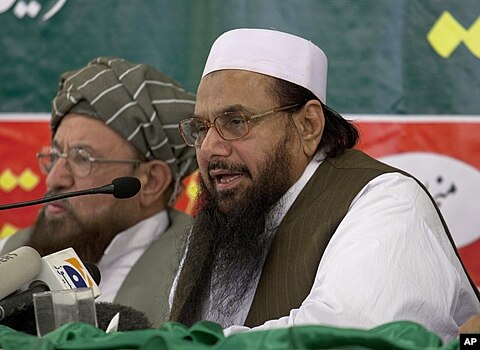
Several terror and militant groups operate in Jammu and Kashmir, including Jaish-e-Mohammad and Lashkar-e-Taiba. The latter has two other front organizations — Jamaat-ud-Dawa (JuD) and Falah-e-Insaniyat (FIF) — both of which allegedly collect charities under the pretext of helping the poor but instead fund the Kashmir cause.
LeT, JuD and FIF are led by Hafez Saeed, a U.S.-designated global terrorist who was allegedly the mastermind of Mumbai’s 2008 terror attacks in which 166 people were killed, including six Americans.
Some of these groups, like the LeT, are alleged to have links to Pakistan’s military and receive its support. Pakistan, however, denies supporting militant groups inside Kashmir.
Tauqir Gilani, chief of the Jammu Kashmir Liberation Front (JKLF), a Pakistan-based political party that believes in the unification of Kashmiris, said the situation is a cause for concern in the region and could be exploited by Pakistan.
“The situation is so volatile that Pakistan can easily exploit it and use Kashmiris as cannon fodder,” Gilani said. “Thousands of people have moved to the cease-fire line from Pakistan’s side, knowing that it is a case of now or never.”
Sahni downplayed the threat and maintains that “India’s intelligence agencies are well-aware of Pakistan’s backing of terrorist groups, and the Jammu and Kashmir police are equipped to handle the situation.”
“The international pressure has shifted in favor of stopping Pakistani support for terrorism. That has increased India’s expectations that Pakistan will not support militants in Kashmir,” he added.

Demographic change
India’s ruling Bharatiya Janata Party (BJP) returned to power earlier this year with a pledge to revoke Article 370.
The BJP, which allegedly has a nationalist Hindu base, also removed Article 35A — paving the way for non-Kashmiris to buy property inside Kashmir, which some analysts believe is a move to change the local demographics and undermine the Muslim-majority status of the region. The legislation gave the Jammu and Kashmir state legislature the power to define the term “permanent resident,” and provide those residents with special rights and privileges.
Mehbooba Mufti, a former chief minister of Jammu and Kashmir who has reportedly been under house arrest since protesting against the Indian government’s move, agreed, saying India wants to change the local demographics.
“They just want to occupy our land and want to make this Muslim-majority state like any other state, and reduce us to a minority and disempower us totally,” she told the BBC.
Sahni does not deny that India’s move will change the state’s demographics, but he argued that Pakistan has done the same thing on its side of Kashmir in the past.
“The Kashmiri movement (local resistance) is not sustainable, because Pakistan has already undertaken the demographic re-engineering of Gilgit-Baltistan,” Sahni said, referring to how Pakistan had settled non-Kashmiris in the Kashmiri territory.

Claims over Kashmir
Kashmir has been a disputed territory between India and Pakistan since 1947, when Muslim-majority Pakistan was partitioned from predominantly Hindu India, and British rule ended in the region.
Both nuclear nations have fought two major wars over Kashmir, which they each claim as an integral part of their territories.
In recent days, Indian politicians reiterated their long-standing position that their claim over Kashmir includes Pakistan-administered Kashmir, as well as the Chinese-administered Kashmiri territory of Aksai Chin.
IS and al-Qaida
There are fears that the indigenous Kashmiri groups operating within Indian-administered Kashmir could build ties with transnational terror groups like Islamic State and al-Qaida.
Malik Nadeem Abid, the New York-based executive director of Kashmir Mission USA, charges that Kashmiri groups are aware of Islamist extremists’ attempts to take over their movement.
“We have our eyes open to prevent infiltration of the Kashmiri cause by pro-Islamist groups like Islamic State and al-Qaida,” he told VOA. “Our movement is 100% indigenous and in the hands of nationalist Kashmiri leaders.”
Communication lines in Jammu and Kashmir have reportedly been cut off since India revoked the state’s special status, leaving local residents unable to communicate with the outside world.
Yusuf Jameel, a VOA reporter in Indian-administered Srinagar, described the situation as uncertain and volatile, which is forcing many people to leave.
“There is an extraordinary level of fear and apprehension among locals. Hundreds of Indian citizens and pilgrims, local workers, craftsmen and traders are leaving the valley,” he said.
D.C. must do more to protect its youth.
Breon Austin’s death hit home. At 16 , he was close in age to two of my grandchildren. A young person’s death always hits hard.
To learn, however, that he lost his life after multiple bullets were fired into his body by a masked assailant in the hallway of Breon’s own home is enraging. The shooter brazenly opened fire in front of Breon’s stepfather, who had just gotten home from work, according to The Post.
Police are searching for a man wearing a black mask and black jacket in a vehicle, captured by a surveillance camera near the crime scene, “described as a gray, four-door sedan with a sun roof and stickers on the driver’s side,” The Post reported.
There’s more to be learned about the circumstances surrounding Breon’s death, but this much is certain: He was the District’s 52nd murder victim this year (as of Friday morning), a 30 percent increase over the same time in 2018. The tide of homicides in our nation’s capital keeps rising.
The vast majority of D.C. homicides, as in Breon’s case, are linked to guns. But guns don’t fire themselves. Without someone to pull the trigger, a gun is just another hunk of metal. The city is rightfully troubled by the number of guns on the streets. It also has to do something about the number of people willing and able to use them.
To be sure, there’s tangible evidence of guns aplenty on our streets. The D.C. police annually recover more than 1,500 firearms in the city.
The gun recovery campaign is continuing. From April 1 to April 22, D.C. police recovered 190 illegal firearms. We’re talking about handguns, rifles and a 12-gauge shotgun.
Get this: Over those 22 days, police arrested 11 youths in gun possession cases. Seven were 17 years old; one was 16; two were 15; and one, age 14.
An anomaly? Every good wish.
From January to March, 41 juveniles were arrested for carrying a pistol without a license, possession of an unregistered firearm or possession of unregistered ammunition.
Homicides are taking a toll on young people, too. Sixteen youths ages 1 to 19 fell victim to homicide in 2016; 12 in 2017; 21 in 2018; and four thus far this year. Those unpleasant truths are little known and little discussed.
But weeping mothers, grieving families and neighbors gathered in the cemetery know all about it. Cops and the courts know all about it. Children hearing about young bodies falling know it, too.
Sadly, the concern of people burdened by gun violence stands in sharp relief to the laser-like focus of city leaders hell-bent on greening this city’s infrastructure, making DC Circulator bus rides a freebie and expanding the line east of the river (at a $16 million cost to taxpayers), and pouring $122 million in a new K Street Transitway to make life easier, says D.C. Mayor Muriel E. Bowser (D), “for all who travel around downtown D.C.”
D.C. Attorney General Karl A. Racine (D), the District’s chief prosecutor, is one local leader who gets it. He’s also bent on finding ways to prevent juvenile involvement in crime.
Racine’s approach to violence, as he told the D.C. Council in budget hearings this week, is to view violence as a disease, and treat it “like the true epidemic that it is.”
You won’t hear many city leaders refer to D.C. violence in such life-and-death terms. Racine, however, won’t back down or give in. “The reduction of gun violence and public safety must be our number-one priority,” he told the council. “Failure to take aggressive steps to prevent violence,” Racine said, “will result in more trauma that will beget more violence. Our children deserve better.”
Racine, a major proponent of a successful diversion program that redirects first-time juvenile offenders to constructive rehabilitative programs, was pitching city lawmakers for money to expand his “Cure the Streets” program, which takes a public-health approach to violence. Cure the Streets may sound touchy-feely, but it’s not.
Cure the Streets rigorously trains participants to intervene in potentially violent conflicts, targeting communities with high rates of shootings and homicides. The program seeks out those most likely to cause conflicts, directly engaging both them and the local community, he said in 2017, “in changing norms around violence.”
In two D.C. sites where Cure the Streets staff have been deployed, Racine said, “people feel safer, tension has dissipated, and we believe that Cure the Streets has made a significant impact.”
The program hasn’t reached the neighborhood where Breon Austin was killed. What if it had? Even more to the point, were it not for the masked gunman, who might Breon have become?
A question that may be asked about other D.C. youth endangered by this deadly epidemic.
Pakistan relying less and less on US, turning to China, Saudi Arabia & UAE
Pakistan is making important strides in its military and naval capacities with the help of China, relying less on US-made weaponry. Despite accepting money from all sides, Pakistan’s relationship with China continues to be strong.
After the Trump administration decided to suspend $3 billion in security assistance to Pakistan, complaining that Islamabad fails to do enough to combat terrorism, Washington has risked pushing Pakistan into the open arms of a number of other notable nations.
China-Pakistan relationship continues to strengthen
China has been a key ally for Pakistan in recent times and is almost certainly the reason why the US has taken a sharp turn in its approach to dealing with the country. (Considering that the Bush administration was caught red-handed funding Pakistani terrorist groups, Washington’s recent disdain for Islamabad makes little sense in the context of wider US imperialism).
Now, China is assisting Pakistan’s Navy to expand rapidly, with the completion and delivery of four advanced warships currently under construction in Shanghai. According to the Diplomat, Pakistan’s Chinese-made naval vessels will arrive through a bilateral arms agreement by 2021. Worth over $348 million, these frigates have the capacity to act as anti-ship and anti-submarine operations, as well as for air defense.
Reports seem to indicate that these ships are to be stationed for defense and security in and around the Gwadar port. This is the same port that many media outlets accused China of attempting to hijack and transform into its own naval base. Perhaps the media sounding the alarm over these reports have helped convince China to try a subtler strategy of creating a naval presence around this strategic area, but either way, the move to acquire Chinese naval ships is sure to irk the United States irrespective of the end result, as some experts are predicting that this will lead to regular Sino-Pakistani patrols across the region.
That being said, this is also the same port in which Saudi Arabia is planning to establish a $10 billion oil refinery, according to the Saudi Energy Ministry, setting Saudi Arabia up as a key partner in the China-Pakistan Economic Corridor (CPEC).
Pakistan turning down American arms
Unfortunately for Washington, Pakistani purchases of US-made military equipment have begun to fall. Data from the Stockholm International Peace Research Institute appears to show that US weapons exports to Pakistan dropped from $21 million in 2017, from a whopping $1 billion just seven years prior. Altogether, since the September 11 attacks, the US has provided over $22 billion in overt security aid to Pakistan and another $10 billion in economic aid, according to a July 2018 report conducted by consultant firm Avascent.
However, despite these initial findings, this same report found that Pakistan was increasingly turning to Beijing for its defense equipment and leaving Washington out in the sand. In total, Pakistan has signed billions of dollars’ worth of contracts for fighter aircraft, submarines and warships from China. The report estimated that over the next decade, Beijing will become the single most important arms supplier for the Pakistani military, but maintains options to obtain arms from Turkey and Russia as well. Turkey, for its part, will upgrade two of Pakistan’s Agosta 90B-class submarines, will provide four MILGEM corvettes to the Pakistani Navy, and already provided a navy fleet tanker in 2016.
Pakistan is also reportedly the largest importer of the F-7PG aircraft from China, with more than 50 F-7PG fighters in the Pakistan Air Force (one of these planes just recently crashed in Western Pakistan, killing the pilot).
The China-Pakistan Economic Corridor
In actuality, China and Pakistan are developing their relationship in more ways than at first meets the eye. It is one thing to spend millions of dollars attempting to beef up a nation’s navy, but it is something else entirely when two nations become attached on a much deeper level, particularly when it involves the citizens of those countries. Just this week, the government of Pakistan announced a new visa regime between Pakistan and China, tourism being an area of Pakistan’s economy that China has already been contributing heavily. Reportedly, millions of young Pakistanis are also foregoing English and learning Mandarin instead in order to obtain jobs and degrees. If we fast-forward a few decades down the line, I venture to bet that Western influence in Pakistan will be almost completely invisible.
Pakistani President Arif Alvi also just hailed the China-Pakistan Economic Corridor (CPEC), vowing that the scheme will bring economic prosperity to the two countries. The CPEC is essentially a combination of infrastructure projects in Pakistan funded by Chinese loans which are worth at least $62 billion. As explained above, Saudi Arabia is not sitting idly by watching this project develop (not surprising, when one understands why).
CPEC, combined with China’s New Silk Road Project, has top US lawmakers and intelligence personnel increasingly “concerned.” One senator stated that he was “concerned about data access China may control through digital infrastructure projects in countries around the world. What is the IC’s assessment of potential dual-use aspects of China’s Belt and Road Initiative and what threats do they pose to US interests?”
US allies and partners “seeking greater independence from Washington”
A report compiled by Daniel R. Coats, the director of national intelligence, entitled “Worldwide threat assessment of the US intelligence community” identifies Pakistan as a nation that contributes to the risks of escalation dynamics and security in the region. More noticeable, however, is that while Pakistan appears in the document a handful of times, China is mentioned at least 85 times right throughout the report.
“We assess that China’s leaders will try to extend the country’s global economic, political, and military reach while using China’s military capabilities and overseas infrastructure and energy investments under the Belt and Road Initiative to diminish US influence,” the report states. “China has built its first overseas military facility in Djibouti and probably is exploring bases, support facilities, or access agreements in Africa, Europe, Oceania, Southeast Asia, and South Asia.”
Most curious is the foreword of the report which, after outlining all the threats Russia and China pose to the United States in all the different ways, states that “[a]t the same time, some US allies and partners are seeking greater independence from Washington in response to perceptions of changing US policies on security and trade and are becoming more open to new bilateral and multilateral partnerships.”
Let’s do the math. As already stated, the US has deprived Pakistan of $3 billion in security assistance. Not too long ago, the Abu Dhabi Fund for Development (ADFD) UAE deposited $3 billion into the State Bank of Pakistan to support its economic growth. Saudi Arabia made a similar promise, agreeing to provide Islamabad with a one-year deferred payment facility for importation of oil worth up to $3 billion.
At around the same time, Emirati media announced that the UAE and Pakistan were accelerating defense cooperation after the federal minister for defense production in Pakistan, Zubaida Jalal, received Major General Staff Pilot Ishaq Saleh Al-Balushi, head of the executive directorate of industries and development of defense capabilities at the UAE Ministry of Defense in Islamabad.
Pakistan is also expected to sign a memorandum of understanding with Saudi Arabia on a framework for $10 billion in Saudi investments. While some media will present Pakistan’s willingness to work with Saudi Arabia as an issue which will rattle and unnerve China, the available evidence appears to show that Sino-Pakistan relations are continuing unabated.
The question of Pakistan’s nukes
Last Thursday, the Pakistani Army Strategic Forces Command conducted a successful test flight of the Nasr close-range ballistic missile, which is nuclear-capable and can reach a specification of 70km.
The target of the ballistic test may surprise you. According to the Pakistani Army statement, the Nasr “augmented Full Spectrum Deterrence posture remaining within the precincts of policy of Credible Minimum Deterrence, against prevailing and evolving threat spectrum more effectively including enemy’s ballistic missile defense and other Air Defence Systems.”
The “enemy” referred to in this statement appears to be a blatant reference to Trump’s recent 2019 Missile Defense Review, which admitted that the US had “discussed potential missile defense cooperation with India” in light of the fact that “a number of states in South Asia are developing an advanced and diverse range of ballistic and cruise missile capabilities.”
Currently, Pakistan has ballistic missiles with ranges that can hit anywhere inside India. It has also built nuclear-tipped cruise missiles that can travel up to 400 miles. Not surprisingly, it was the US that gave the green light to Pakistan to modify its F-16 fighters to be capable of dropping nuclear weapons.
Conclusion
Pakistan’s economic woes put the nation in an incredibly compromising position. Knowing that it can no longer rely on Washington for support, it has to turn to as many partners as it can to keep its economy afloat. While China may not be thrilled by Saudi Arabia’s attempt to wade in on its project at the Gwadar port, it does appear that Pakistan’s geopolitical significance, particularly in relation to China, will entail Beijing continuing to prioritize its relationship with Pakistan. This includes, if necessary, militarizing its available bases in the region through the supply of its Chinese-made naval vessels

About half of U.S. troops in Afghanistan to be withdrawn within weeks. Report comes a day after Trump announced troops leaving Syria
WASHINGTON — A day after a contested decision to pull American military forces from Syria, officials said Thursday that President Donald Trump has ordered the start of a reduction of American forces in Afghanistan.
More than 7,000 American troops will begin to return home from Afghanistan in the coming weeks, a U.S. official said. The move will come as the first stage of a phased drawdown and the start of a conclusion to the 17-year war that officials say could take at least many months. There now are more than 14,000 U.S. troops in Afghanistan. Trump announced Wednesday that he would pull all of the more than 2,000 American troops from Syria.
Taken together, the Syria withdrawal and the likely Afghan drawdown represent a dramatic shift in the U.S. approach to military engagement in hot spots around the world, reflecting Mr. Trump’s aversion to long-running military entanglements with their high costs and American casualties.
“I think it shows how serious the president is about wanting to come out of conflicts,” a senior U.S. official said of how the Syria decision affects his thinking on Afghanistan. “I think he wants to see viable options about how to bring conflicts to a close.”
Taliban confirms meeting with US in the UAE
The Taliban released a short statement today confirming that representatives of its “political office” are set to meet with an American delegation tomorrow (Dec. 17).
The face-to-face is to take place in the United Arab Emirates (UAE). And according to the Taliban, “[r]epresentatives of Saudi Arabia, Pakistan and [the] United Arab Emirates will also attend the meeting.”
Notably absent from the Taliban’s statement is any mention of the Afghan government. The jihadists have publicly rejected any talks with President Ghani’s government, repeatedly describing it as an illegitimate “puppet” of the US.
According to Voice of America (VOA), the encounter in the UAE was brokered by Pakistan, after President Donald Trump requested Pakistan’s assistance in jumpstarting the talks. Citing Pakistani officials, VOA added that previous talks in Qatar stalled because the Taliban insisted on “a date or timeframe” for the US and NATO withdrawal before participating in any sort of peace process with its Afghan foes. Such a timetable would be a major concession just to initiate negotiations.
The Trump administration has attempted to pressure Pakistan into ending its support for the Taliban and other jihadist groups. The US withheld millions of dollars in military aid, but this did not alter Pakistan’s behavior.
The State Department confirmed earlier this year that Pakistan continues to provide a safe haven for the Taliban’s senior leadership, including the al Qaeda-linked Haqqanis.
The Taliban has been using diplomacy to undermine the legitimacy of the Afghan government, while boosting its own international credentials.
The Obama administration’s talks with the Taliban further strained relations between the US and then President Hamid Karzai. The US agreed to allow the Taliban to open its “political office” in Doha with the understanding that the insurgency group wouldn’t refer to itself as the “Islamic Emirate of Afghanistan” – the name of its authoritarian regime prior to the US-led invasion in Oct. 2001.
The first thing the Taliban did upon opening its office in mid-2013 was unfurl a banner with the “Islamic Emirate of Afghanistan” on it. This offended Karzai’s government, as it implies that the Taliban’s regime is the legitimate ruler of Afghanistan.
The Taliban has continued to press this point. Not only does the group constantly refer to itself as the “Islamic Emirate of Afghanistan,” it is also argues that only its extremist, sharia-based government is a legitimate representative of the Afghan people.
For instance, the Taliban released a statement on Nov. 16 concerning a conference in Moscow. The Taliban attended; the Afghan government did not. The statement was tellingly titled, “The Islamic Emirate’s Effective Diplomacy.” From the jihadists’ perspective, the Russian-hosted event was a good opportunity to expose “the crimes of the foreign invaders and Kabul administration and their corruption among other topics.” The Taliban added that in Moscow it “clarified the present situation of Afghanistan and exposed the policies, oppression and corruption of the savage aggressors and Kabul administration.”
The Taliban consistently refers to Ghani’s government as the “Kabul administration” — a derogatory phrase.
The Taliban elaborated, saying the “Islamic Emirate’s delegation presented its religious and national stance at the Moscow Conference through which the doubts of various countries were removed and it became further clear that it is only the Islamic Emirate which at present truly represents the Afghan people, that it has indeed been successful in obtaining the public’s support and is struggling for defending the Afghan people’s rights and state sovereignty — such struggle is the human and legal right of any nation which they must not be deprived of.”
The Taliban crowed that “in the military field the Islamic Emirate has defeated the occupying enemy alongside its enslaved forces on the one hand, and on the other hand it has forced the tired enemy into embarrassment in the political field.” That is, according to the Taliban, the US and the West have been embarrassed into negotiations.
Much of the rest of the Taliban’s statement on the Moscow conference was in this same vein, trumpeting its ability to tell its story in the media, while undermining the US and the West (“the imperialistic powers”), as well as the Afghan government.
In a separate statement on Nov. 28, the Taliban commented on a conference in Geneva that “was also attended by Ashraf Ghani along with his team.” The Taliban said its “Islamic Emirate, as a representative of the valiant Mujahid Afghan nation and as a sovereign entity, is fighting and negotiating with the American invaders for the success of Jihad” — in other words, to get the US and its foreign allies to withdraw from Afghanistan. Moreover, it was a “waste of time” to talk with “powerless and foreign imposed entities” — meaning the Afghan government.
It remains to be seen if Zalmay Khalilzad, who leads the American delegation, can actually get the Taliban and the Afghan government to sit down at the same table — or if the US will proceed without such talks.
At least one American official claims they aren’t even really negotiating with the Taliban. “We are not engaged in peace talks with the Taliban,” John R. Bass, the US Ambassador in Afghanistan, said earlier this month, according to TOLOnews. “We are not negotiating on behalf of the Afghan people, we are not negotiating on behalf of the Afghan government, we are not in negotiating period.”
Previous talks have been held in Qatar, a nation that has offered a permissive fundraising environment for the Taliban and al Qaeda. But the UAE, Qatar’s geopolitical rival, has also allowed freedom of movement for the Taliban. Shortly before he was killed in a US drone strike in Pakistan in May 2016, the Taliban’s emir, Mullah Mansour, visited Dubai. His trip, which was first reported by the Washington Post, was for “shopping and fundraising.” Mansour then visited Iran before returning to Pakistan, where he was droned to death.
Other Taliban figures have been known to travel to the UAE for fundraising as well.
Thomas Joscelyn is a Senior Fellow at the Foundation for Defense of Democracies and the Senior Editor for FDD’s Long War Journal.
US Report Highlights Murky World of “Contractors” in Pakistan
WASHINGTON Dec 8: “The contractor must maintain a constant capability to surge to any location within Afghanistan or Pakistan” within a 30-day period, says an official US announcement released in 2010.
The announcement — highlighted by The Nation, the oldest US weekly, in May 2010 — solicits bids from private war contractors to secure and ship US military equipment through sensitive areas of Pakistan into Afghanistan.
Among the duties the contractors were required to perform was “intelligence, to include threat assessments throughout Afghanistan and Pakistan”.
The solicitation notice — almost completely ignored by the Pakistani media — also underlines the enormity of the task: “There will be an average of 5,000” import shipments “transiting the Afghanistan and Pakistan ground lines of communication (GLOC) per month, along with 500 export shipments”.
The terms of the contract indicate that US personnel were directly involved in these operations, although a bulk of the force was hired locally, in Pakistan and Afghanistan.
Ninety American contractors were among the 65,000 people killed in Pakistan in 17 years.
A May 25, 2010 article in The Nation, by journalist Jeremy Scahill, points out that among the firms listed by the US Department of Defence as “interested vendors” were an Afghan firm tied to a veteran CIA officer and run by the son of a former Afghan defence minister, Gen Abdul Rahim Wardak, and a Pakistani firm with links to Blackwater, a private security company based in the US.
Although often highlighted in the US media, the mysterious world of private contractors drew little attention in Pakistan until recently, when a report by the Brown University’s Costs of War Project mentioned that 90 American contractors were among the 65,000 people killed in Pakistan in the last 17 years.
The activities of private contractors in Pakistan did not receive much attention in the US media either, mainly because the death tolls in Afghanistan and Iraq were much higher.
According to the Brown University report, a total of 7,820 private American contractors have been killed since 2001. Of them 3,937 were killed in Afghanistan, 3,793 in Iraq and 90 in Pakistan.
For most Pakistanis, even 90 contractors are far too many as the number makes them realise that hundreds of private American contractors have been operating in their country without their knowledge.
But the 2010 solicitation expla¬ins why the United States had to hire a large number of private contractors in Pakistan. It identifies “current limitations on having US military presence in Pakistan and threat levels precluding US Military active invol¬vement” as the main reasons for hiring private contractors.
Defining a contractor’s functions, the solicitation states: “The contractor must be proactive at identifying appropriate methods for obtaining the necessary in-transit visibility information.”
Although no official statistics are available about the total number of American contractors deployed in Pakistan, in 2012 the US Central Command informed Congress approximately 137,000 contractors were working for the Pentagon in the greater Middle East region that includes Afghanistan, Iraq and Pakistan.
Of that total, 40,110 were US citizens, 50,560 were local hires, and 46,231 were from neither the US nor the country in which they were working.
“These numbers do not reflect the totality of contractors. For example, they do not include contractors working for the US State Department,” journalist David Isenberg wrote in the Time magazine on October 9, 2012.
According to the US Department of Defence data, at the peak of their deployment (2008-2011) contractors in Iraq and Afghanistan represented 52 per cent of the total force, averaging 190,000 contractors to 175,000 uniformed personnel.
Focusing on the situation in Pakistan, journalist Antony Loewenstein, wrote in an Australian publication in April 2012 that in Pakistan “private security is a state within a state”.
He wrote that a total of 62 retired military officials were running these private companies and at least half of them “had been arrested and then released for corruption and working for the Americans”.
According to him, “the most revealing company name” on the 2012 list was G4S Wackenhut Pakistan. G4S is a British behemoth in the security industry with a troubling human rights record.
A January 2010 report of the Foreign Policy (news site) also covers the period when private security was its peak in Pakistan. It notes that in 2010, the top UN security official, Gregory Starr, the former head of US State Department Security, advocated an increase in the use of private security firms in Pakistan.
The report notes that the UN “accelerated its move toward hired guns” in Pakistan after the Taliban launched an attack against a UN residence in October 2009, killing five UN employees.
The report also identifies some of the companies active in Pakistan in that period, including Blackwater/Xe, Triple Canopy, Dyncorps and Aegis. Most of them have now hired local partners.
`Gwadar Port May Be Gateway to Landlocked Central Asian States’ – Balochistan CM
QUETTA: Balochistan Chief Minister Jam Kamal Khan has said that Gwadar Port can serve as the gateway for the landlocked Central Asian states by providing them access to maritime routes and a trade corridor for doing business with all countries of the world.
According to a statement issued by the Balochistan government, the chief minister was speaking at a meeting of heads of the Regions Forum of the Shanghai Cooperation Organisation (SCO) states in Chelyabinsk city of Russia on Wednesday.
“Pakistan and China are working together to develop the Gwadar Port to facilitate connectivity, trade and investment in the region and beyond,” he added.
The SCO comprises eight member states: Pakistan, China, Russia, India, Uzbekistan, Tajikistan, Kazakhstan and Kyrgyzstan. Four other states have observer status in the organisation.
The SCO’s major objectives include strengthening mutual confidence and good neighbourly relations, promoting effective cooperation in politics, trade and economy, science and technology, culture, education, energy, transportation, tourism and environmental protection.
Prime Minister Imran Khan nominated Balochistan Chief Minister Jam Kamal Khan to represent Balochistan and Pakistan in the forum, while Punjab minister Mian Mohammad Aslam Iqbal, Kamran Khan Bangash, special assistant to the KP chief minister, and Aamir Shoakat, SCO director, accompanied the Pakistani delegation.
The chief minister said that in the integrated world, regional organisations such as the SCO played an important role in coordinating actions and polices to ensure security, peace and development in the region.
“We are highly appreciative of the Russian Federation and Chelyabinsk region for bringing us together at this important platform,” he said, adding that “we would specially thank Mr Dubrovsky, Governor of Chelyabinsk region, for taking this initiative to host the first meeting of the forum”.
“I invite you all to come and visit Balochistan or send your investors to explore possibilities for investment for mutual benefit and cooperation in the province. My government stands ready to extend all possible facilities to all investors,” Mr Khan said.
Donald Trump writes to Pakistan’s Imran Khan in Afghanistan peace move (The Independent UK Dec 3, 2018)
President Donald Trump has reached out to Pakistan’s prime minister, sending Imran Khan a letter seeking Islamabad’s co-operation in bringing the Taliban to the negotiating table to end the 17-year war in neighbouring Afghanistan, officials have said.
The development could help ease tension between Washington and Islamabad.
Relations soured after Mr Trump last month alleged that Pakistan harboured al Qaida leader Osama bin Laden despite getting billions of dollars in American aid.
Pakistan’s foreign ministry quoted Mr Trump as saying in the letter that he considers his most important regional priority achieving a negotiated settlement to the Afghan war and that he was seeking Pakistan’s support and facilitation toward that goal.
It said Mr Trump acknowledged the war has cost dearly both the United State and Pakistan.
The ministry also said Mr Trump emphasised Pakistan and Washington “should explore opportunities to work together and renew their partnership”.
Pakistani authorities did not release the letter, which information minister Fawad Chaudhry said Mr Khan received on Monday morning.
The ministry welcomed the US president’s outreach, saying: “Pakistan has always advocated a political settlement to end war in Afghanistan.”
“Pakistan reiterates its commitment to play the role of facilitator in good faith,” the ministry statement said.
Pakistani media outlets, whose reporters met with Mr Khan in Islamabad on Monday, quoted the prime minister as saying that Pakistan would continue its efforts to help peace in Afghanistan.
When Mr Trump levelled his accusation about bin Laden last month, Islamabad said “such baseless rhetoric … was totally unacceptable”.
Mr Khan at the time stressed the United States had provided what he described as a minuscule 20 billion US dollars in aid to Pakistan.
Bin Laden was killed by US commandos in a surprise raid in May 2011 in the Pakistani garrison city of Abbottabad.
According to Imtiaz Gul, a Pakistani analyst, Mr Trump’s letter indicates there is a realisation within the US administration that Pakistan’s co-operation is vital to ensuring peace in Afghanistan.
Despite near-daily attacks by the Taliban, who now hold sway in about half of Afghanistan’s territory, the Trump administration has stepped up efforts to find a peaceful solution to the protracted war.
US envoy Zalmay Khalilzad was expected to arrive in Pakistan this week during his visit to the region to revive peace talks with the Taliban.
According to the US State Department, Mr Khalilzad will travel to Pakistan, Afghanistan, Russia, Uzbekistan, Turkmenistan, Belgium, the United Arab Emirates and Qatar with a delegation from December 2 to December 20