
Frustrated U.S. Might Withhold $255 Million in Aid From Pakistan

WASHINGTON, Dec 29 — When Pakistani forces freed a Canadian-American family this fall held captive by militants, they also captured one of the abductors. United States officials saw a potential windfall: He was a member of the Taliban-linked Haqqani network who could perhaps provide valuable information about at least one other American hostage.

The Americans demanded access to the man, but Pakistani officials rejected those requests, the latest disagreement in the increasingly dysfunctional relationship between the countries.

Now, the Trump administration is strongly considering whether to withhold $255 million in aid that it had delayed sending to Islamabad, according to American officials, as a show of dissatisfaction with Pakistan’s broader intransigence toward confronting the terrorist networks that operate there.

The administration’s internal debate over whether to deny Pakistan the money is a test of whether President Trump will deliver on his threat to punish Islamabad for failing to cooperate on counterterrorism operations.

Relations between the United States and Pakistan, long vital for both, have chilled steadily since the president declared over the summer that Pakistan “gives safe haven to agents of chaos, violence and terror.”

The United States, which has provided Pakistan more than $33 billion in aid since 2002, said in August that it was withholding the $255 million until Pakistan did more to crack down on internal terrorist groups.

Senior administration officials met this month to decide what to do about the money, and American officials said a final decision could be made in the coming weeks.

The officials, who spoke on the condition of anonymity to describe the sensitive discussions, did not detail what conditions Pakistan would have to meet to receive the aid.

It was not clear how the United States found out about the militant’s arrest, but an American drone had been monitoring the kidnappers as they moved deeper into Pakistan.

Caitlan Coleman, an American, and her Canadian husband, Joshua Boyle, were freed along with their children in an October raid after five years in captivity.

Pakistani troops confronted Haqqani militants as they ferried the family across the tribal lands of northwest Pakistan.

The Trump administration has foreshadowed a cutoff in recent days with harsher language.

Last week, in announcing his national security strategy, Mr. Trump again singled out Pakistan for criticism. “We make massive payments every year to Pakistan,” he said. “They have to help.”

Vice President Mike Pence reinforced that message in a visit to Afghanistan just before Christmas, telling cheering American troops that “President Trump has put Pakistan on notice.”

The reaction of his audience was notable, analysts said, since the Pentagon has historically been one of Pakistan’s defenders in Washington because of its longstanding ties to the Pakistani military.

Pakistan, however, has few friends in Mr. Trump’s National Security Council.

Lt. Gen. H.R. McMaster, the national security adviser, served in Afghanistan, where he saw firsthand how Pakistan meddled in its neighbor’s affairs. Lisa Curtis, the council’s senior director for South and Central Asia, brought critical views about Pakistan from her previous post at the conservative Heritage Foundation.

In a report she wrote in February with Husain Haqqani, Pakistan’s former ambassador to Washington, the two called for the administration to “avoid viewing and portraying Pakistan as an ally.” If Pakistan did not take steps to show its commitment to America’s counterterrorism goals, they wrote, Mr. Trump should strip it of its status as a major non-NATO ally.

Such a step would be more punitive than withholding the $255 million in State Department assistance known as Foreign Military Financing, Mr. Haqqani said in an interview, because it would deprive Pakistan of access to military equipment. He said Pakistani officials were bracing for some kind of aid cutoff.

Pakistan’s military, he said, still views its accommodation of the Haqqani network as in its security interest.

To overcome that, the Trump administration would have to pursue other, more punishing measures, either by imposing targeted sanctions on the government or removing it from the list of non-NATO allies.

“Pakistan can withstand a cutoff in American aid,” Mr. Haqqani said. “It would have to be followed by something else to make Pakistan believe that Mr. Trump means business.”

In July, the Pentagon said it would withhold $50 million in military reimbursements for Pakistan because the country had not taken “sufficient action” against the Haqqani network.

A State Department official said Pakistan’s actions will ultimately determine the course of “security assistance in the future.” The official said conversations with Pakistan are continuing and declined to provide further comment.

The Pakistani government did not respond to a message seeking comment.

After Ms. Coleman, Mr. Boyle and their children were freed, the Pakistani military made no mention of the captured Haqqani operative.

Instead, the military released a statement saying the operation’s “success underscores the importance of timely intelligence sharing and Pakistan’s continued commitment towards fighting this menace through cooperation between two forces against a common enemy.”

Mr. Trump said it was “a positive moment for our country’s relationship with Pakistan.”

American officials are eager to learn what the militant knows about Kevin King, an American university professor who was kidnapped along with Timothy Weeks, an Australian citizen, in August 2016. Mr. King is believed to be alive but ill and American officials are hopeful that he and Mr. Weeks might be released.

Another American, Paul Overby, vanished in 2014 in Afghanistan. Mr. Overby was trying to interview the leader of the Haqqani network when he disappeared.

Gen. Joseph L. Votel, the head of the Pentagon’s Central Command, which oversees Pakistan and Afghanistan, declined to provide any details on the Haqqani operative who was seized other than to say he was “probably pretty important” and that any militants involved in hostage-taking were “significant.”

General Votel would not say whether the Trump administration is considering withholding aid from Pakistan to prod Islamabad to improve its counterterrorism cooperation.

“What we’re trying to do is to talk to Pakistan about this, and not try to communicate with them through public messaging,” General Votel said in an interview.
Trump looks to the sky to force Taliban to the table

KABUL: The war in Afghanistan may be entering its 17th year, but screams of military jet engines in the twinkling skies above Bagram Airfield show no sign of quieting.

This city-scale military base just north of Kabul has — like similar facilities in Kandahar and Jalalabad — become central to Donald Trump´s promise to succeed where his predecessors failed, and end the Afghan war on favorable terms.

Trump concluded a months-long strategy review in August. During that soul searching, the White House came to believe that the Obama administration underutilized America´s total aerial superiority.

The skies, they believe, could hold one key to unlocking the conflict.

Trump will likely send a few thousand more troops to the country — a development sure to grab the headlines — but the days of having 100,000 US military personnel in the country are over.

The ground war is likely to fall more and more to Afghan government forces, and early political efforts will be trained, in part, on getting Pakistan to stop providing safe havens for jihadists across the border.

But the first tangible moves have been a significant increase in the tempo and intensity of airstrikes, an effort to take the war to the Taliban.

The US, which is the only foreign force in Afghanistan carrying out airstrikes, targeted the Taliban and Islamic State group militants with 751 bombs and missiles in September, the month after the strategy review.

That was up 50 percent from August and the highest since October 2010, according to US Air Force data.

US Air Force personnel on the ground in Afghanistan report a significant shift in how airpower is being used.

Before, jets patrolled for up to four hours waiting to provide air support to ground forces. But they often returned to Bagram without having fired a shot in anger.

Chocks away
Today, according to Captain Lyndsey Horn, they are much more likely to come back having engaged the Taliban, the Islamic State group or having targeted an opium production facility.

“For a long time here we stagnated,” said a second officer. “The effects so far are positive, the long term effects are harder to tell.”

Vice President Mike Pence, who on Thursday became the most senior member of the Trump administration to visit Afghanistan, says the strategy is starting to make a difference in Taliban morale.

“President Ghani informed me that in 2017 we have eliminated more senior leaders of the Taliban than were eliminated in all the prior years combined,” Pence said after his meeting in Kabul.

“They have begun to see a sea change in the attitudes among the Taliban” he added. The Taliban “are now beginning to question their future, and our hope is, as we take the fight to the enemy… that eventually the enemy will tire of losing and will be willing to come forward.”

Lofty claims of progress are hard to verify, and the Taliban were able to lift their momentum even after the deaths of their first two chiefs, including Mullah Akhtar Mansour who was killed by a US drone strike in 2015 ordered by Trump´s predecessor Barack Obama.

Afghan forces, beset by desertions and corruption, have seen casualties soar to what a US watchdog has described as “shockingly high” levels since NATO forces officially ended their combat mission in 2014, and the figures are now classified in an effort to save morale.

The Taliban continue to control or contest 45 percent of the country´s territory, according to a September analysis by the respected Long War Journal, and have stepped up raids on security installations across Afghanistan.

No recent arrival at Bagram, and certainly not Trump´s Afghan-savvy former generals who had a hand in the new strategy — namely National Security Advisor HR McMaster and Defense Secretary Jim Mattis — believe the Taliban is about to surrender wholesale.

But the White House hopes overwhelming force will exacerbate divisions in the Taliban ranks and help lure more members to the negotiating table, where America´s diplomats will be waiting.

Officials admit the US strategy is not without risk, and the longer it runs the more costs will accrue.

More bombing almost invariably means more civilian casualties, which could further mobilize Afghans against the United States.

And while the US recently wiped out 10 Taliban labs used to process opium into heroin, counter-narcotics experts believe three million Afghan farmers make their living from the crop, which has been described as “a low-risk crop in a high-risk environment.”

UN Jerusalem vote by country: What countries voted against US call on Israel’s capital?

An overwhelming majority of United Nations member states opposed the United States regarding the disputed status of Jerusalem on Thursday.

In what was seen as a massive blow to the US, a total of 128 of the 193-member UN General Assembly agreed to resolve the Holy City dispute through “negotiations in line with relevant UN resolutions”.

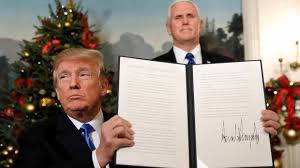
The vote followed President’s Trump decision on December 6 to move the US embassy in Israel to Jerusalem.
The official UN position is that East Jerusalem is part of the occupied Palestinian territory – a sore point of contention for Israel. In 2008 the UN called on for a dual-capital solution.

US ambassador to the UN Nikki Haley said that the vote “disrespected” America and President Trump
Ms Haley later announced that the US will go ahead with moving its embassy to the disputed city regardless of the vote.

She said: “That is what the American people want us to do and it is the right thing to do.

“This vote will make a difference in how Americans look at the UN.

Adding that the US will “remember this day” when it was “singled out for attack”.

The UK, France, China and Germany were among those who voted in favour of the non-binding motion. Only nine voted against and 35 abstained.

Jerusalem vote: A majority of UN states voted in favour of the motion against the US

Here are the countries that voted in favour of the UN motion:
A: Afghanistan, Albania, Algeria, Andorra, Angola, Armenia, Austria, Azerbaijan
B: Bahrain, Bangladesh, Barbados, Belarus, Belgium, Belize, Bolivia, Botswana, Brazil, Brunei, Bulgaria, Burkina Faso, Burundi
C: Cabo Verde, Cambodia, Chad, Chile, China, Comoros, Congo, Costa Rica, Cote d’Ivoire, Cuba, Cyprus, Democratic People’s Republic of Korea (North Korea), Denmark, Djibouti, Dominica
E: Ecuador, Egypt, Eritrea, Estonia, Ethiopia
F: Finland, France
G: Gabon, Gambia, Germany, Ghana, Greece, Grenada, Guinea, Guyana
I: Iceland, India, Indonesia, Iran, Iraq, Ireland, Italy
J: Japan, Jordan
K: Kazakhstan, Kuwait, Kyrgyzstan
L: Laos, Lebanon, Liberia, Libya, Liechtenstein, Lithuania, Luxembourg
M:Madagascar, Malaysia, Maldives, Mali, Malta, Mauritania, Mauritius, Monaco, Montenegro, Morocco, Mozambique
N: Namibia, Nepal, Netherlands, New Zealand, Nicaragua, Niger, Nigeria, Norway
O: Oman
P: Pakistan, Papua New Guinea, Peru, Portugal
Q: Qatar
R: Republic of Korea (South Korea), Russia
S: Saint Vincent and the Grenadines, Saudi Arabia, Senegal, Serbia, Seychelles, Singapore, Slovakia, Slovenia, Somalia, South Africa, Spain, Sri Lanka, Sudan, Suriname, Sweden, Switzerland, Syria
T: Tajikistan, Thailand, The Former Yugoslav Republic of Macedonia, Tunisia, Turkey
U: United Arab Emirates, United Kingdom, United Republic of Tanzania, Uruguay, Uzbekistan
V: Venezuela, Vietnam
Y: Yemen
Z: Zimbabwe

US seeks to quell global outrage over Jerusalem: ‘The sky hasn’t fallen’

Two days after America’s closest allies denounced it in the United Nations, a day after an Israeli air strike killed two in Gaza and hours after protests erupted near the US embassy in Lebanon, Donald Trump’s ambassador to the UN relayed his message to the world: “The sky’s still up there. It hasn’t fallen.”

Nikki Haley echoed that message across three televised appearances on Sunday, four days after the president announced that the US recognizes Jerusalem as capital of Israel. The declaration broke with international consensus, rattled allies across the Middle East, inspired riots and ended decades of US policy in pursuit of a peace agreement between Israeli and Palestinian leaders.

Sporadic violence has broken out in the region since the announcement and four people have been killed, two in an air strike and two in clashes with the Israeli army.

On Friday, 14 of the 15 members of the United Nations security council, including close friends such as Britain and France, excoriated the president’s decision. The US found no solace with allies in the Arab League, which condemned the decision as a “dangerous violation of international law” that “deepens tension, ignites anger and threatens to plunge region into more violence and chaos”.

Allies in the Middle East warned of dramatic consequences. “Mr Trump, Jerusalem is a red line for Muslims,” Turkish president Recep Tayyip Erdoğan said before the announcement. “This could lead us to break off our diplomatic relations with Israel.”

A few days later, leaders with close ties to the US began to spar. In a speech, Erdoğan called Israel a “terrorist state” for its policies in Palestinian territories.

Israeli prime minister Benjamin Netanyahu responded on Sunday: “Mr Erdoğan has attacked Israel. I’m not used to receiving lectures about morality from a leader who bombs Kurdish villages in his native Turkey, who jails journalists, helps Iran go around international sanctions and who helps terrorists, including in Gaza.”

Vice-president Mike Pence is due to visit the region later this month. Both the head of Egypt’s Coptic Church and the Palestinian president, Mahmoud Abbas, have decided not to meet him. Alyssa Farah, a spokeswoman for Pence, said on Sunday it was “unfortunate that the Palestinian Authority is walking away from an opportunity to discuss the future of the region”.

“The administration remains undeterred in its efforts to help achieve peace between Israelis and Palestinians,” Farah said.

Haley argued that the decision has realpolitik logic. She suggested Israeli settlements and Palestinian poverty do not weigh as heavily on the minds of Middle East allies, especially Saudi Arabia, as does Iran’s growing influence in the region.

“We have a whole lot more in common with the Arab League than we have ever had before and mainly that’s because of our fight with Iran,” Haley told CNN’s State of the Union. “What they mostly care about and what is their top priority is Iran, and we are in lockstep with them.”

Asked about fears that the decision, an explicit step in favor of Israel, might inflame extremists in the region, Haley said: “I have no concern.”

The Trump administration and Saudi Arabia’s royals have courted each other since King Salman and the young crown prince gave the president a gilded reception in May.

Trump has continued Barack Obama’s military support for the kingdom’s war in Yemen, with a $110bn arms deal and generally supported the prince’s power plays at home and abroad. Trump’s son-in-law and senior adviser, Jared Kushner, made an unannounced visit to the royals in October.

Kushner is tasked with leading peace talks between Israeli and Palestinian leaders and visited Israel in June and August. Israel and Saudi Arabia have tentatively stepped into a more collaborative relationship, largely in response to Iran.

Haley argued that the president’s decision reflected his appreciation for facts on the ground. “You’ve got the parliament, the president, the prime minister, the supreme court [in Jerusalem], so why shouldn’t we have the embassy there?”

She insisted, without offering details, that the decision would advance peace talks. “When you recognize the truth, when both parties recognize reality, peace comes,” she told CBS’s Face the Nation. “We are living in the reality that Jerusalem is the capital of Israel.”

Making a similar argument that the Obama administration used in its decision to re-establish relations with Cuba, Haley argued that change for its own sake would be more productive than the status quo.

“The last 22 years, that was a bargaining chip and it got us nowhere closer to peace,” she said. “What if this actually moves the ball forward?”

In the two years after the 2014 Gaza conflict, in which the UN tallied 2,104 Palestinians and 72 Israelis killed, the Obama administration failed to resurrect peace talks. In his 2015 re-election campaign, Israeli prime minister Benjamin Netanyahu abandoned his call for a two-state solution, then later took it up again while supporting new settlements.

In a February press conference with Netanyahu, Trump dithered on US policy, saying: “I’m looking at two-state and one-state and I like the one that both parties like. I’m very happy with the one that both parties like.”

On Sunday, Haley said Trump administration policy was deliberately vague. “We did not talk about boundaries or borders for a reason,” she said. “Whatever is East Jerusalem or any other part, that’s between Palestinians and Israelis, that is not for Americans to decide.”

Yet she asserted that the president’s announcement “will go down in history” as “the move that finally got the two parties to come to the table”. Skeptics should return in five or 10 years to ask about the peace talks, she said, adding: “I’ll come back and tell you I told you so.”

Coal Project Is Latest Sign of Growing Pakistan-China Relationship

240B1CD6-E29C-4F2D-81F7-6856206C1CB6_cx6_cy21_cw79_w1597_n_r1_s

ISLAMKOT, PAKISTAN — As the car speeds along gleaming blacktop highways in Pakistan’s southern desert of Tharparkar, it is clear the new roads were not built to serve the poor herders and nomads who live in cone-shaped straw homes and subsist on herding sheep and cattle.

Indeed, a few decades ago, the Tharparkar desert in Sindh province bordering India was accessible only by crab-shaped vehicles that crawled over sand dunes by day and under star-studded skies at night, to reach the people of a forgotten century.

That changed as international feasibility studies sanctioned by Islamabad found that nearly half the desert covered coal. The turning point came as China offered to excavate and convert the fuel to help Pakistan cover its electricity shortfall of 25,000 megawatts.

So while the world turned away from coal to cleaner fuels, the Sindh Engro Coal Mining Company (SECMC) began digging a layered, rectangular trough near the town of Islamkot.

From above, the mining area looks like Pakistan’s 5,000-year-old archaeological site, Moen Jo Daro (Mound of the Dead). But with Pakistani and Chinese flags fluttering side by side — and the hustle-bustle of dump trucks — the excavation clearly looks to the future.

816723C4-C7E7-4504-BE37-DB4023E39B10_w1597_n_r0_s

Across the barren hills, the State Power International Mendong (SPIM) and China Machinery Engineering Corporation’s power plants are poised to convert the coal to energy — reportedly 660 megawatts by the end of 2017.

0020434F-AD7B-433B-A864-5FBBB70EF24A_w1597_n_r0_s

Just outside the power plants sits a Chinese housing colony for the workers it has imported, a common practice for the country’s foreign projects.

9E92FB94-AC51-49CF-9BEC-0D4C14EEAAF3_w650_r0_s

It’s a stark reminder of just how far Pakistan has allowed China’s entry into sensitive border territory.

In April 1965, Pakistan fought a territorial war with India to retake parts of the desert’s marshlands, called Rann of Kutch. Pakistan lost the claim, but it alarmed India sufficiently to fence its Gujarat border and install watch towers to prevent further incursions. New Delhi has so far not objected to the Thar project.

General Pervez Musharraf, the former army chief, gave a militaristic response to India’s enhanced border security. In 2000, his government constructed roads to Tharparkar, instituted border checks and intensified the scrutiny of visitors.

More recently, Washington’s embrace of India — and its rivalry with China — has fostered new regional alliances.

As Pakistan’s friendship with China solidifies, including the multifaceted China-Pakistan Economic Corridor’s projects, power generation is a big part of China’s $62 billion investment.

SECMC Director of Operations Syed Murtaza Azhar Rizvi said China would help extract 19 million tons of coal until 2030, using modern technology to counter the harmful effects of burning coal.

Partners in change
Meanwhile, Engro has a mandate from the Sindh government to ensure that the desert people, sitting atop the world’s seventh-largest coal reserves, become willing partners in the transformation of their habitat.

Already, Engro has created “Khushal Thar” (Prosperous Thar), training 694 people on monthly stipends to be supplied to their Chinese partners.

Armed with a strategy for social change, Engro trains women as dump truck drivers. Recruiter Jehan Ara said the corporation, initially concerned about a backlash, first discussed the community’s response to inducting women into an all-male profession, and only then made the positions official.

BA9BE8B0-CBA6-4364-B27A-AB13EA020C73_w1597_n_r0_s

Interviewed in Islamkot, Marvi, 35, beamed at the prospect of driving dump trucks. Having six children was apparently no deterrent. Her husband, Ratan Lal, was on hand to cheer her, saying: “She is tough; she climbs trees to gather firewood and gets water from afar.”

Environmental Concerns
But the community has concerns that water from the mining process, discharged into Gorano village 28 kilometers away, could pollute drinking water sources. In Mithi town, people have repeatedly demonstrated to sound the alarm, with the fears echoed by Sindh’s civil society.

Attempting to assuage the community’s environmental fears, Engro has contracted with the Xinjiang Institute of Ecology and Geography to treat the mined water and use it for farming.

0CA075BA-03EB-4991-8B7A-BCB2EFEA40DF_w650_r0_s

In a biosaline farm outside “coal alley,” an oasis has sprouted amidst the desert, boasting grains and fruits.

For generations, the desert people have lived amid peacocks, sheep and camels. Engro plans to compensate and relocate them from their straw homes to model homes, fully equipped with schools and hospitals. Muslims and Hindus are to be resettled side by side, emblematic of the peaceful coexistence within the border community.

F22B480D-7E96-4798-820B-EB9E7D232B54_w650_r0_s

China’s coal reserves are declining, so it may get some of Thar’s production, and some of its out-of-work miners and engineers are putting their skills to use again.

But with unemployment also rampant in Pakistan, SECMC maintains it constantly negotiates with the Chinese to hire cheaper Pakistani labor, which has been a sticking point on some projects.

Meanwhile, Pakistan’s sights are firmly set on the future. It expects that sustained coal excavation will eventually help get rid of deliberate power shutdowns aimed at preventing system failures, make electricity affordable and fire up its industries.

The stated goal is to put young people to work — and the nation on the road to prosperity.

https://www.voanews.com/a/coal-project-is-latest-sign-of-growing-pakistan-china-relationship/4125106.html

Troubling Turn in Afghan War: Taliban Profits Soar by Making Heroin

KABUL, Afghanistan — The labs themselves are simple, tucked into nondescript huts or caves: a couple-dozen empty barrels for mixing, sacks or gallon jugs of precursor chemicals, piles of firewood, a press machine, a generator and a water pump with a long hose to draw from a nearby well.

They are heroin refining operations, and the Afghan police and American Special Forces keep running into them all over Afghanistan this year. Officials and diplomats are increasingly worried that the labs’ proliferation is one of the most troubling turns yet in the long struggle to end the Taliban insurgency.

That the country has consistently produced about 85 percent of the world’s opium, despite more than $8 billion spent by the United States alone to fight it over the years, is accepted with a sense of helplessness among counternarcotics officials.

For years, most of the harvest would be smuggled out in the form of bulky opium syrup that was refined in other countries. But now, Afghan and Western officials estimate that half, if not more, of Afghan opium is getting some level of processing in the country, either into morphine or heroin with varying degrees of purity.

The refining makes the drug much easier to smuggle out into the supply lines to the West. And it is vastly increasing the profits for the Taliban, for whom the drug trade makes up at least 60 percent of their income, according to Afghan and Western officials.
“Without drugs, this war would have been long over,” President Ashraf Ghani of Afghanistan said recently. “The heroin is a very important driver of this war.”

At a time when the Taliban has been aggressively seizing territory from the government, particularly in opium-producing regions, the prospect of even more drug profits cuts to the heart of American commanders’ hopes of urging the Taliban to seek peace with the Afghan government.

“If an illiterate local Taliban commander in Helmand makes a million dollars a month now, what does he gain in time of peace?” one senior Afghan official said.

Another official, Gen. Abdul Khalil Bakhtiar, Afghanistan’s deputy interior minister in charge of the counternarcotics police, said the insurgents had used the growing insecurity of the past two years to establish more refining labs, and move them closer to the opium fields.

General Bakhtiar estimated last year that there were 400 to 500 labs in the country, mostly in regions controlled or contested by the Taliban. His forces have destroyed over 100 of them.

But then he admitted, “They can build a lab like this in one day.”

Zabihullah Mujahid, a Taliban spokesman, said the group “had nothing to do” with processing heroin, and denied that major laboratories existed in the areas under its control.

The Taliban have long profited from the opium trade by taxing and providing security for producers and smugglers. But increasingly, the insurgents are directly getting into every stage of the drug business themselves, rivaling some of the major cartels in the region — and in some places becoming indistinguishable from them.

The opium economy in Afghanistan grew to about $3 billion in 2016, almost doubling the previous year’s total and amounting to about 16 percent of the country’s gross domestic product, according to the United Nations Office on Drugs and Crime.

The increase in processing means the Taliban have been able to take a greater share of the $60 billion that the global trade in the Afghan opium crop is estimated to be worth. Demand remains high in Europe and North America: Ninety percent of the heroin on the streets of Canada, and about 85 percent in Britain, can be traced to Afghanistan, the State Department says.

Despite the size of Afghanistan’s opium problem, not much is being done about it. Opium eradication or interception got little attention in the Trump administration’s new strategy for the Afghan war.

Various police forces bear the brunt of the drug war in Afghanistan, but are often complicit in the opium trade themselves, feeding corrupt networks within the Afghan government, both locally and nationally.

The fight to disrupt the flow of Afghan drugs to Western and regional capitals, and cash to the coffers of the Taliban, has largely fallen on a small police unit, the National Interdiction Unit, of about 450 to 600 commandos who are mentored by American Special Forces.

“We have to merge these two things together — the counterterrorism and the counternarcotics. It has to go hand in hand, because if you destroy one, it is going to destroy the other,” said Javid Qaem, the Afghan deputy minister of counternarcotics.

Mr. Qaem said the situation could improve if opium crop eradication efforts factored more into the planning of security operations. He gave the example of Helmand Province, where eradication operations were attempted, but only started after this year’s crop had been harvested.

“In Helmand, we were targeting to do more than 2,000 to 3,000 hectares of eradication,” Mr. Qaem said. “We couldn’t do anything there, none at all, because Helmand was almost an active battlefield, the entire province.”

At the provincial level, counternarcotics officials have proved far from trustworthy, their directors often appointed by local strongmen or vulnerable to their influence.

A senior counternarcotics official in Kabul, who spoke on condition of anonymity to avoid reprisals, recounted how the elite unit was painstakingly following a network of money launderers in one opium-rich province who were helping to import the chemicals needed for refining heroin. The officers finally had enough evidence to make a high-level arrest, nabbing one of the network’s leaders — only to lose him when a powerful police commander personally stepped in to set the suspect free. There was no recourse.

In that environment, the small National Interdiction Unit, sequestered in a secure mountainside base in Kabul, has been one of the surest bets in striking against the opium and heroin networks. And even that has not been foolproof: Its top commander was replaced recently for failing a polygraph test and “was probably leaking information to hostile forces,” according to a report by the U.S. Special Inspector General for Afghanistan Reconstruction. The force also has a one-stop-shop justice center, advised by the British.

A United States Army Special Forces member working with the unit said advisers accompanied the Afghan force on about 30 percent of its operations. Those usually end up as larger-scale raids in Taliban areas, requiring a more complex approach.

“The Taliban derives its funding from the narcotics taxing, sales and trafficking,” said the adviser, who, like other Special Forces members spoke on condition that his name not be used. “It is a priority: We are specifically after denying Taliban their revenue.”

The elite forces and their American advisers, often flying up to six helicopters from Kabul, operate at night. They land miles away from the target to avoid fire, and then make their way by foot.

Still, the raids rarely, if ever, result in arrests; the suspects often flee as soon as they hear the motors. The operations last no more than a few hours, culminating with the torching of the drugs and equipment after a process of documentation.

There are other indicators that more opium is being processed within Afghanistan, officials say, including data from the drug seizures and the amount of chemicals needed for the processing.

In previous years, the amount of opium seized in Afghanistan would far outnumber, by at least five times, the processed morphine and heroin. In 2015, for example, about 30,000 kilograms, or 66,000 pounds, of opium was sized, compared with a little over 5,000 kilograms, or 11,000 pounds, of heroin and morphine combined.

So far in 2017, the seizure numbers seem flipped, officials say: The amount of heroin and morphine, both requiring some level of processing, combined is almost double that of opium.

The Afghan government said that so far this year it had seized about 73 tons of the chemical precursors needed for processing. That number for all of 2015 was just a little over 1.4 tons of solid and close to 5,000 liters, or about 1,300 gallons, of liquid precursors. One recent shipment alone, which cleared customs and was caught being transferred to another vehicle when agents found it, could have made 15 tons of heroin.

If the initial data is any indication, the 2017 poppy harvest was another record year, Afghan officials say. Eradication was abysmal, with security forces unable to even raze fields in Sarobi, just 50 miles from the presidential palace in Kabul.

Mr. Qaem, the deputy minister, said that just as eradication efforts were about to begin in Kabul District, the district’s leadership was changed. And workers were hard to find: They had to be brought in from other provinces, as the local laborers would not destroy their neighbors’ fields.

But the biggest problem was hidden Taliban bombs, he said. Each day, before laborers could destroy the fields, demining teams had to first clear them of explosives.

“It seemed easy — it was Kabul,” Mr. Qaem said. “But it was tough. It was almost a war there, every day.”

Pakistan vows cooperation in fight against terrorist groups

ISLAMABAD — Pakistan’s prime minister pledged his country’s cooperation in fighting Islamist militants during talks here Tuesday with Secretary of State Rex Tillerson, who has insisted that Pakistan do more to curb support for terrorist groups or face U.S. reprisals.

“The U.S. can rest assured that we are strategic partners in the war against terror and that today, Pakistan is fighting the largest war in the world against terror,” Prime Minister Shahid Khaqan Abbasi told Tillerson just before their closed-door talks began. Pakistan’s army and intelligence chiefs also attended the meeting.

Moments earlier, Tillerson alluded to U.S. concerns that Pakistan is providing safe haven to terrorist groups — a charge Pakistan has repeatedly denied. At the same time, he described Pakistan as having an “important role” in the Trump administration’s strategy and referenced “our joint goals of providing peace and security to the region and providing opportunity for [a] greater economic relationship.”

On Monday, during a brief and unannounced visit to Afghanistan, Tillerson struck a much harsher tone, saying he intended to make clear in his talks Tuesday that Pakistan’s relationship with the United States would suffer — including possible aid cuts — if it did not take specific actions to curb support for militant groups, including the Haqqani network, a Taliban affiliate.

Tillerson’s arrival in Pakistan was low key and heavily secured; he landed at a military air base in Rawalpindi, near the capital, at midafternoon with little official protocol or fanfare, and his only visits were to the U.S. Embassy and the prime minister’s office in Islamabad. Traffic was blocked across the capital during the official convoy’s movements.

Pakistan’s Senate chairman, Raza Rabbani, said Tuesday that Tillerson’s threatening message the day before “seems like that of a viceroy’s before they visit a country.”

Abbasi, though, appeared eager to assure Tillerson that he had heard the message, telling him when they met Tuesday that Pakistan’s government is committed to the war against terrorism. “We have produced results,” he said. “And we are looking forward to moving ahead with the U.S. and building a tremendous relationship.”

Despite the largely cordial tone of their opening remarks, followed by several hours of private talks in the prime minister’s office before Tillerson flew to India for a longer stay, the enormous gap between American and Pakistani concerns and priorities has been evident in comments by numerous Pakistani officials and opinion-makers in the past week.

The Trump administration has focused strictly on the demand for more Pakistani cooperation in curbing terrorism and in ending the 16-year conflict in next-door Afghanistan. Many Afghans view Pakistan — which once backed the Taliban regime in Kabul — as a source of violent Islamist militancy and a permanent threat to their country’s stability.

Pakistanis, on the other hand, are far more worried about the threat from India, their larger rival and neighbor to the east, which is led by a Hindu nationalist government. The two countries have fought four limited wars. Both claim the Himalayan border region of Kashmir, and Pakistan has repeatedly accused Indian troops of abusing protesters in the Indian-controlled portion.

Pakistani officials said they intended to raise the issue of India forcefully Tuesday, especially President Trump’s overture to New Delhi to become more deeply involved in developing Afghanistan. That gesture has been viewed here as a direct U.S. rebuke to Pakistan and an invitation to India to jointly dominate the conflicted region.

“Our job will be to show Tillerson that he is mistaken in thinking that the U.S. can ever defeat the Taliban in Afghanistan by relying only on India,” the editors of the News International newspaper wrote Tuesday. “Pakistan is still needed to negotiate a political end to the war,” they wrote, adding that Washington is “looking for scapegoats” to blame for its failures in Afghanistan.

Pakistani Defense Minister Khurram Dastgir, who participated in the talks with Tillerson, told a TV news show Tuesday night that “we told him the threat of India is very real” and that Pakistan wants “mutual respect and cooperation,” not economic aid, from Washington.

Dastgir said a single meeting was held with Tillerson, including senior civilian and military officials, “to give a united message” to Washington. Pakistan’s military establishment cooperates with U.S. intelligence agencies on terrorism issues but has bristled at suggestions from civilian leaders that it allow U.S. troops to operate in Pakistan.

Defense Secretary Jim Mattis is due to visit Pakistan soon and is expected to reinforce Tillerson’s demands; he has told Congress several times that Pakistan is still sheltering the Haqqani network, despite its denials. There has been no specific description of likely sanctions on Pakistan if administration officials decide they are not satisfied.

Ever since Trump accused Pakistan in August of harboring “agents of chaos,” officials here have made numerous efforts to restore American goodwill. Earlier this month, Pakistan’s military unexpectedly announced that its troops had rescued an American woman, her Canadian husband and their three children after five years in Taliban captivity, based on a U.S. intelligence tip. Trump hailed the release as a “positive moment” in the strained relationship.

But observers in both countries doubt that such efforts will do much to resolve the larger tension between the former Cold War allies, which now fear different enemies and seek contradictory solutions to regional conflict. Any smaller signs of cooperation, wrote columnist Huma Yusuf in the Dawn newspaper this week, are only “the piecemeal politics of placation.”

“Washington has now effectively read Pakistan the riot act,” said Michael Kugelman, a Pakistan expert at the Woodrow Wilson International Center for Scholars in Washington. If the Trump administration decides to take drastic measures, the relationship could “plunge into deep crisis,” he said. For the moment there is a “modest thaw,” as indicated by Tillerson’s visit, Kugelman said, but he added that U.S.-Pakistan relations will soon be “put to the test in a big way.”

Morello reported from Qatar. Shaiq Hussain in Islamabad contributed to this report.

Freed Canadian hostage claims Taliban killed infant daughter, raped wife

A US-Canadian couple freed in Pakistan this week, nearly five years after being abducted in Afghanistan, returned to Canada on Friday where the husband said one of his children had been murdered and his wife had been raped.

American Caitlan Coleman and her Canadian husband, Joshua Boyle, were kidnapped while backpacking in Afghanistan in 2012 by the Taliban-allied Haqqani network. They arrived in Canada with three of their children.

“Obviously, it will be of incredible importance to my family that we are able to build a secure sanctuary for our three surviving children to call a home,” Boyle told reporters after arriving at Toronto’s Pearson International Airport, wearing a black sweatshirt and sporting a beard.

Kidnapped US-Canadian couple returns to Canada
Pakistani troops rescued the family in the northwest of the country, near the Afghan border, this week. The United States has long accused Pakistan of failing to fight the Taliban-allied Haqqani network.

“The stupidity and the evil of the Haqqani network in the kidnapping of a pilgrim … was eclipsed only by the stupidity and evil of authorizing the murder of my infant daughter,” Boyle said, reading from a statement, in a calm voice.

“And the stupidity and evil of the subsequent rape of my wife, not as a lone action, but by one guard, but assisted by the captain of the guard and supervised by the commandant.”

the murder of my infant daughter,” Boyle said, reading from a statement, in a calm voice.

“And the stupidity and evil of the subsequent rape of my wife, not as a lone action, but by one guard, but assisted by the captain of the guard and supervised by the commandant.”

He did not elaborate on what he meant by ‘pilgrim’, or on the murder or rape. Coleman was not at the news conference. Boyle said the Taliban, who he referred to by their official name – the Islamic Emirate of Afghanistan – had carried out an investigation last year and conceded that the crimes against his family were perpetrated by the Haqqani network.

He called on the Taliban “to provide my family with the justice we are owed”. “God willing, this litany of stupidity will be the epitaph of the Haqqani network,” said an exhausted-looking Boyle.

He did not take questions form reporters. The family traveled from Pakistan to London and then to Toronto.

Boyle provided a written statement to the Associated Press on one of their flights saying his family had “unparalleled resilience and determination.”

AP reported that Coleman wore a tan-coloured headscarf and sat with the two older children in the business class cabin. Boyle sat with their youngest child on his lap. US State Department officials were on the plane with them, AP added.

‘Helping villagers’
One of the children was in poor health and had to be force-fed by their Pakistani rescuers, Boyle told AP. Reuters could not independently confirm the details.

They are expected to travel to Boyle’s family home in Smiths Falls, 80 km (50 miles) southwest of Ottawa, to be reunited with his parents. Canada has been actively engaged with Boyle’s case at all levels and would continue to support the family, the Canadian government said in a statement.

“At this time, we ask that the privacy of Mr Boyle’s family be respected,” it said. The journey home was complicated by Boyle’s refusal to board a US military aircraft in Pakistan, according to two US officials who spoke on condition of anonymity.

Boyle instead asked to be flown to Canada. But Boyle said he never refused to board any mode of transportation that would bring him closer to home.

Will couple rescue mark a new beginning in ties with US?

Boyle had once been married to the sister of an inmate at the US military detention centre at Guantanamo Bay. The marriage ended and the inmate was later released to Canada.

The families of the captives have been asked repeatedly why Boyle and Coleman had been backpacking in such a dangerous region. Coleman was pregnant at the time.

Boyle told the news conference he had been in Afghanistan helping “villagers who live deep inside Taliban-controlled Afghanistan where no NGO, no aid worker, and no government” had been able to reach.

The Taliban and Haqqani network share the same goals of forcing out foreign troops and ousting the US-backed government in Kabul but they are distinct organizations with separate command structures.

Here’s How Mattis Plans To Win The War In Afghanistan

Secretary of Defense James Mattis offered the most detailed view of President Donald Trump’s strategy to turn the tide of war in Afghanistan Tuesday before the Senate Armed Services Committee.

Mattis’s prepared testimony laid out an “R4+S” strategy, which stands for “regionalize, realign, reinforce, reconcile, and sustain.” The strategy hits upon larger themes of Trump’s Aug. 21 address to the American people, when he pledged to adopt a conditions-based approach for withdrawal from Afghanistan that focuses on pressuring Pakistan to crack down on terror safe havens.

The first three R’s emphasize the regional approach the administration intends to take, providing additional U.S. military advisers at lower levels of the Afghan National Security Forces, and pledging to stay in Afghanistan for the foreseeable future. Mattis deployed an additional 3,000 U.S. troops to Afghanistan shortly after Trump’s address to carry out this mission.

The ultimate goal of the strategy is “reconciliation,” which entails “convincing our foes that the coalition is committed to a conditions-based outcome, we intend to drive fence-sitters and those who will see that we’re not quitting this fight to reconcile with the Afghan National Government.”

Chairman of the Joint Chiefs of Staff General Joseph Dunford echoed to the committee, “this entire effort is to pressure the Taliban and make them understand they will not win a battlefield victory.”

The new strategy will face a significant challenge: The Taliban now controls more territory than at any time since 2001. The Afghan National Security Forces have suffered historic casualties since the end of the full U.S. combat mission in Afghanistan in 2015. Dunford laid some of the blame for the deteriorating situation in Afghanistan on the Obama administration for establishing withdrawal timelines.

The Afghan government is suffering from deep corruption and the Taliban movement have indicated they have no realistic interest in negotiating an end to the conflict. Dunford countered their unwillingness saying that the new U.S. strategy will force the insurgents to give up its resolve and realize that a settlement is the only end to the conflict.

Republican Senator Bob Corker foreshadowed the daunting task Sunday telling NBCNews the U.S. is “likely to have troops in Afghanistan for the next decade.”

Turks being picked up for interrogation in Pakistan

In the early hours of Wednesday, September 27, 2017, Mr. Mesut Kacmaz and his family – Mrs Meral Kacmaz (wife), Ms Huda Nur Kacmaz (17) and Ms Fatma Huma Kacmaz (14) – were abducted from their house located in Wapda Town district of Lahore. Mr Fatih Avcu, a fellow educationist, witnessed the incident and he was arrested by the raid squad, later to be released.

Mr. Kacmaz and his family, along with the witness, were blindfolded and draped in hoods on their heads before being boarded on the squad vehicles. During scuffle, Mr. Kacmaz received light injuries, Mrs Kacmaz fainted and the teenager daughters burst into crying fits. In the light of the witness statement, the family was kept in a fully-furnished safehouse in an unknown location in Lahore.

There are numerous speculations about the identity and institution of the abductors; however, there’s no denial in how appalling it is to blindfold and slip hoods on women and children. The abductors – who must have been motivated by a blank check attitude were extremely brazen.

Mr. Kacmaz and his family faces imminent deportation to Turkey, where they will unquestionably be subjected to torture and incarceration while their children may be sent to a state orphanage. According to an unofficial remark, Mr. Kacmaz and his family have now been brought to Islamabad for deportation. This incident has triggered great reaction and unease among the rest of the Turkish asylum-seeking educationists across Pakistan. As a result of this fear, most of the families have been spending the night out of their homes to evade any potential raid or harassment. Especially, the children and women have been affected psychologically by the current situation which force them to leave the comfort of their homes and seek refuge at local families’ houses.

On Wednesday, September 27, 2017, at 8:00 pm, another Turkish national was harassed by a group of armed people – seemingly FIA police officers but behaving strangely – who wanted enter and question him. Having been denied entry, they got angry and threatened him with dire consequences. They questioned the residents about other Turkish nationals who are under UNHCR protection and threatened that if they will be handed those people, they will conduct raids to all houses of Turkish nationals in Islamabad. After their departure, the residents wrote a complaint to the FIA about the incident; surprisingly, FIA officials stated that no squad was dispatched to interrogate any Turkish national in the vicinity of the house which was tried to raided.

In full violation of the earlier decisions of the Lahore High Court and similar other high courts in Pakistan, the law enforcement agencies conducted and are conducting raids/psychological tactics to intimidate Turkish educationists who are under the UNHCR protection through asylum seeker certificates. None of the Turkish families are feeling safe to stay in their residence, fearing impending raids. All of the Turkish educationists are law-abiding foreigners who have not been involved any illegal and/or detrimental activities in and out of Pakistan. Having been deprived of their teaching jobs as a result of a political deal between the governments of Pakistan and Turkey in November 2016, Turkish teachers have been victimized by a crisis which is not of their doing.