Missing Links

There’s Much More To Daniel Pearl’s Murder Than Meets the Eye

Published Date: March 10, 2002– https://www.washingtonpost.com/archive/opinions/2002/03/10/missing-links/e1bf1bf4-162e-4f27-85c4-fcd4bda4d00b/

AMHERST, Mass. — Nine days ago there was an alarming indication of upheaval in Pakistan — a crackdown on the press. According to the Committee to Protect Journalists, the government pressured the owner of an influential English language newspaper, the News, to fire four journalists. One of them, the paper’s editor, Shaheen Sehbai, said the trouble started after his newspaper reported a link between the prime suspect in the killing of Wall Street Journal reporter Daniel Pearl, and recent attacks on the Indian parliament in Delhi and in the Kashmiri capital, Srinagar. When Sehbai asked the paper’s owner to identify who wanted to sack them, Sehbai said he was told to see officials at the ISI, Pakistan’s Inter-Services Intelligence agency. Instead he resigned and left for the United States.

Continue reading “Missing Links”

Revealing a Gap Between The Leaders and the People

Published Date: June 1, 2002- https://www.washingtonpost.com/archive/opinions/2002/06/02/revealing-a-gap-between-the-leaders-and-the-people/d57efb8d-e4f6-48c7-8554-759d48078784/

WESTFIELD, Mass.

A group of women from India and Pakistan who came here for a peace conference in April returned home to find their countries on the brink of a nuclear catastrophe. One of the delegates wrote back to me about the “horrific atmosphere of war,” which can be averted, she said, only through “sheer good luck.”

Continue reading “Revealing a Gap Between The Leaders and the People”

Three Weeks Ago in Anacostia, Washington DC

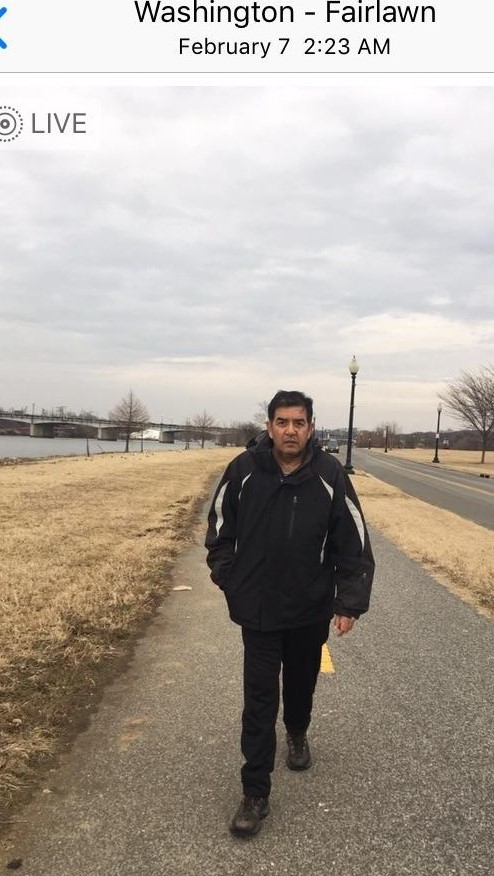
After his recovery from GBS, Jawaid & I took walks in Anacostia Park to help his nerves gain full recovery. This photo was taken three weeks before the cowardly attack on him. A day before that incident on March 1, we had resolved to speed up the exercise process to help him regain full strength. It was also meant as a prelude to our trip back home.

If only Ignorance had not been Bliss

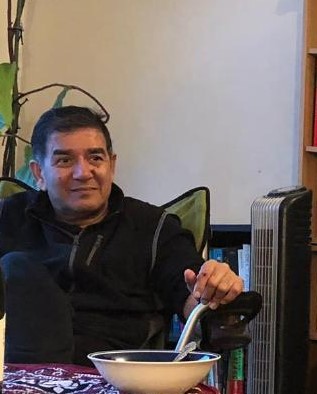
Barely a month before the attack on him, Jawaid sat in his living room, blissfully unaware of the evil that was being plotted underneath our condo unit. After decades of hard struggle, the `American dream,’ of finding work in one city.. and supporting near and dear ones.. had become a reality. The tranquility on his face was emblematic of the kindness in his heart and the good which he searched in every human being.

MEMORIES

Like yellow falling leaves on a warm summers eve,
Flutter and fall on fading heaps,
The winds of time swirl them aloft,
And light them to the eye in sunny beams,
So memories flutter before the eye,
Of past tears,
And past laughter,
And I quiver like a boat tied to the shore,
That can glide on roving waves no more.

WAIT JB, DON’T SAY GOODBYE

I wandered through the earth,
My heart was heavy with yearning,
My spirit scoured the angry seas to find a sorrow bearer,

The earth I tread shall cover soon my unfulfilled soul,
For death is the only peace,
That follows the torture of desire,

I wandered lone in search of God through the blindness of the earth,
If the earth has seductive lights, why hast thy no guide?

I walked all day to the sun but thy let thy curtain fall,
Oh let me die that I may see,
And rest my aching soul

The British find Allies in the Conquest of Sindh in 1843

After the conquest of Sind in 1259/1843, the British attempted to subjugate neighbouring Baluchistan, in which the Aga Khan again helped them militarily and diplomatically. From Jerruk, where the Aga Khan was staying after February, 1843, he contacted the various Baluchi chieftains, advising them to submit to the British rule. He also sent his brother Muhammad Bakir Khan together with a number of his horsemen to help the British against Mir Sher Khan, the Baluchi amir.

Soon afterwards, the Aga Khan I was given a post in Jerruk to secure the communications between Karachi and Hyderabad. Charles Napier writes in his diary on February 29, 1843 that, “I have sent the Persian Prince Agha Khan to Jherruk, on the right bank of the Indus. His influence is great, and he will with his own followers secure our communication with Karachi. He is the lineal chief of Ismailians, who still exist as a sect and are spread all over the interior of Asia.”

H.T. Lambrick writes in “Sir Charles Napier and Sind” (London, 1952, p. 157) that, “Bands of Baluchis had plundered most of the wood and coal stations on the Indus, interrupted the mail route to Bombay via Cutch, and also the direct road to Karachi, whence supplies and artillery had been ordered up. With a view to reopening communications with Karachi, Sir Charles sent the Agha Khan to take post at Jherruk with his followers, some 130 horsemen.”

On March 23, 1843, the Aga Khan and his horsemen were attacked by the Jam and Jokia Baluchis, who killed some 70 to 72 of his followers, and plundered 23 lacs of rupees worth of the Aga Khan’s property. Napier, in April and May, 1843, sent warnings to the Jam and Jokia Baluchis, asking to return the plunder of the Aga Khan and surrender. In May, 1843, Napier ordered his commander at Karachi to attack and recover the property of the Aga Khan, which was done.

The encounter of Jerruk had been equated by the Aga Khan I, according to the native informations, with that of the event of Karbala. In Jerruk, some 70 to 72 Ismaili fidais had sacrificed their lives in fighting with the enemies of their Imam, and their dead bodies were buried on that spot. According to the report of “Sind Observer” (Karachi, April 3, 1949), “Seventy dead bodies of Khojas buried 107 years ago at Imam Bara in Jherruck town, 94 miles by road north-east of Karachi, were found to be fresh on being exhumed recently in the course of digging the foundation for a new mosque for the locality, a Sind government official disclosed on Saturday. The bodies which lay in a common grave were again interred another site selected for the mosque. The Khojas were believed to have been murdered in a local feud 107 years ago according to local tradition in Jherruck.”

It was with the approval of the British government that in 1260/1844, the Aga Khan sent Muhammad Bakir Khan to capture the fortress of Bampur in Iranian Baluchistan. Later, he also sent his other brother, Sardar Abul Hasan Khan, who finally occupied Bampur and won other successes in Baluchistan, while Muhammad Bakir had been relieved to join the Aga Khan in India.

The Aga Khan built his residence at Jerruk, resembling the style that of the Mahallat. Jerruk, a town about 89 miles and 2 furlongs from Karachi via Gharo, Thatta and Soonda; is 150 feet high from the Indus level, having two hills blanketing the town from two sides. About 300 to 350 Ismailis lived in Jerruk, and the Aga Khan I made it his headquarters

http://www.ismaili.net/histoire/history08/history809.html

Archives and Manuscripts at the Bodleian Library

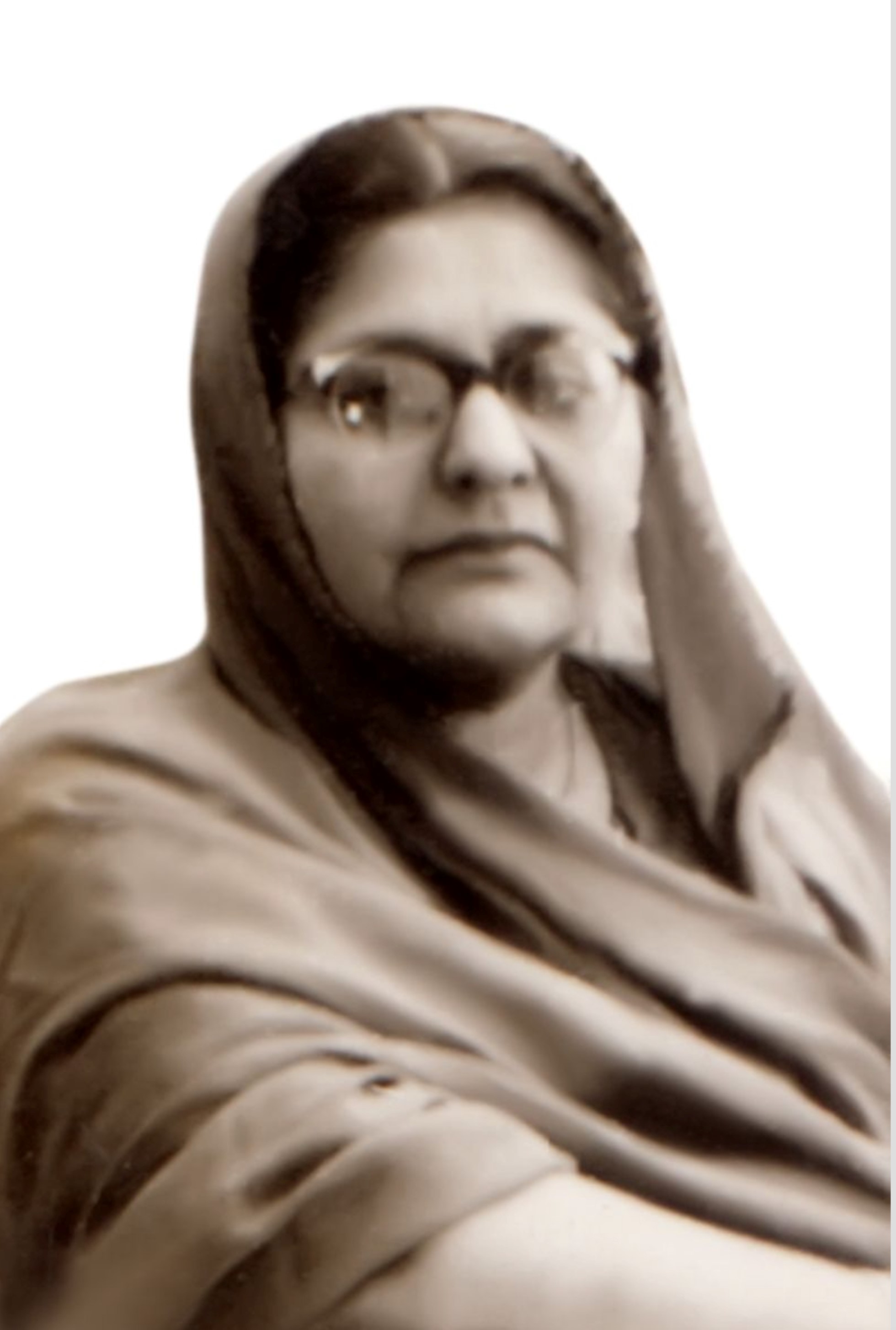
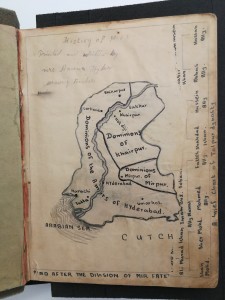
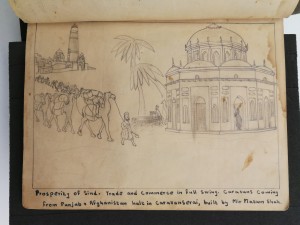
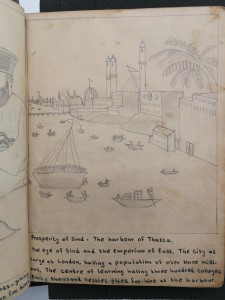
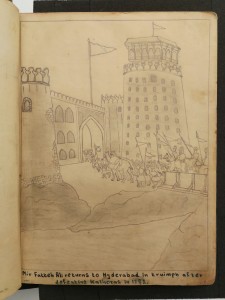
We have recently received the generous donation of an illustrated history of the Mirs of Sindh, given in memory of its author and illustrator Mrs. Amina G. Hyder Khaliqdina (1919 -1959).

Amina’s family have written an account of her remarkable story and kindly given permission for it to be posted here.
cof

Amina was born on 19th April 1919 in Hyderabad, Sindh (presently a Province of Pakistan) to a middle class educated family. Many male members of her family were well-educated, including her grandfather and uncles, and some of them were civil servants of the British government.

Amina was part of the Muslim Shia Ismaili Community, which had emphasised female education. However, in Sindh education opportunities were limited especially for women.

After losing the battle of Miani with the East India Company in 1843, the Emirate of Sindh lost its independent status and was included as a part of the Bombay Presidency. This was the punishment for Sindh confronting the East India Company and, consequently, for many years Sindh remained underdeveloped. Infant mortality was high. Amina herself was the only survivor from seven births. There were only a few educational institutions within Sindh and for higher education one had to correspond with Bombay University. This made it socioeconomically difficult, especially for women, to achieve higher education.

Within this environment Amina achieved matriculation from Bombay University – the first woman in the family – perhaps one of a very few in Hyderabad, Sindh.
cof

By 1936 Sindh had separated from the Bombay Presidency and with that a new chapter of development of Sindh began. Hyderabad again became a culturally bustling town. This was mainly due to Hindu Divans who worked on Plantations in the Caribbean and brought wealth to Sindh. They promoted art and culture. Yet female education was scarce especially for muslims.

Amina was appointed as head of Art section in Madras -Tul – Banat school. We know very little about Amina’s interest in Art and her degree/diploma related to this book due to her untimely death. According to Amina’s mother, she started the artwork in this book before she started her employment and carried on sketching long after her first two children were born. Considering the lack of resources libraries, etc., and limited access to Bombay University, her book is evidence of her perseverance. The book is written in English. It shows her competence in multifarious skills.
cof

In addition, she was a champion for promoting education, regardless of cast, religion or gender. We know that she used to gather together children from the neighbourhood, motivate them, and took them to school. There are many doctors, teachers, and artists who are her ex-students in Sindh and will testify to this fact. She was a pioneer in establishing a reading room and a library for women in Hyderabad so they could read and have literary discussions.

Amina was married on 7th May 1942 and bore seven children. She continued working until her fourth child. The concept of a working mother was not very popular in those days but her quest for knowledge and passing knowledge to others overcame all obstacles. She was a positive influence to her husband too and encouraged and supported him. He became Chief Auditor and Director of Finance for the Province of Sindh (Pakistan).
cof

Politically, the 1930s to 40s was a turbulent period in India. There was the struggle for independence on one hand and, on the other, muslims were demanding equal rights or a separate country. Fortunately Sindh was a religiously tolerant province. There was hardly any evidence of Hindu-Muslim conflict. Her own family was divided: some were supporters of Jinnah’s Pakistan, and others supporters of Gandhi and Congress. But Amina was a supporter of Sindh. She wanted generations to remember the former glorious period of Sindh, its independence, the dark period of Mir’s internal conflict, and the resulting victory of Charles Napier of East India company – who was knighted as a reward of conquering Sindh. Atrocities committed on Sindhis during the battle of Miani were truthfully acknowledged by Sir Charles Napier himself, ”If this was a rascality it was a noble rascality”

Amina’s pictorial description and historical perspective on the Mirs of Sindh is not only a tribute to her Motherland but a testimony to her intellectual vigour, academic pursuit and her artistic abilities. Sadly, her sudden and untimely death on 23rd May 1959, at the tender age of 40 years, deprived not only Sindh of one of her zealous devout daughters, but her parents lost their only child, and her seven young children lost a loving mother and her husband lost a supportive and beloved wife.
Peshawar school attack game withdrawn after uproar

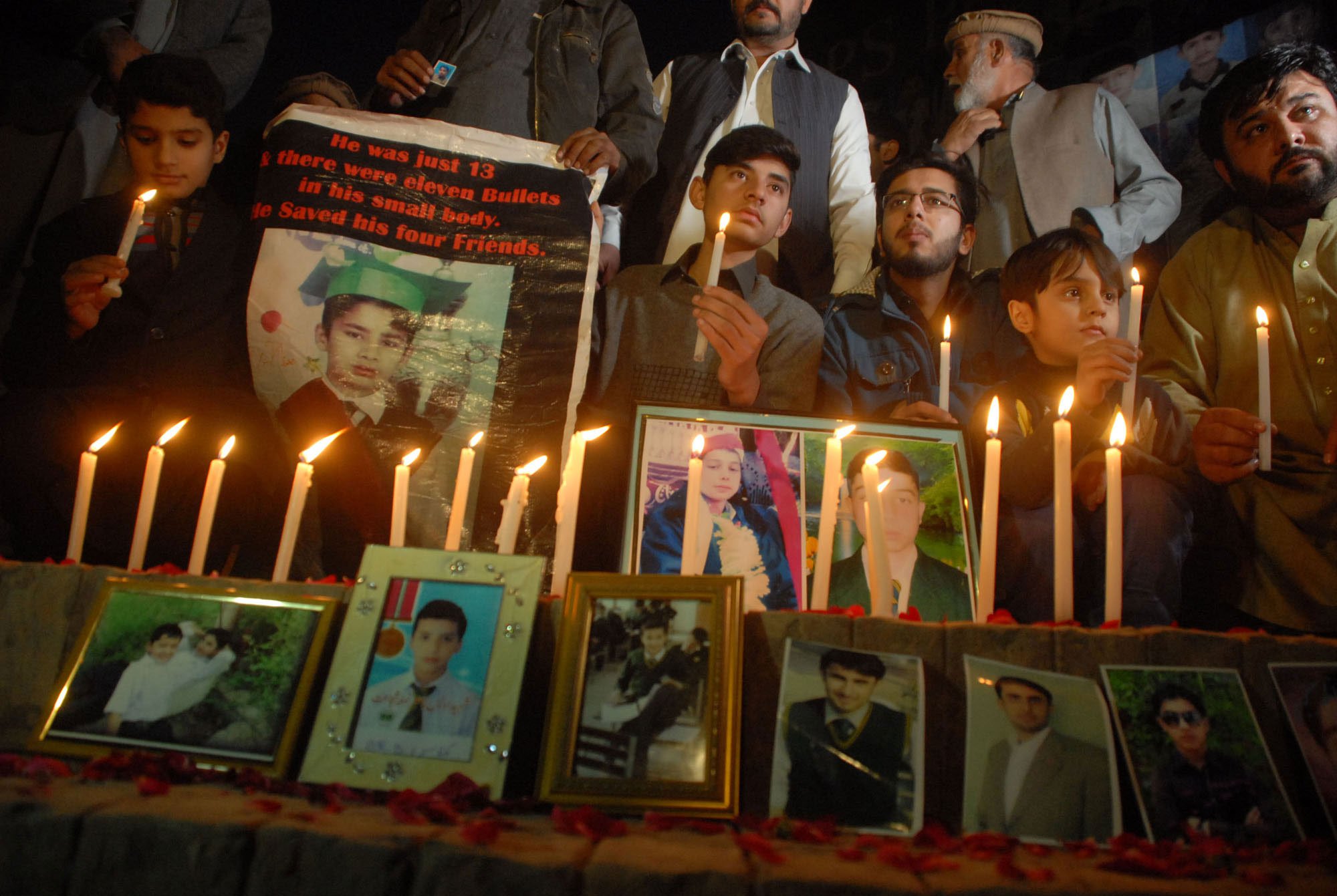
A video game based on the 2014 Taliban school massacre in which at least 132 children were killed in Pakistan’s northwest city of Peshawar has been withdrawn after triggering social media uproar and backlash.

The game, “Pakistan Army Retribution”, was released by the Punjab IT board on Google Play, and invited the player to step into the shoes of a soldier shooting Taliban attackers in a school’s hallways.

It is inspired by Pakistan’s deadliest terror attack that saw seven Taliban gunmen storm the Army Public School (APS) in December 2014.

They shot students and teachers in cold blood and occupied the school for hours until they were killed by the army.
The assault shocked Pakistan and emotional ceremonies marking the anniversary were held across the country last month.
The game was released on Google Play several weeks ago but only came into the limelight after an article lampooning the game in Pakistan’s Dawn newspaper appeared on Monday, making social media users lambast its makers for exploiting the tragedy.

By Monday afternoon, the game was no longer available on Google Play.

Umar Saif, the chairman of the Punjab Information Technology Board, a government body, confirmed that the game was no longer available.

“It wasn’t very well done and it was in poor taste,” said Saif. “In hindsight it was not a good thing to do.

“APS was a watershed for Pakistan, so we had the idea of using it as a theme to promote peace, tolerance and harmony. The plan was to show children that the best weapons are the pen and the book.”

Saif added that the game was produced by an independent company that had “misunderstood the brief” and the IT board “messed up with this particular game”.