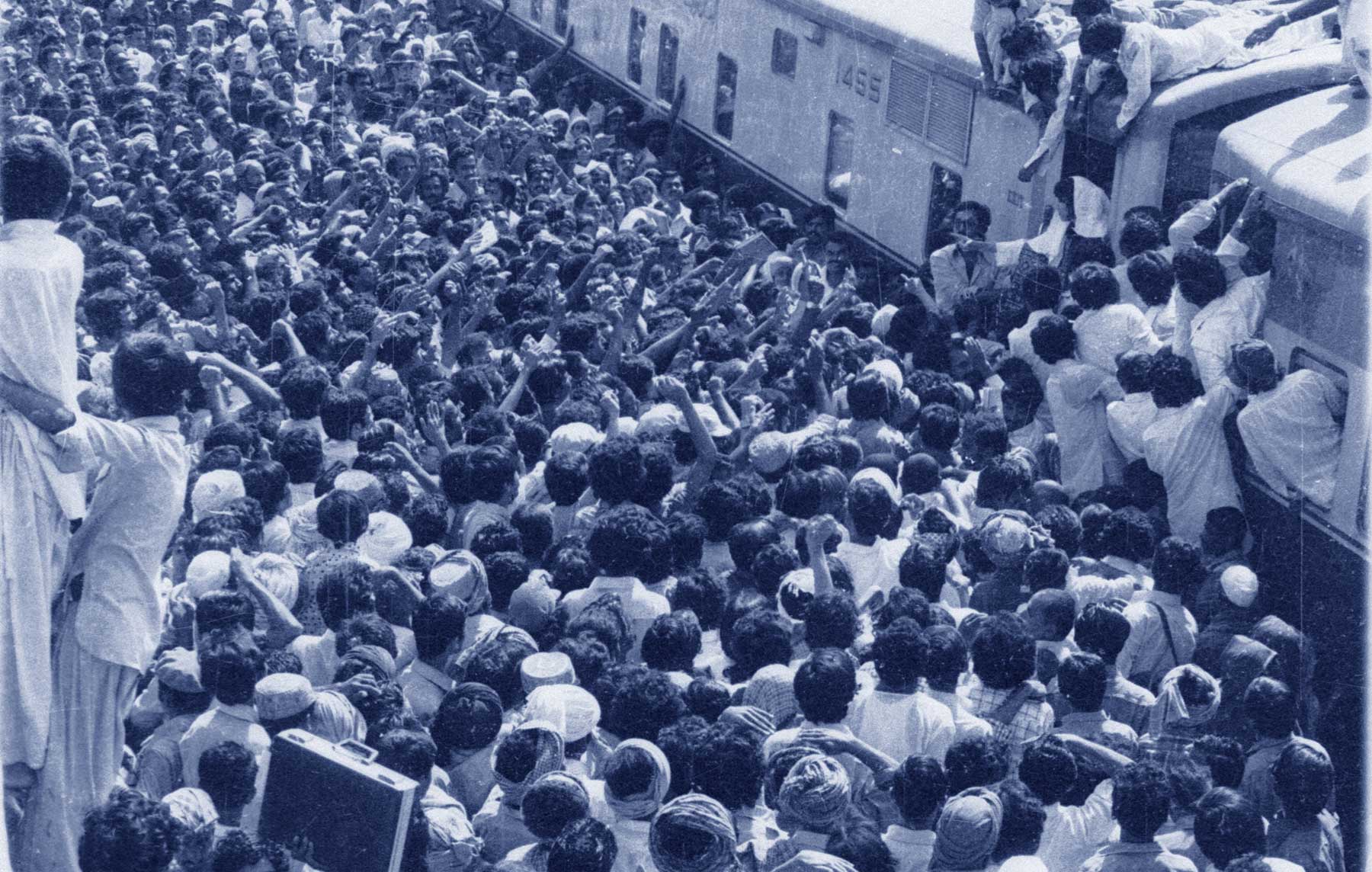
Army & Govt Come Together Over Karachi Security

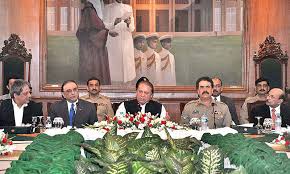
Sharifs in Karachi (Credit: dawn.com)
Sharifs in Karachi
(Credit: dawn.com)

Karachi, May 15 —Prime Minister Mian Muhammad Nawaz Sharif said on Wednesday that the morale of Pakistan Army would never be allowed to let down and the intelligence agencies should expand their intelligence sharing network so that peace and tranquility in the country in general and in Karachi in particular be maintained.

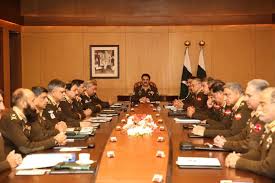
Prime Minister Mian Muhammad Nawaz Sharif, presiding over a high level meeting at Sindh Governor House expressed his resolve with firm determination that peace in Karachi was precious than anything else and the federal government would not hesitate taking any action of any scale for complete restoration of peace and tranquility in Karachi. Karachi was the economic hub of the country and hence this city would not be left alone at the mercy of criminals.

On the occasion, the Chief of Army Staff General Raheel Sharif told the meeting that Pakistan Army was standing beside the civilian government for the cause of restoration of peace in the metropolis.

It was the highest meeting ever held with the Chief of Army Staff General Raheel Sharif, Inter-Services Intelligence chief General Zaheer ul Islam, Karachi Corps Commander Lieutenant General Sajjad Ghani, Federal Interior Minister Chaudhry Nisar Ali Khan, Intelligence Bureau Director General, Pakistan Rangers, Sindh, Director General Maj. Gen. Rizwan Akhtar, former President Asif Ali Zardari, Sindh Governor Dr Ishrat ul Ebad Khan, Sindh Chief Minister Syed Qaim Ali Shah Jilani, Sindh Chief Secretary Sajjad Saleem Hotyana, Acting Inspector General of Police, Sindh Ghulam Haider Jamali, Muttahida Qaumi Movement’s Coordination Committee member Haider Abbas Rizvi, Awami National Party Sindh chapter President and Senator Shahi Sayed, Jamaat-e Islami Karachi Ameer Hafiz Naeem ur Rehman and others.

Nawaz Sharif asked Sindh Chief Minister that being the captain of ongoing targeted operation in Karachi; he should not make the operation a test cricket match but treat it like it was a T-20 cricket match. He questioned as why the process of blocking all illegal and unregistered mobile SIMs was not completed as yet and ordered that it should be completed now without fail to ensure elimination of network of criminals and terrorists operating within the country and from abroad.

He enquired about reasons for delay in issuance of red warrant for arresting the criminals and terrorists, who had escaped from Pakistan to neighbouring countries.

The Premier told the meeting that top civil and military leadership would now monitor the ongoing targeted operation against terrorists and criminals in Karachi. He lauded Pakistan Rangers Sindh for their effective operation and major achievements in Lyari regarding busting gangs of militants.

In this regard, the meeting decided to make the blockage of all such illegal and unregistered mobile SIMs as mandatory within the specified duration and the law enforcement agencies should be given complete free hand.

The meeting updated the Prime Minister about measures being initiated for arresting of criminals and terrorists, who had fled to foreign countries through the Interpol.

Pakistan Rangers Director General informed the meeting that the land mafia, drug mafia and banned religious organisations were behind wreaking havoc in the city and they were sabotaging the efforts of the government for restoring peace and tranquility in the metropolis.

The meeting made lengthy deliberations over reservations of MQM on kidnappings of its workers and extra-judicial murders. The meeting reviewed the pace and strategy of the targeted operation in Karachi, details of arrested suspects, recovery of illegal weapons and issuance of red warrants for arresting the hardened criminals and terrorists.

The meeting briefed the Premier about shifting of the anti-terrorist courts to district Malir, installation of scanners on all routes of entry and exit in Karachi, progress on construction of a high security prison, operation against illegal occupation of land and encroachments and establishment of new Police stations in sensitive areas of the city. The meeting also briefed the Prime Minister about effective implementation of Protection of Pakistan Ordinance and transparent appointments in Police Department.

INP adds: Former President and PPP Co-Chairman Asif Ali Zardari Wednesday pledged that Sindh government was ready to extend its support to Interior Minister Chaudhry Nisar Ali regarding maintenance of law and order in Karachi. “We are ready to help the interior minister in every possible way,” Zardari said. The former president stressed the need to demonstrate patience and said that there was need to help everyone. More than 2,000 army jawans have been recruited in police force, he said, adding that police needed to be equipped with facilities.
MQM Forces Karachi to shut down

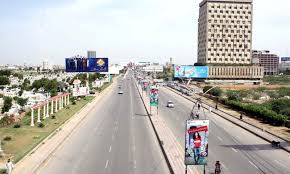
Karachi strike (Credit: dawn.com)
Karachi strike
(Credit: dawn.com)

KARACHI, May 2: The country’s financial capital was shut down due to a call for observing a ‘day of mourning’ by the Muttahida Qaumi Movement (MQM) against extra-judicial killings of its party members, DawnNews reported.

The party has called for a day of mourning in protest against the ‘extrajudicial killing’ of four MQM workers shot dead on Wednesday.

On MQM’s appeal to observe a day of mourning, traders closed down their businesses, commercial centres and shops in Karachi.

Due to absence of public transport on roads, it became quite difficult for people to reach their destinations.

Transporters have also said they would support the party’s call by keeping their vehicles off the roads. Petrol and CNG stations as well as major and minor business centres were shut across the city.

The Private School Management Association on Thursday had announced that schools operating privately would remain shut.

Moreover, the Matriculation and Intermediate boards also postponed all examinations scheduled for today, the new dates for which would be announced later.

Funerals of two of the deceased workers were held yesterday where as funerals of the remaining two, whose bodies were found at Super Highway on Thursday, is scheduled to take place at Numaish chowrangi on Friday afternoon.

Sindh Chief Minister Syed Qaim Ali Shah had also taken notice of the killings of the MQM workers and ordered the formation of a committee headed by DIG Karachi East Munir Ahmed Shaikh to probe the matter.

TTP says it has “gifted” a lull in terror in Pakistan

ISLAMABAD, May 2 : Accusing the government of using the dialogue process as a political tool and to increase military operations, the Tehrik-i-Taliban Pakistan (TTP) on Thursday said they did not know who to talk to in Islamabad, as they believed the government had no powers to reach an amicable solution.

In a statement, TTP spokesman Shahidullah Shahid said they did not know whether they should talk to the government or the military.Shahid said talks and war could not go together adding that the Taliban had the right to defend themselves. He said, on the one hand, the government claimed it was interested in the dialogue but, on the other hand, it hurled threats at the Taliban.

He said the army had imposed a war on the people in Babar and Shaktoi areas of South Waziristan in the last two days. He also condemned the police action against the relatives of missing persons in Islamabad and said such a situation could not provide an environment for a meaningful and serious dialogue.

“The TTP has insisted that it is ready to talk in the interest of Islam and the Muslims of Pakistan. But we will not accept that the dialogue is used as a political tool and to pursue war startegy,” he said.

Shahid said the TTP had shown sincerity and seriousness during the talks and gifted a 45-day ceasefire to the people and the country but the government had not shown any seriousness since the talks took off.

He said the Taliban had left it to the people of Pakistan to decide whether a war or talks could go together and asked if it was the responsibility of the Taliban only to make the process successful.

He said the Taliban will not step back from serious and useful talks but would not accept the politics of threats and war.“We are fighting for the supremacy of Sharia and our Mujahideen have the capability to face any difficult situation and know how to give a befitting response to the enemy,” the TTP spokesman said.

Attack on Hamid Mir: Journalists say Geo TV bent upon maligning army

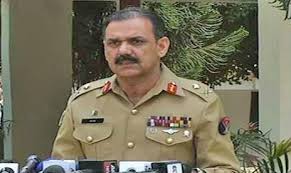
ISPR spokesman (Credit: Pakistantribune.com.pk)
ISPR spokesman
(Credit: Pakistantribune.com.pk)

Senior journalists, columnists and anchorpersons have expressed concern over the ‘organised campaign’ against the security agencies by a section of the media in the name of the attack on Geo TV anchor Hamid Mir, saying this is a clear violation of journalistic values and code of conduct.

“The attack should be investigated but the adventurism we are seeing should have been avoided and responsibility should have been shown,” said columnist Ayaz Amir.

Another columnist, Talat Hussain, said the allegations by Geo TV are akin to a charge sheet, wherein ISI chief Lt Gen Zaheer-ul-Islam has been blamed. “He [Lt Gen Zaheer-ul-Islam] has been charge-sheeted and the focus is on this one point, ignoring the other aspects,” Talat said.

He added that the television channel and Mir’s colleagues seem to have registered an FIR and issued a judgement in the case. “This is against journalistic rules and, in my opinion, unfair to Hamid Mir himself,” he added.

Express News anchor Shazeb Khanzada said that accusations were leveled against the security agencies as Mir’s brother was very vocal about his emotions at the time of the attack. “We are journalists and our job is to bring the truth forth and struggle for the rule of law and the Constitution,” Khanzada said. “We are not supposed to fight against the federal and state organisations. Unfortunately, yesterday an atmosphere was created to press the DG ISI to resign and I think this resignation should not have been demanded at all,” he added. Khanzada claimed “Indian channels took full advantage of the situation”.

Senior columnist and journalist Haroon Rashid said that Geo TV seems determined to ‘defame the army’ and criticised the television channel’s decision to air photographs of the ISI chief while leveling accusations against him of involvement in the attack on Mir.

“There is something called patriotism [which should be taken into account]. Love of the country is part of one’s faith but Geo people do not care for the country. Do they want to turn Pakistan into an Indian state?” Rashid said.

Published in The Express Tribune, April 21st, 2014.

Pakistan warns Afghan Taliban and Haqqani Network

Pak army meeting (Credit: pakistansoldiers.com)
Pak army meeting
(Credit: pakistansoldiers.com)

ISLAMABAD, April 17: The Pakistani establishment has made it clear to the Afghan Taliban and the Haqqani Network that the time has come for them to choose between the Tehreek-e-Taliban Pakistan and the state of Pakistan, if they want to stay friends with Islamabad.

The unprecedented warning from the Pakistani establishment has come at a crucial time when the Pakistani Taliban are holding peace talks with the government in Islamabad, amidst demands to release over 800 Taliban prisoners and to set up a free peace zone in Waziristan.

According to well-informed sources, the warning from the establishment was prompted by the growing cooperation among the Afghan Taliban, the Haqqani Network and the Pakistani Taliban, which has reinforced the martial power of TTP in its current conflict with the security forces of Pakistan.

The TTP spokesman, Shahidullah Shahid, already admitted on October 6, 2013 in an interview that the Afghan Taliban were financially supporting the Pakistani Taliban besides providing them sanctuary in Afghanistan.

The fugitive TTP Ameer, Mullah Fazlullah, who had claimed responsibility last year for killing GOC Swat Major General Sanaullah Niazi is also being sheltered by the Afghan Taliban in the Kunar Province.

However, what seemed to have angered the Pakistani establishment the most were the allegations coming from the Afghan and the Pakistani Taliban, blaming the Inter-Services Intelligence (ISI) for the November 11, 2013 mystery murder [in Islamabad] of Dr Nasiruddin Haqqani, the top fundraiser and organiser of Haqqani Network as well as its liaison man with the Pakistani security establishment.

Dr Nasiruddin, the real brother of Sirajuddin Haqqani, was killed by unknown gunmen in the federal capital 10 days after the November 1, 2013 killing of the TTPAmeer in a US drone attack in North Waziristan. Both were laid to rest in the Dandey Darapa Khel area of North Waziristan which also headquarters the Haqqani Network as well as the TTP.

The decades-old cozy ties between the Pakistani establishment and the Haqqanis were shattered with the mystery murder of Dr Nasiruddin when a spokesman of Haqqani network (Najeebullah) immediately blamed the Pakistani intelligence agencies.

He said: “Dr Nasiruddin had been mediating between a powerful intelligence agency and the Pakistani Taliban for peace talks. But he had refused to mediate further following Hakimullah’s death and the subsequent announcement of TTP not to hold peace talks with the government.

Nasiruddin’s reluctance to mediate anymore after Hakimullah’s killing must have annoyed the agency which decided to eliminate him physically,” the Haqqanis’ spokesman was quoted by the media as saying.

On his part, the TTP spokesman, Shahidullah Shahid, also blamed a Pakistani intelligence agency for the murder, vowing to take revenge. “Nasiruddin Haqqani has been martyred by none other than the ISI.

He was killed because he had bravely backed our Ameer Hakimullah Mehsud,” Shahidullah told AFP when asked about possible killers.

However, on their part, the ISI circles had refuted the allegations of involvement in the murder, saying Dr Nasiruddin Haqqani was either killed by the TTP or by the Afghan National Directorate of Security.

The allegations leveled by the Afghan Taliban and the Haqqani Network were followed by Pakistani intelligence reports that both the groups were supporting and financing the TTP in its terror spree against the khakis and the civilians alike.

Indeed, the Pakistani and the Afghan Taliban are closely allied and both aim to impose a strict version of Islamic laws or Shariah on their societies. However, their leadership and targets differ with each other.

While the Pakistani Taliban mostly focus their terrorist attacks in Pakistan against the security forces which they think are an American ally, the Afghan Taliban target the Afghan and the Allied forces.

Defence Minister Khawaja Asif recently told Reuters in an interview that the Pakistan government was worried about the possibility of increasing convergence between the Pakistani and the Afghan Taliban. “Then the Pakistani Taliban will have a powerhouse behind them,” Khawaja Asif had said.

Analysts believe that these concerns might have prompted the Pakistani security establishment to warn the Haqqanis and the Afghan Taliban against backing the TTP.

However, the close nature of ties between the Afghan and the Pakistani Taliban can be gauged from the fact that the central Shura of TTP has already referred their internal differences to the Afghan Taliban while asking Mullah Omar to intervene and send a delegation to resolve the tiff between two major factions of Mehsud militants from South Waziristan.

A senior TTP commander has been quoted in the media as saying that the Shura thought that the intra-TTP tussle was too serious and critical for them and, therefore, they decided to approach the Islamic Emirate of Afghanistan, a term usually referred to the Afghan Taliban.

There are already reports that the Ameer of the Afghan Taliban is persuading the Pakistani Taliban to end their infighting in South Waziristan as he wants to secure their support against the foreign troops in Afghanistan to launch the annual spring offensive.

Analysts believe the Pakistani security establishment’s warning was meant to dissuade the Haqqanis and the Afghan Taliban from siding with the Pakistani Taliban in their conflict with the state of Pakistan at a time when the Allied forces are set to withdraw from Afghanistan and both the Afghan militia groups would require the crucial support of Islamabad to stage a comeback in Kabul.

In fact, the ultimate agenda of the Pakistani Taliban is the establishment of their own state — the Islamic Emirate of Waziristan [on the pattern of Mullah Omar’s Islamic Emirate of Afghanistan] in Fata where they can impose the Islamic Shariah. On the other hand, the ultimate agenda of the Afghan Taliban is the revival of the lost Islamic Emirate of Afghanistan.

Therefore, following the Pakistani establishment’s warning, Mullah Omar will have to decide whether to befriend the Pakistani Taliban or the state of Pakistan.

Commander Sirajuddin Haqqani of the Haqqani Network is bound to follow suit being a disciple of Mullah Omar just like the Pakistani and the Afghan Taliban. Well informed sources in the establishment say logically speaking Mullah Omar would like to remain a friend of Pakistan instead of inviting its wrath by befriending the TTP.

However, there are those in the Taliban circles who believe that if the Afghan Taliban succeed in regaining power in Kabul after the withdrawal of the Allied troops, there would be greater chances of their joining hands with the Pakistani Taliban whose aims and objectives and those of the Ameerul Momineen are the same.

However, the establishment circles say, in such an eventuality, the Afghan Taliban and the Haqqani Network must know that “strategic depth” would no longer be a consideration of the establishment if the Pakistan government finally orders a military action in North Waziristan after the failure of the talks with the TTP.

Khuhro admits Last PPP Govt made Fake Appointments in Education

Education Minister Nisar Khuhro (Credit: thenews.com.pk)
Education Minister Nisar Khuhro
(Credit: thenews.com.pk)

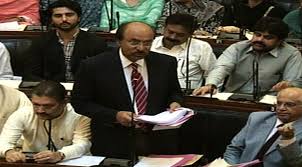
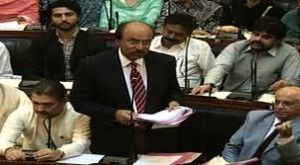
KARACHI April 11: Sindh Minister for Education Nisar Ahmed Khuhro has admitted that “a large number of fake appointments were made in the education department during the previous tenure of the PPP government” but shied away from giving an exact number of such appointments which the opposition members put at a colossal 30,000.

He said that action was being taken against the officers concerned responsible for the serious irregularity but no action was planned against former education minister Pir Mazharul Haq.

Mr Khuhro was responding to questions by different legislators during the question hour about the education department at the Sindh Assembly’s session on Friday, which was first chaired by speaker Agha Siraj Durrani and later by deputy speaker Shehla Raza.

Towards the end of the question hour, heated verbal exchanges were made between the treasury and the opposition benches and the assembly depicted a scene from the proverbial fish market when Mr Khuhro raised objection to a remark passed by a legislator of the Muttahida Qaumi Movement (MQM).

Pakistan Muslim League-Functional legislator Nusrat Abbasi had earlier asked if it was true that 30,000 fake appointments had been made in the education department.

Mr Khuhro replied without either endorsing or rejecting the huge figure and said that “a large number of bogus appointments of teaching and non-teaching staff had been made beyond the sanctioned strength” and without completing legal formalities as laid down in the recruitment rules by former directors of school education Karachi in connivance with district officers during 2012–13.

He said that 12 officers had been suspended over misconduct and show-cause notices had been served on them under the Removal from Service (Special Powers) Sindh Ordinance 2000.

The officers are: Attaullah Bhutto, Shamsuddin Dal, Mumtaz Ali Shaikh, Ahmed Nawaz Naizi, Bashir Ahmed Niazi, Ms Farnaz Riaz, Abdul Jabbar Dayo, Abdul Latif Mughal, Musharaf Ali, Liaquat Ali Solangi, Imran Ali Solangi and Naveed Ahmed.

Mr Khuhro said that the suspended officers as well as those who were appointed by them had moved the courts and the government was defending its actions against them.

To another question by Ms Abbasi, the minister said that as against teaching posts of 1,400 in Karachi, 6,000 appointments had been made and against 2,900 posts of non-teaching staff 4,000 had been recruited.

He said in answer to a question that there was no proof the officers had taken bribe to make the excess appointments without following the procedure. Asked if any action had been taken against the former education minister, Pir Mazharul Haq, Mr Khuhro said that no proof of irregularity was found against him either as all formalities – issuing appointment letters, offer letters, etc – were processed by the officers concerned.

He did not respond to a question if it did not amount to connivance on the part of the former minister then it was sheer inefficiency that he failed to detect such a serious and large-scale breach of rules to make 30,000 fake appointments.

Answering a question by MQM legislator Khalid Ahmed that the irregularity was so serious that not only action should be taken against the minister concerned but the chief minister should also accept responsibility for the recruitment of thousands of incompetent people without following the laid down procedure.

Mr Khuhro replied by objecting to the use of the term ‘incompetent’ by the MQM legislator and said the people of Sindh should not be referred to as such. The objection angered all MQM legislators who stood up and started talking simultaneously. Information minister Sharjeel Memon also stood up to second Mr Khuhro’s stand and in the meantime some treasury members started thumping the desks.

Ms Raza, who was chairing the session at that time, asked the opposition members to sit down and calmly listen to the ministers, by remarking that media would call it a fish market. But the legislators did not listen to her and she adjourned the session for 10 minutes after declaring the time for the question hour was over.

Earlier the legislators, including MQM’s Moeen Pirzada, had complained that the written replies were incomplete but Mr Khuhro insisted the replies were complete.

Responding to a question by MQM’s Heer Soho about the bills passed “by the assembly for the establishment of universities over the past five years,” the written reply gave names of only five public sector universities and on a supplementary question the minister said the bills regarding some other private universities were also passed but he insisted the written reply was complete. Ms Raza agreed with the legislators that incomplete information was provided and that complete information be given.

To another question by Ms Soho which asked specifically “district-wise number of schools which were provided facilities between 2010–13,” the written reply did give the number of schools but did not give the district-wise breakup.

But the minister still insisted that complete information had been provided and surprisingly, speaker Durrani, who was presiding at that time, agreed with the minister. Mr Khuhro later started to read out names of the districts in which schools had been rehabilitated.

The written reply said that rehabilitation of a total of 2,659 schools had been undertaken since 2010 – 11 and 498 of these were still under construction. Out of the 2,659 schools, 319 schools were shelter-less, 1,219 did not have boundary walls and 1,561 were without toilets while others lacked some other basic facilities, it said.

Linguistic Diversity is Key to Democracy

The Standing Committee of National Assembly on Information, Broadcasting and National Heritage has recently rekindled a forlorn hope. In a recently held meeting, the committee adopted a resolution to declare 13 mother languages of Pakistan as national languages and establishing a Languages Commission for scientific research and policy formulation to promote Pakistani languages.

In Pakistan, the seeds of discontent were sown right from its inception when Bengalis asserted for their language to be the national language along with Urdu. Denial of that sparked a nationalist movement that culminated in a debacle in 1971. The threat of Indian aggression coupled by a flippant attitude of the ruling elite at a formative stage resulted in a denial of historic cultures and identities of the federating units.

Islam and Urdu were construed as cementing factors for the culturally-diverse and politically-discrete federating units. Intentions and reasons apart, the approach was too bitter particularly for Sindh and Bengal where native languages were highly advanced and remained official languages for decades.

Language movements in Bengal and Sindh subsequently resulted in parturition of nationalist movements in both provinces.

Recognition and respect for historic identities and cultural inheritance is pivotal for a federation. Founders of Pakistan attempted to mould it into a nation state which was an unnatural and flawed approach. Religion and imposed cultures have never succeeded in unifying people, especially when some of them are discriminated on the basis of their identities. Had there been a fair representation in the state affairs e.g. civil and military bureaucracy, other elements could probably have endured or subsided with time. When cultural identity is made the basis of political and economic oppression, it erupts like a volcano.

At the time of partition, both Bengali and Sindhi were official languages in their respective provinces. Both languages had a cherished history and a treasure trove of literature. Both languages were not only lingua franca of their provinces but were also in vogue for revenue, court, education and other official business.

The first Bengali dictionary/grammar was written by a Portuguese missionary between 1734 and 1742. Nathaniel Brassey Halhed, a British grammarian, wrote a modern Bengali grammar in 1778. Ram Mohan Roy, the great Bengali reformer also wrote “Grammar of the Bengali Language” in 1832.

In 1937 at the Lucknow session of the Muslim League, the Bengalis objected to Urdu becoming the lingua franca of all Indian Muslims. In 1947 when Dr Ziauddin Ahmad, Vice-Chancellor of the Muslim University of Aligarh, declared that Urdu would be the national language of Pakistan, Bengali linguist Dr Shahidullah replied that this ‘would be tantamount to political slavery’. The controversy intensified after the creation of Pakistan.

On February 25, 1948, Mr Datta, a Congress Leader, claimed on the floor of the National Assembly of Pakistan that out of 69 million people, 44 million speak Bengali in the country, therefore, Bengali, along with English and Urdu, should be accepted as a language of the Assembly.

Muhammad Ali Jinnah, during his visit to Bengal in March 1948, took pains to persuade Bengalis for embracing Urdu as the only national language but he could not crack the relentless obstinacy. A macabre episode of 1952 caste the dye and Bengali language movement turned into a fireball of Bengali nationalism, ultimately dismembering the country.

Similarly, Sindhi language owned a rich legacy. Sindh was occupied by British army in 1843 and was annexed with Bombay. In 1848, governor of the province Sir George Clerk ordered to make Sindhi the official language in the province. Sir Bartle Frere, the then commissioner of Sindh, issued orders on August 29, 1857 advising civil servants in Sindh to qualify examination in Sindhi. He also ordered Sindhi to be used in all official communication. Seven-grade education system commonly known as Sindhi-Final was introduced in Sindh. Sindhi Final was made a prerequisite for employment in revenue, police and education departments.

In 1854, Arabic script was adopted for Sindhi language. In 1848 and 1855, English-Sindhi dictionaries were produced. Eminent German scholar Ernest Trump published Sindhi grammar in 1872. Karachi at the time of partition had a population of 0.4million with 61 per cent Sindhi-speaking compared to only 6 per cent Urdu-speaking population.

With influx from India and exodus of Hindus, Sindh underwent a demographic shift. In 1951, the same city had 57 per cent Urdu-speaking population and Sindhis shrunk to a mere 8.6 per cent. At the time of partition, Karachi had 1300 Sindhi medium schools which were subsequently converted into a no-go area for Sindhi language.

President Ayub constituted a Commission on National Educational also known as Sharif Commission, which declared Urdu as the only medium of instruction from the sixth grade. Sindhis took this decision as an affront and launched a movement against the recommendations of the Commission. Language riots of 1971 and 1972 created an ethnic crevasse in Sindh which was further widened by ethnic strife in 80s and 90s.

Sindhi Adabai Sangat (SAS), a prominent literary and cultural organisation of Sindh, had been tirelessly championing the cause of Sindhi language. SAS dispatched 100,000 postcards to the president of Pakistan in 2009 demanding the status of national language for major languages of Pakistan. Sindhi Language Authority also presented a separate memorandum of the same demand to the government.

In 2010, leading literary organisations from all four provinces and Progressive Writers Association of Pakistan presented the same memorandum to the parliamentarians. In 2010, two members of parliament from Sindh presented two separate bills before the National Assembly, demanding major languages of Pakistan to be declared national languages. These bills were rejected without any plausible explanation.

An anachronistic pretext of threat to national integrity is too stale to subscribe to. Had the single language guaranteed national integrity, East Pakistan would not have seceded.

The Other Threat to Pakistan

LAHORE, April 2 — At a literature festival here not long ago, I bumped into a school friend who had recently relocated from Karachi, the southern port city where we both grew up. Karachi has all the buzz, and violence, of a megalopolis — more than 2,700 people were killed there in 2013 — and none of the greenery and historic charms of Lahore, the capital of Punjab Province. “I’m loving Lahore,” she told me. “I feel like I’ve moved to Switzerland after living in a war zone.”

The contrast is not as exaggerated as it sounds. In recent years, Punjab has suffered less than the rest of the country from the suicide attacks and bomb blasts that have killed some 49,000 people since 2001. There have been dramatic exceptions: terrorist attacks against the visiting Sri Lankan cricket team and at a major Sufi shrine in Lahore, at army headquarters in Rawalpindi, and at a five-star hotel and courts in the capital, Islamabad. Anti-India militant groups like Lashkar-e-Taiba and anti-Shiite organizations like Lashkar-e-Jhangvi are based in Punjab and draw most of their recruits from the province. But these groups mostly stage their attacks elsewhere in Pakistan to maintain benign relations with the local authorities.

And so the perception that Punjab has suffered less from violence than the rest of the country prevails, creating much resentment. For non-Punjabis, the province’s relative stability is just the latest demonstration of how Punjabi elites rally to protect their own interests at the expense of their compatriots. And such interprovincial rivalries could be as great a challenge for the country’s stability as the Taliban.

It is commonly said that Punjab is synonymous with Pakistan, and vice versa, which seems to relegate the other provinces and autonomous regions to the status of outliers. Some of Punjab’s good fortune is an accident of geography: the name means “land of five rivers,” referring to the Indus River and the tributaries that flow through the province, making it the agricultural and industrial heartland of Pakistan. But politics matters even more.

Pakistan’s elites, political, bureaucratic and military have long hailed from Punjab and shaped the country’s policies to the province’s advantage. Until recently, Punjab received the lion’s share of national revenues simply by virtue of having the largest population; never mind its actual needs or contributions to the national budget. (The formula was finally revised in 2009, benefiting Sindh, Baluchistan and Khyber Pakhtunkhwa provinces.) Also, the government and the military have long allotted prime agricultural land and urban real estate in other parts of Pakistan to Punjabi officers and senior bureaucrats.

Punjab itself is not a monolith. Some of the province’s southern districts are among the country’s poorest, and their inhabitants have grudges of their own against Lahore-based politicians. Water and energy shortages kept Punjab’s economic growth rate at 2.5 percent between 2007 and 2011, compared with 3.4 percent for the country overall. But this has done little to temper the impression among non-Punjabis that the province is booming while the rest of the country is burning.

These resentments animate the politics of Pakistan’s other provinces and threaten national unity. A separatist movement in Baluchistan taps grievances against Punjabis it says are exploiting Baluch gas and mineral resources to spur industrial growth in Punjab. It also rejects efforts by the predominantly Punjabi military to suppress Baluch nationalists. Killings of Punjabi “settlers” — often school teachers and civil servants — by Baluch separatists are a brutal expression of this.

Concerns about Punjabi domination have soared since the spring of 2013, when Prime Minister Nawaz Sharif, of the Pakistan Muslim League (P.M.L.N.), was returned to power for the third time. He belongs to a Lahore-based industrial family with close ties to Punjab’s business elite and a can-do attitude to governance that features flashy development schemes. The perception that Punjab is batting in a league of its own has mounted under the Sharifs. During the general election campaign last year, while the Pakistan People’s Party, which is perceived to represent Sindhi interests, was making welfare cash transfers to impoverished women, the P.M.L.N. was distributing laptops to students.

Most of Karachi’s 18 million residents have to rely on private transport. But Lahoris commute on a rapid metrobus system, and a similar initiative in Islamabad will be the federal capital’s most expensive road project to date. While the Punjabi government is digitizing land records, automating administrative transactions and promoting what it calls e-governance, the Sindh government faces a famine in Tharparkar.

Punjab has been able to progress because it has been relatively unimpeded by terrorism. Shahbaz Sharif, Nawaz’s brother and Punjab’s chief minister since 2008, publicly appealed to the Pakistani Taliban in 2010 not to attack the province, and the request was largely heeded. His P.M.L.N. government in Punjab has not clamped down on influential sectarian militant groups in the province, instead befriending their leaders to rally votes during elections.

Likewise, the P.M.L.N. government at the center started pushing for peace talks with the Taliban in September and then even more in November, when the Taliban threatened to carry out attacks in Punjab to avenge the killing of their former leader in a U.S. drone strike in North Waziristan. The central government is considering concessions, including swapping prisoners, granting an amnesty to Taliban fighters and even giving the group a political role in the Federally Administered Tribal Areas along the border with Afghanistan.

Government officials have repeatedly stated that a peace deal is necessary because military strikes against the Taliban would lead to reprisal attacks. Given the carnage that Karachi, Quetta and Peshawar have endured in recent years, many Pakistanis describe that policy as a ploy to sacrifice the tribal areas in order to save Lahore. Such perceptions only heighten interprovincial tensions, just at a time when the country needs to be more united than ever.

Huma Yusuf is a Pakistani journalist and global fellow at the Woodrow Wilson International Center for Scholars in Washington.

Sindhi Nationalists Killed in Mysterious Circumstances

JSQM rally (Credit: thefridaytimes.com)
JSQM rally
(Credit: thefridaytimes.com)

When the so-called national TV channels were airing footages of official celebrations of March 23, two charred bodies of workers of a Sindhi nationalist party were awaiting interment in a morgue in Karachi. Millions of Pakistanis observing the day with profound fervour had no inkling of the grimace and anguish of the people of Sindh.

The two political workers — Maqsood Qureshi and Suleman Wadho — were associated with the Jeay Sindh Qaumi Mahaz (JSQM). Their charred bodies were found in a smoldering car abandoned at a relatively deserted link road near Bhirya town of Noushehro Feroz district in the wee hours of March 21. Their postmortem report revealed that both of them were showered with bullets and their bodies were burnt after their murder.

Three workers of another nationalist party were killed in Sanghar district a few years ago.

According to reports, their vehicle was sprayed with bullets and then set ablaze with some inflammable substance. Atrocious and blatant violations of human rights are common in Sindh and Balochistan. Dumping mutilated bodies in Balochistan has already invited opprobrium of international community. Blithe state machinery bereft of even a tad of political sagacity is too obstinate to learn from history.

Young Maqsood Qureshi was brother of the former chairman of JSQM, Bashir Qureshi, who was mysteriously killed some two years ago.

Bashir Qureshi, a doughty nationalist leader, was revered for his humility and non-violent political struggle. Once an aggressive student leader, Bashir morphed into a political leader who ruled hearts of young political workers in Sindh. His death was widely mourned and resented in Sindh.

Ironically, his controversial death was never investigated in spite of frequent demands and protest by people of Sindh.

His brother, Maqsood, was an innocuous political worker who was known for his immaculate political career. His barbaric murder has ignited a strong yet admirably peaceful political reaction in Sindh.

There are discernible parallels between the two murders. Bashir had organised a humongous rally on March 23, 2012 in Karachi and was murdered within two weeks. His brother Maqsood Qureshi was killed only two days before March 23, this year — the day of the JSQM mammoth rally in Karachi.

Political leaders and human rights activists of Sindh believe that the two brothers were killed for committing the same sin of organising huge rallies on March 23.

Launched in early 1970s, the JSQM movement has remained remarkably non-violent mainly because of its founder G.M. Syed’s philosophy and practice of non-violence following the footprints of Gandhi. Many people may not be aware that about half a dozen factions of the Jeay Sindh movement each year celebrate G.M. Syed’s birth anniversary in his native town Sann, where carrying or displaying arms is strictly prohibited and not a single unpleasant incident has ever been reported on the annual ritual.

In a predominantly fractious political ambience, such characteristics are not very common and should not go unappreciated. Ghastly killings of leaders of such a peaceful movement look like a premeditated attempt to infuse violence in nationalist movement in Sindh. Credible evidences are never easy to establish that may justify implicating any specific perpetrator yet what is perplexing is that why dozens of such mysterious deaths go uninvestigated? This cannot happen without the connivance of people who command influence. Sliding all such cases under the carpet corroborates the assertion that it is not always an external hand that commits such crimes.

Higher judiciary in recent days has openly accused law enforcing agencies of forced disappearances and extrajudicial killings. Appalling human rights violations in the country are becoming more frequent and barbaric. Denying involvement of internal actors and blaming external involvement is hard to imbibe.

The flawed prescription of handling a political conflict brought an indelible ignominy in 1971 when East Pakistan became Bangladesh. The episode should have been a lesson to learn from, yet the security apparatus of the country demonstrated their inaptness by unleashing barbarity to steamroller the Movement for Restoration of Democracy (MRD) in 1983 and 1986 in Sindh. It did not stop there —the insensitivity extended towards Balochistan during the last decade has prevailed, giving a cold shoulder to repeated demands of civil society, political leadership and judiciary.

Political leadership in Bangladesh (and Balochistan) never demanded anything beyond constitution. Shaikh Mujib and his Awami League were demanding right to rule and the Baloch leadership has been demanding right over their natural resources. Both these demands are within the remits of the constitution of Pakistan.

Balochistan has become a bleeding wound, where hundreds of political activists have been killed in cold blood and dozens have been confined in clandestine internment centers. A headstrong former Chief Justice of the Supreme Court kept thundering in the courtroom but all fell on deaf ears. Missing persons and mass graves are stumbling blocks in restoration of peace in the restive province.

Amid all the uproar and embarrassment, more frequent killings of political workers are now being reported from Sindh. Dumping lacerated bodies and executing political activists in orchestrated encounters can stoke political violence which will be a recipe for disaster in this fragile national and regional security ambience.


Over six-decade history of the country is annotated with brazen trampling of human rights. What is more exasperating is that two opposite rules are being practiced in one country. Those who publicly infringe law of the country, proudly own pogroms and deride constitution are coddled as stakeholders but peaceful struggles for political rights are crushed with savagery and political activists are brutally killed. Such incidents will only sprinkle fuel on the fire and can eventually turn a peaceful nationalist movement violent.


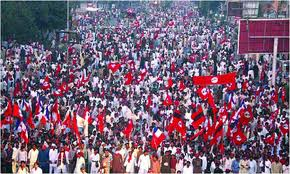
Nationalist movement of Bangladesh and Balochistan were peaceful at their inception. Unbridled killings and flagrant violations of human rights spiralled violence that ultimately brought devastating results. One glaring example of peaceful nationalist movement of Sindh was witnessed on March 23 when thousands of people marched for several miles on Shahrah-e-Faisal, the main artery of Karachi, carrying dead bodies of their leaders and not even a minor incident of violence or even indiscipline occurred.

This testifies to a paramount commitment of nationalist movement to remain steadfast with a peaceful political struggle.

Regrettably, the so-called national media channels did not bother to relay this huge rally and did not appreciate such a commendable spirit of peaceful movement for political rights. Spirit of non-violence and equanimity if not reciprocated with political sagacity, may succumb to mounting frustration.

The provincial government in Sindh has failed to investigate unabated series of extrajudicial killings happening under its nose. Not a single responsible perpetrator has been nabbed so far. Such remiss and indolence is conspicuously deliberate.

The federal government is equally ignorant of this simmering volcano that can erupt with any incendiary incident. This lunacy must end to avoid any catastrophic ramifications. Repeating fatal mistakes of past would culminate in same nightmares.

Pakistan Bars British Journalist after book on Balochistan

British journalist Willem Marx was recently banned from entering Pakistan  after the publication of “Balochistan: At a Crossroads,” his book about a “forgotten” region in that country. Marx was heading to the country for the Lahore Literary Festival.

The blockage of Marx’s visa is seen as the latest in a series of moves by the Pakistani government to discourage journalists from covering the region.

Balochistan is a region that sits in parts of Pakistan, Iran and Afghanistan. It has long been unstable and mired in political violence over its autonomy. The Pakistani government has been accused of “forced disappearing” and other human rights violations in the region.

“Balochistan: At a Crossroads,” a collaborative effort of Marx and French photojournalist Marc Wattrelot, was published earlier this month. The two traveled extensively in Balochistan to capture all aspects of life in the contested area. All of the proceeds are being donated to UNICEF to polio eradication efforts in Quetta, the capital of the Balochistan province.

Marx and other journalists have accused the Pakistani government of blocking information coming out of the region. Balochistan, like most regions outside of major Pakistani urban areas, can only be visited with permission from Pakistani security agencies.

A representative for Marx said he has been detained in the past and has had tapes confiscated by Pakistani authorities. New York Times reporter Carlotta Gall was assaulted and detained by Pakistani officials in 2006 after a report she did in Quetta. In at least one occasion, Marx was able to travel to the region and report by saying he was writing on economic topics.

The government is also accused of blocking access to Balochistan-related information within the country. When asked, Marx said, “It’s like a hidden secret. I cannot get a single person to sell this book. It’s quite bizarre. It’s not because the booksellers don’t want to sell it. They are worried that they will have their premises investigated. No wholesaler will import it. It’s really extraordinary.”

Yesterday, U.S. Representative Louie Gohmert spoke out about the violence in Balochistan and criticized the welcoming of Pakistani officials by the U.S. State Department.

The State Department heavily disagrees. It released a statement soon after, saying that “the United States respects the territorial integrity of Pakistan. It is not the policy of the administration to support independence for Balochistan.”