What Choices for Hindu Girls in Pakistan?

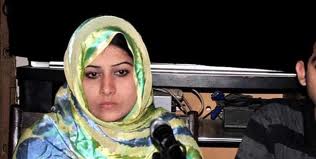
Rinkel Kumari or Faryal Shah? (Credit: Pravasitoday)

On April 18, Chief Justice Iftikhar Muhammad Chaudhry ruled that the three Hindu women who had been converted to Islam, Rinkel Kumari, Dr Lata Kumari and Aasha Kumari, should decide if they want to return to their parents or stay with their new husbands. All three stated that they had willingly converted to Islam and wanted to live with their husbands.

However, there are still concerns about the climate of intimidation in which these cases were carried out and both Rinkel and Dr Lata had previously made contradictory statements in court about their conversions. Often in such cases the Hindu parents and lawmakers receive death threats and therefore raises the question if these decisions by the three women were made under duress.

Imagine your name is Bharti. You are a 15-year-old Hindu girl who lives in a small apartment in Lyari. Your father is a driver and social worker who raises money for others while struggling to pay your family’s medical bills. You have three older brothers, who are busy with their own jobs and families. Your future seems bleak.

Imagine you then meet Abid. He is the son of a police constable and promises to marry you. He promises you many things – but on the condition that you convert to Islam. You agree and run away with him. His family teaches you the Kalima and gives you a niqab to wear. After a few days, they take you to a maulvi. While the nikah form is being filled, you already know what you have to say. You tell the maulvi that you are 18-years-old and your name is now Ayesha.

Imagine that a few months pass. You are still living with Abid and his family. Your father lost the court case after a medical report was produced that stated that you are 18. You couldn’t look your mother in the eye when she came to court. You haven’t once been able to visit your home since you ran away. Your in-laws still haven’t given you a cell phone but sometimes you are able to borrow a phone and briefly talk to your brothers. When you speak to them, you can’t help but cry.

Be it the mean streets of Lyari or the dusty villages of interior Sindh, stories such as these are becoming increasingly common in Pakistan. In the last four months alone there have been at least 47 reported cases of alleged forced conversions of young girls from minority communities. But none of these cases have quite captured the fascination of the public as that of Rinkel Kumari.

Nineteen-year-old Rinkel disappeared from her home in Mirpur Mathelo, a village in the Ghotki district of Sindh, on February 24. The answer to what happened to her varies significantly, depending on whom you speak to. According to her father Nand Lal, a government schoolteacher, Rinkel woke up somewhere between four and five in the morning to go to the bathroom when she was drugged and kidnapped by armed men. She regained consciousness at around nine in the morning to find herself in Barchundi Sharif in Daharaki – a stronghold of PPP MNA Mian Abdul Haq, also known as Mian Mitho, who is the spiritual leader of the shrine where conversions regularly take place. Just hours after her arrival in Barchundi Sharif, Rinkel was forcibly converted to Islam, married off to one of the kidnappers, Naveed Shah, and subsequently renamed Faryal.

Mian Mohammed Aslam, the son of Mian Mitho, provides a different version of events. He stated on an evening news show that Rinkel showed up with Naveed Shah at his doorstep, expressing her wish to convert to Islam and get married. Aslam added that he contacted Rinkel’s parents to let them know his daughter was with him and even invited them to come visit her before she converted, but they never showed up.

And to add to the confusion, there is a third account of events according to which Rinkel was indeed in love with Naveed and went to meet him on the morning of February 24, but did not know that he would be waiting with other men, ready to kidnap her.

In response to the latter accounts, Rinkel’s family has stated that they did not want to meet their daughter at Mian Mohammad Aslam’s residence because they were concerned that they would not be able to talk freely in the presence of the MNA’s son. And her parents have denied suggestions that Rinkel knew Naveed, stating that since there is no phone in their house and Rinkel does not own a cellphone, there was no way for them to have contacted each other.

But be it Rinkel, Bharti or any other girl, the problem at the heart of all these cases is that nobody knows what actually happened to the victims. Some of the girls, including Rinkel, have made somewhat contradictory statements, initially saying that they willingly converted to Islam and later crying that they want to return to their parents. And in all known cases, the accused have fiercely guarded the girls from meeting their families. This raises several questions: Were the girls’ statements made under duress? Should non-Muslim parents be allowed to meet their now Muslim daughters? Does tempting a young girl with false promises count as coercion? Are these forced conversions and marriages essentially cases of rape and sexual harassment committed in the guise of Islam?

Advocate Iqbal Haider believes the answer to all these questions is an unequivocal yes, and he does not hide his disgust towards Mian Mitho and others involved in such conversions: “Mian Mitho is exploiting his status as an MNA and has been indulging in the most objectionable activities.” PPP MNA Mian Mitho

Haider has fought many cases of forced conversions and described the kind of problems that commonly arise in such cases. “No police officer would dare defy the orders of an MNA. The police is not independent,” stated Haider, adding, “I recently saw it in court when two police officers led the girl into the courtroom and her alleged husband was glued to her.”

The police was apparently unconcerned that the man was yet to be proven as the husband and that he was imposing his presence on the girl. It was only when Haider shouted at the police that they separated the two. The families are often not allowed anywhere near their daughters and Rinkel’s parents and their supporters have received public death threats from Mian Mitho and his abettors.

It was against this climate of intimidation that the court decided to move Rinkel and Dr Lata, a 29-year-old who also converted and got married in February, to Islamabad. Haider will not be representing any of the cases in the Supreme Court but he believes it was the right decision to move the girls to more neutral territory. “Keep the girls in Islamabad in a protected area but you can’t keep them there forever. I hope the court holds judicial inquiries into each and every case.”

Haider emphasised the importance of cross-examining all the witnesses since the girls’ statements are often made under duress. And he also pointed out the importance of having a liberal judge since, in his words, “There are bigots everywhere.”

Rinkel and Lata had their court hearing in Islamabad on March 26. Rinkel was barely able to speak and it took her two minutes to answer whether she studied science or arts in school. Chief Justice Iftikhar Muhammad Chaudry instructed everybody to leave the court so that he could talk to the girls privately. The girls were then allowed to briefly meet their parents before being sent to Darul-Aman for two weeks, according to the court’s orders.

In a phone conversation the day after the ruling, Rinkel’s father, Nand Lal, revealed that in the few minutes the family spent with Rinkel, she cried non-stop and said that she wanted to return home with them. She also told them that Mian Mitho’s men had threatened her to not make a statement in favour of her family. While her father hopes that Darul-Aman will provide a safe environment for his daughter, the family does fear that Mian Mitho’s men will be able to reach her there as well. If Rinkel is happily married, as Mian Mitho and his followers like to claim, then why do they feel the need to resort to these intimidatory tactics?

PPP MNA Nafisa Shah, who has publicly condemned the forced conversions, believes this environment of intimidation is the main source of the problem. “Coercion does not just mean using brute force,” she said, “We have an extremely claustrophobic environment in which there is space for only one religion.” And it is this claustrophobic environment that limits opportunities for minority communities in the country and makes the offer to convert and get married all the more alluring to young, vulnerable women. Nafisa Shah also pointed out that Hindus are rarely involved in serious crimes in Pakistan, but because they don’t have arms, they become all the more vulnerable to outside threats.

Nafisa Shah did not want to specifically talk about Mian Mitho, but she made it clear that these forced conversions go against the ideology of the PPP and points out that people like Shahbaz Bhatti and Salmaan Taseer lost their lives as a result of speaking up against prejudicial laws. Shah emphasised that the space for dialogue and multi-faith expression is shrinking and attributes Talibanisation as the source of this problem. She also added that conversions are not an issue, but the fact that in Pakistan it is a one-way street of only minorities converting to Islam that causes concern.

According to Bharti’s nikahnama she is 18-years-old.

Abdul Hai, assistant coordinator at the Human Rights Commission of Pakistan, agrees that there is nothing wrong with converting, even if it is for the sole purpose of getting married. “The real problem is where is the girl going?” he adds “Maulvis will say in court that the girl’s parents are kafirs and that she can no longer meet them. How can you forcibly cut the girl off from her parents?”

Senior journalist and human rights activist, Akhtar Baloch reiterates the points made by both Shah and Hai: “You cannot stop adults from converting or getting married. But why is it only the Hindus who are converting to Islam? And that too girls? Why don’t we have men converting to Islam or Muslims converting to other religions?”

Baloch is also concerned that the cases being highlighted in the media are of those who are financially more secure and he fears that there are countless more cases that go ignored.

One such case is that of Bharti. On December 2011, Narain Das found his daughter was missing from home and filed an FIR at the Baghdadi thana only to soon discover that his daughter had run off with Abid, the son of Anwar Kalia who is a constable at Preedy police station.

This is not the first time one of Das’s children ran off to convert to Islam. Around 12 years ago, Das’s employers, car dealers, lured his oldest son Lakshman, who was at the time barely a teenager, to convert to Islam. The men, who Das drove cars for, would send the young boy to fetch alcohol and when Das scolded him, they suggested that he convert so that he would no longer have to live by his parent’s rules. Das and his wife would try to visit Lakshman but each time he would run away. When Das finally got a hold of his son, Lakshman said that he ran away because he was told that if he met his non-Muslim parents they would all become wajib-ul-qatl. Das had enough knowledge of Islam to know this was untrue but as a cautionary measure got a fatwa from a neighbourhood maulvi. When Lakshman was nearly 18, Das proposed to his son’s converters that they should get his son married and help him get started in life. The next day, Das was called to take his son back home.

“I bet nobody in all of Pakistan has done what I did next to my son,” said Das. He went on to relate how he got his son a job with a Muslim butcher and when a Hindu girl fell in love with his son, he told her parents that she would have to convert to Islam since his son is a Muslim.

“I have a Muslim son. I have Muslim grandchildren. And I am the Hindu dada of those children,” Narain said, stating that he has no issue with his daughter converting to Islam. What offends him is that his daughter was lured to run away and that Kalia’s family is preventing them from contacting each other.

Also, Das has NADRA documents stating that Bharti is 15 but the police got a medical report alleging that she is 18, over which Das lost the court case.

Das was visibly furious when I met him. “If these NADRA documents hold no meaning, then close down all their offices in the country. And how can Bharti suddenly be older than her brother Sunny? Next they’ll come and say she’s older than her parents.”

The family has received death threats for pursuing this case and Das added, “The biggest mistake I made was hiring Amarnath Motumal as my lawyer. Not because Amarnath is a bad person, but because he is a Hindu and the other side clearly threatened him.”

Motumal, who is also the vice-chairman of HRCP, confirmed that Bharti is indeed only 15 but the case is now unfortunately closed and he hopes public outcry might lead to a new, fairer trial.

Das revealed how Anwar Kalia had the police on his side. The DIG Sindh ruled that Bharti should be taken to a women’s thana and that Anwar Kalia’s family would not be allowed to visit her there. However, these orders were ignored and Kalia’s family would go take meals to Bharti everyday. He also describes Bharti’s alleged husband (Das and his family do not recognise the marriage since Bharti was under coercion) as a good-for-nothing drunkard and drug addict. Her brothers tell me I can ask anyone in the neighbourhood about Abid’s reputation.

Occasionally her brothers were able to speak to her on the phone and they said she would always cry and say she made a mistake. In trying to get in touch with Bharti, I spoke to Abid’s uncle who firmly advised me to move on and not bother them, saying “Bharti is happily married so there is no point in talking to her.”

He admitted that they medically proved her age but did not want to disclose the name of the hospital or doctor they went to. And the maulvi who presided over the nikah ceremony, Mohammed Abbasi, was of little help as well. When asked how he confirmed Bharti, or rather Ayesha’s age, when she had no form of identification on her, he said, “She said so. And you can tell by looking if someone is 15 or 18.”

He also shamelessly told me how Narain Das spoke to him on the phone for an hour, begging for help, but he did nothing. “I have given my statement to the police and the girl married willingly.” It also does not concern him that the witnesses were only from the boy’s side even though in Islam, witnesses from the bride’s side are required.

“If they didn’t accept me as a witness because I’m Hindu, then why didn’t they take my Muslim son as a witness?” Das asks. “And why is it that Dr Lata who is 29 is taken to a women’s shelter, but my 15-year-old daughter is sent away with the accused? Why should I be dealt a different judgement because I am poor?”

Had Rinkel’s family not been able to find the right contacts, had Mian Mitho not been involved, had the Pakistan Hindu Council not decided to take up the issue, her case too perhaps would have been left ignored.

New cases of forced abductions are emerging every month. But Nafisa Shah is sceptical about giving exact figures because nobody is able to find out for certain if the girl in question converted willingly or not. How can one know when soon after the conversion, the girls are married off and cut off from the public? Even in the rare case in which a girl speaks up, there is fear of persecution. According to Seema Rana, a member of the Hindu community who is doing research on these conversions, a girl from Lyari was asked to take an oath on the Quran in court. She refused, saying that she cannot take the oath since she is a Hindu and was forcibly converted. The girl was returned to her parents, but her family feared the accused might take revenge and immediately got her married. Even though the girl is willing to talk about her experiences, her family is too afraid to give her name to the media.

Without access to the girls themselves, we can only imagine what truly happened to them.

The Lost Girls

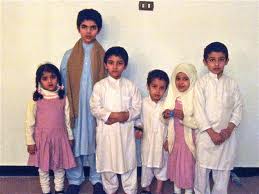
These young girls – long forgotten by all but their families – were allegedly kidnapped from their homes and forced to convert to Islam.

In December 2009, 13-year-old Radha Ram’s parents reported that she was kidnapped from their home in Rahim Yar Khan. She was kept in a madrassa and Abdul Jabbar, the leader of the madrassa, prevented the Hindu family members from meeting her since she was now Muslim.

Four men kidnapped 13-year-old Mashu from Jhaluree, a village near Mirpur Khas, on December 22, 2005. They then allegedly forced her to convert to Islam and renamed her Mariam. Pir Ayub Jan Sarhandi was involved in her conversion and soon after her abduction and conversion, she was married to one of the kidnappers.

Anita Kumar, a 22-year-old Hindu woman with two young children, was kidnapped from her house in Moro, Sindh in April 2011. In the process her two children, aged four and two, were beaten up and locked up alone in the house. The Supreme Court allowed her marriage to a Muslim man, even though she was still married to her first husband, Suresh Kumar. She has since then been renamed Aneela Fatima Pervez.

Gajri, a 15-year-old Hindu girl, was kidnapped by a neighbour from her home in Katchi Mandi in the Rahim Yar Khan district on December 21, 2009. She was later discovered in a madrassa, but by then she had already been converted to Islam and married to her neighbour, Mohammed Salim. Her parents later received an affidavit, in which the daughter stated that she had converted to Islam willingly but they were not sent a copy of the marriage certificate. The parents are not allowed to visit their daughter since they are non-Muslims.

On October 18, 2005, a Hindu driver, Sanno Amra, came home from work to find that his three daughters Reena, Usha and Rima had disappeared from their house in Punjab Colony, Karachi. The oldest sister was 21 and the youngest was 17 – legally still a minor. When Amra pursued the case he started receiving death threats and eventually found affidavits in the mail, which stated that his daughters had willingly converted to Islam. The parents were only allowed to briefly visit the daughters, and that too in the presence of maulvis and police officers.
This article was originally published in the April 2012 issue of Newsline under the headline “Unholy Vows.”

SC Verdict Leaves Hindu Girls Conversion Issue Unresolved

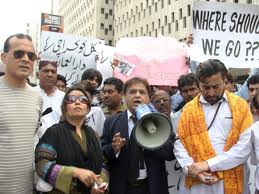
Hindu Protestors in Karachi (Credit: tribune.com.pk)

ISLAMABAD, April 18: The chief justice was in a hurry for once. In just the second hearing on Wednesday of a case related to the conversion of three Hindu women, a Supreme Court bench, headed by Chief Justice Iftikhar Muhammad Chaudhry, wrapped up the case and announced its judgment.

The three young women present in the court were told to express their ‘true’ feelings about what they wanted to do and Sindh police were ordered to be their ‘protectors’ — ensure their safety and their happiness.

Police were asked to submit reports every fortnight about the wellbeing of the women.

The women did not utter a word during the proceedings. Later they were sent off to the registrar’s office to pour their hearts out.

In between, they were kept apart from their parents; they were taken to the registrar’s office from a different route so that no one would run into them.

The women recorded their statements before the registrar and decided to go with their husbands.

The judgment, however, did not go down well with the hapless parents. For the rest of the afternoon, the human tragedy that is the Hindu minority in Pakistan was played out on the steps of the Supreme Court building and outside as the families spoke to media and protested the verdict. Wednesday did not bring them the justice for which they had travelled from Sindh to Islamabad.

The women who appeared before the court under the watchful eyes of Sindh police were Rinkal Kumari, 19, (now known as Faryal Bibi) of Mirpur Mathelo, Dr Lata Kumari, 30, (Hafsa) of Jacobabad, and Aasha Devi, 19, (Haleema Bibi) of Jacobabad, who earlier was missing but surfaced voluntarily.

“We gave these girls sufficient time to think about their future and we will not force them. They are grown-up and are allowed to go wherever they want to go,” the chief justice observed. He said they were sui juris (one who has reached maturity and is no longer dependent) and, therefore, fully in a position to decide about the future.

“We feel they (the women) stayed in a pressure-free atmosphere at the Panah Shelter Home in Karachi where neither of the parties was allowed to meet them,” the court observed.

The order, however, generated instant commotion inside the courtroom, prompting the chief justice to ask the counsel for different parties to urge their clients to maintain discipline.

Frantic developments were seen soon after the announcement of the verdict. Dr Ramesh Kumar Vankwani, patron of the Pakistan Hindu Council (PHC), called an emergent meeting to discuss implications of the verdict.

The PHC also filed a petition highlighting abduction of Hindu girls who were then forced to change their religion and married off to Muslim men. The court will take up the case after two weeks.

The disappointed parents of these women and members of the Hindu community, including parliamentarians from the ruling PPP, staged a sit-in outside the Supreme Court for some time and called for giving custody of the women to their parents.

“This is complete injustice in the name of Islam,” shouted Mohen, father of Aasha, outside the courtroom. He asked why the court did not take into consideration a demand by police for payment of Rs1.8 million for recovering the girl — a demand which was raised to Rs3.5 million and then to Rs5 million. “From where we will fetch this kind of money.”

He said the Hindu community was being forced to leave Pakistan.

The mothers of the three women kept weeping and wailing outside the Supreme Court and alleged that the court had never allowed the girls to meet their parents.

Ramesh Lal, a PPP MNA from Larkana, said minorities had lost all hopes in the country’s judiciary and today justice had been buried forever. “Why the judiciary, which never tires of taking suo motu notices against the president and the prime minister, is not taking notice about police demanding money from the victim families to recover the girls,” he asked.

Noor Naz Agha, the counsel for Rinkal, however, welcomed the verdict and said the court had rightly accepted that being adult, the girls had a right to live their lives according to their choice.

But she held the absence of legislation responsible for the rising number of complaints about forced conversions and marriages.

Mian Aslam, son of MNA Faqir Abdul Haq alias Mian Mitho, who was accused of abducting Rinkal, rejected the allegations, wondering “if we kidnapped her then why she was produced before the magistrate to record her will and later handed over to police”.

He brushed aside an impression that the girls were converted to Islam forcibly.

Curfew imposed in Gilgit after Sectarian Violence

Shoot on sight orders in Gilgit (Credit: nation.com.pk)

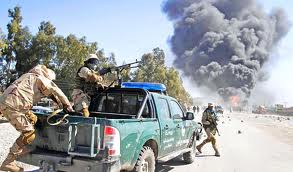
GILGIT, April 4 – The authorities issued shoot-on-sight orders to the law enforcement agencies to maintain law and order situation after 17 people were killed and more than 50 wounded in sectarian violence in Gilgit-Baltistan on Tuesday.

The attacks led to an army deployment and imposition of curfew in the city, confining the inhabitants to their homes, as the situation turned violent.

Gilgit-Baltistan map (sananews)

The ISPR in a statement said the Army has been summoned to Gilgit to control the law and order situation. The casualties occurred in two separate incidents in the northern towns of Gilgit and Chilas.

In Gilgit, gunmen opened fire during a strike called by Ahl-e-Sunnat Wal Jamaat (ASWJ) over the arrest of one of their leaders, Attaullah Saqib, for his alleged involvement in a sectarian attack in February that left 18 dead.

Gilgit Baltistan (facho01.blogspot.com)

The rioters ran amok when police refused to release Attaullah Saqib. Angry protesters opened fire and pelted the anti-riot police with stones, leaving several officers injured. Some unknown men hurled hand grenades at Ittehad Chowk that injured two policemen and a passerby. “At least seven people were killed and 50 others were wounded,” said an official.

Ahle Sunnat rally in Gilgit (brecorder.com)

Senior local police official Ali Sher told AFP the gunmen opened fire on a group of Sunnis appealing to people to close their shops in response to the strike call. It is pertinent to mention here that a complete shutterdown strike was observed against the arrest of Attaullah Saqib, who is said to be chief of Sipah-i-Sahaba Pakistan (SSP), Gilgit chapter.

A curfew was imposed in the city after the incident to bring the situation under control, the official said. Soldiers were given orders to shoot at anyone who defied the curfew order, the local media reported.

Shias protest Kohistan incident (nation.com.pk)

A total of 14 people have reportedly been arrested in the city following the clashes. In the February incident, gunmen disguised in military fatigues hauled 18 Shias off buses and shot them dead in cold blood in the northern district of Kohistan, which neighbours the Swat valley. A local intelligence official, who did not want to be identified, confirmed Tuesday’s death toll and also said a hand grenade had been used.

Noorbakshi sufi sect (siasat.pk)

“But we still don’t know who the attackers were,” he said. He added that tensions had been mounting between the Shias and Sunnis in recent weeks.

In Bonar Das area of Chilas, a Sunni-dominated town about 100 kilometres south of Gilgit, a mob blocked the main Karakoram Highway and killed ten Shias, local police official Alam Jan said.

Pakistan-Army in Gilgit (the newstribe.com)

“The mob took out ten men from buses and shot them dead,” an official said.

Hundreds of people took to the streets in Chilas protesting the killings in Gilgit, he said, adding that the rioters set four buses on fire.

A local intelligence official confirmed the death toll.

Meanwhile, a police officer and his bodyguard were also injured while driving to a bus station in the city to provide security for the passengers from Rawalpindi.

The deteriorating situation in Chilas had prompted the local authorities to impose a curfew there.

Gilgit is the capital of Gilgit-Baltistan region and is popular with mountaineers as a gateway to the Karakoram and Himalayan mountain ranges.

Background of Sectarian Conflict in Gilgit-Baltistan

Around 75% of the region’s population follows some form of Shia Islam, almost an exact reversal of the norm in the rest of Pakistan. This makes the Northern Areas the only Shia majority political unit in Sunni-dominated Pakistan. There are four sects in Gilgit-Baltistan; Shia, Noorbakshi and Ismaili communities believe in the offices of Imamat, according to them, runs after the prophet Muhammad (PBUH) through Ali and his male successors. Whereas Sunnis believe in the office of the Khilafat and according to them Abu Bakr, Usman and Ali were the Caliphs after the death of Muhammad (PBUH).

Please click here to download the PDF document “PILDAT Background Paper: Sectarian Conflict in Gilgit-Baltistan”

Producing Little Osamas on the Run

OBL children on right and grandchildren on left (Credit: worldblog.msnbc.msn)

HARIPUR, Pakistan: It’s an ornate but not lavish two-story house tucked away at the end of a mud clogged street. This is where Pakistan’s intelligence agency believes Osama bin Laden lived for nearly a year until he moved into the villa in which he was eventually killed.

The residence in the frontier town of Haripur was one of five safe houses used by the slain al-Qaeda leader while on the run in Pakistan according to information revealed by his youngest wife, who has been detained.

Retired Pakistani Brig. Shaukat Qadir, who has spent the last eight months tracking bin Laden’s movements, told The Associated Press that he was taken to the Haripur house last November by intelligence agents who located it from a description they got from Amal Ahmed Abdel-Fatah al-Sada.

Al-Sada, a 30-year-old Yemeni, has been in Pakistani custody since May 2 when US Navy SEALs overran the Abbottabad compound, killing bin Laden and four other people inside. Since then, Pakistan’s intelligence agency, known as the ISI, has been trying to uncover the trail that brought him to Abbottabad villa in the summer of 2005.

The best information appears to have come from al-Sada, who was believed to be his favourite and who traveled with bin Laden since his escape from Afghanistan’s eastern Tora Bora mountain range in 2001.

Qadir, a 35-year army veteran who is now a security consultant, was given rare access to transcripts of Pakistani intelligence’s interrogation of al-Sada and access to other documents on bin-Laden’s movements. He provided the AP with details in a recent interview.

The details of bin Laden’s life as a fugitive – which were first published by the Pakistani newspaper Dawn – raise fresh questions over how bin Laden was able to remain undetected for so long in Pakistan after the Sept. 11, 2001 attacks, despite being the subject of a massive international manhunt.

Yet a senior US official, who is familiar with the contents recovered in bin Laden’s Abbottabad house, said there was no evidence that Pakistani officials were aware of bin Laden’s presence.

“There was no smoking gun. We didn’t find anything,” he said on condition of anonymity because he was not authorised to speak about the contents of the Abbottabad house.

According to the interrogation report, bin Laden lived in five safe houses and fathered four children – the two youngest born in a public hospital in Abbotabad. But investigators have only located the houses in Abbottabad and Haripur.

Al-Sada’s descriptions of the homes have been vague and the Haripur house was found only after a series of hits and misses.

She knew only that it was located on the edge of Haripur, it was two stories and it had a basement. It apparently was used by bin Laden while he waited for construction crews to finish his new home Abbottabad, a garrison town just 30 kilometers away.

Investigators scoured the area looking for properties until they found the Haripur house in Naseem Town, a chaotic suburb where relatively affluent houses bump up against sun-baked mud huts that belong to nomadic Afghans.

Like the CIA, the Pakistani agency also tracked the movements of bin Laden’s Pakistani courier who used the pseudonym Abu Ahmed al-Kuwaiti and his brother. The two were ethnic Pashtuns from Pakistan’s Khyber Pukhtunkhwa province on the border with Afghanistan. They were bin Laden’s front men.

The ISI discovered that the Haripur house, like the land on which bin Laden’s Abbottabad villa was built, was rented by two Pashtun brothers claiming to be from Charsadda, a Pashtun dominated town about 110 kilometers away.

The AP located the Haripur house that Qadir said ISI agents had taken him to last November and found the real estate broker, Pir Mohammed, who rented the four-bedroom house to the two brothers, Salim and Javed Khan from Charsadda, for $150 a month.

At the time Pir Mohammed ran a small real estate firm called Mashallah. He said his meeting with the brothers was random.

“They must have seen my sign and come in,” Mohammed said, adding that he had met the brothers only three times – when they signed the contract, when they moved into the house and when they moved out 11 months later.

Two months ago several ISI agents took all the records of the house and its tenants since its construction in 2000, said Qasi Anis Rahman, the brother of the widow who owns the house.

“All they said was that it was for ‘security purposes,’” said Rahman.

Al-Sada is currently in Pakistani custody, along with bin Laden’s two other wives and several children. They were arrested after the raid. The US Navy SEALs shot al-Sada in the leg during the operation.

Mohammed Amir Khalil, a lawyer for the three widows, said the women would be formally charged for illegally staying in Pakistan on April 2. That charge carries a maximum five-year prison sentence.

Shia Hazaras Massacred in Balochistan – Again!

Shia Hazara Grieved - blogs.com.tribune.pk

QUETTA, March 29: At least five people were gunned down, and six others sustained injuries, when a van carrying people belonging to the Hazara community was ambushed on Spini road in Quetta Thursday morning.

Law enforcement agencies and the police put security on high alert in the city after the incident.

According to a senior police official, the van was on its way to Marriabad from Hazara Town when a group of armed men opened indiscriminate fire near Killi Mubarak.

Five people, including a woman, died on the spot while six other were wounded.  The assailants fled the scene after the incident.

A heavy contingent of police and security forces reached the spot and cordoned off the area to collect evidence.

The bodies and injured were shifted to Provincial Sandeman Hospital and Bolan Medical Complex where an emergency had been declared. The injured were later shifted to Combined Military Hospital.

Policeman killed in protests

The incident sparked protest in different parts of the city, especially in areas dominated by the Hazara community on Brewery Road.

Protestors shot at security personnel, killing one policeman, Mukham Raza, and injuring a protestor.

Government Girls College Quetta College on Brewery Road was set alight, and fire brigades were called in to extinguish the blaze that engulfed the outer wall of the college building.

Protesters also intercepted two motorbikes and torched them.

The Hazara Democratic Party called for a shutter-down strike in Quetta on Friday (today) to protest the killings. Jamhoori Watan Party, Pashtunkhwa Milli Awami Party and the Awami Nation Party backed the strike call.

A senior police official said that Frontier Corps and police have jointly launched a search operation in different areas of Quetta, including Saryab, and arrested 45 suspects.

No group had claimed responsibility for the attack till the filing of this report.

The government has decided to form an exclusive force for the protection of the Hazara community following frequent incidents of targeted killings last year. Meanwhile, attacks on the community have intensified in the past few days.

2 UN workers shot dead

Two local UN workers were shot dead by unknown assailants in Mastung, about 50km from Quetta.

According to official sources, three persons, identified as Habibullah, Irfan and Mohammad Zahid were en route to Mastung from Quetta when armed men on a motorbike opened fire on their vehicle near Mastung Stadium bypass, killing two of them on the spot. Irfan sustained bullet wounds.

Law enforcement agencies rushed to the spot soon after the incident and cordoned off the area.

“They were working for UN Food and Agriculture Organisation and were coming to Mastung to visit their office,” sources said, adding that the victims were residents of Quetta.

The bodies of the deceased and the injured were taken to Provincial Sandeman Hospital for autopsy and later handed over to the heirs for burial.

Chief Minister Nawab Aslam Raisani strongly condemned the killings in Quetta and Mastung and directed law enforcing agencies to arrest the culprits involved.

Cultural Ignorance behind the Koran Burning in Afghanistan

Koran burning in Afghanistan newkuwaititimes.net

The Koran burning incident, which has raged in Afghanistan since the last couple of weeks, is symptomatic of the mutual misunderstanding with which the US and regional players have bumbled on for the last 10 1/2 years – with no clear goal in sight.

If the US goal in Afghanistan was to train the security forces to handle their own defenses, the incident of US soldiers burning the Koran outside Bagram prison – allegedly to thwart planning by Taliban soldiers against them – indicates that the decade long war has not taught American soldiers basic cultural norms of Muslim societies.

The Afghans have refused to buy the argument by US soldiers that the notes written on the Korans by Taliban prisoners may have been code words for an insurgency. Instead, the issue has touched a far deeper chord than the video of US soldiers humiliating the corpses of Taliban soldiers…which was repeatedly played in the US media.

The Koran burning incident has thrown world leaders into a bind. Afghan President Hamid Karzai, knowing that his fate will be decided by the Afghans after his US patrons leave, has turned to the Ulema (religious clergy) to defuse the crisis.

On the other hand, US President Barak Obama – with his multi-cultural upbringing – has apologized, but failed to contain the violence that has infiltrated into the Afghan security forces.

If the US had taken a leaf from history, it would found the need for greater sensitivity in a cultural milieu where tribal Afghans have fought off Western influences like the plague.

For example, the former Soviet Union was forced to end its modernity campaign in Afghanistan shortly after its invasion in 1979, after Russian literacy workers were murdered by conservative Afghans. Millions of Afghans migrated to Pakistan, where they coalesced into the Mujahidin. These “holy warriors” were subsequently funded and armed by the US against the Soviets in Afghanistan… in a movement that has fathered the Taliban.

Today, with history come a full circle, Afghan conservatism raises new challenges for the Obama administration.
The Koran burning issue has already spilled into Pakistan where the religious parties (who served as the mid-wives for the Taliban during the 1990s) have used it to capitalize on anti-US sentiment.

In Pakistan, the victimization of religious minorities and even Muslims suspected of sacrilegious acts mushroomed after 1984, when the Gen. Zia ul Haq’s military coup was followed by passage of the Blasphemy Laws to award the death penalty for insulting the Prophet of Islam and the Koran.

In 1994, I visited Gujranwala town in the Punjab to see how a Muslim who had even memorized the Koran, suffered the ultimate penalty for alleged blasphemy. The unfortunate Muslim, Hafiz Farooq Sajjad whose Koran caught fire…it is impossible to verify how it happened… was spotted by his neighbor while the Holy Book was burning, and reported he had burnt it on purpose.

As the news of the Koran burning spread through the town, the clerics announced it from the mosque. An angry mob descended on Sajjad’s home, tied him to the back of his motor bike and dragged him till he died of his wounds.

The most virulent Muslim sects have since emerged from the small towns of the Punjab – groups like the Anjuman Sipah-i-Sahaba Pakistan and the Lashkar-i-Jhangvi – who have singled out Shias, Christians, Ahmediyas and even Muslims for extermination.

Only last week the anti Iranian group, Jundullah took responsibility for singling out Shias traveling in a passenger bus in Pakistan’s northern areas – whence they were forced to disembark and shot on account of their sect.

In this complex scenario, where nations use religious and ethnic groups to fight proxy wars in the Pak-Afghan region, the dangers of religious extremism rise in proportion to incidents like Koran burning.

Indeed, as the Taliban claims military successes in Afghanistan… the religious extremists moving across the porous borders to Pakistan carry the seeds of intolerance that threaten to destabilize the nation still further.

If history repeats itself, and the unexpected always happens, how incapable must Man be of learning from experience. – George Bernard Shaw

Taliban Rules Return for Afghan Women

Afghan women presenters (credit: mcgill.ca)

KABUL: Afghanistan has instructed women TV presenters to stop appearing without a headscarf and to wear less make-up, officials said, raising fears about creeping restrictions on the fledgling media.

“All the TV networks are in seriousness asked to stop women presenters from appearing on TV without a veil and with dense make-up,” the information and culture ministry said. “All women newscasters on Afghan TV channels are also asked to respect Islamic and Afghan values,” it added.

A spokesperson for President Hamid Karzai told AFP on Tuesday that the ministry took the decision after coming under pressure from the Ulema council, the country’s highest religious body of Islamic scholars.

Afghan media, essentially non-existent under the 1996 to 2001 Taliban regime, have enjoyed considerable freedom, with more than two dozen TV stations springing up in the decade since the 2001 US-led invasion.

Pakistan’s Blasphemy Laws

Sheherbano Taseer (Credit: ibtimes.co.uk)

I first became aware of Pakistan’s blasphemy law soon before I turned 18. It was 1991, and although less than three years had passed since a plane explosion killed General Zia and subsequent elections brought Benazir Bhutto to power, the optimism which surrounded those events had already largely dissipated.

Benazir’s ineffectual government had lasted less than two years before being dismissed on corruption charges, and Zia’s protégé Nawaz Sharif was the new prime minister. If Benazir lacked the political power and nerve to overturn any of the repressive laws which Zia had introduced or strengthened in the name of Islam, Nawaz lacked the inclination to do so. The coalition of parties which he headed – the Islamic Democratic Alliance – had, from the outset, knowingly positioned itself against Benazir’s secular, female-led Pakistan People’s Party.

So it wasn’t surprising, but it was sickening, when Sharif’s government went along with the Federal Shariat Court’s ruling of October 1990, stating that an existing law which permitted life imprisonment rather than death to those found guilty of blasphemy was repugnant to Islam. “The penalty for contempt of the Holy Prophet … is death” the court plainly declared, and the government drew up a bill to bring the law into accordance with this ruling.

The blasphemy law, as it’s come to be known, had been around in a milder form long before the Federal Shariat Court’s ruling. In 1947, when the new nation of Pakistan adopted the Indian penal code (drawn up by the British), it included Section 295-A, which ran as follows: “Whoever, with deliberate and malicious intention of outraging the religious feelings of any class of citizens of Pakistan by words, either spoken or written, or by signs or by visible representations or otherwise, insults or attempts to insult the religion or the religious beliefs of that class, shall be punished with imprisonment of either description for a term which may extend to three years, or with fine, or with both.”

For the first few decades of Pakistan’s existence, 295-A was scarcely ever invoked, but when General Zia came to power following a military coup and decided the best way to circumnavigate the absence of a popular mandate was to claim the role of religious saviour, everything changed in the relationship between religion and state.

“Islamisation” became the word of the hour – or rather, of the decade that followed Zia’s usurpation of power. All political parties were banned, their leaders imprisoned if they weren’t in exile, except for the right-wing religious party, the Jamaat-e-Islami; advancement in the army and government became tied to a willingness to espouse Zia’s Islam; school curriculums were “Islamised” – which meant science fell out of favour, religious instruction was raised above all other subjects and the heroes of Pakistan’s history were men who killed (usually Hindus and Sikhs) in the name of religion. It’s worth noting that everyone in Pakistan today under the age of 40 who attended government schools (which is most of the school-going population) would have had Zia’s curriculum and world view pressed into their brains from a very early age.

At the private school I attended, where we followed the ‘O’-level syllabus and used English language texts published outside Pakistan, I grew up learning an entirely different version of the world. Our history lessons covered the ancient world, medieval Europe, a patchwork of Indian history from the Aryan invasions to the rise of Buddhism to the Mughals, through the British Empire to the creation of Pakistan. Islamic lessons – known, to the great amusement of my parents, as RI (religious instruction) – weren’t given any great prominence, but at the same time all students knew that RI was the one lesson where you couldn’t question anything.

Where did this attitude come from? I didn’t learn it from my home life, I know; was it merely the atmosphere of Zia’s Pakistan seeping through or had religion always been sealed in a protected bubble, except in the most radical circles? That’s a question which requires more space to discuss – for the moment, suffice it to say that by the mid-80s an extremist version of Islam had not only been codified in law but had made its way into daily life. Moreover, the Soviet invasion of Afghanistan and India’s acts of brutality against the largely Muslim population of the Kashmir Valley provided seemingly endless opportunities for pro-jihad propaganda. And then, of course, there was Saudi Arabia, delighted with the Wahabbism of Pakistan’s new head of state and only too happy to spend its petrodollars funding Wahabbi mosques and madrassas in Zia’s beleaguered nation.

All this is necessary to understand the atmosphere in which Zia widened the scope of the blasphemy laws, most notably with the addition of a new section 295-C: “Use of derogatory remarks, etc. in respect of the Holy Prophet. Whoever by words, either spoken or written, or by visible representation, or by any imputation, innuendo, or insinuation, directly or indirectly, defiles the sacred name of the Holy Prophet Muhammad (peace be upon him) shall be punished with death, or imprisonment for life, and shall also be liable to fine.”

From the first, the new and expanded blasphemy laws were used as tools of persecution, used not only against non-Muslims but also against Muslims belonging to minority sects (who were viewed by the Wahabbis as being as bad as, if not worse, than non-Muslims). In an entirely skin-crawling manner, the newly fanged laws made perfect sense for Zia’s rule – if you’re going to claim that your authority stems from your role as champion of Islam, then you have to show yourself zealous in finding and punishing those who offend Islam, both at home and abroad. I have to confess that I don’t recall any conversations around the blasphemy laws in Zia’s days. Perhaps this is because there was so much else to froth at the mouth about around his Islamisation policy. Or because I was 13 at the time.

But I remember very clearly the terrifying period four years later, in the newly democratic Pakistan, when Nawaz Sharif’s government did something which Zia’s government had considered and rejected: impose a mandatory death sentence in blasphemy cases. Every hope that the end of Zia would see a reversal of his Islamisation policies died right there and the number of cases registered under 295-C kept on rising. Most of those who were accused, particularly in the early days, were non-Muslims or Ahmediyyas (a group who refer to themselves as Muslim but have been declared non-Muslim by the Pakistan state and are subject to vicious persecution).

But the case which most struck me was that of Akhtar Hameed Khan – a development activist, and one of the great heroes of Pakistan, and in particular of my home city of Karachi. I always heard his name uttered with admiration in my household, so it was chilling to pick up the newspaper one morning and find him accused of blasphemy, and even more chilling to hear the offending words were in a poem for children that ‘could be read’ as blasphemous if you chose to interpret them in a particular way. In the end, he escaped conviction (as he did on the other two occasions when he was accused under the blasphemy law), but the incident was enough to make it clear to me that the law could be used against any writer who strayed from orthodoxy.

In Benazir’s second term in office, her government made some attempts to amend the blasphemy law to decrease its abuse by those seeking to persecute minorities or settle private scores. Her law minister Iqbal Haider later said he had won the agreement of other parties including the hardline religious Jamiat Ulema-e-Islam-Fazl (JUI-F) for making those amendments; but as soon as a newspaper erroneously reported that the government was planning to repeal the blasphemy laws, there were mass demonstrations by religious groups, which so intimidated the government that Iqbal Haider quickly declared support for the laws and dropped all talk of amendments.

It was around this time, while at university, that I first encountered the term “Kafkaesque”. It seemed designed for the blasphemy laws: if one person had said something blasphemous, their words could not be repeated, not even to a policeman or in a court of law, because voicing the blasphemous words would itself be an act of blasphemy, and so the accuser would become the accused. Those charged under the blasphemy law were immediately imprisoned and placed in solitary confinement, awaiting trial, for their own protection; failure by the police to do so, the logic went, left open the possibility that the accused would be killed either by their neighbours (if they weren’t imprisoned) or by other inmates (if they were imprisoned) because passions run so high over blasphemy charges.

The only ray of light in all this was the refusal by the Supreme Court to uphold a single guilty plea in all the blasphemy cases that came before it, though in reality this could mean that an accused person could be in solitary confinement for years and years while the case worked its way through the judicial system. The judges themselves were not immune to pressure: in 1997, Arif Iqbal Bhatti, a High Court judge, was assassinated after finding three men not guilty of blasphemy.

At a certain point, it started to seem impossible to imagine anything would change. Attempts to merely modify the law had failed – President Musharraf had been the latest head of state to suggest the possibility, only to backpedal furiously in the face of pressure from the religious right.The growing feeling in Pakistan that Islam was a religion under threat in the world meant that there was even less likelihood than before of anyone mounting a challenge to the status quo.

Into this situation strode Salman Taseer, governor of Punjab (the most powerful province in Pakistan). In an entirely unprecedented move, he went with his wife to visit a Christian woman in prison, Aasia Bibi, who had been in solitary confinement for over a year after an altercation with a group of Muslim women, who had refused to drink from the same glass of water as her because they considered her “untouchable”. These women later claimed Aasia Bibi had spoken blasphemous words in the course of the fight, and she was taken away to solitary confinement and later found guilty by the lower court.

Salman Taseer promised that Aasia Bibi would receive a presidential pardon. He also called the blasphemy law “a black law” and pointed out that it was man-made, not God-made. President Zardari, whose backing Taseer claimed to have, started to dither. No presidential pardon was immediately forthcoming, and the judiciary (already at loggerheads with Zardari for entirely separate reasons) ruled that he had no right to grant a presidential pardon until the appeals process was exhausted.

While Taseer continued to rail against the blasphemy law his own party deserted both him and Sherry Rehman, the already out-of-favour minister who had tabled a bill to amend the laws. The law minister, Babar Awan, insisted there was no possibility of changing the laws, and the interior minister Rehman Malik went one better and said that he would personally kill anyone who blasphemed. The rightwing press – who make Fox News look left-wing by comparison – applauded this stance and condemned Taseer.

“I was under huge pressure sure 2 cow down b4 rightest pressure on blasphemy. Refused. Even if I’m the last man standing” Taseer tweeted on 31 December. Four days later he was dead, gunned down by one of his own security guards, who said he did it because of Taseer’s stand on the blasphemy law. For this, the murderer has become a hero in large parts of Pakistan – when he arrived in court to be arraigned, lawyers threw rose petals at him. Near the same time, Taseer’s sons were throwing rose petals on their father’s grave. Absent from the grave site was the head of Taseer’s party, and the country’s president, Asif Ali Zardari. It was clear that, rather than doing the only decent thing and repealing the blasphemy law in honour of Taseer’s memory, the government wanted to put as much distance as possible between itself and the memory of the bravest man in its party.

It was left to Chaudhury Shujaat Hussain, a conservative politician from the Pakistan Muslim League (Quaid), to say that amendments were needed to prevent abuse of the blasphemy law. At the time, this seemed the best anyone could hope for – not to touch the law itself, but to make it very difficult for anyone to register an accusation of blasphemy against someone else. But even the faint hope of such procedural changes dimmed as the weeks went by. On 30 January, Hussain’s political party and other centre-right parties joined the right-wing religious groups in a massive rally demanding that the blasphemy laws remain untouched. The head of the JUI (F) publicly declared that the newly appointed governor of the Punjab should visit Taseer’s assassin in prison – just as Taseer had visited Aasia Bibi.

A few days after this, Prime Minister Gilani announced that Sherry Rehman had agreed to withdraw her ‘private member’s bill’ calling for amendments to the law, in keeping with the PPP’s policy of leaving the law untouched. Politically isolated and under threat from extremists, Rehman – who weeks earlier had seen a 25,000 person strong rally march through her hometown of Karachi declaring her an enemy of Islam – said she would stand by her party’s decision.

Through all this, the newspapers continued to carry stories of people charged under the blasphemy law, including a schoolboy who was reported to the authorities by an examination board for allegedly blasphemous remarks he had written on an examination paper. At the beginning of March, Pakistan’s minorities minister Shahbaz Bhatti was assassinated and the Taliban claimed responsibility. He was a Christian and the only non-Muslim in the cabinet. In January, Bhatti had told AFP: “During the Aasia Bibi case, I constantly received death threats. Since the assassination of Salman Taseer … these messages are coming to me even publicly. The government should register cases against all those using hate speech”. The Kafkaesque nightmare continues.


A National Human Rights Commission in the Making

The News, Dec 4: Finally, the bill that shall give birth to a National Human Rights Commission (NHRC) is on the National Assembly’s to-do List. Though it will still take some time to pass the bill in both houses, have approval of the President and put the Commission in place, yet it is good news. Many nations have found NHRCs useful for: strengthening norms and values based on human dignity and rights, reducing burden on the justice delivery system and dealing with rigidity of obsolete laws. As ‘The Statement of Object and Reasons’ attached to this bill explains, 56 countries have this arrangement in place recommended by several UN bodies and international treaties.

Besides the significance of reporting this development to the UN Human Rights Council’s session in October 2012 that shall review human rights situation of Pakistan (second time during the incumbency of this government), forming a human rights institution will have an added value in the present circumstances of Pakistan. There is a tremendous potential in this proposition as it seeks to build an institution over universally agreed upon standards of rights and liberties. Minus any expediencies and bureaucratic hurdles, a truly independent and effective NHRC can give new life to the dream for a democratic and autonomous Pakistan, much beyond the political rhetoric.

Nevertheless, it would be a big challenge for the NHRC to function and deliver in the midst of feeble government machinery, massive human rights abuses and high expectations. Just imagine the flood of complaints that is bound to pour in the good offices of the proposed Commission, with given misunderstanding among the citizens on the difference between rights and charity.

The 11 member body is going to need an elaborate arrangement and mechanism to process and respond to a huge number of complaints of human rights violations. While an adequate number of motivated and skilled staff is a must, the provincial governments must either be required to provide an outreach infrastructure to match the needs of a large demographic and geographic spread as Pakistan or legislate to form such Commissions at provincial levels as well. India, for instance, has one for each of its States besides a NHRC. The Provincial autonomy will have to be given a due regard, however, parochial approaches will have to be discouraged. The South Korean NHRC model would be also good to look at that dealt with the aftermath of prolonged autocratic rules in their country.

The impact of this initiative will largely depend on the role assigned to this institution, its formation and autonomy with regard to rules of business. A clause in the bill that requires NHRC to report to the government, which would be some ministry, looks an impediment as far as autonomy of the new entity. It would serve the purpose well if the proposed Commission should only report to the Parliamentary Standing Committee on Human Rights once a year, in collaboration with but without the approval of any ministry.

With the experiences at hand of such Committees and Commissions in the past that could deliver a little and met enormous difficulties owing to the lack of financial and legal autonomy, the parliament will have to abridge these gaps in the bill. Without restricting the mandate of NHRC in the area of human rights, choices will have to be made with regard to its terms of reference. A distinction in gross and systematic human rights violation will help the course of action and modes operandi of remedial as well as investigative work of the Commission. Bringing Directorate of Human Right under the NHRC would be logical. Apart from the logistics and modalities there are challenges regarding the conceptual issues and education of the citizens in human rights?

The biggest challenge is about building a culture for human rights in social, legal and political systems that have become averse to rights and freedoms. What plans the well-intentioned people in the government and in civil society have to go about this? If the political parties claim a commitment to peoples’ rights, this commitment needs to be reflected in serious and result oriented actions.

Along with the proposed NHRC, we need a greater commitment in the form of a parliamentary pledge that this country will never have a law that contravenes the rights of the people of Pakistan, that the country will get rid of discrimination in whatsoever form and manifestation. That equality of citizens is not going to be a bookish concept but it will become part of daily life.

Once the NHRC becomes a reality the two big political parties — PPP and PMLN — can congratulate themselves for having achieved another goal set out in the Charter of Democracy (CoD). As far as institutional reforms, Pakistan also needs to have a Truth and Reconciliation Commission, something that COD pledged to establish as well. Issues concerning transitional justice are a cause of lurching confusion; be it May 2nd incident or other tragic incidents in the life of the nation. There is a long way to go in structural, institutional and sectoral reforms, through reforming laws and policies. We better make a resolute start and catch up with time.

The writer is executive head of the National Commission for Justice and Peace established by the Catholic Church in Pakistan. He studied Law, Political Science and Rural Development and has been associated with human rights and peace building work for the past twenty four years. He can be reached atjacobpete@gmail.com