Afghans Prepare for Tourism in Bamiyan’s Band-i-Amir National Park

Band-i-Amir (Credit: northshorejournal.org)

Bamiyan, Oct 23 – If the high mountain lakes of Band-e Amir were not in a country in its fourth decade of war they would be world famous.

Outsiders lucky enough to see them today are often lost for words when they first set eyes on the ethereal blue of their waters and the Martian-orange and red cliffs surrounding them.

The lakes, in Bamiyan province, are Afghanistan’s first-ever national park, and draw thousands of local visitors every year. The government hopes foreign tourists will one day come too.

If that sounds quixotic now, so too may the UN and the government’s launch here of the country’s first-ever environmental protection plan – with a solar-powered kettle one of its signature initiatives.

But for those living in Bamiyan’s isolated mountain valleys, the most immediate threat is not the Taliban but drought, partly induced by human activity.

Climate change is making things worse and the lakes could be at risk too.

Glaciers in the province’s Koh-e Baba mountains, the western end of the Hindu Kush, recede further each year.

The climate adaptation programme, as it’s known, “is not luxury, it’s life”, says Bamiyan Governor Habiba Sarabi after climbing up to Qazan, one of 18 mountain farming communities involved in the $6m (£3.75m) scheme. The high mountain lakes of Band-e Amir draw thousands of local visitors every year

‘Disaster-prone’

Some 3,000m (9,800ft) above sea level, this is always going to be a tough place to live and farm.

But it’s got tougher as trees and vegetation have been cut down for fuel – creating the beginnings of a high-altitude dust bowl.

In an Afghan version of the Grapes of Wrath, more families are being forced to leave every year.

Like shaved heads, most of the hillsides are bare, with just the occasional stubble of green.

It also means villages are more exposed to “flash-flooding in spring and summer and avalanches in winter”, says Andrew Scanlon of the UN Environment Programme.

But he is now overseeing the planting of new trees and turf along Qazan’s valley.

Against the repetitive clanging of hammer on metal, workers in Bamiyan city are building scores of cleaner, more-efficient stoves.

The solar kettle is just one of the initiatives to help Bamiyan adapting to climate change

Run by an Afghan NGO called the Conservation Organisation for the Afghan Mountains (COAM), the workshop sells them on preferential terms to local villages and it already has more orders than it can fulfil.

Mr Scanlon wants to expand the scheme elsewhere.

COAM is promoting another energy-saving device, the solar kettle.

It is basically a large satellite dish which reflects sun-rays onto a kettle suspended in the middle.

The bigger the dish the quicker the boil – but the one they are selling for about $100 can make a cup of tea in 20 minutes.

Yet with Nato forces retreating over the next two years, taking large chunks of aid money with them, there are concerns whether this tentative momentum can be maintained.

The New Zealand run civilian-military provincial reconstruction team (PRT) in Bamiyan is due to close early next year.

Catching up

There are questions, too, over the future of Bamiyan’s best-known landmark – the remains of the larger of its two rock Buddhas, blown up by the Taliban months before the US-led invasion in 2001.

The vast cave, or niche, carved into the mountainside 1,500 years ago looms over Bamiyan like a ghostly sentinel – and a permanent reminder of what happened.

But the niche is in “imminent danger of collapse”, says Brendan Cassar of Unesco – the UN’s cultural agency – and they need funding to shore it up.

Security concerns are pressing in too – from districts around Bamiyan where the Taliban and other armed groups have become more active.

That has had a knock-on effect on the small indigenous tourist trade here.

If foreign tourists are still a fledgling species here, Band-e Amir national park usually attracts a steady flow of Afghan visitors.

But there’s been a sharp fall in numbers this year, as the threat along the road towards Bamiyan has risen.

The park itself is still a long way from being managed like protected reserves elsewhere in the world. A guard with a piece of rope across the road is the gate-post.

There is little control on villagers who live next to the lakes. They have often used grenades and other explosives for fishing. Rubbish sometimes gets dumped in the waters.

But it is important to keep locals involved, “so they benefit”, says Mostapha Zaher, the energetic head of Afghanistan’s environmental protection agency – and grandson of the former king.

He admits he’s been called “unrealistic” for his dreams of developing national parks while the country is still in conflict.

But Mr Zaher insists it will happen, with plans underway for a second park in the Wakhan corridor – the finger of mountainous territory that takes Afghanistan all the way to China.

The UN deputy envoy Michael Keating, who has championed the environmental programmes, echoes his optimism: “Twenty years ago who would have thought Cambodia could become a tourist destination?”

To Afghans, the lakes are sacred waters and they believe have healing properties.

Perhaps one day, they will help heal Afghanistan too.

German firm to compensate Karachi factory fire victims

Karachi factory fire (Credit: nation.com.pk)

KARACHI, Oct 23: A German discount clothing retailer has agreed to pay more than $1.2 million compensation for victims of a Pakistan factory fire, a union leader said Wednesday.

The blaze in September at the Ali Enterprises factory in Karachi, which made ready-to-wear garments for Western stores, killed 258 workers and injured 110 more.

German news magazine Der Spiegel reported in its online edition on Tuesday that the Kik chain, which the factory supplied with jeans, had agreed to pay a total of $500,000 compensation – less than $2,000 for every life lost.

Nasir Mansoor, head of the National Trade Union Federation (NTUF), a local union for Pakistani factory workers, said his organisation and the Clean Clothes Campaign, an international group striving for better conditions for garment workers, had forced Kik to up the compensation.

“We did not agree with the compensation they had announced. We warned them that we would seek for international justice if they did not share responsibility and deservedly compensated the families,” Mansoor told AFP.

“Now, Kik has agreed to pay initially 500,000 euros ($650,000). They would soon pay another half-a-million euros.”

Mansoor said NTUF was in talks to secure an even bigger payout for the workers.

Kik agreed to compensate the victims and their families only after activists presented them with evidence that most of the factory’s output was destined for its Okey brand, Mansoor said.

“We saw the labels on the merchandise, checked invoices and interviewed the workers to know that at least 90 per cent of the garments, the Ali Enterprises was producing, was the Okey brand for Kik,” he said.

“We contacted the company and asked for the compensation. Initially, they declined to accept the fact, but they finally gave in to the concrete evidences we had.”

The Pakistani government has paid more than 100 family members 700,000 rupees ($7,000), but many families say they are still waiting for cheques, which were held up by governmental red-tape.

Of the 110 workers who were injured, dozens suffered disabling injuries.

About 2,000 other workers have lost their livelihood.

“Life has become hell since that fire,” said Mohammad Khalid, 29, who worked at the factory with his elder brother Majid. Majid died and Mohammad lost his left arm in the fire.

“I have to take care of my brother’s family as well, but cannot find a job because of my disability,” he said.

His family has not yet received compensation from the government and he sees the German company’s money as inadequate to offer a better life for the two families.

“We have lost both male breadwinners. This compensation will not help for long. Our women and children will have to work hard to feed all of us,” he said.

Two of the three factory owners are facing murder charges. Their application for bail last week was rejected and they were sent to jail on remand.


Taliban Defend Attempted Murder of Girl Child

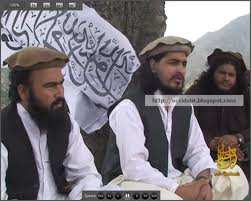
TTP Leaders Address Media (Courtesy: mediawatch.pk)

TTP explains and elaborates reasons that motivated them to attempt target-killing of Malala: TTP successfully targeted Malala Yousafzai in Mingora, although she was young and a girl and TTP does not believe in attacking on women, but whom so ever leads campaign against Islam & Shariah is Ordered to be killed by Shariah.

When its a matter of Shariah, and someone tries to bring fitnah with his/her activities, and it involves in leading a campaign against shariah and tries to involve whole community in such campaign, and that personality become a symbol of anti shariah campaign, not just its allowed to kill such person but its Obligatory in Islam.

If anyone Argues about her so young age , then the Story of Hazrat Khizar in Quran that relates that Hazrat Khizar while Traveling with Prophet Musa (AS) killed a child, arguing about the reason of his killing he said that the parents of this child are Pious and in future he will cause bad name for them. If anyone argues that she was female, then we can see the incident of killing of wife by a blind Companion of Prophet Muhammad (S.A.W.W) because she use to say insultive words for prophet.And prophet praised this act.

Its a clear command of shariah that any female, that by any means play role in war against mujahideen, should be killed.Malala Yousafzai was playing a vital role in bucking up the emotions of Murtad army and Government of Pakistan, and was inviting muslims to hate mujahideen.

Tehrik taliban’s crime wasn’t that they banned education for girls, instead our crime is that we tried to bring Education system for both boys and girls under shariah.We are deadly against co-education and secular education syestem, and shriah orders us to be against it.

If anyone thinks thinks that Malala is targeted because of education, that’s absolutely wrong, and a propaganda of Media, Malala is targeted because of her pioneer role in preaching secularism and so called enlightened moderation. And whom so ever will commit so in future too will be targeted again by TTP.

After this incident Media pour out all of its smelly propaganda against Taliban mujahideen with their poisonous tounges, they are shouting that malala has suffered tyranny like there is no else in the country whom is facing same.Were our sister in lal masjid whom were bombed, gassed and burnt to death, were not humans?? and the sinless women and children of swat , bajour, mohmand, orakzai, & Wazeeristan whom suffered inhumane bombardments by Murtad army don’t qualify to bestow mercy upon them?

Will the blind media pay any attention to Hundreds of Respectful sisters whom are in secret detention centers of ISI and MI and suffering by their captives? Will you like to put an eye on more then three thousand young men whom are killed in secret detention centers and their bodies are found in different areas of swat, claimed to be killed in encounters and died by Cardiac Arrest?? Gain Conscious, Otherwise………… Ihsan-ullah-Ihsan Central spokesman TTP

Malala won’t be airbrushed out

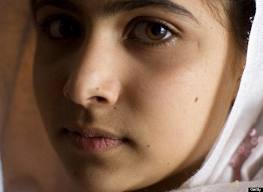
Malala Yusufzai (Credit: huffingtonpost.co.uk)

“I AM worried about Malala. The whole of Swat is worried about her. But every girl in Swat is Malala. We’ll educate ourselves. We will win. They can’t defeat us.”

This was a teenaged classmate of Malala Yousufzai being interviewed live on TV from Mingora. Steeped in courage, her words were delivered with indescribable resolve, a beaming face. Such resolve that a pessimist like me felt she was delivering a stinging slap on my cheek.

Then there was Kainaat. She was travelling in the same school van as Malala and was also wounded in the attack. Her determination appeared equally steely. She was certain nothing was going to stop her from returning to school with the eventual aim of becoming a doctor.

Then as one surfed channels many more Malalas were expressing admiration for their iconic schoolmate. Not one appeared unsure of the way forward. What can you do but salute the tenacity of the girls as well as their lion-hearted parents?

And the teachers. Malala’s teacher spoke with great pride, warmth and affection for his student, the child prodigy: “Such children aren’t born every day. She’s such a gifted child. It is our collective responsibility to support her, protect her. The government must do its part.”

Many months ago when this column focused a tad too frequently on the content of Pakistani TV discussion programmes, my editor advised against too much focus on this one area. He was right.

On this particular occasion, however, one was grateful for the idiot box as a diversity of opinion was beamed directly into the comfort of one’s study. This is where the gratitude ended. To say that the entire spectrum was not welcome would be an understatement.

Pakistan has come to represent such a roller-coaster that it seems to strive daily to live up to Dicken’s words: “… it was the season of light, it was the season of darkness, it was the spring of hope, it was the winter of despair …”

The TV output was no different. It mirrored society.

There was good news. Despite being shot at point-blank range in the head, Malala was somehow going to defy the assassin with her now legendary single-mindedness. She would survive. There were also the voices of her courageous (the word seems so inadequate) friends and classmates.

But then Jamaat-i-Islami’s former amir Qazi Hussain Ahmad made an appearance. He seemed to condemn the attack on the teenaged Swat student and in the same breath also condemned those who, in his words, “used Malala”. He didn’t elaborate. Neither was he asked to.

This was the first in a series of ‘we condemn the attack but…’ statements. Qazi Hussain Ahmad was not the only one who was not willing to condemn this dastardly attack without qualifying his condemnation. Many others created binaries where none existed.

Imran Khan came in for stick on social media for his perceived support to the Taliban but hasn’t he demonstrated his disdain for extremism? Wasn’t he one of the few politicians in the country to visit the bloodied Shia-Hazaras in Quetta, in rushing to Chilas after the mass murder of Shia travellers?

Referring to the attempt on Malala’s life, he talked about the scourge of extremism which he mostly blamed on the US-led war on terror. When the presenter pressed him to name the attackers, Imran Khan reluctantly said the Taliban.

When asked to condemn the Taliban, he was open in saying his party had a presence in Khyber Pakhtunkhwa and Fata and that he didn’t want to give statements condemning the Taliban and leave “my party workers undefended” at their mercy.

This statement at least clarified that he has shied away from unequivocally slamming the Taliban for the sake of his party workers’ safety and not on ideological grounds. One suspects the PTI leader understands the sort of threat the ANP and PPP must face at each of their public events.

This must be a major handicap for his rivals. As election approaches, the PTI is able to gather large crowds every few days in relative safety. Mr Khan must be hoping this generates enough momentum to have a snowball effect at the poll, leaving his Taliban-targeted opponents stranded.

This may be a fantastic tactical move. One hopes he has strategic options up his sleeve so he doesn’t end up risking a Kargil-type situation. Our army has scored similar own goals including the one manifesting itself in the militant threat that has claimed thousands of our soldiers besides civilians.

It was never a conflict we could afford to lose. Factors such as archaic tribal and feudal practices mean a steady diet of abuse of women’s rights anyway. Whether jirgas sanction wani or honour killings; whether it is gang rape or acid attacks we know the victim is almost always a woman.

Now religious extremism has created a new form of women’s oppression. This may owe its birth to a parallel national narrative contrived in the Zia years but it has also grown, gone from strength to strength unchallenged since. Before we move on it is vital to decide on one, single narrative.

Otherwise, this mix of confusion, polarisation and the paralysis it causes will destroy us. We have to somehow acknowledge we live in the 21st century, and are part of a larger world.

Women are more than half our population. Isn’t it an economic and social imperative that women and men are equal?

The Taliban and other forces of darkness would so wish they could do here in all public spaces what the well-known Swedish store chain Ikea did in Saudi Arabia: airbrush women models off their catalogue.

Thank God they can’t. Malala stands in their way. Their ideology may be toxic; her determination is life-affirming. Just imagine what’ll happen if Malala inspires millions of people, particularly the weak-kneed like me, to stand up for once and be counted.

The writer is a former editor of Dawn.
abbas.nasir@hotmail.com


Senior Journalist Zubeida Mustafa Arrives in US for 2012 Lifetime Achievement Award

Zubeida Mustafa (Credit: pamh.org.pk)

Zubeida Mustafa speaks modestly about her 33 years as a journalist in Pakistan, where she worked through extreme political instability, media censorship, gender barriers and social upheaval as the assistant editor of Dawn, a widely-respected English-language daily newspaper.

Her optimism sometimes subverts the challenges she faced as the first woman to work in mainstream media in her country and as a pioneer in reporting seriously on women’s issues, as well as politics, education, health and culture.

Her thorough, facts-based reporting and editorial writing earned the respect of her colleagues and many in the political and diplomatic communities. It also landed criticism from those who thought the subjects she chose were trivial, or even offensive.

“The attitude was, ‘if it’s not so important, let the woman do it,’ Mustafa said, “but I turned that to my advantage.”

She did so by taking lesser-reported topics like health and making clear their relationship to bigger questions about politics and society. As the only woman in the Dawn newsroom during the 1970’s, Mustafa explained that she used gender segregation to cover stories men couldn’t. During Russia’s occupation of Afghanistan in the 1980’s, Mustafa traveled to refugee camps to interview women driven away from their homes by war. “A man would have had a much more difficult time” getting the story, Mustafa said.

Crediting her male colleagues at Dawn for recognizing the value of her work, Mustafa said she did receive backlash for some of her stories from readers. In her editorials, she criticized the pharmaceutical industry for unethical practices and the government for ill-maintained public schools; her editors received angry phone calls, but Mustafa continued to examine tough topics in her pieces.

When she wrote an article on breast cancer, a group of religious conservatives raided Dawn and accused the paper of printing “obscene” content. Undeterred, Mustafa went on to write about contraception and reproductive health. She also covered the case of rape victim turned women’s advocate Mukhtar Mai when other writers were afraid to mention it.

A reporter must ignore critics and write the truth, Mustafa said. “Even if it is a tiny little drop in the ocean, you know you have made a contribution,” she said. “So then you can have a clear conscience.”

As Mustafa’s career as assistant editor – the second-highest position at Dawn – evolved, the central theme of her work became the inequalities she witnessed in Pakistani society. “There is one person who can get anything he or she wants, but there is another person who might be so good but is not getting any opportunities,” Mustafa explained the impetus for her work. She cites the biggest influence on her career as “the people I have met.”

Unequal treatment of men and women was a reality when Mustafa began working in the 1960’s: a condition that, she admits, still exists today. In the early years of her career, she said, there was “a social bias against women working. Especially married women, because they were expected to stay at home and bring up babies and change nappies.”

Mustafa said professional women had to form a perfect balance of work and family “to show people that we could do both.” Mustafa was born in 1941, before Pakistan was a country, in India. She moved to the newly-formed nation with her family as a young girl. She was a bright student who always loved to write. Even so, she didn’t plan on becoming a journalist.

At a time when Pakistani women were discouraged from seeking education, Mustafa earned a B.A. and an M.A. in international relations from the University of Karachi.

Her career began with a job at the Pakistan Institute of International Affairs, where she worked as a research officer in the 1960’s.

Her break into journalism came after she stopped working for a few years to tend to two young daughters. After her second child started school, Mustafa began to look for new work. That was when the editor of Dawn newspaper called her about the assistant editor position.

“Very frankly, I had never even stepped into a newspaper office,” Mustafa said. But her years of work as a researcher had given her ample experience with information gathering and writing.

The assistant editor’s main responsibility was providing editorial content for the paper, which was widely read by diplomats and Pakistan’s leadership. So Mustafa accepted the post and embarked on a career at Dawn that spanned from 1975 to 2008.

Her start as a journalist may have been a matter of chance, but Mustafa recognized the importance of her role for other women. At the time she started at Dawn, women were “on the sidelines” of media, she explained.

In addition to becoming the first woman in Dawn’s newsroom, Mustafa became the first woman on the editorial board, where she fought to gain coverage in the paper for the burgeoning women’s movement.

She advocated running stories with women’s voices in all sections instead of relegating them to a “women’s page”. She argued for hiring policies that would allow women to occupy all positions in the newsroom. “I wanted to create space for women and I thought if there were more, it would give them strength,” Mustafa said.

During her tenure at Dawn, Mustafa launched several new sections including Health Page, CareerWise and Karachi Notebook. For her work on Books & Authors, the first book magazine to be published by a newspaper in Pakistan, she received an award from the Pakistan Publishers and Booksellers Association in 2005. Mustafa also led production of the One World Supplement at Dawn, published in the early 1980s in partnership with 15 newspapers from all over the world. This project allowed her to travel to places like South Africa and Sweden, among others.

She held fast through challenges faced by all Pakistani journalists, like attempts to quash free press. Mustafa recalled a time when nothing could be published “without information officers deciding what could go in and what should come out”.

She said the government exerted absolute control over press and that “they could just decide they didn’t like the paper and then close the paper…and the editor would end up in jail.”

Transitions from a military to civilian government and back created instability that left freedom of speech in jeopardy, according to Mustafa. She said the democracy of Pakistan “is kind of like musical chairs.”

Things are much better now for media than during the tumultuous period in the middle of her career, Mustafa said. “But now there are dangers of a different kind,” she said, with journalists facing more physical threat.

Despite her official retirement in 2008, Mustafa remains a prolific writer. With failing eyesight, she still regularly contributes columns to Dawn. She recently completed her second book and takes up editing projects periodically.

Her former paper now employs many women at all levels. Some current Dawn employees had Mustafa as a personal mentor; all of them consider her an inspiration.

“Ms. Mustafa is the only Pakistani who is and will remain the ultimate role model for women journalists,” said Dawn colleague Khuda Bux Abro. “She has never craved for any kind of personal gain or appreciation because people like her serve society selflessly.”


1990 election was rigged, rules SC

ISLAMABAD: The Supreme Court on Friday ordered legal proceedings against a former head of intelligence and former army chief over allegations that politicians were bankrolled to stop the current ruling Pakistan People’s Party from winning the 1990 election.

It was a landmark ruling from the Supreme Court 16 years after retired air marshal Asghar Khan filed a case, accusing the Inter-Services Intelligence (ISI) agency of doling out money to a group of politicians in the 1990s.

A three-judge bench comprising the chief justice, Justice Jawwad S. Khawaja and Justice Khilji Arif Hussain issued the short order after hearing a petition filed in 1996 by Khan requesting the court to look into allegations that the Inter-Services Intelligence had financed many politicians in the 1990 election by dishing out Rs140 million to create the Islami Jamhoori Ittehad (IJI) and stop Benazir Bhutto’s PPP from coming to power. The petition was based on an affidavit of Durrani.

The Supreme Court in its short order ruled that there was ample evidence to suggest that the 1990 election was rigged and that a political cell maintained by the then president Ghulam Ishaq Khan supported the formation of the IJI to stop a victory of the PPP. The ruling said Ghulam Ishaq Khan, Baig and Durrani violated the Constitution.

“Late Ghulam Ishaq Khan, the then President of Pakistan, General (R) Aslam Baig and General (R) Asad Durrani acted in violation of the  Constitution,” said the apex court, adding the federal government should take “necessary steps under the Constitution and Law against them.”

Stating that corruption was carried out in the 1990 election, the ruling said that the president, the army chief and the ISI’s director-general were not authorised to constitute an election cell. It added that the state should implement its authority through the elected representatives of the people.

The election cell “was aided by General (R) Mirza Aslam Baig who was the Chief of Army Staff and by General (R) Asad Durrani, the then Director General ISI and they participated in the unlawful activities of the Election Cell in violation of the responsibilities of the Army and ISI.”

The apex court moreover ruled that political cells of the ISI and the President House should be abolished and ordered the government to take legal action against former retired generals involved in the corruption as well as against Younus Habib, former president of the now defunct Mehran Bank.

The court further ordered that money that was illegally disbursed among the politicians by the then president and the ISI should be recovered and deposited in the Habib Bank along with the accumulated interest on it. Adding to that, the short order said that legal action should also be taken against the politicians who received the money.

“Mr. M. Younas A. Habib, the then Chief Executive of Habib Bank Ltd…arranged/provided Rs.140 million belonging to public exchequer, out of which an amount of Rs.60 million was distributed to politicians,” added the short order.

The ruling further said that Federal Investigation Agency should investigate into the matter, adding that, if evidence was found against anyone, action should be taken against them.

Moreover, the Supreme Court said that political activism was not the domain of the military and the intelligence agencies. Their job is to cooperate with the government, the judgment said.

Friday’s proceedings

During the hearing, Attorney General Irfan Qadir began presenting his arguments.

Qadir said he was representing the federation and the defence ministry.

Responding to which, Chief Justice Iftikhar directed Qadir to produce the document enabling him to represent the defence ministry.

The attorney general said he would try to assist the court to the best of his abilities “in the short time that was available” to him.

Qadir criticised the judiciary upon which the bench expressed its displeasure.

The attorney general said he had reservations over comments alleged to have been made by Justice Khawaja.

“Justice Khawaja said the Pakistan People’s Party government had failed to perform in the past four years,” Qadir said.

Upon which, Justice Hussain said: “You should not name a particular judge. Those were the remarks of the bench.”

The attorney general requested the bench to exclude the concerned remarks from the record of the case.

Qadir added that judges had taken oaths under the PCO in the past and had also allowed the military to step in, in violation of the Constitution.

The attorney general moreover said that the Asghar Khan case had been pending for the past 15 years and blamed the judiciary for the delay.

He further alleged that “the present judiciary” wanted to “destabilise the government”.

The chief justice remarked that Rs140 million had been given out by Younus Habib and asked as to who was responsible for that.

He further said that evidence suggested that the money was distributed at the behest of the presidency, adding that, prima facie the President House was involved in the operation.

The chief justice reiterated that the president should be impartial and should not partake in political activity.

Responding to which, the attorney general said that the president’s oath does not restrict him from partaking in politics, adding that, the office of the president was also a political position.

The president’s oath is not any different from the oaths administered to the prime minister and the ministers, Qadir said.

Upon which, the chief justice said that the Constitution entitles the president, not the prime minister, as the head of state.

The attorney general added the parliament had on several occasions saved the judiciary from embarrassment.

Chief Justice Iftikhar said the judiciary would not allow derailment of democracy in the country.

He further said that former interior minister Lt-Gen (retd) Naseerullah Babar had also revealed that money was distributed to politicians to manipulate the country’s politics, adding that, it was allegedly done in the greater national interest.

The attorney general said those involved in the decisions of the past were important personalities, adding that, the individuals who were accused of receiving the money should also be heard.

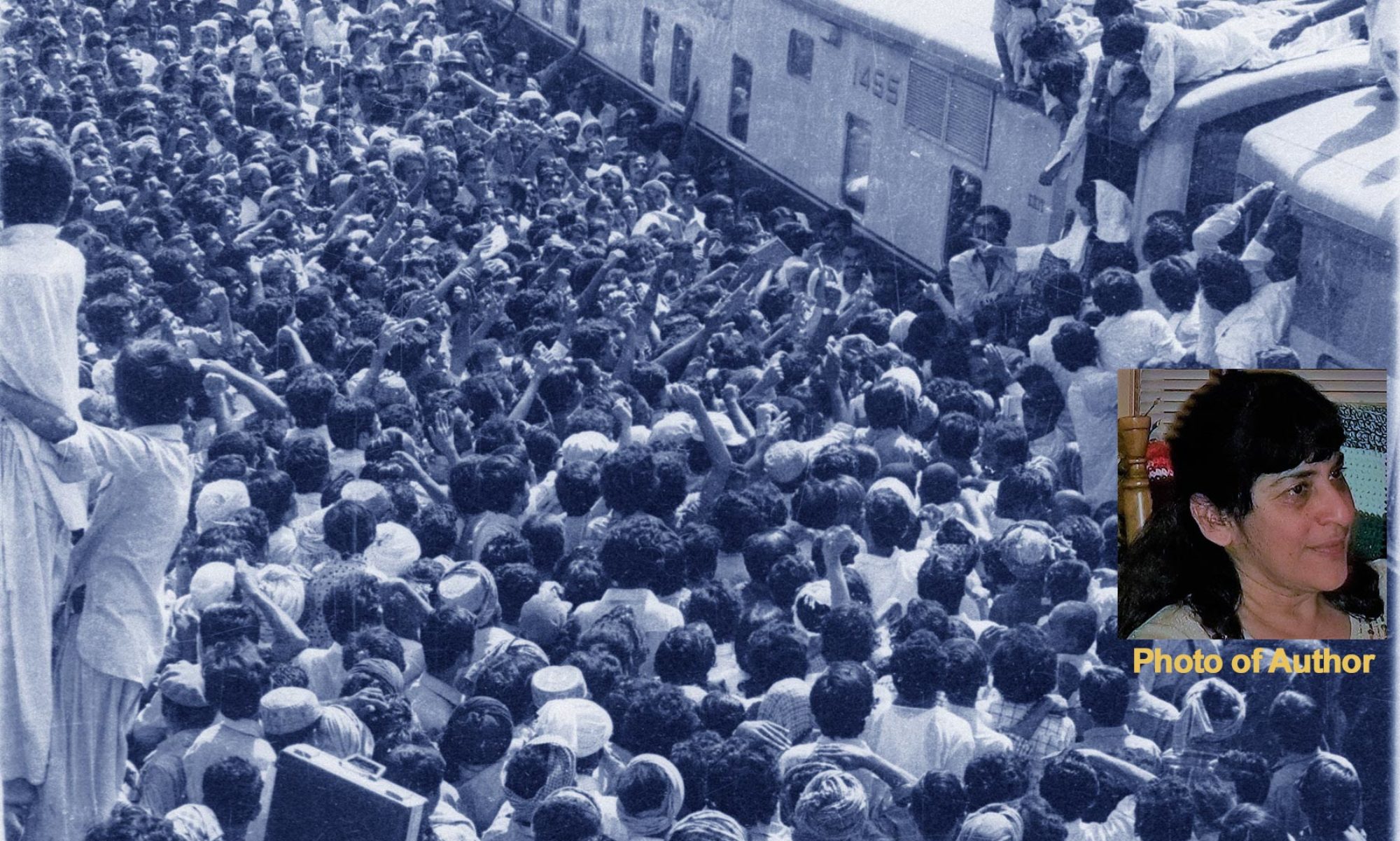
Listen to author interview on ATDT on WBZC Boston radio

The Pakistan Tehrik-i-Insaf’s avowed goal to reach the Waziristan area in Pakistan to protest against US drone attacks was never fulfilled, even as the political party announced it had achieved its goal. What were the goals that the PTI set out to achieve and what role did US peace activists play in it? In this radio report listen to two perspectives: Robert Naiman, travelling with the US peace delegation in D.I. Khan told John Grebe of Greater Boston’s WZBC radio that the peace rally was the way through which real change could begin. The author offered her perspective on a more complex situation in Pakistan. She is also interviewed about her book, Aboard the Democracy Train.

Please click here to download the interview.

Pakistani military blocks anti-drone convoy from entering tribal region

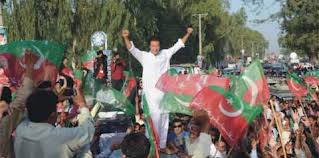
PTI rally (Credit: pakistantoday.com.pk)

Dera Ismail Khan, Oct 7 – Leading a convoy of thousands, the former cricketer was within striking distance of South Waziristan, where the CIA uses remote-controlled planes in the fight against Islamist militants, when he abruptly turned back.

Later Khan said he had changed plan because of warnings from the army and the risk of becoming stuck after the military-imposed curfew.

Addressing an impromptu rally of his supporters, he said the convoy had still been a huge success because he had gone to areas his political rivals “can only look at on maps”.

“We want to give a message to America that the more you carry out drone attacks, the more people will hate you,” Khan told the crowd of around 2,500 supporters. But after two days of travel, the U-turn seemed to surprise some, including a senior party official who got out of his car on the heat-baked roadside surrounded by arid scrubland and declared he had no idea what was going on.

Others expressed anger, saying Khan was more interested in using the event to burnish his popularity before a general election due at some point in the next six months.

“I am very disappointed,” said Khalil Khan Dawar, an oil industry worker who had travelled all day to get to the edge of the tribal agency. “We had to get to South Waziristan. For him this is not just about drones, it is about popularity and elections.”

Some have also questioned the relevance of Kotkai, the town in South Waziristan where Khan hoped to hold his rally, to the drone debate. Most drone attacks now take place in North Waziristan, and Pakistani army efforts to wrest control from militants have forced many of Kotkai’s residents to leave.

The abandonment of the much-publicised attempt to reach Kotkai was the second sudden change of plan on the same day. Earlier Khan had appeared to reassure a largely female delegation of the US peace group Code Pink that there would be no attempt to enter the tribal areas and that instead a rally would be held in the town of Tank.

By midday it was decided to push on regardless, apparently out of a desire not to disappoint the throngs of people who had joined his convoy along the road from the capital, Islamabad. That was despite the all-too evident disapproval of authorities who had placed shipping containers across the road at three different points.

The vehicles, including buses crammed with supporters waving the red and green flag of Khan’s political party, ground to a halt as throngs of protesters worked to push the obstacles out of the way, in one instance destroying a small building in the process.

Indignities and discomforts are nothing new to the mostly middle-aged and female activists of Code Pink, some of whom have been arrested while campaigning against US drone strikes. But being trapped on a bus travelling towards Pakistan’s tribal areas proved too much even for the most hardened of campaigners. “We had only one toilet break in nine hours,” said Medea Benjamin, leader of the 35-strong team of Americans who had agreed to join Khan on the march. They chose not to continue into, in the words of Benjamin, a “chaotic” situation.

To add to their miseries, their minders urged them to stay behind the curtains of their bus – emblazoned on its side with huge images of people killed by drone strikes – throughout much of the journey, particularly in many of the areas affected by militant groups. “It was hard for these people because they are protesters and they wanted to get out there,” said Shahzad Akbar, a lawyer who was looking after the group. “But there’s no way we are going to let them get out in some of those towns!”

Billed as a protest against drone strikes, which Khan and his supporters claim kill large numbers of innocent civilians as well as flouting Pakistan’s sovereignty, the procession had the feel of a political rally on wheels. Many of the vehicles eschewed anti-drone slogans and instead carried pictures of PTI politicians anxious to be included on the party’s official ticket in the upcoming elections.

Teenage School activist survives attack by Taliban

Malalai Yusufzai after attack (Credit: english.alarabiya.net)

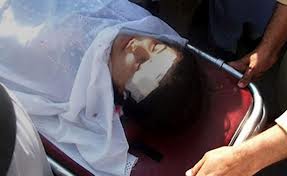
KARACHI, Oct 9— A Taliban gunman shot and seriously wounded a 14-year-old schoolgirl and activist in the Swat Valley in northwestern Pakistan on Tuesday, singling out a widely known champion of girls’ education and a potent symbol of resistance to militant ideology.

The attack occurred in Mingora, the valley’s main town, when masked gunmen stopped a bus carrying schoolgirls who had just taken an exam and sought out the 14-year-old, Malala Yousafzai, shooting her twice.

Ms. Yousafzai, who won a national peace prize last year, was shot in the head and the neck, while two other people on the bus suffered lighter injuries, local health officials said. After emergency treatment, Ms. Yousafzai was taken by helicopter to a military hospital in the provincial capital, Peshawar, where doctors said she was in stable but critical condition late Tuesday.

The Pakistani Taliban claimed responsibility for the attack, saying Ms. Yousafzai had been targeted for her criticism of the Taliban and because it considered her human rights campaigning to be an “obscenity.”

“She has become a symbol of Western culture in the area; she was openly propagating it,” a Taliban spokesman, Ehsanullah Ehsan, said by phone from an undisclosed location. “She considers Obama as her ideal leader.”

The Taliban publicly placed Ms. Yousafzai on its assassination hit list this spring. Mr. Ehsan added that if she survived, the militants would try to kill her again. “Let this be a lesson,” he said.

Although militant violence is a daily occurrence in Pakistan, the assault on an eloquent schoolgirl, who sprang to public attention in 2009 by documenting her determination to continue school under the Taliban, sent shock waves across Pakistan.

“She symbolizes the brave girls of Swat,” said Samar Minallah, a documentary filmmaker who has worked extensively in Swat. “She knew her voice was important, so she spoke up for the rights of children. Even adults didn’t have a vision like hers.”

Girls’ education in Pakistan has been a rallying cry against the Taliban for some here. In other districts close to the Afghan border, militants have shut down schools in recent years as a way of demonstrating their defiance of the national government.

Mustafa Qadri, a Pakistan researcher with Amnesty International, said the attack on Ms. Yousafzai “highlights the extremely dangerous climate many human rights activists face in northwestern Pakistan, where female activists in particular live under constant threats from the Taliban and other militant groups.”

Fazal Rabbi, a family friend in Swat, described Ms. Yousafzai as a girl of “extraordinary qualities.” In Parliament, Prime Minister Raja Pervez Ashraf urged his countrymen to battle the “mind-set” behind such attacks. “She is our daughter,” he said.

On the Internet, the country’s beleaguered progressives seethed with frustration and anger. “Come on, brothers, be REAL MEN. Kill a school girl,” one media commentator, Nadeem F. Paracha, said in an acerbic Twitter post.

Ms. Yousafzai came to public attention in 2009 as the Pakistani Taliban swept through Swat, a picturesque valley once famed for its culture of music and tolerance and as a destination for honeymooning couples.

Her father ran one of the last schools to defy Taliban orders to end female education. As an 11-year-old, his daughter Malala — named after a mythic female figure in Pashtun culture — wrote an anonymous blog documenting her experiences for the British Broadcasting Corporation.

“I had a terrible dream yesterday with military helicopters and the Taliban,” she wrote in one post titled “I Am Afraid.”

Later in 2009, the army launched a sweeping operation against the Taliban in the area, displacing many militants into neighboring districts or across the border into Afghanistan.

Ms. Yousafzai continued to grow in prominence, becoming a powerful voice for the rights of children in the conflict-affected area. In 2011, she was nominated for an International Children’s Peace Prize; later, Yousaf Raza Gilani, the prime minister at the time, awarded her Pakistan’s first National Youth Peace Prize.

In recent months, she led a delegation of children’s rights activists, sponsored by Unicef, that made representations to provincial politicians in Peshawar.

“We found her to be very bold, and it inspired every one of us,” said another student in the group, Fatima Aziz, 15.

“She had this vision, big dreams, that she was going to come into politics and bring about change,” said Ms. Minallah, the documentary maker.

Pakistan’s military has long held the 2009 Swat operation as an example of its ability to conduct successful counterinsurgency drives on its own soil. The shooting on Tuesday, however, was a stark reminder that the Taliban remain a deadly force.

“This is not a good sign. It’s very worrisome,” Kamran Khan, the most senior government official in Swat, said by phone. A search operation was under way to capture the attackers, he added.

In recent months, Taliban fighters have been gradually slipping back into Swat, attacking senior community leaders. On Aug. 3, a Taliban gunman shot and wounded Zahid Khan, the president of the local hoteliers association and a senior community leader, in Mingora.

A senior local official said it was one of three attempted targeted killings by the Taliban in recent months.

The Swat Taliban are a subgroup of the wider Pakistani Taliban movement based in South Waziristan. The leader of the Swat Taliban, Maulvi Fazlullah, rose to prominence in 2007 through an FM radio station that espoused Islamist ideology. He is believed to be sheltering across the border in the Afghan provinces of Kunar and Nuristan.

The Pakistani Army virtually runs Swat, either directly through a large military presence in the valleys, or indirectly through armed militias that keep the Taliban at bay. But the military has also been accused of gross human rights abuses, particularly after a leaked videotape in 2010 showed uniformed men apparently massacring Taliban prisoners.

In response to sharp criticism, the army chief, Gen. Ashfaq Parvez Kayani, announced an inquiry into the shootings. An army spokesman said on Tuesday it had not yet completed its work.

Shah Rasool, the police chief in Swat, said that all roads leading out of Mingora had been barricaded and that more than 30 militant suspects had been taken into custody.

Reporting was contributed by Sana ul Haq from Mingora, Pakistan; Ismail Khan from Peshawar, Pakistan; Ihsanullah Tipu Mehsud from Islamabad, Pakistan; and Zia ur-Rehman from Karachi.

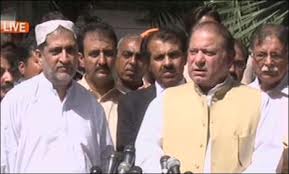
Balochistan hearing: Military, govt deflect Akhtar Mengal’s blows

Sardar Akhtar Mengal with Nawaz Sharif (Credit: thenews.com.pk)

ISLAMABAD, Sept 29: In the wake of Thursday’s high drama at the Supreme Court, the country’s top military leaders rushed to vindicate themselves over the Balochistan problem on Friday, stoutly denying that the Inter-Services Intelligence (ISI) and Military Intelligence (MI) had any involvement in enforced disappearances.

The statement came in response to the six recommendations that former provincial chief minister Sardar Akhtar Mengal presented before the apex court a day before as a precondition for talks. The former chief minister did not mince his words – the conditions include what he referred to as a suspension of covert and overt military operations in Balochistan, recovery of missing persons, and disbanding ‘death squads’ operating under the supervision of secret agencies.

Friday’s statement was submitted by Balochistan Chief Secretary Babar Yaqoob Fateh Muhammad. It was prepared at a meeting attended by top military and executive authority officials in compliance with SC orders.

The high-level meeting was chaired by Defence Minister Naveed Qamar and attended by army chief Ashfaq Parvez Kayani, ISI Director General (DG) Lt Gen Zaheerul Islam, ministers for information, law and postal services, the defence secretary, the attorney general, the principal secretary to the prime minister and the Balochistan chief secretary. The prime minister could not attend the meeting, because he was not present in the capital.

The joint statement addressed the other accusations hurled at the armed forces besides missing persons: “No covert and overt military operation is being carried out in Balochistan by the armed forces. Second, no person alleged to be missing is in the custody of or under detention of any law enforcing authorities or any other agency of Pakistan. Despite this all out efforts are being made to find out whereabouts of the persons who are alleged to be missing. Third, no proxy death squads are operating under the supervision of ISI and MI.” The statement added that the government has always believed that all political parties in Balochistan should participate in political activities without any interference from any quarter.

The statement, however, repeated information that is already available – Joint Investigation Teams (JITs) have been constituted and recently, the Balochistan government has approved a compensation policy for legal heirs of deceased persons. The government has also made a commitment to settle displaced persons.

The chief justice, on the other hand, remained unconvinced. “People have been missing for three years and hearing their [relatives’] accounts brings tears to one’s eyes,” he stated. He also cut short the chief secretary’s attempt at discussing other issues, including the Aghaz-e-Haqooq-e-Balochistan package. Justice Jawwad S Khawaja said there was no obligation to believe the affidavits submitted by intelligence agencies in which they claimed their innocence. We will see the grounds realities too, the court warned.

The chief justice also asked the leaders of all political parties, including Imran Khan and Nawaz Sharif, on Friday’s hearing, to partake in finding a solution to the Balochistan crisis, saying that it was not just the government’s responsibility.

Chief Justice Iftikhar Muhammad Chaudhry issued these directives while penning down a short order pertaining to the Balochistan security case.

Uncomfortable army, govt

Sources said that military officials were ‘very much perturbed’ over Thursday’s proceedings of the apex court. Meanwhile, Raja Irshad, counsel for ISI and MI, expressed similar concerns: While talking to The Express Tribune, Irshad said Mengal was glorified by the court and that “We (army and secret agencies) will take action on such allegations. It was a totally wrong claim that secret agencies are involved in the killing of thousands of Baloch.”

Attorney General Irfan Qadir, whom the court passed a restraining order against on Thursday for ‘interfering in the hearing’, wasn’t very happy with Mengal’s demands either – and asked the chief justice to keep the disgruntled Baloch leader’s statements off record. He also asked the chief justice to direct Mengal to re-submit a more ‘moderately-worded’ statement.

Sources added, however, that executive authorities have decided to gear up political activities in the troubled province as the upcoming parliamentary elections draw closer, and hence did not take too harsh a stance against Mengal’s recommendations.

The court will hear the case from October 8 at the Quetta registry. It also told the provincial chief secretary that judges could pay a ‘surprise visit’ to areas in the province, particularly Dera Bugti, to examine ground realities.