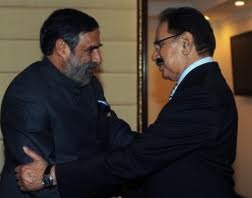
Indo Pak trade reps Sharma & Faheem (Credit: newspakistan.pk)NEW DELHI, Aug 1: India on Wednesday overturned its ban on foreign investment from Pakistan in a move designed to build goodwill amid a renewed push for a peace settlement between the two neighbours.
“The government of India has reviewed the policy… and decided to permit a citizen of Pakistan or an entity incorporated in Pakistan to make investments in India,” said a statement from the Indian commerce ministry.
India and Pakistan, which have fought three wars since independence, are channeling their peace efforts into “trade diplomacy”.
The aim is to build enough trust to tackle the more troublesome issues that divide them, such as the disputed territory of Kashmir.
“It will definitely benefit Pakistani investors and industrialists. We hope this decision will be fruitful for the people of both countries.” Pakistani businessmen also welcomed the move.
“We do appreciate this action by the government of India, but what will be more interesting for me is when the Indian authorities lift its ban on Indian investors investing in Pakistan,” said Majyd Aziz, involved in the import and export of minerals and in shipping.
“For a better economic future in South Asia, it will be a huge step when businessmen from both the countries can freely invest in each other’s country.” Zubair Motiwala, chairman of the board of investment in Sindh province, said it was the “right decision taken at the right time”.
“Allowing our country to invest in India is a great confidence booster and will pave the way for more cordial bilateral relations,” he said.
The warming commercial ties underline the new relevance of the private sector in the peace process, analysts said.
Pakistani citizens and companies will be allowed to invest in all sectors apart from defence, space and atomic energy, a government statement said. All propositions must be notified to the Indian government, it added.
The decision to accept foreign direct investment from Pakistan was taken in April when the trade ministers of the South Asian rivals met in New Delhi.
They also discussed ways to ease visa curbs on business travel and the possibility of allowing banks from both countries to open cross-border branches.
The improved relations between the rivals stem from Pakistan’s decision to grant India “Most Favoured Nation (MFN)” status by year end, meaning Indian exports will be treated the same as those from other nations.
MFN status will mean India can export 6,800 items to Pakistan, up from around 2,000 at present, and the countries aim to lift bilateral trade to $6 billion within three years, officials have said.
Official bilateral trade is just $2.7 billion and heavily tilted in New Delhi’s favour, according to most recent figures, but unofficial trade routed through third countries is estimated at up to $10 billion.
In further progress, the neighbours opened a second trading gate in April along their heavily militarised border, increasing the number of trucks able to cross daily to 600 from 150.
Pakistan has called for a “new era” in economic collaboration with India to build “a legacy of peace and prosperity for our future generations”.
The two countries have said there are many sectors with huge trade potential, from information technology to engineering, education and health.
The two nations have voiced hopes that boosting trade can help peace talks which India warily resumed last year after suspending them after the 2008 attack by Islamist gunmen on Mumbai that killed 166 people.
“Commerce is an excellent way to bring countries together,” Indian strategic analyst Uday Bhaskar told AFP recently.
“Once you institutionalise trade, it becomes hard to slow the momentum for cross-border exchanges.”
Agha Waqar ki Motor Car (Credit: timthumb.php)ISLAMABAD, July 28: A Pakistani engineer has built a car that runs on water, a feat that left onlookers astounded.
Engineer Waqar Ahmad drove his car using water as fuel on Thursday during a demonstration for parliamentarians, scientists and students, Dawn reported from the capital.
He said cars could be driven by a system fuelled by water instead of petrol or CNG.
The onlookers were taken aback when they saw it and a cabinet sub-committee lauded the ‘Water Fuel Kit Project’.
Religious Affairs Minister Syed Khurshid Ahmad Shah, who heads the panel, said the engineer would have their full support.
The media report explained that the water fuelling system is a technology in which ‘hydrogen bonding’ with distilled water produces hydrogen gas to run the car.
Ahmad had earlier told Shah about the unique project and it was taken to the federal cabinet which asked its sub-committee to discuss it. During the demonstration, Shah himself drove the car.
The minister said that Ahmad would be given complete security and the formula would be kept secure. Prime Minister Raja Pervez Ashraf and Finance Minister Hafeez Sheikh value the project, he said.
“We own this project and are committed to successfully completing it,” he was quoted as saying.
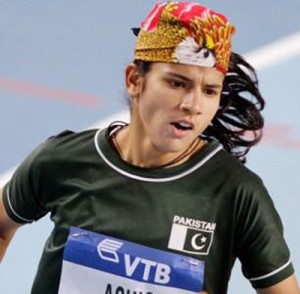
Rabia Ashiq (Credit: brecorder.com)KARACHI: Pakistan’s talented athlete Rabiq Ashiq who will be competing in the 800 metres competition at the London Olympics, scheduled for Aug 8, has received a major boost with her recent sponsorship contract.
Rabia was selected to participate in the Olympics through wildcard and is hoping to make an impact in the challenging event at the Games scheduled for next week.
Rabia said that although she will strive hard for the medals, this opportunity alone of competing in the world’s top sports extravaganza is a dream come true.
“Girls should educate themselves and realise their dreams through hard work and persistence. Nothing is impossible,” she said prior to her departure for London.
Hailing from a modest background, Rabia had to face discouragement from her immediate and extended family initially but her passion drove her to continue taking part in sports at school and college level.
Recognising her tenacity, Zong a leading cellular company has decided to sponsor the athlete for her participation in the world’s foremost sports competition.
“Rabia is an epitome of courage and an excellent example for the world to see that with minimal resources there can still be success stories of women who are willing to dream. Even if the society is not ready to support, a person can change everyone’s perception through his or her consistent efforts,” said an official. (Agencies)
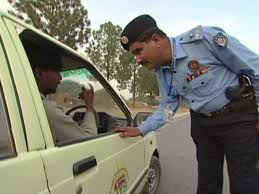
Pakistan police on front lines (Credit: cnn.com)WASHINGTON: Faced with mounting violence, Pakistan needs to push ahead reforms of its police force, which lacks the training, equipment and political will to be effective, a new study said.
In a lengthy report, a commission set up by the New York-based Asia Society called for Pakistan to step up police training and carry out structural reforms to boost the force’s skills and reduce corruption.
“High crime rates throughout the country, relatively low conviction rates of prisoners on trial and heightened concerns about instability spilling over from Afghanistan indicate that there is an urgent and critical need to invest in and reform Pakistan’s law enforcement infrastructure,” the report said.
The study, due to be released on Monday, said that criminals and Islamic extremists have increasingly colluded and evaded a police force hampered by “severe deficiencies” in technology and training.
Pakistan’s military and Inter-Services Intelligence agency have historically been major centers of power. But the report said the police hold primary responsibility for law and order.
“Shifting all the blame onto the police force, whether done by the public, media or government, is unfair and unproductive,” the report said.
Pakistan’s police system “simply is not structured to reward good behavior, as merit-based opportunities for professional advancement are scarce, low pay is the norm and a lack of support and resources compels even many well-intentioned officers to misuse their authority in order to survive,” the report said.
Hassan Abbas, the commission’s project director and a professor at the National Defense University in Washington, said international assistance could help. Britain and the United States have both been assisting police reform.
“However, the overall funding for these projects is no match for the resources provided to Pakistan for anti-terrorism operations throughout the last decade, very little (if any) of which ever reached police institutions because it was so largely geared toward the defense sector,” he said.
“Both are important needs, but a balanced approach is needed to help Pakistan tackle internal and external challenges more effectively.”
Pakistan has received more than $18 billion in US aid, mostly for its military, since it agreed to support the US-led war in Afghanistan after the September 11, 2001 attacks.
The country in recent years has been torn by violence, with extremists carrying out attacks in major cities, militant cells holed up in lawless border areas and an ethnic insurgency raging in Balochistan.
Pakistan’s then military ruler Pervez Musharraf in 2002 issued orders to set clear rules for the police, but the reform quickly lost steam.
The Asia Society study called for the implementation of the 2002 reforms, along with an overhaul of hiring practices, improvements in working conditions and the establishment of an independent authority to assess complaints of police misconduct.
The commission recommended the training of anti-terrorism investigators at each police station, along with special units with direct access to data from private cellular telephone operators.
The report also called for training on protecting the rights of women, children and minorities, a frequent source of concern, and efforts to recruit more women police officers.
Separately, the study called for special efforts to recruit local youth as police in Baluchistan, the southwestern province where insurgents rose up in 2004 to demand greater autonomy.
The report said that police should be put in charge of investigating charges of extrajudicial killings in Balochistan and that Pakistan should restrict the roles there of the paramilitary Frontier Corps and intelligence agencies.
WHAT are the qualities — in terms of scholarship and character — that one should seek in the head of a university if it is to be run competently and produce excellence in education?
Inarguably he must, above all, inspire his students so that he can lead them with his moral strength and knowledge. Considering the fact that many of our universities are in a state of crisis today, it is time we looked at the leadership factor to determine what has gone wrong.
Sindh University presents itself as a perfect example of how poor leadership can destroy an institution of higher education. There has been unrest at the campus at Jamshoro since January when a teacher was murdered. The protest is directed against the vice chancellor, Dr Nazir Mughal. When he was dispatched on ‘forced leave’ in February and his controversial orders dismissing some faculty members withdrawn, a semblance of peace was restored and classes resumed.
Yet all was not well at Jamshoro, because stopgap solutions do not resolve problems. Last month Dr Mughal was back and there has been trouble again. Immediately after his return the vice chancellor announced summer vacations and the examinations that were in progress were disrupted. Soon thereafter a really heinous crime occurred. Two professors — Amar Sindhu, who received bullet wounds, and Arfana Mallah, the secretary general of the Sindh University Teachers’ Association (Suta) — were attacked. Masked gunmen opened fire on them, giving rise to widespread anger. It was plain that those in power were trying to eliminate the VC’s two most vocal critics.
What is at the root of this crisis? The fact is that Dr Mughal does not enjoy the confidence of the faculty. There are serious charges against him. In a petition filed before the Supreme Court, Marvi Memon, a former Senator, has listed a number of them.
They range from the absence of transparency in his appointment in 2010 to his failure to keep peace on campus. Two students and a teacher have been murdered in the last two years. Allegations of corruption, embezzlement and other malpractices have also been levelled.
Meanwhile the vice chancellor has kept himself in office by manipulating pro-PPP student groups. As a champion of the ruling party’s interests he also enjoys the support of political patrons who need compliant and subservient subordinates in critical positions. Since student unions remain banned from Gen Zia’s days, there is no way of knowing where the youth stand on the issue.
All this has affected academic standards while charters have been granted with abandon to institutions with dubious credentials. Instead of universities being cradles of research and intellectual regeneration, they are stagnating. The powers that be have clamped down on students to prevent original thinking that could challenge the status quo.
Dr Mughal had earlier served as vice chancellor of Sindh University from 1995-98 and was reappointed quite arbitrarily in 2010 because of his connections in the right quarters. That was a slap in the face of education in Pakistan considering that his credentials are not impeccable. A committee appointed after his last dismissal in 1998 had recommended disciplinary action against him. In his last tenure he was removed when a student was killed on campus and there was widespread public agitation.
The Suta has now issued a white paper that levels 24 charges against the vice chancellor. Some of them cast doubts on his eligibility for the post he holds today. His association with two educational institutions with foreign links is said to have kept him away from Sindh University, where he was first appointed in 1974 but never confirmed as his presence there was minimal.
The white paper meticulously records photocopies of bills and memoranda in support of corruption charges ranging from financial embezzlement to academic malpractices such as allowing students with zero attendance to appear in examinations, nepotism in the appointment of teachers and the sale of teaching positions. It calls for an independent enquiry.
What is, however, most serious is the fact that the vice chancellor’s relations with the faculty are adversarial and militate against healthy academic activity. The rise in violence at Sindh University — 235 FIRs have been registered since 2010 — is disturbing. Attacking teachers is no solution when matters have reached such a state.
While it is a matter of serious concern that the students of Sindh are being denied a good education and their academic life stands disrupted, the wider implications of the troubles in Jamshoro are grave. Marvi Memon spoke of the vice chancellor’s role being indispensable in facilitating the election of MNAs (said to be 23 in number) who have suspect degrees from Sindh University. She requested the Supreme Court to ask the Higher Education Commission to verify their degrees. This has not happened.
What is happening in Sindh’s universities can at best be described as the politicisation of higher education to facilitate the perpetuation of a party in office. If the axe falls on MNAs who support the present government, that would be destabilising for it. Schools have already been used to consolidate the power of those in office by planting their henchmen in educational institutions. Universities are also being used for the same purpose even though this practice has been deemed illegal by the Lahore High Court in the case of the appointment of the vice chancellor of the University of Health Sciences, Lahore and others.
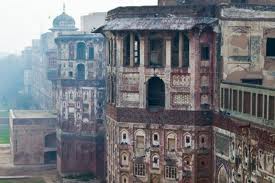
Badshahi mosque in Lahore (Credit: diplopundit.net)Pakistan, July 8: Many of us travel for business or leisure. But few ever take a trip that dramatically shatters their entire worldview of a country and a people in one fell swoop. I was lucky enough to have returned from just such a trip: a week-long sojourn in Pakistan.
It was a true eye-opener, and a thoroughly enjoyable one at that. Many of the assumptions and feelings I had held toward the country for nearly 30 years were challenged and exposed as wrong and even ignorant outright.
Yes, I was aware of all the reasons not to go, safety foremost among them. As an American, an Indian, and a Hindu there seemed to be multiple reasons for someone of my background to have concerns about security. Relatives and friends couldn’t hide their dismay and genuine fear; a frequent question was “why would you want to go?” The subtext is that there’s nothing to see there that’s worth the risk.
The Western and Indian media feed us a steady diet of stories about bomb blasts, gunfights, kidnappings, torture, subjugation of women, dysfunctional government, and scary madrassa schools that are training the next generation of jihadist terrorists. And yes, to many Westerners and especially Indians, Pakistan is the enemy, embodying all that is wrong in the world. Incidents such as the beheading of American journalist Daniel Pearl, 26/11 and the Osama Bin Laden raid in Abottobad have not helped the cause either. Numerous international relations analysts proclaim that Pakistan is “the most dangerous place in the world” and the border with India is “the most dangerous border in the world.”
I’m not naive enough to argue that these proclamations don’t have some elements of truth; through extensive academic work on Pakistan’s governance, its history, and its nuclear weapons arsenal I know that some problems are real. Rather, I am here to tell you that these aspects are overblown; that this country is about so much more, a whole other and much larger, beautiful, glorious, and uplifting side not given equal time by the media. I’ve seen it with my own eyes. And it’s time that Indians and Americans acknowledge Pakistan for what it really is as a whole- and our ignorance for what that is.
It may be easy to dismiss my firsthand experience as anecdotal: yes, I stayed in affluent neighborhoods in large cities, mostly met those who belong to the educated elite, was protected by firearm-toting bodyguards, and rarely revealed my ethnic background to most of the new people I met. Funnily enough, I don’t think now that the absence of any of these factors would have changed my experience at all.
The Genesis
My trip to Pakistan was not planned much in advance. I was in Sri Lanka for a friend’s wedding and spent a great deal of time with two Pakistani friends from my undergraduate days at Georgetown. Both are now businessmen, one in Karachi and the other in Lahore. I was going to be in India soon, and mentioned that a trip to Pakistan is something I always wanted to do, but I was too scared to execute it. Over the next few hours, we had some beer and seafood by the hotel swimming pool in Colombo and got into a detailed and lively discussion, during which time they insisted I visit and guaranteed my safety throughout the stay. My concerns allayed, I promised to make it happen, probably the first person from my family tree to visit Pakistan since the bloody 1947 partition. I was fortunate to have the opportunity for a fully hosted trip and couldn’t pass it up anymore. I have realized now more than ever before how deep the friendships forged during college can run- cutting across borders, cultures, and time.
Karachi
As I was about to land in Karachi on my flight from Colombo, Sri Lanka (direct flights from India are few and far between), I was gripped by a familiar fear. What the hell was I doing? What if I got detained in the airport and then deported because they found out my Indian ancestry and suspected my motives? How would my parents react if they learned I was the victim of a bomb blast while traveling around the city? On the plane I sat next to a very chatty and friendly executive from Lahore, who had gone to Sri Lanka on business. He was excited to tell me about Pakistan since it was my first visit, and the conversation was pleasant enough. But I kept feeling the growing knot of fear in my stomach. I tried to be brave as the plane landed. As my friend had said, 20 million people live in Karachi and now and then bad things happen, but the odds of it affecting me were very low.
Fortunately I got through immigration at the Quaid-e-Azam Airport quickly, and a friend was waiting for me with his pickup truck. The first thing I saw outside the airport was… a giant McDonald’s restaurant surrounded by a large and well-manicured green lawn. An unexpected welcome from the golden arches on a sunny, hot day.
Two uniformed bodyguards with rifles who were exceedingly friendly and welcoming climbed onto the pickup truck bed as we started on a 45-minute drive. I was impressed by the massive, well-maintained parks and gardens surrounding the airport. I was also impressed by the general cleanliness, the orderliness of the traffic, the quality of the roads, and the greenery. Coming from a city government background, I was surprised at how organized Karachi was throughout the ride. I also didn’t see many beggars the entire way. I had just spent significant amounts of time in two major Indian cities, Mumbai and Bangalore, as well as several second-tier cities like Mangalore, and none would compare favorably on maintenance and city planning, especially when it came to potholes and waste management. This was the first surprise; I was expecting that piles of garbage and dirt would line the roads and beggars would overflow onto the streets. Surely there is dirt and poverty in Karachi, but far less than I was expecting. Karachi was also less dense and crowded than India’s cities.
My second pleasant surprise was to see numerous large development projects under way. I had read about Pakistan’s sluggish GDP growth and corruption in public works and foreign aid disbursement. This may be true, but construction was going on all over the place: new movie theaters, new malls, new skyscrapers, new roads, and entire new neighborhoods being built from scratch. In this regard it was similar to India and every other part of Asia I had seen recently: new development and rapid change continues apace, something we are seeing less of in the West.
Just a few of the many highlights in Karachi included relaxing at beachside cafes, dining at amazing tandoori restaurants such as the massive Barbecue Tonight, an excellent burger/brunch joint called Xander’s, a visit to the historic and beautiful Mazar-e-Quaid where the nation’s founder, Muhammad Ali Jinnah is entombed in a marble mausoleum, visiting a book fair next to the British-era Frere Hall, and a sailboat ride around the Karachi port where a magnificent crab feast fit for a Mogul emperor was served on board. The service was so impeccable, the cooks would crack and remove individual crab claw shells by hand to make it easier to access the fresh meat.
We were also able to do some things which may sound more familiar to Americans: bowling at Karachi’s first bowling alley, intense games of pickup basketball with some local teenagers at a large public park (these kids could really play), or passing through massive and well-appointed malls filled with thousands of happy people of all ages walking around, shopping, or eating at the food court. We even attended a grand launch party for Magnum ice cream bars, featuring many of Pakistan’s A-list actors, models, and businesspeople. A friend who is involved in producing musicals directed an excellent performance at the party, complete with live band, singing, and dancing. This troupe, Made for Stage has also produced shows such as the Broadway musical Chicago to critical acclaim with an all-Pakistani cast for the first time in history.
Even the poor areas we visited, such as the neighborhoods around the Mazar, were filled with families coming out for a picnic or a stroll, enjoying their weekend leisure time in the sun. All I could see were friendly and happy people, including children with striking features running around. At no time did I feel the least bit unsafe anywhere we went, and we definitely went through a mix of neighborhoods with varying profiles.
Lahore
Lahore is more beautiful overall than Karachi or any large Indian city I’ve seen. Serious effort has gone into keeping the city green and preserving its storied history. Historians would have a field day here. In particular we saw two stunning historic mosques, the Wazir Khan and the Badshahi, both of which should be considered treasures not only for Muslims, Pakistanis, or South Asia, but for all of humanity. I felt it a crime that I’d never even heard of either one.
Each of them in different ways features breath-taking architecture and intricate artwork comparable to India’s Taj Mahal. These are must-see sights for any tourist to Lahore. The best way to enjoy the vista of the Badshahi mosque is to have a meal on the rooftop of one of the many superb restaurants on Food Street next to the mosque compound. This interesting area was for hundreds of years an infamous red-light district, made up of a series of old wooden rowhouses that look like they were lifted straight out of New Orleans’ Bourbon Street, strangely juxtaposed with one of the country’s holiest shrines. From the roof of Cuckoo’s Den restaurant, we could see all of the massive Badshahi complex along with the adjoining royal fortress, all while having a 5-star meal of kebabs, spicy curries in clay pots, and lassi under the stars. We were fortunate to have very pleasant whether as well. This alfresco dining experience with two good friends encompassed my favorite moments in the city.
We did much more in Lahore. We were given a tour of the renowned Aitchison College, which one of my friends attended. This boys’ private prep school is known for its difficult entrance exams, rigorous academic tradition, illustrious list of alumni since the British founded the school, and its gorgeous and impeccably maintained 200-acre campus that puts most major universities icluding my own Georgetown to shame. Aitchison has been considered one of the best prep schools on the subcontinent since 1886. However, it would have been impossible to get a tour without the alumni connection because security is very thorough.
We went out to the village of Kasur, not too far from the famous Waga border with India, to see my friend’s agricultural business. This gave me a profile of village life, which like India makes up most of the country. The highway on the way was in very good condition, and the village was serene and pleasant, if poor. Just as with the cities, I saw lots of potential in this place. With more advanced farming, shipping, and storage methods, it’s quite likely that we will see much more wealth coming to Pakistan’s villages in the near future.
Beer seems to taste better when it’s bootlegged. There’s an alcohol prohibition in effect across Pakistan so there’s no other way to get it. One of the modern contradictions of Pakistani life is that the country has a top-notch brewer called Murree’s, set up during the British Raj, but the company officially exists only to export the beer- or to have it sold on the local black market, which is apparently insatiable. If you have the money and contacts, you are usually able to find booze. We spent two leisurely evenings in Lahore drinking Murree’s in my friend’s pool, swimming, chatting, and listening to music such as techno, hip-hop, and Talking Heads. Life does not get any better than that- in Pakistan or elsewhere.
In Conclusion
This is a story about more than individual friendships, which brought me to Pakistan in the first place. I was hosted by a number of people in their homes, including a former high-ranking general of the Pakistani Army, and treated like a part of the family despite my background. I conducted several meetings, both formal and informal to discuss business opportunities, and was always treated with great respect. I made a number of new friends, people who I hope to stay in touch with and see many times again.
Indians and Pakistanis should take a step back and think about all of the things they have in common. The brand of Islam I saw in Pakistan was benign, mostly relegated to melodic prayer calls from the minarets, and pleasant salutations between people. It is not an in-your-face brand of the religion as I have seen in the Middle East, where everyone is forced to conform to rules about clothing or shutting down business during prayer times. Pakistanis and Indians are cut from the same cloth, and really aren’t that different from each other. I think this was my biggest and most pleasant surprise of all. The ill feelings that do exist are mostly manufactured for political gain on both sides of the border, or based on slights from decades or even centuries ago.
Though there are grand challenges, foremost among them the issue of Kashmir and related border disputes, these should be easily overshadowed by the economic opportunities available to Pakistan, India, and the West by increasing their level of international trade. In fact, I believe commerce and the march of capitalism will provide the path for India and Pakistan to become allies as nations and friends as people.
There are certainly other challenges. Terrorism and gangsterism are very real problems, and they are alive and well in Pakistan, especially in the rough terrain of the Northwest Frontier region ruled by tribal militias and their blood feuds. The army continues to play an outsized role in government, and there are not yet any better options as the civilian leaders are mostly compromised by business interests and cronyism in a land where feudal tendencies appear time and again. But even these problems can be overcome by bringing Pakistan deeper into the community of nations, and further integrating Pakistan into world markets. India and the United States for their part can do more to help bring this about. I am convinced that instead of the delicate dance the three nations have done around each other since 1947, it is time for all to become closer friends and drop the pretexts for moving backward instead of forward. What I saw in Pakistan more than the perils, is great potential.
I plan to do my part, and this piece is only the first step.
Child receives polio drops (Credit: photoblog.msnbc.msn)Last month, militants in North Waziristan, led by Hafiz Gul Bahadur, announced a ban of anti-polio campaign until the US put a stop to the drone war.
“On the one hand they are killing innocent women, children and old people in drone attacks and on the other, they are spending millions on vaccination campaign,” said a leaflet distributed in the region’s main town of Miramshah.
Following the ban in North Waziristan, similar pamphlets were distributed by a militant faction in the adjoining South Waziristan a week later, warning health workers to stop their campaigns or face the consequences.
“Polio and other foreign-funded vaccination drives in Wana sub-division would not be allowed until US drone operations in the agency are stopped,” stated the pamphlet issued by Taliban commander Mullah Nazir. This is the third time the Taliban have banned polio vaccinations in areas under their control.
Since the Nato conference in Chicago this May, and when Pakistan decided not to re-open its supply route to Afghanistan, drone strikes have intensified and the brunt of attacks has been felt in both the North and South Waziristan agencies.
If the Taliban mean business there could be “an increase in polio cases, and even disability and death among the children of these areas” according to Dr Janbaz Afridi, deputy director of the Expanded Programme for Immunization (EPI) for Khyber Pakhtunkhwa.
“For us, even one child left out is one too many,” says Mazhar Nisar, the Health Education Advisor at the Prime Minister’s Polio Monitoring Cell, referring to the children missed from being administered the oral polio vaccine (OPV) caused by the ban.
These announcements by Taliban are indeed a blow to eradication of polio in Pakistan. Despite two decades of mass vaccination drives, Pakistan has failed to control the crippling paediatric disease. Today, being among the last three countries (others being Afghanistan and Nigeria) where polio is endemic, it is under excessive international pressure to eradicate it as the presence of the virus means a major set-back to global plans.
The last decade saw Pakistan taking massive strides to reduce the polio incidence. In 2005, the number of cases went down to just 28, but since then there have been signs of the OPV drive losing momentum.
Since 1988, the Global Polio Eradication Initiative – spearheaded by WHO, Rotary International, the US Centres for Disease Control and Prevention and Unicef – has achieved a 99 per cent reduction in polio incidence worldwide.
This was possible through the mass administration of OPV simultaneously to all children below the age of five, to induce ‘herd immunity’ in entire regions and replace the wild polio virus with a cultured, attenuated strain.
Since early this year, there have been 22 confirmed polio cases, compared to 52 in the same period last year. Of these, 11 have been reported from Fata, with nine alone from Khyber agency.
Political analyst Hasan Askari Rizvi views the Taliban policy of linking the entry of health workers to stopping drone attacks as show of “confidence and control of the area”.
“That they can implement anything if they become determined and the Pakistani authorities are left with no option but to negotiate with them shows the Taliban disregard for the future of children and this fits in well with their policy of destroying schools. The desire to establish their control and create their domain of authority by whatever means is the objective. They represent an authority alternate to Pakistani authority,” Askari told Dawn.com.
Afridi of the EPI agrees. He says the fear of “torture and kidnapping” from the militant groups is quite palpable and spread across the adjoining agencies as well as parts of Khyber Pakhtunkhwa province.
“There is every effort to assuage these fears and the field teams will be provided complete security by the police, with support from the provincial administration.” So far, he said, there have been no cases of health workers pulling out of the immunisation work due to the threats issued by the local militants.
Meanwhile, Nisar, is quite hopeful that the situation will be resolved. “The federal government is aware of the situation and the government of KPK, the political agents, members of the peace committee and tribal elders are intervening to find a solution,” he told Dawn.com, adding: “After all, they are putting their kids at risk too.”
“I think it’s a step in the right direction,” says Afridi.
Mariam Bibi, who heads Khwendo Kor – a KP-based non-government organisation working for women of the area, too concedes persuasion the only way out. “Nobody wants to endanger the lives of their children, but this message needs to be emphasised.”
However, she warns it should not be limited to getting the militants to agree on administration of the polio vaccine.
“Today it is polio, tomorrow the militants will come up with another issue to arm-twist the government; a more holistic approach is needed where the confidence of the local people has to be won.
“You give them water and I swear half your problem will be resolved,” Bibi said.
She said there were “layers upon layers” of problems that needed to be addressed. “Give them a complete healthcare package, not just polio drops; when you promise education, ensure and negotiate that it is not just for boys but be firm that girls will have to be educated as well.” According to Bibi, the government needed to strategise and build its capacity.
“And they need more women in the field.”
The latest announcement by the militants has once again revived the case of Dr Shakil Afridi, a local doctor convicted by a tribal court to 33 years in prison for assisting American spy agence CIA in finding the whereabouts of Osama Bin Laden through a fake hepatitis campaign.
Bibi said after Dr Afridi was found to be spying, there is a growing suspicion among the locals that there could be several others among the health workers spying for the US This suspicion is compounded by the statement made by Bahadur who alluded to the “strong possibility of spying” on mujahideen for the US during the polio vaccination campaign. “In the garb of these vaccination campaigns, the US and its allies are running their spying networks in Fata…” the leaflets distributed in South Waziristan says.
With anti-American sentiment at an all time low, this has further hampered the vaccination driver.
However, Mazhar is quite convinced the Pakhtun people “would never use children” as a ploy. Moreover, the health workers were all local people and “well aware of the situation on the ground” in these security compromised areas.
“Taliban use such tactics like burning girls schools to gain world’s attention,” agreed Ibrash Pasha, working for Khwendo Kor in Dir.
Therefore, there are never any fixed dates set for holding vaccination drives and “opportunistic campaigns” take place whenever the situation becomes favourable. For now, the only other step taken by the polio cell is to immunise anyone entering or leaving these tribal agencies and the province. “Vaccinators are present at all entry and exit points,” said Mazhar.
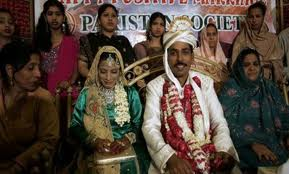
Couple Weds Ahead of Change in British Law (Credit: thenews.com.pk)MIRPUR, July 14: New British immigration laws have unleashed a stampede to wed and a frenzy of English lessons for Pakistanis desperate to migrate as new restrictions come into effect.
The boom was particularly marked in Mirpur, where Islamabad estimates 200,000 of Britain’s 1.2 million Pakistanis have their family origins.
Almost all the town’s 403,000 residents have relatives in the former colonial power, after a huge surge of migration from the area in the 1960s when a major dam was built, costing thousands of farmers their livelihoods.
At the time Britain needed more workers for its factories in the industrial cities of central and northern England, and granted immigration permits to many of them and their families.
Now with immigration an increasingly controversial issue in Britain, Mirpuris rushed to secure residency rights before the door was pushed tighter.
Wedding planners were rushed off their feet, English teachers overwhelmed and immigration consultants buried under mounds of paperwork as brides and grooms queued to file immigration papers by July 6, the last working day before the deadline.
Faisal Mehmood, a self-styled immigration consultant, said business was several times higher than the six to eight cases he normally processes a week.
“I consulted on and helped fill in immigration papers for 53 couples in the first week of July,” he told AFP in his office in Mirpur, the wealthiest town in Pakistani-administered Kashmir, 83 kilometres east of Islamabad.
From July 9, new restrictions made it impossible for anyone who earns less than GBP 18,600 ($29,000) a year to move a foreign spouse to Britain, or less than GBP 22,400 if that spouse has a child.
To acquire British nationality, foreign spouses now have to wait five rather than two years to test whether a relationship is genuine, must be proficient in English and once in Britain, pass a Life in the UK test.
For Britons of Pakistani descent, April is by tradition the peak month for holidays and weddings in their parents’ homeland, before the summer heat becomes unbearable for those accustomed to northern climes.
But wedding planners say they saw record business from Britons in June and the first week of July, with nuptials up 20 per cent in Mirpur so far this year.
Arshad Hussein Shah, the manager of eight marriage halls, said his company organised weddings for 15 Britons from June 1 to July 6.
“There was a sudden surge because the UK government changed the immigration laws for spouses and everybody rushed to marry and file papers before the deadline,” he said.
It was a similar tale for Ali Raza, managing director of the UK College of English Language, who says 35 students enrolled in June—50 per cent more than usual.
“There were more girls than boys. Everybody wanted to complete a quick English course and obtain certificates to file immigration papers,” said Raza.
“Nobody was expecting this sudden implementation of the new laws. It created panic among the candidates,” he added.
Batool Bukhari, 25, married her cousin in April and raced through an English course as quickly as possible.
“I applied for immigration in the second week of June. I had to rush my application when I found out that the new laws are being implemented soon. It was very tense,” said Bukhari.
In Islamabad, the British High Commission said there had been a “significant increase” in the number of applications to join a spouse and live permanently in Britain ahead of the new rules coming into force.
The surge has caused delays in processing applications, the commission said, with some taking up to six months to be resolved.
For those who missed the deadline, the new rules mean new uncertainty.
Naeem Lodhi, 32, who has dreamt of moving to Britain since childhood, married on June 22 but was unable to file the necessary paperwork in time.
“My wife, who came here to marry me, is leaving for the UK in a month. I’m worried about my immigration because her salary is much lower than the amount required,” he said.
Similarly, a hairdresser in London who gave her name only as Irum married her cousin on July 1 after a seven-year engagement, but was depressed about their chances of married life in Britain.
“I don’t know when will I be able to live with my husband in the UK,” she said, adding she would have to find a better paid job.
“It may take weeks, months or years. I don’t know, I am really not sure about my future.”
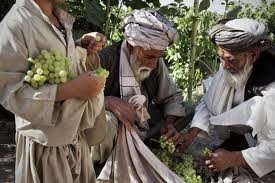
Karz farmers harvest grapes (Credit: Washingtonpost.com)KARZ, July 16 — In this mud-brick village, the United Nations put up the rock retaining wall along the riverbed to keep the road from washing out in floods. The United States paid to fertilize the wheat fields. Hashmat Karzai, a cousin of the president, paid about $70,000 from his own pocket to string up power lines.
As for the Afghan government, it remains all but invisible, even though Karz is the ancestral home of President Hamid Karzai. “The government itself has not done anything,” said Abdul Ali, a village elder.
The United States and its allies have devoted years of effort and billions of dollars to improve the delivery of basic services in rural Afghanistan. If Afghan leadership were to have taken hold anywhere, it might well have been in Karz, a farming area on the outskirts of Kandahar city still populated by relatives and tribesmen of the man who has ruled Afghanistan through a decade of war.
Instead, what is emerging in ever starker relief is a governance vacuum as U.S. forces begin to draw down. As the Americans leave, taking with them a main source of economic stimulus, U.S. officials and residents say what worries them most is the weakness of the local and provincial governments being left behind, which command virtually no resources and almost no authority.
That lack of government progress is apparent every day in Karz with the line of villagers beating a path to Hashmat Karzai’s door.
Karzai holds no official post; his prominence in the village stems from his status as a prosperous and powerful tribal elder and his relationship with the president. He is the former owner of a private security company, Asia Security Group, which sent men to guard U.S. bases, and he currently rents out land for a hotel near NATO’s Kandahar Airfield.
And yet each day the villagers of Karz file into Karzai’s courtyard with a fresh list of problems they say they can find no audience for in the offices of government. One by one they plead for electricity for their irrigation pumps, a clinic for their sick children, or information on the whereabouts of a relative detained by American troops.
“Where should he go? Which door should he knock?” Hashmat Karzai said as he motioned to one of his supplicants. “This is what’s killing the people of Kandahar. You go try to see the governor, it’s impossible to see him. The police chief? The mayor? It would take a month to see them.”
“There’s a distance between locals and the government. There’s a big gap,” Karzai said. “How are you going to cover that gap? I haven’t figured it out yet.”
‘Not delivering the services’
By September, the number of U.S. troops in Kandahar and other, nearby provinces will drop to 13,500, down from a high in April 2011 of nearly 20,000. The bloody battles with the Taliban of the past few years — in Kandahar city and the nearby Arghandab Valley — have shifted farther west, into the rural minefields of Zhari and Panjwai districts.
While the locus of violence has changed, the overall strength of the insurgency has stayed about the same, according to Maj. Gen. James L. Huggins Jr., the top American commander in Kandahar province. He says he is confident that the Afghan soldiers and police can prevail in a fight with the Taliban.
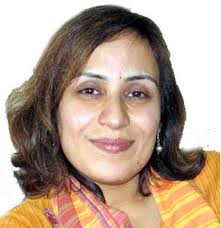
Amar Sindhu (Credit: awamiawaz.net)Hyderabad, July 10: The teachers leading the movement against the University of Sindh (SU) vice chancellor came under attack late Sunday night at the Super Highway.
Women rights activist Prof Amar Sindhu, the chairperson of the philosophy department at SU, was injured in the attack near Sajjad Restaurant as unidentified assailants opened fire at the two cars returning from Karachi with the office bearers of the SU Teachers Association inside.
The attackers sprayed the two cars with bullets and escaped. With burst tyres, the teachers took the cars to a nearby petrol pump.
The general secretary of Federation of All Pakistan Universities Academic Staff Association, Prof Arfana Mallah, was also present in the car but escaped unscathed.
Mallah, who is also a writer and hosts a current affairs talk show on a Sindhi television channel KTN, has been leading the movement at the SU for removal of its vice chancellor Dr Nazir A Mughal. The movement had started after the murder of Prof Bashir Channar on January 2, but became dormant after Mughal was sent on forced leave on February 21. The protests revived, however, with the return of the vice chancellor on June 29.
Earlier on Sunday, the teachers had held a press conference along with Pakistan Muslim League-Nawaz leader Iqbal Zafar Jhagra in Karachi. They had condemned the return of Mughal and the attitude of the provincial government regarding the higher education institutions in the province.
Mallah, who teaches at the SU, told The Express Tribune that she saw three men take positions and open fire at the cars. She ruled out the possibility of robbery since the attackers did not try to do steal their car.
“It appears to be a planned attack,” she said. At least three bullets hit her car.
A case has been lodged at the Gadap police station but due to the confusion over the police jurisdictions, the final FIR will be registered with the Sohrab Goth police.