Storm Florence: Heavy flooding cuts off Wilmington

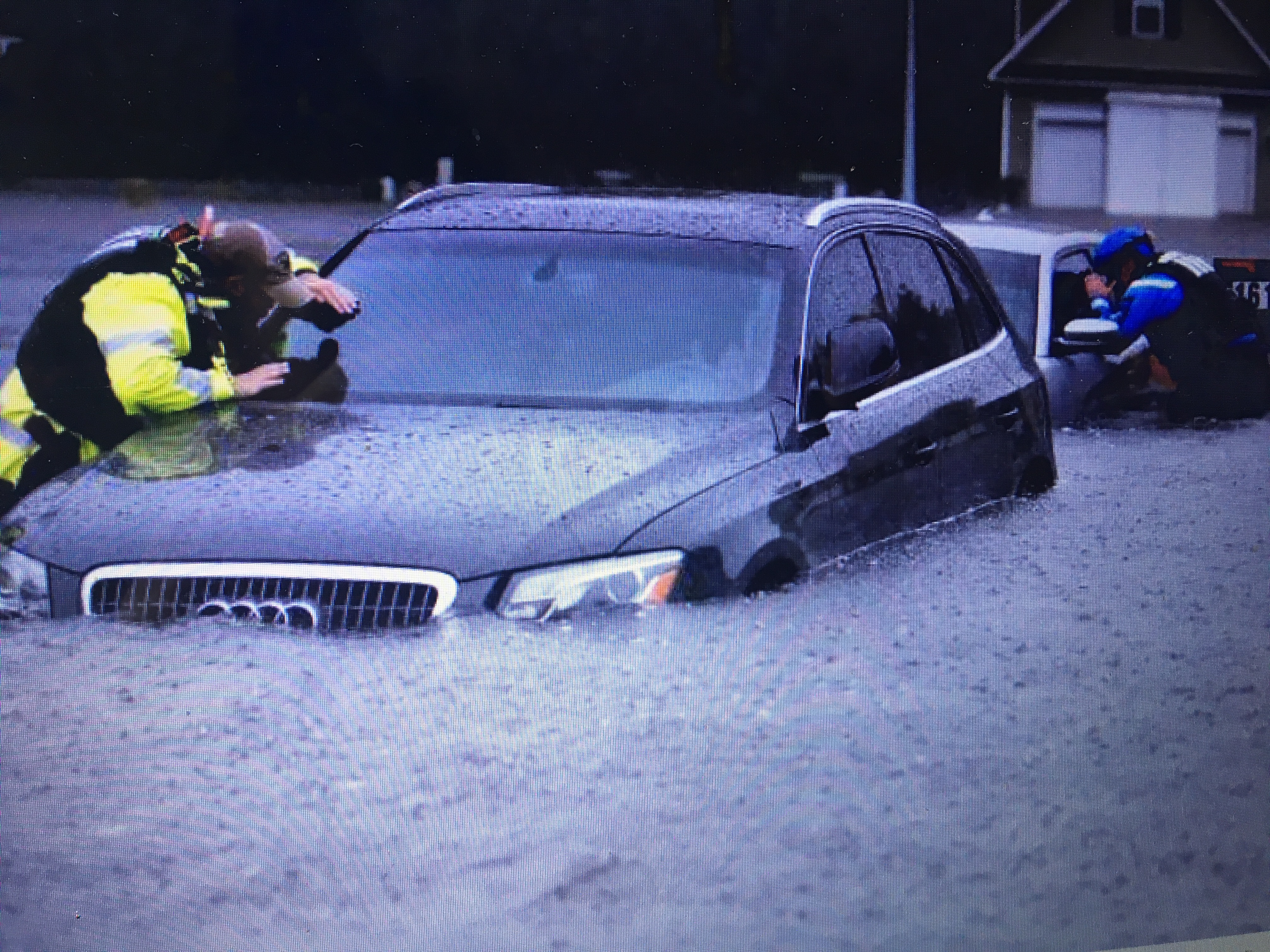
The coastal city of Wilmington, North Carolina, has been cut off from the rest of the state because of heavy floods following Hurricane Florence.

Officials say all roads in and out are now impassable and have warned evacuated residents to stay away.

About 400 people have been rescued from flood waters in the city, described as an island within the state.

Two of the first known fatalities – a mother and her seven-month son – were reported in the city on Friday morning.

At least 15 other people are reported to have died in storm-related incidents across North and South Carolina since Florence made landfall on Thursday.

In Wilmington, with its population of about 120,000, some 400 people have had to be rescued from flood waters, and most of the city remains without power.

The National Weather Service has warned of at least two further days of possible flash flooding in the area before conditions are forecast to improve.

“Do not come here,” New Hanover County Commission Chairman Woody White said.

“Our roads are flooded, there is no access into Wilmington…We want you home, but you can’t come yet.”
House is open is one of the indicators FEMA uses to determine the scale of a disaster.

The area is usually best known as a filming location for US dramas One Tree Hill and Dawson’s Creek.
US basketball legend Michael Jordan – who is fundraising to help residents affected by the storm – also grew up in the city.

Many roads inside Wilmington are still passable for residents who defied evacuation orders to ride the storm out.

But a city-wide curfew has been extended after five people were arrested on suspicion of looting from a store in the city on Saturday.

What is the latest on the storm?

Florence has now weakened into a tropical depression with winds of 30mph (45km/h), according to the National Hurricane Centre.

Some parts of the Carolinas have seen up to 40in (100cm) of rain since Thursday – and officials have warned river levels are yet to peak in places.

On Monday, the National Weather Service announced that the Cape Fear River near Fayetteville, North Carolina, is expected to reach the major flood stage – levels over 60ft (18m) – by this evening.

“At this stage, numerous structures and roadways are flooded and lives are put at risk,” the agency said.

Gusts & floods: the impact of the storm
“The storm has never been more dangerous than it is right now,” North Carolina Governor Roy Cooper said on Sunday.

“Wherever you live in North Carolina, be alert for sudden flooding.”

As of Monday morning, there have been several tornado warnings across North Carolina.
One tornado touched down in Elm City, causing some damage to buildings and power lines, according to local media reports.

The governor also warned of the potential danger of landslides once the weather system reached more mountainous areas.

In South Carolina, the state’s emergency management division reminded residents: “It’s not over yet. Not by a long shot.”

The US coast guard and volunteer boats have been helping people left stricken by rising flood waters across the states.

Officials in North Carolina have said about 900 people have been rescued from floodwaters there, and about 15,000 people are still in emergency shelters.

Authorities are encouraging residents to stay where they are until conditions improve, as many roads across the Carolinas are impassable in some cases due to flooding and debris.

US President Donald Trump has declared a disaster in several North Carolina counties – a move that frees up federal funding for recovery efforts.

Power companies are working to restore power to the almost 502,000 homes and businesses in both states that are still without electricity.

The storm has begun to move into Virginia and West Virginia, and is expected to turn toward New England on Tuesday.

What do we know of the victims?

Eleven deaths were reported in North Carolina, and at least six have been reported in South Carolina.

A mother and her seven-month child who died when a tree fell on their house in Wilmington were the first known deaths reported.

Among the other fatalities were two men in their 70s who died in Lenoir County – one had been connecting extension cords and another was blown by high winds when checking on his dogs.

Four road deaths in South Carolina have been blamed on the storm, and two people died from carbon monoxide poisoning caused by a generator inside their home.

K-P authorities issue arrest warrants for Manzoor Pashteen, Ali Wazir

PESHAWAR: Authorities in Khyber-Pakhtunkhwa ordered the arrest of Pashtun Tahaffuz Movement (PTM) chief Manzoor Pashteen, MNA Ali Wazir and six others.

A letter issued by a senior police official in Swabi declared Pashteen, Wazir, Dr Said Alam Masood, Fazal Advocate, Khan Zaman, Mohsin Dawood, Samad Khan and Noorul Salam as proclaimed offenders.

Police in Swabi confirmed to The Express Tribune that SP Investigation wrote to the political agents of North and South Waziristan seeking arrest of the PTM leaders.

According to the FIR, PTM workers held a gathering at cricket stadium in Swabi’s Shah Mansoor Town without required NOC from authorities. In the jalsa, the PTM chief and others made contemptuous statements against state institutions.

The PTM, formerly Mehsud Tahaffuz Movement, gained momentum following the extra-judicial murder of Naqeebullah Mehsud in Karachi. It sought capital punishment for the prime suspect in Naqeebullah murder case, former SSP Malir Rao Anwar, recovery of missing persons and removal of landmines in tribal areas.

A Jirga, formed by the K-P apex committee and comprising tribal elders, is holding negotiations with the group to resolve their issues.

Sharif, Maryam and Safdar released on parole

ISLAMABAD, Sept 11: Former prime minister Nawaz Sharif, his daughter Maryam Nawaz and son-in-law Captain (retd) Muhammad Safdar were released on parole in the wee hours of Wednesday, after the death of Begum Kulosoom Nawaz.

A notification issued by the Punjab Home Department said the three were released for 12 hours to attend the funeral of Kulsoom Nawaz.

Television footages show that Sharif, Maryam and Safdar were being taken out of the Adiala Jail in a motorcade. They were expected to travel to Lahore sometime in the night.

The decision to release the Sharifs came on an application moved by Sharif’s younger brother Shehbaz Sharif.
“The duration of permission granted shall not exceed twelve hours, which shall not include the time consumed for journey to and from the prison,” the notification said.

Begum Kulsoom Nawaz passes away in London

Earlier, the PM Office released a short statement, saying the government would extend all-out support to the family and relatives of Begum Kulsoom, in accordance with the law. The statement further reads that the Pakistani High Commission in the UK has been directed to extend assistance to the bereaved family.

Talking to The Express Tribune PM’s Special Assistant on Political Affairs Naeemul Haq had said the government would positively respond to the Sharif family’s request for release of its imprisoned family members to attend the funeral.

However, Federal Information Minister Fawad Chaudhry clarified that under the amended rules in Punjab, parole of a convict could not exceed 12 hours. He said the government had no objection to the approval of a parole application.

“Earlier, there was a provision to release convicts on parole for a maximum of three days but later, relevant law was amended and now temporary release is granted for not more than 12 hours. While living within the ambit of laws, Sharif family will be extended all-out cooperation,” he said.

Aitzaz apologises for remarks on Begum Kulsoom’s illness following her demise.

Parole is a method under which the punishment of a convict is temporarily suspended for a specific time and he/she is set free for a defined purpose under the supervision of police officials.

Rules provide that prisoner’s family submits an application with provincial parole committee that considers it and with its comments forwards it to the home secretary who has the authority to accept or reject it.

In 2004, Sharif and his family members, including Punjab former chief minister Shehbaz Sharif, had not attended the funeral of their father, Mian Sharif. At that time, the Sharif family was in exile. In 2002, former president Asif Ali Zardari was released on parole from Adiala jail to attend funeral of his mother.

Shehbaz’s departure for London

According to sources in the Pakistan Muslim League-Nawaz (PML-N), PML-N President Shehbaz Sharif was likely to leave for London at 3am on Wednesday to receive Kulsoom Nawaz’s dead body, which, reports suggested, was shifted to a mortuary in London temporarily.

Earlier, the PML-N chief flew to Rawalpindi to meet his elder brother Nawaz at Adiala Jail. Sources in the PML-N said both the Sharifs, after discussing the funeral arrangements in detail, agreed that Hassan Nawaz and Hussain Nawaz, the ex-PM’s two sons, should not arrive in Pakistan.

Hassan and Hussain have been declared absconders by the Accountability Court in the Avenfield Apartments reference and would be arrested in case they land in Pakistan.

Kulsoom’s body would be brought to Allama Iqbal International Airport Lahore from Heathrow Airport London on Thursday, PML-N sources said. Her funeral prayers would be held the following day, after Friday prayers. She would be buried at Sharif family’s graveyard in Jati Umra, Raiwand the same day.

— ‘Democratic institutions are quickly becoming more robust and will only get stronger with the passage of time’ – Pak army chief

ISLAMABAD: Chief of Army Staff (COAS) General Qamar Javed Bajwa said on Sunday that democracy in the country was fostering with time.
The army chief was speaking to the media at Arif Alvi’s oath-taking ceremony. “Democratic institutions are quickly becoming more robust and will only get stronger with the passage of time,” Gen Qamar was quoted as saying. “This is an important day for the continuity of democracy in the country,” the COAS added.
Alvi was sworn in as Pakistan’s 13th head of state in a ceremony held at Aiwan-e-Sadr in Islamabad. Chief Justice of Pakistan Mian Saqib Nisar administered the oath in a ceremony that was attended by top civil-military brass including Prime Minister Imran Khan, Bajwa and Chairman Joint Chiefs of Staff Committee Gen Zubair Hayat. Saudi, Chinese diplomats also attended the presidential oath.
The newly-sworn in president was later given his first guard of honour by the smartly turned out contingents of the armed forces at Aiwan-e-Sadr.
Alvi is succeeding Mamnoon Hussain, who took oath as 12th head of state on September 9, 2013 after his election as a candidate of the Pakistan Muslim League-Nawaz (PML-N).
It is pertinent to mention that civil-military relations have always been subject to controversies in Pakistan. The relations went particularly sour during the tenure of the erstwhile ruling party Pakistan Muslim League-Nawaz (PML-N), following the controversial Dawn leaks.
After the eviction of former PM Nawaz Sharif by Supreme Court in the infamous panama leaks case, the PML-N leadership, especially Nawaf Sharif, openly criticized the role of Pakistan Army and even accused it of cross-border terrorism in an interview.
In the past, Pakistan has been viewed in the west as a country influenced by its armed forces, but the country has witnessed positive chances in this narrative since the arrival of the Pakistan-Tehreek-e-Insaf (PTI) government, led by Imran Khan.
Soon after taking charge, PM Imran Khan went to GHQ where he held an eight-hour long with the military heads. The PM was briefed on the overall security situation of the country as well as on the workings of the army.
On September 6, during a ceremony held in the honour of the martyrs of Pakistan Army, PM Imran Khan reiterated that the government and army was on the same page, which is to help Pakistan stand on its own feet. He went on rebuff all rumours regarding a possible rift between the government and army, and said that Pakistan Army, like other institutions, was working in close coordination with the government.

US Pakistan talks prompt vow to reset ties after prolonged spat – By Asad Hashim Al Jazeera (Sept 5, 2018)

Pompeo has held talks with Pakistan’s prime minister and foreign minister, as the two erstwhile strategic allies seek to mend ties that Pakistan has said have become “almost non-existent” in recent months.

Pompeo met Prime Minister Imran Khan and Foreign Minister Shah Mehmood Qureshi in the Pakistani capital Islamabad on Wednesday, in a set of talks both sides described as a “positive beginning” to rebuilding the relationship.

Army chief Qamar Javed Bajwa, whose institution has ruled Pakistan for roughly half its history and still controls aspects of security and foreign policy, was also part of the talks.

“We have still got a long way to go, lots more discussion to be had,” Pompeo told reporters before leaving Islamabad for his next stop, the Indian capital New Delhi.

Qureshi will meet Pompeo again in Washington DC later this month, following his attendance of the UN General Assembly. He will also be travelling to Kabul shortly for talks with Afghan authorities, he said.

‘Alignment and convergence’
The talks on Wednesday focused on opportunities to reset the relationship and for greater cooperation on the war in Afghanistan, particularly on Pakistan’s role in the political reconciliation process with the Taliban, Pakistan’s foreign minister told reporters.

“The US has been evaluating its policy, and they have reached the conclusion that the solution in Afghanistan is a negotiated political settlement,” said Qureshi. “And here once again you will see an alignment and convergence between the US and Pakistan.”

Pakistan and the US have differed greatly over the conflict in Afghanistan, with the United States and Afghanistan often accusing Pakistan of offering sanctuary to leaders of the Afghan Taliban and its ally, the Haqqani Network.

Pakistan denies the charges, saying it has acted indiscriminately against all armed groups on its soil, and in turn accuses Kabul of allowing elements in the Tehreek-e-Taliban Pakistan (TTP, also known as the Pakistani Taliban) to operate in that country’s eastern provinces.

Pompeo said the talks on Wednesday focused on deliverable outcomes.

“We made it clear to them – and they agreed – that it’s time for us to begin to deliver on our joint commitments,” he said. “We have had lots of times where we have talked and made agreements, but we have not been able to actually execute those.”

“And so, there was a broad agreement between myself and Foreign Minister Qureshi, as well as with the prime minister, that we need to begin to do things that will actually begin to deliver, on the ground, outcomes so that we can begin to build confidence and trust between the two countries.”

State Department spokesperson Heather Nauert, meanwhile, said Pompeo commented on Pakistan’s role in neighbouring Afghanistan and the wider region during the talks.

“In all of his meetings, Secretary Pompeo emphasised the important role Pakistan could play in bringing about a negotiated peace in Afghanistan, and conveyed the need for Pakistan to take sustained and decisive measures against terrorists and militants threatening regional peace and stability,” Nauert said.

Funding slashed

The US-Pakistan relationship has remained troubled since President Donald Trump assumed power last year.
In January, Trump cut more than $1.1 billion in security assistance to Pakistan, accusing the country of “lies and deceit” in its role in the Afghan conflict.

On Sunday, the US confirmed that $300 million in a Coalition Support Funds reimbursement, which was initially suspended under that announcement, had been finally cancelled.

Pakistani Foreign Minister Qureshi said he did not raise the issue of the funds with Pompeo as he wanted to focus on resetting the atmosphere of the relationship, rather than dwelling on previous decisions.

“Our relationship is not based on transactions, we have to think differently,” he said. “We have to talk not about money, but about principles.”

Qureshi said that if the relationship was to move forward, “it must be based on truth [and] frank, candid conversations”.

“I said this to him, and he agreed, that this blame and shame game does not achieve anything,” he said.
“Yes, we have challenges. On some things, we may think differently, but we have shared objectives as well.”

From the dentist’s office to President House: Dr Arif Alvi becomes Pakistan’s 13th president

PTI’s Dr Arif Alvi was elected the 13th president of Pakistan on Tuesday.

The country’s new president is a politician, dentist and parliamentarian. He has been described as the “chief whip of the PTI” in his profile on the party’s website.

Born in Karachi on July 29, 1949, Dr Alvi acquired a degree in dentistry from de’Montmonrency College of Dentistry, an affiliate of the University of Punjab, and then completed his master’s in prosthodontics (fixing or replacing teeth ) and orthodontics (straightening teeth to improve alignment).

He was the first Pakistani to specialise in orthodontics, according to the PTI’s website.

In 1995, Dr Alvi was certified by the Diplomate American Board of Orthodontists and became the only Pakistani or SAARC dentist to have achieved this level of qualification.

Dr Alvi, who is one of the founding members of the PTI, started his political career as the president of the student union at de’Montmonrency College of Dentistry in Lahore, Pakistan.

He was an active member of the student movements of the Jamaat-e-Islami which occurred during the tenure of General Ayub Khan. Dr Alvi was shot twice during one of the protests on Lahore’s Mall Road at the time. One of the bullets is still embedded in his right arms, which he proudly carries as a mark of his struggle for democracy.

When Imran Khan started the PTI in in 1996, Dr Alvi joined him and began his long career with the PTI.
He contested the 1997 election for the Sindh Assembly PS-89 seat but lost to PML-N candidate Saleem Zia. In the same year, he was appointed the party’s Sindh chapter president.

In 2002 he lost the election on PS-90 to the MMA’s Umar Sadiq. Despite losing, he was made the party’s secretary general in 2006, a post he served on till 2013.

In 2013 he was elected to the National Assembly from NA-250, beating the MQM’s Khushbakht Shujaat. He was appointed the PTI’s Sindh president again in 2016.

During the General Election 2018, he was victorious from Karachi’s NA-247. While campaigning for the elections, he drove a rickshaw in Karachi and garnered attention on social media.

The father of four, who is married to Samina Alvi, is the son of Dr Habibur Rehman Elahi Alvi, the dentist of Jawaharlal Nehru. His father migrated to Pakistan in 1947 and operated a dental clinic in Saddar, Karachi. According to Dr Alvi’s son Awab, his grandfather was a member of the JI and was very close to the party’s then head Syed Munawar Hussain.

Prime Minister Imran Khan nominated Dr Alvi as president on August 18, two days after taking oath as the country’s premier.

Why Imran Khan Must Bat for Civil Society in Pakistan

Prime Minister Imran Khan of Pakistan has set out an ambitious development and reform agenda. He is determined to reign in elite corruption and increase spending on health, education and women’s welfare.

To carry out these important social programs, Mr. Khan needs the support of Pakistan’s battered and bruised civil society. He needs to put an end to the coercion civil society groups have faced from the previous government and the military and help them to function effectively and without constraints.

In the past, Mr. Khan had taken various regressive positions — supporting the discriminatory blasphemy laws, attacking liberals, criticizing the press and describing the Taliban insurgency in Afghanistan as a legitimate jihad against occupying forces — but he has an opportunity to turn the page and embrace a new, more inclusive vision for the country.

Pakistan features on the lower margins of most international human development indexes. It has the worst infant mortality rate. A child born in Iceland has a one-in-1,000 chance of death at birth, while a child born in Pakistan has a one-in-22 chance, according to the United Nations Children’s Fund. Twenty-three million Pakistani children are out of school and millions of children enrolled in public and private schools can barely read or write.

Pakistan needs all the help it can get. Mr. Khan has to find the money and expertise to face these challenges when his government faces immense international debt repayments and collapsing revenues from taxes and exports.

Several international nonprofit groups such as Action Aid, Asia Foundation, Mercy Corps and Open Society Foundation have worked in Pakistan for years.

Civil society organizations have helped during national crises like floods; promoted education in remote, rural areas; and have worked with minority groups such as Christians and Hindus, who are ignored by the state.

Instead of supporting local and international nongovernmental organizations, the Pakistani establishment has responded with a crackdown on these groups. The previous government and the military initiated proceedings to curtail the work and even eject scores of international civil society groups working in Pakistan. Sections of the establishment and right-wing television networks in Pakistan have been promoting allegations linking international NGOs to espionage and antigovernment activities.

Last year, Pakistan ordered 21 international nongovernmental organizations to renew their registration in the country. When they submitted new applications in December, they were denied registration. No official explanation for the decision was provided. They are still waiting for a reply to an appeal.

Various programs run by these groups have been paralyzed for more than a year because of the uncertainty the government has created about their future. And tens of thousands of Pakistanis who work for nongovernmental organizations face the specter of unemployment. Donors such as Western governments are hesitant to come forth.

Pakistani nongovernmental organizations work under extremely difficult conditions, as they don’t have the option of leaving the country nor of effectively challenging clampdowns by the state. Thousands of Pakistani civil society groups, especially the ones working to promote human rights, have been asked to renew their registration and submit answers to highly personal questionnaires. Foreign funding for these organizations has also been suspended.

Mr. Khan cannot make any real progress on his agenda of reform until he ends the curbs on civil society and enlists these groups in creating a better Pakistan.

It is tragic that while Islamabad has pressured and coerced nongovernmental groups, it has opened up greater political and social space for Islamic extremist groups and their affiliates. Pakistan’s Election Commission allowed several extremist groups such as Lashkar-e-Taiba — a State Department-designated terrorist group, which faces sanctions from the United Nations — to contest the recent general elections while using front organizations.

The military has argued that it is mainstreaming these groups by bringing them into the electoral process. But without any de-radicalization program in place, without a commitment from these groups to disarm their tens of thousands of followers and disavow their extremist ideology and show a commitment to democratic processes, allowing them to contest elections only helps them increase their support base.

Extremist groups fielded some 1500 candidates in the elections. While Lashkar-e-Taiba’s proxy failed to win a seat, the Sunni extremist group, Tehreek-i-Labbaik, won two seats in the Sindh Provincial Assembly and got over four million votes.

Mr. Khan needs to rectify this reckless state of affairs as Pakistan remains on the Financial Action Task Force’s “grey list” of countries that have not fulfilled their obligations to curb terrorist activities. According to Western diplomats, the F.A.T.F. review of Pakistan’s compliance in August did not go well.

F.A.T.F. is concerned about extremist groups being allowed to operate as charities in Pakistan while they are listed as terrorist groups by the United Nations. By October, Pakistan could be moved up to the “black list” of F.A.T.F. that includes North Korea and Iran and would result in international sanctions on Pakistan, unless it changes its behavior.

Apart from its direct political consequences, the failure to comply with the F.A.T.F. will also force donor countries to stop bilateral funding, most of which goes to nonprofit groups.

At present there is enormous good will for Mr. Khan, but how long it lasts will depend on whether he will continue policies that are clearly harming Pakistan’s global image, undermining civil society and preventing NGOs from carrying out their tasks.

Policy decisions to return international nongovernmental organizations to their previous status, complying with F.A.T.F. obligations and stopping the growing power of Islamic extremist groups are urgently required. At stake is Pakistan’s democratic future.

Ahmed Rashid is the author, most recently, of “Pakistan on the Brink: The future of Afghanistan, Pakistan and the West.’

PM Khan wants media to give him three months before criticizing his government

Prime Minister Imran Khan has asked that the media give his government three months before criticising its performance, DawnNewsTV reported on Friday.

The statement was made during a meeting with journalists in Islamabad.

The PM promised that three months down the road, there will be a marked difference in the way the country is run. He also mentioned that none of his cabinet members was appointed permanently and could be shuffled around on the basis of performance.

According to Geo.tv, PM Khan, responding to a question, said that while Pakistan cannot fight the US and looks to improve ties with Washington, the government will not give in to any unjust demands made by the White House.

He mentioned that Pakistan seeks peaceful relations with India, Afghanistan and Iran as well.

According to DawnNewsTV, PM Khan also told journalists that he has directed the chairman of the National Accountability Bureau to continue an indiscriminate accountability process in the country.

He added that if any member of the government is suspected of any indiscretion, they should also be held accountable.

The prime minister also pointed out that Pakistan’s circular debts stands at Rs1.2 trillion and that progress would not be possible without across-the-board accountability.

During the meeting, PM Khan was also asked about his usage of a helicopter for travel to and from Banigala, which he defended as a way of saving citizens from the trouble of traffic holdups.

Imran Khan gives 2-week deadline to recover stashed money

Islamabad, Pakistan: Fulfilling his poll promise to clampdown on corruption, Pakistan Prime Minister Imran Khan on Tuesday gave a deadline of two weeks to a task force to chalk out a plan to recover unlawfully acquired foreign assets and stashed wealth.

On Monday, the task force chaired its first meeting, where various government departments informed the unit of the current status of pending probes of money laundering and financial fraud cases, officials were quoted by The Express Tribune, as saying.

Khan has said that his topmost priority is to retrieve hidden offshore assets and promised to bring back ill-gotten wealth in overseas banks.

According to the terms of reference (ToR) of the task force, Khan has set a deadline of two weeks for the body to take steps for the “expedient return of unlawfully acquired assets from abroad”.

Meanwhile, the chairman of the task force has directed Pakistan’s Finance Ministry to share earlier reports prepared by the committees set up under the purview of the country’s Supreme Court to recover the unlawfully acquired foreign assets.

The task force has been asked to review all cases of financial fraud pending before the government departments and organisations. The body will also be responsible for the investigation of the existing mechanism, international agreements, working out modalities to fast-track the recovery of ill-gotten wealth and undeclared offshore assets, and ensuring coordination of the Pakistan government with other governments on the same, The Express Tribune report said.

Recently, Pakistan gave its citizens the last opportunity to declare their wealth and offered them offshore and domestic tax amnesty schemes. While over 5,000 people availed the offshore scheme and declared over USD 8 billion assets, the repatriation to the country was less than USD 70 million.

On August 19, in his first address to the nation after being sworn-in as Pakistan’s prime minister, Khan vowed to tackle corruption and said that he would form a task force to bring back swindled money to the country. (ANI)

The end of discretionary funds: rhetoric and reality

ISLAMABAD: In its meeting on Monday evening, the federal cabinet decided to abolish the discretionary funds of the prime minister, federal ministers and development funds for MNAs, a decision which has been widely projected as an unprecedented step by the Pakistan Tehreek-i-Insaf (PTI) government. The reality is quite the opposite.

Very few observers have cared to check whether these funds existed before. A sum of just Rs80 million a year used to be allocated to the prime minister, which he would largely spend on entertaining the applications of needy people for free medical treatment and the like. Even incumbent government officials agree this was not a substantial allocation.

A special fund of Rs1 million used to be allocated to each cabinet member, but had already been abolished by the previous government. The practice of releasing secret funds to different ministries had also been stopped by the Pakistan Muslim League-Nawaz (PML-N) administration; the intelligence agencies remained the only exception to this rule.

The PML-N government had also announced the abolition of discretionary development funds to MNAs, although this practice continued under different official nomenclature.

So what is different? The hefty allocations made for development projects in the constituencies of ruling coalition MNAs is the key point. Abolishing this would really be a big test for the government. These funds are what the PTI government has decided to stop, terming them as “discretionary funds”. Ideally, development is the domain of the local government apparatus, not that of federal lawmakers, since financial resources were largely devolved to the provinces under the 18th amendment to the constitution.

The abolition of these funds was promised in the PTI manifesto published in 2013. The party had announced an end to this practice in Khyber Pakhtunkhwa when it formed the government there five years ago. Did it keep the promise? The answer is negative.

Before pinning so much hope on such pledges, it is important to ascertain the fate of such measures announced in the past so as to spell out the challenges faced in translating rhetoric into reality. In the early days of the Nawaz Sharif government in 2013, there was a similar air of optimism. Austerity was the buzzword, as with the newly ensconced PTI government.

The first budget of the PML-N government unveiled a 45 per cent cut in the expenses of PM House, reducing it from Rs725 million a year to Rs396 million. However, they started increasing again from Sharif’s second year in office onward. By the time the PML-N government presented its last budget in May, some Rs986 million was budgeted for PM House, significantly more than the slashed budget announced in 2013.

Likewise, non-development expenditures were trimmed by 30 per cent in line as part of the austerity drive at the time. This resulted in the slowing down of office work, as staff would complain of shortages of paper, ink and other supplies, and about restrictions on the use of telephones. Ultimately, the government had to backtrack on its decision to cut financial corners.

Similarly, a radical decision was taken by the erstwhile PML-N government to abolish development funds for MNAs. This was made controversial by the unconstrained abuse of the funds by former Pakistan People’s Party (PPP) premier Raja Pervez Ashraf. He lavished funds totaling Rs47 billion on his native Gujar Khan, while a further Rs5 billion was granted to other influential PPP lawmakers and their allies.

When the matter was taken up by the Supreme Court, it directed action against Pervez and ruled that the allocation of discretionary funds to the prime minister and chief ministers for development projects was an unconstitutional practice.

“The government is bound to establish procedure/criteria for governing allocation of such funds for this purpose,” the Supreme Court noted in its verdict on December 5, 2013.

When the PML-N formed the government, it initially refused to grant funds to MNAs for handpicked development schemes in their constituencies. Meanwhile, any announcement by the prime minister for, say, the construction of a road or the provision of piped natural gas, was routed through the Planning Division. The Nawaz Sharif government faced raucous opposition when it approved funds for the Rawalpindi-Islamabad metro bus project, with critics dubbing it a violation of the Supreme Court order in the Raja Pervez Ashraf case, although the plan was expedited via the Planning Division, not from any discretionary fund.

In an apparent attempt to counter-balance this criticism, Nawaz announced the establishment of 46 state-of-the-art hospitals across the country, a move which failed to make any headway due to the poor conception of the project. It gave rise to questions as to whether administrative charge and financing of the hospitals would be undertaken by provincial administrations or the federal government.

However, the government found itself under real pressure from MNAs to restore the funds after the destabilising crises created by the PTI-led dharna in 2014 and the Dawn leaks controversy in 2016. It was torn between obeying the court’s order banning the discretionary allocation of development funds and appeasing lawmakers in the run-up to the 2018 general election.

It sought and found an innovative way of releasing the controversial grants. They were allocated under the heading of the United Nations’ 17 Sustainable Development Goals, which require the government to invest in the provision of clean drinking water, energy and poverty alleviation – all through the Planning Division and mostly to treasury MNAs, with the major chunk allocated to politicians from Punjab.

The PTI provincial government in Khyber Pakhtunkhwa behaved no differently, violating its 2013 manifesto pledge and the Supreme Court’s order. In 2014, PTI Chairman Imran Khan wrote a letter to the then chief minister, Pervez Khattak, directing him to stop the release for discretionary funds for himself, cabinet members and MPAs. What happened in reality is a matter of public record.

The following year (2015), Rs8.5 billion was released to MPAs. Whereas the PML-N government had made such allocations under the UN Sustainable Development Goals, the KP government did so under its Annual Development Programme, doling out funds in the form of special packages and district development initiatives. A significant chunk went to the constituencies of treasury lawmakers and ministers, according to according to Centre for Governance and Public Accountability (CGPA), which obtained the data courtesy of Right To Information (RTI) laws.
Another RTI request by the CGPA brought to the public’s attention the fact that Khattak and his finance minister, Muzaffar Said, collectively spent Rs837 million in the financial year 2017-18 alone, sourcing it from the discretionary funds for local governments at their disposal.

Some Rs557 million was allocated to Khattak and Rs280 million to Said, according to the data obtained by the CGPA. The single highest allocation of Rs490 million was made for projects in Khattak’s home district of Nowshera, followed by Rs200 million to Said’s home district of Lower Dir.

Advertisement