US seeks to quell global outrage over Jerusalem: ‘The sky hasn’t fallen’

Two days after America’s closest allies denounced it in the United Nations, a day after an Israeli air strike killed two in Gaza and hours after protests erupted near the US embassy in Lebanon, Donald Trump’s ambassador to the UN relayed his message to the world: “The sky’s still up there. It hasn’t fallen.”

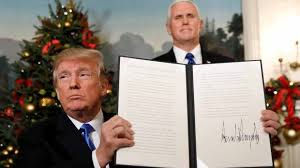
Nikki Haley echoed that message across three televised appearances on Sunday, four days after the president announced that the US recognizes Jerusalem as capital of Israel. The declaration broke with international consensus, rattled allies across the Middle East, inspired riots and ended decades of US policy in pursuit of a peace agreement between Israeli and Palestinian leaders.

Sporadic violence has broken out in the region since the announcement and four people have been killed, two in an air strike and two in clashes with the Israeli army.

On Friday, 14 of the 15 members of the United Nations security council, including close friends such as Britain and France, excoriated the president’s decision. The US found no solace with allies in the Arab League, which condemned the decision as a “dangerous violation of international law” that “deepens tension, ignites anger and threatens to plunge region into more violence and chaos”.

Allies in the Middle East warned of dramatic consequences. “Mr Trump, Jerusalem is a red line for Muslims,” Turkish president Recep Tayyip Erdoğan said before the announcement. “This could lead us to break off our diplomatic relations with Israel.”

A few days later, leaders with close ties to the US began to spar. In a speech, Erdoğan called Israel a “terrorist state” for its policies in Palestinian territories.

Israeli prime minister Benjamin Netanyahu responded on Sunday: “Mr Erdoğan has attacked Israel. I’m not used to receiving lectures about morality from a leader who bombs Kurdish villages in his native Turkey, who jails journalists, helps Iran go around international sanctions and who helps terrorists, including in Gaza.”

Vice-president Mike Pence is due to visit the region later this month. Both the head of Egypt’s Coptic Church and the Palestinian president, Mahmoud Abbas, have decided not to meet him. Alyssa Farah, a spokeswoman for Pence, said on Sunday it was “unfortunate that the Palestinian Authority is walking away from an opportunity to discuss the future of the region”.

“The administration remains undeterred in its efforts to help achieve peace between Israelis and Palestinians,” Farah said.

Haley argued that the decision has realpolitik logic. She suggested Israeli settlements and Palestinian poverty do not weigh as heavily on the minds of Middle East allies, especially Saudi Arabia, as does Iran’s growing influence in the region.

“We have a whole lot more in common with the Arab League than we have ever had before and mainly that’s because of our fight with Iran,” Haley told CNN’s State of the Union. “What they mostly care about and what is their top priority is Iran, and we are in lockstep with them.”

Asked about fears that the decision, an explicit step in favor of Israel, might inflame extremists in the region, Haley said: “I have no concern.”

The Trump administration and Saudi Arabia’s royals have courted each other since King Salman and the young crown prince gave the president a gilded reception in May.

Trump has continued Barack Obama’s military support for the kingdom’s war in Yemen, with a $110bn arms deal and generally supported the prince’s power plays at home and abroad. Trump’s son-in-law and senior adviser, Jared Kushner, made an unannounced visit to the royals in October.

Kushner is tasked with leading peace talks between Israeli and Palestinian leaders and visited Israel in June and August. Israel and Saudi Arabia have tentatively stepped into a more collaborative relationship, largely in response to Iran.

Haley argued that the president’s decision reflected his appreciation for facts on the ground. “You’ve got the parliament, the president, the prime minister, the supreme court [in Jerusalem], so why shouldn’t we have the embassy there?”

She insisted, without offering details, that the decision would advance peace talks. “When you recognize the truth, when both parties recognize reality, peace comes,” she told CBS’s Face the Nation. “We are living in the reality that Jerusalem is the capital of Israel.”

Making a similar argument that the Obama administration used in its decision to re-establish relations with Cuba, Haley argued that change for its own sake would be more productive than the status quo.

“The last 22 years, that was a bargaining chip and it got us nowhere closer to peace,” she said. “What if this actually moves the ball forward?”

In the two years after the 2014 Gaza conflict, in which the UN tallied 2,104 Palestinians and 72 Israelis killed, the Obama administration failed to resurrect peace talks. In his 2015 re-election campaign, Israeli prime minister Benjamin Netanyahu abandoned his call for a two-state solution, then later took it up again while supporting new settlements.

In a February press conference with Netanyahu, Trump dithered on US policy, saying: “I’m looking at two-state and one-state and I like the one that both parties like. I’m very happy with the one that both parties like.”

On Sunday, Haley said Trump administration policy was deliberately vague. “We did not talk about boundaries or borders for a reason,” she said. “Whatever is East Jerusalem or any other part, that’s between Palestinians and Israelis, that is not for Americans to decide.”

Yet she asserted that the president’s announcement “will go down in history” as “the move that finally got the two parties to come to the table”. Skeptics should return in five or 10 years to ask about the peace talks, she said, adding: “I’ll come back and tell you I told you so.”

‘Rid Karachiites of water tankers’: SC says as CM Murad, Kamal appear in unsafe water case

Sindh Chief Minister Murad Ali Shah, former Karachi mayor Mustafa Kamal and Karachi police chief Mushtaq Ahmed Mahar appeared before the Supreme Court on Wednesday for a hearing on a plea concerning provision of clean drinking water and safe environment in the province.

Headed by Chief Justice of Pakistan Mian Saqib Nisar, a three-judge bench at the SC Karachi registry is hearing the constitutional petition of Shahab Usto, a concerned citizen and lawyer, against the provincial government’s failure to provide potable water, better sanitation, environment and associated issues.

The court on Monday had directed Shah to appear in court as the provincial government’s “satisfactory reply” on the issue of provision of clean drinking water and safe environment was not forthcoming.

The court had also directed Kamal, who was the mayor from 2005 to 2010, to appear in court to clarify who he had asked before allotting the 50 acres reserved for the Mehmoodabad treatment plant allegedly to some misplaced people.

When the provincial chief minister appeared at the rostrum at the outset of the hearing on Wednesday, the chief justice remarked that the court had summoned him [Shah] with great respect and dignity.

“Our objective is only to rid people of this polluted water,” he said.

Kamal, who is the chief of Pak Sarzameen Party (PSP), is accompanied at the court by PSP leader Anis Qaimkhani. Advocate general Sindh, the home secretary and managing director of the Karachi Water and Sewerage Board (KWSB) are also present in the court.

Justice Nisar said he was deeply saddened by the state of affairs and the court wanted to change the situation.
“If you say, you and I can travel to Mithi and both of us will drink a glass of water from the stream,” he said.

A documentary film was then shown in the court about the issue of unsafe drinking water.

The chief justice told Shah the provincial government could seek help from the court if need be and “we will fully assist you”.

Justice Nisar said he wished PPP Chairman Bilawal Bhutto-Zardari was present in the court to witness the situation.

“Bilawal Bhutto would also find out the state of affairs in Larkana,” he remarked.

” title=”“>

Documentary shown in court about effluent discharge in Sindh.

Six-month deadline
Addressing the chief minister, Justice Faisal Arab said, “You were elected [by the people] to solve issues,” adding that people turn towards court due to failure of the administration. “The court has no desire of using the administration’s authority.”

The apex court is ready to lend its support to the provincial government, but the chief minister will have to give a guarantee of accomplishing the task, the chief justice remarked.

Justice Nisar inquired as to how much water from the Indus River falls into the sea annually and why this water could not be used to meet the needs of Karachiites.

The chief minister responded that the level of water in the Indus River is very low.

“Badin and Thatta are being destroyed due to shortage of water,” Shah said.

When the CJP proposed a six-month deadline to solve the unsafe drinking water issue, Shah said the task could not be accomplished in six months.

At this, justice remarked that the administration should act and an extension could be given if asked for.
The chief minister assured the court that he would devise an executable plan and fully implement it, but requested time to resolve the issue.

Being the chief minister of Sindh, you will have to submit an affidavit to the court stating the time required for the task, the CJP told Shah. He recommended that Shah should not simply form a committee and leave it on its own.

Shah said he would give the court a time-frame about the plan of action, methods, finances and resources needed for the job.

“You received votes from the people, and you are the one who is answerable [to them],” the CJP said, addressing Shah.

Shah informed the court that Rs3.5 billion are required to clean the effluent that falls into the Indus River.
He said he would try to solve the issues that he has committed to, but the task that belongs to the executive should be left for the executive to do.

“Some court decisions are impacting the performance of the executive,” Shah alleged.

The CJP offered Shah to use the court’s “shoulders” to resolve the issues at hand.

Justice Nisar asked Shah where he resided — at his house or the Chief Minister House.

The chief minister responded that he lives in the Cantonment area and gets water at his house via tankers.

“Shah sahib, rid the lives of Karachiites from tankers,” the CJP urged the chief minister.

Justice Nisar reminded Shah that under the Constitution, the water and sanitation issues fall into the domain of fundamental rights.

“The court has the authority to intervene if the executive does not fulfill its duties,” he stressed.

Justice Nisar said the court will not interfere in the powers enjoyed by the executive and neither was the court expecting overnight improvement.

The court directed the Sindh government to submit a comprehensive plan about the provision of clean drinking water and treatment of sewerage to the court within 15 days.

‘Providing water is local govts’ job’
Former Karachi mayor Mustafa Kamal claimed before the court that Karachi is being provided 1.51 per cent of the water from Sindh’s share.

Kamal said providing safe water and solving sewerage issues is the job of local governments — not the chief minister’s.

He said the population of Karachi will exceed 30 million by 2020 and the city demands 1,250 million gallons of water on a daily basis.

Kamal recommended that water supply projects K-I, II and IV be started simultaneously to save costs.

He said he had drafted the legal master plan of Karachi in 2007, which did not exist earlier.

Addressing the issue of Mehmoodabad treatment plant land, Kamal denied allotting the land to anyone, saying he didn’t have the powers to do so.

The 149.1 acre land was allotted with the approval of the City Council.

The court directed the local bodies secretary to submit a detailed report about the allotment of land meant for Mehmood treatment plant for residential purposes.

‘91% water is contaminated’
The bench had earlier constituted a judicial commission, headed by Justice Iqbal Kalhoro of the Sindh High Court, to probe the government’s failure in providing safe water to the people of the province.

Advocate Usto had informed the judges during the last hearing that the people in 29 districts across the province were drinking contaminated water which was absolutely not fit for human consumption.

“Ninety-one per cent water in Karachi, 85pc in Hyderabad, 88pc in Larkana and 78pc in Shikarpur is contaminated,” he had said, while quoting the reports of the Pakistan Council of Research in Water Resources.
Waste from hospitals, industries and municipalities was disposed of in rivers across Sindh without proper treatment as the three treatment plants were also not functional, he had added.

“Those who are responsible for this, why aren’t they doing anything?” the CJP had questioned, asking that those who went to people and promised them that they would do this and that, why had they turned a blind eye towards this.

“Such people make big claims but they cannot supply clean water to the nation. Is there anyone who can solve the problems of the nation?”

“We are not the people who bear any grudge against anyone,” the CJP had said, adding that the judges only wanted solution to the problem.

CJP Nisar had said if the issue was not resolved this way, then the court would issue orders. “We can’t stay quiet over the prevailing danger to human lives.

Steve Edwards’s Reviews > Aboard the Democracy Train: A Journey Through Pakistan’s Last Decade of Democracy

Light on character development and providing few insights into the why? of deeply ingrained cultural traditions that superficially at least appear discriminatory, running contrary to values held dear by liberal “westernized” elites from democratic societies.
Otherwise, for the outsider, an exposition of the defacto politics, current affairs and attitudes of a troubled region in the midst of fracticious change and shifting tribal and international allegiences, that resists the tendancy to sensationalise and benefits from the biographical viewpoint of the writer, who should be commended for her bravery, integrity and unwavering dedication to the journalistic profession as a cause for good.

Pakistan is making concessions to religious extremists. What’s the cost?

ISLAMABAD — In the past 10 days, two dramatic events — the government’s capitulation to a violent protest by radical Muslims and the release from house arrest of an anti-India militia leader — have crystallized the sway that hard line Muslim groups increasingly hold in Pakistan, a nuclear-armed state whose military leaders claim to be fighting extremist violence.

The freeing of Hafiz Saeed, a Islamist cleric accused of masterminding a deadly rampage in Mumbai nine years ago, came as no surprise. Although denounced as a terrorist by the United Nations and the United States, Saeed enjoys a large following in Pakistan as a fiery champion of Muslim rights in Kashmir, the disputed border region with India. He has been repeatedly detained and released by the courts, a sign of Pakistan’s often-contradictory efforts to secure both domestic Muslim loyalty and international support.

In contrast, the chaotic scenes in late November of angry Muslim demonstrators throwing stones at police near the capital, then rising up across the country to protest a minor change in an electoral law, shocked the nation and raised the specter of mass religious unrest — a permanent worry in an impoverished nation of 207 million, 95 percent of whom are Muslim, most from the same Sunni branch as the protesters.

But the quick resolution of the problem also raised worrisome questions about the long-term capability of the Pakistani government, a fragile democracy whose prime minister was recently ousted, to push back against religious extremism and the risks of bringing in the powerful military to settle civilian disputes.

Saeed was released Nov. 24 after a provincial court found “insufficient evidence” to link him to the four-day Mumbai terror spree in 2008 that killed 164 people. This time, the court action came amid intense pressure from the Trump administration on Pakistan to prove it is not harboring Islamist militias. It also met with especially sharp denunciations from India, an archrival whose Hindu nationalist prime minister has developed a warm relationship with the new administration in Washington.

American officials demanded that Saeed — who was detained in January under U.S. pressure — be arrested again. The U.S. Embassy here expressed “serious concerns” over his release and charged that his now-disbanded militia, Lashkar-e-Taiba, was responsible for the deaths of “hundreds of innocent civilians” in numerous terrorist attacks. Six victims in the Mumbai bombing and shooting attack, which Indian and U.S. officials believe was carried out by Lashkar-e-Taiba commandos, were U.S. citizens.

In Pakistan, though, Saeed remains a force to be reckoned with and a political survivor who has continually reinvented his movement, changing its name and founding a charitable offshoot that helps people in emergencies. In October, after years of denouncing electoral politics, he also formed a political party, and its candidate performed better than expected in a race for parliament. After he was released, he triumphantly returned to his Friday pulpit in Lahore and demanded that his name be removed from the U.N. sanctions list.

While Saeed’s supporters were celebrating his return to the public arena, a tense drama was playing out in the capital between another religious firebrand and government security forces. The confrontation that erupted early on Nov. 25 quickly escalated into a nationwide protest surge and ended 24 hours later in triumph for the protesters and embarrassment for the government, which accepted virtually all of their demands.

In contrast to Saeed, a well-established though controversial leader in Pakistan, the recent protests thrust a little-known, rabble-rousing cleric into the news. Within 48 hours, Khadim Hussain Rizvi had exhorted his supporters to violence, sparked mini-protests across the country, stared down civilian officials, bargained hard with the army — and became a household name.

Unlike Saeed, Rizvi is not associated with armed militant groups. His movement is built around reverence and love for Muhammad as Islam’s final prophet. On Friday night, just one week after the angry protests subsided, Pakistani Muslims everywhere jubilantly celebrated Muhammad’s birthday, thronging streets hung with dazzling lights and gathering around tents where devotees recited chants glorifying him.

But Rizvi’s movement is also harsh and extreme in its views. It has built a cult around a man who assassinated a provincial governor for religious reasons, believes blasphemers should be executed and crusades against Ahmedis, a small religious minority that follows a later prophet. The protests were raised against a change in electoral laws that softened requirements for candidates to avow Muhammad as the final prophet — a move that Rizvi’s group suspected was aimed at increasing the political participation of Ahmedis.

The price of pacifying Rizvi and his followers, many Pakistani leaders and commentators said, may be the emboldening of other fanatical Muslim groups, a further weakening of civilian authority, an increased potential for the military to intervene, and a rise in both sectarian hatred and conflict between rival Sunni schools. Some warn that the foundations of Pakistan’s fragile democracy have been shaken.

“This is a steep descent into a bottomless pit for the state and society,” said Faratullah Babar, a liberal senator. “It is the abject surrender of the constitutional government to a lawless mob” whose leaders seek to gain power through the “facade of religion.”

Others suggest that the episode signifies a growing confluence of interest between hard line religious groups and the military, whose leaders have vowed to stay out of politics but are known to be unhappy with both the ruling party and its top electoral rival, the movement led by cricket legend Imran Khan.

Imtiaz Alam, writing Thursday in The News International newspaper, noted that the state, which once encouraged militant groups like Saeed’s to fight in India and Afghanistan, has now abetted the domestic agenda of a fanatical strain within Pakistan’s large, mainstream Sunni group, the Barelvis. “The law of the jungle is to prevail,” he warned. “The state has left its citizens . . . at the mercy of demons.”

Much of this drama will play out in Punjab province, the country’s most populous and wealthy region, and its capital, Lahore. Punjab is the home base of the ruling Pakistan Muslim League, headed by the former prime minister, Nawaz Sharif. The party has been riven by divisions and disarray since Sharif was ousted by the Supreme Court in July and will be fighting for its political life next year.

The Lahore area is also the headquarters of Saeed’s operations, as well as Rizvi’s smaller Movement in Service to the Messenger of God. The provincial government and courts have long been criticized for coddling Islamic extremists — allowing Saeed to preach freely, radical Islamic students to intimidate university campuses, and hard line sectarian groups to operate. Recently authorities agreed to allow Rizvi’s group to influence school curriculums and blasphemy cases.

But that policy of appeasement may have backfired. Both Saeed and Rizvi fielded candidates in the October race to fill Sharif’s seat in parliament — and both won far more votes than expected. Now, the successful protests have put Rizvi’s group in a position to challenge the Sharifs on their home turf and play a central role in next year’s polls.

Coal Project Is Latest Sign of Growing Pakistan-China Relationship

240B1CD6-E29C-4F2D-81F7-6856206C1CB6_cx6_cy21_cw79_w1597_n_r1_s

ISLAMKOT, PAKISTAN — As the car speeds along gleaming blacktop highways in Pakistan’s southern desert of Tharparkar, it is clear the new roads were not built to serve the poor herders and nomads who live in cone-shaped straw homes and subsist on herding sheep and cattle.

Indeed, a few decades ago, the Tharparkar desert in Sindh province bordering India was accessible only by crab-shaped vehicles that crawled over sand dunes by day and under star-studded skies at night, to reach the people of a forgotten century.

That changed as international feasibility studies sanctioned by Islamabad found that nearly half the desert covered coal. The turning point came as China offered to excavate and convert the fuel to help Pakistan cover its electricity shortfall of 25,000 megawatts.

So while the world turned away from coal to cleaner fuels, the Sindh Engro Coal Mining Company (SECMC) began digging a layered, rectangular trough near the town of Islamkot.

From above, the mining area looks like Pakistan’s 5,000-year-old archaeological site, Moen Jo Daro (Mound of the Dead). But with Pakistani and Chinese flags fluttering side by side — and the hustle-bustle of dump trucks — the excavation clearly looks to the future.

816723C4-C7E7-4504-BE37-DB4023E39B10_w1597_n_r0_s

Across the barren hills, the State Power International Mendong (SPIM) and China Machinery Engineering Corporation’s power plants are poised to convert the coal to energy — reportedly 660 megawatts by the end of 2017.

0020434F-AD7B-433B-A864-5FBBB70EF24A_w1597_n_r0_s

Just outside the power plants sits a Chinese housing colony for the workers it has imported, a common practice for the country’s foreign projects.

9E92FB94-AC51-49CF-9BEC-0D4C14EEAAF3_w650_r0_s

It’s a stark reminder of just how far Pakistan has allowed China’s entry into sensitive border territory.

In April 1965, Pakistan fought a territorial war with India to retake parts of the desert’s marshlands, called Rann of Kutch. Pakistan lost the claim, but it alarmed India sufficiently to fence its Gujarat border and install watch towers to prevent further incursions. New Delhi has so far not objected to the Thar project.

General Pervez Musharraf, the former army chief, gave a militaristic response to India’s enhanced border security. In 2000, his government constructed roads to Tharparkar, instituted border checks and intensified the scrutiny of visitors.

More recently, Washington’s embrace of India — and its rivalry with China — has fostered new regional alliances.

As Pakistan’s friendship with China solidifies, including the multifaceted China-Pakistan Economic Corridor’s projects, power generation is a big part of China’s $62 billion investment.

SECMC Director of Operations Syed Murtaza Azhar Rizvi said China would help extract 19 million tons of coal until 2030, using modern technology to counter the harmful effects of burning coal.

Partners in change
Meanwhile, Engro has a mandate from the Sindh government to ensure that the desert people, sitting atop the world’s seventh-largest coal reserves, become willing partners in the transformation of their habitat.

Already, Engro has created “Khushal Thar” (Prosperous Thar), training 694 people on monthly stipends to be supplied to their Chinese partners.

Armed with a strategy for social change, Engro trains women as dump truck drivers. Recruiter Jehan Ara said the corporation, initially concerned about a backlash, first discussed the community’s response to inducting women into an all-male profession, and only then made the positions official.

BA9BE8B0-CBA6-4364-B27A-AB13EA020C73_w1597_n_r0_s

Interviewed in Islamkot, Marvi, 35, beamed at the prospect of driving dump trucks. Having six children was apparently no deterrent. Her husband, Ratan Lal, was on hand to cheer her, saying: “She is tough; she climbs trees to gather firewood and gets water from afar.”

Environmental Concerns
But the community has concerns that water from the mining process, discharged into Gorano village 28 kilometers away, could pollute drinking water sources. In Mithi town, people have repeatedly demonstrated to sound the alarm, with the fears echoed by Sindh’s civil society.

Attempting to assuage the community’s environmental fears, Engro has contracted with the Xinjiang Institute of Ecology and Geography to treat the mined water and use it for farming.

0CA075BA-03EB-4991-8B7A-BCB2EFEA40DF_w650_r0_s

In a biosaline farm outside “coal alley,” an oasis has sprouted amidst the desert, boasting grains and fruits.

For generations, the desert people have lived amid peacocks, sheep and camels. Engro plans to compensate and relocate them from their straw homes to model homes, fully equipped with schools and hospitals. Muslims and Hindus are to be resettled side by side, emblematic of the peaceful coexistence within the border community.

F22B480D-7E96-4798-820B-EB9E7D232B54_w650_r0_s

China’s coal reserves are declining, so it may get some of Thar’s production, and some of its out-of-work miners and engineers are putting their skills to use again.

But with unemployment also rampant in Pakistan, SECMC maintains it constantly negotiates with the Chinese to hire cheaper Pakistani labor, which has been a sticking point on some projects.

Meanwhile, Pakistan’s sights are firmly set on the future. It expects that sustained coal excavation will eventually help get rid of deliberate power shutdowns aimed at preventing system failures, make electricity affordable and fire up its industries.

The stated goal is to put young people to work — and the nation on the road to prosperity.

https://www.voanews.com/a/coal-project-is-latest-sign-of-growing-pakistan-china-relationship/4125106.html

The deadly network of human trafficking

LAHORE: The notorious gang of human traffickers, involved in an effort to smuggle 20 now deceased people to Europe, has very strong and organised network bases across the country and even outside its borders.

The initial investigations conducted by the Federal Investigations Agency (FIA) disclosed that the suspected human traffickers used fake names and whatsapp to communicate. The investigations further revealed that the suspects used to send people to Iran and Iraq under the garb of pilgrimage on visas, while the gang had people working for them to transport people illegally to Europe. The gang also sent people through illegal border crossing to Iran and Iraq via Balochistan. From Iraq and Iran, they were to be transported to Europe illegally but unfortunately their journey ended in the barren mountains of Turbat.

FIA arrested eight land route agents for investigations linked to the Turbat killings. A team conducted a raid in Sadhoki, Gujranwala and arrested seven suspects. The team also recovered 142 original Pakistani passports, fake stamps, pictures, several original CNICs, medical certificates, photocopier machines, laptops and internet devices from their possession.

The arrested suspects were identified as Muhammad Hasnain Khan, a resident of Bhakkar district and seen as the prime suspect by the FIA, Afzaal Ahmad, a resident of Mandi Bahauddin, Iqrar Hussain, a resident of Bhakar, Raja Muhammad Farooq Khan, a resident of Kotli Azad Kashmir, Imran Khan, a resident of Bhakhar, Faisal Ameen, a resident of Sialkot and Rasheed Abbas Khan, a resident of Bhakhar.

An officer of FIA said the gang sent people to Iran and Iraq for pilgrimage with proper documents and visa while their accomplices received these people to smuggle them to Turkey and then to Greece through illegal border crossing. While some of the gang members would smuggle people through illegal border crossing via Quetta, Iran, Turkey and then Greece to enter Europe.

The officer said they checked call records of the main suspect Muhammad Hussain and found communication with agents through calls and whatsapp communication. He was in frequent contact with Zafar Mayo, the brother of Akhtar Mayo, another major suspect of the Turbat tragedy. FIA has registered a case under section 3/4 HTO, 17/22 EO and 18 EO in the FIA Gujranwala Police Station.

The officer said in another raid, one more land route local agent, Qasier Munir, a resident of Gujrat, was arrested.

Meanwhile, FIA has also arrested seven passengers, booked by different agents, leaving from Kharian to Lahore to proceed to Quetta for illegal border crossing to reach Greece via Iran and Turkey. The passengers told the FIA team that they have paid Rs130,000 each to different land route agents whom they identified as Sajid alias Bobi, Tayyab and Nisar. A case FIR No 356/2017 under section 17(1)22(b) EO 1979 3/4 HTO 2002 has been registered at PS FIA Gujrat against the suspects.

15 men from Punjab found dead in Kech
On November 19, FIA had arrested an agent Waheed Khan. During investigations, he revealed that he had handed over deceased Zulfiqar Ali to Talib, an agent at Quetta. During further investigations, it also transpired that his real name was Muhammad Sadiq. FIA Lahore had shared the information with FIA Quetta and the suspected agent, Talib, was arrested. During investigations, he revealed that his real name was Muhammad Sadiq.

Two days ago, FIA arrested a suspected agent identified as Muhammad Tanveer, a resident of Sialkot. He had allegedly sent two men, namely Ghafor and Zafran, both residents of village Awan Bagwal Sialkot district, with the help of his nephew Rashid Cheema who was reportedly working as his accomplice in Turkey.
These two victims were among the deceased found at Panjgor border. The arrested agent had received Rs150,000 each from them.

Sources disclosed that the statement of the BLF spokesman was published in a local newspaper in which he had claimed that all those 20 men killed in the incident had ‘confessed’ they were working for Frontier Work Organisation (FWO) and BLF has recorded their ‘confession’ in a video tape.

Turbat massacre victims were close friends, took selfie in Quetta

All five young men whose bodies were found dumped in Turbat on Saturday were close friends and belonged to Punjab’s Gujrat district.

According to Express News, the bodies of all the victims were shifted from Karachi to Lahore through a Pakistan International Airlines (PIA) flight. The victims’ relatives and CCPO received the bodies at the Allama Iqbal International airport where moving scenes were witnessed. The bodies were later moved to their ancestral village in Gujrat.

Four of the victims identified as Usman Qadir, Danish Ali, Saqib and Qasim were residents of Khori Rasool Pur village while Badar Munir was a resident of Jalalpur Jattan. All the victims can be seen in a selfie which has lately surfaced on social media. According to sources, they were illegal immigrants who wanted to sneak into Iran en route to Europe.

No group has so far claimed responsibility for the massacre, though the banned Baloch Liberation Front (BLF) of Dr Allah Nazar had claimed credit for the November 15 killings in which 15 young men were shot dead execution-style in the same district of the volatile Balochistan province.

Human smuggling is a huge business in Pakistan and other South Asian countries.

Pakistan unveils 1,700-year-old sleeping Buddha, evoking diverse heritage

A reflection of the diverse history and culture of the South Asian country, the ancient Buddhist site in Bhamala province was first discovered in 1929. Eighty-eight years on, excavations resumed and the 14-metre-(48-foot)-high Kanjur stone Buddha image was unearthed, and opposition leader Imran Kahn presided over Wednesday’s presentation.

“This is from the 3rd century AD, making it the world’s oldest sleeping Buddha remains,” Abdul Samad, director of Bhamla’s archaeology and museums department, told Reuters.

“We have discovered over 500 Buddha objects and this 48-foot-long sleeping Buddha remains,” he added.

Khan said: “It’s a question of preserving these heritage sites which are an asset for our country.”

The region was once the center of Buddhist civilization that took root under the Mauryan king Ashoka 2,300 years ago.

The presentation of the Buddha image coincided with a lockdown of major highways around the nation’s capital to contain a rightist protest against a perceived slight to Islam by members of the ruling Pakistan Muslim League-Nawaz (PML-N).

A general view of main stupa, is seen after it was discovered and unveiled to the public, during a ceremony at the Buddhist-period archeological site near Haripur, in Khyber Pakhtunkhwa (KPK) province, Pakistan, November 15, 2017.

Minority communities in Pakistan are often targeted by right-wing groups and successive governments have in the past been reluctant to embrace the country’s non-Muslim heritage.

But recent attempts to improve Pakistan’s image have included overtures to minority communities by the PML-N.
In January, then-Prime Minister Nawaz Sharif inaugurated the restoration of Hindu temples at Katas Raj in Punjab province.

Imran Khan, chairman of the Pakistan Tehreek-e-Insaf (PTI) political party, along with the members of the media, looks on during the unveiling ceremony of the Buddhist-period archeological site near Haripur, in Khyber Pakhtunkhwa (KPK) province, Pakistan.

Considered a conservative figure, Khan has stressed dialogue with Islamist hardliners including the Taliban but on Wednesday said the preservation of sites like Bhamala could promote religious tourism.

“It’s a world heritage site (and) because of it people can come for religious tourism and see these places,” he said.

Khan dismissed the protesters in Islamabad, seeking to project a more tolerant image of Pakistan. “It’s a very small part of what is happening in Pakistan. The majority of the population wants to see such (Buddhist) sites restored.”

Khan’s opposition Pakistan Tehreek-e-Insaf party is hoping to make big gains at the 2018 elections as the PML-N has been increasingly embroiled in corruption investigations.

Sharif resigned as prime minister in July after the Supreme Court disqualified him for not declaring a source of income and faces trial before an anti-corruption court.

Opinion | Editorial Choking on Air in New Delhi

One year after a record-breaking toxic haze blanketed New Delhi, prompting school closings, car pileups and flight delays, the smog is back and it’s worse than ever. It has reached levels nearly 30 times what the World Health Organization considers safe, or the equivalent of smoking more than two packs of cigarettes a day.

On Tuesday, the Indian Medical Association declared the situation a “public health emergency.” The current haze comes on top of air pollution so bad it killed 2.5 million people in India in 2015, according to an article published last month in the medical journal The Lancet — more than in any other country.

The main culprit that turns New Delhi, already one of the 20 most polluted cities in the world, into what Delhi State’s chief Minister, Arvind Kejriwal, called “a gas chamber,” is the annual burning of crop stubble by farmers in nearby states who are too poor to clear their fields for replanting by less polluting means. But rather than help farmers afford the equipment they need to clear stubble without burning it, turn it into compost or use it to generate biogas, state governments simply issue bans that nobody pays much attention to.

The visibility is so poor it’s hard to make out the colors of traffic lights at intersections. The deputy chief minister of Delhi State, Manish Sisodia, ordered the closing of some 4,000 schools after seeing children vomiting out the window of a school bus ferrying them through the acrid air on Wednesday. While wealthier citizens can afford indoor air purifiers and masks to filter bad air when they venture outdoors, there is no relief for the poor.

A ban by India’s Supreme Court on firecrackers during the Hindu festival of Diwali last month brought temporary relief. To further reduce the dust, Delhi’s government has reintroduced an alternate day limit on the use of private cars, prohibited heavy trucks from entering the city and halted some construction projects. But it is crop burning that has pushed the area’s already high pollution level off the charts.

A hodgepodge of stopgap measures is clearly not up to the task of checking this spiraling air-pollution crisis. India’s gasping millions need Prime Minister Narendra Modi to demonstrate some of the strong leadership he promised when he was elected in 2014. In this case, he could and should swiftly launch an emergency national action plan that includes funds for state governments to help farmers move quickly to other means of disposing of crop stubble.

Musharraf quick to welcome newly formed MQM-PSP alliance

Former president Pervez Musharraf, in a video message on Wednesday, welcomed the formation of a political alliance between Muttahida Qaumi Movement (MQM) and the Pak Sarzameen Party (PSP), however, Musharraf did so even before it was formally announced.

The video message was shared on social media from the official account of Musharraf’s political party — All Pakistan Muslim league (APML).

Musharraf started the video message by expressing his delight on the merger of political forces representing the Mohajir community. He, however, was quick to clarify that he had no sympathy for MQM and didn’t see any future of that party, but it was necessary for the Mohajir community to unite under one political umbrella.

The former president went on to say that he did not support community-based politics and preferred to do politics for the betterment of the country.

“If the factions of APML unite in Khyber Pakhtunkhwa and Balochistan, and join hands with them [the newly formed alliance] then this will give birth to a new national-level political force,” Musharraf said while presenting his formula for changing the existing political scenario in the country.

He urged all the communities living in Karachi and rural Sindh to unite under this platform, so that they are able to defeat PPP and form the government in the province.

Alliance or merger?
The announcement of an alliance between the political parties that, until recently, were highly critical of each other attracted mixed reactions on Twitter from politicians. MQM stalwart Ali Haider Abidi announced his decision to quit the party and vacate his NA-251 seat while the press conference was ongoing.

On the other hand, Faisal Sabzwari provided clarification that MQM and PSP had only formed an “alliance” and not announced a merger.

Senior MQM members Nadeem Nusrat and Mustafa Azizabadi did not hold back in hiding their displeasure over the announcement. They lashed out at the “establishment” and praised Abidi for quitting the party. Azizabadi claimed that “Muhajirs” will not accept this alliance.

Meanwhile, Pakistan Tehreek-i-Insaf’s (PTI) leader Asad Umar regarded the event as a long-formed conclusion.
Umar’s colleague Naeemul Haque said there was “nothing wrong” with the announced alliance, however, he raised questions over the leaders’ past.

The leaders of MQM and PSP set aside their bitter rivalry to announce that they were gearing up for the eventual consolidation of their political forces.

“The modalities of this alliance will be decided in the days to come,” MQM Pakistan chief Dr Farooq Sattar had said while addressing a much-hyped press conference at the Karachi Press Club with PSP chairman Mustafa Kamal by his side.