ISLAMABAD, May 2 : Accusing the government of using the dialogue process as a political tool and to increase military operations, the Tehrik-i-Taliban Pakistan (TTP) on Thursday said they did not know who to talk to in Islamabad, as they believed the government had no powers to reach an amicable solution.
In a statement, TTP spokesman Shahidullah Shahid said they did not know whether they should talk to the government or the military.Shahid said talks and war could not go together adding that the Taliban had the right to defend themselves. He said, on the one hand, the government claimed it was interested in the dialogue but, on the other hand, it hurled threats at the Taliban.
He said the army had imposed a war on the people in Babar and Shaktoi areas of South Waziristan in the last two days. He also condemned the police action against the relatives of missing persons in Islamabad and said such a situation could not provide an environment for a meaningful and serious dialogue.
“The TTP has insisted that it is ready to talk in the interest of Islam and the Muslims of Pakistan. But we will not accept that the dialogue is used as a political tool and to pursue war startegy,” he said.
Shahid said the TTP had shown sincerity and seriousness during the talks and gifted a 45-day ceasefire to the people and the country but the government had not shown any seriousness since the talks took off.
He said the Taliban had left it to the people of Pakistan to decide whether a war or talks could go together and asked if it was the responsibility of the Taliban only to make the process successful.
He said the Taliban will not step back from serious and useful talks but would not accept the politics of threats and war.“We are fighting for the supremacy of Sharia and our Mujahideen have the capability to face any difficult situation and know how to give a befitting response to the enemy,” the TTP spokesman said.
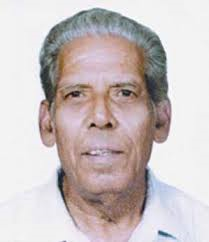
When somebody you have known for 54 years suddenly passes away, it is always a shock. When, however, the person has been in a coma for some considerable time and then pegs down from unnatural causes, it somehow lessens the feeling of distress, for one is forewarned that the worst could happen –– like in the case of Izharul Hasan Burney, popularly referred to as IH Burney. He had had a fall at home and went into a long coma from which he never recovered. Burney was a founding member of the Karachi Press Club. He never won any laurels or honours, but was a ceaseless campaigner for the freedom of the press. He came across as a strict disciplinarian who did his job to the best of his ability. He was a journalist from the old school –– a gentleman, correct, disciplined and hardworking –– a newspaper man to the core who never missed a deadline. He played by the rules –– something that a lot of younger journalists do not do. He knew the difference between news and views and corrected those who didn’t. And above all, he knew the importance of correct English.
Burney was a veteran of the fourth estate with a fierce sense of loyalty. He joined Dawn in 1958, in the hot metal-and-Linotype days when the paper was housed in a ramshackle clutch of barrack-like rooms on the embankment of a drain on south Napier Road –– and moved with the establishment when it was carted lock, stock and barrel to its imposing current location on Dr Ziauddin Ahmed Road. In his 54-year career with the paper, he started off as a crime reporter where he came into contact with the seamy side of the underworld. I still remember his account of an interview he conducted with the station house officer of Jacob Lines who had an inordinate fondness for gambling. He described the fellow as a lower order tyrant with a short fuse who always looked as if he was in desperate need of a drink. Later, he covered other areas of interest; and after his retirement from Dawn was rehired on contract as editor of The Star, the evening newspaper of the Group, where his colleagues described him as a hard taskmaster. He also spent some years in Dubai when Mahmoud Haroon was setting up the Khaleej Times, which belonged to Abdul Rahim and Abdul Latif Galadari. His last assignment was as director of the chairman’s secretariat.
Burney was exceptionally fond of cricket, which along with war was the only other thing that united the Pakistani nation. Of course he had his favourites, like everybody else, which usually changed with the seasons. He was also very fond of chess and we often indulged in a Round Robin contest at the Karachi Press Club with Hasin Ahmed, a former employee of the US consulate general in Karachi, Ghazi Salahuddin of Geo, and Nargis Khanum who contributes articles and reviews to the Business Recorder. On one occasion while the telly was crackling in the background during a match between India and Pakistan, and our batsmen were giving their very best shot at snatching defeat from the jaws of victory, Hasin Ahmed decided to act as commentator. What followed was a highly spirited commentary on the virtue of each of our players in chaste Urdu. When he had finished Burney turned to me and asked who I thought was the greatest batsman that ever lived. I unhesitatingly replied it is Sachin Tendulkar. “Well, now that is settled, can we get on with our chess game?”
Published in The Express Tribune, April 27th, 2014.
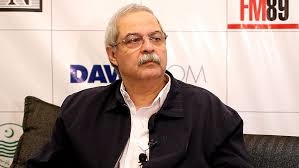
Hameed Haroon, the President of the All Pakistan Newspapers Society (APNS), has expressed concern that the freedom of press envisioned in Article 19 of the Constitution of Pakistan is now facing the gravest threat it has encountered in the past decade, and if press freedoms are allowed to deteriorate further, an irreversible damage will be inflicted on Pakistan’s democracy and the constitutionally stipulated freedoms associated with it. He has emphasised that apart from the dangers of targeting the lives of journalists by extremist elements in the country, a dangerous drift towards anarchy has reared its ugly head in the past week where unbridled behaviour on the part of certain sections of the security establishment and the media, coupled with confused signals emanating from government, have resulted in damaging the freedom of expression and the freedom of press enshrined in the Constitution.
“The signs on the horizon are clear. The fundamental problem appears to be that every one of the principal players involved in this crisis is responsible for a saddening deterioration of public affairs. The apparent undue haste with which the Independent Media Corporation and the Independent Newspaper Corporation, the twin media firms controlling the Geo-Jang group, pointed an accusatory finger at the Inter Services Intelligence (ISI) as being complicit in what can only be described as a murderous attack upon television anchor and columnist Hamid Mir, is only one part of the problem. The promptness with which the ISI through its Deputy Director General responded with a complaint through the Defence Ministry to Pemra to seek revocation of the broadcasting licences and the declarations of the GEO-Jang group, has clearly demonstrated that the institution of the armed forces has acted in haste and has not critically examined the validity of their positions nor of subsequent actions that have stemmed from a misconceived interpretation of press laws.
“At first the government appeared to be dealing wisely with the new threat to press freedoms posed by the murderous attacks on Raza Rumi in Lahore and Hamid Mir in Karachi. The Prime Minister of Pakistan, Mian Nawaz Sharif, speedily acted to form a judicial commission to investigate the attempt on Mir’s life at the highest level. One would have thought with an appropriate high-level commission of enquiry, composed of the superior judiciary, any investigation of the incident of the attempt on Hamid Mir’s life appeared to be in capable hands. However, within a day of the Prime Minister’s announcement, the ISI through the Defence Ministry called for the revocation of the licences and declarations of the GEO-Jang group, with Pemra officials making suitably supportive statements. Thus despite a wise move by the Prime Minister to constitute a commission immediately, the guilt of the offending party had been prejudged, well in advance of the verdict.
“Clearly the need of the hour is to immediately force a cooling down of tempers in all sections of the state and security apparatus as well as, critically, within the media itself. If we are to speak of ensuring the ‘preservation of the sovereignty, security and integrity of the Islamic Republic of Pakistan’ then the imperative is for all contending parties to exercise restraint.
“Additionally, the damage in this potentially explosive powder-keg needs to be contained. The judicial Commission of Enquiry should begin work immediately and avail of the services of Hamid Mir, among others, to reach a satisfactory conclusion as to which persons were responsible for engineering this attempt. Only when the findings are made public can it be determined whether the management and journalists of the newspaper (who have both been alleged as complicit in a slander campaign according to the ISI complaint to the Defence Ministry), were justified in levelling their early allegations. Nor would it be just to proceed with any retaliatory actions against this media group, awaiting the results of the high-level judicial enquiry that has been instituted. Such a travesty of justice is not becoming for any credible democracy.
“I appeal on behalf of the APNS, to Gen Raheel Sharif, the Chief of Army Staff, to rein in the knee-jerk retaliatory measures that have been initiated by various segments of the armed forces. This will lessen any public misperceptions with respect to what the security establishment sees as its principled stand in the matter. It is grossly unfair that Lt Gen Zaheerul Islam or any other member of the security establishment be presumed guilty unless the substance of such guilt can be irrefutably proved in a commission of enquiry. If he is found innocent, the media group found guilty of publishing and broadcasting such allegations against him must render an unqualified apology as per the valid international norms that govern such situations.
“In the meantime I also appeal to all sections of the media to exercise credible restraint and desist from publishing or broadcasting any statement which might be considered prima facie as defamatory or slanderous either against the ISI chief or against the media group. Concurrently it is imperative for the Prime Minister and the Federal Minister for Information to immediately commence a formal dialogue with all the major national bodies — the APNS, the CPNE, the PBA and the PFUJ — to attempt to provide a meaningful framework in which journalists can tell the truth and be protected from life-threats while doing so. This alone will ensure the ordered functioning of a nascent democracy and encourage the government to clamp down with unbridled severity on the spiralling incidents of violence against the media.”
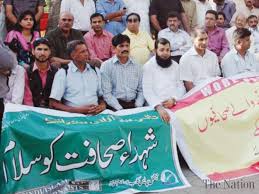
Pak demo for press freedom (Credit: nation.com.pk)
1991 will go down as the year in Pakistan when the press united and stopped the attacks on journalists. Several journalists had been attacked before us, but the attack on Kamran and me started a fire.
There was a reason for it. Kamran worked for the Jang group of newspapers, while I was reporter for the Dawn group of newspapers – the two biggest publishing houses which own about half the effective print publications in the country. Their tycoon owner-publishers, the Mir Shakilur Rehman and Haroon families were represented in the highest newspaper bodies, All Pakistan Newspaper Society (APNS) and the Council of Newspaper Editors and Publishers (CPNE) which wield a huge influence on Pakistan’s governments.
The week after I was threatened with knives, the Pakistan Federal Union of Journalists (PFUJ) and the All Pakistan Newspaper Employees Confederation (APNEC) energized journalist protests in rallies and demonstrations held across Pakistan. PFUJ and APNEC serve as the backbone of the journalist industry and their activism under the harsh dictatorship of Gen. Zia ul Haq has yielded dividents in keeping the media free.
The military backed Nawaz Sharif’s government refused to accept responsibility for the attacks on journalists. Between April 26, 1991 and October 24, 1991, the U.S. based Committee to Protect Journalists (CPJ) sent four letters to Sharif, protesting against the mounting attacks on the press. It was met with stony silence.
It was left to my journalist colleagues to fight for press freedom. Following the attacks on Kamran and me, journalists walked out of the assembly in the four provinces of Pakistan – Sindh, Punjab, Balochistan and Northwest Frontier Province – and forced the assemblies to condemn the attacks on the press. Each day the newspapers appeared chock full of statements by politicians, human rights groups, labor leaders, women and civil society to condemn the Sindh government and demand the arrest of our attackers.
From my sanctuary in Islamabad, my mother told me the phone at our Karachi home rang off the hook. Government officials, politicians, journalists and of course friends…called to ask about my welfare. Embarrassed by the negative publicity they received, officials in Jam Sadiq Ali’s cabinet offered to appoint police officials at a security post they proposed from across my house. It was like asking the fox to guard the chicken coop. I rejected their offer.
Knives Were Used to Send a Message
As I lay low in Islamabad, Benazir Bhutto issued a statement from overseas which squarely blamed the federal and Sindh government for the attacks on Kamran and me. It read:
“Both journalists have a distinguished record of investigative journalism, which includes an expose of the MQM and the criminal activities being conducted at the CIA headquarters. There is no doubt that these attacks have been coordinated by the Jam Government on the instructions of Nawaz Sharif and Ghulam Ishaq Khan.”
It was a fair indictment of the perpetrators, except that it cast doubt on the MQM’s role in the attacks. Although the ethnic party used to dictate news coverage, threaten hawkers and burn newspapers considered to be unfriendly, by the fall of 1991, they were themselves victims of the army’s “Operation Clean up.” As such, they were not in a position to conduct the attacks.
The MQM chief Altaf Hussein’s tried to dispel his party’s image. In a statement carried by the press on September 27, 1991 he said:
“We too differ with some of the media contents, but we go to people and ask them to stop reading a particular paper. The MQM has never attacked any newspaper office or resorted to such things.”
I took the MQM statement with a handful of salt. However in the present instance I recognized that I had grown entangled in the war between the intelligence agencies. This was more apparent because Kamran and I had used the same military intelligence (MI) source in exposing the Jam-Marwat combine.
Apparently, the MI, which is the political wing of the military, was then at odds with the techniques used by the ISI and the intelligence bureau (IB) in arm twisting the PPP’s political opponents. The IB, which snooped around locally to guess which journalists appeared to support the PPP, put us on its “hit list.” The office of Chief Minister Jam Sadiq Ali then flanked by a dime a dozen operators who supported his nefarious tactics, apparently directed the CIA to send knife-wielding assailants to warn us not to interfere in their mafia operations.
A Historic Protest
Five days had passed and I watched the national outcry against the knife attacks from my brother Pervez’s place in Islamabad. That weekend my brother’s colleague at the Quaid-i-Azam University, Dr A.H. Nayyar arrived, carrying heavy editions of the newspapers. Dr Nayyar, a physicist like my brother was hugely invested in the political situation inside Pakistan, and had a wry sense of humor.
Apparently tired from the weight of the weekend editions of the English and Urdu newspapers he had been carrying; Nayyar plunked them down on the table in front of us and flopped down himself.
“What’s the news?” my brother Pervez asked.
“Nothing,” Nayyar replied wearily. “They’re full of statements on Nafisa.”
I went through the newspapers. Statements were splashed across every newspaper by political parties, journalist unions, women’s organizations, minority groups, and human rights groups. In several instances they named the influential culprits and demanded punishment for the attacks on myself and my colleague.
Even while the federal government assured the employers and journalist unions that our attackers would be caught and punished, we knew that nothing of that sort would happen. The matter of a free press was inextricably linked with the polarized politics in Sindh and could not be resolved short of dismissing the Sindh government. The newspaper bodies correctly surmised that the media would suffer unless we demonstrated a collective show of strength.
And so, newspapers, magazines, and periodicals announced they planned to suspend publication on September 29, 1991. It was an unprecedented event, designed to shut down 25 million copies for one day to protest the attacks against journalists. The journalist community declared that as a mark of protest no reporter would attend or cover the government functions on that date – which fell on a Sunday.
On the day of the press shut-down, my journalist colleagues from The News took me to the home of their editor Maleeha Lodhi. Lodhi would later serve as Pakistan’s ambassador to the U.S. – under Benazir Bhutto and then Pervaiz Musharraf. Maleeha looked at me searchingly and said,
“You know, Kamran is associated with the intelligence agencies. But with you we know there is no such association.”
I was glad to hear it.
A journalist friend of mine, Ayoub Shaikh had once asked me, eyes twinkling,
“I sometimes wonder, who does Nafisa work for?”
“No one,” I had said, “I work for myself”.
“I know,” he had said, smiling.
On strike day, the Rawalpindi Union of Journalists organized a national event in Rawalpindi, Islamabad’s twin city, which was addressed by media stalwarts – All Pakistan Newspaper Society President, Farhad Zaidi, veteran journalist turned politician Mushahid Hussain, The News editor Maleeha Lodhi, senior editors, and representatives of journalist unions.
I spoke from a highly charged frame of mind, fired up by my close encounter. Mostly, I told journalists in Islamabad about the incredibly polarized political situation in my southern home province of Sindh.
“If we do not stand together, I am afraid that a journalist may be killed any day now,” I said.
It was a speech I made from the heart, and it appeared in the press on October 1, when the newspapers went back into circulation.
A Pakistan Television team arrived at the press club after I had finished speaking. They had come to film the protests against the attacks on the press nationwide, and needed footage of my speech. I was surprised to see them because the government controlled national television. Their decision to cover the event indicated that Prime Minister Nawaz Sharif was not entirely in charge.
Later, I watched the video footage of the nationwide protests in the districts, towns and cities of the four provinces – with the most impressive march in Karachi from where the attacks had emanated.
LAHORE, April 21: Journalists, civil society activists and politicians have demanded early arrest of the perpetrators of the attack on anchorperson Hamid Mir, while terming it an attack on the freedom of speech and expression in Pakistan.
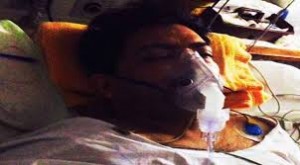
A large number of journalists and civil society activists gathered at the Lahore Press Club where they held a protest demonstration after passing a condemnation resolution. Hamid Mir sustained three bullet injuries in an attack on Faisal Avenue in Karachi by four unidentified gunmen, on Saturday. Doctors said one bullet pierced his intestine while two others wounded his leg and pelvic area, however he was out of danger.
The Lahore Press Club condemnation resolution and protest rally was joined by Pakistan Tehreek-e-Insaf Punjab President Ejaz Chaudhry, MNA Shafqat Mahmood, Andleeb Abbas, Punjab Federation of Union of Journalists leaders Rana Azeem, Afzal Butt and other office-bearers. LPC President Arshad Ansari, Afzaal Talib were also present there. Senior journalists including Geo Lahore bureau chief Khawar Naeem Hashmi and other journalist from Jang Group also joined the demonstration.
Civil society activists including former chairperson of Human Rights Commission of Pakistan and former President Supreme Court Bar Association Asma Jehangir, Hina Gilani, IA Rehman, Abid Hassan Manto, Imtiaz Aalam, Jungo Mohin, Mehmal Sarfraz also participated in the protest rally and demanded early arrest of culprits involved in attack on Hamid Mir besides arrest of their mastermind. The protestors were holding various placards inscribed with slogan in support of Hamid Mir and press freedom.
LPC president Arshad Ansari said that the journalist community would boycott covergare of the government if proper and quick inquiry was not made and justice was denied. Khawar Naeem Hashmi said three bullets cannot stop him (Hamid Mir) from speaking truth. “Our fight which is continue from past will continue for the sake of truth and for the country.”
Earlier, a condemnation resolution was passed in LPC demanding a transparent investigation and bringing the culprits to the book. Separately, Opposition Leader in National Assembly Khursheed Shah, while talking to media at Lahore airport condemned attack on Hamid Mir and urged the government to hold a transparent probe into the incident. PU vice chancellor Professor Dr Mujahid Kamran, Punjab University Academic Staff Association president Ihsan Sharif and secretary Javed Sami have also condemned the attack.
PU Institute of Communication Studies, the alma mater of Hamid Mir, where his father Waris Mir also served as chairman, has prayed for the early recovery of their journalists. ICS teachers and students have demanded the government to book the culprits at the earliest possible.
Punjab Chief Minister Muhammad Shahbaz Sharif has said the attack on a senior journalist Hamid Mir is tragic and highly condemnable. He prayed for early recovery of Hamid Mir. He was talking to media after inaugurating Walton Flyover Sunday.
The chief minister prayed that Hamid Mir take up his journalistic responsibilities again. He said that attack on Hamid Mir was an attack on freedom of press. He said that the federal government would conduct inquiry into the incident and ensure punishment to the culprits. He said that the elements involved in this heinous act will soon be apprehended and brought to justice so that no one could dare attack journalists again.
Federal Information Minister Pervauz Rasheed while talking to media at Lahore airport said as per a directive of Prime minister a committee was being constituted to conduct a transparent probe into the incident. He expressed his complete solidarity with the Hamid Mir and his family as well as the journalists community.
The attack on Hamid Mir has brough large-scale criticism of the government as well as the law enforcement agencies by the Pakistani and foreign media. India media has launched a campaign against ISI quoting a statement of Amir Mir, the brother of Hamid Mir, who is also an investigative journalist.
An ISI spokesman has condemned the attack on Mir and the allegations against the ISI: “The spokesman has condemned the incident of firing on senior anchor Hamid Mir, prayed for his wellbeing and quick recovery. The spokesman said that an independent inquiry must immediately be carried out to ascertain the facts.
Senior journalists, columnists and anchorpersons have expressed concern over the ‘organised campaign’ against the security agencies by a section of the media in the name of the attack on Geo TV anchor Hamid Mir, saying this is a clear violation of journalistic values and code of conduct.
“The attack should be investigated but the adventurism we are seeing should have been avoided and responsibility should have been shown,” said columnist Ayaz Amir.
Another columnist, Talat Hussain, said the allegations by Geo TV are akin to a charge sheet, wherein ISI chief Lt Gen Zaheer-ul-Islam has been blamed. “He [Lt Gen Zaheer-ul-Islam] has been charge-sheeted and the focus is on this one point, ignoring the other aspects,” Talat said.
He added that the television channel and Mir’s colleagues seem to have registered an FIR and issued a judgement in the case. “This is against journalistic rules and, in my opinion, unfair to Hamid Mir himself,” he added.
Express News anchor Shazeb Khanzada said that accusations were leveled against the security agencies as Mir’s brother was very vocal about his emotions at the time of the attack. “We are journalists and our job is to bring the truth forth and struggle for the rule of law and the Constitution,” Khanzada said. “We are not supposed to fight against the federal and state organisations. Unfortunately, yesterday an atmosphere was created to press the DG ISI to resign and I think this resignation should not have been demanded at all,” he added. Khanzada claimed “Indian channels took full advantage of the situation”.
Senior columnist and journalist Haroon Rashid said that Geo TV seems determined to ‘defame the army’ and criticised the television channel’s decision to air photographs of the ISI chief while leveling accusations against him of involvement in the attack on Mir.
“There is something called patriotism [which should be taken into account]. Love of the country is part of one’s faith but Geo people do not care for the country. Do they want to turn Pakistan into an Indian state?” Rashid said.
Published in The Express Tribune, April 21st, 2014.
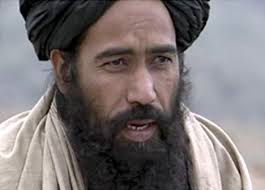
MIRAMSHAH, April 15: Taliban supreme leader Mullah Mohammad Omar has called for seeking guidance from Holy Quran to resolve differences between two rival factions of the outlawed Tehreek-i-Taliban Pakistan amid reports of rifts widening between the groups.
A pamphlet in Pashto carrying the name of Mullah Omar issued in Miramshah (North Waziristan) on Monday said there were serious differences among Mujahideen of Mehsud tribe in South Waziristan and asked them to recite verses from Quran to end hostilities.
“There are none worthy of worship besides You (God). Glorified are You. Surely I am from among the wrongdoers,” say the verses quoted in the pamphlet.
Mullah Omar said it was binding upon every Muslim to recite these verses 100 times a day.
Clashes between the Khan Said and Sheheryar groups leave a large number of militants dead and injured.
They are fighting to capture TTP leadership in South Waziristan.
Sheheryar has refused to accept Khan Said alias Sajna as chief of TTP’s Mehsud militants and declared himself as their leader.
Commander Daud of the Sheheryar group accused Khan Said of trying to occupy the top TTP post in South Waziristan. To end the crisis, he said, both the factions should end the fighting and allow a neutral group chosen by the Taliban leadership to lead Mehsud militants.
Daud said fighting would not end the crisis, adding that his group would accept any decision taken by TTP chief Maulvi Fazlullah.
ISLAMABAD, April 17: The Pakistani establishment has made it clear to the Afghan Taliban and the Haqqani Network that the time has come for them to choose between the Tehreek-e-Taliban Pakistan and the state of Pakistan, if they want to stay friends with Islamabad.
The unprecedented warning from the Pakistani establishment has come at a crucial time when the Pakistani Taliban are holding peace talks with the government in Islamabad, amidst demands to release over 800 Taliban prisoners and to set up a free peace zone in Waziristan.
According to well-informed sources, the warning from the establishment was prompted by the growing cooperation among the Afghan Taliban, the Haqqani Network and the Pakistani Taliban, which has reinforced the martial power of TTP in its current conflict with the security forces of Pakistan.
The TTP spokesman, Shahidullah Shahid, already admitted on October 6, 2013 in an interview that the Afghan Taliban were financially supporting the Pakistani Taliban besides providing them sanctuary in Afghanistan.
The fugitive TTP Ameer, Mullah Fazlullah, who had claimed responsibility last year for killing GOC Swat Major General Sanaullah Niazi is also being sheltered by the Afghan Taliban in the Kunar Province.
However, what seemed to have angered the Pakistani establishment the most were the allegations coming from the Afghan and the Pakistani Taliban, blaming the Inter-Services Intelligence (ISI) for the November 11, 2013 mystery murder [in Islamabad] of Dr Nasiruddin Haqqani, the top fundraiser and organiser of Haqqani Network as well as its liaison man with the Pakistani security establishment.
Dr Nasiruddin, the real brother of Sirajuddin Haqqani, was killed by unknown gunmen in the federal capital 10 days after the November 1, 2013 killing of the TTPAmeer in a US drone attack in North Waziristan. Both were laid to rest in the Dandey Darapa Khel area of North Waziristan which also headquarters the Haqqani Network as well as the TTP.
The decades-old cozy ties between the Pakistani establishment and the Haqqanis were shattered with the mystery murder of Dr Nasiruddin when a spokesman of Haqqani network (Najeebullah) immediately blamed the Pakistani intelligence agencies.
He said: “Dr Nasiruddin had been mediating between a powerful intelligence agency and the Pakistani Taliban for peace talks. But he had refused to mediate further following Hakimullah’s death and the subsequent announcement of TTP not to hold peace talks with the government.
Nasiruddin’s reluctance to mediate anymore after Hakimullah’s killing must have annoyed the agency which decided to eliminate him physically,” the Haqqanis’ spokesman was quoted by the media as saying.
On his part, the TTP spokesman, Shahidullah Shahid, also blamed a Pakistani intelligence agency for the murder, vowing to take revenge. “Nasiruddin Haqqani has been martyred by none other than the ISI.
He was killed because he had bravely backed our Ameer Hakimullah Mehsud,” Shahidullah told AFP when asked about possible killers.
However, on their part, the ISI circles had refuted the allegations of involvement in the murder, saying Dr Nasiruddin Haqqani was either killed by the TTP or by the Afghan National Directorate of Security.
The allegations leveled by the Afghan Taliban and the Haqqani Network were followed by Pakistani intelligence reports that both the groups were supporting and financing the TTP in its terror spree against the khakis and the civilians alike.
Indeed, the Pakistani and the Afghan Taliban are closely allied and both aim to impose a strict version of Islamic laws or Shariah on their societies. However, their leadership and targets differ with each other.
While the Pakistani Taliban mostly focus their terrorist attacks in Pakistan against the security forces which they think are an American ally, the Afghan Taliban target the Afghan and the Allied forces.
Defence Minister Khawaja Asif recently told Reuters in an interview that the Pakistan government was worried about the possibility of increasing convergence between the Pakistani and the Afghan Taliban. “Then the Pakistani Taliban will have a powerhouse behind them,” Khawaja Asif had said.
Analysts believe that these concerns might have prompted the Pakistani security establishment to warn the Haqqanis and the Afghan Taliban against backing the TTP.
However, the close nature of ties between the Afghan and the Pakistani Taliban can be gauged from the fact that the central Shura of TTP has already referred their internal differences to the Afghan Taliban while asking Mullah Omar to intervene and send a delegation to resolve the tiff between two major factions of Mehsud militants from South Waziristan.
A senior TTP commander has been quoted in the media as saying that the Shura thought that the intra-TTP tussle was too serious and critical for them and, therefore, they decided to approach the Islamic Emirate of Afghanistan, a term usually referred to the Afghan Taliban.
There are already reports that the Ameer of the Afghan Taliban is persuading the Pakistani Taliban to end their infighting in South Waziristan as he wants to secure their support against the foreign troops in Afghanistan to launch the annual spring offensive.
Analysts believe the Pakistani security establishment’s warning was meant to dissuade the Haqqanis and the Afghan Taliban from siding with the Pakistani Taliban in their conflict with the state of Pakistan at a time when the Allied forces are set to withdraw from Afghanistan and both the Afghan militia groups would require the crucial support of Islamabad to stage a comeback in Kabul.
In fact, the ultimate agenda of the Pakistani Taliban is the establishment of their own state — the Islamic Emirate of Waziristan [on the pattern of Mullah Omar’s Islamic Emirate of Afghanistan] in Fata where they can impose the Islamic Shariah. On the other hand, the ultimate agenda of the Afghan Taliban is the revival of the lost Islamic Emirate of Afghanistan.
Therefore, following the Pakistani establishment’s warning, Mullah Omar will have to decide whether to befriend the Pakistani Taliban or the state of Pakistan.
Commander Sirajuddin Haqqani of the Haqqani Network is bound to follow suit being a disciple of Mullah Omar just like the Pakistani and the Afghan Taliban. Well informed sources in the establishment say logically speaking Mullah Omar would like to remain a friend of Pakistan instead of inviting its wrath by befriending the TTP.
However, there are those in the Taliban circles who believe that if the Afghan Taliban succeed in regaining power in Kabul after the withdrawal of the Allied troops, there would be greater chances of their joining hands with the Pakistani Taliban whose aims and objectives and those of the Ameerul Momineen are the same.
However, the establishment circles say, in such an eventuality, the Afghan Taliban and the Haqqani Network must know that “strategic depth” would no longer be a consideration of the establishment if the Pakistan government finally orders a military action in North Waziristan after the failure of the talks with the TTP.
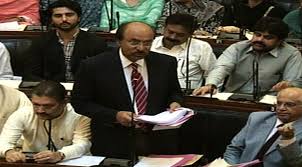
Education Minister Nisar Khuhro (Credit: thenews.com.pk)
KARACHI April 11: Sindh Minister for Education Nisar Ahmed Khuhro has admitted that “a large number of fake appointments were made in the education department during the previous tenure of the PPP government” but shied away from giving an exact number of such appointments which the opposition members put at a colossal 30,000.
He said that action was being taken against the officers concerned responsible for the serious irregularity but no action was planned against former education minister Pir Mazharul Haq.
Mr Khuhro was responding to questions by different legislators during the question hour about the education department at the Sindh Assembly’s session on Friday, which was first chaired by speaker Agha Siraj Durrani and later by deputy speaker Shehla Raza.
Towards the end of the question hour, heated verbal exchanges were made between the treasury and the opposition benches and the assembly depicted a scene from the proverbial fish market when Mr Khuhro raised objection to a remark passed by a legislator of the Muttahida Qaumi Movement (MQM).
Pakistan Muslim League-Functional legislator Nusrat Abbasi had earlier asked if it was true that 30,000 fake appointments had been made in the education department.
Mr Khuhro replied without either endorsing or rejecting the huge figure and said that “a large number of bogus appointments of teaching and non-teaching staff had been made beyond the sanctioned strength” and without completing legal formalities as laid down in the recruitment rules by former directors of school education Karachi in connivance with district officers during 2012–13.
He said that 12 officers had been suspended over misconduct and show-cause notices had been served on them under the Removal from Service (Special Powers) Sindh Ordinance 2000.
The officers are: Attaullah Bhutto, Shamsuddin Dal, Mumtaz Ali Shaikh, Ahmed Nawaz Naizi, Bashir Ahmed Niazi, Ms Farnaz Riaz, Abdul Jabbar Dayo, Abdul Latif Mughal, Musharaf Ali, Liaquat Ali Solangi, Imran Ali Solangi and Naveed Ahmed.
Mr Khuhro said that the suspended officers as well as those who were appointed by them had moved the courts and the government was defending its actions against them.
To another question by Ms Abbasi, the minister said that as against teaching posts of 1,400 in Karachi, 6,000 appointments had been made and against 2,900 posts of non-teaching staff 4,000 had been recruited.
He said in answer to a question that there was no proof the officers had taken bribe to make the excess appointments without following the procedure. Asked if any action had been taken against the former education minister, Pir Mazharul Haq, Mr Khuhro said that no proof of irregularity was found against him either as all formalities – issuing appointment letters, offer letters, etc – were processed by the officers concerned.
He did not respond to a question if it did not amount to connivance on the part of the former minister then it was sheer inefficiency that he failed to detect such a serious and large-scale breach of rules to make 30,000 fake appointments.
Answering a question by MQM legislator Khalid Ahmed that the irregularity was so serious that not only action should be taken against the minister concerned but the chief minister should also accept responsibility for the recruitment of thousands of incompetent people without following the laid down procedure.
Mr Khuhro replied by objecting to the use of the term ‘incompetent’ by the MQM legislator and said the people of Sindh should not be referred to as such. The objection angered all MQM legislators who stood up and started talking simultaneously. Information minister Sharjeel Memon also stood up to second Mr Khuhro’s stand and in the meantime some treasury members started thumping the desks.
Ms Raza, who was chairing the session at that time, asked the opposition members to sit down and calmly listen to the ministers, by remarking that media would call it a fish market. But the legislators did not listen to her and she adjourned the session for 10 minutes after declaring the time for the question hour was over.
Earlier the legislators, including MQM’s Moeen Pirzada, had complained that the written replies were incomplete but Mr Khuhro insisted the replies were complete.
Responding to a question by MQM’s Heer Soho about the bills passed “by the assembly for the establishment of universities over the past five years,” the written reply gave names of only five public sector universities and on a supplementary question the minister said the bills regarding some other private universities were also passed but he insisted the written reply was complete. Ms Raza agreed with the legislators that incomplete information was provided and that complete information be given.
To another question by Ms Soho which asked specifically “district-wise number of schools which were provided facilities between 2010–13,” the written reply did give the number of schools but did not give the district-wise breakup.
But the minister still insisted that complete information had been provided and surprisingly, speaker Durrani, who was presiding at that time, agreed with the minister. Mr Khuhro later started to read out names of the districts in which schools had been rehabilitated.
The written reply said that rehabilitation of a total of 2,659 schools had been undertaken since 2010 – 11 and 498 of these were still under construction. Out of the 2,659 schools, 319 schools were shelter-less, 1,219 did not have boundary walls and 1,561 were without toilets while others lacked some other basic facilities, it said.
The Standing Committee of National Assembly on Information, Broadcasting and National Heritage has recently rekindled a forlorn hope. In a recently held meeting, the committee adopted a resolution to declare 13 mother languages of Pakistan as national languages and establishing a Languages Commission for scientific research and policy formulation to promote Pakistani languages.
In Pakistan, the seeds of discontent were sown right from its inception when Bengalis asserted for their language to be the national language along with Urdu. Denial of that sparked a nationalist movement that culminated in a debacle in 1971. The threat of Indian aggression coupled by a flippant attitude of the ruling elite at a formative stage resulted in a denial of historic cultures and identities of the federating units.
Islam and Urdu were construed as cementing factors for the culturally-diverse and politically-discrete federating units. Intentions and reasons apart, the approach was too bitter particularly for Sindh and Bengal where native languages were highly advanced and remained official languages for decades.
Language movements in Bengal and Sindh subsequently resulted in parturition of nationalist movements in both provinces.
Recognition and respect for historic identities and cultural inheritance is pivotal for a federation. Founders of Pakistan attempted to mould it into a nation state which was an unnatural and flawed approach. Religion and imposed cultures have never succeeded in unifying people, especially when some of them are discriminated on the basis of their identities. Had there been a fair representation in the state affairs e.g. civil and military bureaucracy, other elements could probably have endured or subsided with time. When cultural identity is made the basis of political and economic oppression, it erupts like a volcano.
At the time of partition, both Bengali and Sindhi were official languages in their respective provinces. Both languages had a cherished history and a treasure trove of literature. Both languages were not only lingua franca of their provinces but were also in vogue for revenue, court, education and other official business.
The first Bengali dictionary/grammar was written by a Portuguese missionary between 1734 and 1742. Nathaniel Brassey Halhed, a British grammarian, wrote a modern Bengali grammar in 1778. Ram Mohan Roy, the great Bengali reformer also wrote “Grammar of the Bengali Language” in 1832.
In 1937 at the Lucknow session of the Muslim League, the Bengalis objected to Urdu becoming the lingua franca of all Indian Muslims. In 1947 when Dr Ziauddin Ahmad, Vice-Chancellor of the Muslim University of Aligarh, declared that Urdu would be the national language of Pakistan, Bengali linguist Dr Shahidullah replied that this ‘would be tantamount to political slavery’. The controversy intensified after the creation of Pakistan.
On February 25, 1948, Mr Datta, a Congress Leader, claimed on the floor of the National Assembly of Pakistan that out of 69 million people, 44 million speak Bengali in the country, therefore, Bengali, along with English and Urdu, should be accepted as a language of the Assembly.
Muhammad Ali Jinnah, during his visit to Bengal in March 1948, took pains to persuade Bengalis for embracing Urdu as the only national language but he could not crack the relentless obstinacy. A macabre episode of 1952 caste the dye and Bengali language movement turned into a fireball of Bengali nationalism, ultimately dismembering the country.
Similarly, Sindhi language owned a rich legacy. Sindh was occupied by British army in 1843 and was annexed with Bombay. In 1848, governor of the province Sir George Clerk ordered to make Sindhi the official language in the province. Sir Bartle Frere, the then commissioner of Sindh, issued orders on August 29, 1857 advising civil servants in Sindh to qualify examination in Sindhi. He also ordered Sindhi to be used in all official communication. Seven-grade education system commonly known as Sindhi-Final was introduced in Sindh. Sindhi Final was made a prerequisite for employment in revenue, police and education departments.
In 1854, Arabic script was adopted for Sindhi language. In 1848 and 1855, English-Sindhi dictionaries were produced. Eminent German scholar Ernest Trump published Sindhi grammar in 1872. Karachi at the time of partition had a population of 0.4million with 61 per cent Sindhi-speaking compared to only 6 per cent Urdu-speaking population.
With influx from India and exodus of Hindus, Sindh underwent a demographic shift. In 1951, the same city had 57 per cent Urdu-speaking population and Sindhis shrunk to a mere 8.6 per cent. At the time of partition, Karachi had 1300 Sindhi medium schools which were subsequently converted into a no-go area for Sindhi language.
President Ayub constituted a Commission on National Educational also known as Sharif Commission, which declared Urdu as the only medium of instruction from the sixth grade. Sindhis took this decision as an affront and launched a movement against the recommendations of the Commission. Language riots of 1971 and 1972 created an ethnic crevasse in Sindh which was further widened by ethnic strife in 80s and 90s.
Sindhi Adabai Sangat (SAS), a prominent literary and cultural organisation of Sindh, had been tirelessly championing the cause of Sindhi language. SAS dispatched 100,000 postcards to the president of Pakistan in 2009 demanding the status of national language for major languages of Pakistan. Sindhi Language Authority also presented a separate memorandum of the same demand to the government.
In 2010, leading literary organisations from all four provinces and Progressive Writers Association of Pakistan presented the same memorandum to the parliamentarians. In 2010, two members of parliament from Sindh presented two separate bills before the National Assembly, demanding major languages of Pakistan to be declared national languages. These bills were rejected without any plausible explanation.
An anachronistic pretext of threat to national integrity is too stale to subscribe to. Had the single language guaranteed national integrity, East Pakistan would not have seceded.