Taliban Tentacles Fasten Grip around Karachi

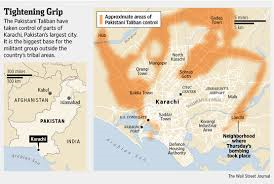
Taliban Penetrate Karachi (Credit: onlinewallstreetjournal.com)
Taliban Penetrate Karachi
(Credit: onlinewallstreetjournal.com)

KARACHI, Feb 2014 — The Pakistani Taliban have tightened their grip over the country’s commercial hub, officials and residents said, despite a five-month government crackdown here.

On Thursday, tentative peace talks with the government were thrown into disarray when the militants claimed responsibility for a roadside bombing that killed at least 12 police officers when the bus taking them to duty was destroyed near the city’s southeastern Landhi neighborhood, an area the Taliban dominate.

Karachi is likely to pay a steeper price if efforts by Prime Minister Nawaz Sharif’s government to forge a peace deal with the al Qaeda affiliate’s leadership in tribal areas collapse and a military operation is launched there.

“If the peace talks fail, we fear that a big terrorism wave will hit Karachi,” said Raja Umar Khattab, a senior officer in the counterterrorism Crime Investigation Department of the Karachi police.

The Pakistani Taliban are a national threat, with Karachi providing the group a vital financial lifeline. Money raised in Karachi from extortion, land-grabbing, kidnapping and robberies is sent to the group’s leadership in the tribal areas along the Afghan border, security officials said.

The January assassination of Karachi’s most prominent counterterrorism police officer, Chaudhry Aslam, showcased the militants’ reach and had a chilling effect on the police force, officers said.

“Everyone now is at a loss about who will step into Chaudhry Aslam’s shoes,” said Omar Shahid Hamid, a senior counterterrorism officer now on leave. “He had become a symbol, someone who is standing up to [Tehreek-e-Taliban Pakistan]

In January, the militant group attacked police officers, shot and killed three journalists, repeatedly bombed paramilitary Rangers who are helping carry out the crackdown, gunned down three polio-vaccination workers, and slit the throats of six devotees visiting a shrine. Karachi police said 27 officers were killed in January, after 168 were killed last year.

Mr. Sharif, concerned that his economic-revival plans would be undermined by spreading mayhem, initiated the security operation in September. Karachi, a fast-growing city of at least 20 million, has a huge industrial base, the country’s only major port and is the nation’s center of banking and finance.

Some officers said they fear local political support is fading for the Karachi operation, which they view as a last chance to regain control of the city from TTP and other militias. The operation’s implementation depends largely on the Sindh provincial government, which is run by the opposition Pakistan Peoples Party, and which controls Karachi’s police. There are signs of tension between the Rangers, who answer to Islamabad, and the provincial government, which is based in Karachi, security officials and politicians said.

“This is a difficult path,” said Interior Minister Chaudhry Nisar Ali Khan, visiting Karachi on Thursday. “But, God willing, we will bring peace back to Karachi.”

Ahmed Chinoy, head of the Citizens Police Liaison Committee, a statutory body that works with the police to reduce crime, said parts of Karachi were still too dangerous for regular patrols, while the crackdown targeted regular crime. “While the focus of the operation was on other crimes, the militants got breathing space and took advantage.”


Last year, five different police chiefs served Karachi, disrupting the battle against crime. The current chief, Shahid Hayat, said that at any given time, he had about 7,000 officers available to be deployed on the streets, out of a total force strength of 27,000—9,000 officers are kept on personal security duty for politicians and other officials.

It is only in recent weeks, he added, that the operation has shifted focus to jihadi groups such as TTP.

“I’m being asked to control Karachi with such small numbers of police,” said Mr. Hayat. “Policemen are being killed day in, day out. But we’re still fighting.”

More than 13,000 people have been arrested in the sweep since September, in more than 10,000 raids by police and the paramilitary Rangers force, the provincial Sindh government said. But officials and residents said it has left largely untouched the poor outlying neighborhoods that remain under TTP control, encircling the city, including one adjacent to the new U.S. Consulate compound.

TTP is the most aggressive armed group operating in multiethnic Karachi, alongside the ethnic Baluch gangs in Lyari, and the Muttahida Qaumi Movement, a party that represents the descendants of Muslim migrants from current India, and that has traditionally dominated Karachi politics.

The Karachi security operation led to the arrest of just 63 TTP members through the end of January, police said. That compared with the arrest of 296 people affiliated with the MQM, 101 with links to the Awami National Party—a secular Pashtun political party—and 171 members of Lyari gangs.

Sharfuddin Memon, the adviser to the Sindh provincial chief minister on security issues, said the operation had led to a 50% drop in assassinations and kidnapping for ransom in the city. He said police “morale is high” but the conviction rate for serious crimes is just 5%.

“There has been an impact from the operation, but if we don’t sustain it, we are in trouble,” said Mr. Memon.

Research by The Wall Street Journal, based on conversations with security officials and urban planners, shows TTP still control or dominate about 470 square miles of Karachi, or nearly a third of its area, where at least 2.5 million people live.

TTP’s sway in Karachi extends right up to Saddar—the city center—and into areas such as Sultanabad, a ramshackle community next to the new U.S. Consulate compound.

These are districts with a majority population of Pashtuns, the same ethnic group as TTP’s leadership. These areas that encircle the city include Baldia and the Sindh Industrial Trading Estate to the west and Gadap in the north. Residents in these areas said TTP’s hold had gotten stronger over the past year.

“There’s been no action against the main body of the TTP, just against some smaller factions,” said Khawaja Izharul Hassan, a provincial MQM lawmaker.

In addition to the main TTP faction from the Mehsud tribe of South Waziristan in the tribal areas, long established in Karachi, the city is increasingly plagued by another TTP faction from the Mohmand tribal area, police officers said, along with TTP Swat.

Islamist militants also have influence over some non-Pashtun districts of the city, such as Lyari in the southwest where TTP ally Lashkar-e-Jhangvi has a base. TTP has an ability to stage attacks across Karachi.

TTP dominates 33 of Karachi’s 178 administrative units—known as union councils— security officials said. These tend to be the larger, peripheral, districts, with ever expanding shanty settlements that eat into the surrounding desert. The militants are also now getting more educated recruits, including non-Pashtuns, and spreading to neighboring areas outside Karachi, including Hub to the west and Jamshoro to the northeast.

In the areas it controls, TTP is levying a tax on residents and businesses, said a businessman in Sohrab Goth, a Taliban-run neighborhood just north of the city center.

The militant group has set up courts in neighborhoods to resolve disputes, which give written judgments, handling matters that include disagreements over land ownership and regulating levels of theft from power lines that they allow, residents said.

“The Taliban milk money from their own communities,” the businessman said. “They have calculated the worth of every person here.”

For instance, on a monthly income of 40,000 rupees ($380), TTP takes a levy of 1,000 rupees. Concentrate blocks made for use in construction—a major business in the Pashtun areas—are sold for 18 rupees each, of which three rupees goes to the Taliban. The businessman said TTP’s hold had hardened over the past year.

“The Taliban have complete control of Karachi,” said Bashir Jan, a senior member of the Awami National Party, the main secular Pashtun political party in the city. “They can go anywhere and do what they want.”
Pakistan Bars British Journalist after book on Balochistan

British journalist Willem Marx was recently banned from entering Pakistan  after the publication of “Balochistan: At a Crossroads,” his book about a “forgotten” region in that country. Marx was heading to the country for the Lahore Literary Festival.

The blockage of Marx’s visa is seen as the latest in a series of moves by the Pakistani government to discourage journalists from covering the region.

Balochistan is a region that sits in parts of Pakistan, Iran and Afghanistan. It has long been unstable and mired in political violence over its autonomy. The Pakistani government has been accused of “forced disappearing” and other human rights violations in the region.

“Balochistan: At a Crossroads,” a collaborative effort of Marx and French photojournalist Marc Wattrelot, was published earlier this month. The two traveled extensively in Balochistan to capture all aspects of life in the contested area. All of the proceeds are being donated to UNICEF to polio eradication efforts in Quetta, the capital of the Balochistan province.

Marx and other journalists have accused the Pakistani government of blocking information coming out of the region. Balochistan, like most regions outside of major Pakistani urban areas, can only be visited with permission from Pakistani security agencies.

A representative for Marx said he has been detained in the past and has had tapes confiscated by Pakistani authorities. New York Times reporter Carlotta Gall was assaulted and detained by Pakistani officials in 2006 after a report she did in Quetta. In at least one occasion, Marx was able to travel to the region and report by saying he was writing on economic topics.

The government is also accused of blocking access to Balochistan-related information within the country. When asked, Marx said, “It’s like a hidden secret. I cannot get a single person to sell this book. It’s quite bizarre. It’s not because the booksellers don’t want to sell it. They are worried that they will have their premises investigated. No wholesaler will import it. It’s really extraordinary.”

Yesterday, U.S. Representative Louie Gohmert spoke out about the violence in Balochistan and criticized the welcoming of Pakistani officials by the U.S. State Department.

The State Department heavily disagrees. It released a statement soon after, saying that “the United States respects the territorial integrity of Pakistan. It is not the policy of the administration to support independence for Balochistan.”

An Unlikely Romance Ends in Tragedy
Young American idealist killed by Indian rickshaw driver husband

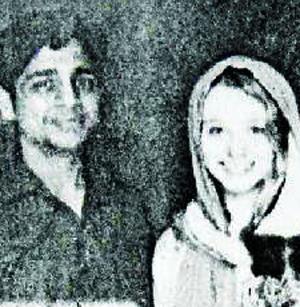
Erin White & Bunty Sharma (Credit: timesofindia.com)
Erin White & Bunty Sharma
(Credit: timesofindia.com)

A devoted American social worker has been stabbed to death by her Indian husband of five months – who then returned to their home and blew himself up.

Erin Willinger, 35, a yoga teacher and psychologist from New York, was found dumped in a bush with multiple stab wounds to her face and body in the city of Agra on Thursday night, according to Indian news reports.

Her husband, 32-year-old Bunty Sharma, returned to their home, where he is believed to have ignited cooking gas, causing a massive explosion that killed him.

The tragedy comes just months after the couple met and married – but accused each other of lying about previous marriages, while Willinger also accused her new husband of infidelity.

Willinger had visited Agra – which is about 120 miles south of New Delhi – with a group of Americans in July and chose to stay after telling the Indo-Asian News Service she wanted to help make the city worthy of ‘such a beautiful monument as the Taj Mahal’.

But within weeks, their marriage began to crumble and by December, they started living separately.

Both accused the other of hiding previous marriages and Willinger, who went by the alias Kiran Sharma and also uses the name Erin White, accused her new husband of greed, infidelity and cruelty, the Hindustan Times reported.

White approached the Agra Police’s Mediation Cell for Family Matters in January, asking for help and the couple was put in touch with a counselor, who encouraged them to start living together again.

But the arguments continued and on Thursday evening, Bunty reportedly drove Willinger to a quieter section of the city and stabbed her to death in his taxi cab.

He then shoved her body in bushes along the road, the Hindustan Times reported.

He then returned home and locked himself in his room on the second floor.

Local residents then said they heard a loud explosion and saw flames erupting from the room. When they rushed inside to rescue him, they found his charred body on the floor.

Authorities believe Bunty sparked the blast by igniting gas he had released from a cooking gas cylinder in the apartment.

The union home ministry and the American embassy in New Delhi have been informed.

A State Department official confirmed Willinger’s death.

‘We offer our condolences to her family and loved ones on their loss,’ the official told MailOnline.

‘We are in contact with her family and are providing all appropriate consular assistance. Out of respect for the privacy of those affected, we decline further comment.’

Before her death, Willinger had revealed that she was deeply in love with Indian culture and wanted to improve civic conditions in Agra.

On the day she was killed, she addressed a press conference to promote her campaign ‘Agra Sunder Hai’, and several local NGOs pledged support to her.

She had said she hoped to help Agra with improving its water, plastic waste and garbage disposal.

She said that she wanted to stay in Agra until ’60 or maybe more – as long as the body permits’.

‘This city needs a push,’ she said. ‘The city is dirty and no one wants to stay back here for a night. You have to teach people to be conscious of hygiene, health and sensibilities of others. You have to build trust and reach out.’

She spoke of taking money from the rich to give resources to the poor, and said she hoped to get actors and other celebrities on board to help make programs more attractive.

And she was confident that her idea was going to be a success.

‘I am talking with so many [students, businessmen and professionals] and they all agree that the time for change has indeed come,’ she said.

‘You need role models. A democratic society needs inspiring heroes to move ahead. You need success stories to diffuse the clouds of negativity all around.

Waziristan Offensive likely by March

Pak Afghan border (Credit: geotv.com)
Pak Afghan border
(Credit: geotv.com)

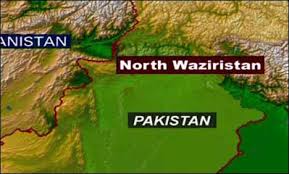
ISLAMABAD: The government is all set to launch a ground offensive in North Waziristan Agency, signalling a paradigm shift in its policy. Talking to The Express Tribune, both government and security officials confirmed that the civil and military leaderships have finally concluded that a targeted military operation is now ‘unavoidable’.

A high-level meeting chaired by Prime Minister Nawaz Sharif and attended by army chief General Raheel Sharif and other senior officials on Thursday discussed several options to deal with the Taliban in the face of a recent surge in attacks carried out by the group.

we-army

One official, who asked to remain anonymous, disclosed that there was a ‘greater realisation’ among all stakeholders that certain groups will never enter into dialogue and will have to be dealt with the use of force. Sources said the decision to initiate a ground offensive in March is believed to be taken on account of the challenge posed by the harsh winter in North Waziristan to security personnel operating in the agency. However, surgical strikes may soon be carried out against Taliban hideouts ahead of the targeted operation in the tribal region.

When asked a security official pointed out that the military was ready to take on the challenge. “We [the army] have the capacity and the will to eliminate all such groups which are not willing to reconcile,” said the official.

Pakistan has long resisted foreign pressure to launch a ground offensive in North Waziristan, which is considered a safe haven not only for TTP, but several other groups, such as the Haqqani Network.

It is unclear, however, whether the March operation will also target the Haqqani Network.

the-decision

One retired officer, who is still closely connected with the security establishment, said the Haqqanis by now probably understand that the operation in North Waziristan is inevitable.

“The Haqqanis have strongholds in Afghanistan’s three provinces and they will definitely move out of North Waziristan before the start of any operation,” the retired two-star army officer told The Express Tribune.

However, he said a military operation should have been carried out much earlier and a lot of time had already been wasted in the name of peace talks.

The Express Tribune has also learnt that the recent air strikes in North Waziristan were carried out after security agencies exploited divisions within various outfits operating in the region. Some of the groups, which are willing to hold peace talks, had provided ‘key intelligence’ about the presence of senior TTP commanders and other foreign fighters in Mir Ali and Miramshah.

On the other hand, a senior cabinet member said the government would still hold talks with groups willing to reconcile. “But those who are not willing to accept our peace offers will have to be dealt with accordingly,” he added.

Gas shortage after blasts brings misery to Punjab

Gas pipelines to Punjab (Credit: bbc.co.uk)
Gas pipelines to Punjab
(Credit: bbc.co.uk)

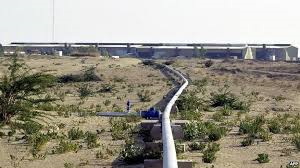
LAHORE, Feb 10: Civic, industrial and commercial activities almost came to a halt as most areas of Punjab passed Monday without gas due to an explosion in three main pipelines in Rahimyar Khan the previous day. Gas authorities say the situation will start improving from Tuesday (today).

“It is perhaps the worst-ever gas pipeline blast in Punjab as it caused over 45 per cent gas shortfall (700mmcfd) in the 1650mmcfd quota allocated for the province in winter. Before the incident, 950mmcfd was flowing in the blown-up pipelines,” Minister for Petroleum and Natural Resources Shahid Khaqan Abbasi told Dawn on Monday.

He said SNGPL teams had started repair work and hoped that supply to domestic consumers would be restored by Tuesday afternoon and that to industry by Wednesday afternoon.

He said the gas pipelines of 18-, 42- and 36-inch diameter had been damaged by the blasts, but luckily a 24-inch pipeline remained safe. This enabled the SNGPL to provide gas to domestic consumers partially on Monday. “However, most domestic consumers are either facing extreme low gas pressure or getting no gas,” Mr Abbasi said.

He said he had asked an additional secretary of the ministry to hold an inquiry into the blast. Rahimyar Khan District Police Officer Sohail Zafar Chattha said initial police findings suggested that the blasts might have been caused by gas leakage. He said police had collected some metal parts from the site and sent them to a laboratory for analysis. Police will be in a position to say whether it was a terrorist activity or accident only after receiving a report from the laboratory.

Mr Chattha said police had found an IED (improvised explosive device) in the same site a month ago. “We gave a cash award of Rs10,000 to the man who provided the information about presence of the IED.”

He said police had recently provided SNGPL security guards to protect its pipelines and other installations, but the company was required to hire its own guards.

Life was badly affected in Lahore, Faisalabad, Multan, Sargodha, Sahiwal and other towns and cities in the province.

In Lahore, the situation was miserable as a majority of people, including schoolchildren, left homes without having breakfast. There was no gas for commercial ovens (Tandoor), leaving the people with no option but to arrange food from bakeries.

People were also seen either buying firewood or LPG cylinders for cooking.

“You cannot imagine how we spent the whole day. After sending my children to school and husband to his office on empty stomach, I myself came out to purchase some wood to prepare lunch,” said Sakina of Rehmanpura (Ichra).

Aqeel Ahmad, of Wapda Town, said he burnt some waste furniture wood lying at his home to help his wife cook something.

Saleem Shahid adds from Quetta: The banned Baloch Republican Army has claimed responsibility for the blasts in the gas pipelines in Rahimyar Khan. Calling journalists from an unidentified place on Monday, its spokesman Sarbaz Baloch said the BRA had blown up the pipelines because these were supplying gas to Punjab from the Sui gas field in Dera Bugti district, Balochistan.

Missing Persons found in Mass Graves in Balochistan

Baloch youth picked up (Credit: balochistanhcrblogspot.com)
Baloch youth picked up
(Credit: balochistanhcrblogspot.com)

KHUZDAR – Khuzdar administration on Monday exhumed at least 11 more decomposed bodies from a mass grave discovered in Mayy area of Tutak, about 50-kilometre from Khuzdar city. The bodies are too decomposed to be recognised. A couple of days earlier on Sunday, two bodies were recovered from same area.

“At least 11 decomposed bodies were brought to District Headquarters Hospital Khuzdar,” said medics at hospital adding, “The bodies were decomposed beyond recognition like the two discovered earlier in Tutak, a desolate place far away from the main population centre.”

Total 13 bodies have so far been recovered and all of them were buried in Police Line graveyard in Khuzdar in presence of law enforcing agencies.

Deputy Commissioner Khuzdar Waheed Shah said that Balochistan levies personnel have again started digging the area. The identity of the bodies could not be ascertained; however, he added, that DNA test might help determine the identities.

“There could be few more, as we saw human remains,” said an official on the condition of anonymity. Presence of vulture and other wild birds attracted the attention of the shepherds who informed the district administration about the mass grave.

Baloch nationalist parties and relatives of the missing persons claimed that the victims could have been abducted and killed in official custody. “We fear that these bodies belonged to missing persons. Judiciary and Human Rights Watch should press the government to carryout a transparent investigation into this humanitarian issue,” said nationalists.

A shutter-down strike was observed in different Baloch-dominated districts on the call of Baloch National Front. The strike was observed in Turbat, Panjgour, Nushki, Kalat, Mastung and others area of the province where shops and markets remained shut.
Meanwhile, the Human Rights Commission of Pakistan voiced its serious concern over the discovery of decomposed bodies in Khuzdar district, calling upon the federal and Balochistan government to urgently establish identity of the deceased and their killers.

In letters written to the federal interior minister and Balochistan chief minister, the HRCP noted that the bodies were far too decomposed to be recognisable. So far there was no information about who the deceased were and who killed them. Initial reports suggested that the persons had died around a month earlier and parts of their bodies had been eaten by wild animals.

According to reports and eye-witness accounts, there was a camp in the neighbourhood where some proxy gangs operated against the tribesmen who were not supporting them. It is more possible that the opponents were picked up, killed and dumped in the mass grave as a part of policy.

The HRCP demanded that a thorough probe must be initiated and all efforts made to establish the facts in the case and bring the perpetrators to justice. If necessary, DNA tests should be conducted at the earliest to identity the deceased, it added.
“Such an investigation is all the more vital in view of the spate of violence, targeted killings and enforced disappearance and dumping of dead bodies of missing persons in Balochistan in recent years. The HRCP also called upon the government to facilitate relatives of missing persons who are keen to learn if the deceased included their dear ones.

The HRCP also urged the federal and provincial governments to find a solution to the violence, lawlessness and killings in Balochistan and stressed that such a solution must respect due process and human rights and that emphasis should be placed on finding political means to address the challenges.

US Puts Lashkar-i-Jhangvi chief on Global Terror List

LEJ chief Malik Ishaq (Credit: pakistantoday.com)
LEJ chief Malik Ishaq
(Credit: pakistantoday.com)

LAHORE, Feb 7- The US has added the founder of a banned Pakistani militant group to its list of global terrorists, blaming him for the deaths of hundreds of Pakistanis.

Malik Ishaq is the founding member and leader of the Lashkar-e-Jhangvi (LJ), a banned Sunni Muslim organization dedicated to killing or driving out Pakistan’s minority Shi’ite Muslims.

“In 1997, Malik Ishaq admitted his involvement in terrorist activity that resulted in the deaths of over 100 Pakistanis,” the US State Department said on its Web site in a statement posted on Thursday.

It noted he had also been arrested in connection with twin bombings in the western Pakistani city of Quetta that killed about 200 people last year.

“LJ specializes in armed attacks and bombings and has admitted responsibility for numerous killings of Shi’ite religious and civil society leaders in Pakistan,” the State Department said.

The designations means anyone who supports Ishaq or Lashkar-e-Jhangvi could have their assets frozen by the US government.

Ishaq’s deputy and spokesman said the decision to list Ishaq was the result of a conspiracy between the United States and Iran, a majority Shi’ite country.

About 20 percent of Pakistan’s 180 million people are Shi’ite.

“The US administration took the step on Iran’s instigation,” said the spokesman, Hafiz Ghulam Rasool Shah.

“Malik Ishaq was acquitted by Pakistan’s courts and he is leading the life of an honorable and peaceful citizen of Pakistan.”

Ishaq has spent 14 years in jail on dozens of murder or terrorism charges and was in prison when some of the attacks happened. He was eventually acquitted.

“The US made the decision in the wake of attack on Sri Lankan Cricket team in Lahore. When the incident occurred, Ishaq was in Multan district jail,” he said, referring to a deadly 2009 attack on the sports team.

“Right now, Ishaq is in jail on the charges of making hatred speeches only.”

In 2012, Ishaq told Reuters that Shi’ites were the “greatest infidels on earth” and that Pakistan should declare them non-Muslims.

“Whoever insults the companions of the Holy Prophet should be given a death sentence,” Ishaq declared.

Fifth International Karachi Literature Festival Begins

KLF features book displays (Credit: chowrangi.pk.)
KLF features book displays
(Credit: chowrangi.pk.)

Karachi, Feb 7: The Karachi Literature Festival (KLF) begins in Karachi at the Beach Luxury Hotel till February 9. It will have 100-plus sessions featuring 200 speakers from 11 countries.

Over 180 Pakistani and 34 international authors, poets and academics will grace the Festival.

According to Ameena Sayyid and KLF director Asif Farrukhi awards will be given to authors for three different prize categories: KLF-Coca-Cola Best Non-Fiction Book Prize, KLF-Embassy of France Prize, and KLF Peace Prize.

The panel of judges for the prizes include some of Pakistan’s most eminent critics, writers and scholars, who have short-listed three books for each prize category.

According to the programme, proceedings on the opening day will commence with a discussion with Moni Mohsin; a session titled ‘The Power of the Fourth Estate’; and a session on Faiz. These will be followed by a conversation with Mustansar Hussain Tarar; a session with Bushra Ansari; a session on ‘Literature and Music in Pakistan’ with Tina Sani, Zeb Bangash, and Sarmad Khoosat as panellists; readings by Intizar Hussain with the launch of Silver Jubilee edition of his novel Basti, and a conversation with Rajmohan Gandhi. The first day will end with a Mushaira.

Important sessions on the second day of the festival include ‘Contemporary Fiction at Home and the Diaspora’; New Voices in Sindhi Poetry’; ‘Shayer e Awam: Habib Jalib’; ‘Glitter of the Silver Screen’; ‘Qawwali Music and the Sufi Poetry Tradition’; conversations with Kamila Shamsie, Uzma Aslam Khan, Zehra Nigah, and Raza Ali Abidi; dramatic storytelling by Nadia Jamil; and Dastangoi by Danish Hussain, Darain Shahidi and Mahmood Farooqui.

Highlights of the third day will include sessions on ‘Baloch Literature and Landscapes’; ‘Karachi: From Stone Age to Cyber Age’; ‘Bringing Down the Gender Walls’; ‘Drama and the Small Screen’ with Haseena Moin, Sultana Siddiqui, Shakeel, Seema Taher Khan and Attiya Dawood as speakers; conversations with Ashis Nandy, Navid Shahzad, Mohammed Hanif, Amar Jaleel, and Abdullah Hussain; Readings by Zia Mohyeddin;  ‘Chulbuk Chori’ a play by Thespians Theatre; screenings of Sharmeen Obaid Chinoy’s films; kathak performance by Nahid Siddiqui; and a concert by Laal.

The festival will include launches of about 28 books including Dr Rajmohan Gandhi’s book Punjab: A History from Aurangzeb to Mountbatten, The Kashmir Dispute 1947 by A.G. Noorani, I’ll Find My Way an anthology of short stories edited by Muniza Naqvi, The Rest is Silence: Zahoor ul Ikhlaq: Art and Society in Pakistan, Jazeera Sukhanwaran by Ghulam Abbas, Delhi by Heart by Raza Rumi, The Prisoner by Omer Shahid Hamid, Urdu Afsanay by Hasan Manzar, and What’s Wrong with Pakistan? By Babar Ayaz.

Energy shortages force Pakistanis to scavenge for wood, threatening tree canopy

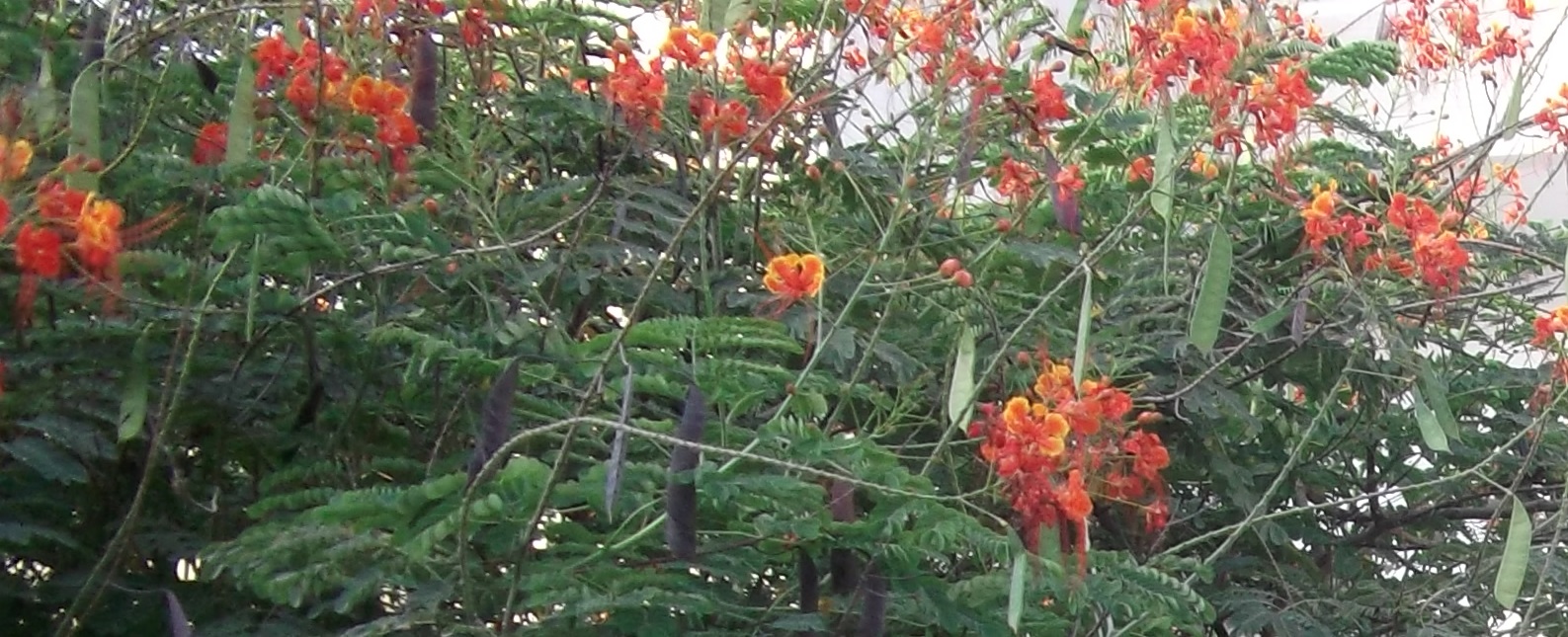
Gul Mohar tree in Pakistan

ISLAMABAD, Feb 1 — Ramesh Iqbal lives in one of the Pakistani capital’s middle-class neighborhoods and attends college. But on a recent day, he and two friends emerged from a wooded area, their arms full of the logs and branches they had to gathered to warm their homes.

“We never thought we would face such a situation,” said Iqbal, 24, wearing a sweater over a collared shirt. “But due to winter, and cold, we are facing problems.”

In a country where about 20 percent of residents lack basic utilities, generations of poor and rural Pakistanis have relied on timber to make it through the winter. But severe energy shortages are turning even wealthier families into wood scavengers.

They snap branches, uproot saplings and hack trees, and they carry their bounty any way they can — by truck, motorcycle and even bicycle. And with each trip, Pakistan loses another piece of its tree canopy, an alarming trend for one of the world’s least forested countries.

Environmentalists and government officials fear Pakistan is now at a tipping point, having retained just 2 to 5 percent of its tree cover. Officials fear the deforestation will contribute to more lethal floods, disruptive landslides, bacteria-ridden drinking water and stifling air pollution. The country may also become more vulnerable to climate change.

“This is a very dangerous situation for Pakistan,” said Pervaiz Amir, a local forestry and agriculture expert. “The middle class are now cutting trees and burning trees.”

But convincing the public of the value of tree cover has been a tough sell, especially this year, when electricity is out for up to 10 hours each day and the natural gas supply is often too low to power heaters and stoves.

Even in Islamabad, known as one of the greenest capitals in Asia because of the nearby Margalla Hills National Park, wooded areas and vacant lots are being slashed, leaving behind rows of twisted, yellow, ankle-high sapwood.

Shortages of gas, electric

Under British colonial rule, Pakistan was sparsely populated and largely avoided the tree-cutting that stripped many other areas in South Asia of greenery. Pakistan had towering timber forests in the north, coniferous forests in its western hills and lush mangrove forests where its southern border meets the Indian Ocean.

But as Pakistan’s population grew from about 37 million in 1947, when it was partitioned from India, to an estimated 180 million residents today, forests were rapidly depleted. When the Soviet Union invaded Afghanistan in 1979, more than 1 million Afghans fled into Pakistan, often moving into makeshift camps carved out of previously forested areas.

More recently, Pakistan has struggled to combat a relentless “timber mafia,” a term that loosely defines individuals and organized groups who illegally cut and sell timber without a permit. Over the years, there have been numerous allegations that police and forestry officials have accepted kickbacks from the lucrative industry.

“In my father’s times, some 70-80 years back, there were forests and tall trees on almost every hill, but now most are barren,” said Muhammad Afzal Khan, a former federal minister in the scenic Swat Valley, which has been particularly hard-hit by illegal cutting. “The forest officials are part of the problem — [they are] not the protectors.”

Now, the shortage of natural gas for heating and cooking is increasingly prompting people to build fires in portable fireplaces and stoves. Though Pakistan had a plentiful supply of natural gas a decade ago, a surge in demand and poor efficiency standards have led to a steady decrease in supplies in recent winters.

“This is the first time we’ve had to collect wood, as there was no gas crisis like this before,” said Khalid Nazir, 35, a tailor in Islamabad.

Syed Mahmood Nasir, Pakistan’s inspector general for forests, said he’s particularly concerned that large factories in major cities such as Karachi are also burning wood for heat because of electric and gas shortages.

“This should be a concern not only for Pakistan, but a global concern,” Nasir said.

Even before this year, the World Bank had estimated that just 2.1 percent of Pakistan had forest cover, compared with 23 percent in neighboring India and 33 percent in the United States. Pakistani leaders dispute that figure, saying satellite-generated data reveal a forestation rate of about 5.1 percent.

But government officials acknowledge the problem and fear deforestation is worsening the impact of extreme weather, contributing to tragedies such as the record-setting floods in 2010 that covered one-fifth of the country and killed more than 1,50o people.

Even before this winter, Pakistan was losing 67,500 acres of forest­land annually, according to government statistics. Amir estimated that the country needs to plant 1.5 trillion to 2 trillion trees to begin reversing the damage, saying one acre can hold up to 2,500 saplings.

“If you look at satellites, there is no tree cover in public forests; they are all gone,” said Amir, who is also a South Asia expert for the Global Water Partnership, which advocates for sustainable development and water management.

Officials say Pakistan is planting about 100 million saplings each year, but about half of them die within two years. Environmentalists are skeptical of the figures.

Raja Hasan Abbas, secretary of the federal government’s Climate Change Division, said there is only so much that Pakistan’s cash-starved government can do as it struggles with debt, a weak economy and near-daily terrorist attacks.

“The government of Pakistan has limitations,” Abbas said.

Little incentive to sustain

In December, Pakistan secured a $3.8 million grant from the World Bank to study the extent of deforestation and begin drafting strategies for curtailing it. Naeem Ashraf Raja, the director of Pakistan’s biodiversity program, said officials also hope to convince the United States and other foreign donors to help launch programs to compensate landowners who agree not to cut trees. Currently, there is little incentive for Pakistanis to preserve green space on private land.

Azhar Javed, who has run a timber market on the outskirts of Islamabad, said demand has driven up prices by about 30 percent this year. While good for business, the price hike encourages illegal logging, and Javed is worried about the long-term sustainability of his business.

“The people who live in forest areas are uneducated, unemployed . . .so they just cut trees and cut forests,” Javed said. “And they don’t have money for replantation.”

A 48-year-old man who was carrying dozens of branches on his head as he walked on a hillside road above Islamabad said he collects wood for several hours a day, including in the Margalla Hills National Park, and sells what he can carry for about $3.50.

“I have no job,” said the man, Akhtar, who uses only one name. “ And this is the only way I am earning for my four kids.”

Haq Nawaz Khan in Peshawar contributed to this report.

UK probes links between MQM chief & party leader’s murder

UK prosecutors have asked Pakistan to trace two suspects believed to have been involved in the 2010 murder of Imran Farooq, a senior leader of the Muttahida Qaumi Movement (MQM).

He was stabbed outside his home in Edgware, London, close to the Pakistani political party’s international HQ.

Documents obtained by BBC Newsnight name the suspects as Mohsin Ali Syed and Mohammed Kashif Khan Kamran.

They are believed to be in Pakistani custody but not under formal arrest.

The investigation into Mr Farooq’s murder has seen more than 4,000 people interviewed, but so far the only person arrested in the case has been Iftikhar Hussain, the nephew of MQM’s London-based leader Altaf Hussain.

Iftikhar Hussain was arrested on suspicion of conspiracy to murder, but is now on police bail. It is an arrest the party says was based on wrong information.

MQM senator Farogh Naseem has described Iftikhar Hussain as “not a person who is really with himself mentally”. He said Iftikhar Hussain had suffered at the hands of the Pakistani authorities.

In November 2011 – 14 months after the murder – Metropolitan Police chief Bernard Hogan-Howe said his force was liaising with Pakistani authorities over two arrests believed to have been made in Karachi.

Since then, however, the force has refused to confirm or deny that it is seeking Pakistani assistance.

The Pakistani government has denied anyone has been arrested and officials have failed to respond to questions about the request from the UK’s Crown Prosecution Service.

The documents, obtained by Newsnight from official sources in Pakistan, suggest Mohsin Ali Syed and Mohammed Kashif Khan Kamran secured UK visas on the basis of being granted admission to the London Academy of Management Sciences (LAMS), in east London.

The documents name two other men. One is Karachi-based businessman Muazzam Ali Khan, of Comnet Enterprises, who is believed to have endorsed the suspects’ UK visa applications and was in regular contact with Iftikhar Hussain throughout 2010.

In 2011, police released an e-fit image of a suspect in the murder case

The other is Atif Siddique, an educational consultant in Karachi, who is believed to have processed them.

Atif Siddique said he was not the agent of LAMS and did not know the two suspects.

Mr Ali Khan has not responded to e-mails and phone calls offering him the chance to respond.

A director of the college, Asif Siddique – Atif Siddique’s brother – has confirmed the two students were meant to study there. One of them registered, but failed to attend.

LAMS is designated as a “highly trusted” partner of the UK Border Agency, which means it is supposed to report the non-attendance of students within 10 days of the 10th missed student encounter with staff. Asif Siddique said the college had reported one of the student’s non-attendance to the UK authorities in May 2012.

‘Under surveillance’

The Home Office has refused to say whether or not it believes LAMS broke the rules for reporting non-attendance, but has said it is not currently investigating the college.

Mohsin Ali Syed, in his late 20s, arrived in the UK in February 2010. He moved between a number of London addresses, including bedsits in Tooting, in south London, and Whitchurch Lane, in Edgware.

Mohammed Kashif Khan Kamran arrived in the UK in early September 2010. Phone records indicate the two moved around together and it is believed they kept Mr Farooq under surveillance.

Altaf Hussain has widespread support in Karachi but is based in Edgware

The murder weapons were left at the scene of the crime and the documents seen by Newsnight state that the British authorities are seeking DNA samples as evidence that could be used in a British court.

Records show that both men left the UK on 16 September 2010, a few hours after the murder had happened, and flew to Sri Lanka, and then on to Karachi on the 19 September.

According to immigration officials in Pakistan, security officials picked them up on the tarmac before they left Karachi airport. Pakistani security sources deny that the men were picked up as a result of a British tip-off.

Whereabouts unknown

Documents lodged with Sindh High Court refer to another man, Khalid Shamim, who is believed to have helped the two suspects return to Pakistan. His wife has started legal proceedings in the court in an attempt to trace his whereabouts.

The MQM, Karachi’s dominant political party, describes itself as a modern, secular and middle class party. Senior party figures say it offers the best chance of opposing the rise of the Taliban in Pakistan’s largest city.

It insists it is a peaceful party, but its opponents complain that the UK allows it to use London as a safe haven from which it can organise its violent control of Karachi.

The party says it wants to co-operate with the murder inquiry, but insists it has nothing to do with the case and accuses UK police of harassment.

Last month, Altaf Hussain complained police were making his life “hell”.