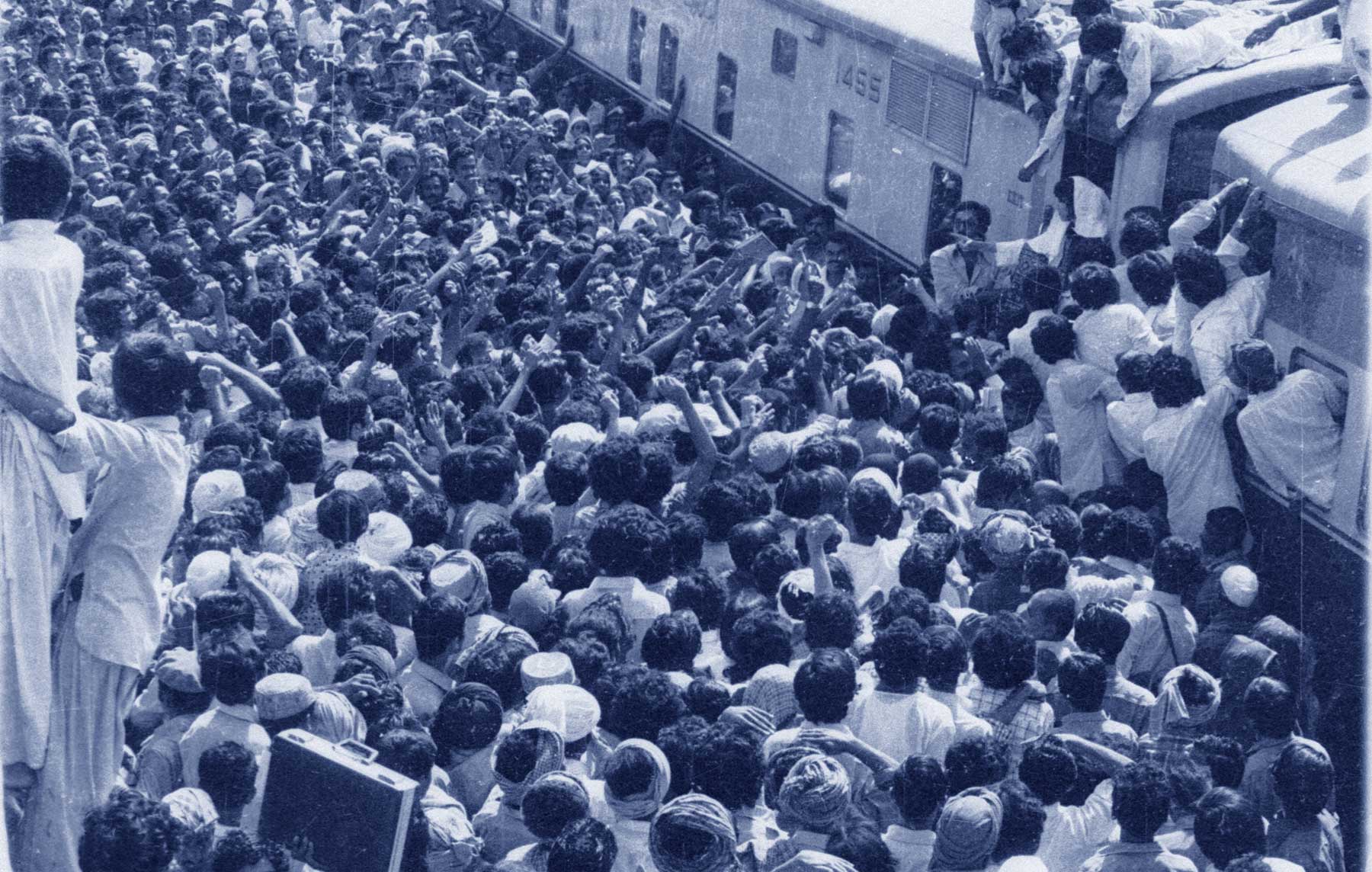
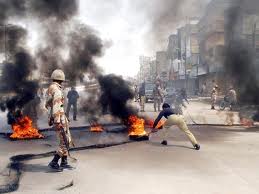
Karachi Burns in Ethnic Fires (Credit: blogstribune.com.pk)
KARACHI, May 22: At least 12 people have been killed and 29 injured in violence that erupted after unidentified gunmen opened fire on a rally organised by the Awami Tehreek and banned Peoples Amn Committee (PAC) in Karachi on Tuesday.
The protestors were rallying against the proposed Mohajir province and operation in Lyari.
Soon after the attack, the protest turned violent and dozens of cars and motorbikes were torched. The violence, which erupted in the Napier Road area, spread to the nearby localities including Lyari.
Police personnel deployed to maintain security failed to control the situation, however, after Rangers arrived, violence was brought under control.
Prime Minister Yousaf Raza Gilani has taken notice of the violence and has sought a report from the Sindh government.
Meanwhile Express News reported that Interior Minister Rehman Malik said that Awami Tehreek and Pakistan Muslim League-Nawaz, PAC, Punjabi-Pakhtun Ittehad (PPI), KCI had participated in the rally, but they had not sought prior permission from the government. A Joint Investigation Team (JIT) has been formed to investigate into the matter.
Later, while commenting on Twitter, Malik said he had proposed to Chief Minister Sindh for an inquiry into the incident through a judge of the Sindh High Court. The Court should then ascribe responsibility for a probe.
The interior minister, further tweeted late Tuesday night, posing questions to the parties involved in the rally, asking why Ayub Awan, Ayaz Latif Palijo and particularly PML-N’s Marvi Memon led 2000 people into sensitive areas including Lyari and Kharadar.
Malik blamed PML-N for the deaths, caused due to the violence.
He also shrugged off any responsibility for the episode of violence, saying that it was the responsibility of the local police, Home Secretary Sindh and Chief Minister Sindh, adding that he is only responsible for providing logistical support and forces.
Due to today’s violence, Board of Intermediate Education in Karachi and Hyderabad have postponed exams scheduled to be held on Wednesday. The exams will now be held on May 30 in Karachi and May 26 in Hyderabad.
Muttahida Qaumi Movement (MQM) leader Wasay Jalil expressed sorrow over the incident and called it a planned activity. He further claimed that the rally “had caused the violence”
Awami Tehreek President Ayaz Palijo, in a press conference, said that the police left the areas as soon as firing began and the PPP “stood there, watching Sindhis being killed”.
“I thank PML-N and Jamaat-e-Islami who supported us in the protest,” he added.
He further warned that every drop of blood that was shed in today’s riots will be avenged, “not from innocent Urdu-speaking people, but from terrorists”.
Palijo also said that he had received text messages last night from a certain party which threatened of repeating the May 12 scenario today during the protest.
Islamabad, April 29: The beheaded corpse of a British aid worker has been discovered in the Pakistani city of Quetta, almost four months after he was kidnapped.
The body of Khalil Rasjed Dale was left on a road outside the city, in southern Baluchistan province, with a note attached which said he had been killed because a ransom had not been paid to his captors.
Dale, who had been working for the International Committee of the Red Cross (ICRC), was kidnapped in January while driving near the organisation’s Quetta office.
He was abducted by gunmen as he made his way home in a clearly-marked ICRC vehicle on 5 January. His assailants are said to have bundled him into a car about 200m from an ICRC residence.
At the time, police in Quetta said Dale was abducted by unknown assailants driving a Landcruiser following a visit to a local school. He was travelling with a Pakistani doctor and a driver, who were not seized.
Quetta police chief Ahsan Mahboob said the killers’ note read: “This is the body of Khalil who we have slaughtered for not paying a ransom amount.”
Dale had been a Muslim convert for more than 30 years.
William Hague, the foreign secretary, said “tireless efforts” had been made to secure Dale’s release and the British government had worked closely with the Red Cross.
“I utterly condemn the kidnapping and killing of Mr Dale and send my deepest condolences to his family and loved ones as they come to terms with their tragic and distressing loss,” he said.
“We are devastated,” said ICRC director general Yves Daccord. “Khalil was a trusted and very experienced Red Cross staff member who significantly contributed to the humanitarian cause.
“All of us at the ICRC and at the British Red Cross share the grief and outrage of Khalil’s family and friends.”
Separatist militants and the Taliban are extremely active in Quetta, which is just a couple of hours’ drive to the border with Afghanistan’s Kandahar province, where the Taliban is battling US forces.
The ICRC has working relations with movements such as the Taliban, but its staff remain vulnerable to criminals and kidnappers.
Retired nurse Sheila Howat, a former colleague of Dale’s at Dumfries and Galloway Royal Infirmary, said: “It’s dreadful what has happened to him, really awful. The world has lost someone who really cared for others.”
JALOZAI, April 8 – Banmaroo stands in the dust, tears rolling down her cheeks as she recalls how her husband was killed in Pakistan’s latest battle zone on the Afghan border. “He was just a labourer. Firing started. I don’t know who killed him, but I was handed his body in the afternoon. It was in such a rough condition, just pieces,” she said, wiping her face with her green veil.
Too frightened to cope alone and worried that her children would also become caught up in fighting between the army and local warlord Mangal Bagh, she fled. “We felt danger everywhere. If the situation becomes good and our area gets freedom, we’ll go back. We need peace,” she said.
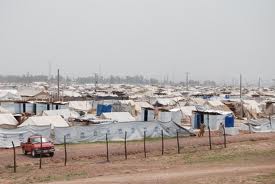
Travelling from her home in Khyber, Banmaroo and her six children arrived at Jalozai, Pakistan’s largest refugee camp, three weeks ago. She is among more than 250,000 people, mostly women and children, Save the Children says have fled the violence since January.
Khyber lies just outside Peshawar in Pakistan’s semi-autonomous tribal belt, on the Afghan border, still considered the world’s premier Al-Qaeda hub despite the killing of Osama bin Laden and the impact of US drone strikes. But the war in Bara, where Banmaroo and her children remember a once-idyllic life, is far murkier than a simple fight between the state and Islamist militants who want to impose sharia law and purge communities of infidels.
Troops have struggled since 2009 to defeat Bagh, a former bus conductor who founded Lashkar-e-Islam, a militia better known for kidnapping and extortion than religion. Now soldiers are stepping up the fight, keen to quell Bara to protect nearby Peshawar, the sprawling city where an increase in bomb and rocket attacks has been linked to the fighting in Khyber.
As a result, thousands of refugees stream into Jalozai everyday. Young men queue up to register in droves, standing or squatting under the burning sun. Security guards armed with sticks swipe queue-jumpers. “Five thousand people are expected to register today. Three days back it was 2,900,” UNHCR field officer Changaiz Mataul Hussain told AFP.
It’s a scene that Jalozai knows only too well. For 26 years, it was home to Afghans fleeing Soviet occupation, civil war and Taliban rule. Then in 2007, six years after the US-led invasion toppled the Taliban and when life in Afghanistan appeared to be improving, Pakistan closed the camp. Afghans were either voluntarily repatriated or told to find new homes.
But when the Pakistani Taliban rose up against the government in late 2007, Pakistan’s own creeping conflict forced Jalozai to re-open. With a capacity of 140,000, according to Hussain, nowhere else offered temporary shelter to so many Pakistanis displaced by conflict.
In 2008, the refugees came from the tribal district of Bajaur, then from neighbouring Mohmand and in 2009 there was a huge influx from the Swat valley, where the army managed to put down a Taliban insurgency. Today, the majority of the 109,515 in the camp are from Bara. They speak of their horror at gun battles, air strikes and mortar rounds destroying houses, but few go into details, fearful of spies.
Life in Jalozai is hard. Residents say there is no electricity, particularly galling at night. Children complain of eating rice day after day. The newest arrivals are ensconced some distance from the ordered blocks of tents protected by fences of plastic sheeting, on a stretch of desolate land where children scramble across the stone-strewn landscape.
It is only in the relative privacy of a tent that Khayalzar, a wild-haired man squatting on his haunches, is prepared to be more candid. “If you’re against Mangal Bagh, you’ll be slaughtered, so everyone is afraid. One of my neighbours was selling hashish. Mangal Bagh people threatened him many times, but he kept on doing it,” he said.
“Then one day, they came, put him inside a vehicle and drove off. On the second day, a headless body was dumped outside the village. Five or six days later, we found the head.” But it is not just the army fighting Lashkar-e-Islam. The militia is also embroiled in deadly turf wars with rivals, including the Pakistani Taliban.
Two suicide attacks outside Lashkar mosques killed 27 people last month in the Tirah valley, a hashish-growing area well outside government control, where Bagh’s turf war with the Taliban is concentrated.
“It’s very complex,” said Rahimullah Yusufzai, a tribal affairs expert. “There is no real goal. The main factor now is to be in control.” But the outcome of the army offensive is also unclear. It is not a sweeping operation as in Swat and despite numerous claims to have cleared other parts of the tribal belt, fighting continues and violence remains a problem.
“Mangal Bagh and the government are two faces of the same coin. We’ve suffered from both sides,” snaps Salma, sitting on the side of a dusty track, a crumpled burqa obscuring her face and body. “Mangal Bagh targets us on the ground and government jets target us from the air,” she says. “Only God can bring peace.”
QUETTA, March 29: At least five people were gunned down, and six others sustained injuries, when a van carrying people belonging to the Hazara community was ambushed on Spini road in Quetta Thursday morning.
Law enforcement agencies and the police put security on high alert in the city after the incident.
According to a senior police official, the van was on its way to Marriabad from Hazara Town when a group of armed men opened indiscriminate fire near Killi Mubarak.
Five people, including a woman, died on the spot while six other were wounded. The assailants fled the scene after the incident.
A heavy contingent of police and security forces reached the spot and cordoned off the area to collect evidence.
The bodies and injured were shifted to Provincial Sandeman Hospital and Bolan Medical Complex where an emergency had been declared. The injured were later shifted to Combined Military Hospital.
Policeman killed in protests
The incident sparked protest in different parts of the city, especially in areas dominated by the Hazara community on Brewery Road.
Protestors shot at security personnel, killing one policeman, Mukham Raza, and injuring a protestor.
Government Girls College Quetta College on Brewery Road was set alight, and fire brigades were called in to extinguish the blaze that engulfed the outer wall of the college building.
Protesters also intercepted two motorbikes and torched them.
The Hazara Democratic Party called for a shutter-down strike in Quetta on Friday (today) to protest the killings. Jamhoori Watan Party, Pashtunkhwa Milli Awami Party and the Awami Nation Party backed the strike call.
A senior police official said that Frontier Corps and police have jointly launched a search operation in different areas of Quetta, including Saryab, and arrested 45 suspects.
No group had claimed responsibility for the attack till the filing of this report.
The government has decided to form an exclusive force for the protection of the Hazara community following frequent incidents of targeted killings last year. Meanwhile, attacks on the community have intensified in the past few days.
2 UN workers shot dead
Two local UN workers were shot dead by unknown assailants in Mastung, about 50km from Quetta.
According to official sources, three persons, identified as Habibullah, Irfan and Mohammad Zahid were en route to Mastung from Quetta when armed men on a motorbike opened fire on their vehicle near Mastung Stadium bypass, killing two of them on the spot. Irfan sustained bullet wounds.
Law enforcement agencies rushed to the spot soon after the incident and cordoned off the area.
“They were working for UN Food and Agriculture Organisation and were coming to Mastung to visit their office,” sources said, adding that the victims were residents of Quetta.
The bodies of the deceased and the injured were taken to Provincial Sandeman Hospital for autopsy and later handed over to the heirs for burial.
Chief Minister Nawab Aslam Raisani strongly condemned the killings in Quetta and Mastung and directed law enforcing agencies to arrest the culprits involved.
Afghan Grief after Massacre by US Soldier - (Credit: pressirtv)KABUL, Afghanistan, March 15 — Prospects for an orderly withdrawal of NATO forces from Afghanistan suffered two blows on Thursday as President Hamid Karzai demanded that the United States confine troops to major bases by next year, and the Taliban announced that they were suspending peace talks with the Americans.
Getting talks started with the Taliban has been a major goal of the United States and its NATO allies for the past two years, and only in recent months was there concrete evidence of progress.
And the declaration by President Karzai, if carried out, would greatly accelerate the pace of transition from NATO to Afghan control, which previously was envisioned to be complete by 2014. Defense officials admitted there was a major divide between Mr. Karzai’s declaration and the American goals of training the Afghan security forces and conducting counterinsurgency operations. Successful counterinsurgency requires close working relationships with rural Afghans to help build schools, roads and bring about other improvements.
Asked if it was possible to take all American forces out of villages by 2013 and still train Afghan security forces and conduct counterinsurgency operations, a senior American defense official replied, “It’s not clear that we would be able to.”
Mr. Karzai declaration came in reaction to widespread Afghan anger over the massacre by an American soldier of 16 civilians in Kandahar on Sunday, and the decision of the military authorities to remove the soldier from Afghanistan, which was reported on Wednesday.
The Taliban statement, issued in English and Pashto on an insurgent Web site, said talks with an American representative had commenced over the release of some Taliban members from the Guantánamo Bay prison, but accused the American representative of changing the preconditions for the talks.
The statement did not make clear what preconditions were objectionable, but the statement emphasized that the Taliban were only interested in talking with the Americans, and criticized “propaganda” about the talks that American officials had issued. Zabiullah Mujahid, a spokesman for the Taliban reached by cellphone at an undisclosed location, said the statement suspending the talks was genuine but declined to discuss it further.
It was unclear if the two developments might have been related. But both came to light just as Defense Secretary Leon E. Panetta had left Afghanistan after a tense two-day visit that included talks with Mr. Karzai, and the Afghanistan president’s announcement in particular appeared to be a surprise. On Wednesday, President Obama said in Washington that the timetable for an Afghanistan withdrawal would not change.
Defense officials traveling with Mr. Panetta in Abu Dhabi said that the tone of the meeting between Mr. Karzai and Mr. Panetta was more positive than Mr. Karzai’s statement would indicate, and that he made no demands of the defense secretary — suggesting that the statement was in part aimed at a domestic audience enraged not only by the massacre but also by recent Koran burnings.
The officials acknowledged that Mr. Karzai told Mr. Panetta during their meeting that American troops should be confined to major bases by next year, but the officials sought to publicly tamp down the differences and portray the two countries as working together. “Secretary Panetta said, ‘We’re on the same page here,’ ” the Pentagon press secretary, George Little, quoted Mr. Panetta as telling Mr. Karzai.
Mr. Panetta, speaking to reporters after the meeting, said he had told Mr. Karzai that the military pledged a full investigation of the massacre and would bring the gunman to justice. He said that Mr. Karzai had not brought up the transfer of the suspect, an Army staff sergeant, to Kuwait.
Although the move was likely to further anger Afghans, who had called for him to be tried in their country, Lieutenant Gen. Curtis M. Scaparrotti, the No. 2 American commander in Afghanistan, told reporters that the Afghans had been informed of the move ahead of time, and he said that “their response is that they understood.”
General Scaparrotti said that the American military would likely not make the suspect’s name public until and if he was formally charged. He did not say when that might happen. “We are conscious of due process,” he said.
American officials said in recent weeks that there had been no talks of any substance since January, when Ambassador Marc Grossman, the United States special representative for Afghanistan and Pakistan, and his team last visited the region. Even the meetings held then did little to move the process beyond the “talks about talks” stage, and the Afghan government had not yet begun to play any significant role in the effort, despite statements from Mr. Karzai to the contrary, the officials said.
The main obstacle appeared to be executing the first set of confidence-building measures: A prisoner swap that would transfer five senior Taliban leaders held at Guantánamo to house arrest in Qatar in exchange for a Westerner being held by the insurgents.
The plan faced a series of difficulties, notably uncertainty about what conditions the five Taliban would be living under in Qatar, and American lawmakers on both sides of the political divide expressed deep skepticism about the release of the insurgents.
Faced with substantial political opposition, the Obama administration wanted to wait to release the men until it could get a direct exchange for the Westerner, the American officials said. But it appeared Thursday that the Taliban had grown tired of waiting for the Americans to begin the process, and that the insurgents feared the conditions under which their compatriots would be housed in Qatar would be too restrictive.
“Acknowledging their involvement in Qatar talks was a significant move for the Taliban. They expected that the U.S. would move quickly with confidence-building measures,” said Michael Semple, a fellow at the Carr Center for Human Rights Policy at Harvard’s Kennedy School. “The transfer of Taliban leaders to Qatar was top on the list. The Taliban announcement of suspending engagement in Qatar is a response to their frustration at the U.S.’s slowness to deliver.”
Mr. Semple said a series of crises to beset the Americans in the Afghanistan conflict since the start of the year had added another layer of uncertainty to the talks, emboldening Taliban hardliners to press back against the peace effort. “The Taliban also believe that the U.S. mission in Afghanistan is in disarray and their hardliners want to take advantage of that by launching a new fighting season.”
Still, the Taliban statement appeared to leave open the door to a resumption of the process, terming their move a “suspension.”
Angry over its exclusion from the first round of talks, which involved the Taliban opening a political office in Qatar as well as the proposed prisoner releases, Mr. Karzai’s government has tried to establish its own track for peace talks, saying Saudi Arabia should be an intermediary, and sending its own envoy to Guantánamo to talk to Taliban prisoners.
The Taliban statement repeated previous declarations by the insurgents that they viewed Afghan government officials as puppets of the Americans and would not hold talks with them. “Hamid Karzai, who cannot even make a single political decision without the prior consent of the Americans, falsely proclaimed that the Kabul administration and the Americans have jointly started peace talks with the Taliban,” the statement said.
The Taliban were only at the stage of discussing prisoners and the Qatar office, the statement said, adding, “neither have we accepted any other condition with any other side nor have we conducted any talks with Karzai administration.”
On the withdrawal of American forces to major bases by 2013, Mr. Karzai said that Afghan authorities were capable of taking charge of security in rural areas. The massacre Sunday took place in a rural part of Panjwai District, in southern Kandahar Province.
The shooting suspect has been described by sources as a 38-year-old staff sergeant in the Second Battalion, Third Infantry Regiment, Third Stryker Brigade, Second Infantry Division based at Joint Base Lewis-McChord in Washington State.
Elisabeth Bumiller contributed reporting from Abu Dhabi, U.A.E.
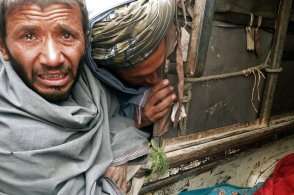
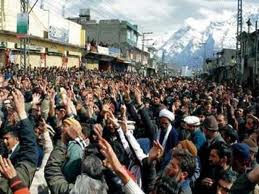
Shias protest killings in Kohistan (Credit: nation.com.pk)Gunmen have killed at least 18 Shia Muslim bus passengers in a sectarian attack in the northern Pakistani district of Kohistan, officials say.
The attackers are reported to have checked the identity cards of all the passengers before removing the Shias and shooting them.
About 27 other passengers on the bus were spared.
Meanwhile, a Chinese woman was shot dead with a Pakistani male companion in the city of Peshawar, police say.
Bus attack
Kohistan is not known for militancy, but it borders the Swat valley, which has had a Taliban presence in the past.
The attack took place close to the remote and mountainous area of Harban Nala, approximately 130 miles (208 km) north of the capital, Islamabad.
Four buses were travelling in a convoy from the city of Rawalpindi to the northern town of Gilgit.
“Armed men hiding on both sides of the road attacked,” local police chief Mohammad Ilyas told the Agence France-Presse news agency. Local officials say that the men who ambushed the bus were wearing military fatigues.
It happened in an area dominated by Sunni tribes, Reuters quotes a policeman as saying.
Prime Minister Yousuf Raza Gilani has condemned the attack, insisting that such incidents would not deter the government in its resolve to fight “the menace of terror”.
Correspondents say that more than two-thirds of Kohistan’s 500,000 people live a nomadic life and move up and down the country in search of pastures.
Kohistan is 7,400 sq km of sheer mountains, rising from 2,400m (7,874 ft) to 3,700m (12,139 ft) with virtually no plains.
Sunni extremists allied to or inspired by al-Qaeda and the Taliban routinely attack government and security targets in north-west Pakistan, in addition to religious minorities and other Muslim sects they consider to be infidels.
The BBC’s Aleem Maqbool in Islamabad reports that there are frequently complaints from Shias that the Pakistani state does little to stop the attacks and has even released from custody notorious militants accused of carrying them out.
Last month more than 30 Shias were killed in an attack on a mosque in north-west Pakistan.
Chinese targets
The Chinese woman, 40, and her Pakistani companion, 22, were killed by gunmen on motorbikes while walking in the Kohati bazaar area in the historic centre of Peshawar, police said.
It was the fifth shooting or bomb attack in north-western Khyber Pakhtunkhwa province since Thursday, raising concerns that violence is worsening following a relative lull in recent months.
The father of the dead Pakistani said that his son had been working as a translator for the Chinese woman while he was on holiday from studying English literature at university.
The BBC’s M Ilyas Khan in Islamabad says that while a motive for the attack is unclear, it is not unusual for Chinese people to be targeted in Pakistan.
In 2009 a Chinese engineer was kidnapped in the Dir region of north-west Pakistan. He was released after five months
A Chinese beautician kidnapped during the Red Mosque siege of 2007 was released several months after being abducted
One of two Chinese engineers kidnapped by militants loyal to Taliban commander Abdullah Mehsud in 2004 was killed during a rescue bid by Pakistani forces.
QUETTA: The Functional Committee of Senate on Human Rights has rejected a report presented by the Provincial Home Department over law and order situation and human rights violations in Balochistan.
The committee expressed serious concerns over the recovery of mutilated bodies of missing persons, targeted killing of labourers, doctors, teachers and an increasing number of kidnappings for ransom in the province.
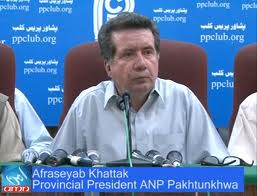
The committee met under the chairmanship of Afrasiab Khattak here on Wednesday and was briefed by Home Secretary Naseebullah Bazai. Other members included Senator Surriya Amiruddin, Senator Farhat Abbas and Senator Hafiz Rasheed.
Addressing a news conference, Senator Khattak said the committee held its meeting in Quetta to assess the current situation of the province in detail. “The human rights situation is grave here, particularly recovery of mutilated bodies and incidents of kidnapping for ransom are matters of great concern. These issues must be taken up seriously and sincere efforts are needed by the government to normalise the situation,” he said.
The recovery of mutilated bodies, Khattak said, gave a message that the state and its institutions did not consider them their own people but rather their enemy. “The people will definitely look up to others for help if they are continuously pushed against the wall.”
The committee chairman said federal and provincial governments should take notice of this serious issue and bring the culprits to book. “There is a common perception that secret agencies are involved in enforced disappearances and dumping of mutilated bodies. If this is true, then government should control its institutions as they are damaging Pakistan’s sovereignty,” he urged.
He said some militant groups are also targeting labourers and teachers. “Violence in any shape is wrong and unjustified. Those who are involved in these killings are not the well wishers of Balochistan,” he said.
The functional committee said that targeted killing of people belonging to the Hazara community was not sectarian violence, rather an act of terrorism and that terrorist groups are behind these killings. The committee sought a report on the murder of police surgeon Dr Baqar Shah, key witness of Kharotabad massacre of foreign nationals.
The committee further suggested that laws should be introduced to curtail the power and influence of security agencies and that they should be brought under parliamentary control.
Kidnapping of Hindu people was also discussed during the meeting and the committee stated it will pressurise the provincial government to ensure the protection of life and property of minorities.
Senator Khattak said that the government cannot get away by just stating that foreign elements are involved in destabilising this province. “They should investigate what circumstances have paved way for foreign involvement. The people will look towards foreigners if their rights are trampled down by their own people,” he said.
The Senate committee said that the government should hold talks with angry Baloch people to address their grievances for a durable peace in Balochistan.
“All the Baloch political parties must be taken into confidence because if government can agree to hold talks with Taliban militants then why not with our Baloch brothers?” the committee questioned.
Gilani concedes there is a problem in Balochistan
With the Senate too taking notice of human right violations in Balochistan, Prime Minister Syed Yousaf Raza Gilani too admitted on Wednesday that there was a problem in the country’s largest province. He intends to convene an All Parties Conference (APC) to discuss and address the issues of Balochistan, particularly the law and order situation, through collective wisdom.
“There is a law and order situation in Balochistan, which has to be addressed. We are also talking with the coalition partners in this respect,” Gilani said in an interaction with senior newspaper editors at the Prime Minister House. The Prime Minister also mentioned the incumbent government’s initiative of “Aghaz-e-Haqooq-Balochistan” to remove the sense of deprivation of the people of that province, conceding, however, the law and order situation in Balochistan had overshadowed the initiative.
KABUL, Jan 28 — Several Taliban negotiators have begun meeting with American officials in Qatar, where they are discussing preliminary trust-building measures, including a possible prisoner transfer, several former Taliban officials said Saturday.
The former officials said that four to eight Taliban representatives had traveled to Qatar from Pakistan to set up a political office for the exiled Afghan insurgent group.
The comments suggested that the Taliban, who have not publicly said they would engage in peace talks to end the war in Afghanistan, were gearing up for preliminary discussions.
American officials would not deny that meetings had taken place, and the discussions seemed to have at least the tacit approval of Pakistan, which has thwarted previous efforts by the Taliban to engage in talks.
The Afghan government, which was initially angry that it had been left out, has accepted the talks in principle but is not directly involved, a potential snag in what could be a historic development.
The former Taliban officials, interviewed Saturday in Kabul, were careful not to call the discussions peace talks.
“Currently there are no peace talks going on,” said Maulavi Qalamuddin, the former minister of vice and virtue for the Taliban who is now a member of the High Peace Council here. “The only thing is the negotiations over release of Taliban prisoners from Guantánamo, which is still under discussion between both sides in Qatar. We also want to strengthen the talks so we can create an environment of trust for further talks in the future.”
The State Department spokeswoman Victoria Nuland has said only that Marc Grossman, the Obama administration’s special representative for Afghanistan and Pakistan, had “a number of meetings” related to Afghanistan when he visited Qatar last week.
The Taliban’s announcement this month that they would open an office in Qatar, which could allow for direct negotiations, drew fire from some Afghan factions as well as some American policy makers, who fear the insurgents would use negotiations as a ploy to gain legitimacy and then continue their efforts to reimpose an extremist Islamic state in Afghanistan.
Mr. Grossman, at a news conference in Kabul last week, said that real peace talks could begin only after the Taliban renounced international terrorism and agreed to support a peace process to end the armed conflict.
The Afghan government and the Qataris must also come to an agreement on the terms under which the Taliban will have an office. Mr. Grossman has been regularly briefing the Afghan government but Afghan officials have complained that they were being kept out of the loop.
The Taliban officials now in Doha, Qatar, include a former secretary to the Taliban’s leader, Mullah Muhammad Omar, as well as several former officials of the Taliban government that ruled Afghanistan from 1996 to 2001, according to Mr. Qalamuddin and Arsala Rahmani, a former Taliban minister of higher education.
The former Taliban officials here described fairly advanced discussions in Qatar about the transfer of prisoners. One former official, Syed Muhammad Akbar Agha, who had been a Taliban military commander, said that five Taliban prisoners were to be transferred in two phases, two or three in one group and then the remainder.
There has also been discussion in Qatar of removing some Taliban members from NATO’s “kill or capture” lists, the former Taliban officials said.
Mr. Grossman, in his comments last week, played down talk of detainee releases, saying the United States had not yet decided on the issue. “This is an issue of United States law first of all, that we have to meet the requirements of our law,” he said.
He said the Obama administration would also consult with Congress. Under American law, the defense secretary must certify to Congress that the transfer of any Guantánamo prisoner to a foreign country would meet certain requirements, including that the country maintains control over its prisons and will not allow a transferred detainee to become a future threat to the United States.
If any detainees were released, Western and Afghan officials said, they would likely be transferred to Qatar and held there, perhaps under house arrest.
The former Taliban officials said that they were most surprised by Pakistan’s decision to allow the Taliban delegates to obtain travel documents and board a plane to Qatar. The former officials have long contended that Pakistan has obstructed talks. “This is a green light from Pakistan,” Mr. Rahmani said.
Pakistan “definitely supported this and is also helping,” Mr. Qalamuddin added. He said that if Pakistan did not approve of the talks, it would have arrested the Taliban delegates to Qatar, just as it did with Mullah Baradar, a senior Taliban official, after he began secret talks with the Afghan government in 2010.
Steven Lee Myers contributed reporting from Washington, Taimoor Shah from Kandahar, Afghanistan, and Sharifullah Sahak from Kabul.
WASHINGTON: US Defence Secretary Leon Panetta has urged Islamabad to release a Pakistani physician who helped the United States find Osama bin Laden in Abbottabad on May 2 last year.
In an interview for an episode of “60 Minutes”, a programme run by the Colombia Broadcasting Service (CBS), Mr Panetta acknowledged that the doctor provided vital clues to the United States about Osama’s lair.
The revelation came on the heels of a Friday speech by Vice President Joseph Biden in which he disclosed that he had cautioned President Barack Obama against raiding Osama bin Laden’s hideout, but the president took the decision all alone.
Speaking at a conference of House Democrats in Maryland, Mr Biden said President Obama ignored his reservations and Leon Panetta, then CIA chief, was the only member of the inner circle who backed the president.
In the CBS interview, Leon Panetta said he believed Pakistani officials knew where Osama bin Laden was hiding before US Navy SEALs found and killed him on May 2, last year.
“There is a Pakistani doctor who, as we understand, was helping our efforts there, a man named Shakil Afridi, he is now being charged with treason in Pakistan and I wonder what you think of that?” asked the interviewer.
“I am very concerned about what the Pakistanis did with this individual. This was an individual who, in fact, helped provide intelligence that was very helpful with regard to this operation.
“And he was not in any way treasonous towards Pakistan. He was not in any way doing anything that would have undermined Pakistan,” Mr Panetta replied.
Dr Afridi ran a vaccination programme for the CIA to collect DNA and verify Osama bin Laden’s presence in the Abbottabad compound. Media reports claim that Islamabad had charged Mr Afridi, an employee of the Pakistan government, with treason for working for a foreign intelligence agency.
Mr Panetta headed the CIA when Dr Afridi worked for the agency. Pakistan has so far not issued any official statement on Mr Afridi’s whereabouts. “As a matter of fact, Pakistan and the US have a common cause here against terrorism, have a common cause against Al Qaeda, have a common cause against those who will attack not only our country but their country. And for them to take this kind of action against somebody who was helping to go after terrorism, I just think it is a real mistake on their part,” said Mr Panetta.
“Should they free him?” the interviewer asked. “They can take whatever steps they want to do to discipline him, but ultimately he ought to be released,” Mr Panetta replied.
Reports in the US media quoted senior Pakistani officials as saying that they wanted to resolve the issue amicably. Pakistan would release Mr Afridi quietly to US custody, once media attention died down, the reports said. Asked if he believed Pakistani officials knew Osama was hiding in Abbottabad, Mr Panetta said: “I don’t have any hard evidence, so I can’t say it for a fact. There’s nothing that proves the case. But as I said, my personal view is that somebody somewhere probably had that knowledge.”
Mr Panetta said Pakistani military helicopters were reported to have passed over the compound where the late Al Qaeda chief was found. “I personally have always felt that somebody must have had some sense of what — what was happening at this compound. Don’t forget, this compound had 18 foot walls. … It was the largest compound in the area.
“So you would have thought that somebody would have asked the question, ‘What the hell’s going on there?’” Mr Panetta said.
The defence secretary also explained why Pakistani officials were not informed when the United States raided the compound.
“We had seen some military helicopters actually going over this compound. And for that reason, it concerned us that, if we, in fact, brought [Pakistan] into it, that — they might … give bin Laden a heads up,” he said.
Diplomatic observers in Washington say that Mr Panetta’s statement was aimed at exerting pressure on Pakistan to release Dr Afridi.
BIDEN EXPLAINS HIS ADVICE: Mr Biden said in his speech he advised President Obama not to carry out the mission because he believed “we have to do more things to see if he’s there”.
The vice president gave an insider account of the internal discussions in the White House before the order was officially carried out and praised Mr Obama as a person with a “backbone like ramrod”.
Mr Biden said that for a four-to-six week period early last year, only six people knew that Osama bin Laden might be hiding in Abbottabad.
When enough information finally surfaced, the president convened his national security staff on April 28.
“The president, he went around the table, with all the senior people, including the Joint Chiefs of Staff, and he said ‘I have to make a decision, what is your opinion’. He started with the National Security Adviser, the Secretary of State, and he ended with me,” recalled Mr Biden.
“He (Obama) went around the table with all the senior people. … Every single person in that room hedged their bet except Leon Panetta. Mr Leon said, ‘go.’ Everyone else said 49, 51 (percent in favour),” Mr Biden added. “It got to me. (Mr Obama) said ‘Joe — what do you think?’ I said, ‘You know, I didn’t know we had so many economists around the table.’ I said we owe the man a direct answer. Mr. President, my suggestion is don’t go.” “You end up having to make decisions based on the moon, will there be enough light. And we had to make a decision,” said Mr Biden.
According to the Vice President, Mr Obama left that meeting and said he would make the decision in the morning. “The next morning he came down to the diplomatic entrance, getting in a helicopter I believe to go to Michigan, I’m not positive for that. He turned to Tom Donilon (then national security adviser) and said “go,” Mr Biden related.
The Vice President was not the only person who had second thoughts about pulling the trigger.
Former defence secretary Robert Gates has also admitted he had reservations about the raid.
President Obama, Mr Biden argued, showed leadership. “He knew what was at stake. Not just the lives of those brave warriors, but literally the presidency, and he pulled the trigger,” Mr Biden said.
“This guy doesn’t lead from behind — he just leads.”
A Pentagon official told Fox News that Adm. Mike Mullen, who was chairman of the Joint Chiefs at the time, “certainly recognised the risk, but he did not hesitate in offering his advice that we should go.”
Another official said that Gen. James Cartwright, who was vice chairman of the Joint Chiefs at the time, was leaning against a raid and more toward an air strike in that final meeting.
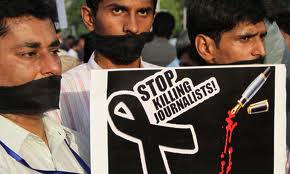
Karachi, Jan 14: That the judicial commission’s report on Saleem Shahzad’s murder is inconclusive should not be surprising, experts say. Its shortcoming lies in its very foundation – the formation of a ‘judicial panel’ to investigate a murder.
The judicial commission’s failure to point out the murderers of journalist Saleem Shahzad was expected, said Coordinator of the Committee to Protect Journalists’ Asia Programme Bob Dietz.
“I know a lot of journalists had pressed for the judicial panel, but the report now clearly shows that it hasn’t been able to serve its purpose of pointing out the murderers,” Dietz said while speaking to The Express Tribune via phone.
The judicial panel shouldn’t have been tasked with uncovering the murderers of Saleem, simply because this required expertise that they didn’t possess to begin with, Dietz said.
“This is basically the job of the police who are trained to investigate murder cases. In fact it is only because of the inability of the police and the government to uncover the truth that the panel was entrusted with this job,” he said.
Dietz suggested the case should have been investigated by a panel similar to the one that had been formed in the aftermath of Daniel Pearl’s murder in Karachi. “In Daniel’s case, real police work was done by experts in their fields. This led to the arrest of several suspects and eventually some of them were sentenced and sent to jails.”
When asked what was the way forward if the police investigators were vary of probing into a case that allegedly involved senior intelligence agency officials, Dietz proposed that then the media itself would have to do the job of exposing the murderers.
Senior Analyst Mazhar Abbas said he found the report “interesting” and recommended all journalists to go through it “from an academic point of view.”
Abbas pointed out a number of missing links in the commission’s report. For example, he says, the IGP Islamabad’s testimony has not been included in the report to clarify the important point about how Saleem’s vehicle was able to move out of Islamabad all the way to Jhelum without anyone in the police taking notice: “When Saleem was reported kidnapped, did the police pass on a message on their wireless control system about the disappearance?”
Also, he said, that while the commission leaves the door open about the motive and people involved in the incident, it is clear that normally militant groups claim responsibility for their attacks.
“If even for the sake of argument we assume that the Ilyas Kashmiri group was behind the murder [as stated as one of possibilities in the report], then what was stopping them from claiming the attack on Saleem,” he asked.
Pulitzer prize winning author Dexter Filkins, who had written an article in The New Yorker about Shahzad’s death titled “The Journalist and the Spies”, stood by the revelations he had made in his article.
In his piece, Filkins not only connected the dots between Shehzad’s death and militant commander Ilyas Kashmiri’s killing in a drone attack, but also spoke of senior American officials, who alleged that the orders to kill Shahzad came directly from the top army brass.
When asked to comment on the commission’s report, Dexter said in an email: “I’m going to let my article speak for itself.”
ISI’s Brigadier Zahid Mehmood Khan, in his written testimony to the commission mentioned in the report, had lambasted Filkins for his piece.
Published in The Express Tribune with the International Herald Tribune, January 14th, 2012.