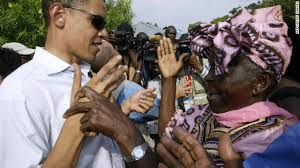
Paternal grandmother of U.S. President Barack Obama attended an exhibition detailing the life of the Prophet Mohammad at the end of a pilgrimage in the Saudi city of Makkah, local media reported Wednesday.
Unlike the Hajj pilgrimage – a trip to the cities of Makkah and Madinah which every able-bodied Muslim is expected to undertake at least once in their lifetime – Umrah can be undertaken at any time of the year.
After finishing Umrah, Omar visited an exhibition about the life of the Prophet, commenting that it was a “good example” of what she called the moderate teachings of Islam.
“I am very happy to visit this exhibition, which is a good example for the propagation of Islam in a modern way, supported by scientific and authentic documents,” local daily Arab News quoted her as saying.
The Arabic-language Akhbar meanwhile said Obama’s grandmother cried during her visit to the exhibition.
Obama is a Christian whose religious views developed in his adult life but his father is of Muslim heritage from Kenya. Obama said both his American mother and Kenyan father were not devout.
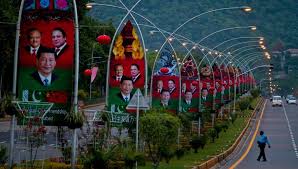
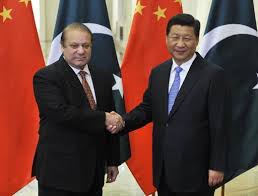
Chinese President visits Islamabad (Credit: houstonchronicle.com)
ISLAMABAD, April 20: Chinese President Xi Jinping has termed Pakistan’s offensive against militants in North Waziristan a “game-changer” in bringing peace to the region.
The Chinese president, who arrived in Pakistan earlier today, said Operation Zarb-e-Azb’s ‘remarkable results’ would also, in turn, contribute to Pakistan’s economic development.
President Xi made the comments during his meeting with Services Chiefs of Pakistan’s armed forces Monday evening, according to an Inter-services Public Relations (ISPR)statement.
He also appreciated Pakistan’s strenuous efforts in counter-terrorism to promote peace, stability in the region, and vowed to stand by Pakistan in all its endeavours, and to continue to support it in fight against terrorism, and bringing stability.
President Xi arrived at the Prime Minister House after receiving a rousing welcome at the Islamabad airport earlier in the day.
He is on a two-day state visit to Pakistan to sign a number of important agreements and MoUs worth $46 billion. The two countries are set to cooperate in gas, coal, and solar energy projects to provide 16,400 megawatts of electricity — roughly equivalent to the country’s entire current capacity.
BEIJING, April 19 — China’s president, Xi Jinping, travels to Pakistan on Monday laden with tens of billions of dollars in infrastructure and energy assistance on a scale the United States has never offered in the past decade of a close relationship, a gesture likely to confirm the decline of American influence in that nation.
Mr. Xi, making his first overseas trip this year, and the first by a Chinese leader to Pakistan in nine years, will arrive fortified from the robust reception to the new China-led Asian Infrastructure Investment Bank, and is looking to show that China can make a difference in a friendly, neighboring country troubled by terrorism.
Pakistani officials say that Mr. Xi will be signing accords for $46 billion for the construction of roads, rails and power plants to be built on a commercial basis by Chinese companies over 15 years.
Just as the United States sought to stabilize Pakistan during the war in Afghanistan, so China wants to prevent the spread of militant groups in Pakistan into Xinjiang, the far western region of China with a large Muslim population.
Washington tried to encourage the Pakistani government to try to stop terrorist groups from crossing the border into Afghanistan and attacking American troops, in part, by sending assistance intended to revive the gasping economy. Now, as China faces growing restiveness in Xinjiang, which has borders with Pakistan and Afghanistan, Beijing is attempting to help stem the flow of radicalism into its own backyard by bolstering development in perhaps the most vulnerable part of Pakistan.
To the increasing frustration of China, a Muslim separatist group, the East Turkestan Islamic Movement, founded by Uighurs, a Turkic-speaking ethnic minority concentrated in northwestern China, operates alongside several Pakistani terrorist groups inside Pakistan’s ungoverned tribal areas. A military operation was launched by the Pakistani Army in North Waziristan last June against the Taliban, also aimed at the Turkestan group, an action designed to please China.
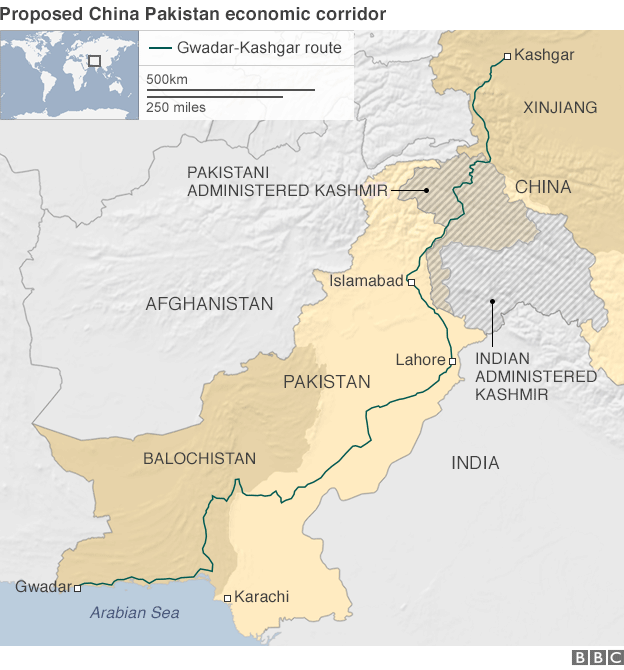
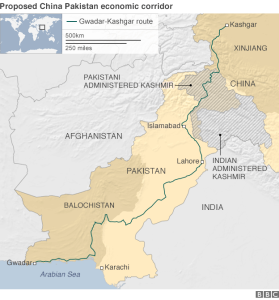
A significant amount of China’s new assistance, including a port facility at Gwadar on the Arabian Sea, and rails and roads leading from the port across Baluchistan Province and into western China, will be in areas close to the tribal areas where the militant groups operate.
The route from Gwadar to Kashgar, in Xinjiang — a project officially called the Economic Corridor — also serves as a shortcut for the shipment of goods from Europe to China, avoiding the Strait of Malacca farther east.
“The Chinese are stepping in, in a much, much bigger way than the United States ever contemplated,” said Jahangir Tareen, a Pakistani businessman, and the secretary general of the Pakistan Tehreek-e-Insaf party. “The assistance is far, far more than the United States government offered under the United States Agency for International Development.”
In advance of his trip, Mr. Xi wrote in a column distributed to the Pakistani news media over the weekend: “We need to form a ‘1+4’ cooperation structure with the Economic Corridor at the center and the Gwadar Port, energy, infrastructure and industrial cooperation being the four key areas to drive development across Pakistan and deliver tangible benefits to its people.”
Most striking about the visit is the scale of Mr. Xi’s aid announcement compared with the American effort from 2009 to 2012 spearheaded in Congress by John Kerry, then a senator, and pressed in Pakistan by Hillary Rodham Clinton, then secretary of state. The program designated $7.5 billion for development projects over five years.
That effort was a “dramatic failure” because the resources were scattered too thinly, and had no practical or strategic impact, said David S. Sedney, a former senior official at the Pentagon responsible for Pakistan during that period.
The Chinese appear to have learned from the American program, including the notion that the American plan was designed to deliver a strategic result — deterring terrorism — but failed to do so, Mr. Sedney said.
To do better than the United States, the Chinese have come up with “a much larger financial commitment — and it is focused on a specific area, it has a signature infrastructure focus and it is a decades-long commitment,” he said.
The Chinese Foreign Ministry said on Friday that the projects in Pakistan would be the first initiatives of the $40 billion Silk Road Economic Belt and Maritime Silk Road plans, an ambitious network of roads, rails and ports designed to link China to Europe through Central Asia and Russia, and announced with considerable fanfare by Mr. Xi in November.
China’s assistant foreign minister, Liu Jianchao, declined to say how much of the Silk Road funds would go to the Pakistani projects, or how much the new Asian Infrastructure Investment Bank would lend. “It needs huge financing. China stands ready to provide financing,” Mr. Liu said.
Mr. Xi embarks on his visit to Pakistan after the Finance Ministry announced last week that 57 countries had signed to join the new development bank.
Perhaps just as important as China’s economic assistance is a major military deal that is unlikely to be publicized during the Chinese leader’s visit, Pakistani analysts said.
Pakistan has agreed to buy eight Chinese submarines to counter India’s naval dominance in the Indian Ocean, a $6 billion purchase approved by a parliamentary committee in Islamabad this month. The new submarines were “very quiet, capable and lethal,” and a step up from previous Chinese arms sales to Pakistan, said Lyle J. Goldstein, associate professor at the Naval War College in Newport, R.I.
Pakistan announced on Thursday Chinese President Xi Jinping will arrive in Pakistan on April 20 for a two-day visit.
“The Chinese president will attend a joint session of Parliament and important agreements in various fields will be signed during the visit,” Foreign Office spokesperson Tasneem Aslam said, during her weekly press briefing in Islamabad.
Chinese President Xi Jinping will launch energy and infrastructure projects worth $46 billion on a visit to Pakistan next week as China cements links with its old ally and generates opportunities for firms hit by slack growth at home.
Also being finalised is a long-discussed plan to sell Pakistan eight Chinese submarines.
The deal, worth between $4 billion and $5 billion, according to media reports, may be among those signed on the trip.
Commercial and defence ties are drawing together the two countries, which share a remote border and long-standing mistrust of their increasingly powerful neighbour, India, and many Western nations.
“China treats us as a friend, an ally, a partner and above all an equal – not how the Americans and others do,” said Mushahid Hussain Sayed, chairman of the Pakistan Parliament’s defence committee.
Pakistan and China often boast of being “iron brothers” and two-way trade grew to $10 billion last year from $4 billion in 2007, Pakistani data shows.
Xi’s trip is expected to focus on a Pakistan-China Economic Corridor, a planned $46-billion network of roads, railways and energy projects linking Pakistan’s deepwater Gwadar port on the Arabian Sea with China’s far-western Xinjiang region.
It would shorten the route for China’s energy imports, bypassing the Straits of Malacca between Malaysia and Indonesia, a bottleneck at risk of blockade in wartime.
If the submarine deal is signed, China may also offer Pakistan concessions on building a refuelling and mechanical station in Gwadar, a defence analyst said.
China’s own submarines could use the station to extend their range in the Indian Ocean.
“China is thinking in terms of a maritime silk road now, something to connect the Indian Ocean and Pacific Ocean,” said a Pakistani defence official, who declined to be identified.
For Pakistan, the corridor is a cheap way to develop its violence-plagued and poverty-stricken Balochistan, home to Gwadar.
China has promised to invest about $34 billion in energy projects and nearly $12 billion in infrastructure.
Xi is also likely to raise fears that Muslim separatists from Xinjiang are linking up with Pakistani militants, and he could also push for closer efforts for a more stable Afghanistan.
“One of China’s top priorities on this trip will be to discuss Xinjiang,” said a Western diplomat in Beijing.
“China is very worried about the security situation there.”
Reaction to UAE minister
Pakistan refused on Thursday to respond to a statement by a UAE junior foreign minister that censured Pakistan’s neutral stance on the Saudi-led offensive against Houthi rebels in Yemen.
“We do not respond to statements issued on Twitter,” Aslam said.
Read: No fence-sitting: Pakistan ‘ambiguous stance’ angers UAE
On April 11, UAE’s minister of state for foreign affairs Anwar Gargash took to social networking site Twitter to criticise Pakistan’s stance and warned the country of a “heavy price.”
The Pakistani parliament’s resolution, which promoted neutrality on the Yemeni conflict, and voiced support for Saudi Arabia is contradictory and dangerous and unexpected from Islamabad,” the UAE minister had said.
“In favour of its strategic relations with the Gulf nations, contradictory and ambiguous views on this decisive matter will cost highly,” he added.
However, earlier this week Prime Minister Nawaz Sharif clarified the United Arab Emirates foreign minister’s criticism of Pakistan’s neutral stance on Yemen was a result of an “apparent misunderstanding.”
Read: Yemen resolution misinterpreted, Pakistan does not abandon strategic partners: PM
“We are also in touch with other GCC countries to assure them that their disappointment was based on an apparent misinterpretation of Parliament’s Resolution.”
“Pakistan does not abandon friends and strategic partners, especially at a time when their security is under threat,” the premier said, while addressing the nation on April 13.
‘Not involved in an arms race’
Further, reacting to a New York Times editorial asking the world to shift its focus to Pakistan as it grows its nuclear arsenal, Aslam said, “Pakistan is a responsible nuclear nation and we are not involved in any arms race.”
LONDON, April 14 — Hours before he was scheduled to be executed last month, the Pakistani hit man made an incendiary accusation.
Speaking into a video camera at a remote desert jail, Saulat Mirza, a death-row convict from the port city of Karachi, said his orders to kill had come from Altaf Hussain, the city’s most powerful and, until recently, untouchable political leader.
“Altaf Hussain directly gave us the murder instructions,” Mr. Mirza said in footage that was broadcast on several television news channels later that evening in March.
It was enough to earn Mr. Mirza a last-minute reprieve, as the authorities investigated his claims. Mr. Hussain, for his part, called it a conspiracy to damage his image.
But in Karachi, Pakistan’s largest and most volatile city, the accusations were seen as further evidence that the political winds were violently shifting against Mr. Hussain after decades of iron-fisted dominance.
On March 11, Rangers in balaclavas raided Nine Zero, the fortified headquarters of Mr. Hussain’s party, the Muttahida Qaumi Movement, confiscating weapons and files. One political worker was killed by gunfire during the raid, and several others were taken into custody, some on murder charges.
On the political front, Mr. Hussain has come under attack from the opposition leader Imran Khan, who has started an aggressive foray into his electoral heartland. On Friday, in a symbolic challenge, Mr. Khan held a small event just a few hundred yards from Mr. Hussain’s party headquarters.
In London, the British police are continuing to press criminal investigations of Mr. Hussain and his inner circle. On April 1, a senior aide, Muhammad Anwar, was arrested on suspicion of money laundering.
Mr. Hussain, who was arrested in connection with the same case in June, underwent further questioning at a London police station on Tuesday. His bail has been extended until July.
Not long ago, any of those shocks would have caused an immediate shutdown of Karachi, a city of 20 million people where Mr. Hussain’s ability to empty the streets at an hour’s notice has long been a sign of his immense influence.
But this past month, life has largely continued as normal. Muttahida’s militant wing — organized groups of armed supporters who carry out extortion and intimidation, and are seen as the enforcers of Mr. Hussain’s authority — has melted off the streets.
The news media, which previously treated the party with caution, has aired criticism of the party. (Among those arrested was a Muttahida supporter charged with the murder of Wali Khan Babar, a prominent television journalist who was shot dead in his car in 2011.) And in the city’s political back rooms, senior Muttahida officials have begun to quietly consider the possibility of a new leader — an unthinkable idea until recently.
“The fear factor is gone,” said a senior party official who, like several others, spoke on the condition of anonymity out of fear of retribution.
But the upheaval has also brought worries of new instability in a city that is awash with armed groups. Noting that Karachi is in a “state of flux,” the newspaper Dawn warned in an editorial this month that “when the chips fall, they may not do so without considerable violence.”
The moves against Muttahida are part of a broader effort to stem a cycle of political and criminal violence that has left Karachi prone to Taliban infiltration in recent years. Militants disrupted election campaigning in 2013, leading to a crackdown that has broken several Taliban cells, according to police officials and ethnic Pashtun community leaders.
Now the authorities have turned their attention to the armed wings of the city’s political parties, of which Muttahida is by far the largest.
But few are writing off Mr. Hussain, a wily political player with a long record of survival, just yet.
For much of the 1990s, Mr. Hussain’s supporters waged a street war against the security forces in Karachi, only to ultimately re-emerge stronger than ever.
Since then, he has enjoyed unquestioned support from the city’s Mohajir population — mostly Urdu-speaking families that migrated from India in 1947 — by playing on their sense of grievance at the hands of local ethnic groups, creating a magnetic cult of personality in the process.
This time, however, the challenges also come from within. Mr. Hussain’s stewardship of the party has become increasingly erratic recently, several officials said.
The opposition leader Imran Khan during an anti-government demonstration in Islamabad, Pakistan, last year. Credit Aamir Qureshi/Agence France-Presse — Getty Images
In addresses to party rallies in Karachi, delivered over the phone from London (his usual mode of communication with the party faithful), he frequently appears to be under the influence of alcohol, they said.
During one lengthy tirade on March 30, Mr. Hussain publicly resigned his leadership and urged his followers to take up charity work, only to reappoint himself hours later.
“We never know if it’s going to be happy hour or sad hour,” said one senior official who privately advocated a change in leadership and spoke on the condition of anonymity.
To many, it seems clear that the Pakistani military, which has a long history of meddling in politics, is trying to engineer a change in leadership. Journalists say the videotaped accusations from Mr. Mirza, the death-row convict, bore the hallmarks of a military intelligence operation.
In political circles, the army has started to take informal soundings about a possible successor to Mr. Hussain, the same party official said.
“They want to keep the M.Q.M., but without Altaf or anyone directly associated with violence,” he said.
But experts warn that such a strategy is fraught with danger. “If the M.Q.M. implodes, what will happen to Karachi?” said Laurent Gayer, author of “Ordered Disorder and the Struggle for the City,” a recent book on Karachi. “It seems that few people are thinking about the consequences of a militarized, fragmented party.”
In any event, Mr. Gayer said, Mr. Hussain is unlikely to be unseated through conventional politics, and therefore much hinges on the outcome of the long-running police investigation in London.
Mr. Hussain looked unsteady as he pushed through reporters at the entrance to the London police station on Tuesday. He has said a large sum of money found at his house — about $650,000, party officials say — came from legitimate political donations.
But his circle faces potentially greater peril from a related police investigation into the murder of Imran Farooq, a former ally who was stabbed to death outside his London home in 2010. On Monday, the Pakistan Interior Ministry announced that a suspect in the case had been arrested.
Still, the British police seem mainly interested in two other suspects, both Muttahida supporters, who fled to Pakistan from London just after the killing in 2010.
The police have not brought charges in either case. But just the possibility of a prosecution has visibly destabilized Mr. Hussain’s party and has weakened his grip on Karachi.
For now, though, the most immediate threat is political. The opposition leader Mr. Khan, whose party is close to the military, and Muttahida are running in an important by-election in Karachi on April 23. Mr. Khan has declared his intention to “liberate” Karachi from Mr. Hussain.
“It is time for M.Q.M. and Altaf Hussain to decide whether they want to be a democratic party or want to do politics through a militant wing,” Mr. Khan told reporters last week.
Few believe the choice is that simple. But even among Muttahida officials, there is a gnawing worry about what will happen if Mr. Hussain, who long commanded the respect of figures like Mr. Mirza, suddenly loses control.
“The militants are confused and worried,” another senior party official said. “They don’t want to follow instructions from a man who says one thing in the morning, and another in the afternoon. That’s a worry for us all.”
A few days ago, a newly appointed female civil servant of the Police Service of Pakistan (PSP) said in an interview how on duty she felt more like a police officer than a woman. This meant she could do her duty as well as a male officer. She didn’t feel discriminated against during training. Here was a tough woman ready to take on a tough job. Wish I could tell her and numerous women in her position to discard the idea of trying to be a man in a man’s world. All women in positions of power have tried the formula and ended up killing their feminism and all that good it can bring to the world. A woman trying to be a man and working according to those principles is setting herself up for failure even before she begins. In case it is misunderstood, I am not advocating laziness at work or taking relaxations on the basis of gender.
I also realise that in today’s Pakistan, feminism is considered as bad a word as ‘liberalism’. I will not be surprised if after reading this some pretentious analyst will trash feminism as an extension of liberalism. But feminism is not about disregarding or disrespecting values or being what is popularly understood as madar-piddar azad — a hippie of sorts. It is about enhancing space for yourself and others with greater sensitivity to life and those around you. Feminism does not preclude negotiating power or using power; it means a bigger and different vision than a man’s. While ‘man’-kind is known for total obsession with power (and please here we are not discussing exceptions), ‘woman’-kind bears the greater burden of creating life and taking care of it. Instinctively, it makes her different from a man. I am not even suggesting that all women are feminist. A lot of women lose their sense of feminism or what it is to be a woman by constantly trying to play by the rules laid down by men. Just go down a list of women in authority and see how their power brought greater disappointment because in an urge to compete with men, they forgot to be women and thus bring to the table a sensitivity towards life and humanity that a male-oriented system doesn’t.
May I also take the opportunity to remind the young police officer to debunk the idea that she would be treated equally or that she ever was. A training system and its norms do not mean equal opportunity. Perhaps, at junior positions she may not notice this but the system does discriminate. Having been a civil servant myself and with my continued engagement with many others, I couldn’t miss how women are always treated as a different category. They have to disprove their womanhood every minute by stating that they are professionals and not women, as if that is something bad. Male colleagues often indulge in gossip to explain the success of a female co-worker. It may be her looks, her style or something else but rarely her work. And even if her work is accepted, it is done with a pinch of salt. Or she is immediately categorised as one of the men. The female police officer would be expected to be tougher and do more to prove her competence than fellow male officers. The minute she can’t deliver on something, she will be reminded of being a fragile species from whom nothing better was expected. By the way, these men are educated. But so were those who would argue with you that why crib about Mukhtaran Mai as she had been compensated sufficiently for the deed done to her.
I am not arguing that this is completely the fault of men. Women in professional lives can be equally brutal in mistreating themselves. There are many in the civil service who would emphasise their gender to get some relaxation at work. These women are not feminists. There is always more gossip about women at the workplace or the accusation that women can’t work together. The stigma always hides the fact that men are some of the worst gossipmongers and have a killer instinct when it comes to competition. The stories of the unimaginable extra miles that men go to for ensuring success both in the civil and military bureaucracy are a fact, not fiction.
In the past decade or so, Pakistan has done a lot to market its ability to compete with the world in giving opportunities to women. We now have women as police officers, and as fighter pilots in the army and navy. The short biographical notes published about them basically convey the following: these women are treated the same as men. But do we know about how many of these fighter pilots are actually deployed on active duty? You could count the numbers on your fingers. Many end up doing office work rather than operations. I remember from my time at the naval headquarters, the vice chief refused to entertain my request to provide a proper toilet. There were occasions when male officers would point out female naval officers doing secondary duties wearing nice saris and ask you how nice (read: cute) they looked. It goes without saying that by asking such questions, they either tested your limits or treated you as one of the men. Surely, new spaces have been created but that they do not really provide breathing space to women is another issue.
Remember, in our part of the world women’s accomplishments are still accepted grudgingly. Recently at a conference in India, which reminded me of many such I had attended in my own country, I realised how the female PhDs really had to strive to remind people that they had a doctorate just like the male presenters. Our societies are programmed to give respect of even a qualification much more easily to men than to women. In such an environment, policing would certainly not be easy. Hope the police officer remembers she is far more capable and stronger to have survived this environment and can contribute much more as a woman.
Published in The Express Tribune, April 9th, 2015.
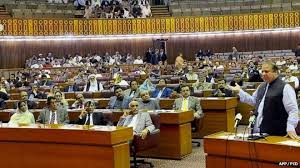
ISLAMABAD, April 10 — The Pakistani Parliament voted on Friday to stay out of the conflict in Yemen, but it urged the government led by Prime Minister Nawaz Sharif to play a diplomatic role in defusing the crisis.
The decision came as international aid agencies reported rising desperation in Yemen, the Middle East’s poorest country, where half the population suffered chronic shortages of basics before the conflict escalated last month.
While a limited amount of emergency medicine was airlifted into Sana, the capital, millions of Yemenis have little or no food, water and fuel; hundreds have been killed, and more than a quarter-million displaced. The United Nations humanitarian relief coordinator for Yemen, Johannes van der Klaauw, told reporters at a news conference in Geneva that the crisis was “getting worse by the hour.”
Analysts in the Arab world saw the Pakistani Parliament’s vote as a significant setback for Saudi Arabia, which is leading a campaign of airstrikes against the Houthis in Yemen. Saudi Arabia, a major donor to Pakistan, had incorrectly advertised Pakistani participation in the campaign from the night it began more than two weeks ago.
While declining a military role, the lawmakers vowed to stand “shoulder to shoulder” with Saudi Arabia, a long-term Sunni ally that had requested aircraft, warships and troops. The lawmakers also pledged to defend Saudi Arabia if its “territorial sovereignty and integrity” was violated.
Saudi Arabia has accused Iran, the region’s most influential Shiite country, of providing military aid to the Houthis, whose leaders follow a variant of Shiite Islam, and leaders in Tehran condemned the Saudi air campaign on Thursday. Most experts say that Iran supports the Houthis but that it does not control them.
The parliamentary measure, which was passed with unanimous support, followed four days of lively debate in a joint session of Pakistan’s Senate and National Assembly.
Critics of military action warned that Pakistan risked getting sucked into a broader sectarian conflict in the region, particularly at a time of growing violence against Shiites at home.
Pakistan is a predominantly Sunni country, but Shiites represent about 20 percent of the population.
The Iranian foreign minister, Mohammad Javad Zarif, visited Islamabad, the Pakistani capital, this week and urged Pakistan to press for a cease-fire in Yemen.
Mr. Sharif’s government has close ties to Saudi Arabia, which gave Pakistan a $1.5 billion grant last year. Mr. Sharif also lived in the Saudi city of Jidda in the early 2000s, when he went into exile to escape the military rule of Pervez Musharraf.
The parliamentary resolution on Friday appeared to largely align with Iran’s wishes. “Pakistan should maintain neutrality in the Yemen conflict so as to be able to play a proactive diplomatic role to end the crisis,” read the resolution, which had been presented by Finance Minister Ishaq Dar.
Lawmakers said they supported “regional and international efforts for restoration of peace and stability in the region.”
Still, the pledge to stand with Saudi Arabia and to defend its sovereignty was seen as leaving open a door to possible military action if the situation in Yemen were to worsen.
Citing sources close to Mr. Sharif, some Pakistani news outlets reported on Friday that the Pakistani prime minister had privately warned Mr. Zarif, his Iranian counterpart, against supporting the Houthis.
In a statement on Thursday, Mr. Sharif said he had used the meeting to express concern about the Yemeni government being overthrown by “nonstate actors.”
“Beside the loss of innocent lives, the crisis can undermine the unity of Muslim world,” Mr. Sharif said in the statement.
The emergency airlift of medical supplies to Sana, arranged by the International Committee of the Red Cross and Unicef, arrived on Friday at the international airport. The agencies said the supplies would be distributed to hospitals across the country. The Red Cross said the shipment included 16 tons of medicine, bandages, intravenous fluids and surgical equipment.
But relief workers in the country reported increasingly dire problems. Doctors Without Borders said it had treated more than 800 war wounded over the past few weeks, but that fighting had left many people, including pregnant women, stranded in their homes or at checkpoints in need of medical treatment.
“Every day we are getting calls from patient in a critical condition — sometimes war-wounded, sometimes with other serious health problems — who cannot reach our hospitals,” Dr. Ali Dahi said in an interview posted on the Doctors Without Borders website. He was working for the charity in Ad Dhale, a town in southern Yemen.
Nuha Abdulljabbar, a Yemeni aid worker for Oxfam, the British charity, said in a telephone interview from Sana that daily bombings by the Saudi-led coalition had paralyzed the city.
“You never know when they will start to bomb,” she said. “There’s no warning, nowhere to go. It’s pretty scary.”
Asked what Yemenis fear the most, she said, “I think the main thing the people are fearing is the silence of the world.”
Salman Masood reported from Islamabad, and Rick Gladstone from New York. Declan Walsh contributed reporting from London.
Slamming Pakistan’s decision to not join the Saudi-led coalition targeting Houthi rebels in Yemen as ‘dangerous and unexpected,’ the United Arab Emirates said the country was favouring Iran over the Gulf nations.
“The Pakistani parliament’s resolution, which promoted neutrality on the Yemeni conflict, and voiced support for Saudi Arabia is contradictory and dangerous and unexpected from Islamabad,” UAE’s minister of state for foreign affairs Anwar Gargash said on Twitter.
Gargash accused Pakistan of choosing Iran over the Gulf nations at a time when they face an “existential confrontation” in the Yemen conflict, according to Al Arabiya.
“Tehran seems to be more important to Islamabad and Ankara than the Gulf countries,” Gargash added.
After a marathon debate on Riyadh’s request for Pakistan to join the military coalition against Houthi rebels in Yemen, federal lawmakers asked the government on Friday with one voice to stay out of the conflict in the Arabian Peninsula, but backed its commitment to protect Saudi Arabia’s territory which is currently under no threat.
Read: Will of parliament: ‘Stay out of Yemen conflict’
“Though our economic and investment assets are inevitable, political support is missing at critical moments,” he wrote, referring to the Gulf countries economic assistance to Pakistan.
“The Arabian Gulf is in a dangerous confrontation, its strategic security is on the edge, and the moment of truth distinguishes between the real ally and the ally of media and statements,” the minister further said.
“The vague and contradictory stands of Pakistan and Turkey are an absolute proof that Arab security — from Libya to Yemen — is the responsibility of none but Arab countries, and the crisis is a real test for neighbouring countries.”
Read: Yemen conflict will have serious implications for regional security: Army chief
Turkey expressed its support for the Saudi-led coalition and said it would offer logistics and intelligence support.
“This is nothing but another chapter of laggard impartial stand,” Gargash added.
Not only criticising Pakistan’s stance, the minister also demanded Pakistan to show a clear stand “in favour of its strategic relations with the Gulf nations, ad contradictory and ambiguous views on this decisive matter will have a cost highly.”
Meanwhile, the military spokesperson for the Saudi-led offensive code named Operation Decisive Storm, Brigadier General Ahmed Asiri claimed on Friday, Pakistan is yet to announce its official position.
Asiri said while Pakistan’s participation would be an addition to the coalition, its absence in the operation wouldn’t affect the coalition’s work.
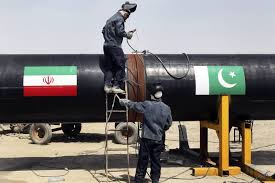
Iran-Pakistan gas pipeline (Credit: wsj.com)ISLAMABAD, April 9 — China will build a pipeline to bring natural gas from Iran to Pakistan to help address Pakistan’s acute energy shortage, under a deal to be signed during the Chinese president’s visit to Islamabad this month, Pakistani officials said.
The arrival of President Xi Jinping is expected to showcase China’s commitment to infrastructure development in ally Pakistan, at a time when few other countries are willing to make major investments in the cash-strapped, terrorism-plagued country.
The pipeline would amount to an early benefit for both Pakistan and Iran from the framework agreement reached earlier this month between Tehran and the U.S. and other world powers to prevent Iran from developing nuclear weapons. The U.S. had previously threatened Pakistan with sanctions if it went ahead with the project.
“We’re building it,” Pakistani Petroleum Minister Shahid Khaqan Abbasi told The Wall Street Journal. “The process has started.”
In Washington, U.S. officials said details of sanctions will be negotiated as part of a comprehensive nuclear deal with Iran due in June.
“We aren’t going to speculate as to how any solutions we may reach in that regard could impact on any particular proposed business ventures,” a State Department official said late Wednesday, adding that “significant support to Iran’s energy sector, such as providing significant investment or technology,” could still result in sanctions under the framework agreement last week.
Dubbed the “Peace Pipeline,” the project will further bolster improving ties between Pakistan and Iran, uneasy neighbors for decades as a result of Pakistan’s ties to Iran’s long-term adversaries, Saudi Arabia and the U.S.
The pipeline will bring much-needed gas to Pakistan, which suffers from a crippling electricity deficit because of a shortage of fuel for its power-generation plants. Pakistan has been negotiating for months behind the scenes for China to build the Pakistani portion of the pipeline, which will cost up to $2 billion.
Tehran says that its 560-mile (900-kilometer) part of the pipeline from an Iranian gas field is complete and has long pressed Pakistan to build its part of the scheme.
Pakistan hasn’t begun construction, however, in light of threatened U.S. sanctions for trading with Iran. Islamabad had sought to work around the sanctions by asking the Chinese to build the pipeline but not yet connect it to the Iranian portion. The prospect of an Iran nuclear agreement, which would ease sanctions in stages once the deal is completed, has given Islamabad further impetus to clear the project. Among the first sanctions to be lifted, according to the framework accord, would be the ban on Iran energy exports.
“This [Iran nuclear agreement] will help us in getting a few things which were coming into the way of the Iran-Pakistan gas pipeline to be cleared and we will move forward,” Pakistan’s ambassador to Iran, Noor Muhammad Jadmani, said Sunday in Tehran, according a report on IRNA, the official Iranian news agency.
Pakistan is negotiating with China Petroleum Pipeline Bureau, a subsidiary of Chinese energy giant China National Petroleum Corporation, to build 435 miles (700 kilometers) of pipeline from the western Pakistani port of Gwadar to Nawabshah in the southern province of Sindh, where it will connect to Pakistan’s existing gas-distribution pipeline network.
China Petroleum Pipeline Bureau referred questions to CNPC, which didn’t respond to a request for comment.
The cost would be $1.5 billion to $1.8 billion for the pipeline, or $2 billion if an optional Liquefied Natural Gas terminal at Gwadar is included in the scheme. Under the deal, 85% of the financing will be provided by a Chinese loan, with Pakistan coming up with the rest.
The remaining 50 miles (80 kilometers), from Gwadar to the Iranian border, will be built by Pakistan. The pipeline, which would take two years to build, would eventually supply Pakistan with enough gas to fuel 4,500 megawatts of electricity generation—almost as much as the country’s entire current electricity shortfall.
The pipeline would give Iran a market to its east for its gas. The pipeline scheme, conceived in 1995, originally was supposed to extend to India. Tehran blames U.S. pressure for India dropping out in 2009.
Islamabad believes the Iranian gas is the cheapest and simplest energy supply option for Pakistan. Pakistan will also start to take liquefied natural gas from Qatar, and it remains in protracted multicountry negotiations over a pipeline that would bring gas from Turkmenistan through Afghanistan to supply Pakistan and India. Washington had long lobbied Pakistan to go for the Turkmenistan pipeline instead of the Iranian one.
The Chinese president’s visit, which has been postponed at least twice, is now expected on or around April 19.
Pakistan has had a close strategic alliance with China for decades—aimed mostly against common foe India—but now Beijing is seeking to add an economic dimension to the relationship. Islamabad and Beijing plan an “economic corridor” linking the Pakistani port of Gwadar, which is under Chinese management, to southwestern China with road and rail connections. The highly ambitious program, which also includes power-generation projects, carries a price tag of some $40 billion. Unveiling agreements and details for the economic corridor will form a center piece of Mr. Xi’s visit.
The Iran pipeline isn’t part of the economic corridor but it will be separately fast-tracked, Pakistani officials said.
“The Chinese have an expertise, a willingness to come here, and also work in areas which are not considered to be very safe,” said Hamayoun Khan, director of the Pakistan Council on China, an independent think tank based in Islamabad.
—Jeremy Page in Beijing contributed to this article.
ISLAMABAD (Reuters) – Pakistan and the United States moved closer to a billion dollar defense deal this week, after U.S. authorities notified Congress of a proposal to supply helicopters and missiles to sharpen up Pakistan’s counter-terrorism efforts.
U.S. ally Pakistan, a nuclear-armed nation of 180 million people, is fighting a Taliban insurgency in its northwest, a separatist insurgency along its Iranian border in the west, and has a heavily militarized and disputed border with arch rival India in the east.
The $952 million proposal involves the United States supplying Pakistan with 15 AH-1Z attack helicopters, 1,000 Hellfire missiles, engines, targeting and positioning systems and other equipment. But negotiations are not complete.
The helicopters and weapon systems were designed for counter-terrorism and counter-insurgency operations, especially in the mountainous Taliban strongholds along the Afghan border, the U.S. Defense Security Cooperation Agency said.
On Monday, the agency notified Congress of the proposed sale, noting it would “contribute to the foreign policy and national security of the United States by helping to improve the security of a country vital to U.S. foreign policy and national security goals in South Asia”.
The equipment “will not alter the basic military balance in the region,” the agency said.
Pakistani defense officials did not reply to requests for comment. The United States has been pushing Pakistan to take action against the Taliban as it withdraws most of its combat troops from neighboring Afghanistan, which is facing its own Taliban insurgency.
James Hardy, the Asia-Pacific editor for IHS Jane’s Defence Weekly, told Reuters the helicopters would help modernize Pakistan’s aging fleet, some of which had problems with spares and maintenance.
“Attack helicopters give you ‘loiter’ capability – you can hang around, find the target, knock it out,” he said. “Right now Pakistan is using its fast jets for counterinsurgency work.”
Pakistan is also trying to finalize a deal to buy eight submarines from China for a reported cost of between $4 billion to $5 billion.
China supplied 51 percent of the weapons Islamabad imported in 2010-2014, according to the Stockholm International Peace Research Institute (SIPRI), which tracks global arms sales.
This year’s budget allocated $7 billion to the military. The police received $800 million.
(Reporting by Katharine Houreld; Editing by Nick Macfie)