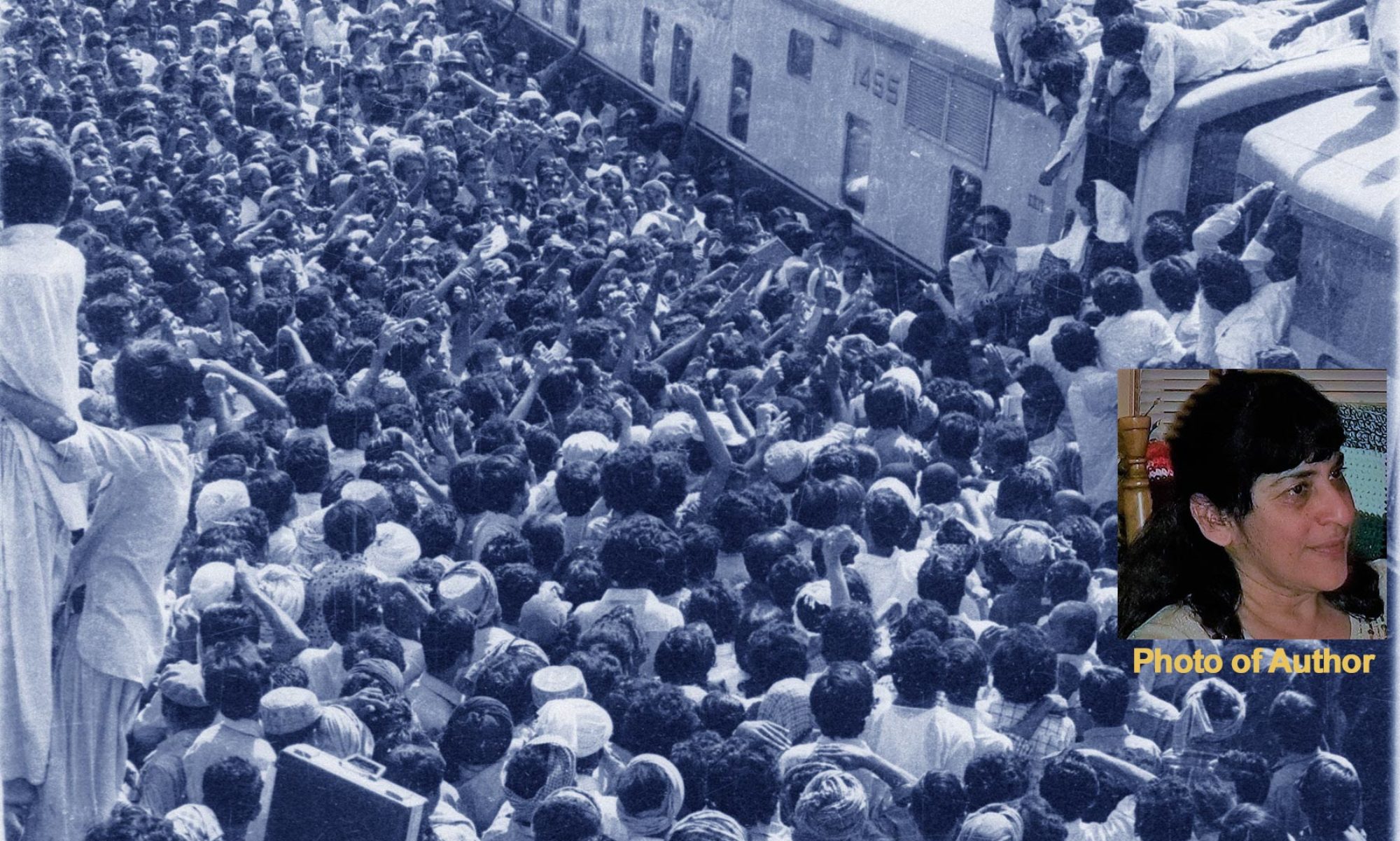
A plan without action

The Peshawar incident could become a turning point of in history only if the state institutions demonstrate their commitment to change of narrative. Anything less than that would mean moving in circles and waiting for next tragedy.

The government has launched a national plan of action with tall promises and fresh commitment to confront the menace of terrorism. More than a month past, the plan has yielded a number of meetings, press conferences and mounting figures of rounded up suspects. Meanwhile hangings of previously convicted criminals have become more conspicuous, encounters are on rise and it is being repeatedly asserted that the government will not discriminate between good and bad Taliban. This would be a major shift from the past if happens at all.

Newspaper reports, however, suggest that the purpose-built good Taliban still enjoy safe havens and not much has changed on ground. Some of the recently reported incidents indicate that a complete dissociation with good Taliban is not imminent even if there is a serious will to do so.
Sources in the Interior Ministry revealed that the ministry is contemplating a ban on Haqqani group and Jamaat-ud-Dawa. It is customary in Pakistan that the banned outfits continue their operations unhindered by just adjusting to a new innocuous title.

With a simple change of brand name, leaders of such outfits stand absolved of all the previous baggage. As long as they fall under the category of good warriors of security establishment, they can operate with a new license. Some two dozen such outfits enjoy complete impunity in Pakistan. Most of them have their sanctuaries in Punjab where state apparatus lacks both courage and will to lay hands on them.

The same attitude explains inaction against the Lal Mosque cleric Mullah Aziz, who openly challenged the jealously guarded writ of the state. A court has issued his non-bail-able warrants that he brazenly defied by saying he will neither seek bail nor will he surrender before the law.
The state apparatus that recklessly dumps mutilated bodies in Balochistan and Sindh to secure writ of the law, becomes spineless when it comes to religious fanatics. Few days back an incident was reported in newspapers that narrate the degree of patronisation enjoyed by sectarian elements.
The PML-N represents a wider sentiment among Punjabi middle class that enjoys a negotiated peace on its land at the expense of bloodshed in other parts of the country.

On the evening of December 31, a leader of Ahle Sunnat Wal Jamaat (AWSJ), was arrested by a joint patrolling team of police and Rangers. The cleric who is a proclaimed offender was heavily guarded. His guard also included a properly armed policeman. According to the newspaper reports, the cleric received a VIP treatment at the SHO’s office. He was ceremoniously released even before the magistrate of the area came to grant him bail.

As the news story appeared in leading newspapers, the Interior Ministry found a scapegoat and a competent police officer, SSP Asmatullah Junejo was suspended. Internal inquiry conducted by senior police officers revealed that the release orders of the cleric came from IGP office yet an honest police officer had to bear the brunt of departmental action, enough to demoralise a handful of honest and committed officers in the police department. The police inquiry is silent on who deployed a police guard to protect a proclaimed offender and who actually ordered his release. This single incident reported in Islamabad is enough testimony that the narrative of good Taliban is immune to the current wave of action.
In September 2014, Maulana Asmatullah Muawiya, head of TTP Punjab announced that his faction would no more carry out attacks in Pakistan. Muawiya however unequivocally mentioned that his group will continue his activities in Afghanistan. He subsequently surrendered before military officials in Miramshah. The episode was trumpeted as a great success of the military operation without narrating details of the heinous incidents of terrorism that he perpetrated. A long list of barbaric acts is attached to his credit. No action has been heard against him and his aides so far. The newspaper reports confirm that he has been allowed to return to his hometown in Punjab. No one knows about the deal that erased all the blood stains from his hands.

According to findings of the interior minister, Islamabad is infested with religious seminaries, mostly illegal. The small town with a population of about two million, houses some 401 seminaries compared to only 422 government schools and colleges. It includes illegally functioning 160 madarassas and 72 Quranic institutions that are not registered with any government authority. Number of seminaries’ students in the capital territory is 31,769 that include 14,377 non local students. Most of these seminaries are located in Sihala, Bhara Kahu, Shahzad Town and Margalla Town, located barely few miles away from the Interior Ministry offices.
Intelligence agencies have been reporting about their involvement in dubious activities.

Other cities and towns of Pakistan have much higher number of seminaries and students. Many of them operate illegally and possess tentacles to mobilise financial resources without much effort.
While the Interior ministry finds it hard to track their financing, channels funneling money into these seminaries are not too veiled. Both charitable and illegal sources of their income are well known to those who matter. However, most of these resources are not availed through formal methods and hence cannot be regulated through banking channels and tax authorities.

Religious parties that openly coddle madrassas are not too naïve about the streams of resources flowing into these seminaries and the education being imparted in these institutions. Madarassa reform is an anachronistic prescription that has never worked in the past. Just tweaking their curriculum and introducing modern subjects would not suffice anymore. Their number has swollen beyond the regulatory capacity of government bodies. Proselytization of unimaginable proportions is being practiced in these seminaries and the narrative has been intelligently aligned with the ideology of state.
According to one study conducted by noted scholar Dr Tariq Rehman, when seminary students were asked priorities for Pakistan, 99.2 per cent answered conquering Kashmir whereas 97.7 per cent students wanted enforcement of Sharia law. This is only tip of the iceberg. Extremist jihadi literature is widely taught in many seminaries and young minds are openly indoctrinated. Much before conceiving any action, the government is apologetic on madarassas issue.

The interior minister dutifully keeps issuing clean bill of health to more than 90 per cent seminaries without revealing details about the remaining ones. Media reports indicate that the government is completely confounded and bereft of clarity on how to tackle madarassas issue.
The PML-N’s soft corner and ideological tilt towards extremist groups is no more a secret. The PML-N in fact represents a wider sentiment among Punjabi middle class that enjoys a negotiated peace on its land at the expense of bloodshed in other parts of the country. However as these terrorist groups are spinning out of their centre of gravity, this aperture of peace is shrinking at a faster pace. It is practically not possible to regulate militancy beyond a certain limit.

Once for all, civilian and security establishment has to take an unambiguous position against terrorism in all its forms. A three-sixty degree policy shift is inevitably required to retrieve peace from the knife-edge.
India clears cows, dogs, dust for Obama Taj Mahal trip

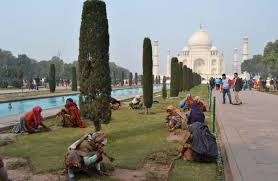
Taj Mahal cleanup (Credit: ibtimes.co.in)

INDIA, Jan 23: As he scrubs the road to India’s Taj Mahal on his knees for less than five dollars a day, Ramjeet beams with pride at the thought of US President Barack Obama admiring his handiwork.

“If everything is clean then he will be impressed,” said the aching man as he took a rest with another 10 kilometres (six miles) of road still to be scoured by him and his co-workers.

“It’s hard on the knees and back,” admitted the cleaner, who is being paid just 300 Indian rupees (around $4.80) a day for his part in a massive makeover.

Ramjeet, who does not have a last name, is one of 600 cleaners mobilised in the city of Agra ahead of Tuesday’s visit by the US president and First Lady Michelle Obama to the world’s most famous temple of love.

Apart from cleaning white lines on the roads, authorities have been rounding up stray dogs, clearing cows from the streets, and have ordered a lockdown around the complex.

“There are a lot of spit stains and such that need to be washed away. The streets need to be spick and span,” said India’s former chief achaeologist KK Mohammed, who has guided world leaders around the white marbled mausoleum.

“You cannot have a VVVIP of the world come to the Taj Mahal and let him see that,” Mohammed told AFP.

The spruce-up, which comes after Modi himself launched a national clean-up campaign last October, reflects a wider determination to ensure the Obamas get to see India at its finest.

In the capital Delhi, workers have been coating buildings and bollards with fresh paint ahead of the Obamas’ attendance at a military parade on Monday.

But the frenzy has been most intense in Agra, no stranger to hosting heads of state or royalty such as Britain’s late Princess Diana.

The Obamas’ visit will be covered by a massive press pack and organisers want to ensure a picture-perfect backdrop.

Pradeep Bhatnagar, chairman of the Taj Trapezium Zone, a buffer region around the monument, said ongoing beautification work has been halted for 10 days to allow dust to settle before the guests arrive.

Suresh Chand, who is in charge of the clean-up, said stray dogs — a common sight in any Indian city — have been rounded up, and more than two tonnes of rubbish pulled from the nearby polluted Yamuna river in just two days.

Another official said cows and buffaloes roaming the streets also “would have to go”.

“When a guest comes to our house then we have to do something better than the normal,” said Chand, Agra municipal council’s chief engineer.

Inside the Taj complex, a dozen barefoot women were busy trimming lawn edges with trowels.

“Obama, Obama,” one lady, who has worked at the Taj for more than two decades and earns 100 Indian rupees a day, said with a grin.

Some 3,000 police are on duty and will conduct boat patrols of the river, said Agra police senior superintendent Rajesh Modak.

Tourists will be turned away while the Obamas are touring the Taj, built by Mughal emperor Shah Jahan as a tomb for his beloved empress who died during childbirth in 1631.

Locals teeming the alleys around the Taj — which took 20,000 labourers 16 years to build — said they have been ordered to stay indoors.

Not everyone is happy about the lockdown, with some saying it has made them feel like criminals.

“You can’t go outside, you can’t go onto the roof, you can’t go outside to the bathroom — it’s like a curfew,” grumbled Anil Kumar Sonkar, who runs a sweet shop a stone’s throw from the Taj.

“We should be open for business and Obama should be allowed to come and sample my world-famous petha,” said Sonkar of the sweet made from sugar and pumpkin.

A similar shutdown occurred during US president Bill Clinton’s visit in 2000, prompting him to ask officials if he was visiting a ghost town, according to locals.

“We were (then) rounded up and made to stand in a line and Mr Clinton came past in his car and shook our hands,” said Sunehri Lal, as he watched children play in a rubbish heap.

“If Obama did something like that, it would be overwhelming.”


Why don’t more moderate Muslims denounce extremism?

Why don’t Muslim leaders speak out?

That question comes up every time terrorists purporting to be deeply religious Muslims carry out armed attacks that kill innocent people. Where, commentators ask, are the moderate Muslim leaders and why aren’t they decrying the horrors perpetuated by fellow Muslims?

In fact, mainstream Muslims are speaking out, clearly and consistently. Leaders around the world, many of whom I know personally through my work at the Foundation for Ethnic Understanding, have issued strong and unambiguous statements virtually every time a violent attack has occurred, condemning such acts as immoral and counter to the fundamental precepts of Islam.

Yet somehow their responses are not being heard, barely registering in the public consciousness.

Recently, there were two major news stories of Islamist extremist attacks on innocent civilians — the holding of 17 hostages in downtown Sydney, Australia by a pro-Islamic State fanatic and the slaughter of 145 people, nearly all of them schoolchildren, in the city of Peshawar by the Pakistani Taliban.

The outcry against these evil acts by responsible Muslim leaders was nearly instantaneous. While the hostage drama was still unfolding at the Lindt Chocolate Café in Sydney, Grand Mufti Ibrahim Abu Mohamed, the country’s highest Islamic office holder, said he felt devastated by the attack, commenting:
‘The Grand Mufti and the Australian National Imams Council condemn this criminal act unequivocally and reiterate that such actions are denounced in part and in whole in Islam.

Numerous Muslim scholars and community leaders have repeatedly denounced the Islamic State as barbaric and un-Islamic.

Meanwhile, the horrific mass murder of schoolchildren by the Pakistani Taliban was met with near universal revulsion across the Islamic world. Dr. Zaruful Islam Khan, President of the All India Muslim Majlise Mushawarat, termed the attack “a blot in the face of Islam,” adding, “We don’t have words to condemn such barbaric act and savagery … There is no justification of killing of innocent children. It has nothing to do with humanity, leave aside Islam.” The Islamic Society of North America repeatedly speaks out against extremism of all kinds and were among the first Muslim organizations to denounce Boko Haram.

This is nothing new. During The summer of 2014, the war between Israel and Hamas in Gaza triggered an explosion of violent anti-Semitism across Europe; many acts were committed by Muslims. While the media highlighted the very real and deeply troubling upsurge of violence in countries like France, Germany and Belgium, they rarely reported on Muslim leaders who denounced the violence.

For example, after riots by a predominantly Muslim crowd in the Paris suburb of Sarcelles attacked a synagogue and Jewish businesses, the local Muslim Association sent a letter of solidarity and support to the vice president of the synagogue. National Muslim leaders took part in an interfaith ceremony that denounced the violence and called for reconciliation. French Council of the Muslim Faith head Dalil Boubakeur, who attended the ceremony, affirmed that the vast majority of French Muslims are not anti-Semitic. How could they be, he asked, when they themselves are battling racism?

Those responses should have been part of the story. But too often, Islam is portrayed negatively, and as a monolithic entity. People don’t realize that there is a diversity of opinion within Islam and that most Muslims condemn extremism and violence.

Yes, Islamist extremism is a genuine threat to world peace. But those who lump all Muslims together, and dismiss as meaningless the courageous stand of the moderate majority against extremism, aren’t helping to win that battle. Rather, they’re strengthening extremism by perpetuating a false narrative of perpetual conflict between Islam and the West. That is something which we must fight with all our might.

Returning to Hyderabad, India, Once a Land of Princes and Palaces

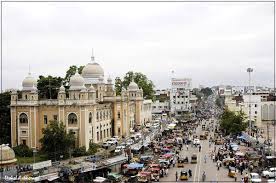
Hyderabad Deccan (Credit: topindiatravels.com)

It took 15 minutes for my car to creep forward about 20 feet, giving me ample time to admire the crumbling filigreed balconies jutting precariously overhead.

Throughout the gridlocked lanes of Hyderabad’s Old City, mud-splattered ancient ramparts are studded with tea stalls, Western Union signs and makeshift roadside repair shops stacked with washing machines waiting to be coaxed back to life. There are glimpses of glory amid the rubble and grime: a solitary remnant of a once-imposing palace wall peeks out timidly amid a labyrinth of electric wires; latticed windows blackened by generations of soot and rain are further obscured by corrugated tin shacks.

“There’s such beauty, but how pathetically it’s been destroyed,” said Dr. Anand Raj Varma, a local scholar and historian who was accompanying me. “Sab khatam ho gaya. Nothing is there.”

I was raised far from India on my father’s outlandish tales of Hyderabad’s magnificent deoris — sprawling walled estates — and of the city’s fragrant gardens and refined etiquette, stories that were passed down from his own father. He watched that world evaporate from the 1950s through the ’70s, and his anecdotes typically end with him shaking his head in wonder: “You couldn’t fathom it.” He barely can himself.

“Everything’s gone now,” he bemoans, like Dr. Varma. Thanks to a lethal mix of government neglect and citizen apathy, and the financial collapse of the aristocracy after the state was absorbed into India in 1948, much of old Hyderabad has been decimated, giving way to a congested urban abyss. The Hyderabad of my father’s nostalgia seemed as implausible to me as Atlantis.

I mostly ignored his lamentations, as teenagers are wont to do. But as I grew older and sought a deeper connection with the city I consider my second home, I began to wonder how things might have been 60 years ago, before Hyderabad’s gracious boulevards were engulfed by dreary concrete blocks. When my maternal grandfather, Mahmood bin Muhammad, a senior administrator, diplomat and writer, died in late 2013, that mild interest graduated to obsession. Most of the buildings my father speaks of dissolved into oblivion decades ago; the people who recall that era are also ebbing away.

And so I returned to see what was left, before both the physical vestiges and the memories that sustain them are lost forever.

Hyderabad isn’t an easy place to love. Delhi has its historical monuments, Rajasthan its palaces, Kerala its lush backwaters and Mumbai its Bollywood glamour. Hyderabad languishes, suspended between a stifled past and a future not yet fully realized. The week I arrived, a politician was making headlines for claiming that his party did more for the state in nine years than the erstwhile ruling Asaf Jahi dynasty, better known as the Nizams, did in hundreds.

Continue reading the main story

The senior-most princes in India during the British Raj, the dynasty of the Nizams reigned over a state the size of the Britain. The seventh and final ruling Nizam, Mir Osman Ali Khan, was proclaimed the richest man in the world on a 1937 Time cover, with a net worth estimated to amount to more than $35 billion in today’s terms. “He spent his leisure hours dipping his arms up to the elbows in chests of diamonds, emeralds, rubies and pearls,” read his 1967 New York Times obituary. He also bestowed the state with educational institutions, hospitals and infrastructure galore.

But Hyderabad has lately reinvented itself as Cyberabad, home to gleaming offices for Facebook, Google, IBM and Oracle. Last year, the city was abuzz with news that a hometown boy, Satya Nadella, had succeeded Steve Ballmer as chief executive of Microsoft. Technology is king today, eclipsing the endowment of bygone monarchs.

“The Nizam has done so much for Hyderabad, and people forget it very quickly because they have short-term memories,” said Princess Esra Jah, an ex-wife of the seventh Nizam’s heir, Prince Mukarram Jah. I had arrived via horse and carriage at the Falaknuma Palace, a Tudor-Italian marvel reborn in 2010 as a sumptuous Taj hotel, to have tea with the princess responsible for its restoration.

“How can they say he did nothing for Hyderabad if it was the most advanced” princely state in all of India? said the princess. “It’s in the history books. But I don’t think most of the politicians read history, if you ask me.”

The princess, who looks just as elegant today as she did as a young ingénue in footage from her then-husband’s 1967 coronation, now splits her time among Istanbul, London and Santa Barbara, Calif.; she came back at the prince’s request to return some family properties to their original splendor. “I took on two projects, the Chowmahalla and Falaknuma palaces, to restore them and to be able to give something back to the city,” she said. This was an arduous task; Falaknuma took more than a decade to bring back to its 1890s glory. “It’s very easy to construct, but difficult to restore,” she said.

Indeed, there must be something to restore in the first place. From Notting Hill in London to the Colaba district of Mumbai, there are countless striking examples of urban development that complement a city’s historical fabric. But in a quest for modernization, much of Hyderabad’s architectural legacy was dismantled, and recent attempts to revisit the past are often a case of too little, too late. “Right from the beginning, people did not give enough importance to restoration,” the princess said. “Buildings came up with no aesthetic sense at all. Just because you are high-tech, it doesn’t mean you have to be ugly.”

Continue reading the main story

High atop a hill, Falaknuma stood empty for decades, shrouded in cobwebs and awaiting its moment. The wonder of Falaknuma isn’t just in the Taj’s immaculate re-creation of the palace’s rooms and gardens, though its 101-seat dining table, stained-glass terrace dome and refreshed frescoes are indeed impressive. The magic lies in its simultaneous re-creation of a lost era of refined manners, or tehzeeb.

My family are among the few people I know who still greet their elders with the traditional “aadaab,” raising an upturned palm to the forehead while bowing slightly at the waist. But murmurs of “aadaab” reverberate throughout Falaknuma’s halls, with everyone from the general manager to the gardeners calling out to me as I pass.

“The manners were wonderful,” said Princess Esra Jah of what she loved most about the Hyderabad of old. “It wasn’t just the nobility or the rich or the poor; everyone had the same manners. They were terribly dignified in their behavior.” The Taj team may set out to revive an edifice, but the nostalgic sense of social grace rekindled at the same time is priceless.­

A few days later Dr. Varma and I crossed the Musi River, flanked by the bulbous domes of the High Court and the Osmania General Hospital, and the car lurched us into the maze of the Old City. We did a circuit past monuments like the iconic 1591 Charminar arch and the sprawling 17th-century Mecca Masjid mosque before arriving at a bright yellow gate. Behind it lay Purani Haveli, the sixth Nizam’s palace, a lavish spread famed for its legendary 262-foot closet — a necessary amenity for a man who reportedly never repeated an outfit. These days, parts of the property are home to a museum and an engineering college, while the rest of its wilting cupolas and turrets lie derelict.

A caretaker eyed us quizzically as we approached. “I just want to show her around,” Dr. Varma said, and the guard waved us in without further questioning. We roamed freely, peering behind a faded curtain rippling in a doorway to find broken windows, dilapidated fountains and jaundiced plasterwork. Hyderabadis are famously laid-back but also unfailingly hospitable, and this combination worked in my favor; “mulahiza,” or gracious deference, defined most of my interactions. All you have to do is ask, I learned quickly: a smile, a polite entreaty, and warm welcomes ensued.

Over the next week, simply by asking nicely, I gained entree to residences, ruins, private clubs, colleges and palaces. I was tipped off to the 17th-century Goshamahal Baradari, an imposing Masonic temple where, despite the fact that I claimed no allegiance to the Freemasons, I was led through inner chambers clearly labeled “Members Only.” At the Hussaini Kothi deori, a family hosted me in their 200-year-old living room, brimming with colorful antique chandeliers and furnishings in impeccable condition. I visited family friends at the neo-Classical Aziz Bagh, where seven generations have lived since 1899 in a three-acre compound so bucolic you’d never guess it existed deep within the thrum of the Old City. At Famous Ice Cream, a city institution embedded in the 1935 Moazzamjahi Market complex, I stopped for dessert and poked around the sepia-tinted stone arcade.

Continue reading the main story Continue reading the main story

Continue reading the main story

Directly opposite a gaudy sari shop near the chaotic Begum Bazaar, I visited the fashion designer Vinita Pittie at her 250-year-old mansion, a legacy of her husband’s forefathers ( financiers to Hyderabadi nobility) that she has taken great pains to preserve. Vibrant tones of scarlet and emerald dominate her immaculately maintained living room, and delicate chandeliers sway from weathered hand-painted ceilings. ­Over a cup of decadent saffron tea, she told me why leaving the traffic-clogged arteries to escape for a more modern abode in the new city was not an option. “This house is an entity that has a soul. Just like humans, it too has a destiny — so the question of leaving it doesn’t arise,” Ms. Pittie told me. “People ask how long we’ll stay. I say, ‘Let’s see how long this haveli keeps me,’ ” she said of the house.

­

Osmania University College for Women teems with students dawdling amid a mishmash of forgettable buildings. But one stands out: In the heart of the campus, two stone lions stand sentinel by a Palladian structure reminiscent of the Pantheon, complete with six imposing Corinthian columns. I approached a group of girls sitting astride one of the lions, gossiping away under the pretext of reviewing notes. “Excuse me, what building is this?” I asked. They shrugged, uninterested in what’s quite literally under their noses. I retreated down the steps, ­many years’ accumulation of dried bird excrement crunching beneath my feet, to seek anyone who might give me access.

Readers of William Dalrymple’s historical “White Mughals” are familiar with the building I had sought out this afternoon. In his impeccably researched biography, Mr. Dalrymple chronicles the love affair between the British Lt. Col. James Achilles Kirkpatrick and his Muslim bride, Khair un-Nissa, which played out here at the erstwhile British Residency in the early 19th century. After being converted into a college in 1949 — my grandmother and mother both studied there, and have fond memories of eating their lunches on the cannons stationed out in front — the building fell into tatters. These days it lies neglected despite the constant activity surrounding it, waiting for a much-needed restoration courtesy of a World Monuments Fund grant to begin.

As I circled the dilapidated structure, stepping over waist-high weeds and puddles of leaking water, I finally encountered a professor who pointed me in the direction of the administration building, where I could ask for permission to access the Residency. After a brief audience, the principal smiled and gave me her blessing, and sent a caretaker to accompany me inside. He released the flimsy padlock and pushed open the doors, revealing two grand staircases that curve to fuse into a magnificent egg-shaped atrium. Despite the pockmarked walls branded by scores of students inscribing their names over the years, despite the stray birds soaring in and out of broken windows, despite the carcass of a chandelier hanging limply overhead, I was mesmerized. I had entered a time capsule abandoned in plain sight.

The late afternoon sun filtered a honeyed aura over the contours of the massive dome, casting me into my own celluloid vision: Lavish parties and imperial intrigue played out all around me. I could picture the grandeur that was Hyderabad. At long last, I’d found Atlantis.


Shifting paradigms

Gen Raheel Sharif in London (Credit: tribune.com.pk)

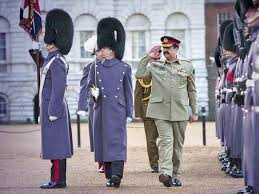
General Raheel Sharif is a very busy man. In particular, he is seen as advancing parts of the National Action Plan (NAP) that sit in his bailiwick. Currently, he is in London for three days and he is meeting people who make things happen. On his first day in the UK, he met British Prime Minister David Cameron and had talks with Secretary of Defence Michael Fallon as well as “other senior officials”, according to reports. The UK is home to a large population of people of Pakistani origin, not all of whom seem to have the best interests of their motherland in their hearts. Of particular concern is an organisation that is banned in Pakistan — the Hizbut Tahrir (HuT) — which is said to have strong support in parts of the UK’s Pakistani population. The army has a particular concern about the HuT as in 2012, four military officers which included a brigadier, were convicted of their links to the HuT. Also present in the UK are several prominent members of the Baloch separatist movement, who give the government another headache.

The purpose of raising these matters with the UK government is to seek its support and assistance in preventing funds being channelled to the HuT and Baloch separatists, as well as exploring the possibility of the UK similarly banning HuT, which is a proscribed organisation in a number of countries other than Pakistan — which may strengthen the argument that General Raheel presents. Given that the HuT has the goal of establishing a global caliphate and considering events in Paris in the last 10 days, any move to limit expansionism by extremist groups must be welcomed.

Baloch separatists have been in the UK for many years, and at least since 2004. The head of the Balochistan Liberation Army (BLA) lives in London from where he often speaks on the Balochistan insurgency, and is reportedly a funding magnet. The BLA is prominent among the several groups active in Balochistan and has claimed responsibility for a number of attacks, including on those people who have settled in Balochistan from other parts of the country. Whether the argument that fighting terrorism is a global responsibility is going to sway the British remains to be seen, but it is the first time Pakistan has reached out and sought help from the British in this way.

On the same day that General Raheel was busy in London, there was a move in Islamabad that may be an indicator of just how far paradigms have shifted since the tabling of the NAP. Many of the terrorist organisations operating in Pakistan get their money from overseas, and some of it comes from Saudi Arabia. Saudi Arabia is a close friend and ally of Pakistan and has been for many years. A fresh facet of that relationship is now being explored and the interior ministry has approached the Saudi embassy in Islamabad to urgently discuss matters relating to the funding by Saudi philanthropists of madrassas and mosques in Pakistan. This is a sensitive matter and will require deft handling, but it comes on the back of a recommendation from a NAP committee that Tehran, Riyadh and the United Arab Emirates all be asked to help stop the funding of groups that are banned in Pakistan and which fan religious and sectarian fires. The interior ministry is to share intelligence reports on foreign funding in support of its request.

Taken together, events in London and Islamabad in pursuit of the goals set out in the NAP are beginning to look like the government is starting to put its money where its mouth is. There have been arrests for the misuse of loudspeakers, hate material has been confiscated in a number of places and now the diplomatic machine is beginning to turn. We welcome these developments, and hope for more of the same.

Published in The Express Tribune, January 16th, 2015.


Pakistan bans Haqqani network after security talks with Kerry

Pakistan has outlawed the Taliban-linked Haqqani network, officials said on Friday, days after US Secretary of State John Kerry urged Prime Minister Nawaz Sharif’s government to fight groups that threaten Afghan, Indian and US interests.

American officials blame high-profile attacks in Afghanistan on the powerful Haqqani network, which mainly operates out of Pakistan’s border areas.

Senior Pakistani government officials told Reuters a formal announcement of the ban would be made “within weeks”.

“We have decided to ban the Haqqani network as a step in implementing the National Action Plan devised after the (Peshawar) school attack,” said a cabinet member, referring to a massacre of 134 children by Taliban gunmen last month.

“The military and the government are on the same page on how to tackle militancy. There is no more ‘good’ or ‘bad’ Taliban.

“Kerry specifically pressed for action against the Haqqanis, including banning the group,” the official added.

A second official, a minister who spoke on condition of anonymity, confirmed the decision to outlaw the Haqqani group.

The United States accuses the Pakistani intelligence agency of supporting the Haqqani militants and using them as a proxy in Afghanistan to gain leverage there against the growing influence of its arch-rival India. Pakistan denies this allegation.

A formal announcement of the ban would show the government is keen to convince the United States it will no longer differentiate between ‘good’ and ‘bad’ militants.
But it remains to be seen if the ban will translate into significant action.

There has been intense debate within the government on whether to brand the group a terrorist organisation.

Some officials have argued the move would have little battlefield impact but risks setting back Afghan reconciliation efforts and unleashing more attacks against Pakistan.
In June last year the Pakistan army launched a long-expected military operation in the troubled North Waziristan region, said to be the base of the Haqqani group.

“Pakistan has done a lot already to disrupt the activities of the Haqqanis…within Pakistan,” said a Western diplomat.
“But they must also take follow up steps … to ensure the Haqqanis and other groups are not allowed to regroup or return to sanctuaries, their assets are frozen, their funding is blocked and their networks dismantled.”

Intelligence Agencies Directed Briefing on Benazir’s Murder – Cheema

Brig Javed Cheema (Credit: ibnlive.in.com)
ISLAMABAD, Jan 16: Retired Brigadier Javed Iqbal Cheema, former director general of the National Crisis Management Cell (NCMC), told a Rawalpindi Anti-Terrorism Court (ATC) on Friday that he had addressed a press conference following the assassination of Benazir Bhutto after discussing it with the spymasters and then secretary interior.

This statement differs from the one the Federal Investigation Agency (FIA) produced before the ATC on February 7, 2011, where the prosecution included Brig Cheema as a prime witness against former president retired General Pervez Musharraf, in connection with the Benazir murder case.

As per Brig Cheema’s previous statement, submitted by the FIA along with case challan, the former DG NCMC was quoted as saying that a day after Ms Bhutto’s assassination, on December 28, 2007, he held a press conference on the advice of Gen Musharraf. In the FIA’s version of Brig Cheema’ statement, he maintains that he held the press conference, in compliance with Gen Musharraf’s orders, to dispel the negativity against the regime, that prevailed in the aftermath of the assassination.

Brig Javed Iqbal Cheema says he was told by spymasters to present Baitullah’s video claiming responsibility for assassination

A reporter who attended the press conference in question told Dawn that during the presser, Brig Cheema had said that the cause of Ms Bhutto’s death was an injury to the head, sustained when her head hit the sunroof lever of her own vehicle. The second thing he disclosed during the press conference was that Baitullah Mehsud, who was the leader of the banned Tehreek-i-Taliban Pakistan at the time, had claimed the responsibility for the attack in a video message.

Brig Cheema had also shared the video — where Mehsud had indirectly claimed responsibility for the assassination of Benazir Bhutto — with members of the press corps.

But on Friday, when the prosecution produced Brig Cheema as a witness before the ATC, he told the court that the decision to hold the press conference was taken by then-interior secretary Kamal Shah.

He said that before the press conference, he was summoned to the headquarters of the Inter-Services Intelligence (ISI), where he met the interior secretary and the heads of the ISI, Military Intelligence and Intelligence Bureau.

He told the court that the spymasters briefed them about their meeting with Gen Musharraf and handed him the video and instructed him to hold a press conference to this effect. He also told the court that he also consulted then-interior minister retired Lt-Gen Hamid Nawaz before holding the press conference.

Pakistan Needs a Fundamental Shift to Tackle Militancy

Army Public School Parents Protest PTI chief's visit (Credit: siasat.com)
Army Public School Parents
Protest PTI chief’s visit (Credit: siasat.com)
After the terrorists executed their barbarous action, the government mercifully woke up to develop a plan for its action. A committee of political wizards, including Sheikh Rashid who had been publicly inciting violence, has been constituted to contemplate measures to curb terrorism in the country.

Heart-wrenching incidents like the one in Peshawar normally prompt such reaction from government quarters. Committees are constituted, thundering statements are issued, a wish list of punitive measures against the perpetrators is suggested and then all fizzles out without a measurable outcome. Depending on gravity of the incident, sometimes a flurry of ephemeral actions is also witnessed. However, root causes are barely touched. In the spirit of fairness, one may eschew criticising an unborn plan of action, yet the track record is undeniably dismal.

After a decade-long battle against terrorism, the country does not merely need a set of cosmetic actions to mollify enraged masses but it requires a fundamental shift in the thought, approach and policies on terrorism. A major policy retrofit is unavoidably needed to put the course on right track. The State ought to adopt an unambiguous position on all forms of terrorism without any classification of its degree, location and suitability.

Analysing and responding to Peshawar incident as an isolated act and perpetrators as just a rouge group of militants would be a blunder. An appalling naivety, insincerity or political bankruptcy of leadership was evident from a news report published on December 19 in a leading national daily. The news report of the prime minister’s meeting with the president carried a paragraph leaving every reader’s head spinning. It reads “A spokesperson for the president said Mamnoon Hussain had asked PM Sharif to involve non-political religious scholars to contact militants and convince them to give up their ‘un-Islamic’ and ‘inhuman’ agenda.” This conversation took place only two days after the gruesome and barbaric incident in Peshawar.

What is bewildering is that the head of the State still believes that militants should be communicated with and convinced to abandon their barbaric tactics! The statement was not much different from the one issued by the cleric of Lal Masjid Maulana Aziz. Misusing Friday sermon to discuss his personal matters he suggested to the military and political leadership to negotiate peace with the Taliban, ostensibly for a more worthy cause. He further suggested that a united force of Pak army and Taliban should be established to fight the infidels.

An even more glaring affection for good Taliban was expressed by Sartaj Aziz, Adviser to the Prime Minister on National Security and Foreign Affairs. In his interview to BBC exactly a month before the incident he was sloppy enough to say “Pakistan should not target militants who do not threaten the country’s security. Why should America’s enemies unnecessarily become our enemies? When the United States attacked Afghanistan, all those that were trained and armed were pushed towards us. Some of them were dangerous for us and some are not. Why must we make enemies out of them all?

The ill-advice of the president to the prime minister and the wisdom showered by the foreign minister were not merely their piteous personal utterances. These manifest the policy paradigm prevailing in the highest policy corridors of the country. It does not remain confined in the policy avenues but also trickles down sapping the administrative web that runs day-to-day affairs of the country.

This characteristic confusion was echoed on December 19 when Islamabad police registered an FIR against civil society activists who were holding a peaceful demonstration outside Laal Masjid demanding an unconditional condemnation of the perpetrators of the Peshawar incident from the mullah. The cleric of the mosque flatly refused to condemn the incident in a talk show that infuriated the whole country. The efficient Islamabad police that did not waste a minute to register FIR against peaceful civil society activists had been too indolent to act against law breaking clerics. The same police did not have courage to book the cleric when he openly instigated violence during Friday sermon. According to a news report, the custodian of law, Islamabad police were able to arrest only three of the 193 clerics booked for amplifier act violations during the whole year.

The present government’s lenient tilt to religious extremists is not much obscure. The incumbent chief minister Punjab while speaking at a seminar held in Lahore to commemorate the services of late Mufti Muhammad Hussain Naeemi in March 2010 beseeched Taliban to spare Punjab. In his cavalier choice of words he said that the Taliban and Pakistan Muslim League-Nawaz both opposed former military dictator Pervez Musharraf and, therefore, he is surprised that this common stance has failed to stop the Taliban from carrying out terror attacks in Punjab. He went on saying “Gen Musharraf planned a bloodbath of innocent Muslims at the behest of others only to prolong his rule, but we in the PML-N opposed his policies and rejected dictation from abroad and if the Taliban are also fighting for the same cause then they should not carry out acts of terror in Punjab.”

Not just that but the ruling party leadership also outlandishly used proscribed outfits to muster support during recent anti-government movement. A newspaper reported on August 23, 2014 that Ahle Sunnat Wal Jamaat (AWSJ), formerly banned as Sipah-i-Sahaba Pakistan, marched from Lal Masjid to Islamabad Press Club registering their support for the Nawaz government. The PML-N’s members were present on the stage and thanked AWSJ for supporting their government.

Confronting political opponents with the support of religious extremists amply indicate the bankruptcy of a supplicant ruling party. Legitimising religiosity to prop up political vested interests is a clear lack of political acumen and stewardship. Similarly, the PTI’s avoidance of condemning Taliban in unequivocal terms is another example of apologetic approach. It was five days after the Peshawar incident when the PTI’s core committee named the perpetrators and condemned them. If leading political parties adopt a policy of pandering terrorist outfits, the country will remain trapped in the quagmire of terrorism.

This approach encourages violent mobs to lynch putative blasphemers without any evidence. It lets clerics to freely abuse pulpits to incite hate and violence in society. The very approach glorifies heinous murderers and elevates their stature from a condemned criminal to an adorable hero and epitome of piety. On the other hand, it muzzles every voice of sanity that demands to demarcate the limits of lunacy. Thus demand for separating faith from the State business becomes an unpardonable sin likened to infidelity. Infusing society with this scale of bigotry breeds intolerance and lunacy of unfathomable proportions. A precipitous descent of the society into chaos and anarchy is a logical corollary of the course. Practicing this prescription for decades, Pakistan has become a nursery of pathological obscurantists.

While it is customary to blame foreign hand behind every act of terrorism, reciprocally we are also blamed for offering cozy sanctuaries to the elements involved in the acts of naked terrorism in other parts of the world. Some of them not only roam freely but also convene public rallies, persuade people and forces to take up arms for jihad, brazenly promote violence and exhort pogroms of sectarian and religious minorities.

They are at liberty to use every public space from mosques to media shows to spew verbal venom with complete impunity. They do not need licenses from poor PEMRA to operate radio or tv channels to air any uncensored content. They can publish literature full of distorted interpretations of religious scriptures. Patted by the powerful patrons, these clerics can conveniently demonize anyone with the charge of apostasy, issue decrees of capital punishment and even publically decapitate the accused yet stay unscathed.

They hardly tolerate existence of womenfolk on earth. From legislation to moon sighting, almost every State and public affair has been made subservient to the clergy. Some of these self-proclaimed guardians of religion were instrumental in instigating gruesome acts of arson against Christian, Hindu, Qadyani and Shia Pakistanis. They do not hesitate to burn them alive, mercilessly kill their innocent children, defile their sacred places and vandalise their deities. All this would not have been possible without tacit support or nonchalance of the highest power centers in the country.

Peshawar incident is nothing but the continuum of this insanity that has plagued the country for decades now. This is high time to decide if this Frankenstein is a strategic asset or an eternal enemy of this country and the humanity. Rather than exterminating the monster of extremism, exploring possibilities of an armistice, as suggested by the president to the prime minister, would be tantamount to paving way for more Peshawar-like macabre scenes.

Is Pakistan Worth America’s Investment?

It doesn’t take much to stir controversy over America’s relationship with Pakistan. The latest dust-up involves $532 million in economic assistance that the United States expects to provide later this year. Last week, Pakistani officials jumped the gun by suggesting the money is closer to being disbursed than it is; the news annoyed India, which doesn’t think the aid is merited.

That is a familiar complaint. Since 9/11, the United States has provided Pakistan with billions of dollars, mostly in military aid, to help fight extremists. There are many reasons to have doubts about the investment. Still, it is in America’s interest to maintain assistance — at a declining level — at least for the time being. But much depends on what the money will be used for. One condition for new aid should be that Pakistan do more for itself — by cutting back on spending for nuclear weapons and requiring its elites to pay taxes.

Doubts about the aid center on Pakistan’s army, which has long played a double game, accepting America’s money while enabling some militant groups, including members of the Afghan Taliban who have been battling American and Afghan troops in Afghanistan. The relationship hit bottom in 2011 when Osama bin Laden was found hiding in Pakistan and was killed by a Navy SEAL team. But it has since improved. Secretary of State John Kerry is expected to visit Islamabad soon.

After militants massacred 148 students and teachers at an army-run school in Peshawar last month, Pakistan’s government promised that it would no longer distinguish between “bad” militant groups, which are seeking to bring down the Pakistani state, and “good” militant groups that have been supported and exploited by the army to attack India and wield influence in Afghanistan. But there is little evidence that the army has gone after the “good” groups in a serious way.

This double game is a big reason that the administration has been unable to fulfill Congress’s mandate to certify that Pakistan has met certain requirements, including preventing its territory from being used for terror attacks, as a condition of assistance. Instead, officials have had to rely on a national security waiver to keep aid flowing.

There is a case for doing that. After much foot-dragging, the Pakistani army is finally battling militants in the North Waziristan region, and American officials say there has been real progress.

Also, Pakistan has allowed American drone attacks against militants along the border to resume, and is cooperating with the new Afghan president, Ashraf Ghani. Pakistan’s help is essential as Mr. Ghani pursues peace talks with the Taliban. It also counts as progress that Pakistan completed a transition from one civilian government to another in 2013 and that the current government, while fragile, remains in place.

American officials say aid has allowed them to maintain some modest leverage with Pakistan’s leaders and to invest in projects that advance both countries’ interests, including energy, more than 600 miles of new roads and support for democratic governance. But it makes no sense to subsidize Pakistan’s policy failures, which include an obsession with nuclear weapons, paltry investments in education and a refusal to seriously combat extremism.

Pakistan still receives more assistance than most countries, a holdover from the days when Washington mistakenly thought it might be a real partner. But the levels are declining and should continue to do so. Cutting aid precipitously would be unwise, but a managed decrease is in line with more realistic expectations about the diminished potential for bilateral cooperation.

Muslim, Jewish & Christian heads of state join mass Paris march to honor victims

Million march in Paris (Credit: arabnews.com)
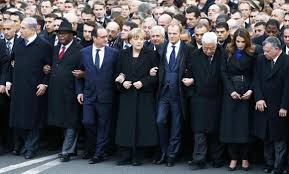
PARIS, Jan 11: Dozens of world leaders including Muslim and Jewish statesmen linked arms leading hundreds of thousands of French citizens on Sunday in an unprecedented march under high security to pay tribute to victims of militant attacks.

President Francois Hollande and leaders from Germany, Italy, Israel, Turkey, Britain and the Palestinian territories among others, moved off from the central Place de la Republique ahead of a sea of French and other flags.

Giant letters attached to a statue in the square spelt out the word Pourquoi?” (Why?) and small groups sang the “La Marseillaise” national anthem.

Some 2,200 police and soldiers patrolled Paris streets to protect marchers from would-be attackers, with police snipers on rooftops and plain-clothes detectives mingling with the crowd.

City sewers were searched ahead of the vigil and underground train stations around the march route are due to be closed down.

The silent march – which may prove the largest seen in modern times through Paris – reflected shock over the worst militant assault on a European city in nine years.

For France, it raised questions of free speech, religion and security, and beyond French frontiers it exposed the vulnerability of states to urban attacks.

Two of the gunmen had declared allegiance to al Qaeda in Yemen and a third to the militant Islamic State.

“Paris is today the capital of the world. Our entire country will rise up and show its best side,” said Hollande in a statement.

Seventeen people, including journalists and police, were killed in three days of violence that began with a shooting attack on the weekly Charlie Hebdo known for its satirical attacks on Islam and other religions as well as politicians.

It ended on Friday with a hostage-taking at a Jewish deli in which four hostages and the gunman were killed. Overnight, an illuminated sign on the Arc de Triomphe read: “Paris est Charlie” ( “Paris is Charlie”).

Several London landmarks including Tower Bridge were due to be lit up in the red white and blue colours of the French national flag in a show of support for the event in Paris. Fifty-seven people were killed in an militant attack on London’s transport system in 2005.

Hours before the march, a video emerged featuring a man resembling the gunman killed in the kosher deli. He pledged allegiance to the Islamic State insurgent group and urged French Muslims to follow his example.

German Chancellor Angela Merkel, British Prime Minister David Cameron and Italy Prime Minister Matteo Renzi were among 44 foreign leaders marching with Hollande.

U.N. Secretary-General Ban Ki-moon, Israel’s Benjamin Netanyahu – who earlier encouraged French Jews to emigrate to Israel – and Palestinian President Mahmoud Abbas were also present.

Immediately to Hollande’s left, walked Merkel and to his right Malian President Ibrahim Boubacar Keita. France has provided troops to help fight Islamist rebels there.

In a rare public display of emotion by two major-power leaders, cameras showed Hollande embracing Merkel, her eyes shut and forehead resting on his cheek, on the steps of the Elysee before they headed off to march.

After world leaders left the march, Hollande stayed to greet survivors of the Charlie Hebdo attack and their families. While there has been widespread solidarity with the victims, there have been dissenting voices.

French social media have carried comments from those uneasy with the “Je suis Charlie” slogan interpreted as freedom of expression at all cost.

Others suggest there was hypocrisy in world leaders whose countries have repressive media laws attending the march.

The official estimate on attendance is due to be announced later. A 1995 protest against planned welfare cuts brought some 500,000-800,000 people onto the streets of the capital, while a 2002 rally against the far-right National Front’s then leader Jean-Marie Le Pen afer he got into the run-off of that year’s presidential election drew 400,000-600,000.

Twelve people were killed in Wednesday’s initial attack on Charlie Hebdo, a journal know for satirising religions and politicians. The attackers, two French-born brothers of Algerian origin, singled out the weekly for its publication of cartoons depicting and ridiculing the Prophet Mohammad (PBUH).

All three gunmen were killed in what local commentators have called “France’s 9/11”, a reference to the September 2001 attacks on U.S. targets by al Qaeda.

The head of France’s 550,000-strong Jewish community, Roger Cukierman, the largest in Europe, said Hollande had promised that Jewish schools and synagogues would have extra protection, by the army if necessary, after the killings.

France’s Agence Juive, which tracks Jewish emigration, estimates more than 5,000 Jews left France for Israel in 2014, up from 3,300 in 2013, itself a 73 per cent increase on 2012.
Far-right National Front leader Marine Le Pen, whom analysts see receiving a boost in the polls due to the attacks, said her anti-immigrant party had been excluded from the Paris demonstration and would instead take part in regional marches.

In Germany, a rally against racism and xenophobia on Saturday drew tens of thousands of people in the eastern German city of Dresden, which has become the centre of anti-immigration protests organised by a new grassroots movement called PEGIDA.

A building of the newspaper Hamburger Morgenpost, which like many other publications has reprinted Charlie Hebdo cartoons, was the target of an arson attack and two suspects were arrested, police said on Sunday.

Turkish and French sources said a woman hunted by French police as a suspect in the attacks had left France several days before the killings and is believed to be in Syria.

French police had launched in an intensive search for Hayat Boumeddiene, the 26-year-old partner of one of the attackers, describing her as “armed and dangerous”.