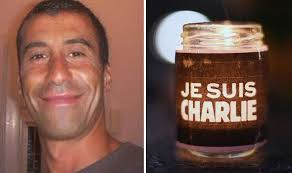
Paris policeman Ahmed Merabet (Credit: arabnews.com)
Ahmed Merabet, the police officer gunned down in the Charlie Hebdo attack, was killed in an act of barbarity by “false Muslims” his brother said in a moving tribute on Saturday, where he also appealed for unity and tolerance.
Speaking for a group of relatives gathered in Paris, Malek Merabet said the terrorists who ignored his brother’s plea for mercy as he lay wounded on the street may have shared his Algerian roots, but had nothing else in common.
“My brother was Muslim and he was killed by two terrorists, by two false Muslims,” he said. “Islam is a religion of peace and love. As far as my brother’s death is concerned it was a waste. He was very proud of the name Ahmed Merabet, proud to represent the police and of defending the values of the Republic – liberty, equality, fraternity.”
Malek reminded France that the country faced a battle against extremism, not against its Muslim citizens. “I address myself now to all the racists, Islamophobes and antisemites. One must not confuse extremists with Muslims. Mad people have neither colour or religion,” he said.
“I want to make another point: don’t tar everybody with the same brush, don’t burn mosques – or synagogues. You are attacking people. It won’t bring our dead back and it won’t appease the families.”
His brief speech was a moving tribute to the slain officer, loved as a son, brother, companion and uncle, but also a powerful call for harmony.
Ahmed Merabet’s death was captured in a graphic video, as he was wounded by one of the two attackers and then shot in cold blood. Photograph: Twitter
Merabet’s death was captured in a graphic video, as he was wounded by one of the two attackers and then shot in the head in cold blood. He is shot in the groin, then falls to the pavement groaning in pain and holding up an arm as though to protect himself.
The second gunman moves forward and asks the policeman: “Do you want to kill us?” Merabet replies: “No, it’s OK mate,” but the terrorist then shoots him in the head.
The images were widely shared online and one was published on the front page of a national newspaper.
Malek berated media outlets and websites that showed the graphic content, which he said was extremely painful for the family. “How dare you take this video and broadcast it? I heard his voice, I recognised him, I saw him being killed and I continue to hear him every day.”
Ahmed’s partner, Morgane Ahmad, who said she had watched footage of the shooting without realising it was him, also appealed for calm.
“What the family and I want is for everyone to be united, we want everyone to be able to demonstrate in peace, we want to show respect for all the victims and that the demonstration should be peaceful,” she said.
Ahmed had been a pillar of the family since his father died 20 years earlier, Malek said. The 42-year-old grew up in Livry-Gargan, in the north-eastern suburbs of Paris, and graduated from the local lycée in 1995. He ran a cleaning company before joining the police force eight years ago, and worked hard for a promotion.
“Through his determination, he had just got his judicial police officer [detective] diploma and was shortly due to leave fieldwork. His colleagues describe him as a man of action who was passionate about his job,” Malek said.
Merabet was called to the scene of the attack while on a bicycle patrol and arrived just as the killers were making their escape. They stopped to add him to the long list of victims.
“He was on foot, and came nose to nose with the terrorists. He pulled out his weapon. It was his job, it was his duty,” said Rocco Contento, a colleague who was a union representative at the central police station for Paris’s 11th arrondissement, where Merabet was based. He described him as a quiet and conscientious officer who was always smiling and widely liked.
As news spread that the gunned down policeman was a Muslim, the hashtag #JeSuisAhmed began spreading on Twitter in solidarity. One user, identified as @Aboujahjah, said: “I am not Charlie, I am Ahmed the dead cop. Charlie ridiculed my faith and culture and I died defending his right to do so.”
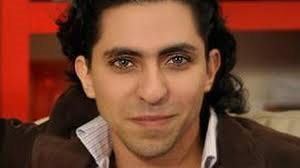
Saudi Arabia, which has described itself as the “guardian of Islam,” released a statement on Wednesday through its official news agency condemning the attack on Charlie Hebdo as a “cowardly terrorist act” that is “incompatible with Islam.” But on Friday, the government pulled a blogger named Raif Badawi from his jail cell in Jeddah, brought him to a square in front of a mosque, and administered the first phase—fifty lashes—of a public flogging. As with Charlie Hebdo, Badawi’s offense involved the exercise of freedom of expression, often with a touch of sarcasm. He is scheduled to get another fifty lashes every Friday for the next nineteen weeks. He also faces ten years in prison and a fine that exceeds a quarter of a million dollars.
Badawi, who is thirty, ran a Web site called Saudi Liberal Network, which dared to discuss the country’s rigid Islamic restrictions on culture. One post mocked the prohibition against observing Valentine’s Day, which, like all non-Muslim holidays, is banned in Saudi Arabia. (Even foreigners aren’t allowed to buy trees for Christmas.) Religious police, known as the Commission for the Promotion of Virtue and Prevention of Vice, have reportedly patrolled flower shops and chocolate shops to warn against selling items that commemorate an infidel celebration. The Web site scoffed, “Congratulations to us for the Commission on the Promotion of Virtue for teaching us virtue and for its eagerness to insure that all members of the Saudi public are among the people of paradise.”
The site was also known to criticize conservative Muslim preachers. Saudi Arabia’s brand of Wahhabi Islam is extremely fundamentalist; Osama bin Laden was an adherent, as are many members of Al Qaeda and one of its franchises, Al Qaeda in the Arabian Peninsula (A.Q.A.P.). The two shooters in Paris, Chérif and Saïd Kouachi, are said to have invoked A.Q.A.P. during their rampage. United States officials say that one of them trained in Yemen, where A.Q.A.P. has been based since it was forced out of Saudi Arabia.
Badawi’s site, which the government ordered taken down, often pressed the Saudi monarchy to show the same degree of religious tolerance that is customary in the West. In one article, which has been translated and reposted elsewhere, Badawi wrote:
We have not asked ourselves how it is that America allows Islamic missionaries on its territory, and how it is that we reject under all circumstances the freedom to proselytize within our Kingdom’s land. We can no longer hide our heads like an ostrich and say that no one can see us or that no one cares. Whether we like it or not, we, being a part of humanity, have the same duties that others have as well as the same rights.
When Badawi, a father of three, was arrested, in 2012, the charges against him included undermining Saudi security. A judge initially recommended that he be charged with apostasy, which carries an automatic death sentence. A noted Saudi cleric, Sheikh Abdul-Rahman al-Barrak, issued a religious ruling that Badawi was an “unbeliever,” because his site declared that Muslims, Jews, Christians, and atheists were equal, according to Human Rights Watch.
In 2013, when Badawi’s sentence was handed down, Nadim Houry, of Human Rights Watch, said, “This incredibly harsh sentence for a peaceful blogger makes a mockery of Saudi Arabia’s claims that it supports reform and religious dialogue.” The punishment also included an additional three months in prison for uquq, or parental disobedience, because Badawi had argued publicly with his father over the years.
After the sentencing, the French foreign ministry issued a statement expressing concern about “freedom of opinion and expression” in Saudi Arabia. On Thursday, in a rare intervention in the Saudi judiciary system, the State Department called on the Kingdom to “cancel this brutal punishment” and review both the case and the “inhumane punishment.” Jen Psaki, speaking for the State Department, said, “The United States strongly opposes laws, including apostasy laws, that restrict the exercise of these freedoms, and urges all countries to uphold these rights in practice.”
Saudi Arabia has also sentenced Badawi’s lawyer, Waleed Abu al-Khair, to fifteen years in prison—with an additional fifteen-year ban on leaving the country—for insulting the judiciary, inciting public opinion, and undermining the regime and its officials. In October, three other lawyers were sentenced to between five and eight years for criticizing the Justice Ministry. Over the past four months, the government has also detained women for driving automobiles and f0r using social media to publicly challenge the driving ban.
“These prosecutions show just how sensitive the Saudi authorities have become to the ability of ordinary citizens to voice opinions online that the government considers controversial or taboo,” Sarah Leah Whitson, of Human Rights Watch, said. “Instead of pursuing their peaceful online critics, Saudi officials would be better employed in carrying out much-needed reforms.”
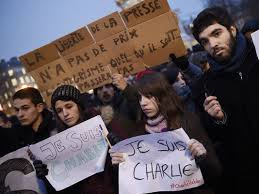
Placards say ‘I am Charlie’ (Credit: usa.com)LONDON, Jan 7 — The sophisticated, military-style strike Wednesday on a French newspaper known for satirizing Islam staggered a continent already seething with anti-immigrant sentiments in some quarters, feeding far-right nationalist parties like France’s National Front.
“This is a dangerous moment for European societies,” said Peter Neumann, director of the International Center for the Study of Radicalization at King’s College London. “With increasing radicalization among supporters of jihadist organizations and the white working class increasingly feeling disenfranchised and uncoupled from elites, things are coming to a head.”
Olivier Roy, a French scholar of Islam and radicalism, called the Paris assault — the most deadly terrorist attack on French soil since the Algerian war ended in the early 1960s — “a quantitative and therefore qualitative turning point,” noting the target and the number of victims. “This was a maximum-impact attack,” he said. “They did this to shock the public, and in that sense they succeeded.”
Anti-immigrant attitudes have been on the rise in recent years in Europe, propelled in part by a moribund economy and high unemployment, as well as increasing immigration and more porous borders. The growing resentments have lifted the fortunes of established parties like the U.K. Independence Party in Britain and the National Front, as well as lesser-known groups like Patriotic Europeans Against Islamization of the West, which assembled 18,000 marchers in Dresden, Germany, on Monday.
In Sweden, where there have been three recent attacks on mosques, the anti-immigrant, anti-Islamist Sweden Democrats Party has been getting about 15 percent support in recent public opinion polls.
Paris was traumatized by the attack, with widespread fears of another. “We feel less and less safe,” said Didier Cantat, 34, standing outside the police barriers at the scene. “If it happened today, it will happen again, maybe even worse.”
Mr. Cantat spoke for many when he said the attacks could fuel greater anti-immigrant sentiment. “We are told Islam is for God, for peace,” he said. “But when you see this other Islam, with the jihadists, I don’t see peace, I see hatred. So people can’t tell which is the real Islam.”
The newspaper, Charlie Hebdo, in its raucous, vulgar and sometimes commercially driven effort to offend every Islamic piety, including the figure of the Prophet Muhammad, became a symbol of an aggressive French secularism that saw its truest enemy in the rise of conservative Islam in France, which is estimated to have the largest Muslim population in Europe.
The mood among Parisians near the scene of the attack Wednesday on the newspaper Charlie Hebdo was apprehensive and angry. “There’s no respect for human life,” said Annette Gerhard.
On Wednesday, Islamic radicals struck back. “This secular atheism is an act of war in this context,” said Andrew Hussey, a Paris-based professor of postcolonial studies. Professor Hussey is the author of “The French Intifada,” which describes the tangled relations between France and its Muslims, still marked by colonialism and the Algerian war.
“Politically, the official left in France has been in denial of the conflict between France and the Arab world,” Professor Hussey said. “But the French in general sense it.”
The attack left some Muslims fearing a backlash. “Some people when they think terrorism, think Muslims,” said Arnaud N’Goma, 26, as he took a cigarette break outside the bank where he works.
Samir Elatrassi, 27, concurred, saying that “Islamophobia is going to increase more and more.”
“When some people see these kinds of terrorists, they conflate them with other Muslims,” he said. “And it’s the extreme right that’s going to benefit from this.”
In reaction to the deadly attack on the French satirical newspaper Charlie Hebdo, President Obama said the United States would provide France with “every bit of assistance” in fighting terrorism.
The German interior minister, Thomas de Mazière, told reporters on Wednesday: “The situation is serious. There is reason for worry, and for precautions, but not for panic.”
With each terrorist attack, however, the acceptability of anti-immigrant policies seems to reach deeper into the mainstream. In Britain, for example, which also has a large Muslim population, the U.K. Independence Party has called for a British exit from the European Union and sharp controls on immigration, emphasizing what it sees as dangers to British values and identity. The mainstream parties have competed in promising more controls on immigration, too.
“Large parts of the European public are latently anti-Muslim, and increasing mobilization of these forces is now reaching into the center of society,” Mr. Neumann said. “If we see more of these incidents, and I think we will, we will see a further polarization of these European societies in the years to come.”
Those who will suffer the most from such a backlash, he said, are the Muslim populations of Europe, “the ordinary normal Muslims who are trying to live their lives in Europe.”
Nowhere in Europe are the tensions greater than in constitutionally secular France, with as many as six million Muslims, a painful colonial history in Algeria, Syria and North Africa, and a militarily bold foreign policy. That history has been aggravated by a period of governmental and economic weakness, when France seems incapable of serious structural, social and economic reform.
Several videos showing the gunmen outside the office of Charlie Hebdo, a satirical newspaper, have surfaced online. The footage includes scenes of graphic violence.
The mood of failure and paralysis is widespread in France. The Charlie Hebdo attack came on the publication day of a contentious new novel, “Submission,” by Michel Houellebecq, which describes the victory of Islam in France and the gradual collaboration of the society with its new rulers from within. Mr. Houellebecq, like the well-known caricaturists and editors who were killed at Charlie Hebdo, has been a symbol of French artistic liberty and license, and his publishers, Flammarion, were reported to be concerned that he and they could be another target.
But the atmosphere has been heightened by the rise of the National Front and its leader, Marine Le Pen, who runs ahead of the Socialist Party in the polls, campaigning on the threat Islam poses to French values and nationhood.
There was much recent attention to another best-selling book by a conservative social critic, Éric Zemmour, called “The French Suicide,” attacking the left and the state for being powerless to defend France against Americanization, globalization, immigration and, of course, Islam. Another new novel, by another well-known French writer, Jean Rolin, called “The Events,” envisions a broken France policed by a United Nations peacekeeping force after a civil war.
“This attack is double honey for the National Front,” said Camille Grand, director of the French Foundation for Strategic Research. “Le Pen says everywhere that Islam is a massive threat, and that France should not support attacks in Iraq and instead defend the homeland and not create threats by going abroad, so they can naturally take advantage of it.”
The military-style attack on Wednesday creates major security questions for France, said a senior French official who spoke on the condition of anonymity because he was not authorized to speak publicly on such a delicate matter. “We knew this would happen,” he said. “But we didn’t know how efficient it would be.”
Speaking in both English and French, Secretary of State John Kerry expressed solidarity with France against an attack on the French satirical newspaper Charlie Hebdo that killed 12 people.
After a series of three apparently lone-wolf attacks on crowds around Christmas in France, and other attacks in Ottawa and in Sydney, Australia, there was speculation that this attack might also be a response to the September call of a spokesman of the Islamic State, Abu Muhammad al-Adnani, for supporters to strike at domestic targets of the countries attacking the Islamic State.
Mr. Grand noted that at least 2,000 young French citizens have traveled to fight with the militants in Iraq and Syria. “So how do we manage our Muslim population?” he asked. “This kind of attack is very difficult to detect or prevent,” he said, adding that the state must not overreact, which is what the radicals want.
Still, he said, even given that the number of radical Muslims is a tiny minority in France, “there are definitely more than 50 crazy guys,” so it will be important to know whether the attackers had been to Syria or “wanted to go and did this instead.”
François Heisbourg, a defense analyst and special adviser to the Foundation for Strategic Research, in Paris, said that the professional military acumen of the attack reminded him of the commandos who invaded Mumbai, India, in July 2011. “This is much closer to a military operation than anything we’ve experienced in France, and that may limit the political impact,” he said.
“Between this attack and whatever real societal problems we have in France, there is a great gap,” Mr. Heisbourg said. “These were not corner-shop guys from the suburbs.”
The mood in Paris, near the scene of the attack, was both apprehensive and angry. Ilhem Bonik, 38, said that she had lived in Paris for 14 years and had never been so afraid. “I am Arab, Tunisian, Muslim, and I support the families, the journalists and all the people involved,” she said. “This is against Islam.”
When journalists are killed for expressing their views, it is one step away from burning books, said Annette Gerhard, 60. “It’s like Kristallnacht,” Ms. Gerhard said, noting that her family had died in Nazi deportations. “There’s no respect for human life.”
Rachel Donadio and Aurelien Breeden contributed reporting from Paris, and Alison Smale from Berlin.
Volleyball players killed (Credit: naharnet.com)PESHAWAR, Jan 4: At least five people, including some football players were killed and 11 injured on Sunday in a bomb attack in Pakistan’s restive north western tribal region during a match, officials said.
A bomb exploded at a playground in Kadda Bazaar area of Kalya, the main town of Orakzai district today, killing five and injuring 11 people, Khiasta Akbar Khan, a local official said.
“Five people were killed and 11 injured in the bomb explosion,” he said.
The officials said that the attack took place when the spectators were watching a volleyball match but Radio Pakistan reported that a football match was in progress during the attack.
No militant outfit has taken the responsibility of the attack so far.
Nazim Ali, Waseem and Sarfraz Ali are some of the players among the dead, officials said.
Initial reports have shown that a planted device was used in the explosion.
The security forces have cordoned off the Shia-dominated area and started search operations.
Prime Minister Nawaz Sharif condemned the blast and deplored the loss of lives.
He emphasized on the government’s resolve to eradicate the menace of terrorism and extremism.
The bombing comes as the first major terror attack on Pakistani soil in the new year.
The country witnessed one of the deadliest attacks last month, when Taliban killed at least 149 people, mostly children at an army-run school in Peshawar.
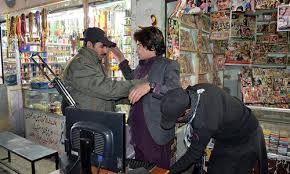
Balochistan crackdown (Credit: dawn.com)QUETTA, Jan 3: Police and Frontier Corps (FC) on Saturday launched a crackdown against shopkeepers selling hate material in Quetta and other parts of Balochistan.
Capital City Police Officer (CCPO) Quetta, Razzaq Cheema stated that 40 suspects were apprehended and twenty shops were sealed during different raids in Quetta.
Police also recovered 715 detonators, walkie-talkie sets and other materials from the sealed shops.
Since the Peshawar school attack, security forces have been conducting raids in different parts of Balochistan and arresting suspected militants.
FC also conducted raids in Chaman, Killa Abdullah, Khuzdar, Turbat and other districts of Balochistan and recovered hate materials including books, pamphlets, CDs and literature.
Spokesman FC in a statement stated that the crackdown was launched after approval by the federal government.
CCPO Quetta Razzaq Cheema stated that raids were conducted in Kuchlak, Satellite Town, Pashtoonbabad and other areas and more than forty shopkeepers were arrested.
“We will not allow anyone to spread hatred,” Cheema said. Markets in Quetta have been awash with CDs and hate literature for more than a decade.
This is the first time that police and FC have launched a joint crackdown against shopkeepers.
“We are interrogating the arrested shopkeepers,” Razzaq Cheema said.
When asked about threats in Quetta, the CCPO stated that information about threats were available but police were determined to ensure peace in the province.
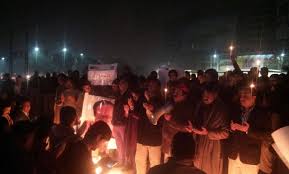
Taseer commemoration (Credit: pakistantoday.com.pk)ISLAMABAD, Jan 4: Some enraged people attacked the participants of a candle light vigil organized here to mark the death anniversary of former governor Salman Taseer.
People had gathered at Liberty Chowk to mark the death anniversary of ex-governor of Punjab, Salman Taseer, who was shot and killed by his own guard, Mumtaz Qadri, in broad day light in December 2010 in Islamabad.
A group of four-five people showed up at the scene, snatched and tore up placards and photos of Salman Taseer before beating up the participants of the vigil.
The attackers indiscriminately kicked women and other participants. They also subjected the reporters covering the event to torture and hit threw their cameras on the road and also damaged their DSNG vans.
A TV footage captured this event and in it a reporter can be heard saying: “What is our crime?”
Geo News cameraman Badar Munir also received some blows from the attackers while window panes of the DSNG van were also smashed.
Panicked participants ran in all directions to look for cover.
Parliament meets on special courts (Credit: expresstribune.pk.com)
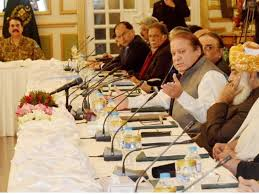
ISLAMABAD, Jan 2: The All Parties Conference (APC) at the PM House on Friday reached consensus on providing constitutional cover to special courts through an act of Parliament, while a roadmap regarding the 20-point National Action Plan was presented.
Speaking to the media after the meeting on Friday evening, PTI Vice-Chairman Shah Mehmood Qureshi said that members of the APC agreed on the proposition that amendments be made to the Army Act to enable “speedy” trials against “hardened criminals”.
He added that the meeting was prolonged because of the discussion on whether what they were doing was enough.
“Legal experts were of the opinion that challenges are expected to any possible amendment to the Army Act or the Constitution in superior courts,” Qureshi said. “Legal experts believe that if amendments are made with constitutional cover it will be easier to defend them [in superior courts].”
Earlier, Prime Minister Nawaz Sharif said legislation regarding the the National Action Plan, which would possibly amend the Constitution to establish military courts, should be tabled in the National Assembly today.
“The time has come for a final decision to be made today. I am hopeful that this bill should be presented before Parliament today. There is no room for further debate on NAP,” Nawaz said, urging political leaders to finalise the draft for the amendment in the Constitution.
“The nation wants to see the National Action Plan in action,” the prime minister said while addressing an All Parties Conference at the PM House in Islamabad.
Further, the premier reiterated that the military courts would only be set up for two years.
Nawaz lauded the efforts made by the leadership of all political parties for being on the same page following the aftermath of the tragic attack on the Army Public School in Peshawar in which 150 people were killed.
“I am happy to announce that the day after the incident, on December 17, all political parties’ leaders were in Peshawar and on the same page,” he said.
“In that APC, we unanimously decided that a parliamentary committee will be made to take action after the horrific incident,” said the premier.
Further, the prime minister said another meeting was held on December 24, which lasted 11 hours, in which the 20-point National Action Plan was also agreed upon collectively.
“I am happy that the political leadership of Pakistan is standing together to work towards eliminating terrorism,” he said.
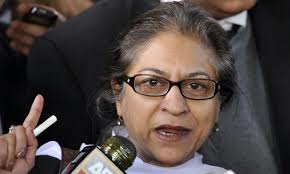
Human Rights lawyer, Asma Jehangir (Credit: dawn.com)
LAHORE, Jan. 1: The parliament mustn’t give legal cover to military courts, the Lahore High Court Bar Association said at its general house meeting on Thursday. The LHCBA passed a resolution condemning the plan to set up military courts to hear terrorism cases.
A general house meeting was called to deliberate on the issue. The LHCBA announced that it would call an All Pakistan Lawyers’ Convention to devise a strategy to resist the move.
Former Supreme Court Bar Association president Asma Jahangir said there was a need to cooperate with the armed forces in fighting the menace of terrorism. The people of the country gave a massive portion of the national budget to the armed forces each year to help them fight terrorism. “But they couldn’t even protect a school in their own cantonment.”
Jehangir said the judiciary and the democratic setup had its faults but they were still better than martial law or military courts. “These courts cannot resolve conflict.” Under the military, there could be no separation of powers, she said. “The whole system would collapse.”
Jehangir said that the parliament should not wait for the judiciary to declare the amendment illegal. It shouldn’t pass the bill at all.
The first step the government needs to take is to take note of all sympathisers of terrorists from among politicians and within the armed forces. “Everyone knows that the FC is protecting Lashkar-i-Jhangvi in Balochistan. The only solution to the problem of terrorism is the supremacy of civil rule.”
There is no doubt that Pakistan is faced with a severe terrorism problem, but setting up military courts will not change a thing, former SCBA president Advocate Hamid Khan said.
Pakistan had tried and tested military courts since 1958 and nothing good had come of it, he said. “Setting up military courts gives the impression that the attack in Peshawar was the judiciary’s fault.” It was clear that the military and intelligence agencies had failed in gathering intelligence about the attack and pre-empting it, said Khan. The armed forces hadn’t been able to kill any terrorists involved in the attack, the culprits blew themselves up.
Khan said the prosecution was to blame for not collecting enough evidence to bring the culprits to book. Whatever reforms the country needed in light of the war on terror must be taken within the Constitution, he said. “The security and protection the government plans to provide military courts should be extended to judges.” The state has created the impression that protection and security extends to the armed forces and not the civilians. “This is a failure of the state,” he said.
Small militia groups under the banners of Lashkar and Sippah needed to be disbanded immediately, said Khan. “Regardless of their reputation, every organisation that preached a version of militant Islam needs to be disarmed,” he said.
Advocate Tanveer Chaudhry was critical of judges. Today courts act like dictators, he said. “One of the judges took a traffic warden into custody after he asked him to queue up to get a driving licence; another judge ordered four robbers to be shot dead for robbing the house of a civil court judge in Sheikhupura,” Chaudhry said. “An MS was put in handcuffs for not treating an LHC judge’s daughter on priority… Is this a civilian judiciary?” He said the country’s judiciary were acting like core commanders. Advocate Raja Zulqarnain said lawyers would not accept a move to set up military courts. He said politicians and military men provided weapons to the Jamatud Dawa and the Sippah-i-Sahaba. “Why are they protecting hardliners?”
LHCBA’s acting president Amir Jalil Siddiqi said the bar should have announced its view point right after political parties made an announcement in this regard. He said Nawaz Sharif became prime minister because of the Lawyers’ Movement. “We will not let him commit an illegal act.”
Published in The Express Tribune, January 2nd, 2015.
While we all got used to missing persons and tortured bodies in Balochistan, it’s odd to find Sindh becoming part of the same tragic cycle.
Death and dead bodies are not new to Sindh. Every decade since the 1980s, the province has bled for one reason or the other. But this current spate of killings seems to be a new pattern. It is almost as if Sindhi nationalism is being woken up. Interestingly, the six dead bodies found recently did not belong to violent nationalists. In fact, five out of the six were men who had moved on in life. Notwithstanding old associations with the JSMM, these people were not actively involved in any ‘anti-state’ activity or even in party politics.
In any case, one thought that from the state’s perspective, Sindh was not Balochistan. The province had been through this phase during the 1980s when people challenged the military regime and were killed for it. Like Balochistan, Sindh was politically vibrant. The Sindhi media and intelligentsia was politically active and educated people about issues in its own language. Fast-forward to the 2000s, things were manipulated and changed. Despite the media still being active, it has begun to behave and sound more like the media in the rest of the country. What the state couldn’t purchase or silence was bought over by influential dons.
One also thought that the state was using two other tools to repair relations with Sindh. First, approximately 80,000 men were inducted into the army during the Musharraf period that naturally increased effectiveness of old and new cantonments and cadet colleges in different places in the province. In fact, one came across Sindhi expatriates and intellectuals, who would argue in favour of their people joining the civil and military bureaucracy. Many scions of influential families joined the security establishment in different positions to enhance their power and influence. Second, the province was gradually but systematically infested with militant organisations, madrassas and other infrastructure. In any case, the JUI-F and the JUI-S were expanding their influence, which was obvious from the votes that the late Khalid Soomro got in Larkana contesting the 1990 elections against Benazir Bhutto. Given the absence of a forceful narrative to counter the gradually melting feudalism (that turned into neo-feudalism), the new middle class in Sindh was getting attracted to religious discourse. Certain religious organisations got lots of opportunities to bring back traditional support for them in Sindh back to life in a newer form.
So, one really wonders why it was felt that there was a need to light a fire in Sindh. Such killings can only provoke anger and resentment, especially amongst the youth who are abandoned both by the state and the political governments. The stories of poor governance, corruption and neglect of the people are far too gory for anyone to claim that the PPP and its leadership are not to blame. As a political party, the PPP is both a perpetrator and victim of the wave of violence. It is responsible for not crying out loud against what is happening in the province it claims to control. The collusion between its key leaders and the security apparatus denoted by joint exploitation of resources makes its behaviour questionable. Yet, it is a party that will find itself in a deeper mess if the violence doesn’t stop. It would be even more tragic if it has to become party to the greater intrusion of the security apparatus that will step in under the pretext of securing the place against ‘violent nationalism’.
Recently, the chairman of the Sindhi Taraqi Pasand Party, Qadir Magsi, rightly warned the JSMM against an armed struggle as it could result in greater losses and deaths of Sindhi youth. Moreover, violence will eventually open doors even wider for both the military and religious militants to expand their existing influence. Then, things will get so muddled that no one will seem to have a recipe other than perhaps, the Chinese. But in the process, the tranquility and serenity of the place will disappear forever. The Sufi tradition, multiculturalism and tolerance, which are already drifting away, will become things of the past. Even nationalists wouldn’t realise when they start seeking help of militants because there is no other help available. It is quite likely that, like in Balochistan where al Qaeda seems to have taken up the cause of Baloch nationalism, forces of extremism will determine Sindh’s politics.
While we try to solve the mystery of why Sindh is being sinned against, it is important to note that all moderate political forces are disappearing. This is also a reference to the recent killing of the JUI-F’s Dr Soomro. Although the partnership between the PPP and the JUI-F during the last six years played a critical role in strengthening the latter and bringing in militant elements into Sindh, which mostly came under the religious party’s umbrella, Dr Soomro was a political man who cared for Sindhi nationalism as well. Even if he hadn’t died, he would find himself less effective in the face of the evolving politics of Sindh. Some people even argue that his death may be linked with his nationalistic perspective rather than anything else. Not to forget that the JUI-F has an interesting legacy and historically had a leadership that opposed the official nationalist narrative. This was also a party where the politics of the left and right merged together. The death of leaders like Dr Soomro indicate a transition towards a different kind of leadership or the rising influence of new militant groups in Sindh, which are more aligned with Islamabad’s nationalist perspective. A new hybrid-theocratic society is in the process of being born.
Sindh has had a legacy of great history and traditions. While we can all think of demons that can be held responsible for the current mayhem, there is no time to waste if we want to stop the bleeding. The state must be held accountable and made to stop this bloodshed.
KARACHI, Dec 26 — Seven years have passed since Benazir Bhutto, Pakistan’s former prime minister, was assassinated in Rawalpindi, on Dec. 27, 2007. Her legacy and significance in world history continue to hold a special place in the hearts of the millions of Pakistanis who mourn her death as much as they mourn the death of the dream of what Pakistan might have been had she lived to rule the country just one more time.
As with that of many political icons, Ms. Bhutto’s sudden death left a void in both leadership and inspiration; no politician in Pakistan has been able to fill it. She also left behind a checkered past, with allegations of corruption that still linger, unproved in court for lack of evidence. The two governments she led were dismissed on corruption charges, and she was accused of amassing a large personal fortune for her own family while doing far too little to alleviate the burdens of Pakistan’s poor.
In her own life, she carved out a brilliant academic career at Harvard and Oxford, and political achievements of undeniable import as the daughter of an assassinated prime minister battling to restore democracy in Pakistan; later, she became the first woman elected to lead a Muslim country. She inhabited a marriage that puzzled people as much as it fascinated them — to a controversial man who ruled Pakistan in her name for years after her death. She raised a son and two daughters, who now strive, with mixed results, to serve the Pakistani people she claimed to have lived for.
Yet Ms. Bhutto left behind more than success or scandal. In her wake are the millions of Pakistani girls and women who look at her life, her determination, her perseverance in the face of all odds. They appropriate even the smallest part of these elements of her life and add it to the blueprint they envision for their own. And they thrill to the idea, still radical in Pakistan 40 years after Ms. Bhutto began her political career, that gender doesn’t have to stop them from achieving their dreams.
One of the more literal examples of Ms. Bhutto’s legacy that helps Pakistani women is the Benazir Income Support Program, which distributes cash, without conditions, to low-income families throughout Pakistan. These poorest of the poor, 5.5 million families in 2013, receive 1,200 Pakistani rupees — about $12 — twice monthly, most of which is spent on food. Ms. Bhutto worked on the vision, concept and design of the program with a renowned Pakistani economist, Dr. Kaiser Bengali. After her death, the initiative was enacted by Prime Minister Yousaf Raza Gilani, but named after Ms. Bhutto by her widower, President Asif Ali Zardari, as a tribute to her.
The program isn’t without flaws; critics have said that it is meant to influence voters at election time, that political influence skews which families are eligible to be recipients, and the fact that most of the assistance is nonconditional renders it ineffective (a subprogram gives families more cash if they enroll their children in primary school).
But there is also a revolutionary side to the scheme: The cash is transferred into the bank account of a woman in the family, not a man. Placing spending power directly into the hands of poor Pakistani women empowers them on many levels: They become decision makers within the family, and their respect and value increase in the community. To obtain the cash, they are required to get national identity cards and bank accounts; as a result, they achieve a level of citizenship and fiscal identity denied to previous generations, when the births and deaths of women were rarely registered in official records.
While mothers are being helped by the program, their daughters are going to school in even greater numbers than before, thanks to the many awareness campaigns and education drives underway in Pakistan. Many of these girls regard Benazir Bhutto as an inspiration for their own educational paths. Malala Yousafzai, Pakistan’s most famous schoolgirl, cites Ms. Bhutto as her personal idol, and wore Ms. Bhutto’s white shawl when she addressed the United Nations in 2013.
Young women attend classes at the Shaheed Zulfikar Ali Bhutto Institute of Science and Technology, which Ms. Bhutto established in her father’s name, in Karachi, Islamabad, Hyderabad and Larkana. There, they study law, media, computer engineering and more. Ms. Bhutto’s university-educated daughters, Asifa and Bakhtawar, today publicly encourage Pakistani girls to go to school so that they, too, may one day serve the nation as educated, empowered women.
The daughter of a privileged landowning family, Ms. Bhutto nevertheless fought against the conservative social mores of her environment, in which rich girls could go to school but grown women were expected to run a house and raise a family, no matter how educated they were. She herself returned to Pakistan after her studies, and entered politics, heading the Pakistan Peoples Party in its now-celebrated struggle in the 1980s against the dictator Gen. Mohammad Zia ul-Haq.
She endured house arrest and exile throughout her political career, overcame the powerful mullahs’ objections to a woman’s ruling an Islamic nation, and won admirers all over the world for her political skills and compassion. Even after her death, she serves as the ultimate mentor to Pakistani girls and women who want to set the course of their lives for themselves, instead of having it dictated to them.
What might have happened in Pakistan had Ms. Bhutto been elected for a third term will remain an unanswerable question. Her personal and political legacy is full of contradictions and complexities that will continue to be examined by earnest historians, mined by rapacious politicians, venerated by her supporters and picked apart by her detractors.
Yet she emboldened the heart of every girl and woman in Pakistan who was ever told that being a woman precluded her from a lifetime of accomplishment, service and worth. This was her greatest legacy.
Bina Shah is the author of several books of fiction, including, most recently, “A Season for Martyrs.”