A British jihadi nicknamed “Barbie” who sneaked back to the UK from a training camp in Syria has been jailed for 12 years.
Imran Khawaja, a “poster boy” for an Isil-linked terror group, got fed up with the conditions in the war-torn region, so he faked his own death by falsely spreading rumours online and fled for the UK, a court heard.
But the 27-year-old bodybuilder was caught trying to re-enter the UK at Dover and was today handed a 17-year extended sentence, 12 of which will be spent in custody.
Woolwich Crown Court heard that Khawaja – who has links with British hostage executioner Jihadi John – had complained of a lack of toileteries, cocoa butter and condoms for the “war booty” during his six-month stint with the Rayat al-Tawheed (RAT) insurgents in the Middle East last year.
ICSR / King’s College London
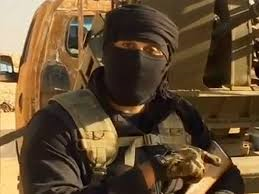
Extremist: Imran Khawaja got fed up with the conditions in Syria
During the two-day sentencing hearing, the court was shown disturbing footage of Khawaja reaching into a bag of severed heads before pulling one out with his bare hand, getwestlondon.co.uk reports.
The 27-year-old can be heard saying: “Heads, kuffars [non-believers]. Disgusting.”
However, a psychological assessment of the defendant concluded he had restricted cognitive ability, a lack of critical thinking, poor concentration and an IQ that was within the lowest 12% in the country.
As a consequence he was found to be vulnerable to manipulation and radicalisation.
Khawaja travelled to Syria in January 2014 and became a leading figure within Rayat al–T awheed (RAT), a group linked to the Islamic State of Iraq and the Levant, the court was told.
By the end of May the group had released an image of the defendant, who pleaded guilty to terror charges last month, claiming that he had been killed in battle.
He was, in fact, on his way back to the UK, being driven by his co-defendant and cousin Tahir Bhatti, 45, from Watford.
In text messages read out in court, Khawaja – who was also known as Imz, Iron, Immi, Touchi and Cashew – complained of not having moisturiser and toilet paper while in Syria.
He had demanded cocoa butter and toiletries as well as “condoms for the war booty” and complained when his friends failed to send it.
Psychological assessment: Jihadi fighter Imran Khawaja has an IQ that within the lowest 12% of the UK Woolwich Crown Court was told
The court heard that Khawaja’s family repeatedly begged him to come home even cajoling him with images of Nando’s food.
He lied and told them he was doing charity work, telling his sister that he cared more for Allah than his family.
His sister replied on many occasions saying that “their parents’ hearts were breaking” and that if “he didn’t come home she would come and get him”.
In messages home, Khawaja put pressure on his friends and family to send him money because “guns, cars cost money” and he wanted a “Rambo gun” and needed “shooters”.
When that failed, prosecutor Brian Altman QC told the court that Khawaja decided, in May 2014, to briefly come back to the UK to sort funds out himself.
He was stopped by port officials at Dover while trying to regain entry to the UK with his cousin Bhatti.
Jihadi: Southall bodybuilder Imran Khawaja was jailed for 12 years
In a letter to the court, Khawaja apologised for his actions and urged other young Britons not to make the same mistakes he had.
In the note to the judge, he said: “I will just like to apologise for the laws I have broke [sic]. I am sincerely sorry. I have let my country, my family and my community down.
“I have nightmares about Syria. I am lucky to be alive. I would hate to see the young men of Britain to make the same mistake I made and say to them ‘do not get attracted by the propaganda’.”
Jailing Khawaja at Woolwich Crown Court today, judge Jeremy Baker handed him a 17-year term for the most serious offence.
It will comprise a 12-year custodial term before being released on licence.
For decades, royal Arab hunting expeditions have traveled to the far reaches of Pakistan in pursuit of the houbara bustard — a waddling, migratory bird whose meat, they believe, contains aphrodisiac powers.
Little expense is spared for the elaborate winter hunts. Cargo planes fly tents and luxury jeeps into custom-built desert airstrips, followed by private jets carrying the kings and princes of Persian Gulf countries along with their precious charges: expensive hunting falcons that are used to kill the white-plumed houbara.
This year’s hunt, however, has run into difficulty.
It started in November, when the High Court in Baluchistan, the vast and tumultuous Pakistani province that is a favored hunting ground, canceled all foreign hunting permits in response to complaints from conservationists.
Those experts say the houbara’s habitat, and perhaps the long-term survival of the species, which is already considered threatened, has been endangered by the ferocious pace of hunting.
That legal order ballooned into a minor political crisis last week when a senior Saudi prince and his entourage landed in Baluchistan, attracting unusually critical media attention and a legal battle that is scheduled to reach the country’s Supreme Court in the coming days.
Anger among conservationists was heightened by the fact that the prince — Fahd bin Sultan bin Abdul Aziz, the governor of Tabuk province — along with his entourage had killed 2,100 houbara over 21 days during last year’s hunt, according to an official report leaked to the Pakistani news media, or about 20 times more than his allocated quota.
Still, Prince Fahd faced little censure when he touched down in Dalbandin, a dusty town near the Afghan border on Wednesday, to be welcomed by a delegation led by a cabinet minister and including senior provincial officials.
His reception was a testament, critics say, to the money-driven magnetism of Saudi influence in Pakistan, and the walk-on role of the humble bustard in cementing that relationship.
“This is a clear admission of servility to the rich Arabs,” said Pervez Hoodbhoy, a physics professor and longtime critic of what he calls “Saudization” in Pakistan. “They come here, hunt with impunity, and are given police protection in spite of the fact that they are violating local laws.”
The dispute has focused attention on a practice that started in the 1970s, when intensive hunting in the Persian Gulf nearly rendered the houbara extinct there, and with it a cherished tradition considered the sport of kings.
As the houbara migrated from its breeding grounds in Siberia, newly enriched Persian Gulf royalty flocked to the deserts and fields of Pakistan, where they were welcomed with open arms by the country’s leaders.
For the Pakistanis, the hunt has become an opportunity to earn money and engage in a form of soft diplomacy.
Although only 29 foreigners have been permitted houbara licenses this year, according to press reports, they include some of the wealthiest and most powerful men in the Middle East, including the kings of Bahrain and Saudi Arabia, the Emir of Kuwait and the ruler of Dubai.
Their devotion to the houbara can seem mysterious to outsiders. The bird’s meat is bitter and stringy, and its supposed aphrodisiac properties are not supported by scientific evidence.
But falcon hunting, and the pursuit of the houbara, occupy a romantic place in the Bedouin Arab culture.
In Pakistan, the lavish nature of the winter hunts, which take place largely away from public scrutiny, have become the stuff of legend. In the early ’90s, it was reported, the Saudi king arrived in Pakistan with a retinue of dancing camels.
To curry favor with local communities, the Arab hunters have built roads, schools, madrassas and mosques, as well as several international-standard airstrips in unlikely places.
The only airport, at Rahim Yar Khan in the south of Punjab Province, is named after Sheikh Zayed bin Sultan al-Nahayan, the former ruler of Abu Dhabi.
In recent times the hunts have also played a role, albeit unwitting, in the United States’s war against Al Qaeda.
Osama bin Laden took refuge at a houbara hunting camp in western Afghanistan in the late 1990s, by several accounts, at a time when the C.I.A. was plotting to assassinate him with a missile strike.
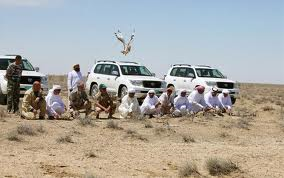
A falcon, right, tried to catch a houbara bustard during a falconry competition in Hameem, the United Arab Emirates, last December. Baluchistan is a popular place to hunt the bustard. Credit Karim Sahib/Agence France-Presse — Getty Images
The journalist Steve Coll wrote in his Pulitzer Prize-winning book, “Ghost Wars,” that American officials declined to take the shot, fearing that the Arab sheikh who was hosting Bin Laden would have been at risk of dying in the attack.
For several years starting in 2004, the C.I.A. used an Arab-built airstrip at Shamsi, a barren desert valley in central Baluchistan, to launch drone strikes against Islamist militants in Pakistan’s tribal belt.
When news of the American base stirred a scandal in Pakistan’s Parliament in 2011, the country’s air force chief sought to deflect blame onto the United Arab Emirates government.
The deserts around Dalbandin, where Prince Fahd landed on Wednesday, were the site of Pakistan’s first nuclear test explosion in 1998, and are an established way station for heroin smugglers and Taliban insurgents.
But the growing influence of Gulf Arab countries is not universally appreciated. Progressive Pakistanis bemoan their conservative influence on society, and the infusion of petrodollars for jihadi groups.
The hunts have also come under attack. In Baluchistan, where the houbara is the provincial symbol, some royal hunts had to be curtailed after Baluch separatist rebels opened fire on hunting parties.
Now the battle has shifted to the capital, Islamabad. The prime minister, Nawaz Sharif, enjoys close relations with the rulers of Saudi Arabia, where he spent much of his exile between 2000 and 2007 — one reason, critics believe, for the indulgence shown toward Prince Fahd.
Mr. Sharif sent his federal planning minister, Ahsan Iqbal, to greet Prince Fahad in Dalbandin, as well as Baluchistan’s minister for sports and culture.
“Not a single political leader reacted against illegal hunting by Arab princes,” Asma Jahangir, a prominent human rights campaigner, posted on Twitter.
Although Mr. Sharif never confirmed it, Saudi Arabia is widely believed to have injected $1.5 billion into Mr. Sharif’s government last year to help prop up the ailing economy. Last year in Islamabad, Mr. Sharif laid out a lavish welcome for the other Saudi hunting permit holder: Salman bin Abdul-Aziz Al Saud, who last month was inaugurated as king.
The International Union for the Conservation of Nature has termed the houbara a vulnerable species, and India has banned the hunt. The Baluchistan court order in November cited Pakistan’s obligation to international conservation treaties.
Hunt supporters say the houbara population has never been scientifically surveyed, and complain that the royal visits are being unnecessarily politicized.
“The foreigners are a blessing, not a problem,” said Ernest Shams of Houbara Foundation International Pakistan, a charity that works with the United Arab Emirates government to boost houbara stocks. “They bring so much money into the country.”
In a bid to overcome the court ban, the Baluchistan government has lodged an appeal in Pakistan’s Supreme Court that is likely to be heard on Wednesday, officials in Islamabad said Friday.
Prince Fahd is currently at his hunting camp in Bar Tagzi, surrounded by his falcons and a contingent of security — and most definitely not hunting any houbara, according to Pakistani officials.
“They are visiting development sites,” said Obaidullah Jan Babat, an adviser to the Baluchistan chief minister. “They are not hunting.”
Salman Masood contributed reporting from Islamabad, Pakistan.
“Writing is a horribly lonely profession. You’ll never know where you stand, whether you will be compensated; it’s not like other professions which have an infrastructure,” said author of ‘Home Boy’, H.M. Naqvi, during the Iowa Silk Route Residency Program session at the Karachi Literature Festival 2015 (KLF).
The session, which saw local and international writers, was engaging, informative and whimsical as the speakers drew on their individual experiences as residents of Iowa University’s three-month residency program at different periods in time and also shared a number of anecdotes.
Formed in 1997, the program hosts 1400 writers from more than 140 countries — writers not only work on their own projects but also hold book readings, discussions among other things.
Narrating her experience, popular Karachi-based writer and columnist Bina Shah said that living in Iowa city was the most American and un-American experience.
“American because it is the heartland of the United States and un-American because the city almost feels like an international society as hosting writers has made Iowa so rich.”
Indian writer Sridala Swami’s wit was at her best when she exclaimed how doing the residency programme was like being married to several people – an allusion to the global nature of the programme.
She also drew chuckles from the audiences when she relayed how she and Shandana Minhas, author of ‘Tunnel Vision’, met at the programme in 2013, discovered that they were from India and Pakistan, respectively, and also found themselves in rooms facing off each other.
Perhaps it was this very question that prompted two members in the audience to later ask why there was so much of love ruining hate at the national level between the two neighbouring countries and why couldn’t they resolve their differences.
Indian writer Kavery Nambisan responded saying that ‘politicians are generally hardbrained people’ and also added that it was not completely fair to put the onus on the government and that citizens were equally responsible.
“We need more events like KLF – I have got to know so much about Pakistan through it.” Her reply ensured that the session did not go dangerously askew, politically.
As most of the speakers are established writers to their credit, an interesting question asked from one of the members in the audience was the impact of the residency programme on their writing.
Minhas said she had heightened confidence in her capabilities and embraced her craft anew, following completion of the program.
Earlier, she also divulged how her father always told everyone that she was a journalist, despite the fact that she was a writer, as the latter is not so well-received and respected which bore testament to the fact that writing still has a long way to go before it cements its place as a mainstream, lucrative profession in Pakistan.
Gorakh hill station, Dadu Sindh (Credit: pak101.com)The land of Shah Latif bleeds again.
The seven queens of Shah Latif’s Shah Jo Risalo – Marui, Sassui, Noori, Sorath, Lilan, Sohni, and Momal – have put on black cloaks and they mourn. The troubles and tribulations are not new for the queens.
After the sack of Delhi, Nadir Shah (Shah of Iran), invaded Sindh and imprisoned the then Sindhi ruler Noor Mohammad Kalhoro in Umarkot fort. Shah Latif captured it in the yearning of Marui for her beloved land when she was locked up in the same Umarkot fort.
If looking to my native land
with longing I expire;
My body carry home, that I
may rest in desert-stand;
My bones if Malir reach, at end,
though dead, I’ll live again.
(Sur Marui, XXVIII, Shah Jo Risalo)
The attack on the central Imambargah in Shikarpur is as ominous in many ways as it is horrendous and tragic.
The Sufi ethos of Sindh has long been cherished as the panacea for burgeoning extremism in Pakistan. Sufism has been projected lately as an effective alternative to rising fundamentalism in Muslim societies not only by the Pakistani liberal intelligentsia but also by some Western think-tanks and NGOs.
But the question is, how effective as an ideology can Sufism be in its role in contemporary societies?
To begin with, Sufism is not a monolithic ideology.
There are several strains within Sufism that are in total opposition to each other, thus culminating into totally opposite worldviews. The most important of them is chasm between Wahdat al-Wajud (unity of existence) and Wahdat al-Shahud (unity of phenomenon).
The former professes that there is only One real being not separated from His creation, and thus God runs through everything. While Wahdat al-Shahud holds that God is separated from His creation.
Take a look: Shikarpur blast: SHO suspended, investigation underway
While the distinction between the two might seem purely polemical, it actually leads to two entirely opposite logical conclusions.
Wahdat al-Wajud sees God running through everything. Thus apparent differences between different religions and school of thoughts vanish at once. In diversity, there lies a unity thus paving way to acceptance of any creed, irrespective of its religious foundations.
Ibn al-Arbi was the first to lay the theoretical foundations of Wahdat al-Wajud and introduce it to the Muslim world.
On the other hand, the Wahdat al-Shahud school of thought was developed and propagated by Sheikh Ahmad Sirhindi, who rose to counter the secular excesses of Akbar. He pronounced Ibn al-Arbi as Kafir and went on deconstructing what he deemed as heresies.
Wahdat al-Shahud in its sociopolitical context leads to separation and confrontation. The staunch anti-Hindu and anti-Shia views of Ahmed Sirhindi are just a logical consequence of this school of thought. Ahmed Sirhindi is one of the few Sufis mentioned in Pakistani textbooks.
Historically, Sufis in today’s Pakistan have belonged to four Sufi orders: Qadriah, Chishtiah, Suharwardiah, and Naqshbandiah.
It is also interesting to note that not all of these Sufi orders have been historically anti-establishment.
While Sufis who belonged to the Chishtiah and Qadriah orders always kept a distance from emperors in Delhi and kept voicing for the people, the Suharwardia order has always been close to the power centres. Bahauddin Zikria of the Suharwardiah order enjoyed close relations with the Darbar and after that leaders of this order have always sided with the ruler (either Mughals or British) against the will of the people.
Sufism in the subcontinent in general and Sindh in particular, emerged and evolved as a formidable opposition to the King and Mullah/Pundit nexus. Not only did it give voice to the voiceless victims of religious fanaticism, but also challenged the established political order.
To quote Marx it was ‘the soul of soulless conditions’.
A case-in-point is Shah Inayat of Jhok Sharif, who led a popular peasant revolt in Sindh and was executed afterwards. Shah Latif wrote a nameless eulogy of Shah Inayat in Shah Jo Risalo.
However, the socio-political conditions that gave rise to Sufism in the subcontinent are not present anymore. The resurrection of Sufism as a potent resistance ideology is difficult if not impossible. Sufis emerged from ashes of civilizational mysticism, independent of organised religion and political powers.
Today, however, the so-called centres of Sufism known as Khanqahs are an integral part of both the contemporary political elite and the all-powerful clergy. On intellectual front self-proclaimed proponents of contemporary Sufism – Qudratullah Shahab, Ashfaq Ahmad, Mumtaz Mufti, et al – have been a part of state apparatus and ideology in one form or another.
Sufism is necessarily a humanist and universal ideology. It is next to impossible to confine it to the boundaries of modern nation states and ideological states in particular, which thrive on an exclusivist ideology.
Mansoor al-Hallaj travelled extensively throughout Sindh. His famous proclamation Ana ‘al Haq (I am the truth) is an echo of Aham Brahmasmi (I am the infinite reality) of the Upanishads. There are striking similarities between the Hindu Advaita and Muslim Wahdat al-Wajud.
These ideologies complement each other and lose their essence in isolation.
Punjab has been a centre of The Bhakti Movement – one of the most humanist spiritual movements that ever happened on this side of Suez – but all the humanist teachings of the movement could not avert the genocide of millions of Punjabis during the tragic events of the Partition.
The most time-tested peace ideology of Buddhism could not keep the Buddhists from killing Muslims in Burma.
Such are the cruel realities of modern times that can overshadow the viability of any spiritual movement.
Sufism in Sindh exists today as a way of life and not an ideology.
It is an inseparable part of how people live their daily lives. In Pakistan, however, to live a daily life has come to be an act of resistance itself.
Sindh bleeds today and mourns for its people and culture that are under attack. Bhit Shah reverberates with an aggrieved but helpless voice:
O brother dyer! Dye my clothes black,
I mourn for those who never did return.
(Sur Kedaro, III, Shah Jo Risalo)
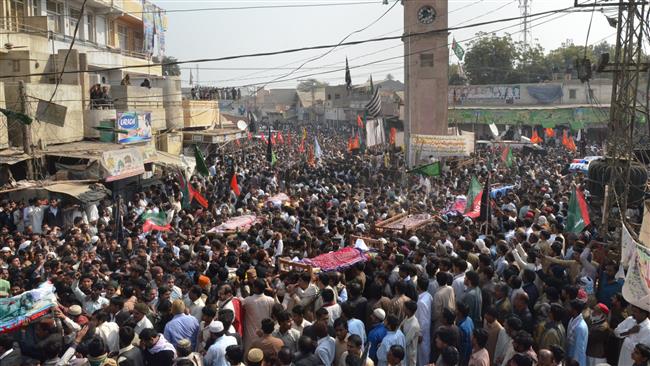
Lakkhi Dar, Shikarpur (Credit: presstv.ir)SHIKARPUR, Pakistan Jan 30 – At least 49 people were killed in a powerful explosion at a crowded Shi’ite mosque in Pakistan during Friday prayers, the latest sectarian attack to hit the South Asian nation.
Police said the blast was caused either by a suicide bomber or an explosive device which went off when the mosque was at its fullest on Friday afternoon in the center of Shikarpur, a city in Pakistan’s southern province of Sindh.
Radical Sunni Islamist groups often target mosques frequented by minority Shi’ites, whom they see as infidels.
Earlier this month, six people were killed and 17 wounded by a suicide bomber outside a Shi’ite mosque in the city of Rawalpindi, also after Friday prayers.
“We are trying to ascertain the nature of the blast,” said Shikarpur police chief Saqib Ismail Memon. “A bomb disposal squad is examining the scene.”
Saeed Ahmed Mangnejo, head of the regional civil administration, told Reuters that the death toll had reached 49.
In chaotic scenes that followed the blast, part of the mosque collapsed after the explosion, burying some of the wounded under rubble. Bystanders pulled people from the debris and piled them into cars for the journey to hospital.
Locals said there were not enough ambulances and the army later sent additional vehicles to transport people to hospitals.
The atmosphere was tense in Shikarpur after the explosion, with shops boarded up and crowds of emotional residents massing outside hospitals.
“The entire city is in lockdown and there is tension in the air. There is a heavy police presence and the Rangers are patrolling the city,” said Pariyal Marri, a local resident.
“THEY ARE OUR ENEMIES”
Jundullah, a splinter group of Pakistan’s Taliban which last year pledged support for the Islamic State group based in Syria and Iraq, claimed responsibility.
“Our target was the Shia mosque … They are our enemies,” said Fahad Marwat, a Jundullah spokesman. He did not elaborate.
Majlis Wahdat-e-Muslimeen, a Shi’ite organization, has called for a province-wide strike on Saturday in protest.
Sain Rakhio Merani, a regional police official, said the blast was probably caused by a bomb, although Pakistani television quoted some residents as saying they saw a man wearing a suicide vest.
The attack came as Pakistan tries to adopt new measures to tackle Islamist extremists following a massacre of 134 children last month at an army-run school in the northwestern city of Peshawar.
The government has pledged to crack down on all militant groups, reintroduce the death penalty, set up military courts to speed convictions and widen its military campaign in lawless tribal areas.
Yet Pakistan’s religious minorities, among them Ahmadis, Christians and Hindus, say the government is doing little to alleviate their daily struggle against humiliation, discrimination and violence.
Shi’ites make up about a fifth of Pakistan’s mainly Sunni population of around 180 million. More than 800 Shi’ites have been killed in attacks since the beginning of 2012, according to Human Rights Watch.
(Additional reporting by Syed Raza Hassan in Islamabad and Saud Mehsud in Dera Ismail Khan; Writing by Maria Golovnina; Editing by Mike Collett-White)
ISLAMABAD: During Friday’s session of the Senate, Minister of State for Interior Baligur Rehman informed the House that Middle Eastern countries namely Saudi Arabia, Kuwait, Qatar, Iran and the United Arab Emirates were giving aid to religious seminaries in three provinces.
The information was compiled on the basis of a report sent by provincial Inspector Generals (IGs). However, Rehman said he would not support or defend the statements made by the IGP on the matter.
According to the report presented before the Senate, 23 religious seminaries in the country are receiving foreign assistance. Out of the 23 seminaries, five belong to the Shia sect and are located in Balochistan.
Other seminaries are based in KP, Sindh and Balochistan and are part of the Sunni sect. No information was given with regards to the province of Punjab. However reports have said that the seminaries in Punjab are not receiving any assistance.
Following a demand made by Senator Sughra Imam, Acting Chairman of the Senate Sabir Ali Baloch referred the question to Senate Privileges Committee with directives that IG of Punjab police may be summoned before the committee to explain his position on foreign assistance being received by religious seminaries in Punjab.
The federal minister told the Upper House of Parliament that according to the anti-money laundering law, financial transaction of religious seminaries and Non Governmental Organisations (NGOs) would be monitored.
The minister further told the House that some NGOs are receiving assistance from the United States, Netherlands and Australia.
Earlier, the opposition also walked out from the proceedings of the House over the absence of Interior Minister Chaudhry Nisar and Minister of State for Interior.
Later, on directives issued by the chair, Rehman showed up at the house and responded to the questions relating to the Interior Ministry.
The Senate has been adjourned to meet again on Monday at 4 pm.
JUI-F chief warns govt against stopping foreign funding
Meanwhile, Jamiat Ulema-i-Islam Fazal (JUI-F) chief Maulana Fazlur Rehman has warned the government against stopping foreign assistance from being received by Pakistan’s religious seminaries.
“The government cannot stop this and if the buildings of seminaries are occupied, we would continue to teach under the shadow of trees,” he told the media after chairing a parliamentary committee meeting on Kashmir.
He said the government was taking this action to please the United States which he alleged was creating disturbance within the country.
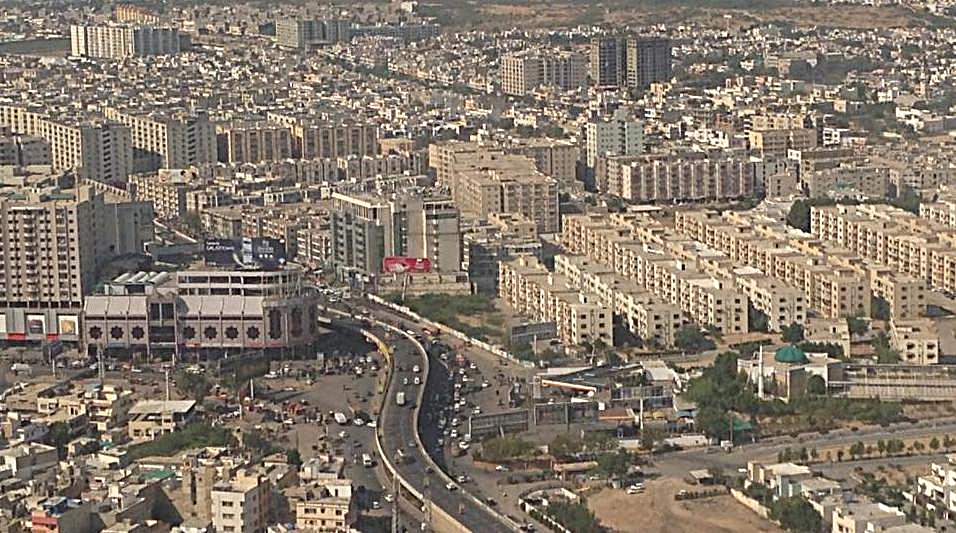
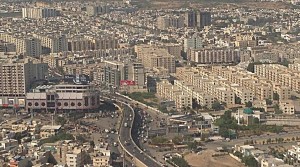
Karachi mega city (Credit skyscrapercity.com)Well, first of all, Kanak, Himal and the India International Centre, thank you so much for having arranged this and having invited me. Delhi is special to me. I was born here, and left Delhi on the last train that ever went from Delhi to Karachi. That was the 15th of August, 1947. So it’s always nice, in a way, being back in Delhi.
The contents of my talk are drawn from my research work, teaching and activism in Pakistan in general, and in Karachi in particular. But you know, I have had the privilege of having been associated with programmes and projects in a number of cities in Southasia and in Asia in general, and over the last two and a half decades, I worked on a number of projects in these countries and have had the benefit of meeting their planners, government officials and NGO activists, and on occasion spent some time with the communities that live in these cities.
The subject of megacities has been discussed almost to death. It is something that is written about. The economists write about the economic aspects of it; environmentalists write about the terrible environmental conditions. The planners write about the infrastructure issues that are so damaging to the lives of poor communities. And now, you can add climate change to it. All these discussions take place in the press all the time, and also are subjects of academic research. They are all available on the net. I will approach this issue from a somewhat different perspective. I will talk about the socioeconomic change that is taking place and the state’s response to that socioeconomic change in physical and in investment terms. Since most of my research is on Karachi, I will refer to Karachi often. But I think you will be able to identify similar trends in your own cities.
One statistic stands out regarding the megacities of Southasia. And that is the phenomenal increase in their populations, especially after the last census. This holds true of them, all except for Calcutta. For instance, the Delhi population, according to the 2011 census, was between 16 and 17 million. Today, it is being claimed that it is more than 24 million. I don’t know how accurate it is, but serious writings claim that it is 24 million. Then, you have Dhaka. It was projected at 18 million for 2015. I am told by my Bangladeshi friends that it shot way beyond this. They talk of 22 million today.
I would believe none of this, by the way, because the figures are so large. I wouldn’t believe it if I didn’t come from Karachi, because Karachi has grown at a phenomenal rate. It was 11 million in 1998. Today, it is about 21 million – almost double that amount. Not only that, it has expanded, it has increased, by 100 percent – spatially, the city has expanded by 23 percent, swallowing up villages and their pasture lands and ruining the districts’ rural economy. Now there are two points of view here. A very able Karachi planner, Farhan Anwar, has documented the terrible damage this expansion does to rural communities and how it impoverishes them, whereas my colleague Parveen Rehman supported this expansion because she said it was going to benefit the poor who were coming into the city. Now you have two very pro-poor planners thinking in very different terms. I think this is a subject that needs attention.
The only areas where the poor can find affordable land, and that too informally developed or only for occupation, is on the extreme city fringe, which is far away from work areas.
Also in 2011 it was estimated that the total urban population of Southasia was 243 million, of which 34 percent lived in megacities. If we take today’s figures, it’s already 40 percent. I find it very difficult to believe, but evidence suggests that this is so. But the question I’ve been engaged with is why is this phenomenal increase taking place? Roland deSouza, another Karachi planner, has argued that this expansion is simply because Southasian populations have grown by about 550 percent between 1941 and 2011, whereas in other countries the growth has been much less. For example, Thailand increased in about the same period by about 280 percent, and Britain by 160 percent. Roland argues that if we had increased by only 300 percent, we would be living in a very different world. So, as he says, our positive achievement is that we have produced so many children. As he puts it: growth less, migration less; growth more, migration more. Percentages do not tell us the truth anymore because the figures are so large. So for one thing, I think we should talk more in terms of figures rather than percentages.
Our own research on Pakistan has established that the most important reason for increases in migration is the changes that are taking place in the socioeconomic condition of rural areas. Through a long process, which I have documented in my writings, the rural economy has transformed from a barter economy to a cash one. And in the process, the link between caste and profession, which made village self-sufficiency possible, has either vanished or is under pressure. As a result, the village no longer – at least in Pakistan, in most of Pakistan – has a lohar, a kumhar, a barai, a chamar, a raj, etc. They have all migrated to the cities. The village today depends entirely on urban-produced goods and is no longer self-sufficient – a self-sufficiency that Gandhi admired very much. The landless labourer and the traditionally lower-caste cannot afford the city-manufactured goods, and so migration is the only option left.
The earlier migrants, made a conscious decision to migrate, to improve their livelihoods and families back home. They came from stable societies where local community governance systems functioned, even if they were questioned. The present migrants come from societies where the jirga has no moral authority – jirga is a form of inter-tribal association to sort out disputes. They come from societies where the jirga has no moral authority and the chaudhry, panchayat, the mukhi, the patel and the numberdar are all non-existent. Also, the clan and extended family is disintegrating, so there is a freedom to choose, move, and freedom from community controls and loyalties. This is the trend. It’s a very powerful trend, and it’s not going to be reversed.
For the first time, lower castes, such as bheels, kohlis, meghwars and jogis, who did not migrate before except as individuals now have the freedom to migrate en masse. And they do. However, due to their lack of skills, there are, in essence, large, circulating populations going back to the rural areas during the harvesting season and having no permanent residence. All this is new. It’s in Pakistan, and it’s in the last 15-20 years that these changes have started consolidating themselves.
There, something else has happened. Most of the migrants used to work on building sites. Building roads, building buildings; mechanisation of construction projects has limited their jobs. We just studied a road-building project, a small road-building project, in which everything was mechanised. Excavation was mechanised, earth refilling was mechanised, compaction was mechanised, the laying of the tarmac was mechanised, and we asked the contractor how many people had he employed and he said 60. And we said if you didn’t have these machines how many people would you have employed? He said about a thousand. Now, this is a very big factor in demitting of jobs. This is a study that we are currently doing to see how this works and how it affects migrant labour. There are other reasons for migration as well which I will talk about later, but one very important factor is that the cities that we are talking about are becoming cities of migrants – increasingly. And the local population will have less of a presence. In Karachi it’s already so.
Also, the cities to which migration is taking place have also changed. For one, they have expanded spatially and land and real estate has replaced gold as an investment. As my friend, he says, whatever happened for, “Jo bhi sone kiliye hota tha, zamin kiliye hota hai” (Whoever used to deal with gold now deals with land). ‘You kill, you occupy, you pressurise’, has replaced gold as an investment. It is no longer possible to squat near the city center and work areas as it was before. The Katchi Abadis of Karachi history, they are not going to be there anymore, because the land is not there. The only areas where the poor can find affordable land, and that too informally developed or only for occupation, is on the extreme city fringe, which is far away from work areas. If I look at land values in Karachi, which we’ve studied to some extent, in 1991 one square metre of land on the city’s periphery used to cost 1.7 times the daily wage at that time. Today, it is 40 times the daily wage, far away, even further away from the city than it was in 1991. So, there are other problems. The non-regularised informal settlements and even regularised ones are needed for middle-class housing whose demand has grown by 300 percent in the last decade. And this demand is likely to grow as the middle class increases.
Living on the fringe is more expensive than renting within the city. Utilising transport costs on the fringe means expensive commuting and time, and there are also social costs. Our studies show that women cannot work on the fringe. Fathers often do not see their children because of long hours of travelling. Entertainment and recreation cannot be accessed. People are fatigued due to commuting in uncomfortable and expensive transport in terrible environmental conditions. The worst affected are women, there’s transports studies, which will be out soon, where 62 percent of the women interviewed said that if they lived nearer to their places of work, they would have better job opportunities. Many said they would work, which they don’t, if they lived nearer the city, or if transport was cheaper and better. The impact on men was less. So what has happened now is that these informal settlements which were single-storey and double-storey and were near the city are now becoming five-storey, six-storey, 10-storey buildings. In Bombay it has already happened. And these are informal ownerships because this is informal high-rise development. They are becoming extremely overcrowded and they suffer from all the negative aspects of overcrowding, which are very serious. And this overcrowding is increasing, since the renters are increasing because of the rise of these multi-storey buildings. Before you had a house, you lived in it. Now, you live in a building, and your house has become six floors or ten floors.
The environment, the place has changed, it is not the same place. And people have come here whom you don’t know, the street is no longer a public space, so these are the changes that are taking place.
Meera Bapat, an architect planner in Pune, she and I made some studies, she on Pune and me on Karachi. We went back to the settlements that we knew 30 years ago, and what did we find? We found that the settlements’ infrastructure had improved, their social indicators had improved, but they had become overcrowded. And the quality of life, in spite of the improvement in infrastructure and social indicators, had declined considerably. So, apart from that, a very important aspect was the vulnerability of the renters in these settlements because the buildings are owned by musclemen and the renter can be thrown out whenever they like, and the rent can be increased whenever they want. So this also has been documented in fairly great detail.
Living on the fringe is more expensive than renting within the city.
Now what has the government’s response been? I won’t go into the statistics of the gap between supply and demand, but what has the government’s response been? After the 1990s, the government’s response has been ‘go and access the market’. That has been the response, both in India and in Pakistan, except for small projects that really don’t make much of a difference. To access the market, the government has liberalised finance. But this has benefited the developers more than anyone else because they can access finance for their clients. But if individually one wants to access a loan, the requirements are such that the poor cannot access it. You need a formal job, you need an asset that you can mortgage, etc. In spite and in addition to that, these additions to the loan capital can serve only 16 percent of the demand. So to make affordable the product, the units are becoming smaller and smaller, both in the formal and in the informal sector. And they are becoming so small – 24 square metres, 30 square metres – that a family cannot live in them. Yet, you have 10-15 people living in these homes.
Now, I was in Delhi in 2007 and some of my friends said that there is a lot of development, informal development, taking place in Jamuna Path, so I decided to go there and take a look. My taxi driver was a sardarji, I told him “Jamuna Path chale”.
He said, “Waha kya karenge aap?” (What will you do there?)
Maine kaha, “Mujhe plot kharidna hai.” So he was very excited he said he knew exactly the place where I could get a plot. And he asked me how big a plot. I said, “About 60 to 100 metres.”
He said, “Aap usme kaise rahenge?” (How will you stay there?)
Maine kaha, “Nahi, mere driver ke liye hai.”
So he was very excited, and he took me there. And so, we went, it was all in Hindi, the billboards, so I couldn’t read it; I don’t read the Devanagari script. But underneath it was written ‘Property Advisor’, so we spoke to him. He showed me the map, he showed me which was the best plot, he showed me, told me I couldn’t take any corner plots because they had already been given to those who had helped him in setting up this colony. Finally, we agreed on a price, and I said to him, “Is this sort of approved by the government scheme?”
He said, “No, it is not approved by a government scheme.”
I said, “Why should I buy a plot there?”
He said, “Hojayega, approve hojayega na.” (Approval will come)
I said, “I don’t believe it. I construct a plot here, I have no proof of ownership?”
He said, “You have. I’m giving you the proof of ownership. I’m giving you a paper.”
This paper, he said, is acceptable for all transactions: renting, building, etc. So I said to him that I don’t believe this. This will cause me great problems. He said, “Tusi kyu rafte ho? Main hoon na.” (Why are you flustered. I am here to help you).
Now, this is exactly how development takes place on the fringe of Karachi as well. No difference. And in the case of what I saw in 2007, it was a very huge development, enormous in size. Now you have all these informal systems of ownership, transfer, etc. They exist. They are not recognised. What do we do about them? How do we deal with them? I leave that as an open question.
The second change that I would like to talk about is in the older settlements that were built between 1970 and 1980. They have changed. When I began working the settlements, older people always used to come as the community leaders and they used to talk in a flowery – they were illiterate – they used to talk in a flowery Urdu. They used to say janam, husoor, sahi, nyadman sharfhasidua etc etc. Today, when you go there, there are young men who can read and write and sometimes women who call you uncle and that too in English. So these schools have changed, these settlements have changed. They are no longer purely working class settlements. Truckloads of women go to work into the factories everyday which they didn’t before. There are beauty parlours, lots of them, marriage halls, community centres and schools that the people have set up themselves. Now these settlements, their needs are less about water, electricity and sewage. Their needs are that their aspirations should be fulfilled, that they should be integrated into the middle class of the city. So they want more schools, they want vocational training, they want health, and they want culture. This is, again, something that they are fighting to get, but are not conscious that they are fighting specifically for this.
The voting patterns of these old settlements have also changed. Whereas previously they voted for progressive parties who promised them regularisation of their settlements, they now vote for the more conservative parties and increasingly have middle-class values. Unlike before, they are reluctant to join movements against evictions and/or reform. The nature of their relationship with officaldom has changed from protest to negotiation. They also constitute the largest group of voters in Karachi and are listened to. Meanwhile, shopkeepers, mandi operators and transporters have become very powerful political agents. They have not yet exercised their power, but they are in a position to do so and I don’t think it would be too different in the rest of Southasia.
Then you have new concepts that are floating around among the more radical planners and academics; the concepts of new urbanism have been promoted. And future architects and planners are being trained in them. This has also been pushed by international financial institutions and Western academia. They are telling us to have higher densities, mixed land-uses and ‘inclusive cities’. However, the three most dense cities in the world are situated in Southasia – Dhaka with a density of 4440 persons per hectare, Mumbai, with 3090 and Karachi with 2800. These densities could not be achieved without the violation of existing density laws. For instance, Karachi’s by-laws permit a maximum of 1625 persons per hectare and Mumbai’s existing density could not have been achieved if its floor-to-area ratio of 1:1.33 would have been followed. The difference between the actual density and rules and regulations is because low-income settlements have extremely high densities. In Karachi, they go up to 6000 persons per hectare, similar to that of Dharavi, while elite settlements have densities of less than 200 persons per hectare. Also, housing units on 400-2000 square metres of land in Karachi are only 2 percent of the housing stock, but they occupy 26 percent of the residential land of the city. Similar figures have been quoted for the other Southasian mega-cities. This form of development not only continues to take place but has increased due to the changes in the urban development paradigm. But the question is, is it sustainable?
Let me summarise. Mega-cities will have to find homes, transport and social services for their new arrivals who are not related to any formally structured group. They will have to cater to the needs and aspirations of the older informal settlements, which can only happen if they are protected from evictions and relocations and supported through laws, regulations and procedures in developing the social and physical infrastructure that they are already trying to develop on their own. They will have to promote new societal values to accommodate the changes that are taking place. I will also briefly mention something else which I had not planned to, but I think I should – the nature of social change in the older settlements. The most important group in the census is between 14 and 24 years of age because it’s the present and the future. In this age group, in 1981, 39 percent of women were married. Today, in this age group, less than 20 percent women are married; 17 percent of men were married in ’81. Eight percent of men are married today. For the first time in the history of the city, we have an overwhelming majority of unmarried adolescents and this is enough to change social structures and gender relations. And that is what has happened. And extended families, clans, settlements based on clan, they are rapidly becoming history. Also there are other factors: court marriages where a couple goes to a court to seek protection because it’s a self-willed marriage. In 1992, we had 12-15 applications per day for court marriages. In 2006, we had 250 plus applications for court marriages per day. And it has probably increased, but a time will come when it will decrease rapidly when the concept of marrying for your own free will becomes acceptable in society. More than half the applications today come from the rural areas. So I think these are important changes that are taking place which are going to affect, I feel, the future of these cities.
Concepts such as ‘it is not the business of the state to do business’, ‘cities are the engines of growth’, direct foreign investment, and concepts linking economic well-being with GDP growth have had a major impact on the national policies of Southasian countries and especially on the mega-cities.
Now, one important thing is the changing nature of official planning. We inherited the welfare state model from our colonial masters. However, we were not able to implement it except on paper due to institutional and financial constraints and a lack of political will. This is what is normally said, but I don’t think that is the only reason. The real reason was well-entrenched anti-poor social systems and land-ownership patterns. I think this was one of the major reasons. This concept has been eclipsed by the neoliberalism of the 1990s and beyond, and has been promoted aggressively both by international institutions and their local partners. Collectively, these organisations and their local partners have promoted what has come to be known as the ‘free market’ economy, which aims to remove subsidies on health, education and housing; increase taxation on utilities; sell government industrial and real estate assets to the national or international corporate sector; and remove restrictions on imports and exports. This had been done. I am not against all this, but there are other considerations.
Whole new terminologies and concepts have been developed to support this market economy. Concepts such as ‘it is not the business of the state to do business’, ‘cities are the engines of growth’, direct foreign investment, and concepts linking economic well-being with GDP growth have had a major impact on the national policies of Southasian countries and especially on the mega-cities. A whole new world, a whole new thinking has become acceptable. Now, from what I read about India, 500 Special Economic Zones have been established and corporate farming has been promoted. And according to some papers that I read, between 2010 and 2015, it was estimated that 400 million people would willingly or unwillingly be forced to move from rural to urban areas. I don’t know how correct this is but these are the figures you get in a number of papers. This is twice the population of the United Kingdom, France and Germany put together. All this has also affected agriculture. It is replacing food crops by cash crops, and in the process increasing the cost and shortage of food and making the state vulnerable to corporate sector pressures and interests. I think this was nicely summed up by a farmer in Tharparkar, who said to me, “Pehle hum jo botai thai, khathe thai, ab jo botai hai, usko bechtai hai, aur khana kharidte hai.” (Before we used to eat what we grew, now we grow it to sell and then buy our food). I think this has happened and it has affected a very large section of our population.
The free market promoted political reforms and deregulations that have also had a major impact on property markets and have reshaped the politics of land development. Trading across borders in gold and contraband goods is no longer lucrative. As a result, the gangs and mafias involved in these underworld activities have become involved in the real estate business and linked up with their underworld partners. The narcotic trade today funds much of the real estate development, at least in my city. All this has introduced an element of violence and targeted killings and kidnappings of opponents, rivals and social activists in the land and the real estate sector.
The state in almost all cases has responded to these market pressures and made land available for development through land-use conversions, new development schemes and the bulldozing of informal settlements. NGOs and CBOs who have challenged this process have faced two constraints (apart from their own internal weaknesses and culture); one is an unsympathetic media, which reports stories but not the causes, and the other is an absence of laws to prevent environmentally and socially inappropriate land conversions. Even where such laws do exist, rules, regulations and procedures and institutions to manage and implement them are often missing. As a result, courts deliver judgments that promote inequity, poverty and social fragmentation. Media too is increasingly being controlled by a few organisations. Eighty-two percent of Karachiites have access to TV according to the census.
I will pass over this because it will take too long, and come to some of the issues. What has been elaborated and said before has had a profound effect on the shape and politics of our cities. The shape that our cities are taking and the reasons behind them are the result of a powerful nexus of developers and investors (many of dubious origins, otherwise such large sums of money could not have been mobilised), compromised government institutions and bureaucrats, and politicians seeking global capital for re-shaping their cities in the image of the West – an image that is promoted (implicitly or explicitly) by the promoters of the market economy. To promote this paradigm, a new term and concept has been developed, and that is of the world-class city.
Karachi, Mumbai, Delhi, all aspire to become world-class cities in their literature. Some wish to become like Shanghai, as with Mumbai, others wish to become like Dubai, as with Karachi, although the context of Shanghai or Dubai is very far removed from them. A world-class city has been defined beautifully and also sympathetically by Mahbubur Rahman (a Bangladheshi planner) in a brilliant paper and in other literature as well. According to the world-class city agenda, the city should have iconic architecture. It should be recognised with something like the highest building or fountain in the world. It should be branded for a particular cultural, industrial or other product or happening. It should be an international event city. It should have high-rise apartments as opposed to upgraded settlements and low-rise neighborhoods. It should cater to international tourism. It should have malls as opposed to traditional markets. This is how it has been described and this is what a global city or a world-class city today is trying to achieve.
For establishing this image, poverty is pushed out of the city to the periphery and already poor-unfriendly by-laws are made even more unfriendly by permitting environmentally and socially unfriendly land-use conversions. This is driving out industry and businesses from poor settlements. The three most important repercussions of this agenda are: 1) that global capital increasingly determines the physical and social form of the city; 2) in the process, projects have replaced planning; and 3) land-use is now determined on the basis of land value alone and not on the basis of social and environmental considerations. Land has unashamedly become a commodity and so the poor cannot be adequately serviced. The city stands divided as never before. My city is now four cities. They speak different languages, they have different types of shopping centres. They even have different education institutions, and they only meet at the beach or in some parks at the city centre.
High-rise buildings, we have conclusively shown that these settlements can be upgraded to four or five storeys with the help of the residents, and could be regularised. So we do not feel the need for pulling down these settlements and re-planning them as the state insists on doing. As far as events are concerned, from what we gather, about 500,000 persons were evicted from Delhi for the preparation of the 2010 Asian Olympics [Commonwealth Games] alone. Numerous studies show how poor people become after relocation: loss of social capital, loss of physical capital, and relocations are often 20-30 kilometres – sometimes much more than that – from where they work. Children’s education is the most serious disruption that is caused. In one of the projects that we opposed, which was partially successful, 2800 students could not take their metric and pre-metric exams because of the bulldozing that took place.
The world-class city image is all about gentrification and it has no place in it for informal businesses and hawkers except as organised tourist attractions. The link of these hawkers and businesses with low income people (for whom they make life affordable) and with commuters is not recognised and as such, large scale evictions of informal businesses and hawkers have taken place without any compensation in all the mega-cities in Asia, of which Calcutta is perhaps the worst example. This has impoverished millions of families.
Projects should seek to serve the interests of the majority who live in our cities, who are the lower-middle class and the working class.
Then the free market economy has led to a considerable liquidity in banks and leasing companies. This has been utilised for providing loans for the purchase of cars. Karachi registered, in the year 2006-07, 606 cars per day. When I was in Delhi in 2007, I was told that the cars being registered here were 1250 per day. Bangkok was even more – 1750 cars per day. Now, there is a nexus between the automobile industry, the banking sector and the oil sector. We learnt this when we discovered that 1.6 billion USD worth of loans had been given by the Karachi banks for the purchase and leasing of cars. And we went to the prime minister and said, “Can’t we use this for some other purposes?” He was excited, so we had a meeting with 18 bank heads, who said no, that automobiles were the thing they would invest in, because the loans were short, they knew the clients, they were sure of returns, and housing was not something they would invest in. And one of them told me when we were leaving, he said, “Arif, you must realise the automobile industry, the banking sector are one and the same thing, they are not two different things.” So these are the new realities with which we have had to deal with.
Now there are many other factors that I will also just touch on. Transport: We can have all the mass transit systems. We have big plans for Karachi, but when we study them we see that the transportation for people living on the fringe, in large informal settlements, will not improve. The transport that we will be providing them will be far too expensive, unless a very major subsidy is attached to it. It is expensive because we are building on a process of build, operate and transfer, which is also a free market economy concept, whereas if we just let the Pakistan Railways manage it, the costs would be considerably less. That is one aspect I wanted to touch upon.
We have in Karachi, about 80,000 autos and we have an additional 60,000 of what we call Qingqis – these are six-seater motorcycle rickshaws. The Karachiites love them, they find them cheaper, women find them safer, and the government wishes to ban them and they did ban them, but they are still there because the High Court of Sindh decided that they are essential for the people. Now the problem is, what do we do with them, because there is so much antagonism against them. Even though they have a right now to function, the police does everything possible to limit their movement. The other way in which the transport issue is being tackled is by motorbikes. In 2004, we had 400,000 motorbikes, while today we have 1.7 million motorbikes. And all surveys show – we had surveys done at bus stops – everybody wants motorbikes. And if we reduce the price to 20,000 rupees instead of 32,000 rupees, I don’t think we will need a mass transit system, or any expansion of a mass transit system. Now the question is, do we promote these forms of movement, these forms of transport? It is a serious discussion which we have been trying to indulge in, so should they be promoted?
Now, I don’t know any of these cities that have produced an alternative vision for the city. There has been a lot of writing on ‘what should be or should not be’, but a vision that is acceptable or seriously pursued has not been presented. When the Karachi Special Development Plan was being made, I was a member of one of the committees, and we said, “Let’s not have this vision of world-class city, but let us have a vision of a pedestrian and commuter-friendly city.” It would change everything; the whole manner of planning would change if the vision was kept there. But, one of the members of the Asian Development Bank who was a member of the party said, “With this vision, nobody would invest any money in the city.” So, that was out.
The other serious thing is projects replacing planning. Karachi for the foreseeable future will only have projects. There is going to be no serious planning, and planning will be overtaken by projects. Accepting this, I tried to promote some principles on the basis of which projects could be judged and/or modified. These principles are: One, projects should not damage the ecology of the region in which the city is located; two, projects should, as a priority, seek to serve the interests of the majority who live in our cities, who are the lower-middle class and the working class; Three, projects should decide land-use on the basis of social and environmental considerations and not on the basis of land values alone. And four, projects should protect the tangible and intangible cultural heritage of the communities that live in them. In my opinion, this would produce much better projects and improve people projects. But again, at the same meeting, the same gentleman responded, “With your four points, there would be no projects.” So that is another issue which needs to be taken into consideration.
However, to finish, the question is whether the megalomania and opportunism of politicians and planners will accept a new and more humane paradigm that curtails their profits and decommoditises land. I think that this is a very fundamental issue. I do not think that they will unless they are pressurised by city wide networks armed with alternative research and an alternative vision. In this, I think professional education can play a very important role. Right now, professional education is increasingly becoming pro-neoliberal in the bad sense of the word. I have often thought that it might help if graduating architects, planners and engineers could take an oath similar to those of doctors, and if they did not follow the terms of the oath, their names be removed from the list of practicing professionals.
In 1983, after evaluating an important urban renewal project which created poverty and environmental degradation, I made a pledge in writing. I will just quote from that. I wrote, “I will not do projects that will irreparably damage the ecology and environment of the area in which they are located. I will not do projects that increase poverty, dislocate people and destroy the tangible and intangible cultural heritage of communities that live in the city. I will not do projects that destroy multi-class space and violate building by-laws and zoning regulations. And I will always object to insensitive projects that do all this, provided I can offer viable alternatives.” Well I have tried to keep my promise, except that I have violated building rules and regulations, but they were bad ones. But I have put this before the architectural community again and again, “Why don’t we have such an oath?” And one of the architects answered, he said to me, ‘Arif bhai, hum toh bazaar meh bhettain hai.’ (Arif, we are part of a market). And this is a reality that we have to take into consideration when discussing a new paradigm.
Thank you so much.
Arif Hasan is an urban philosopher and social researcher based in Karachi. He has been involved with the Orangi Pilot Project since 1982, and is the founding Chairman of the Urban Resource Centre.
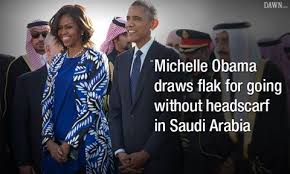
Michelle Obama in Saudi Arabia (Credit: facebook.com)It is clear that any attempt to draw the West’s attention to Saudi Arabia’s history of glaring human rights violations, would require an urgent amendment to the terminology we regularly use to describe the Saudi regime.
The most genial words have been pouring in from across the world for King Abdullah, the “reformer”.
President Obama cancelled his trip to the Taj Mahal to fly to Saudi Arabia.
In his statement on the death of King Abdullah, Obama spoke about the king’s initiatives “that will outlive him as an enduring contribution to the search for peace in the region”.
The National Defense University in the US announced an essay competition to pay tribute to the deceased Saudi monarch.
The Japanese government praised him as a “peacekeeper”.
Perhaps the most baffling commendation came from the IMF’s Christine Lagarde, who called King Abdullah “a strong advocate for women”.
The four adult daughters reportedly house-arrested by King Abdullah, just to keep them from returning to his ex-wife were apparently not available to rebut Lagarde’s tribute.
Nor were the millions of other Saudi women who, regrettably, could not leave their homes without their husbands’ permission.
David Cameron applauded the Saudi monarch for his “commitment to peace and for strengthening understanding between faiths”. This, in spite of a leaked diplomatic cable in which Abdullah personally prodded the US to invade Iran; and in spite of his support for extremist outfits engaged in what can only be described as a ‘Shia genocide’.
While praise has been pouring in from nearly every corner of the world, there’s a reason for us foregrounding the West’s adoration of Abdullah in particular.
There is a stark contrast between these countries’ official advocacy for democracy and freedom, and the kind of non-democratic rulers they choose to lionise.
Many Western nations, particularly the United Kingdom, have visible sympathy for monarchism. Never mind the fact that the unelected monarch is basically a ‘dictator’, the British have nevertheless taken great comfort in their country’s “symbolic dictatorship”.
This ‘soft corner’ for monarchism is periodically displayed with utmost zeal, as the common Englishmen proceed to curtsy before the men and women of supposedly superior bloodlines.
Monarchism – which is basically the arbitrary division of humans into peasants and high-borns, based simply on the accident of birth – is systematically glorified in art, music, children’s literature, and even mainstream politics in a surprising number of countries.
It’s easy to imagine why the word ‘King’ may appear less threatening to the denizens of such nations.
“Dictators” are men like Saddam Hussein and President Bashar Al-Assad. Kings and Queens are decorated, well-starched, and assuredly benign figures that inspire us with their radiant smiles and gentle waves.
Problematically, the Elizabethan/Disney description of a monarch gets projected onto the assuredly non-benign figures of the Middle East, and beyond.
These diplomatic geniuses have always used the simple power of linguistics to route and reroute global outrage, however they find profitable – subjectively sifting out the ‘rebels’ from the ‘terrorists’, and a ‘coup’ from a ‘takeover’.
We say the word “killed” when we want to provoke outcry, and the word “died” where an outcry is politically inconvenient.
Yes, “died”, like from high cholesterol or old age.
Now, with the ideological boundaries between the brutal Saudi administration and ISIS growing blurrier by the day, we find ourselves engaged in Olympics-grade verbal gymnastics, trying to wedge them apart.
Let’s not do that.
An unelected ruler of a country that publicly decapitates and lashes its citizens – often hastily and for archaic, moralistic reasons – and exports fanatical ideas to many politically volatile corners of the world, may be safely described with a word less lenient than “King”.
It wasn’t long ago that President Obama touted Yemen as a success in the fight against terrorism. “This strategy of taking out terrorists who threaten us while supporting partners on the front lines is one that we have successfully pursued in Yemen and Somalia for years,” he said in a major speech in September, outlining his approach to defeating Islamic State. Within weeks of that pronouncement, the Iranian-backed Houthi militia occupied the capital city of San’a. Now matters are getting worse.
On Tuesday Houthi forces seized the presidential palace along with the headquarters of the presidential guard, taking dozens of hostages and seizing an arsenal of tanks and artillery. The country’s nominal president, the U.S.-backed Abed Rabbo Mansour Hadi, was last seen inside his residence; his fate wasn’t clear as we went to press. The U.S. Embassy in San’a reported that Houthi gunmen fired on one of its diplomatic vehicles, though nobody was injured.
This comes days after the West was brutally reminded in Paris that it cannot remain indifferent to chaos in a poor Arab country. At least one of the Kouachi brothers had weapons training in Yemen, and the Yemen-based branch of al Qaeda took credit for sponsoring the attack on the editorial offices of Charlie Hebdo. If the Houthi have now overthrown our partner government in Yemen, we’ll need either a new partner or a new strategy.
The Houthi are often described as a sect or a tribe. But it’s more accurate to say they are a radical Shiite political movement similar to Hezbollah, whose guiding slogan is “God is Great, Death to America, Death to Israel, Curse on the Jews, Victory to Islam.” Last year, the Houthi gained control of the Yemeni port city of Al Hudaydah, just north of the Bab El-Mandab strait separating the Red Sea from the Indian Ocean. Along with the Strait of Hormuz, this gives Iran the ability to threaten both maritime chokepoints surrounding the Arabian peninsula.
One temptation will be to see a silver lining in the Houthi takeover, on the theory that the Shiite group is at war with al Qaeda and its radical Sunni affiliates. But the “let Allah sort it out” approach to foreign policy espoused by Sarah Palin won’t work, given that neither side is likely to defeat the other and a de facto partition of the country into two radical camps would complicate and multiply the dangers. The Hadi government cooperated with U.S. forces targeting al Qaeda in Yemen, but the Houthi won’t do the same. We could face two terrorist havens.
What should the U.S. do? The Obama Administration should insist that the Houthi guarantee Mr. Hadi’s safety and release him if he’s in custody. The U.S. and Saudi Arabia may also need to coordinate a strategy to dislodge the Houthi from San’a. The collapse of Yemen is another reminder, along with Iraq, that counterterrorism-lite doesn’t work, and that the U.S. has to do more to prop up its allies, if necessary with troops on the ground.
If it can’t be reversed, the fall of Yemen takes the Mideast closer to a regional war between radical Sunnis and radical Shiites, with U.S. allies caught in the middle. It’s an illusion to think that if we withdraw the carnage will stay over there.
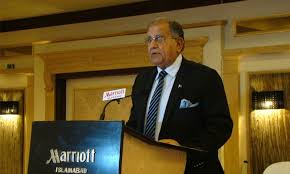
Federal Minister Riaz Hussain Pirzada (Credit: dawn.com)ISLAMABAD, Jan 25: Federal Minister for Inter-provincial Coordination (IPC) Riaz Hussain Pirzada has accused the Saudi government of creating instability across the Muslim world, including Pakistan, through distribution of money for promoting its ideology.
Addressing a two-day ‘Ideas Conclave’ organised by the “Jinnah Institute” think tank in Islamabad, the federal minister said ‘the time has come to stop the influx of Saudi money into Pakistan’.
He also blasted his own government for approving military courts in the presence of an ‘independent and vibrant judiciary’ and said that military courts reflect ‘weak and coward leadership’.
“Such cowardly leadership has no right to stay in power,” Pirzada added.
In her opening remarks, Chairperson of Jinnah Institute Sherry Rehman said that the two-day conference would deliberate upon new ideas needed for a progressive and better Pakistan.
Pakistan Tehreek-i-Insaf (PTI) leader Shafqat Mehmood said the government has failed to address the problems being faced by the common man.
Awami National Party (ANP) leader Afrasiab Khan Khattak expressed regret over military courts and said their establishment ‘has eroded democracy’. He called upon democratic elements to play their role in reversing the 21st constitutional amendment.
Muttahida Qaumi Movement (MQM) leader Farooq Sattar supported military courts and said there was no other option to deal with terrorists.
The Federal Minister for Commerce Khurram Dastgir while addressing the conference, said that for an elected government to deliver, they need at least a modicum of security that their leadership will exist tomorrow.
He said that lawmakers have little incentive to read legislation. They are judged by their constituents on how much patronage they can deliver.
“We are answerable to the people. No general would stand up here and take your criticism,” said Dastgir.
He further added that there is no excuse for not holding local body elections.