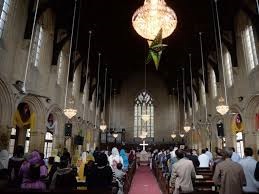
Church service in Pakistan (Credit: tribune.com.pk)[/caption]>LAHORE, Dec 25: For Christians around the world “tis the season to be jolly”, but several parishes in Pakistan decided to put out their Christmas candles this year and observe festivities in a solemn manner to express solidarity with the families who lost their children in a terror attack in Peshawar on Tuesday.
Archbishop Joseph Coutts has appealed to the Christian community to reflect on the message of hope and peace, which Christmas brings with it. Human rights activist and freelance journalist Peter Jacob told The Express Tribune that 11 parishes and several churches in the city had decided to cancel or postpone some programmes and events, mostly pageants and plays, to celebrate Christmas. “Most of them have been postponed… they will be held after January 1,” he said.
In Roman Catholic tradition, celebrations for the season usually commence on the first Sunday of Advent falling nearest to St Andrew’s feast. This year, celebrations began on November 30. The following three Sundays leading up to Christmas celebrated with prayers, candles, feasting and carolling.
Lahore Cathedral Dean Reverend Shahid P Mehraj expressed sorrow and concern for the grieving families and the lives that were lost. “This is an attack on the future of Pakistan,” he said from his office at the church.
In light of the events, Mehraj said they would hold special prayers for them on the fourth Sunday of Advent and would dedicate the candle-lighting ceremony to those who lost their lives in the attack. “Christmas brings hope to the world. The birth of Christ was also marked by a massacre of innocent children by King Herod… it is in the backdrop of this bloodshed that Jesus Christ was born as a symbol of hope,” he said.
Mehraj said this was a time to spread a message of love and brotherhood. “Christmas has come at the right time.”
Since Quaid-i-Azam was also born on Christmas Day, the rest of the country should reflect on his vision and dreams for the country, Mehraj said. “This year, Christmas will focus on a message of peace,” said Jacob. This year, Christians in Pakistan will remember and say prayers for not only the innocent lives lost in Peshawar but also Sajjad and Shama, killed in Kot Radha Kishen in November, he said.
WASHINGTON: After 13 years, the United States is winding down its war in Afghanistan, plagued by doubts about what was accomplished at such a high cost.
Instead of a sense of triumph at the close of the longest conflict in America’s history, there is mostly regret and fatigue over a war that claimed the lives of more than 2,300 American troops and cost more than a trillion dollars.
US commanders insist the Afghan security forces will hold the line in a stalemate with the Taliban. But some officials fear a repeat of Iraq, in which an American-trained army virtually collapsed in the face of an extremist onslaught.
A large majority of Americans now say the war was not worth it, and only 23 per cent of US soldiers believe the mission has been a success, according to recent polls.
But when it began, the war enjoyed overwhelming support and victory seemed within reach.
Less than a month after Al Qaeda’s attacks of September 11, 2001, president George W. Bush captured the nation’s sense of righteous anger as he announced military action in Afghanistan in a televised address in October.
The goal was to “disrupt the use of Afghanistan as a terrorist base of operations,” Bush said, and to attack the Taliban regime that had hosted Al Qaeda and refused to hand over its leaders.
Toppling the Taliban
US objectives were met with stunning speed. Al Qaeda training camps were wiped out and Northern Alliance fighters — backed by US-led air strikes and a small number of American special forces — toppled the Taliban regime within a month.
For the United States, the war seemed all but over. But the Taliban eventually regrouped from safe havens, even as Washington’s attention shifted to a new war in Iraq.
The Taliban grew into a virulent insurgency that exploited resentment of a corrupt, ineffective government in Kabul.
The United States formed the backbone of an international force that found itself in a protracted fight with insurgents.
The US-led contingent steadily expanded — while the goals of the war became increasingly ambitious as well.
Washington and its allies embraced the lofty ideals of nation-building, vowing to fight corruption, foster economic development, and forge a “stable, democratic state” in an impoverished land mired in war for decades.
The results were often disappointing. International aid helped build roads and schools, but it also was blamed for fuelling rampant corruption, with some of the money ending up with the insurgents.
Attempts to broker peace talks with the Taliban in recent years came to nothing. Critics say Washington missed a chance at cutting a deal early in the war, when the insurgents were on the retreat.
Fighting the elusive Taliban, with their homemade bombs and Pakistani sanctuaries, proved frustrating for Western troops, who struggled to grasp the language and tribal rivalries of an alien culture.
Commanders appealed for more troops. And Washington kept sending forces “in the vain hope that something might somehow improve”, wrote retired general Daniel Bolger, author of “Why We Lost”.
Having reached a peak of more than 100,000 US forces, the American presence is down to about 11,000 troops, now that Nato’s combat mission is over.
‘Big test’
The balance sheet for the campaign is decidedly mixed.
The intervention deprived Al Qaeda of a sanctuary, ousted the Taliban from power, eased the repression of women and created an Afghan army that could make it difficult for the insurgents to return to their once dominant role, analysts said.
But Al Qaeda — even after its leader Osama bin Laden was killed by US commandos — has spawned cells elsewhere and inspired new extremists in Syria and Iraq, while women’s advances are fragile and could easily unravel.
The Taliban may no longer run ministries but they are far from defeated and could yet turn the tide against the Kabul government’s army, which has suffered unsustainably high casualties and desertions.
“The Taliban have nowhere near the power they did in 2001, but they are certainly not finished,” said Vanda Felbab-Brown, a senior fellow at the Brookings Institution think tank.
US officials hope a huge investment in the Afghan security forces will pay off, but already the insurgents have clawed back control in some areas in the south where American troops have pulled out.
The newly created security force, riddled with ethnic divisions, remains “a question mark”, Felbab-Brown said.
“Next year is a big test for them,” said Carter Malkasian, author of a book on the war who worked as a US diplomat for two years in southern Helmand province.
“If they lose ground, that’s an indication that this war is going to keep going,” he told AFP.
“If that happens, the Taliban are going to get bolder, because the Taliban are not going to see a reason to negotiate.”
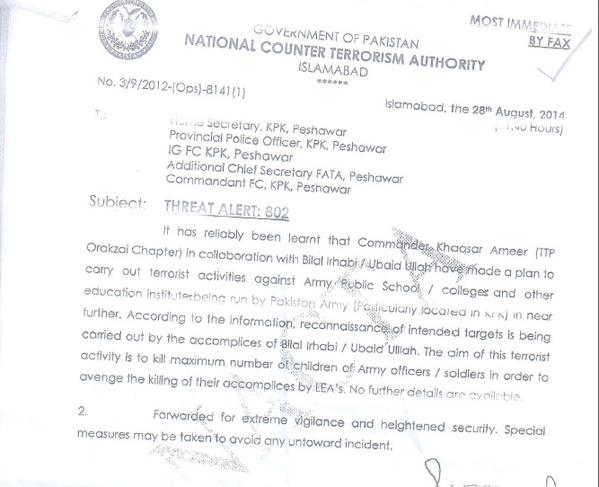
Official warning to KPK govt (Credit: hindu.com)Peshawar, Dec 22: Khyber Pakhtunkhwa government departments had been warned of an imminent attack on the Army Public School months before the carnage unfolded in Peshawar.
A copy of the written warning issued on August 28 has been obtained by Geo News.
Alert No. 802 issued by the Khyber Pakhtunkhwa Home Ministry stated that the Taliban Orakzai Commander, Khaksar along with terrorists Bilal and Obaidullah had planned to carry out attacks at educational institutions under the army.
According to information, Bilal and Obaidullah with their accomplices had also conducted reconnaissance of the targets. The warning stated the intention of terrorists was revenge and they wanted to kill as many children of army officers as possible.
The written warning had called for security measures to be made in advance to avoid any untoward incident and copies were sent to Khyber Pakhtunkhwa Chief Minister, Home Minister and law enforcement agencies.
On December 16, terrorists carried out one of the most horrific attacks in the history of Pakistan. Tehreek-e-Taliban Pakistan (TTP) terrorists brutally killed over 140 people mostly children at the Army Public School.
Following the attack government and political parties expressed a renewed resolve to fight terrorism in the country. The prime minister also lifted the moratorium on the death penalty in terrorism cases.
PESHAWAR, Dec 18: `We have killed all the children in the auditorium,` one of the attackers told his handler.
‘What do we do now?` he asked. `Wait for the army people, kill them before blowing yourself,` his handler ordered.
This, according to a security official, was one of the last conversations the attackers and their handler had shortly before two remaining suicide bombers charged towards the special operations soldiers positioned just outside the side entrance of the Army Public School`s administration block here on Tuesday.
This and other conversations between the attackers and their handlers during the entire siege of seven and a half hours of the school on Warsal< Road form part of an intelligence dossier Chief of Army Staff Gen Raheel Sharif shared with Afghan authorities on Wednesday.
`Vital elements of intelligence were shared with the authorities concerned with regard to the Peshawar incident,` an Inter-Services Public Relations statement on Gen Sharif`s visit to Afghanistan said.
Pakistan has the names of the attackers and the transcripts of the conversation between one of them, identified as Abuzar, and his handler,`commander`Umar.
Umar Adizai, also known as Umar Naray and Umar Khalifa, is a senior militant from the Frontier Region Peshawar.
Security officials believe he made the calls from Nazian district of Afghanistan`s Nangrahar province and now want the Afghan authorities to take action.
The officials believe that a group of seven militants attacked the school. Five of them blew themselves up inside the administration block and two others outside it.
The attackers entered the building by climbing its rear wall, using a ladder and cutting barbed wire. They all headed for the main auditorium where an instructor was giving a first-aid lesson to students of the school`s senior section.
`Did the attackers have prior 1(nowledge of the congregation in the main hall? We don`t know this yet. This is one of the questions we are trying to find an answer to,` a security official said.
A watchman standing at the rear of the auditorium appears to be the first victim because of a pool of congealed blood splashed in one corner of several steps in the open courtyard.
Finding the rear door closed, the militants charged towards the two main entry and exit doors and this is where the main carnage appears to have taken place, according to a military officer who took part in the counter-assault. Pools of blood at the entrance on both sides bore testimony to the horrific, indiscriminate shooting.
`There were piles of bodies, most dead, some alive. Blood everywhere. I wish I had not seen this,` the officer said.
The students in the hall appear to have rushed to leave the place af ter hearing the first round of shooting, and this was where they barged into the waiting militants who were blocking the two doors.
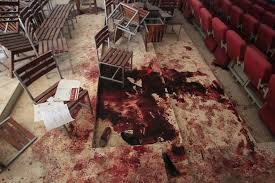
Inside the main hall, there was blood everywhere, almost on every inch of it.
Shoes of students and women teachers lay asunder. Those who had hid behind rows of seats were shot one by one, in the head.
More than 100 bodies and injured were evacuated from the entrances and the hall.
Every row of seats was bloodied. On one seat, there were blood-stained English notebooks of two eighth-grade students, Muhammad Asim and Muhammad Zahid.
A corner to the right of the stage in the auditorium, where an instructor was giving the lesson, was where a woman teacher, who had beseeched the militants to have mercy and let the children go, was shot and later burnt.
By that time, the Special Services Group (SSG) men had arrived and fighting had ensued and the militants were forced tomake a run for the administration block, just a few metres away.
Security officials believe the death toll could have been far higher had the militants reached the junior section before the arrival of the SSG personnel.
It is from inside the administration block that the militants fired at the SSG men.
Four of the militants blew themselves up inside the lobby of the block when they were cornered.
The impact was huge and devastating.
There were pockmarks from the flying ball bearings and human flesh and hair were plastered to the ceiling and the walls.
One of the bombers blew himself up in the office of the Headmistress, Tahira Qazi. Her office stands gutted. Her body was recognised later. A leg of the bomber was lying around.
Two students and three staff members were killed in the administration block along with the headmistress.
The last two bombers charged towards the SSG men who had taken positions on either side of the flank entrance to the block.
One of them exploded himself and after a while, the second one did. Shrapnel and ball bearings hit the rear wall, some pierced through the trees opposite the entrance.
This is where the seven SSG men were injured. One of the personnel who had taken position behind one of the trees was hit in the face, but is reported to be in stable condition.
The assault came to an end but left several questions.
Could the tragedy have been avoided? Yes, given prior specific intelligence tips of August and repeated conveyance of concerns by some teachers regarding the school`s vulnerability vis-a-vis its western and northern boundary walls.
Could the casualties have been avoided or minimised? Probably not, given the short response time. By the time the SSG men arrived and began the operation within 10 to 15 minutes of the assault, the militants had carried out much of the carnage.
There was no clarity on the number of militants and their location. The SSG team arrived through the front gate covered by two armoured personnel carriers. As they moved from block to block, the first major priority was to secure the junior section.
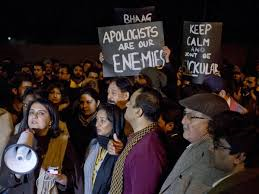
Civil Society protest at Red Mosque, Islamabad (Credit: philly.com)
LONDON, Dec 19 — Only a week ago, the Red Mosque seemed a nearly untouchable bastion of Islamist extremism in Pakistan, a notorious seminary in central Islamabad known for producing radicalized, and sometimes heavily armed, graduates.
On Friday evening, though, the tables were turned when hundreds of angry protesters stood at the mosque gates and howled insults at the chief cleric — a sight never seen since the Taliban insurgency began in 2007.
What has changed is the mass killing of schoolchildren, at least 132 of them, slain by Pakistani Taliban gunmen in a violent cataclysm that has traumatized the country. In the months before the shocking assault on a Peshawar school on Tuesday, Pakistan’s leadership had been consumed by political war games, while the debate on militancy was dominated by bigoted and conspiracy-laden voices, like those of the clerics of the Red Mosque.
Now, united by grief, rage and political necessity, Pakistanis from across society are speaking with unusual force and clarity about the militant threat that blights their society. For the first time, religious parties and ultraconservative politicians have been forced to publicly shun the movement by name. And while demonstrations against militancy have been relatively small so far, they touched several cities in Pakistan, including a gathering of students outside the school in Peshawar.
Photo
Children wearing white burial shrouds demonstrated on Friday in Lahore, Pakistan, against an attack by Taliban militants on an army-run school in Peshawar. Credit Arif Ali/Agence France-Presse — Getty Images
Protest leaders believe that the public will support them. “This will become a protest movement against the Taliban,” one organizer, Jibran Nasir, thundered into a microphone outside the Red Mosque on Friday.
Though there is little doubt that the Peshawar massacre has galvanized Pakistani society, the question is whether it can become a real turning point for a society plagued by violent divisions, culture wars and the strategic prerogatives of a powerful military.
After all, Pakistan has been here before. The country has suffered countless wrenching tragedies — the death of Benazir Bhutto in 2007, as well as attacks on mosques, markets and churches — only for rage to fizzle into nothing. And after the Taliban attack on the teenage rights campaigner Malala Yousafzai, a resulting backlash against Western support for her made her the target of smears and vitriolic criticism.
Prime Minister Nawaz Sharif, seemingly paralyzed for much of the year by political opposition, has promised that this time will be different. He rushed to Peshawar as the school shooting was still underway. As global scrutiny intensified, Mr. Sharif vowed to eliminate the distinction between “good” and “bad” militants — a nod to the military’s decades-old policy of fighting some Islamists while secretly supporting others.
The army, for its part, has been buoyed by a wave of public sympathy, as many of the children killed at the Army Public School in Peshawar came from military families. And other forces, such as Karachi’s M.Q.M. party, have sought to harness national anger for local purposes.
“Crush Taliban to Save Pakistan,” read the banners at a large party rally in Karachi on Friday.
The tide of outrage has encouraged progressive Pakistanis, increasingly marginalized for years, to speak up.
Outside the Red Mosque on Friday, protesters waved placards mocking the chief cleric, Maulana Abdul Aziz, who had enraged many by refusing to condemn the Taliban attackers during a television interview. “Run, burqa, run” read one sign, in a reference to Mr. Abdul Aziz’s attempt to slip through a military cordon in 2007 while disguised in a woman’s concealing garments.
A day earlier, when a few dozen demonstrators tentatively appeared outside the mosque, students there wielded staves to intimidate the protesters into silence. But on Friday, the protest grew, and riot police officers waving truncheons interposed themselves between the two sides.
“The Red Mosque has become a factory of terror and hatred,” said Bushra Gohar of the Awami National Party, a Pashtun political party that has suffered countless Taliban attacks.
But for all the fighting talk, many are skeptical that the anger and tears of this week can make a sustained change.
The most intense anti-Taliban protests this week have been confined to the relative safety of social media such as Twitter and Facebook, where many users have posted solid black images as profile pictures. The extraordinary scenes at the Red Mosque would only be significant if they were replicated in numbers across Pakistan, said Chris Cork, an editorial writer with The Express Tribune newspaper.
But, he said, civil society is still weak and disorganized, riven by fear of the Taliban and the harsh gaze of the intelligence agencies.
“I don’t see a joining up of the dots across the country,” Mr. Cork said. “There isn’t the infrastructure, the will, the people with organization, ability and visibility to lead it.”
The wave of anti-Taliban sentiment is “probably just a blip,” he added. “Quite honestly, give it a month and it will have faded.”
The hard lessons of history underpin such pessimism. Although the Pakistani military has taken the fight into the Taliban stronghold of North Waziristan in recent months, there is evidence that Pakistan’s generals continue to play favorites among militant groups.
The “good” militants that Mr. Sharif referred to in his speech — those focused on Afghanistan and India, and who have longstanding ties to Pakistani intelligence — have continued to strut the national stage, even after the Peshawar massacre.
The most visible of such groups is Lashkar-e-Taiba, which carried out the deadly 2008 attacks in Mumbai. Not only does its leader, Hafiz Muhammad Saeed, who has a $10 million United States government bounty on his head, live openly in the eastern city of Lahore, but he has also built a public profile as a media personality.
On Friday, his brother-in-law, Hafiz Abdul Rehman Makki, delivered a sermon at a mosque in Hyderabad, the second largest city in Sindh Province. After offering prayers for the victims of the Peshawar attack, Mr. Makki first accused NATO of sending “terrorists disguised as Muslims” into Pakistan, then linked the attack to India.
The group said that as he spoke, preachers from its charity wing fanned out across Karachi, a city of 20 million people, giving sermons at 45 different mosques — and propagating similar conspiracy theories.
Experts say it would be naïve to expect the Pakistani military to immediately disband groups like Lashkar-e-Taiba, particularly given the fraught state of relations with India in recent months. But they also say that the underground ties between militant groups — which often share ideas, fighters and weapons — hopelessly undermine army efforts to dismantle the Pakistani Taliban.
“It’s that old story,” Hillary Rodham Clinton said when she visited Islamabad as secretary of state in 2011. “You can’t keep snakes in your backyard and expect them only to bite your neighbors.”
A cross-party political committee, formed by the prime minister, has promised to come up with a new strategy to fight the Taliban within a week. That is a hopelessly optimistic goal, by most reckonings.
The bigger worry, though, is that once anger over the Peshawar massacre has dissipated, the debate over militancy will once again be clouded in confusion and obfuscation — which, as recent years have shown, offers an ideal moment for the Taliban to strike again.
Salman Masood contributed reporting from Islamabad, Pakistan, and Saba Imtiaz from Karachi, Pakistan.
“Tuesday’s attack was utterly reprehensible, and it is imperative that those responsible for this unimaginable tragedy are brought to justice. However, resorting to the death penalty is not the answer – it is never the answer,”said David Griffiths, Amnesty International’s Deputy Director for Asia-Pacific.
Sharif’s announcement came the day after at least 148 people – including 132 children – were killed by Taliban militants at an army-run school in the north-western city.
“Pakistan is understandably gripped by fear and anger in the wake of the attacks. However, lifting the moratorium on executions appears to be a knee-jerk reaction which does not get at the heart of the problem – namely the lack of effective protection for civilians in north-west Pakistan,” said Griffiths.
“This is where the government should focus its energies, rather than perpetuating the cycle of violence with the resumption of executions,” he said.
Amnesty International calls for those responsible for indiscriminate attacks and attacks against civilians, including the Peshawar attack, to face investigation and prosecution in proceedings that comply with international fair trial standards, but without resort to the death penalty.
“Capital punishment is not the answer to Pakistan’s law and order situation and would do nothing to tackle crime or militancy in the country,” the London-based rights body said.
Pakistan re-imposed a moratorium on executions in October 2013 and has not executed since the hanging of a soldier in November 2012, while the last civilian hanging was in late 2008.
There are currently dozens of people sentenced to death for terrorism-related offences in the country.
DERA ISMAIL KHAN: The most hated man in the country is a 36-year-old father of three and volleyball enthusiast nicknamed “Slim”. His real name is Umar Mansoor and the Tehreek-e-Taliban Pakistan say he masterminded this week’s massacre of 132 children and nine staff at a school in Peshawar – the deadliest militant attack in Pakistan’s history.
A video posted on Thursday on a website used by the Taliban shows a man with a luxuriant chest-length beard, holding an admonishing finger aloft as he seeks to justify the December 16 attack.
The caption identified him as Umar Mansoor.
“If our women and children die as martyrs, your children will not escape,” he said. “We will fight against you in such a style that you attack us and we will take revenge on innocents.”
The Taliban say the attack, in which gunmen wearing suicide-bomb vests executed children, was retaliation for a military offensive carried out by the army.
The school attack shocked a nation where traditionally, women and children are protected, even in war.
Six TTP members interviewed by Reuters confirmed the mastermind was Mansoor. Four of them said he is close to Mullah Fazlullah, the embattled leader of the fractious group who ordered assassins to kill Malala Yousafzai.
“He strictly follows the principles of jihad,” one said. “He is strict in principles, but very kind to his juniors. He is popular among the juniors because of his bravery and boldness.”
Mansoor got a high school education in the capital, Islamabad, two Taliban members said, and later studied in a madrassah. “Umar Mansoor had a tough mind from a very young age, he was always in fights with other boys,” said one Taliban member.
Mansoor has two brothers and spent some time working in the city of Karachi as a labourer before joining the Taliban soon after it was formed, in late 2007, said one commander.
His nickname is “nary,” a word in the Pashto language meaning “slim”, and he is the father of two daughters and a son, said another commanders.
“(Mansoor) likes to play volleyball,” said one of the Taliban members. “He is a good volleyball player. Wherever he shifts his office, he puts a volleyball net up.”
The Taliban video describes him as the “amir”, or leader, of Peshawar and nearby Darra Adam Khel.
Mansoor deeply opposes talks with the government, the commanders said.
“He was very strict from the start when he joined,” a commander said. “He left many commanders behind if they had a soft corner (of their heart) for the government.”
Peshawar student wounded by Taliban (Credit: theagecom.edu)“We were in the education hall when militants barged in, shooting,” said Zeeshan, a student, speaking at a hospital. “Our instructor asked us to duck and lay down and then I saw militants walking past rows of students shooting them in the head.”
Mushtaq Ghani, the information minister for Khyber-Pakhtunkhwa Province, confirmed that most of the victims had been killed by gunshots to the head.
As Pakistani security forces responded, some of the attackers blew themselves up while others were killed by members of the army’s Special Service Group commando unit.
Desperate parents, meanwhile, rushed to local hospitals or gathered outside the school gates seeking news of their children. One of them, Muhammad Arshad, described his relief after his son Ehsan was rescued by army commandos.
“I am thankful to God for giving him a second life,” he said.
Witnesses described the scene on Tuesday in Peshawar in northwestern Pakistan after at least 145 people were killed in a Taliban attack on a school.
But at the Combined Military Hospital, the bodies of schoolchildren were lined up on the floor, most of them with single gunshot wounds to the head.
A 7-year-old student, Afaq, said militants had entered his classroom and immediately started shooting. “They killed our teacher,” he said, breaking down in tears.
“These attackers were not in the mood to take hostages,” a security official said. “They were there to kill and this is what they did.”
Some students managed to flee. Television coverage showed panic-stricken pupils in green sweaters and blazers, the school uniform, being evacuated from the compound. Others were wounded and were taken to another hospital in the area, Lady Reading, where parents also gathered looking for news of their children.
Lady Reading Hospital later published a list of students known to have died; many of the dead have not yet been identified.
By late afternoon, the army said it had cleared three sections of the school compound and that troops were pushing through the remaining sections. After the last of the militants was killed, officials said, soldiers were sweeping the compound for explosives.
Prime Minister Nawaz Sharif arrived in Peshawar, where the authorities declared three days of mourning. Mr. Sharif announced an emergency meeting of all political parties in the city for Wednesday. In a statement, the foreign ministry said it was “deeply shocked” by the attack but that the government was undeterred in its fight against the Taliban.
The British prime minister, David Cameron, called the attack “deeply shocking” and said it was “horrifying that children are being killed simply for going to school.” The American ambassador to Pakistan, Richard G. Olson, said the United States “stands in solidarity with the people of Pakistan.”
And Malala Yousafzai, the teenage education campaigner from northwestern Pakistan who was awarded the Nobel Peace Prize in a ceremony last week, said she was “heartbroken by this senseless and coldblooded act of terror.”
“Innocent children in their school have no place in horror such as this,” Ms. Yousafzai said in a statement. “I, along with millions of others around the world, mourn these children, my brothers and sisters — but we will never be defeated.”
The Army Public School in Peshawar is part of a network of schools that the military operates in garrison towns and major cities across Pakistan. Students from army families have preferential access, but many of the students and teachers in the schools come from civilian backgrounds.
The assault came at a time of political turbulence in Pakistan. The opposition politician Imran Khan, whose party controls the provincial government in Khyber-Pakhtunkhwa, has been staging protest rallies in major cities in a bid to unseat Mr. Sharif, claiming that Mr. Sharif’s supporters rigged the 2013 elections.
Mr. Khan has criticized army operations in the tribal areas and called on the government to negotiate with the militants instead of fighting them, a stance that has attracted wide criticism.
The Pakistani Taliban, always a loose and chaotic coalition of militant groups, have come under increased pressure this year because of internal frictions and the military’s continuing operation in North Waziristan, which started in June following an audacious attack on the Karachi airport.
The military says that the offensive, officially known as Operation Zarb-e-Azb, has resulted in the death of 1,800 militants and cleared much of North Waziristan, the region’s most notorious hub of militant activities.
Still, the school attack on Tuesday demonstrated that the Taliban remain willing and able to strike at vulnerable civilian targets.
Ihsanullah Tipu Mehsud contributed reporting from Peshawar, and Declan Walsh from London.
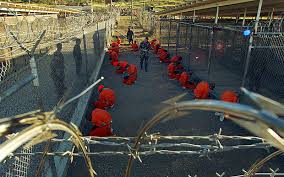
On Tuesday morning, the Senate intelligence committee released an executive summary [1] of its five-year investigation into the CIA’s interrogation and detention program. (Read the executive summary here. [2])
Among the report’s most striking revelations is that CIA interrogators were often untrained and in some instances made up torturous techniques as they went along.
The CIA was “unprepared” to begin the enhanced interrogation program, the Senate report concluded. The agency sent untrained, inexperienced people into the field to interrogate Abu Zubaydah, the first important Al Qaeda suspect the US captured.
Within weeks of Zubaydah’s arrival, while he was still in the hospital recovering from a gunshot wound, CIA headquarters was planning to throw him in all-white room with no natural lighting, blast rock music 24/7, strip him of his clothes, and keep him awake all day. They did. Extreme interrogations like these, identified as “enhanced interrogation techniques,” went on for more than three months before CIA officers received any sort of training in the new techniques from anyone.
As the overall detention and interrogation program proceeded, many untrained CIA personnel continued to do whatever they wanted, without authorization or supervision. At one facility in 2002, code-named COBALT, “untrained CIA officers…conducted frequent, unauthorized, and unsupervised interrogations of detainees using harsh physical interrogation techniques that were not—and never became—part of the CIA’s formal ‘enhanced’ interrogation program,” the report found. COBALT is reportedly [9] a prison in Afghanistan the agency nicknamed “the Salt Pit.” In one example identified by the report, an interrogator left a COBALT detainee chained naked to the concrete floor. The detainee later died of suspected hypothermia.
The CIA also put a junior official with absolutely no relevant experience in charge of this entire facility. Later, when the CIA’s inspector general investigated COBALT, the CIA said it knew little about what happened there. Several interrogators at the site became uncomfortable with their coworkers’ methods, not sure that they were safe or effective. According to John Helgeron, the CIA inspector general who conducted a formal review of the agency’s detention and interrogation program, CIA interrogators at COBALT had zero training guidelines before December 2002. The report claims, quoting Helgeron: “Interrogators, some with little or no training, were ‘left to their own devices in working with detainees.'”
In 2004, the CIA chief at another detention site, code-named BLACK, penned a long email about his disillusionment with the program, especially deficiencies in training:
And in one particularly heinous example, the CIA headquarters sent an untrained interrogator to question Abd al-Rahim al-Nashiri, a man the CIA claimed was an Al Qaeda “terrorist operations planner” involved in several bombings. One senior CIA official had reservations about sending the untrained interrogator, noting that he heard the man was “too confident, had a temper, and had some security issues.” But the man got sent anyway.
While there, the interrogator allegedly forced Nashiri to stand with his hands over his head for two and a half days, blindfolded him, pushed a pistol up against his head, and revved up a cordless drill close to his body. When this produced no new information, the interrogator slapped the detainee repeatedly on the back of the head, told him he’d sexually assault his mother in front of him, blew cigar smoke in his face, and made him sit in such stressful positions that a medical officer was concerned the detainee’s shoulders would be dislocated.
The CIA base chief let this happen because he thought this interrogator was sent to “fix” the problem of an uncooperative detainee and had permission from headquarters to take such extreme steps. Both men were later reprimanded, according to the report.
The problem of untrained amateurs questioning and torturing of detainees wasn’t unique to the CIA. In 2008, Mother Jones explored [8] the world of untrained interrogators with testimony from Ben Allbright—a soldier who recalls using harsh interrogation techniques while serving as a military guard at a small Iraqi prison called Tiger in Western Iraq:
Ben was not a “bad apple,” and he didn’t make up these treatments. He was following standard operating procedure as ordered by military-intelligence officers. The MI guys didn’t make up the techniques either; they have a long international history as effective torture methods. Though generally referred to by circumlocutions such as “harsh techniques,” “softening up,” and “enhanced interrogation,” they have been medically shown to have the same effects as other forms of torture. Forced standing, for example, causes ankles to swell to twice their size within 24 hours, making walking excruciating and potentially causing kidney failure.
The Senate intelligence committee did not address allegations of torture or abuse by the US military. In fact, when members of the US military stopped by COBALT, they decided it was too risky for them to be involved at all.
In July 2002, CIA headquarters recommended that a group of interrogators, “none of whom had been trained in the use of the CIA’s enhanced interrogation techniques,” try to “break” a detainee named Ridha al-Najjar, who was arrested in Pakistan and identified as a former bodyguard for Osama bin Laden.
When officers from the US military arrived for a debriefing, the military’s legal adviser took note of the extreme techniques being used. The interrogators left Najjar hanging handcuffed to an overhead bar for 22-hour periods. He was left in total darkness and cold temperatures, hooded and shackled. They forced him to wear a diaper and didn’t provide a bathroom. And on top of that, the US military officer claimed that the warden in charge “[had] little to no experience with interrogating or handling prisoners.”
At the end of the visit, the legal adviser concluded that the treatment of the prisoner and the concealment of the facility were too big a liability for the military to get involved. But even then, Najjar’s treatment became a “model” for future interrogations, according to the report.
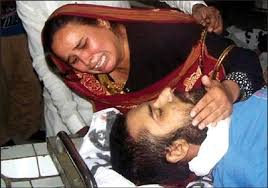
Grieving Sarwech mother (Credit: awamiawaz.com)Sarwech Ali Pirzado’s grave stands out in the ancestral Pirzado graveyard in Balhreji, Larkana district. A red Jeay Sindh Muttahida Mahaz (JSMM) flag is spread over the grave. Another party flag flutters beside it. Known as ‘little Moscow’, Balhreji has seen many socialist and communist movements, evidence of which is found on the main entrance to the street where the graveyard is located. There is a plaque here in memory of “social reformer Muhib Hussain Pirzado”.
The area has been in the spotlight in recent weeks, as the venue where families from across Sindh receive the tortured bodies of their relatives — activists of Sindh’s nationalist parties who hailed largely from Larkana district.
Sitting on a charpoy in his modest home, Sarwech’s father Lutuf Pirzado wore an expression of resigned acceptance as he mentioned his son’s affiliation with the JSMM’s student wing, the Jeay Sindh Students Federation (JSSF). Himself an active member of the Movement for the Restoration of Democracy in the 1980s, Lutuf received 15 lashes in prison for wall-chalking and demanding the release of communist leader Jam Saqi.
“A month before his abduction, we had a family discussion. Both his mother and I asked him to stay away from some of his friends. Their activities seemed suspicious to us,” he said. The reason behind the discussion was the news of activists disappearing one by one in Karachi. Soon after, an announcement appeared in Daily Subh, a Sindhi-language newspaper, of Sarwech’s resignation from the JSMM and its student organisation.
The 22-year-old was working as a sales manager in Karachi when on Sept 11 he went missing, “somewhere in Saddar”, his father added.
The incident went unnoticed for over an hour until an employee of a courier service called his office around 6pm to inquire whether Sarwech would be picking up a letter he was supposed to. Search for Sarwech started soon after, with his father and brother going to Karachi, running from pillar to post to locate him. The police refused to register an FIR, so they went to the Sindh High Court.
While waiting for the hearing, they protested in front of the Karachi Press Club on Sept 23. In the meantime, a ‘well-wisher’ of the family sent a message to them through a relative that the young man had indeed been abducted by the security forces for a plot he was accused of hatching with his friends to target security installations. Sarwech’s brother Inayat Ali recalled, “He also asked us to relax, as the man told my cousin that Sarwech seemed like he belonged to a good family. And they might release him because of that. We continued hoping, waiting for his release.”
It took another few days to convince the authorities to register the FIR. But on Nov 30, they learned of his death. “One of our relatives heard it on TV and called from Karachi to inform us that two bodies had been found in Nooriabad, hands tied with gunshot wounds to the head,” said his mother Mehrunnisa, a lady health worker in Larkana district.
Her face remained emotionless as she narrated how she was the one who informed the police that her son might have been abducted due to his past affiliation with the JSMM. “They looked at me, surprised. Then hushed me up for saying the word ‘agency’ out loud. I just want to know whether by abducting these young men are they trying to finish off the movement or bolstering it?”
Many in Larkana do not consider the JSMM as truly representing the poor. Others say that the recent abductions were a result of the separatist movement, mostly underground, gaining strength in recent years. One of the reasons for the recent surge in the ‘kill-and-dump’ phenomenon, earlier associated only with Balochistan, is said to be the growing proximity between Baloch separatists and their counterparts in Sindh.
In 2011, a picture of Sirai Qurban Khuhawar, senior vice chairperson of the JSMM at the time, Ruplo Choliani, Noor ul Haq Tunio and Nadir Bugti, went viral among nationalist groups on Facebook. Soon after, Khuhawar and Choliani’s car was found torched near Sanghar. It was followed by a picture of Balaach Marri and the present JSMM leader Shafi Burfat on the internet. Locals say the proximity between JSMM and Baloch separatists continued till recently, resulting in enforced disappearances.
Another factor, pointed out by a former political activist of the Jeay Sindh Mahaz, Ustad Khalid Chandio, is that the JSMM is getting stronger even while being banned. “You must have heard people shrug off their cause saying their attacks are limited to ‘cracker blasts’. But has anyone thought how the material for making a ‘cracker bomb’ is available to them? How a mere cracker blows up five to six feet of solid steel railway tracks? At the same time, there’s some truth to reports about India’s interference in our region. We may ignore them but there’s some truth there. This nationalist movement is not all black and white; there are many shades of grey.”
Another factor he mentioned was that over the years, with the absence of governance, awami movements in Sindh were gradually being replaced by azadi movements. “Secularism is being wiped out in this country. Stoking a militant movement in Sindh is ideally a good shut-up call for the nationalists, good for creating conflict and confrontation amongst those seeking provincial autonomy and those seeking independence. All of this, in the end, is useful to justify torture against militant groups,” he added. At present there’s no ongoing strong movement for a ‘Sindhudesh’ in the province, Chandio argued, as was once imagined and explained in detail by G.M. Syed in his book about Sindhudesh.
When the question was put to the senior vice president of JSSF, Shehzad Manglo, whether there was a solution to the ongoing kill-and-dump policy in the province, he politely said “an independent Sindh”.