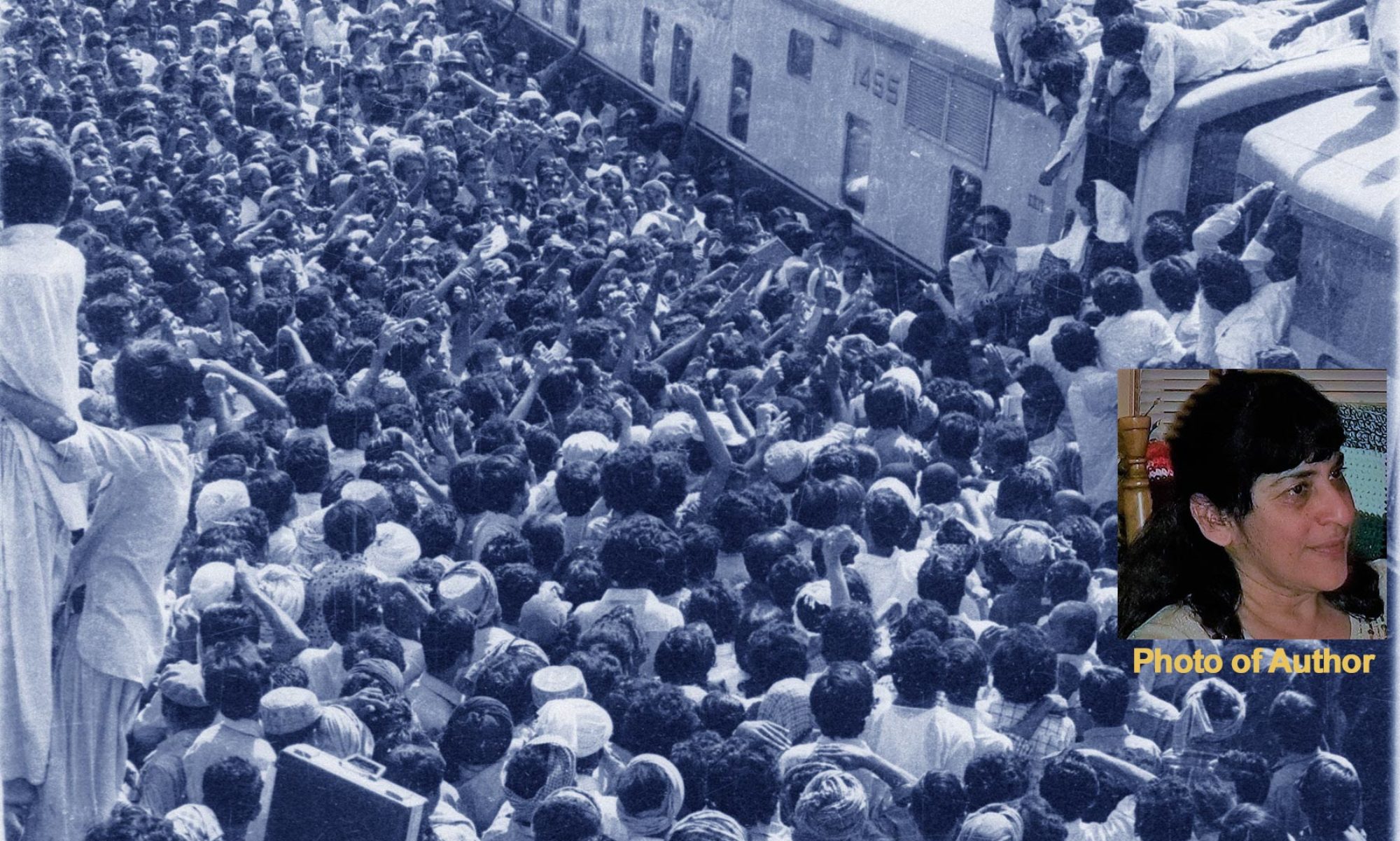

Burnes Road is Named after British spy doctor James Burnes

Burnes Road (Credit: khabrustan.wordpress.com)
Burnes Road
(Credit: khabrustan.wordpress.com)

For those of you who’re not aware of it, Burnes Road in Karachi is named after James Burnes, a doctor who also worked as a spy for the British Raj in the subcontinent, back in the 18th century.

In Sindh ke Darbar, a book based on the memoirs of James Burnes, the former secretary of Sindhi Literary Board, Aijaz Mangi preludes with the following passage on Burnes:
Dr Burnes was the member of a nation which planned to take over Sindh and systematically make it part of the British Raj. As such, he deemed the native population there to be inferior and despicable. But one must admit that the observations of Dr Burnes are an invaluable and accurate insight into how things were back at that time; very informative and highly interesting.
Following Partition, the road named after Dr Burnes was renamed to ‘Shahrah-e-Liaquat’, but if you ask around for directions with that name, I doubt a single soul would be able to help you.

Ask for ‘Burns Road’ and just about anyone will be able to point you to the street of Mazaydar Haleem, biryani, dahi baray, quorma, gola kabab, halwa puri, mithai and what not.

Explore: The truth behind Karachi’s Freemasons
Burnes has some fascinating things to say about the ruling family of Sindh at that time, the Talpur Mirs. On page 35 of Sindh ke Darbar it says:
It was part of Baloch tradition that before a doctor could administer medicine to his students, he would have to take the medicine himself. [My patient] Mir Murad Ali wasn’t ready to take the medicine without me having taken it first. But I had had enough of its bitter doses already.

So eventually, it came down to a poor, ill-fated servant who was forced to take the medicine for a long time, despite having zero need for it. It must have created a really bad impression of British medicines on his mind.

I tried hard but in vain to find out more about the medical qualifications of Dr Burnes and where he’d gotten his education from. His memoirs do detail how Burnes was able to cure Mir Murad Ali:

The simple reason why Mir Murad recovered was that I stopped him from taking any heavy medication. But the Mirs thought it was my extraordinary skills as a physician. Then a series of fortunate coincidences completely established their faith in my healing powers.

So what was that drug which never failed to cure Mir Murad? Burnes explains:

I used ‘Konain’, something which the people of Sindh are yet to learn about. For the native population, it is the best cure for the seasonal cold. I would even predict the effects of the medicine in advance, to the surprise of many patients.

But once Mir Murad discovered that Konain was the secret behind his health, he took my bottle of Konain without my permission and locked it up in his cupboard. This one time, I fell ill and he wouldn’t even return it to me! When it was time for me to go, I asked him for the empty bottle, but he still refused. Mir Murad seemed to think that the bottle was a vital part of this miracle drug.

Also read: The real Father of Karachi
The Mirs were just as spoilt as the other rulers of Hindustan. Keeping slave-girls was common and acceptable everywhere, but the treatment these Mirs meted out to kids borne of these girls was horrific. Burnes writes:
Mir Mohammad Khan does not have any children. Keep in mind that in the court of Sindh, it’s a custom to kill any children borne by slave-girls…I’ve learned through credible sources that a certain member of the Mir clan has killed as many as 27 babies.

The Mirs ruled differently than other rulers in Hindustan at the time. At other places, the real power always lay with the person sitting on the throne. His brothers and relatives would not be of any importance, and would often even be killed, if the need arose.

But the Mir brothers weren’t like that. All three used to rule together and would never let any one of them be left alone in the capital at any given moment. Burnes says:

The Mirs are one peculiar lot. They don’t trust each other one bit. Like I mentioned before, when Mir Murad fell sick, all the brothers confined themselves to the Hyderabad Fort for several months. If they went out to hunt, they’d take care to leave an agent behind so as not to leave affairs unguarded…It wasn’t easy to rule in an atmosphere of such uncertainty and lack of trust. Mir Murad Ali had once opened up to me saying: ‘Rulers bear an immense burden on their chests; only a ruler can understand that burden.'”

Look through: The unwashed Bandar Road
A study of history reveals that the British conquest of Sindh had little to do with clever stratagems and much more with the mistrust between the ruling Talpur brothers, and their differing views on the native population (many of whom were Hindus). Burnes writes on pages 51-52:

When I set out of Sindh, the Mir brothers handed me two of their watches for repair. At that time, one of their servants said that there was an expert watch-repairer in Bhaj (an area in India). When the Mirs heard that, they refused to hand the watches over to me until I promised that I wouldn’t trust an infidel with them.

They also gifted me a very expensive sword, bearing an inscription (by a courtier) that the Mirs were very proud of.
The memoirs of James Burnes are flooded with passages illuminating the Mir rule of Sindh. One has only got to initiate research. I hope the students of history will dig deeper into these resources and increase our knowledge of the past.
________________________________________
Translated by Talha Ahmed from the original in Urdu.
Musharraf’s party calls for withdrawal of treason trial to ‘end political deadlock’

Pervaiz Musharraf on trial (Credit: presstv.ir)
Pervaiz Musharraf on trial
(Credit: presstv.ir)

LAHORE, Aug 23: With so much uncertainty and speculation already surrounding the ongoing political crisis in Islamabad, former president Pervez Musharraf’s party has thrown its own curveball in the mix. 

The All Pakistan Muslim League (APML) has called upon Prime Minister Nawaz Sharif to immediately withdraw the government’s treason trial against Musharraf as part of what it called a ‘compromise’ to unlock the current political crisis.

In a statement released on Saturday, political advisor to Musharraf Chaudhry Sarfraz Anjum Kahlon stated that it was “compulsory for any discussion concerning an end to the current national political crisis to include the immediate withdrawal of the politically-motivated treason trial against Musharraf.”

Describing the treason trial as a “fundamental element of the ongoing political crisis,” Kahlon claimed he has received “assurances from senior members of the Pakistan Tehreek-e-Isaf (PTI) and the Pakistan Awami Tehreek (PAT) that the withdrawal of the treason trial would be privately presented as a fundamental demand in negotiations with the government.”

According to the statement, in June 2013,  Kahlon lead private discussions with the PTI and the PAT in which it had been agreed that both parties would provide support to Musharraf “at the right time”.

Kahlon added, in the statement, that “Nawaz Sharif has lost his political mandate to pursue the baseless treason trial, which has served to undermine the country’s democratic system.”

Populist’s Brash Tactics Stir Fears of Crisis in Pakistan

KP CM's khattak dance (Credit: slingshow.com)
KP CM’s khattak dance
(Credit: slingshow.com)

LONDON, Aug 23 — Only last year, Imran Khan was casting himself as the savior of Pakistani politics: a playboy cricketer turned opposition leader who enjoyed respect and sex appeal, filling stadiums with adoring young Pakistanis drawn to his strident attacks on corruption, American drone strikes and old-school politics. When Mr. Khan promised that he would become prime minister, many believed him.

Now, though, Mr. Khan’s populist touch appears to have deserted him.

He led thousands of supporters into the center of the capital, Islamabad, a week ago in a boisterous bid to force the resignation of Prime Minister Nawaz Sharif, whom he accuses of election fraud. But the crowds he attracted were much smaller than his party had hoped, and the protest movement has been messy, inchoate and inconclusive.

Mr. Khan, 61, delivers speeches every day from atop a shipping container opposite the Parliament building, while his supporters sleep on the streets of a paralyzed city. But because he lacks the clout to break the political deadlock, he has turned to inflammatory tactics.

In recent days, he has called for a tax boycott, threatened to have his supporters storm the prime minister’s house, and pulled his party’s lawmakers from Parliament. In interviews, he has compared himself to Gandhi and to Tariq ibn Ziyad, an eighth-century Islamic general. In speeches, he has threatened his enemies and taunted Mr. Sharif, at one point challenging him to a fistfight.

The rest of the political opposition and much of the news media in Pakistan have turned against Mr. Khan, who is seen as having disastrously overreached. “Go Home Imran,” said a politically conservative newspaper, The Nation. Another writer called him “the Sarah Palin of Pakistan.”

But many worry that Mr. Khan’s brash tactics could endanger the country’s fragile democracy. Breaking its sphinxlike stance, the military intervened in the turmoil on Tuesday, urging politicians to resolve their differences with “patience, wisdom and sagacity.” Though benignly worded, the statement caused anxious flutters among the political class, who note Pakistan’s long history of military coups.

Continue reading the main story

The protests in Islamabad “threaten to upend the constitutional order, set back rule of law and open the possibility of a soft coup, with the military ruling through the back door,” the Brussels-based International Crisis Group warned on Thursday. Hours later, the American Embassy in Islamabad said pointedly in a statement that its diplomats “strongly oppose any efforts to impose extraconstitutional change.”

On the streets, Mr. Khan’s movement has the boisterous feel of a midsummer music festival. Pop stars introduce his speeches, which are punctuated by songs during which his supporters, many of them women, burst into dance. A disc jockey known as DJ Butt is part of his entourage.

But Mr. Khan’s stewardship of that exuberant crowd has seemed erratic. When the marchers arrived in Islamabad on Aug. 15 after a punishing 36-hour journey from Lahore, the capital was being pounded by rain. While his supporters slept on the wet streets, Mr. Khan retreated to his villa outside the city to rest, drawing sharp criticism.

Continue reading the main story Continue reading the main story

Continue reading the main story

In speeches, he has used extensive cricket analogies, referring to himself as “captain,” and his heated, often intemperate style has alienated some supporters. At one point, he threatened to send his political enemies to the Taliban so the insurgents could “deal with them.”

Mr. Khan’s call for supporters to stop paying taxes and utility bills met with widespread derision because few Pakistanis pay income taxes, and the country is already crippled with power shortages. His attack on the United States ambassador, Richard G. Olson, was seen as pandering to anti-American sentiment. “Are we, Pakistanis, children of a lesser god?” he said in that speech.

The protests stem from accusations of vote-rigging in the May 2013 general election. Mr. Khan accuses Mr. Sharif’s party of fixing the vote in a number of constituencies in Punjab Province. Critics of Mr. Khan call his accusations sour grapes: Although international observers noted some irregularities, the election was accepted as broadly free and fair.

Suspicions that the military, whose relations with Mr. Sharif’s government have been tense, might have something to do with Mr. Khan’s protest movement were heightened by the appearance of Muhammad Tahir-ul Qadri, a mercurial cleric whose parallel movement has, in recent days, outshone Mr. Khan’s.

Mr. Qadri, who wants to replace Mr. Sharif’s government with one of technocrats, appears to have attracted a larger and more disciplined crowd, and to be benefiting from a simpler message. Normally based in Canada, he controls no seats in Parliament, and his populist manifesto is filled with laudable but vague notions like an end to terrorism.

Mr. Sharif’s government, which initially reacted to the protests in a clumsy and sometimes brutal manner, has taken a more sophisticated approach in recent days. The police have allowed Mr. Khan’s and Mr. Qadri’s supporters to reach the area outside Parliament, although the building itself is surrounded by hundreds of soldiers.

On one level, the dispute is about control of Punjab, Pakistan’s most populous province and Mr. Sharif’s political heartland. Mr. Khan’s party, the Pakistan Tehreek-e-Insaf, knows it must challenge Mr. Sharif in Punjab to stand a chance of beating him nationally.

Negotiations started Wednesday, but Mr. Khan called them off a day later, demanding that Mr. Sharif resign first. Addressing a crowd, he railed against the prime minister in language considered coarse even by the rowdy standards of Pakistani politics.

Pressure to resolve the crisis is rising, both from hard-liners in Mr. Sharif’s party and from residents of Islamabad, who complain about the strain the protests have put on the capital. Protesters dry their laundry on the lawn of the Supreme Court and slip behind bushes to defecate.

The former president, Asif Ali Zardari, has offered to help mediate between the parties and met with Mr. Sharif on Saturday. But the situation on the streets remains fluid. An outbreak of violence or an overreaction by the police could shift the advantage to Mr. Khan and endanger the government, analysts say.

Few Pakistanis believe that a military coup is imminent. But the crisis has weakened Mr. Sharif, who has squabbled with the generals over policy toward India, peace talks with the Taliban and the fate of the former military ruler Pervez Musharraf, who faces treason charges.

“The military doesn’t need to impose martial law now,” said Amir Mateen, a political analyst based in Islamabad. “Imran has weakened the entire political class, and the government is on its knees. The military can have its agenda fulfilled without doing anything.”

The next move, though, is up to Mr. Khan, who, having played an ambitious game, now needs to find a way to end it peacefully.

Salman Masood contributed reporting from Islamabad, Pakistan.

Cricket May be the Easier Game When One Plays to Win

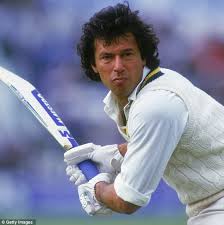
Imran Khan (Credit: dailymail.co.uk)
Imran Khan
(Credit: dailymail.co.uk)

ISLAMABAD, Aug 17: Cricket hero Imran Khan rode a wave of discontent to finally break through as a serious player in Pakistani politics at last year’s election. Now he is aiming even higher, leading thousands on a march to the capital in a bid to unseat the prime minister.

But in taking his campaign to force out Nawaz Sharif on to the streets of Islamabad, Khan may have overplayed his hand. This weekend his crowd of followers was already thinning out, and without overt support from the military his protests are unlikely to be a game-changer.

Thousands showed up for his rally on Saturday, but some supporters grumbled they had slept out in the rain while Khan relaxed in his nearby mansion.

“The path he’s chosen is one of protest,” said Samina Ahmed, South Asia director of the Brussels-based International Crisis Group think tank. “Now the question is: does he have a strategy beyond the protest?”

Even if the protest movement fizzles, however, Sharif will have been left weakened and less likely to challenge the country’s powerful military on security and foreign policy, which Pakistan’s generals have long considered to be their domain.

Khan accuses Sharif of rigging last year’s election, which marked the first democratic transition in Pakistan’s turbulent history, and last week vowed to occupy Islamabad until the prime minister resigns.

The government has warned that his protest, and another led by fiery cleric Tahir ul-Qadri, could destabilise the nuclear-armed nation of 180 million, which has seen a succession of military coups and is struggling to stifle a Taliban insurgency.
It fears Khan is trying to force a confrontation so the army will once again intervene, or that the military is manipulating Khan from behind the scenes.

There is no doubt that the military brass dislike Sharif, who stormed back to power for a third time last year after his party won a clear majority of parliament’s seats.
Sharif has put former military head Pervez Musharraf, who abruptly ended his last stint as prime minister in a 1999 coup, on trial for treason.

He has also dithered over a military offensive to quash the Taliban, sided with the Jang Group that accused the military of shooting one of its journalists and sought reconciliation with arch-foe India, the perceived threat that the army uses to justify its prominent position.

One political analyst said it was unlikely Khan was encouraged by the army to challenge Sharif, and much more likely that Khan had decided to pounce because the prime minister’s sparring with the generals had left him vulnerable.

“If the relationship with the military had not gone out of kilter, then Imran would not have seized this opportunity,” said the analyst, who declined to be named due to the sensitivity of the issue. “He saw Sharif was on shaky ground.”

In recent months, Sharif’s resistance to the military has softened. An anti-Taliban offensive began in June and the treason trial against Musharraf has quietly ground to a halt.

The army has not commented publicly on the protests, but insiders say it has no appetite for forcing Sharif out – which would involve a showdown with Pakistan’s increasingly powerful judiciary.
That makes it all the more likely that Khan’s protest will fizzle out unless he forces a confrontation.
“When I asked him, ‘what’s your exit strategy?’, he said: ‘I play to win,’” said the analyst.
“It’s a sportsman’s calculus.”

In the past, the military may have seen Khan as a useful figure to ensure it remains the real centre of power.

Had Sharif not won so handsomely, Khan would have been a forceful opposition in parliament, keeping mainstream parties on the defensive and acting as a safety valve for popular anger over the graft and incompetence of the political class.

But the military also see him as a nuisance for seeking an end to the fight against the Taliban and a negotiated peace. He has sometimes been ridiculed as “Taliban Khan” for his views on the insurgency and hostility towards U.S. drone strikes.

Another reason for the military’s reluctance to back Khan may be the performance of his party in Khyber Pakhtunkhwa province, home to the Taliban insurgency, since it took power there last year.

Khan’s provincial government has hiked the education budget and tried to reform the police. It has also legislated on citizens’ rights to government information and services such as gas, power and water, and forbidden officials to engage in business that conflicts with their duties.

But residents say implementation of those laws is spotty, and some other promised reforms have failed to materialise.

Now, as Khan’s supporters camp out in Islamabad, some in his own provincial capital of Peshawar are becoming impatient.
“We voted for Imran Khan’s party in our province but they have engaged themselves in other issues,” said furniture maker Mohammad Ikram. “They should solve the problems of the people of this province first and then criticise the federal government.”

Has Khan Boxed himself into a Corner?

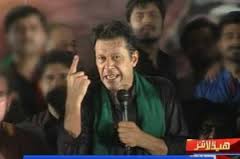
IK (Credit: worldtribunepakistan)
IK
(Credit: worldtribunepakistan)

Islamabad, Aug 20: The political soap opera being currently played on the capital’s stage is getting more melodramatic. The story is unfolding strictly according to the script in this season of ‘revolutions’. It begins with the march on Islamabad. Now we are into the second episode: the storming of the ‘red zone’. What next? Breakdown of the order and entrance of the arbiter. There is little suspense about the ending, but the next episode is going to be critical.

If not macabre, at the very least the situation is bizarre. Imran Khan came to storm the citadel of power and destroy the old order, but may have killed his own and his party’s political future in the bargain. He is trying to rock the boat that may sink him too. His call for civil disobedience followed by the decision to resign from the assemblies is a high-stakes game that he may never win.

Imran Khan seems to have boxed himself and his party in a blind alley with no exit. One wonders if there is any logic behind this apparent madness. How can a leader of a major political party be so thoughtless in his decisions — decisions that not only threaten the entire system but also politically isolate him and his party?

He may be strictly following a prepared script, but the situation seems to be getting out of control. Can there be a new twist to the story? One is not sure. We still have to wait for the end of the political stage show gripping the capital. It may not be too long now, with the fast unfolding situation.

The support of parliament is still the biggest strength for the prime minister provided he wakes up from his slumber

Away from the screen and the 24/7 hysteria, it was a different story on the ground at the Pakistan Tehreek-i-Insaf’s dharna. It was not even remotely close to the ‘massive sea of humanity’ as projected by party leaders and some television commentators. Over the next five days, it turned into a part-time dharna with the protesters reassembling in the evenings — almost corresponding to prime time TV viewership — to listen to the unending rants of their leaders with the blare of song and music in the background. The atmosphere was more festive than charged with revolutionary zeal.

The disconnect between the leadership and the audience could not be more obvious. While the leaders would return to the comfort of their place of residence after the end of the late-night dharna sessions, those who came from other towns were left to spend nights in the rain. It was a chaotic setting for the struggle that promised to deliver change.

Just a few minutes’ walk across the road it was a completely different milieu where Qadri is staging his separate dharna, a round-the-clock vigil with leaders fully integrated with the cadres and the crowd much bigger and more organised and disciplined.

What has been most impressive is the huge participation of women and those who are surely more ideologically motivated. Qadri’s support comes largely from the educated lower middle class. It is a mix of religious and political following. Notwithstanding his highly questionable background such dedicated support is remarkable.

A powerful demagogue, Qadri has upstaged Imran Khan with his more radical pitch. He proclaims himself a revolutionary in the “cast of Marx and Lenin with a strong Islamic shade”. His ‘revolutionary manifesto’ presents the outline of a ‘utopia’ where everyone will be equal. In contrast, what has been lost on the kaptan is that politics is not a game of cricket. Not being in electoral politics Qadri has nothing to lose, whatever the outcome of this confrontation.

But most intriguing has been the complete disappearance from the scene of the prime minister, regarded as the villain of the piece. He has not emerged since the Aug 14 Independence Day ceremonies where his glum expression was most noticeable. He is occasionally seen in the news in a huddle with his brother. His seems to be getting more dysfunctional in the face of the Khan/Qadri challenge. The suspicion of the military backing the anti-government marches seems to have compounded his inertia.

His decision to set up a Supreme Court commission to investigate the allegations of fraud in the last parliamentary elections is not only too little too late, but may not even be implemented because of some legal and constitutional hitches. Both Imran Khan and Qadri have closed doors on any offer for talks.

A new political alignment is emerging as the threat of the winding up of the system becomes real. All major political parties have closed ranks as the country descends into chaos. Even the Jamaat-i-Islami, the PTI’s only political ally, is not willing to support its decision to quit the assemblies and call for civil disobedience.

The destructive politics of the PTI seems to have given Sharif some space to regain his initiative. The support of parliament still is the biggest strength for the prime minister provided he wakes up from his deep slumber. But it may already be too late. His options are running out as he gets more deeply mired in the turbulent waters. Even support from other political forces is not much of help. The balance of power is already shifted to Rawalpindi.

Once again Pakistani politics has taken a unique twist just when a feeling had crept in of a return to the democratic process. Whatever the outcome of the last episodes of the melodrama, it has broken that slow reassurance amongst most Pakistanis. This confidence, important both for citizens and our image internationally, has been broken by the kaptan leaving deep scars on Pakistan’s already bleeding politics.

The vacuum created by the confrontation would inevitably be filled by horsemen already in the saddle. Sharif is paying the ultimate price for his hubris, ineptness and more importantly for his conflict with the military. The sound of the boots is getting louder, pushing the country deeper into a state of uncertainty and instability.

The writer is an author and journalist.

Pakistani Protestors March Toward Parliament

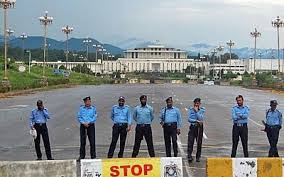
Parliament House, Islamabad khybernews.tv
Parliament House, Islamabad
khybernews.tv

ISLAMABAD, Aug 19 — Thousands of Pakistani opposition supporters, some armed with sticks and wire cutters, marched into a fortified zone in the center of Islamabad on Tuesday night to press their demands for the resignation of the prime minister.

The protesters, who have camped in the capital since Friday, are led by Imran Khan, the former cricketer, and a charismatic cleric named Muhammad Tahir-ul Qadri, who run separate campaigns but are united in their opposition to Prime Minister Nawaz Sharif.

The march on the city’s red zone — an area that contains the Parliament, the prime minister’s official residence and many Western embassies — was widely seen as a final effort by Mr. Khan to rally his supporters after days of threats and political rhetoric.

Although Mr. Khan’s crusade attracted a crowd in Islamabad that was smaller, it received a major lift on Tuesday when his supporters merged with Mr. Qadri’s, forming a crowd that police estimated at more than 40,000 people marching into the red zone.

As participants started toward the Parliament building, television pictures showed a crane on the street that was apparently used to remove shipping containers impeding their way.

Mr. Sharif’s government, which came to power in June 2013, has struggled to quell the escalating political crisis, partly as a result of Mr. Sharif’s tense relationship with the Pakistani army leadership.

In recent days. Mr. Sharif’s administration failed to engage Mr. Khan and Mr. Qadri in negotiations to end the standoff and appeared to be hoping that the protests would simply fade.

But there was little sign of that on Tuesday evening, as Mr. Khan and Mr. Qadri both gave impassioned speeches before sending their followers toward the city’s protected area, which was ringed by shipping containers and thousands of police and paramilitary officers.

In his speech before a cheering crowd, Mr. Khan repeatedly attacked Mr. Sharif, whom he accuses of stealing the 2013 election through vote rigging. He has even challenged him to a duel.

Mr. Khan described the prime minister as a thief and a corrupt politician and vowed to turn the space outside the Parliament building into “a Tahrir Square,” a reference to the site of the 2011 uprising in Egypt. While instructing his jubilant supporters to remain peaceful, he repeatedly warned of the possibility of violence.

“Nawaz Sharif,” he told the crowd, directly addressing the prime minister. “If there is any violence, I will not leave you.” Moments later, when a helicopter hovered nearby, Mr. Khan said it had come to “take away Sharif,” drawing a roar of approval.

The government said that 30,000 security forces had been deployed to protect the red zone, which includes the United States Embassy. Witnesses said they could not see evidence of such a large contingent, but the army said in a statement that it had deployed 700 soldiers to protect the Parliament, the Supreme Court and other important buildings inside the zone.

The decision to deploy army troops was taken after a meeting between Mr. Sharif and the army chief, Gen. Raheel Sharif, who is not related to the prime minister.

“The army is not behind anyone,” said Chaudhry Nisar Ali Khan, the Pakistani interior minister, during a new conference earlier Tuesday.

Mr. Sharif’s officials have privately said they feared the opposition marches could provide a pretext for the military to intervene — much as it did in 1999 when Mr. Sharif’s last stint in power came to an abrupt end with a military coup.

Many suspect that Mr. Qadri, the cleric, has at least tacit backing from the military. Mr. Qadri denies any such links and is openly supported by the leaders of Barelvi and Shiite Islamic organizations, which has helped to galvanize his dedicated supporters.

Although numbers were hard to accurately estimate, many Pakistanis watching television Tuesday said that Mr. Qadri appeared to have amassed a larger crowd than Mr. Khan. While Mr. Khan’s street rallies often had the air of a music festival, Mr. Qadri’s rally, a few streets away, had a more purposeful air.

Whatever the outcome of the protests, analysts said they appeared to have opened a turbulent political period.

In a reminder of the pressing security challenges facing Pakistanis, the military said Tuesday that it had killed 48 people during airstrikes against Taliban camps in the North Waziristan and Khyber tribal districts.

Salman Masood reported from Islamabad and Declan Walsh from London.

The Inimitable Educator, Prof. Anita Ghulam Ali Passes Away

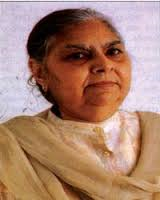
Anita Ghulamali (Credit: newslinemag.com)
Anita Ghulamali
(Credit: newslinemag.com)

KARACHI, Aug 9: Anita Ghulam Ali, one of the country’s most famous teachers who served twice as education minister of Sindh, died in a hospital here on Friday after protracted heart problems. She was 76.

“She had been in the hospital since July 28 for cardiac problems and breathed her last at about 2.20pm today,” said one of her colleagues at the Sindh Educa­tion Foundation (SEF) that she had quit a few months ago after a 24-year stint.

Born in Karachi in 1938 in the house of a former judge and a family of intellectuals and linguists, Ms Ghulam Ali was an out-and-out Karachiite, and an athlete who captained her university’s netball team and a champion table tennis and badminton player.

St Lawrence Girls School near what used to be Cincinnatus Town and now is called Garden East was just a stone’s throw away from her grand house and became the first destination of her arduous trek that made her an epitome of education in the country.

Her house was not far from the hilly area where the Quaid-i-Azam was later buried. She told a subordinate how she saw people moaning and beating their chests during the funeral procession of the Father of the Nation.

Ms Ghulam Ali often bunked botany classes in Dayaram Jethamal (DJ) College on Saturday afternoons to watch the movies that cinemas showed at concessional rates to students once a week.

She would rip pages from her college books to create room in her bag to bring her table tennis racquet and shoes.

Her restless soul finally found a niche in the Karachi University where she found pull in microbiology and left the campus as a topper – a fact that put everyone who knew her from the beginning in a pleasant shock.

She was also a popular English newscaster at Radio Pakistan until Islamabad became the federal capital.

“I can’t be shy to say that a third class student can become a first class teacher,” she would often say after joining the Sindh Muslim College in 1961 where she remained a revered faculty member till 1985 despite being a tough taskmaster.

She used to box the ears of her students, pulled their hair, ripped up their pockets. “I think this is the kind of communication skill that develops once you show them that you care for them,” she repeatedly said.

A large number of her students are in government, police and top vocations abroad.

Late Anita was a leader in the teachers’ movement in 1970 during which she was beaten with police batons and briefly put behind bars. The movement was to get the private colleges nationalised to ensure that teachers, who lived pathetically while working for private masters, could receive hand­some and uninterrupted salaries.

After leaving the SM Col­l­ege, she headed the Tea­chers’ Foundation and then became managing director of the SEF after its inception.

She served as a provincial education minister in Mum­taz Ali Bhutto’s interim government in 1996 for three months and then in 1999 after retired Gen Pervez Musharraf seized power.

She quit Gen Musharraf’s government when the military ruler announced a controversial referendum to consolidate his power.

Among various other distinctions, Prof Anita was the recipient of the Sitara-i-Imtiaz for her lifetime contribution to education and community development.

She refused a further extension in her tenure by the provincial government and retired from the SEF on Jan 23 this year.

She, as she often said, is survived by ‘thousands and thousands’ of her students.

Opposition-Govt Collision Course Destabilizing for Pakistan

ISLAMABAD, Aug 11: Leader of the Opposition in the Senate Senator Aitzaz Ahsan on Monday warned the federal government and Pakistan Tehreek-i-Insaf (PTI) chief Imran Khan not to take any violent course of action.

Aitzaz Ahsan said that the PTI leader had been approached through several avenues in order to diffuse the rising tensions, including recounting of votes, but it had been in vain which was most regrettable.

The opposition leader said that Prime Minister Nawaz Sharif has no need to worry because Parliament is standing by the government.

Aitzaz said that the prime minister should not create obstacles for peaceful protestors.

“Revolutions are always non-violent so the revolution as announced by Pakistan Awami Tehreek (PAT) chief Dr Tahirul Qadri cannot be genuine in light of his statements against the police,” he said.

Aitzaz added that if any untoward incident took place, the government will not be blamed rather Imran Khan and Tahirul Qadri would be held responsible.

“Universally revolutions are brought by purity and without any ambiguity.

“In reality revolution should be brought against those standing by the sides of people calling for revolution,” Aitzaz said in a veiled reference to Sheikh Rashid and the Chaudhry bros.

The opposition leader said that statements given by General Raheel Sharif after General Kayani’s retirement said that the army was not in favour of interventions regardless of calls made by Qadri.

Senator Haji Adeel belonging to the Awami National party (ANP) said Islamabad has been turned into a fort owing to the government’s actions and added that even his party had reservations accepting the results of the 2013 general elections but had accepted the PTI victory in areas traditionally won by the ANP.

Defending the steps taken by the government, Pakistan Muslim League – Nawaz central secretary information Senator Mushahidullah Khan said that if the parliament was attacked then even opposition members would accuse the government of not doing enough.

He further said that the PML-N was not even in power when the alleged rigging had taken place.

Senator Mushahidullah claimed that PTI was not the true opposition and had the lust for derailing democracy. He also alleged that Dr Tahirul Qadri was trying to spread anarchy in the country.

Talking about the delay in the decision over verification of votes as per demands of the PTI he said that the matter was the responsibility of the election commission and not the governments.

Every one would have raised objections had the decision been taken by the government.

Pakistanis spend nearly half of their income on food: USDA

Pakistan's Food Insecurity (Credit: pakistanaffairs.com)
Pakistan’s Food Insecurity
(Credit: pakistanaffairs.com)

According to a report by the US Department of Agriculture’s Economic Research Service in which 84 countries were surveyed, Pakistanis spend more of their income on food than any other country. An average Pakistani spends 47.7 per cent of their house hold budget on food consumed at home.

On the other hand, people in United States spent the least on food, even less than Europeans and Canadians. An average American citizen spends only 6.6 per cent of their house hold budget on food at home.

In Pakistan, where average consumer expenditures per person, which comprises of personal expenditures on goods and services, are $871 people spend $415 on food at home. In comparison, Americans spend nearly $2,273 on food.

It is pertinent to note that while US citizens spent a smaller fraction of their budget on food, the amount spent on food is almost five times of what an average Pakistani spends on food.

The stark difference could possibly be explained since the per capita income of Pakistan stood at $1,299 in 2012-13, while the per capita income of US was $53,143.

Loading…

Besides the US, people in Singapore, United Kingdom and Canada spend less than 10 per cent of consumer expenditure on food. An average Singaporean spends almost 7.3 per cent of their household income on food, while Britishers and Canadians splash almost 9.1 and 9.6 per cent of their house hold budget on food.

An average Indian spends almost $220 every year on food at home, which translates into 25.2 per cent of their total consumer expenditure every year.

Pumping out Poverty with National Resources

“Had the income of oil companies been properly spent, towns of Sanghar, Ghotki and Badin would have paralleled Paris.” Supreme Court’s quip is not too far from the reality. Catching a glimpse of scruffy towns and villages in these districts, one would not believe that the areas overlay the wealth of hydrocarbons worth several billion dollars.

Remarks of the judge resemble a resonating speech by Mohammad Mosaddeq, a reformist prime minister of Iran. While nationalising oil resources in 1951, he said “with the oil revenues we could meet our entire budget and combat poverty, disease, and backwardness among our people.” Mosaddeq audaciously nationalised Iranian oil industry hitherto controlled by Britain through erstwhile Anglo-Persian Oil Company, now known as British Petroleum. His act was considered as an unpardonable sin and he was disposed through a CIA-choreographed coup in 1953.

Supreme Court’s impromptu intervention came in the wake of oath-taking ceremony of Tando Adam Bar Association presided by the ex-chief justice Iftikhar Chaudhry. President of the association, advocate Abdul Hakim Khoso, in his speech revealed facts about woeful remiss of oil and gas companies operating in Sanghar district. He cogently presented issues of environmental degradation, denial of employment opportunities to locals and non-compliance to social welfare obligations by oil and gas companies.

The CJ took notice of the speech that was subsequently converted into a petition through the Human Rights Cell of the court. In the course of discussions an astounding disclosure was made that various companies have deposited a staggering amount of Rs780 billion with federal and provincial governments. However, the amount meant for local development is dumped in the official lockers due to lack of transparent mechanism for its ultimate utilisation. People in Sindh and Balochistan have been decrying apathy of federal and provincial governments and the companies. Wretched communities in the vicinity of oil and gas fields are living virtually in primitive age while precious resources are being pumped out underneath their feet, hardly leaving any mark of wellbeing on their lives.

According to Pakistan Energy Year Book 2013, Sindh contributes 68 and 40.6 per cent of national gas and oil production respectively. Recent oil discoveries in KPK dwarfed Sindh’s share from 56 per cent till only two years back. Sindh province is the largest contributor in national energy basket. Sharing of benefits accruing from natural resources has been at the heart of conflict between provinces of Sindh, Balochistan and the federal government. Before the 18th Amendment, oil and gas resources were directly managed by the federal government, trespassing on the realm of Council of Common Interest. Provinces receive meager benefits through Straight Transfers that are not part of divisible pool. Under this arrangement, provinces were entitled for 12.5 per cent royalty, income from excise duty on gas and Gas Development Surcharge. However provinces had no direct ownership of resources and all key decisions were taken by the Federal Ministry for Petroleum and Natural Resources.

The 18th Amendment made a radical shift in the ownership of oil and gas resources. Article 172 (3) of Constitution now recognizes equal share of provinces in oil and gas resources within their remits. Straight Transfers — though a fraction of real income — have been generating substantial amount for provinces. Provincial governments are equally responsible for plight of people by not devising any mechanism to remit a part of these incomes to those communities.

Sindh has been the largest recipient of these benefits. An analysis of last eight years’ budget documents shows that the province has received Rs475 billion through Straight Transfers. From 1989-90 to 2013-13, share of the province in royalty of oil and gas stood at Rs319 billion. Much of this amount has already been transferred to the province. The amount is enough to revamp shabby towns by developing infrastructure and providing basic services to impoverished communities in the vicinity of oil and gas fields.

Petroleum policy stipulates that 50 per cent of royalty should be used for infrastructure development in the district where oil and gas is produced. While holding federal government and companies accountable for their deeds is fully justified; provincial government is also culpable for its cavalier governance. Hefty budgetary packages are announced for favourite districts at the expense of marginalised resource-producing areas.

The provincial government cannot be exonerated from showering unscrupulous largesse, obnoxiously skewed towards influential political clique. In a report submitted to the Supreme Court, the provincial government has admitted that 10 out of 14 schemes in Thatta, Kashmore and Badin are in violation of the policy. The fund meant for basic services in backward areas have been spent for elitist structures of Gymkhana and Citizens’ club.

Article 30.9 of the Petroleum Concession Agreement (PCA) makes it obligatory for oil and gas companies to undertake social welfare programmes in the concession areas. Amount to be spent on social welfare has been linked with the volume of hydrocarbons produced. An amount of US$30,000/year has also been made obligatory during exploration, which increases substantially on commercial production. Only a few companies manage this portfolio professionally. Similarly, discretionary corporate funds are mostly spent on advertisements, gala dinners, sports events and other such entertainments in urban centers.

Local employment is another thorny issue. Hydrocarbon fields are mostly located in remote and marginalised areas. Oil and gas companies have their opulent corporate offices in big cities like Islamabad and Karachi where people from local areas don’t even make a fraction of their human resources. The companies come up with a frivolous excuse of unavailability of qualified and experienced human resource from those areas. The mundane argument has lost its luster as the provinces have reputed universities and technical institutes producing sizeable number of professionals with required qualification.

The Petroleum Policy also obligates companies to invest in capacity-building. This amount can be used to build capacity of unskilled or semi-skilled locally recruited human resource. The companies outsource most of their work through performance based contracts. These contractors are mostly outsiders and they hire most of their staff from other areas, thus depriving local youth from even low paid jobs.

Contractors recruit a large number of employees who do not appear on the company’s payroll and are often non-locals. Low paid unskilled labour is grudgingly considered from local areas as it is not feasible to recruit them from outside. Interestingly, the PCA asks companies to gradually replace expatriate staff with nationals but does not ask for replacing national staff with locals as they become available. Apart from that, it is moral and professional obligation of the companies to invest in development of local human resources enabling them to compete for mid-level and senior positions in the companies. Some of the companies have made some appreciable investments but at a very limited scale.

Conserving environment and natural endowment of local communities is another brazenly violated obligation. Policy Objective No. 9 of the Petroleum Policy 2012 commits to undertake exploitation of oil and gas resources in a socially, economically and environmentally sustainable and responsible manner. However, the policy document does not delineate any guidelines on environmental aspects.

Environmental Protection Act 1997 provides overall framework of environmental regulation in the country. Under the Act, oil and gas exploration projects are subject to either Initial Environmental Examination (IEE) or Environmental Impact Assessment (EIA). After the 18th Amendment, provinces are also in process of developing their environmental laws and guidelines.

The government of Sindh has already approved Environmental Protection Act 2014. The Act requires conducting Strategic Environmental Impact Assessment of environmentally sensitive projects. With the passage of time EIA has been degenerated into a farce. A handful of consultancy firms have perfected the art of drafting EIAs and IEEs to meet the wishes of companies.

Due to rampant corruption and lack of regulatory capacity within the EPAs, the environmental regulation of oil and gas exploration projects is fast losing its credibility. Most of the public hearings of EIAs are conducted in big cities far away from the communities subjected to the wrath of environmental violations. This scenario has provided enough space to the companies to evade environmental obligations.

Poor regulatory mechanism and weak civil society are key responsible factors that provide safe passage to companies with environmental violations. As a corollary, local communities pay the price in the shape of diseases, loss of productive land and contamination of ground water.

In the judgment reserved by the Supreme Court of Pakistan on aforementioned petition 46 of 2013, the court recognized that “the people of Pakistan are the ultimate owners of such resources through their governments and State controlled entities”. However, both federal and provincial government also did not play a proactive role to ensure that these companies fulfill their contractual obligations.

The court in its judgment also concluded that the social welfare obligations imposed on E&P Companies were not being met. People forsaken by the government and maltreated through iniquitous policies of companies have pinned their forlorn hopes on the court for restitution of their ownership on their resources.

(The News, 10th Aug 2014)