Govt Seeks to Evacuate Pakistanis from Libya

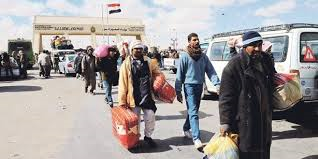
Expats leave Libya (Credit: todayzaman.com)
Expats leave Libya
(Credit: todayzaman.com)
ISLAMABAD, Aug 4: With the situation in Libya deteriorating in recent days, the Pakistani mission there has been working to evacuate up to 6,000 citizens to neighbouring Tunisia for repatriation to Pakistan.

A statement from the Foreign Office on Monday evening said that the Pakistani embassy in Libya was in touch with the Pakistani community there and were making arrangements to evacuate between 3,000-6,000 citizens.

Clashes in troubled Libya have intensified over the week with a depot near the airport in Tripoli set ablaze over the weekend during clashes between rival groups. Citizens of a number of countries have been advised to leave as the situation turns tense, but evacuation has proved tricky with airports closed.

Since no airport in Libya is currently functioning, the government is working on arranging on-arrival visas for Pakistanis at the Tunisian border. Once in Tunisia, these Pakistanis can then be repatriated to Pakistan.

“Our Embassy in Tripoli has already registered a large number of Pakistanis and referred their documents to Tunisian authorities for visa on arrival,” the statement read.

The foreign office advised all Pakistanis in Libya to contact the embassy in Tripoli and Tunisia and inform the officials about their location and get registered.

Pakistan Embassy can be contacted on the following help lines:
–         No. 00218 922379368 (Ayaz Khan)
–         No. 00218 922555216 (Kamran)
–         No. 00218 213610937
–         No. 00218 213616581 (0900 to 1600 hours)

Rejection of Pak Asylum Seekers Keeping them Away from US

San Francisco, Aug 2: Although the number of Pakistanis seeking refuge in other countries is rising, those seeking asylum from the proverbial land of opportunity – the United States – are declining in number.

In the years before and shortly after the 9/11 attacks, the US was a country of choice for thousands of Pakistanis looking to emigrate. In 2002, close to 20% of the 7,000 Pakistanis wanting to leave their country applied to the US for asylum. In 2013, of over 26,000 Pakistanis seeking asylum, less than 2.5% were asking to enter the once-friendly United States.

“Muslims have been targeted by the Department of Homeland Security, and the United States is simply not hospitable to Muslim asylum-seekers,” observed Matthew L Kolken, a New York-based attorney and a senior member of the American Immigration Lawyers Association.

Among 44 industrialised countries with asylum-seekers, Pakistan currently ranks sixth, according to the United Nations High Commissioner for Refugees (UNHCR). Last year, Pakistan witnessed an 11 per cent rise in asylum-seekers, according to the agency.

The reasons for leaving Pakistan have become more urgent as the country continues to grapple with its fledgling democracy.

Generally, the applicants are claiming fear of persecution, from either terrorists or extremist groups, said Harnam S Arneja, a Washington DC-based lawyer who has taken on asylum cases.

But access to asylum in the US has become extremely difficult and cumbersome because of changes to the application standards and a decreased rate of approvals, explained Arneja. “Any applicant, including a Pakistani, has to prove credible fear of persecution, either in the past or in future if he or she returns to Pakistan.”

The US Citizenship and Immigration Services (USICS) and Department of Homeland Security data revealed that 4,113 applications of asylum-seekers were received from 2002 to April 2014. Around 1,736 applications were approved, 115 denied and 1,742 adjudicated referred. The ‘adjudicated referred’ column refers to cases that USICS is not able to approve. “Such cases are referred to federal immigration courts, where a judge makes the final determination on eligibility,” said Tim Counts, the USCIS spokesperson.

These statistics do not include all nationals from Pakistan who applied for asylum during these years, he explained.

Separately, US Department of State’s Bureau of Population, Refugees and Migration (PRM) Public Affairs Officer Christine Getzler Vaughan told The Express Tribune that since 2002, America has resettled 927 refugees from Pakistan. She, however, explained that these statistics do not include those who may have immigrated to the US via other means or sought asylum after arrival.


Pakistani jurist Majid Bashir, who deals with asylum-seekers’ cases, has listed several reasons for the declining trend in asylum-seeking in the United States.

The US imposed restrictions on Pakistan by putting her on the watch list when it comes to dealing with trade and intellectual property rights, he said, pointing to some. “New laws and Muslims’ alleged involvement in security-related issues and incidents could be the major reason behind it,” he added.

And it seems like the trend of declining asylum-seekers is here to stay – Pakistanis have made the choice of not seeking opportunities in the ‘land of opportunity’.

Published in The Express Tribune, August 2nd, 2014.

Ibn-i-Safi’s Creative Pen Dipped into his own Madness

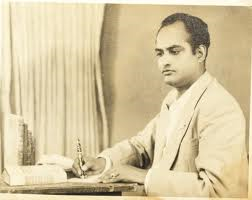
Asrar Ahmed alias Ibn-i-Safi (Credit:urdublogspot4u.com)
Asrar Ahmed
alias Ibn-i-Safi
(Credit:urdublogspot4u.com)

As a kid in the 1970s, one of the first Urdu authors that I began reading was Ibn-i-Safi. Most Pakistani kids and young people in cities did that and probably many still do; going on to continue reading his novels well into their less curious adulthoods.

I don’t anymore though, outgrowing the fantastic sounding cities and countries full of quirky spies, strange gadgets and racy plots that Safi offered in his novels, making him one of Pakistan’s most popular and best-selling Urdu novelists of all time.

However, I returned to reading Safi again a few years ago when English translations of some of his many novels began appearing in local book stores. Though much of Safi’s highly imaginative style of writing gets lost in translation, it was nice to see someone actually attempting to introduce this most prolific and popular author to a whole new generation and breed of readers.

More interesting though is the reality of Safi, the man. A reality that is not well-documented but can be pieced together with the help of the many snippets on him that appeared in various Urdu newspapers and magazines in the last many decades.


While Ibn-i-Safi blended mystery with humour, espionage, law enforcement, science fiction, adventure and drama; was he aware that his own life was a curious blend of the above?


A majority of his fans simply know him through the colourful and inspired characters that he created operating in an environment creatively culled from the archetypical political paranoia of the Cold War (during which Safi authored his novels).

Very few are aware that many of Safi’s characters and plots also emerged from a serious bout of schizophrenia that he suffered in the early 1960s. Though the mental illness rendered him incapable of writing anything at all, he eventually recovered and actually converted some of the delirious delusions and even hallucinations that had suffered at the time into creating brand new characters, scenarios and plots for his comeback novels!

Ibn-i-Safi was himself a fascinating character. A young school teacher in 1952 but raring to make a name for himself as a writer, Safi began writing highly imaginative spy novels.

From 1957 onwards the pace of his writing more than doubled, and by 1960 he had written over a hundred short novels, all taking place in the imaginary and fantastical world that he had created, full of colourful, flamboyant and wise-cracking spies, beautiful women, strange-sounding villains, exotic places and odd gadgets.

But as Safi came up with one exotic story after another, he also began to isolate himself from his family. He eventually collapsed within himself, suffering a crippling spell of schizophrenia for which he needed to be committed to a psychiatric ward.


Very few are aware that many of Safi’s characters and plots also emerged from a serious bout of schizophrenia that he suffered in the early 1960s.


In 1960 his career seemed to be as good as over when he was put on heavy tranquilisers but he continued suffering from hallucinations and severe paranoia. The budding raw genius had crossed that thin line into ‘madness.’

He began to believe that the characters that he had created were real and that the villains among them were conspiring against him. He hid in his room, refusing to come out, as strange-sounding men plotted and conspired against him from subterranean bases.

After a long stint in the psychiatry ward of a hospital, Safi was shifted back to his home where he was patiently nursed back to health by his wife (and a family hakeem).

Amazingly, just three (painful years) later, he was back writing again. Some of the characters that had haunted him during his illness actually made their way into his new novels.

The demand for his spy novels reached new heights (both in Pakistan as well as India) and he kept producing them with incredible speed. By the early 1970s he was dishing out an average of three to four novels a year, setting new standards in the ability to produce racy and highly imaginative Urdu pulp fiction.

In another interesting twist, in 1973 Pakistan’s intelligence agency, the ISI, actually invited him on a few occasions to lecture new ISI recruits on the ‘art of espionage’. I actually stumbled upon an old 1973 newspaper cutting (from a local Urdu daily) that had a photograph of Safi lecturing a group of ISI recruits in Islamabad. In the short report that accompanied the photograph, an ISI officer is quoted as saying that it was “Safi Sahib’s understanding of the politics of the Cold War and his knowledge of the history of modern-day espionage that made them [the agency] invite him to deliver a few lectures”.

Becoming Pakistan’s best-selling author, one of Safi’s books was also turned into a film by Hussain Talpur (a maverick film-maker who was also known as ‘Maulana Hippie’). However, the film, Dhamaka (Explosion), released in late 1974, bombed at the box-office as the director simply failed to convincingly translate Safi’s animated words and imagery into celluloid reality.

But despite being a bestselling author, Safi made half the amount of money that he should have mainly due to the crookedness of many of his publishers and his own lack of understanding of the financial side of his art.

In 1977 a TV series based on some of his novels was produced by PTV. However, its run was disallowed when in the same year the government of Z.A. Bhutto was toppled in a reactionary military coup. The reason given by the military regime that replaced the Bhutto government was that the series was ‘vulgar’.

In 1978, Safi, who had continued to be on medication ever since the early 1960s, fell ill again. His legendary productivity as a writer slowed down and by 1979 he was bedridden again, as friends, family and publishers fought around him over how much money was made and owned to whom from his books.

Then in 1980 he passed away, dying quietly in his sleep and in the process finally getting the rest that he had longed for decades. He left behind an enormous body of work that is still being reproduced. He was just 52 at the time of death.

Merry makers Drown in Karachi’s Rough Seas over Eid

Clifton beach (Credit themalaysianinsider.com)

Karachi, July 31 – At least 21 bathers have drowned in rough seas off Pakistan’s biggest city Karachi, officials said Thursday, after defying a ban on swimming during the monsoon season.

The bathers were among thousands who had taken to the beaches to celebrate the Eid-ul-Fitr holiday, which began on Tuesday and continues until Friday.

Senior police officer Ibadat Nisar said police discovered three bodies washed up at the upscale Clifton beach on Wednesday evening, which prompted a wider search operation that was suspended overnight but resumed Thursday.

“We started talking to picnickers on the beach and realised that the number of people who drowned was much higher than we thought, people whom we talked to told us about their friends or relatives who had gone missing while swimming,” he said.

Shoaib Ahmed Siddiqui, the city’s top administrator confirmed the incident to AFP, adding: “We have just recovered another dead body and the toll now stands at 21, and it might increase.

“The coastal area is very long and we cannot say how many people might be still missing — let’s hope the number is not very big.”

Several ambulances were seen on the beach where the relatives of some of the missing anxiously awaiting word of their loved ones.


Faiz Rehman, 32, said he and his younger brother had came to the beach on Wednesday to go for a swim along with two friends — who were now missing.

He said: “As we were swimming in the sea, I noticed the waves getting bigger and more rough, and I got scared and started swimming back.

“I also called my brother and friends to swim back to the shore. My brother returned but my two friends were still swimming as the waves got bigger I lost sight of them.

“I waited for around three hours but they didn’t return.”


Twenty-four-year-old Muhammad Haroon added he had come to celebrate Eid with his cousins, but refused to swim with them because he did not want to ruin his new clothes.

“I was walking along the shore waiting for them to return.

“We are still clueless about them.”

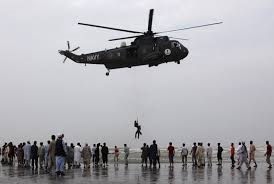
Administrator Siddiqui added that a search operation had been launched with the help of navy divers and a helicopter, as well as civil authorities.

Thousands of residents regularly throng Karachi’s beaches on public holidays, with few public parks for picnics.

But safety standards are very low with the few lifeguards on duty often unable to exert any authority.

Despite the deaths, hundreds of families including women and children continued to arrive at the Clifton Beach Thursday, as some clashed with police and demanding to be allowed to swim.

“We are still searching for dead bodies and these people can see the dead bodies with their eyes but they are still fighting with us to allow them to swim in the sea,” Fahad Ali, a police official deployed at the beach told AFP.

“These people have came with their family members, there are women and children and you can see kids as young as six and their parents are fighting with us to allow them to swim in the sea,” he said.

“This is the height of stupidity,” he added.

Nisar, the senior police officer, told AFP the government had imposed a ban on swimming in the sea before the start of the monsoon season in June.

Karachi, a teeming city of 20 million people, is Pakistan’s economic hub and is regularly wracked by political and ethnic violence.

Pakistan’s New Fear of Flying

KARACHI, July 22— I had just landed at Jinnah International Airport on July 7, and was walking toward the baggage claim area when I saw the bullet hole.

There it was, a single hole in one glass pane, probably from a stray bullet, fired hundreds of yards away. It was the only visible reminder of the firefight on June 8, when members of the Pakistani Taliban invaded the old terminal building where cargo and private flights now operate. Through the night, they fought a pitched battle with security forces that ended with 36 people dead, including the 10 militants. Another casualty, now permanently scarred, was our collective sense of security about our airport.

Jinnah International was the one place where we felt safe from Karachi’s woes. The airport feels like a sanctified space, its air already heavy with the magical scent of “abroad.” Traveling overseas is difficult at the best of times for Pakistanis, who must struggle through complicated visa applications and stressful visa interviews, weighed down by the need to prove one’s bona fide intentions as a visitor to another country, along with the daunting financial burden that traveling overseas presents to most Pakistanis.

But when you drive to Jinnah International to catch a dawn flight, with the sky turning from lavender to rose and peach, the airport shimmers from a distance like a mirage. The closer you get, the more real becomes the imposing gray granite building with its swooping ramps and graceful runways; with it, your dreams of escaping Karachi’s grip become reality, too.

The single bullet hole seemed so insignificant compared with the images that had crowded our television screens during the attack: plumes of smoke and fire emerging from the cargo buildings, soldiers bearing heavy weaponry to battle positions, ambulances rushing to the scene. I had been in London on June 8, but like everyone who lives in Karachi, I had seen similar scenes before — and not just on television: We’ve witnessed the bombs, gun battles and attacks, and their aftermath, with our own eyes.

But the airport siege opened a new wound. We were so proud of Jinnah International — not just its new terminal, built from 1985 to 1992 at a cost of at least $100 million, but also the old terminal. Its Star Gate remains a Karachi landmark. Hundreds of thousands of Pakistanis had passed through its dingy old buildings: to hajj, to emigrate abroad, to return home, to go to university, to discover the world.

The planners of the attack had to know that their strike, whether or not it crippled the airport indefinitely, would deliver a grievous wound to our psyche as Pakistanis. The airport, after all, represents our connection to the outside world, our modernity and our prosperity.

It is also the hub of Pakistan International Airlines, our beleaguered national carrier. Once the pride of the country, it is now the butt of a thousand bad jokes. P.I.A., you hear, stands for “Prayers in the Air.”

Pakistanis complain about nearly everything the airline does: its on-time record, its finances, its fleet maintenance, the often surly staff. But no matter how bad P.I.A. gets, it’s still ours: a national symbol established in 1955 under the leadership of a well-known Pakistani industrialist, Mirza Ahmad Ispahani. Its birth announced to the world that our fledgling country now counted itself among the nations that mattered. The terrorists struck at that idea, too.

Leaving home is always stressful, but Pakistanis have special reason to be nervous when flying abroad: Since 9/11, we have faced particularly stringent security checks and have often been singled out for special questioning at immigration lines. When we land abroad, the extra scrutiny and suspicion aroused by our green Pakistani passports amplify fears that we might be deported back to Pakistan, rather than be allowed to reach our destinations.

But the deepest cause of anxiety for Pakistanis leaving home may be historical memory. The ghosts of the millions who were slaughtered 66 years ago during Partition, when they were migrating between India and Pakistan, still haunt us when we travel. Who hasn’t heard the stories of entire trainloads of immigrants arriving dead at the train stations; of sword-wielding mobs killing defenseless men, women and children just because of their faith? These stories have been passed down through the generations, and their impact is imprinted onto our collective psychology. The Taliban’s actions at Jinnah International exposed that nerve, with eerie precision.

Pakistanis are always superstitious when we travel: We utter special Islamic prayers for safe departures and arrivals, and we give alms and thanks when we return home safely. But these customs won’t help to ease our anxiety nearly as much in the future. Not now that there are menacing-looking soldiers in combat fatigues clutching submachine guns as they patrol the airport’s corridors. Not now that only one person is allowed to drop you off at the airport, instead of the entire family that was present to comfort and distract you from last-minute jitters. And only one person can greet you when you return — taking some of the joy out of a successful homecoming.

Once I was safely home from the airport, the memory of that bullet hole in the windowpane, so small that it must have been overlooked by repair crews, reminded me of the way Bilal Tanweer, an up-and-coming Pakistani writer, opens the prologue to his novel “The Scatter Here Is Too Great”: “Ever seen a bullet-smashed windscreen? The hole at the center throws a sharp clean web around itself and becomes crowded with tiny crystals. That’s the metaphor for my world, this city: broken, beautiful, and born of tremendous violence.”

Bina Shah is the author of several novels, including “Slum Child,” and short-story collections.

US Mentors Prepare to Let Afghan Forces Go it Alone

US mentors in Afghanistan (Credit: nytimes.com)
US mentors in Afghanistan
(Credit: nytimes.com)

KOH-E-SAFI, Afghanistan, July 21 — The small and cherubic governor of Koh-e-Safi District was struggling to compute the meaning of the American troop withdrawal.

He had just finished crediting a young American Special Forces captain for improved security in his district, an area near Kabul that has been a busy staging ground for insurgent attacks. Now, suddenly, he was trying to talk about his plans for when the team of Green Berets leaves in August.

“Well, we hope it will not happen,” he said, flattening his hands on his desk. “We think the Americans will find a way to stay.”

The captain, having been through this routine before, interjected: “We are out of here by the end of the summer. It’s happening. And if there’s no plan to fill that void, then that’s what people in this room need to be talking about right now.”

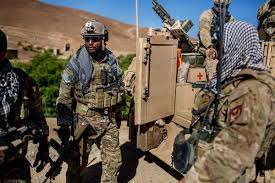
The American Special Forces teams have over the past decade become a central part of the local security landscape in Afghanistan. The 12-man teams are embedded in remote areas with a high insurgent threat, and they train indigenous police and elite Afghan units while coordinating the efforts of the local government and security bureaucracies. They also hunt down Taliban figures.

For many Afghans, they have been the face of the American military presence, for better or worse. But they are leaving. Even if a long-term security agreement is signed with the United States, these teams in their current form will not be part of the tiny force that will remain.

Whether the Afghan forces can sustain themselves in the critical districts the Green Berets will be ceding to them is an urgent question all over the country. The answer will help define America’s legacy in Afghanistan, much as it has in Iraq, where the Iraqi forces have fallen apart in combat.

The void in some places will be hard to fill. Beyond being a deterrent to the Taliban, the teams grant a measure of confidence to the Afghan forces they fight alongside. That confidence is already being tested: In the past few months, the Taliban have been aggressively going after the security forces in places the Americans have left.

In places like Koh-e-Safi, a district of ashen mountains of silt, rock and chromite, there is worry about what will come after the Americans.

“I’m not sure they have the confidence to do this once we leave,” said the Green Beret team captain, who spoke on the condition of anonymity because of military rules. “Over the last few years, they have come to rely on Americans’ solving their problems.”

The sentiment is shared, to some degree, among the other team members, most of whom have deployed several times in Afghanistan.

“This country is going to turn into a warlord environment,” said one sergeant on his fifth tour. “Until these guys are willing to fight for a sense of nationalism, I don’t see how this changes.”

But sustainability is more than fighting. It is a matter of logistics: feeding and fueling forces spread across the country, perhaps the greatest challenge for the Afghan forces.

“We have modeled them so much on us that they have taken on more logistical requirements than they need,” the team sergeant said.

As a result, it is likely that the Afghan Army Special Forces team, which is meant to do the same thing for the district that its American counterparts do, will go elsewhere when the Americans depart. There simply will not be the logistical support for it in Koh-e-Safi.

During the meeting in his office, the governor, Saifullah Bedar, raised another issue that has increasingly been on Afghans’ minds: Iraq’s rapid disintegration after the American withdrawal there.

“What is the difference between Iraq and Afghanistan?” Mr. Bedar asked the captain.

“I was in Iraq near the end,” the team leader fired back. “When we left, they were set up for success. The decisions they made in the following three years left them where they are now.”

An American Special Forces captain observes how his Afghan trainees do on their own as they meet villagers near Taliban territory in Parwan Province. Credit Diego Ibarra Sanchez for The New York Times

The room was silent, everyone fidgeting in the suffocating heat.

“The same thing can happen in Koh-e-Safi if the government and security forces don’t make the right decisions,” the captain warned.

By most accounts, the American team in Koh-e-Safi has done well. It has brokered relationships with local leaders, trained nearly 130 police officers, and mentored two Afghan Special Forces teams. It has also helped keep the Taliban mostly confined to the remote southern half of the district, but there are worries here that the militants will find a way to creep back after the Americans leave.

The commander of one of the local police checkpoints here, Shaman Gul, visited the Americans last month on a hill overlooking his village, Damdar. From the hilltop, plots of emerald farmland could be seen in the valley basins below, rare flashes of color in an otherwise gray-brown tableau.

I wish all involved well but, naturally, there are doubts. The performance of the South Vietnamese Army in 1975 and that of the Iraqi Army…The only thing that the Afghans will miss is the free and easy money that is being funneled into their country.

Mr. Shaman Gul, who also owns a tailoring shop in Damdar, said he recently got a call from the Taliban, who reminded him that the Americans would be leaving soon. While he insists he is unafraid, he knows that things will change soon.

On the walk around his base, a ramshackle affair fortified with barriers and wire, he began noting deficiencies the Americans might help resolve.

“We only have 120 bullets a man,” he told the captain, shrugging.

“When is the last time you guys were in a firefight?” the captain asked, knowing it had been months. Mr. Shaman Gul shrugged again.

More than ever, the Special Forces are trying to have their Afghan counterparts take the lead. While that has always ostensibly been the plan, it only really began to be a focus this year, when it dawned on commanders that one way or another they were leaving. The American team captain in Koh-e-Safi acknowledged that it had been hard to keep his men from going out on missions.

On a recent operation near Chanerai, a small village of mud homes arranged in a valley near the edge of Taliban territory, the Green Berets tested their resolve to allow their Afghan comrades to operate alone. From the top of a barren ridgeline, the captain peered through binoculars, watching as the Afghan team organized a meeting, or shura, with the locals.

“I want to know what’s going on in there,” the captain said, pulling the binoculars away, impatience creeping into his voice. “I want to see firsthand how the Afghan soldiers are handling the shura.”

In a departure from past missions, the Americans would not go into the village. They would not press the Afghans to ask direct questions. They would not challenge dismissive answers from villagers. They would, instead, stand on the peripheral ridgeline, peering down at the village and scanning the valley for ambushes.

“When the Americans go in, the villagers act differently,” the captain said. “We become the focus of attention.”

A few of the men drove all-terrain vehicles along the ridgeline. But one soldier, angling around a truck on the side of a ravine, lost control. As the vehicle turned down the hill, the sergeant quickly hopped off.

Everyone stood silently, watching weaponry, tarps and other equipment catapulted off the four-wheeler as it cartwheeled down the hill. Its broken body somehow landed upright.

Pak Govt to Hand Over Islamabad’s Security to Army From Aug 1

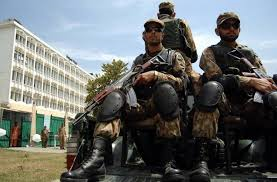
Pak army in Islamabad (Credit: abplive.com)
Pak army in Islamabad
(Credit: abplive.com)

Islamabad, July 25 –

The Pakistan government will hand over security of the capital Islamabad to the army from the beginning of next month, it was announced today.

The army is being called under article 245 of the constitution which authorises the civilian government to deploy the armed forces to maintain law and order in the country.

Interior Minister Nisar Ali Khan told media outside the parliament house that the army will stay in the capital for three months from August 1 to the end of October.

He said Prime Minister Nawaz Sharif had decided on July 4 to deploy army to maintain security at key places in the country.

Article 245 which deals with the functions of the armed forces states says that “armed forces shall, under the directions of the federal government, defend Pakistan against external aggression or threat of war, and, subject to law, act in aid of civil power when called upon to do so”.

The decision will give the army control over Islamabad’s law and order situation ahead of a key protest march announced by Pakistan Tehreek-e-Insaf (PTI) chief Imran Khan on August 14.

It is widely believed that the decision to invoke article 245 was taken to thwart the rally of Imran who threatened yesterday that the march would seal the fate of the government. Khan is protesting over alleged rigging in last year’s general election.

After several small rallies during the previous months to force the government for a recount of at least four selected national assembly seats which his party lost in 2013, he has given the call for a major protest in the capital.

The Sharif government has so far reacted in panic to the threat from Imran’s party.

Initially, it planned to organise month-long celebrations in August and a big function in front of the parliament house on August 14, Pakistan’s independence day.

As Imran and his party have refused to budge and have announced to hold the rally at the same venue, the government has now announced to hand over security to the armed forces.

Nisar tried to play down the threat of Imran’s march and said the government has not taken any decision to let PTI hold the rally, as the organisers had so far not sought formal permission for the event in the capital.

Struggling to Keep Afghan Girls Safe from Harm

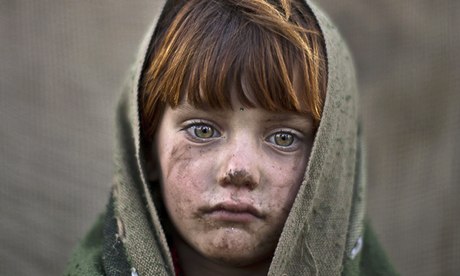
laiba Hazrat, a six-year-old Afghan refugee in Islamabad, Pakistan.KUNDUZ, Afghanistan, July 19 — It was bad enough that the alleged rape took place in the sanctity of a mosque, and that the accused man was a mullah who invoked the familiar defense that it had been consensual sex.

But the victim was only 10 years old. And there was more: The authorities said her family members openly planned to carry out an “honor killing” in the case — against the young girl. The mullah offered to marry his victim instead.

This past week, the awful matter became even worse. On Tuesday, local policemen removed the girl from the shelter that had given her refuge and returned her to her family, despite complaints from women’s activists that she was likely to be killed.

The case has broader repercussions. The head of the Women for Afghan Women shelter here where the girl took refuge, Dr. Hassina Sarwari, was at one point driven into hiding by death threats from the girl’s family and other mullahs, who sought to play down the crime by arguing the girl was much older than 10. One militia commander sent Dr. Sarwari threatening texts and an ultimatum to return the girl to her family. The doctor said she now wanted to flee Afghanistan.

The head of the women’s affairs office in Kunduz, Nederah Geyah, who actively campaigned to have the young girl protected from her family and the mullah prosecuted, resigned on May 21 and moved to another part of the country.

The case itself would just be an aberrant atrocity, except that the resulting support for the mullah, and for the girl’s family and its honor killing plans, have become emblematic of a broader failure to help Afghan women who have been victims of violence.

The result challenges hopes that Western aid and encouragement can make lasting headway on behalf of Afghan women, particularly in remote parts of the country where traditional customs are still stronger than modern law. Here, Taliban insurgents and pro-government elements often make common cause in their hatred of progress in women’s rights, most of which has come about with international funding and pressure.

Most of the anger in Kunduz has been focused not on the mullah but on the women’s activists and the shelter, which is one of seven operated across Afghanistan by W omen for Afghan Women, an Afghan-run charity that is heavily dependent on American aid, from both government and private donors.

“People know this office as the Americans’ office,” Dr. Sarwari said. “They all think the shelter is an American shelter. There isn’t a single American here,” she said.

“W.A.W. is not American-run,” said Manizha Naderi, its executive director. “Every single staff member is an Afghan. They are from the communities we work in. Our only concern is to make sure women and girls are protected and that they get justice.”

As the Western withdrawal from Afghanistan has accelerated, rights advocates are seeing a sharp difference in their funding. “We already see the signs of losing the support of the international community,” said Ms. Geyah, in an interview before she resigned. “No one’s funding new civil society programs anymore. None of the foreigners show up anymore; they’re all in hiding. And I think what gains we have achieved the last 13 years, we’re slowly losing all of them.”

The accused mullah, Mohammad Amin, was arrested and confessed to having sex with the girl after Quran recitation classes at the mosque on May 1, but claimed that he thought the girl was older and that she responded to his advances.

The girl’s own testimony, and medical evidence, supported a rape so violent that it caused a fistula, or a break in the wall between the vagina and rectum, according to the police and the official bill of indictment. She bled so profusely after the attack that she was at one point in danger of losing her life because of a delay in getting medical care.

After the two women’s officials began speaking out about the case, they started receiving threatening calls from mullahs — some of them Taliban, others on the government side — and from arbakai, or pro-government militiamen. One of their claims was that the girl was actually 17, and thus of marriageable age, not 10.

Photographs of the girl that Dr. Sarwari took in the hospital clearly show a pre-pubescent child, and the doctor said the girl weighed only 40 pounds. Few Afghans have birth records, and many do not know their precise ages. But the girl’s mother said she was 10, and a forensic examination in the hospital agreed, saying she had not yet started menstruating or developing secondary sexual characteristics.

In the photographs, which Dr. Sarwari displayed on her laptop computer recently, the girl has beautiful alabaster features and inky black hair cut in a pageboy style. She lay in her hospital bed under a quilted blanket with cartoon characters on it.

Ms. Geyah said she showed photos of the girl to government officials and prosecutors to prove that she was much too young to have consented. Dr. Sarwari said, “We wanted to give her a face, to make her real to them.”

Ms. Geyah said: “I went to the hospital when they brought her there. I was sitting next to her bed when I overheard her mother and aunt saying that her father was under tremendous pressure by the villagers to kill the girl because she had brought shame to them.”

Such honor killings in rape cases are common in Afghanistan, and are often more important to the victim’s family than vengeance against the attacker. Human rights groups say about 150 honor killings a year come to light, and many more probably go unreported.

When Dr. Sarwari, who is a pediatrician, arrived to pick up the girl at the hospital, a crowd of village elders from Alti Gumbad, the girl’s home village on the outskirts of the city of Kunduz, were gathered outside the hospital; the girl’s brothers, father and uncle were among them. Inside, Dr. Sarwari encountered the girl’s aunt, who told her she had been ordered by her husband to sneak the girl out of the hospital and deliver her to the male relatives outside. “She said they wanted to take her and kill her, and dump her in the river,” Dr. Sarwari said.

Efforts to reach the girl’s relatives by telephone were unsuccessful, and insurgent activity around Alti Gumbad made the village too dangerous for journalists to visit. “The girl’s family gave us a guarantee that they would not harm her,” said Sayed Sarwar Hussaini, head of the Kunduz police criminal investigation division. “We would not hand her back unless we were sure.”

In the hospital room, the doctor found the girl’s mother holding her child’s hand, and both were weeping. “My daughter, may dust and soil protect you now,” Dr. Sarwari quoted the mother as saying. “We will make you a bed of dust and soil. We will send you to the cemetery where you will be safe.”

Even mothers here often believe that there is no choice but to kill rape victims, who are seen as unmarriageable and therefore a lifelong burden to their families, as well as a constant reminder of dishonor. “Their men feel they have to wash their shame with blood,” Dr. Sarwari said.

The doctor took the girl away to the shelter. Afterward, Dr. Sarwari and several women’s affairs officials were threatened by the girl’s family, and by other mullahs. “They call me and curse me, and threaten to kill me and my family, and say they know where I live,” Dr. Sarwari said. “They say, once your American husbands leave Afghanistan, we will do what we want to you.” (Her husband is an Afghan doctor and war veteran.)

Dr. Sarwari has accused prosecutors and religious officials of siding with the accused rapist and ignoring the child’s plight.

“There are a lot of powerful people behind the mullah,” Dr. Sarwari said. The girl’s family knows they cannot do anything to Mr. Amin, she said, but “the girl is easy. They can get to her; she’s their daughter.” She said she feared the girl would either be killed, or forced to recant her accusations against the mullah.

Women for Afghan Women arranged for the girl to get medical treatment, and after she healed, she was returned to the shelter in Kunduz, about two weeks ago, until the police returned her to her family last Tuesday. Those caring for the girl said she had been terribly homesick and wanted to return to her family, but no one had the heart to tell her they had been conspiring to kill her.

Habib Zahori contributed reporting from Kunduz, and Jawad Sukhanyar from Kabul, Afghanistan.

Girl wants husband punished for chopping off her nose

MINGORA, July 4: A teenage girl, whose nose had been chopped off by her husband on May 16, wants the accused punished under the Qisas (retribution) laws.

Talking to reporters here, Shahida, 18, said that was only seven years old when she was married to the accused, Sahibzada, after his sister married with her brother. She alleged that she had been subjected to torture since her marriage, adding that her husband once broke her hand and also hanged her from ceiling fan in her house.

The victim girl said that she was also confined in a room for 20 days. She said that she managed to escape from her husband’s house at Manja area in injured condition and got admitted to Saidu Sharif Hospital for treatment.

Shahida said that when she informed her father about the torture he got registered an FIR against the accused in Kabal police station, adding that after registration of the case, her husband intensified torture on her.

The Kabal police arrested Sahibzada, a special policeman, on June 5.

The victim demanded of the government to give to her custody her two and half year old son and also provide her free treatment as she couldn’t afford expenses on the treatment of her nose.

Bakhti Raj, mother of the victim, and Zahir Shah, her father, also appealed to the government to take notice of the gory act and provide justice to them.

Speaking on the occasion, chairperson of Khuyando Tolana NGO, Tabassum Adnan, demanded ban on child marriages, saying that the government should make legislation aimed at protecting minor girls from being victimised.

Meanwhile, Swat deputy commissioner Mahmood Aslam Wazir on Wednesday sent 22 traders to jail for fleecing consumers, and also fined 48 shopkeepers Rs92,000 during surprise raids in different bazaars of Swat.

Extremists Make Inroads in Pakistan’s Diverse South

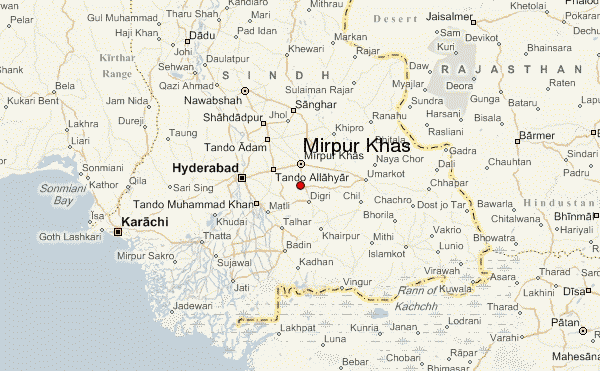
Mirpurkhas Sindh (Credit weatherforecast.com)MIRPURKHAS, July 15 — In a country roiled by violent strife, the southern province of Sindh, celebrated as the “land of Sufis,” has long prized its reputation as a Pakistani bastion of tolerance and diversity.

Glittering Sufi shrines dot the banks of the river Indus as it wends through the province. The faithful sing and dance at exuberant religious festivals. Hindu traders, members of a sizable minority, thrive in the major towns.

But as Islamist groups have expanded across Pakistan in tandem with the growing strength of the Taliban insurgency, so, too, are they making deep inroads into Sindh. Although banned by the state, such groups are systematically exploiting weaknesses in Pakistan’s education system and legal code as part of a campaign to persecute minorities and spread their radical brand of Sunni Islam.

The growth of the fundamentalist groups, many with links to armed factions, has been alarmingly rapid in Sindh and has brought violence in its wake, according to police officials, politicians and activists. In recent months, Hindu temples have been defaced, Shiite Muslims have been assaulted and Christians have been charged with blasphemy.

A central factor in the expansion of such groups is a network of religious seminaries, often with funding from opaque sources, that provides them with a toehold in poor communities. “If there were three seminaries in a city before, now there are tens of seminaries in just one neighborhood,” said Asad Chandio, news editor of the Sindhi-language newspaper Awami Awaz.

In May, a threatening crowd in Mirpurkhas, a small city in central Sindh, surrounded four members of the Jehovah’s Witnesses who had set up a stall near the railway station. The mob accused the four of blasphemy because they were selling books that contained images of God and Moses. The crowd’s leader was a member of Ahle Sunnat Wal Jamaat, a sectarian group that is ostensibly banned by the government, but that is now openly operating, and growing, across Sindh.

Fearing crowd violence, police officers led the four to a nearby police station where they were charged with blasphemy — potentially a capital offense. They were taken away in an armored vehicle, and are now in hiding as they await trial.

Locals said they were struggling to understand how, or why, the incident had taken place. “There are so many communities here, and we have all lived peacefully,” said Francis Khokhar, the lawyer for the four accused.

The Sunni supremacist ideology propagated by Pakistani sectarian groups is similar to the one that is proving so potent in the Middle East, where the Islamic State in Iraq and Syria, or ISIS, is flourishing. In Pakistan, such groups do not pose a direct threat to the state yet. But their growth in Sindh is a sobering reminder that a future threat to Pakistani stability could stem from the provincial towns as much as the distant tribal belt, where the Pakistani military is trying to disrupt havens for the Taliban and other militants.

Ahle Sunnat Wal Jamaat, the group behind the blasphemy charges in Mirpurkhas, sprang from a small town in Punjab Province about 30 years ago, capitalizing on local sectarian and political divides. Once known as Sipah-e-Sahaba Pakistan, it has grown into Pakistan’s dominant vehicle for Sunni sectarianism, trafficking in hatred against Shiites to win popular and political support.

It has been banned several times — first, in its incarnation as Sipah-e-Sahaba, and in 2012 in its present guise. Still, that did not stop its leader, Maulana Muhammad Ahmed Ludhianvi, from running for Parliament last year. This year, an election tribunal disqualified the winner and gave the seat to Mr. Ludhianvi. The case is in litigation now.

The group also has longstanding ties to the ruthless militant group Lashkar-e-Jhangvi, whose militants have killed hundreds of Shiites in Baluchistan and Karachi in the past two years. Malik Ishaq, the leader of Lashkar, is also a vice president of Ahle Sunnat.

Now Ahle Sunnat is on a recruitment drive in Sindh. While it was traditionally centered in Karachi and Khairpur district, about 200 miles to the north, it now has signed up 50,000 members across Sindh, about half of them outside Karachi, said a spokesman, Umar Muavia. A key to its success is an expanding network of 4,000 religious seminaries that offer free classes and food to students from impoverished families.

“We give them a religious education,” said Hammad Muavia, a spokesman for the group in the Khairpur district. “We feed and house them, and provide them a bursary that goes to their families. We even pay for their medical expenses. We take better care of the students than even their own parents.”

In part, Ahle Sunnat is exploiting the chronic weakness of Pakistan’s education system: Over 3,000 state-run schools in Sindh are not functioning, and those in operation frequently offer a dismal quality of schooling. Less clear are its sources of income. The group says it raises funds from local businessmen and the community, but critics say it is principally funded by Saudi Arabia.

“Yes, sometimes if there are clerics from Saudi Arabia visiting Pakistan, they contribute to us,” said Mr. Muavia, the Khairpur spokesman. “But there is no relationship with the Saudi government.”

The link between madrasas and militancy is often debated by experts; some point out that Pakistan’s most famous jihadi commanders have been educated not at madrasas but at state-run schools. What is clear, though, is that the madrasas offer groups like Ahle Sunnat a toehold from which to project themselves into the community and expose more Pakistanis to sermons that sometimes veer explicitly into incitement of violence against Shiites and other minorities.

The group is also using the contentious blasphemy law to cow its enemies. Mr. Chandio, the newspaper editor, said his newspaper received threats from Ahle Sunnat after he published photos of the group’s activists attacking a police van during a blasphemy case.

Mr. Muavia, the Ahle Sunnat spokesman in Khairpur, said he had filed several blasphemy cases, but, to his disappointment, the police had rejected them. “The Pakistani government is outraged when blasphemous acts against Prophet Muhammad take place abroad, but does nothing when they happen at home,” he complained.

Other Sunni groups are also expanding in Sindh. Jamaat-ud-Dawa, a charity that the United States recently designated as a front for the terrorist group Lashkar-e-Taiba, has a network of seminaries and carries out relief work during natural disasters. Its leader, Hafiz Saeed, regularly tours Karachi and other major cities in Sindh, evidently unbothered by a $10 million American bounty for his arrest.

Also expanding is Jamiat Ulema-e-Islam, led by Maulana Fazlur Rehman, a conservative politician from northwestern Pakistan. The group held two of the largest political rallies in the province in recent years.

Since March, the police have recorded 12 attacks on Hindu and Sikh temples across the province, said Iqbal Mehmood, who until recently served as the provincial police chief. Separately, Hindu leaders have accused Muslim groups of trying to forcibly convert Hindu girls to Islam.

Across Pakistan, Shiites have been subjected to “an alarming and unprecedented escalation in sectarian violence,” Human Rights Watch recently noted in a report on attacks on ethnic Hazara Shiites in western Baluchistan Province, which adjoins Sindh.

Some officials say the groups have flourished in part thanks to the turning of a blind eye by provincial politicians — mostly from the Pakistan Peoples Party that has dominated Sindh’s politics for decades — and the tacit support of the military and its powerful spy agency, Inter-Services Intelligence.

During the 1990s, Lashkar-e-Jhangvi “enjoyed a close relationship” with the military and ISI because it was assisting with the fight in Indian-controlled Kashmir, said the recent Human Rights Watch report. For its part, the military denies that it is supporting militant groups.

“These groups don’t come up naturally; they are provided backing by the state,” said Mr. Chandio, the newspaper editor. “They can protest anywhere, and close down a city if they want. But when they hold rallies in support of the army and the ISI, they’ve proven who supports them.”

Saba Imtiaz reported from Mirpurkhas, and Declan Walsh from London.