Deadly landslides and flooding hit India and Pakistan

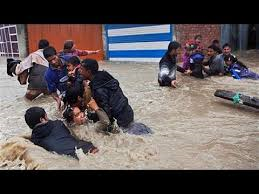
Deadly floods in subcontinent (Credit: wn.pk.com)
Deadly floods in subcontinent
(Credit: wn.pk.com)

Heavy monsoon rains and flash floods have killed 110 people in Pakistan and 86 people in India, officials said on Saturday, as forecasters warned of more rain in the coming days and troops raced to evacuate people from deluged areas.

The annual monsoon season has struck hard across the region, leaving people to wade through rushing water in towns and villages across Pakistan and in Indian-controlled areas of Kashmir, where authorities say they are seeing some of the worst flooding in decades.

Ahmad Kamal, a spokesman for Pakistan’s National Disaster Management Authority, said at least 61 people had died in the eastern Punjab province since Thursday. He said another 38 people died in the Pakistan’s portion of Kashmir and 11 died in northern Gilgit Baltistan province.

Kamal said officials believed all those were killed when the roofs of their homes collapsed. He said the deluge has injured 148 people across the country.

“We are dispatching tents and other relief items for those who have been affected because of rains and floods,” he said. He said the army helicopters and boats were evacuating people from affected areas.

In India authorities put the death toll at 86 people, including 27 people killed when a bus filled with those attending a wedding washed away in a flooded stream. Four passengers managed to swim away but around 30 others remain unaccounted for, officials said.

At least 300 federal rescue workers have joined thousands of state police and soldiers to rescue tens of thousands of people stranded across the region. Dozens of bridges have been damaged or washed away.

Authorities fear the death toll may rise in the region as more flooding and rain is forecast for the coming days.

State-run Pakistan television showed inundated villages, submerged roads and damaged homes across Pakistan and in its portion of Kashmir.

Pakistan’s prime minister, Nawaz Sharif, said the deaths and destruction caused by the rains and floods were a great loss, noting that some 650 homes had been destroyed already.

“The government will leave no stone unturned to help the people in distress,” Sharif said.

Pakistan’s meteorological service said “widespread rain-thundershowers” were expected on Saturday in various parts of the country.

Pakistan and India suffer widespread flooding during the annual monsoon season. In 2010 flash floods killed 1,700 people in Pakistan
UN Test Finds Tsunami Could “Wipe Out” Karachi

KARACHI, Sept 10: Pakistan’s largest city Karachi, home to around 18 million people, could be “wiped out” by a tsunami, officials said Wednesday after a drill simulating a major earthquake in the Indian Ocean.

The test and one carried out a day earlier, simulating another quake off Indonesia, were designed to check an early-warning system set up after the 2004 Indian Ocean tsunami which killed more than 230,000 people.

The exercise organised by the United Nations was based on a hypothetical 9.0-magnitude quake in the Makran Trench, where the Arabian and Eurasian tectonic plates meet, off the coast of Pakistan.

“This would create waves of 0.9 to seven metres high (3-23 feet) that could reach Karachi in one and a half hours,” Tauseef Alam, the chief meteorologist who was supervising the tests, told AFP.

“This could wipe out the city as the waves would be immensely powerful.”

Karachi was hit by a tsunami in 1945 that killed at least 4,000 people, Alam said.

A repeat would likely have a devastating effect on Pakistan nationally, since Karachi, the country’s main port, accounts for around 42 per cent of national GDP.

“The city is vulnerable because there is a chance of another tsunami in the same vicinity but we don’t know when,” Alam said.
In the event of a tsunami, real-time data would be sent to the Met Office in Karachi from Indonesian, Australian and Indian centres.

An alarm would sound when an alert was issued and the team would start disseminating the data to around a dozen disaster management departments.

“Our goal is to ensure the timely and effective notification of tsunamis, to educate communities at risk about safety preparedness and to improve our overall coordination,” Alam said.

But it is not clear whether Karachi has a tsunami evacuation plan, or whether one would even be feasible in the chaotic, sprawling city.

“We will evaluate what works well, where improvements are needed, make necessary changes and continue to practice,” the meteorologist said.

As well as the Makran Trench, Pakistan also straddles the boundary between the Eurasian and Indian plates, and is hit by earthquakes from time to time.

A devastating 7.6-magnitude earthquake hit Pakistan-administered Kashmir in October 2005, killing more than 73,000 people and leaving around 3.5 million homeless.

And in September last year a 7.7-magnitude hit Awaran district in southwestern Balochistan province, killing 376 people and leaving 100,000 others homeless.

Pak Sailor Disappears into Australia’s Crocodile infested Sea

SYDNEY, Sept 7: The Royal Australian Navy said Sunday it had launched a search for a Pakistani sailor believed to have disappeared overboard during a multinational military exercise in the north of the country.

The navy said the sailor, who was not named, went missing early Sunday while the Pakistan Navy ship PNS Nasr was anchored at Darwin Harbour in the Northern Territory during the biennial KAKADU military exercises.

A Northern Territory police spokesman told the Australian Broadcasting Corporation the sailor might have deliberately jumped into the crocodile-infested waters to swim to the mainland.

“A backpack was found in the water which would indicate that the person leaving the ship did know what he was doing at the time and didn´t simply fall off the ship,”

Superintendent Rob Burgoyne said.” He was described as skulking in the bushes (on the mainland), so one can work out from that, probably he didn´t want to be found.”

“The Australian Defence Force is assisting with the search and rescue efforts,” the military said in a statement, adding that the hunt for the sailor would involve boats and aircraft.

More than 1,000 people, eight warships and 26 aircraft from 15 Asia-Pacific and Indian Ocean nations are involved in the maritime exercise, which lasts until September 12.

Burgoyne said the sailor was “probably lucky that he didn´t come across one (crocodile) when he was in the water”.

China Cancels Trip to `All Weather Friend,’ Pakistan

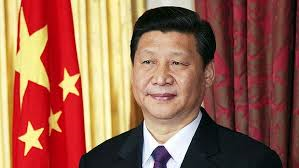
Chinese president Xi Jinping (Credit: asianet.com)
Chinese president Xi Jinping
(Credit: asianet.com)

NEW DELHI, Sept 5: Chinese President Xi Jinping has cancelled his mid-September trip to Pakistan amid political chaos in Islamabad, in what could be a strong signal to Beijing’s allweather friend that it must get its act together before hosting a big visit.

This would be music to India’s ears which had long opposed clubbing of visits to India and Pakistan every time a Chinese President or premier came to the sub-continent. It is no secret that Delhi has strong reservations against the Sino-Pak nuclear axis and Beijing’s support for infrastructure projects in Pakistan Occupied Kashmir.

Their decadesold defence partnership has been India’s Achilles heel. Xi’s visit was crucial for Pakistan, during which a number of economic and defence deals were expected to be signed between the two countries. Xi was scheduled to lay the foundation stone of the Lahore-Karachi motorway section, launch power projects and give final touches to the proposed Pakistan-China railway link.

The two countries are finalising plans to build an economic corridor between China’s Xinjiang and Pakistan’s Gwadar Port which is being developed by Chinese firms. China has announced $32 billion to be invested in next seven years in various Pakistani projects for infrastructure building and power During the September trip, Xi had planned to visit India and then Pakistan followed by Sri Lanka.

However, his proposed dates were clashed with President Pranab Mukherjee’s trip to Vietnam from September 14-17. As India was unwilling to reschedule the President’s trip to Hanoi, Xi decided to first visit Pakistan, followed by Sri Lanka and then reach India. This will be Xi’s first visit to the subcontinent after taking over as president.

Xi may announce big support for Indian infrastructure sector during his trip from September 17-19. Former High Commissioner G Parthasarathy told ET, “there would have been serious security concerns for a Chinese President to cancel his trip to Pakistan, a close partner for Beijing. By taking this step, he is trying to send a strong signal to Islamabad to strengthen architecture to address security concerns and also control extremist forces.”

Xi’s security delegation was in Islamabad on Wednesday to review the security situation in the light of the protests, and was not satisfied with the arrangement. Instead, it was suggested that he should visit Lahore instead of Islamabad.

However, his security team did not give clearance for that either. Last month, Sri Lankan President Mahinda Rajapaksa also cancelled his visit to Pakistan in the wake of the country’s political situation. The cancellation was seen as a major blow to the Pakistan government.

Afghanistan Could Unravel Faster than Iraq

Having spent several weeks auditing ballots in Afghanistan’s fraud-plagued presidential vote, election officials there are expected to declare a winner within days. If the two candidates vying for the post fail to reach a power-sharing deal beforehand, the announcement could easily kick off a wave of unrest that would all but guarantee a catastrophic wind-down to America’s longest war.

The window of opportunity to strike a compromise is narrowing dangerously. Without a new government in place, the Obama administration may well pull back on plans to keep a military contingent in Afghanistan beyond 2014, and without that force, the international community will cease bankrolling the impoverished nation.

Abdullah Abdullah, the former foreign minister, not without reason, is fighting the outcome of an election in which his rival, former finance minister Ashraf Ghani, is widely expected to be declared the winner. Western officials say that the audit of millions of ballots cast on June 14 has made clear that the scope and sophistication of fraud was staggering even for Afghan standards. Having ceded another fraud-plagued election to President Hamid Karzai in 2009, Mr. Abdullah and his powerful backers are not willing to concede defeat in another corrupt election.

But they ought to understand that they stand to lose far more by being intransigent. The Taliban are fighting hard to retake crucial urban areas, and the country’s anemic economy is likely to collapse amid the uncertainty.

The Obama administration, which had preferred to limit its involvement in the election, has sensibly offered a power-sharing structure under which the losing candidate, or a designee, would hold a chief executive position with considerable authority.

A senior American official said that Mr. Ghani and Mr. Abdullah appear close to signing off formally on the deal, but they remain at odds over just how much power the losing candidate would wield. One sticking point is whether ministers would report to the chief executive, rather than to the president.

Continue reading the main story 25Comments Continue reading the main story

Recent Comments

iona

1 hour ago

Everybody OUT. Let them deal with their own problems we only make things worse because we are there to support either thug and get those…

Prof.Jai Prakash Sharma,

1 hour ago

The entire history of Afghanistan being full of external power rivalry, bloody tribal feuds and wars, how could it deviate from its…

FXQ

4 hours ago

Flip a coin, whoever wins is the president, and the other is vice president for the first term. Then, the roles are switched for the second…

  • See All Comments
  • Write a comment

Mr. Ghani and Mr. Abdullah have displayed considerable pragmatism in recent weeks as the electoral dispute has dragged on, raising hopes that they could in fact govern jointly. This week, the two men sent a letter to NATO leaders meeting in Wales, pledging that they are committed to forming a “government of national unity that will honor the epic participation of our people in the electoral process.” The message shows that both men understand continued international support to be indispensable for the fledgling state they aspire to lead.

A solution to the government crisis will take more than pragmatism, though. Both candidates must rein in their most reactionary constituents and work hard to manage expectations in the days ahead. The power-sharing deal will need to be detailed, clear and public to reduce the temptation for the winner to sideline his rival after taking office.

In this crisis, the Obama administration has had to take on a broker’s role. It must remain engaged and patient in helping the Afghans avert the chaos of a government rived by ethnic or sectarian divisions. The alternative could look much like Iraq’s unraveling. Except in Afghanistan, it would almost certainly come quicker

Pakistan’s army instructs prime minister Sharif to act without violence

Islamabad Aug 31 (Credit: khybertv.com)
Islamabad Aug 31
(Credit: khybertv.com)

Islamabad, Aug 31 – Pakistan‘s army has instructed the country’s embattled government to solve its political crisis without violence on Sunday following a night of clashes in the capital between police and thousands of protesters demanding the prime minister step down. The demand came after an emergency meeting of the army’s high command and was the latest intervention by the country’s powerful military in the drawn out standoff between the government and followers of former cricketer Imran Khan and populist cleric Tahir-ul-Qadri.

The army has toppled civilian governments in the past, including one led by the current prime minister Nawaz Sharif, either by directly assuming power in coups or by installing caretaker governments. In language that underlined the institution’s undimmed ability to dictate events, an army statement said it was “committed to playing its part in ensuring security of the state”.

It added its “serious concern” about violence in Islamabad and that the situation should be “resolved politically without wasting any time and without recourse to violent means.”

Political accommodation appears unlikely, given that the government and its opponents are deadlocked over the future of the prime minister, who won a landslide victory in last May’s election that Khan claims was secured by massive vote rigging. Khan and Qadri, who marched from the city of Lahore to Islamabad on 14 August in a bid to oust the government, insist Sharif must go.

The government has been at pains to avoid an ugly stand off with demonstrators, ordering police not to confront them as they advanced ever closer to the heart of the capital, even allowing them to hold a protracted sit-in on the road directly in front of parliament and other key government buildings.

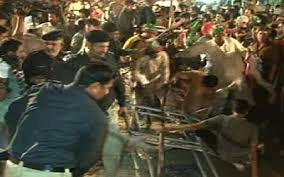
But, on Saturday night, Khan and Qadri urged their supporters to seize Sharif’s official residence, forcing police to respond with tear gas and rubber bullets to swarms of demonstrators who succeeded in smashing a gate and flooding into the grounds of parliament. Almost 500 people were injured and three died, although one was the victim of a heart attack.

The police response was criticised as excessive by some, though many of the protesters were equipped with gas masks and armed with bamboo staffs, slingshots and other weapons.

The main opposition Pakistan People’s party, which has generally supported Sharif throughout the crisis, criticised the crackdown. And the Muttahida Qaumi Movement party, which has a significant vote block in parliament, joined calls for the government to step down.

Sporadic clashes continued throughout the day on Sunday, with some protesters using slingshots to fire glass marbles at police.

But, by night-time, it seemed neither Khan nor Qadri were preparing to provoke another confrontation, with Khan appearing on the top of the converted sea container in which he has been living for more than two weeks to announce he was going to have a rest. The government will struggle to defend key buildings without using force in any future attempt to seize them.

“Sharif is now in the tightest of corners,” said commentator Mosharraf Zaidi. “The army does not want to intervene in this political dispute but it also clearly indicates that it will not defend prime minister Sharif.”

A noticeably gloomy editorial in Dawn, a respected English-language daily paper, asked whether Sharif could survive Sunday’s crisis.

“The answer, in these frantic hours, must surely be a miserable, despondent no,” it concluded.

Once Jailed by Musharraf, Hashmi Rejects Being Used Against Nawaz

Javed Hashmi (Credit: breakingnewspak.com)
Javed Hashmi
(Credit: breakingnewspak.com)

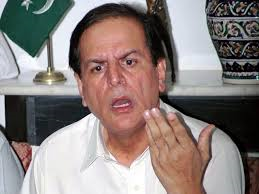
ISLAMABAD, Aug 31: Pakistan Tehreek-e-Insaf (PTI) President Javed Hashmi has stated that Imran Khan’s decision to move forward to the PM House was against that of the party.

Addressing a press conference here Sunday, Hashmi disclosed that Imran Khan had assured that they would not move forward from Constitution Avenue.

Hashmi said Imran Khan changed his stance after Sheikh Rasheed and Saifullah Niazi delivered a message to him. The PTI president said that he was not informed of what prompted the decision to move forward despite asking Imran Khan. Hashim said he was told by Imran Khan that he could leave if he had difference.

Hashmi regretted that there was no democracy in the party. “I had advised Imran to wait till the result of negotiations”, he said. “Shah Mehmood Qureshi had also supported my viewpoint.”

He said: “No distance has been left between martial law and us”.

According to Javed Hashmi, the Pakistan Awami Tehreek (PAT) would not proceed to the PM House until they received the go ahead from Imran Khan.

The PTI president called on the government to end the barbaric action and asked Imran Khan to return, stating that he would stand by him if he did so.!

The PTI President also said, if democracy is derailed Imran Khan will be responsible for it.

Imran Reacts

Addressing his supporters from his container, Imran Khan said he is disappointed at Javed Hashmi’s statements and announced that from this day forward his path and Javed Hashmi’s path are different.

Pakistan, Its Own Worst Enemy

Pakistan faces very big problems: a failing economy; a Taliban insurgency; and persistent tension with India, which has resulted again in exchanges of cross-border fire. The country’s leaders and citizens obviously need to join in common cause to put the country on a steadier course.

Alas, this is Pakistan. For the past two weeks, thousands of protesters in Islamabad have been demanding the resignation of Prime Minister Nawaz Sharif. His critics have every right to express their views peacefully. But forcing his resignation is the last thing Pakistan needs.

It would further polarize society, weaken the fragile democratic institutions and strengthen a powerful military, which says it wants to be out of politics but has regularly staged coups and otherwise sought to control civilian governments for three decades.

Mr. Sharif came to office in a parliamentary election 15 months ago, the first peaceful, democratic transition of power between civilian leaders in the country’s history. It was a hopeful moment; some 60 percent of voters turned out, and most people seemed willing to accept his victory.

The current anti-Sharif anger is being stoked by two men. Imran Khan, a prominent cricketer turned politician, wants new elections. Muhammad Tahir-ul Qadri, a cleric of the Sufi Islam sect, is pushing for the creation of a unity government. The protesters have demanded electoral reforms and Mr. Sharif’s removal because of alleged corruption in the 2013 election. Some believe that the army, which has an uneasy history with Mr. Sharif, has had a hand in the crisis. Reports that Mr. Khan and Mr. Qadri are negotiating with the army chief of staff are unsettling.

Mr. Sharif’s brief tenure has been marked by sectarian tensions, power outages, insurgent-related violence and a failure to deliver on campaign promises of economic revival. He has also named cronies to high posts. But forcing him out now and in this way is not the answer. A smarter approach is to make democratic processes work through reforms to prevent electoral fraud and rampant cronyism. It will also require negotiation and compromise.

The United States, preoccupied with crises elsewhere, has shown little urgency in trying to calm the situation, even though Pakistan’s stability is crucial to regional order — especially as American troops withdraw from Afghanistan. It should be pressing Pakistan’s army, in particular, to reject any idea of staging a coup. Mr. Sharif should resolve to govern better while the military focuses on its primary concern, defeating the Taliban threat.

Govt should voluntarily step down to avoid bloodshed – Altaf Hussain

Altaf Hussain (Credit: thenews.com.pk)
Altaf Hussain
(Credit: thenews.com.pk)

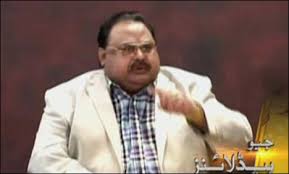
LONDON, Aug 27: Muttahida Qaumi Movement (MQM) chief Altaf Hussain terming all demands of Pakistan Awami Tehreek (PAT) chief Dr Tahirul Qadri as ‘valid’, has said that it would be in the country’s interest if the government voluntarily stepped down to avoid any bloodshed, DawnNews reported.

Talking about the anti-government sit-ins being held in the federal capital city and a possible government reaction, Hussain said that the government should consider the safety of women and children, participating in the sit-ins.

He further cited that the ‘third force’ would have to intervene, if Tahirul Qardi did not step back voluntarily.

Also read: Altaf calls for resolving dispute to avert martial law
“No one calls for a Martial law or ventilator with delight,” he added.

MQM chief said that amendments could be made in the demands through dialogues, but added “How can the talks prevail if the government refuses to accept valid demands?”
He made it clear that he had no intentions of becoming prime minister, nor president, but only wanted a peaceful atmosphere in the country.

The MQM chief said that he considered any one in opposition to the local governmental system and power of the people as an enemy of democracy.

It is worth mentioning here that contrary to MQM’s balanced stance, where Altaf Hussain urged both sides to neutralise tensions, the party has pressed the government to step down in a changed scenario.
Earlier on Wednesday, Tahirul Qadri announced ‘Revolution day’ while Imran Khan also declared to put talks on hold till the resignation of Prime Minister Nawaz Sharif.

Both PTI and PAT have been holding anti-government protests and sit-ins in Islamabad’s Red Zone area and are demanding Prime Minister Nawaz Sharif’s resignation.

MQM UK member hauled up in London re Imran Farooq murder

London, Aug 27: Scotland Yard  late on Wednesday released a suspect arrested in connection with the murder of former Muttahida Qaumi Movement (MQM) leader Dr Imran Farooq, Express News reported.

The suspect has been asked to appear before the police again in mid-November this year.

Earlier, a spokesperson for the Scotland Yard confirmed to The Express Tribune that the suspect was arrested from East London this morning. He is currently being kept in custody where he is being interrogated. The suspect is reportedly a British Pakistani, but Scotland Yard did not confirm the nationality of the suspect.

He is said to be an MQM UK unit member, party officials told The Express Tribune.

The suspect is the second man to be arrested in the case so far. Last June, the Scotland Yard arrested a nephew of MQM chief Altaf Hussain, 52-year-old man Iftikhar Hussain. He was arrested on suspicion of conspiracy to murder and is currently on bail.

Further, in May, Scotland Yard released pictures of two suspects allegedly involved in the murder of Farooq.

Scotland Yard claimed that the two suspects, identified as Mohsin Ali Syed and Mohammed Kashif Khan Kamran, were believed to be in Pakistan and had traveled to London on student visas. They are also believed to be residents of Karachi.

Farooq, 50, was a former leader of MQM and had lived in London in self-imposed exile from 1999. He was on his way back from work when he was attacked outside his home in Edgware, north London, in September 2010. A post-mortem gave the cause of death as multiple stab wounds and blunt trauma to the head. A kitchen knife and a house brick used in the attack were recovered at the scene.