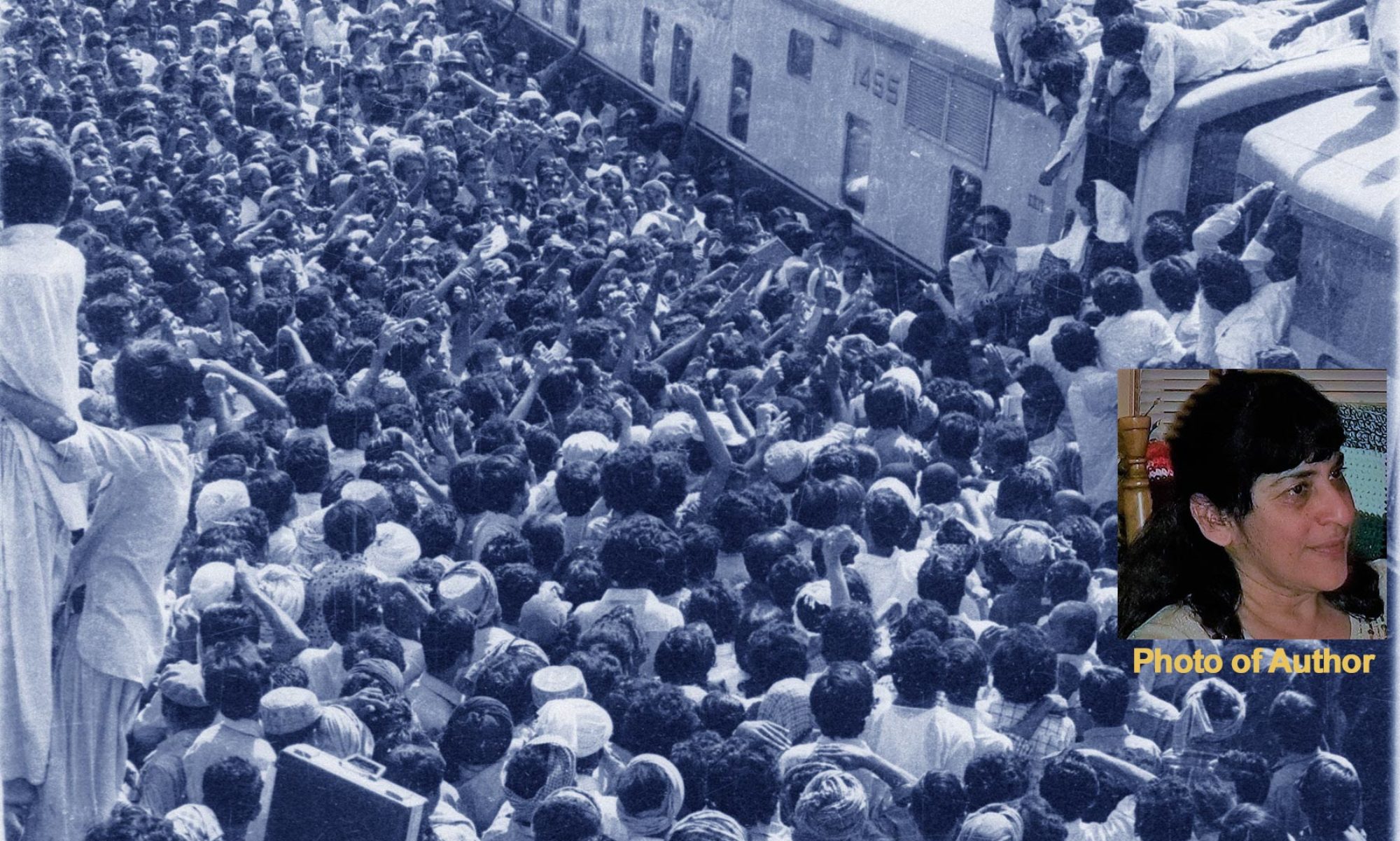
LAHORE, April 2 — At a literature festival here not long ago, I bumped into a school friend who had recently relocated from Karachi, the southern port city where we both grew up. Karachi has all the buzz, and violence, of a megalopolis — more than 2,700 people were killed there in 2013 — and none of the greenery and historic charms of Lahore, the capital of Punjab Province. “I’m loving Lahore,” she told me. “I feel like I’ve moved to Switzerland after living in a war zone.”
The contrast is not as exaggerated as it sounds. In recent years, Punjab has suffered less than the rest of the country from the suicide attacks and bomb blasts that have killed some 49,000 people since 2001. There have been dramatic exceptions: terrorist attacks against the visiting Sri Lankan cricket team and at a major Sufi shrine in Lahore, at army headquarters in Rawalpindi, and at a five-star hotel and courts in the capital, Islamabad. Anti-India militant groups like Lashkar-e-Taiba and anti-Shiite organizations like Lashkar-e-Jhangvi are based in Punjab and draw most of their recruits from the province. But these groups mostly stage their attacks elsewhere in Pakistan to maintain benign relations with the local authorities.
And so the perception that Punjab has suffered less from violence than the rest of the country prevails, creating much resentment. For non-Punjabis, the province’s relative stability is just the latest demonstration of how Punjabi elites rally to protect their own interests at the expense of their compatriots. And such interprovincial rivalries could be as great a challenge for the country’s stability as the Taliban.
It is commonly said that Punjab is synonymous with Pakistan, and vice versa, which seems to relegate the other provinces and autonomous regions to the status of outliers. Some of Punjab’s good fortune is an accident of geography: the name means “land of five rivers,” referring to the Indus River and the tributaries that flow through the province, making it the agricultural and industrial heartland of Pakistan. But politics matters even more.
Pakistan’s elites, political, bureaucratic and military have long hailed from Punjab and shaped the country’s policies to the province’s advantage. Until recently, Punjab received the lion’s share of national revenues simply by virtue of having the largest population; never mind its actual needs or contributions to the national budget. (The formula was finally revised in 2009, benefiting Sindh, Baluchistan and Khyber Pakhtunkhwa provinces.) Also, the government and the military have long allotted prime agricultural land and urban real estate in other parts of Pakistan to Punjabi officers and senior bureaucrats.
Punjab itself is not a monolith. Some of the province’s southern districts are among the country’s poorest, and their inhabitants have grudges of their own against Lahore-based politicians. Water and energy shortages kept Punjab’s economic growth rate at 2.5 percent between 2007 and 2011, compared with 3.4 percent for the country overall. But this has done little to temper the impression among non-Punjabis that the province is booming while the rest of the country is burning.
These resentments animate the politics of Pakistan’s other provinces and threaten national unity. A separatist movement in Baluchistan taps grievances against Punjabis it says are exploiting Baluch gas and mineral resources to spur industrial growth in Punjab. It also rejects efforts by the predominantly Punjabi military to suppress Baluch nationalists. Killings of Punjabi “settlers” — often school teachers and civil servants — by Baluch separatists are a brutal expression of this.
Concerns about Punjabi domination have soared since the spring of 2013, when Prime Minister Nawaz Sharif, of the Pakistan Muslim League (P.M.L.N.), was returned to power for the third time. He belongs to a Lahore-based industrial family with close ties to Punjab’s business elite and a can-do attitude to governance that features flashy development schemes. The perception that Punjab is batting in a league of its own has mounted under the Sharifs. During the general election campaign last year, while the Pakistan People’s Party, which is perceived to represent Sindhi interests, was making welfare cash transfers to impoverished women, the P.M.L.N. was distributing laptops to students.
Most of Karachi’s 18 million residents have to rely on private transport. But Lahoris commute on a rapid metrobus system, and a similar initiative in Islamabad will be the federal capital’s most expensive road project to date. While the Punjabi government is digitizing land records, automating administrative transactions and promoting what it calls e-governance, the Sindh government faces a famine in Tharparkar.
Punjab has been able to progress because it has been relatively unimpeded by terrorism. Shahbaz Sharif, Nawaz’s brother and Punjab’s chief minister since 2008, publicly appealed to the Pakistani Taliban in 2010 not to attack the province, and the request was largely heeded. His P.M.L.N. government in Punjab has not clamped down on influential sectarian militant groups in the province, instead befriending their leaders to rally votes during elections.
Likewise, the P.M.L.N. government at the center started pushing for peace talks with the Taliban in September and then even more in November, when the Taliban threatened to carry out attacks in Punjab to avenge the killing of their former leader in a U.S. drone strike in North Waziristan. The central government is considering concessions, including swapping prisoners, granting an amnesty to Taliban fighters and even giving the group a political role in the Federally Administered Tribal Areas along the border with Afghanistan.
Government officials have repeatedly stated that a peace deal is necessary because military strikes against the Taliban would lead to reprisal attacks. Given the carnage that Karachi, Quetta and Peshawar have endured in recent years, many Pakistanis describe that policy as a ploy to sacrifice the tribal areas in order to save Lahore. Such perceptions only heighten interprovincial tensions, just at a time when the country needs to be more united than ever.
Huma Yusuf is a Pakistani journalist and global fellow at the Woodrow Wilson International Center for Scholars in Washington.
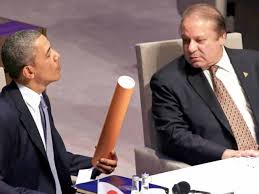
As the 2014 Nuclear Security Summit gets underway in The Hague, Netherlands, world leaders and nuclear security experts will ponder the future of nuclear security in the Indian subcontinent. Nuclear-armed neighbors India and Pakistan both score poorly on several important indicators for the security of nuclear materials and their ability (or inability) to regulate their supply of both fissile material and weaponized nuclear systems is a continued cause of concern for nuclear security advocates.
The Nuclear Threat Initiative‘s 2014 Security Index, “a unique public assessment of nuclear materials security conditions in 176 countries, developed with the Economist Intelligence Unit (EIU),” scored both India and Pakistan rather poorly for nuclear material security. The NTI’s ranking examines nuclear material security indicators among the 25 countries known to possess weapons-usable nuclear material and this year’s ranking put India in 23rd place and Pakistan in the 22nd place. Only Iran and North Korea — two nations largely ostracized by the international community for their nuclear programs — scored lower. Despite its higher internal instability, Pakistan came out ahead of India on the NTI 2014 Security Index.
India’s low score on the NTI Security Index is mostly due to a series of bureaucratic failures and delays. India remains a relative newcomer to the community of normal nuclear weapon states. Despite the fact that India never signed the Nuclear Non-Proliferation Treaty, its landmark 2006 civil nuclear cooperation deal with the United States and its eventual receipt of a waiver from the Nuclear Suppliers Group in 2008 made it the first nuclear weapon state outside of the NPT framework to engage in civil nuclear commerce.
India’s nuclear security problems are myriad. Despite having excellent multilateral compliance, including fully implementing UN Security Council resolution 1540, poor regulations and laws that merely suggest but do not require oversight keep India’s nuclear security provisions below optimal levels. Two years ago, at the last Nuclear Security Summit in Seoul, India pledged to establish an independent regulatory agency for nuclear material security but has failed to do so. Other major shortcomings for India include a failure to hedge against insider threats to nuclear materials and protect materials during transport. While India’s threat environment is far less dangerous than Pakistan’s, terrorist groups have plotted to acquire nuclear materials in India.
According to India’sEconomic Times, the Indian delegation to the Nuclear Security Summit in The Hague will focus on “gaps” in the international nuclear security legal framework — an area in which India is rather exemplary — to avoid drawing attention to India’s enduring shortcomings in nuclear materials security. Given India’s looming elections and the probability of the incumbent coalition falling from power, it is unlikely that the institutional and legislative changes needed will occur anytime soon (P.R. Chari has a piece over at the Carnegie Endowment for International Peace that examines the reasons for this in greater detail).
Pakistan, despite being ranked a notch above India on the 2014 NTI Security Index and winning the honor of “most improved nuclear-armed state,” comes short on nuclear security in several areas. Pakistan has the world’s fastest growing nuclear arsenal, a maturing tactical nuclear weapon program, a history of supporting insurgents against India, and a highly unstable internal threat environment. Pakistan scored the lowest for “Political Stability” on the 2014 NTI Index while taking first place for “Domestic Nuclear Materials Security Legislation” and “Independent Regulatory Agency” — scoring high on some of the areas where India has shortcomings.
Pakistan’s nuclear weapons program and nuclear security is fiercely independent of its national politics and alliance with the United States — for better and worse. Additionally, Pakistan’s Inter-Services Intelligence’s association with anti-India militant groups raises concerns of state-sponsored nuclear terrorism, even though state agents have very good reasons not to hand off a nuclear device to a terrorist group. Furthermore, we’ve seen the Pakistani Taliban and other insurgent groups within the country target military facilities in recent years — the potential of an attack succeeding against a Pakistani facility containing nuclear weapons or nuclear materials is remote but worth considering. The United States has contingency plans for precisely such an event occurring within Pakistan.
South Asia remains the world’s likeliest nuclear flash point given the high level of mutual mistrust and enmity between India and Pakistan. While the risk of an imminent strategic nuclear weapon exchange remains low given each nation’s deterrents, Pakistan’s development of tactical nuclear weapons could reduce barriers for a nuclear event in the subcontinent. Beyond nuclear weapons, the security of nuclear materials in both these countries remains inadequate. Given the multitude of variables involved in establishing a robust nuclear security architecture for these countries, domestic developments alone can do little to reduce the chance of a nuclear event. A general reduction in tensions between India and Pakistan — eventually leading to the normalization of bilateral relations — is just as important.
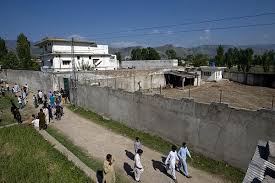
Bin Laden home in Abbotabad (Credit: csmonitor.com)
Shortly after the Sept. 11 attacks, I went to live and report for The New York Times in Afghanistan. I would spend most of the next 12 years there, following the overthrow of the Taliban, feeling the excitement of the freedom and prosperity that was promised in its wake and then watching the gradual dissolution of that hope. A new Constitution and two rounds of elections did not improve the lives of ordinary Afghans; the Taliban regrouped and found increasing numbers of supporters for their guerrilla actions; by 2006, as they mounted an ambitious offensive to retake southern Afghanistan and unleashed more than a hundred suicide bombers, it was clear that a deadly and determined opponent was growing in strength, not losing it. As I toured the bomb sites and battlegrounds of the Taliban resurgence, Afghans kept telling me the same thing: The organizers of the insurgency were in Pakistan, specifically in the western district of Quetta. Police investigators were finding that many of the bombers, too, were coming from Pakistan.
In December 2006, I flew to Quetta, where I met with several Pakistani reporters and a photographer. Together we found families who were grappling with the realization that their sons had blown themselves up in Afghanistan. Some were not even sure whether to believe the news, relayed in anonymous phone calls or secondhand through someone in the community. All of them were scared to say how their sons died and who recruited them, fearing trouble from members of the ISI, Pakistan’s main intelligence service.
After our first day of reporting in Quetta, we noticed that an intelligence agent on a motorbike was following us, and everyone we interviewed was visited afterward by ISI agents. We visited a neighborhood called Pashtunabad, “town of the Pashtuns,” a close-knit community of narrow alleys inhabited largely by Afghan refugees who over the years spread up the hillside, building one-story houses from mud and straw. The people are working class: laborers, bus drivers and shopkeepers. The neighborhood is also home to several members of the Taliban, who live in larger houses behind high walls, often next to the mosques and madrasas they run.
The small, untidy entrance on the street to one of those madrasas, the Jamiya Islamiya, conceals the size of the establishment. Inside, a brick-and-concrete building three stories high surrounds a courtyard, and classrooms can accommodate 280 students. At least three of the suicide bombers we were tracing had been students here, and there were reports of more. Senior figures from Pakistani religious parties and provincial-government officials were frequent visitors, and Taliban members would often visit under the cover of darkness in fleets of S.U.V.s.
We requested an interview and were told that a female journalist would not be permitted inside, so I passed some questions to the Pakistani reporter with me, and he and the photographer went in. The deputy head of the madrasa denied that there was any militant training there or any forced recruitment for jihad. “We are educating the students in the Quran, and in the Quran it is written that it is every Muslim’s obligation to wage jihad,” he said. “All we are telling them is what is in the Quran. Then it is up to them to go to jihad.” He ended the conversation. Classes were breaking up, and I could hear a clamor rising as students burst out of their classrooms. Boys poured out of the gates onto the street. They looked spindly, in flapping clothes and prayer caps, as they darted off on their bikes and on foot, chasing one another down the street.
The reporter and the photographer joined me outside. They told me that words of praise were painted across the wall of the inner courtyard for the madrasa’s political patron, a Pakistani religious-party leader, and the Taliban leader Mullah Muhammad Omar. This madrasa, like so many in Pakistan, was a source of the Taliban resurgence that President Hamid Karzai and other Afghan leaders had long been warning about. In this nondescript madrasa in a poor neighborhood of Quetta, one of hundreds throughout the border region, the Taliban and Pakistan’s religious parties were working together to raise an army of militants.
“The madrasas are a cover, a camouflage,” a Pashtun legislator from the area told me. Behind the curtain, hidden in the shadows, lurked the ISI.
The Pakistani government, under President Pervez Musharraf and his intelligence chief, Lt. Gen. Ashfaq Parvez Kayani, was maintaining and protecting the Taliban, both to control the many groups of militants now lodged in the country and to use them as a proxy force to gain leverage over and eventually dominate Afghanistan. The dynamic has played out in ways that can be hard to grasp from the outside, but the strategy that has evolved in Pakistan has been to make a show of cooperation with the American fight against terrorism while covertly abetting and even coordinating Taliban, Kashmiri and foreign Qaeda-linked militants. The linchpin in this two-pronged and at times apparently oppositional strategy is the ISI. It’s through that agency that Pakistan’s true relationship to militant extremism can be discerned — a fact that the United States was slow to appreciate, and later refused to face directly, for fear of setting off a greater confrontation with a powerful Muslim nation.
On our fifth and last day in Quetta, four plainclothes agents detained my photographer colleague at his hotel. They seized his computer and photo equipment and brought him to the parking lot of the hotel where I was staying. There they made him call and ask me to come down to talk to them. “I’m in trouble here,” he told me. It was after dark. I did not want to go down to the parking lot, but I told my colleague I would get help. I alerted my editor in New York and then tried to call Pakistani officials.
Before I could reach them, the agents broke through the door of my hotel room. The lintel splintered, and they burst in in a rush, snatching my laptop from my hands. There was an English-speaking officer wearing a smart new khaki-colored fleece. The other three, one of whom had the photographer in tow, were the muscle.
They went through my clothes and seized my notebooks and a cellphone. When one of the men grabbed my handbag, I protested. He punched me twice, hard, in the face and temple, and I fell back onto the coffee table, grabbing at the officer’s fleece to break my fall and smashing some cups when I landed. For a moment it was funny. I remember thinking it was just like a hotel-room bust-up in the movies.
Then I flew into a rage, berating them for barging into a woman’s bedroom and using physical violence. The officer told me that I was not permitted to visit the neighborhood of Pashtunabad and that it was forbidden to interview members of the Taliban. As they were leaving, I said the photographer had to stay with me. “He is Pakistani,” the officer said. “We can do with him whatever we want.” I knew they were capable of torture and murder, especially in Quetta, where the security services were a law unto themselves. The story they didn’t want out in the open was the government’s covert support for the militant groups that were propagating terrorism in Afghanistan and beyond.
Six months later, Pakistan blew up. In the spring of 2007 in Islamabad, female students from a madrasa attached to the Red Mosque were staging a sit-in to protest the demolition of several illegal mosques in the city. The Red Mosque stood at the center of Pakistan’s support for jihad in Afghanistan and throughout the Muslim world. It was founded by a famed jihadi preacher, Maulana Muhammad Abdullah, who was assassinated in 1998, not long after he visited Osama bin Laden in Afghanistan. Al Qaeda blamed the killing on the Pakistani government at the time.
Abdullah’s sons inherited the mosque and continued its extremist teachings. The eldest, Maulana Abdul Aziz, delivered fiery Friday sermons excoriating Musharraf for his public stance on the fight against terrorism and his dealings with the American government. Despite an earlier reputation as a nonreligious bureaucrat, the younger brother, Abdul Rashid Ghazi, spoke of undergoing a conversion after his father’s death and a meeting with Bin Laden, and by 2007 he would not leave the Red Mosque compound for fear of arrest. He warned that ranks of suicide bombers would retaliate if the government moved against the student protesters.
With such leaders behind them, the students began staging vigilante actions in the streets. They were radical and obsessive, vowing to die rather than give up their protest. The government’s inaction only encouraged them. Several months after the protest began, a group of students made a midnight raid on a massage parlor and abducted several Chinese women.
Remonstrations from China, Pakistan’s most important regional ally, pushed Musharraf to take action. Pakistani Army rangers occupied a school across the street, and police officers and soldiers moved in to surround the mosque on July 3. Armed fighters appeared from the mosque, carrying rockets and assault rifles and taking up sandbagged positions on the mosque walls. Loudspeakers told the students that this was the time for bravery. A female student took over the microphone. “Allah, where is your help?” she asked in a quavering voice. “Destroy the enemies. Tear their hearts apart. Throw fireballs on them.”
Islamabad is a green, tranquil home for civil servants and diplomats, but for several days it resounded with gunfire and explosions. Crowds of worried parents arrived from all over the country to try to retrieve their children. The Red Mosque leaders tried to make the students stay. “They said if the women and others die, the people will take their side,” one father told me, and I realized then how premeditated this all was, how the girls were pawns in their plan to spark a revolution.
A week after the siege began, there was a ferocious battle. Elite Pakistani commandos rappelled from helicopters into the mosque and were raked with machine-gun fire. Perched in the mosque’s minarets and throughout its 75 rooms, the militants fought for 10 hours. They hurled grenades from bunkers and basements, and suicide bombers threw themselves at their attackers. The commandos found female students hiding in a bricked-up space beneath the stairs and led 50 women and girls to safety. Ghazi retreated to a basement in the compound. He died there as the last surviving fighters battled around him.
More than 100 people were killed in the siege, including 10 commandos. The ISI — despite having a long relationship with the mosque and its leaders, as well as two informers inside providing intelligence — played a strangely ineffective role. In a cabinet meeting after the siege, ministers questioned a senior ISI official about the intelligence service’s failure to prevent the militant action. “Who I meet in the evening and what I discuss is on your desk the next morning,” one minister told the official. “How come you did not know what was happening a hundred meters from the ISI headquarters?” The official sat in silence as ministers thumped their desks in a gesture of agreement.
“One hundred percent they knew what was happening,” a former cabinet minister who attended the meeting told me. The ISI allowed the militants to do what they wanted out of sympathy, he said. “The state is not as incompetent as people believe.”
The Pakistani military faced an immediate and vicious backlash. In the months that followed, there were strikes against convoys of soldiers in the northwest and a wave of suicide bombings against government, military and civilian targets throughout the country, including the army’s headquarters and the main ISI compound in Rawalpindi. After years of nurturing jihadists to fight its proxy wars, Pakistan was now experiencing the repercussions. “We could not control them,” a former senior intelligence official told a colleague and me six months after the Red Mosque siege.
Yet even as the militants were turning against their masters, Pakistan’s generals still sought to use them for their own purpose, most notoriously targeting Pakistan’s first female prime minister, Benazir Bhutto, who was preparing to fly home from nearly a decade in exile in the fall of 2007. Bhutto had forged a deal with Musharraf that would allow him to resign as army chief but run for another term as president, while clearing the way for her to serve as prime minister. Elections were scheduled for early 2008.
Bhutto had spoken out more than any other Pakistani politician about the dangers of militant extremism. She blamed foreign militants for annexing part of Pakistan’s territory and called for military operations into Waziristan. She declared suicide bombing un-Islamic and seemed to be challenging those who might target her. “I do not believe that any true Muslim will make an attack on me because Islam forbids attacks on women, and Muslims know that if they attack a woman, they will burn in hell,” she said on the eve of her return.
She also promised greater cooperation with Afghanistan and the United States in combating terrorism and even suggested in an interview that she would give Western officials access to the man behind Pakistan’s program of nuclear proliferation, A. Q. Khan.
President Karzai of Afghanistan warned Bhutto that his intelligence service had learned of threats against her life. Informers had told the Afghans of a meeting of army commanders — Musharraf and his 10 most-powerful generals — in which they discussed a militant plot to have Bhutto killed.
On Oct. 18, 2007, Bhutto flew into Karachi. I was one of a crowd of journalists traveling with her. She wore religious amulets and offered prayers as she stepped onto Pakistani soil. Hours later, as she rode in an open-top bus through streets of chanting supporters, two huge bombs exploded, tearing police vans, bodyguards and party followers into shreds. Bhutto survived the blast, but some 150 people died, and 400 were injured.
Bhutto claimed that Musharraf had threatened her directly, and Karzai again urged her to take more precautions, asking his intelligence service to arrange an armored vehicle for her equipped with jammers to block the signals of cellphones, which are often used to detonate bombs. In the meantime, Bhutto pressed on with her campaign, insisting on greeting crowds of supporters from the open top of her vehicle.
In late December, a group of militants, including two teenage boys trained and primed to commit suicide bombings, arrived at the Haqqania madrasa in the northwestern town of Akora Khattak. The madrasa is a notorious establishment, housing 3,000 students in large, whitewashed residence blocks. Ninety-five percent of the Taliban fighting in Afghanistan have passed through its classrooms, a spokesman for the madrasa proudly told me. Its most famous graduate is Jalaluddin Haqqani, a veteran Afghan mujahedeen commander whose network has become the main instrument for ISI-directed attacks in Kabul and eastern Afghanistan.
The two young visitors who stopped for a night at the madrasa were escorted the next day to Rawalpindi, where Bhutto would be speaking at a rally on Dec. 27. As her motorcade left the rally, it slowed so she could greet supporters in the street. One of the two teenagers fired a pistol at her and then detonated his vest of explosives. Bhutto was standing in the roof opening of an armored S.U.V. She ducked into the vehicle at the sound of the gunfire, but the explosion threw the S.U.V. forward, slamming the edge of the roof hatch into the back of her head with lethal force. Bhutto slumped down into the vehicle, mortally wounded, and fell into the lap of her confidante and constant chaperone, Naheed Khan.
As Bhutto had long warned, a conglomeration of opponents wanted her dead and were all linked in some way. They were the same forces behind the insurgency in Afghanistan: Taliban and Pakistani militant groups and Al Qaeda, as well as the Pakistani military establishment, which included the top generals, Musharraf and Kayani. A United Nations Commission of Inquiry into the circumstances of Bhutto’s death found that each group had a motive and merited investigation.
Pakistani prosecutors later indicted Musharraf on charges of being part of a wider conspiracy to remove Bhutto from the political scene. There was “overwhelming circumstantial evidence” that he did not provide her with adequate security because he wanted to ensure her death in an inevitable assassination attempt, the chief state prosecutor in her murder trial, Chaudhry Zulfiqar Ali, told me. (Musharraf denied the accusations.) A hard-working, hard-charging man, Ali succeeded in having Musharraf arrested and was pushing to speed up the trial when he was shot to death on his way to work in May 2013.
Ali had no doubts that the mastermind of the plot to kill Bhutto was Al Qaeda. “It was because she was pro-American, because she was a strong leader and a nationalist,” he told me. A Pakistani security official who interviewed some of the suspects in the Bhutto case and other militants detained in Pakistan’s prisons came to the same conclusion. The decision to assassinate Bhutto was made at a meeting of the top council of Al Qaeda, the official said.
It took more than three years before the depth of Pakistan’s relationship with Al Qaeda was thrust into the open and the world learned where Bin Laden had been hiding, just a few hundred yards from Pakistan’s top military academy. In May 2011, I drove with a Pakistani colleague down a road in Abbottabad until we were stopped by the Pakistani military. We left our car and walked down a side street, past several walled houses and then along a dirt path until there it was: Osama bin Laden’s house, a three-story concrete building, mostly concealed behind concrete walls as high as 18 feet, topped with rusting strands of barbed wire. This was where Bin Laden hid for nearly six years, and where, 30 hours earlier, Navy SEAL commandos shot him dead in a top-floor bedroom.
After a decade of reporting in Afghanistan and Pakistan and tracking Bin Laden, I was fascinated to see where and how he hid. He had dispensed with the large entourage that surrounded him in Afghanistan. For nearly eight years, he relied on just two trusted Pakistanis, whom American investigators described as a courier and his brother.
People knew that the house was strange, and one local rumor had it that it was a place where wounded Taliban from Waziristan recuperated. I was told this by Musharraf’s former civilian intelligence chief, who had himself been accused of having a hand in hiding Bin Laden in Abbottabad. He denied any involvement, but he did not absolve local intelligence agents, who would have checked the house. All over the country, Pakistan’s various intelligence agencies — the ISI, the Intelligence Bureau and Military Intelligence — keep safe houses for undercover operations. They use residential houses, often in quiet, secure neighborhoods, where they lodge people for interrogation or simply enforced seclusion. Detainees have been questioned by American interrogators in such places and sometimes held for months. Leaders of banned militant groups are often placed in protective custody in this way. Others, including Taliban leaders who took refuge in Pakistan after their fall in Afghanistan in 2001, lived under a looser arrangement, with their own guards but also known to their Pakistani handlers, former Pakistani officials told me. Because of Pakistan’s long practice of covertly supporting militant groups, police officers — who have been warned off or even demoted for getting in the way of ISI operations — have learned to leave such safe houses alone.
The split over how to handle militants is not just between the ISI and the local police; the intelligence service itself is compartmentalized. In 2007, a former senior intelligence official who worked on tracking members of Al Qaeda after Sept. 11 told me that while one part of the ISI was engaged in hunting down militants, another part continued to work with them.
Soon after the Navy SEAL raid on Bin Laden’s house, a Pakistani official told me that the United States had direct evidence that the ISI chief, Lt. Gen. Ahmed Shuja Pasha, knew of Bin Laden’s presence in Abbottabad. The information came from a senior United States official, and I guessed that the Americans had intercepted a phone call of Pasha’s or one about him in the days after the raid. “He knew of Osama’s whereabouts, yes,” the Pakistani official told me. The official was surprised to learn this and said the Americans were even more so. Pasha had been an energetic opponent of the Taliban and an open and cooperative counterpart for the Americans at the ISI. “Pasha was always their blue-eyed boy,” the official said. But in the weeks and months after the raid, Pasha and the ISI press office strenuously denied that they had any knowledge of Bin Laden’s presence in Abbottabad.
Colleagues at The Times began questioning officials in Washington about which high-ranking officials in Pakistan might also have been aware of Bin Laden’s whereabouts, but everyone suddenly clammed up. It was as if a decision had been made to contain the damage to the relationship between the two governments. “There’s no smoking gun,” officials in the Obama administration began to say.
The haul of handwritten notes, letters, computer files and other information collected from Bin Laden’s house during the raid suggested otherwise, however. It revealed regular correspondence between Bin Laden and a string of militant leaders who must have known he was living in Pakistan, including Hafiz Muhammad Saeed, the founder of Lashkar-e-Taiba, a pro-Kashmiri group that has also been active in Afghanistan, and Mullah Omar of the Taliban. Saeed and Omar are two of the ISI’s most important and loyal militant leaders. Both are protected by the agency. Both cooperate closely with it, restraining their followers from attacking the Pakistani state and coordinating with Pakistan’s greater strategic plans. Any correspondence the two men had with Bin Laden would probably have been known to their ISI handlers.
Bin Laden did not rely only on correspondence. He occasionally traveled to meet aides and fellow militants, one Pakistani security official told me. “Osama was moving around,” he said, adding that he heard so from jihadi sources. “You cannot run a movement without contact with people.” Bin Laden traveled in plain sight, his convoys always knowingly waved through any security checkpoints.
In 2009, Bin Laden reportedly traveled to Pakistan’s tribal areas to meet with the militant leader Qari Saifullah Akhtar. Informally referred to as the “father of jihad,” Akhtar is considered one of the ISI’s most valuable assets. According to a Pakistani intelligence source, he was the commander accused of trying to kill Bhutto on her return in 2007, and he is credited with driving Mullah Omar out of Afghanistan on the back of a motorbike in 2001 and moving Bin Laden out of harm’s way just minutes before American missile strikes on his camp in 1998. After the Sept. 11 attacks, he was detained several times in Pakistan. Yet he was never prosecuted and was quietly released each time by the ISI.
At his meeting with Bin Laden in August 2009, Akhtar is reported to have requested Al Qaeda’s help in mounting an attack on the Pakistani army headquarters in Rawalpindi. Intelligence officials learned about the meeting later that year from interrogations of men involved in the attack. Information on the meeting was compiled in a report seen by all of the civilian and military intelligence agencies, security officials at the Interior Ministry and American counterterrorism officials.
At the meeting, Bin Laden rejected Akhtar’s request for help and urged him and other militant groups not to fight Pakistan but to serve the greater cause — the jihad against America. He warned against fighting inside Pakistan because it would destroy their home base: “If you make a hole in the ship, the whole ship will go down,” he said.
He wanted Akhtar and the Taliban to accelerate the recruitment and training of fighters so they could trap United States forces in Afghanistan with a well-organized guerrilla war. Bin Laden said that Afghanistan, Pakistan, Somalia and the Indian Ocean region would be Al Qaeda’s main battlefields in the coming years, and that he needed more fighters from those areas. He even offered naval training for militants, saying that the United States would soon exit Afghanistan and that the next war would be waged on the seas.
Akhtar, in his mid-50s, remains at large in Pakistan. He is still active in jihadi circles and in running madrasas — an example of a militant commander whom the ISI has struggled to control yet is too valuable for them to lock up or eliminate.
In trying to prove that the ISI knew of Bin Laden’s whereabouts and protected him, I struggled for more than two years to piece together something other than circumstantial evidence and suppositions from sources with no direct knowledge. Only one man, a former ISI chief and retired general, Ziauddin Butt, told me that he thought Musharraf had arranged to hide Bin Laden in Abbottabad. But he had no proof and, under pressure, claimed in the Pakistani press that he’d been misunderstood. Finally, on a winter evening in 2012, I got the confirmation I was looking for. According to one inside source, the ISI actually ran a special desk assigned to handle Bin Laden. It was operated independently, led by an officer who made his own decisions and did not report to a superior. He handled only one person: Bin Laden. I was sitting at an outdoor cafe when I learned this, and I remember gasping, though quietly so as not to draw attention. (Two former senior American officials later told me that the information was consistent with their own conclusions.) This was what Afghans knew, and Taliban fighters had told me, but finally someone on the inside was admitting it. The desk was wholly deniable by virtually everyone at the ISI — such is how supersecret intelligence units operate — but the top military bosses knew about it, I was told.
America’s failure to fully understand and actively confront Pakistan on its support and export of terrorism is one of the primary reasons President Karzai has become so disillusioned with the United States. As American and NATO troops prepare to withdraw from Afghanistan by the end of this year, the Pakistani military and its Taliban proxy forces lie in wait, as much a threat as any that existed in 2001.
In January 2013, I visited the Haqqania madrasa to speak with senior clerics about the graduates they were dispatching to Afghanistan. They agreed to let me interview them and gave the usual patter about it being each person’s individual choice to wage jihad. But there was also continuing fanatical support for the Taliban. “Those who are against the Taliban, they are the liberals, and they only represent 5 percent of Afghans,” the spokesman for the madrasa told me. He and his fellow clerics were set on a military victory for the Taliban in Afghanistan. Moreover, he said, “it is a political fact that one day the Taliban will take power. The white flag of the Taliban will fly again over Kabul, inshallah.”
Pakistani security officials, political analysts, journalists and legislators warned of the same thing. The Pakistani military was still set on dominating Afghanistan and was still determined to use the Taliban to exert influence now that the United States was pulling out.
Kathy Gannon of The Associated Press reported in September that militants from Punjab, Pakistan’s most populous province, were massing in the tribal areas to join the Taliban and train for an anticipated offensive into Afghanistan this year. In Punjab, mainstream religious parties and banned militant groups were openly recruiting hundreds of students for jihad, and groups of young men were being dispatched to Syria to wage jihad there. “They are the same jihadi groups; they are not 100 percent under control,” a former Pakistani legislator told me. “But still the military protects them.”
The United States was neither speaking out against Pakistan nor changing its policy toward a government that was exporting terrorism, the legislator lamented. “How many people have to die before they get it? They are standing by a military that protects, aids and abets people who are going against the U.S. and Western mission in Afghanistan, in Syria, everywhere.”
When I remember the beleaguered state of Afghanistan in 2001, I marvel at the changes the American intervention has fostered: the rebuilding, the modernity, the bright graduates in every office. Yet after 13 years, more than a trillion dollars spent, 120,000 foreign troops deployed at the height of the war and tens of thousands of lives lost, Afghanistan’s predicament has not changed: It remains a weak state, prey ambitions of its neighbors and extremist Islamists. This is perhaps an unpopular opinion, but to pull out now is, undeniably, to leave with the job only half-done.
KARACHI, Jan 10: The impact of the Internet, especially state regulation and its control of cyberspace, was discussed after a comprehensive report on Pakistan’s online future was launched by Bytes for All at a local hotel on Friday.
While the blocking and filtering of content on the Internet by the state resulted in numerous violations of fundamental rights, especially the right to access to information, people successfully circumvented these blocks by using proxy servers and virtual private networks, said Jahanzaib Haque, author of the 28-page report ‘Pakistan’s Internet Landscape’.
Presenting report’s main findings and recommendations to the gathering, Mr Haque said that although the blocking and filtering of online content was becoming increasingly organised, it continued to be inconsistent.
He added that the blocking and filtering was mostly directed at the content that was deemed blasphemous or obscene, even though these terms were not properly defined. He cited examples of some educational websites that were incorrectly defined as ‘obscene’ and therefore banned by the authorities. Some members of the audience added to the discussion by relating anecdotes of students who had experienced difficulties in learning, because the You tube ban restricted them from accessing useful lectures and other study materials on the website.
Talking about the problems of hate speech and extremism in his presentation, Mr Haque, web editor at The Express Tribune, said there had been very specific and targeted attacks on well-known personalities in recent years. In this regard, he cited the hate campaigns that started in the wake of the deadly attack on Malala Yousafzai in October 2012, and those hailing Mumtaz Qadri as a hero for killing former Punjab governor Salman Taseer in January 2011.
The presentation was followed by a lively, rather informal panel discussion on the report’s findings, and their impact on the freedom of expression in the cyberspace and Internet rights in Pakistan. Panelists included Wusatullah Khan (senior journalist), Sabeen Mahmud (founder of PeaceNiche/T2F), and technologist Aleem Bawany, along with Shahzad Ahmad, Country Director of Bytes for All, Pakistan, as well as the author of the report.
The complete report — produced by Bytes for All Pakistan (B4A), a human rights organisation focusing on the Information and Communication Technologies — is available online for the public to read.
The research paper provides a detailed outline of the Internet control mechanisms deployed by the government, and describes the existing legislative measures and their applications to the Internet. It also provides a historical view of Internet censorship in Pakistan, and the state’s attempts to ‘criminalise legitimate expression’ in the cyberspace. The report also explores the current situation of Internet surveillance, its purpose, the method used, and the effects caused by such monitoring.
The event was attended by media practitioners, journalists, human rights activists, members of the civil society, politicians, researchers, as well as major stakeholders in the cyberspace.
The event concluded with the screening of a light-hearted video titled ‘Hugs to Youtube’, starring a person dressed as the You tube logo, and carrying a sign stating “Hug me if you want me back”. The video was an initiative by the #KholoBC Pakistan for All campaign that opposes all forms of state oppression and regulation of content on the Internet.
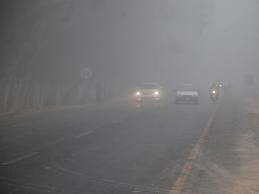
THE density of the fog that has been blanketing parts of Pakistan for some years now has been steadily increasing. Steps urgently need to be taken to mitigate its effects.
Many mistakenly think that the fog that has become the norm during the winters is the natural outcome of falling temperatures and relative humidity. However, fog created in this manner is localised and vanishes as the temperature rises.
The persistence and intensity of the haze currently enveloping parts of the country is actually the effect of the deeper problem of air pollution. While automobile exhaust, the burning of dried leaves and other polluting activities are contributors, the single biggest factor is the use of coal for the generation of electricity in thermal power plants.
In terms of air pollution, South Asia is amongst the most badly affected areas in the world. Unchecked industrial activity that uses fuels that endanger the environment has brought about severe changes in climate, including fog.
Regions that don’t have such polluting industries are not spared either: the levels of gases such as sulphur dioxide, nitrogen oxide and particulate matter have been increasing with pollutants being carried by the wind for thousands of miles. Consequently, pollution is an issue not just for the country that produces it but for other states as well.
The phenomenon of persisting fog during December and January has been increasing in Pakistan over the past 15 years. Its range also includes the Indo-Gangetic plain that stretches from Peshawar to Kolkata and beyond. The single largest contributor to air pollution in South Asia is coal-run thermal power generation.
The consumption of coal in South Asia during 2012 was around 685 million tons in total, out of which 98pc was used in India; the majority of this coal was consumed by the power sector. The share of electricity generated using coal as fuel in India is 71pc, 3.2pc in Bangladesh and 0.1pc in Pakistan. A report by the Centre for Study of Science, Technology and Policy in Bangalore reveals that the quality of Indian coal is very poor, with 35-45pc ash content and low heating value. Thus, the generation of one unit of electricity emits one kilo of carbon dioxide; annually, almost 200 million tons of ash are generated by the use of coal in the power sector.
Energy is vital for growth in India and consequently, the fog that envelopes Pakistan over the winter months has kept pace with its generation and grown thicker. Indian reports on the energy statistics of 2013 say that today India is the ninth largest economy in the world driven by a real GDP growth of 8.7pc. This has placed enormous demand on its energy resources.
The demand and supply imbalance in energy is pervasive and requires serious efforts by the government of India to augment energy supplies. The country faces possibly severe energy-supply constraints. Nevertheless, India is violating transnational environmental laws by creating negative externalities for the countries it shares borders with.
Indian scientists concede that coal-based thermal power plants are major air pollutants, including small particle pollutants — the aerosol.
Recent studies using satellite modelling show a significant increase in aerosols in the Indo-Gangetic plain. Several reports also conclude that the coal supplied to power plants is of the worst quality. This factor, coupled with the low efficiency, results in more pollution. The emission of other, more hazardous gases, fly ash and suspended particulate are responsible for aggravating the greenhouse effect.
Pakistan is suffering from dire changes in its climate. Many projects have been envisaged and some even pursued for remedying global warming, but the lack of clearly identified goals and effective strategies have resulted in zero gains.
Like the fog that envelopes much of Pakistan, these efforts have been draped in a shroud of failed promises and never accomplished aims. Climate change has evolved into an industry in the country but the only effort is in terms of getting funding. Ensuring the implementation of practical measures is hardly on the agenda of any non-governmental organisation working in the climate change sector in Pakistan.
While I appreciate the efforts of the present government for increasing cooperation with India, there is a need to augment these by taking steps to prevent environmental degradation. Pakistan needs to follow the model of the Asean agreement to come up with a ‘Transboundary Haze Pollution’ model in South Asia. At the same time, other countries including Bangladesh, Bhutan, the Maldives, Nepal, and Sri Lanka, have to find the courage to ask India to replace its coal-power plants.
The writer is adviser, water and energy, at the Sustainable Development Policy Institute, Islamabad
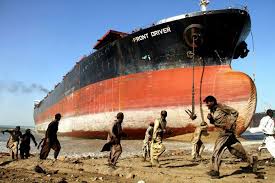
Ship breaking in Pakistan (Credit: customstoday.com.pk)
PARIS, Jan 9: Pakistan, along with India and Bangladesh, remained the market leaders in global ship breaking, with the subcontinent accounting for more than two-thirds of business, a French monitoring group said on Thursday.
In 2013, 1,119 ships went to the world’s breaker’s yards, a decline of 16 per cent over 2012 which was an “exceptional year,” the environmental watchdog Robin des Bois (Robin Hood) said.
The figures “confirm that the ship demolition sector is in good health,” Robin des Bois said.
It is the second highest tally since 2006, when the group began compiling annual reports in an effort to boost transparency in a sector with a contested environmental record.
In terms of number of ships demolished, the three South Asian countries accounted for 50 per cent of ships torn down in 2013.
India, being the world leader, tore 343 ships, or about 26 per cent of total ships demolished.
Bangladesh and Pakistan stood third and fifth in the list with 210 and 104 ships or 16 and eight per cent respectively.
In terms of tonnage, the three South Asian countries accounted for 71 per cent of the worlds scrapped ships. India came in at the top with 2.8 million tonnes or 31 per cent of total metal recycled globally, while Bangladesh and Pakistan accounted for 2.3 million (25 per cent) and 1.4 million (15 per cent) respectively.
India headed the list in both categories, but China was also a big player, ranking second in the number of ships that it demolished and third in terms of tonnage. Pakistan came in fifth (by number of ships) and fourth (by tonnage).
Turkey captured a significant market as it came in fourth by number of ships, tearing down 136 ships (10%) and fifth by tonnage with 514,000 tonnes (six per cent).
Of the 1,119 ships, 667 were scrapped after being held at ports, along with their crew, for failing to meet international safety standards, the report said.
“Port inspections are playing a solid role in cleaning up the world’s merchant fleet,” it said.
Roughly a third of ships that were broken up were bulk carriers, while container ships accounted for one in six – a sharp rise over the last six years.
According to the report, out of 1119 ships that were scrapped in 2013, 387 were bulker, 245 cargo, 180 container ships, 164 containers and 39 Ro Ro.
Environmental concerns
South Asia has long been a graveyard for merchant ships, but it also carries a reputation for poor safety and environmental hazards.
The European Union has approved regulations requiring large EU-flagged vessels to be recycled at approved facilities.
Robin des Bois described the intention as “pious,” given that only eight per cent of such vessels were scrapped at European yards in 2013, and many European ships were given a flag of convenience by their owners for their last voyage.
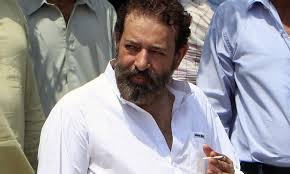
Iron Man, SP Khan, the lead character of the Bollywood movie Shootoutat Lokhandwalaand our own late Sultan Rahi of Maula Jatt fame; my friend, Chaudhry Aslam has been compared with all of these. However, the former three were merely fictional, while Aslam was the real character. After Friday prayers this week, in a leafy suburb of West London, prayers were said for his departed soul with everyone present uttering a louder than normal and heartfelt ‘ameen’ as if they all knew Aslam. This only proved that he had developed a global following, just like all these fictional heroes he has been compared with.
I can recall the early days when I got to know Aslam as a sub-inspector, serving under my late father Arif Jah Siddiqui in District Central, Karachi. Aslam had his first posting as SHO of the Gulbahar police station. Two things were very clear from the onset: he was devoted to eradicating crime and was fearless to a fault. He never had time to deal with the bureaucracy of police work — and believe me, there is a lot of it if you are responsible for a police station or a team. He would delegate all this to his trusted subordinates and instead, took up the onerous task of patrolling the roads and narrow lanes of his area. He always believed that if policemen were doing their jobs out in the open, people could see them and feel more secure, while criminals would think twice before committing a crime. His style was uncomplicated and that was the reason that officers and jawans developed a strong loyalty to him.
Aslam encountered many difficulties during his career; however, his morale was never subdued. He was imprisoned for more than a year and a half. Even during this period in Central Prison Karachi, whenever I visited him, he was in good spirits and this kept the morale of his fellow imprisoned officers and jawans high as well. He was a man with a big heart and took special care of his subordinates and their families, giving both his time and money generously to help them in their hour of difficulty. When he was bailed, he made sure that every member of his team was treated fairly. Finally, all of them were acquitted of the charges that had been levelled against them.
Despite getting rapid promotions, he never gave up frontline detective and investigative work. As a matter of routine, he would be busy all night, seeking information, planning surveillances, plotting raids and travelling to some of the most hostile parts of Sindh and Balochistan to assess the ground realities. This hard work and diligence made him a very successful police officer. He would delegate tasks but would never lose control. The junior officers knew that their boss was very much on the ground, so they had to do their jobs as thoroughly as possible.
The other aspect of his personality was his accessibility to everyone, including the vast network of his informers, journalists, colleagues and friends. He would answer his mobile directly, so much so that if anyone needed to meet him in his office, one would just need to call him on his mobile and he would ask the guard to allow the guest to come through the checkpost. He was a people’s man and had no desire for protocol, a secretariat or a posh office.
From the time he took command of the anti-extremist cell of the CID, he had to severely restrict his movements. Whenever, during my visits to Karachi, I went to see him, we would walk around the CID compound for hours exchanging notes. On occasions, I felt that he had huge pent-up energy, which needed to be released but he did not have the luxury to vent it like a normal person would, by freely moving around the city and socialising. On these instances, he came across as a lion in a cage, pacing the available space up and down.
Aslam had made many enemies, a negative fallout for all diligent police officers. The principal reason for this was that he was among the very few officers, who had the courage to take action against all types of criminal syndicates operating in Karachi. There have been some discussions about his approach towards eradication of crime. He has been marked as brutal and unforgiving. I question these commentators as they may not know the circumstances under which these officers are required to keep the average citizen safe and secure. They work on severely depleted resources, are under constant threat as are their loved ones and know that one wrong step can get them embroiled in litigation, and they may even end up facing imprisonment. Is there any other profession where a person takes on such enormous risks? One should not forget that the police service is merely a reflection of the society it serves and we fall far short of being an ideal society.
Aslam’s martyrdom is an international tragedy. His work has been instrumental in stopping large terrorist attacks in Pakistan and other countries. He delivered results at the frontline of the war on terror and in the end, gave his live in protecting innocent citizens, and eradicating crime and terror from this world.
I met him on January 31, 2013 at the funeral of another martyred officer. Little did I know that this would prove to be our last meeting. I pleaded strongly with him that he should take a break from this madness of fighting terrorism and come with me to the UK. He responded in his typical friendly style, “Aftab bhai would you take the whole of Karachi with you?” I said I could not do that but wanted him to come with me, and he said, “Bhai, don’t worry. I will be okay here,” and that was Aslam. I will always remember him as a man of high morale and a police officer dedicated to his profession to a fault.
Published in The Express Tribune, January 12th, 2014.
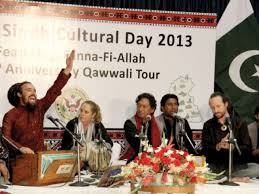
KARACHI, Dec 8: The demand for Sindhi topis and Ajraks doesn’t only skyrocket on the Sindhi Cultural Day but has become a year-round fashion statement.
While the use of Ajrak in villages has always been quite common, in the cities it was used mostly on special occasions, such as wedding ceremonies. But according to people in the business, the demand for the traditional attire, even in urban areas, was never as high as in 2013.
“Most of the younger generation didn’t like topi and Ajrak but the trend has changed now. They like to buy it in different colours and of good quality,” commented Abdul Ghafoor from Tando Muhammad Khan.
The demand for painted Ajrak is still low as compared to the printed ones since the latter are much cheaper. The printed Ajraks are sold between Rs500 to Rs800 while traditional ones, which are mostly painted by hand, start from Rs1,000 and can go up to Rs5,000.
“Thousands of printed Ajraks can be made in a single day while a traditional Ajrak needs time,” said Ajrak maker, Fayaz Hussain Soomro, from Tando Muhammad Khan, adding that it takes 20 to 25 days to make 40 traditional Ajraks. “The work is quite technical and requires concentration.”
The main Ajrak market is in Hyderabad and its surrounding areas, including Hala, Bhitt Shah and Tando Muhammad Khan. The Sindhi topis, according to its makers, have also become quite popular because of their colours and styles and remain more popular than Ajrak.
Global celebrations
The 5th Sindhi Cultural Day, which will be celebrated today [Sunday], is being celebrated with fervour not only across the province but also in America, Canada and the United Kingdom where Sindhi families and students reside in large numbers.
Multiple political and nationalist parties, civil society organisations and communities have planned to arrange walks in small towns and big cities for the revival of Sindh’s heritage. Rallies from different parts of Karachi will converge outside the Karachi Press Club.
Rallies, charged with popular folk songs such as ‘Jeay Sindh Jeay, Sindh Wara Jeayan’, were organised during the last week along with activities, such as ‘Mach Kachehries’.
Apart from Sindhis, people from other ethnic groups, swathed in the indigo block-printed Ajrak, Sindhi topis and patko with white dresses, also took part in the festivities.
Intellectual direction
The cultural day is being celebrated on the theme ‘Aikta Day’ [unity day] which Sindhi writers, poets and intellectuals think is quite fitting, saying, “This day, which falls in the last month of the year, has united different clans under a single banner.” They believe that soon, the day will not only be about wearing Ajrak and Sindhi topis but will be given a constructive direction. “It is a good sign that people own their cultural identity. It is a sign of life. It also indicates that the culture has diversity,” said renowned writer and poetess Amar Sindhu.
While talking to The Express Tribune from Lahore, Sindhu said that while the passion was visible, the spirit of Sindh was still missing from the event. “The [Sindhi] culture has gathered people from all walks of life and now it has become a mass culture. No one can stop it now.”
Poet Masroor Pirzado also called it a day of showing unity. “The sense of cultural celebrations and unity will reduce hatred among people and will lessen extremism in the society,” said Pirzado. “The cultural day should not be restricted to only wearing topis, ajrak and dancing on folk songs. It must also change attitude of the people to understand their cultural values.”
Published in The Express Tribune, December 8th, 2013.
KARACHI, Dec 4: “On the one hand we have schools being destroyed but on the other there are also mothers bringing their children to the book fair to buy them books,” said chairman of the Pakistan Publishers & Booklovers Association central committee, Aziz Khalid, at a press conference ahead of the ninth Karachi International Book Fair (KIBF) on Tuesday.
“KIBF has for the past nine years been showing to the world that we are peace lovers, book lovers and that we care about education. It has been creating a soft image of Pakistan for the rest of the world,” he added.
The book fair organised by the Pakistan Publishers & Booklovers Association in collaboration with the National Book Foundation will be held from Dec 5 to 9 in three halls of the Karachi Expo Centre. “The fair will be inaugurated by Sindh Senior Minister for Education and Literacy Nisar Khuhro and will remain open for the general public from 10am to 9pm on all the five days,” briefed the convener of the fair, Owais Mirza Jamil.
“There will be places for new authors to introduce their books to readers while also networking with publishers. There will be several book launches, and activities planned for children, too,” he said, adding that booking for stalls became tight some one month back and they were completely booked some 15 days ago. Textbook boards and educational institutions get complementary stalls, of course.
“There are 300 stalls in the three expo centre halls but next time we will try booking more halls in order to be able to offer more halls. There is also international participation in the fair from the UK, the US, Iran, Thailand, Malaysia and India. And we are expecting over 400,000 visitors this year,” he said.
Meanwhile, Mr Khalid returned to the rostrum to inform the media that besides showcasing educational books, the KIBF would also offer books in different regional languages published locally. “There will be Sindhi books published by the Sindhi Adabi Board and Pushto books published by the Pushto Academy along with law books, medical books, children’s books and religious books,” he said.
“Last year the visiting Indian publishers also brought with them several Sindhi books published there, which were sold out almost immediately,” he said.
In reply to a question about visas for the Indian publishers coming to the book fair, he said: “Well, there are supposed to be 20 Indian publishers coming here this time but this works on a reciprocal basis. Last year only two Pakistani publishers got visas to enter the Dehli Book Exhibition, too,” he said.
About the rising cost of books, Mr Khalid said it was due to the high costs of paper. “We produce little paper locally and there is a heavy duty on imported paper. If we cannot fulfil the paper requirement of the country, and education is to be spread here, our government needs to rethink its policy on paper imports,” he said.
Malahat Kaleem of the Library Association of Pakistan, who was also attending the press conference, urged the media to raise the issue of making books printing easy in Pakistan. “There are foreign publishers investing in India. They publish their books there as the paper is cheaper there just like the labour. We in Pakistan are losing out in this area,” she said.
KIBF deputy convener Waqar Matin Khan and Liberty Books director Saleem Hussain were also present.
ISLAMABAD, Dec 2 — Unidentified gunmen opened fire on the office of a leading news media group in Karachi on Monday evening, wounding a security guard and underscoring the threats journalists face in the country.
The motive of the attack, on the offices of the Express Media Group, remained unclear, and there was no immediate claim of responsibility.
Pakistan is one of the world’s most dangerous countries for journalists, who face frequent harassment and intimidation here from a variety of groups, including the Pakistani Taliban and other militants, state security forces and intelligence agencies, and local political and criminal groups. So far this year, at least five journalists have been killed. And 44 more have been killed over the past decade, according to the New York-based Committee to Protect Journalists.
The Express Media Group publishes an Urdu-language newspaper and an English daily, The Express Tribune, which is a partner publication of The International New York Times. The group also owns the Urdu television network Express News.
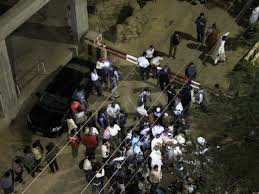
The number of attackers was not immediately clear, said Bilal Lakhani, the publisher of The Express Tribune. The gunmen opened fire on the building at 7:10 p.m. from an adjacent bridge. However, they did not try to approach the main entrance, located in a narrow, barricaded alley off the main road. Security guards on the rooftop of the building fired back, and the attackers fled, Mr. Lakhani said.
Though the Pakistani Taliban did not claim responsibility for the attack, some officials believe that recent threats suggested that they were probably behind the shooting.
Most recently, the Taliban criticized the news media for praising the Indian cricket star Sachin Tendulkar, who retired in November.
One employee of Express Media Group speculated that Monday’s attack might have been a reaction to a recent news article in The Express Tribune that said Taliban militants had been hiding in the Defense Housing Authority Phase II neighborhood, an upscale district of Karachi.
The attack on Monday was the second time the office had come under fire in recent months. In August, four unidentified gunmen opened fire at the office, wounding a security guard and a woman. Extortion — which is rampant in the city considered to be the country’s commercial and industrial hub — was thought to be the motive of that attack, according to police officials.
Sultan Ali Lakhani, the chief executive of Express Media Group, said that the company was taking the attacks very seriously, and that he planned to increase security at the main office.
Still, he said staff morale was “great” despite the two attacks in four months. “They are journalists,” he said. “They are used to such stuff.”