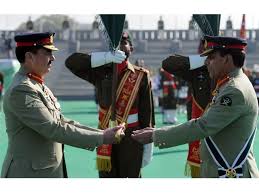
Raheel Sharif new army chief (Credit: tribune.com.pk)
ISLAMABAD, Nov 29: Outgoing military chief General Ashfaq Kayani on Friday handed over the command of the army to Chief of Army Staff Gen Raheel Sharif.
He passed the baton of command to Gen Sharif at a ceremony held in the Army Hockey Stadium, close to the General Headquarters (GHQ).
The entire area around the venue of the ceremony was blocked off with military and police personnel deployed in the area. Except for the invitees, no one was allowed to move into the area.
The change of command ceremony was attended by federal ministers, services chiefs, diplomats and senior serving and retired officers.
Speaking at the ceremony prior to handing over the baton of command to Gen Sharif, Kayani said leading Pakistan army was an honour for him. He said during his time as army chief he had experienced a wide array of challenges on which the military focused its full attention as a national institution.
The military worked with honesty and dedication, Kayani said, adding that it was only through the sacrifices rendered by the soldiers and the officers that peace could be established in some of the most challenging parts of the country.
He said the army had never disappointed the nation, the support of which was imperative for the military to continue its work with dedication.
He paid his respects to those killed during the “difficult time” that the country was going through, including the women and children whose lives were lost.
On Wednesday, the government had announced career infantry officer Raheel Sharif to succeed Kayani. Gen Rashad Mehmood was named the chairman of Joint Chiefs of Staff Committee the same day.
Just prior to his appointment, Gen Sharif was serving as Inspector General Training and Evaluation with the rank of a Lt General.
Gen Sharif also holds the Hilal-i-Imtiaz military award, and is the younger brother of late Major Shabbir Sharif, who received the Nishan-i-Haider for his services in the 1971 war.
Gen Sharif’s selection as army chief selection implies that frontrunner and the senior most military officer Lt Gen Haroon Aslam was ignored for the elevation. Lt Gen Aslam retired soon after the latest key military appointments.
The post of army chief is arguably the most powerful in Pakistan and anxiety had prevailed in Pakistan on who will replace the taciturn, chain-smoking Kayani.
Kayani’s retirement from the post comes after rules were relaxed to grant him an extension in July 2010 by the PPP-led coalition government in what then prime minister Yousuf Raza Gilani said was in the interest of continuity at a time when the war on terror was successfully continuing against elements who wanted to impose a system of their choice on the country.
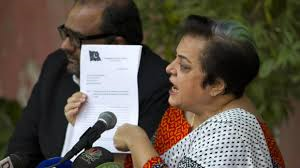
Shireen Mazari at press conference (Credit: watchinga.com)
The political party of the former cricket star Imran Khan on Wednesday identified a man it described as the Central Intelligence Agency’s top spy in Pakistan, in an escalation of Mr. Khan’s campaign to end American drone strikes in the country.
In a letter to the Pakistani police, Mr. Khan’s information secretary, Shireen Mazari, accused the C.I.A. director, John O. Brennan, along with a man identified as the agency’s Islamabad station chief, of “committing murder and waging war against Pakistan.”
In Washington, a C.I.A. spokesman declined to comment on the case.
Ms. Mazari demanded that the authorities prevent the station chief, whose identity has not yet been confirmed, from leaving the country so that he can face prosecution in a Pakistani court.
That seems unlikely, but the move is expected to infuriate American officials, who had to recall a previous C.I.A. station chief in 2010 after he was identified in the local news media, also in relation to a legal suit brought by anti-drone campaigners.
But while that outing was blamed on smoldering tensions between the C.I.A. and Pakistan’s Inter-Services Intelligence spy agency, this time it appears to be driven more by Mr. Khan’s increasingly confrontational stance against drone strikes.
In an appearance on a television talk show on Wednesday evening, Mr. Khan said he had named the station chief essentially to punish the C.I.A. for a deadly drone strike this month in the province his P.T.I. party controls, Khyber-Pakhtunkhwa. Now, he said, it was up to Prime Minister Nawaz Sharif’s government to take the next step against the American spy agency.
He has vowed to block NATO supply lines into Afghanistan in retaliation for the Nov. 1 drone strike that killed the leader of the Pakistani Taliban, Hakimullah Mehsud. On Saturday, his supporters moved to deliver on that promise by searching trucks and roughing up drivers as they passed through Khyber-Pakhtunkhwa province on the way to Afghanistan.
In her letter on Wednesday, Ms. Mazari claimed that the station chief did not enjoy diplomatic immunity, and suggested that if interrogated by the police he might divulge the names of the pilots who fly the drones.
The high-profile attempt to obstruct C.I.A. operations in Pakistan was said to be a response to the Nov. 21 drone strike that struck a seminary linked to the Haqqani network, a Taliban-affiliated militant group at the center of American security concerns in Afghanistan. The strike, which killed the Haqqanis’ spiritual leader and five others, occurred in the Hangu district of Khyber-Pakhtunkhwa, in a rare drone strike outside Pakistan’s tribal areas.
Mr. Khan has been a leading advocate of ceasing military action against the Pakistani Taliban, even though Khyber-Pakhtunkhwa has been the region hardest hit by Islamist violence this year, with hundreds killed in attacks. The Taliban also sprung several hundred prisoners to freedom in an embarrassing and well-organized jailbreak in July.
Mr. Khan has used the drone issue to leverage his popularity against Prime Minister Sharif, who is his main electoral competitor in Punjab Province, and indeed has largely succeeded in framing the political debate on drones in recent years.
Some Sharif supporters criticized Mr. Khan for trying to score political points by outing the C.I.A. station chief. “This a thoughtless move,” said Siddiqul Farooq, a central leader of the governing Pakistan Muslim League party. “It is selfish and compromises the national interest.”
Since the escalation of the C.I.A.’s drone war in Pakistan in 2008, the Islamabad station has grown to become one of the spy agency’s largest outposts in the world. The agency’s expansion in Pakistan has been an irritant to America’s relations with Pakistan, with one of the low points coming in January 2011 when an agency contractor, Raymond Davis, shot and killed two men in Lahore.
The influence of the C.I.A.’s Islamabad’s station chief has sometimes eclipsed even that of the American ambassador in Pakistan. A previous station chief clashed repeatedly in 2011 with Cameron Munter, the ambassador at the time, over the intensity of the drone campaign. The Obama administration ended up siding with the C.I.A., and Mr. Munter later resigned.
When the identity of an earlier C.I.A. station chief was made public in 2010, it was also as part of litigation related to the drone campaign. But such court applications are mostly seen as public relations devices, and at the time American officials privately accused the ISI spy agency of a gross breach of trust.
While the C.I.A. station chief discloses his identity to senior Pakistani intelligence officials, he is technically a covert operative and his name is not commonly known in Pakistan or elsewhere.
The C.I.A. did not say whether its station chief would be affected by Wednesday’s action. Similar disclosures in Israel in 1999 and Argentina in 2001 led to the C.I.A. station chiefs in those countries being recalled to the United States.
Reporting was contributed by Salman Masood from Islamabad, Pakistan, and Mark Mazzetti from Washington.
The Nawaz Sharif government – perhaps because of its history of emerging from the womb of the army – is eliminating ‘bad Taliban’ much more covertly than its predecessors.
Behind the angry posturing of Pakistan Muslim League (N) interior minister Chaudhry Nisar Ali Khan and a coterie of politicians publicly denouncing the US for `sending a drone through peace talks,’ the US and Pakistan are coordinating against Taliban militants who threaten Western interests and attack inside Pakistan.
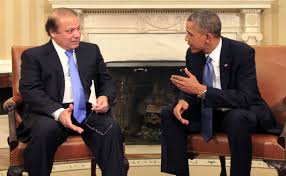
The discrepancy between what Pakistan says and does, came to light on Oct 23, when prime minister Nawaz Sharif met US President Barak Obama and denounced drone attacks. Around the same time, victims of drone strikes in Pakistan testified in the Capitol against the killing of innocent people in the tribal areas.
But US House of Representatives Foreign Affairs Committee member, Alan Grayson gave food for thought when he told the media: “With all due respects to an ally, it is well within Pakistan’s capability to end those drone strikes tomorrow.” He called Pakistan’s air force “very powerful,” – with the capability of controlling its own air space.
So long as the US calls the shots and gives aid to Pakistan, the government uses its officials to counter public anger. While the interior minister Chaudhry Nisar is the “bad cop,” who spews anger at the US for “violating Pakistan’s sovereignty,” the prime minister’s advisor, Sartaj Aziz is the “good cop,” promising the US will halt strikes during talks with the Tehrik-i-Taliban Pakistan.
It is an old military strategy with a new set of characters. Mark Mazetti, author of the `Way of the Knife,’ writes that Pakistan asked the US to launch its first predator drone strike in 2004 to eliminate tribal leader, Nek Mohammed, after he led a rebellion against the state. Afterwards, Pakistan claimed it had fired the missile that killed the tribal leader who it had once patronized.
Apparently, like his predecessors, Nek Mohammed and Baitullah Mehsud, the Tehrik-i-Taliban Pakistan (TTP) commander – Hakeemullah Mehsud – killed in a drone strike on Nov 1 – had become dispensable. The US offered $5 million for his capture after Hakeemullah coordinated with a Jordanian agent in December 2009 – and wiped out a sizeable staff of CIA employees stationed in Khost, Afghanistan. Pakistan too put PKR 50 million head money on him for his lethal attacks against the state.
Before the drone was lobbed against Hakeemullah, the government let the garrulous media chatter about its plan to engage with its Taliban militants. It simultaneously took JUI (F) chief Maulana Fazlur Rehman into confidence about arranging a “peace meeting” with the Taliban in North Waziristan.
But as events unfolded, Sharif’s visit to Washington.. followed by his announcement from London, Oct 31 that “peace talks with the Taliban have begun,” .. were met by puzzled silence in Pakistan. The TTP spokesman, Shahidullah Shahid told journalists the same day that they were unaware of any talks. And, parliamentary leaders publicly complained that they had been kept in the dark.
Still in North Waziristan, months of friendly communiqués between the government apparently put militants at ease. The administration’s imposition of curfew added to the impression that it was for upcoming TTP-government talks. On Nov. 1, the Taliban gathered in a mosque near Hakeemullah’s sprawling farm house – bought by his cousin, Latifullah Mehsud – for a meeting on whether to talk to the government.
The US had set the ball rolling to nab Hakeemullah shortly after NATO troops snatched Latifullah in early October from the custody of Afghan intelligence officials – and interrogated him at Bagram base. Latifullah was a key link between the Taliban groups in Pakistan and Afghanistan. The Karzai government had planned to use him as an interlocutor in “peace talks” with the Taliban, despite the TTP’s known role of attacking state institutions inside Pakistan.
These increased cross border attacks have in recent months caused Pakistan’s Foreign Office to complain that Afghanistan is being used as a safe haven for TTP militants.
For two days, US drones fired missiles into North Waziristan.. searching for their target. The second attack on Nov 1 was successful. Hakeemullah and his two companions were killed outside his $120,000 farm house, after the TTP returned from the mosque meeting. Neighbors reported surprise at seeing the Taliban commander before his vehicle was struck. Hakeemullah was understandably a rarity here, being on the run from drone attacks that occur mostly in this Pak-Afghan border area.
With the assassination of the TTP chief, and his replacement by Mulla Fazlullah – who escaped the 2009 military operation against him in Swat – an enraged Taliban pledged attacks on the military and senior government officials in the Punjab for being a “slave” of the US.
But, Islamabad says it will continue to pursue peace talks with its Taliban. In so doing it has found Pakistan Tehrik-i-Insaf chief Imran Khan’s reactions especially useful to soak up the anger. Khan’s visible shock at Hakeemullah’s assassination – and angry moves by the PTI and religious parties toward stopping NATO convoys to Afghanistan has served to deflect attention and let off steam.
It is the same strategy that Gen. Musharraf used after 9/11 -when public anger at the US invasion of Afghanistan helped propel the coalition of Islamic parties, Mutehidda Majlis-i-Amal in the border areas. Then too, the US was allowed to become the favorite whipping boy of the masses.
But as the US prepares for withdrawal of its troops from Afghanistan in 2014, it is less interested in Pakistan’s domestic politics and more in achieving its aims. Only a day after Sartaj Aziz said that drone attacks would be temporarily halted while it talks to the TTP, the US lobbed a drone missile over a madressah in the settled Hangu area and killed members of the Haqqani network. These Afghan Taliban were instrumental on attacks on NATO troops in Afghanistan.
The killing of Afghan Taliban financier, Naseerullah Haqqani in Islamabad also indicates cross intelligence agencies at work… and a falling out between multiple Taliban groups, once loosely commandeered by Hakeemullah Mehsud.
Meanwhile, the federal government – which earlier found Imran Khan’s anger “useful,” is less amused that he is carrying out his threat to block NATO supplies as a lever to stop drone attacks. That is being treated as an attempt to disrupt law and order.
As a dozen years of war has revealed, the younger generation of Taliban is angrier and less controllable than the militants trained by Pakistan in the 1990s to take over Afghanistan. Indeed, there is a shortage of “good Taliban,” like Mullah Omar, Mullah Baradar and the Haqqani network.. taking refuge in Pakistan.. who merely attack NATO troops in Afghanistan and don’t attack state interests within Pakistan.
Instead, the Taliban today fight the US, Afghanistan and Pakistan.. even as they forge bonds across the Durand Line. This so called border between Afghanistan and Pakistan is ignored from Pashtuns from both sides, at the cost of growing militancy in the region.
Inside Pakistan, the failure to tell the truth to nearly180 million people fuels the conspiracy theories being regurgitated in the media. While the Western world acts out of their own interest, officially naming it as the scapegoat has only served to spew venom and hatred toward outsiders.
In this complex scenario, how Pakistan gets rid of its ‘bad Taliban,’ while deflecting anger away from it.. and simultaneously gains a foothold in Afghanistan.. will be a high wire act worth watching.
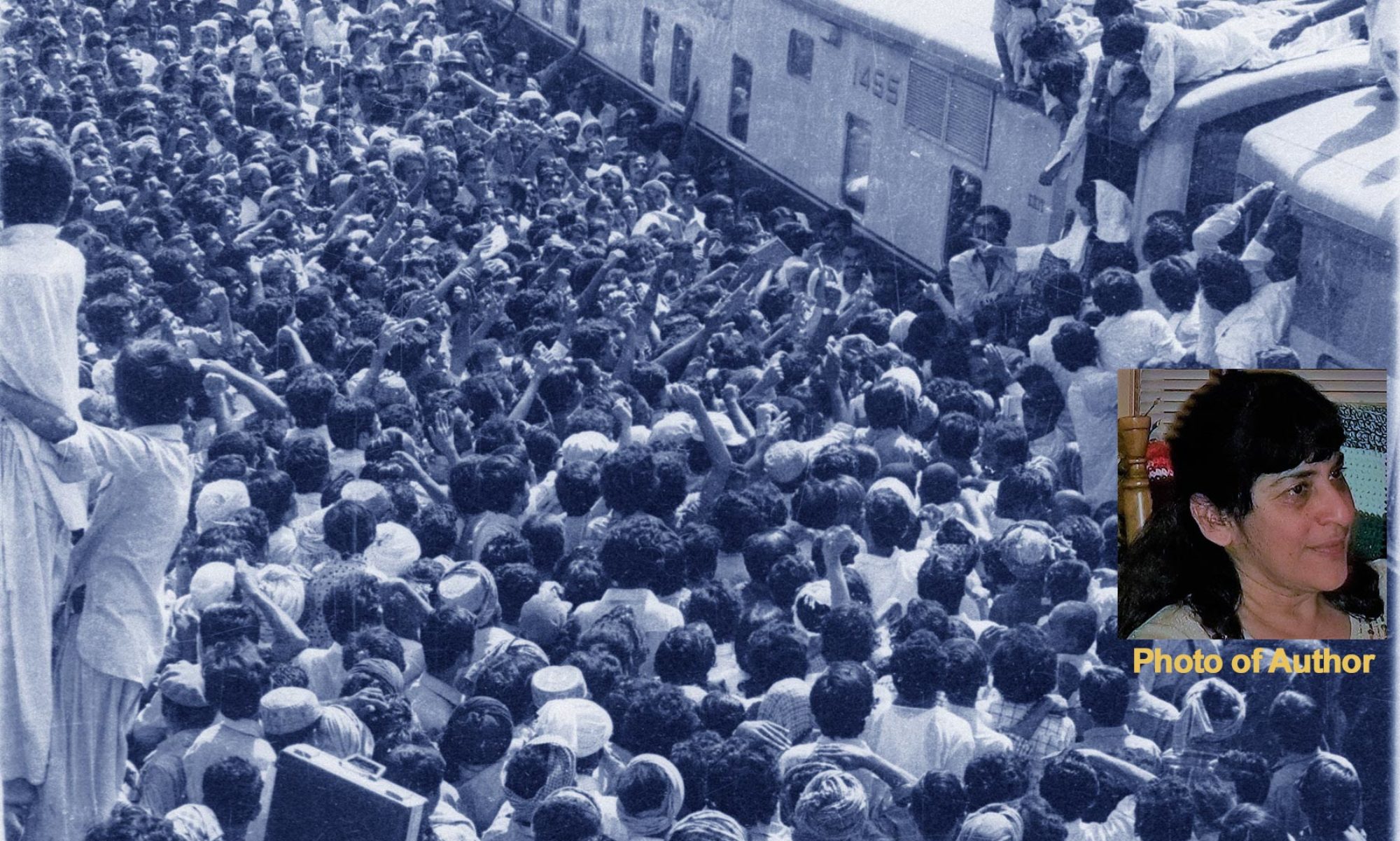
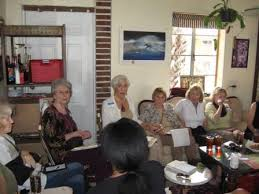
The UN Women/USNC Gulf Coast Book Club met on Monday, November 4, 2013 to discuss Aboard the Democracy Train: A Journey through Pakistan’s Last Decade of Democracy, by Nafisa Hoodbhoy. Hoodbhoy was raised by an educated, prosperous family in Karachi among Christians, Zoroastrians and Hindus. She studied history in the United States and returned to become the only woman reporter for Pakistan’s leading English language newspaper, Dawn. Her sixteen-year journalism career began during the Islamic oppressive era of Gen. Zia ul Haq, but her book focuses on “the nation’s whiff of democracy” as she covered Benazir Bhutto’s chaotic campaign to become prime minister as head of the Pakistani People‘s Party.
A photo of Bhutto’s train serves as the book’s cover. Just looking at the riotous crowds around, on top of, and jammed inside the train gives the reader a hint of the bedlam that surrounded Pakistani politics between 1988-1999, and culminated in Bhutto’s assassination. Hoodbhoy also explores Pakistani-Afghan politics, observing that the region’s future hinges much on the situation in Afghanistan, and tribal insurgencies in Pakistan .
Hoodbhoy’s perspective on women’s rights is surprisingly optimistic. She notes the power of social media, organizations such as “War against Rape,” and a Citizens Education Development Foundation that educates girls and boys at home before sending them to regular schools.
Sharon Burde, President of UN Women Gulf Coast Chapter, shared insights of her conversations with Hoodbhoy. We were fascinated to learn that though strong traditions and customary laws still keep most women indoors, Hoodbhoy visits Pakistan regularly.
Readers found the book very informative, if challenging, with its kaleidoscope of people and events, as complex as Pakistan itself. Many cliff-hanging episodes keep one glued to the page, such as an incident when the author is followed to her house by a would-be assassin who jumps from his car flashing a long knife just as she whisks inside the gate.
Nafisa Hoodbhoy’s harrowing experiences and political insights make her book required reading for understanding her part of the world.
(To learn more about Nafisa Hoodbhoy’s activities, please visit her web site: http://www.aboardthedemocracytrain.com)
Future readings include:
December However Long the Night: Molly Melching’s Journey to Help Millions of African Women and Girls Triumph (The story of TOSTAN Senegal/Africa)
January The Almond Tree, by Michelle Cohen Corasanti (Israel/Palestine)
February Peony, by Pearl S. Buck
March Ruth Prawer Jhabvala: Select any or all of this incredible author’s works, e.g., Heat and Dust, The Householder, My Nine Lives, A Love Song for India
April Alesandra Olenka de SasKropiwnicka, Olenka and/or Love Conquers All, Olenka in Africa (Polish Holocaust survivor) (available on Kindle, Amazon)
May Danticat, Edwidge, Claire of the Sea Light (Haiti)
June Giocanda Belli: The Country Under My Skin (Nicaragua)
CHAGAI, Nov 17: The CEO of Tethyan Copper Company (TCC) manages to wear local attire (shalwar kameez) for a meeting with the then chief minister of Balochistan. An hour prior to the meeting, I go and meet the secretary mines who is busy in other matters.
As he sees me: “Oh yes, we do have a meeting in one hour, let me call the section officer concerned to give me a briefing.”
A project of national importance is going to be discussed and the secretary wants to have a briefing of just a few minutes from his section officer before he goes for the meeting for a multi-billion-dollar project that could change the fate of the country and the province.
As the TCC team walks in, greeted by the then chief minister and seated, the meeting starts with the chief minister in his humorous style, saying: “We are going to do the project ourselves.”
At first, I thought that he was just joking but when he repeated the sentence three times, I could realise that it was the end of his humour. It seemed that all including the secretary finance and the secretary mines were taken by surprise. I, being the only person in that room who had physically monitored the execution of a similar project (Saindak copper and gold project), replied: “Sir, there is no way that you can do the project yourself and I can tell you why?” But he was not ready to listen.
Another meeting followed with a very senior officer of the government of Balochistan. During this half-hour meeting, we had no eye contact understood that perhaps this upright and honest man had to toe the line of his boss and did not want to say what he had to.
TCC, Saindak project and NFC award were discussed and my apprehensions expressed during this meeting unfortunately proved to be true as nowhere could be seen the kind of development against the amount of funds spent from the NFC award. Where has all that money gone?
The desire of the then provincial government to operate a copper project could have been a dream fulfilled by taking over the already operating Saindak project but this somehow never happened. The same running contract was simply extended rather than being negotiated for much better terms that could have become an additional source of revenue for the province.
This is where the previous government miserably faltered, on one hand, adamant on working on the Reko Diq project and on the other hand let the Saindak project slip away. Money for jobs further added to the agonies of the masses in Balochistan.
The delay due to indecisiveness by the government made the TCC to shift its stance from specific performance to damages claim. The country can face dire consequences and it can be devastating in case the decisions in international courts go against the government. The claim against damages could amount to billions of dollars and at this stage, the country is in no position to meet such a liability.
Although elaborated by the present CM on the floor of the house several times, there seems to be a very strong restraining factor that is not allowing the government of Balochistan to initiate fresh negotiations and an out-of-court settlement with TCC that could prevent an impending “calamity”.
While there is still time before the proceedings in international courts kick off in January 2014, the province should be allowed to take a decision unilaterally on merit before it is too late.
Deprivation in Balochistan is the main impeding factor and this project has the capacity to eliminate this deficiency.
It would be a wishful thinking for the present government to fix responsibility for merely extending the Saindak contract rather than it being negotiated for much better terms for the province or for the Saindak project being run by the provincial government instead?
At present, 1,250 Pakistanis with a supervisory staff of only 200 Chinese are running the Saindak project. Surprisingly, there have been no serious counter-checks or monitoring of the blister copper that is being exported.
In spite of the passage of 18th Amendment, it is yet to be seen that this amendment is implemented in letter and spirit in Balochistan in particular. However, if the Council of Common Interests (CCI) was religiously followed, it could transform into an effective mechanism to regulate centre-province relations, upholding the constitution, but the CCI is also being taken too casually.
The use of force combined with the centre’s denial of an absolute political and administrative autonomy and authority to the Balochistan government is further fuelling the grievances of the Baloch, thereby incapacitating the present chief minister in addressing their grievances and bringing them back to the political mainstream.
Although the chief minister has the acumen, the will and the desire to change the fate of Balochistan and its people, but this can only be possible provided entire trust is reposed in him by the centre and he is fully empowered to make this dream come true.
The writer is the former project director and deputy managing director of Saindak Copper Gold Project, Chagai district, Balochistan
Published in The Express Tribune, November 18th, 2013.
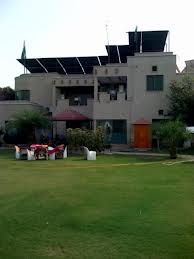
On an average summer’s day when the rest of Lahore sullenly waits in the heat for the electricity to return, Shahid Razzaq’s family lounges peacefully, their air conditioner running and all appliances working. While in other households the sudden and frequent power blackouts are greeted with groans and resigned sighs, the Razzaq family doesn’t even notice. And they certainly never have to switch on a generator.
That’s because they’re almost completely ‘off the grid’, having tired of the vagaries of Wapda some time back. Instead, they turn to what they consider to be a far more reliable source of power: the sun. And in a city that experienced up to 20 hours of loadshedding in a single day last summer, this is no small blessing.
Fed up of the never-ending power crisis, Razzaq took the plunge and installed solar cells on his roof. Of course he hasn’t yet fully cut the Wapda cord.
“We actually have a hybrid system running,” he says. “During the day when the sun is out, we use the solar cells. At night we shift to Wapda. Usually before we switch over, we know that we have about eight hours of backup electricity that has been generated during the day.” Razzaq appears to be content with this solution, as would anyone who isn’t sweating thanks to what is one of the most persistent problems in Pakistan.
Appliances that run on solar power in this house include two freezers, a television, computer, iron, microwave and, amazingly enough, two air conditioners.
“I can use anything and everything at home,” says his wife. “Never has life been so peaceful.”
Razzaq says that he has installed solar cells of six kilowatts. “But one can even get higher wattage and run only on solar power instead of using a hybrid line. In fact we have a surplus of electricity during the day time.”
Unfortunately, this surplus is more or less wasted here. In other countries surplus electricity is given back to the grid station and the same amount is returned to the consumer in the shape of free units through smart meters. But not in Pakistan.
“If only we could have this advantage, things would be so much easier and fair for the average citizen trying to actually conserve electricity,” he says.
His son-in-law, Moez Naseer, who is coincidently a software engineer in a solar power firm, explains that if the government shifts ever so slightly with regard to its policies and introduces one that allows citizens to generate their own electricity, everyone would be better off.
“Think of all the benefits of just one simple policy,” he says. “The government’s provision of electric power would meet the demand better, instead of being at a deficit all the time. For the consumer, it would be slightly expensive but at least he would get uninterrupted power, and it would be a relief to solve your power issues on your own.”
They both stress that if the government would take this into serious consideration, this would prove to be a landmark step towards the future of energy in Pakistan.
It is true that the initial investment cost was high for Razzaq. “For our six kilowatt solar panels, including the batteries, the invertors, installation, etc. it all came to about Rs900,000. But that is nothing compared to the running cost of fuel used in a generator, not to mention the fact that you’re using up fossil fuels, and causing both air and noise pollution. Our decision to install solar panels did not just revolve around the financial aspect, although of course that was a major part of it. Our decision was also based on the environmental aspect.”
Razzaq has installed 34 solar panels of 235 watts each, costing up to Rs80 per watt. Cleverly he has not been sucked into branding and has instead imported unbranded panels from China, and has had them installed separately. The batteries are of 200 Amp each and he must use eight batteries to provide him for four hours backup everyday.
“We use the ACs but if someone doesn’t want to consider putting up an AC in his house or office, then the cost can come down greatly,” he says, giving an estimated decrease of about Rs0.5 million at least for the initial installment. “There is really no maintenance cost, except taking care of the batteries and having them changed every seven years or so. But that is nothing compared to the maintenance cost of generators.”
With this investment, they find that the durability is a lot to boast about. The batteries can last up to seven or eight years (there are dry ones that he uses but wet batteries can also be used), while the solar cells can last up to 25 years. In winter or in an overcast day the yield will definitely be less, but then so is the overall pressure on the grid. But perhaps the greatest sign of the success of his approach is the amount of people who ask him how his system works.
Razzaq argues that the more people who opt to go solar, the lower the overall cost will become. Not only will there be greater competition in the market, but banks may also launch products that make it easier to finance solar-powed solutions. And there is certainly a great deal of interest in solar power, as evidenced by the interest people show in Razaaq’s solution.
“A lot of people have shown interest in this and have asked me to help them out,” he says. “The best part is that there is no harm being done to the environment in any way, and that there is just no ‘wastage’ of electricity: it’s clean energy, and Pakistan should seriously tap into this on a local and governmental level,” he says.
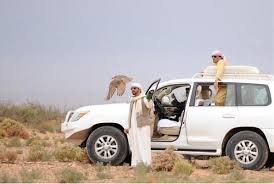
Hunting Houbaras (Credit: uaeinteract.org)Every winter Pakistan plays host to two exceptionally diverse species of visitors. The first to arrive are the Houbara bustards, taxonomically classified as ‘chlamydotis undulata’. Conspicuous by their quiet, peaceful and graceful arrival, they bring with them a sense of beauty, serenity and diversity. They live on seeds and insects and enrich our harsh and arid ecosystem with their breathtaking presence.
In sharp contrast the second category of visitors is the rich, self-indulgent and uncouth ruling class of the Gulf countries. These predators arrive with plane loads of arrogance and pomposity (disguised in holy appearances), with a singular objective of annihilating the peaceful and harmless migratory birds.
Complicit in this crime is the environmentally insensitive government of Pakistan. Instead of protecting and preserving these magnificent birds, the government promotes this massacre by eagerly offering “permits to kill”. These documents are essentially void ‘ab initio’ as the hunting of the internationally protected migratory bird is banned under various local and international conservation laws.
These unending violent encounters have resulted in near extinction of the endangered rare birds and dilapidation of the little that is left of our dwindling environments. There is yet another negative fallout of this illegal and unethical yearly carnage which may be termed as the ‘houbara vehicle’ syndrome. At the end of the killing season, there are scores of unregistered, non-duty paid, foreign license plate vehicles that the affluent visitors leave behind as gifts, bribe or charity to the local hosts and officials. A small price to pay for continuing a racket that would earn anyone a place behind bars anywhere in the world.
Now imagine for a moment, the PM of Pakistan driving in a Gulf country in a car with Pakistani number plate. He will certainly be stopped by the ‘shurta’, fined and forced to follow the law. How come hundreds of vehicles carrying Gulf number plates are driving with complete impunity in Pakistan for past several years. Why has our police not been empowered to check these fraudulent vehicles that are neither duty-paid nor registered in Pakistan. A nuclear state’s police ought to have the courage and confidence to flag down a ‘houbara vehicle’ and either impound it or send it back to the country it came from.
ISLAMABAD, Nov 13 -With more than 5,000 signatures on a petition filed in the Supreme Court, Karachi activists hope the judges will take up the murder case of Orangi Pilot Project (OPP) director Parveen Rahman.
These signatures were submitted in the attorney general’s office on Tuesday nearly two months after a three-judge bench, headed by Justice Tassadaq Hussain Jilani, admitted a petition on Rahman’s murder case. Setting aside the objections raised by the registrar’s office, the Supreme Court admitted the plea filed by the Human Rights Commission of Pakistan and the citizens of Karachi. The petition, filed on Tuesday, urges the apex court to take up the case on an urgent basis.
OPP’s Rahman was killed in Karachi in March this year allegedly due to the enmities she made through her work – she worked extensively on the city’s drainage network and water hydrants. A charge sheet on her murder has, however, yet to be submitted in court. The petitioner’s counsel told the court that Rahman’s murderers were still at large and they were being sheltered allegedly by a political party.
The petition aims to draw attention to justice denied to a person who dedicated three decades of her life to redress grievances of the poor in the face of land grabbers, claimed one of the petitions. “Her killers, those who pulled the trigger and those who ordered it, remain at large,” said the director of Akhtar Hameed Khan Resource Centre, Fayyaz Baqir. “No one is there to guard those who dedicate their lives to public service.”
Apart from Baqir, human rights activist Zohra Yusuf and journalist Zubaida Mustafa have also submitted petitions. They have cited the provincial and the federal governments and the provincial police as respondents.
Her works
Rahman was compiling land records of settlements on the fringes of Karachi, which were vanishing into the city’s vastness because of the ever-increasing demand from thousands of families migrating to the metropolis.
According to her colleagues, she had been receiving death threats from land grabbers. In one of her interviews, conducted in 2011, she had stated in detail the nature of land grabbing activities in Karachi and the threats received by her and her colleagues.
Naseemur Rehman, one of her colleagues, told The Express Tribune that if they compromise on this murder of a community worker today, then nobody will dare stand up for the uplift of the poor strata of society. “We will not let this case die in the files,” he added.
TV news channels are supposed to provide information based on facts with objectivity and honesty. Sadly, all this is sorely lacking in the expanding media milieu in Pakistan. Without a touch of Bollywood melodrama and sensation, our news today is incomplete. Our news bulletins have turned news channels into ‘infotainment channels.’ Is it because of the rating competition, marketing considerations or plain lack of professionalism?
While speaking at a private university, a producer of a popular infotainment show on a private TV channel admitted that at least 50 percent of their “show” was based on “fake stories,” and the channel dramatized it in such a fashion that it looked real.
He was speaking about a show that is among the top-rated infotainment show aired on every Saturday and Sunday. It would not be difficult to assess, then, the kind of information we feed our viewers.
One must appreciate the confession made by the producer but was he the only person responsible. Such shows normally have a producer, an assistant producer, a researcher and the anchor himself, who act as a captain because he or she is the one who often face criticism in the media, whether it is his or her fault or not. Anchors and reporters are the real face of any channel.
One of the channels recently fired its bureau chief in Hyderabad after numerous complaints against him, including airing a “fake crime story.” When the show was aired, it hit the headlines, got good ratings and the channel made special promos for promotional purposes and the issues were also covered in the news bulletin. Now was it ethical on part of the anchor, channel and all those involved to air the story? Why was only the producer fired?
The police arrested the bureau chief in what has been described by his colleagues “in a most humiliating” manner. “He was picked up like a terrorist or a criminal. They did not even allow him to wear his shirt,” said Ali Hasan, former president of Hyderabad Press Club.
When he was released on bail of Rs.1 million (according to the bureau chief) after 24 hours of police custody, I called him to find out his side of the story. He was afraid to talk, his voice was chocked and he said little about his ordeal. “I am innocent, I did nothing. It has nothing to do with the story but I can’t say at the moment why I was picked up and on whose order,” he said.
When I spoke to a senior staffer of his channel, he confirmed that there were number of complaints against the bureau chief including the story aired in the popular show.
The channel may take more action against some of the other people involved in the story and the show, but the fact is: Was this the only show where we often see stories far from facts.
What many team members and anchors of different shows do not realize is that such stories could threaten their lives, not because of their “boldness” but due to “fake or non-factual” stories.
A story based on facts and proper investigation can attract viewers depending on its production quality and content. So, why to look for a “desk story?”
Many private TV news channels have crime shows aired at prime time from 7pm to 11pm. Even in the morning shows events are “dramatized” (factual or non-factual) and as a result infotainment now has a dominant role while news and current affairs have taken the backseat.
The Islamabad High Court recently took notice of a show in which a female anchor “raided” – a term more often used by bureaus of different channels and newspapers for policing – a prostitution den. Except for showing “sex scenes” she allegedly showed everything, as she asked all kind of probing questions from the “call girls.”
Though “infotainment” is not confined to crime shows, those heading such programs are under tremendous pressure to bring more and more crime shows. The content of these shows is often dominated by sex stories as it gets “good rating.”
We, the reporters, producers and anchors, don’t hesitate to raid houses, cafes, private parties any more.
Now in the race and competition, the channels have ran out of true stories – though there are millions of them, provided someone interested can go find them – and turned to concocted stories.
Instead of promoting investigative journalism and allowing reporters to investigate true news stories on crime, terrorism, financial scams, political scandals, we have adopted a more negative approach.
I know for a fact how some of our colleagues put pressure on different departments and at times blackmail the police and other departments like customs, excise and taxation etc.
When the private ownership of news channels was allowed in 2001, the channels attracted viewers as they offered 24/7 news. Compared to the print media’s combined circulation of some five million, the viewership of the news channels crossed 30 million.
The credit goes to the “news.” But now the channels have increased the ratio of infotainment. In the initial years, we used to have re-enactment, which was later taken over by dramatization. Now we have complete drama in the “news channel.”
Some of us still remember what happened when one of the channels ran a “fake story” about a madrassa in Karachi that kept its students in chains. Everyone who handled the story knows the actual facts, yet a fake story was aired. The outburst was more lethal from the madrassa than they expected. The team members went underground and ran from one city to another to save their skin.
The fake stories, often presented as real stories, are not only unethical but often put the anchors, producer and team members in an embarrassing position. At times, they are left with no other option but to offer a public apology. But when the crunch comes – in the shape of action from the police, law enforcement agencies or from non-state actors – it is only the staffers that suffer.
There is nothing wrong in reenactment and actors presenting a story for as long as the story itself is not fictitious. After all, the basis of journalism and ethical media is to look for stories based on “facts” that have to be accurate.
We need to promote healthy journalism, not fake journalism. Pakistani media has come a long way after a tireless struggle. People have lot of faith in us. Let’s not destroy it in the name of commercialism and the mad race for rating.
—————————————————————————–
The author is former secretary-general of Pakistan Federal Union of Journalists.