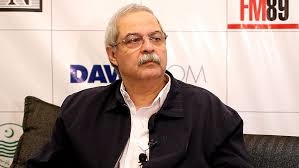
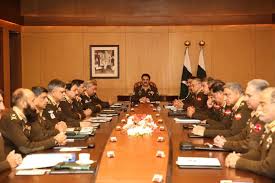
Hameed Haroon, the President of the All Pakistan Newspapers Society (APNS), has expressed concern that the freedom of press envisioned in Article 19 of the Constitution of Pakistan is now facing the gravest threat it has encountered in the past decade, and if press freedoms are allowed to deteriorate further, an irreversible damage will be inflicted on Pakistan’s democracy and the constitutionally stipulated freedoms associated with it. He has emphasised that apart from the dangers of targeting the lives of journalists by extremist elements in the country, a dangerous drift towards anarchy has reared its ugly head in the past week where unbridled behaviour on the part of certain sections of the security establishment and the media, coupled with confused signals emanating from government, have resulted in damaging the freedom of expression and the freedom of press enshrined in the Constitution.
“The signs on the horizon are clear. The fundamental problem appears to be that every one of the principal players involved in this crisis is responsible for a saddening deterioration of public affairs. The apparent undue haste with which the Independent Media Corporation and the Independent Newspaper Corporation, the twin media firms controlling the Geo-Jang group, pointed an accusatory finger at the Inter Services Intelligence (ISI) as being complicit in what can only be described as a murderous attack upon television anchor and columnist Hamid Mir, is only one part of the problem. The promptness with which the ISI through its Deputy Director General responded with a complaint through the Defence Ministry to Pemra to seek revocation of the broadcasting licences and the declarations of the GEO-Jang group, has clearly demonstrated that the institution of the armed forces has acted in haste and has not critically examined the validity of their positions nor of subsequent actions that have stemmed from a misconceived interpretation of press laws.
“At first the government appeared to be dealing wisely with the new threat to press freedoms posed by the murderous attacks on Raza Rumi in Lahore and Hamid Mir in Karachi. The Prime Minister of Pakistan, Mian Nawaz Sharif, speedily acted to form a judicial commission to investigate the attempt on Mir’s life at the highest level. One would have thought with an appropriate high-level commission of enquiry, composed of the superior judiciary, any investigation of the incident of the attempt on Hamid Mir’s life appeared to be in capable hands. However, within a day of the Prime Minister’s announcement, the ISI through the Defence Ministry called for the revocation of the licences and declarations of the GEO-Jang group, with Pemra officials making suitably supportive statements. Thus despite a wise move by the Prime Minister to constitute a commission immediately, the guilt of the offending party had been prejudged, well in advance of the verdict.
“Clearly the need of the hour is to immediately force a cooling down of tempers in all sections of the state and security apparatus as well as, critically, within the media itself. If we are to speak of ensuring the ‘preservation of the sovereignty, security and integrity of the Islamic Republic of Pakistan’ then the imperative is for all contending parties to exercise restraint.
“Additionally, the damage in this potentially explosive powder-keg needs to be contained. The judicial Commission of Enquiry should begin work immediately and avail of the services of Hamid Mir, among others, to reach a satisfactory conclusion as to which persons were responsible for engineering this attempt. Only when the findings are made public can it be determined whether the management and journalists of the newspaper (who have both been alleged as complicit in a slander campaign according to the ISI complaint to the Defence Ministry), were justified in levelling their early allegations. Nor would it be just to proceed with any retaliatory actions against this media group, awaiting the results of the high-level judicial enquiry that has been instituted. Such a travesty of justice is not becoming for any credible democracy.
“I appeal on behalf of the APNS, to Gen Raheel Sharif, the Chief of Army Staff, to rein in the knee-jerk retaliatory measures that have been initiated by various segments of the armed forces. This will lessen any public misperceptions with respect to what the security establishment sees as its principled stand in the matter. It is grossly unfair that Lt Gen Zaheerul Islam or any other member of the security establishment be presumed guilty unless the substance of such guilt can be irrefutably proved in a commission of enquiry. If he is found innocent, the media group found guilty of publishing and broadcasting such allegations against him must render an unqualified apology as per the valid international norms that govern such situations.
“In the meantime I also appeal to all sections of the media to exercise credible restraint and desist from publishing or broadcasting any statement which might be considered prima facie as defamatory or slanderous either against the ISI chief or against the media group. Concurrently it is imperative for the Prime Minister and the Federal Minister for Information to immediately commence a formal dialogue with all the major national bodies — the APNS, the CPNE, the PBA and the PFUJ — to attempt to provide a meaningful framework in which journalists can tell the truth and be protected from life-threats while doing so. This alone will ensure the ordered functioning of a nascent democracy and encourage the government to clamp down with unbridled severity on the spiralling incidents of violence against the media.”
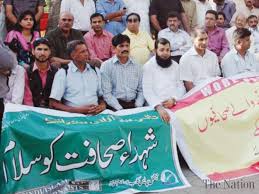
Pak demo for press freedom (Credit: nation.com.pk)
1991 will go down as the year in Pakistan when the press united and stopped the attacks on journalists. Several journalists had been attacked before us, but the attack on Kamran and me started a fire.
There was a reason for it. Kamran worked for the Jang group of newspapers, while I was reporter for the Dawn group of newspapers – the two biggest publishing houses which own about half the effective print publications in the country. Their tycoon owner-publishers, the Mir Shakilur Rehman and Haroon families were represented in the highest newspaper bodies, All Pakistan Newspaper Society (APNS) and the Council of Newspaper Editors and Publishers (CPNE) which wield a huge influence on Pakistan’s governments.
The week after I was threatened with knives, the Pakistan Federal Union of Journalists (PFUJ) and the All Pakistan Newspaper Employees Confederation (APNEC) energized journalist protests in rallies and demonstrations held across Pakistan. PFUJ and APNEC serve as the backbone of the journalist industry and their activism under the harsh dictatorship of Gen. Zia ul Haq has yielded dividents in keeping the media free.
The military backed Nawaz Sharif’s government refused to accept responsibility for the attacks on journalists. Between April 26, 1991 and October 24, 1991, the U.S. based Committee to Protect Journalists (CPJ) sent four letters to Sharif, protesting against the mounting attacks on the press. It was met with stony silence.
It was left to my journalist colleagues to fight for press freedom. Following the attacks on Kamran and me, journalists walked out of the assembly in the four provinces of Pakistan – Sindh, Punjab, Balochistan and Northwest Frontier Province – and forced the assemblies to condemn the attacks on the press. Each day the newspapers appeared chock full of statements by politicians, human rights groups, labor leaders, women and civil society to condemn the Sindh government and demand the arrest of our attackers.
From my sanctuary in Islamabad, my mother told me the phone at our Karachi home rang off the hook. Government officials, politicians, journalists and of course friends…called to ask about my welfare. Embarrassed by the negative publicity they received, officials in Jam Sadiq Ali’s cabinet offered to appoint police officials at a security post they proposed from across my house. It was like asking the fox to guard the chicken coop. I rejected their offer.
Knives Were Used to Send a Message
As I lay low in Islamabad, Benazir Bhutto issued a statement from overseas which squarely blamed the federal and Sindh government for the attacks on Kamran and me. It read:
“Both journalists have a distinguished record of investigative journalism, which includes an expose of the MQM and the criminal activities being conducted at the CIA headquarters. There is no doubt that these attacks have been coordinated by the Jam Government on the instructions of Nawaz Sharif and Ghulam Ishaq Khan.”
It was a fair indictment of the perpetrators, except that it cast doubt on the MQM’s role in the attacks. Although the ethnic party used to dictate news coverage, threaten hawkers and burn newspapers considered to be unfriendly, by the fall of 1991, they were themselves victims of the army’s “Operation Clean up.” As such, they were not in a position to conduct the attacks.
The MQM chief Altaf Hussein’s tried to dispel his party’s image. In a statement carried by the press on September 27, 1991 he said:
“We too differ with some of the media contents, but we go to people and ask them to stop reading a particular paper. The MQM has never attacked any newspaper office or resorted to such things.”
I took the MQM statement with a handful of salt. However in the present instance I recognized that I had grown entangled in the war between the intelligence agencies. This was more apparent because Kamran and I had used the same military intelligence (MI) source in exposing the Jam-Marwat combine.
Apparently, the MI, which is the political wing of the military, was then at odds with the techniques used by the ISI and the intelligence bureau (IB) in arm twisting the PPP’s political opponents. The IB, which snooped around locally to guess which journalists appeared to support the PPP, put us on its “hit list.” The office of Chief Minister Jam Sadiq Ali then flanked by a dime a dozen operators who supported his nefarious tactics, apparently directed the CIA to send knife-wielding assailants to warn us not to interfere in their mafia operations.
A Historic Protest
Five days had passed and I watched the national outcry against the knife attacks from my brother Pervez’s place in Islamabad. That weekend my brother’s colleague at the Quaid-i-Azam University, Dr A.H. Nayyar arrived, carrying heavy editions of the newspapers. Dr Nayyar, a physicist like my brother was hugely invested in the political situation inside Pakistan, and had a wry sense of humor.
Apparently tired from the weight of the weekend editions of the English and Urdu newspapers he had been carrying; Nayyar plunked them down on the table in front of us and flopped down himself.
“What’s the news?” my brother Pervez asked.
“Nothing,” Nayyar replied wearily. “They’re full of statements on Nafisa.”
I went through the newspapers. Statements were splashed across every newspaper by political parties, journalist unions, women’s organizations, minority groups, and human rights groups. In several instances they named the influential culprits and demanded punishment for the attacks on myself and my colleague.
Even while the federal government assured the employers and journalist unions that our attackers would be caught and punished, we knew that nothing of that sort would happen. The matter of a free press was inextricably linked with the polarized politics in Sindh and could not be resolved short of dismissing the Sindh government. The newspaper bodies correctly surmised that the media would suffer unless we demonstrated a collective show of strength.
And so, newspapers, magazines, and periodicals announced they planned to suspend publication on September 29, 1991. It was an unprecedented event, designed to shut down 25 million copies for one day to protest the attacks against journalists. The journalist community declared that as a mark of protest no reporter would attend or cover the government functions on that date – which fell on a Sunday.
On the day of the press shut-down, my journalist colleagues from The News took me to the home of their editor Maleeha Lodhi. Lodhi would later serve as Pakistan’s ambassador to the U.S. – under Benazir Bhutto and then Pervaiz Musharraf. Maleeha looked at me searchingly and said,
“You know, Kamran is associated with the intelligence agencies. But with you we know there is no such association.”
I was glad to hear it.
A journalist friend of mine, Ayoub Shaikh had once asked me, eyes twinkling,
“I sometimes wonder, who does Nafisa work for?”
“No one,” I had said, “I work for myself”.
“I know,” he had said, smiling.
On strike day, the Rawalpindi Union of Journalists organized a national event in Rawalpindi, Islamabad’s twin city, which was addressed by media stalwarts – All Pakistan Newspaper Society President, Farhad Zaidi, veteran journalist turned politician Mushahid Hussain, The News editor Maleeha Lodhi, senior editors, and representatives of journalist unions.
I spoke from a highly charged frame of mind, fired up by my close encounter. Mostly, I told journalists in Islamabad about the incredibly polarized political situation in my southern home province of Sindh.
“If we do not stand together, I am afraid that a journalist may be killed any day now,” I said.
It was a speech I made from the heart, and it appeared in the press on October 1, when the newspapers went back into circulation.
A Pakistan Television team arrived at the press club after I had finished speaking. They had come to film the protests against the attacks on the press nationwide, and needed footage of my speech. I was surprised to see them because the government controlled national television. Their decision to cover the event indicated that Prime Minister Nawaz Sharif was not entirely in charge.
Later, I watched the video footage of the nationwide protests in the districts, towns and cities of the four provinces – with the most impressive march in Karachi from where the attacks had emanated.
MIRAMSHAH, April 15: Taliban supreme leader Mullah Mohammad Omar has called for seeking guidance from Holy Quran to resolve differences between two rival factions of the outlawed Tehreek-i-Taliban Pakistan amid reports of rifts widening between the groups.
A pamphlet in Pashto carrying the name of Mullah Omar issued in Miramshah (North Waziristan) on Monday said there were serious differences among Mujahideen of Mehsud tribe in South Waziristan and asked them to recite verses from Quran to end hostilities.
“There are none worthy of worship besides You (God). Glorified are You. Surely I am from among the wrongdoers,” say the verses quoted in the pamphlet.
Mullah Omar said it was binding upon every Muslim to recite these verses 100 times a day.
Clashes between the Khan Said and Sheheryar groups leave a large number of militants dead and injured.
They are fighting to capture TTP leadership in South Waziristan.
Sheheryar has refused to accept Khan Said alias Sajna as chief of TTP’s Mehsud militants and declared himself as their leader.
Commander Daud of the Sheheryar group accused Khan Said of trying to occupy the top TTP post in South Waziristan. To end the crisis, he said, both the factions should end the fighting and allow a neutral group chosen by the Taliban leadership to lead Mehsud militants.
Daud said fighting would not end the crisis, adding that his group would accept any decision taken by TTP chief Maulvi Fazlullah.
ISLAMABAD, April 17: The Pakistani establishment has made it clear to the Afghan Taliban and the Haqqani Network that the time has come for them to choose between the Tehreek-e-Taliban Pakistan and the state of Pakistan, if they want to stay friends with Islamabad.
The unprecedented warning from the Pakistani establishment has come at a crucial time when the Pakistani Taliban are holding peace talks with the government in Islamabad, amidst demands to release over 800 Taliban prisoners and to set up a free peace zone in Waziristan.
According to well-informed sources, the warning from the establishment was prompted by the growing cooperation among the Afghan Taliban, the Haqqani Network and the Pakistani Taliban, which has reinforced the martial power of TTP in its current conflict with the security forces of Pakistan.
The TTP spokesman, Shahidullah Shahid, already admitted on October 6, 2013 in an interview that the Afghan Taliban were financially supporting the Pakistani Taliban besides providing them sanctuary in Afghanistan.
The fugitive TTP Ameer, Mullah Fazlullah, who had claimed responsibility last year for killing GOC Swat Major General Sanaullah Niazi is also being sheltered by the Afghan Taliban in the Kunar Province.
However, what seemed to have angered the Pakistani establishment the most were the allegations coming from the Afghan and the Pakistani Taliban, blaming the Inter-Services Intelligence (ISI) for the November 11, 2013 mystery murder [in Islamabad] of Dr Nasiruddin Haqqani, the top fundraiser and organiser of Haqqani Network as well as its liaison man with the Pakistani security establishment.
Dr Nasiruddin, the real brother of Sirajuddin Haqqani, was killed by unknown gunmen in the federal capital 10 days after the November 1, 2013 killing of the TTPAmeer in a US drone attack in North Waziristan. Both were laid to rest in the Dandey Darapa Khel area of North Waziristan which also headquarters the Haqqani Network as well as the TTP.
The decades-old cozy ties between the Pakistani establishment and the Haqqanis were shattered with the mystery murder of Dr Nasiruddin when a spokesman of Haqqani network (Najeebullah) immediately blamed the Pakistani intelligence agencies.
He said: “Dr Nasiruddin had been mediating between a powerful intelligence agency and the Pakistani Taliban for peace talks. But he had refused to mediate further following Hakimullah’s death and the subsequent announcement of TTP not to hold peace talks with the government.
Nasiruddin’s reluctance to mediate anymore after Hakimullah’s killing must have annoyed the agency which decided to eliminate him physically,” the Haqqanis’ spokesman was quoted by the media as saying.
On his part, the TTP spokesman, Shahidullah Shahid, also blamed a Pakistani intelligence agency for the murder, vowing to take revenge. “Nasiruddin Haqqani has been martyred by none other than the ISI.
He was killed because he had bravely backed our Ameer Hakimullah Mehsud,” Shahidullah told AFP when asked about possible killers.
However, on their part, the ISI circles had refuted the allegations of involvement in the murder, saying Dr Nasiruddin Haqqani was either killed by the TTP or by the Afghan National Directorate of Security.
The allegations leveled by the Afghan Taliban and the Haqqani Network were followed by Pakistani intelligence reports that both the groups were supporting and financing the TTP in its terror spree against the khakis and the civilians alike.
Indeed, the Pakistani and the Afghan Taliban are closely allied and both aim to impose a strict version of Islamic laws or Shariah on their societies. However, their leadership and targets differ with each other.
While the Pakistani Taliban mostly focus their terrorist attacks in Pakistan against the security forces which they think are an American ally, the Afghan Taliban target the Afghan and the Allied forces.
Defence Minister Khawaja Asif recently told Reuters in an interview that the Pakistan government was worried about the possibility of increasing convergence between the Pakistani and the Afghan Taliban. “Then the Pakistani Taliban will have a powerhouse behind them,” Khawaja Asif had said.
Analysts believe that these concerns might have prompted the Pakistani security establishment to warn the Haqqanis and the Afghan Taliban against backing the TTP.
However, the close nature of ties between the Afghan and the Pakistani Taliban can be gauged from the fact that the central Shura of TTP has already referred their internal differences to the Afghan Taliban while asking Mullah Omar to intervene and send a delegation to resolve the tiff between two major factions of Mehsud militants from South Waziristan.
A senior TTP commander has been quoted in the media as saying that the Shura thought that the intra-TTP tussle was too serious and critical for them and, therefore, they decided to approach the Islamic Emirate of Afghanistan, a term usually referred to the Afghan Taliban.
There are already reports that the Ameer of the Afghan Taliban is persuading the Pakistani Taliban to end their infighting in South Waziristan as he wants to secure their support against the foreign troops in Afghanistan to launch the annual spring offensive.
Analysts believe the Pakistani security establishment’s warning was meant to dissuade the Haqqanis and the Afghan Taliban from siding with the Pakistani Taliban in their conflict with the state of Pakistan at a time when the Allied forces are set to withdraw from Afghanistan and both the Afghan militia groups would require the crucial support of Islamabad to stage a comeback in Kabul.
In fact, the ultimate agenda of the Pakistani Taliban is the establishment of their own state — the Islamic Emirate of Waziristan [on the pattern of Mullah Omar’s Islamic Emirate of Afghanistan] in Fata where they can impose the Islamic Shariah. On the other hand, the ultimate agenda of the Afghan Taliban is the revival of the lost Islamic Emirate of Afghanistan.
Therefore, following the Pakistani establishment’s warning, Mullah Omar will have to decide whether to befriend the Pakistani Taliban or the state of Pakistan.
Commander Sirajuddin Haqqani of the Haqqani Network is bound to follow suit being a disciple of Mullah Omar just like the Pakistani and the Afghan Taliban. Well informed sources in the establishment say logically speaking Mullah Omar would like to remain a friend of Pakistan instead of inviting its wrath by befriending the TTP.
However, there are those in the Taliban circles who believe that if the Afghan Taliban succeed in regaining power in Kabul after the withdrawal of the Allied troops, there would be greater chances of their joining hands with the Pakistani Taliban whose aims and objectives and those of the Ameerul Momineen are the same.
However, the establishment circles say, in such an eventuality, the Afghan Taliban and the Haqqani Network must know that “strategic depth” would no longer be a consideration of the establishment if the Pakistan government finally orders a military action in North Waziristan after the failure of the talks with the TTP.
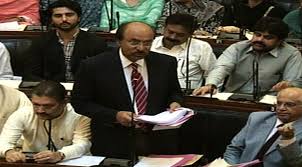
Education Minister Nisar Khuhro (Credit: thenews.com.pk)
KARACHI April 11: Sindh Minister for Education Nisar Ahmed Khuhro has admitted that “a large number of fake appointments were made in the education department during the previous tenure of the PPP government” but shied away from giving an exact number of such appointments which the opposition members put at a colossal 30,000.
He said that action was being taken against the officers concerned responsible for the serious irregularity but no action was planned against former education minister Pir Mazharul Haq.
Mr Khuhro was responding to questions by different legislators during the question hour about the education department at the Sindh Assembly’s session on Friday, which was first chaired by speaker Agha Siraj Durrani and later by deputy speaker Shehla Raza.
Towards the end of the question hour, heated verbal exchanges were made between the treasury and the opposition benches and the assembly depicted a scene from the proverbial fish market when Mr Khuhro raised objection to a remark passed by a legislator of the Muttahida Qaumi Movement (MQM).
Pakistan Muslim League-Functional legislator Nusrat Abbasi had earlier asked if it was true that 30,000 fake appointments had been made in the education department.
Mr Khuhro replied without either endorsing or rejecting the huge figure and said that “a large number of bogus appointments of teaching and non-teaching staff had been made beyond the sanctioned strength” and without completing legal formalities as laid down in the recruitment rules by former directors of school education Karachi in connivance with district officers during 2012–13.
He said that 12 officers had been suspended over misconduct and show-cause notices had been served on them under the Removal from Service (Special Powers) Sindh Ordinance 2000.
The officers are: Attaullah Bhutto, Shamsuddin Dal, Mumtaz Ali Shaikh, Ahmed Nawaz Naizi, Bashir Ahmed Niazi, Ms Farnaz Riaz, Abdul Jabbar Dayo, Abdul Latif Mughal, Musharaf Ali, Liaquat Ali Solangi, Imran Ali Solangi and Naveed Ahmed.
Mr Khuhro said that the suspended officers as well as those who were appointed by them had moved the courts and the government was defending its actions against them.
To another question by Ms Abbasi, the minister said that as against teaching posts of 1,400 in Karachi, 6,000 appointments had been made and against 2,900 posts of non-teaching staff 4,000 had been recruited.
He said in answer to a question that there was no proof the officers had taken bribe to make the excess appointments without following the procedure. Asked if any action had been taken against the former education minister, Pir Mazharul Haq, Mr Khuhro said that no proof of irregularity was found against him either as all formalities – issuing appointment letters, offer letters, etc – were processed by the officers concerned.
He did not respond to a question if it did not amount to connivance on the part of the former minister then it was sheer inefficiency that he failed to detect such a serious and large-scale breach of rules to make 30,000 fake appointments.
Answering a question by MQM legislator Khalid Ahmed that the irregularity was so serious that not only action should be taken against the minister concerned but the chief minister should also accept responsibility for the recruitment of thousands of incompetent people without following the laid down procedure.
Mr Khuhro replied by objecting to the use of the term ‘incompetent’ by the MQM legislator and said the people of Sindh should not be referred to as such. The objection angered all MQM legislators who stood up and started talking simultaneously. Information minister Sharjeel Memon also stood up to second Mr Khuhro’s stand and in the meantime some treasury members started thumping the desks.
Ms Raza, who was chairing the session at that time, asked the opposition members to sit down and calmly listen to the ministers, by remarking that media would call it a fish market. But the legislators did not listen to her and she adjourned the session for 10 minutes after declaring the time for the question hour was over.
Earlier the legislators, including MQM’s Moeen Pirzada, had complained that the written replies were incomplete but Mr Khuhro insisted the replies were complete.
Responding to a question by MQM’s Heer Soho about the bills passed “by the assembly for the establishment of universities over the past five years,” the written reply gave names of only five public sector universities and on a supplementary question the minister said the bills regarding some other private universities were also passed but he insisted the written reply was complete. Ms Raza agreed with the legislators that incomplete information was provided and that complete information be given.
To another question by Ms Soho which asked specifically “district-wise number of schools which were provided facilities between 2010–13,” the written reply did give the number of schools but did not give the district-wise breakup.
But the minister still insisted that complete information had been provided and surprisingly, speaker Durrani, who was presiding at that time, agreed with the minister. Mr Khuhro later started to read out names of the districts in which schools had been rehabilitated.
The written reply said that rehabilitation of a total of 2,659 schools had been undertaken since 2010 – 11 and 498 of these were still under construction. Out of the 2,659 schools, 319 schools were shelter-less, 1,219 did not have boundary walls and 1,561 were without toilets while others lacked some other basic facilities, it said.
The Standing Committee of National Assembly on Information, Broadcasting and National Heritage has recently rekindled a forlorn hope. In a recently held meeting, the committee adopted a resolution to declare 13 mother languages of Pakistan as national languages and establishing a Languages Commission for scientific research and policy formulation to promote Pakistani languages.
In Pakistan, the seeds of discontent were sown right from its inception when Bengalis asserted for their language to be the national language along with Urdu. Denial of that sparked a nationalist movement that culminated in a debacle in 1971. The threat of Indian aggression coupled by a flippant attitude of the ruling elite at a formative stage resulted in a denial of historic cultures and identities of the federating units.
Islam and Urdu were construed as cementing factors for the culturally-diverse and politically-discrete federating units. Intentions and reasons apart, the approach was too bitter particularly for Sindh and Bengal where native languages were highly advanced and remained official languages for decades.
Language movements in Bengal and Sindh subsequently resulted in parturition of nationalist movements in both provinces.
Recognition and respect for historic identities and cultural inheritance is pivotal for a federation. Founders of Pakistan attempted to mould it into a nation state which was an unnatural and flawed approach. Religion and imposed cultures have never succeeded in unifying people, especially when some of them are discriminated on the basis of their identities. Had there been a fair representation in the state affairs e.g. civil and military bureaucracy, other elements could probably have endured or subsided with time. When cultural identity is made the basis of political and economic oppression, it erupts like a volcano.
At the time of partition, both Bengali and Sindhi were official languages in their respective provinces. Both languages had a cherished history and a treasure trove of literature. Both languages were not only lingua franca of their provinces but were also in vogue for revenue, court, education and other official business.
The first Bengali dictionary/grammar was written by a Portuguese missionary between 1734 and 1742. Nathaniel Brassey Halhed, a British grammarian, wrote a modern Bengali grammar in 1778. Ram Mohan Roy, the great Bengali reformer also wrote “Grammar of the Bengali Language” in 1832.
In 1937 at the Lucknow session of the Muslim League, the Bengalis objected to Urdu becoming the lingua franca of all Indian Muslims. In 1947 when Dr Ziauddin Ahmad, Vice-Chancellor of the Muslim University of Aligarh, declared that Urdu would be the national language of Pakistan, Bengali linguist Dr Shahidullah replied that this ‘would be tantamount to political slavery’. The controversy intensified after the creation of Pakistan.
On February 25, 1948, Mr Datta, a Congress Leader, claimed on the floor of the National Assembly of Pakistan that out of 69 million people, 44 million speak Bengali in the country, therefore, Bengali, along with English and Urdu, should be accepted as a language of the Assembly.
Muhammad Ali Jinnah, during his visit to Bengal in March 1948, took pains to persuade Bengalis for embracing Urdu as the only national language but he could not crack the relentless obstinacy. A macabre episode of 1952 caste the dye and Bengali language movement turned into a fireball of Bengali nationalism, ultimately dismembering the country.
Similarly, Sindhi language owned a rich legacy. Sindh was occupied by British army in 1843 and was annexed with Bombay. In 1848, governor of the province Sir George Clerk ordered to make Sindhi the official language in the province. Sir Bartle Frere, the then commissioner of Sindh, issued orders on August 29, 1857 advising civil servants in Sindh to qualify examination in Sindhi. He also ordered Sindhi to be used in all official communication. Seven-grade education system commonly known as Sindhi-Final was introduced in Sindh. Sindhi Final was made a prerequisite for employment in revenue, police and education departments.
In 1854, Arabic script was adopted for Sindhi language. In 1848 and 1855, English-Sindhi dictionaries were produced. Eminent German scholar Ernest Trump published Sindhi grammar in 1872. Karachi at the time of partition had a population of 0.4million with 61 per cent Sindhi-speaking compared to only 6 per cent Urdu-speaking population.
With influx from India and exodus of Hindus, Sindh underwent a demographic shift. In 1951, the same city had 57 per cent Urdu-speaking population and Sindhis shrunk to a mere 8.6 per cent. At the time of partition, Karachi had 1300 Sindhi medium schools which were subsequently converted into a no-go area for Sindhi language.
President Ayub constituted a Commission on National Educational also known as Sharif Commission, which declared Urdu as the only medium of instruction from the sixth grade. Sindhis took this decision as an affront and launched a movement against the recommendations of the Commission. Language riots of 1971 and 1972 created an ethnic crevasse in Sindh which was further widened by ethnic strife in 80s and 90s.
Sindhi Adabai Sangat (SAS), a prominent literary and cultural organisation of Sindh, had been tirelessly championing the cause of Sindhi language. SAS dispatched 100,000 postcards to the president of Pakistan in 2009 demanding the status of national language for major languages of Pakistan. Sindhi Language Authority also presented a separate memorandum of the same demand to the government.
In 2010, leading literary organisations from all four provinces and Progressive Writers Association of Pakistan presented the same memorandum to the parliamentarians. In 2010, two members of parliament from Sindh presented two separate bills before the National Assembly, demanding major languages of Pakistan to be declared national languages. These bills were rejected without any plausible explanation.
An anachronistic pretext of threat to national integrity is too stale to subscribe to. Had the single language guaranteed national integrity, East Pakistan would not have seceded.
Claire Handscombe has a commitment problem online. Like a lot of Web surfers, she clicks on links posted on social networks, reads a few sentences, looks for exciting words, and then grows restless, scampering off to the next page she probably won’t commit to.
“I give it a few seconds — not even minutes — and then I’m moving again,” says Handscombe, a 35-year-old graduate student in creative writing at American University.
But it’s not just online anymore. She finds herself behaving the same way with a novel.
“It’s like your eyes are passing over the words but you’re not taking in what they say,” she confessed. “When I realize what’s happening, I have to go back and read again and again.”
To cognitive neuroscientists, Handscombe’s experience is the subject of great fascination and growing alarm. Humans, they warn, seem to be developing digital brains with new circuits for skimming through the torrent of information online. This alternative way of reading is competing with traditional deep reading circuitry developed over several millennia.
“I worry that the superficial way we read during the day is affecting us when we have to read with more in-depth processing,” said Maryanne Wolf, a Tufts University cognitive neuroscientist and the author of “Proust and the Squid: The Story and Science of the Reading Brain.”
If the rise of nonstop cable TV news gave the world a culture of sound bites, the Internet, Wolf said, is bringing about an eye byte culture. Time spent online — on desktop and mobile devices — was expected to top five hours per day in 2013 for U.S. adults, according to eMarketer, which tracks digital behavior. That’s up from three hours in 2010.
Word lovers and scientists have called for a “slow reading” movement, taking a branding cue from the “slow food” movement. They are battling not just cursory sentence galloping but the constant social network and e-mail temptations that lurk on our gadgets — the bings and dings that interrupt “Call me Ishmael.”
Researchers are working to get a clearer sense of the differences between online and print reading — comprehension, for starters, seems better with paper — and are grappling with what these differences could mean not only for enjoying the latest Pat Conroy novel but for understanding difficult material at work and school. There is concern that young children’s affinity and often mastery of their parents’ devices could stunt the development of deep reading skills.
The brain is the innocent bystander in this new world. It just reflects how we live.
“The brain is plastic its whole life span,” Wolf said. “The brain is constantly adapting.”
Wolf, one of the world’s foremost experts on the study of reading, was startled last year to discover her brain was apparently adapting, too. After a day of scrolling through the Web and hundreds of e-mails, she sat down one evening to read Hermann Hesse’s “The Glass Bead Game.”
“I’m not kidding: I couldn’t do it,” she said. “It was torture getting through the first page. I couldn’t force myself to slow down so that I wasn’t skimming, picking out key words, organizing my eye movements to generate the most information at the highest speed. I was so disgusted with myself.”
Adapting to read
The brain was not designed for reading. There are no genes for reading like there are for language or vision. But spurred by the emergence of Egyptian hieroglyphics, the Phoenician alphabet, Chinese paper and, finally, the Gutenberg press, the brain has adapted to read.
Before the Internet, the brain read mostly in linear ways — one page led to the next page, and so on. Sure, there might be pictures mixed in with the text, but there didn’t tend to be many distractions. Reading in print even gave us a remarkable ability to remember where key information was in a book simply by the layout, researchers said. We’d know a protagonist died on the page with the two long paragraphs after the page with all that dialogue.
The Internet is different. With so much information, hyperlinked text, videos alongside words and interactivity everywhere, our brains form shortcuts to deal with it all — scanning, searching for key words, scrolling up and down quickly. This is nonlinear reading, and it has been documented in academic studies. Some researchers believe that for many people, this style of reading is beginning to invade when dealing with other mediums as well.
“We’re spending so much time touching, pushing, linking, scrolling and jumping through text that when we sit down with a novel, your daily habits of jumping, clicking, linking is just ingrained in you,” said Andrew Dillon, a University of Texas professor who studies reading. “We’re in this new era of information behavior, and we’re beginning to see the consequences of that.”
Brandon Ambrose, a 31-year-old Navy financial analyst who lives in Alexandria, knows of those consequences.
His book club recently read “The Interestings,” a best-seller by Meg Wolitzer. When the club met, he realized he had missed a number of the book’s key plot points. It hit him that he had been scanning for information about one particular aspect of the book, just as he might scan for one particular fact on his computer screen, where he spends much of his day.
“When you try to read a novel,” he said, “it’s almost like we’re not built to read them anymore, as bad as that sounds.”
Ramesh Kurup noticed something even more troubling. Working his way recently through a number of classic authors — George Eliot, Marcel Proust, that crowd — Kurup, 47, discovered that he was having trouble reading long sentences with multiple, winding clauses full of background information. Online sentences tend to be shorter, and the ones containing complicated information tend to link to helpful background material.
“In a book, there are no graphics or links to keep you on track,” Kurup said.
It’s easier to follow links, he thinks, than to keep track of so many clauses in page after page of long paragraphs.
Kurup’s observation might sound far-fetched, but told about it, Wolf did not scoff. She offered more evidence: Several English department chairs from around the country have e-mailed her to say their students are having trouble reading the classics.
“They cannot read ‘Middlemarch.’ They cannot read William James or Henry James,” Wolf said. “I can’t tell you how many people have written to me about this phenomenon. The students no longer will or are perhaps incapable of dealing with the convoluted syntax and construction of George Eliot and Henry James.”
Wolf points out that she’s no Luddite. She sends e-mails from her iPhone as often as one of her students. She’s involved with programs to send tablets to developing countries to help children learn to read. But just look, she said, at Twitter and its brisk 140-character declarative sentences.
“How much syntax is lost, and what is syntax but the reflection of our convoluted thoughts?” she said. “My worry is we will lose the ability to express or read this convoluted prose. Will we become Twitter brains?”
Bi-literate brains?
Wolf’s next book will look at what the digital world is doing to the brain, including looking at brain-scan data as people read both online and in print. She is particularly interested in comprehension results in screen vs. print reading.
Already, there is some intriguing research that looks at that question. A 2012 Israeli study of engineering students — who grew up in the world of screens — looked at their comprehension while reading the same text on screen and in print when under time pressure to complete the task.
The students believed they did better on screen. They were wrong. Their comprehension and learning was better on paper.
Researchers say that the differences between text and screen reading should be studied more thoroughly and that the differences should be dealt with in education, particularly with school-aged children. There are advantages to both ways of reading. There is potential for a bi-literate brain.
“We can’t turn back,” Wolf said. “We should be simultaneously reading to children from books, giving them print, helping them learn this slower mode, and at the same time steadily increasing their immersion into the technological, digital age. It’s both. We have to ask the question: What do we want to preserve?”
Wolf is training her own brain to be bi-literate. She went back to the Hesse novel the next night, giving herself distance, both in time and space, from her screens.
“I put everything aside. I said to myself, ‘I have to do this,’ ” she said. “It was really hard the second night. It was really hard the third night. It took me two weeks, but by the end of the second week I had pretty much recovered myself so I could enjoy and finish the book.”
Then she read it again.
“I wanted to enjoy this form of reading again,” Wolf said. “When I found myself, it was like I recovered. I found my ability again to slow down, savor and think.”
The capital of the republic is hit. Perhaps, the attack on the wholesale market of fruits and vegetables the other day in Islamabad is the biggest terrorist attack in the capital since the massive bombing of the Marriott Hotel some years ago.
According to initial reports, explosives were packed into a crate of guavas. It took more than 20 lives instantly, and about the same number of people is told to be in a critical condition. We don’t know yet how many will survive and whether they will ever be able to lead a normal life. More than a hundred are injured and hospitalised. We don’t know how many will remain able-bodied afterward and whether it will be possible for them to work again to support their families.
No act of violence is welcome. But deplorable as it may be, attacking those who are in power and seen as making decisions that go against you, or killing those who are involved in a physical battle against you can be understood at one level. Killing innocent citizens in the name of an ideology, faith, liberation movement or political cause amounts to sheer callousness. It is a blatant crime committed against common people. In Pakistan, not only do terrorists of various hues and colours commit these crimes with complete impunity, the state collapses on a daily basis to protect the lives, liberties and properties of its citizens.
But what property is to be protected for a woman or a man belonging to the working class in Pakistan? It is only her or his life. S/he has a simple and difficult life to lead, perpetually struggling to support herself and the kith and kin in order to survive, and only enjoying the liberty to move to the workplace and be back home. Even that is being taken away. What hurts more is the pride terrorist outfits would take in killing the most ordinary women and men, seeing them as soft targets. What causes much greater pain is the inability of the Pakistani state to save its citizens.
As citizens, we will not hold the militant outfits and terror groups responsible for inflicting death, pain and suffering on the people of Pakistan. It is our state and successive governments that are responsible for their wrong actions in the past or concerted inaction at present, for their continuous failure to protect us. Not to mention their massive incompetence and failure to help all citizens lead a decent, prosperous and honourable life.
Let us have a look at the profile of those killed, injured or maimed in the wholesale market of Islamabad. Most of them must be fruit and vegetable vendors, hardly making their ends meet, or common citizens who think they will save a few rupees if they buy fruits and vegetables from wholesalers than retailers.
We do not know yet who perpetrated this attack as the claim made by a Baloch separatist outfit was rubbished by the interior ministry. Even if the Baloch separatists have made a rightful claim, does that particular group of Baloch secessionists think that the guava-sellers are consulted in by the federation while making policy or by the FC when it acts in Kalat, Khuzdar or Turbat? Has eliminating or pushing out barbers, milk sellers, schoolteachers, construction labourers, carpenters and masons from Balochistan helped the cause in anyway in the recent past?
Many of us believe that Balochistan as a province and the Baloch as a people have been denied their rights in our federation for too long. We stand with them in their struggle for realisation of their economic, political and cultural rights. We stand with them in asking for an immediate end to forced disappearances and military action by the Pakistani state. We condemn mass graves found anywhere. We do not accept the view of the powers that be, which squarely place the blame on Baloch tribal chieftains for the poverty and dispossession that Balochistan is subjected to.
Again, it was the failure of our state in meeting the basic needs and ensuring the fundamental rights of its Baloch citizens, not the responsibility of the sardars – many of who collaborated with the state anyway. We recognise that for decades when chappatis were baked in Lahore on the stoves fired by the natural gas piped from Balochistan and the industry in Karachi used natural gas supplied from and metals extracted from the ores in Balochistan, the province and its people neither had gas to cook with or to heat up their homes with during the harsh winters.
We also know that schools were not built, hospitals were not established, roads were not paved and industry was not set up in areas of Balochistan that fed the Pakistani elite and middle class in other provinces and the civil and military institutions they dominate. However, it is time for the disgruntled Baloch to ask how the killing of ordinary citizens and those belonging to the working class anywhere serve their cause. Will that not escalate violence in the province and make it increasingly difficult for their genuine advocates to plead their case?
The TTP has also denied its involvement but it is now increasingly obvious to most that the outfit is not necessarily a strong monolith. There may be some from the ranks of its coalition or outsiders who were involved even if the core was not. We don’t know. But if fruit and vegetable vendors are attacked in the name of faith or an ideology by anyone, one must ask if any of these people killed or injured participated in making decisions about their country playing a part in the war on terror in Afghanistan or in the tribal regions of Pakistan.
How many cauliflower sellers on the streets of Rawalpindi and Islamabad were consulted before the Swat operation or before making air sorties in Fata? Did they ever exist for those planning drone strikes in our tribal regions? Did they help the Americans smoke out Saddam Hussein in Iraq or get Osama bin Laden trapped in his hideout near Abbottabad?
As far as the state and its ruling elite are concerned, they need to be reminded again and again what Hazrat Ali once said. “A profane state or government can surely survive but a cruel one never can.” What is meted out to them is not what the already struggling working and lower middle classes of Pakistan deserve. For them, prosperity is far away. The state is not even able to defend their right to life.
Knowing how our country and its economy works for its less privileged classes, one such attack will push hundreds of families in the throes of abject poverty. Doling out a couple of hundred thousand rupees – at the most – for each casualty will serve no purpose either. This money will be spent in a few weeks if they have to nurse the injured or else used to pay off a part of the debt such families are normally trapped in.
By killing a cobbler in the Nazimabad neighbourhood of Karachi for being a Pakhtun, an office clerk in the Baldia neighbourhood of the same city for being a Mohajir, a student leader in Khuzdar for being a Baloch rights activist, an unemployed political activist in Ghotki for being a Sindhi, a primary schoolteacher in Mastung for being a Punjabi, a shopkeeper in Quetta for being Shia, a worshipper in Lahore for being Ahmadi, a labourer in a church in Peshawar for being Christian and a fruit vendor in Islamabad for a reason still unknown, nothing will be achieved. But the state, in no uncertain terms, will dwindle fast.
KABUL, April 4— For the two seasoned war correspondents, it was not an unusually risky trip. Getting out to see Afghanistan up close was what Anja Niedringhaus, a Pulitzer Prize-winning photographer for The Associated Press, and Kathy Gannon, a veteran reporter for the news agency, did best.
The eastern province of Khost, where Ms. Niedringhaus and Ms. Gannon traveled to cover Afghanistan’s presidential election on Saturday, is considered dangerous, still plagued by regular Taliban attacks. But they had carefully plotted their trip, arranging to move beyond the relatively safe confines of the provincial capital under the protection of Afghan Army troops and the police.
Yet it was those precautions that proved fatal for Ms. Niedringhaus on Friday morning. As she and Ms. Gannon waited outside a government compound, a police commander walked up to their idling car, looked in at the two women in the back seat, and then shouted “Allahu akbar!” — God is great — and opened fire with an AK-47, witnesses and The Associated Press said.
Ms. Niedringhaus was killed instantly, and Ms. Gannon, shot three times in the wrist and shoulder, was severely wounded. In the span of a few muzzle flashes, the two women, who had covered the war since it began in 2001, became victims of another attack that blurred friend and foe.
For both Afghans and Westerners, the list of adversaries has expanded beyond the resilient Taliban, who have staged a series of attacks in an attempt to disrupt the election. Afghan soldiers and the police have repeatedly turned on one another and their foreign allies. The squabbling between President Hamid Karzai and American officials has grown into a deep-seated animosity.
At the same time, Afghans have seen scores of their fellow citizens killed by errant American airstrikes. And even as the United States pushes for a long-term security deal that would allow it to keep troops here beyond the end of this year, it does so with the understanding that its forces will be largely hidden away behind the high walls of fortified bases.
Ms. Niedringhaus, 48, and Ms. Gannon, 60, had no desire to hunker down. The focus of their work over the past dozen years has been putting a human face on the suffering inflicted by the war. As a pair, they often traveled to remote corners of Afghanistan to report articles, and Ms. Niedringhaus also spent significant time embedded with coalition forces.
Many of their colleagues noted sadly that they were attacked by a police officer who appeared to have seen in the back seat of the journalists’ Toyota Corolla a pair of anonymous Westerners on whom to vent his rage. If Afghans have a dominant complaint about the West, it is that they are often treated as faceless, dismissed as nonentities by the people who say they are here to help.
That was not the case with Ms. Niedringhaus and Ms. Gannon.
In this March 30, 2003 photo by Anja Niedringhaus, Iraqi women lined up for a security check by British soldiers on the outskirts of Basra. Credit Anja Niedringhaus/Associated Press
“They just seemed so bravely willing to go into these kinds of situations and get to the places that you needed to get to tell stories that weren’t being told,” said Heidi Vogt, a reporter who worked for The A.P. in Afghanistan until last year.
“They’re the last two people you’d expect this to happen to,” she added. “It felt like they had a little protective force field around them.”
Ms. Niedringhaus, a German citizen who was based in Geneva, first came to Afghanistan after joining The A.P. in 2002, and she quickly formed a partnership with Ms. Gannon. They were among a band of female photographers and correspondents who persevered through many years of conflict in Iraq as well as in Afghanistan.
In the process, they helped redefine traditional notions of war reporting. Even as they covered the battlefield, they also focused attention on the human impact of conflicts known for their random, unpredictable violence against civilians.
Ms. Niedringhaus’s fascination with Afghanistan continued to grow even as she was pulled away to other trouble spots, including Iraq, where she was part of a team of A.P. photographers who won a Pulitzer Prize in 2005.
“If I’d told her, ‘You don’t need to do this anymore, you’ve earned your spurs, leave it to another generation,’ ” said Tony Hicks, a photo editor at The A.P., “the response would have been a series of expletives, then laughing and another pint.”
But, Mr. Hicks pointed out, Ms. Niedringhaus was equally at home at major sports events and other less high-stakes diversions, such as the Geneva auto show.
Hundreds of U.S. Marines gathered at Camp Commando in Kuwait in 2002. Credit Anja Niedringhaus/Associated Press
She was on the finish lines when Usain Bolt, the Jamaican sprinter, broke the world record for the 100-meter dash. And “she loved Wimbledon,” he said. “It was almost her second home.”
Ms. Gannon, a Canadian who is a senior writer for The A.P., arrived in Peshawar, Pakistan, in 1986 when the Afghan mujahedeen were battling the forces of the Soviet Union. She went on to serve as The A.P.’s bureau chief in Islamabad, and she was one of the few Western reporters whom the Taliban permitted to work in Kabul when they ruled Afghanistan.
Ms. Gannon was in Kabul during the American invasion in 2001, and she wrote of covering the Taliban’s last days in the city with her Afghan colleague, Amir Shah. The two cowered in the basement of a house during air raids, often working by candlelight or lantern. They tried to avoid members of Al Qaeda, who were much more hostile than the Taliban. When a bomb struck nearby, she was thrown across the room — and then went straight back to work.
“She knows Afghanistan very well,” said Mr. Shah, an A.P. reporter in Kabul, according to an article by the news agency. “She knows the culture of the people.”
But the divide between Afghans and Westerners has been deepening for years, and so-called insider attacks in which Afghan security forces turn on their coalition counterparts or one another have been the most visible symptom. Afghan and Western officials say they believe that most of the attacks are driven by personal animosity or anger about the war in Afghanistan, where many have come to view foreign forces as occupiers.
Though Western civilians working with the coalition have at times been killed in such attacks, the shooting on Friday was believed to be the first time an Afghan police officer had intentionally killed a foreign journalist.
Afghan security officials said they believed that the shooting was an opportunistic attack, not the work of the Taliban, who offered no comment.
A Marine on his way to pick up food supplies in June, 2001. Credit Anja Niedringhaus/Associated Press
The police commander, whom officials identified as Naqibullah, 50, was known for his anti-Western views, one official said. The officials did not believe he had advance notice that Ms. Niedringhaus or Ms. Gannon was headed his way.
The two spent Thursday night at the compound of the provincial governor in Khost, and they left on Friday morning with a convoy of election workers delivering ballots to an outlying area in the Tanai district, The A.P. and Afghan officials said.
The convoy was protected by the Afghan police, soldiers and operatives from the National Directorate of Security, Afghanistan’s main intelligence agency, said Mubarez Zadran, a spokesman for the provincial government. Ms. Niedringhaus and Ms. Gannon were in their own car, traveling with a driver and an Afghan freelance journalist who was working with the news agency.
Mr. Naqibullah, the police commander, surrendered to other officers immediately after shooting the journalists and was arrested.
Ms. Gannon was taken to a hospital in Khost. She underwent surgery before being evacuated to one of the main NATO bases in the country, where there is a hospital equipped to handle severe battlefield trauma. She was said to be in stable condition.
Yet even as Friday’s shooting provided a stark reminder of how broader tensions can set off violence at the most personal level, its aftermath also highlighted the bonds between old friends and strangers alike, be they Afghans or foreigners.
Aides to Mr. Karzai, who has known Ms. Gannon for years, said he tried to get her on the phone to see she how she was doing after he heard about the attack. He later spoke with her husband, and his office then put out a statement condemning the attack.
The doctor who first treated Ms. Gannon, Muhammad Shah, was distressed by the shooting.
“Not only me, but all Afghans are disappointed and sorry for this loss of life,” he said by phone Friday night from Khost Provincial Hospital, between operations. “She was a guest here in Afghanistan, a foreigner.”
Matthew Rosenberg reported from Kabul, and Farooq Jan Mangal from Khost Province, Afghanistan.
The book, by poet Boris Pasternak, had been banned from publication in the Soviet Union. The British were suggesting that the CIA get copies of the novel behind the Iron Curtain. The idea immediately gained traction in Washington.
“This book has great propaganda value,” a CIA memo to all branch chiefs of the agency’s Soviet Russia Division stated, “not only for its intrinsic message and thought-provoking nature, but also for the circumstances of its publication: we have the opportunity to make Soviet citizens wonder what is wrong with their government, when a fine literary work by the man acknowledged to be the greatest living Russian writer is not even available in his own country in his own language for his own people to read.”
The memo is one of more than 130 newly declassified CIA documents that detail the agency’s secret involvement in the printing of “Doctor Zhivago” — an audacious plan that helped deliver the book into the hands of Soviet citizens who later passed it friend to friend, allowing it to circulate in Moscow and other cities in the Eastern Bloc. The book’s publication and, later, the awarding of the Nobel Prize in Literature to Pasternak triggered one of the great cultural storms of the Cold War.
Because of the enduring appeal of the novel and a 1965 film based on it, “Doctor Zhivago” remains a landmark work of fiction. Yet few readers know the trials of its birth and how the novel galvanized a world largely divided between the competing ideologies of two superpowers. The CIA’s role — with its publication of a hardcover Russian-language edition printed in the Netherlands and a miniature, paperback edition printed at CIA headquarters — has long been hidden.
The newly disclosed documents, however, indicate that the operation to publish the book was run by the CIA’s Soviet Russia Division, monitored by CIA Director Allen Dulles and sanctioned by President Dwight D. Eisenhower’s Operations Coordinating Board, which reported to the National Security Council at the White House. The OCB, which oversaw covert activities, gave the CIA exclusive control over the novel’s “exploitation.”
The documents were provided at the request of the authors for a book, “The Zhivago Affair,” to be published June 17. Although they were redacted to remove the names of officers as well as CIA partner agencies and sources, it was possible to determine what lay behind some of the redactions from other historical records and interviews with current and former U.S. officials. Those officials spoke on the condition of anonymity to discuss material that remained classified.
Tim Gressie
The title page from a 1958 Russian-language edition of “Doctor Zhivago” that the CIA arranged to have secretly printed in the Netherlands and distributed to Soviet tourists at the 1958 world’s fair in Brussels.
A voice from the past
During the Cold War, the CIA loved literature — novels, short stories, poems. Joyce, Hemingway, Eliot. Dostoevsky, Tolstoy, Nabokov.
Books were weapons, and if a work of literature was unavailable or banned in the Soviet Union or Eastern Europe, it could be used as propaganda to challenge the Soviet version of reality. Over the course of the Cold War, as many as 10 million copies of books and magazines were secretly distributed by the agency behind the Iron Curtain as part of a political warfare campaign.
In this light, “Doctor Zhivago” was a golden opportunity for the CIA.
Both epic and autobiographical, Pasternak’s novel revolves around the doctor-poet Yuri Zhivago — his art, loves and losses in the decades surrounding the 1917 Russian Revolution. At times, Zhivago is Pasternak’s alter ego. Both the character and the writer, who was born in 1890, were from a lost past, the cultured milieu of the Moscow intelligentsia. In Soviet letters, this was a world to be disdained, if summoned at all.
Pasternak knew that the Soviet publishing world would recoil from the alien tone of “Doctor Zhivago,” its overt religiosity, its sprawling indifference to the demands of socialist realism and the obligation to genuflect before the October Revolution.
But Pasternak had long displayed an unusual fearlessness: visiting and giving money to the relatives of people who had been sent to the gulag when the fear of taint scared so many others away, intervening with authorities to ask for mercy for those accused of political crimes, and refusing to sign trumped-up petitions demanding execution for those designated enemies of the state.
“Don’t yell at me,” he said to his peers at one public meeting where he was heckled for asserting that writers should not be given orders. “But if you must yell, at least don’t do it in unison.”
Pasternak felt no need to tailor his art to the political demands of the state. To sacrifice his novel, he believed, would be a sin against his own genius. As a result, the Soviet literary establishment refused to touch “Doctor Zhivago.”
Fortunately for Pasternak, a Milan publisher had received a copy of the manuscript from an Italian literary scout working in Moscow. In June 1956, Pasternak signed a contract with the publisher, Giangiacomo Feltrinelli, who would resist all efforts by the Kremlin and the Italian Communist Party to suppress the book.
In November 1957, an Italian-language edition of “Doctor Zhivago” was released.
In a memo in July 1958, John Maury, the Soviet Russia Division chief, wrote that the book was a clear threat to the worldview the Kremlin was determined to present.
“Pasternak’s humanistic message — that every person is entitled to a private life and deserves respect as a human being, irrespective of the extent of his political loyalty or contribution to the state — poses a fundamental challenge to the Soviet ethic of sacrifice of the individual to the Communist system,” he wrote.
In an internal memo shortly after the appearance of the novel in Italy, CIA staff members recommended that “Doctor Zhivago” “be published in a maximum number of foreign editions, for maximum free world distribution and acclaim and consideration for such honor as the Nobel prize.”
While the CIA hoped Pasternak’s novel would draw global attention, including from the Swedish Academy, there was no indication that the agency’s motive for printing a Russian-language edition was to help Pasternak win the prize, something that has been a matter of speculation for some decades.
Associated Press
Giant stars hanging over broad promenades added a bright touch to the Brussels Universal and International Exposition in 1958.
Associated Press
Prince Rainier III of Monaco, holding his glasses and looking skyward, and Princess Grace, with a bouquet, at the Vatican pavilion at the Brussels exposition.
As its main target for distribution, the agency selected the first postwar world’s fair, the 1958 Brussels Universal and International Exposition. Forty-three nations were participating at the 500-acre site just northwest of central Brussels.
Both the United States and the Soviet Union had built huge pavilions to showcase their competing ways of life. What was especially interesting to the CIA: The fair offered one of those rare occasions when large numbers of Soviet citizens traveled to an event in the West. Belgium had issued 16,000 visas to Soviet visitors.
After first attempting to arrange a secret printing of the novel through a small New York publisher, the CIA contacted the Dutch intelligence service, the BVD. Agency officials had been following reports of the possible publication of “Doctor Zhivago” in Russian by an academic publishing house in The Hague and asked whether it would be possible to obtain an early run of copies.
The two intelligence agencies were close. CIA subsidies in 1958 paid for about 50 of the BVD’s 691 staff members, and new Dutch employees were trained in Washington. Joop van der Wilden, a BVD officer, was dispatched to the U.S. Embassy at The Hague to discuss the issue with Walter Cini, a CIA officer stationed there, according to interviews with former Dutch intelligence officials.
Cini told him it would be a rush job, but the CIA was willing to provide the manuscript and pay well for a small print run of “Doctor Zhivago.” He emphasized that there should be no trace of involvement by the U.S. or any other intelligence agency.
Tim Gressie
The blue linen cover of the 1958 Russian-language edition of “Doctor Zhivago.”
In early September 1958, the first Russian-language edition of “Doctor Zhivago” rolled off the printing press, bound in the signature blue linen cover of Mouton Publishers of The Hague.
The books, wrapped in brown paper and dated Sept. 6, were packed into the back of a large American station wagon and taken to Cini’s home. Two hundred copies were sent to headquarters in Washington. Most of the remaining books were sent to CIA stations or assets in Western Europe — 200 to Frankfurt, 100 to Berlin, 100 to Munich, 25 to London and 10 to Paris. The largest package, 365 books, was sent to Brussels.
“Doctor Zhivago” could not be handed out at the U.S. pavilion at the world’s fair, but the CIA had an ally nearby: the Vatican.
The Vatican pavilion was called Civitas Dei, the City of God, and Russian emigre Catholics had set up a small library “somewhat hidden” behind a curtain just off the pavilion’s Chapel of Silence, a place to reflect on the suppression of Christian communities around the world.
There, the CIA-sponsored edition of “Doctor Zhivago” was pressed into the hands of Soviet citizens. Soon the book’s blue linen covers were littering the fairgrounds. Some who got the novel were ripping off the cover, dividing the pages, and stuffing them in their pockets to make the book easier to hide.
The CIA was quite pleased with itself. “This phase can be considered completed successfully,” read a Sept. 10, 1958, memo.
In the Soviet Union, meanwhile, word of the novel’s appearance quickly reached Pasternak. That month, he wrote to a friend in Paris, “Is it true that Doctor Zhivago appeared in the original? It seems that visitors to the exhibition in Brussels have seen it.”
Associated Press
Children view a statue of Pope Pius XII at the Vatican pavilion at the world’s fair in Brussels.
Contractual problems
There was only one problem: The CIA had anticipated that the Dutch publisher would sign a contract with Feltrinelli, Pasternak’s Milan publisher, and that the books handed out in Brussels would be seen as part of that print run.
The contract was never signed, and the Russian-language edition printed in The Hague was illegal. The Italian publisher, who held the rights to “Doctor Zhivago,” was furious when he learned about the distribution of the novel in Brussels. The furor sparked press interest and rumors, never confirmed, of involvement by the CIA.
The spies in Washington watched the coverage with some dismay, and on Nov. 15, 1958, the CIA was first linked to the printing by the National Review Bulletin, a newsletter supplement for subscribers to the National Review, the conservative magazine founded by William F. Buckley Jr.
A writer using the pseudonym Quincy observed with approval that copies of “Doctor Zhivago” had been quietly shipped to the Vatican pavilion in Brussels: “That quaint workshop of amateur subversion, the Central Intelligence Agency, may be exorbitantly expensive but from time to time it produces some noteworthy goodies. This summer, for instance, [the] CIA forgot its feud with some of our allies and turned on our enemies — and mirabile dictu, succeeded most nobly. . . . In Moscow these books were passed from hand to hand as avidly as a copy of Fanny Hill in a college dormitory.”
The CIA concluded that the printing was, in the end, “fully worth trouble in view obvious effect on Soviets,” according to a Nov. 5, 1958, cable sent by Dulles, the director. The agency’s efforts, after all, had been re-energized by the awarding of the Nobel Prize in Literature to Pasternak the previous month.
The Kremlin treated the award as an anti-Soviet provocation, vilified the author, and forced Pasternak to turn it down.
The CIA provided elaborate guidelines for its officers on how to encourage Western tourists to talk about literature and “Doctor Zhivago” with Soviet citizens they might meet.
“We feel that Dr. Zhivago is an excellent springboard for conversations with Soviets on the general theme of ‘Communism versus Freedom of Expression,’ ” Maury wrote in a memo in April 1959. “Travelers should be prepared to discuss with their Soviet contacts not only the basic theme of the book itself — a cry for the freedom and dignity of the individual — but also the plight of the individual in the communist society.”
Courtesy of the CIA
The miniature paperback edition of “Doctor Zhivago” that the CIA printed at its headquarters in 1959.
Clandestine edition
Prompted by the attacks on Pasternak in Moscow and the international publicity surrounding the campaign to demonize him, the CIA’s Soviet Russia Division began to firm up plans for a miniature paperback edition. In a memo to the acting deputy director for plans, the chief of the division, Maury, said he believed there was “tremendous demand on the part of students and intellectuals to obtain copies of this book.”
Officials at the agency reviewed all the difficulties with the Mouton edition published in the Netherlands and argued against any outside involvement in a new printing. “In view of the security, legal and technical problems involved, it is recommended that a black miniature edition of Dr. Zhivago be published at headquarters using the first Feltrinelli text and attributing it to a fictitious publisher.”
The agency already had its own press in Washington to print miniature books, and over the course of the Cold War it had printed a small library of literature — each book designed to fit “inside a man’s suit or trouser pocket.”
By July 1959, at least 9,000 copies of a miniature edition of “Doctor Zhivago” had been printed “in a one and two volume series,” the latter presumably to make it not so thick and easier to split up and hide. The CIA attempted to create the illusion that this edition of the novel was published in Paris by a fictitious entity, the Société d’Edition et d’Impression Mondiale. A Russian emigre group also claimed it was behind the publication.
CIA records state that the miniature books were passed out by “agents who [had] contact with Soviet tourists and officials in the West.” Two thousand copies of this edition were also set aside for dissemination to Soviet and Eastern European students at the 1959 World Festival of Youth and Students for Peace and Friendship, which was to be held in Vienna.
There was a significant effort to distribute books in Vienna — about 30,000 in 14 languages, including “1984,” “Animal Farm,” “The God That Failed” and “Doctor Zhivago.” Apart from a Russian edition, plans also called for “Doctor Zhivago” to be distributed in Polish, German, Czech, Hungarian and Chinese at the festival.
The New York Times reported that some members of the Soviet delegation to the Vienna festival “evinced a great curiosity about Mr. Pasternak’s novel, which is available here.” Occasionally it was not only available, but unavoidable. When a Soviet convoy of buses arrived in sweltering Vienna, crowds of Russian emigres swarmed them and tossed copies of the CIA’s miniature edition through the open windows.
On another occasion, a Soviet visitor to the youth festival recalled returning to his bus and finding the cabin covered with pocket editions of “Doctor Zhivago.”
“None of us, of course, had read the book but we feared it,” he wrote in an article many years later.
Soviet students were watched by the KGB, who fooled no one when these intelligence operatives described themselves as “researchers” at the festival. The Soviet “researchers” proved more tolerant than might have been expected.
“Take it, read it,” they said, “but by no means bring it home.”