Govt makes first contact with Taliban

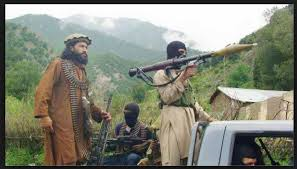
Taliban insurgents (Credit: pkdebate.com)
Taliban insurgents
(Credit: pkdebate.com)

ISLAMABAD, Oct 2 – The PML-N government has formally established contacts with the Taliban leadership through ulema from Wafaq-ul-Madaris and those commanding respect in various Taliban factions operating in the country’s restive tribal areas.

Sources in the government confirmed having started the process of contact with the Taliban, while modus operandi of the dialogue would shape up in the coming days.

A delegation of ulema belonging to Wafaq-ul-Madaris had a detailed meeting with Federal Interior Minister Ch Nisar Ali Khan and some other key persons having a vital role in the whole process on Tuesday and discussed the key issues on which the foundation of peace parleys would be laid.

The sources further said now these ulema who are playing an intermediary role would approach the Tehreek-e-Taliban Pakistan leadership to have their input and then in the light of the suggestions and proposals coming from both sides would devise some baseline for the peace initiative, and the two sides would follow basic guidelines for a formal contact.

They further said initially both the sides would be asked to stop operations against each other and then these ulema would sift the workable demands and devise a mechanism for bringing normalcy to the troubled areas.

Prime Minister Nawaz Sharif remained in constant touch with Interior Minister Ch Nisar Ali Khan despite his hectic schedule in the US where he remained for over a week in connection with the United Nations General Assembly session.

The prime minister, who landed back on Tuesday night, would be having a detailed briefing from the interior minister on the subject with specific reference to Tuesday’s meeting with the ulema.
The sources further said that as the prime minister would be having some other pressing engagements, including finalisation of names for the NAB chief slot and the Joint Chiefs of Staff Committee chairman, the interior minister would be dealing with the dialogue process with the Taliban.

Sources in the ruling PML-N revealed that a meeting of the prime minister with the leader of opposition was fixed for October 3 (Thursday) at which they would finalise a name for the NAB chairman.

On the other hand, the prime minister would be finding a fresh summary for the appointment of Joint Chiefs of Staff Committee chairman and he would have to pick a person for the slot as the incumbent would be retiring next week.

It is pertinent to mention here that previously the Ministry of Defence had put up the name of Lt-Gen Mahmood Haroon Aslam for the slot, but it was turned down by the premier before his departure for the US.

Agencies add: Tehrik-e-Taliban Pakistan (TTP) has welcomed an appeal for ceasefire made by Wifaqul Madaris ulema.

TTP spokesman Shahidullah Shahid Tuesday said the Tehrik would follow the suit, if the government decided a ceasefire prior to talks. Shahid also thanked PTI Chairman Imran Khan for his proposal to allow the TTP to open a political office. However, he added that the militia didn’t need such an office in Pakistan.

He said it was the unanimous decision of the TTP Shoora to move forward in light of the all-parties conference (APC) proposals.

This positive geture of Taliban can be considered as a major breakthrough for peace talks as the TTP on Saturday sharply criticised Prime Minister Nawaz Sharif for changing his mind and giving a precondition of laying down weapons. “By telling us that we will have to lay down arms and respect the constitution, the prime minister, Nawaz Sharif, showed that he is following the policy of America and its allies,” a TTP spokesman said.

In an interview with a private TV channel, PTI Chairman Imran Khan said that if the Taliban refuse to obey the Constitution and the Parliament‚ action will be taken against them. “Talks are possible only with those who obey the Constitution and the Parliament”, Imran elaborated.
He said the Army and the political parties were on the same page to hold talks with the Taliban. He said top priority should be given to holding talks with the Taliban with the use of force as a last option. Military action alone was not the solution of the problem, he maintained.

He said some of our enemies were funding some groups of Taliban against Pakistan. He reminded terrorism and suicidal attacks started in the country owing to wrong policies of the former military dictator Pervez Musharraf.

To a question, he said all the parties have given mandate to the government for holding talks with Taliban and there should not be delay in launching of this process.
India and Pakistan Talk, but Tensions Are High

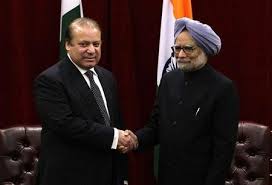
Nawaz Sharif & Manmohan Singh at UN (Credit: yahoo.com)
Nawaz Sharif & Manmohan Singh at UN
(Credit: yahoo.com)

LONDON, Sept 27 — The leaders of Pakistan and India held their first official meeting in New York on Sunday, leaving with renewed promises of mutual restraint in Kashmir but little real hope for a fresh start in relations.

Prime Minister Manmohan Singh of India and Prime Minister Nawaz Sharif of Pakistan shook hands for the cameras at the Plaza Hotel in Manhattan before their long-anticipated meeting on the sidelines of the United Nations General Assembly. But despite the smiles, violence back home formed the backdrop to the encounter.

A series of cross-border artillery exchanges in the disputed territory of Kashmir over the past two months has led to the death of at least eight soldiers on both sides, and plunged diplomatic relations to their lowest ebb in years. In the latest episode, on Thursday, a militant raid on an Indian Army base in Indian-controlled Kashmir resulted in the deaths of at least 10 people, causing an outcry in India.

India’s national security adviser, Shivshankar Menon, said that Mr. Singh and Mr. Sharif agreed during their meeting on Sunday to dial back tensions in Kashmir, the disputed territory that has triggered three wars between Pakistan and India since 1947.

The leaders pledged to push senior military officers to find “effective means” of restoring a 2003 cease-fire in Kashmir, Mr. Menon said.

Both Mr. Singh and Mr. Sharif personally favor normalizing relations, but both are hamstrung by domestic considerations — especially hard-line elements in their respective military and political establishments — that drastically limit their room to maneuver.

Mr. Singh’s party faces an electoral challenge early next year against Hindu parties that have called for a tougher stance against Pakistan. Under fire at home for meeting with Mr. Sharif, he established a tough tone in an address to the United Nations on Saturday in which he called Pakistan the “epicenter of terrorism” in South Asia.

For any progress to occur, he said, Pakistan has to first ensure that the “terrorist machine” operating from its soil is shut down. That was a reference to Lashkar-e-Taiba, the militant group that was responsible for the 2008 Mumbai terrorist attacks, in which 166 people were killed, and whose leadership still enjoys free movement within Pakistan.

Mr. Sharif, 63, was more optimistic, telling the United Nations on Friday that he wanted “a new beginning” with India, and deploring the resources both countries have spent on their nuclear-arms race — a pointed statement given that it was Mr. Sharif who ordered Pakistan’s first nuclear test during his last stint in power in the late 1990s.

Mr. Sharif’s push for a new peace initiative can be seen in part as an attempt to continue the business of that previous term, in which he staked much on reaching out to India in a process that was derailed by a nuclear crisis and a military coup in 1999. Now, as then, he has framed better relations with India as an economic necessity for both countries.

“We stand ready to re-engage with India in a substantive and purposeful dialogue,” he said during his speech to the United Nations General Assembly on Friday.

For Mr. Singh, 81, whose lack of personal political power has made him a deeply cautious prime minister, meeting with Mr. Sharif was a bold move.

On Sunday at a large rally in New Delhi, Narendra Modi, who is the opposition Bharatiya Janata Party’s prime ministerial candidate, questioned Mr. Singh’s ability to undertake the meeting effectively.

“I wonder if he will meet the Pakistan P.M. confidently today?” Mr. Modi asked. “Will he be able to ask him when Pakistan will stop aiding terrorism? Will he be able to question Nawaz Sharif on the Indian soldiers who were brutally killed?”

Analysts said Sunday’s meeting met its low expectations, and could at best stabilize relations until the political climate in both countries improved.

“This can help border incidents from escalating until India’s election season is over and more serious business can be transacted between the two countries,” said Maleeha Lodhi, a former Pakistani ambassador to the United States.

Stephen P. Cohen, an American academic who recently published a book on the India-Pakistan conflict, said the leaders appeared as “two men with tired ideas and constraints that they cannot overcome, afraid to take the bold measures that could liberate them.”

But even with the best intentions, Pakistani and Indian leaders have frequently found their efforts at diplomacy undone by the spoiling tactics of hard-liners.

In 1999, Mr. Sharif made impressive strides toward peace with Atal Bihari Vajpayee, India’s prime minister. Months later, the Pakistani military carried out a covert operation in the disputed territory of Kashmir that spectacularly upended the peace drive and, for a brief period, edged the two countries toward a nuclear conflict. A coup deposed Mr. Sharif soon afterward.

In November 2008, Pakistan’s president, Asif Ali Zardari, told an Indian conference that Pakistan was ready for a more moderate nuclear weapons policy, and called for closer economic ties between the countries. Days later came the militants’ coordinated attacks in Mumbai.

The long conflict between India and Pakistan has become a major preoccupation of the security establishment in both countries, and has found expression through proxy forces in third countries like Afghanistan.

Indian officials have for years demanded that Pakistan take action against Lashkar-e-Taiba and its founder, Hafiz Muhammad Saeed, who lives openly in Lahore. Mr. Menon, the Indian security adviser, said in New York that Mr. Sharif had promised to take action against those responsible for the 2008 Mumbai attacks.

Mr. Menon said the tone of the talks was friendly, but added: “As for how useful and productive the meeting was, I think the only proof will be in the months to come.”

Gardiner Harris contributed reporting from New Delhi, and Somini Sengupta from New York.

Balochistan Earthquake Tremors Felt up to New Dehli

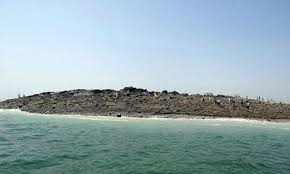
Islet formed near Gwardar port (Credit: guardian.co.uk)

A major earthquake has killed at least 327 people and left thousands more injured and homeless in a remote region of southwestern Pakistan.

The Pakistani military said it was rushing troops and helicopters to Awaran district in Baluchistan province where the magnitude 7.7 quake struck on Tuesday afternoon.

The quake was felt as far away as New Delhi, the Indian capital, some 1,200 kilometers (about 740 miles) away, but no damage or injuries were immediately reported there.

In Pakistani cities such as Karachi along the Arabian Sea and Quetta, the capital of Baluchistan province, people ran into the streets in fear, praying for their lives when the quake hit.

Local officials said they were sending doctors, food and 1,000 tents for people who had nowhere to sleep as strong aftershocks continued to shake the region.

Most of the victims were killed when their houses collapsed. Pakistani television showed pictures of the area.

Walls of the mud brick houses had collapsed and people were gathered outside because they had no homes to sleep in.

Devastation: Baluchistan is Pakistan’s largest province but also the least populated and most impoverished. Awaran district has about 300,000 residents

Emergency response: Local officials said they were sending doctors, food and 1,000 tents for people who had nowhere to sleep as strong aftershocks continued to shake the region

Pakistani officials were investigating a small island that appeared off the coast of Pakistan after the quake, apparently the result of earth and mud pushed to the surface by the quake.

The head of the Geological Survey of Pakistan confirmed that the mass was created by the quake and said scientists were trying to determine how it happened.

Zahid Rafi said such masses are sometimes created by the movement of gases locked in the earth under the sea, pushing mud and earth up to the surface in something akin to a mud volcano.

‘When such a strong earthquake builds pressure, there is the likelihood of such islands emerging,’ he said. ‘That big shock beneath the earth causes a lot of disturbance.’

To get a better idea of what the island is made of and how permanent it is, scientists will have to get samples of the material to see if it’s mostly soft mud or rocks and harder material.

He said these types of islands can remain for a long time or eventually subside back into the ocean, depending on their makeup.

A Pakistani Navy team reached the island by midday Wednesday, navy geologist Mohammed Danish told the country’s Geo Television. He said the mass was about 60 feet (18 meters) high, 100 feet (30 meters) long and 250 feet (76 meters) wide.

‘There are stones and mud,’ he said, warning residents not to try to visit the island. ‘Gases are still emitting.’

But dozens of people had already visited the island, said the deputy commissioner of Gwadar district, Tufail Baloch, who traveled by boat himself to the island Wednesday morning.

Water bubbled along the edges of the island, in what appeared to be gas discharging from under the surface, Baloch said.

He said the area smelled of gas that caught fire when people lit cigarettes.
Dead fish floated on the water’s surface while local residents were visiting the island and taking stones as souvenirs, he added.

Such land masses have appeared before off Pakistan’s Makran coast, said Muhammed Arshad, a hydrographer with the navy. After quakes in 1999 and 2010, new land masses rose up along a different part of the coast about 282 kilometers (175 miles) east of Gwadar, he said.

He said each of those disappeared back into the sea within a year during the monsoon season, a period of heavy rain and wind that sweeps Pakistan every summer. He said that in the area where the island was created on Tuesday, the sea is only about six to seven meters (23 feet) deep.

Baluchistan is Pakistan’s largest province but also the least populated and most impoverished. Awaran district has about 300,000 residents.

Many residents are believed to be involved in smuggling fuel from Iran, while others harvest dates.

The area where the quake struck is at the center of an insurgency that Baluch separatists have been waging against the Pakistani government for years.

The separatists regularly attack Pakistani troops and symbols of the state, such as infrastructure projects.

Baluchistan and neighboring Iran are prone to earthquakes. A magnitude 7.8 quake centered just across the border in Iran killed at least 35 people in Pakistan last April.

PTI Chief Urges Opening of Taliban Office in Pakistan

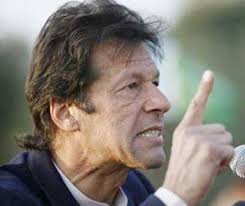
PTI chief Imran Khan (Credit: insaf.com)

PESHAWAR, Sept 25: Pakistan Tehrik-i-Insaaf (PTI) chairman Imran Khan on Wednesday urged the government to declare a ceasefire if it was serious about holding peace talks with militants in Pakistan.

The PTI chief also called on the government to allow militants to open an office in Pakistan similar to the Afghan Taliban office in Qatar to facilitate the dialogue process, DawnNews reported.

Speaking to media representatives after visiting injured persons of the Peshawar church bombing at the Lady Reading Hospital, Khan said that on one hand, there were talks of holding negotiations whereas on the other, war was still ongoing. How would it be possible to hold peace talks, he questioned.

The PTI chairman moreover said that after the fourth All Parties Conference (APC), it was decided to hold peace talks; however no solutions had come about.

Khan stressed that the government should take negotiations seriously, adding that it should declare a ceasefire.

Furthermore, he also said that the government should allow militants to establish a political office in Pakistan to hold peace talks in the absence of which negotiations would not be possible and the decade-long war against terrorism would continue.

While discussing the Peshawar church bombing which killed 81 people, Khan alleged that the tragedy had been politicised. He said 170 blasts had taken place in Khyber Pakhtunkhwa in the past nine years under previous governments, but PTI had not politicised those tragedies.

Bloody Sunday: Hundred years of coexistence tears at Peshawar’s heart

Peshawar church massacre (Credit: lakewypilot.com)

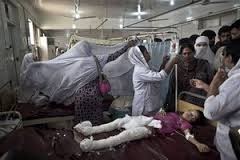
PESHAWAR: As bodies became unseemly piles in the morgue and victims offered up mangled injuries for attention, Lady Reading Hospital (LRH) was mercilessly transported back to the horrors of October 28, 2009 when a bomb exploded at Meena Bazaar.

“It is difficult to tell how many people have been killed or injured, they are just pouring in,” said LRH Chief Executive Officer Arshad Javaid initially. “This is the biggest trauma we have had to deal with since the 2009 attack, which killed 139 people.”

And no one was prepared.

The LRH chief confessed the hospital was running short of medicines, supplies, coffins and something he did not need to say out loud – space.

Pervez Masih, an eyewitness waiting to get head and chest injuries looked at, described how an ordinary weekend mass at the 130-year-old church turned into a bloody Sunday. Around 400 people, including the elderly, women and children, were at the church, he estimated. “What sounded like a minor blast occurred outside the church, but people rushed out to the main gate.” That is when the second suicide bomber, clad in a police uniform, ran at the crowd and blew himself up, said Pervez.

“We don’t understand what happened next,” he said, and he does not remember how he reached the hospital.

Principal of Geovernment High School No-4 Nothia William Ghulam and his son Neil William, a student of Khyber Medical College Peshawar, were not as fortunate as Pervez. They died in the blasts, but William Ghulam’s wife, daughter, brother Anwar and sister-in-law survived, however, not unscathed. Anwar and his wife were being treated for head, chest and hand injures at the LRH.

The aftermath of the twin suicide attack has resulted in at least 78 dead and more than 146 injured. By evening, Khyber Teaching Hospital had 25 patients – six women and three minors – and had sent 15 of their nurses to the LRH.

A jolt to the system

As the first closest point of response, the LRH took in the lion’s share of the casualties but Sunday meant lean staff; even the blood bank was shut. Doctors had to be called in; the hospital had to be woken up with a shock to its system.

The first response to any calamity or attack determines many eventualities. Most importantly, it controls the increase in fatalities and severity of injuries. This was near impossible in the attack at the church as ‘ambulances’ took the shape and form of anything with wheels and a working engine. No Rescue 1122, a few Edhi and mostly Al Khidmat ambulances were visible hurrying to the LRH. The latter eventually took bodies waiting to be buried to their homes.

Inside the hospital, while LRH doctors, nurses and staff were being called in, not much could be done about the shortage of space – the dead and the injured remained lying on the floor for nearly three to four hours.

Below ground, the LRH morgue has the official capacity to store 60 bodies. Without sufficient hands on deck, the deceased lay askew on blocks of ice. The hospital had only 52 coffins at a point when it had at least 70 bodies.

The last straw, the first brick

Above ground, the chaos only brewed chaos. As relatives collected inside the halls, there were not enough medical professionals to cater to everyone’s injuries and beds were in short supply. A majority of the injured seemed to be women and children. Distraught, with no place to even sit, loved ones raised a voice, chanting slogans against the absence of facilities and the Pakistan Tehreek-e-Insaf (PTI) government.

“Yeh zalim loug hain, yeh humain is mulk mein nahin jeenay dein geh,” cried an inconsolable family member of a deceased victim.

Younas Masih, an older adult, led the impromptu protest which resulted in some broken window panes and a rowdy crowd. “We are citizens of this country and we have equal rights like other citizens. Why is the PTI government not providing us with security and with facilities in the hospital?”

“We only ask for our rights,” said Younas. “This is a huge loss for us.”

Security lapse?

As the hospital was overrun with patients and caregivers, safety measures were invisible. Standard procedures after a blast dictate heightened security to ensure a second disaster does not follow, bur there were no policemen or private guards visible at the gates or inside.

After the hospital gained some control, LRH chief Javaid assured the victims and their worried caregivers the hospital was fully staffed and will attempt to treat every patient.

Referencing the blood bank which was shut earlier, Javaid promised the hospital was equipped with blood but encouraged people to go and donate.

Published in The Express Tribune, September 23rd, 2013.

MQM – Between a Rock & a Hard Place

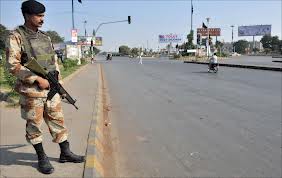
Operation in Karachi (Credit: centralasiaonline.com)
Operation in Karachi
(Credit: centralasiaonline.com)
In Pakistan, the wheel of history has brought the Muttehida Qaumi Movement (MQM) up against a sheer battle for survival. Today the ethnic party of Mohajirs (Urdu speakers from India), is squeezed between a wary, experienced Punjabi prime minister and a Sindh based PPP – that no longer seeks compromise to stay in power.

Small wonder that MQM chief, Altaf Hussain – who fled to London under Prime Minister Nawaz Sharif’s first tenure – has denounced the ongoing operation in Sindh as a reminder of the “genocide of Mohajirs” suffered in 1992 under ‘Operation Clean up.’ In so doing, he has appealed to third and fourth generation of Mohajirs, whose fathers may have been killed during that decade in police encounters and extrajudicial killings.

Apparently, the MQM miscalculated when it invited the army to conduct the operation. The first sign that the operation was not to their liking, came, when it’s former MPA, Nadeem Hashmi was arrested for the murder of two policemen – and the party protested by shutting down Karachi and a few urban areas in Sindh. Hashmi’s sudden release from an anti-terrorist court would show the MQM still has political leverage.

But essentially, US plans to withdraw from Afghanistan and the election of a `Taliban friendly,’ government have contributed to the MQM’s woes. In the wake of 9/11, the party reinvented itself as the secular alternative to `Talibanization.’ However, given that the Mohajir-Pashtun conflict is ethnic in nature, the MQM went on a limb to prevent the `Pashtoonization’ of Karachi. As violence erupted in Karachi, it prevented ever migrating Pashtuns from settling there.

After 9/11, US support for Gen. Pervaiz Musharraf facilitated him to patronize the MQM – allowing the ethnic party to reach its hey day. It contributed to the longest tenure for MQM’s Ishrat ul Ebad to govern Sindh – notwithstanding the murder and army kidnapping cases lodged against him in 1992. Former president, Asif Zardari, learning from the rocky tenures of his prime minister-wife, Benazir Bhutto, molly-coddled the MQM – enabling the PPP government to complete its tenure.

The downside was that for the last five years, the MQM and the Awami National Party (representing Pushtoons) fought on ethnic basis for the control of Karachi. The PPP, saved its coalition with the two parties by desisting from action against politically affiliated criminals. Adopting the maxim `If you can’t beat them, join them,’ it patronized armed Baloch groups from Lyari to keep control.

While the PPP government abdicated power, the land mafia dug in and brutal Taliban elements entered Karachi. Murders sky rocketed and extortion, kidnappings for ransom, vehicle thefts and mobile phone snatching soared. All this happened as the US presence in Afghanistan made weapons more accessible than ever. It resulted in 7,000 people being killed in the city in the last five years alone.

Given that Karachi is the back-bone of the nation’s tax base, the business minded Sharif government has focused on returning peace to the city. Senior police officers have been transferred and Rangers deputed to crack down in Karachi. The PPP, now acting as a junior partner of Sharif’s government, coyly says it needs to act against all criminal elements, regardless of party affiliation.

However, the absence of justice in Pakistan’s political system makes the MQM woefully aware that its real “crime,” is being out of power!!

For example, Scotland Yard has only now reinvigorated the three-year-old murder case of Imran Farooq – that implicates MQM chief Altaf Hussain. As Altaf’s demi-God personality comes under challenge, his followers have passionately rallied around him in a `now or never’ battle for survival. Media reports nevertheless, talk about cracks within the MQM – among those who support Ebad’s governorship, and others who want to stay in opposition.

At the end of the day, Sindh seeks an even-handed operation that will rid the province of all criminal elements – regardless of patronage. Presently, the culture of nepotism and absence of just policies keeps people coalescing around ethnicity. In the urban areas – and a mega city like Karachi, it fans a culture of violence that promotes fear and intimidation.

Today the biggest stake holders of Sindh – Sindhis and Mohajirs – need to rid themselves of ethnic prejudices and work together to promote rational policies and good governance. That means taking a lesson from developed nations – where race, ethnicity religion, sect and gender can no longer be used to discriminate and obstruct the common good.

Pakistani’s Iron Grip, Wielded in Opulent Exile, Begins to Slip

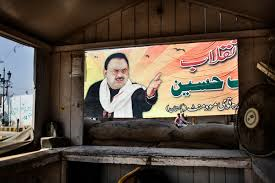
MQM chief Altaf Hussain (Credit: nytimes.com)
MQM chief Altaf Hussain
(Credit: nytimes.com)

LONDON, Sept 12 — For two decades, Altaf Hussain has run his brutal Pakistani political empire by remote control, shrouded in luxurious exile in London and long beyond the reach of the law.

He follows events through satellite televisions in his walled-off home, manages millions of dollars in assets and issues decrees in ranting teleconferences that last for hours — all to command a network of influence and intimidation that stretches from North America to South Africa.

This global system serves a very localized goal: perpetuating Mr. Hussain’s reign as the political king of Karachi, the brooding port city of 20 million people at the heart of Pakistan’s economy.

“Distance does not matter,” reads the inscription on a monument near Mr. Hussain’s deserted former house in Karachi, where his name evokes both fear and favor.

Now, though, his painstakingly constructed web is fraying.

A British murder investigation has been closing in on Mr. Hussain, 59, and his party, the Muttahida Qaumi Movement. His London home and offices have been raided, and the police have opened new investigations into accusations of money laundering and inciting violence in Pakistan.

The scrutiny has visibly rattled Mr. Hussain, who recently warned supporters that his arrest may be imminent. And in Karachi, it has raised a previously unthinkable question: Is the end near for the untouchable political machine that has been the city’s linchpin for three decades?

“This is a major crisis,” said Irfan Husain, the author of “Fatal Faultlines,” a book about Pakistan’s relationship with the United States. “The party has been weakened, and Altaf Hussain is being criticized like never before.”

Mr. Hussain’s rise offers a striking illustration of the political melee in Pakistan.

His support stems from the Mohajirs, Urdu-speaking Muslims whose families moved to Pakistan after the partition from India in 1947, and who make up about half of Karachi’s population. Since the 1980s, the Muttahida Qaumi Movement has fiercely defended Mohajir interests, and in turn it has been carried to victory in almost every election and to an enduring place in national coalition governments as well.

Mr. Hussain fled to London in 1992, when the movement was engaged in a vicious street battle with the central government for supremacy in Karachi. The British government granted him political asylum and, 10 years later, a British passport.

London has long been the antechamber of Pakistani politics, where self-exiled leaders take refuge until they can return. The former military ruler Pervez Musharraf lived here until recently, and the current prime minister, Nawaz Sharif, lived here until 2007.

Mr. Hussain, however, shows no sign of going back. The Muttahida Qaumi Movement has an office in Edgware, in northwest London. But these days Mr. Hussain is mostly at home, in a redbrick suburban house protected by raised walls, security cameras and a contingent of former British soldiers he has hired as bodyguards.

From there, he holds court, addressing his faraway followers in a vigorous, sometimes maniacal style, punctuated by jabbing gestures and hectoring outbursts. Occasionally he bursts into song, or tears. Yet, on the other end of the line, it is not unusual to find tens of thousands of people crowded into a Karachi street, listening raptly before an empty stage containing Mr. Hussain’s portrait, as his disembodied voice booms from speakers.

“The cult of personality surrounding Altaf Hussain is quite extraordinary,” said Farzana Shaikh, an academic and the author of “Making Sense of Pakistan.” “He is immensely charismatic, in the way one thinks of the great fascist leaders of the 20th century.”

In Karachi, his overwhelmingly middle-class party is fronted by sharply dressed, well-spoken men — and a good number of women — and it has won a reputation for efficient city administration. But beneath the surface, its mandate is backed by armed gangs involved in racketeering, abduction and the targeted killings of ethnic and political rivals, the police and diplomats say.

Other major Pakistani parties indulge in similar behavior, but the Muttahida Qaumi Movement frequently brings the most muscle to the fight. An American diplomatic cable from 2008 titled “Gangs of Karachi,” which was published by WikiLeaks, cited estimates that the party had an active militia of 10,000 gunmen, with an additional 25,000 in reserve — a larger force, the dispatch notes, than the city police.

Many journalists who have criticized the party have been beaten, or worse, driving most of the news media in Karachi to tread lightly. In June, the Committee to Protect Journalists, a lobbying group based in New York, accused the party of organizing the killing of Wali Khan Babar, a television reporter.

In the West, the party has avoided critical attention partly because it has cast itself as an enemy of Islamist militancy. In 2001, Mr. Hussain wrote a letter to Prime Minister Tony Blair of Britain, offering to help Britain set up a spy network against the Taliban.

Critics of the party have frequently questioned the role of British officials in facilitating its unusual system of governance. Pakistani exiles from Baluchistan, also accused of fomenting violence, have faced criminal prosecution. But Britain is not the only node of Mr. Hussain’s international support network.

Through the Pakistani diaspora, the Muttahida Qaumi Movement has active branches as far afield as the United States, Canada and even South Africa, which has become an important financial hub and a haven for the group’s enforcers, Pakistani investigators say.

Two police interrogation reports obtained by The New York Times cite militants from the movement who say they traveled to South Africa in between carrying out political assassinations in Karachi. One of those men, Teddy Qamar, confessed to 58 killings between 2006 and 2012, the police say. In an interview, Anis Hasan, the party’s joint organizer for South Africa, denied any link to organized violence.

But if Mr. Hussain seemed immune to scrutiny at his London stronghold, his luck started to turn in September 2010 after Imran Farooq, a once-influential leader in the movement who had split from the party, was stabbed to death near his house in Edgware.

Soon after, Mr. Hussain appeared on television, mourning Mr. Farooq with a flood of tears. But over the past year, the police investigation has turned sharply in his direction.

In December, officers from Scotland Yard’s Counter Terrorism Command searched the movement’s London office. Then in June they went to Mr. Hussain’s home and arrested Ishtiaq Hussain, his cousin and personal assistant, who is now out on bail. The police impounded $600,000 in cash and some jewelry under laws that target the proceeds of crime.

Mr. Hussain was not available for an interview, his party said. But a senior party official, Nadeem Nusrat, speaking at the movement’s London office, denied any link to Mr. Farooq’s killing. “Our conscience is clear,” Mr. Nusrat said. “We have nothing to do with it.”

Mr. Nusrat said the impounded money had come from political donations. And he rejected accusations, also the subject of a police inquiry, that Mr. Hussain has directly threatened political rivals, in some instances by warning that he would arrange for their “body bags.”

“It’s all taken out of context,” Mr. Nusrat said.

Mr. Hussain has receded from public view during the recent furor. There have been rumors about mounting health problems, which Mr. Hussain’s aides deny. But he cannot return to Pakistan, they say, because the Taliban could kill him. “In Pakistan,” said Muhammad Anwar, a longtime aide, “nobody can guarantee your life.”

Then there are the legal threats: over the years, dozens of murder charges have been lodged against Mr. Hussain in Pakistan, although some have been quashed in court. A more pressing question, perhaps, concerns the impact on the streets of Karachi if Mr. Hussain is forced to step down.

Some fear that without his guiding hand, tensions within the movement could split it into hostile factions — a frightening prospect in a city where political violence already claims hundreds of lives a year.

“However viciously the party conducts itself, there is an order within the apparent disorder,” said Ms. Shaikh, the academic.

Even if the British government wished to crack down on Mr. Hussain, she added, it might find itself subject to appeals from the Pakistani authorities. “The fear of Karachi going up in flames is so great,” Ms. Shaikh said, “that no government can take that risk, as long as Altaf Hussain is alive.”


Taliban’s Murder Claim of Major Gen. Evokes Strong Response

General Officer Commanding Swat, Maj Gen. Sanaullah NIazi (Credit: tribune.com.pk)

Speaking as we would expect from an army chief, Chief of Army Staff (COAS) General Ashfaq Parvez Kayani has said the military would not allow terrorists to ‘coerce’ the government or people into talks, and that the army had the capability of taking the war to them. General Kayani’s strong words reflect public outrage and national revulsion over Taliban attacks that left at least eight security personnel dead within the past 48 hours. The most senior officer among them was the General-Officer-Commanding Swat, Major General Sanaullah Niazi, whose vehicle was hit by an improvised explosive device in Upper Dir. A lieutenant colonel was also killed in the attack. The army chief stressed the armed services had the ‘ability and will’ to take the battle to the terrorists and would not allow these elements to take advantage of a quest for peace.

Any talks with terrorists must take place from a powerful position; the government must not appear to be cowering before them.

Certainly, this is what seems to be happening now. Following the call by an All Parties Conference to pursue a course of dialogue to solve security issues, the Tehreek-e-Taliban Pakistan has put out a set of demands which include a troop withdrawal from tribal areas and the release of all Taliban prisoners. At the same time they seem to be bent on continuing their war against the state. Dealing with a force that speaks from a perceived position of strength by accepting any of its terms or even hinting this could happen would be a disaster; quite possibly a fatal one. No state can afford to allow itself to be weakened in this fashion.
General Kayani, whose primary role, of course, is to defend the nation, has done well to speak out forcefully. His words act as a reminder of the act of folly that political players may have been moving towards. Any talks with terrorists must take place from a powerful position; the government must not appear to be cowering before them — and the army chief’s expression of a full readiness to take them on is reassuring given the developments of the past few days and the farcical terms put down by the TTP for talks, which more and more people of rationality believe it would be foolish to attempt to pursue, at least, at the present point in time.

US Looks to Cut Cost of Afghanistan Pull out

US preparing for withdrawal from Afghanistan (Credit: businessinsider.com)
WASHINGTON, Sept 13: Pentagon officials are holding talks in Afghanistan on the withdrawal of US military equipment from the country, officials said Friday, as Washington hopes to lower the cost of the massive operation.

American forces are having to fly out large amounts of gear at great expense but defense officials would like to move more vehicles and equipment over cheaper land routes through Pakistan, officials said.

With the US military’s drawdown underway and set to finish by the end of 2014, about 20 percent of the cargo is currently being withdrawn through the overland route across the Pakistan border.

But officials say they would prefer to have 60 percent of all materiel move over land instead of by air.

Deputy Defense Secretary Ash Carter and other senior officials arrived in Kabul earlier Friday and the equipment withdrawal, or “retrograde,” will feature prominently in their discussions, officials said.

Carter will seek to “assess the continued progress on retrograde efforts,” a defense official said.

The Afghan government shut the border earlier this year in a dispute over what the US military should pay for withdrawing its gear, with Kabul insisting the Americans owed up to $70 million in customs fines.

Washington has maintained the military equipment came into the country legally and refused to pay the fees. Afghan authorities eventually reopened the border.

Asked about the dispute, a senior Pentagon official told reporters: “We think we’ve resolved that.”

The official, who spoke on condition of anonymity, said the Pentagon was pleased with the pace of movement on the Pakistan route since April and hoped that the share of cargo moving on the supply line would expand soon from 20 to 30 percent.

Unlike the American departure from Iraq, the withdrawal of US military equipment from Afghanistan represents a daunting logistical problem in a landlocked nation with unreliable roads and mountainous terrain.

By 2015, the United States must remove about 24,000 vehicles and the equivalent of roughly 20,000 shipping containers.

Other equipment deemed not to be worth taking out is being donated to the Afghan government, passed on to NATO allies willing to cover the transport costs, or destroyed.

The cost of the effort is estimated to range from $5 billion to $7 billion, but how much of the gear is ferried out by land will affect the final price tag, officials said.

Since April, about half of all cargo has been taken out by aircraft to ports in the Middle East, and then shipped back to the United States. And roughly 28 percent of the equipment is flown all the way from Afghanistan to the United States.

Weapons and other sensitive items have to be ferried by air, but the percentage moving over land could increase if “administrative” procedures were cleared up on the Afghan side of the border, officials said.

The United States has 55,000 troops in Afghanistan and plans to withdraw the bulk of combat forces by the end of 2014. US officials are negotiating an agreement with Kabul to keep a smaller force in place beyond 2014.)

Visit to ancestral village of Sultanabad

Author meets community in Sultanabad (Credit: Fayyaz Naich)
Sultanabad, Aug 20: ATDT author visited her ancestral village of Sultanabad, founded by her maternal grandfather Fida Hussain Khaliqdina – who was appointed in 1920 as a trustee of Sultan Mohammed Shah Aga Khan 111 – while Sindh was still under British occupation.

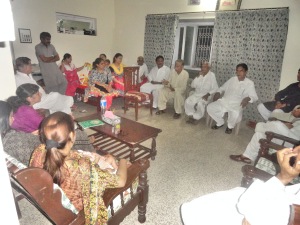
The invitation to visit Sultanabad was formally extended to the author and her companions by the religious higher ups of the community.

Sultanabad founder  (extreme right) (Credit: Author)
Sultanabad founder (extreme right) (Credit: Author)
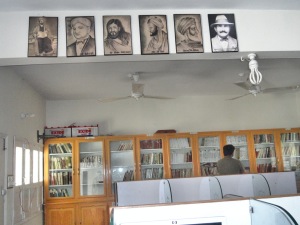
Built in the proximity of Mirpurkhas, Sindh (in the south of Pakistan), Sultanabad is enclosed in a thicket of trees, with rich cultivated farm lands, well planned rows of houses, class rooms for computer training, community hall, library – and prayer house.

The author was apprised of her grandfather’s work in buying 644 acres of barren land in Bulgai Jodhpur Railway Station, near Sukkur barrage, where he successfully settled Ismaili families with his own funds, in what became known as Sultanabad Agriculture Colony.

According to the community elders, Sultanabad (1-3) have since become a model agricultural villages.. with a thriving market that supplies fruits and vegetables to Sindh. In turn, the community has built up good quality education, employment, health facilities and a high level of security that protects it from the uncertainty that plagues much of the province.

A multi purpose cooperative society has been formed in the name of Varis Fida Hussain, to facilitate economic cooperation and enhance the financial well being of the community.