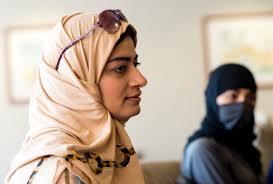
At any of the countless secular universities she might have chosen, religion — at least in theory — would be beside the point. But she picked one that would seem to underline her status as a member of a religious minority. She enrolled at the University of Dayton, a Roman Catholic school, and she says it suits her well.
“Here, people are more religious, even if they’re not Muslim, and I am comfortable with that,” said Ms. Alhamad, an undergraduate in civil engineering, as several other Muslim women gathered in the student center nodded in agreement. “I’m more comfortable talking to a Christian than an atheist.”
A decade ago, the University of Dayton, with 11,000 undergraduate and graduate students, had just 12 from predominantly Muslim countries, all of them men, said Amy Anderson, the director of the school’s Center for International Programs. Last year, she said, there were 78, and about one-third of them were women.
The flow of students from the Muslim world into American colleges and universities has grown sharply in recent years, and women, though still far outnumbered by men, account for a rising share.
No definitive figures are available, but interviews with students and administrators at several Catholic institutions indicate an even faster rate of growth there, with the Muslim student population generally doubling over the past decade, and the number of Muslim women tripling or more.
At those schools, Muslim students, from the United States or abroad, say they prefer a place where talk of religious beliefs and adherence to a religious code are accepted and even encouraged, socially and academically. Correctly or not, many of them say they believe that they are more accepted than they would be at secular schools.
“I like the fact that there’s faith, even if it’s not my faith, and I feel my faith is respected,” said Maha Haroon, a pre-med undergraduate at Creighton University in Omaha, who was born in Pakistan and grew up in the United States. “I don’t have to leave my faith at home when I come to school.”
She and her twin sister, Zoha, said they chose Creighton based in part on features rooted in its religious identity, like community service requirements and theology classes that shed light on how different faiths approach ethical issues.
Many Muslim students, particularly women, say they based their college choices partly on the idea that Catholic schools would be less permissive than others in the United States, though the behavior they say they witness later can call that into question.
They like the prevalence of single-sex floors in dorms, and even single-sex dorms at some schools. “I thought it would be a better fit for me, more traditional, a little more conservative,” said Shameela Idrees, a Pakistani undergraduate in business at Marymount University in Arlington, Va., who at first lived in an all-women dorm.
Some of the women land at Catholic schools more or less accidentally — some are married and simply enroll where their husbands are going, while others are steered toward particular schools by their home countries’ governments.
But for others it is a conscious choice, based on recommendations from friends or relatives, or impressions gained from growing up in places, like Lebanon, with strong traditions of church schools.
Most of the schools say they do not specifically recruit Muslim students.
“There’s no conscious effort,” said the Rev. Kail Ellis, a priest and vice president for academic affairs at Villanova University, near Philadelphia. “It’s basically something that happened through word of mouth and reputation.”
Muslim students here cite the accommodations Dayton has made, like setting aside spaces for them to pray — a small room for daily use, and two larger ones for Fridays — and installing an ablution room for the traditional preprayer washing of hands and feet.
The university also helps students arrange celebrations of major religious holidays, and it contracts with a halal meat supplier for special events.
Manal Alsharekh, a Saudi Arabian graduate student in engineering at Dayton, said, “I was in another university before that did not respect us so much.”
Even so, the adjustment to an American school can be jarring, especially for women. They are a minority even within the minority of Muslim students. Many of them follow restrictions on interaction with nonrelatives, and the head coverings most of them wear make it impossible to blend in.
The degree of culture shock students experience varies as widely as the traditions they grew up in. Some eat the nonhalal meat served daily in school cafeterias, some eat it only after saying a blessing over it and others do not eat it at all.
In a gathering of foreign-born Muslim women here, traditional attire varied widely, from Ayse Cayli, a graduate student from Turkey who does not cover her head and wore shorts and a T-shirt, to Mrs. Alsharekh, who while in public wears a floor-length cloak over her clothes and a veil across most of her face. Most wear a hijab, or head covering, and stylish but fairly conservative Western clothes extending to the ankles and wrists, even in warm weather.
The prospect of walking into an identifiably Christian institution, often for the first time in their lives, can be intimidating.
“I was afraid they will not like me because I am Muslim, or they will want me to go to church,” said Falah Nasser Garoot, a male Saudi graduate student in business at Xavier University in Cincinnati. “At first, when I saw the crosses on the classroom walls, it was very strange for me.”
Fatema Albalooshi, a graduate student from Bahrain who is studying engineering at Dayton, said that when she first looked into the school, “I thought it was going to be compulsory to take Catholic courses.”
And for the women, especially, identifiable by their head scarves, there are always questions. “People stop and ask me questions, total strangers, about my head covering, they’re curious about how I dress,” said Hadil Issa, an undergraduate here who grew up in the Palestinian territories and the United States. The more covering they wear, the more women are asked if they get hot in the summer. Muslims are consulted on etiquette by students planning to visit the Middle East. And often, they are asked why they attend a Catholic school.
“I tell people the atmosphere is very warm and supportive,” Ms. Issa said. “I feel accepted here, and that’s what matters.”
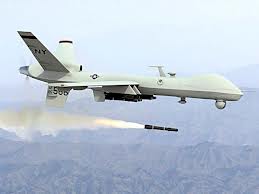
Washington/Islamabad, August 25 – Badruddin Haqqani, the key operational commander of the al Qaeda linked Haqqani network, and top Pakistani Taliban commander Mullah Dadullah are believed to have been killed in US drone and air strikes in the tribal region of Pakistan and Afghanistan. Badruddin, the son of Afghan warlord.
Jalaluddin Haqqani, is ranked as a deputy to his elder brother and the network’s chief Sirajuddin and was believed to be killed in one of the five volleys of drone strikes in Pakistan’s Taliban-controlled tribal agency of North Waziristan since August 18.
Four of the missiles hit took place in Shawal Valley, considered to be traditional area of operations of Haqqani network in North Waziristan, and US reports said he may have been killed in the August 21 strike near Miranshah.
The wave of attacks drew strongest protest from Islamabad in recent years when a senior US diplomat was summoned by the Foreign Ministry to lodge their opposition to the attacks.
Badruddin, thought to be in his mid-30s, was a member of the Miranshah Shura Council, one of the Afghan Taliban’s four regional commands, which controls all activities of the militant group in Afghanistan and Pakistan.
Senior US officials were quoted by the New York Times as saying that they had strong indications that Badruddin, the key commander of the Haqqani network which is responsible for most of the spectacular assaults on American bases and Afghan cities in recent years, was killed in a drone strike
Meanwhile, a statement by coalition forces in Afghanistan said that Tehrik-e-Taliban Pakistan leader Mullah Dadullah was among 20 militants killed in a “precision airstrike in Shigal wa Sheltan district (of) Kunar province yesterday.” Dadullah, whose real name is Maulana Mohammad Jamaluddin, was made the commander of Taliban in Pakistan’s Bajaur Agency in 2010. He fled to Afghanistan to escape an operation launched by the Pakistan Army. His deputy Shakir too was killed in the airstrike, the statement said.
Badruddin is one of the nine Haqqani family members who have been designated by the US as global terrorists. His brother Sirajuddin is the overall leader of the Miramshah Shura.
Siraj was designated by the State Department as a terrorist in March 2008 and in March 2009, the State Department put out a bounty of USD 5 million for information leading to his capture.
Giving details about the operation, American intelligence officials indicated to the Long War journal yesterday that the remotely piloted Predators and Reapers were targeting an “important Jihadi leader” in the region but his name was not disclosed.
“There are indications that Haqqani has met his demise,” a senior US official said in Washington yesterday.
He said officials were waiting to sift through evidence, including information on jihadist websites, before they could be certain that Haqqani had been killed.
The report said their caution stemmed from previous erroneous claims by American and Pakistani officials about militant deaths in Waziristan, a difficult place to get reliable information. But if confirmed, Haqqani’s death would be a “major benefit to the military coalition in Afghanistan.”
“Badruddin has been at the centre of coalition attacks in Afghanistan as well as mischief in Pakistan,” said the official. The Haqqani network has been blamed for some of the most spectacular assaults on US bases and Afghan cities in recent years.
By Friday evening, reports of Badruddin Haqqani’s death were circulating in Pakistan’s tribal belt.
In Washington, the White House and the CIA, which carries out drone strikes in Pakistan, declined to comment.
The latest string of drone attacks, most of them carried out in Shawal area of North Waziristan Agency, has renewed tensions between Pakistan and the US.
Nearly 40 suspected militants have been killed in these attacks, including a Kashmiri jihadi named “Engineer” Ahsan Aziz. Former Jamaat-e-Islami chief Qazi Hussain Ahmed recently led funeral prayers in Mirpur for Aziz, who was killed in a drone strike on August 18.
Badruddin Haqqani runs the Haqqani network’s day-to-day militant operations, handles high-profile kidnappings and manages its lucrative smuggling operations, according to a report by the Combating Terrorism Center at West Point.
In August last year, Afghan intelligence released intercepts of Badruddin Haqqani directing a daring assault on Kabul?s Intercontinental Hotel. Three years before that, he held a reporter for The New York Times, David Rohde, hostage.
The last major successful drone strike in Pakistan was the killing of al-Qaeda deputy leader Abu Yahya al-Libi in June.
US drones yesterday fired six missiles at three locations in Shawal Valley, destroying mud-walled compounds and two vehicles, Pakistani security officials and a Taliban commander said.
Among the 18 people killed was Emeti Yakuf, a senior leader of the East Turkestan Islamic Movement, a group from western China whose members are Chinese Uighur Muslim militants.
Immigrant protests in Greece (Credit: eutimes.net)
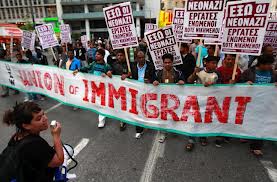
ATHENS, Aug 24: Greek police say up to 3,000 people have participated in a peaceful demonstration by immigrant groups in Athens on Friday to protest racist attacks in the crisis-struck country.
Protesters, most of who were from Pakistan, marched to Parliament shouting slogans and brandishing banners.
Friday’s march was held to protest increasing racist attacks and alleged cases of police brutality against immigrants.
Greece is the main entry point for illegal immigrants seeking a better life in the European Union.
The massive influx coincided with a spike in crime, and contributed to the sharp rise of the extreme-right, anti-immigrant Golden Dawn group that won 18 of Parliament’s 300 seats in June’s national elections.
Golden Dawn supporters have been repeatedly accused of violent attacks on immigrants, which the group says it does not condone.
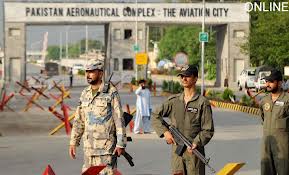
Minhas air base in Kamra (Credit: onlinenews.com.pk)
Islamabad, Aug 16: Militants targeted a major military air base some 30 miles northwest of Islamabad early Thursday morning, giving momentum within Pakistan to the prospect of a long-controversial military mission against elements in restive North Waziristan.
The battle between the military and the militants lasted for more than five hours and left nine militants and one soldier dead. Tehrik-e-Taliban Pakistan (TTP), the North Waziristan-based group, claimed responsibility for the attack.
Minhas air base at Kamra includes an aeronautical complex that produces and develops air and ground weapons. But the attack has drawn particular concern because the base has been widely reported to be equipped with nuclear weapons, though the military denies that.
Analysts in Pakistan are calling today’s attack the first of many to come in response to the reports of an operation by the Pakistani military in North Waziristan.
“The Kamra attack is an eye-opener that [the Taliban] can hit us anywhere, anytime, and the speech by the Army chief earlier had the same strategic message in it – that we need to unite against such elements and drive them out,” says a senior military official, referencing a televised speech by Gen. Ashfaq Parvez Kayani on the operation.
The TTP has strengthened itself in North Waziristan in the past five years. The area is also reported to be home to the Haqqani network, which the US government blames for orchestrating attacks inside Afghanistan.
“Thursday’s attack epitomizes the blowback of a military operation in North Waziristan. And the worrying sign is the capacity of these terrorists to attack. If still nothing is done against them, they will only grow stronger. So it reinforces what we have been hearing about, a need of an operation in North Waziristan, where these elements operate freely,” says Cyril Almeida, a columnist who writes for the largest English daily paper in Pakistan.
Defense Secretary Leon Panetta said Monday that General Kayani told US military officials that Pakistan planed to launch operations against Taliban militants in North Waziristan. Secretary Panetta acknowledged that the combat operation might not include offensives directly attacking the Haqqani network.
“We realize that the most difficult task for any Army is to fight against its own people. But this happens as a last resort. Our real objective is to restore peace in these areas so that people can lead normal lives,” the Pakistani Army chief emphasized in a speech on August 14. He then added that “no state can afford a parallel system or a militant force.”
Kayani attempted to address the popular sentiment among Pakistanis that the military was bending to America’s will. “The fight against extremism and terrorism is our own war, and we are right in fighting it,” he said in a televised speech.
However, many are skeptical about whether the operation will be effective if it does not attack the Haqqani network. “Our military is interested in acting against Pakistani-centric militants only, to stop attacks inside Pakistan like the one today,” adds Mr. Almeida.
Locals from North Waziristan also point out flaws in an operation in North Waziristan. “They have been talking about a possibility of an operation for the past three years. Do you think that the Haqqani network is going to sit around and wait?” says Safdar Dawar, president of the Tribal Union of Journalists.
According to intelligence officials who have operated in the tribal belt, the Haqqani network has more than a dozen places in Afghanistan to operate from.
“Other elements operating in North Waziristan have no place to go and can be targeted as they have been cornered into this area,” says Brig. Asad Munir, who belongs to the tribal belt and retired from military a few years ago.
Munir, who has served in key intelligence positions in the tribal belt, says the military operation will improve relations between Pakistan and America, but not for that long. And given the terrain between Pakistan and Afghanistan, security experts say it is almost impossible to seal this border.
“North Waziristan has been the most strenuous issue between the two countries, and the US believes if Pakistan acts in this area, the insurgency in Afghanistan will be controlled. But without border control from both sides, the operation may not be so successful,” the brigadier adds.
This is not the first time a military base in Pakistan has been attacked.
In 2009, the headquarters of the military came under a siege that lasted for 20 hours. And last year, an attack at a naval base in the port city of Karachi lasted for almost 15 hours.
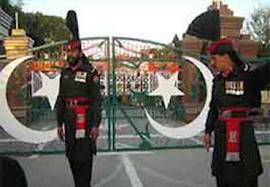
Indo Pak border at Wagah (Credit: exclusivenews.in)
NEW DELHI, Aug 15 — More than 250 Pakistani Hindus have arrived in India over the past two weeks bearing tales of religious persecution, according to Indian border officials, fueling perceptions of growing discrimination against minorities in Pakistan.
The Pakistani Hindus, who came by road and rail with valid pilgrimage visas from Sindh, Baluchistan and Punjab provinces, have reported incidents of kidnapping, looting and forced religious conversion, the officials said.
Pakistan has 2.7 million Hindus in a majority-Muslim population of 180 million. They represent those who chose to stay after the sectarian blood bath that accompanied the 1947 partition of the subcontinent at the end of British rule.
The Pakistani Hindus’ allegations of persecution and expressed desire to stay in India pose a diplomatic quandary for the New Delhi government: Should India welcome them and open the floodgates? Or should it stay aloof, treating this as an internal Pakistani matter — and shielding itself from allegations of Muslim mistreatment in India.
“As far as we know, the families have come on a pilgrimage. So far, no family that is based in Pakistan has approached us for asylum,” Preneet Kaur, India’s deputy foreign minister, told the Headlines Today news channel in New Delhi on Tuesday.
Kaur noted that India and Pakistan had agreed in 1972 not to interfere in each other’s internal affairs. But she added, “However, we do request Pakistan, on humanitarian grounds, to look after the interests of minorities.”
India does not have a national refugee law; it deals with arrivals from neighboring countries on an ad hoc basis. Thousands of Pakistani Hindus who have come here in the past two decades have still not received Indian citizenship.
But the country may be unable to maintain that detachment for long, in view of the steady stream of Pakistani Hindus who say they are being harassed by new Muslim fundamentalist groups in Pakistan’s Sindh province.
“They barge into our homes in broad daylight, snatch jewelry from the women, money from our shops, and kidnap Hindu girls and convert them to Islam,” Mukesh Kumar Ahuja, a young Hindu from Pakistan, told Indian reporters in the northern state of Punjab. “We want India to let us stay and ease visa rules for our relatives who are still in Pakistan.”
Tejinder Goggi, a hotel owner and peace activist in Punjab, said he saw at least 100 Pakistani Hindus arrive last week with bedding, pots and pans stuffed into jute sacks and cardboard cartons.
“They are worried about their daughters because 20 girls were kidnapped and married to Muslim boys in the past year,” Goggi said.
An immigration officer said that only half of those who have come to India in the past year have returned to Pakistan.
“They come for pilgrimage on a 30-day visa, and they keep extending it,” the officer said, speaking on the condition of anonymity to discuss the politically sensitive issue. “They produce medical certificates to say they are ill, or report a marriage or death in the family.”
On Monday, several Indian lawmakers raised the issue in Parliament and urged the government to take it up with Pakistan.
“If persecuted Hindus don’t come to India, where will they go?” asked Prakash Javadekar, spokesman for the Hindu nationalist opposition Bharatiya Janata Party.
Hindu protests have been growing in Pakistan. Last week, Pakistani President Asif Ali Zardari set up a three-member panel to address the Hindus’ grievances, and Interior Minister Rehman Malik has promised to examine the situation. “The government will first look into the matter and then allow them to leave Pakistan,” Malik said of those seeking visas. He did, however, question why India had given such a large number of visas to the Hindus.
Not all Pakistani Hindus want to leave. “I was born in Pakistan,” Kanhaiya Nagpal, a retired professor, said in a telephone interview from Karachi. “I like to live here. This is my country.”
Nagpal said he had participated in a demonstration organized by several Hindu groups Monday to protest harassment. But he added: “The solution is not to run away. If the rule of law is followed in Pakistan, then everything will be all right.”
Nisar Mehdi in Karachi contributed to this report.
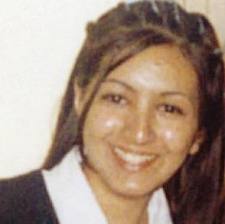
ictim of Honor Killing in London (Credit: guardian.co.uk)
LONDON, Aug 3 : A Pakistani-born couple were jailed for life by a British court Friday for murdering their “westernised” teenage daughter in an apparent honour killing.
Iftikhar Ahmed, 52, and his wife Farzana, 49, were told at Chester Crown Court in Cheshire, north-west England, that they would serve a minimum of 25 years each after suffocating their 17-year-old daughter Shafilea in 2003.
In a high-profile case, Shafilea’s sister Alesha had told the jury that her mother had said, “Just finish it here,” as they forced a plastic bag into Shafilea’s mouth in front of their other children.
Prosecutors said the Ahmeds, who lived in the town of Warrington, near Chester, killed their daughter because they felt her “western” habits such as wearing make-up and talking to boys brought shame on the family.
Passing sentence, judge Roderick Evans told the pair: “Your concern about being shamed in your community was greater than the love of your child.
“Shafilea was a determined, able and ambitious girl who wanted to live a life which was normal in the country and in the town in which you had chosen to live,” he said.
“She was being squeezed between two cultures — the culture and way of life that she saw around her and wanted to embrace, and the culture and way of life you wanted to impose on her.”
Iftikhar Ahmed stood impassively as the sentence was passed, while his wife sobbed.
The jury had unanimously found them guilty earlier on Friday after 11 hours of deliberation.
Shafilea had disappeared in September 2003, and her body was found five months later on a riverbank in Cumbria, north-west England.
The court heard that she had been drugged and taken to Pakistan in February 2003 to be forced into a marriage with a much older man.
She was so terrified of the marriage that she drank bleach, and was taken back to Britain where she spent eight weeks in hospital.
Shortly before she was taken to Pakistan, she had run away from home and asked the local authority to provide her with emergency accommodation, the court heard.
In her letter to the authorities, she said she had suffered from regular domestic violence since she was 15.
“One parent would hold me whilst the other hit me,” she wrote. “I was prevented from attending college and my part-time job.”
Her main reason for running away was that her parents “were going to send me to Pakistan and get me married to someone,” she added.
Her parents were arrested in December 2003, three months after the killing, on suspicion of kidnapping Shafilea — but they were released without charge after prosecutors found there was insufficient evidence against them.
They were re-arrested in 2010 after Alesha was caught organising an armed robbery at the family’s own home, and told police she had witnessed her sister’s murder.
Iftikhar Ahmed, a taxi driver, denied the murder and said Shafilea had run away. His wife also denied the killing, but told the jury she saw her husband beating Shafilea and believed that he killed her.
Another of their daughters, Mevish, supported their defence.
But in a remarkable twist after the trial began, one of Mevish’s friends produced writings by her that appeared to corroborate Alesha’s story.
Mevish Ahmed insisted the writings were a piece of drug-induced “fiction” that Alesha had used to base her story on.
Prosecutor Paul Whittaker paid tribute to Alesha Ahmed for having the courage to give evidence against her parents, and urged victims of honour-based violence to come forward.
“The word ‘shame’ has been heard many times during the course of this trial, but the shame is not on Shafilea, it is on her parents,” he said. (AFP)
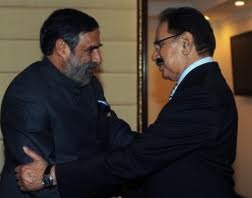
Indo Pak trade reps Sharma & Faheem (Credit: newspakistan.pk)NEW DELHI, Aug 1: India on Wednesday overturned its ban on foreign investment from Pakistan in a move designed to build goodwill amid a renewed push for a peace settlement between the two neighbours.
“The government of India has reviewed the policy… and decided to permit a citizen of Pakistan or an entity incorporated in Pakistan to make investments in India,” said a statement from the Indian commerce ministry.
India and Pakistan, which have fought three wars since independence, are channeling their peace efforts into “trade diplomacy”.
The aim is to build enough trust to tackle the more troublesome issues that divide them, such as the disputed territory of Kashmir.
“It will definitely benefit Pakistani investors and industrialists. We hope this decision will be fruitful for the people of both countries.” Pakistani businessmen also welcomed the move.
“We do appreciate this action by the government of India, but what will be more interesting for me is when the Indian authorities lift its ban on Indian investors investing in Pakistan,” said Majyd Aziz, involved in the import and export of minerals and in shipping.
“For a better economic future in South Asia, it will be a huge step when businessmen from both the countries can freely invest in each other’s country.” Zubair Motiwala, chairman of the board of investment in Sindh province, said it was the “right decision taken at the right time”.
“Allowing our country to invest in India is a great confidence booster and will pave the way for more cordial bilateral relations,” he said.
The warming commercial ties underline the new relevance of the private sector in the peace process, analysts said.
Pakistani citizens and companies will be allowed to invest in all sectors apart from defence, space and atomic energy, a government statement said. All propositions must be notified to the Indian government, it added.
The decision to accept foreign direct investment from Pakistan was taken in April when the trade ministers of the South Asian rivals met in New Delhi.
They also discussed ways to ease visa curbs on business travel and the possibility of allowing banks from both countries to open cross-border branches.
The improved relations between the rivals stem from Pakistan’s decision to grant India “Most Favoured Nation (MFN)” status by year end, meaning Indian exports will be treated the same as those from other nations.
MFN status will mean India can export 6,800 items to Pakistan, up from around 2,000 at present, and the countries aim to lift bilateral trade to $6 billion within three years, officials have said.
Official bilateral trade is just $2.7 billion and heavily tilted in New Delhi’s favour, according to most recent figures, but unofficial trade routed through third countries is estimated at up to $10 billion.
In further progress, the neighbours opened a second trading gate in April along their heavily militarised border, increasing the number of trucks able to cross daily to 600 from 150.
Pakistan has called for a “new era” in economic collaboration with India to build “a legacy of peace and prosperity for our future generations”.
The two countries have said there are many sectors with huge trade potential, from information technology to engineering, education and health.
The two nations have voiced hopes that boosting trade can help peace talks which India warily resumed last year after suspending them after the 2008 attack by Islamist gunmen on Mumbai that killed 166 people.
“Commerce is an excellent way to bring countries together,” Indian strategic analyst Uday Bhaskar told AFP recently.
“Once you institutionalise trade, it becomes hard to slow the momentum for cross-border exchanges.”
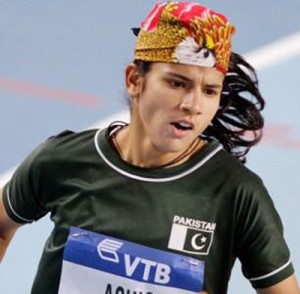
Rabia Ashiq (Credit: brecorder.com)KARACHI: Pakistan’s talented athlete Rabiq Ashiq who will be competing in the 800 metres competition at the London Olympics, scheduled for Aug 8, has received a major boost with her recent sponsorship contract.
Rabia was selected to participate in the Olympics through wildcard and is hoping to make an impact in the challenging event at the Games scheduled for next week.
Rabia said that although she will strive hard for the medals, this opportunity alone of competing in the world’s top sports extravaganza is a dream come true.
“Girls should educate themselves and realise their dreams through hard work and persistence. Nothing is impossible,” she said prior to her departure for London.
Hailing from a modest background, Rabia had to face discouragement from her immediate and extended family initially but her passion drove her to continue taking part in sports at school and college level.
Recognising her tenacity, Zong a leading cellular company has decided to sponsor the athlete for her participation in the world’s foremost sports competition.
“Rabia is an epitome of courage and an excellent example for the world to see that with minimal resources there can still be success stories of women who are willing to dream. Even if the society is not ready to support, a person can change everyone’s perception through his or her consistent efforts,” said an official. (Agencies)
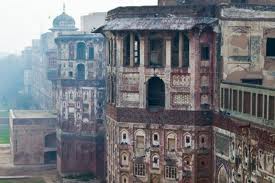
Badshahi mosque in Lahore (Credit: diplopundit.net)Pakistan, July 8: Many of us travel for business or leisure. But few ever take a trip that dramatically shatters their entire worldview of a country and a people in one fell swoop. I was lucky enough to have returned from just such a trip: a week-long sojourn in Pakistan.
It was a true eye-opener, and a thoroughly enjoyable one at that. Many of the assumptions and feelings I had held toward the country for nearly 30 years were challenged and exposed as wrong and even ignorant outright.
Yes, I was aware of all the reasons not to go, safety foremost among them. As an American, an Indian, and a Hindu there seemed to be multiple reasons for someone of my background to have concerns about security. Relatives and friends couldn’t hide their dismay and genuine fear; a frequent question was “why would you want to go?” The subtext is that there’s nothing to see there that’s worth the risk.
The Western and Indian media feed us a steady diet of stories about bomb blasts, gunfights, kidnappings, torture, subjugation of women, dysfunctional government, and scary madrassa schools that are training the next generation of jihadist terrorists. And yes, to many Westerners and especially Indians, Pakistan is the enemy, embodying all that is wrong in the world. Incidents such as the beheading of American journalist Daniel Pearl, 26/11 and the Osama Bin Laden raid in Abottobad have not helped the cause either. Numerous international relations analysts proclaim that Pakistan is “the most dangerous place in the world” and the border with India is “the most dangerous border in the world.”
I’m not naive enough to argue that these proclamations don’t have some elements of truth; through extensive academic work on Pakistan’s governance, its history, and its nuclear weapons arsenal I know that some problems are real. Rather, I am here to tell you that these aspects are overblown; that this country is about so much more, a whole other and much larger, beautiful, glorious, and uplifting side not given equal time by the media. I’ve seen it with my own eyes. And it’s time that Indians and Americans acknowledge Pakistan for what it really is as a whole- and our ignorance for what that is.
It may be easy to dismiss my firsthand experience as anecdotal: yes, I stayed in affluent neighborhoods in large cities, mostly met those who belong to the educated elite, was protected by firearm-toting bodyguards, and rarely revealed my ethnic background to most of the new people I met. Funnily enough, I don’t think now that the absence of any of these factors would have changed my experience at all.
The Genesis
My trip to Pakistan was not planned much in advance. I was in Sri Lanka for a friend’s wedding and spent a great deal of time with two Pakistani friends from my undergraduate days at Georgetown. Both are now businessmen, one in Karachi and the other in Lahore. I was going to be in India soon, and mentioned that a trip to Pakistan is something I always wanted to do, but I was too scared to execute it. Over the next few hours, we had some beer and seafood by the hotel swimming pool in Colombo and got into a detailed and lively discussion, during which time they insisted I visit and guaranteed my safety throughout the stay. My concerns allayed, I promised to make it happen, probably the first person from my family tree to visit Pakistan since the bloody 1947 partition. I was fortunate to have the opportunity for a fully hosted trip and couldn’t pass it up anymore. I have realized now more than ever before how deep the friendships forged during college can run- cutting across borders, cultures, and time.
Karachi
As I was about to land in Karachi on my flight from Colombo, Sri Lanka (direct flights from India are few and far between), I was gripped by a familiar fear. What the hell was I doing? What if I got detained in the airport and then deported because they found out my Indian ancestry and suspected my motives? How would my parents react if they learned I was the victim of a bomb blast while traveling around the city? On the plane I sat next to a very chatty and friendly executive from Lahore, who had gone to Sri Lanka on business. He was excited to tell me about Pakistan since it was my first visit, and the conversation was pleasant enough. But I kept feeling the growing knot of fear in my stomach. I tried to be brave as the plane landed. As my friend had said, 20 million people live in Karachi and now and then bad things happen, but the odds of it affecting me were very low.
Fortunately I got through immigration at the Quaid-e-Azam Airport quickly, and a friend was waiting for me with his pickup truck. The first thing I saw outside the airport was… a giant McDonald’s restaurant surrounded by a large and well-manicured green lawn. An unexpected welcome from the golden arches on a sunny, hot day.
Two uniformed bodyguards with rifles who were exceedingly friendly and welcoming climbed onto the pickup truck bed as we started on a 45-minute drive. I was impressed by the massive, well-maintained parks and gardens surrounding the airport. I was also impressed by the general cleanliness, the orderliness of the traffic, the quality of the roads, and the greenery. Coming from a city government background, I was surprised at how organized Karachi was throughout the ride. I also didn’t see many beggars the entire way. I had just spent significant amounts of time in two major Indian cities, Mumbai and Bangalore, as well as several second-tier cities like Mangalore, and none would compare favorably on maintenance and city planning, especially when it came to potholes and waste management. This was the first surprise; I was expecting that piles of garbage and dirt would line the roads and beggars would overflow onto the streets. Surely there is dirt and poverty in Karachi, but far less than I was expecting. Karachi was also less dense and crowded than India’s cities.
My second pleasant surprise was to see numerous large development projects under way. I had read about Pakistan’s sluggish GDP growth and corruption in public works and foreign aid disbursement. This may be true, but construction was going on all over the place: new movie theaters, new malls, new skyscrapers, new roads, and entire new neighborhoods being built from scratch. In this regard it was similar to India and every other part of Asia I had seen recently: new development and rapid change continues apace, something we are seeing less of in the West.
Just a few of the many highlights in Karachi included relaxing at beachside cafes, dining at amazing tandoori restaurants such as the massive Barbecue Tonight, an excellent burger/brunch joint called Xander’s, a visit to the historic and beautiful Mazar-e-Quaid where the nation’s founder, Muhammad Ali Jinnah is entombed in a marble mausoleum, visiting a book fair next to the British-era Frere Hall, and a sailboat ride around the Karachi port where a magnificent crab feast fit for a Mogul emperor was served on board. The service was so impeccable, the cooks would crack and remove individual crab claw shells by hand to make it easier to access the fresh meat.
We were also able to do some things which may sound more familiar to Americans: bowling at Karachi’s first bowling alley, intense games of pickup basketball with some local teenagers at a large public park (these kids could really play), or passing through massive and well-appointed malls filled with thousands of happy people of all ages walking around, shopping, or eating at the food court. We even attended a grand launch party for Magnum ice cream bars, featuring many of Pakistan’s A-list actors, models, and businesspeople. A friend who is involved in producing musicals directed an excellent performance at the party, complete with live band, singing, and dancing. This troupe, Made for Stage has also produced shows such as the Broadway musical Chicago to critical acclaim with an all-Pakistani cast for the first time in history.
Even the poor areas we visited, such as the neighborhoods around the Mazar, were filled with families coming out for a picnic or a stroll, enjoying their weekend leisure time in the sun. All I could see were friendly and happy people, including children with striking features running around. At no time did I feel the least bit unsafe anywhere we went, and we definitely went through a mix of neighborhoods with varying profiles.
Lahore
Lahore is more beautiful overall than Karachi or any large Indian city I’ve seen. Serious effort has gone into keeping the city green and preserving its storied history. Historians would have a field day here. In particular we saw two stunning historic mosques, the Wazir Khan and the Badshahi, both of which should be considered treasures not only for Muslims, Pakistanis, or South Asia, but for all of humanity. I felt it a crime that I’d never even heard of either one.
Each of them in different ways features breath-taking architecture and intricate artwork comparable to India’s Taj Mahal. These are must-see sights for any tourist to Lahore. The best way to enjoy the vista of the Badshahi mosque is to have a meal on the rooftop of one of the many superb restaurants on Food Street next to the mosque compound. This interesting area was for hundreds of years an infamous red-light district, made up of a series of old wooden rowhouses that look like they were lifted straight out of New Orleans’ Bourbon Street, strangely juxtaposed with one of the country’s holiest shrines. From the roof of Cuckoo’s Den restaurant, we could see all of the massive Badshahi complex along with the adjoining royal fortress, all while having a 5-star meal of kebabs, spicy curries in clay pots, and lassi under the stars. We were fortunate to have very pleasant whether as well. This alfresco dining experience with two good friends encompassed my favorite moments in the city.
We did much more in Lahore. We were given a tour of the renowned Aitchison College, which one of my friends attended. This boys’ private prep school is known for its difficult entrance exams, rigorous academic tradition, illustrious list of alumni since the British founded the school, and its gorgeous and impeccably maintained 200-acre campus that puts most major universities icluding my own Georgetown to shame. Aitchison has been considered one of the best prep schools on the subcontinent since 1886. However, it would have been impossible to get a tour without the alumni connection because security is very thorough.
We went out to the village of Kasur, not too far from the famous Waga border with India, to see my friend’s agricultural business. This gave me a profile of village life, which like India makes up most of the country. The highway on the way was in very good condition, and the village was serene and pleasant, if poor. Just as with the cities, I saw lots of potential in this place. With more advanced farming, shipping, and storage methods, it’s quite likely that we will see much more wealth coming to Pakistan’s villages in the near future.
Beer seems to taste better when it’s bootlegged. There’s an alcohol prohibition in effect across Pakistan so there’s no other way to get it. One of the modern contradictions of Pakistani life is that the country has a top-notch brewer called Murree’s, set up during the British Raj, but the company officially exists only to export the beer- or to have it sold on the local black market, which is apparently insatiable. If you have the money and contacts, you are usually able to find booze. We spent two leisurely evenings in Lahore drinking Murree’s in my friend’s pool, swimming, chatting, and listening to music such as techno, hip-hop, and Talking Heads. Life does not get any better than that- in Pakistan or elsewhere.
In Conclusion
This is a story about more than individual friendships, which brought me to Pakistan in the first place. I was hosted by a number of people in their homes, including a former high-ranking general of the Pakistani Army, and treated like a part of the family despite my background. I conducted several meetings, both formal and informal to discuss business opportunities, and was always treated with great respect. I made a number of new friends, people who I hope to stay in touch with and see many times again.
Indians and Pakistanis should take a step back and think about all of the things they have in common. The brand of Islam I saw in Pakistan was benign, mostly relegated to melodic prayer calls from the minarets, and pleasant salutations between people. It is not an in-your-face brand of the religion as I have seen in the Middle East, where everyone is forced to conform to rules about clothing or shutting down business during prayer times. Pakistanis and Indians are cut from the same cloth, and really aren’t that different from each other. I think this was my biggest and most pleasant surprise of all. The ill feelings that do exist are mostly manufactured for political gain on both sides of the border, or based on slights from decades or even centuries ago.
Though there are grand challenges, foremost among them the issue of Kashmir and related border disputes, these should be easily overshadowed by the economic opportunities available to Pakistan, India, and the West by increasing their level of international trade. In fact, I believe commerce and the march of capitalism will provide the path for India and Pakistan to become allies as nations and friends as people.
There are certainly other challenges. Terrorism and gangsterism are very real problems, and they are alive and well in Pakistan, especially in the rough terrain of the Northwest Frontier region ruled by tribal militias and their blood feuds. The army continues to play an outsized role in government, and there are not yet any better options as the civilian leaders are mostly compromised by business interests and cronyism in a land where feudal tendencies appear time and again. But even these problems can be overcome by bringing Pakistan deeper into the community of nations, and further integrating Pakistan into world markets. India and the United States for their part can do more to help bring this about. I am convinced that instead of the delicate dance the three nations have done around each other since 1947, it is time for all to become closer friends and drop the pretexts for moving backward instead of forward. What I saw in Pakistan more than the perils, is great potential.
I plan to do my part, and this piece is only the first step.
Child receives polio drops (Credit: photoblog.msnbc.msn)Last month, militants in North Waziristan, led by Hafiz Gul Bahadur, announced a ban of anti-polio campaign until the US put a stop to the drone war.
“On the one hand they are killing innocent women, children and old people in drone attacks and on the other, they are spending millions on vaccination campaign,” said a leaflet distributed in the region’s main town of Miramshah.
Following the ban in North Waziristan, similar pamphlets were distributed by a militant faction in the adjoining South Waziristan a week later, warning health workers to stop their campaigns or face the consequences.
“Polio and other foreign-funded vaccination drives in Wana sub-division would not be allowed until US drone operations in the agency are stopped,” stated the pamphlet issued by Taliban commander Mullah Nazir. This is the third time the Taliban have banned polio vaccinations in areas under their control.
Since the Nato conference in Chicago this May, and when Pakistan decided not to re-open its supply route to Afghanistan, drone strikes have intensified and the brunt of attacks has been felt in both the North and South Waziristan agencies.
If the Taliban mean business there could be “an increase in polio cases, and even disability and death among the children of these areas” according to Dr Janbaz Afridi, deputy director of the Expanded Programme for Immunization (EPI) for Khyber Pakhtunkhwa.
“For us, even one child left out is one too many,” says Mazhar Nisar, the Health Education Advisor at the Prime Minister’s Polio Monitoring Cell, referring to the children missed from being administered the oral polio vaccine (OPV) caused by the ban.
These announcements by Taliban are indeed a blow to eradication of polio in Pakistan. Despite two decades of mass vaccination drives, Pakistan has failed to control the crippling paediatric disease. Today, being among the last three countries (others being Afghanistan and Nigeria) where polio is endemic, it is under excessive international pressure to eradicate it as the presence of the virus means a major set-back to global plans.
The last decade saw Pakistan taking massive strides to reduce the polio incidence. In 2005, the number of cases went down to just 28, but since then there have been signs of the OPV drive losing momentum.
Since 1988, the Global Polio Eradication Initiative – spearheaded by WHO, Rotary International, the US Centres for Disease Control and Prevention and Unicef – has achieved a 99 per cent reduction in polio incidence worldwide.
This was possible through the mass administration of OPV simultaneously to all children below the age of five, to induce ‘herd immunity’ in entire regions and replace the wild polio virus with a cultured, attenuated strain.
Since early this year, there have been 22 confirmed polio cases, compared to 52 in the same period last year. Of these, 11 have been reported from Fata, with nine alone from Khyber agency.
Political analyst Hasan Askari Rizvi views the Taliban policy of linking the entry of health workers to stopping drone attacks as show of “confidence and control of the area”.
“That they can implement anything if they become determined and the Pakistani authorities are left with no option but to negotiate with them shows the Taliban disregard for the future of children and this fits in well with their policy of destroying schools. The desire to establish their control and create their domain of authority by whatever means is the objective. They represent an authority alternate to Pakistani authority,” Askari told Dawn.com.
Afridi of the EPI agrees. He says the fear of “torture and kidnapping” from the militant groups is quite palpable and spread across the adjoining agencies as well as parts of Khyber Pakhtunkhwa province.
“There is every effort to assuage these fears and the field teams will be provided complete security by the police, with support from the provincial administration.” So far, he said, there have been no cases of health workers pulling out of the immunisation work due to the threats issued by the local militants.
Meanwhile, Nisar, is quite hopeful that the situation will be resolved. “The federal government is aware of the situation and the government of KPK, the political agents, members of the peace committee and tribal elders are intervening to find a solution,” he told Dawn.com, adding: “After all, they are putting their kids at risk too.”
“I think it’s a step in the right direction,” says Afridi.
Mariam Bibi, who heads Khwendo Kor – a KP-based non-government organisation working for women of the area, too concedes persuasion the only way out. “Nobody wants to endanger the lives of their children, but this message needs to be emphasised.”
However, she warns it should not be limited to getting the militants to agree on administration of the polio vaccine.
“Today it is polio, tomorrow the militants will come up with another issue to arm-twist the government; a more holistic approach is needed where the confidence of the local people has to be won.
“You give them water and I swear half your problem will be resolved,” Bibi said.
She said there were “layers upon layers” of problems that needed to be addressed. “Give them a complete healthcare package, not just polio drops; when you promise education, ensure and negotiate that it is not just for boys but be firm that girls will have to be educated as well.” According to Bibi, the government needed to strategise and build its capacity.
“And they need more women in the field.”
The latest announcement by the militants has once again revived the case of Dr Shakil Afridi, a local doctor convicted by a tribal court to 33 years in prison for assisting American spy agence CIA in finding the whereabouts of Osama Bin Laden through a fake hepatitis campaign.
Bibi said after Dr Afridi was found to be spying, there is a growing suspicion among the locals that there could be several others among the health workers spying for the US This suspicion is compounded by the statement made by Bahadur who alluded to the “strong possibility of spying” on mujahideen for the US during the polio vaccination campaign. “In the garb of these vaccination campaigns, the US and its allies are running their spying networks in Fata…” the leaflets distributed in South Waziristan says.
With anti-American sentiment at an all time low, this has further hampered the vaccination driver.
However, Mazhar is quite convinced the Pakhtun people “would never use children” as a ploy. Moreover, the health workers were all local people and “well aware of the situation on the ground” in these security compromised areas.
“Taliban use such tactics like burning girls schools to gain world’s attention,” agreed Ibrash Pasha, working for Khwendo Kor in Dir.
Therefore, there are never any fixed dates set for holding vaccination drives and “opportunistic campaigns” take place whenever the situation becomes favourable. For now, the only other step taken by the polio cell is to immunise anyone entering or leaving these tribal agencies and the province. “Vaccinators are present at all entry and exit points,” said Mazhar.