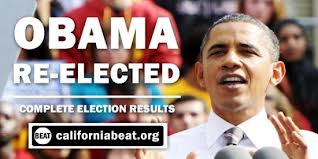
Islamabad, Nov 7 – As news of President Obama’s victory reaches Pakistan, many say they do not expect any substantial change in US foreign policy toward the country.
But some Pakistani officials and politicians are quietly hoping that perhaps a cabinet reshuffle and a strengthened mandate, now that reelection pressures are eased, could soften an otherwise tense relationship between the two countries.
And rumors that Sen. John Kerry (D) from Massachusetts could replace Secretary of State Hillary Rodham Clinton has some officials hoping that the former’s many-year relationship with Pakistan could pave the way for an even smoother cooperation.
“It is of course up to the US president to appoint the Secretary of State. However, if speculations about Kerry become true, then that would be a positive development – and a lot easier. Kerry has many friends in Pakistan. He obviously knows the region, and the ins and outs of our relationship,” says Fawad Chaudhury, a special assistant to Pakistan’s prime minister.
Kerry was one of the US senators who sponsored the $1.5 billion annual Kerry-Lugar-Berman aid package to Pakistan, and is known for his relationship with the country. He paid visits to Afghanistan and Pakistan following the Navy Seal raid that killed Osama bin Laden, in an effort to save the rocky partnership.
Some within the security establishment agree. “I think he is more soft and understanding toward Pakistan. There may be a better relationship between the two as a result,” says a security official who preferred to remain unnamed.
The official also predicts that Obama’s reelection could have given him a strengthened mandate to pursue the foreign policy line – and vision – that he laid out during his first presidential campaign.
“This time he might be more bold, and have more space to make his own decisions. In the first term, the CIA and Pentagon were calling the shots. Now Obama is less worried about reelection, and can ensure that the State Department sets the line,” says the official.
In an interview before the election, cricketer-turned-politician Imran Khan said he tentatively agreed that an Obama win would benefit Pakistan. “Obama’s instincts are basically right. Let’s hope if he wins the second term, we see a different Obama,” he said.
Even Pakistan’s right-wing Islamist political party Jamaat-e-Islami (JI) appears hopeful. “Less pressure on Obama could create some space for small changes in their policy. Perhaps Obama could move closer toward the message he gave the Muslim world in his Cairo speech. But time will tell,” says Fareed Ahmed Paracha, JI’s deputy secretary general.
But Dr. Paracha also echoed the broader apparent disinterest of the Pakistani public in Obama’s victory. “The bottom line is that we need to get our own house in order,” he says. “The US, as such, does not matter.”
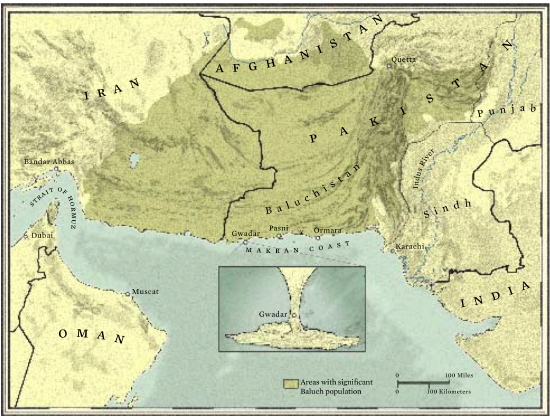
Not only does Balochistan have vast mineral resources (resources at Reko Diq alone are estimated in hundreds of billions, if not over a trillion, in dollars, sufficient to put our economic house in order for a decade or so), it also has the largest coastline available to us, housing the only deep sea port at Gawadar. But its real strategic significance is really far greater and durable than that.
Balochistan (and Gawadar) are the essence of our oft repeated ‘strategic location’.
It links us through Iran to the Middle East, and is the outlet for flow of resources from Central Asia, Western China, and Afghanistan. This is also China’s safe outlet to the Atlantic. A cursory look at the map will suffice to comprehend that from China’s eastern ports, sea-borne traffic via the Pacific poses no difficulty but to get to the Middle East or via the Gulf of Aden to the Atlantic is not merely a lengthy, circuitous route via the bottleneck at Straits of Malacca, it is peppered with US naval bases which can interdict traffic at will.
From Gawadar, however, Chinese vessels are at the mouth of the Arabian Gulf and a mere 1400 kms from the Gulf of Aden; what is more, this route is unthreatened. With the growing Chinese industry in the Chinese province of Xinkiang, coupled with an expanded KKH and a parallel rail link, this Strategic Commercial Corridor has become of vital strategic significance to China.
Finally, a Chinese naval presence at Gawadar in the not too distant future will multiply China’s options of power projection. It is in this backdrop that the Chinese warning to the US, in the aftermath of the US raid to execute Osama bin Laden on May 2nd this year when China stated that, “any future attack on Pakistan will be considered an attack on Beijing”, is comprehensible. Pakistan is, for the first time, in a position to be an equal partner in the (so-far) lopsided Sino-Pak relationship!
No wonder then, that Balochistan hosts so many international actors working to our detriment!
While ethnic based target killing has reduced in recent months, militants have now started targeting the pro-Pakistan loyalists. One example is the recent killing of Dr. Lal Bakhsh Baloch of the National Party. Reportedly, his death was ordered by Dr. Allah Nazar, BLF.
An apparently unusual development, but one which is understandable, is that the, usually peaceful Zikri community along the coast has joined the “Baloch Sarmakar”, a title denoting all Baloch insurgents. The Zikris, as we all know, have always been held in low esteem and discriminated against. To prove their “Balochness”, they have joined the insurgents and, very interestingly, I am told that Nadeem Baloch, a Zikri, has been appointed second in command by Allah Nazar!
As of last year, the area of major insurgent activity, which had rooted itself in the area ranging from Kalat to Khuzdar and Naushki, has extended to portions of the Mekran coast, due to afore-stated developments.
Traditionally, the anti-Sardari element among the Baloch were the youth and the very small middle class; these were also (mostly) patriotic and pro-Pakistan. The youth are alienated and, therefore prepared to accept distortions of their history, and are turning into insurgents; the Middle Class has gone into hibernation.
Traditional hold of Baloch Sardars is no longer very strong. All Baloch tribes have divided loyalties under sub-Sardars; all scions of the original Sardar family; most of them fighting each other. The most noteworthy exception is Sardar Khair Bakhsh Marri who enjoys the following of the bulk of his own tribe, as well as that of Baloch militants (and potential militants) and, to a far lesser degree, Ataullah Mengal.
The extent and depth of the corruption in the provincial government is well known and accepted. While many Baloch Pashtun are vehemently resentful of the rampant corruption, most Baloch seem to think it is a way of compensation to the Baloch! They seem to view the corruption as ‘stealing from Pakistan (or Punjab)’. Few, except the middle class, including Pakistan-loyalists who are relatively sidelined, advert to the fact that this corruption has actually deprived them of the development; the lack of which is their current complaint. Few are even aware of the billions of rupees that have been donated by the central government for socio-economic development, education, and human resource development, over the last decade, in addition to the annual budget.
In one instance, Zulfiqar Magsi has been quoted as having responded to a question, by Khair Bakhsh Marri, who asked him, “kiya ho raha hei?” Magsi responded, “Sab mil ke Balochistan kee XXXX XXXX rahe hein!”
Over the last year or so, resentment against the army has begun to decline and the army’s efforts to assist in health, education, and socio-economic welfare have begun to be appreciated. However, the ‘execution’ of Nawab Akbar Bugti still sticks in the Baloch craw, for which they cannot forgive the army, even though most of them are conscious of, and state, that it was on Musharraf’s orders.
On the other hand, naval cantonments along the coastline are a very sore point with the Baloch. Apparently, Naval Cantonments have made no effort to provide locals the kind of facilities that are associated with army cantonments. Very little, if any, effort is being made by PN to extend, health, education, sanitation, or social welfare. In the words of the Baloch, “They (PN personnel) are like foreigners occupying our land who treat us like dirt. We can do manual labor for them, but under armed escort. Even those (Baloch) permitted into their hospital are escorted by an armed guard”. I am not personally witness to this; however, even if this view is an exaggerated one, as we are all aware, in such instances, perceptions are more important than realities.
The general impression, with which I concur, is that there is no coordination between the various organs of the intelligence services in Balochistan, or between any of them and the FC. Consequences are frequently chaotic.
Smuggling arms, weapons, explosives, and drugs continues unabated. The general impression is that this is being done in collaboration with individuals in the intelligence agencies and the FC, in the case of the latter, almost without exception. This accusation is difficult to dispute. I have been given the name of one prominent smuggler, who is known by his pseudonym, “Beer”. Whether or not he belongs to the tribe, he now calls himself a Bizenjo and, reputedly, enjoys political patronage. Three different influential (but middle class) individuals, two of whom I consider fairly reliable, have told me that, along the border with Afghanistan/Iran, posts are vacated at certain times to facilitate free movement of smugglers.
Siraj Raisani is credited with most of the smuggling and he is laying claim to most of the killings and “missing persons”. However, he sells himself as one who enjoys support from GHQ and claims to be acting on behalf of the army/ISI.
A number of the Baloch have used words to the effect that, “if you send majors, Lt Cols, or even Brigs to such assignments, who have no future left in the army, why should they not seize the opportunity to enrich themselves”.
Some individuals have pointed out that (some) very senior officers have also taken the opportunity to make profits, if not through outright corruption, through misuse of authority. Shares procured by senior officers in various mining projects, by exerting influence, and jobs procured by them for close family members are cited as examples. I am not in a position to verify this and put it down merely to emphasize that the general view is that “Balochistan is a land that provides opportunities to rape it and enrich both; politically powerful Baloch and military officers/bureaucrats for the duration of their stay”.
Intelligence agencies and the ISI in particular, are still held responsible for the majority of deaths and ‘disappearances’. In private, however, some individuals, albeit reluctantly, acknowledge the fact that under the garb of accusations against the ISI, numerous personal vendettas, internecine rivalries, including political rivalries, inter and intra tribal ones, and between smugglers are responsible for a large number of killings, including those who are tortured; and that all these are laid at the door of the military/ISI.
In the last few years, there has been a demographic change in the population of Balochistan due to the influx of Afghan Pashtuns and Hazarvis, as well as Pashtum from Tribal Areas. The Baloch are very conscious of this fact and of the fact that, over decades past, the Pashtun of Balochistan have outstripped the Baloch in all respects: financially, in education, in employment opportunities; in every conceivable sphere.
They are also convinced that there is a deliberate effort by “Pakistan” to favor the Pashtun so as to diminish the intensity of the insurgency. If this is a policy, it might succeed in the interim but, in the long term Baloch grievances will have to be addressed.
With reference to above, some contradictory clarification is necessary, since the Pashtun complain of being under-represented in the political dispensation. Many, ethnically Pashtun Baloch tribes have adopted Baloch ways. Not only do they exclusively speak Balochi language, they claim Baloch ethnicity, like the Raisani tribe. Consequently, while Balochistan’s corrupt CM is ethnically Pashtun, for all practical purposes, from the Governor down to the IG Police; all posts are actually held by Baloch or Barahvis.
As a consequence, the traditional hostility between the Barahvi and Baloch has virtually disappeared. They have, more or less united against the common threat from Pashtun dominance engineered by “Pakistan/Punjab”. That being stated, the “Barahvi Ittehad” continues to exist.
However, the hard core Baloch militants are not, in my estimation, too large a number. I estimate them to be well under 10,000. They do, however, enjoy the willing support of their extended families, their tribe, and other Baloch.
The greatest and most urgent problem is that there are between 500,000 to 750,000 (so-called) ‘educated’ youth, some with college, others with university degrees, in search of gainful and respectable employment. They are fully conscious that their degrees are worthless and they are unfit to find respectable employment in a competitive selection. They are too proud to take up manual labor and angry enough to become potential militants and/or their supporters. I have frequently heard these words spoken in anger, even hate, but the plaintive cry beneath them is audible if one is listening, “Hum par Jihalat kyoon musallat kee jaa rahee hei”.
The youth are being fed, not only distortions of their real history, they are being fed the spiel that, “The Americans are coming. They will divide Balochistan into a Pashtun region and a Baloch region. Each Baloch family will receive a grant of $ 500,000/-“. Very few actually believe this but it serves as a “fall-back” belief, if all else fails—a ray of hope, if you will. Khair Bakhsh Marri is the main individual responsible for selling this view.
In brief, the all-pervasive view among the new generation of Baloch is that they are unequal citizens of Pakistan and are not stake-holders with a future or any hope of a future.
The fact that numerous ‘foreign hands’ are involved in stoking unrest in Balochistan is now accepted by numerous international journalists as well. This fact comes as no surprise to me or to the audience this document is addressed to. After a lengthy discussion, one young man who burst out in anger, while explaining that, with a university degree, all he could really qualify for is manual labor and added, “why should I not earn $ 100/- a day?” Since I wanted to goad him into saying more, I also asked in pretended anger, “who the hell will pay YOU $ 100/- a day?” and he immediately replied, “Indians pay $ 75/- through Iranian conduits and the CIA pays $ 100/- through Pakistani agents in Quetta.
This view has been expressed by some middle class Baloch and Punjabis, settled in Quetta for over a generation. “You (meaning Pakistan, the army, or government—take your pick) have turned Pakistan into a country of Muslims, not Pakistanis. Consequently, all Muslims from all over the world are here. The current war for control of Quetta is being fought between Iran and Saudi Arabia. Saudi supporters (presumably meaning Taliban) are occupying Kuchlag and Iranian supporters (Shias including Hazarvis) are centered round the Quetta Medical College. Kuchlag is, as you know, Pashtun, and the area was once under the iron hands of the father of Maj Ashraf Khan Nasir, former Chief Secretary Balochistan), whom I know well. There are a couple of nuances in this assessment, which need to be highlighted, since most Pakistanis refuse to acknowledge the damage done to us by Saudi Arabia and focus exclusively on the US. Firstly; that Saudis are a major part of the problem and, secondly; that, when it comes to Iranian interests, Jundallah (a Sunni organization) and Irani Shias (including the Iranian chapter of Hizbollah) and Hazarvis join hands. This opinion is shared by some Baloch Shias as well, but I am not certain that this is necessarily true.
Taliban: When the so-called “Quetta Shoora” initially moved into Quetta from Afghanistan and attempted to exert itself; it was soon silenced and, over time the prominent member of the Shoora shifted to Karachi. During my visits, between 2003 and 2009, I saw numerous Taliban roaming the streets of Kuchlag, Loralai and other Pashtun dominated regions. However, they went unarmed during daylight. My impression was that local Pashtuns were prepared to host them but kept them firmly under control. Ashraf Nasir also assured me that my impression was accurate. In 2009, however, for the first time, Ashraf Nasir sent me back to Quetta after dinner, under a heavy escort. Early this year (2011), in response to my query on Taliban, he reiterated his earlier claims of their being firmly under control, but my impression was that that was no longer true. Taliban had become independently strong.
This was very visible in other Pashtun dominated regions, including Chaman. (My impression is that this may be a deliberate response by the Pashtun of Balochistan due to being excluded from the corridors of political power.) The Pashtoonkhwa Party is being revitalized, which might also be a reactionary response.
From the above, I conclude that the claim of a ‘turf war’ between Taliban and Iran supported groups is probably a gross exaggeration but with, at least, a grain of truth. Recent events like the attack targeting the DIG FC and the one killing over two dozen Hazrvis lends some credence to this conclusion.
Underneath a rather large paint of hate to be found in the Baloch activists, is a yearning for peace and a return to normalcy. However, they are proud people who have a stated position and, therefore, need to be “seen to have won” (something) so as to acquiesce to a return to the Pakistani bosom.
I have, for long held the view that Counter Insurgency, COIN, is NOT really a military function. And, that if there is an insurgency, it is due to genuine (or perceived) socio/politico/economic grievance(s), or a combination of these. That if they have taken recourse to violence, it is because of the feeling that, without violence, their voice does not reach their target audience. Consequently, COIN as a strategy must seek to redress those grievances. To coin a phrase, insurgencies cannot be suppressed; a COIN campaign can only succeed by “out-governing” the insurgents!
This in no way implies that there is no role for the use of force, whether overtly, by security forces or covertly, by intelligence agencies. But the use of force, by either means, is only to create a situation favorable for COIN to succeed. This is a link to an article by me, originally carried in the US by Counterpunch, where I have attempted to explain my perspective of why American COIN is a perpetual failure, but it includes illustrations by example, of the selective use of force—-for those interested in wasting another 10 minutes: http://groups.yahoo.com/group/alochona/message/21219!!
It is my considered view that unless we can, with immediate effect, initiate a meaningful two-pronged COIN strategy, addressing the immediate and the mid/long term, we might end up alienating the Baloch forever.
Since the success of a comprehensive COIN strategy hinges around its effective utilization of resources, it will have no chance, if funds are routed through the corrupt provincial government or NGOs. Consequently, I find myself left with only one option i.e. organizing this through the army! I am fully conscious of the irony of this proposal after having stated above, so vehemently, that COIN is not the function of the military.
However, our political leadership is, not only magnificently unaware of this fact (that COIN is a non-military function), it has willingly been ceding in Swat and SWA all socio-economic development projects to the army’s supervision (including our very successful venture titled “Sabaoon”) and, I am certain, would willingly cede ALL aspects relating to COIN in Balochistan as well.
I am also very conscious of the fact that GHQ is overworked and would be very reluctant to assume a larger role. However, my proposal will attempt to reduce its direct involvement to a bare minimum. Nonetheless, it will have to be GHQ and the ISI that pushes for this proposal; otherwise it will not take off.
Under the garb of COIN; using the excuse that the provincial government itself offers an excuse i.e. its inability to access remote areas and those areas threatened by violence, GHQ/JCSC should assume responsibility for ALL projects relating to health, education, and socio-economic welfare of the people of Balochistan, on behalf of the provincial government, the last clause is of prime importance since then GHQ/JCSC will be seen as acting within the mandate of the 18th Amendment and not in violation of it by acting on behalf of the central government.
As stated earlier, the immediate problem is a large proportion of (supposedly) educated youth who are unemployed and have no hope of getting respectable employment, expected by young boys/girls, with college/university degrees. My short term recommendations deal with this issue.
Start numerous Vocational Institutions located in or close to all military cantonments, for the young with college degrees, youth of upto 25, though individuals elder than that need not be excluded automatically. These institutes could include basic computer skills, alongside the field of actual specialization, sewing, knitting, embroidery and similar subjects for young ladies; mechanical skills, carpentry, masonry, electrician, plumbing, etc for men.
Young men should be encouraged to move to other cities in the country to seek employment opportunities there. Even Fauji Foundation could induct a certain percentage of these youth. If they are skilled labor and acquire their skills and are employed away from home, they will earn a respectable living, without being exposed to the humiliation of having to do such work where they might be exposed to ridicule by their peers.
Young ladies, on the other hand, should be encouraged and assisted to find employment close to home. Askari Bank might be encouraged to start a venture akin to the famous “Grameen Bank” in Bangladesh, which provides small loans to (almost exclusively female “members”) to enable them to begin small business ventures on their own. Some young ladies could be encouraged to begin such ventures collectively.
Most young men over 25 might be reluctant to join vocational institutes. Those willing to, should be encouraged to move to larger cities, where job opportunities are greater. They can be assisted in finding semi-respectable employment e.g. when I ordered a V Sat connection from PTCL, two respectably dressed young men on a motorcycle, turned up to set up the gadget and explain how it works. I am certain that there are numerous other such opportunities for semi-skilled work, for which limited necessary expertise is more easily acquired. Others can be encouraged to turn to agriculture as desalination plants spring up along the coast.
Small industries for fruit packaging and export should be encouraged around Quetta. This is one industry for which, unlike the ill-fated venture of textile industries, no raw material need be imported and, logically, the packaging plant(s) should be as close to the source as possible. This too will generate employment opportunities and will be profitable. In fact Fauji Foundation or AWT could espouse this venture and set aside a fixed percentage of the profits for other welfare projects in Balochistan.
A variation on the “Sabaoon” theme is required for the Baloch youth. I am not yet in a position to spell out how or what. But as soon as I can, I will consult with people and make a separate suggestion on this.
The Baloch plea against “Jihalat” being forced upon them is both moving and merited. It must be addressed immediately, and be seen to being addressed in the long term. We have to revive their hope for a better future for the future Baloch generations in a united Pakistan.
PARIS, Oct 28: An aide of French former president Nicolas Sarkozy was on Monday charged in an illegal political funding scandal known as the “Karachi Affair,” a complex probe into alleged kickbacks on arms deals.
Nicolas Bazire, the current number two of luxury group LVMH, was heard by judges for four hours and accused of handling illicit funds used for political campaigns.
A former campaign manager for ex-prime minister Edouard Balladur, Bazire had been under investigation since September.
Investigators are looking into irregularities in the financing of Balladur’s 1995 presidential campaign. Sarkozy was Balladur’s campaign spokesman and budget minister at the time.
Judges suspect Balladur’s campaign of receiving illicit “retro-commissions” from the sale of French submarines to Pakistan. Two Sarkozy political aides and a former minister are under formal investigation over the affair.
Judges are also probing claims that a 2002 bombing in Karachi that killed 11 French naval engineers was carried out by Pakistani agents in revenge for the cancellation of bribes secretly promised to officials.
The payment of arms sales commissions was legal in France until 2000, but the payment of kickbacks back to France was and is illegal.
The probe focuses on the 1994 sale of submarines to Pakistan and frigates to Saudi Arabia.
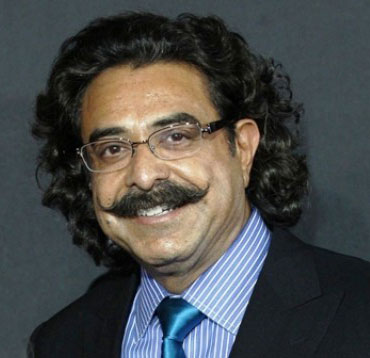
NEW YORK, Oct 26: Pakistan-born billionaire Shahid Khan has told US television newsmagazine “60 Minutes” that racist remarks when he bought the NFL’s Jacksonville Jaguars last November made him more determined to succeed.
CBS said Thursday that the report, to air on the show’s Sunday telecast, shows Khan that he felt like such remarks as “sand monkey” and “terrorist from Pakistan” were not his problem but showed the troubles of those who made them.
“(I reacted) the way I reacted most of my life, which is it’s not really my problem. It’s their problem,” he said. “It was not Jacksonville’s finest moment.”
Anti-Muslim insults did not spoil Khan’s joy at buying the Jaguars from former owner Wayne Weaver, whom Khan said was embarassed by the racist remarks and concerned they might want Khan to forget the deal.
“I think he was surprised. And he wanted to just make sure that you know, it wasn’t giving me pause,” Khan said, noting he never had a second thought about completing the purchase because of the comments.
“As a matter of fact, if it was possible for me to be more determined, it… gave me more determination.”Khan spent $760 million, according to Forbes magazine, for the Jaguars, which were founded as an expansion team in 1995. Khan had failed in a 2010 bid to purchase the St. Louis Rams, a central US NFL team much nearer his business.
Khan said Pakistan lacks the same opportunities he found in the United States, visiting where he grew up in Lahore with a CBS film crew.
“See how hard things are? Power’s going out, it’s 108 degrees. It’s tough,”Khan said. “I think the biggest impediment here is that hope, getting to the next stage, it doesn’t matter how hard you work, there are forces that kind of prevent you from being the best you can be.”
Khan came to the United States in 1967 at age 16 to attend college and went from working in a small garage to making a fortune in auto parts, his unqiue one-piece bumper design becoming a hit in vehicle manufacturing circles.
Two-thirds of all cars and trucks sold in America now have at least one part manufactured by Khan’s firm, Flex-N-Gate, and he ranks among the 400 richest Americans as categoried by Forbes.
Khan, who was born in Pakistan in 1950, graduated with an engineering degree from the University of Illinois in 1971, a year after he started working at Flex-N-Gate, which he bought in 1980. It now has $3 billion in annual sales.
“This gentleman is absolutely the American story,” Weaver said at the time of the sale. “He came to this country from Pakistan… he has factories worldwide and is one of the major producers of parts for all of the major automobile companies.
“I absolutely admire entrepreneurs and he absolutely sets the bar.”
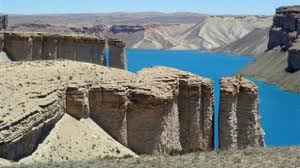
Bamiyan, Oct 23 – If the high mountain lakes of Band-e Amir were not in a country in its fourth decade of war they would be world famous.
Outsiders lucky enough to see them today are often lost for words when they first set eyes on the ethereal blue of their waters and the Martian-orange and red cliffs surrounding them.
The lakes, in Bamiyan province, are Afghanistan’s first-ever national park, and draw thousands of local visitors every year. The government hopes foreign tourists will one day come too.
If that sounds quixotic now, so too may the UN and the government’s launch here of the country’s first-ever environmental protection plan – with a solar-powered kettle one of its signature initiatives.
But for those living in Bamiyan’s isolated mountain valleys, the most immediate threat is not the Taliban but drought, partly induced by human activity.
Climate change is making things worse and the lakes could be at risk too.
Glaciers in the province’s Koh-e Baba mountains, the western end of the Hindu Kush, recede further each year.
The climate adaptation programme, as it’s known, “is not luxury, it’s life”, says Bamiyan Governor Habiba Sarabi after climbing up to Qazan, one of 18 mountain farming communities involved in the $6m (£3.75m) scheme. The high mountain lakes of Band-e Amir draw thousands of local visitors every year
‘Disaster-prone’
Some 3,000m (9,800ft) above sea level, this is always going to be a tough place to live and farm.
But it’s got tougher as trees and vegetation have been cut down for fuel – creating the beginnings of a high-altitude dust bowl.
In an Afghan version of the Grapes of Wrath, more families are being forced to leave every year.
Like shaved heads, most of the hillsides are bare, with just the occasional stubble of green.
It also means villages are more exposed to “flash-flooding in spring and summer and avalanches in winter”, says Andrew Scanlon of the UN Environment Programme.
But he is now overseeing the planting of new trees and turf along Qazan’s valley.
Against the repetitive clanging of hammer on metal, workers in Bamiyan city are building scores of cleaner, more-efficient stoves.
The solar kettle is just one of the initiatives to help Bamiyan adapting to climate change
Run by an Afghan NGO called the Conservation Organisation for the Afghan Mountains (COAM), the workshop sells them on preferential terms to local villages and it already has more orders than it can fulfil.
Mr Scanlon wants to expand the scheme elsewhere.
COAM is promoting another energy-saving device, the solar kettle.
It is basically a large satellite dish which reflects sun-rays onto a kettle suspended in the middle.
The bigger the dish the quicker the boil – but the one they are selling for about $100 can make a cup of tea in 20 minutes.
Yet with Nato forces retreating over the next two years, taking large chunks of aid money with them, there are concerns whether this tentative momentum can be maintained.
The New Zealand run civilian-military provincial reconstruction team (PRT) in Bamiyan is due to close early next year.
Catching up
There are questions, too, over the future of Bamiyan’s best-known landmark – the remains of the larger of its two rock Buddhas, blown up by the Taliban months before the US-led invasion in 2001.
The vast cave, or niche, carved into the mountainside 1,500 years ago looms over Bamiyan like a ghostly sentinel – and a permanent reminder of what happened.
But the niche is in “imminent danger of collapse”, says Brendan Cassar of Unesco – the UN’s cultural agency – and they need funding to shore it up.
Security concerns are pressing in too – from districts around Bamiyan where the Taliban and other armed groups have become more active.
That has had a knock-on effect on the small indigenous tourist trade here.
If foreign tourists are still a fledgling species here, Band-e Amir national park usually attracts a steady flow of Afghan visitors.
But there’s been a sharp fall in numbers this year, as the threat along the road towards Bamiyan has risen.
The park itself is still a long way from being managed like protected reserves elsewhere in the world. A guard with a piece of rope across the road is the gate-post.
There is little control on villagers who live next to the lakes. They have often used grenades and other explosives for fishing. Rubbish sometimes gets dumped in the waters.
But it is important to keep locals involved, “so they benefit”, says Mostapha Zaher, the energetic head of Afghanistan’s environmental protection agency – and grandson of the former king.
He admits he’s been called “unrealistic” for his dreams of developing national parks while the country is still in conflict.
But Mr Zaher insists it will happen, with plans underway for a second park in the Wakhan corridor – the finger of mountainous territory that takes Afghanistan all the way to China.
The UN deputy envoy Michael Keating, who has championed the environmental programmes, echoes his optimism: “Twenty years ago who would have thought Cambodia could become a tourist destination?”
To Afghans, the lakes are sacred waters and they believe have healing properties.
Perhaps one day, they will help heal Afghanistan too.
Moscow, Oct. 4: It would have been the first visit to Pakistan by any Soviet or Russian head of state, and a strong signal that something might be changing in the foreign policy calculus of a country that has always strictly regarded India as its No. 1 regional partner.
The Kremlin says Mr. Putin’s trip to Pakistan was never officially confirmed and his working schedule this week is “too tight” to accommodate the two-day visit, which was to have included participation in a regular summit of regional leaders on Afghanistan and bilateral talks on trade, technical, and military cooperation with Pakistani President Asif Ali Zardari.
However, Putin dispatched Foreign Minister Sergei Lavrov to Islamabad Wednesday in what looked like a hastily arranged effort to explain the change to Pakistani leaders and keep the door open for future warming of ties. Experts say that an increasingly anxious Russia wants very much to engage with Pakistan, and sees it as an indispensable regional player in dealing with whatever emerges in Afghanistan following NATO’s pullout in barely two years. The Russians fear a repeat of the turbulent 1990s, when narco-trafficking exploded across former Soviet Central Asia and militant Islamist movements based in Afghanistan triggered major civil strife in Uzbekistan, Tajikistan, and Kyrgyzstan.
“It remains to be seen what will happen, of course, but most in Moscow tend to view it through the prism of how things went when the USSR pulled its forces out of Afghanistan in 1989. There followed a string of disasters which nobody would like to see repeated,” says Fyodor Lukyanov, editor of Russia in Global Affairs, a leading Moscow foreign policy journal.
“Pakistan will be a key player, and it follows that Russia must have an open channel to Pakistan, at the very least to know how they will react and what they will do,” he adds.
A Russian take on Afghanistan
Not everyone agrees that the outlook for Afghanistan after 2014 is chaos. Gen. Makhmud Gareyev, president of the Russian Academy of Military Sciences and a former adviser to the pro-Soviet leader of Afghanistan, President Najibullah, following the withdrawal of Soviet forces, argues that things are quite different now.
“The fact is that the new post-Soviet Russian government established contacts with the rebels, and left Najibullah without ammunition,” says General Gareyev.
“I firmly believe that Afghanistan could have been normalized if not for that…. The Americans talk about leaving, but they aren’t really going to go. They’ll do what they did in Iraq, leave some forces and regroup them. They’ll try to keep bases in Central Asia and reinforce their presence in Pakistan. The Americans will still be around,” he says.
“Which doesn’t mean things will be OK. The Taliban will continue killing, and drugs will still pour out of Afghanistan. There will be lots of problems,” he adds.
Putin’s planned visit this week would have been the perfect opportunity to officially begin building bridges with Pakistan. He was to have attended the regular quadrilateral meeting on Afghanistan, which includes the leaders of Russia, Tajikistan, Afghanistan, and Pakistan. Previous summits, held in various regional capitals, were always attended by then-President Dmitry Medvedev, who has met with Mr. Zardari six times in the past three years – though never in Pakistan.
Uncertainty why Putin cancelled
Russian experts say they are at a loss to explain why Putin ducked out of the meeting, a move that seems to have seriously set back Moscow’s timetable and led to a wave of injured feelings and perplexed speculation in the Pakistani media.
“One possible explanation is that Putin is a very specific guy, who feels like he can write his own rules and do things his own way,” says Sergei Strokan, foreign affairs columnist for the Moscow daily Kommersant. He points out that Putin last May refused to attend a summit of the Group of Eight advanced countries, despite the fact that President Barack Obama had specifically moved the meeting’s venue to accommodate him. Putin never offered any more detailed explanation other than that he was “too busy.”
“So far there is no clear statement from the Kremlin as to when, if ever, the visit will take place. It’s hard to see what’s going on here, but the fact that Lavrov has gone to Pakistan suggests that there is a strong feeling in Moscow that if we miss the chance to develop stronger relations with Pakistan now, we may pay for it with deep complications down the road,” Mr. Strokan adds.
Pipeline politics?
Some experts suggest that pipeline politics may lie at the root of the mystery. Russia’s powerful state-run natural gas monopoly, Gazprom, is seen as deeply involved in plans to export Iranian, Russian, and Central Asian gas to the lucrative markets of South Asia via two projects that are currently on the drawing boards. First, the Iran-Pakistan-India (IPI) pipeline, which analysts say Gazprom has a strong interest in, has apparently been stalled by Pakistan due to US objections. Second, the Tajikistan-Afghanistan-Pakistan-India (TAPI) pipeline, which experts say Gazprom wants to build and own, may also be an unresolved issue between Moscow and Islamabad.
“There is a lot of talk behind the scenes about these pipelines, and it’s obvious that interests are lining up. It may be a hidden explanation for the confused diplomacy we’re seeing at the moment,” says Strokan. “But everything will depend upon regional stability. You can’t build pipelines through Afghanistan if there isn’t reliable security there.”
Experts say that time may be running out to find some kind of regional formula to handle the worst-case scenario for post-NATO Afghanistan that Moscow seems to believe in.
“From the moment NATO troops are partially withdrawn from Afghanistan, Russia wants that country to be controllable,” says Alexander Konovalov, president of the independent Institute of Strategic Assessments in Moscow.
“The fear in Moscow is that radical Islamism will spread, drug trafficking with explode, and Russia will be left to pick up the pieces. We know there’s no hope for stability there without Pakistan’s active participation, and we need to be talking seriously with them,” he adds.
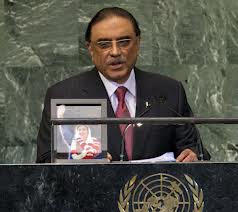
Asif Zardari with Benazir Bhutto's photograph (Credit: englishalarabiya.net)
UNITED NATIONS, Sept 25 : Pakistan’s President Asif Ali Zardari declared Tuesday before the United Nations that his country had suffered enough in its fight against extremist terror and should not be asked to do more.
“No country and no people have suffered more in the epic struggle against terrorism than Pakistan,” he insisted.
“To those who say we have not done enough, I say in all humility: Please do not insult the memory of our dead, and the pain of our living. Do not ask of my people what no one has ever asked of any other peoples,” he said.
“Do not demonize the innocent women and children of Pakistan. And please, stop this refrain to ‘do more’.”
Beginning his address to the UN General Assembly with a denunciation of the recent American-made movie trailer and French cartoons that insulted the Prophet Mohammed (PBUH), he demanded that such material be banned worldwide.
Then, speaking next to a photograph of his late wife — Pakistani politician Benazir Bhutto, who was murdered by militants — he set about defending the Pakistani people’s record in the war on violent extremism.
Zardari said regular US drone strikes against targets in his country made his task of selling the fight against terror to his people harder, as did the massive increase in Afghan drug exports since the US-led invasion.
“There are a lot of questions that are asked of Pakistan these days,” he said, his voice rising as he warmed to his theme.
“I am not here to answer questions about Pakistan. The people of Pakistan have already answered them. The politicians of Pakistan have answered them. The soldiers of Pakistan have answered them,” he declared.
“We have lost over 7,000 Pakistani soldiers and policemen, and over 37,000 civilians,” he added. “And I need not remind my friends here today, that I bear a personal scar.”
Pakistan has long been seen as a safe haven for myriad armed groups, whether Taliban fighting along the Afghan border, domestic extremists or Kashmiri Muslims bent on capturing Indian-held territory.
“I remember the red carpet that was rolled out for all the dictators,” he said. “These dictators and their regimes are responsible for suffocating and throttling Pakistan, Pakistan’s institutions and Pakistani democracy.
“I remember the jailing of Pakistan’s elected leaders. I remember the 12 years I myself spent in prison. And I remember the billions provided by the international community to support those dictatorships,” he said.
“My country’s social fabric, its very character has been altered. Our condition today is a product of dictatorships.”
Zardari’s government has often been accused in the West of not doing enough to fight armed extremism, and since bin Laden was found — in a garrison town near the capital — some in Washington have called for aid to be cut.
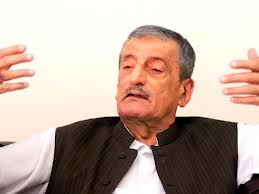
ANP MInister Ghulam Ahmed Bilour (Credit: tribune.com.pk)
PESHAWAR, Sept 26: The Pakistani Taliban say they are granting an “amnesty” to a Cabinet minister who is offering a $100,000 reward to anyone who kills the American maker of an anti-Islam film sparking deadly riots in the Muslim world.
Pakistani Taliban spokesman Ehsanullah Ehsan told reporters on Wednesday that the minister’s views represent the true spirit of Islam. Consequently, the militants have removed him from their hit list.
“We have totally forgiven him and removed his name from our hit list,” the Taliban spokesman said in a phone call from an unknown location.
Ehsan said that Taliban shoora, a top consultative body, had met on Tuesday and “praised Bilour for his sacrifice for the cause of Islam”.
“The shoora paid rich tributes to Bilour and endorsed his bounty announcement,” he said.
But Ehsan clarified that others in Bilour’s secular party – The Awami National Party (ANP), which opposes the Taliban – won’t enjoy the reprieve.
Railways Minister Ghulam Ahmad Bilour had announced a $100,000 bounty for the killing of the maker of “Innocence of Muslims” – a film which has sparked deadly protests throughout the Muslim world. Bilour had also sought the Taliban’s and al Qaeda’s help in the “noble cause” of killing the filmmaker.
Pakistan’s government says Bilour’s bounty doesn’t represent official policy, and his party, the ANP, has also distanced itself from the minister’s comments.
Bilour, however, insisted public opinion was behind him in Pakistan, which has seen widespread protests against the film including nationwide rallies on Friday that ended in bloodshed and looting, with at least 23 people killed.
“I expressed my personal view and faith. I stand by my declaration,” the 72-year-old Bilour had said on Tuesday. “My faith is non-violent, but I cannot forgive and tolerate (this insult),” he said.
Bilour had added that a businessman from Lahore had offered to put up a further $400,000 for the reward and said that freedom of speech should not be used as an excuse to insult Islam.
“Killing is not a good way, but right now it is the only way, because no action has been taken from Western countries (against the filmmaker),” he said.
Washington condemned Bilour’s reward offer as “inflammatory and inappropriate”, while the EU said it deplored it.
Bilour could not be reached for comment on Wednesday.
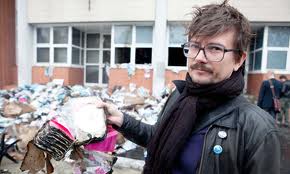
Charlie Hebdo Firebombed last year (Credit: guardian.co.uk)
PARIS, Sept 19 — A French satirical magazine on Wednesday published a series of cartoons mocking the Prophet Muhammad, setting off a new wave of outrage among Muslims and condemnation from French leaders amid widening unrest over an amateur video that has provoked violence throughout the Islamic world. The illustrations were met with a swift rebuke from the government of François Hollande, which had earlier urged the magazine, Charlie Hebdo, not to publish the cartoons, particularly in the current tense environment.
“In France, there is a principle of freedom of expression, which should not be undermined,” Laurent Fabius, the foreign minister, said in a French radio interview. “In the present context, given this absurd video that has been aired, strong emotions have been awakened in many Muslim countries. Is it really sensible or intelligent to pour oil on the fire?”
In the interview on France Info radio, Mr. Fabius announced that, as a precaution, France planned to close its embassies in 20 countries on Friday, the Muslim day of prayer, which has become an occasion for many to express their anger although “no threats have been made against any institutions.” A Foreign Ministry spokesman said the closings would affect French consulates, cultural centers and schools as well.
In Egypt, representatives of the Muslim Brotherhood denounced the cartoons as blasphemous and hurtful, and called upon the French judiciary to condemn the magazine.
Mahmoud Ghozlan, a spokesman for the group, noted that French law prohibits Holocaust denial and suggested that similar provisions might be made for comments deemed blasphemous under Islam.
“If anyone doubts the Holocaust happened, they are imprisoned,” Mr. Ghozlan told Reuters. “It is not fair or logical” that the same not be the case for insults to Islam, he said.
Religious and political leaders in other majority Muslim nations also denounced the cartoons but called for calm. Tunisia’s governing Islamist party, Ennahda, warned believers against falling into a trap set by “suspicious parties to derail the Arab Spring and turn it into a conflict with the West,” Reuters reported.
Charlie Hebdo’s Web site was not functioning on Wednesday, the result of a computer attack, according to the editorial director, Stéphane Charbonnier. A Pakistani technology news outlet, ProPakistani, reported that a Pakistani hacker group claimed it had blocked the site because of its “blasphemous contents” about Muhammad. The violence provoked by the video disparaging the prophet began on Sept. 11 when a mob attacked the American Embassy in Cairo. The unrest quickly spread to Libya, where an attack on an American diplomatic mission in Benghazi claimed the lives of the American ambassador, J. Christopher Stevens, and three staff members.
On Wednesday, police officers were dispatched to guard the offices of Charlie Hebdo in eastern Paris.
The magazine’s headquarters, not far from its present offices, were gutted by a firebomb in November after it published a spoof issue “guest edited” by Muhammad to salute the victory of an Islamist party in Tunisian elections. Mr. Charbonnier, the editorial director, has been under police protection since.
Neither he nor the publication had received threats as a result of the most recent issue of the magazine, he said.
Prime Minister Jean-Marc Ayrault said the government would prohibit a series of protests that had been planned in several French cities for Saturday — one week after a group of around 250 people staged a largely nonviolent protest of the American-made amateur film, “Innocence of Muslims,” outside the American Embassy here.
“There is no reason for us to let a conflict that doesn’t concern France come into our country,” Mr. Ayrault told RTL radio. “We are a republic that has no intention of being intimidated by anyone.”
Mr. Charbonnier contested that decision, which he called “shocking.”
“The government needs to be consistent,” he said. “Why should they prohibit these people from expressing themselves? We have the right to express ourselves, they have they right to express themselves, too.”
In a statement, the main body representing Muslims in France, the French Muslim Council, expressed its “deep concern” over the cartoons and warned that their publication risked “exacerbating tensions and provoking reactions.” The council urged French Muslims to express their grievances “via legal means.”
Mr. Charbonnier said the weekly published the cartoons in defense of freedom of the press, adding that the images “would shock only those who wanted to be shocked.”
Gérard Biard, the magazine’s editor in chief, said: “We’re a newspaper that respects French law. Now, if there’s a law that is different in Kabul or Riyadh, we’re not going to bother ourselves with respecting it.”
This week as every other week, Mr. Biard insisted, “We’ve simply commented on the news.” The caricatures are meant to satirize the video that has stirred violence across the Muslim world, he said, and to denounce that violence as absurd.
“What are we supposed to do when there’s news like this?” Mr. Biard asked. “Are we supposed to not do that news?”
Known for its sharply ironic and often vulgar tone, Charlie Hebdo has a reputation for being an equal-opportunity provocateur. In addition to episode in November, the magazine was criticized for a decision in 2006 to republish cartoons of Muhammad that first appeared in a Danish newspaper.
In an editorial on Wednesday, Le Monde, France’s newspaper of record, defended the magazine’s right to publish what it pleases, within the limits of French law. But it called the most recent caricatures “in poor taste, or even appalling” and questioned the “sense of responsibility of their authors and editors.”
Mr. Charbonnier held firm.
“I’m sorry for the people who are shocked when they read Charlie Hedbo,” Mr. Charbonnier said. “But let them save 2.50 euros and not read it. That’s the only thing I have to say.
“They can’t hold us responsible for the closure of the embassies, they can’t hold us responsible for the violence and the deaths,” he said. “We’re not provoking anything.” Religious radicals can use “any pretext to start the fire,” he said.
US ambassador to Libya Christopher Stevens (Credit: telegraph.co.uk)
The U.S. Ambassador to Libya, Christopher Stevens, was killed when suspected Libyan religious extremists stormed the U.S. Consulate in Benghazi late Tuesday night, according to Libyan Deputy Prime Minister Mustafa Abushagour. Margaret Coker has the latest on The News Hub.
The killing of the U.S. ambassador to Libya and three other Americans, in one of the most brazen attacks on a U.S. diplomatic compound in a generation, sparked a security crisis in the North African country, elevated tensions across the Middle East and raised concerns about how well the U.S. can protect its diplomats abroad.
The U.S. responded to the assault by dispatching two Navy destroyers, dozens of Marines, federal investigators and intelligence assets to Libya to protect Americans and hunt the suspected religious extremists who carried out the attack late Tuesday. U.S. officials described the attack that killed Ambassador Christopher Stevens as complex and possibly premeditated.
The assault, along with a protest at the American embassy in Cairo, created a crisis atmosphere in Washington just as the presidential campaign is hitting its stretch run and fueled a harsh exchange between President Barack Obama and Republican Mitt Romney.
Mr. Obama said the U.S. will work with the Libyan government to bring attackers to justice, but he and other officials didn’t rule out a unilateral U.S. strike. “Make no mistake, justice will be done,” the president said.
What’s the likely fallout from the killing of the U.S. ambassador to Libya as well as the storming of U.S. embassies in Libya and Egypt? Eurasia Group Middle East and North Africa Analyst Hani Sabra discusses on The News Hub. Photo: Reuters.
The attack took place on the anniversary of the Sept. 11 attacks, a day when security officials are typically on heightened alert. American officials, who debriefed survivors, described a horrifying scene in the consulate where, amid thick smoke and gunfire, Mr. Stevens became separated from his security officer.
As the flames grew and attacks increased, personnel were forced to abandon the building without the ambassador. American officials retrieved his body when it was brought to the airport the next day by Libyans.
An Obama administration official declined to comment on the ambassador’s security measures but said a review conducted ahead of the anniversary found “no information and there were no threat streams to indicate that we were insufficiently postured.”
U.S. officials were still piecing together the day’s events, which followed protests at the U.S. embassy in Cairo over an anti-Islamic video. In contrast to the Cairo protest, which appeared to be spontaneous, U.S. officials said the attack in Benghazi late Tuesday night might have been planned by militants who used the protests as cover.
American intelligence agencies were poring over information that could help indicate what groups may have taken part. Officials said intelligence agencies are looking specifically at the pro-al Qaeda group Ansar al Shariah but cautioned they didn’t have solid evidence.
Nearly 24 hours after the start of the shooting, officials struggled to piece together details about what transpired through hours of chaos and terror inside the darkened consulate and a nearby annex. They warned that their preliminary version of events could change as more information became available.
Nearby, Benghazi residents described a harrowing scene of destructive mob violence. A Libyan doctor said he and several neighbors attempted to get the gang of about 200 armed men to leave as they marched toward the U.S. compound. “We told them to leave our homes alone and one [of the militants] replied, ‘The Americans are infidels and we are going to finish them,’ the doctor said. “Many of us then fled because the shooting started.”
Ali Ben Saud, the Libyan owner of the villa leased to the U.S. for the consulate, said the men arrived in the neighborhood around 8 p.m. local time, carrying weapons including rocket-propelled grenade launchers and automatic rifles.
The handful of local security forces were overwhelmed. “We couldn’t stop them. They were multiplying, minute by minute. There were hundreds of them,” said Saleheddine al-Arghoubi, a neighborhood resident. “They didn’t come to talk. They came to fight.” The first shots were fired at around 10 p.m. local time, or 4 p.m. Eastern time, according to a preliminary U.S. account.
The attackers gained access to the compound and began firing into the main building, setting it afire. A senior administration official said three people were inside the compound at the time: Mr. Stevens; Sean Smith, a foreign service information-management officer; and a U.S. regional security officer.
As the three tried to leave the burning building, they became separated from each other in heavy smoke. The regional security officer, whose name hadn’t been disclosed by late Wednesday, made it outside, and then he and other security personnel rushed back into the burning building to try to rescue Mr. Stevens and Mr. Smith. They found Mr. Smith, already dead.
They were unable to find the ambassador before being forced to flee the building because of the heavy flames and continuing small-arms fire.
Around 10:45 p.m. local time, U.S. security personnel assigned to a nearby annex tried to regain control of the main building but came under heavy fire and returned to the annex. At around midnight, the mission annex came under fire. Two U.S. diplomats were killed during that attack and two others were wounded.
At around 2:30 a.m. local time, Libyan security forces regained control of the situation, according to the preliminary U.S. account. Mr. Obama was told Tuesday night that Mr. Stevens was unaccounted for.
According to Mr. Ben Saud, the landowner, Libyan security guards jumped into the compound and pulled Mr. Stevens from the burning building at around 1 a.m. local time. Libyans then drove him to Benghazi Central Hospital, where the staff there tried unsuccessfully to revive him. One Libyan doctor said the diplomat died of asphyxiation and that he tried for 90 minutes to revive him, according to the Associated Press
Obama administration officials said they didn’t know what condition the ambassador was in when he left the compound. “His body was later returned to U.S. personnel at the Benghazi airport,” an administration official said. A chartered aircraft evacuated U.S. personnel back to Tripoli, including the remains of those killed.
Secretary of State Hillary Clinton said the attack should “shock the conscience” of people of all faiths, but wouldn’t alter U.S. policy in Libya. The “mission in Libya is noble and necessary…and will continue,” she said from Washington. The U.S. also announced increased security measures for all U.S. diplomatic facilities.
Libyan officials, many of whom led the rebel government based in Benghazi and worked with Mr. Stevens during that time, condemned the killings. The head of the new congress, Mohammed Magarief, apologized to the American public for the tragedy. By late Wednesday, no one had been arrested. Officials in Tripoli were scrambling to implement a response to what they admitted was a monumental security breach.
Egyptian protesters climbed the walls of the U.S. Embassy in Cairo and replaced the flag with a black standard bearing an Islamic inscription, in protest of a film deemed offensive to the Prophet Muhammad. Matt Bradley has details on The News Hub.
The U.S. responded by sending two destroyers, the U.S.S. Laboon and the U.S.S. McFaul, to the Libyan coast to aid in any evacuations or humanitarian missions, said a U.S. official.
In addition, a U.S. Marine team was sent to supplement security at the U.S. embassy in Tripoli, arriving there Wednesday. The unit is known as a Fleet Antiterrorism Security Team, or FAST team, and typically numbers 50 Marines.
Mr. Stevens is the first ambassador killed by hostile forces since 1979, when the U.S. ambassador to Afghanistan was murdered in Kabul. Officials said intelligence agencies were now trying to determine if any threads of information may have been missed.
American intelligence agencies are poring over threat information that could help indicate what groups may have taken part in the attack.
Members of the Ansar al Shariah militant group gave an interview to the local television station from the hospital early Wednesday morning, praising the men who attacked the consulate, calling them “the top layer of Libyan society.” However, the members told Benghazi TV that their organization, a group of religious fighters who battled to help oust Moammar Gadhafi from power, didn’t plan the attack against the Americans.
Mr. Stevens, 52, who is usually based in the capital Tripoli, apparently was visiting Benghazi ahead of the planned opening of a U.S. cultural center there, said a Libyan official.
The attack on the U.S. consulate was the second this year. In June, suspected Islamic militants detonated an improvised explosive device at the same compound. A Libyan guard was injured, but no Americans were harmed. In the spring, the International Committee for the Red Cross offices in Benghazi were also targeted.
Washington has long been leery of the radical Islamic fringe in Libya. The largest number of foreign fighters in Iraq waging battles against U.S. soldiers were from two towns in eastern Libya, and U.S. drones have monitored those locations since the Libyan uprising last year.
—Siobhan Gorman, Devlin Barrett and Carol E. Lee contributed to this article.