Egyptian billionaire Naguib Sawiris has offered to buy an island off Greece or Italy and develop it to help hundreds of thousands of people fleeing from Syria and other conflicts.
The telecoms tycoon first announced the initiative on Twitter.
“Greece or Italy sell me an island, I’ll call its independence and host the migrants and provide jobs for them building their new country,” he wrote.
More than 2,300 people have died at sea trying to reach Europe since January, many of them Syrians who fled their country’s four-and-a-half year conflict.
Sawiris said in a television interview that he would approach the governments of Greece and Italy about his plan.
Asked by AFP whether he believed it could work, he said: “Of course it’s feasible.”
“You have dozens of islands which are deserted and could accommodate hundreds of thousands of refugees.”
Sawiris said an island off Greece or Italy could cost between $10 million and $100 million, but added the “main thing is investment in infrastructure”.
There would be “temporary shelters to house the people, then you start employing the people to build housing, schools, universities, hospitals.
“And if things improve, whoever wants to go back (to their homeland) goes back,” said Sawiris, whose family developed the popular El Gouna resort on Egypt’s Red Sea coast.
He conceded such a plan could face challenges, including the likely difficulty of persuading Greece or Italy to sell an island, and figuring out jurisdiction and customs regulations.
But those who took shelter would be treated as “human beings,” he said. “The way they are being treated now, they are being treated like cattle.”
Sawiris is the chief executive of Orascom TMT, which operates mobile telephone networks in a number of Middle Eastern and African countries plus Korea as well as underwater communications networks.
TAXILA, May 9: A stupa dating back to the 3rd Century BC was discovered at the ancient Buddhist site of Badalpur near Taxila during excavations carried out by the Taxila Institute of Asian Civilisations (TIAC) of Quaid-i-Azam University.
The stupa measuring 25×25 was discovered on the southern side of the main monastery with a centre water tank at the ancient Buddhist site. Coins, pottery and metal objects have also been excavated from the site by graduate and doctorate students of the TIAC. The students were led by the institute’s director, Professor Dr Ashraf Khan, Assistant Professor Dr Sadid Arif and Coordinator Mohammad Ibrahim.
Professor Dr Ashraf Khan told Dawn that the newly discovered monastery was built in Kushan workmanship style known as ‘diaper masonry’, consisting of thin neatly placed layers of schist interspersed with large blocks of stone as well as semi-ashlar masonry.
He said the cells of the monastery are plastered with mud mortar, the first of its kind seen in the Taxila Valley.
In response to a query, Dr Khan said the discovery of metal objects showed the craftsmanship of the people living in the area between the first and fourth century.
Dr Khan said six copper coins from the Kushan period have been discovered in the excavations. He said that according to the carbon study of the newly discovered stupa carried out by the University of Wisconsin-Madison dates it between the 3rd century BC to 1st century AD.
He said during the last season of the excavation, a good number of antiquities such as a bust of Buddha in stucco, copper coins, bones, charcoal, iron objects and pottery were discovered.
Unveiling the archaeological significance of the site, he said the site was early mentioned by Alexander Cunningham in 1863, the then director, Archaeological Survey of India, during his expedition to Gandhara.
The first excavation at the site was carried out in 1916-17 by Natisa Aiyar, superintendent of Frontier Circle, while the second was carried out from 2005 till 2009 by Federal Archaeology in collaboration with Taxila Institute of Asian Civilisations, Quaid-i-Azam University.
He said five seasons of excavations had been successfully conducted by the institute at this ancient Buddhist site.
The most remarkable discovery was an iron nail and animal bones which revealed that Gandhara people knew the use of different metals and that Buddhists used to eat meat, said Dr Khan.
“History of Taxila should be rewritten in the light of the new and substantial evidence obtained,” he said.
Dr Khan said despite limited resources, the university had planned to excavate and preserve the whole site.
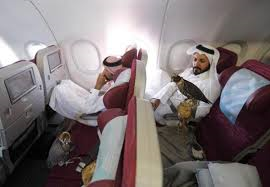
Arabs travel for the hunt to Pakistan (Credit: zistboom.com)Wallah, it is once again the season of the hunt. We Arabs love God’s magnificent creatures; we travel all over the world to find them and kill them. For there is no struggle more glorious than a Sheikh’s entourage of armed bodyguards versus a small, defenseless bird. In the great deserts of Arabia there are few animals to hunt. There are camels but they do not understand the idea of running away; they stand there, idiots, and it is the Sheikh who has to run away to make distance. Ya tifl, that is not good.
That is why we come to our friends in al-Bakistan, where everyone looks like our servants from back home. They have many of these (houbara) bastards for our falcons to hunt. The Sheikh Abu bin Ibn says there will be great reward on the Day of Judgment for those who have killed the (houbara) bastards for this illegitimate bird is close to Shaitan and there is good in striking it down.
We choose the second day of the second month for this pilgrimage to al-Bakistan; the weather is nice and hot but by the grace of God their country is a bit rural, too few malls and eight lane highways and five star hotels. I ask the locals, “Have you not been blessed with the divine gift of oil?”
They cast their eyes downwards and make faces as if to say no. The Sheikh Riyal bin Petrolyam tells me people do strange things with oil in al-Bakistan, like but it in their hair or in their food. I say no, no, you have to find Americans and sell it to them but the Sheikh says they do not understand.
The hospitality here is heartwarming and we truly feel part of a global Muslim Ummah which is why we build balace sized homes with electrified fences to keep the locals out.
We start the hunt on a Friday for verily on this day there is a blessing upon those who carry radar devices and radio transmitters in a ten vehicle cavalcade. This year we go to the inhospitably arid dunes of Chagai.
Ya Habibi, this is the thrill of the hunt; pitting yourself in air-conditioned cars against harsh deserts, ferocious foreign journalists and keepers of wildlife reservations. Wallah there is nothing more dangerous than an enraged conservationist.
And though we do not gamble verily we make a bet of 40 camels to see who can strike down a (houbara) bastard before the other, and this time Sheikh Abu bin Ibn’s falcon did fly away and when he started firing upon the houbara bushes in anger, the recoil set him upon the hot desert floor and the bullet hit a passerby and there was much rejoicing, for surely God smiles upon him who falls down while firing a rifle.
Then we heard the crown prince had landed in al-Bakistan and upon seeing the airport at the capital had remarked, “Is this a joke?” but then the prince told the Sheikhs that whatever has been promised to you has been promised tenfold, and in dollars, to the government of al-Bakistan for truly he is a friend who lets his brother hunt in his home.
The Sheikh Riyal bin Petrolyam tells me people do strange things with oil in al-Bakistan, like but it in their hair or in their food. I say no, no, you have to find Americans and sell it to them but the Sheikh says they do not understand.
For even though the locals are forbidden to strike the (houbara) bastard, for Arabs that they establish a special hunting license, called a keffiyeh, that is worn around the head and makes blessed all animals killed while wearing it.
This follows a long tradition of Arabs enjoying safaris in South Asia from the days of Muhammad bin Qasim who made the journey to hunt the prized wildlife known as Maharajas.
But some people try to make bad this relationship like last year when an al-Bakistani bureaucrat whispered ill things about the crown prince saying he had personally destroyed the habitat of hundreds of flying creatures and should no longer be given a visa. Surely, as justice is served on the wings of the falcon, the bureaucrat is now washing dishes somewhere in Sibi and close bond between Arabs and whatever these locals call themselves is preserved.
When the crown prince joined us in Chagai, he explained that in nature many things had been made good for man, and the bastard is one of them, for the bastard is good for the kindling of an Arab’s passions and keeps him young and virile.
And the Sheikhs Wiz bin Khalifa, Khalid bin Naum and Sahil bin Kahil did raise a toast of halal wine to his speech and there was much rejoicing.
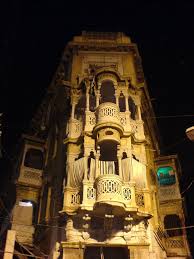
It took 15 minutes for my car to creep forward about 20 feet, giving me ample time to admire the crumbling filigreed balconies jutting precariously overhead.
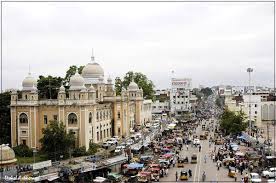
Throughout the gridlocked lanes of Hyderabad’s Old City, mud-splattered ancient ramparts are studded with tea stalls, Western Union signs and makeshift roadside repair shops stacked with washing machines waiting to be coaxed back to life. There are glimpses of glory amid the rubble and grime: a solitary remnant of a once-imposing palace wall peeks out timidly amid a labyrinth of electric wires; latticed windows blackened by generations of soot and rain are further obscured by corrugated tin shacks.
“There’s such beauty, but how pathetically it’s been destroyed,” said Dr. Anand Raj Varma, a local scholar and historian who was accompanying me. “Sab khatam ho gaya. Nothing is there.”
I was raised far from India on my father’s outlandish tales of Hyderabad’s magnificent deoris — sprawling walled estates — and of the city’s fragrant gardens and refined etiquette, stories that were passed down from his own father. He watched that world evaporate from the 1950s through the ’70s, and his anecdotes typically end with him shaking his head in wonder: “You couldn’t fathom it.” He barely can himself.
“Everything’s gone now,” he bemoans, like Dr. Varma. Thanks to a lethal mix of government neglect and citizen apathy, and the financial collapse of the aristocracy after the state was absorbed into India in 1948, much of old Hyderabad has been decimated, giving way to a congested urban abyss. The Hyderabad of my father’s nostalgia seemed as implausible to me as Atlantis.
I mostly ignored his lamentations, as teenagers are wont to do. But as I grew older and sought a deeper connection with the city I consider my second home, I began to wonder how things might have been 60 years ago, before Hyderabad’s gracious boulevards were engulfed by dreary concrete blocks. When my maternal grandfather, Mahmood bin Muhammad, a senior administrator, diplomat and writer, died in late 2013, that mild interest graduated to obsession. Most of the buildings my father speaks of dissolved into oblivion decades ago; the people who recall that era are also ebbing away.
And so I returned to see what was left, before both the physical vestiges and the memories that sustain them are lost forever.
Hyderabad isn’t an easy place to love. Delhi has its historical monuments, Rajasthan its palaces, Kerala its lush backwaters and Mumbai its Bollywood glamour. Hyderabad languishes, suspended between a stifled past and a future not yet fully realized. The week I arrived, a politician was making headlines for claiming that his party did more for the state in nine years than the erstwhile ruling Asaf Jahi dynasty, better known as the Nizams, did in hundreds.
The senior-most princes in India during the British Raj, the dynasty of the Nizams reigned over a state the size of the Britain. The seventh and final ruling Nizam, Mir Osman Ali Khan, was proclaimed the richest man in the world on a 1937 Time cover, with a net worth estimated to amount to more than $35 billion in today’s terms. “He spent his leisure hours dipping his arms up to the elbows in chests of diamonds, emeralds, rubies and pearls,” read his 1967 New York Times obituary. He also bestowed the state with educational institutions, hospitals and infrastructure galore.
But Hyderabad has lately reinvented itself as Cyberabad, home to gleaming offices for Facebook, Google, IBM and Oracle. Last year, the city was abuzz with news that a hometown boy, Satya Nadella, had succeeded Steve Ballmer as chief executive of Microsoft. Technology is king today, eclipsing the endowment of bygone monarchs.
“The Nizam has done so much for Hyderabad, and people forget it very quickly because they have short-term memories,” said Princess Esra Jah, an ex-wife of the seventh Nizam’s heir, Prince Mukarram Jah. I had arrived via horse and carriage at the Falaknuma Palace, a Tudor-Italian marvel reborn in 2010 as a sumptuous Taj hotel, to have tea with the princess responsible for its restoration.
“How can they say he did nothing for Hyderabad if it was the most advanced” princely state in all of India? said the princess. “It’s in the history books. But I don’t think most of the politicians read history, if you ask me.”
The princess, who looks just as elegant today as she did as a young ingénue in footage from her then-husband’s 1967 coronation, now splits her time among Istanbul, London and Santa Barbara, Calif.; she came back at the prince’s request to return some family properties to their original splendor. “I took on two projects, the Chowmahalla and Falaknuma palaces, to restore them and to be able to give something back to the city,” she said. This was an arduous task; Falaknuma took more than a decade to bring back to its 1890s glory. “It’s very easy to construct, but difficult to restore,” she said.
Indeed, there must be something to restore in the first place. From Notting Hill in London to the Colaba district of Mumbai, there are countless striking examples of urban development that complement a city’s historical fabric. But in a quest for modernization, much of Hyderabad’s architectural legacy was dismantled, and recent attempts to revisit the past are often a case of too little, too late. “Right from the beginning, people did not give enough importance to restoration,” the princess said. “Buildings came up with no aesthetic sense at all. Just because you are high-tech, it doesn’t mean you have to be ugly.”
High atop a hill, Falaknuma stood empty for decades, shrouded in cobwebs and awaiting its moment. The wonder of Falaknuma isn’t just in the Taj’s immaculate re-creation of the palace’s rooms and gardens, though its 101-seat dining table, stained-glass terrace dome and refreshed frescoes are indeed impressive. The magic lies in its simultaneous re-creation of a lost era of refined manners, or tehzeeb.
My family are among the few people I know who still greet their elders with the traditional “aadaab,” raising an upturned palm to the forehead while bowing slightly at the waist. But murmurs of “aadaab” reverberate throughout Falaknuma’s halls, with everyone from the general manager to the gardeners calling out to me as I pass.
“The manners were wonderful,” said Princess Esra Jah of what she loved most about the Hyderabad of old. “It wasn’t just the nobility or the rich or the poor; everyone had the same manners. They were terribly dignified in their behavior.” The Taj team may set out to revive an edifice, but the nostalgic sense of social grace rekindled at the same time is priceless.
A few days later Dr. Varma and I crossed the Musi River, flanked by the bulbous domes of the High Court and the Osmania General Hospital, and the car lurched us into the maze of the Old City. We did a circuit past monuments like the iconic 1591 Charminar arch and the sprawling 17th-century Mecca Masjid mosque before arriving at a bright yellow gate. Behind it lay Purani Haveli, the sixth Nizam’s palace, a lavish spread famed for its legendary 262-foot closet — a necessary amenity for a man who reportedly never repeated an outfit. These days, parts of the property are home to a museum and an engineering college, while the rest of its wilting cupolas and turrets lie derelict.
A caretaker eyed us quizzically as we approached. “I just want to show her around,” Dr. Varma said, and the guard waved us in without further questioning. We roamed freely, peering behind a faded curtain rippling in a doorway to find broken windows, dilapidated fountains and jaundiced plasterwork. Hyderabadis are famously laid-back but also unfailingly hospitable, and this combination worked in my favor; “mulahiza,” or gracious deference, defined most of my interactions. All you have to do is ask, I learned quickly: a smile, a polite entreaty, and warm welcomes ensued.
Over the next week, simply by asking nicely, I gained entree to residences, ruins, private clubs, colleges and palaces. I was tipped off to the 17th-century Goshamahal Baradari, an imposing Masonic temple where, despite the fact that I claimed no allegiance to the Freemasons, I was led through inner chambers clearly labeled “Members Only.” At the Hussaini Kothi deori, a family hosted me in their 200-year-old living room, brimming with colorful antique chandeliers and furnishings in impeccable condition. I visited family friends at the neo-Classical Aziz Bagh, where seven generations have lived since 1899 in a three-acre compound so bucolic you’d never guess it existed deep within the thrum of the Old City. At Famous Ice Cream, a city institution embedded in the 1935 Moazzamjahi Market complex, I stopped for dessert and poked around the sepia-tinted stone arcade.
Directly opposite a gaudy sari shop near the chaotic Begum Bazaar, I visited the fashion designer Vinita Pittie at her 250-year-old mansion, a legacy of her husband’s forefathers ( financiers to Hyderabadi nobility) that she has taken great pains to preserve. Vibrant tones of scarlet and emerald dominate her immaculately maintained living room, and delicate chandeliers sway from weathered hand-painted ceilings. Over a cup of decadent saffron tea, she told me why leaving the traffic-clogged arteries to escape for a more modern abode in the new city was not an option. “This house is an entity that has a soul. Just like humans, it too has a destiny — so the question of leaving it doesn’t arise,” Ms. Pittie told me. “People ask how long we’ll stay. I say, ‘Let’s see how long this haveli keeps me,’ ” she said of the house.
Osmania University College for Women teems with students dawdling amid a mishmash of forgettable buildings. But one stands out: In the heart of the campus, two stone lions stand sentinel by a Palladian structure reminiscent of the Pantheon, complete with six imposing Corinthian columns. I approached a group of girls sitting astride one of the lions, gossiping away under the pretext of reviewing notes. “Excuse me, what building is this?” I asked. They shrugged, uninterested in what’s quite literally under their noses. I retreated down the steps, many years’ accumulation of dried bird excrement crunching beneath my feet, to seek anyone who might give me access.
Readers of William Dalrymple’s historical “White Mughals” are familiar with the building I had sought out this afternoon. In his impeccably researched biography, Mr. Dalrymple chronicles the love affair between the British Lt. Col. James Achilles Kirkpatrick and his Muslim bride, Khair un-Nissa, which played out here at the erstwhile British Residency in the early 19th century. After being converted into a college in 1949 — my grandmother and mother both studied there, and have fond memories of eating their lunches on the cannons stationed out in front — the building fell into tatters. These days it lies neglected despite the constant activity surrounding it, waiting for a much-needed restoration courtesy of a World Monuments Fund grant to begin.
As I circled the dilapidated structure, stepping over waist-high weeds and puddles of leaking water, I finally encountered a professor who pointed me in the direction of the administration building, where I could ask for permission to access the Residency. After a brief audience, the principal smiled and gave me her blessing, and sent a caretaker to accompany me inside. He released the flimsy padlock and pushed open the doors, revealing two grand staircases that curve to fuse into a magnificent egg-shaped atrium. Despite the pockmarked walls branded by scores of students inscribing their names over the years, despite the stray birds soaring in and out of broken windows, despite the carcass of a chandelier hanging limply overhead, I was mesmerized. I had entered a time capsule abandoned in plain sight.
The late afternoon sun filtered a honeyed aura over the contours of the massive dome, casting me into my own celluloid vision: Lavish parties and imperial intrigue played out all around me. I could picture the grandeur that was Hyderabad. At long last, I’d found Atlantis.
Republican presidential nominee Mitt Romney (Credit: handbill.us)Start with Wal-Mart in America, where the goods are cheap because they have low manufacturing costs, sustained by overseas workers earning small wages. With high consumer spending by Americans, Wal-Mart amasses big profits. That has enabled the corporation to get on par with the GDP of the 25th largest economy in the world, surpassing 157 smaller countries.
We’ve found 25 major American corporations whose 2010 revenues surpass the 2010 Gross Domestic Product of entire countries, often with a few billion to spare.
Even some major countries like Norway, Thailand, and New Zealand can be bested by certain U.S. firms.
Yahoo is bigger than Mongolia
Mongolia’s GDP: $6.13 billion
Yahoo’s Revenue: $6.32 billion
Yahoo would rank as the world’s 138th biggest country.
Source: Fortune/CNN Money, IMF
Visa is bigger than Zimbabwe
Zimbabwe’s GDP: $7.47 billion
Visa’s Revenue: $8.07 billion
Visa would rank as the world’s 133rd biggest country.
Source: Fortune/CNN Money, IMF
E-Bay is bigger than Madagascar
Madagascar’s GDP: $8.35 billion
E-Bay’s Revenue: $9.16 billion
E-Bay would rank as the world’s 129th biggest country.
Source: Fortune/CNN Money, IMF
Nike is bigger than Paraguay
Paraguay’s GDP: $18.48 billion
Nike’s Revenue: $19.16 billion
Nike would rank as the world’s 102nd biggest country.
Source: Fortune/CNN Money, IMF
Consolidated Edison is bigger than the Democratic Republic of the Congo
Democratic Republic of the Congo’s GDP: $13.13 billion
Con-Edison’s Revenue: $13.33 billion
Con-Edison would rank as the world’s 112th biggest country.
Source: Fortune/CNN Money, IMF
McDonald’s is bigger than Latvia
Latvia’s GDP: $24.05 billion
McDonald’s Revenue: $24.07 billion
McDonald’s would rank as the world’s 92nd biggest country.
Source: Fortune/CNN Money, IMF
Amazon.com is bigger than Kenya
Kenya’s GDP: $32.16 billion
Amazon.com’s Revenue: $34.2 billion
Amazon would rank as the world’s 86th biggest country.
Source: Fortune/CNN Money, IMF
Morgan Stanley is bigger than Uzbekistan
Uzbekistan’s GDP: $38.99 billion
Morgan Stanley’s Revenue: $39.32 billion
Morgan Stanley would rank as the world’s 82nd biggest country.
Source: Fortune/CNN Money, IMF
Cisco is bigger than Lebanon
Lebanon’s GDP: $39.25 billion
Cisco’s Revenue: $40.04 billion
Cisco would rank as the world’s 81st biggest country.
Source: Fortune/CNN Money, IMF
Pepsi is bigger than Oman
Oman’s GDP: $55.62
Pepsi’s Revenue: $57.83 billion
Pepsi would rank as the world’s 69th biggest country.
Source: Fortune/CNN Money, IMF
Apple is bigger than Ecuador
Ecuador’s GDP: $58.91 billion
Apple’s Revenue: $65.23 billion
Apple would rank as the world’s 68th biggest country.
Source: Fortune/CNN Money, IMF
Microsoft is bigger than Croatia
Croatia’s GDP: $60.59 billion
Microsoft’s Revenue: $62.48 billion
Microsoft would rank as the world’s 66th biggest economy.
Source: Fortune/CNN Money, IMF
Costco is bigger than Sudan
Sudan’s GDP: $68.44 billion
Costco’s Revenue: $77.94 billion
Costco would rank as the world’s 65th biggest country.
Source: Fortune/CNN Money, IMF
Proctor and Gamble is bigger than Libya
Libya’s GDP: $74.23 billion
Proctor and Gamble’s Revenue: $79.69 billion
Proctor and Gamble would rank as the world’s 64th biggest country.
Source: Fortune/CNN Money, IMF
Wells Fargo is bigger than Angola
Angola’s GDP: $86.26 billion
Wells Fargo’s Revenue: $93.249 billion
Wells Fargo would rank as the world’s 62nd biggest economy.
Source: Fortune/CNN Money, IMF
Ford is bigger than Morocco
Morocco’s GDP: $103.48 billion
Ford’s Revenue: $128.95 billion
Ford would rank as the world’s 60th biggest country.
Source: Fortune/CNN Money, IMF
Bank of America is bigger than Vietnam
Vietnam’s GDP: $103.57 billion
Bank of America’s Revenue: $134.19 billion
Bank of America would rank as the world’s 59th biggest country.
Source: Fortune/CNN Money, IMF
General Motors is bigger than Bangladesh
Bangladesh’s GDP: $104.92 billion
GM’s Revenue: $135.59 billion
GM would rank as the world’s 58th biggest country.
Source: Fortune/CNN Money, IMF
Berkshire Hathaway is bigger than Hungary
Hungary’s GDP: $128.96 billion
Berkshire Hathaway’s Revenue: $136.19 billion
Berkshire Hathaway would rank as the world’s 57th biggest economy.
Source: Fortune/CNN Money, IMF
General Electric is bigger than New Zealand
New Zealand’s GDP: $140.43 billion
GE’s Revenue: $151.63 billion
GE would rank as the world’s 52nd biggest country.
Source: Fortune/CNN Money, IMF
Fannie Mae is bigger than Peru
Peru’s GDP: $152.83 billion
Fannie mae’s Revenue: $153.83 billion
Fannie Mae would rank as the world’s 51st biggest country.
Source: Fortune/CNN Money, IMF
Conoco Phillips is bigger than Pakistan
Pakistan’s GDP: $174.87 billion
Conoco Phillip’s Revenue: $184.97 billion
Conoco Phillips would rank as the world’s 48th biggest country.
Source: Fortune/CNN Money, IMF
Chevron is bigger than the Czech Republic
Czech Republic’s GDP: $192.15 billion
Chevron’s Revenue: $196.34 billion
Chevron would rank as the world’s 46th biggest country.
Source: Fortune/CNN Money, IMF
Exxon Mobil is bigger than Thailand
Thailand’s GDP: $318.85 billion
Exxon Mobil’s Revenue: $354.67 billion
Exxon Mobil would rank as the world’s 30th biggest country.
Source: Fortune/CNN Money, IMF
Walmart is bigger than Norway
Norway’s GDP: $414.46 billion
Walmart’s Revenue: $421.89 billion
Walmart would rank as the world’s 25th biggest country.
Source: Fortune/CNN Money, IMF
SYDNEY, Sept 7: The Royal Australian Navy said Sunday it had launched a search for a Pakistani sailor believed to have disappeared overboard during a multinational military exercise in the north of the country.
The navy said the sailor, who was not named, went missing early Sunday while the Pakistan Navy ship PNS Nasr was anchored at Darwin Harbour in the Northern Territory during the biennial KAKADU military exercises.
A Northern Territory police spokesman told the Australian Broadcasting Corporation the sailor might have deliberately jumped into the crocodile-infested waters to swim to the mainland.
“A backpack was found in the water which would indicate that the person leaving the ship did know what he was doing at the time and didn´t simply fall off the ship,”
Superintendent Rob Burgoyne said.” He was described as skulking in the bushes (on the mainland), so one can work out from that, probably he didn´t want to be found.”
“The Australian Defence Force is assisting with the search and rescue efforts,” the military said in a statement, adding that the hunt for the sailor would involve boats and aircraft.
More than 1,000 people, eight warships and 26 aircraft from 15 Asia-Pacific and Indian Ocean nations are involved in the maritime exercise, which lasts until September 12.
Burgoyne said the sailor was “probably lucky that he didn´t come across one (crocodile) when he was in the water”.
For those of you who’re not aware of it, Burnes Road in Karachi is named after James Burnes, a doctor who also worked as a spy for the British Raj in the subcontinent, back in the 18th century.
In Sindh ke Darbar, a book based on the memoirs of James Burnes, the former secretary of Sindhi Literary Board, Aijaz Mangi preludes with the following passage on Burnes:
Dr Burnes was the member of a nation which planned to take over Sindh and systematically make it part of the British Raj. As such, he deemed the native population there to be inferior and despicable. But one must admit that the observations of Dr Burnes are an invaluable and accurate insight into how things were back at that time; very informative and highly interesting.
Following Partition, the road named after Dr Burnes was renamed to ‘Shahrah-e-Liaquat’, but if you ask around for directions with that name, I doubt a single soul would be able to help you.
Ask for ‘Burns Road’ and just about anyone will be able to point you to the street of Mazaydar Haleem, biryani, dahi baray, quorma, gola kabab, halwa puri, mithai and what not.
Explore: The truth behind Karachi’s Freemasons
Burnes has some fascinating things to say about the ruling family of Sindh at that time, the Talpur Mirs. On page 35 of Sindh ke Darbar it says:
It was part of Baloch tradition that before a doctor could administer medicine to his students, he would have to take the medicine himself. [My patient] Mir Murad Ali wasn’t ready to take the medicine without me having taken it first. But I had had enough of its bitter doses already.
So eventually, it came down to a poor, ill-fated servant who was forced to take the medicine for a long time, despite having zero need for it. It must have created a really bad impression of British medicines on his mind.
I tried hard but in vain to find out more about the medical qualifications of Dr Burnes and where he’d gotten his education from. His memoirs do detail how Burnes was able to cure Mir Murad Ali:
The simple reason why Mir Murad recovered was that I stopped him from taking any heavy medication. But the Mirs thought it was my extraordinary skills as a physician. Then a series of fortunate coincidences completely established their faith in my healing powers.
So what was that drug which never failed to cure Mir Murad? Burnes explains:
I used ‘Konain’, something which the people of Sindh are yet to learn about. For the native population, it is the best cure for the seasonal cold. I would even predict the effects of the medicine in advance, to the surprise of many patients.
But once Mir Murad discovered that Konain was the secret behind his health, he took my bottle of Konain without my permission and locked it up in his cupboard. This one time, I fell ill and he wouldn’t even return it to me! When it was time for me to go, I asked him for the empty bottle, but he still refused. Mir Murad seemed to think that the bottle was a vital part of this miracle drug.
Also read: The real Father of Karachi
The Mirs were just as spoilt as the other rulers of Hindustan. Keeping slave-girls was common and acceptable everywhere, but the treatment these Mirs meted out to kids borne of these girls was horrific. Burnes writes:
Mir Mohammad Khan does not have any children. Keep in mind that in the court of Sindh, it’s a custom to kill any children borne by slave-girls…I’ve learned through credible sources that a certain member of the Mir clan has killed as many as 27 babies.
The Mirs ruled differently than other rulers in Hindustan at the time. At other places, the real power always lay with the person sitting on the throne. His brothers and relatives would not be of any importance, and would often even be killed, if the need arose.
But the Mir brothers weren’t like that. All three used to rule together and would never let any one of them be left alone in the capital at any given moment. Burnes says:
The Mirs are one peculiar lot. They don’t trust each other one bit. Like I mentioned before, when Mir Murad fell sick, all the brothers confined themselves to the Hyderabad Fort for several months. If they went out to hunt, they’d take care to leave an agent behind so as not to leave affairs unguarded…It wasn’t easy to rule in an atmosphere of such uncertainty and lack of trust. Mir Murad Ali had once opened up to me saying: ‘Rulers bear an immense burden on their chests; only a ruler can understand that burden.'”
Look through: The unwashed Bandar Road
A study of history reveals that the British conquest of Sindh had little to do with clever stratagems and much more with the mistrust between the ruling Talpur brothers, and their differing views on the native population (many of whom were Hindus). Burnes writes on pages 51-52:
When I set out of Sindh, the Mir brothers handed me two of their watches for repair. At that time, one of their servants said that there was an expert watch-repairer in Bhaj (an area in India). When the Mirs heard that, they refused to hand the watches over to me until I promised that I wouldn’t trust an infidel with them.
They also gifted me a very expensive sword, bearing an inscription (by a courtier) that the Mirs were very proud of.
The memoirs of James Burnes are flooded with passages illuminating the Mir rule of Sindh. One has only got to initiate research. I hope the students of history will dig deeper into these resources and increase our knowledge of the past.
________________________________________
Translated by Talha Ahmed from the original in Urdu.
Asrar Ahmed alias Ibn-i-Safi (Credit:urdublogspot4u.com)
As a kid in the 1970s, one of the first Urdu authors that I began reading was Ibn-i-Safi. Most Pakistani kids and young people in cities did that and probably many still do; going on to continue reading his novels well into their less curious adulthoods.
I don’t anymore though, outgrowing the fantastic sounding cities and countries full of quirky spies, strange gadgets and racy plots that Safi offered in his novels, making him one of Pakistan’s most popular and best-selling Urdu novelists of all time.
However, I returned to reading Safi again a few years ago when English translations of some of his many novels began appearing in local book stores. Though much of Safi’s highly imaginative style of writing gets lost in translation, it was nice to see someone actually attempting to introduce this most prolific and popular author to a whole new generation and breed of readers.
More interesting though is the reality of Safi, the man. A reality that is not well-documented but can be pieced together with the help of the many snippets on him that appeared in various Urdu newspapers and magazines in the last many decades.
While Ibn-i-Safi blended mystery with humour, espionage, law enforcement, science fiction, adventure and drama; was he aware that his own life was a curious blend of the above?
A majority of his fans simply know him through the colourful and inspired characters that he created operating in an environment creatively culled from the archetypical political paranoia of the Cold War (during which Safi authored his novels).
Very few are aware that many of Safi’s characters and plots also emerged from a serious bout of schizophrenia that he suffered in the early 1960s. Though the mental illness rendered him incapable of writing anything at all, he eventually recovered and actually converted some of the delirious delusions and even hallucinations that had suffered at the time into creating brand new characters, scenarios and plots for his comeback novels!
Ibn-i-Safi was himself a fascinating character. A young school teacher in 1952 but raring to make a name for himself as a writer, Safi began writing highly imaginative spy novels.
From 1957 onwards the pace of his writing more than doubled, and by 1960 he had written over a hundred short novels, all taking place in the imaginary and fantastical world that he had created, full of colourful, flamboyant and wise-cracking spies, beautiful women, strange-sounding villains, exotic places and odd gadgets.
But as Safi came up with one exotic story after another, he also began to isolate himself from his family. He eventually collapsed within himself, suffering a crippling spell of schizophrenia for which he needed to be committed to a psychiatric ward.
Very few are aware that many of Safi’s characters and plots also emerged from a serious bout of schizophrenia that he suffered in the early 1960s.
In 1960 his career seemed to be as good as over when he was put on heavy tranquilisers but he continued suffering from hallucinations and severe paranoia. The budding raw genius had crossed that thin line into ‘madness.’
He began to believe that the characters that he had created were real and that the villains among them were conspiring against him. He hid in his room, refusing to come out, as strange-sounding men plotted and conspired against him from subterranean bases.
After a long stint in the psychiatry ward of a hospital, Safi was shifted back to his home where he was patiently nursed back to health by his wife (and a family hakeem).
Amazingly, just three (painful years) later, he was back writing again. Some of the characters that had haunted him during his illness actually made their way into his new novels.
The demand for his spy novels reached new heights (both in Pakistan as well as India) and he kept producing them with incredible speed. By the early 1970s he was dishing out an average of three to four novels a year, setting new standards in the ability to produce racy and highly imaginative Urdu pulp fiction.
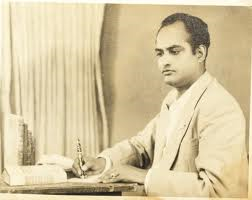
In another interesting twist, in 1973 Pakistan’s intelligence agency, the ISI, actually invited him on a few occasions to lecture new ISI recruits on the ‘art of espionage’. I actually stumbled upon an old 1973 newspaper cutting (from a local Urdu daily) that had a photograph of Safi lecturing a group of ISI recruits in Islamabad. In the short report that accompanied the photograph, an ISI officer is quoted as saying that it was “Safi Sahib’s understanding of the politics of the Cold War and his knowledge of the history of modern-day espionage that made them [the agency] invite him to deliver a few lectures”.
Becoming Pakistan’s best-selling author, one of Safi’s books was also turned into a film by Hussain Talpur (a maverick film-maker who was also known as ‘Maulana Hippie’). However, the film, Dhamaka (Explosion), released in late 1974, bombed at the box-office as the director simply failed to convincingly translate Safi’s animated words and imagery into celluloid reality.
But despite being a bestselling author, Safi made half the amount of money that he should have mainly due to the crookedness of many of his publishers and his own lack of understanding of the financial side of his art.
In 1977 a TV series based on some of his novels was produced by PTV. However, its run was disallowed when in the same year the government of Z.A. Bhutto was toppled in a reactionary military coup. The reason given by the military regime that replaced the Bhutto government was that the series was ‘vulgar’.
In 1978, Safi, who had continued to be on medication ever since the early 1960s, fell ill again. His legendary productivity as a writer slowed down and by 1979 he was bedridden again, as friends, family and publishers fought around him over how much money was made and owned to whom from his books.
Then in 1980 he passed away, dying quietly in his sleep and in the process finally getting the rest that he had longed for decades. He left behind an enormous body of work that is still being reproduced. He was just 52 at the time of death.
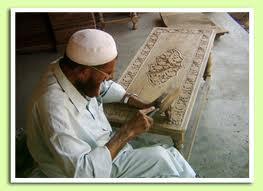
MINGORA, June 23: Artists from Swat skilled in relief carving and sculpting wood have urged government and non-government organisations to support them in conserving the craft. Woodcarving was once widely practised in the region during the ancient Uddiyana Kingdom, purported to be located in the valley.
Woodcarving in Swat can be traced back to the early Buddhist period of Kushan rulers and glimpses of the Greco-Buddhist style are still visible in furniture, buildings and monuments across the valley.
The delicate strokes represent the area’s tradition, culture and heritage, while their intricate floral designs represent Swat’s history and its civilization.
The craft has been passed on from generation to generation and is still a source of livelihood for several families. Although the number of carvers has dwindled, the quality of their work has not suffered.
Keeping the chisels busy
Nasar Sheen, a renowned woodcarver from Swat said, “The artist inside me was woken by the great Gandharan art reflected in buildings and structures around me. I began carving in my childhood but with the idea of taking the ancient craft into the modern era,” said Sheen.
“In a way, woodcarving is an inherent part of our culture. We see it on furniture, doors, pillars and it has been with us for a long time.”
Sheen has not learnt the art from a teacher; several of his friends are artists who taught him. “In truth, my teacher is Ghandharan art which I am surrounded by,” says the carver. His works uphold themes of strong cultural values, women’s education, peace, human rights, culture and music.
Artists, archaeologists and cultural activists in Swat say this unique art needs the attention for its conservation and promotion. “Frequent exhibitions on a national and international level will not only promote the art but also will encourage artists to improve their work. Later generations will also be motivated to learn the craft, which will keep it alive,” added Sheen.
In the eyes of the world
Sir Aurel Stein, a British-Hungarian archaeologist who visited Swat in 1926 wrote a book on his time in the valley. In An Archaeological Tour in Upper Swat and Adjacent Hill Tracts, Stein says, “The other local craft of Upper Swat retains evidence of the ancient skill that is woodcarving.”
Commenting on the quality and beauty of the craft, Stein writes, “I was struck by the amount of woodcarving, old and new, to be seen in mosques and houses.
These traditions clearly left their mark in a variety of decorative motifs of purely Greco-Buddhist style, plentifully displayed in the woodcarving on the pillared loggias of mosques and on the doors of headmen’s houses.”
Indology professor Doris Meth Srinivasan in her article ‘The Tenacity of Tradition: Art From the Valley of Swat’ states, “On land nestled between peaks that thrust higher than 5,500 metres, a rich artisanal tradition has flourished that reflects cultural intermingling that has taken place there. Among the varied artistic traditions of the Islamic world, the art of the Vale of Swat is unique.”
Published in The Express Tribune, June 23rd, 2014.
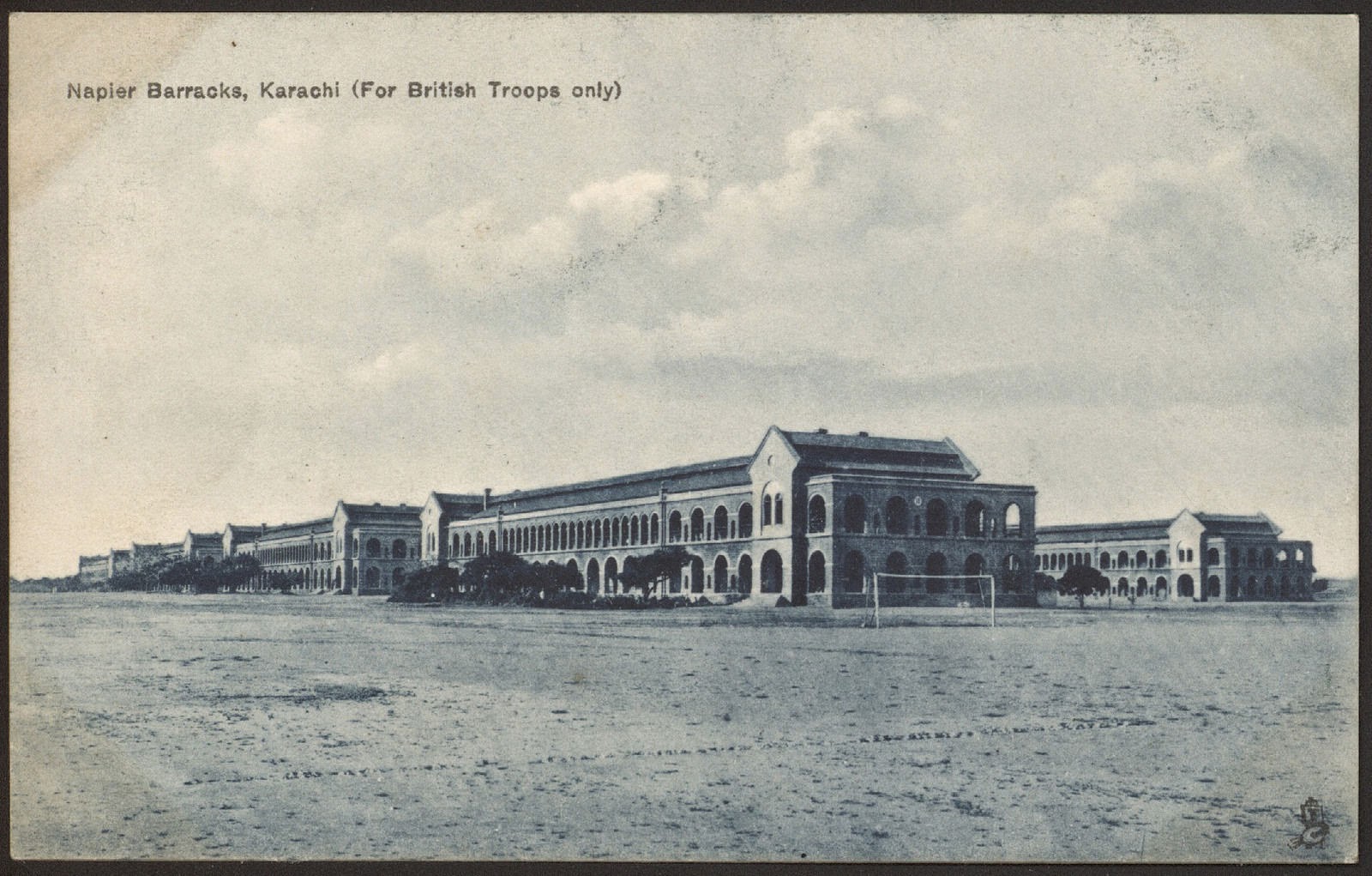
At least five times this month, a Pakistani bureaucrat who works from a colonial-era barracks in Karachi, just down the street from the former home of his country’s secularist founder, Mohammed Ali Jinnah, asked Twitter to shield his compatriots from exposure to accounts, tweets or searches of the social network that he described as “blasphemous” or “unethical.”
All five of those requests were honored by the company, meaning that Twitter users in Pakistan can no longer see the content that so disturbed the bureaucrat, Abdul Batin of the Pakistan Telecommunications Authority: crude drawings of the Prophet Muhammad, photographs of burning Qurans, and messages from a handful of anti-Islam bloggers and an American porn star who now attends Duke University.
The blocking of these tweets in Pakistan — in line with the country-specific censorship policy Twitter unveiled in 2012 — is the first time the social network has agreed to withhold content there. A number of the accounts seemed to have been blocked in anticipation of the fourth annual “Everybody Draw Muhammad Day” on May 20.
This censorship comes as challenges to Pakistan’s draconian blasphemy law have become increasingly deadly, amid a flurry of arrests, killings and assassination attempts on secularists.
The Pakistani journalist Raza Rumi survived an assassination attempt in March that killed his driver. He and other liberals have been targeted for criticizing Islamist militancy and a blasphemy law.
This week, a local edition of the International New York Times was printed in Pakistan with a large blank space instead of an Op-Ed article headlined “Pakistan’s Tyranny of Blasphemy.”
Twitter, which has trumpeted its commitment to free speech, argues that it is a lesser evil to block specific tweets that might violate local laws than to have the entire site blocked in certain countries. The company posts a record of every request it agrees to in the Chilling Effects Clearinghouse, a database maintained by eight American law schools and the Electronic Frontier Foundation.
In previous cases, Twitter has agreed to withhold the tweets of an outlawed neo-Nazi group from users in Germany, and this week it blocked the account of an ultranationalist Ukrainian group from users in Russia.
Eva Galperin, a global policy analyst for the Electronic Frontier Foundation, wrote on Thursday that Twitter’s decision to block the Ukrainian group Pravy Sektor’s tweets from Russians was “disappointing” for two reasons.
“First, Twitter has no employees or assets in Russia, so it should not have to comply with a Russian court order at all,” Ms. Galperin argued. “And the order isn’t even about a Russian account — it’s a Ukrainian one. Worse yet, Pravy Sektor’s account is plainly political. If Twitter won’t stand up for political speech in a country where independent media is increasingly under attack, what will it stand for?”
Ms. Galperin also pointed out that a civil rights group in Pakistan concerned with Internet access, Bolo Bhi, called “the legitimacy of the requests forwarded by Pakistan Telecommunication Authority” to Twitter questionable. The law that defines the regulator’s power, the group explained, “does not in any form give P.T.A. the authority to arbitrarily restrict content on the Internet.”
Close scrutiny of the law, the Pakistani rights group argued, suggests that “content removal, whether by itself or through another, is beyond the ambit of powers of the P.T.A. or of any government authority for that matter.”
Despite those concerns, the P.T.A. has dedicated a page of its website to making it easy for citizens to report “Blasphemous URLs,” as Omar Quraishi, the opinion page editor of Karachi’s Express Tribune, noted on Twitter.