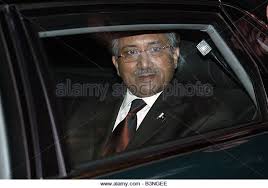
Musharraf leaves Pakistan after three-year travel ban lifted

Former army chief flies overseas (Credit: alamy.com)
Former army chief flies overseas
(Credit: alamy.com)

Lahore, March 18: Pakistan’s former president Pervez Musharraf slipped out of the country in the early hours of Friday morning in a move widely interpreted as a sign the government has conceded defeat at the hands of an all-powerful military establishment.

The former army chief, who took power in a 1999 coup and was facing charges of treason, was finally removed from the country’s “exit control list” on Thursday after almost three years of being banned from international travel.

He had been prevented from leaving since April 2013, soon after he returned from self-imposed exile and became embroiled in a series of legal cases, including a historic government-initiated high treason trial.

That Musharraf had been banned from international travel for so long had been widely taken as a sign of the determination of the prime minister, Nawaz Sharif, to defy staunch opposition from the army’s high command and prosecute the man who ousted him in the 1999 coup.

But in a press conference late on Thursday night, the interior minister, Nisar Ali Khan, said the government would not prevent Musharraf from leaving on a Dubai-bound flight in order to seek medical attention overseas.

Khan said the government had relented because Musharraf had vowed to face all the cases against him and had “promised to return in four to six weeks”.

Musharraf’s lawyer said he would come back after having surgery on his back that he said was not available in Pakistan.

Many doubted that would be the case given the army would almost certainly not wish to see the return of a man who has become a key irritant in the always sensitive relationship between a dominant military establishment and a government yearning to reassert civilian supremacy.

Shaukat Qadir, a retired army officer, said the two sides appeared to have reached an accommodation.

“It is quite fair to think that a deal has been struck finally that perhaps the army wanted some time back,” he said. “Frankly I don’t think army chiefs should be exempt from anything but considering the circumstances hopefully he has now learned his lesson and won’t be coming back.”

Bilawal Bhutto Zardari, leader of the opposition Pakistan People’s party, vowed to launch country-wide protests against the government for allowing Musharraf to travel.

Musharraf returned from a life of self-imposed exile in Dubai and London in March 2013 in a disastrous bid to contest a seat in that year’s general elections. Only sparse crowds turned up to welcome him home at Karachi airport in a sign he had gravely overestimated his support. He later said he had gauged his popularity from the number of followers he had attracted to his Facebook page.

He was swiftly de-barred from contesting any seats in a general election in which the party of his nemesis Nawaz Sharif, the Pakistan Muslim League Nawaz (PML-N), swept the board.

And he became ensnared in a series of legal cases, including one alleging complicity in the 2007 assassination of former prime minister Benazir Bhutto. Far more serious, however, was the decision by the government to set up a special court to try Musharraf for treason, not for his 1999 coup but for taking emergency rule powers in 2007.

A successful prosecution would not only have risked a potential death sentence, it would also have amounted to an extraordinary challenge to the power and prestige of the country’s dominant military class.

The army was accused of taking drastic measures to find excuses for Musharraf not to appear in person at the trial when it was launched under heavy security in the capital.

On one occasion a roadside bomb was reportedly found along the way to the court just before Musharraf’s convoy was about leave his “farm house” in the suburbs of Islamabad. Later he claimed to have suffered a heart scare while on route to the court, causing a diversion to a military hospital where he remained for months on end.
Undercover cop famed for catching corrupt SHOs appointed new IG Sindh

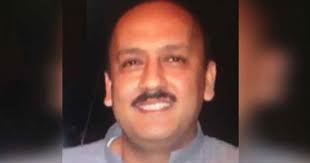
AD Khawaja (Credit newstodaypk.com)

Karachi, March 12: Allah Dino Khawaja was posted as Dadu SSP when he came up with a unique method to gain information on criminals. “During his posting, he started patrolling in the city under the guise of a milk seller and a vegetable supplier,” recalled Laila Ram Manglani, one of his best friends, explaining that Khawaja wanted to target corrupt cops who used to loot people on the streets.

“During his posting in Dadu, he focused mainly on [improving] police performance and suspended several [corrupt] SHOs in the volatile district,” he said. Manglani recalled how Dadu residents took to the streets in his favour when he was transferred out in the 1990s.

Humble origins

Khawaja, who belongs to a village in Tando Muhammad Khan district, was born in a Muslim family but was raised by a Hindu one. His father, Aziz Khawaja, was a landlord of the area and he was best friends with Daryano Mal, a local Hindu businessman who had no son of his own. Mal requested Aziz to allow him to take care of Khawaja and ended up paying for all his educational and other expenses.

Dal, who hailed from Jamshoro’s Thana Bola Khan area, had Khawaja enrol in Cadet College Petaro, from where he completed his Intermediate in 1982. After that, he completed his Master’s in Criminology from the University of Sindh, Jamshoro.

“Since my childhood, I wanted to become a police officer. I appeared for my Civil Service of Pakistan (CSS) exam in 1986-87 and passed it with flying colours,” Khawaja told The Express Tribune.

His exceptional score landed him a post in the foreign services but Khawaja had his eyes set on becoming a police officer. “I challenged the government decision and they reallocated me,” he said.

In the initial days, he worked in the Punjab as ASP and SP, and was later transferred to Sindh. “After appearing in the CSS exam, I also got admission in NED University in the civil engineering department but I dropped out soon after I passed the CSS exam,” he recalled.

When he speaks about his success, Khawaja gives credit to Dal, his Hindu mentor who helped fulfil his dreams. “This is a true story of my childhood. I am proud to be a Muslim and I am equally thankful to our Hindu family friend, who bore all my educational expenses and paved the way to make me a good citizen,” said Khawaja.

The cop life

Khawaja has served as SSP in various districts of Sindh and worked in Karachi as DIG in districts South and East, according to Sindh Police records. He also rendered his services in Intelligence Bureau (IB) as a joint director.

He was also posted as DIG for telecommunication and director for Sindh’s anti-corruption department. Khawaja also worked as personal staff officer for two chief ministers, Syed Muzaffar Hussain Shah and Syed Abdullah Shah.

Character certificate

Khawaja is known as one of the most respectable and honest officers in Sindh Police — a fact that led him to become one of the three members of the Supreme Court-appointed inquiry committee probing corruption charges against the outgoing Sindh IG.

Some officials accused Khawaja of embezzling government funds and using that money to establish petrol pumps but he denied these accusations. “This is just [an attempt] to malign me,” he said.

As he takes charge of the province during the crucial targeted operation in Karachi, Khawaja shared his plans. “My first priority will be to get rid of the defamed ‘thana culture’ and appoint police officers on merit,” he said.


ON Feb. 29 – a bad day for anniversaries – Pakistan executed my father’s killer

My father was the governor of Punjab Province from 2008 until his death in 2011. At that time, he was defending a Christian woman who had fallen afoul of Pakistan’s blasphemy laws, which are used by the Sunni majority to terrorize the country’s few religious minorities. My father spoke out against the laws, and the judgment of television hosts and clerics fell hard on him. He became, in the eyes of many, a blasphemer himself. One January afternoon his bodyguard, Malik Mumtaz Hussain Qadri, shot him dead as he was leaving lunch.

Mr. Qadri became a hero in Pakistan. A mosque in Islamabad was named after him. People came to see him in prison to seek his blessings. The course of justice was impeded. The judge who sentenced him to death had to flee the country. I thought my father’s killer would never face justice.

But then, in the past few months, it became possible to see glimmers of a new resolve on the part of the Pakistani state. The Supreme Court upheld Mr. Qadri’s death sentence last October. Earlier this year, the president turned down the convict’s plea for mercy — which, at least as far as the law goes, was Mr. Qadri’s first admission that he had done anything wrong at all. Then on the last day of last month came the news: Pakistan had hanged Malik Mumtaz Hussain Qadri. How would the country — not the state, but the people — respond?

I spoke to my sister in Lahore and for a moment we dared to hope that Pakistan, which had suffered so much from Islamic terrorism, might turn a corner. A lot had happened in the five years since Mr. Qadri killed our father. There was attack after hideous attack. In December 2014, terrorists struck a school in Peshawar, killing 132 children. Was it possible that Pakistan was tired of blood and radicalism? Had people finally begun to realize that those who kill in the name of a higher law end up becoming a law unto themselves? Had the horrors of the Islamic State in Iraq and Syria done nothing to dampen enthusiasm for Islamism? Perhaps. I hoped.

But when a BBC interviewer asked me about this, something made me equivocate. I said it was too early to say and that we should be careful not to confuse the hardening resolve of the Pakistani government with the will of its people. Mr. Qadri’s funeral was the next day. That would give a better indication of the public mood.

And so it did.

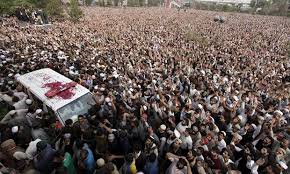
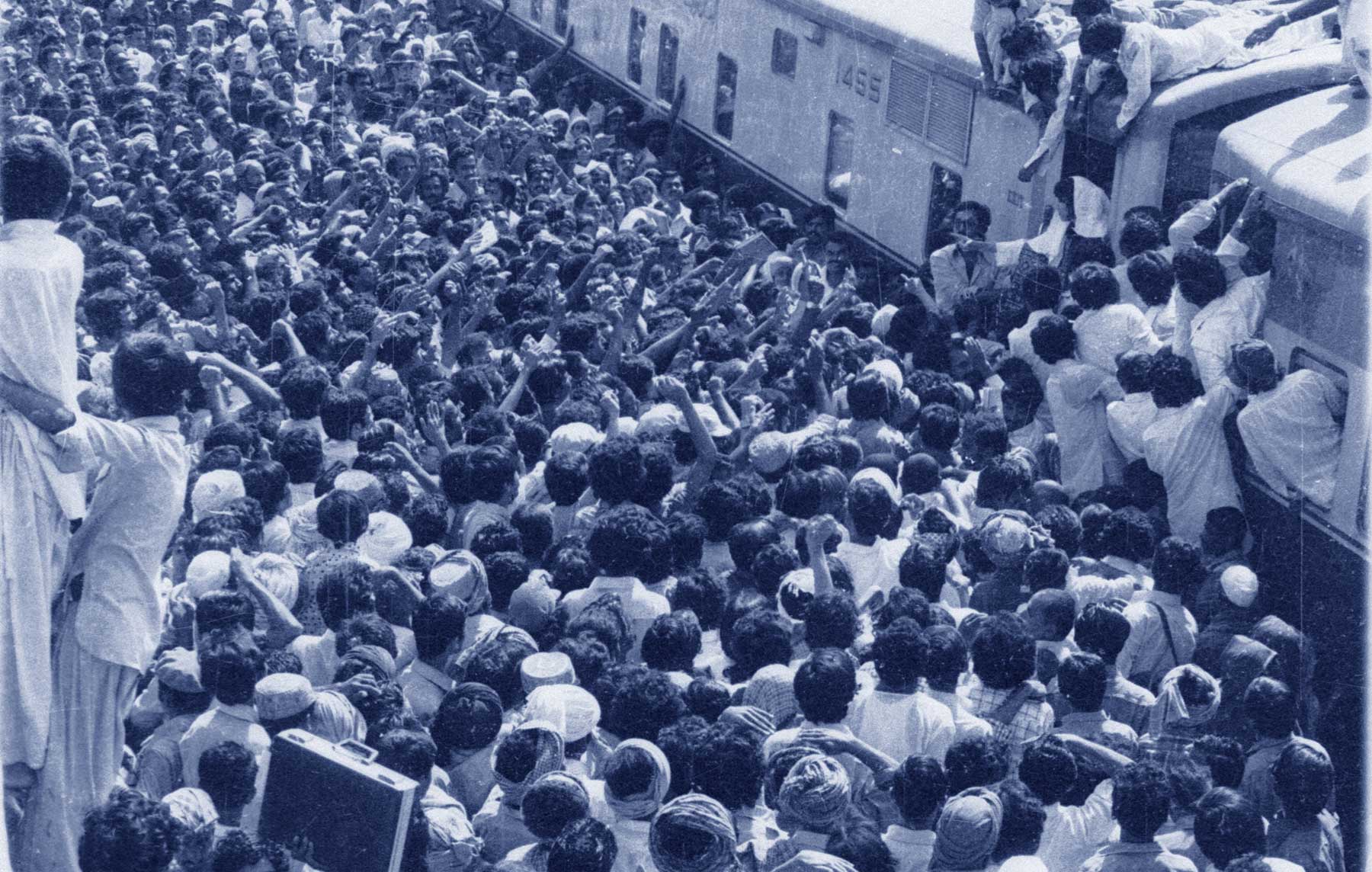
An estimated 100,000 people — a crowd larger than the population of Asheville, N.C. — poured into the streets of Rawalpindi to say farewell to Malik Mumtaz Hussain Qadri. It was among the biggest funerals in Pakistan’s history, alongside those of Muhammad Ali Jinnah, the father of the nation, and Benazir Bhutto, the former prime minister, who was assassinated in 2007. But this was no state funeral; it was spontaneous and it took place despite a media blackout.

As pictures emerged of the sea of humanity that coalesced around the white ambulance strewn with red rose petals that carried Mr. Qadri’s body, a few thoughts occurred to me: Was this the first funeral on this scale ever given to a convicted murderer? Did the men who took to the street in such great numbers come out of their hatred of my father or their love of his killer? They hardly knew Mr. Qadri. The only thing he had done in all his life, as far as they knew, was kill my father. Before that he was anonymous; after that he was in jail. Was this the first time that mourners had assembled on this scale not out of love but out of hate?

And finally, I wondered, what happens when an ideology of hate is no longer just coming from the mouths of Saudi-funded clerics but has infected the body of the people? What do you do when the madness is not confined to radical mosques and madrasas, but is abroad among a population of nearly 200 million?

The form of Islam that has appeared in our time — and that killed my father and so many others — is not, as some like to claim, medieval. It’s not even traditional. It is modern in the most basic sense: It is utterly new. The men who came to mourn my father’s killer were doing what no one before them had ever done. As I watched this unprecedented funeral, motivated not by love for the man who was dead but by hatred for the man he killed, I recognized that the throng in Rawalpindi was a microcosm of radical Islam’s relationship to our time. It drew its energy from the thing it was reacting against: the modernity that my father, with his condemnation of blasphemy laws and his Western, liberal ideas, represented. Recognizing this doesn’t pardon the 100,000 people who came to grieve for Malik Mumtaz Hussain Qadri, but it reminds us that their existence is tied up with our own.

Thousands at funeral of Pakistani executed for murdering governor

Qadri funeral (Credit: theguardian.com)
Qadri funeral
(Credit: theguardian.com)

Rawalpindi, March 1: An estimated crowd of more than 100,000 people have attended the funeral of Mumtaz Qadri, in a massive show of support for the convicted murderer of a leading politician who had criticised Pakistan’s blasphemy laws.

The vast gathering on Tuesday centred on Liaquat Park in Rawalpindi, where a succession of clerics made fiery speeches bitterly condemning the government for giving the go-ahead for Monday’s execution of Qadri, a former police bodyguard who became a hero to many of his countrymen after he shot and killed Salmaan Taseer, the governor of Punjab province, in 2011.

Fearing violence, authorities closed schools and beefed up security in both the garrison city of Rawalpindi and neighbouring Islamabad, the capital. Key roads were closed to traffic and the “red zone” near important government buildings was sealed.

Many people had travelled from around the country to attend the funeral, and crowds spilled out of the park on to the adjacent thoroughfare where throngs crushed around the flower-strewn ambulance that eventually brought Qadri’s body to the event.

Some of the all-male crowd wore “I am Qadri” signs around their necks while others held up the front page of the Ummat newspaper for bypassers to kiss, which was entirely covered with a photo of Qadri’s dead and garlanded body.

Many in the crowd were furious with the courts for convicting Qadri, with the governing faction of prime minister Nawaz Sharif’s Pakistan Muslim League for not ordering a presidential pardon, and with the media for agreeing to a strict news blackout on the protests.

Despite the huge numbers of mourners, none of the fleet of satellite trucks representing Pakistan’s numerous television stations were in attendance.

Sajjad Akhtar Abassi, a lawyer wearing the black suit and tie of his trade, condemned the supreme court for upholding Qadri’s death sentence last year.

“It is a court of law, not a court of justice,” he said. “Islam is a religion of peace and harmony but it does not allow anybody to use wrong words against the prophet or any other holy character.”

Qadri’s supporters believe he was justified in killing Taseer as he left a restaurant in Islamabad in 2011 because he had called for the pardoning of a poor Christian woman who had been convicted under blasphemy laws, which he also condemned.

The blasphemy laws are much criticised by human rights groups who say hundreds of people, mostly members of religious minorities, have been convicted for insulting Islam, often on flimsy evidence.

“The government can never change the blasphemy law because we are a nation of Muslims and the constitution already protects the position of minorities,” said Abassi.

The extreme sensitivity of the issue was reflected in the silence of Pakistan’s usually voluble politicians on the decision to execute Qadri.

On Monday night, video footage appeared online showing the information minister, Pervaiz Rasheed, being heckled by passengers in the departure lounge of Karachi airport.

One politician who did comment was the minister for religious affairs, Pir Muhammad Amin Ul Hasnat Shah, who released a statement that described Qadri as a martyr and urged people to participate peacefully in his funeral.

Karachi’s ex mayor Mustafa Kamal Picks Fight with MQM chief

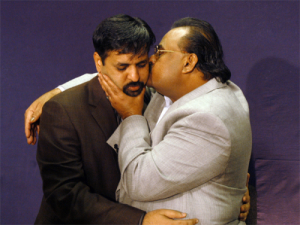
Altaf embraces Mustafa (Credit: changingpakistan.com)
Altaf embraces Mustafa
(Credit: changingpakistan.com)
KARACHI, March 3 – After a prolonged absence from the local political scene, former city nazim of Karachi Syed Mustafa Kamal was holding a press conference in Karachi on Thursday.

The joint press conference with his former fellow Muttahida Qaumi Movement (MQM) leader Anees Qaim khani was being held in DHA phase 6 area of Karachi. Kamal had said that he would apprise the media over key matters.

Addressing the media, Kamal lashed out sharply at MQM chief Altaf Hussain, with whom the former Karachi mayor has had a falling out since years. Kamal said that his press conference would be divided into three parts. “First part will be about why I and Anees left the party. Second, why we have cameback, and what we will do next.”

Kamal said that Altaf had insulted workers several times in public meetings, especially once in May 2013 when he changed the party set up overnight. “How can a commander insult his sepoys other than to serve him?”

“We have returned today because every child of Pakistan, every party, the establishment of Pakistan as well as the present and past government’s know, that Altaf Hussain has links with the Indian intelligence agency RAW,” he alleged.

He recalled that during his time in the MQM, the Rabita Committee would be degraded and insulted by Altaf Hussain within weeks and months but recently the situation became such that the Rabita Committee would be insulted every few minutes.

What was first done in private settings was being done in public through media channels, he said. He recalled how the MQM Rabita Committee was manhandled by people when the PTI secured 800,000 votes.

He also revealed that a time came when former interior minister Rehman Malik would dictate the press releases for MQM, adding that Malik had access to the MQM chief even more than MQM leaders.

Syed Mustafa Kamal served as a city nazim of Karachi from 2005 to 2009. Both the leaders were appearing before the media after almost three years of absence from the political scene in Karachi.

Senior journalist Talat Hussain said that the two leaders, who have been estranged from the MQM for years, might provide an alternate leadership to voters of the MQM.

Sources told that the MQM leadership has called its workers and top activists to the party’s secretariat in London, where party chief Altaf Hussain is based.

According to the sources, Altaf is also expected to be present at the meeting. But MQM senior leader Wasay Jalil rejected the news of the emergency meeting. “Neither any meeting has been summoned nor workers have been called in London,” said the leader in a message posted on Twitter.

The MQM leadership has remained tight lipped about the press conference stating that it will only comment after the press conference takes place.

Parliament Watch: Beyond the PM’s threat to fix NAB

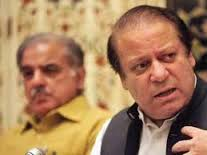
Nawaz Sharif Press Conference (Credit: pkshafaqna.com)
Nawaz Sharif Press Conference
(Credit: pkshafaqna.com)
Prime Minister Nawaz Sharif’s uncharacteristic outburst against the National Accountability Bureau (NAB) this week resounded more than it astounded political circles and commentators.

People did not miss Imran Khan much, who has been holidaying in the Maldives, as television channels and newspapers continued to analyse the reasons and consequences of the sudden hard feelings of the otherwise cool elder Sharif.

If frustration was behind it, as some say, it would be understandable.

After all, the prime minister and his party were expecting acclaim over their achievements – standing his ground against PIA strikers and closing the multi-billion dollar LNG deal with Qatar – instead of being hounded by the talk of a NAB probe into the deal and other pet projects such as the Metro Bus, Orange Train, LDA City.

Even worse was the talk that old cases against Nawaz and Shahbaz Sharif might be reopened, even though they have obtained stay orders from the courts.

In his attack on NAB, the prime minister broadly suggested that the PML-N could cut NAB down to size, or form a commission to watch over its activities.

That would be politically incorrect, since today’s NAB and its chairman, Qamar Zaman Chaudhry, are the product of a bipartisan consensus. Not only would the PML-N be doing what it had loudly criticised the PPP for doing in Sindh – reining in the powers of the Rangers – but would also lend weight to PPP charges that the PML-N government used NAB and other federal agencies to carry out ‘selective accountability’ and a ‘witch-hunt’ in Sindh.
Indeed, the situation looks much more ominous to political observers and analysts, who wonder what made the prime minister take on NAB personally, when a lesser figure in the cabinet or party could have fired the warning shot just as easily.
In background discussions, lawmakers from different political parties and government officials privy to the development, provided no direct clue and yet, expected more fireworks.

Some thought that the PML-N leadership would want to smother any activity that paints it black in the run up to the next elections, even if they are far away.

It would like to enter the battle in the shining armour of progress and with state-of-the-art edifices firmly in the ground.

It was Punjab Chief Minister Shahbaz Sharif who prodded his elder brother “to be tough”, according to a ruling party parliamentarian. “NAB had turned its eyes on Punjab and was in the process of going ahead with a few important arrests from within the ruling party on the charges of corruption. That would have stained the party’s clean image in the public eye,” he said.

Others added that the arrests would have had knock-on effect on the bureaucracy, the mainstay of the PML-N’s governance. “In the event, government officers will think twice before doing the bidding of their political masters, and that will directly affect our party’s development projects,” explained one.

A PTI lawmaker said the prime minister’s harsh remarks against the NAB reflected the frustrations of the PML-N leaders both at the centre and in Punjab. “Instead of improving the life of the common man, their hopes to hanging on to power hang on building roads and flyovers and metro bus,” he said.

To him PML-N was “habitual of picking up fights with institutions, mainly to divert attention from the failures of their government. I will not be surprised if the duo blasts other institutions in the coming weeks,” said the PTI lawmaker.

A PPP MNA from Sindh did not agree that the PM’s attack on the NAB put the PML-N and the PPP on the same side. “Just wait and watch how things unfold,” he advised. “A little retrospection would reveal that whenever the PML-N leadership throws the gauntlet against a state institution something serious is brewing.”

Meanwhile, sources close to the NAB and the security establishment say no one should expect them to back off from their campaign against corrupt elements and banned outfits hiding in the southern districts of Punjab.

Whatever may have led the prime minister to attack the NAB, “we will spare no suspect whatever his party affiliation,” said a senior NAB official.

A security official was even more forthcoming. “A contingency plan is already in place to go after the activists of the militant banned outfits. Soon action will start against them,” he said.

Published in Dawn, February 19th, 2016

Pakistan airline strike causes flights chaos

PIA said none of its scheduled flights took off from anywhere in the country.

Staff stepped up their industrial action after two employees were shot dead during clashes with security forces in Karachi on Tuesday.

The strikers have been threatened with the sack if they hinder efforts to reform the loss-making airline.

Prime Minister Nawaz Sharif has said they may even be imprisoned.

On Wednesday dozens of PIA’s national and international flights were cancelled amid demonstrations by striking staff.

“Everything is shut now and flight operations have come to a complete halt,” airline spokesman Danial Gilani told the AFP news agency.

The violence in at Karachi’s Jinnah International Airport prompted the airline’s chairman Nasir Jafar to tender his resignation, but Mr Gilani said the PM had yet to accept the offer.

It is still not clear who fired the shots in Karachi, with both police and paramilitary forces denying that they did.

On Wednesday, additional police and security personnel were deployed outside major airports.

BBC correspondents say private airlines have been brought in to help clear the flight backlog – in some cases doubling their fares.

Staff are angry at proposals to complete a partial sale of the airliner by July.

PIA was once a source of pride for Pakistan but in recent years its reputation has been hit by losses, mismanagement and cancelled flights.


‘Callous disregard’ – media view

The privatisation issue has come under intense press scrutiny, with most Pakistani newspapers accusing the government of handling the affair clumsily.

As far as left-liberal Dawn is concerned, invoking an act of parliament to stop the airline unions striking was “an act of sheer panic”.

“Beyond the follies of the moment, the entire episode has turned a delicate matter into an open contest of wills of the sort that is usually won by the party with more grit, which in this case would be the unions,” it says.

The News, which is centrist, agrees, saying Tuesday’s events showed a “callous disregard for the norms of a healthy society” and adding: “It took only two days for an already bad situation to be worsened through a needless escalation.”

Urdu-language Nawa-i-Waqt wants an investigation but maintains that if the policy of not giving into pressure from the PIA employees is continued, “their blackmailing could be ended once and for all and the status of the national airline would be restored”.

‘COAS green-lighted NAB action in DHA Valley scam’

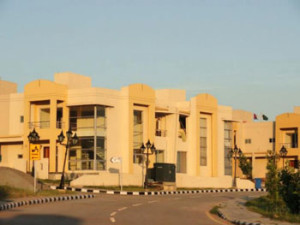
DHA city (Credit: zameen.com)
DHA city
(Credit: zameen.com)

ISLAMABAD, Jan 11: Chief of Army Staff (COAS) Gen Raheel Sharif had green-lighted stern action against retired military officers and civilians involved in the Rs62 billion Defence Housing Authority (DHA) Valley scam around six months ago, sources in the National Accountability Bureau (NAB) have told Dawn.

A top NAB officer said on condition of anonymity that a senior military official had called on NAB Chairman Qamar Zaman Chaudhry in July last year and assured him of the army’s full support to the bureau in investigating the matter.

The NAB chief was informed that the COAS was determined that no-one should be spared in the investigation, even army officials.

“The message Gen Sharif conveyed to the NAB chairman was that no-one involved in the scam should be spared and action should be taken, even if his own brothers are found to have links to the scam,” an official privy to the meeting said.

NAB has recently started flexing its muscles against Bahria Town chief Malik Riaz, brothers of former army chief Gen Ashfaq Parvez Kayani and some DHA officials. Now, it is looking into irregularities in the construction of the DHA Valley scheme — meant for families of military personnel who were killed in the line of duty — which was to be built on Punjab government land at the site of the Dadhocha Dam, near Rawat.

When contacted, Inter-Services Public Relations (ISPR) declined to comment on the matter. However, it has been widely reported that the management of DHA has formally filed a complaint with NAB, asking it to investigate the matter.

The NAB source said that during their meeting, the military official had inquired about a NAB investigation into a complaint, submitted by retired Lt-Col Mohammad Tariq Kamal in Sept 2010. The complaint alleged that the DHA Valley real estate project was being developed on an area reserved for the proposed Dadhocha Dam. Following the verification of the complaint on June 13, 2011, the bureau had authorised an inquiry on July 3, 2012.

The NAB chairman had, at the time, indicated that former army chief Gen Ashfaq Parvez Kayani’s brothers and other retired army officials were implicated. At this, the source claimed, the military officer told the NAB chief that Gen Sharif wanted a just investigation and that no-one should be spared.

The case was later tried by the Supreme Court and a two-judge bench headed by Justice Jawwad S. Khawaja heard the petition on July 16, 2015. In addition to demanding an explanation from NAB, the court also asked the Punjab government to respond to the petitioner’s allegations.

The petition claimed that DHA, Bahria Town and a private construction firm Habib Rafique had entered into a contract to develop various housing schemes including DHA Valley, DHA Phase II Extension, DHA Expressway and DHA Villas in Rawalpindi, as a joint venture (JV).

According to the petitioner’s evaluation, DHA Valley was valued at Rs110 billion, DHA Phase II Extension at Rs70 billion, DHA Expressway at Rs50 billion and DHA Villas at Rs100 billion. DHA-I and DHA-II are already-developed housing societies, but DHA Valley is yet to be developed.

According to NAB investigation, those who had paid for plots in DHA Valley found themselves in an awkward position when, in 2009 DHA transferred all the funds it had been paid (Rs62 billion) to the accounts of Bahria Town, which eventually failed to develop the scheme. Those cheated out of their money included 110,000 civilians, 41,000 serving and retired military officers, jawans and families of martyrs.

Gen Kiyani’s brothers respond

Also on Sunday, retired Brig Amjad Parvez Kayani issued a statement, claiming that the former army chief Gen Ashfaq Pervez Kayani had nothing to do with the actions and business interests of his brothers.

“Rather than talking about us as individuals, a reference is always made to Gen Kayani, as if he sponsored and facilitated us in everything we did or did not do. Everything under the sun is attributed to us without a shred of lawful or even raw evidence, departmental records or proof. These allegations are baseless. Gen Kayani never, in any way, sponsored or facilitated our business interests,” the statement said.

Brig Amjad claimed that his brother Kamran Kayani, an accused in the DHA City Lahore scam, was not a partner in the JV between DHA Lahore and Eden Private Limited, nor did he facilitate a deal between the two in favour of EDEN City. “In this JV, DHA Lahore is the senior partner and all plots/files which were marketed would have been issued by DHA and no-one else (including Kamran Kayani),” he said.

Kamran Kayani also has no connections with another JV, signed in 2009 between DHA Islamabad and Elysium. “Ownership of the Elysium was clearly established in a Supreme Court’s decision, which ordered EOBI to return 50 plots to Elysium and the company to pay back Rs1 billion to EOBI. The decision of the Supreme Court was implemented,” he said.


Pakistani Women Transition from Heels to Wheels

Punjab Women on Motorbikes (Credit: dawn.com)
Punjab Women on Motorbikes
(Credit: dawn.com)

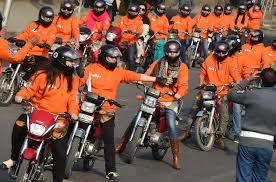
LAHORE: The Women on Wheels (WoW) project was launched on Sunday with a motorcycle rally for women on The Mall.

A total of 150 women motorcyclists, who completed training from the Special Monitoring Unit on Law and Order and City Traffic Police, took part in the rally.

SMU launches motorbike training for women

Austrian Ambassador Brigitta Balaha and former Supreme Court Bar Association president Asma Jehangir also participated in the rally. Minister for Population Welfare Zakia Shahnawaz, Minister for Women Development Hameeda Waheedud Din, Special Monitoring Unit Senior Member Salman Sufi, Danish Ambassador Helen Neilson, American Consul General Zackary Harkenrider, UN Women Country Representative Jamshed Qazi and a prominent motorcyclist from Singapore, Juvena Huan, were present on the occasion.

She said that the Punjab government was taking effective measures for the elimination of gender discrimination, change in social mindsets and ensuring active participation of women in all sectors of the economy.

She said that in view of transport problems faced by women, the government had taken various mitigation measures. “On the instructions of the government, free training is being imparted to women to ride motorcycles under the aegis of Special Monitoring Unit,” she said.

She said that on International Women’s Day, 1,000 scooties would be distributed among women. Referring to various challenges and problems being faced by women, the minister said that equal rights and encouragement were being given to women so that they could play their role in the society.

Zakia Shahnawaz said that provision of equal opportunities of development to women was the responsibility of the Punjab government. “No effort will be spared for making the Women on Wheels project successful. The government will continue the process of legislation for empowerment of women,” she said.

Brigitta Balaha said that provision of opportunity and facilities to Pakistani women was a commendable step.

Zachary Harkenrider said that it was an honour for him to see the historic rally of motorcyclist women.

MQM Distances itself from Dr Imran Farooq’s Assassins

ISLAMABAD, Jan 8: Two men suspected of being involved in the murder of Muttahida Qaumi Movement’s self-exiled leader Dr Imran Farooq recorded their confessional statements before the Islamabad deputy commissioner on Thursday, sources said.

The FIA had arrested three suspects — Khalid Shamim, Mohsin Ali Syed and Moazzam Ali — for their alleged role in Dr Farooq’s murder.

While Shamim and Mohsin Ali confessed to their involvement, Moazzam Ali, said to be the prime suspect, was unwilling to come up with a confession, sources in the prosecution told Dawn.

In his statement recorded under Section 164 of the criminal procedure code, Mohsin said that Moazzam had handled the travel documents to live in the United Kingdom.
According to private news channel Geo News, Mohsin in his statement gave graphic details of the murder.

He said that at a university hostel in London he and his accomplice Kashif Khan Kamran, whose whereabouts are not known and may have died, prepared a plot to kill Dr Farooq.

He said they monitored the movement of Dr Farooq in London to know about his routine.

On the day of the murder, he said, he grabbed Dr Farooq while Kashif stabbed him and then bludgeoned him with a brick to ensure his death.

Shamim said that he had consented to join the murder plot because he was a diehard MQM activist, sources said.

Shamim claimed that senior MQM leader Muhammad Anwar gave the order to assassinate Dr Farooq.

The JIT constituted to investigate the murder had suggested that MQM chief Altaf Hussain regarded Dr Farooq as a threat and wanted him eliminated.

The JIT report also noted that all three suspects were members of the All Pakistan Muttahida Students Organisation, the MQM’s student wing.

The suspects were sent to Adiyala jail on 14-day judicial remand by an Islamabad anti-terrorism court.

The gruesome murder took place on Sept 16, 2010, near Dr Farooq’s London home.

The London police had named Mohsin Ali Syed and Mohammad Kashif Khan Kamran as wanted men in connection with the murder as they were in the UK when Dr Farooq was murdered. They arrested the three men during the last five years but released them later without filing any charges.

However, it was widely reported that both Mohsin and Kamran had been taken into custody by Pakistani intelligence agents the moment they landed at Karachi airport in 2010.

The third suspect, Khalid Shamim, was allegedly taken into custody in January 2011 and a petition regarding his ‘illegal detention and going missing’ was filed by his wife in the Sindh High Court.

In March last year, Moazzam was arrested at his Azizabad house for facilitating the suspects in getting a British visa.

On June 18, 2015, the Frontier Corps claimed to have arrested Mohsin and Shamim in Chaman in Balochistan.

The FC claimed that the two were illegally entering Pakistan from Afghanistan.

On Dec 5, 2015 — the day Karachi went to the local government polls — the FIA registered a murder case against MQM chief Altaf Hussain, his nephew Iftikhar Hussain, Moazzam Ali Khan, Khalid Shamim, Kashif Khan Kamran and Syed Mohsin Ali.

MQM’s reaction
Meanwhile, the MQM made it clear that none of its workers had anything to do with the assassination of Dr Farooq.

“The MQM is aware of reports in the media that individuals held in detention by Pakistani authorities have allegedly confessed to the murder of Dr Imran Farooq. We categorically state that no party personnel have had anything whatsoever to do with the tragic death of Dr Farooq. We mourn the loss of a man who was our friend and colleague for many years,” said a statement issued in Karachi on Thursday evening.
Published in Dawn, January 8th, 2016