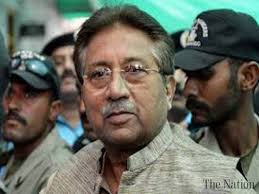
ISLAMABAD: Pakistan’s Supreme Court on Wednesday granted bail to former president Pervez Musharraf over the death of Baloch rebel leader Akbar Bugti, bringing closer the former dictator’s possible release after nearly six months of house arrest.
Musharraf has now been granted bail in three major cases against him, including one relating to the assassination of former prime minister Benazir Bhutto.
His lawyer said the ruling meant he was a “free man”. But he is likely to remain under heavy guard at his villa on the edge of Islamabad, where he has been under house arrest since April, because of serious threats to his life.
A two-judge bench of the apex court, headed by Justice Nasirul Mulk, heard Musharraf’s appeal against the Balochistan High Court’s rejection of his bail application in the Nawab Akbar Bugti murder case.
The bench observed that substantial evidence was not available to involve Musharraf in the criminal conspiracy regarding Bugti’s murder and granted bail to the former president.
His lawyer Ibrahim Satti said the three-member bench had granted bail in the Bugti case in return for surety bonds worth two million rupees.
Though the court had summoned Jamil Bugti, a son of Nawab Akbar Bugti, who is a complainant in the case, he remained absent from today’s hearing.
Musharraf ‘a free man’
“Pervez Musharraf is a free man now after getting bail in the Bugti case,” said Qamar Afzal, another counsel for the former president.
As well as the Bugti and Bhutto cases, Musharraf also faces cases over the suspension of judges during emergency rule, which he imposed in 2007.
The Taliban have threatened to kill the 70-year-old former general, who as president allied Pakistan with Washington in the US “war on terror” in the wake of the September 11, 2001 attacks.
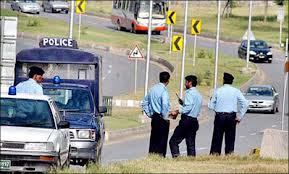
Security remained tight at Musharraf’s villa, an AFP reporter at the scene said, with no sign of any preparations for departure.
Musharraf’s spokesman Raza Bokhari said the general was “gratified” by the bail ruling but determined to clear his name of charges which he has always maintained were politically motivated.
“After all these formalities are finalised he would be free to travel within and outside Pakistan, but this is just the beginning. These court cases are a long-run process,” said Bokhari.
“He will continue to fight these cases until his name is clear of these false, fabricated and fictitious charges.”
‘No decision to leave Pakistan’
The secretary-general of Musharraf’s political party, the All Pakistan Muslim League, said he expected “progress” on Thursday after the bonds are paid but denied Musharraf planned to leave Pakistan.
“There has been no deal with the government, nor has Musharraf taken any decision to immediately leave the country,” Muhammad Amjad told reporters.
Musharraf returned to Pakistan in March to run in the general election, vowing to “save” the country from economic collapse and militancy.
But he was barred from contesting the election, won convincingly by Prime Minister Nawaz Sharif – the man he ousted from power in 1999 – and was hit with a barrage of criminal cases dating back to his rule.
He has been living in part of his 1,100 square metre house, declared a “sub-jail” under the auspices of the Adiala prison in Rawalpindi, where he is guarded by some 300 police, paramilitaries and marksmen.
Reports have claimed he is enjoying a comfortable life in detention. He has even had the services of his personal cook because of his fears of being poisoned.
Since Sharif won the election there have been repeated rumours that a deal would be reached to allow Musharraf to leave Pakistan before his trials were completed.
Musharraf spokesman Bokhari insisted no such arrangement had been cooked up.
One theory was that Musharraf might be allowed to visit his sick elderly mother in Dubai on compassionate grounds, but APML spokesman Amjad rejected the idea.
“Musharraf’s mother has been quite unwell for quite some time but he has not reached any deal nor has he made any request to leave the country to see his mother,” Amjad said.
Baloch nationalist leader Nawab Akbar Khan Bugti was killed in August 2006 in an explosion in a cave where he had taken refuge during a military crackdown ordered by Musharraf who was president and army chief at the time.
Bugti had led an armed campaign to press for provincial autonomy and a greater share of profits from Balochistan’s natural resources.
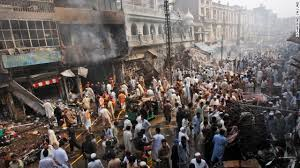
Terrorist attack in Qissa Khwani bazaar (Credit: cnn.com)Washington DC, Oct 3: Three consecutive terrorist attacks in Peshawar – which have killed and injured hundreds of innocent people – reflect a growing impatience of the Taliban for the “pre-selected” candidates of 2013 elections to deliver to their demands.
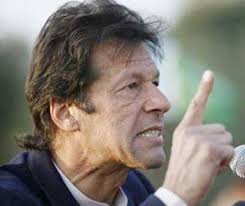
These terrorist attacks – waged by criminal elements in a growing array of Taliban factions – have come after a long period of inactivity. In the lull before the storm, political parties held an All Parties Conference in Islamabad to vote for talks with the TTP. Spear heading the APC were prime minister, Mian Nawaz Sharif and the king maker of the Khyber Pakhtunkhwa government, Imran Khan.
Here it is relevant to mention that just prior to this year’s elections, the Pakistan army blessed this set of politicians in their bid for power – with the end game of Afghanistan in mind.
But the army – which has since 9/11 supported the Afghan Taliban, while restraining the Pakistani Taliban – has been unable to stop the militants blow back. Instead, its strategy for a pro-Pashtun government in Afghanistan has had major consequences. As Pashtuns from both sides of the Durand line will testify, the Pak-Afghan border is a meaningless entity. A fierce Taliban resurgence in Afghanistan has emboldened their Taliban partners to attack military and state institutions in Pakistan.
In this complex scenario, the newly elected political parties like Pakistan Muslim League (Nawaz) and Pakistan Tehrik-i-Insaf – which were spared from attacks prior to the elections – are now boxed in between terrorist attacks by militants and the demand for military action against them.
The Taliban is not monolithic, but divided in a bewildering array of groups. Among those striking ferociously of late has been the faction led by Maulvi Fazlullah – who has been sheltering in Afghanistan since the military operation in Swat in 2009.
The Taliban have correctly identified the US and Pakistan military as responsible for drone strikes. However, any moral argument they had won in favor of ending the strikes.. or ending the military operation in FATA.. have been weakened by their killing of common people.
The KP government’s failure to condemn the perpetrators of civilian attacks has apparently emboldened terrorists. Adding fuel to fire, the Pakistan Tehrik-i-Insaf chief followed the massacre of Christians with the demand that the Taliban be allowed to open offices for negotiations.
Those who voted for “change,” – on the PTI’s call – have discovered that the brutal spilling of innocents blood, was not exactly the change they had in mind.
Indeed, if history is to serve as a rear view mirror, politicians need to heed that the worst terrorist attacks in Pakistan took place in 2008, after Musharraf and his coalition partners – the Mutehidda Majlis-i-Amal – concluded a series of peace accords with the Taliban. The accords were preceded by MMA-Taliban talks that looked the other way as the militants organized themselves.
In the present scenario, Taliban groups have unleashed terror against civilians even before talks have begun. Their modus operandi appears to be to keep spilling blood until the army withdraws from the tribal areas. The next step, as the Taliban declared in 2009 (prior to the Swat operation), would be to overthrow the constitution of Pakistan and avowedly implement Shariah (Islamic law). In practice, this means tribal law that ushers in pre-Islamic customary laws with a vengeance.
The TTP’s demands ought to give the army and politicians pause as to exactly who they may be negotiating with. The ruthless killing of civilians is hardly adding to the Taliban’s populist base. Perhaps overconfidence by militants that they have politicians in their pocket facilitates these rapid attacks. However, it is the politicians – and ultimately military response – that will determine the security and stability of Pakistan.
In the meantime, the PML (N) government has announced that it will first give peace a chance by holding talks with the Tehrik-i-Taliban Pakistan. At the same time, it is on record for saying that the violation of a cease-fire by the militants could result in a sustained military operation against them.
With tens of thousands already killed in Pakistan since 9/11, it is critical for the army to draw a workable strategy for the region. Given that US withdrawal from Afghanistan is in sight, Pakistan is throwing weight behind select Pushtun Taliban next door. What is important is that in pursuing the Great Game, it does not lose Pakistan.
ISLAMABAD, Oct 2 – The PML-N government has formally established contacts with the Taliban leadership through ulema from Wafaq-ul-Madaris and those commanding respect in various Taliban factions operating in the country’s restive tribal areas.
Sources in the government confirmed having started the process of contact with the Taliban, while modus operandi of the dialogue would shape up in the coming days.
A delegation of ulema belonging to Wafaq-ul-Madaris had a detailed meeting with Federal Interior Minister Ch Nisar Ali Khan and some other key persons having a vital role in the whole process on Tuesday and discussed the key issues on which the foundation of peace parleys would be laid.
The sources further said now these ulema who are playing an intermediary role would approach the Tehreek-e-Taliban Pakistan leadership to have their input and then in the light of the suggestions and proposals coming from both sides would devise some baseline for the peace initiative, and the two sides would follow basic guidelines for a formal contact.
They further said initially both the sides would be asked to stop operations against each other and then these ulema would sift the workable demands and devise a mechanism for bringing normalcy to the troubled areas.
Prime Minister Nawaz Sharif remained in constant touch with Interior Minister Ch Nisar Ali Khan despite his hectic schedule in the US where he remained for over a week in connection with the United Nations General Assembly session.
The prime minister, who landed back on Tuesday night, would be having a detailed briefing from the interior minister on the subject with specific reference to Tuesday’s meeting with the ulema.
The sources further said that as the prime minister would be having some other pressing engagements, including finalisation of names for the NAB chief slot and the Joint Chiefs of Staff Committee chairman, the interior minister would be dealing with the dialogue process with the Taliban.
Sources in the ruling PML-N revealed that a meeting of the prime minister with the leader of opposition was fixed for October 3 (Thursday) at which they would finalise a name for the NAB chairman.
On the other hand, the prime minister would be finding a fresh summary for the appointment of Joint Chiefs of Staff Committee chairman and he would have to pick a person for the slot as the incumbent would be retiring next week.
It is pertinent to mention here that previously the Ministry of Defence had put up the name of Lt-Gen Mahmood Haroon Aslam for the slot, but it was turned down by the premier before his departure for the US.
Agencies add: Tehrik-e-Taliban Pakistan (TTP) has welcomed an appeal for ceasefire made by Wifaqul Madaris ulema.
TTP spokesman Shahidullah Shahid Tuesday said the Tehrik would follow the suit, if the government decided a ceasefire prior to talks. Shahid also thanked PTI Chairman Imran Khan for his proposal to allow the TTP to open a political office. However, he added that the militia didn’t need such an office in Pakistan.
He said it was the unanimous decision of the TTP Shoora to move forward in light of the all-parties conference (APC) proposals.
This positive geture of Taliban can be considered as a major breakthrough for peace talks as the TTP on Saturday sharply criticised Prime Minister Nawaz Sharif for changing his mind and giving a precondition of laying down weapons. “By telling us that we will have to lay down arms and respect the constitution, the prime minister, Nawaz Sharif, showed that he is following the policy of America and its allies,” a TTP spokesman said.
In an interview with a private TV channel, PTI Chairman Imran Khan said that if the Taliban refuse to obey the Constitution and the Parliament‚ action will be taken against them. “Talks are possible only with those who obey the Constitution and the Parliament”, Imran elaborated.
He said the Army and the political parties were on the same page to hold talks with the Taliban. He said top priority should be given to holding talks with the Taliban with the use of force as a last option. Military action alone was not the solution of the problem, he maintained.
He said some of our enemies were funding some groups of Taliban against Pakistan. He reminded terrorism and suicidal attacks started in the country owing to wrong policies of the former military dictator Pervez Musharraf.
To a question, he said all the parties have given mandate to the government for holding talks with Taliban and there should not be delay in launching of this process.
PESHAWAR, Sept 25: Pakistan Tehrik-i-Insaaf (PTI) chairman Imran Khan on Wednesday urged the government to declare a ceasefire if it was serious about holding peace talks with militants in Pakistan.
The PTI chief also called on the government to allow militants to open an office in Pakistan similar to the Afghan Taliban office in Qatar to facilitate the dialogue process, DawnNews reported.
Speaking to media representatives after visiting injured persons of the Peshawar church bombing at the Lady Reading Hospital, Khan said that on one hand, there were talks of holding negotiations whereas on the other, war was still ongoing. How would it be possible to hold peace talks, he questioned.
The PTI chairman moreover said that after the fourth All Parties Conference (APC), it was decided to hold peace talks; however no solutions had come about.
Khan stressed that the government should take negotiations seriously, adding that it should declare a ceasefire.
Furthermore, he also said that the government should allow militants to establish a political office in Pakistan to hold peace talks in the absence of which negotiations would not be possible and the decade-long war against terrorism would continue.
While discussing the Peshawar church bombing which killed 81 people, Khan alleged that the tragedy had been politicised. He said 170 blasts had taken place in Khyber Pakhtunkhwa in the past nine years under previous governments, but PTI had not politicised those tragedies.
Operation in Karachi (Credit: centralasiaonline.com)In Pakistan, the wheel of history has brought the Muttehida Qaumi Movement (MQM) up against a sheer battle for survival. Today the ethnic party of Mohajirs (Urdu speakers from India), is squeezed between a wary, experienced Punjabi prime minister and a Sindh based PPP – that no longer seeks compromise to stay in power.
Small wonder that MQM chief, Altaf Hussain – who fled to London under Prime Minister Nawaz Sharif’s first tenure – has denounced the ongoing operation in Sindh as a reminder of the “genocide of Mohajirs” suffered in 1992 under ‘Operation Clean up.’ In so doing, he has appealed to third and fourth generation of Mohajirs, whose fathers may have been killed during that decade in police encounters and extrajudicial killings.
Apparently, the MQM miscalculated when it invited the army to conduct the operation. The first sign that the operation was not to their liking, came, when it’s former MPA, Nadeem Hashmi was arrested for the murder of two policemen – and the party protested by shutting down Karachi and a few urban areas in Sindh. Hashmi’s sudden release from an anti-terrorist court would show the MQM still has political leverage.
But essentially, US plans to withdraw from Afghanistan and the election of a `Taliban friendly,’ government have contributed to the MQM’s woes. In the wake of 9/11, the party reinvented itself as the secular alternative to `Talibanization.’ However, given that the Mohajir-Pashtun conflict is ethnic in nature, the MQM went on a limb to prevent the `Pashtoonization’ of Karachi. As violence erupted in Karachi, it prevented ever migrating Pashtuns from settling there.
After 9/11, US support for Gen. Pervaiz Musharraf facilitated him to patronize the MQM – allowing the ethnic party to reach its hey day. It contributed to the longest tenure for MQM’s Ishrat ul Ebad to govern Sindh – notwithstanding the murder and army kidnapping cases lodged against him in 1992. Former president, Asif Zardari, learning from the rocky tenures of his prime minister-wife, Benazir Bhutto, molly-coddled the MQM – enabling the PPP government to complete its tenure.
The downside was that for the last five years, the MQM and the Awami National Party (representing Pushtoons) fought on ethnic basis for the control of Karachi. The PPP, saved its coalition with the two parties by desisting from action against politically affiliated criminals. Adopting the maxim `If you can’t beat them, join them,’ it patronized armed Baloch groups from Lyari to keep control.
While the PPP government abdicated power, the land mafia dug in and brutal Taliban elements entered Karachi. Murders sky rocketed and extortion, kidnappings for ransom, vehicle thefts and mobile phone snatching soared. All this happened as the US presence in Afghanistan made weapons more accessible than ever. It resulted in 7,000 people being killed in the city in the last five years alone.
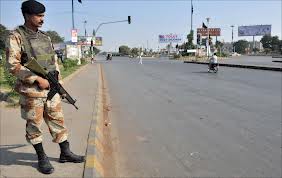
Given that Karachi is the back-bone of the nation’s tax base, the business minded Sharif government has focused on returning peace to the city. Senior police officers have been transferred and Rangers deputed to crack down in Karachi. The PPP, now acting as a junior partner of Sharif’s government, coyly says it needs to act against all criminal elements, regardless of party affiliation.
However, the absence of justice in Pakistan’s political system makes the MQM woefully aware that its real “crime,” is being out of power!!
For example, Scotland Yard has only now reinvigorated the three-year-old murder case of Imran Farooq – that implicates MQM chief Altaf Hussain. As Altaf’s demi-God personality comes under challenge, his followers have passionately rallied around him in a `now or never’ battle for survival. Media reports nevertheless, talk about cracks within the MQM – among those who support Ebad’s governorship, and others who want to stay in opposition.
At the end of the day, Sindh seeks an even-handed operation that will rid the province of all criminal elements – regardless of patronage. Presently, the culture of nepotism and absence of just policies keeps people coalescing around ethnicity. In the urban areas – and a mega city like Karachi, it fans a culture of violence that promotes fear and intimidation.
Today the biggest stake holders of Sindh – Sindhis and Mohajirs – need to rid themselves of ethnic prejudices and work together to promote rational policies and good governance. That means taking a lesson from developed nations – where race, ethnicity religion, sect and gender can no longer be used to discriminate and obstruct the common good.
LONDON, Sept 12 — For two decades, Altaf Hussain has run his brutal Pakistani political empire by remote control, shrouded in luxurious exile in London and long beyond the reach of the law.
He follows events through satellite televisions in his walled-off home, manages millions of dollars in assets and issues decrees in ranting teleconferences that last for hours — all to command a network of influence and intimidation that stretches from North America to South Africa.
This global system serves a very localized goal: perpetuating Mr. Hussain’s reign as the political king of Karachi, the brooding port city of 20 million people at the heart of Pakistan’s economy.
“Distance does not matter,” reads the inscription on a monument near Mr. Hussain’s deserted former house in Karachi, where his name evokes both fear and favor.
Now, though, his painstakingly constructed web is fraying.
A British murder investigation has been closing in on Mr. Hussain, 59, and his party, the Muttahida Qaumi Movement. His London home and offices have been raided, and the police have opened new investigations into accusations of money laundering and inciting violence in Pakistan.
The scrutiny has visibly rattled Mr. Hussain, who recently warned supporters that his arrest may be imminent. And in Karachi, it has raised a previously unthinkable question: Is the end near for the untouchable political machine that has been the city’s linchpin for three decades?
“This is a major crisis,” said Irfan Husain, the author of “Fatal Faultlines,” a book about Pakistan’s relationship with the United States. “The party has been weakened, and Altaf Hussain is being criticized like never before.”
Mr. Hussain’s rise offers a striking illustration of the political melee in Pakistan.
His support stems from the Mohajirs, Urdu-speaking Muslims whose families moved to Pakistan after the partition from India in 1947, and who make up about half of Karachi’s population. Since the 1980s, the Muttahida Qaumi Movement has fiercely defended Mohajir interests, and in turn it has been carried to victory in almost every election and to an enduring place in national coalition governments as well.
Mr. Hussain fled to London in 1992, when the movement was engaged in a vicious street battle with the central government for supremacy in Karachi. The British government granted him political asylum and, 10 years later, a British passport.
London has long been the antechamber of Pakistani politics, where self-exiled leaders take refuge until they can return. The former military ruler Pervez Musharraf lived here until recently, and the current prime minister, Nawaz Sharif, lived here until 2007.
Mr. Hussain, however, shows no sign of going back. The Muttahida Qaumi Movement has an office in Edgware, in northwest London. But these days Mr. Hussain is mostly at home, in a redbrick suburban house protected by raised walls, security cameras and a contingent of former British soldiers he has hired as bodyguards.
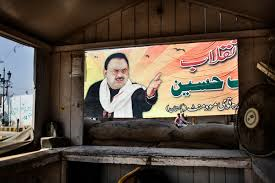
From there, he holds court, addressing his faraway followers in a vigorous, sometimes maniacal style, punctuated by jabbing gestures and hectoring outbursts. Occasionally he bursts into song, or tears. Yet, on the other end of the line, it is not unusual to find tens of thousands of people crowded into a Karachi street, listening raptly before an empty stage containing Mr. Hussain’s portrait, as his disembodied voice booms from speakers.
“The cult of personality surrounding Altaf Hussain is quite extraordinary,” said Farzana Shaikh, an academic and the author of “Making Sense of Pakistan.” “He is immensely charismatic, in the way one thinks of the great fascist leaders of the 20th century.”
In Karachi, his overwhelmingly middle-class party is fronted by sharply dressed, well-spoken men — and a good number of women — and it has won a reputation for efficient city administration. But beneath the surface, its mandate is backed by armed gangs involved in racketeering, abduction and the targeted killings of ethnic and political rivals, the police and diplomats say.
Other major Pakistani parties indulge in similar behavior, but the Muttahida Qaumi Movement frequently brings the most muscle to the fight. An American diplomatic cable from 2008 titled “Gangs of Karachi,” which was published by WikiLeaks, cited estimates that the party had an active militia of 10,000 gunmen, with an additional 25,000 in reserve — a larger force, the dispatch notes, than the city police.
Many journalists who have criticized the party have been beaten, or worse, driving most of the news media in Karachi to tread lightly. In June, the Committee to Protect Journalists, a lobbying group based in New York, accused the party of organizing the killing of Wali Khan Babar, a television reporter.
In the West, the party has avoided critical attention partly because it has cast itself as an enemy of Islamist militancy. In 2001, Mr. Hussain wrote a letter to Prime Minister Tony Blair of Britain, offering to help Britain set up a spy network against the Taliban.
Critics of the party have frequently questioned the role of British officials in facilitating its unusual system of governance. Pakistani exiles from Baluchistan, also accused of fomenting violence, have faced criminal prosecution. But Britain is not the only node of Mr. Hussain’s international support network.
Through the Pakistani diaspora, the Muttahida Qaumi Movement has active branches as far afield as the United States, Canada and even South Africa, which has become an important financial hub and a haven for the group’s enforcers, Pakistani investigators say.
Two police interrogation reports obtained by The New York Times cite militants from the movement who say they traveled to South Africa in between carrying out political assassinations in Karachi. One of those men, Teddy Qamar, confessed to 58 killings between 2006 and 2012, the police say. In an interview, Anis Hasan, the party’s joint organizer for South Africa, denied any link to organized violence.
But if Mr. Hussain seemed immune to scrutiny at his London stronghold, his luck started to turn in September 2010 after Imran Farooq, a once-influential leader in the movement who had split from the party, was stabbed to death near his house in Edgware.
Soon after, Mr. Hussain appeared on television, mourning Mr. Farooq with a flood of tears. But over the past year, the police investigation has turned sharply in his direction.
In December, officers from Scotland Yard’s Counter Terrorism Command searched the movement’s London office. Then in June they went to Mr. Hussain’s home and arrested Ishtiaq Hussain, his cousin and personal assistant, who is now out on bail. The police impounded $600,000 in cash and some jewelry under laws that target the proceeds of crime.
Mr. Hussain was not available for an interview, his party said. But a senior party official, Nadeem Nusrat, speaking at the movement’s London office, denied any link to Mr. Farooq’s killing. “Our conscience is clear,” Mr. Nusrat said. “We have nothing to do with it.”
Mr. Nusrat said the impounded money had come from political donations. And he rejected accusations, also the subject of a police inquiry, that Mr. Hussain has directly threatened political rivals, in some instances by warning that he would arrange for their “body bags.”
“It’s all taken out of context,” Mr. Nusrat said.
Mr. Hussain has receded from public view during the recent furor. There have been rumors about mounting health problems, which Mr. Hussain’s aides deny. But he cannot return to Pakistan, they say, because the Taliban could kill him. “In Pakistan,” said Muhammad Anwar, a longtime aide, “nobody can guarantee your life.”
Then there are the legal threats: over the years, dozens of murder charges have been lodged against Mr. Hussain in Pakistan, although some have been quashed in court. A more pressing question, perhaps, concerns the impact on the streets of Karachi if Mr. Hussain is forced to step down.
Some fear that without his guiding hand, tensions within the movement could split it into hostile factions — a frightening prospect in a city where political violence already claims hundreds of lives a year.
“However viciously the party conducts itself, there is an order within the apparent disorder,” said Ms. Shaikh, the academic.
Even if the British government wished to crack down on Mr. Hussain, she added, it might find itself subject to appeals from the Pakistani authorities. “The fear of Karachi going up in flames is so great,” Ms. Shaikh said, “that no government can take that risk, as long as Altaf Hussain is alive.”
General Officer Commanding Swat, Maj Gen. Sanaullah NIazi (Credit: tribune.com.pk)
Speaking as we would expect from an army chief, Chief of Army Staff (COAS) General Ashfaq Parvez Kayani has said the military would not allow terrorists to ‘coerce’ the government or people into talks, and that the army had the capability of taking the war to them. General Kayani’s strong words reflect public outrage and national revulsion over Taliban attacks that left at least eight security personnel dead within the past 48 hours. The most senior officer among them was the General-Officer-Commanding Swat, Major General Sanaullah Niazi, whose vehicle was hit by an improvised explosive device in Upper Dir. A lieutenant colonel was also killed in the attack. The army chief stressed the armed services had the ‘ability and will’ to take the battle to the terrorists and would not allow these elements to take advantage of a quest for peace.
Any talks with terrorists must take place from a powerful position; the government must not appear to be cowering before them.
Certainly, this is what seems to be happening now. Following the call by an All Parties Conference to pursue a course of dialogue to solve security issues, the Tehreek-e-Taliban Pakistan has put out a set of demands which include a troop withdrawal from tribal areas and the release of all Taliban prisoners. At the same time they seem to be bent on continuing their war against the state. Dealing with a force that speaks from a perceived position of strength by accepting any of its terms or even hinting this could happen would be a disaster; quite possibly a fatal one. No state can afford to allow itself to be weakened in this fashion.
General Kayani, whose primary role, of course, is to defend the nation, has done well to speak out forcefully. His words act as a reminder of the act of folly that political players may have been moving towards. Any talks with terrorists must take place from a powerful position; the government must not appear to be cowering before them — and the army chief’s expression of a full readiness to take them on is reassuring given the developments of the past few days and the farcical terms put down by the TTP for talks, which more and more people of rationality believe it would be foolish to attempt to pursue, at least, at the present point in time.
Eid security (Credit: thenews.com.pk)Islamabad, Aug 8: The Islamabad Capital Territory (ICT) Police have finalised a comprehensive security and patrolling plan on the eve of Eidul Fitr and also augmented the security at public places, worship places and other important buildings to thwart any untoward incident, a police spokesman said.
IGP Islamabad Sikandar Hayat has directed all officials to remain on high alert and fully prepared during Eid days. As per security plan chalked out by SSP Islamabad Muhammad Rizwan, more than 2,500 policemen would perform security duties. Patrolling would be made in various sectors to check possible house burglaries during Eid holidays. However, people have also been appealed to inform relevant police stations before their departure to native areas.
Eid prayers will be offered at 507 places in Islamabad including Masajid, Imambargahs and open places which will be covered by armed guards and policemen. Four SPs, nine ASPs/DSPs, 17 Inspectors will overall look after security arrangements in their respective jurisdictions.
Special Quick Response Force (QRF) teams have been constituted for immediate assistance to citizens while vehicles, earlier serving with various squads, will be on patrolling duty to ensure vigilance during Eid days.
Falcon squads and police commandos including contingents of lady police will also patrol in the city to ensure sense of complete security to citizens on Eid occasion.
According to the plan, policemen would also patrol in the various sectors and police in charges of circles would ensure proper security at the Eid congregations in various locations.
Superintendents of Police (SPs) will conduct checking of security and patrolling duties in their respective areas and to ensure coordination among all the mobile police teams.
More than 140 policemen lead by two SPs, two ASP/DSP, four Inspectors would be only deputed for the security at Faisal Mosque on Eid day while walk through gates and scanners would be installed as a part of security measure.
Sub-Divisional Police Officers and Station House Officers would be responsible of the security around worship places. They may be provided additional force on their request for the effective patrolling and security at Eid congregations in various sectors.
Duty rosters have been prepared by the in charges of police stations and policemen would patrol in various sectors during day and night timings to ensure protection to properties during Eid holidays.
The mobile officers and police guard posted at Mosques, Imambargahs, public/picnic places will take notice of the beggars hovering around the premises and will take legal action against them.
Special focus is to ensure safety to properties and stop incidents of theft and car-lifting during Eid holidays. As a part of security measures, police pickets would be erected at all important entry and exit points for checking of vehicles and SPs of each Zone will visit these points to brief the deployed cops about effective checking and security.
The mobile patrols and squads of Islamabad Traffic Police would also remain present in markets, shopping plazas and at prominent points during Eid congregations. Bomb disposal squad will remain available at short notice and all public places, parks, play grounds will be kept under strict vigilance and security cover.
Islamabad Traffic Police (ITP) on special directions of SSP (Traffic) Dr. Moeen Masood has made a special plan and 250 traffic personnel will be deputed at various locations lead by SP, three DSPs and 9 Inspectors. Traffic deployment in shopping areas, markets will be augmented while the patrol cars and pairs will patrol in their respective areas to facilitate the general public.
KARACHI, Aug 1: Mamnoon Hussain, president elect of Pakistan, told the BBC Urdu website that political parties were backing groups of criminals, land-grabbers, and extortionists and that this fact had been highlighted in various decisions of the courts.
In his first interview after getting elected as the 12th president of Pakistan, the Karachi-based senior politician said that whenever he thinks of resolving the law and order issue of Pakistan his mind comes to Karachi first adding that he was well aware of the practical situation in the city.
Elaborating further on the topic he said that Karachi would have to be given special attention as it was the driving force of the entire country and that the city was vital to the country not just from the economic aspect but from every angle.
Talking about the deteriorating law and order situation of Karachi Hussain said that full fledged action to eradicate crime was not taken in the past as the criminals, land-grabbers, and extortionists had the backing of political parties and that this fact had been mentioned in various court verdicts.
He added that the situation could not improve until the practice was ended and criminal elements were brought to justice.
Hussain said that there was need for intelligence agencies to come together under one platform and for political parties to stop backing criminals.
Reminiscing about Agra the president elect said that if the Pakistan Muslim League – Nawaz (PML-N) government initiated peace talks with neighbouring India, he wished to be part of the process and hoped to play a role in this regards, as Agra was his birthplace.
He further said that he wished to visit Agra, especially, to see the Taj Mahal.
Mamnoon Hussain was born in India’s Agra city on 1940 and he migrated from India with his family to Pakistan during the 1947 partition of the sub-continent.
KARACHI, Pakistan — Usman, who limps on a leg bowed by the polio he caught as a child, made sure that his first three children were protected from the disease, but he turned away vaccinators when his youngest was born.
He was furious that the Central Intelligence Agency, in its hunt for Osama bin Laden, had staged a fake vaccination campaign, and infuriated by American drone strikes, one of which, he said, had struck the son of a man he knew, blowing off his head. He had come to see the war on polio, the longest, most expensive disease eradication effort in history, as a Western plot.
In January, his 2-year-old son, Musharaf, became the first child worldwide to be crippled by polio this year.
“I know now I made a mistake,” said Usman, 32, who, like many in his Pashtun tribe, uses only one name. “But you Americans have caused pain in my community. Americans pay for the polio campaign, and that’s good. But you abused a humanitarian mission for a military purpose.”
Anger like his over American foreign policy has led to a disastrous setback for the global effort against polio. In December, nine vaccinators were shot dead here, and two Taliban commanders banned vaccination in their areas, saying the vaccinations could resume only if drone strikes ended. In January, 10 vaccinators were killed in Nigeria’s Muslim-dominated north.
Since then, there have been isolated killings — of an activist, a police officer and vaccinators — each of which has temporarily halted the campaign.
The war on polio, which costs $1 billion a year and is expected to take at least five more years, hangs in the balance. When it began 25 years ago, 350,000 people a year, mostly children, were paralyzed. Last year, fewer than 250 were, and only three countries — Afghanistan, Nigeria and Pakistan — have never halted its spread at any point.
While some experts fear the killings will devastate the effort here, Pakistan’s government insists that they will not, and has taken steps to ensure that. Vaccinators’ pay was raised to $5 a day in the most dangerous areas, police and army escorts were increased and control rooms were created to speed crisis responses.
But the real urgency to finish the job began earlier, for a very different reason. Two years ago, India, Pakistan’s rival in everything from nuclear weapons to cricket, eliminated polio.
“Nothing wounded our pride as much as that,” said Dr. Zulfiqar A. Bhutta, a vaccine expert at Aga Khan University’s medical school.
Bill Gates, who is the campaign’s largest private donor and calls beating the disease “the big thing I spend the majority of my time on,” said that Pakistan’s desire to not be further humiliated “is our biggest asset.”
After India’s success and hints from the World Health Organization that it might issue travel warnings, Pakistan’s government went on an emergency footing. A cabinet-level “polio cell” was created. Vaccinators’ routine pay doubled to $2.50. More than 1,000 “mobilizers” were hired to visit schools and mosques to counter the ever-swirling rumors that the vaccine contained pork, birth control hormones or H.I.V., the virus that causes AIDS.
Mullahs were courted to endorse vaccination. They issued 24 fatwas, and glossy booklets of their directives were printed for vaccinators to carry.
Perhaps most important, local command was given to deputy commissioners, who have police powers that health officials lack.
Pakistan is closer than ever. Although cases will not peak until after the summer monsoons, there have been only 21 so far this year. A few years ago, 39 substrains of the polio virus circulated; now only two do. About 300,000 children live in areas too dangerous for vaccinators, but almost all the sewage samples from those areas are clear of the virus.
Ultimately, though, success will depend on more than political will and the rivalry with India. In the wake of the recent killings, it will rely most of all on individual acts of courage, like those by prominent imams who pose for pictures as they vaccinate children.
Or by Usman, who appeared with his polio-stricken son, Musharaf, in a fund-raising video asking rich Persian Gulf nations to buy vaccines for poor Muslims elsewhere.
Or by volunteers, like the women of the Bibi family, in Karachi, who formed a vaccination team. Two of them, Madiha, 18, and Fahmida, 46, were gunned down in December. Television news showed female relatives keening over their bodies. Not only are those women still vaccinating, but Madiha’s 15-year-old sister also volunteered for her spot.
“All the children of Pakistan are our children,” said Gulnaz Shirazee, 31, who leads the team. “It’s up to us to eradicate polio. We can’t stop. If we’re too afraid, then who will do it?”
A Moving Target
If there is one spot on earth where polio may make its last stand, it is a cramped slum called Shaheen Muslim Town No. 1 in Peshawar, a hotbed of anti-Western militancy. Since sampling began, its sewers have never tested negative for the virus.
It is a neighborhood of migrant Pashtun families who rent rooms briefly and move on, looking for menial jobs picking fruit or making bricks. On a recent sunny afternoon, its alleys were full of carts drawn by donkeys whose faces were decorated with the red prints of hands dipped in henna. Many women wore the full burqa popular in Afghanistan.
In this part of the world, virtually all those with polio are from the Pashtun tribe, in which resistance to vaccination is highest. It is Afghanistan’s largest ethnic group and the wellspring of the Taliban, but a minority in Pakistan. Pakistani Army sweeps and American drone strikes have driven many Pashtuns from their mountain valleys into crowded cities.
Peshawar worries even Dr. Elias Durry, a normally optimistic polio specialist with the W.H.O. “You can get 90 percent vaccine coverage, and come back a few months later, and it’s 50 percent,” he said. “People just move so quickly.”
Shaheen’s sewers are concrete trenches about a foot deep, into which wastewater, rendered milky white by dish soap, flows from pipes exiting mud-brick houses. A child reaching into one for a stick to play with showed how easily the virus, carried in fecal matter, could spread.
Though the area has clean water from a well, the steel pipe it flows through at times dips inside the sewerage trench. It has dents where trucks have banged it, and it is pierced by connectors, some attached just to rubber hoses.
“Piped water with sewage mixed in is worse than no piped water,” said Dr. Bhutta of Aga Khan. “Sometimes rural populations have it better. They carry water from the river, and they defecate in open fields, so there’s no mixing.”
Pakistani children suffer diarrhea so often that half the country’s young are stunted by it. Polio immunity is low, even in vaccinated children, because other viruses crowd the gut receptors to which the vaccine should attach.
At the clinic in Shaheen, the doctor running the polio drive, an ophthalmologist, complained that he got too little police help.
“I have 28 teams, so I requested 56 constables,” he said. “I was given 12.”
He said the underpaid officers inevitably knocked off at midday because their station house serves a hot meal.
The same problem was echoed in Gadap Town, a Karachi neighborhood where vaccinators were killed in December. As a team worked its way from house to house with a reporter, it had every reason to feel secure: because the visit was arranged by an official, six officers with AK-47s came along.
But another team passing by was guarded only by an aged sergeant with a cudgel.
“Yes, we have a security problem,” Dr. Syed Ali, a local official, said quietly on a side street. “What is a stick in front of a gun?”
The isolation and poverty of the Pashtun tribe underlie its resistance. Many of its imams are from Islam’s fundamentalist Deobandi sect, which emerged in the 19th century as a reaction to the British conquest.
Many Pashtun neighborhoods receive few government services like health clinics, paved streets or garbage pickup, but get shiny new billboards trumpeting the polio fight paid for by Western donors.
“People tell us, ‘We need schools, we need roads, we need housing, and all you bring our children is polio, polio, polio,’ ” said Madiha, a black-veiled Gadap vaccinator.
In the middle of last year, it became known that in 2011, the C.I.A. had paid a local doctor to try to get DNA samples from children inside an Abbottabad compound to prove they were related to Bin Laden.
Even though the doctor, Shakil Afridi, who is now serving a 33-year sentence for treason, was offering a hepatitis vaccine, anger turned against polio drops.
Leaders of the polio eradication effort could not have been more frustrated. They were already fighting new rumors that vaccinators were helping set drone targets because they have practices like marking homes with chalk so that follow-up teams can find them. Now, after years of reassuring nervous families that the teams were not part of a C.I.A. plot, here was proof that one was.
“It was a huge, stupid mistake,” Dr. Bhutta said.
Anger deepened when American lawmakers called Dr. Afridi a hero and threatened to cut off aid if he was not released. The W.H.O. and the Unicef, afraid of offending the United States, did not protest publicly. Unicef’s executive director, Anthony Lake, is a former White House national security adviser, which put the agency in an awkward position, an agency official said on the condition of anonymity because of the sensitivity of the issue.
But the deans of a dozen top American public health universities wrote a letter of protest to the Obama administration. Mr. Gates said he endorsed it, though he was not asked to sign. He also said he discussed the issue with Tom Donilon, the former national security adviser, though he would not give details of the conversation.
Fistfuls of Rupees
New opposition has forced the adoption of new ground tactics.
Dr. Qazi Jan Muhammad, the former deputy commissioner of Karachi East, called his approach “a mix of carrots and sticks.”
Whole apartment buildings were missed, he discovered, because Pashtun watchmen were shooing away vaccinators.
“I had the police tell them: ‘Either you let them in, or you go behind bars,’ ” he said.
He had traffic circles blocked so teams could approach each car, and he led some teams himself holding fistfuls of rupees, worth about a penny each.
“I saw a girl, about 11, carrying her 2-year-old sister,” he said. “I gave her a 10-rupee note and said, ‘Will you allow me to give drops to your sister? You can get sweets for yourself.’ ”
“She told all the children, ‘A man is giving away 10 rupees,’ and they all came rushing. I vaccinated 400 kids for only 4,000 rupees.”
The sewers of his district, which has several million inhabitants, are now virus-free.
At the Front Lines Again
The country’s new determination has also brought Rotary International back to the front lines.
The club, founded in Chicago in 1905, started the global polio eradication drive in 1988. It has had chapters in what is now Pakistan since 1927, and is now led by Aziz Memon, a hard-driving textile magnate.
Mr. Memon, 70, and other Rotary-affiliated executives have used their money and political connections to keep the pressure on. They compensated the killed vaccinators’ relatives and held news conferences at which the families urged others to continue fighting.
Rotarians also work in places that terrify government officials. In an industrial neighborhood in Karachi, where both gangs and the Taliban hold sway after dark, Abdul Waheed Khan oversaw a Rotary polio clinic in his school, Naunehal Academy. A big, gregarious man, he angered the Taliban by admitting girls to his academy and offering a liberal arts education instead of only Koran study. His only security was local teenagers who ride motorcycles beside his car to keep anyone from pulling up alongside.
In March, he hosted Dr. Robert S. Scott, the 79-year-old Canadian chairman of Rotary’s polio committee, who flew in to vaccinate children to prove that the fight would go on despite the December killings.
“I had a fatwa put on my head,” Mr. Khan said in April as he led a tour of the clinic. “They said I was Jewish. I had a friend issue a counter-fatwa saying I was a good Muslim.”
On May 13, Mr. Khan was killed by gunmen who also wounded his 1-year-old daughter.
His clinic will not close. “No one can replace Waheed, but life has to go on,” Mr. Memon said.
‘This Is Good Work’
Rotary also sponsors a tactic used to reach children from areas too dangerous for home visits: “transit point” vaccinating.
At a tollbooth on the highway into Karachi, Ghulam Jilani’s team takes advantage of an army checkpoint. As soldiers stop each bus to search for guns, Rotary vaccinators hop aboard. On a typical day, they reach 800 children.
Yes, Mr. Jilani said, the soldiers’ presence may intimidate some resistant families into complying. Also, he added brightly: “We scare them a little. We say, ‘You are entering a city with the disease. Don’t you want your children safe?’ ”
About 90 percent comply, he said, sometimes after a public argument between a father who believes the rumors and a mother, outside their home and at times backed by other women on the bus, insisting the children be protected.
Near the Afghan frontier, where thousands of children live in valleys under Taliban control, teams do the same at military roadblocks. At hospitals, which are usually guarded by soldiers, nurses will pack extra doses of the vaccine on ice for families willing to smuggle it to neighbors.
Some frontier clan chiefs have lost their government stipends for opposing vaccination, and officials have threatened to deny national identity cards to their clans. But the chiefs are in a bind; the Taliban have assassinated many for cooperating with the government.
Mr. Memon of Rotary opposes what he called “these coercive gimmicks.”
“We can’t twist arms,” he said. “We want to win them over with love and affection.”
Among hundreds of men wearing turbans and topees at Karachi’s main train station, Muhammad Arshad stood out in his blue baseball cap with Rotary’s bright yellow gearwheel.
Threading his way through the crowd squatting on Platform 1, he picked out children under age 5.
“What a nice boy,” he said to Sohail Ameer, chucking his infant, Abadur Rahann, under the chin. “May I give him drops against polio?”
Mr. Ameer agreed, and it was over in seconds. Abadur looked nervous, but he did not howl and squirm like some.
After the December killings, Mr. Arshad worried briefly, he said. “But then I thought: This is good work, and God will protect me.”
Friendly strangers came up to the Rotary table to suggest he play it safe and quit. He replied that the railroad police would protect him.
His wife tried the hardest.
“But I told her,” he said. “If a man has to die, he can die even at home. I’m going back to work.”