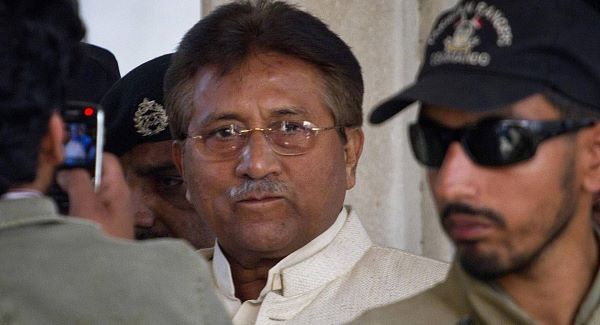
As Pakistanis head to the polls for general elections on May 11, something to watch among top candidates for prime minister is how they position themselves in relation to Pakistan’s powerful military establishment. The military has essentially ruled the country for more than half of the country’s 66 years. This election marks the first transfer of power from one government to another without any military interference.
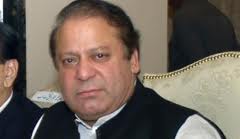
Nawaz Sharif is considered the front-runner to become Pakistan’s next prime minister.
Mr. Sharif, a business magnate, jumped into politics as a protégé of the military dictator Gen. Zia-ul-Haq during the 1980s, after the Sharif family lost much of their business under the nationalization policy of the previous civilian government.
While he was Pakistan’s prime minister from 1990 until 1993 he was popularly known for his economic liberalization policies. After taking office again in 1997 his government was upended in a coup in 1999 when Sharif tried to remove the army chief, Pervez Musharraf, from office.
He was tried on terrorism and corruption charges in a military court and given a life sentence. But Saudi Arabia, where his family did significant business, came to his rescue. And under an agreement with the Saudi government, Sharif was exiled from the country.
He returned to Pakistan in 2007 to participate in the last elections, this time as a heavy critic of the military that once brought him to power. His party, Pakistan Muslim League (PML-N), a center-right, pro-business party, came into power in Punjab Province under his leadership.
Sharif continues to run the family steel business, making his family one of the wealthiest in the country, and favored among business elites.
He’s been long criticized for suspected covert support of Islamic extremist groups like Lashkar-e-Jhangvi, which has links with Al Qaeda and is headquartered in Punjab. Sharif’s party denies alliance with extremists; however, while the Pakistani Taliban have pledged to attack the Awami National Party (ANP), the Pakistan People’s Party (PPP), and the liberal Muttahida Quami Movement (MQM) parties, no extremist groups have threatened to disrupt campaigning by the PML-N or Sharif.
He promises to take Pakistan out of many challenging crisis, including bringing an end to crippling power shortages, improving law and order, and reviving the economy. No one is quite sure how many seats his party will win, but analysts say he may have to form a coalition. Still, unlike the PPP-led government which just left office, A Sharif government is likely to be more proactive in responding to issues, and thus more popular.
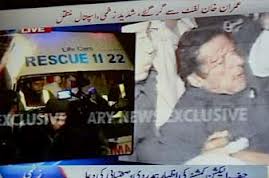
On Wednesday, doctors at the hospital where the 60-year-old was being treated said the leader of the Pakistan Tehreek-e-Insaf party (PTI) would have to remain in bed for several days to come after falling 4.5 metres (15 ft) from a makeshift lift and damaging his back.
His campaign was supposed to end with a final rally of supporters on Thursday, with polling then taking place on Saturday.
Khan, who sustained three fractured vertebrae and a broken rib, is now unlikely to take part and has ruled out going to vote in his home constituency of Mianwali, in north-west Punjab.
Faisal Sultan, his doctor, said the politician would recover if allowed to rest. He said: “The most important and reassuring thing is that the spinal canal is intact and Mr Khan is in full control of his limbs and body functions. There was no neurological compromise.”
Khan has benefited from a wave of public concern and sympathy from supporters and opponents alike, with other leading parties cancelling many campaign events on Wednesday.
The PTI has turned an interview recorded with Khan as he lay in a neck brace in a hospital bed just hours after the accident into a party political broadcast repeatedly aired by various TV channels.
The shaken looking Khan said it was up to voters to elect leaders “in the name of ideology” rather than on the basis of personality, adding: “I have done whatever I could do. Now you have to decide whether you want to make a new Pakistan.”
Mohammad Malick, a prominent journalist, said the images in the broadcast would more than compensate for the loss of time on the campaign trail. “This really resonates because people like the image of a fighter, of a warrior,” he said. “He took this terrible fall and he’s recovering quickly – that is a powerful image.”
Malick said it could also help boost voter turnout, which analysts believe will benefit Khan more than the frontrunner, Nawaz Sharif, the head of his faction of the Pakistan Muslim League (PML-N).
A poll published by the political magazine Herald on Wednesday showed the PTI and PML-N were virtually tied, with the latter leading by less than a percentage point among the 1,285 people surveyed.
Khan’s frenetic campaigning in recent weeks, which has seen him do as many as four rallies a day, appears to have galvanised the public and given the PTI momentum.
But because of the first-past-the-post, constituency-based system used in Pakistan, it is possible that Khan will win many more votes than seats. Most analysts anticipate a hung parliament, with the former cricketer turned politician holding the balance of power or leading the opposition.
Khan has in the past insisted he would never enter into a coalition with either the PML-N or the Pakistan Peoples party (PPP), which has been in power for five years.
“We are in totally uncharted waters,” said Malick. “He could get maybe between 40 to 50 seats, but we just don’t know.”
Governments require 172 seats to form a majority in parliament.
In an interview to a local television station, Khan revealed that his injuries could have been worse if he had not been wearing a bulletproof jacked under his shirt, which doctors believe protected his spine.
Pictures that have emerged of the incident show a man in a black T-shirt appeared to have accidentally pushed Khan, who lost his balance and fell to the ground along with at least three of his aides.
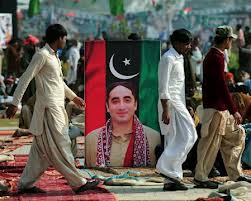
Bilawal on campaign trail (Credit: dailystar.com.lb)
THE battle lines have been drawn as polling day closes in. The outcome of these elections, now less than a week away, is perhaps the most difficult to predict since the 1970s. There may be many surprises waiting as the battle at the hustings intensifies.
It is no more a traditional fight for the crown between the two long-term rivals, the PPP and PML-N. The meteoric rise of the Pakistan Tehreek-i-Insaf (PTI) has completely changed the country’s electoral scene. A quintessential outsider is now challenging the domination of the two established parties.
Seemingly, the elections have essentially become a contest between the PML-N and PTI with the region along the Grand Trunk Road in the Punjab becoming the main battleground. Various opinion polls vindicate the widespread perception.
While the two front runners are jostling it out, the PPP seems to be out of breath. Its lacklustre election campaign does not give much hope to party loyalists. Is this the twilight moment for the party which has been at Pakistan’s political centre stage since its inception some four decades ago? Maybe, or not as yet. But the decline of the PPP’s political base is shocking.
Leaderless and rudderless sums up the current state of the PPP, as it struggles to stay in the critical race. There are no big election rallies nor is there any central leader to galvanise the electorate. For the first time, the party has gone into the election campaign without a Bhutto to lead it. Therefore there is no Bhutto charisma to revive the party’s fast-diminishing populist credibility.
Not only was Benazir Bhutto there to start the party’s 2008 election campaign, her assassination drew sympathy votes bringing back the party to power after a hiatus of 11 years. But now a critical peg to hang on to and a fight-back to regain the ground lost during its not so enviable five-year term in office appear to be missing. The party’s TV campaign advertisements reflect its desperation to clutch on to the past and resort to the politics of martyrdom.
It is largely a negative campaign targeting the past record of the PML-N. There is nothing about its own performance or what the party will offer to the electorate in the future. This illustrates the defeatist mindset of a party that is unable to defend its incompetence and corruption-ridden rule. It is a sad commentary on the state of what was once the most formidable political force in the country.
Over the past 40 years, the PPP went through many ups and downs, but it has never seen its fortunes plummeting so rapidly. It is a party now trying to live off its past without any hope for the future. One of the greatest assets of the party that kept it alive through the worst of times was its contact with the masses. That seems to have been completely lost due to the party’s new ethos of political wheeling and dealing and buying loyalties.
Not surprisingly, this new political culture is manifested in the emergence of people of the ilk of Manzoor Wattoo, Anwar Saifullah, Faryal Talpur and Owais Muzaffar ‘Tappi’ as the faces of the party. The jiyalas have long disappeared, leaving the party soulless.
The attempt to launch Bilawal Bhutto Zardari to infuse some life into the party’s dead election campaign seems to have failed because of his reported falling out with his father and paternal aunt. In any case it would have been very difficult for an untested young man with little understanding of the realities and complexities of the country’s politics to boost the flagging morale of the party and to win votes.
For long, the party’s support base in the urban areas particularly in Punjab has been shrinking, but it now seems to be heading to an expulsion there with the PTI and PML-N now fighting for the urban middle-class votes. The party’s only hope is to scavenge some seats because of the divided votes between the two main contestants.
The PPP has largely become a rural-based party with its support mainly concentrated in feudal-dominated Sindh and south Punjab. Yet, it seems hard to predict whether it can maintain its hold in those regions too in the elections. While the party is most likely to retain its domination in Sindh, it may not get the same margin of victory. The failure of the PPP government to deliver on its promises to its constituents has also eroded the party’s vote bank in its stronghold.
Having said that, the PPP may be down but it is certainly not completely out of the race. Even with a far fewer number of seats, the party will remain relevant in an expectedly fragmented house, though it is likely to not be in a position to lead the coalition.
In a scenario where the PTI gets close to the number of seats as the PML-N, it would become much more difficult to form a viable and effective coalition government. In a hung parliament the PPP with its majority in the Senate will hold the balance.
But the real issue is whether a rudderless PPP with a declining mass base is able to emerge united after a possible electoral setback or whether the situation would lead to the complete unravelling of a party that still claims to espouse liberal credentials.
The May 11 elections are indeed important for the party, but a more critical issue is whether it can ever regain its lost mass base. This is only possible if the party reforms itself in a changed political, social and cultural environment. It is certainly an uphill task for a party that depends on its past and does not seem to be looking towards the future.
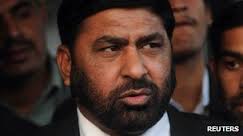
MULTAN, Pakistan, May 3 — Gunmen on Friday killed a Pakistani prosecutor who had been investigating the murder of former Prime Minister Benazir Bhutto and the 2008 Mumbai attacks.
Assailants opened fire on the prosecutor, Chaudhry Zulfikar Ali, as he drove to work from his home in a suburb of the capital, Islamabad, for a court hearing in which the former military leader, Pervez Musharraf, faces charges in relation to Ms. Bhutto’s death in 2007.
The police said that gunmen traveling by motorbike and in a taxi sprayed Mr. Ali’s car with bullets, lightly wounding his bodyguard and killing a woman who was passing by when his car veered out of control. Television footage from the scene showed a bullet-riddled vehicle crashed by the roadside.
Mr. Ali died before he reached a hospital in Islamabad, where a doctor said he had been shot 13 times. The police said that Mr. Ali’s bodyguard returned fire and managed to wound one of the attackers. The police are searching for the attackers, all of whom escaped.
There was no immediate claim of responsibility for the attack, and the police said it was too early to comment on a possible motive. But few doubted that it was linked to Mr. Ali’s work as a state prosecutor in some of the most sensitive cases in the country, and his death reinforced the vulnerability of senior government officials who challenge Islamist militants and other powerful interests.
Mr. Ali represented the Federal Investigation Agency, which has implicated Mr. Musharraf in the death of Ms. Bhutto, who was assassinated in December 2007, just before the last election.
After the previous hearing in the Bhutto case on April 30, Mr. Ali told reporters he had “solid evidence” that connected Mr. Musharraf with Ms. Bhutto’s death.
Prosecutors and Bhutto supporters accuse Mr. Musharraf of failing to provide adequate security to Ms. Bhutto after her return from exile in October 2007. Mr. Musharraf has denied those accusations.
Since Mr. Musharraf’s return from exile in March, investigators have questioned him about the security arrangements for Ms. Bhutto in 2007. He insisted that, as head of state, he was not involved in administrative matters such as security arrangements.
Mr. Ali was also involved in another sensitive case: the trial of seven people from the militant group Lashkar-e-Taiba charged with involvement in the attacks in Mumbai, India, in November 2008, which killed more than 160 people.
Seven Lashkar activists have been on trial since 2009, accused of orchestrating the slaughter from Pakistan, and one of the defendants is the group’s operational leader, Zaki ur-Rehman Lakhvi. But the hearings have been characterized by opacity and a lethargic pace.
The trial is taking place at Adila jail in Rawalpindi, ostensibly on security grounds, and the news media are barred from proceedings. Hearings have been repeatedly adjourned because of the absence of lawyers or the presiding judge.
Currently, defense lawyers are cross-examining the prosecution witnesses. Mr. Ali was scheduled to appear in court on Saturday in relation to the case.
Lashkar-e-Taiba was founded with help from the Inter-Services Intelligence Directorate, Pakistan’s spy agency, in the 1990s, and its presumed leader, Hafiz Muhammad Saeed, lives openly in the eastern city of Lahore. The spy agency says it has cut all links with the group.
Mr. Ali’s death comes at a sensitive time, with Pakistanis scheduled to go to the polls for a general election on May 11. Campaigning has been marred by widespread Taliban violence against candidates from secular parties.
In the latest attack, gunmen shot dead a candidate from the secular Awami National Party, which has borne the brunt of attacks, along with his 6-year-old son, in the port city of Karachi on Friday.
Although Islamabad suffered a number of militant attacks in 2008 and 2009, it has escaped major violence in recent years. But several prominent figures have been assassinated on its streets, including the former governor of Punjab Province, Salman Taseeer, and a minister for religious affairs.
Mir Hazar Khan Khoso, the interim prime minister, addressed the nation Friday evening and reiterated his government’s resolve to hold free, fair, transparent and peaceful elections, and he said a special security cell had been established in the Interior Ministry to coordinate with the national election commission.
“This cell will collect intelligence reports and share it with provincial government and law enforcing agencies, and this cell is also empowered to take decisions for timely action if needed,” Mr. Khoso said. “All resources will be used to improve security of the sensitive polling stations and their effective monitoring,” he added.
Mr. Musharraf returned from exile with a plan to run for Parliament in a general election. He faces charges in several cases related to his time in power, including the murder of Ms. Bhutto, the killing of a Baloch nationalist leader, and the firing of senior judges.
Mr. Musharraf, a retired general, has been disqualified from contesting the election, and this week a court banned him from politics for life. He also faces possible treason charges.
In the court hearing in nearby Rawalpindi, lawyers for Mr. Musharraf argued that he should be exempted from appearing in person in the case, Pakistani television stations reported. The hearing was adjourned until May 14.
Salman Masood contributed reporting from Islamabad, Pakistan.
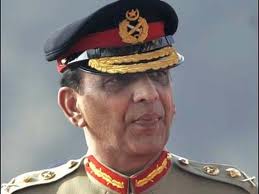
Army chief Gen. Ashfaque Pervaiz Kiyani (Credit topnews.in)
ISLAMABAD: Army chief Gen Ashfaq Parvez Kayani used the occasion of ‘Youm-i-Shuhada’ (martyrs’ day) to send more than one message to more than one audience.
Assuring everyone that the elections would be held on May 11, he tried to dispel the ever-circulating rumours about the postponement of elections.
He also made it clear that the war the army was fighting was Pakistan’s war and that the anti-democratic forces would never be acceptable, sending a message to all those watching the country’s battle with extremism and militants. And last but not least, he also indirectly expressed the military’s reservations about the treatment being meted out to his predecessor retired Gen Pervez Musharraf.
“Allah willing, general elections will be held in the country on 11th of May. We must not harbour any doubts or misgivings about it,” the army chief said while addressing a ceremony at the GHQ to mark the day.
“I assure you that we stand committed to wholeheartedly assist and support in the conduct of free, fair and peaceful elections; to the best of our capabilities and remaining within the confines of the constitution. I also assure you that this support shall solely be aimed at strengthening democracy and rule of law in the country,” he said.
Like every Pakistani, he said, Pakistan Army in its humble capacity, had endeavored to strengthen democracy in the past five years with the hope that the next elections would steer the country towards betterment.
“Now, once the destination is in sight we must not err in accomplishing our responsibilities towards the election process. We must never forget that success of any system resides in coming up to the aspirations of the masses. The success of democracy is intimately linked with the wellbeing and prosperity of the nation. The real virtue of democracy ultimately lies in the safety and welfare of the masses,” he said.
GOLDEN OPPORTUNITY: He termed the next elections “a golden opportunity” for the people that “can usher in an era of true democratic values in the country”.
In his indirect reference to the ongoing trial of former military ruler Musharraf, the army chief said: “In my opinion, it is not merely retribution, but awareness and participation of the masses that can truly end this game of hide and seek between democracy and dictatorship.”
Gen Kayani was of the view that if they succeeded in rising above all ethnic, linguistic and sectarian biases to vote solely on the basis of honesty, sincerity, merit and competence, “there would be no reason to fear dictatorship or to grudge the inadequacies of our present democratic system”.
“Our salvation resides in transforming the government into a true platform of public representation. This would come to pass once the construct of public representation in Pakistan is oriented towards affording primacy and precedence to larger public interest over personal interests. Otherwise, may it be democracy or dictatorship; governance would continue to remain a means of self-aggrandisement and that of plundering national wealth and resources,” he said.
According to the army chief, the conduct of elections is not an end in itself, “but is surely an important means towards delivering us from our present sufferings”.
He regretted that despite tremendous sacrifices, the dream of founding fathers under the leadership of Quaid-i-Azam and Allama Iqbal was yet to be realised. “Perhaps, we have either not discovered the correct path or have not remained steadfast in our journey. Yet the spirit of sacrifice and resilience of our nation remains undiminished.”
‘WAR ON TERROR’: Blaming “external enemies” for the menace of terrorism and extremism that had claimed thousands of lives in the country, the army chief criticised those busy in debating the causes and origin of the ‘war on terror’ — an apparent reference to certain political and religious groups accusing Gen Musharraf of bringing this war to the country’s soil.
“We cannot afford to confuse our soldiers and weaken their resolve with such misgivings,” he said, adding: “Considering this war against terrorism as the war of the armed forces alone can lead to chaos and disarray that we cannot afford.”He said the fact of the matter was that today it was Pakistan and its valiant people who were a target of this war and were suffering tremendously.
“I would like to ask all those who raise such questions that if a small faction wants to enforce its distorted ideology over the entire nation by taking up arms and for this purpose defies the Constitution of Pakistan and the democratic process and considers all forms of bloodshed justified, then does the fight against this enemy of the state constitute someone else’s war?”, he asked.
According to the COAS, even in the history of the best evolved democratic states, treason or seditious uprisings against the state have never been tolerated and in such struggles their armed forces have had unflinching support of the masses; questions about the ownership of such wars have never been raised.
Gen Kayani expressed the desire that all those who had “strayed and have picked up arms against the nation, return to the national fold”.
However, he said, this was only possible once “they unconditionally submit to the state, its constitution and the rule of law. There is no room for doubts when it comes to dealing with rebellion against the state.”
The army chief said the “nefarious designs of our enemy, may it be internal or external, will never succeed and we shall eventually prevail.”
He paid tribute to the 140 soldiers and officers who lost their lives in an avalanche in Gayari sector.
The event honoured the personnel of armed forces and police and the civilians killed by the terrorists and extremists.
Apart from the parents of martyred servicemen, sons of SP Syed Abdul Kalam and ANP leader Bashir Ahmed Bilour, who were killed in suicide attacks, and the children of slain journalist Nasrullah Khan Afridi also spoke.
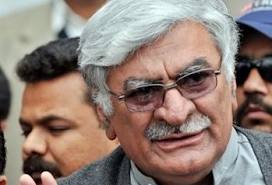
ANP president Asfandyar Wali Khan (Credit: pakistantoday.com.pk) The 2013 elections in Pakistan are critical for setting a clear goal post for the nation. However, the short time frame in which they are taking place has left the caretaker administration and security institutions scrambling to clean up a nation wracked by terrorism, poverty and inequality.
With the simmering insurgency on the Pak-Afghan border, the caretaker administration has tried to beef up security in the violence stricken areas of FATA, Khyber Pakhtunkhwa and Balochistan — as well as Karachi, where former incumbents from the secular PPP, ANP and MQM are under attack by a determined Taliban enemy.
But given that militants in Pakistan’s north have consistently targeted secular candidates, especially Awami National Party, while allowing rallies by Imran Khan’s Tehrik-i-Insaf, Jamiat-i-Ulema Islam (Fazlur Rehman group) and even the Pakistan Muslim League (N) — has led to questions about the outcome of the election.
In particular, civil society is questioning whether the relentlessness with which militants are killing secular incumbents and their supporters, while facilitating political parties who have a soft corner for them – will bring pro Taliban legislators into parliament.
In many areas of the KP and FATA, the poor security situation has already deprived incumbents from hoisting party flags or holding rallies. Apart from contesting as independents or putting up proxies, the ANP and PPP have not nominated candidates to many seats in Waziristan and the tribal belt bordering Afghanistan.
The anti US sentiment in Pakistan, accelerated by drone attacks and military operations… combined with increased poverty, income gap and poor governance, is a big factor that has caused the incumbents to lose ground among voters.
But the ANP – which lost many key leaders while stopping the onslaught of the Taliban in the last five years – has been worst hit. Its rallies have been repeatedly attacked and its rank and file killed and wounded across Pakistan. The party leadership has clearly spelled out the Tehrik-i-Taliban as the perpetrators. The TTP has also become the MQM’s worst enemy – kiling their candidates and attacking their election offices.
Time and again, the caretaker administration has taken note of the terrible security situation and beefed up security. The visible effects of greater law enforcement has been a drop off in mass terror attacks (like the one planned by the Lashkar-i-Jhangvi against Hazaras late April in Balochistan) and a slight drop off in violence in Karachi.
But it is a situation that has caused the PPP to hunker down and avoid public rallies. That is changing the face of the once populist party, which even refrained from kicking off its election campaign on April 4, the death anniversary of PPP founder, Prime Minister Zulfikar Ali Bhutto.
The election scenario does not look good for the Zardari led PPP, whose primary achievement seems to have been the completion of five years in power. To its detriment, the PPP government has left behind a nation that is hungrier, violent and more unstable — and still out of sync with the modern world.
Come May 11, voters across Pakistan will likely vote on the basis of feudal and tribal loyalties. Still, the government’s lack luster performance over the last five years is bound to cost them a big percentage of the votes.
This is bound to hurt the party even in its home turf in Sindh, where it is now pitted against all political forces that exercise influence in the province. The Pakistan Muslim League (N), joined by Pirs, tribal and feudal chiefs, religious parties and even nationalists have formed an anti PPP front that is almost reminiscent of the Islami Jamhoori Ittehad (IJI) — funded by the intelligence agencies in 1993 to prevent Benazir Bhutto from returning to power.
That is where the similarity ends.
Two decades ago, when Benazir led the PPP, her being a woman necessarily changed the party’s image. Keeping up the populism espoused by her father former Prime Minister Zulfikar Ali Bhutto, she led a party of the masses that touched on the promised goodness of the socialist rhetoric `roti, kapra, makan,’ (food, clothing and shelter) — even if it did not deliver. But the image of millions of people looking for change did not jive with the establishment — and contributed to her murder in 2007.
Thereafter, the default president, Asif Zardari — hands untied, amassed wealth and privileges for a coterie of supporters at the expense of the majority “have-nots.” He used the classic methods he knew of getting opponents out of the way — sweet talk and bribe.
The situation has not gone unnoticed by the Supreme Court, which recently moved against some of the political appointments made by the departing PPP government. The superior court has also moved against the “life time of perks and privileges” bestowed by the PPP’s departing prime minister to former government functionaries just before the National Assembly term concluded.
Come May 11, tribal loyalties and to some extent the background of the candidates will influence the results of elections in rural Sindh. In so doing, voters may still choose the lower middle class Sindhis from the PPP as opposed to larger feudals. Still, the situation remains dicey and not altogether in the PPP’s favor.
Midway between Karachi and Hyderabad, the coastal town of Thatta promises to be a test case in the electoral contest between the PPP – where the Shirazis and Malkanis (head of the tribal Jats) – have announced the withdrawal of support from the PPP to their own nominee. In so doing, they have put up their own candidate, Zardari’s nominee and a shadowy muscle man – Owais Muzzafar (Tappi) – accusing him of usurpation of lands and the promotion of a coastal town of Zulfikarabad, being opposed by the locals.
It has opened up the situation for an independent candidate for provincial assembly – Mohammed Ali Shah – to step into the election. Shah is president of the Pakistan Fisher folk Forum and espouses an idealistic program to fight for the rights of fisher folk as well as agricultural and livestock communities.
Shah, who opposes PPP’s Owais Muzzafar for provincial assembly, claims his candidature has caused the Thatta feudals to break away from their support for the PPP.
Whichever way the situation pans out, a sense of disillusionment with the incumbent parties as well as the existing culture of the provinces is bound to redraw its political scenario.
Till then, the candidates deserve a level playing field instead of the life and death threats they confront in their quest to represent the people.
Shahab Usto (Credit: tsj.com.pk)Leadership is all about coming up with the right answers to the fundamental questions that are related to the state and society; the rest is just fancy gimmickry and demagogy to woo the half-literate and gullible electorate.
The search for these answers has become all the more imperative as the parties are bracing for the ‘final’ round to ‘oust’ one another from the electoral arena or from the realm of probablity to form a government , though it remains to be seen how they are going to achieve their goal within the democratic parameters when none of the parties seems likely to achieve the required numbers in the elections to single-handledly form a government at Islamabad, if not in the provinces. Moreover, what alternative programme do they have that is going to salvage the country from the existing crises? Finally, do they really believe the problems lie only with bad governance, corruption etc ( as the PTI vehemently claims) and not with the fundamental national security and foreign policy paradigm, which has been jealously guarded by the establishment right from the beginning?
In addition to these queries, there are five questions of primal importance that the mainstream political contenders must answer on the eve of the elections if they have to steer the country out of the gathering storms.
First, how to forge a foreign policy that should pursue a peaceful resolution of bilateral and regional disputes without compromising on national interests, and more importantly, shunning the abstract non-state or meta-state strategic objectives?
This question arose on the very eve of the country’s creation. Kashmir and other disputes with India demanded that the state’s policies should strike a balance between social and security priorities. Unfortunately, that balance was never struck. Security trumped the social sector, sowing the seeds of both intra- and inter-national conflicts with or via India, which cost the country half its part and plunged it into regional and global conflagrations, particularly in the wake of the Soviet invasion of Afghanistan in 1979 and 9/11.
Secondly, how to drastically rehash the existing lopsided socio-economic order to change the pathetic social and economic realities faced by the millions of the dispossessed and marginalised masses? Again, this question has never been seriously addressed. Particularly after the perceived ‘failure’ of the PPP’s ‘socialist agenda’ and the tragic fall of Zulfikar Ali Bhutto, none of the political or military leaders has dared to go for a meaningful redistribution of wealth and resources. Instead, the fledgling trade unions and peasant movements were nipped in the bud by means of repressive laws and the coercive state machinery.
As a result, today on the one hand half of the population is illiterate, one-third ‘very poor’, one-fourth homeless and one-fifth unemployed, but on the other the country has seen over recent years an increasing monopolisation of industrial, financial and landed assets by a small group of political, business and bureaucratic interests. In fact, regardless of which political party is in power, the state continues to remain blindly wedded to this oligarchic neo-liberal economic model that has failed even in the west in the absence of state regulation.
De-politicisation by General Musharraf and the so-called political ‘reconciliation’ have further strengthened this oligarchic order. As a result, the weak and impoverished classes have been suffering at the hands of bad governance and rising cost of living but the rich and resourceful have been reaping the rewards of a lax fiscal regime, ineffectual accountability and an unbounded access to power.
Third, how to remove the ill will, acrimony between the powerful Centre and the smaller provinces and and the increasingly uncontrolable sectarian, ethnic and mafia-style violence within the society? This question continues to beg an answer notwithstanding the loss of the eastern wing in 1971, the recurring insurgencies in Balochistan, ethnic turf wars in Karachi, and the increasing demand for more linguistic provinces. Moreover, the recent constitutional reforms and devolution of powers to the provinces has made it incumbent upon the political (and military) leadership to evolve a consensus on maximum provincial autonomy. This question may seriously impinge upon the federation and security of the state. Already, the Centre-provinces relations, particularly with reference to Balochistan, are increasingly getting snarled up with the regional web of rivalries and proxy wars, further complicating the situation. Pakistan has repeatedly pointed to the ‘safe havens’ for insurgents in Afghanistan.
Fourth, how to stem and reverse the rising tide of sectarian and inter-religion conflicts that have traumatised society and turned the state into a pawn of regional and global jihadi and counter-jihadi wars? This question needs to be addressed politically and socially, i.e. by enforcing a stringent rule of law to develop a tolerant space for discourses among the representatives of various liberal, religious and sectarian schools. The purpose should be to help evolve an understanding on freedom of expression and respect for multi-scholastic views. So far, the mainstream leadership, both liberal and conservative, have failed to achieve it. Their myopic partisan interests and mutual distrust have not allowed the participatory democratic system to take root and help accommodate divergent views and ideologies. As a result, the ‘discourse’ has been hijacked by violent extremist outfits.
Finally, how to make the government lean, clean and accountable? This is again a primordial question that has cost many a civilian government, paving the way for the decades-long military rule. More recently, it became the ‘cause’ of the dismissal of at least three elected governments in the 1990s, the ‘lost’ decade. But surprisingly, the civilian leaderships have not learnt any lessons. The PPP-coalition government has been castigated day in and day out for its alleged ‘corruption’ and ‘inefficiency’. Indeed, the debate on good governance has acquired an all-encompassing character. Both the PML-N and the PTI are seeking the electoral approval from the masses on this count.
However, it would be wrong to assign all the fundamental structural — social, economic and political — ills to bad governance, which is a significant but only an administrative aspect of the state. No wonder, autocracy has further aggravated the state crisis by focusing only on ‘good governance’ and leaving the underlying socio-economic and political conflicts unattended. Therefore, what is important is to strengthen the institutional bases of good governance. In other words, let the requisites of good governance be fulfilled by putting in place an accountable executive, responsible opposition, reformative legislature, independent judiciary, watchful media, civil society and so on.
But unfortunately, all the ire and reprobation is reserved only for the executive, leaving out the rest of the constituents of bad governance. The PML-N, for example, at the fag end of the last government launched its ‘go Zardari’ campaign, ignoring the fact that barring a small minority, the entire mainstream leadership was partaking of the government at the Centre or the provinces. Why did they not find and fix the malfunctioning parts of the ‘system’ instead of scoring points on partisan political grounds?
And if they couldn’t, because theywere more interested in capturing power, then at least now let these questions be given the utmost priority in the electoral debates and let the electorate be educated enough to weed out the ‘inept’ and ‘corrupt’ would-be rulers, who ever they are.
The writer is a lawyer and academic. He can be reached at shahabusto@hotmail.com
Musharraf in Islamabad High Court (Credit: breakingnews.ie)
ISLAMABAD, April 18 — When the former military ruler Pervez Musharraf ended his years of exile last month, it was with a vision of himself as a political savior, returning in the nick of time to save Pakistan from chaos.
Instead, he contributed a new and bizarre chapter to the country’s political turmoil on Thursday, fleeing the halls of the High Court after a judge ordered his arrest. Speeding away in a convoy of black S.U.V.’s as a crowd of lawyers mocked him, he hurried to his fortress compound outside of the capital, where he was later declared under house arrest.
Less than five years after wielding absolute power, the retired four-star general has become the latest example of the Pakistani judiciary’s increasing willingness to pursue previously untouchable levels of society — even to the top ranks of the powerful military.
Never before has a retired army chief faced imprisonment in Pakistan, and analysts said the move against Mr. Musharraf could open a new rift between the courts and the military.
All this comes at a delicate moment for Pakistan, with elections near and only a temporary caretaker government at the helm. Though army commanders have sworn to stay on the sidelines in this election, there is fear that any tension over Mr. Musharraf’s fate could make the military more politically aggressive.
It was perhaps with that potential conflict in mind that the country’s Supreme Court was reported by Mr. Musharraf’s aides to have deputized his luxury villa — secured by both retired and serving soldiers — as a “sub-jail” late Thursday night rather than demanding that he appear outside the compound’s walls for arrest.
The tight security at his home, ringed by guard posts and barbed wire, was at first a reflection of repeated Taliban threats to kill the former general. But for now, the imminent danger to Mr. Musharraf, who ruled Pakistan between 1999 and 2008, stems from the courts.
At Thursday’s hearing, the High Court judge, Shaukat Aziz Siddiqui, refused to extend Mr. Musharraf’s bail in a case focusing on his controversial decision to fire and imprison the country’s top judges when he imposed emergency rule in November 2007.
Resentment toward the former army chief and president still runs deep in the judiciary, which was at the center of the heady 18-month protest movement that led to his ouster in 2008.
Mr. Musharraf’s fledgling All Pakistan Muslim League party was cast into crisis. A spokesman for the party described the court order as “seemingly motivated by personal vendettas,” and hinted at the possibility of a looming clash with the military, warning that it could “result in unnecessary tension among the various pillars of state and possibly destabilize the country.”
Mr. Musharraf’s lawyers immediately lodged an appeal with the Supreme Court, which rejected it. The legal team said it would try again on Friday.
The court drama represents the low point of a troubled homecoming for the swaggering commando general, who had vowed to “take the country out of darkness” after returning from four years of self-imposed exile in Dubai, London and the United States.
But instead of the public adulation he was apparently expecting, Mr. Musharraf has been greeted by stiff legal challenges, political hostility and — perhaps most deflating — a widespread sense of public apathy.
Pakistan’s influential television channels have given scant coverage to Mr. Musharraf since his return, and his party has struggled to find strong candidates to field in the general election scheduled for May 11. On Tuesday, the national election commission delivered another blow, disqualifying Mr. Musharraf from the election.
The army, once the source of Mr. Musharraf’s power, has offered little in the way of succor, apart from some armed security.
Meanwhile, Mr. Musharraf faces criminal charges in three cases dating to his period in office — the one related to firing judges and two others related to the deaths of the former Prime Minister Benazir Bhutto and Nawab Akbar Khan Bugti, a Baloch tribal leader. Attempts by some critics to charge Mr. Musharraf with treason have not succeeded.
At times, the self-described elite soldier seemed bent on shooting himself in the foot. In an interview with CNN last week, he admitted to having authorized American drone strikes in the tribal belt — a statement that contradicted years of denials of complicity in the drone program, and which was considered politically disastrous in a country where the drones are widely despised.
In returning home in such an apparently ill-considered manner, Mr. Musharraf has placed himself at the mercy of some of his most bitter enemies.
The favorite to win the coming election is Nawaz Sharif, the onetime prime minister whom Mr. Musharraf overthrew to seize power in 1999.
Meanwhile, the Supreme Court is led by his sworn enemy, Chief Justice Iftikhar Muhammad Chaudhry, whom Mr. Musharraf fired and placed under house arrest in 2007. Justice Siddiqui, who refused him bail on Thursday, is considered a conservative who has been hostile to the military.
Last week, another judge placed Mr. Musharraf on the Exit Control List, which means that he cannot leave the country until a court gives him permission.
In his 2006 memoir, “In the Line of Fire,” Mr. Musharraf wrote: “It is not unusual in Pakistan for the general public and the intelligentsia to approach the army chief and ask him to save the nation.” But as the events of Thursday suggested, it is the former army chief who may need saving this time.
Tribunal overturns ROs in Ayaz Amir case (Credit Pakistanpressfoundation.org)
ISLAMABAD, April 5– Aslam Khan Khattak passed his first — and perhaps most curious — test this week in his quest to become a member of Pakistan’s parliament: He correctly named the first person to walk on the moon.
The question was posed to Khattak by Pakistani judges, who have provoked both laughter and criticism in recent days in their vetting of potential candidates in the country’s upcoming national elections with queries that have veered between the controversial and the bizarre.
One candidate was prodded to spell the word graduation. Another was quizzed on the lyrics of the national anthem. A third was asked how she would manage to serve as a lawmaker with two young children at home.
Many candidates were forced to recite Islamic prayers to prove they were devout Muslims, and one — a prominent journalist — was disqualified because one of his newspaper columns was deemed to have ridiculed Pakistan’s ideology.
“The manner in which the exercise of screening election candidates is being conducted cannot even be termed as childish. It is far worse,” Pakistan’s Dawn newspaper said in an editorial Friday.
The source of the problem, according to critics, is a pair of articles in Pakistan’s constitution — 62 and 63 — introduced in the 1980s by former military dictator Gen. Zia ul-Haq that govern who is eligible to serve in parliament.
The former dictator sought to intensify the religious nature of the majority Muslim country, and article 62 stipulates a lawmaker “has adequate knowledge of Islamic teachings and practices obligatory duties prescribed by Islam.” It also mandates a candidate must be honest and has not “worked against the integrity of the country or opposed the ideology of Pakistan.”
Although the articles have been in the constitution for years, they haven’t played a significant role in past elections. But the Supreme Court has pressed judges vetting thousands of candidates to enforce the law more strictly in the run-up to the May 11 parliamentary election in an attempt to weed out corrupt politicians and those who may have broken basic laws, such as not paying their taxes, a common abuse in Pakistan.
The election will mark the first transition between democratically-elected governments in the 65-year history of Pakistan, a country that has experienced three military coups and constant political instability.
Former military dictator Gen. Pervez Musharraf returned to Pakistan recently to contest the election in four different constituencies, which is allowed in the country. But his nomination papers were rejected in one constituency in central Punjab province Friday because he did not meet the criteria in articles 62 and 63, said lawyer Javed Kasuri, who filed a complaint against Musharraf.
Weeding out corrupt lawmakers is widely supported in Pakistan, where public graft is alleged to be rampant. But the decision by some judges to make candidates recite verses from Islam’s holy book, the Quran, to prove they are good Muslims has sparked outrage.
Officials “don’t have the right to determine who is a good Muslim and who is a bad Muslim, and they must not reject nomination papers just because someone could not recite verses from the Quran,” said Asma Jehangir, one of Pakistan’s top human rights activists.
She said the people of Pakistan should have the right to decide the fate of these candidates themselves.
The decision of a judge in Punjab on Thursday to reject the nomination papers of Ayaz Amir, a prominent journalist and national lawmaker, also generated significant controversy.
Amir said the judge told him that an article he wrote about famous newspaper columnist Ardeshir Cowasjee after the man’s death last year ridiculed Pakistan’s ideology — a hotly debated subject in a country that has many competing storylines. The judge did not mention what was specifically wrong with the article, which discussed Amir’s friendship with Cowasjee.
“It was a case of illiteracy. The judge didn’t understand what I wrote in English,” said Amir, who plans to appeal the ruling. “Nothing was against the ideology of Pakistan.”
Amir wrote in the newspaper The News on Friday that the government should repeal articles 62 and 63 because they give too much power to religious leaders in the country. Politicians have been hesitant to act for fear of appearing un-Islamic.
“Every society has its share of outright fools, holding forth as if they have a direct line to heaven, but few societies give fools such a free rein as we seem to do,” wrote Amir.
Ishtiaq Ahmad Khan, the secretary of Pakistan’s election commission, said the problem was that the judges are dealing with subjective issues that need to be standardized, likely by the Supreme Court.
“All these things need to be debated very seriously,” said Khan. “These are very serious issues that have implications for the democratic process.”
The election commission stirred a bit of controversy itself when it forwarded a proposal to the government this week to add to the ballot the choice of “none of the above” — admittedly one that many Pakistanis might support given their low opinion of the country’s politicians. Khan, the election commission secretary, said the organization was just following the Supreme Court’s order.
Some of the questions asked by the judges clearly seemed to fall outside the purview of determining a candidate’s eligibility according to the law, prompting The Express Tribune newspaper to say the process had taken “a turn for the weird.”
Zahid Iqbal, a candidate from the Sunni Tehreek party in the southern city of Karachi, was asked for the correct abbreviation of a bachelor of law degree and the spelling of the word graduation, said the party’s spokesman, Fahim Sheikh. Iqbal failed on both counts, and the judge is expected to decide his fate Friday, said Sheikh.
Former Punjab provincial lawmaker Shamshad Gohar said a judge asked her how many children she had.
“When I said I have two children, aged seven and 11, he said, ‘Your children are too young and how will you manage to look after them after becoming a lawmaker,'” said Gohar, who assured the judge she could handle it.
Perhaps the strangest question was put to Khattak in Karachi, who was asked to name the first person to step on the moon. When Khattak said it was Neil Armstrong, the judge quickly asked who next stepped on the moon. Khattak said it was also Armstrong since he was not disabled and had use of both of his legs.
His candidacy was approved.
___
Associated Press writers Atif Raza in Karachi, Pakistan, Zaheer Babar in Lahore, Pakistan, and Munir Ahmed in Islamabad contributed to this report.
Majyd Aziz (Credit: twtrland.com)PAGE recently had a session with industrialist and business personality Majyd Aziz to solicit his views on good governance in Pakistan and the future of the foreign exchange reserves.
Majyd Aziz is a scion of the Balagamwala family that migrated from Bantva, India after Independence and settled in Karachi. Today he heads the close-knit family as well as the Group’s business ventures. The family companies are involved in imports of coal (having over 80% share), pulses, canola, fertilizer, palm kernel cake and many commodities. It is also the largest exporter of chrome ore, barite, and other minerals. It is the largest cargo-handling and stevedoring company in Pakistan. It is the largest facilitator of cement exports and also represents many global shipping lines. It manufactures value-added fabrics that are considered as the benchmark in suiting fabrics. All family members have studied in USA or UK and are actively involved in the family businesses.
Majyd Aziz is also the Chairman of the primarily government-owned SME Bank Ltd. He is a Former President of Karachi Chamber of Commerce and Industry, Former Chairman of SITE Association of Industry, and ex Director of KESC and SITE Ltd. He has represented Pakistan at various international forums and is Honorary Citizen of Houston as well as Austin, Texas, USA.
Q.No.01: How would you comment on good governance in Pakistan?
At the outset, we have to determine what we mean by good governance. A simple definition I found out is that it is the process of decision-making and the process by which decisions are implemented or not implemented. Taking that as a start and putting on my cap as a citizen of this nation, I can state with all merit at my command that good governance has become a rhetorical slogan noticeably devoid of any substance. I do not differentiate between a government that has a democratic dispensation or a regime that is under the control of non-democratic forces. In Pakistan, the element of good governance is a rare commodity.
Let me give you some prime examples. Take the last five years of the democratic environment. The major political party, one which considers its roots among the masses, blatantly demolished its own avowed rallying slogan “Roti, Kapra, Makaan” (Food, Clothing, Shelter) during its tenure. There has been a total disconnect between the politicians and the poor, the unemployed, the landless, and the disfranchised. The hierarchy of the political government spent most of the tenure in scoring political points and indulging in Machiavellian intrigues. Inspite of formidable support from other coalition partners including independents, the government concentrated on stuffing the state-owned enterprises with political appointees, ruthlessly crushed meritocracy, went on a rampage on funds in Treasury, unabashedly acted like Little Caesars, developed a fiddling Nero mindset, and politicized bureaucracy with impunity.
The Benazir Income Support Program, with all its faults, including a half-baked original vision, was regrettably utilized as a political tool rather than a pragmatic and even-handed welfare oriented project. Billions were spent on self-aggrandizement activities. Resources were spent lavishly on media to keep it from sniffing around. Foreign aid was squandered to attract voters towards the party in power. This is an example of high-profile bad governance in the previous five years.
It seems that the government was participating in a 100-yard race. It was only in the penultimate fortnight of its tenure that it made the final five yard dash at full speed to announce populist projects that would probably not see the light of the day if another party comes into power after May 11, 2013.
The Shaukat Aziz government plotted schemes enabling the banks to reap windfall profits and making the stock exchange go on a wild spree. It purposely allowed the bubble to expand and when the e.Coli hit the fan, the country went on a downward spiral that, sadly, continues till today. There was no fallback strategy designed by his government and the ensuing results proved disastrous.
The incoming government lacked a solid economic team and the performance of the economic managers during the last five years was mediocre, distressing, and seemingly lost at sea. Pakistan suffered seriously because of the lackadaisical environment prevailing in the corridors of the economic policy makers. The Monetary Policy of State Bank of Pakistan did not create any wonders and the Planning Commission wasted time, money, and expertise while its output was nothing to write home about.
The government had no pragmatic plan to tackle the energy shortages and relied on hollow promises. The Rental Power Project succumbed to outright dishonesty, chicanery and massive corruption. State-owned enterprises continue to hemorrhage scarce financial resources and are systematically being destroyed in more ways than one.
There is a sense of isolation that Pakistanis feel today. Globally, the nation’s image is at its lowest nadir due to various factors that could have been controlled but the government was unable to do it because it lacked the critical mass to catch the bull by its horns. The nation has immensely suffered from terrorism, extremism, and fanaticism.
On the home front, the Presidency was used a political tea-house with the President donning a political hat as well a constitutional cap. A continued battle raged between the Federal and the Punjab governments. The Sindh government was controlled by a non-elected nominee of the President who was considered the de facto Chief Minister. The Balochistan Chief Minister was more comfortable racing his Harley-Davidson in Islamabad rather than solving the myriad problems faced by the Balochis, especially the unrest and rebellion gathering steam in the Province. In Khyber Pakhtunkhwa, the government was in a defensive position due to the threats of the domestic extremist groups. Even the Chairman of the ruling party in KPK avoided staying in the Province.
Scandals were galore. Personalities who had access to the powers that be had their best five years. Land scams, LPG scams, Rental Power Scams, NICL, OGRA, PIA, Pakistan Railways, Pakistan Steel, etc became synonymous with the words cronyism, nepotism and corruption. Parliamentarians and politicians evaded taxes, hid their dual nationality status, forged their educational certificates and degrees, misused perks and privileges, acted like buffoons on TV talk shows but kept on espousing the slogan created by some smart copywriter that “Democracy is the best revenge”.
Q.No.02: What big challenges do you think Pakistan has been facing in terms of good governance?
Elections are round the corner and there is this hope that maybe a new government would be in a vantage position to introduce change and maybe bring about relief and sanity within the country. However, considering the distressing situation prevailing in the country, it would be an onerous task for the new government to move at a faster pace to instill confidence in the people. I foresee a period of stagnation atleast until the end of 2013. The new government would take time to settle down and in all probability it would be another coalition government. The 18th Amendment has also brought about unforeseen issues that need to be addressed as this legislation has also impacted on good governance. Moreover, the new government would be highly strapped for cash, would be still facing colossal losses in State-owned enterprises, may not be comfortable with the Benazir Income Support Program, would have to decide whether to knock at the portals of International Finance Institutions and accepting the harsh conditionalities, restore the confidence of trade and industry, and work hard in restoring the positive image of Pakistan in the comity of nations.
The new government would have to set priorities that are doable and manageable and they should give less emphasis on announcing populist measures that usually backfire largely because they either do not achieve the purpose or they become hostage to corrupt elements. The government has to announce a fast track program to revitalize the SME sector through infusion of low credit and facilitation in marketing and procurement of their products. This should be on the high list of priorities since this would provide immediate employment opportunities.
The second very important sector that the new government should focus is low-cost housing. The government should refrain from inviting foreign firms to participate in this venture. It is proposed that domestic builders using locally-made inputs are invited to develop low-cost schemes to alleviate the chronic shortage of housing that is reaching the ten million mark. The government can provide free land and zero-rate all duties and taxes on inputs used in construction of these low-cost houses.
The new government’s main challenge would be to ruthlessly go after corruption and, in the process, use all measures and means to control party members from indulging in shameless corruption practices that was the hallmark of the previous government. A concerted effort to reduce corruption would send the right signals not only to domestic investors but also to foreign entities desiring to invest in Pakistan.
It would be a big challenge for the incoming government to refrain from excessive politicking atleast for three to four years and instead it should divert all energies towards improving the quality of life and thus earning plaudits from the people. Of course, a strong stand must be taken to ensure that coalition partners, if any, do not continuously demand their pound of flesh. That, in itself, is the biggest challenge.
Q.No.03: Your views on foreign reserves:
A country’s foreign exchange reserves position is also an indicator of its macro-economic status and sustainability. Usually the benchmark is that a country must have enough to pay its import bills for atleast two months. At the beginning of fiscal year 2011-12, Pakistan’s Forex reserves exceeded $ 18 billion while today it is only $ 12 billion. In July 2011, the government’s reserves were nearly $ 15 billion out of the $ 18 billion. Today the figure has shrunk to a little over $ 7 billion. Pakistan’s monthly import bill hovers around $ 4 billion while half-yearly exports during this financial year are a shade over $ 14 billion. Of course, exports have grown by 7% compared to last year. Taking the precarious Forex situation into consideration, it can be rightly stated that Pakistan is between a rock and a hard place. The alarming factor is that the incoming government would have to deal with the electricity issue and would have to prove that it will reduce load shedding. Thus the bill for furnace oil would escalate and that would also put pressure on the reserves. Another distressing factor is that the government has to shell out $ 1.3 billion between July and November 2013 to pay off IMF. Moreover, foreign exchange reserves of banks and private citizens have remained constant between $ 4 and 5 billion. One more moot point is whether the $ 7 billion figure contains any “deposits” parked by friendly countries such as China. One point that I dispute is that the Forex reserves of banks and private sector should never be included in the country’s total reserves and only official figures must be highlighted.
It is to some extent commendable that foreign remittances are exhibiting a positive growth. It is estimated that remittances may touch $ 16 billion by end June 2013. Notwithstanding this positive situation, it is to be noted that there is going to be a formidable shortfall in revenue collection inspite of reduction of over Rs 250 billion by FBR from its earlier estimates. Will the Caretaker government negotiate a new Standby Arrangement with IMF? That remains to be seen. Furthermore, the government is still playing hide and seek in settling the Circular Debt in the energy sector.
Q.No.04: How has the issue of inflation been tackled in Pakistan recently?
The State Bank of Pakistan resorted to a tight Monetary Policy to handle the inflation issue. This text-book approach made life miserable for private sector as it made bank financing an expensive alternative. The high discount rates coupled with the excessive bank spread proved to be disastrous for trade and industry and one outcome was the exceedingly burgeoning Non-Performing Loans. Furthermore, the downslide of the value of the
Rupee also impacted severely on the inflation rate. The government professes that it has brought down the inflation rate to about 10% but this is highly debatable. Pakistani is an import-based country and with the Rupee reaching the 100 mark against the Dollar, it is improbable that inflation has drastically reduced.
The government routinely increases the rates of electricity, gas and petrol. The cost of social services continues to rise. Imported raw material is paid in foreign exchange. Land prices keep escalating. Cement and other inputs in housing construction are getting expensive too. The State Bank of Pakistan as well as the Finance Ministry have relied on theories to tackle the inflation issue rather than taking concrete steps to mitigate the sufferings of the citizens. There is zero likelihood of the new government being in a position to bring down either core inflation or food inflation. If the oil prices in the global marketplace start rising again, well, the inflation rate may zoom up to about 20% and we may see a repeat of the half-hearted measures that SBP and Finance Ministry undertook in the past.
Q.No.05: How would you comment on good governance in Pakistan as compared to its neighbors?
Pakistan is not the only country accused of bad governance. Each neighboring country has its own dynamics. Each neighboring country has its own policies and mindset. Corruption is rife in nearly all these neighboring countries. Civil liberties are targeted while human rights laws are flouted by the state. Each neighboring country is facing economic, social, and political difficulties and each of them are endeavoring to address these issues. The setback for Pakistan is that her international image has been battered by inimical external and internal forces that do not want to see Pakistan moving towards economic prosperity. Pakistan is unfortunately suffering immensely because of this negative perception. Although the populace is peaceful, save for some misguided elements, the prime dilemma is that the successive governments in Pakistan have never sincerely formulated implementable policies to make life better for the 190 million denizens. This is the tragedy that Pakistanis face, and worse than this tragedy is the apathy of these 190 million to forcefully demand their rights, to agitate for their safety and security, and to express their aspirations and demands through judicious use of their right to vote and their right to speak. The Constitution guarantees them these rights. Sadly, they do not take advantage of what is enshrined in the Constitution. Thus, bad governance is their ill-fated lot. I take solace from Martin Luther King Jr who very rightly said: “Only in the darkness can you see the stars.” I hope my fellow Pakistanis heed this advice and move ahead