Balochistan crackdown (Credit: dawn.com)QUETTA, Jan 3: Police and Frontier Corps (FC) on Saturday launched a crackdown against shopkeepers selling hate material in Quetta and other parts of Balochistan.
Capital City Police Officer (CCPO) Quetta, Razzaq Cheema stated that 40 suspects were apprehended and twenty shops were sealed during different raids in Quetta.
Police also recovered 715 detonators, walkie-talkie sets and other materials from the sealed shops.
Since the Peshawar school attack, security forces have been conducting raids in different parts of Balochistan and arresting suspected militants.
FC also conducted raids in Chaman, Killa Abdullah, Khuzdar, Turbat and other districts of Balochistan and recovered hate materials including books, pamphlets, CDs and literature.
Spokesman FC in a statement stated that the crackdown was launched after approval by the federal government.
CCPO Quetta Razzaq Cheema stated that raids were conducted in Kuchlak, Satellite Town, Pashtoonbabad and other areas and more than forty shopkeepers were arrested.
“We will not allow anyone to spread hatred,” Cheema said. Markets in Quetta have been awash with CDs and hate literature for more than a decade.
This is the first time that police and FC have launched a joint crackdown against shopkeepers.
“We are interrogating the arrested shopkeepers,” Razzaq Cheema said.
When asked about threats in Quetta, the CCPO stated that information about threats were available but police were determined to ensure peace in the province.
Parliament meets on special courts (Credit: expresstribune.pk.com)
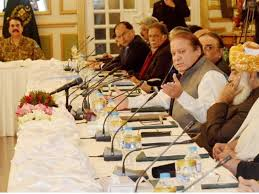
ISLAMABAD, Jan 2: The All Parties Conference (APC) at the PM House on Friday reached consensus on providing constitutional cover to special courts through an act of Parliament, while a roadmap regarding the 20-point National Action Plan was presented.
Speaking to the media after the meeting on Friday evening, PTI Vice-Chairman Shah Mehmood Qureshi said that members of the APC agreed on the proposition that amendments be made to the Army Act to enable “speedy” trials against “hardened criminals”.
He added that the meeting was prolonged because of the discussion on whether what they were doing was enough.
“Legal experts were of the opinion that challenges are expected to any possible amendment to the Army Act or the Constitution in superior courts,” Qureshi said. “Legal experts believe that if amendments are made with constitutional cover it will be easier to defend them [in superior courts].”
Earlier, Prime Minister Nawaz Sharif said legislation regarding the the National Action Plan, which would possibly amend the Constitution to establish military courts, should be tabled in the National Assembly today.
“The time has come for a final decision to be made today. I am hopeful that this bill should be presented before Parliament today. There is no room for further debate on NAP,” Nawaz said, urging political leaders to finalise the draft for the amendment in the Constitution.
“The nation wants to see the National Action Plan in action,” the prime minister said while addressing an All Parties Conference at the PM House in Islamabad.
Further, the premier reiterated that the military courts would only be set up for two years.
Nawaz lauded the efforts made by the leadership of all political parties for being on the same page following the aftermath of the tragic attack on the Army Public School in Peshawar in which 150 people were killed.
“I am happy to announce that the day after the incident, on December 17, all political parties’ leaders were in Peshawar and on the same page,” he said.
“In that APC, we unanimously decided that a parliamentary committee will be made to take action after the horrific incident,” said the premier.
Further, the prime minister said another meeting was held on December 24, which lasted 11 hours, in which the 20-point National Action Plan was also agreed upon collectively.
“I am happy that the political leadership of Pakistan is standing together to work towards eliminating terrorism,” he said.
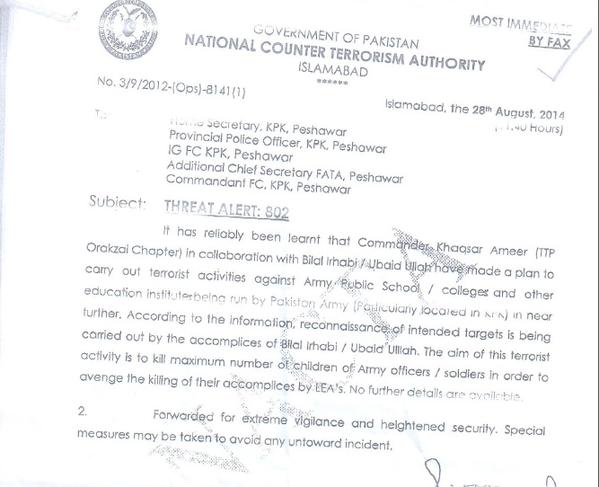
Official warning to KPK govt (Credit: hindu.com)Peshawar, Dec 22: Khyber Pakhtunkhwa government departments had been warned of an imminent attack on the Army Public School months before the carnage unfolded in Peshawar.
A copy of the written warning issued on August 28 has been obtained by Geo News.
Alert No. 802 issued by the Khyber Pakhtunkhwa Home Ministry stated that the Taliban Orakzai Commander, Khaksar along with terrorists Bilal and Obaidullah had planned to carry out attacks at educational institutions under the army.
According to information, Bilal and Obaidullah with their accomplices had also conducted reconnaissance of the targets. The warning stated the intention of terrorists was revenge and they wanted to kill as many children of army officers as possible.
The written warning had called for security measures to be made in advance to avoid any untoward incident and copies were sent to Khyber Pakhtunkhwa Chief Minister, Home Minister and law enforcement agencies.
On December 16, terrorists carried out one of the most horrific attacks in the history of Pakistan. Tehreek-e-Taliban Pakistan (TTP) terrorists brutally killed over 140 people mostly children at the Army Public School.
Following the attack government and political parties expressed a renewed resolve to fight terrorism in the country. The prime minister also lifted the moratorium on the death penalty in terrorism cases.
PESHAWAR, Dec 18: `We have killed all the children in the auditorium,` one of the attackers told his handler.
‘What do we do now?` he asked. `Wait for the army people, kill them before blowing yourself,` his handler ordered.
This, according to a security official, was one of the last conversations the attackers and their handler had shortly before two remaining suicide bombers charged towards the special operations soldiers positioned just outside the side entrance of the Army Public School`s administration block here on Tuesday.
This and other conversations between the attackers and their handlers during the entire siege of seven and a half hours of the school on Warsal< Road form part of an intelligence dossier Chief of Army Staff Gen Raheel Sharif shared with Afghan authorities on Wednesday.
`Vital elements of intelligence were shared with the authorities concerned with regard to the Peshawar incident,` an Inter-Services Public Relations statement on Gen Sharif`s visit to Afghanistan said.
Pakistan has the names of the attackers and the transcripts of the conversation between one of them, identified as Abuzar, and his handler,`commander`Umar.
Umar Adizai, also known as Umar Naray and Umar Khalifa, is a senior militant from the Frontier Region Peshawar.
Security officials believe he made the calls from Nazian district of Afghanistan`s Nangrahar province and now want the Afghan authorities to take action.
The officials believe that a group of seven militants attacked the school. Five of them blew themselves up inside the administration block and two others outside it.
The attackers entered the building by climbing its rear wall, using a ladder and cutting barbed wire. They all headed for the main auditorium where an instructor was giving a first-aid lesson to students of the school`s senior section.
`Did the attackers have prior 1(nowledge of the congregation in the main hall? We don`t know this yet. This is one of the questions we are trying to find an answer to,` a security official said.
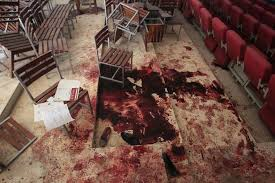
A watchman standing at the rear of the auditorium appears to be the first victim because of a pool of congealed blood splashed in one corner of several steps in the open courtyard.
Finding the rear door closed, the militants charged towards the two main entry and exit doors and this is where the main carnage appears to have taken place, according to a military officer who took part in the counter-assault. Pools of blood at the entrance on both sides bore testimony to the horrific, indiscriminate shooting.
`There were piles of bodies, most dead, some alive. Blood everywhere. I wish I had not seen this,` the officer said.
The students in the hall appear to have rushed to leave the place af ter hearing the first round of shooting, and this was where they barged into the waiting militants who were blocking the two doors.
Inside the main hall, there was blood everywhere, almost on every inch of it.
Shoes of students and women teachers lay asunder. Those who had hid behind rows of seats were shot one by one, in the head.
More than 100 bodies and injured were evacuated from the entrances and the hall.
Every row of seats was bloodied. On one seat, there were blood-stained English notebooks of two eighth-grade students, Muhammad Asim and Muhammad Zahid.
A corner to the right of the stage in the auditorium, where an instructor was giving the lesson, was where a woman teacher, who had beseeched the militants to have mercy and let the children go, was shot and later burnt.
By that time, the Special Services Group (SSG) men had arrived and fighting had ensued and the militants were forced tomake a run for the administration block, just a few metres away.
Security officials believe the death toll could have been far higher had the militants reached the junior section before the arrival of the SSG personnel.
It is from inside the administration block that the militants fired at the SSG men.
Four of the militants blew themselves up inside the lobby of the block when they were cornered.
The impact was huge and devastating.
There were pockmarks from the flying ball bearings and human flesh and hair were plastered to the ceiling and the walls.
One of the bombers blew himself up in the office of the Headmistress, Tahira Qazi. Her office stands gutted. Her body was recognised later. A leg of the bomber was lying around.
Two students and three staff members were killed in the administration block along with the headmistress.
The last two bombers charged towards the SSG men who had taken positions on either side of the flank entrance to the block.
One of them exploded himself and after a while, the second one did. Shrapnel and ball bearings hit the rear wall, some pierced through the trees opposite the entrance.
This is where the seven SSG men were injured. One of the personnel who had taken position behind one of the trees was hit in the face, but is reported to be in stable condition.
The assault came to an end but left several questions.
Could the tragedy have been avoided? Yes, given prior specific intelligence tips of August and repeated conveyance of concerns by some teachers regarding the school`s vulnerability vis-a-vis its western and northern boundary walls.
Could the casualties have been avoided or minimised? Probably not, given the short response time. By the time the SSG men arrived and began the operation within 10 to 15 minutes of the assault, the militants had carried out much of the carnage.
There was no clarity on the number of militants and their location. The SSG team arrived through the front gate covered by two armoured personnel carriers. As they moved from block to block, the first major priority was to secure the junior section.
DERA ISMAIL KHAN: The most hated man in the country is a 36-year-old father of three and volleyball enthusiast nicknamed “Slim”. His real name is Umar Mansoor and the Tehreek-e-Taliban Pakistan say he masterminded this week’s massacre of 132 children and nine staff at a school in Peshawar – the deadliest militant attack in Pakistan’s history.
A video posted on Thursday on a website used by the Taliban shows a man with a luxuriant chest-length beard, holding an admonishing finger aloft as he seeks to justify the December 16 attack.
The caption identified him as Umar Mansoor.
“If our women and children die as martyrs, your children will not escape,” he said. “We will fight against you in such a style that you attack us and we will take revenge on innocents.”
The Taliban say the attack, in which gunmen wearing suicide-bomb vests executed children, was retaliation for a military offensive carried out by the army.
The school attack shocked a nation where traditionally, women and children are protected, even in war.
Six TTP members interviewed by Reuters confirmed the mastermind was Mansoor. Four of them said he is close to Mullah Fazlullah, the embattled leader of the fractious group who ordered assassins to kill Malala Yousafzai.
“He strictly follows the principles of jihad,” one said. “He is strict in principles, but very kind to his juniors. He is popular among the juniors because of his bravery and boldness.”
Mansoor got a high school education in the capital, Islamabad, two Taliban members said, and later studied in a madrassah. “Umar Mansoor had a tough mind from a very young age, he was always in fights with other boys,” said one Taliban member.
Mansoor has two brothers and spent some time working in the city of Karachi as a labourer before joining the Taliban soon after it was formed, in late 2007, said one commander.
His nickname is “nary,” a word in the Pashto language meaning “slim”, and he is the father of two daughters and a son, said another commanders.
“(Mansoor) likes to play volleyball,” said one of the Taliban members. “He is a good volleyball player. Wherever he shifts his office, he puts a volleyball net up.”
The Taliban video describes him as the “amir”, or leader, of Peshawar and nearby Darra Adam Khel.
Mansoor deeply opposes talks with the government, the commanders said.
“He was very strict from the start when he joined,” a commander said. “He left many commanders behind if they had a soft corner (of their heart) for the government.”
Peshawar student wounded by Taliban (Credit: theagecom.edu)“We were in the education hall when militants barged in, shooting,” said Zeeshan, a student, speaking at a hospital. “Our instructor asked us to duck and lay down and then I saw militants walking past rows of students shooting them in the head.”
Mushtaq Ghani, the information minister for Khyber-Pakhtunkhwa Province, confirmed that most of the victims had been killed by gunshots to the head.
As Pakistani security forces responded, some of the attackers blew themselves up while others were killed by members of the army’s Special Service Group commando unit.
Desperate parents, meanwhile, rushed to local hospitals or gathered outside the school gates seeking news of their children. One of them, Muhammad Arshad, described his relief after his son Ehsan was rescued by army commandos.
“I am thankful to God for giving him a second life,” he said.
Witnesses described the scene on Tuesday in Peshawar in northwestern Pakistan after at least 145 people were killed in a Taliban attack on a school.
But at the Combined Military Hospital, the bodies of schoolchildren were lined up on the floor, most of them with single gunshot wounds to the head.
A 7-year-old student, Afaq, said militants had entered his classroom and immediately started shooting. “They killed our teacher,” he said, breaking down in tears.
“These attackers were not in the mood to take hostages,” a security official said. “They were there to kill and this is what they did.”
Some students managed to flee. Television coverage showed panic-stricken pupils in green sweaters and blazers, the school uniform, being evacuated from the compound. Others were wounded and were taken to another hospital in the area, Lady Reading, where parents also gathered looking for news of their children.
Lady Reading Hospital later published a list of students known to have died; many of the dead have not yet been identified.
By late afternoon, the army said it had cleared three sections of the school compound and that troops were pushing through the remaining sections. After the last of the militants was killed, officials said, soldiers were sweeping the compound for explosives.
Prime Minister Nawaz Sharif arrived in Peshawar, where the authorities declared three days of mourning. Mr. Sharif announced an emergency meeting of all political parties in the city for Wednesday. In a statement, the foreign ministry said it was “deeply shocked” by the attack but that the government was undeterred in its fight against the Taliban.
The British prime minister, David Cameron, called the attack “deeply shocking” and said it was “horrifying that children are being killed simply for going to school.” The American ambassador to Pakistan, Richard G. Olson, said the United States “stands in solidarity with the people of Pakistan.”
And Malala Yousafzai, the teenage education campaigner from northwestern Pakistan who was awarded the Nobel Peace Prize in a ceremony last week, said she was “heartbroken by this senseless and coldblooded act of terror.”
“Innocent children in their school have no place in horror such as this,” Ms. Yousafzai said in a statement. “I, along with millions of others around the world, mourn these children, my brothers and sisters — but we will never be defeated.”
The Army Public School in Peshawar is part of a network of schools that the military operates in garrison towns and major cities across Pakistan. Students from army families have preferential access, but many of the students and teachers in the schools come from civilian backgrounds.
The assault came at a time of political turbulence in Pakistan. The opposition politician Imran Khan, whose party controls the provincial government in Khyber-Pakhtunkhwa, has been staging protest rallies in major cities in a bid to unseat Mr. Sharif, claiming that Mr. Sharif’s supporters rigged the 2013 elections.
Mr. Khan has criticized army operations in the tribal areas and called on the government to negotiate with the militants instead of fighting them, a stance that has attracted wide criticism.
The Pakistani Taliban, always a loose and chaotic coalition of militant groups, have come under increased pressure this year because of internal frictions and the military’s continuing operation in North Waziristan, which started in June following an audacious attack on the Karachi airport.
The military says that the offensive, officially known as Operation Zarb-e-Azb, has resulted in the death of 1,800 militants and cleared much of North Waziristan, the region’s most notorious hub of militant activities.
Still, the school attack on Tuesday demonstrated that the Taliban remain willing and able to strike at vulnerable civilian targets.
Ihsanullah Tipu Mehsud contributed reporting from Peshawar, and Declan Walsh from London.
On Tuesday morning, the Senate intelligence committee released an executive summary [1] of its five-year investigation into the CIA’s interrogation and detention program. (Read the executive summary here. [2])
Among the report’s most striking revelations is that CIA interrogators were often untrained and in some instances made up torturous techniques as they went along.
The CIA was “unprepared” to begin the enhanced interrogation program, the Senate report concluded. The agency sent untrained, inexperienced people into the field to interrogate Abu Zubaydah, the first important Al Qaeda suspect the US captured.
Within weeks of Zubaydah’s arrival, while he was still in the hospital recovering from a gunshot wound, CIA headquarters was planning to throw him in all-white room with no natural lighting, blast rock music 24/7, strip him of his clothes, and keep him awake all day. They did. Extreme interrogations like these, identified as “enhanced interrogation techniques,” went on for more than three months before CIA officers received any sort of training in the new techniques from anyone.
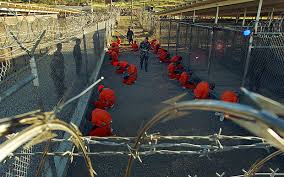
As the overall detention and interrogation program proceeded, many untrained CIA personnel continued to do whatever they wanted, without authorization or supervision. At one facility in 2002, code-named COBALT, “untrained CIA officers…conducted frequent, unauthorized, and unsupervised interrogations of detainees using harsh physical interrogation techniques that were not—and never became—part of the CIA’s formal ‘enhanced’ interrogation program,” the report found. COBALT is reportedly [9] a prison in Afghanistan the agency nicknamed “the Salt Pit.” In one example identified by the report, an interrogator left a COBALT detainee chained naked to the concrete floor. The detainee later died of suspected hypothermia.
The CIA also put a junior official with absolutely no relevant experience in charge of this entire facility. Later, when the CIA’s inspector general investigated COBALT, the CIA said it knew little about what happened there. Several interrogators at the site became uncomfortable with their coworkers’ methods, not sure that they were safe or effective. According to John Helgeron, the CIA inspector general who conducted a formal review of the agency’s detention and interrogation program, CIA interrogators at COBALT had zero training guidelines before December 2002. The report claims, quoting Helgeron: “Interrogators, some with little or no training, were ‘left to their own devices in working with detainees.'”
In 2004, the CIA chief at another detention site, code-named BLACK, penned a long email about his disillusionment with the program, especially deficiencies in training:
And in one particularly heinous example, the CIA headquarters sent an untrained interrogator to question Abd al-Rahim al-Nashiri, a man the CIA claimed was an Al Qaeda “terrorist operations planner” involved in several bombings. One senior CIA official had reservations about sending the untrained interrogator, noting that he heard the man was “too confident, had a temper, and had some security issues.” But the man got sent anyway.
While there, the interrogator allegedly forced Nashiri to stand with his hands over his head for two and a half days, blindfolded him, pushed a pistol up against his head, and revved up a cordless drill close to his body. When this produced no new information, the interrogator slapped the detainee repeatedly on the back of the head, told him he’d sexually assault his mother in front of him, blew cigar smoke in his face, and made him sit in such stressful positions that a medical officer was concerned the detainee’s shoulders would be dislocated.
The CIA base chief let this happen because he thought this interrogator was sent to “fix” the problem of an uncooperative detainee and had permission from headquarters to take such extreme steps. Both men were later reprimanded, according to the report.
The problem of untrained amateurs questioning and torturing of detainees wasn’t unique to the CIA. In 2008, Mother Jones explored [8] the world of untrained interrogators with testimony from Ben Allbright—a soldier who recalls using harsh interrogation techniques while serving as a military guard at a small Iraqi prison called Tiger in Western Iraq:
Ben was not a “bad apple,” and he didn’t make up these treatments. He was following standard operating procedure as ordered by military-intelligence officers. The MI guys didn’t make up the techniques either; they have a long international history as effective torture methods. Though generally referred to by circumlocutions such as “harsh techniques,” “softening up,” and “enhanced interrogation,” they have been medically shown to have the same effects as other forms of torture. Forced standing, for example, causes ankles to swell to twice their size within 24 hours, making walking excruciating and potentially causing kidney failure.
The Senate intelligence committee did not address allegations of torture or abuse by the US military. In fact, when members of the US military stopped by COBALT, they decided it was too risky for them to be involved at all.
In July 2002, CIA headquarters recommended that a group of interrogators, “none of whom had been trained in the use of the CIA’s enhanced interrogation techniques,” try to “break” a detainee named Ridha al-Najjar, who was arrested in Pakistan and identified as a former bodyguard for Osama bin Laden.
When officers from the US military arrived for a debriefing, the military’s legal adviser took note of the extreme techniques being used. The interrogators left Najjar hanging handcuffed to an overhead bar for 22-hour periods. He was left in total darkness and cold temperatures, hooded and shackled. They forced him to wear a diaper and didn’t provide a bathroom. And on top of that, the US military officer claimed that the warden in charge “[had] little to no experience with interrogating or handling prisoners.”
At the end of the visit, the legal adviser concluded that the treatment of the prisoner and the concealment of the facility were too big a liability for the military to get involved. But even then, Najjar’s treatment became a “model” for future interrogations, according to the report.
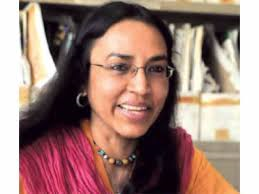
ISLAMABAD, Nov 12: Sindh Police have started probing land grabbers allegedly involved in the murder of Orangi Pilot Project (OPP) former director Parveen Rahman.
“A questionnaire has been sent to the Board of Revenue Sindh to find out the details of Katchi Abadis, record of land grabbers and land mafia,” Deputy IG west zone Karachi has said in the progress report submitted in the Supreme Court on Wednesday.
The report has also provided details of the 5th session of the Joint Investigation Team (JIT) held on October 15 regarding the murder case, the copy of which is available with The Express Tribune.
Giving details of the JIT meeting, the report says a representative of Intelligence Bureau (IB) briefed that the process of regularisation of Katchi Abadies and goths was stalled since Rahman’s assassination, pointing to the involvement of those benefitting from land mafia.
Similarly, representative of special branch briefed the JIT and said that investigations had revealed that land grabbers affiliated with the Tehreek-e-Taliban Pakistan (TTP), Naseebullah Kakar and Thorani Afghani did not like Rahman because she was active against land grabbers, tankers mafia and also supported NGOs in the anti-polio vaccination campaign.
Rehman was murdered in Karachi on March 13, 2013.
The special branch representative further said that the place of Rahman’s murder, near Pakhtoon market in Manghopir, is under the influence of Abid Muchar and Shamsur Rahman groups of the TTP, who were also apprehensive of Rahman’s growing social activities.
Meanwhile, the three-judge bench of the apex court headed by Chief Justice Nasirul Mulk while resuming the case hearing on Wednesday directed the Sindh Police to arrest all culprits involved in the murder within a month.
Justice Dost Muhammad Khan observed that there were clues that land mafia is involved in Rahman’s murder but no investigation had been carried out in this regard previously.
He asked the police to investigate groups against regularisation of Katchi Abadies.
During the hearing, DIG CID Sultan Khawaja told the bench that IB was asked about the details of nine people suspected to be involved in the case.
Khawaja added that Pakistan People’s Party leader Taj Haider had told to the investigation team that Rahman had with her a map of land which had been allegedly occupied by wings of different political parties.
The chief justice, though, asked the DIG to focus on the murder case only.
The DIG further said that a person named Raheem Sawati was obstructing her social welfare work but he has left Karachi now, adding that police was trying to trace him.
The chief justice observed that no doubt, the case is difficult but not impossible.
The court directed that the investigation should continue, with a focus on finding the real culprits. It asked for another progress report to be filed in the next hearing scheduled for December 15.
A game of land?
Human Rights Commission of Pakistan and 11 other petitioners had, through their counsel Reheel Kamran Sheikh, previously submitted that they suspected the JIT was deliberately ignoring the presence of land mafia because of vested interests of a range of ‘influential parties’.
The petitioners pointed out that the JIT had failed to take into account the fact that Rahman was collaborating with the government of Sindh for identification, survey and mapping of various settlements in parts of Karachi for their regularisation and that all regularisations came to a halt following her murder.
“Nearly 1,063 settlements were regularised by the Sindh government through the efforts of Rahman, whereas more than 1,000 were left,” the application said.
“When a settlement is regularised it becomes difficult to evict the residents as they become lawful lessees. Consequently, the price of the land also increases. Both these factors make it difficult for the land mafia and the real estate developers to grab land through forced eviction or fraudulent/coercive transactions,” it adds.
The application added that residents of various settlements were approaching Rahman seeking her assistance in regularisation.
“Rahman had, therefore, become a symbol of resistance against the land mafia and real estate developers,” it says.
LAHORE, Nov 2: At least 60 people were killed on Sunday in a blast near the Wagah border, the responsibility of which was claimed separately by the outlawed Jundullah and TTP-affiliated Jamaat-ul-Ahrar outfits.
Victims include 10 women and seven children, while more than 110 people have been injured.
Punjab police chief Inspector General Mushtaq Sukhera told AP that the bomb exploded outside a restaurant near a paramilitary soldiers’ checkpoint at Wagah border on the outskirts of Lahore city. He also added that the explosion could have been the result of a suicide blast.
Lahore police chief Amin Wains confirmed it was a suicide attack. “People were returning after watching the parade at Wagah border when the blast took place. Ball bearings were found at the scene,” he said.
Emergency has been declared at all hospitals in Lahore. Prime Nawaz Sharif has taken notice of the explosion and called for a report on the incident.
Wagah is the only road border crossing between the Indian city of Amritsar and the Pakistani city of Lahore.
An Indian security official told Reuters that the Indian side of Wagah border is “safe” after blast on Pakistani side.
The Jamaat-ul-Ahrar splinter group of the proscribed Tehreek-i-Taliban Pakistan (TTP) claimed responsibility for the Wagah border attack as its spokesman Ehsanullah Ehsan, speaking to Dawn on telephone from Afghanistan, said it was carried out by one of their men.
When asked if it was more than one suicide bomber, he said one man carried out the attack.
“We will continue such attacks in the future,” Ehsan said.
“Some other groups have claimed responsibility of this attack, but these claims are baseless. We will soon release the video of this attack,” he said.
“This attack is revenge for the killing of innocent people in North Waziristan,” the banned militant group’s spokesman said.
Earlier Jundullah, another outlawed group which was behind a suicide bombing that killed at least 78 Christians at a church in Peshawar last September, had also claimed responsibility for the Wagah border attack.
The spokesman of the splinter group of the TTP Ahmed Marwat via telephone said that the attack is a reaction to military operation Zarb-i-Azb and Waziristan operation.
Jundullah and the much larger Pakistani Taliban are among loosely aligned militant groups that frequently share personnel, tactics and agendas. Claims for specific incidents are often hard to verify.
The group has claimed various attacks including the October 23 attack on Maulana Fazlur Rehman in Quetta.
On September 22, 2013, a twin suicide bomb attack had killed 127 people at a Peshawar church. This was the deadliest attack on the Christian minority in the history of Pakistan. Jundallah had wasted no time in accepting responsibility of this attack too.
18 Shia Muslims traveling from Rawalpindi to Gilgit-Baltistan on a bus in February 2012 were stopped in Kohistan and massacred based on their religious affiliation by individuals dressed in Military uniforms. Jundallah had also claimed responsibility for the act by contacting the media.
In June 2013, Jundallah had claimed responsibility for the killing of tourists and their Pakistani guide in Gilgit–Baltistan. The tourists were mountain-climbers who had hoped to climb Nanga Parbat. The dead included five Ukrainians, three Chinese, and their guide.
Scenes at the hospital
As most of the dead and injured were shifted to the nearby Ghurki Hospital, reporters said the premises was swarming with police, security agencies and the families of victims.
Hospital administration confirmed that at least 40 dead and over 50 injured have been received by hospital authorities.
“We received 35 bodies including those of women and children and 60 to 70 were wounded,” Deputy Medical Superintendent of Ghurki Hospital near the Wagah border crossing, identified only as Dr Khurram, told domestic television channels earlier.
Later, medical superintendent Dr Iftikhar confirmed that over 100 people have been brought to Ghurki Hospital. More injured have been shifted to Lahore hospitals as GH does not have the capacity to treat further patients.
Timing of Explosion
The explosion reportedly took place as the Rangers concluded the ceremony at Wagah, and the flags were being lowered.
For years, a military flag-lowering ceremony that takes place every evening at the Wagah border post, which draws crowds of partisan tourists who cheer every hostile strut and stare traded by the border guards on both sides.
DG Rangers confirms suicide blast
Director General Rangers Punjab Khan Tahir Khan confirmed that the explosion is a suicide blast.
“The parade venue is about 600 metres ahead of the blast site. Because of the strict checking the suicide bomber detonated the bomb away from the parade venue.”
Blast site
Footage shows shops and nearby buildings destroyed at the site of the blast. Security and rescue personnel rushed to the site of the blast.
Journalists have been instructed to clear the area, which the Rangers have cordoned off for security reasons. Forensic teams are currently present at the site and are collecting evidence as part of the investigation.
An eyewitness speaking to DawnNews said people were coming out of the shops when the bomb explosion took place.”There were several bodies at the scene of the blast. It was a very powerful blast.”
Pakistan has its share of Voldemorts – the dark lords who cannot be named – but none as powerful as this lot: the banned sectarian outfits and their leaders. They kill with impunity, and then move on with their business without the fear of ever being caught, or convicted.
They are brazen and flagrant, they cannot be stopped. And, egregiously, they cannot be named, at least not without risking one’s life.
Owen Bennett Jones, in his book Pakistan: Eye of the storm, narrates a bloodcurdling tale of a Bollywood style drama that unfolded in Lahore during the days Riaz Basra, founder of Lashkar-e-Jhangvi, was still alive.
Contrary to popular belief that PML-N is sympathetic towards their cause, the Nawaz-led government was cracking down hard against sectarian outfits. The bounty on Basra’s head had been increased to make him the most wanted terrorist in the country, and the police were employing all energies to apprehend him.
Miffed at this, Basra decided to send a strong message.
He crept into one of the public meetings held by the Prime Minister, placed himself right behind Nawaz, allowing an accomplice to take pictures in the process; and then three days later sent the print of the same to the PM house, with his and Nawaz’s head encircled, and an inscription underneath reading,
It’s that easy.
It indeed is easy for them to wriggle into the most secure places. Easier still to go ahead and shoot anyone.
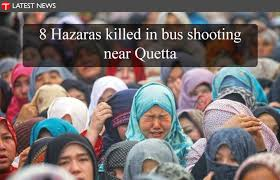
No surprises should then come when the common folks, such as the Hazaras, are murdered in dozens with the government failing to provide protection.
Convenience, as expediency in so many other matters, demands that we do not even identify this as a sectarian bloodshed. We shut our eyes, look elsewhere, ignore the elephant in the room and hope peace would somehow prevail.
Where we do indeed identify the killings as being sectarian in nature, we refuse to attribute direct blame; to name names and identify perpetrators. No political party has the guts to directly confront these outfits or to censure them for being completely out of sync with the religion they preach.
Why make enemies of such barbarians?
Hardened by this attitude, the outfits rage on with their sprees.
What had started off as the targeting of hitmen of organisations affiliating with other sects – back in the times when, as Jalib would put it, Zulmat (Darkness) insisted on being called Zia (Light) – slowly moved on to becoming a campaign against the notables. Doctors, lawyers, intellectuals and government servants were the targets in this phase.
Not satiated with the bloodshed and the rewards they had accumulated for the hereafter, these organisations took it a step further.
Thus began indiscriminate sectarian killings.
Pakistanis are killing Pakistanis; Muslims are murdering Muslims. Ubaidullah Aleem had written some 40 years ago:
Main yeh kis ke naam likhoon, Jo alam guzar rahay hain Meray shehar jal rahay hain, Meray log mar rahay hain
(Whom should I blame for these afflictions; my cities are burning, my people are dying).
Koi aur to nahin hai pas-e-khanjar aazmai Ham hi qatl ho rahay hain, Ham hi qatl ker rahay hain
(It is not an outsider behind the swashing dagger; we are the ones getting killed and we are the ones doing the killing).
The weapon of choice employed by these outfits to put their point across is violence. The fact that the government has been unable to keep its monopoly on the legitimate use of violence – as a punishment to prevent perpetuation of crime – renders it a failure.
The government too, however, despite the criticism heaped upon it, fails not because of lack of intent but because of failure of mechanism.
There were 40 plus cases registered against Malik Ishaq (the second of the three founders of Lashkar-e-Jhangvi), and of these, he has already been acquitted in about 30. The reason: the witnesses either did not turn up due to fear, went missing, or were killed.
No judge would punish a person if evidence is lacking, even if the perpetrator had owned up to killing at least a hundred Shias in an interview with an Urdu Newspaper in 1997.
Together with a lack of evidence is the predicament of having to contain the sympathy these criminals win with security agencies. The problem of reverse-indoctrination, where prisons instead of acting as the reformation centres end up becoming recruitment fields, further complicates the matter.
Until these issues are addressed head on, and the government is better empowered to deal with them, we are left with only two pitiable solutions:
Solution one: every time a tragedy of the sorts where Hazaras are sprayed with bullets occurs, we shake our heads, condemn the actions of ‘namaloom afraad‘ (unknown people/assailants), gain some mileage by politicising the matter and within days move on, waiting for another such incident to occur in the future.
Solution two: where lack of evidence would merit acquittal of the accused – the extrajudicial killing of criminals in police ‘encounters’.
As a lawyer committed to human rights, I am against both. The former for its passivity, the latter for fear of an innocent person being murdered.