On the road to nowhere

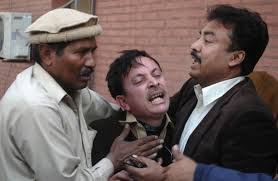
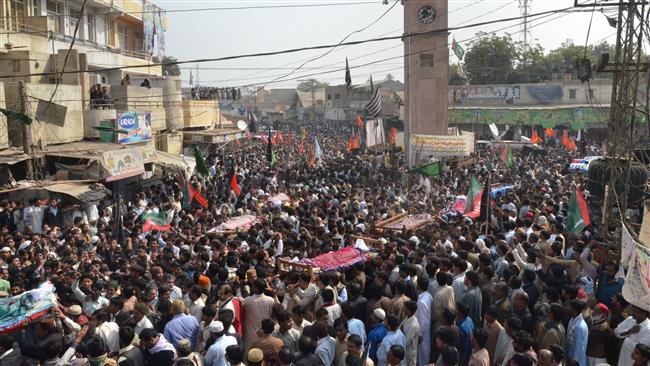
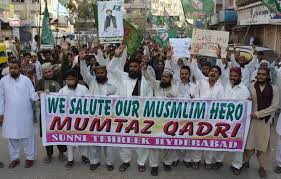
Punjab Governor Salman Taseer's killer acclaimed (Credit: demotix.com)
Punjab Governor Salman Taseer’s killer acclaimed (Credit: demotix.com)

While the media is brimming with tall claims of no relaxation to terrorists, three big fish managed to wriggle out of the clamped jaws of law during recent weeks. Simpletons are told that their lawyers were consummate enough to outshine the official mavericks in the court so the jury was constrained to let them walk free.

The case of Mumtaz Qadri is even more intriguing. In a baffling verdict while his death penalty has been maintained, the judges were convinced that the act of killing a sitting governor is not terrorism.

The Islamabad High Court (IHC) verdict says that is amazing to note that appellant (Mumtaz Qadri) took protection and rights guaranteed by the constitution, but deprived the deceased (Salman Taseer) of all constitutional guarantees. It is beyond any reasonable doubt that the murder of Salman Taseer at the hands of appellant Mumtaz Qadri was pre-planned, cold blooded and gruesome.” However about the charges of terrorism, the court observed that “it was not applicable because the incident did not create panic among the public.”

It is baffling that if a failed attempt on Gen. Musharraf can lead to hanging of the convicts, how the “pre-planned, cold blooded and gruesome” murder of the governor of a province is less than terrorism? Article 6 (2-n) of The Anti-Terrorism Act 1997 defines terrorism as an action that involves serious violence against a member of the police force, armed forces, civil armed forces, or a public servant. Also it is hard to comprehend how the grisly act did not create panic among the public? If the prosecutor was too naïve to prove these explicit facts, one even with a severest flu would still smell a rat.

More flabbergasting was the performance of two counsels for the felon. Khawaja Muhammad Sharif, a former chief justice of the Lahore High Court while arguing before the court showered his profound eulogy for the gunmen who attacked French weekly Charlie Hebdo and pronounced them “heroes”. He also pleaded before the court that the shooting of Salman Taseer was not an act of terrorism. Another lawyer of the convict, a retired judge from Punjab Mian Nazir Akhtar expressed his vehemence by saying that “I am sure Salman Rushdie would also be killed if he were to come here”.

When the IHC remarked that even a judge cannot touch an accused after awarding him punishment, yet the defence counsel insisted that a person can kill another person under unusual circumstances. These observations leave one dumbfounded as both the lawyers adorned the seat of justice for several years with such ethos. How accused of blasphemy or heresy would have been treated by an adjudicator who ardently justifies killing by the lunatic fringe. Both lawyers must also be aware that in September 2014, a prisoner guard at Adiala Jail shot a septuagenarian British-Pakistani accused over blasphemy charges. An internal inquiry revealed that the shooter was incited by Mumtaz Qadri while he was deployed outside his cell. He became a disciple of Qadri and used to seek religious lessons from him.

Incompetence and connivance of a matching magnitude was evident in the case of Zakiur Rehman Lakhvi, leader of Lashkar-e-Taiba. The Punjab government’s slouchy demeanour was too unveiled that eventually set free Zakiur Rehman Lakhvi, an alleged architect of November 2008 Mumbai carnage. Not much different is the case of Malik Ishaq, leader of a proscribed outfit who was put at ease by the Punjab government when it withdrew an appeal for extension of his confinement. The government opted to plead a weak case and facilitate his acquittal.

The list does not end here. There are even more privileged names to count who receive a VIP treatment in official corridors. An astounding news report revealed that website of TTP could not be blocked because of lack of legal mechanism. The concerned authorities have expressed their inability to this effect under the pretext of absence of requisite legal instruments. One wonders why such legal tools are not required to block word press and other sites where public opinion is aired.

According to a newspaper report, a survey carried out by the Capital Development Authority (CDA) has made a startling revelation about illegally constructed mosques in Islamabad. The report disclosed that out of 492 mosques in the city, 233 are illegally erected on state land encroaching non-perennial streams, right of way of major roads and other such expropriated public and private locations. The CDA mentioned the number of such mosques 83 in 2011. In other words, such mosques have grown threefold during past four years.

According to another survey jointly conducted by the CDA and police, the city has 160 unregistered madrassas and 72 day scholar Quranic institutes. Deobandi madrassas take the larger share of 193 out of total 329 seminaries in the city. Interestingly only one month ago, Interior Minister Chaudhry Nisar, while replying to a question in National Assembly, claimed that Islamabad has only 30 unregistered madrassas. This indicates the lack of credible information at high level decision making forums.

A newspaper reported that in line with the recommendations of the National Action Plan, provincial Auqaf departments have gathered data of madrassas from all provinces. The survey revealed that there are 8,135 unregistered seminaries in the four provinces with an enrollment of 0.3 million students. Punjab tops the list with 4,125, followed by KP with 2,411 such seminaries. Sindh and Balochistan are not immune either and are home to 1,406 and 266 such institutions respectively.

Another report puts the number of unregistered seminaries in Punjab at 6,550.
Intelligence reports have been indicating that foreboding signs are ripe in the capital city and cannot be just dismissed with flippancy. All these facts corroborate the assertion of an Interior Ministry official that the federal capital is an “extremely dangerous” city. A senior official of the Interior Ministry made this ominous disclosure while making a presentation before the National Assembly standing committee in February 2014. The official claimed that the capital city had been at high risk and has become a sleeper cell of banned organisation members, including al-Qaeda, Tehreek-i-Taliban Pakistan (TTP) and Lashkar-e-Jhangvi (LeJ). In a bid to quell the horror feelings, the Interior Minister dismissed the report and termed Islamabad a safe and secure city.

Not just Islamabad but much of the Punjab is also infested with militants. Leadership and administration of Punjab has been eschewing any confrontation and always attempted reconciliation with militants. This approach has provided safe bastions to militancy. Recently, the Interior Minister told a top level meeting that the number of proscribed organisations engaged in terrorism and extremism in Pun jab had reached 95.

Several newspaper reports indicate that intelligence agencies have been warning the Punjab government about spiraling militancy in the province but the cavalier Punjab government remained unfazed and conveniently ignored all such red alerts and slept over sprawling sleeper cells. This lax attitude of the Punjab government is not mere inaction or apathy of the PML-N government but it represents a segment within civil-military establishment that continues to believe in the fallacy of considering militants as strategic assets.

These intransigent elements always see foreign hand in every macabre incident occurring in Pakistan. This self-deceiving contentment is far from reality on ground where copious of evidences indicate internal hands as the real cause of prevalent malaise. It would be pertinent to mention that in 2013 a new chapter was added in the army doctrine that describes homegrown militancy as the biggest threat to national security. The army doctrine deals with operational preparedness and inclusion of this fact marked a major shift in the security paradigm. It is, however, yet to see how this cardinal doctrine is mainstreamed and policies and practices are fully synchronized across the board.
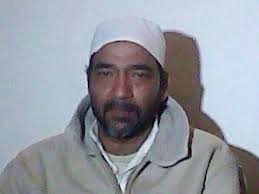
MQM uses us like ’tissue papers’ – Death row inmate Saulat Mirza

Saulat Mirza (Credit: tribune.com.pk)
KARACHI/ISLAMABAD: Saulat Mirza, in a video statement aired on Geo News, hurled startling allegations on Muttahida Qaumi Movement (MQM) and its top leadership, just a few hours before his execution was scheduled to take place on Thursday at 5:30AM. Mirza’s execution has now been postponed for 72 hours.

Mirza said he was an MQM worker and received direct orders from MQM leader Babar Ghauri to assassinate KESC chief Shahid Hamid. “I was summoned at Babar Ghauri’s house where I took Altaf Hussain’s orders via telephone. Altaf Hussain would usually pass on instructions through Babar Ghauri,” alleged Saulat Mirza.

Speaking to ARY News, MQM Chief Altaf Hussain said, “Without any proof or evidence, Saulat Mirza’s statement will not have any effect on the party.” Hussain termed the allegations a conspiracy against MQM.

Babar Ghauri speaking to Geo News dismissed Mirza’s statement as a “fable” and denied having given any order for a murder.

“This is a made up story, we are not allowed to call workers to our house and deal with them there,” he said. When asked if Saulat Mirza has never come to his house, Ghauri said “no”.

“When he [Mirza] was in North Nazimabad, I met him then as an MPA,”.
“Then he was removed from the party and I maintained no communication or relationship with him.”

Mirza, however, said workers like him were used as “tissue papers” by MQM, and were disposed off when there was no use left for the party. “Other workers should take a lesson from my ending,” said Mirza. “Criminals in the party would get protection under Governor Sindh,” he claimed.

Meanwhile Sindh Governor’s spokesperson has stated that Dr. Ishratul Ibad has never supported any accused or criminal.

Saulat went on to say that workers in the MQM who gained popularity among the public are eventually sidelined.

“Mustafa Kamal was humiliated and then sidelined from the party because he had grown popular and Azeem Tariq was murdered for the same reason,” Mirza said.
“I have no vested interest in making these allegations at this hour. I just want to leave a message for those who wish to join, or are part of political organisations, to learn from my mistakes,” said the death-row inmate.
Meanwhile, Machh Jail Deputy Superintendent Sikandar Kakar while talking to DawnNews confirmed that they have received orders to postpone the hanging of Saulat Mirza for three days.

Mirza was found guilty of murdering the then managing director (MD) of Karachi Electric Supply Corporation (KESC), now K-electric, Malik Shahid Hamid, his driver Ashraf Brohi, and his guard Khan Akbar outside Hamid’s residence in DHA on July 5, 1997.

Previously a resident of Block J in North Nazimabad, Karachi, Saulat was his parents’ fourth child.

Having received his intermediate education from Pakistan Shipowners’ College in Karachi, he became active in student politics and joined the All Pakistan Mohajir Students Organisation (APMSO), the students’ wing of MQM, then an acronym for Mohajir Qaumi Movement.

His name first appeared on intelligence and security agencies’ radar in 1994, after the killing of two US diplomats at Karachi’s Shahrah-i-Faisal and murder of four workers of an American oil company, Union Texas, near PIDC bridge.

He was believed to have been arrested from Karachi airport after his arrival from Bangkok; police confirmed his arrest at a press conference on December 11, 1998.
During that press conference, in the presence of the then Karachi DIG, Ameen Qureshi, Saulat Mirza made revelations about his involvement in the murder of scores of innocent people, including several high-profile personalities.

Mirza was initially detained by FIA immigration officials for traveling on a fake identity but was handed over to the then Station House Officer (SHO) of Gulbahar police station, Mohammad Aslam Khan (Chaudhry Aslam), who was also present at the airport on intelligence reports.

Noose tightens around MQM

Rangers raid 90 (Credit: thenews.com.pk)

Shrugging off allegations of being politically motivated, the law enforcers showed Wednesday morning that even the big guns could be silenced. A heavy contingent of Rangers raided Nine Zero, the headquarters of the Muttahida Qaumi Movement (MQM) in Karachi’s Azizabad area, detained around 20 criminals and seized a large cache of illegal weapons and ammo.

In the operation, which was managed and executed by members of the paramilitary force alone, a number of party workers, including MQM’s Rabita Committee member Amir Khan, and notorious convicts were detained during the raid which also incidentally claimed the life of a young MQM supporter.

After breaking barricades leading to MQM headquarters, Rangers personnel cordoned off the area and searched through departments of the party’s offices. During the raid, the Rangers cut off the telephone lines at Nine Zero, disabling communication with MQM’s international secretariat.

Scores of activists and party members protested the raid by Rangers by chanting slogans. Aerial firing also ensued outside Nine Zero as activists attempted to break the Rangers’ cordon. As the situation turned chaotic, Waqas Ali Shah of MQM’s Central Information Committee was killed during the raid while Express News cameraman Waseem Mughal was injured in the firing.

Shah’s death invoked the need of an enquiry into the incident as it remained unclear if he died due to Rangers’ aerial firing or someone at the spot killed him.

MQM spokesperson Wasay Jalil claimed that Shah was killed in straight fire by Rangers personnel around 7:45am Wednesday.

“Dozens of mobiles of Rangers appeared at Nine Zero around 6am. Personnel proceeded to raid 50 offices in our headquarters. They went to each office, went through all the files and broke telephones.”

Sindh Police Additional IG Ghulam Qadir Thebo said that Shah was not shot by Rangers personnel, but that the bullet fired was from a handgun.

Rangers Director General (DG) Major General Bilal Akbar said that MQM activist Shah was shot with a TT pistol and the fact would become clear once the medical board’s report is received.

SINDH CITIES COME TO A STANDSTILL:

MQM announced a day of peaceful protest against the search operation by Rangers and urged for transport services to be suspended throughout the day.

MQM leader Farooq Sattar termed the raid “deeply upsetting and worth investigating”. He said that MQM is compliant of all laws and instead of appreciating the party’s efforts of promoting peace, it is being treated with contempt.

He demanded of Prime Minister Nawaz Sharif, Interior Minister Chaudhary Nisar and Sindh Governor Ishratul Ebad to play their due roles. Sattar also warned that the situation could be a setback to the enhancement of democratic process.

Commercial activity was suspended with shops, markets and educational institutions remained closed not just in Karachi but in other cities of the province, such as Hyderabad, Sukkur, Nawabshah, Jamshoro and Mirpur Khas.

Petrol pumps and private schools in several areas of Karachi were also reportedly shut down as activists in large numbers protested against the Rangers. Children who managed to get to schools were sent back to their homes and examinations were cancelled in colleges and universities.

While the MQM has maintained that the protest against the Rangers raid will be peaceful, a bus was set alight at Gulistan-i-Jauhar while a rickshaw was torched in Karimabad.

MQM leaders and activists gathered outside the headquarters but were not allowed to enter its premises.

RANGERS MAKE IT CLEAR:

A press release issued by Rangers soon after the raid on MQM’s headquarters said: “Pakistan Rangers Sindh has conducted a series of targeted raids at surrounding areas of 90 including Khursheed Memorial Hall today. During the above mentioned action, following hardcore criminals have been arrested: Faisal Mota, Farhan Shabbir aka Mullah Amir, Nadir and Ubaid K 2.”

Faisal Mota was awarded the death sentence in absentia on March 1, 2014 by an anti-terrorism court in the murder case of Wali Khan Babar, a Geo TV reporter while Nadir had also been convicted and sentenced 13 years imprisonment.

Rangers spokesperson Colonel Tahir called the two-hour raid a “purely information-based operation” and divulged that the Khursheed Memorial Hall at Nine Zero has been sealed and will be handed over to police for further investigation.

Col Tahir added that ammunition stolen from NATO containers was also seized during the search operation.

Speaking to media, MQM leader Faisal Subzwari and Haider Abbas Rizvi admitted that weapons were seized during the raid, but said that they were all licensed and were being kept for security in view of the threats being received from “the Taliban and other extremist elements”.

“After the Army Public School attack, even schools and colleges are now being asked to keep weapons for security. We were also told to keep weapons for our security,” Subzwari said.

MQM CHIEF DILLYDALLIES:

Contrary to his party leaders’ statement, MQM chief Altaf Hussain claimed that the weapons presented were “brought by the Rangers themselves in blankets”.

Claiming that the Establishment does not tolerate MQM’s presence, he maintained that the ammunition seized from Nine Zero by Rangers does not belong to MQM. He further said that if the weapons belonged to MQM, they would not have been stored in Nine Zero.

In a telephonic address, Hussain denounced the raid by Rangers on Nine Zero and said that this was the first time that the house and office of a political party chief was raided.

Addressing Rangers personnel, he remarked that Rangers have authority but “they are unable to deliver justice”. Claiming that more than 60 people were arrested during the raid by Rangers, he demanded that “terrorism in the name of search operations” be stopped.

However, later retracting from his stand point, MQM chief told a news channel that he was supportive of cracking down on criminals irrespective of where they were. In the same breath, he maintained that his party headquarters was not harbouring terrorists but “they were just living in the vicinity”.

Earlier, the MQM chief had stated in a telephonic address that “people who had committed mistakes should not have stayed at the MQM headquarters as they had jeopardised the security of others”. “Such people should have sought refuge elsewhere as I have been staying in Britain for the last 20 years,” said the MQM chief.

After condemning the raid, Altaf Hussain apparently appreciated the “valour” of Rangers personnel for “having dared to raid his house”. In an apparent naked threat, Hussain said that the Rangers’ officers who participated in the raid at his elder sister’s house “would soon become a part of the past”.

The MQM has in the recent past accused the Rangers of involvement in illegal detention and extrajudicial killings of its members and the raid and arrests appear to be the climax of the complex dynamics between the two sides.

The Rangers last month in a report implicated the MQM in the Baldia Town factory inferno fire that claimed the lives of at least 258 factory workers, a charge the party vehemently denies. The JIT report also contains several other disclosures about the involvement of MQM workers in several criminal cases as well rigging in the 2013 general elections.

Suicide Attacks on Churches in Pakistan Kill at Least 15

Taliban attack Punjab churches (Credit: dawn.com)

LAHORE, March 15 — Suicide bombers attacked two Christian churches during Sunday services in the Pakistani city of Lahore, killing at least 15 people and wounding dozens in the latest attack on religious minorities in the country.

The attacks occurred in quick succession outside Catholic and Protestant churches in Youhanabad, one of Pakistan’s biggest Christian neighborhoods.

A man rigged with explosives blew himself up outside the main gate of St. John’s Catholic Church after being prevented from entering by a security guard, said Haider Ashraf, a senior police officer.

A second blast went off minutes later in the compound of Christ Church, about half a mile away.

In the aftermath of the attacks, an enraged crowd lynched two people suspected of being accomplices in the bombings, one of whom was wrenched from police custody. Local news outlets reported that the mob set their dead bodies on fire.

The crowd also prevented the police from entering the scene of the attacks, and angry protests spread across the city. Demonstrations were also reported in Karachi and other cities.

Jamaat-ul-Ahrar, a splinter faction of the Pakistani Taliban, claimed responsibility for the attack.

Local television stations broadcast images of wailing and distraught relatives in hospital corridors. One woman wept hysterically as relatives tried to calm her.

Pervez Masih, 45, who was in one of the churches, said the explosion went off just as the prayer service was concluding. “Afterward people were running here and there, trying to save their lives,” he said.

Religious minorities including Shiites, Christians and Ahmadi Muslims have been under violent attack for years in Pakistan. At least 85 people were killed in an attack on All Saints Church in Peshawar in September 2013.

There have also been sporadic attacks on Christians in Punjab, the country’s most populous province, often triggered by accusations of blasphemy against the Prophet Muhammad.

But Pakistan has been particularly on edge in recent months since a Taliban assault on a Peshawar school that killed at least 150 people, most of them children.

Nabila Ghazanfar, a spokeswoman for the Punjab police, said the deaths from the attack on Sunday included 13 worshipers, two police officers deployed for security outside the churches and the two suspects beaten to death by the mob, in addition to the two bombers.

Television images showed police officials struggling to keep the angry crowd away from one of the men who was later lynched.

Dr. Muhammad Saeed, the chief doctor at Lahore General Hospital, where scores of the wounded were brought, said that many were in critical condition.

Sohail Johnson, a witness who lives close to the churches, said the Sunday services were usually attended by more than 1,000 worshipers.

Salman Masood contributed reporting from Islamabad, Pakistan.


OBL-Sharif connection revealed in Abbotabad Files

Files recovered from Osama bin Laden’s compound in Abbotabad reveal that the prime minister’s brother, Punjab chief minister Shahbaz Sharif, sought to strike a peace deal with the Tehreek-e-Taliban Pakistan (TTP) through al Qaeda, The Long War Journal reported.

The files were revealed in terror convict Abid Naseer’s trial by a Brooklyn jury earlier this month. One of the files is a letter written by Atiyah Abd al Rahman (Mahmud), who was then the general manager of al Qaeda, to Osama bin Laden (identified as Sheikh Abu Abdallah) in July 2010.

The letter reveals a complicated nexus involving Al Qaeda, the Pakistani Taliban, Punjab Chief Minister Shahbaz Sharif, and the ISI.

According to one letter from Rahman, one of bin Laden’s top deputies, dated July 2010, Bin Laden was informed that Shahbaz Sharif wanted to cut a deal with the TTP, whose leadership was close to Bin Laden. The government “was ready to reestablish normal relations as long as [the Pakistani Taliban] do not conduct operations in Punjab.”

Attacks elsewhere in Pakistan were apparently acceptable under the terms of the alleged proposal.

Rahman’s letter stated that Punjab Chief Minister Shahbaz Sharif initiated negotiations with the militant group. In the letter, Rahman informed TTP commanders Hakeemullah Mehsud and Qari Husayn that Shahbaz Sharif “sent them a message indicating they [the government] wanted to negotiate with them, and they were ready to reestablish normal relations as long as they do no conduct operations in Punjab.”

Rahman clarified that the deal was limited to the “governmental jurisdiction” of Punjab and did not include Islamabad.

“The government said they were ready to pay any price…and so on,” the letter states. “They told us the negotiations were under way.”

Read: Osama wanted to rebrand Al Qaeda: Whitehouse

Rahman then made it clear that the TTP was to keep Al Qaeda leadership in the loop at all times. “We stressed that they needed to consult us on everything, and they promised they would.”

According to the report, Shahbaz Sharif’s willingness to negotiate is consistent with his public opinion at the time. The chief minister was a vociferous critic of General Pervez Musharraf’s policies and “blamed the escalation of violence in Pakistan on Pervez Musharraf.”

ISI’s role

The report states that al Qaeda’s negotiating tactic was simple. They wanted Pakistanis to either leave them alone, or they would suffer more terrorist attacks. Rahman’s letter reveals how bin Laden’s men sought to convey their message. They relied on Haqqani Network leader, Siraj Haqqani, which has been supported by the military and intelligence establishment.

One of Pakistani intelligence’s emissaries was Fazlur Rehman Khalil, leader of Harakat ul Mujahedin (HUM). Khalil was an ally of Osama bin Laden ally. The intelligence agency used Khalil’s HUM to send al Qaeda a letter.

“We received a messenger from them bringing us a letter from the Intelligence leaders including Shuja Shah, and others,” Rahman wrote, according the US government’s translation. “They said they wanted to talk to us, to al Qaeda. We gave them the same message, nothing more.”

Read: Pakistan probably knew Bin Laden’s whereabouts, says former ISI chief

Beyond his role as a leader in Pakistani intelligence, “Shuja’ Shah” is not further identified in the letter. Ahmad Shuja Pasha was the head of Pakistan’s Inter-Services Intelligence (ISI) agency at the time. Some have alleged that Pasha knew bin Laden was located in Abbottabad.

Pasha has repeatedly denied this. Rahman’s letter does not indicate that “Shuja Shah” or Pakistani intelligence knew of the Al Qaeda chief’s whereabouts, but it shows that they knew how to get in touch with his top lieutenants.

ISI got in touch with al Qaeda again a “little later,” sending the “same man” who had acted as a messenger the first time.

Rahman noted: “This time the surprise was that they brought Hamid Gul into the session, and Fazlur Rehman Khalil attended with them as an adviser!” Hamid Gul headed the ISI in the late 1980s.

“Be patient with us for a little bit,” Rahman quoted them as saying, indicating that the Pakistan had requested a cooling off period of up to two months.

If “we can convince the Americans,” the Pakistanis said, then we “have no objection to negotiating with you and sitting with you,” the letter states further.

‘Al Qaeda was cautious, but willing to make a deal’

In July 2010, Rahman wrote another letter to bin Laden, revealing that group was cautious but willing to strike a deal with the negotiators.

“Are the Pakistanis serious, or are they playing around and dissembling?” Rahman wrote. He believed that “Caution is mandatory, as is preparedness, awareness, and staying focused on the mission and resolve.”

Suicide Attackers Kill 19 in Assault on a Shiite Mosque in Pakistan

Peshawar Shia mosque blast (Credit: ibtimes.com)

PESHAWAR, Pakistan — Heavily armed militants killed at least 19 people and wounded more than 40 after they stormed into a Shiite mosque during Friday Prayer in a suburb of Peshawar, the main city in northwestern Pakistan, doctors and officials said.

The assault was the most fearsome show of violence in the Peshawar area since a Taliban attack on a school in December that killed about 150 people, and it offered a chilling reminder of the continuing threat from militants in Pakistan despite a concerted crackdown by the security forces.

The police said that at least four gunmen wearing vests rigged with explosives and lobbing grenades entered the crowded Imamia Mosque in Hayatabad, an upscale suburb that is adjacent to the Khyber tribal district, a notorious militant sanctuary.

Security guards at the mosque shot and killed one attacker, but three others made it into the main hall. They fired guns and flung grenades into a crowd of worshipers before detonating their vests, the provincial police chief, Nasir Khan Durrani, told reporters at the scene.

Policemen surveyed the scene after Taliban suicide bombers attacked a Shiite mosque in Peshawar, Pakistan, while victims were rushed to the hospital.

The number of casualties would have been higher if several grenades had not failed to explode, Mr. Durrani said.

A United Nations employee was among the dead. In a statement, the United Nations coordinator in Pakistan, Timo Pakkala, condemned the attack, saying, “Any violent act targeting minorities is totally unacceptable.” He also called on the government to foster tolerance in the country as it fights Islamist militancy.

Some witnesses said the attackers were wearing black police uniforms. Outside the mosque stood the charred remains of a vehicle they had used to reach the area and had set on fire moments before the assault.

The Pakistani Taliban claimed responsibility for the attack through a spokesman who said it was in revenge for the execution of a convicted militant known as Dr. Usman, who was hanged on Dec. 19. “This is a continuation of blood for blood,” he said in a statement emailed to journalists. “The government should expect further, and stronger, reaction.”

In a video sent from the same email address, a Taliban commander identified as Omar Mansoor, who also claimed responsibility for the Peshawar school attack in December, issued further warnings to the government. “Either Pakistan will become your graveyard, or God’s law, Shariah, will be implemented,” he said.

Government officials have blamed a Taliban-affiliated group for a suicide bomb attack on Jan. 30 at a Shiite mosque in Shikarpur, in the southern province of Sindh, that killed 61 people.

That attack was Pakistan’s deadliest sectarian assault since February 2013, when a bombing at a market in Quetta, the capital of the western province of Baluchistan, killed 89 people.

But government officials at the scene of Friday’s attack described it as a likely response to continuing Pakistani military operations in the nearby tribal belt, which have been stepped up since the assault at the Peshawar school in December.

Pakistan’s Parliament has also empowered the army to start trying Taliban suspects in military courts.

The government lifted a moratorium on executions in the wake of the Peshawar attack and on Friday hanged two convicted prisoners, bringing the number of executions since mid-December to 24.

Unlike those executed earlier, the two men hanged on Friday had not been convicted under Pakistan’s terrorism laws, a fact that Amnesty International criticized as a dangerous escalation by the country’s authorities.

“The death penalty is always a human rights violation, but the serious fair trial concerns in Pakistan make its use even more troubling,” the group said in a statement.

On Thursday, Pakistan’s military spokesman told reporters that the security forces had arrested 12 militants linked to the school attack but that six others, including the Taliban leader Maulana Fazlullah, remained at large.

Pakistani officials have said they believe Mr. Fazlullah is hiding in the mountains of eastern Afghanistan, but they have credited Afghan officials with helping pursue him, in a sign of thawing relations between the two countries.

Declan Walsh contributed reporting from London.

British Jihadi, Imran Khawaja jailed after faking his own death to flee ISIS

Imran Khawaja (Credit independent.co.uk)

A British jihadi nicknamed “Barbie” who sneaked back to the UK from a training camp in Syria has been jailed for 12 years.

Imran Khawaja, a “poster boy” for an Isil-linked terror group, got fed up with the conditions in the war-torn region, so he faked his own death by falsely spreading rumours online and fled for the UK, a court heard.

But the 27-year-old bodybuilder was caught trying to re-enter the UK at Dover and was today handed a 17-year extended sentence, 12 of which will be spent in custody.

Woolwich Crown Court heard that Khawaja – who has links with British hostage executioner Jihadi John – had complained of a lack of toileteries, cocoa butter and condoms for the “war booty” during his six-month stint with the Rayat al-Tawheed (RAT) insurgents in the Middle East last year.

ICSR / King’s College London

Extremist: Imran Khawaja got fed up with the conditions in Syria

During the two-day sentencing hearing, the court was shown disturbing footage of Khawaja reaching into a bag of severed heads before pulling one out with his bare hand, getwestlondon.co.uk reports.

The 27-year-old can be heard saying: “Heads, kuffars [non-believers]. Disgusting.”

However, a psychological assessment of the defendant concluded he had restricted cognitive ability, a lack of critical thinking, poor concentration and an IQ that was within the lowest 12% in the country.

As a consequence he was found to be vulnerable to manipulation and radicalisation.

Khawaja travelled to Syria in January 2014 and became a leading figure within Rayat al–T awheed (RAT), a group linked to the Islamic State of Iraq and the Levant, the court was told.

By the end of May the group had released an image of the defendant, who pleaded guilty to terror charges last month, claiming that he had been killed in battle.

He was, in fact, on his way back to the UK, being driven by his co-defendant and cousin Tahir Bhatti, 45, from Watford.

In text messages read out in court, Khawaja – who was also known as Imz, Iron, Immi, Touchi and Cashew – complained of not having moisturiser and toilet paper while in Syria.

He had demanded cocoa butter and toiletries as well as “condoms for the war booty” and complained when his friends failed to send it.

Psychological assessment: Jihadi fighter Imran Khawaja has an IQ that within the lowest 12% of the UK Woolwich Crown Court was told

The court heard that Khawaja’s family repeatedly begged him to come home even cajoling him with images of Nando’s food.

He lied and told them he was doing charity work, telling his sister that he cared more for Allah than his family.

His sister replied on many occasions saying that “their parents’ hearts were breaking” and that if “he didn’t come home she would come and get him”.

In messages home, Khawaja put pressure on his friends and family to send him money because “guns, cars cost money” and he wanted a “Rambo gun” and needed “shooters”.

When that failed, prosecutor Brian Altman QC told the court that Khawaja decided, in May 2014, to briefly come back to the UK to sort funds out himself.

He was stopped by port officials at Dover while trying to regain entry to the UK with his cousin Bhatti.

Jihadi: Southall bodybuilder Imran Khawaja was jailed for 12 years

In a letter to the court, Khawaja apologised for his actions and urged other young Britons not to make the same mistakes he had.

In the note to the judge, he said: “I will just like to apologise for the laws I have broke [sic]. I am sincerely sorry. I have let my country, my family and my community down.

“I have nightmares about Syria. I am lucky to be alive. I would hate to see the young men of Britain to make the same mistake I made and say to them ‘do not get attracted by the propaganda’.”

Jailing Khawaja at Woolwich Crown Court today, judge Jeremy Baker handed him a 17-year term for the most serious offence.

It will comprise a 12-year custodial term before being released on licence.

He will serve a minimum of eight years.

Blast at Shi’ite mosque in southern Pakistan’s Shikarpur city kills scores

Lakkhi Dar, Shikarpur (Credit: presstv.ir)
SHIKARPUR, Pakistan Jan 30 – At least 49 people were killed in a powerful explosion at a crowded Shi’ite mosque in Pakistan during Friday prayers, the latest sectarian attack to hit the South Asian nation.

Police said the blast was caused either by a suicide bomber or an explosive device which went off when the mosque was at its fullest on Friday afternoon in the center of Shikarpur, a city in Pakistan’s southern province of Sindh.

Radical Sunni Islamist groups often target mosques frequented by minority Shi’ites, whom they see as infidels.

Earlier this month, six people were killed and 17 wounded by a suicide bomber outside a Shi’ite mosque in the city of Rawalpindi, also after Friday prayers.

“We are trying to ascertain the nature of the blast,” said Shikarpur police chief Saqib Ismail Memon. “A bomb disposal squad is examining the scene.”

Saeed Ahmed Mangnejo, head of the regional civil administration, told Reuters that the death toll had reached 49.

In chaotic scenes that followed the blast, part of the mosque collapsed after the explosion, burying some of the wounded under rubble. Bystanders pulled people from the debris and piled them into cars for the journey to hospital.

Locals said there were not enough ambulances and the army later sent additional vehicles to transport people to hospitals.

The atmosphere was tense in Shikarpur after the explosion, with shops boarded up and crowds of emotional residents massing outside hospitals.
“The entire city is in lockdown and there is tension in the air. There is a heavy police presence and the Rangers are patrolling the city,” said Pariyal Marri, a local resident.

“THEY ARE OUR ENEMIES”
Jundullah, a splinter group of Pakistan’s Taliban which last year pledged support for the Islamic State group based in Syria and Iraq, claimed responsibility.

“Our target was the Shia mosque … They are our enemies,” said Fahad Marwat, a Jundullah spokesman. He did not elaborate.
Majlis Wahdat-e-Muslimeen, a Shi’ite organization, has called for a province-wide strike on Saturday in protest.

Sain Rakhio Merani, a regional police official, said the blast was probably caused by a bomb, although Pakistani television quoted some residents as saying they saw a man wearing a suicide vest.

The attack came as Pakistan tries to adopt new measures to tackle Islamist extremists following a massacre of 134 children last month at an army-run school in the northwestern city of Peshawar.

The government has pledged to crack down on all militant groups, reintroduce the death penalty, set up military courts to speed convictions and widen its military campaign in lawless tribal areas.

Yet Pakistan’s religious minorities, among them Ahmadis, Christians and Hindus, say the government is doing little to alleviate their daily struggle against humiliation, discrimination and violence.

Shi’ites make up about a fifth of Pakistan’s mainly Sunni population of around 180 million. More than 800 Shi’ites have been killed in attacks since the beginning of 2012, according to Human Rights Watch.

(Additional reporting by Syed Raza Hassan in Islamabad and Saud Mehsud in Dera Ismail Khan; Writing by Maria Golovnina; Editing by Mike Collett-White)

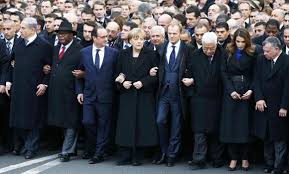
Muslim, Jewish & Christian heads of state join mass Paris march to honor victims

Million march in Paris (Credit: arabnews.com)
PARIS, Jan 11: Dozens of world leaders including Muslim and Jewish statesmen linked arms leading hundreds of thousands of French citizens on Sunday in an unprecedented march under high security to pay tribute to victims of militant attacks.

President Francois Hollande and leaders from Germany, Italy, Israel, Turkey, Britain and the Palestinian territories among others, moved off from the central Place de la Republique ahead of a sea of French and other flags.

Giant letters attached to a statue in the square spelt out the word Pourquoi?” (Why?) and small groups sang the “La Marseillaise” national anthem.

Some 2,200 police and soldiers patrolled Paris streets to protect marchers from would-be attackers, with police snipers on rooftops and plain-clothes detectives mingling with the crowd.

City sewers were searched ahead of the vigil and underground train stations around the march route are due to be closed down.

The silent march – which may prove the largest seen in modern times through Paris – reflected shock over the worst militant assault on a European city in nine years.

For France, it raised questions of free speech, religion and security, and beyond French frontiers it exposed the vulnerability of states to urban attacks.

Two of the gunmen had declared allegiance to al Qaeda in Yemen and a third to the militant Islamic State.

“Paris is today the capital of the world. Our entire country will rise up and show its best side,” said Hollande in a statement.

Seventeen people, including journalists and police, were killed in three days of violence that began with a shooting attack on the weekly Charlie Hebdo known for its satirical attacks on Islam and other religions as well as politicians.

It ended on Friday with a hostage-taking at a Jewish deli in which four hostages and the gunman were killed. Overnight, an illuminated sign on the Arc de Triomphe read: “Paris est Charlie” ( “Paris is Charlie”).

Several London landmarks including Tower Bridge were due to be lit up in the red white and blue colours of the French national flag in a show of support for the event in Paris. Fifty-seven people were killed in an militant attack on London’s transport system in 2005.

Hours before the march, a video emerged featuring a man resembling the gunman killed in the kosher deli. He pledged allegiance to the Islamic State insurgent group and urged French Muslims to follow his example.

German Chancellor Angela Merkel, British Prime Minister David Cameron and Italy Prime Minister Matteo Renzi were among 44 foreign leaders marching with Hollande.

U.N. Secretary-General Ban Ki-moon, Israel’s Benjamin Netanyahu – who earlier encouraged French Jews to emigrate to Israel – and Palestinian President Mahmoud Abbas were also present.

Immediately to Hollande’s left, walked Merkel and to his right Malian President Ibrahim Boubacar Keita. France has provided troops to help fight Islamist rebels there.

In a rare public display of emotion by two major-power leaders, cameras showed Hollande embracing Merkel, her eyes shut and forehead resting on his cheek, on the steps of the Elysee before they headed off to march.

After world leaders left the march, Hollande stayed to greet survivors of the Charlie Hebdo attack and their families. While there has been widespread solidarity with the victims, there have been dissenting voices.

French social media have carried comments from those uneasy with the “Je suis Charlie” slogan interpreted as freedom of expression at all cost.

Others suggest there was hypocrisy in world leaders whose countries have repressive media laws attending the march.

The official estimate on attendance is due to be announced later. A 1995 protest against planned welfare cuts brought some 500,000-800,000 people onto the streets of the capital, while a 2002 rally against the far-right National Front’s then leader Jean-Marie Le Pen afer he got into the run-off of that year’s presidential election drew 400,000-600,000.

Twelve people were killed in Wednesday’s initial attack on Charlie Hebdo, a journal know for satirising religions and politicians. The attackers, two French-born brothers of Algerian origin, singled out the weekly for its publication of cartoons depicting and ridiculing the Prophet Mohammad (PBUH).

All three gunmen were killed in what local commentators have called “France’s 9/11”, a reference to the September 2001 attacks on U.S. targets by al Qaeda.

The head of France’s 550,000-strong Jewish community, Roger Cukierman, the largest in Europe, said Hollande had promised that Jewish schools and synagogues would have extra protection, by the army if necessary, after the killings.

France’s Agence Juive, which tracks Jewish emigration, estimates more than 5,000 Jews left France for Israel in 2014, up from 3,300 in 2013, itself a 73 per cent increase on 2012.
Far-right National Front leader Marine Le Pen, whom analysts see receiving a boost in the polls due to the attacks, said her anti-immigrant party had been excluded from the Paris demonstration and would instead take part in regional marches.

In Germany, a rally against racism and xenophobia on Saturday drew tens of thousands of people in the eastern German city of Dresden, which has become the centre of anti-immigration protests organised by a new grassroots movement called PEGIDA.

A building of the newspaper Hamburger Morgenpost, which like many other publications has reprinted Charlie Hebdo cartoons, was the target of an arson attack and two suspects were arrested, police said on Sunday.

Turkish and French sources said a woman hunted by French police as a suspect in the attacks had left France several days before the killings and is believed to be in Syria.

French police had launched in an intensive search for Hayat Boumeddiene, the 26-year-old partner of one of the attackers, describing her as “armed and dangerous”.

Pak blast: 5 killed during football match in tribal region

Volleyball players killed (Credit: naharnet.com)
PESHAWAR, Jan 4: At least five people, including some football players were killed and 11 injured on Sunday in a bomb attack in Pakistan’s restive north western tribal region during a match, officials said.

A bomb exploded at a playground in Kadda Bazaar area of Kalya, the main town of Orakzai district today, killing five and injuring 11 people, Khiasta Akbar Khan, a local official said.

“Five people were killed and 11 injured in the bomb explosion,” he said.

The officials said that the attack took place when the spectators were watching a volleyball match but Radio Pakistan reported that a football match was in progress during the attack.

No militant outfit has taken the responsibility of the attack so far.

Nazim Ali, Waseem and Sarfraz Ali are some of the players among the dead, officials said.

Initial reports have shown that a planted device was used in the explosion.

The security forces have cordoned off the Shia-dominated area and started search operations.

Prime Minister Nawaz Sharif condemned the blast and deplored the loss of lives.

He emphasized on the government’s resolve to eradicate the menace of terrorism and extremism.

The bombing comes as the first major terror attack on Pakistani soil in the new year.

The country witnessed one of the deadliest attacks last month, when Taliban killed at least 149 people, mostly children at an army-run school in Peshawar.