Mastermind of Quetta Civil Hospital carnage killed, says Sarfraz Bugti

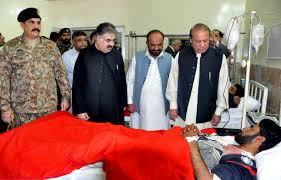
Security forces on Monday killed the mastermind of the Quetta Civil Hospital bombing along with four other high-profile militants during an operation in Balochistan’s Pishin district, said Balochistan’s Home Minister Mir Sarfaraz Ahmed Bugti.

“Jehangir Badini, mastermind behind the attack on Quetta’s Civil Hospital was killed during the operation,” said Bugti.

Bugti was talking to the media at a press conference in Quetta.

The militants were involved in a series of terrorist acts, including the attack at Hazara women and the murder of Barrister Amanullah Achakzai, the principal of University of Balochistan’s law college.

“So far three of the five terrorists have been identified,” the home minister said.
Balochistan Police Chief Ahsan Mehboob and other high-ups also flanked him during the press conference.

Security forces also claimed to have recovered a large quantity of arms and ammunition from the possession of the militants.

“Security forces recovered 30 to 40 kilogrammes of explosives, four suicide jackets and other weapons,” said Bugti.

One suspect was detained during the operation and was being interrogated by security forces.

The suicide bomber, who exploded himself in the hospital in Quetta on Aug 8, was also identified with the help of DNA tests.

His name was Ahmed Ali and he was a resident of Quetta, Bugti added.

Ali had targeted the emergency services ward at Quetta’s Civil Hospital, killing at least 70 people and leaving scores injured.

Tehreek-i-Taliban Pakistan (TTP) splinter group, Jamaat-ul-Ahrar (JuA), had claimed responsibility for the bombing, which occurred at the gates of the building housing the emergency ward.

The bomber struck as more than 100 mourners, mostly lawyers and journalists, crowded into the emergency department to accompany the body of Advocate Bilal Anwar Kasi.

IS commander killed near Islamabad: officials

ISLAMABAD, Nov. 18 — Pakistani anti-terrorism personnel killed a commander of the militant group Islamic State (IS) near the country’s capital of Islamabad on Friday, officials said.

Two members of the Counter Terrorism Department (CTD) were also injured when Ehsan Sattai, the IS commander, in exchange of firing, in the outskirts of Murree, a scenic town, some 50 kilometers from Islamabad.
Two IS activists escaped during the shootout, officials said.

The CTD members raided a house early morning on a tip off that the suspects were hiding there. The suspects were planning to attack media houses in Islamabad and the nearby Rawalpindi city, an official told the media.

The authorities recovered rifles, explosives, bomb-making equipment and suicide vest, he said.

The suspects refused to surrender and threw a hand grenade at the raiding party, the official said. Both sides exchanged fire.

IS Claimed Bombing Kills at Least 52 in Khuzdar Bombing

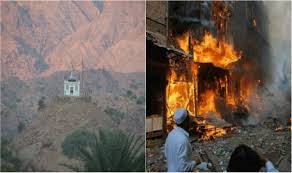
Quetta, Nov 13: A suicide bomber detonated his vest in the midst of devotees at a packed shrine in a remote area of Khuzdar district Saturday evening, killing at least 52 and maiming more than 100. Officials fear the death toll might go up as rescuers were scrambling to reach the shrine, located in the dirt-poor mountainous region where medical facilities are limited.

The teenage bomber targeted a crowd of devotees performing dhamaal (devotional dance) at the shrine of Sufi saint Shah Noorani, some 750 kilometres south of provincial capital Quetta. “The bomber appeared to be 14 to 16 years old,” said Muhammad Hashim Ghalzai, the commissioner of Kalat division, of which Khuzdar is a district.

At least 45 dead, over 100 injured in Khuzdar’s Shah Noorani shrine explosion

SSP Jafar Khan said that around 1,000 devotees were present in the shrine when the bomber detonated the explosives strapped to his body. Provincial Home Minister Sarfraz Bugti confirmed 43 fatalities, though he could not provide a precise figure for those injured.

Rescue officials, however, confirmed to The Express Tribune that at least 50 devotees had been killed and more than 100 wounded in the deadly blast. They added that the casualties included a number of women and children.

According to witnesses and survivors, the bombing took place in a place reserved for the daily ritual of dhamaal. “Every day at sunset, there is a dhamaal session here and a large number of devotees turn up to perform the devotional dance to drumbeats,” he told The Express Tribune by phone.

The custodian of the shrine, Nawaz Ali, said 1,000 to 1,500 devotees participated in the dance on the night between Saturday and Sunday.

Chief military spokesperson Lieutenant General Asim Saleem Bajwa said troops and medical teams had been dispatched but that “difficult terrain and long distance” were hampering their progress.

He said that 20 ambulances and 50 soldiers were about to reach the site, while a further 45 ambulances and 100 troops were also on their way, along with medical teams. A military helicopter would attempt evacuations at night, he added, but medical teams could not access the area by plane as there were no air strips close by.

Balochistan government spokesman Anwarul Kakar said Chief Minister Nawab Sanaullah Zehri was personally monitoring the situation.

He added that the casualties were being ferried to hospitals in the nearby industrial town of Hub and the port city of Karachi, where a state of emergency has been declared.

Federal Minister for Ports and Shipping Mir Hasil Khan Bizenjo said the suicide bombing could be a reprisal for the killing of a senior commander of a banned militant organisation. Jundullah chief Saqib, alias Arif alias Anjum Abbas, was taken down in a gunfight with security forces in Hub on Friday. His wife and nine-year-old son were also injured in the clash.

The carnage came a day before Prime Minister Nawaz Sharif was scheduled to flag off the first shipment of trade goods from Gwadar port to international markets, marking the historic launch of trade activity through the China-Pakistan Economic Corridor (CPEC).
“Balochistan has become frontline state to bear the cost imposed on Pakistan for CPEC and India’a non-conventional warfare,” Jan Achakzai, special assistant to the chief minister, wrote on Twitter while commenting on the shrine bombing. However, Ports and Shipping Minister Bezenjo believes it could be linked to sectarianism and not CPEC.

A woman mourns the death of relative in a mortuary in Karachi on November 12, 2016, following the arrival of those killed in bombing at a Sufi shrine

Home Minister Sarfraz Bugti, who briefed the media on the deadly blast in Gwadar, said that the provincial government has no helicopters to ferry the casualties from the site. “It’s not possible to fly helicopters for rescue in pitch darkness,” he added. “We have sent ambulances to the site.”

Chief Minister Zehri, who was in Gwadar for Sunday’s CPEC ceremony, directed that all available resources be utilised to ferry the injured to hospitals. “Terrorists cannot deter us with such attacks. Action against them will continue unabated,” he said while strongly condemning the bloody attack.

President Mamnoon Hussain and Prime Minister Nawaz Sharif strongly condemned the bombing in separate statements. “The government is determined to eliminate terrorism and extremists from the country,” Mamnoon said in a statement expressing sympathy with the victims and their families.

A statement from Sharif’s office said the prime minister called for the “best medical treatment” to be given to the wounded

At least 30 killed, 70 injured in blast at Khuzdar shrine

At least 30 people were killed and 70 were injured on Saturday in an explosion at the shrine of Shah Norani in Khuzdar district of Balochistan, DawnNews reported.

“30 people have been killed and 70 injured in the blast including women and children,” said Tehsildar Javed Iqbal. He added women and children are among the casualties.

The explosion took place at the spot where the dhamaal is performed, within the premises of the shrine.

Security forces have reached the spot of the incident. Emergency services are facing difficulty in reaching the site of the incident due to its remote location and poor communication infrastructure. The shrine is also located in hilly terrain, further adding to the difficulties being faced by emergency services.

No group has yet taken responsibility of the attack.

“People who are critically injured in the blast will be transported to Karachi,” said Balochistan Home Minister Mir Sarfaraz Ahmed Bugti.

No major hospital is located near the shrine, and the injured will be shifted to Karachi for further treatment. Reportedly the injured are being shifted in private vehicles.

While answering a question regarding security measures in Balochistan, Bugti said “If there is security lapse on part of the state, those responsible will be held accountable”.

The shrine is frequented by a large number of devotees on Friday, and is visited by people from across the country. Iranian nationals also frequent the shrine.

Sindh Chief Minister Murad Ali Shah has expressed his grief over the killing of innocents and condemned the blast at the shrine of Shah Noorani.

Earlier attacks
In October, heavily-armed militants wearing suicide vests stormed a police academy in Quetta, killing at least 61 people and wounding at least 117.

Three gunmen burst into the sprawling academy, targeting sleeping quarters home to some 700 recruits, and sent terrified young men aged between 15 and 25 fleeing.

Communication intercepts showed the attack was carried out by Al-Alimi faction of the Lashkar-i-Jhangvi (LJ) militant group.

In August, a suicide bomber targeted the emergency services ward at Quetta’s Civil Hospital killing at least 70 people and leaving scores injured, majority of those killed were lawyers.

Tehreek-i-Taliban Pakistan (TTP) splinter group, Jamaat-ul-Ahrar (JuA), had claimed responsibility for the bombing which occurred at the gates of the building housing the emergency ward.

Balochistan has been experiencing incidents of violence and targeted killings for over a decade. More than 1,400 incidents targeting the minority Shia and Hazara community have taken place in the province during the past 15 years.

The largest province of the country by area, is home to a low-level insurgency by ethnic Baloch separatists. Al Qaeda-linked and sectarian militants also operate in the region. The province shares borders with Afghanistan and Iran.

Pakistani cadets ran, jumped from windows to flee militants

QUETTA, Pakistan — Survivors of a Monday night attack that killed 61 people at a Pakistani police academy described chaotic scenes of gunfire and explosions, with militants shooting anyone they saw and cadets running for their lives and jumping from windows and rooftops.

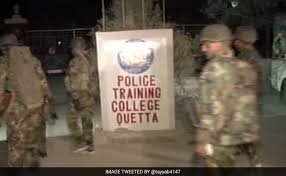
A Taliban splinter group and an affiliate of the Islamic State group made competing claims of responsibility for the four-hour siege late Monday at the Police Training College on the outskirts of the southwestern city of Quetta.

Most of the dead and the 123 wounded were recruits and cadets, said Wasay Khan, a spokesman for the paramilitary Frontier Corps. Of the three militants who carried out the attack, two blew themselves up with explosive vests and the third was killed by army gunfire, he added.

As the nation reeled and sought to understand how militants were able to carry out such violence, many Pakistanis were reminded of a bloody 2014 attack by the Taliban on an army-run school in Peshawar in which more than 150 people, mostly children, were killed.

Broadcasters on Tuesday showed the aftermath of the attack on the Quetta academy: scorched windows and floors littered with the shoes of the dead and wounded.

Prime Minister Nawaz Sharif and the army chief Gen. Raheel Sharif rushed to the scene to meet with survivors, who spoke of the horrors of the surprise attack on about 700 cadets, trainees, instructors and other staff that began about 11:30 p.m.

Cadet Asif Hussain said he had been asleep when gunshots broke out.

“We hid ourselves beneath cots. We had in our mind that if we didn’t lock ourselves inside the hall, they will kill us,” he said.

The attackers kicked at their door but failed to open it, Hussain said. The gunmen instead fired on them from a window, wounding two cadets before moving to a nearby dorm.

Shortly after entering, one of the attackers detonated his vest inside a hall after firing at cadets.

In the chaos, cadets and trainers ran for their lives, jumping through windows and off rooftops to try to escape.
Troops arrived and “it gave us confidence that we are safe now,” Hussain said.

Another recruit, his face covered in blood, told a TV station that the gunmen shot at anyone they saw.
“I ran away, just praying God might save me,” he said.

Another witness, Faisal Khan, said he had been chatting with friends when the shooting began.
“We closed the main door and switched off lights,” he said.

While most of the casualties were from the academy, some of the soldiers who responded to the assault also were killed, said Shahzada Farhat, a police spokesman in Quetta, the capital of Baluchistan province.

The Islamic State group posted a claim of responsibility on the group’s media arm, the Arabic-language Aamaq news agency. The claim was not confirmed by Pakistani officials and IS did not offer any previously unknown details about the attack.

A little-known breakaway faction of the Pakistani Taliban, called the Hakimullah group, also claimed responsibility.

In addition, Maj. Gen. Sher Afgan, head of the Pakistani paramilitary force that is primarily responsible for Baluchistan province, said the attackers had received instructions from commanders in neighboring Afghanistan and were most likely from the banned militant group Lashker-e-Jhangvi Al-Almi, which is affiliated with al-Qaida and the Taliban. The Sunni militant group has mainly targeted minority Shiite Muslims whom its members consider to be infidels.

Pakistani officials said they had received intelligence reports that militants had entered Baluchistan province, but there was no indication of possible targets.

Earlier, Interior Minister Chaudhry Nisar Ali Khan, without naming Afghanistan, said enemies of Pakistan were planning attacks in Pakistan from a neighboring country.

Kabul condemned the attack and dismissed the allegations that the assault was planned from bases inside Afghanistan.

“Afghanistan is the biggest victim of terrorism and denounces all terrorist attacks,” said Mohammad Haroon Chakhansuri, spokesman for Afghan President Ashraf Ghani.

Pakistan maintains that militants fleeing army operations in its tribal regions regularly flee over the border and find safe haven in Afghanistan. For his part, Ghani has criticized Pakistan, saying it has provided shelter to the Taliban, and in particular, the violent Haqqani network.

For over a decade, Baluchistan has been the scene of a low-intensity insurgency by nationalist and separatist groups demanding a bigger share in the regional resources.

Pakistan has carried out several military operations against militants in its lawless tribal regions near Afghanistan, including a major push that began in mid-2014 in North Waziristan, a militant base. The militants have killed tens of thousands of people, seeking to install their own harsh brand of Islamic law.

Later Tuesday, the flag-draped coffins of the slain cadets and troops began being moved from Quetta to their families for burial.

One of the dead, army Capt. Rooh Ullah, was given Pakistan’s fourth-highest military award for killing one of the militants before he was slain. Sharif, the army chief, attended a service for him in Quetta before the body was flown to his hometown in the northwest.

Ullah’s father told a local TV station that he was proud his son died a “martyr.”

In Islamabad, minority Christians lit candles for those killed. They chanted slogans condemning violence and vowing to support the victims.

35 killed, over 100 injured as militants storm police training centre in Quetta

At least 35 security personnel were martyred, and over 100 others injured as terrorists stormed a police training centre on the edge of the provincial capital late Monday night.

Three terrorists opened entered the New Sariab Police Training College, some 13 kilometres away from Quetta city. The terrorists headed straight for the hostel where around 250 police recruits were sleeping.

Balochistan Home Minister Mir Sarfaraz Ahmed Bugti told reporters assembled at the
site early Tuesday that the sprawling compound had been attacked by three militants equipped with suicide jackets, revising down an earlier estimate of “five to six” assailants.

“They first targeted the watch tower sentry, and after exchanging fire killed him and were able to enter the academy grounds,” he said. “At least 20 were killed but this figure isn’t final – we’ll confirm it in the morning,” he said, putting the provisional number of injured at 65.

He added, “Frontier Corps’ Quick Responce Force (QRF) wing responded along with Anti-Terrorist Force (ATF) and [Pakistan Army’s] Light Commando Battallion…one terrorist was killed while two of them exploded”.
Terrorists belonged to Lashkar-e-Jhangvi

Major General Sher Afgan, chief of the paramilitary Frontier Corps in Balochistan, which led the counter-operation, said “the attack was over in around three hours after we arrived.”

He added that the militants belonged to the Al-Alimi faction of the Lashkar-e-Jhangvi militant group – which is affiliated with the Pakistani Taliban. “They were in communication with operatives in Afghanistan,” he said. The group itself has not claimed the attack.

Bugti said the compound was housing some 700 recruits at the time of the attack, hundreds of whom were rescued.
The area was plunged into darkness when the counter-offensive was launched, while security personnel created a cordon and ambulances zoomed in and out, taking the injured to hospitals. Military helicopters circled overhead.
Two FC personnel gunned down in Quetta

Bugti said the law enforcers cleared the operation within four hours, adding that “99% the operation is complete but the forces will remain in the centre till daylight”.

The training college is situated on Sariab Road, one of the most sensitive areas of Quetta. While militants have been targeting security forces in the area for almost a decade, the training college has come under attack in 2006 and 2008.

The casualties were driven to different hospitals of the city where a state of emergency was declared. Provincial authorities, in the meantime, also made arrangements to fly those with critical wounds to hospitals in Karachi.
Chief Minister Nawab Sanaullah Zehri said that the terrorists attacked the police centre, which is located on the edge of Quetta, after they failed to hit a target in the provincial capital where security was on high alert following intelligence information about a possible attack three or four days back.

The attack came a day after separatist gunmen on a motorcycle shot dead two coast guards and a civilian and wounded a shopkeeper in Gwadar.

In August, a suicide bombing at a Quetta hospital claimed by the Islamic State group and the Jamaatul Ahrar faction of the Pakistani Taliban killed 73 people, including many of the city’s lawyer community who had gone there to mourn the fatal shooting of a colleague.

Balochistan is also a key region for China’s ambitious $46 billion China-Pakistan Economic Corridor (CPEC) infrastructure project linking its western province of Xinjiang to the Arabian Sea via Pakistan.

Pakistan blames India for fuelling terrorism in Balochistan in an attempt to sabotage CPEC. A senior officer of Indian navy, Kulbushan Yadav, was arrested from Balochistan earlier this year.

JIT To Investigate Hazaras Murders in Quetta

QUETTA, Oct 9: A day after gunmen shot dead four women from the Shia Hazara community, the Balochistan administration decided to form a joint investigation team to probe into the grisly violence which officials say violates all tribal norms of the province.

A high-level huddle reviewed the security situation following Tuesday’s deadly assault on a bus which was en route to Hazara Town, an overwhelmingly Shia neighbourhood, on the edge of Quetta. Three gunmen riding a bike intercepted the vehicle on Kirani Road in the Podgali area.

Two of them boarded the section reserved for women and shot five women after confirming they were from the Hazara community. Four of them died on the spot while one was injured in the attack which was apparently motivated by sectarian hatred.

Attendees at Wednesday’s conclave included Home Minister Sarfaraz Bugti, Chief Secretary Saif Ullah Chatta, IGP Ahsan Mehboob, DIG Quetta Abdul Razaq Cheema and civil and other military officials. The meeting also decided to improve security arrangements by putting up closed-circuit television cameras in the city. IGP Mehboob updated participants on the investigations.

Meanwhile, Sariab police registered a quadruple murder case against unidentified gunmen. Investigations are under way.

Separately, the Hazara Democratic Party staged a protest outside the Quetta press club against the killing of the women of their community.

HDP Secretary General Ahmed Ali Kuhzad led demonstrators. Participants expressed concern over targeted attacks against their community. Killing women is a violation of tribal and Islamic values which is condemnable, they added.

“We want the government to tell us where did the attackers come from and how did they manage to commit the grisly violence amid heightened security,” Kuhzad said. The Hazara community leaders also criticised the intelligence and security agencies for their sheer failure to preempt the attack.

The protesters called upon the United Nations and rights groups to take notice of the ‘genocide’ of their community in Balochistan.

A top military commander, meanwhile, called for unity among all segments of society to defeat the enemy’s designs.

“We will have to demonstrate unity to defeat our enemy who is hatching conspiracies to divide us,” Lt Gen Aamer Riaz, Commander Southern Command, said during a visit to an Imambargah where he offered Fateha for the victims of Tuesday’s attack on a moving bus.

Lt Gen Riaz visited Nichari Imambargah in Quetta Wednesday to offer condolences to the aggrieved community. He promised that the perpetrators of the cowardly attack would not go unpunished. “They will be brought to justice at any cost,” he added. “Stern action will be taken against those involved in targeted killings of innocent people.”

He called upon all segments of society to maintain unity among their ranks in order to foil the evil designs of the enemy who wanted to divide the society.
Published in The Express Tribune, October 6th, 2016

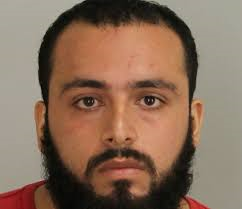
Ahmad Khan Rahami spent time at Pakistan seminary tied to Taliban

Suspect in New York and New Jersey bombings spent three weeks in 2011 at Kaan Kuwa Naqshbandi madrassa, source says, amid questions of terrorism links. Ahmad Khan Rahami, the man suspected of placing bombs in New York and New Jersey last weekend, spent time in a religious seminary in Pakistan closely associated with the Afghan Taliban, according to a government official.

The 28-year-old, who was born in Afghanistan but became a US citizen, spent time at the Kaan Kuwa Naqshbandi madrassa on his two visits to Pakistan, a security official working for the government of Balochistan province told the Guardian.

Rahami spent three weeks in 2011 receiving “lectures and Islamic education” at the school in Kuchlak, a dusty cluster of villages 20km north of Quetta, the provincial capital of Balochistan, he said.

Kuchlak is a well-known hub for the Taliban, the Islamist movement that has waged a 15-year insurgency against local and Nato forces in nearby Afghanistan. It is home to many madrassas, the seminaries intimately linked with the Taliban, originally a movement of religious students.

US officials have revealed basic details about Rahami’s two visits to Pakistan, the first in 2011 when he spent a couple of months in Quetta and got married and almost a year in 2013 when he also made a car journey to Afghanistan.

But very little information has emerged from inside Pakistan about what Rahami did during his visits.

The government official, who did not wish to be named because he was speaking about a highly sensitive subject, said Pakistani security agencies have tried to “hide all the details of his visits to Quetta” and keep as much information as possible out of the media.

Rahami, he said, also visited other sensitive areas in the province, including Surkhab and Nushki, where former Taliban leader Mullah Akhtar Mansoor was killed by a US drone in May.

Pakistan has long been accused of playing a “double game” with the US, both supporting the Nato counterinsurgency in Afghanistan but also allowing the Taliban to use its territory a vital rear base.

A western expert on the Taliban said Abdul Samad, the Afghan owner of the Kuchlack madrassa, was an important local figure.

“The madrassa is a place where you have multiple Afghan Taliban going there and hanging out in [Samad’s] court, as well as active ISI officers,” he said, referring to the Inter-Services Intelligence (ISI) directorate, an army-run spy agency.

“Samad is the kind of person who should have been shut down long ago but enjoys a high degree of protection,” he said.

Despite being part of the mystical, Sufi strain of Islam which many hardliners abhor, Samad is highly respected by the movement, he said.

A Karachi-based cleric told the Guardian the school is a sizeable operation, with more than 200 students.

Despite several attempts to reach Samad for comment, the Guardian was unable to make contact with the madrassa.

Although the Taliban’s leadership is often described as the “Quetta Shura” many analysts consider Kuchlak to be the actual command centre for many senior members of the movement.

The Taliban’s white flags have been reportedly seen flying in the town’s graveyards and Shahbaz Taseer, a Pakistani kidnapped by militants in Lahore in 2011 and held for more than four years, was released in Kuchlak in March by the Taliban.

Rahami’s father Mohammad Rahami has said his son had grown increasingly interested in Islamist movements, watching Taliban and al-Qaida videos, and listening to their poetry. Rahami had also showed sympathy towards the Taliban, a former employer said.

Given the Taliban has long avoided entanglement in international jihad, insisting it is only interested in forcing foreign troops out of Afghanistan, it is unlikely Rahami was operating under instruction when he planted his bombs. A notebook found on Rahami when he was captured after a shootout on Monday suggests he may have been inspired by the Islamic State group.

But the claim Rahami attended an important Taliban-sympathising madrassa could be embarrassing for Pakistan at a time the country is under intense international criticism, not least from India which accused Pakistan this week of hosting “the Ivy League of terrorism”.

Anwar-ul-Haq Kakar, a spokesman for the Balochistan government, said that because more than 1 million Afghan refugees live in the province it is “difficult to know what sort of activity is being conducted by some individuals”.

“Filtering out the terrorist influences in such a huge community is a very difficult task,” he said.

Nor could the government be expected to be aware of a US traveller like Rahami who has “deep links in the host community”.

“If he was not spotted by the CIA and FBI or Homeland Security, then this shows that it is really global problem,” he said.

Three mysterious incidents in New York, New Jersey and Minnesota raise fears of terrorism

NEW YORK, Sept 18 — Authorities are investigating three incidents — explosions in New York and New Jersey and a stabbing attack in Minnesota — that took place within a 12-hour period on Saturday and sowed fears of terrorism.

Officials said they could identify no definitive links between the disturbances — a bombing that hurt 29 in Chelsea, an explosion along the route of a scheduled race in Seaside Park, N.J., and a stabbing that wounded nine in a St. Cloud, Minn., mall.

But each incident in its own right raised the possibility of terrorist connections, prompting federal and local law enforcement to pour major resources into determining exactly what happened and why.

A news agency linked to the Islamic State claimed Sunday that the suspect in Minnesota, who was fatally shot by an off-duty police officer, was “a soldier” of the militant group, though there was no confirmation of what connection the man may have had.

A claim of responsibility is no guarantee that the terrorist group directed or even inspired the attack, and authorities said they were still exploring a precise motive. The terrorist group made no similar claims about the New York and New Jersey incidents.

In New York, authorities said there was no evidence that the mysterious Saturday-night explosion was motivated by international terrorism, though they confirmed that the bombing was intentional.

“This is the nightmare scenario,” Gov. Andrew M. Cuomo (D) said.

The governor said nearly 1,000 police officers and National Guard troops would be sent to bus stops, train stations and airports, as investigators with the New York Police Department, the FBI, and the Bureau of Alcohol, Tobacco, Firearms and Explosives worked to identify the person or people responsible for the explosion.

A federal law enforcement official said investigators were still aggressively probing if the New York and New Jersey incidents were related, though the official cautioned that as of Sunday afternoon they had not tied them together definitively.

Those injured in the Saturday-night blast in Chelsea had been released from hospitals by Sunday.
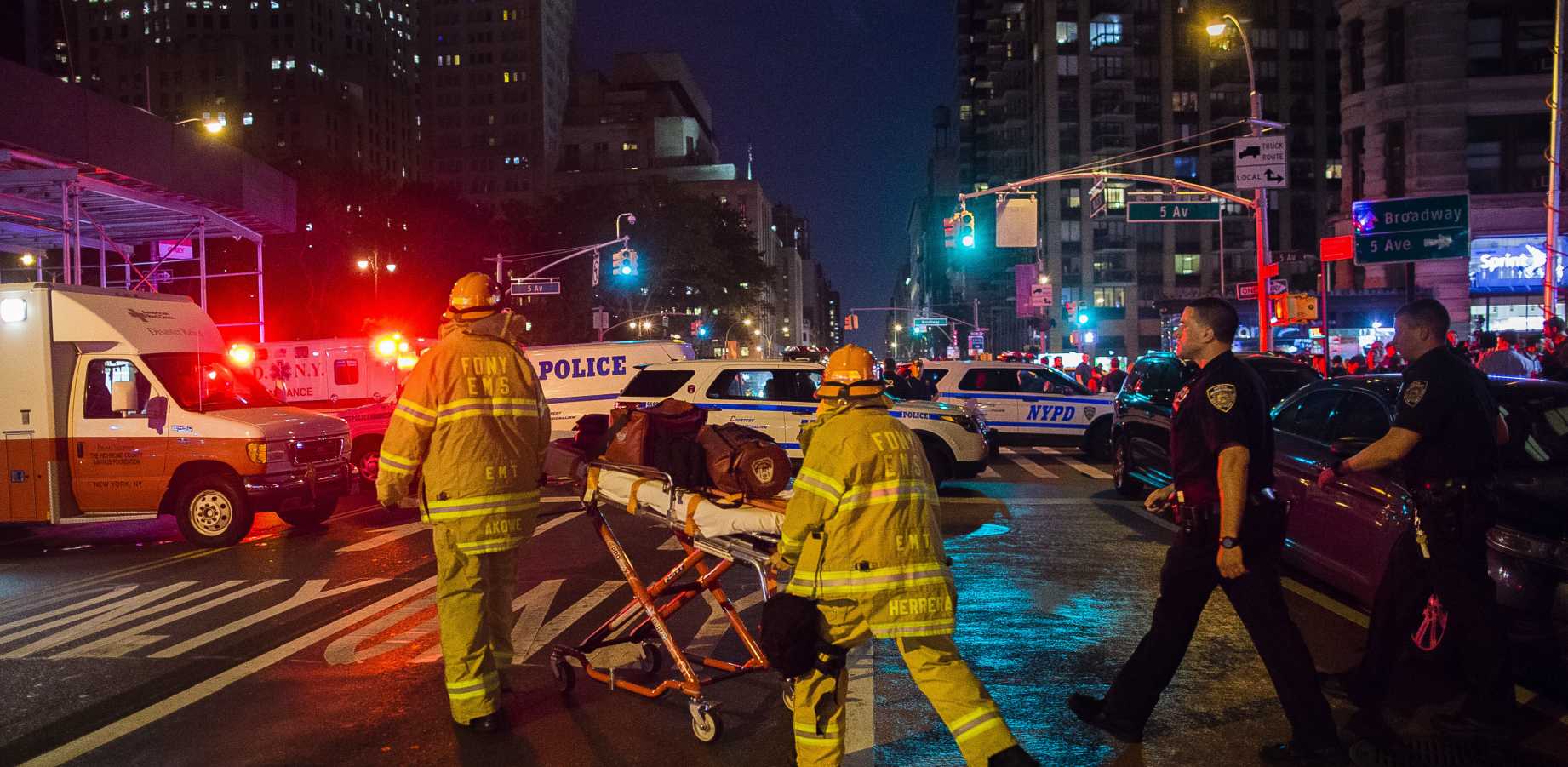
The Manhattan explosion occurred about 8:30 p.m. Saturday in the area of West 23rd Street between Sixth and Seventh avenues, injuring 29 people as it hurled glass and debris into the air, officials said. Surveillance video showed passersby running to get away from the blast, and investigators said they would comb through that and older footage to try to identify those responsible.

Authorities said the explosion was produced by some type of bomb, and they posted on Twitter a photo of what appeared to be a mangled Dumpster or garbage container. Masum Chaudry, who manages a Domino’s Pizza near the scene, said the explosion “shook the whole building” and caused “total chaos.”

Cuomo said, “When you see the amount of damage, we really were very lucky there were no fatalities.”
A short time after the explosion, just a few blocks away, police found another potentially explosive device, which looked like a pressure cooker with wiring, according to a law enforcement official who spoke on the condition of anonymity to discuss the ongoing investigation. Both that device and the remnants of that which exploded will be sent to the FBI’s lab in Quantico, Va., for analysis, authorities said. Pressure cookers were used in the two bombs detonated at the Boston Marathon in 2013.

Sara Miller, who was at a restaurant two blocks from the site of explosion, said she heard the blast, then saw people scrambling to get away. “I was here on September 11th so I thought, maybe, you know, I was being paranoid … but then I saw people running,” said Miller, 42. “It is a scary time because you never know when it will happen again.”

Officials differed on whether to call the Saturday night explosion an act of terrorism. Cuomo said: “It depends on your definition of terrorism. A bomb exploding in New York is obviously an act of terrorism, but it’s not linked to international terrorism.”

City, police and FBI officials said it was too early to determine any type of motivation, though they insisted they would not shy from labeling the crime an act of terror if it became appropriate to do so.

“We do not know the motivation. We do not know the nature of it. That’s what we have to do more work on,” said New York City Mayor Bill de Blasio, who shied away from labeling the attack as terrorism.

The incident comes as foreign leaders, including many heads of state, are heading to Manhattan for the United Nations General Assembly. Secretary of State John F. Kerry arrived Saturday, while Obama is scheduled to head to the city on Monday.

This annual meeting — held more than two miles from the site of the explosion in Chelsea — is traditionally a challenging time for New York, as many roads are shut down and the heavy security leads to traffic jams.

Officials said they had already prepared to beef up security, and now they would intensify those efforts.
On the campaign trail, the Democratic and Republican presidential candidates offered varied reactions to news of the incident. As early reports circulated Saturday night, Donald Trump declared that a “bomb went off” in New York City and said: “We better get very, very tough. We’ll find out. It’s a terrible thing that’s going on in our world, in our country and we are going to get tough and smart and vigilant. … We’ll see what it is. We’ll see what it is.”

Hillary Clinton condemned what she characterized as the “apparent terrorist attacks” in Minnesota, New Jersey and New York.

“This should steel our resolve to protect our country and defeat ISIS and other terrorist groups,” Clinton said, using an acronym for the Islamic State. She added, “I have laid out a comprehensive plan to do that.”

Moyed Abu, 28, a manager of OMG, a jeans store on 7th Avenue, said he and two employees were in the store at the time of the blast. Abu said they assumed initially it was construction noise — but immediately saw dozens of people, though not everyone, running in both directions, Abu said.

“I saw that some people started to take pictures,” he said. “In this situation, it’s better to just leave! It’s not safe!”

The Chelsea explosion occurred about 11 hours after a pipe bomb exploded in a Jersey Shore garbage can, shortly before a scheduled charity 5K race to benefit Marines and Navy sailors. No one was hurt.

Officials said that device, too, would be sent to the FBI lab in Quantico, though Cuomo noted the pipe bombs used in New Jersey “appear to be different” than those in New York.

New York Police Commissioner James O’Neill said officials would explore a possible connection between the two cases but noted, “At this point, there doesn’t appear to be one.”

Two law enforcement officials said residue of tannerite — used primarily for making exploding targets for firearms practice — was found in material that had detonated in New York. The officials said a cellphone was used in both the New York and the New Jersey cases.

In another incident Saturday night in Minnesota, a man who made reference to Allah and asked at least one person whether he or she were Muslim stabbed and wounded nine people inside a Minnesota mall. He was shot to death by an off-duty police officer. On Sunday, the Islamic State claimed that the attacker was “a soldier of the Islamic State” and “carried out the operation in response to calls to target the citizens of countries belonging to the crusader coalition.”

A law enforcement official said Sunday that officials were examining all the devices, reviewing surveillance footage and combing through social media. Another official said that there was no clear suspect as of Sunday afternoon but that the investigation was in its very early stages.

“Whoever placed these bombs, we will find, and they will be brought to justice,” Cuomo said.

Some New Yorkers, though, said they felt uneasy waiting. Leonard Glass, 55, who walked 20 blocks from the upper West Side of Manhattan to the site of the explosion early Sunday afternoon, said that no one had taken responsibility for the explosion made it worse.

“I hope this is something else,” he said. “Not terrorism.”

Zapotosky and Wang reported from Washington. Renae Merle in New York and Mark Berman, Ellen Nakashima, Kristine Guerra, Sari Horwitz, Sean Sullivan, Steven Overly, John Wagner and Julie Tate contributed to this report, which has been updated.
The Afghan War Quagmire

Eight years ago, President Obama pledged to wind down the war in Iraq and redouble efforts to defeat the Taliban in Afghanistan. “As president, I will make the fight against Al Qaeda and the Taliban the top priority that it should be,” he said during a campaign speech. “This is a war that we have to win.”

Lasting peace, Mr. Obama said, would depend on not only defeating the Taliban but helping “Afghans grow their economy from the bottom up.” He added, “We cannot lose Afghanistan to a future of narco-terrorism.”

Now, at the twilight of his presidency, these goals are receding further into the distance as America’s longest war deteriorates into a slow, messy slog. Yet despite this grim reality, there has been no substantive debate about Afghanistan policy on the campaign trail this year. Neither Donald Trump nor Hillary Clinton has outlined a vision to turn around, or withdraw from, a flailing military campaign.

The war in Afghanistan has cost American taxpayers in excess of $800 billion — including $115 billion for a reconstruction effort, more than the inflation-adjusted amount the United States spent on the Marshall Plan. The Afghan government remains weak, corrupt and roiled by internal rivalries. The casualty rate for Afghan troops is unsustainable. The economy is in shambles. Resurgent Taliban forces are gaining ground in rural areas and are carrying out barbaric attacks in the heart of Kabul, the capital. Despite an international investment of several billion dollars in counternarcotics initiatives, the opium trade remains a pillar of the economy and a key source of revenue for the insurgency.

“It does not appear that the Afghan forces in the near future will be able to defeat the Taliban,” said a senior administration official who spoke about the White House’s appraisal of the campaign on the condition of anonymity. “Nor is it clear that the Taliban will make any significant strategic gains or be able to take and hold on to strategic terrain. It’s a very ugly, very costly stalemate.”

The administration’s current strategy commits the United States to keeping roughly 8,400 troops in Afghanistan for the foreseeable future and spending several billion dollars each year subsidizing the Afghan security forces. The goal has been to coax the Taliban to the negotiating table by beating them on the battlefield, a prospect that now seems remote.

The next American president may be tempted to adopt the Obama policy and hope for the best. That would be a mistake. At the very least, the next administration needs to carry out a top-to-bottom review of the war, one that unflinchingly addresses fundamental questions.

One such question is whether the Afghan Taliban — an insurgency that has never had aspirations to operate outside the region — is an enemy Washington should continue to fight. American forces started battling the Taliban in 2001 because the group had provided safe haven for Al Qaeda, which was based there when it planned the Sept. 11 attacks. While Al Qaeda has largely been defeated, the Taliban has proved to be extraordinarily resilient.

Another question is what it would take to bring the conflict to an end — either by enabling Afghan forces to defeat the Taliban or by bringing them into the political fold — and whether that is something the United States is realistically capable of achieving.

This will not be an easy discussion. A precipitous drawdown from Afghanistan may well have calamitous consequences in the short run, exacerbating the exodus of refugees and expanding the area of ungoverned territory in which extremist groups could once again subject Afghans to despotism and plot attacks on the West.
But American taxpayers and Afghans, who have endured decades of war, need a plan better than the current policy, which offers good intentions, wishful thinking and ever-worsening results.