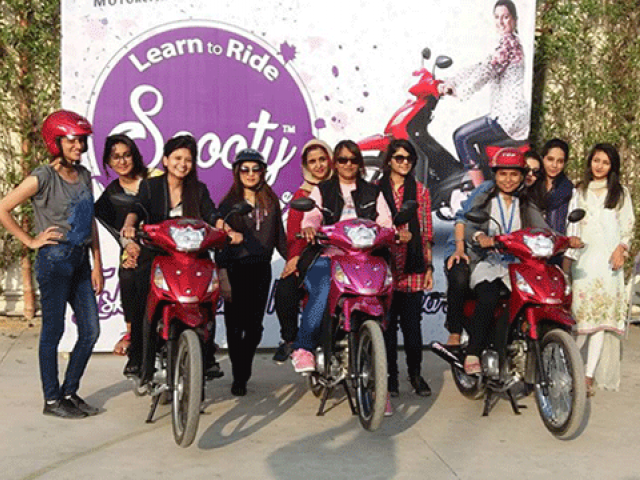
Scooty revolution: Women learn to ride bikes on Karachi’s mean streets

She was perhaps the only one riding on two wheels in a world full of men. But, that was then. Now, within days, more than a thousand women have filled the application form to learn how to drive a scooty from Mehwish Ekhlaque. The applications are queuing up and they don’t have space for more.

“It has been my dream that a group of women ride with me, both for passion and as a means of commuting,” says Ekhlaque. Social media advertisements of the scooty driving workshops for women, advertised by Super Power Scooty, show Ekhlaque in her element. Helmet on, hair flowing out of it, with the protective gear on, totally in control – she is the image of an empowered woman that so many females in Pakistan want to emulate.

Faiza Saroj, a teacher, is one of Ekhlaque’s first students. Her husband is helping her get a grip of the scooty during recess. “This is a great new initiative. The stigma associated with women driving motorbikes has to end. We need a culture of acceptance for women who want to commute on motorbikes. I would love my daughter to learn to ride motorcycles too,” she says.Yet, stigmas are not easy to end, and the ride has not been easy for Ekhlaque as one of Karachi’s very few women who ride motorbikes regularly. While male-dominated groups of motorcycling aficionados have been encouraging and supportive, she struggles with the idea that motorcycling, both as a hobby and as a means of transport, remains limited to men. “A woman deserves the same sense of control a man gets when he kick-starts a motorbike. I belong on a motorbike. It makes me feel alive,” she expresses. However, Ekhlaque has had to be parts of all-men groups to take morning and evening rides and out-of-city motorcycle trips. “I don’t mind that, but we have to come to a point where women can also do this on their own,” she says.

In a city of over 20 million that still does not have a mass transit system, and a growing number of women pursuing professional careers, it is the need of the day that women have the option of using motorbikes as a means of transport. Yet, Karachi, a city where millions of motorcycles are registered and a much bigger number still unregistered, the number of women riding motorbikes can be counted on fingers. “I’m not learning this for recreation; it’s a need. Do people realise how difficult it is for girls who have to commute every morning from North Karachi to Saddar for work, changing many busses on way?” says Sarwat Muzammil. This young IT entrepreneur is a natural, according to Ekhlaque, and has learnt to ride the scooty within a day. “My father was initially reluctant; he was worried about my safety,” says Muzammil. “But once he met Mehwish, and we explained to him the reasons, he relented, and is in fact now encouraging me,” she shares.

Umair Malik and Haris Khan from the Pirani Group are part of the communications team that designed and marketed these workshops, and the response, they say, is more encouraging than they anticipated. “Mehwish is incredible. We were just testing the waters initially. Within days, we have realised the immense potential that lies in this,” says Malik.
The workshops are going to be conducted for three days every week – Friday, Saturday and Sunday – for the month of December at different locations in the city to enable the maximum number of women to benefit from the opportunity. And they are free of cost. They include both theory and practice. “Traffic laws for riding a motorcycle and safety protocol are part of the workshop,” confirms Ekhlaque.

However, these workshops are on for just a month, and each student will get a chance to learn for only two to three days. They will, at best, just give women a taste of the pleasure of riding a scooty, says Ekhlaque, who feels that she needs at least 10 to 15 classes with each student to bring them to a point that they are able to ride motorbikes confidently on their own in any part of the city, even during rush hours. “My dream is to have a motorcycling institute teaching women how to maneuver two-wheelers. But for that, I need support. I am hoping against hope that someone comes forth and invests in this cause. I need others who believe in this to join hands with me,” she expresses. The time is right. The demand is there. And so is the teacher. Are there any takers?

Pakistan to deport National Geographic ‘Afghan Girl’

Peshawar, Nov 4: An Afghan woman who appeared on a National Geographic cover when she was 12 will be sent back to the war-stricken homeland she fled decades ago, after a Pakistani court ordered that she be deported.

Sharbat Gula, whose striking green eyes were captured in an image taken by photographer Steve McCurry in a refugee camp in Pakistan in 1985, was arrested last week.

She was accused of living in Pakistan on fraudulent identity papers after a two-year investigation, one of thousands of refugees using fake ID cards.

Gula pleaded guilty on Friday, her lawyer said, and the court sentenced her to 15 days’ imprisonment and a 110,000 Pakistani rupee (£1,319) fine.

“She has already spent 11 days in jail,” Mubashar Nazar said. “We had requested the court release her on humanitarian grounds.”

An Afghan consulate official said the fine imposed on Gula had been paid and she would be released on Monday. “We will take her to Afghanistan in an honourable way on Monday,” said Abdul Hameed Jalili, a counsellor for refugees at the Afghan consulate in Peshawar.

Her four children will also return to Afghanistan. Gula, who has hepatitis C, has said her husband died several years ago.

The National Geographic image of Gula became the most famous cover in the magazine’s history. After a 17-year search, McCurry tracked Gula down to a remote Afghan village in 2002, where at the time she was married to a baker and had three daughters.

Pakistani officials say she applied for the fraudulent ID card in Peshawar in 2014.

Gula’s plight highlights the desperate measures many Afghans take to avoid returning to their homeland, as Pakistan takes a tougher stance on undocumented foreigners.

Pakistan has for decades provided a haven for millions of Afghans after the Soviet invasion of 1979. But since July hundreds of thousands have returned to Afghanistan.

Last month the UN refugee agency said more than 350,000 documented and undocumented Afghan refugees had returned from Pakistan in 2016. It expects a further 450,000 to do so by the year’s end.

Women’s Action Forum shocked by brutal murders of 3 girls

PESHAWAR, Oct 21: The Women Action Forum (WAF) has expressed deep concern over the recent killing of three young women, whose charred bodies were found in the provincial metropolis, and the attempts to influence the investigation into the gory incident.

A press release issued here on Friday said the incident had shocked all and sundry as the burnt-down bodies of the women, stated to be between 18 to 24 years of age, were found dumped in Chan Mari locality of Tehkal area of the Peshawar district.

The WAF stated that it was matter of anguish that even in the 21st century the detestable crimes of killing of women and burning their bodies were taking place.

The women rights group believed nobody could have dared to resort to such a gruesome act had those who committed similar crimes in the past been brought to justice.

The WAF voiced anger at the reports being spread by some unscrupulous elements in a section of the media who were casting aspersions on the character of the murdered women to influence the police investigation as nobody was there to defend the victims.

The women rights group called for a fair and speedy probe into the brutal murder of three women by tracing the culprits and have them punished. “Attempts to mislead the public and investigators will not work. Justice should be done in this case. Crimes against women cannot be condoned under any garb,” concluded the WAF statement

Police officer, family members arrested in suspected honor killing of Samia Shahid

Samia Shahid (Credit: theguardian.com)
Samia Shahid
(Credit: theguardian.com)

When Samia Shahid died in Pakistan in July, her family said it was the result of a heart attack. Authorities now believe it was an honor killing carried out by her ex-husband, father and uncle, and that an investigator helped some of her family members flee the country.

According to the Guardian, the 28-year-old British woman returned to Pandori, a village in Punjab, under the impression that her father was sick. While she was there, she was strangled to death, a detail the station house officer of the local police station, Aqeel Abbas, initially suppressed.

“He helped people escape the country who were wanted in the case of Samia,” Abubakar Khuda Bakhsh, who’s been appointed to lead a special investigation into the circumstances of Shahid’s death, told the Guardian. “Despite clear instructions, he let them go.”

Bakhsh was referring to Shahid’s mother and sister, whom police are trying to bring back to Pakistan. Abbas, who is also suspected of having accepted a bribe in exchange for his cooperation, is currently in custody.

Shahid’s second husband, Mukhtar Syed Kazam, believes her death to have been an honor killing, her family’s retribution for a marriage they opposed. According to the Guardian, she was “pressured into marrying” Chaudhry Shakeel and outraged her family when she divorced him, then marrying Kazam.

According to the BBC, Shakeel told authorities he’d strangled her with a scarf and is being held for murder, a crime with which he was reportedly assisted by Shahid’s father, Muhammad Shahid. He’s being held as an accessory, while her uncle, Haq Nawaz, is allegedly in custody for having tried to falsify Shahid’s medical records to support the claim she’d died from a heart attack.

On top of murder, Shakeel has also been charged with raping his ex-wife, the India Times reported. Unfortunately, the killing is far from an isolated incident — the BBC reported that, in 2014, almost 1,100 women in Pakistan died at the hands of relatives who believed the women had dishonored their houses. New legislation aims to crack down on honor killings, and while it won’t be able to prevent them entirely, it’s a step in the right direction.

“Enough is enough,” Anis Haroon, a member of Pakistan’s National Commission on Human Rights, told CNN. “We don’t want any more killings in the name of honor. It’s a total falsehood — there is no honor in killing.”

Pakistani Social Media Celebrity Dead in Apparent Honor Killing

Qandeel Baloch (Credit: starsunfolded.com)
Qandeel Baloch
(Credit: starsunfolded.com)

ISLAMABAD, Pakistan — Qandeel Baloch, a Pakistani social media sensation, was strangled by her brother in central Pakistan, police officials said Saturday, in what appears to have been a so-called honor killing.

The police said Ms. Baloch was apparently attacked on Friday night while she was asleep in her parents’ house in Muzaffarabad, a town on the outskirts of Multan in the province of Punjab. The police suspect her brother, Waseem Ahmed Azeem, of killing Ms. Baloch. His whereabouts was unknown on Saturday.

Ms. Baloch, 26, a model, singer and social media celebrity, had gained notoriety in Pakistan recently because of provocative, seminude photographs of herself that she posted on social media sites, and appearances in music videos.

Her bold persona defied the conventions of Pakistan, a deeply conservative society. She was reviled by some in the country for being crass and vulgar, and prone to attention-seeking stunts. But other Pakistanis admired her defiance and independence. She attracted more than 700,000 followers on Facebook and at least 40,000 on Twitter.

“Qandeel was probably the first true female internet celebrity in Pakistan, in that her celebrity had nothing to do with any achievement beyond her provocative presence on social media,” said Hasan Zaidi, a Pakistani filmmaker and media critic.

“It was unfathomable to a lot of Pakistanis that a real woman could be as brazen or shameless about her sexuality publicly, because her entire persona was built around flaunting her body, talking about sex and being in everyone’s face,” Mr. Zaidi said.

Ms. Baloch’s latest appearance was in a video by an unknown singer, in which she danced provocatively to a song titled “Ban.” The producers of the song anticipated that it could not be broadcast on mainstream entertainment channels and instead posted it on YouTube.

Born to a poor family from the backwaters of Punjab, Ms. Baloch, whose real name was Fauzia Azeem, said she had run away from home to pursue her dream of becoming a star. She took to social media after unsuccessful efforts to enter the mainstream entertainment industry.

In interviews, she acknowledged that she was pushing the traditional boundaries of socially acceptable behavior in Pakistan. “I know I exploited the freedom given to me by my parents,” she said in an interview with BBC. “But now, it is too late.”

In June, Ms. Baloch posted photographs of herself with a well-known Muslim cleric, Mufti Abdul Qavi, which attracted much attention on social media. The pictures show Ms. Baloch pouting and wearing the cleric’s hat while he, seemingly bedazzled, stares into the camera.

Many Pakistanis saw the photographs as scandalous, and Mr. Qavi was removed from his position on the country’s moon-sighting committee, which determines when Ramadan starts and ends in accordance with the Islamic lunar calendar.

On Wednesday, she found herself in the spotlight again after local media outlets reported that a man identified as her former husband claimed that he had a son with her and that he had divorced her after he could not meet her demands to provide a house and a luxury car. In response, Ms. Baloch said she had been a victim of domestic abuse.

Ms. Baloch was not shy about saying she wanted to be famous.

In a Twitter post on Wednesday, Ms. Baloch wrote: “I will fight for it. I will not give up. I will reach my goal & absolutely nothing will stop me.”

The news of her death prompted an immediate outcry on Twitter and Facebook in Pakistan, with many people condemning her killing and praising Ms. Baloch for her irreverent and uninhibited ways.

“Qandeel Baloch was no role model,” Sherry Rehman, an opposition politician and a former Pakistani ambassador to Washington, posted on Twitter. “But she deserved a better life and death. Strongly condemn.”

The killing has put the spotlight back on so-called honor killings in Pakistan. Each year, hundreds of Pakistani women are killed by relatives angered by behavior they believe has tarnished the family’s reputation, human-rights activists say.

Prime Minister Nawaz Sharif has vowed to strengthen laws intended to prevent such killings, but critics say no concrete steps have been taken yet.

In most cases, the honor killings take place within the family, said Syeda Sughra Imam, a former senator from Punjab who has pushed for legislation against the practice.

“The accused and the complainant are from the same family and they forgive each other,” Ms Imam said. “No one is ever prosecuted.”

Ms. Imam’s proposed legislation calls for eliminating a “forgiveness clause” in Pakistani law that allows families to reach a financial settlement or to forgive the killer.

“This killing with impunity has to stop,” Ms. Imam said.

Asim Tanveer contributed reporting from Multan, Pakistan.

The Dirty Old Men of Pakistan

Karachi, Pakistan — IN the world we live in, there is no dearth of pious men who believe that most of the world’s problems can be fixed by giving their women a little thrashing. And this business of a man’s God-given right to give a woman a little thrashing has brought together all of Pakistan’s pious men.

A few weeks ago, Pakistan’s largest province passed a new law called the Punjab Protection of Women Against Violence Act. The law institutes radical measures that say a husband can’t beat his wife, and if he does he will face criminal charges and possibly even eviction from his home. It proposes setting up a hotline women can call to report abuse. In some cases, offenders will be required to wear a bracelet with a GPS monitor and will not be allowed to buy guns.

A coalition of more than 30 religious and political parties has declared the law un-Islamic, an attempt to secularize Pakistan and a clear and present threat to our most sacred institution: the family. They have threatened countrywide street protests if the government doesn’t back down.

Their logic goes like this: If you beat up a person on the street, it’s a criminal assault. If you bash someone in your bedroom, you’re protected by the sanctity of your home. If you kill a stranger, it’s murder. If you shoot your own sister, you’re defending your honor. I’m sure the nice folks campaigning against the bill don’t want to beat up their wives or murder their sisters, but they are fighting for their fellow men’s right to do just that.

It’s not only opposition parties that are against the bill: The government-appointed Council of Islamic Ideology has also declared it repugnant to our religion and culture. The council’s main task is to ensure that all the laws in the country comply with Shariah. But basically it’s a bunch of old men who go to sleep worrying that there are all these women out there trying to trick them into bed. Maybe that’s why there are no pious old women on the council, even though there’s no shortage of them in Pakistan.

The council’s past proclamations have defended a man’s right to marry a minor, dispensed him from asking for permission from his first wife before taking a second or a third, and made it impossible for women to prove rape. It’s probably the most privileged dirty old men’s club in the country.

Some of us routinely condemn these pious old men, but it seems they are not just a bunch of pampered religious nuts. In fact, they are giving voice to Pakistani men’s collective misery over the fact that their women are out of control. Look at university exam results; women are hogging all the top positions. Go to a bank; there is a woman counting your money with her fancy nails. Turn on your TV; there is a female journalist questioning powerful men about politics and sports.

One of these journalists recently was grilling a famous mufti opposed to the bill. Bewildered, the mufti said: Are you a woman, or are you a TV journalist? She was professional enough not to retort: Are you a mufti, or just another old fart?

It wasn’t supposed to be like this. Three decades ago, most Pakistani women who had paid jobs worked at menial tasks, and the others were confined to traditional professions like medicine or teaching or, occasionally, law. There was a small and brave women’s movement. Women were writing novels and making movies, but they were few in number. Now they are flying planes, heading companies, policing the streets, climbing mountains and winning Oscars and Nobel Prizes. There are millions of women across the country running little beauty parlors from their homes, employing other women and gaining a measure of independence.

But for every bank teller, there are still millions of women who are farmhands or house help. For every TV journalist, there are many more women who live in half-slavery, scrubbing and cleaning, and shouldering the heavy burden of protecting and raising their kids.

Let’s not just blame the mullahs and muftis. Misogyny is way older than any religion. Even people who have never seen the inside of a mosque or the Sufis who want to become one with the universe wouldn’t think twice before treating a woman as something between a pest and a pet goat.

Some members of Parliament stayed away when this bill was being passed in the Punjab assembly. They probably represent a majority. Some of us even call ourselves feminist. “See, I have never stopped my sister from going to school, never given my girlfriend a black eye. That makes me a feminist, right? But we must protect our families. You don’t want a family-loving feminist man going around with a GPS tracker, do you?”

What really scares the so-called feminist men is that a lot of women are actually quite bored with talking about being a woman. They talk about their work. A film director talks about bad actors. A development worker talks about idiotic funding patterns. A maid talks about her cellphone and the quality of detergents.

There’s a woman in my neighborhood who walks fast. She is always carrying two kids in her arms. Not infants but 3-, 4-year-old sturdy kids, heavy weights. She walks fast. Probably you have to walk fast when you are carrying two kids. She doesn’t expect a lift from the many cars passing by. She can’t afford a cab. She is walking toward her bus. Always with the two kids in her arms and a bag around her shoulder. She gives Quran lessons at people’s homes.

I don’t think all those pious men, or anyone else, can tell that woman with the two kids how to walk her daily walk. If someone asks her how it feels to be a woman in this society, she’d probably answer, “Can’t you see I’m working?”

Mohammed Hanif is the author of the novels “A Case of Exploding Mangoes” and “Our Lady of Alice Bhatti” and the librettist for the opera “Bhutto.”


British man becomes first to be jailed for forcing wife to live like a slave

Safaraz Ahmed (Credit: independent.co.uk)
Safaraz Ahmed
(Credit: independent.co.uk)

A man who treated his wife as a slave and subjected her to “physical and mental torture” has been jailed for two years.

Safraz Ahmed, 34, is the first Briton convicted of forcing their wife in to domestic servitude.

Ahmed initially denied the offence but changed his plea to guilty.

He and his wife, Sumara Iram, married in 2006 in an arranged marriage in her home city of Gurjat, in the Pakistani state of Punjab.

When she came to the UK in 2012, she was forced to carry out endless chores for her husband, who subjected her to vicious beatings.

Woolwich crown court heard he would throw tins of cat food at her, send demeaning text messages and told her she should jump in front of a moving car or in a river.

To keep her isolated, she was locked inside the house and her mobile was confiscated. Ahmed further humiliated her by making her wash in the garden.

The deplorable conditions continued for two years, only coming to light when neighbours became suspicious.

After a brutal attack in February 2014, in which Ahmed broke her nose, Ms Iram ran into the street, fearing for her life. Neighbours spotted the injured woman and witnessed her being dragged back into the house.

Despite the police being called, her lack of English meant she was unable to lodge a formal complaint. Her husband was released from custody. Six months after the attack, she took an overdose of painkillers in an attempt to take her own life.

Ms Iram suffers from post-traumatic stress disorder and claims the experience “ruined her life”.

Ahmed will now serve two years for enforced domestic servitude and eight months for causing actual bodily harm by breaking his wife’s nose. Both sentences will run concurrently.

Damaris Lakin, a lawyer for the Crown Prosecution Service, said: “This is a ground-breaking case which demonstrates how far we have come in tackling modern-day slavery. We believe this is the first conviction in England and Wales of a husband for holding his wife in servitude.

“After moving to the UK in 2012 to live with her husband it did not take long before the victim’s dream of a loving family life was shattered as she realised that she had been brought to the UK only to be a servant.

“She was treated with complete contempt by the defendant who responded to her requests for affection with physical assaults and verbal abuse. She was isolated from the world, allowed only very restricted contact with her family and was not allowed to leave the house unaccompanied.

“The CPS is committed to working with the police and other partner agencies to bring the perpetrators of modern day slavery to justice and support victims to help them through the prosecution process and beyond in the hope that they can rebuild their lives.”

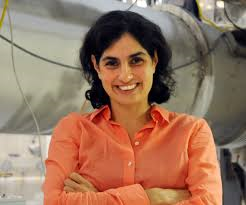
Nergis Mavalvala: The Karachiite who went on to detect Einstein’s gravitational waves

Nergis at MIT (Credit: news.mit.edu)
Nergis at MIT
(Credit: news.mit.edu)
Karachi-born quantum astrophysicist Nergis Mavalvala, Associate Department Head of Physics at MIT is a member of the team of scientists that announced on Thursday the scientific milestone of detecting gravitational waves, ripples in space and time hypothesized by physicist Albert Einstein a century ago.

Professor Mavalvala, whose career spans 20 years, has published extensively in her field and has been working with MIT since 2002.

Mavalvala did her BA at Wellesley College in Physics and Astronomy in 1990 and a Ph.D in physics in 1997 from the Massachusetts Institute of Technology.
Before that, she was a postdoctoral associate and then a research scientist at California Institute of Technology (Caltech), working on the Laser Interferometric Gravitational Wave Observatory (LIGO).

She has been involved with LIGO since her early years in graduate school at MIT and her primary research has been in instrument development for interferometric gravitational-wave detectors.

She also received the prestigious MacArthur Foundation Award in 2010.

The girl from Karachi

Born to a Parsi family in Karachi, Mavalvala received her early education from the Convent of Jesus and Mary school, an administration official from the educational institute confirmed to Dawn.com.

She later moved to the United States as a teenager to attend Wellesley College in Massachusetts, where she is said to have a natural gift for being comfortable in her own skin, according to an article published on the sciencemag.org website.
“Even when Nergis was a freshman, she struck me as fearless, with a refreshing can-do attitude,” says Robert Berg, a professor of physics at Wellesley.

________________________________________
“I used to borrow tools and parts from the bike-repair man across the street to fix my bike,” Mavalvala says.
________________________________________

In an earlier report, Mavalvala’s colleague observed that while many professors would like to treat students as colleagues, most students don’t respond as equals. From the first day, Mavalvala acted and worked like an equal. She helped Berg, who at the time was new to the faculty, set up a laser and transform an empty room into a lab. Before she graduated in 1990, Berg and Mavalvala had co-authored a paper in Physical Review B: Condensed Matter.

Her parents encouraged academic excellence. She was by temperament very hands-on. “I used to borrow tools and parts from the bike-repair man across the street to fix my bike,” she says. Her mother objected to the grease stains, “but my parents never said such skills were off-limits to me or my sister.”

So she grew up without stereotypical gender roles. Once in the United States, she did not feel bound by US social norms, she recalls.

Her practical skills stood her in good stead in 1991, when she was scouting for a research group to join after her first year as a graduate student at MIT. Her adviser was moving to Chicago and Mavalvala had decided not to follow him, so she needed a new adviser. She met Rainer Weiss, who worked down the hallway.

“What do you know?” Weiss asked her. She began to list the classes she had taken at the institute—but the renowned experimentalist interrupted with, “What do you know how to do?” Mavalvala ticked off her practical skills and accomplishments: machining, electronic circuitry, building a laser. Weiss took her on right away.

Mavalvala says that although it may not be immediately apparent, she is a product of good mentoring.

From the chemistry teacher in Pakistan who let her play with reagents in the lab after school to the head of the physics department at MIT, who supported her work when she joined the faculty in 2002, she has encountered several encouraging people on her journey.

Although the discovery of gravitational waves, that opens a new window for studying the cosmos, was made in September 2015, it took scientists months to confirm their data.

The researchers said they detected gravitational waves coming from two black holes – extraordinarily dense objects whose existence also was foreseen by Einstein – that orbited one another, spiraled inward and smashed together. They said the waves were the product of a collision between two black holes 30 times as massive as the Sun, located 1.3 billion light years from Earth.

The scientific milestone, announced at a news conference in Washington, was achieved using a pair of giant laser detectors in the United States, located in Louisiana and Washington state, capping a long quest to confirm the existence of these waves.

The announcement was made in Washington by scientists from the California Institute of Technology, the Massachusetts Institute of Technology and the LIGO Scientific Collaboration.

“We are really witnessing the opening of a new tool for doing astronomy,” MIT astrophysicist Nergis Mavalvala said in an interview. “We have turned on a new sense. We have been able to see and now we will be able to hear as well.”

Saudi Foreign Minister says ‘be patient’ on women’s rights

Saudi women drivers (Credit: telegraph.co.uk)
Saudi women drivers
(Credit: telegraph.co.uk)
MUNICH: Saudi Arabia’s foreign minister defended his country’s treatment of women on Friday, saying it had made progress on female education but would take time to let them drive cars.

“When it comes to issues like women’s driving, this is not a religious issue, it’s a societal issue,” Adel al-Jubeir told an audience at the Munich Security Conference.

He said it was unfair to fixate on the issue of women drivers, given the ultra-conservative Islamic kingdom’s efforts to educate girls.

“We went from no schools for women in 1960 to universal education, to where today 55 percent of college students are women,” said Jubeir.

“Some of our top doctors and engineers and lawyers and business people are women. The issue is one that is evolving just like it is in other countries.”
He compared Saudi Arabia to the United States, arguing that it took 100 years after America’s independence before women were given the right to vote, and another 100 years for it to elect its first female parliamentary speaker.

“I’m not saying ‘Give us 200 years’. I’m saying ‘be patient’,” said Jubeir.
“We hope that in the modern world with technology and communications that this process is accelerated, but things take time. We can’t expect to rush things.”

Restrictions in Saudi Arabia remain some of the toughest in the world with women forced to cover themselves in black from head to toe in public.
For the first time in December women were allowed to stand for election to local councils.

Human Rights Watch has criticised Saudi Arabia’s male guardianship system which forbids women “from obtaining a passport, marrying, travelling, or accessing higher education without the approval of a male guardian”.

Pakistani Women Transition from Heels to Wheels

Punjab Women on Motorbikes (Credit: dawn.com)
Punjab Women on Motorbikes
(Credit: dawn.com)

LAHORE: The Women on Wheels (WoW) project was launched on Sunday with a motorcycle rally for women on The Mall.

A total of 150 women motorcyclists, who completed training from the Special Monitoring Unit on Law and Order and City Traffic Police, took part in the rally.

SMU launches motorbike training for women

Austrian Ambassador Brigitta Balaha and former Supreme Court Bar Association president Asma Jehangir also participated in the rally. Minister for Population Welfare Zakia Shahnawaz, Minister for Women Development Hameeda Waheedud Din, Special Monitoring Unit Senior Member Salman Sufi, Danish Ambassador Helen Neilson, American Consul General Zackary Harkenrider, UN Women Country Representative Jamshed Qazi and a prominent motorcyclist from Singapore, Juvena Huan, were present on the occasion.

She said that the Punjab government was taking effective measures for the elimination of gender discrimination, change in social mindsets and ensuring active participation of women in all sectors of the economy.

She said that in view of transport problems faced by women, the government had taken various mitigation measures. “On the instructions of the government, free training is being imparted to women to ride motorcycles under the aegis of Special Monitoring Unit,” she said.

She said that on International Women’s Day, 1,000 scooties would be distributed among women. Referring to various challenges and problems being faced by women, the minister said that equal rights and encouragement were being given to women so that they could play their role in the society.

Zakia Shahnawaz said that provision of equal opportunities of development to women was the responsibility of the Punjab government. “No effort will be spared for making the Women on Wheels project successful. The government will continue the process of legislation for empowerment of women,” she said.

Brigitta Balaha said that provision of opportunity and facilities to Pakistani women was a commendable step.

Zachary Harkenrider said that it was an honour for him to see the historic rally of motorcyclist women.