MANSEHRA, May 5: Former Muttahida Majlis-i-Amal MNA from Kohistan Maulvi Abdul Haleem on Saturday warned women working in non-governmental organisations against entering his district and said violators of the warning would be forcibly married off to locals.
“I issued a decree during Friday sermon that getting education for degrees by women is repugnant to Islamic injunctions because if a woman gets degree, she may use it for job, an act which Islam doesn’t allow in absence of mehram (close relatives),” he told reporters here.
Mr Haleem said: “If women working in NGOs enter Kohistan, we won’t spare them and solemnise their nikkah (marriage) with local men.”
Maulana Haleem, who remained MNA during the Musharraf regime, said if a woman got education and used it for job, then it was against the teachings of Islam.
“That’s why girls are not going to schools in Kohistan and girl schools are used as cattle pen,” he said.
The ex-MNA, who was once a mufti at Darul Uloom Haqqania, Akora Khattak, and also taught top clerics Maulana Samiul Haq, Maulana Anwarul Haq, Maulana Nizamuddin Shamazai, said he was not opposed to NGOs and would ensure complete protection of their male staffers in Kohistan.
He said if NGOs wanted to work for women’s development, they should spend money for the purpose through government departments.
“We won’t let them (NGOs) influence our women in the name of empowerment and financial support through women workers of NGOs,” said the ex-MNA, who remained the district chairman in Kohistan during the General Ziaul Haq regime.
He said he issued a decree in the past in favour of poppy cultivation and trade and continued to believe so.
“I also rose up against the unjustified slaughtering of animals by Jehanzeb Khan, the ruler of the formerly Swat state, at his birthday. Kohistan was part of the state of Swat at that time. Even he (ruler) put me behind the bars but I didn’t withdraw the decree,” he said.
The ex-MNA said killing of women in the name of honour was a ‘local custom and religious practice’ in Kohistan.
He said if someone witnessed female members of his family roaming with ghair mehram (other than close relatives), he could kill her without producing four witnesses,” he said.
Meanwhile, a man was killed and his father and two brothers critically wounded on Saturday when their rival tribesmen attacked their house in Palis area.
A dispute over the ownership of a water reservoir was blamed for the Narng Shahkhail attack on Badakhail tribesmen.
The dead included Azizur Rehman, while the injured were his father, Mohammad Asghar, and his brothers, Mohammad Essa and Abdul Quddos, whose condition was stated be critical at a local hospital.
The Palis police lodged an FIR and began investigation. Last year, four people were killed and three injured when Badakhail and Narng Shah-khail tribes exchanged heavy fire over the same dispute.
Pakistani feminists say they are determined to fight blasphemy charges filed in mid-April by militant Islamic groups opposed to their International Women’s Day rallies held on March 8.
Rinkel Kumari or Faryal Shah? (Credit: Pravasitoday)
On April 18, Chief Justice Iftikhar Muhammad Chaudhry ruled that the three Hindu women who had been converted to Islam, Rinkel Kumari, Dr Lata Kumari and Aasha Kumari, should decide if they want to return to their parents or stay with their new husbands. All three stated that they had willingly converted to Islam and wanted to live with their husbands.
However, there are still concerns about the climate of intimidation in which these cases were carried out and both Rinkel and Dr Lata had previously made contradictory statements in court about their conversions. Often in such cases the Hindu parents and lawmakers receive death threats and therefore raises the question if these decisions by the three women were made under duress.
Imagine your name is Bharti. You are a 15-year-old Hindu girl who lives in a small apartment in Lyari. Your father is a driver and social worker who raises money for others while struggling to pay your family’s medical bills. You have three older brothers, who are busy with their own jobs and families. Your future seems bleak.
Imagine you then meet Abid. He is the son of a police constable and promises to marry you. He promises you many things – but on the condition that you convert to Islam. You agree and run away with him. His family teaches you the Kalima and gives you a niqab to wear. After a few days, they take you to a maulvi. While the nikah form is being filled, you already know what you have to say. You tell the maulvi that you are 18-years-old and your name is now Ayesha.
Imagine that a few months pass. You are still living with Abid and his family. Your father lost the court case after a medical report was produced that stated that you are 18. You couldn’t look your mother in the eye when she came to court. You haven’t once been able to visit your home since you ran away. Your in-laws still haven’t given you a cell phone but sometimes you are able to borrow a phone and briefly talk to your brothers. When you speak to them, you can’t help but cry.
Be it the mean streets of Lyari or the dusty villages of interior Sindh, stories such as these are becoming increasingly common in Pakistan. In the last four months alone there have been at least 47 reported cases of alleged forced conversions of young girls from minority communities. But none of these cases have quite captured the fascination of the public as that of Rinkel Kumari.
Nineteen-year-old Rinkel disappeared from her home in Mirpur Mathelo, a village in the Ghotki district of Sindh, on February 24. The answer to what happened to her varies significantly, depending on whom you speak to. According to her father Nand Lal, a government schoolteacher, Rinkel woke up somewhere between four and five in the morning to go to the bathroom when she was drugged and kidnapped by armed men. She regained consciousness at around nine in the morning to find herself in Barchundi Sharif in Daharaki – a stronghold of PPP MNA Mian Abdul Haq, also known as Mian Mitho, who is the spiritual leader of the shrine where conversions regularly take place. Just hours after her arrival in Barchundi Sharif, Rinkel was forcibly converted to Islam, married off to one of the kidnappers, Naveed Shah, and subsequently renamed Faryal.
Mian Mohammed Aslam, the son of Mian Mitho, provides a different version of events. He stated on an evening news show that Rinkel showed up with Naveed Shah at his doorstep, expressing her wish to convert to Islam and get married. Aslam added that he contacted Rinkel’s parents to let them know his daughter was with him and even invited them to come visit her before she converted, but they never showed up.
And to add to the confusion, there is a third account of events according to which Rinkel was indeed in love with Naveed and went to meet him on the morning of February 24, but did not know that he would be waiting with other men, ready to kidnap her.
In response to the latter accounts, Rinkel’s family has stated that they did not want to meet their daughter at Mian Mohammad Aslam’s residence because they were concerned that they would not be able to talk freely in the presence of the MNA’s son. And her parents have denied suggestions that Rinkel knew Naveed, stating that since there is no phone in their house and Rinkel does not own a cellphone, there was no way for them to have contacted each other.
But be it Rinkel, Bharti or any other girl, the problem at the heart of all these cases is that nobody knows what actually happened to the victims. Some of the girls, including Rinkel, have made somewhat contradictory statements, initially saying that they willingly converted to Islam and later crying that they want to return to their parents. And in all known cases, the accused have fiercely guarded the girls from meeting their families. This raises several questions: Were the girls’ statements made under duress? Should non-Muslim parents be allowed to meet their now Muslim daughters? Does tempting a young girl with false promises count as coercion? Are these forced conversions and marriages essentially cases of rape and sexual harassment committed in the guise of Islam?
Advocate Iqbal Haider believes the answer to all these questions is an unequivocal yes, and he does not hide his disgust towards Mian Mitho and others involved in such conversions: “Mian Mitho is exploiting his status as an MNA and has been indulging in the most objectionable activities.” PPP MNA Mian Mitho
Haider has fought many cases of forced conversions and described the kind of problems that commonly arise in such cases. “No police officer would dare defy the orders of an MNA. The police is not independent,” stated Haider, adding, “I recently saw it in court when two police officers led the girl into the courtroom and her alleged husband was glued to her.”
The police was apparently unconcerned that the man was yet to be proven as the husband and that he was imposing his presence on the girl. It was only when Haider shouted at the police that they separated the two. The families are often not allowed anywhere near their daughters and Rinkel’s parents and their supporters have received public death threats from Mian Mitho and his abettors.
It was against this climate of intimidation that the court decided to move Rinkel and Dr Lata, a 29-year-old who also converted and got married in February, to Islamabad. Haider will not be representing any of the cases in the Supreme Court but he believes it was the right decision to move the girls to more neutral territory. “Keep the girls in Islamabad in a protected area but you can’t keep them there forever. I hope the court holds judicial inquiries into each and every case.”
Haider emphasised the importance of cross-examining all the witnesses since the girls’ statements are often made under duress. And he also pointed out the importance of having a liberal judge since, in his words, “There are bigots everywhere.”
Rinkel and Lata had their court hearing in Islamabad on March 26. Rinkel was barely able to speak and it took her two minutes to answer whether she studied science or arts in school. Chief Justice Iftikhar Muhammad Chaudry instructed everybody to leave the court so that he could talk to the girls privately. The girls were then allowed to briefly meet their parents before being sent to Darul-Aman for two weeks, according to the court’s orders.
In a phone conversation the day after the ruling, Rinkel’s father, Nand Lal, revealed that in the few minutes the family spent with Rinkel, she cried non-stop and said that she wanted to return home with them. She also told them that Mian Mitho’s men had threatened her to not make a statement in favour of her family. While her father hopes that Darul-Aman will provide a safe environment for his daughter, the family does fear that Mian Mitho’s men will be able to reach her there as well. If Rinkel is happily married, as Mian Mitho and his followers like to claim, then why do they feel the need to resort to these intimidatory tactics?
PPP MNA Nafisa Shah, who has publicly condemned the forced conversions, believes this environment of intimidation is the main source of the problem. “Coercion does not just mean using brute force,” she said, “We have an extremely claustrophobic environment in which there is space for only one religion.” And it is this claustrophobic environment that limits opportunities for minority communities in the country and makes the offer to convert and get married all the more alluring to young, vulnerable women. Nafisa Shah also pointed out that Hindus are rarely involved in serious crimes in Pakistan, but because they don’t have arms, they become all the more vulnerable to outside threats.
Nafisa Shah did not want to specifically talk about Mian Mitho, but she made it clear that these forced conversions go against the ideology of the PPP and points out that people like Shahbaz Bhatti and Salmaan Taseer lost their lives as a result of speaking up against prejudicial laws. Shah emphasised that the space for dialogue and multi-faith expression is shrinking and attributes Talibanisation as the source of this problem. She also added that conversions are not an issue, but the fact that in Pakistan it is a one-way street of only minorities converting to Islam that causes concern.
According to Bharti’s nikahnama she is 18-years-old.
Abdul Hai, assistant coordinator at the Human Rights Commission of Pakistan, agrees that there is nothing wrong with converting, even if it is for the sole purpose of getting married. “The real problem is where is the girl going?” he adds “Maulvis will say in court that the girl’s parents are kafirs and that she can no longer meet them. How can you forcibly cut the girl off from her parents?”
Senior journalist and human rights activist, Akhtar Baloch reiterates the points made by both Shah and Hai: “You cannot stop adults from converting or getting married. But why is it only the Hindus who are converting to Islam? And that too girls? Why don’t we have men converting to Islam or Muslims converting to other religions?”
Baloch is also concerned that the cases being highlighted in the media are of those who are financially more secure and he fears that there are countless more cases that go ignored.
One such case is that of Bharti. On December 2011, Narain Das found his daughter was missing from home and filed an FIR at the Baghdadi thana only to soon discover that his daughter had run off with Abid, the son of Anwar Kalia who is a constable at Preedy police station.
This is not the first time one of Das’s children ran off to convert to Islam. Around 12 years ago, Das’s employers, car dealers, lured his oldest son Lakshman, who was at the time barely a teenager, to convert to Islam. The men, who Das drove cars for, would send the young boy to fetch alcohol and when Das scolded him, they suggested that he convert so that he would no longer have to live by his parent’s rules. Das and his wife would try to visit Lakshman but each time he would run away. When Das finally got a hold of his son, Lakshman said that he ran away because he was told that if he met his non-Muslim parents they would all become wajib-ul-qatl. Das had enough knowledge of Islam to know this was untrue but as a cautionary measure got a fatwa from a neighbourhood maulvi. When Lakshman was nearly 18, Das proposed to his son’s converters that they should get his son married and help him get started in life. The next day, Das was called to take his son back home.
“I bet nobody in all of Pakistan has done what I did next to my son,” said Das. He went on to relate how he got his son a job with a Muslim butcher and when a Hindu girl fell in love with his son, he told her parents that she would have to convert to Islam since his son is a Muslim.
“I have a Muslim son. I have Muslim grandchildren. And I am the Hindu dada of those children,” Narain said, stating that he has no issue with his daughter converting to Islam. What offends him is that his daughter was lured to run away and that Kalia’s family is preventing them from contacting each other.
Also, Das has NADRA documents stating that Bharti is 15 but the police got a medical report alleging that she is 18, over which Das lost the court case.
Das was visibly furious when I met him. “If these NADRA documents hold no meaning, then close down all their offices in the country. And how can Bharti suddenly be older than her brother Sunny? Next they’ll come and say she’s older than her parents.”
The family has received death threats for pursuing this case and Das added, “The biggest mistake I made was hiring Amarnath Motumal as my lawyer. Not because Amarnath is a bad person, but because he is a Hindu and the other side clearly threatened him.”
Motumal, who is also the vice-chairman of HRCP, confirmed that Bharti is indeed only 15 but the case is now unfortunately closed and he hopes public outcry might lead to a new, fairer trial.
Das revealed how Anwar Kalia had the police on his side. The DIG Sindh ruled that Bharti should be taken to a women’s thana and that Anwar Kalia’s family would not be allowed to visit her there. However, these orders were ignored and Kalia’s family would go take meals to Bharti everyday. He also describes Bharti’s alleged husband (Das and his family do not recognise the marriage since Bharti was under coercion) as a good-for-nothing drunkard and drug addict. Her brothers tell me I can ask anyone in the neighbourhood about Abid’s reputation.
Occasionally her brothers were able to speak to her on the phone and they said she would always cry and say she made a mistake. In trying to get in touch with Bharti, I spoke to Abid’s uncle who firmly advised me to move on and not bother them, saying “Bharti is happily married so there is no point in talking to her.”
He admitted that they medically proved her age but did not want to disclose the name of the hospital or doctor they went to. And the maulvi who presided over the nikah ceremony, Mohammed Abbasi, was of little help as well. When asked how he confirmed Bharti, or rather Ayesha’s age, when she had no form of identification on her, he said, “She said so. And you can tell by looking if someone is 15 or 18.”
He also shamelessly told me how Narain Das spoke to him on the phone for an hour, begging for help, but he did nothing. “I have given my statement to the police and the girl married willingly.” It also does not concern him that the witnesses were only from the boy’s side even though in Islam, witnesses from the bride’s side are required.
“If they didn’t accept me as a witness because I’m Hindu, then why didn’t they take my Muslim son as a witness?” Das asks. “And why is it that Dr Lata who is 29 is taken to a women’s shelter, but my 15-year-old daughter is sent away with the accused? Why should I be dealt a different judgement because I am poor?”
Had Rinkel’s family not been able to find the right contacts, had Mian Mitho not been involved, had the Pakistan Hindu Council not decided to take up the issue, her case too perhaps would have been left ignored.
New cases of forced abductions are emerging every month. But Nafisa Shah is sceptical about giving exact figures because nobody is able to find out for certain if the girl in question converted willingly or not. How can one know when soon after the conversion, the girls are married off and cut off from the public? Even in the rare case in which a girl speaks up, there is fear of persecution. According to Seema Rana, a member of the Hindu community who is doing research on these conversions, a girl from Lyari was asked to take an oath on the Quran in court. She refused, saying that she cannot take the oath since she is a Hindu and was forcibly converted. The girl was returned to her parents, but her family feared the accused might take revenge and immediately got her married. Even though the girl is willing to talk about her experiences, her family is too afraid to give her name to the media.
Without access to the girls themselves, we can only imagine what truly happened to them.
The Lost Girls
These young girls – long forgotten by all but their families – were allegedly kidnapped from their homes and forced to convert to Islam.
In December 2009, 13-year-old Radha Ram’s parents reported that she was kidnapped from their home in Rahim Yar Khan. She was kept in a madrassa and Abdul Jabbar, the leader of the madrassa, prevented the Hindu family members from meeting her since she was now Muslim.
Four men kidnapped 13-year-old Mashu from Jhaluree, a village near Mirpur Khas, on December 22, 2005. They then allegedly forced her to convert to Islam and renamed her Mariam. Pir Ayub Jan Sarhandi was involved in her conversion and soon after her abduction and conversion, she was married to one of the kidnappers.
Anita Kumar, a 22-year-old Hindu woman with two young children, was kidnapped from her house in Moro, Sindh in April 2011. In the process her two children, aged four and two, were beaten up and locked up alone in the house. The Supreme Court allowed her marriage to a Muslim man, even though she was still married to her first husband, Suresh Kumar. She has since then been renamed Aneela Fatima Pervez.
Gajri, a 15-year-old Hindu girl, was kidnapped by a neighbour from her home in Katchi Mandi in the Rahim Yar Khan district on December 21, 2009. She was later discovered in a madrassa, but by then she had already been converted to Islam and married to her neighbour, Mohammed Salim. Her parents later received an affidavit, in which the daughter stated that she had converted to Islam willingly but they were not sent a copy of the marriage certificate. The parents are not allowed to visit their daughter since they are non-Muslims.
On October 18, 2005, a Hindu driver, Sanno Amra, came home from work to find that his three daughters Reena, Usha and Rima had disappeared from their house in Punjab Colony, Karachi. The oldest sister was 21 and the youngest was 17 – legally still a minor. When Amra pursued the case he started receiving death threats and eventually found affidavits in the mail, which stated that his daughters had willingly converted to Islam. The parents were only allowed to briefly visit the daughters, and that too in the presence of maulvis and police officers.
This article was originally published in the April 2012 issue of Newsline under the headline “Unholy Vows.”
Hindu Protestors in Karachi (Credit: tribune.com.pk)
ISLAMABAD, April 18: The chief justice was in a hurry for once. In just the second hearing on Wednesday of a case related to the conversion of three Hindu women, a Supreme Court bench, headed by Chief Justice Iftikhar Muhammad Chaudhry, wrapped up the case and announced its judgment.
The three young women present in the court were told to express their ‘true’ feelings about what they wanted to do and Sindh police were ordered to be their ‘protectors’ — ensure their safety and their happiness.
Police were asked to submit reports every fortnight about the wellbeing of the women.
The women did not utter a word during the proceedings. Later they were sent off to the registrar’s office to pour their hearts out.
In between, they were kept apart from their parents; they were taken to the registrar’s office from a different route so that no one would run into them.
The women recorded their statements before the registrar and decided to go with their husbands.
The judgment, however, did not go down well with the hapless parents. For the rest of the afternoon, the human tragedy that is the Hindu minority in Pakistan was played out on the steps of the Supreme Court building and outside as the families spoke to media and protested the verdict. Wednesday did not bring them the justice for which they had travelled from Sindh to Islamabad.
The women who appeared before the court under the watchful eyes of Sindh police were Rinkal Kumari, 19, (now known as Faryal Bibi) of Mirpur Mathelo, Dr Lata Kumari, 30, (Hafsa) of Jacobabad, and Aasha Devi, 19, (Haleema Bibi) of Jacobabad, who earlier was missing but surfaced voluntarily.
“We gave these girls sufficient time to think about their future and we will not force them. They are grown-up and are allowed to go wherever they want to go,” the chief justice observed. He said they were sui juris (one who has reached maturity and is no longer dependent) and, therefore, fully in a position to decide about the future.
“We feel they (the women) stayed in a pressure-free atmosphere at the Panah Shelter Home in Karachi where neither of the parties was allowed to meet them,” the court observed.
The order, however, generated instant commotion inside the courtroom, prompting the chief justice to ask the counsel for different parties to urge their clients to maintain discipline.
Frantic developments were seen soon after the announcement of the verdict. Dr Ramesh Kumar Vankwani, patron of the Pakistan Hindu Council (PHC), called an emergent meeting to discuss implications of the verdict.
The PHC also filed a petition highlighting abduction of Hindu girls who were then forced to change their religion and married off to Muslim men. The court will take up the case after two weeks.
The disappointed parents of these women and members of the Hindu community, including parliamentarians from the ruling PPP, staged a sit-in outside the Supreme Court for some time and called for giving custody of the women to their parents.
“This is complete injustice in the name of Islam,” shouted Mohen, father of Aasha, outside the courtroom. He asked why the court did not take into consideration a demand by police for payment of Rs1.8 million for recovering the girl — a demand which was raised to Rs3.5 million and then to Rs5 million. “From where we will fetch this kind of money.”
He said the Hindu community was being forced to leave Pakistan.
The mothers of the three women kept weeping and wailing outside the Supreme Court and alleged that the court had never allowed the girls to meet their parents.
Ramesh Lal, a PPP MNA from Larkana, said minorities had lost all hopes in the country’s judiciary and today justice had been buried forever. “Why the judiciary, which never tires of taking suo motu notices against the president and the prime minister, is not taking notice about police demanding money from the victim families to recover the girls,” he asked.
Noor Naz Agha, the counsel for Rinkal, however, welcomed the verdict and said the court had rightly accepted that being adult, the girls had a right to live their lives according to their choice.
But she held the absence of legislation responsible for the rising number of complaints about forced conversions and marriages.
Mian Aslam, son of MNA Faqir Abdul Haq alias Mian Mitho, who was accused of abducting Rinkal, rejected the allegations, wondering “if we kidnapped her then why she was produced before the magistrate to record her will and later handed over to police”.
He brushed aside an impression that the girls were converted to Islam forcibly.
KABUL: Afghanistan has instructed women TV presenters to stop appearing without a headscarf and to wear less make-up, officials said, raising fears about creeping restrictions on the fledgling media.
“All the TV networks are in seriousness asked to stop women presenters from appearing on TV without a veil and with dense make-up,” the information and culture ministry said. “All women newscasters on Afghan TV channels are also asked to respect Islamic and Afghan values,” it added.
A spokesperson for President Hamid Karzai told AFP on Tuesday that the ministry took the decision after coming under pressure from the Ulema council, the country’s highest religious body of Islamic scholars.
Afghan media, essentially non-existent under the 1996 to 2001 Taliban regime, have enjoyed considerable freedom, with more than two dozen TV stations springing up in the decade since the 2001 US-led invasion.
Women demonstrators (Credit: dw-world.de)SUCH are the paradoxes in Pakistan’s politics, that at a time our politicians are locked in a grim power struggle in Islamabad, the same gentlemen joined hands to pass unanimously the women’s commission bill last Thursday.
Whether this show of unity on a matter concerning women should be interpreted as an act of chivalry or a demonstration of ‘woman power’, it will be widely welcomed. One must, however, admit that it was the clout of the women’s caucus and the determination of the speaker — also a woman — to get the treasury and opposition benches to forge a consensus that ultimately carried the day. The bill is expected to have a smooth sailing in the Senate.
This certainly has been an uphill struggle. When the commission was set up in July 2000, it was widely felt that its mandate was too weak to allow it to function as an effective body. This view was confirmed in July 2001 when Aurat Foundation and Shirkat Gah organised an international conference where representatives from abroad briefed the participants about the powers wielded by similar bodies in their countries.
It became increasingly clear that the announcement made with great fanfare by Gen Musharraf was no more than a gimmick.
The National Commission on the Status of Women (NSCW) lacked the capacity to bring about the emancipation of women and the elimination of discrimination against them.
Hence it was demanded that the powers and independence of the women’s commission should be enhanced to optimise its performance. The participants of the Islamabad conference also called for greater transparency and accountability in the commission’s selection and working.
It took more than a decade and a lot of hard work and advocacy to get the government to consider a change in the status quo.
The new body with the simple nomenclature of the National Commission for Women will certainly have more teeth in some respects as compared to its predecessor. It will be autonomous with the power to raise its own finances. Its composition will be more representative. Thus a bipartisan parliamentary committee will give a list of nominees from which the prime minister will select the members.
The prime minister will appoint the chairperson with the agreement of the leader of the opposition. This would hopefully ensure that the working of the commission is not hamstrung by inter-party conflict. Autonomy should allow the commission to bypass the red tape of bureaucracy and proceed to take up issues it feels are urgent.
The bill adopted by the National Assembly is significant in another way. The commission has been empowered to take up complaints of violations of women’s rights and even hold an enquiry into the matter if it is not being attended to. It can also inspect jails to check on female prisoners. In effect it will have the powers of a civil court. The ordinance of 2000 did not grant this power to the NCSW which could only monitor such violations and individual grievances, and then undertake initiatives for better management of justice and social services through the concerned forums.
In respect of the commission’s power of reviewing and monitoring the laws, policies and programmes of the government in the light of their implications for gender equality, empowerment of women, political participation and representation, the new law upholds the provision of the previous ordinance. It can also recommend repeal, amendment or new legislation as its predecessor could do. As before, it is authorised to sponsor research and maintain a database on gender issues as well as recommend the signing or ratification of international instruments.
The catch in all these provisions is that the commission can only make recommendations. It has no power to enforce its own views. When Justice Majida Razvi was the chairperson of the NCSW she had the Hudood Ordinances reviewed and the commission very strongly recommended their repeal. Her appeal fell on deaf ears. It was only later that the injustice inflicted on women by the Hudood Ordinances was neutralised by adopting the Women’s Protection Law of 2006. Will an autonomous commission have more powers of implementation? Most unlikely.
India’s National Commission for Women has been described as a strong body and yet one of its former members, Syeda Hameed, writes in her book They Hang, “The stories I tell are, of course, stories of women abused and violated by men wielding brute power. But they are also about the National Commission for Women, the nation’s apex body for women vested with the power to summon the highest functionaries of the land and seek redress — yet it remains ineffective for the most part … Perhaps it was ignorable or ignorance combined with indifference, but the truth of the matter is that the commission’s reports and jurisdiction are not binding on anyone, and its jurisdiction stops at its front door.”
Our commission can expect no better treatment from the male-dominated administration. But there is still hope. If the chairperson is an active and experienced person as the incumbent (Anis Haroon) is, she can use her office to draw public attention to the issue that needs to be addressed.
Working in close liaison with women parliamentarians the National Commission for Women can make an impact on the laws.
In other words the battle has to go on. But every victory helps create greater awareness and should be used in the campaign to mobilise women at the grass-roots. That is where lies the strength of the women’s movement wherever it may be.
The Upper House of the Parliament passed two flagship bills on Monday, in order to protect the sanctity and rights of women living in Pakistan. Both the bills entail significant policies and mandates to protect women from practices such as forced wedlock, honour killing, marriage with the Quran and inflicting pain and torture by throwing acid on them. The bills state that culprits found and indicted of committing any of these crimes will be penalised and subjected to severe punishments.
Over the years, thousands of women in Pakistan have been subjected to the atrocities, which are often unheard of in civilized communities. Women, irrespective of their urban or rural affiliations, have been innocent targets, unable to raise their voice due to the lack of policies safeguarding their interests. Men have stoned, burnt, buried and brutally murdered them for their vested interests and heinous motives, which are an open violation of the human rights policies formulated by the United Nations and other multilateral agencies defending and advocating human rights across the globe.
Passing bills to protect women’s rights in Pakistan is highly commendable and is being appreciated by all the religious, political and social quarters, however, the question remains how noteworthy are these bills? Will they be implemented as easily and efficiently as the cabinet makes it sound? Or will they be discarded just as another tool to obstruct the customs and rituals of our so-called traditional mindset? Do we really think that women in Pakistan will have access to the fair judiciary, which will ensure their protection and rights to live as an individual?
In a country where influential ministers and senators have advocated the shooting and later on dumping women in ditches as a justifiable act, one which requires no punishment and remorse, justice is quite evidently denied to many of the victims. Being a witness to these crimes is merely a sport and an adventure to the privileged few of the rural society. These centuries’ old traditions are not allowed to be questioned and are known to be hushed-up by the feudal lords and the family of the victims as well, as reporting such violence results in severe repercussions for all those involved.
According to a report by the human rights organisation, 300 Pakistani women are torched alive by their husband’s families annually. Unwanted wives are “taken care of” by denying them the right to live, hence the tradition of “burning at the stakes” continues. Every second Pakistani woman is a victim of direct or inadvertent assault which can be categorized as physical and emotional. Our religion gives women the right to demand and get a divorce; however, women are generally ripped off of this privilege when her guardians chalk out the clause specifying the aforementioned right in the “Nikkah-nama.” Uneducated and deprived women living in the rural areas of Pakistan are not the only ones who experience these brutalities. Many educated women in metropolitans such as Karachi, Lahore and Islamabad have also been victims of domestic violence and harassment at work and on the streets.
Drafting a policy or a bill and getting it approved is a feat but devising an appropriate plan to implement the same is an issue which Pakistan has been battling with ever since the time of its establishment. A document remains a document, if the mechanism to carry out what the document specifies is inconsequential. The biggest catastrophe of Pakistan is that the influentially empowered people, responsible for undertaking the responsibility to ensure that the legal and political decrees are being followed, are the ones who are often responsible for blatantly committing a breach. Is it lack of education or awareness that is forcing us to act in vain or is the fear of empowering the rural population and exposing them to education instigating the policy makers to violate the laws?
Low literacy rate is one of the fundamental issues that we are facing as a nation. Most of the women are unable to voice their opinions and issues because they are not provided with the platform to do so. The dilemma is that their sufferings are considered as a part of the many customs and rituals that we have accepted as a nation. We stopped paying attention to news entailing honour killing, acid thrown victims and forced marriages. They just became a part of our social setup but are we going to stay passive for the rest of our lives? It is time for us to rise as a nation and take individual measures to make these bills successful. Women require respect, protection and equal treatment and as a Pakistani we need to positively reinforce this ideology by abiding by the policies clearly mentioned in the bill.
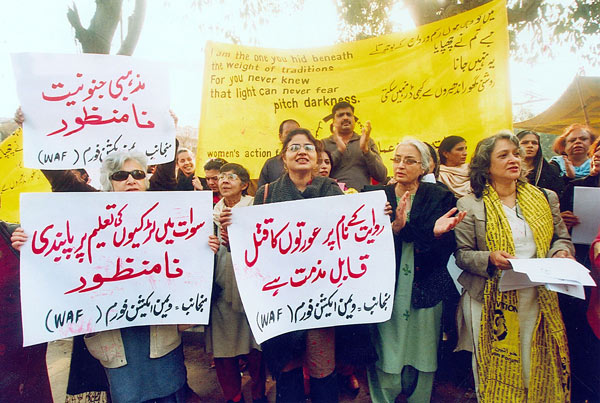
Women's Action Forum Protest Customary Laws (Credit: Dawn File)Halfway between Toronto and Montreal, ghastly details of a murder trial are unfolding. The dead are three young Muslim girls and their stepmother. Stand accused of their murder are the parents and the brother of the dead girls.
What makes Muslim parents murder their own children, especially daughters, is a question that has leapt to the front pages of newspapers all across Canada. It is, unfortunately, not the first time that Muslim parents in Canada have murdered a female child. Such murders are known as ‘honour killings’ where parents murder their daughter/s to “protect the family honour.”
It was only in December 2007 when a Pakistani father (along with his son) murdered his 16-year old daughter, Aqsa Parvez, in a suburb of Toronto. Her crime: she wanted to act and dress like other teenage girls in her school. Fewer than two years after Aqsa’s murder, another Muslim father in Canada murders not one but three daughters.
On the morning of June 30, 2009, a car was found submerged in the Rideau Canal in Kingston, Ontario, a small university town some 250 km East of Toronto. Found dead in the car were the three Shafia sisters: Zainab, 19, Sahar, 17, and Geeti, 13. Also found dead in the car was 50-year old Rona Amir Mohammad, who was the girls’ stepmother. Weeks later the Canadian police arrested the girls’ parents Mohammad Shafia, 59, and Tooba Mohammad Yaha, their 39-year old mother. The police also arrested the girls’ brother Hamed Shafia, 18, and accused the three of murdering the three teenage girls and their stepmother, Shafia’s first wife who did not bear any children.
A little over two years later, the accused are now standing trial in Kingston. As the trial proceeds, gruesome details emerge about the family that conspired to kill its own daughters. Once again, it is a familiar story where a father is unhappy with his teenage daughters and decides to kill them “to protect his family honour.”
Shafias, originally from Afghanistan, moved to Canada in 2007 and settled in a suburb of Montreal. The court proceedings reveal an overbearing father who was not happy with the way his daughters were growing up in Canada. He was particularly concerned about his eldest daughter, Zainab, who fancied a Pakistani young man of modest means. Mohammad Shafia did not approve of the relationship.
Over the next two years an acrimonious relationship develops between the father and the eldest daughter. Shafia was spying on the daughters and was aware of the digital photographs of his older daughters with their friends. He was not pleased.
While Shafia was away in Dubai for work, Zainab wedded the Pakistani young man in a small ceremony attended by her immediate family members. Missing from the ceremony was Shafia and the groom’s entire family, who also did not approve of the union.
What transpired later in the day after the Nikkah ceremony revealed that Zainab in fact got married to spite her father. According to the Toronto Star, she told her uncle: “… this boy doesn’t have money and he’s not handsome. The only reason I’m marrying him is to get my revenge. I will sacrifice myself for my other sisters. At least they will get their freedom after me.’’ Zainab told her mother after the Nikkah that she would be willing to dissolve the day-old marriage to please her mother. Soon the family was off to a vacation in Niagara Falls. On their way back from vacation they made an overnight stop in Kingston. Next morning, four dead bodies were found trapped in the submerged car.
The police suspected the family from the very beginning. The evidence found around the crime scene suggested that the submerged car was pushed into the water by another car, which also belonged to the family. Further investigations revealed that the four women were dead before the car went into water, suggesting that it was not a freak traffic accident, as was initially claimed by the parents.
The police planted surveillance equipment in the Shafias’ home and car, and also bugged their phone. The taped conversations played in the courtroom revealed a calculated plot by Mohammad Shafia to kill his daughters. They painted a picture of a man who had no remorse for killing his own flesh and blood. Geeti, who was 13, and his first wife, Rona were the collateral damage. Still Shafia is heard on tape saying: “I am happy and my conscience is clear,” and that his daughters “haven’t done good and God punished them.”
Was it really a punishment from God or from a sadist father who killed in cold blood because his daughters disobeyed him? He called his daughters “filthy and rotten children” and expressed his resolve to do the same 100-times over.
While the tapes reveal a merciless man who was a captive of his tribal norms, which he brought with him from Afghanistan, a swoop of Hamed Shafia’s computer by the police also revealed a cunning man who was searching the Internet to plot murders. Other searches conducted on the laptop computer focused on what would happen to one’s business and property if one was incarcerated.
Many in the West associate ‘honour killings’ with Muslim societies. However, the deplorable practice can be found in several non-Muslim majority societies. In India, for instance, the practice is more frequent in rural settings where village councils at times have sanctioned murdering the couple who had eloped or married without the family’s consent. Earlier this week a judge in Uttar Pradesh sentenced eight men to death and 20 others for life imprisonment for honour killings committed in 1991. In May 2011, the Indian Supreme Court had already recommended capital punishment for those convicted of honour killings, thus enabling the lower courts to award stricter punishments.
In Pakistan and several other Muslim countries, female victims of honour killings seldom get justice. While laws against honour killing have been on the books in Pakistan since 2005, however the conviction rate has been despicably low. In Khyber Pukhtunkhwa (KP), a mere 8 per cent of those accused of honour killings were convicted in 2009. *Of the 33 women and 18 men murdered in honour killings in 2009 in KP, 83 per cent of the accused were husbands, fathers, brothers and other male relatives of the deceased.
Research from Pakistan, Jordon, and other countries revealed that often mothers of murdered women approach the sharia courts as their legal heirs and sought and received pardon for the accused father, brother or other male relative of the murdered girl in a Diyat (blood money) arrangement.
The Shafias will have to face justice. Mohammad Shafia’s wealth and property cannot buy him freedom in Canada. He murdered his daughters. It was not an act of passion, but a premeditated one. Shafia thinks he acted honourably.
However, nothing is more dishonourable and cowardly than murdering children.
*Sajid, Imran A.; Khan, Naushad A.; Farid, Sumera. Violence Against Women in Pakistan: Constraints in Data Collection. Pakistan Journal of Criminology. Volume 2, No. 2, April 2010, pp. 93 – 110.
Murtaza Haider, Ph.D. is the Associate Dean of research and graduate programs at the Ted Rogers School of Management at Ryerson University in Toronto.
Sindhiani Tehrik - key player against customary laws (reproduced image)
In 1991, a male colleague and I headed to a small town in interior Sindh, where the peasants and low-income traders were spiritual disciples of feudals in Benazir’s cabinet. We were escorted by guards through a magnificent fortress with high walls and cemented pathways, which wove into a labyrinth. My male colleague and I were taken into a grand drawing room with fine carpets and engraved tables.
The feudal lord greeted me pleasantly – the “honorary male” from a prominent newspaper. Afterwards, when we finished a frank, at times “off the record” type of conversation, he suggested I visit the women’s quarters. Politely, I rose and was escorted by the servant to the women folk. My colleague stayed back; he was after all a “Na Mehram” – a man unrelated by blood to the women.
I walked through a maze that led up to the women’s quarters. Wearing loosely draped chador (a type of veil), the women here lived in an age reminiscent of 16th century Moghul India. Never exposed to the outside world, they did not have a lot to talk about. We exchanged pleasantries; I explained I had come from Karachi to do a story. They did not know what it meant to be a journalist, nor did career prospects seem interesting to them.
When these women from feudal families went outdoors, they donned black veils with tiny holes for their eyes. Even so, it was the feudal lord who determined the liberties the women of his family could avail; they were required to travel in chauffer-driven cars with black drapes, dress modestly at all times and under no circumstances speak to men outside the family.
I spent a night at this haveli (feudal home)living as the women did, with days and nights of solitude. At night, uniformed guards patrolled their ancient fortress. My ears picked up the changing of guards in the dead silence of the night. “Allah Sain Khair” (by God’s grace), “Maula Sain Khair” (all is safe).
I left the fortress and continued traveling across interior Sindh. My freedom was in stark contrast to the lives of these women – creatures starved even of simple sensory impulses. The time I spent reporting in Sindh would inform me of the importance of the veil. By a process of osmosis, girls grew up to believe that their path to fulfillment lay in marriage and children.
In 1993, I attended a wedding in a small town of interior Sindh. It was a private event but my journalist’s eye took mental snapshots. Women arrived in carefully designed, expensive shalwar kameez and dupattas.with matching jewelry and make-up – all designed to show their standing in the feudal hierarchy. Chaperoned by male relatives and wearing black veils, the women showed their faces only after they were exclusively surrounded by their own sex. Outside, volunteers stood guard to stop any peeping toms.
The carefully made-up women exposed adaptations of risqué dresses worn by foreign models that one saw on CNN and the Indian ZEE television channels. Captivated by the glamorous images of women, their female viewers copied the fashions in the privacy of their homes and exposed them to other women.
Apparently, the spread of cable television in the remote areas of rural Sindh had created all sorts of unfulfilled desires among the cloistered women. On one occasion, I sat with the young wife of a feudal lord as she watched cable television in a remote town of Sindh. Turning away momentarily from watching a Western film, she sighed wistfully:
“It’s very hard to be locked indoors after living in Karachi.” Still, sensitive to small town gossip about who was a “good woman,” she had never left the house alone.
In the rare case where a young woman from a small town joined a university or medical college, she would likely join the urban women’s movement. Still, societal pressures on women to marry and have children were overwhelming. It left the women blissfully unaware that the military government had passed Islamic legislation that gave them an inferior status before the law.
Brides of the Quran
Journeying through interior Sindh, I stumbled upon large numbers of unmarried, graying women who lived in ancestral homes located in Hyderabad, Thatta, Matiari and Hala. Time hung heavy on their hands. Equipped with little education and no exposure to the outside world, these women had never been exposed to men in their lives.
In 1992, during a journalistic jaunt, I discovered a horrendous custom that kept these women housebound. Under Islamic law, women inherit property when they marry. But in the absence of male relatives, feudals in Sindh refuse to give their daughters inheritance. Instead, big feudals of Sindh and southern Punjab, who derive their power base from the land, prefer to keep their daughters unmarried.
In a more elaborate example of how feudals manipulate women’s lives for financial gain, the Syed communities – who trace direct ancestry to Prophet Mohammed – have their daughters married off to the Muslim holy book, the Quran. That literally seals their prospects of marriage. Under this practice – called “haq bakshna” (waiver of rights) women place their hand on the Quran and waive the Islamic right to marry and inherit property. Even more ingeniously, they are told their virginity gives them a spiritual status and a duty to dispense talismans to sick children.
The paradoxes were stunning. Feudal politicians took orders from a woman prime minister, Benazir Bhutto even as they kept their own women locked up or “married to the Quran.” Some of them were superiors in her party and took orders from the woman prime minister to wield power in their own fiefdoms. The big feudals, who form the backbone of autocratic governments, have kept their control of women well-hidden from public view.
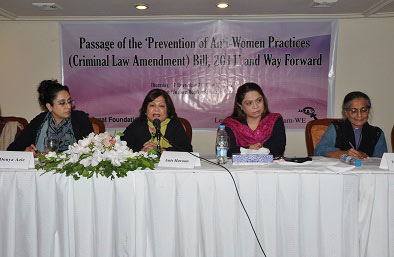
Women Politicians & Activists Pushed Prevention of Anti Women Practices Bill 2011 (Courtesy Aurat Foundation)
After twice being rejected by the National Assembly, the Prevention of Anti-Women Practices (Criminal Law Amendment) Act 2011 was approved unanimously on Tuesday. Although it still needs to be passed by the Senate, civil society in Pakistan has welcomed the move and praised the efforts of Pakistan’s women legislators in particular.
The bill was first tabled in the lower house by the legislator Donya Aziz during former Pakistani President General Pervez Musharraf’s tenure but had repeatedly failed to get clearance from other MPs, who are largely men.
The bill outlines severe punishments for practices such as “wani” and “swara,” child marriage customs, in which young girls are forcibly married to other clans in order to resolve feuds. The law would punish offenders with jail terms of between three and 10 years.
The bill also proposes a minimum sentence of five years’ imprisonment for depriving a woman of her inheritance, and jail terms of between three and five years for bartering a woman. Forcing a woman into marriage will be made a non-bailable offence, if the bill is passed into law.
‘A ray of hope’
Women’s rights activists are delighted, said Mahnaz Rahman, the resident director of the Aurat Foundation. “We have been advocating for the abolishment of anti-women laws and practices for decades,” she told Deutsche Welle. “Finally, we see a ray of hope.”
Rahman also praised President Asif Ali Zardari’s ruling Pakistan People’s Party for its role in getting the bill approved in the National Assembly, despite the fact that the author of the bill belongs to the Pakistan Muslim League (Q).
“Despite our differences with the PPP on many issues, we believe that women rights in Pakistan are better protected under the current government,” she said.
Pakistani writer and human rights activist Harris Khalique also applauded the PPP, but said it really was the victory of Pakistan’s feminists and civil society. He also expressed concern that the Senate might not approve the bill since it is “more conservative than the National Assembly” in its make up.
However, “if we have such laws, the anti-women and regressive forces will have to think twice about indulging in misogynist practices,” he said. “Take the example of the Blasphemy Law. It is only in the books but it emboldens the Islamists in their mistreatment and persecution of religious minorities. Similarly, if there are progressive laws in the country, they will improve human rights in Pakistan, irrespective of their implementation.”
Although there are number of liberal laws in Pakistan they are not always implemented by the state and law enforcing agencies. In tribal areas, where women bartering is rampant, people often obey their own systems of justice. Past attempts to undo retrogressive laws have been bitterly opposed by the powerful religious right.
Rampant discrimination against women
Women are particularly subjected to discrimination in the Islamic Republic of Pakistan because of tribal and feudal social structures that go back centuries. Anti-women groups were further encouraged by a number of laws that were promulgated in the 1980s by General Zia-ul-Haq.
But Rahman said that women’s rights groups would continue their struggle. “We will act as a watchdog to ensure the women’s protection bill is implemented,” she said but she added that society, and especially men in Pakistan, had to go through a “long process of attitudinal change.”