Parveen Rahman – Pakistan Loses a Courageous Woman Working for Upliftment of the Poor

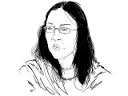
Sketch of Parveen (Credit: tribune.com.pk)

KARACHI, March 15: A media-shy social worker who devoted her life to the development of the impoverished neighbourhoods across the country, was gunned down near her office in Orangi Town on Wednesday. She was 56.

Parveen Rehman was born in Dhaka in 1957. She did part of her schooling in the former East Pakistan and migrated to Karachi after the fall of Dhaka.

She received a bachelor’s of engineering in architecture from Karachi’s Dawood College of Engineering and Technology in 1981 and joined a private architect’s firm.

A few months later, she left the job and joined the Orangi Pilot Project initiated by Akhtar Hameed Khan to bring healthy changes to the lives of impoverished residents of Orangi.

“The late Akhtar persuaded her to join the OPP. We both joined the OPP in 1982 and since then we worked in close association,” said Anwer Rashid, co-director of the OPP-RTI (Orangi Pilot Project-Research and Training Institute).

Mr Rashid choked on words as he described his working relationship with Ms Rehman.

Noted town planner Arif Hasan, who is member of the OPP’s board, briefly visited Ms Rehman’s home and left early as he was deeply distressed like dozens of her friends and colleagues who had gathered at her house in Safari Boulevard in Gulistan-i-Jauhar.

“She was a courageous and brave lady. She was a true pupil of Akhtar Hameed Khan who worked in an environment where most people will avoid to work,” said Mr Rashid.

Soon after the private TV networks flashed news of her death, a large number of people flocked to the Abbasi Shaheed Hospital, where her body had been shifted.

Eyewitnesses said those who gathered in the hospital and outside her home, where she was living alone with her octogenarian mother, included dozens of residents of Orangi who were mourning her death.

“She was a great help for us. She was just like an elder sister to whom we would go whenever a problem struck us,” said a middle-aged man who identified himself as Azmat Ali.

Arif Pervez, development professional and a friend of hers, said Ms Rehman had been receiving death threats for a long time, apparently from the mafia involved in grabbing precious land on the fringes of the city.

“She had been receiving threats on her life for a long time. We had discussed this several times but every time I advised her to take care of herself, she smiled, waved her hand and said what will they do, I have to work a lot and that too in the middle of the people,” Mr Pervez said.

Ms Rehman was an ardent compiler of the record of precious lands, which were on the fringes of the city in shape of villages but were speedily vanishing into its vastness because of ever-increasing demand by thousands of families who were shifting to Karachi every year from across the country.

She said on record that around 1,500 goths (villages) had been merged into the city since 15 years. Land-grabbers subdivided them into plots and earned billions by their sale.

“She documented everything about the lands that have been grabbed. Another sin of her was to help those whose lands had been grabbed. Yet, she never hesitated to go to the area where her life was constantly under threat,” Mr Pervez said.

“Many people certainly have lost their elder sister,” he said.

Noman Ahmed of NED University said Ms Rehman’s great achievement was to get involved and empower communities in development work.

“She involved communities in development work and her cautious endeavour was to empower people and lessen their sense of deprivation. Her motto was way forward. She saw it as a defeat to terrorists by not changing her routine to help people,” Mr Ahmed said.

Besides her mother, Ms Rehman is survived by her two brothers and a sister, living abroad.
 

Violent backdrop for crucial Pakistan elections

The most critical elections in Pakistan’s history are taking place amid an orgy of killings – minority groups, civilians and military personnel have all been targeted by a variety of extremists.

With the number of targeted assassinations of leading politicians expected to increase by the time of the elections in the second week of May, there are no signs that the government or the army are prepared for a deterioration of security.

The sense of instability is not made any better by the worsening economic crisis.

An average of 10 to 20 people a day are being killed in the major cities – Karachi, Quetta, Lahore and Peshawar – as the country is gripped by violence. On a bad day as many as 100 people can be killed by suicide or car bombs.

Intolerance unchecked

Those suffering most are the minority Shia population, who are being targeted by Sunni extremists. On 9 March, Christians were attacked and their homes ransacked in a poor locality of Lahore by a rampaging mob.

Pakistan endured one of its worst days of violence on 10 January when 115 people were killed – including 93 Shias belonging to the Hazara ethnic group in Quetta.

A month later on 16 February another 84 were killed and 200 wounded in a similar massacre in the city. For days Shia Hazaras refused to bury their dead and many prepared to leave Pakistan for ever.

The plight of some Hindus, Sikhs, Christians, Ahmedis and Shias has forced many to flee the country as intolerance unchecked by the government escalates.

On 3 March another 50 Shias were killed and over 100 wounded in a massive truck bomb that exploded in a Shia locality of Karachi.

Pakistani Shia naval officers and Shia doctors have likewise been killed. Last year more than 400 Shias were killed in Pakistan by Sunni hardliners. Already more than 200 Shias have been killed in the first two months of 2013.

The killings are being carried out by Lashkar-e-Jhangvi – a Sunni militant group which has already been declared a terrorist organisation.

But the government’s only reaction so far has been to place its former leader Malik Ishaq under house arrest. He has been arrested and freed several times before.

Test of democracy

It appears to many Pakistanis that the militants are more powerful than the army or the government.

The elections come as fears are rising over sectarian violence

Yet these elections are critical, for it will be the first time in Pakistan’s history that an elected government will hand over power to another elected government.

It will be the biggest test of Pakistan’s democracy, but at the same time none of the major political parties is prepared to take on the extremists.

Karachi is dissolving into chaos. It is not only besmirched by the Shia killings, but also by a vicious, multi-sided turf war between ethnic and sectarian groups, mafias and land grabbers.

Almost every day some part of the sprawling metropolis is shut down because of gunfire, murders or citizens’ protests.

On 13 March one of the country’s top aid workers – Karachi-based sanitation expert Parveen Rehman – was shot and killed in the city.

According to the independent Human Rights Commission of Pakistan (HRCP), at least 2,284 people died in violence in Karachi in 2012.

Meanwhile, journalists continue to be targeted across the country – two were killed within 72 hours in early March.

In Khyber Pakhtunkhwa province the Taliban carries on bombing civilians in Peshawar and attacking army posts in the mountains.

The militants have launched multiple suicide bombers against police stations in populated areas.

On 28 February militants in the north-western tribal areas bombed four boys’ schools in the Mohmand agency – bringing to more than 100 the number of schools they have destroyed in the tribal areas since 2011.

In Balochistan a separatist insurgency claims more lives every day.

Not surprisingly there are serious doubts as to how elections will take place in many areas where there is no law and order.

The army has made it clear that it cannot deploy at every polling station and the police appear to be demoralised and unwilling to ensure law and order in many parts of the country.

Electioneering will be muted and large gatherings will be impossible because of the fear of suicide bombings.

HRCP head IA Rehman has pointed out that half of the National Assembly seats fall in “the fear zone” where voters will be too scared to turn out in sufficient numbers or candidates may withdraw.

In other areas candidates may seek endorsement from the extremists to avoid getting killed.

Moreover, according to the constitution, the government must resign by mid-March and dissolve the national and provincial parliaments. It must nominate a caretaker government and a prime minister to oversee the elections.

But such an interim government will be weak and will not be mandated to go after the extremists.

Covert support

People are asking why the army does not do more.

Malik Ishaq has been repeatedly arrested and freed

Army chief General Pervez Kayani says the civilian law enforcement authorities controlled by the Pakistan People’s Party (PPP) government needs to carry out its tasks more efficiently.

Gen Kayani says that the army will only act if it is requested to do so by the government – something the PPP is loathe to do because it will show abject weakness just before the elections.

The PPP-led government has over the years allowed the extremists to flourish by refusing to go after them.

Other political parties have given them refuge and covert support.

Almost all the extremist groups have a home in Punjab province, run by the opposition Pakistan Muslim League (PML). It has had no scruples about forging electoral alliances with religious groups known for extremist views.

If the PML comes to power on the back of such alliances, it will be even more unlikely to crack down on them.

Meanwhile, the Asian Development Bank has warned that Pakistan faces a severe balance of payments crisis and would need to borrow at least US $9bn (£6bn) from the IMF before the year is out.

The country’s foreign exchange reserves have fallen to cover only two months of imports.

Ultimately elections will take place. So it behoves all parties – the army, the politicians, the police and the media – to ensure that violence is reduced so that the vote is as free and fair as is possible.

But even that looks like a long shot at the moment.


US- Afghanistan at Odds over Strategy to Wind down War

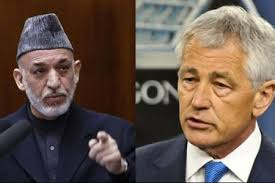
Karzai meets Hagel (Credit: presstv.ir)

KABUL (Reuters) – Afghan President Hamid Karzai ratcheted up his criticism of the United States on Sunday, marring a debut visit by the new U.S. defense secretary, Chuck Hagel, and highlighting tensions that could undermine Washington’s strategy to wind down the unpopular war.

A day after two Taliban bombings killed 17 people, Karzai accused the United States and the Taliban of colluding to convince Afghans that foreign forces were needed beyond 2014, when NATO is set to wrap up its combat mission and most troops withdraw.

“Those bombs that went off in Kabul and Khost were not a show of force to America. They were in service of America. It was in the service of the 2014 slogan to warn us if they (Americans) are not here then Taliban will come,” Karzai said in a speech.

“In fact those bombs, set off yesterday in the name of the Taliban, were in the service of Americans to keep foreigners longer in Afghanistan.”

It was one of several inflammatory comments by Karzai and his government on Sunday and follow weeks of efforts by the Afghan leader to curtail U.S. military activity in Afghanistan, including a call to kick American special forces out of an important province. U.S. commanders see special operations forces as key to the end-phase of the conflict.

Hours after Karzai’s speech, Hagel said he spoke “clearly and directly” about the comments during his first meeting with the Afghan leader since becoming U.S. defense secretary on February 27.

Hagel appeared at pains to be respectful of Karzai and avoid sharp criticism, but he told reporters that any collusion between the U.S. and the Taliban “wouldn’t make a lot of sense.”

The U.S. and NATO commander in Afghanistan, General Joseph Dunford, was more categorical.

“We have fought too hard over the past 12 years, we have shed too much blood over the past 12 years, we have done too much to help the Afghan security forces grow over the last 12 years to ever think that violence or instability would be to our advantage,” Dunford told reporters travelling with Hagel.

Of Karzai’s remarks, he added: “I’ll let others judge whether that’s particularly helpful or not at the political level.”

Still, politics will be key over the next several months, as the United States and NATO allies work to carry out their strategy of pulling out their troops and decide how large a residual force to leave behind after 2014.

NATO defense chiefs meeting in Brussels last month discussed keeping a combined U.S. and allied force of 8,000-12,000 in Afghanistan, focusing on training Afghan troops and countering the remnants of al Qaeda, the Pentagon has said.

Any deal for a follow-on force, which Washington says must include immunity for U.S. troops, would need Karzai’s blessing.

ABUSING STUDENTS? TALIBAN TALKS?

Karzai has a history of making incendiary statements that exasperate Washington but the nature and awkward timing of his latest remarks about the United States were exceptional.

He also alleged on Sunday that the Taliban and the United States had been holding talks in the Gulf Arab state of Qatar on a “daily basis,” further fuelling his suggestion that Washington and the militants were working at common purposes.

“I told the president that it was not true,” Hagel said. “The fact is any prospect for peace or political settlements – that has to be led by the Afghans.”

The Taliban spokesman in Afghanistan, Zabihullah Mujahid, denied that negotiations with the United States had resumed.

Karzai’s government also alleged that U.S.-led forces and Afghans working with them were abusing and arresting university students. Karzai issued an executive order banning foreign troops from entering all education institutions.

Hagel and Karzai were meant to have appeared together at a joint news conference on Sunday evening. But, in a reminder of the threats posed by the resilient insurgency, U.S. officials said it was canceled because of security concerns.

Hagel was about a kilometer away and within earshot of a Saturday morning suicide attack outside the defense ministry that killed nine people. He was meant to have met his Afghan counterpart there this weekend but the venue was later changed.

Hagel’s visit coincided with the passing of a deadline imposed by Karzai for U.S. special forces to leave Wardak province accusing them of overseeing torture and killings.

U.S. forces have denied involvement in any abuses.

Hagel has sounded hopeful that a deal could be reached on their continued deployment but acknowledged no breakthroughs were made in his talks with Karzai.

It was unclear how Hagel’s trip would be viewed by U.S. Republicans who bitterly fought his nomination to become defense chief, portraying him as soft on Iran and questioning his judgment.

Hagel at times appeared sympathetic to the stresses of political life that Karzai must endure.

“I know these are difficult issues for President Karzai and the Afghan people. And I was once a politician,” Hagel said. “So I can understand the kind of pressures – especially leaders of countries – are always under.”

(Additional reporting by Hamid Shalizi; Writing by Phil Stewart, Michael Georgy and Jeremy Laurence; Editing by Christopher Wilson and Peter Graff)


TTP affiliates have dug into Karachi – ATDT author

PPP Senator Dr Karim Khawaja (left) listens to ATDT author

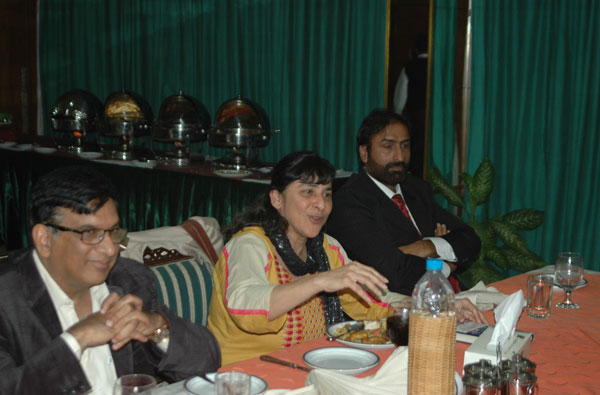
Karachi, Feb 6: The author of Aboard the Democracy Train, Nafisa Hoodbhoy, gave an international perspective on Pakistan’s political situation at a luncheon reception hosted by PPP Senator Dr Karim Khawaja at the Defense Housing Authority Club in Karachi.

The get-together with PPP officials and senior television and print journalists became an occasion for the author to talk about how Pakistan  changed in the post 9/11 era. She used her experience as a US based journalist to talk about the winding down of Washington’s offensive in Afghanistan and how that would likely affect Pakistan.

PPP office bearers & supporters

The author focused on the inroads made by the Tehrik-i-Taliban and their affiliates in Karachi, which have unnerved residents. She told the gathering about some of the forces behind the sectarian wars that have now taken hold of  the city, previously wracked by ethnic wars.

Hoodbhoy also spoke of how television anchors have themselves become mouth pieces for power brokers – planting their own perspective instead of allowing invitees the opportunity to present their points of view.

Senior Journalists at DHA club

The PPP office bearers sat through the frank discussion about the opportunism of mainstream political parties,  including the  absence of governance by the ruling party during their last five years in power.


Book launch: Violence we are reaping today, was sowed in ’80s

Writer Aisha Siddiqa speaks at ATDT event (Credit: SPO Pakistan)

ISLAMABAD, Feb 20: Violence on campus was a gift from the right wing, and the politics of violence were introduced by the same students once they graduated. This was the consensus among speakers on Tuesday at the launch of journalist Nafeesa Hoodbhoy’s book, ‘Aboard the Democracy Train: A journey Through Pakistan’s Last Decade of Democracy’.

The gathering included many who once were students, later political activists and journalists. Decades later, they were sharing memories of their days of struggling against brutal and tyrannical regimes.

“There are few books which chronicle political and journalistic struggles in Pakistan, but this book is a continuation of Zameer Niazi’s books on the press which were authored around the end of the Ziaul Haq era,” said journalist Zahid Hussain.

Strengthening Participatory Organisations (SPO) Chief Executive Naseer Memon called the book an absorbing account with a living storyline of the tumultuous ‘80s and ‘90s “when politics was struggling and general and army was ruling.”

Memon shared the current situation in Sindh and underscored that religious and ethnic rivalries created in the once-secular society of the province were not “homegrown” but were “injected into society by the establishment”.

Senator Mir Hasil Bazinjo, who was a student leader at Karachi University at the time, admitted that it was a mistake by progressive forces to support an urban ethnic group to counterbalance the power of the religious group. “I was a student and often would have problems with the Jamat-e-Islami, which was funded and aided by Zia.” He said it was the time when weapons made their way into campuses and students were killed due to their allegiances with liberal and social groups struggling for a viable, peaceful Pakistan. The ethnic group was later patronised by the establishment, which led to the current crisis.

About the book, he said, “It is an account with personal touch and it helps us remember what we have experienced till date.”

Defence analyst Ayesha Siddiqa said that in the contemporary media age, “We have short memories with no sequence of events and its ramification.”

She talked about the difficulties in identifying real news in this age, as “different people come in the garb of religion, liberalism or in the name of national interest.”

On a related note, M Ziauddin, the executive editor of The Express Tribune, pointed out that the media in Pakistan is market-driven, rather than news-driven. He cited this as a reason that most media outlets exercise self-censorship to protect their commercial interests.

Khawar Mumtaz, Chairperson, National Commission on the Status of Women and chief guest on the occasion said reading the book triggered the frightening ambience of Zia’s era of violence and tyranny. “It reminded me of the days when religiosity and violence was flowering and blossoming under the umbrella of the state,” she said.

She recalled the days when Hindus and Parsis were her classmates and they lived in peace and tranquility. “There is a need of more such accounts for the current generation to remember what has been done in the past and how did they come to the current crisis.”

Hoodbhoy called the book a narration of her “experience as a reporter and eyewitness to many accounts from 1988-99” and shared how the “strings of even a civilian government were being pulled by somebody from outside to derail the democratic process.’

Published in The Express Tribune, February 20th, 2013.
Source: http://tribune.com.pk/story/509794/book-launch-violence-we-are-reaping-today-was-sowed-in-80s/

Nafisa pens down challenges to Pakistan in her book

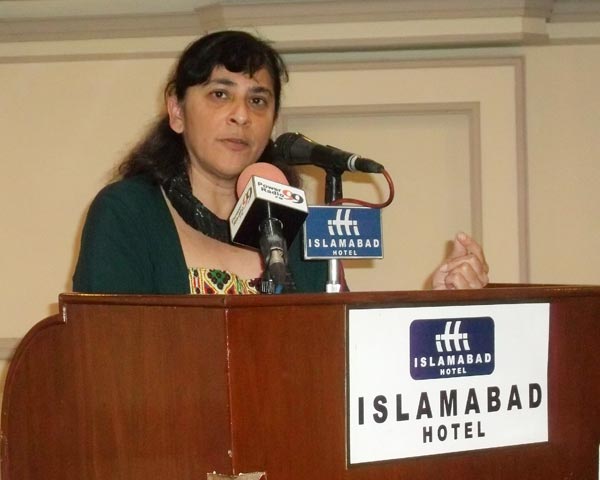
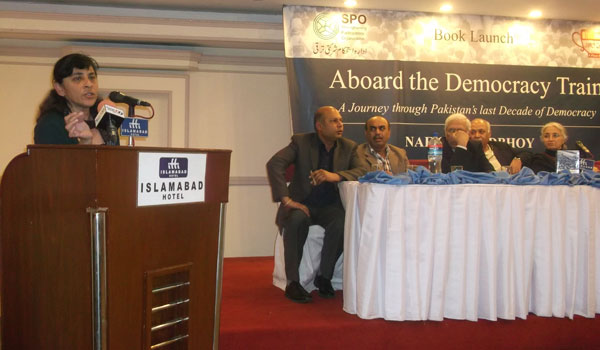
Nafisa Hoodbhoy addresses Islamabad audience (Credit: SPO Pakistan)

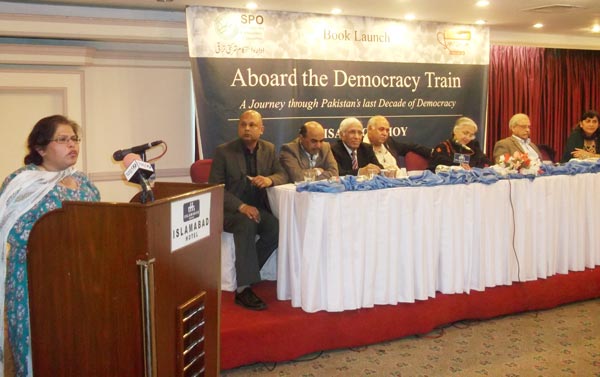
ISLAMABAD, Feb 19: Aboard the Democracy Train, a book by Nafisa Hoodbhoy, launched on Tuesday at a ceremony organised by the Strengthening Participatory Organisation (SPO). In the book, the author recounts her experiences as the only female reporter of a leading daily newspaper at that time.

“Unfortunately we are on a train that is leading us to a failed state, more than towards democracy,” said Ayesha Siddiqa, a political and military analyst, while addressing a book launch ceremony. She said that such personal narratives were imperative so that the nation can learn from the past mistakes and deal with the hazards and menaces that have surrounded Pakistan today.

National Commission on the Status of Women Chairperson Khawar Mumtaz presided over the event. SPO Chief Executive Naseer Memon, Senator Mir Hasil Khan Bizenjo, veteran journalists Zahid Hussain and M Ziauddin and the author also spoke on the occasion besides others.

Khawar Mumtaz congratulated the author on completion of this thorough account and said the book was a good reminder of the fact that the violence has its roots in history. Senator Bizenjo said that reading the book took him back in the era of the 1980s where ethnic violence took routes and later spread to the entire city, the devastating effects of which can be seen today.

Nafisa Hoodbhoy, the author, researcher and the broadcaster, told the gathering that apart from her front line experiences she has examined the circumstances in the post-9/11 scenario. “I have also tried to pick up on mafias that lead to the death of Benazir Bhutto, a two-time former prime minister,” she said.

“As the only woman reporter in Dawn newspaper (1984–2000), I was curious about the connection between day to day events and stored them in memory to tell the world some day about the larger picture. “My access to leading politicians and places would go on to feed a narrative on Pakistan that has normally been hidden from the public view,” she said.

“In using my personae, I have tried to break down the complex history and politics of my home country – which despite its small size is a big player on the global scene,” she said. “I have used my knowledge as a journalist on both sides of the Atlantic to trace the path taken by the nation to where it has arrived,” she said.

Source: http://webcache.googleusercontent.com/search?q=cache:D9KAJC0eMj4J:thespokesman.pk/index.php/template/politically-incorrect/itemlist/user/940-thespokesman%3Fstart%3D92+&cd=2&hl=en&ct=clnk&gl=us

“Aboard the Democracy Train” launched on 19th Feb

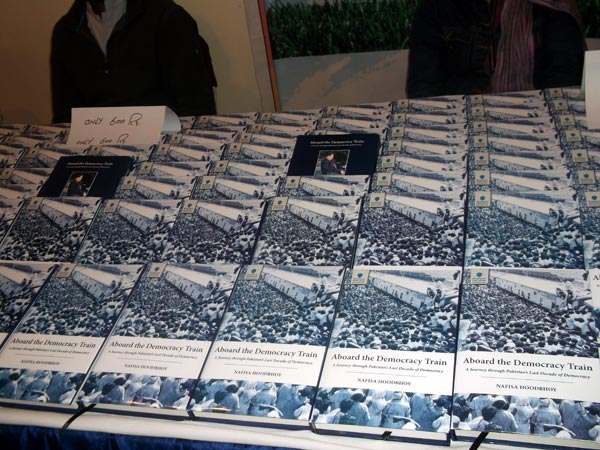
Pakistan edition of ATDT on display at Islamabad hotel (Credit: SPO Pakistan)

ISLAMABAD, Feb 20: SPO Civic Café organized the launching ceremony of Prominent Journalist Ms. Nafisa Hoodbhoy’s book in Islamabad

On the occassion‚giving the introduction of book Author Nafeesa Hudboy said‚ while living in the US‚ she wrote about her front line experiences of the period between 1988-1999. Then‚ working as the only woman reporter for the Dawn newspaper in Karachi‚ Pakistan during Gen. Zia’s era‚ she had associated with the nation’s key politicians and gained key insights into the nation’s road to democracy.

Chief Executive Strengthening Participatory Organizaion Naseer Memon briefed about role of SPO in the process of development. While talking about the book he said‚ the author has described the events during Zia’regime with powerful narration. She has written about religiosity and ethnic division which have been one of the most highlighted issues in Sindh during Zia’s regime. He said‚ in the last five years Sindh is undergoing a transformation and fundamentalism is flourishing at an alarming situation.

Prominent Journalist Zahid Hussain said that the peak period of Zia’s Martial law was Origin of the ethnic divides and riots in Karachi. He said‚ author has given due space to the period of martial law leading to the period when democracy was restored. He said‚ the book takes you back on a journey to Zia’s regime.

Senator Mir Hasil Khan Bajinjo opines that the book is a journey to Zia’s era. The process of violation was initiated by Zia through student organisation‚ and Karachi university did provided a platform

Eminent writer Dr. Ayesha Sadiqa defines the book as personal account and story- dotes‚ which helps the reader to associate with the incidents‚ happenings in the 80’s. The book is a critical account of how societies are molded. The narratives might be helpful in finding joining our dots where we as a nation lost our way‚ due to short-memory as a nation. The book talks about how we have developed.

Renowned journalist M. Ziauddin said that It’s a great book‚ it is must read for every budding journalists. The author shares her experience of a period‚ which she has witnessed and gone through. The author has done a fantastic job.

Chief Guest‚ Ms. Khawar Mumtaz‚ Chairperson‚ National Commission on the Status of Women said that the book is living experience. It reminded me my student days‚ when Karachi University administration Supported a student organisation. She said this book triggered our memories. She said if zia ul Haq was not there‚ situation was not too bad. Karachi was a peaceful city. She said ‚we need this kind of writing‚ this is point of reference for all of us.

The discussion was followed by questions from the audience.

The event was followed by book signing by the author.

Eminent Poet and Human right Activist Haris Khaleeq moderate the event and SPO chief Executive Naseer Memon give the vote of thanks for making the event successful.

Nafisa Hoodbhoy’s book is a gripping account of the two-terms each of Mohtarma Benazir Bhutto Shaheed and Nawaz Sharif during 1988 to 1999. Both ascended the Prime Minister’s office through elections and both were sacked by the President of the time.

Nafisa serving as the only female reporter with the premier English daily of Pakistan‚ Dawn‚ for 16 eventful years‚ 1984-2000‚ had the advantage of covering for her paper all major developments of that period and taking mental notes to be incorporated in a book after the turmoil settled down and admitted of an objective evaluation of the events that continue to cast their shadow even to this day.

Source: http://www.radio.gov.pk/newsdetail-38357

Riding the democracy train

ATDT author at Islamabad book launch (Credit: Strengthening Participatory Organization)

ISLAMABAD, Feb 19: Aboard the Democracy Train: A Journey through Pakistan’s last decade of democracy, was billed as a chronicler of the 1980s and the 1990s – a historical narrative that documents the degeneration of the country, under General Ziaul Haq and the events that followed.

The hard back book, written by Nafisa Hoodbhoy, contained personal accounts of the author from General Ziaul Haq’s reign and then the worsening political picture after 9/11 under General Pervez Musharraf.

Launched in collaboration with Strengthening Participatory Organisation (SPO) here on Tuesday, two thirds of this book shed light on the political history/developments in Karachi and how the Muttahida Qaumi Movement (MQM) and the Jamaat-i-Islami found patronage under General Zia.

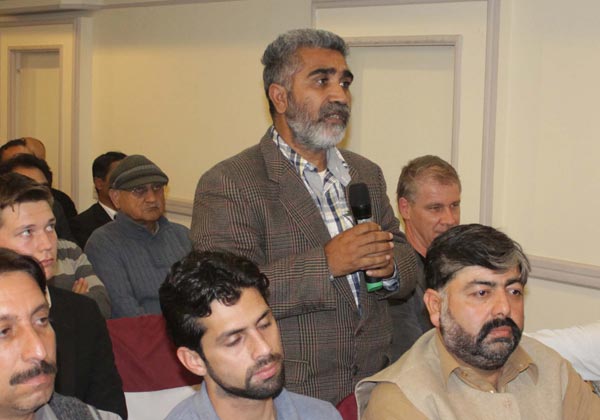
A Baloch guest asking a question

The remaining one third of the book, Aboard the Democracy Train dealt with post 9/11 situations and the American engagement in Pakistan that further worsened the political affairs of the country.

“I have captured the front line experiences as a journalist when I was the only female reporter for Dawn in Karachi,” she said.

Senior journalists and columnists, who had known Nafisa Hoodbhoy personally as well as professionally, made up the group of speakers to talk about the book, the events as they remembered (to corroborate all that was captured in the book) and the author.

For CEO of SPO, Naseer Memon, the absorbing accounts revived the terrors of General Ziaul Haq’s 11 years tenure in power and the dramatic changes in Karachi since the 1990s.

Journalist and author, Zahid Hussain said the book reminded him of how Karachi used to be the centre of all politics and was transforming into a hub of violence.

“Those were also the days of curbs on journalism when media used to be a resistance media,” said Zahid Hussain.

History was also recalled when National Party Senator Mir Hasil Khan Bizenjo remembered the birth of the MQM from 40 to 45 students lead by Altaf Hussain, to counter Sindhi politicians.

“Nine students were shot dead in three years in Karachi University,” said the Senator commenting on the ethnic violence initiated by the MQM.

Since most of the guests speakers happened to have attended the Karachi University, they were thrown back to the days when they were students and were first hand witnesses to the degeneration of Karachi.Sentences and paragraphs jumped out of the book like images, said the editor of Express Tribune, Mohammad Ziauddin.

“It’s a fine and easy read, especially for the younger generation. The author has turned it into an historical movie from 1984 to the present day,” said Mohammad Ziauddin who empathised with the Sindhis, whom he described as innocent and systematically exploited people.

The personal and humane touch of the author, took writer/columnist, Ayesha Siddiqa 20 years back.

“I remember all those stories like they were yesterday – the critical events that changed opinions and societies and eventually resulted in this failed State today,” said Ayesha Siddiqa elaborating on how Nafisa Hoodbhoy had explained the nation got derailed.

The event was also an opportunity for guests in the audience to congratulate Nafisa Hoodbhoy and meet the author personally.

Source: http://dawn.com/2013/02/20/riding-the-democracy-train/

ATDT Author Calls on Elite to Connect with the “Real Pakistan”

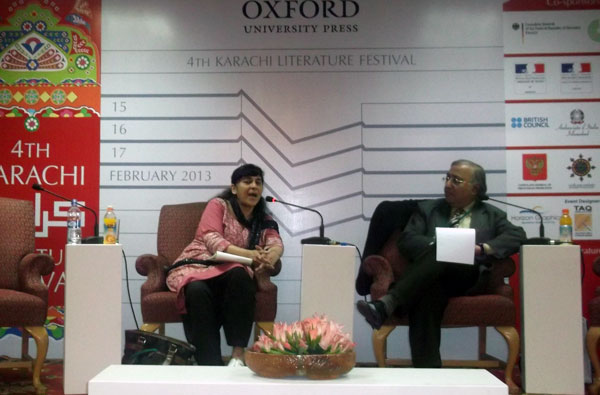
Nafisa Hoodbhoy presents her book at the Karachi Literary Festival

Karachi, Feb 17: Nafisa Hoodbhoy, author of Aboard the Democracy Train, a Journey through Pakistan’s Last Decade of Democracy told a gathering at the Karachi Literature Festival on Sunday that the nation’s elite needs to connect with its own majority in order to understand the real Pakistan.

Presenting her motivation for writing ATDT, while living in the US, Ms Hoodbhoy said that she worked back in memory to write about her front line experiences of the period between 1988-1999. Then, working as the only woman reporter for the Dawn newspaper in Karachi, Pakistan during Gen. Zia’s era, she said she had associated with the nation’s key politicians and gained key insights into the nation’s road to democracy.

The author told the primarily English speaking audience, gathered at the Beach Luxury hotel, that her academic and journalistic experiences in the US had also enabled her to document how Pakistan had functioned as an ally of the US “War on Terror,” – and the impact that had left in terms growing militarization and fundamentalism in the region.

Responding to the moderator,  Syed Jaffer Ahmed’s query about whether she could have written the book if she had not gone to the US, she said, “Probably not.”  According to the author, she took opportunity of the distance and solitude to recreate from her experiences.

“Given that `Journalism is Literature in a Hurry,’ it became the right time for me to unpack my memories,” she told the gathering.

The presentation was followed by questions from the audience.

Earlier, Kenize Mourad, author of In the City of Gold and Silver presented her book in the same room, in the session moderated by Aliya Iqbal-Naqvi.


ATDT Event at HPC

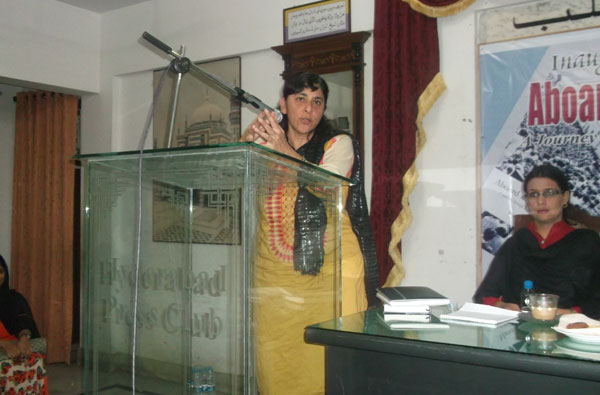
Nafisa Hoodbhoy speaking at HPC

Hyderabad, Feb 13: Aboard the Democracy Train  was launched on Wednesday at the Hyderabad Press Club amid a diverse gathering of professors, teachers, students, journalists and intellectuals.

The event was addressed by Jami Chandio, Executive Director of the Center for Peace and Civil Society, Sindh University teacher, Amar Sindhu, journalist Ali Hassan, media personality, Anita Shah and moderated by president Sindh University Teachers Association, Arfana Mallah.

ATDT author, Nafisa Hoodbhoy spoke about her book and fielded  questions on politics and journalism from the audience.

The event was followed by book signing and media interviews given by the author.