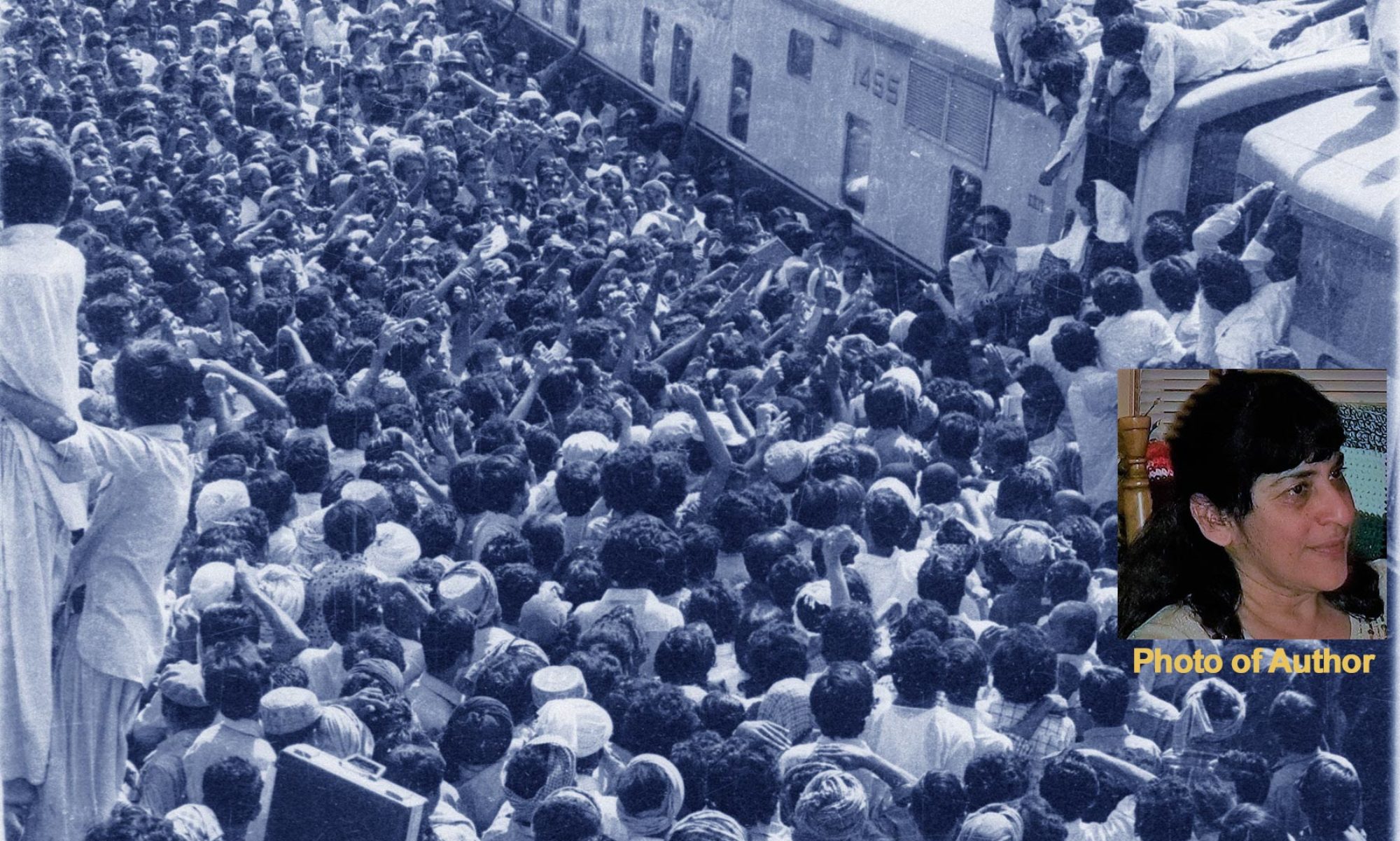
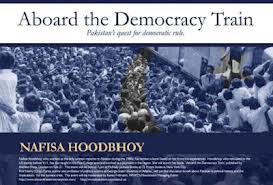
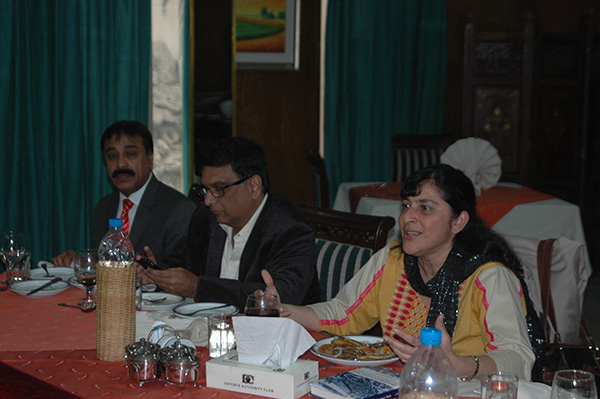
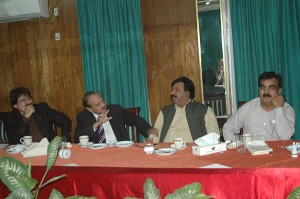
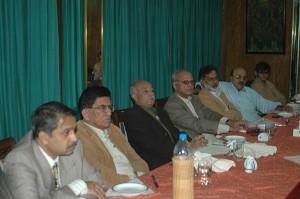
SPO Civic Café has organized the launching ceremony of Prominent Journalist Ms. Nafisa Hoodbhoy’s book in Islamabad
Nafisa Hoodbhoy’s book is a gripping account of the two-terms each of Mohtarma Benazir Bhutto Shaheed and Nawaz Sharif during 1988 to 1999. Both ascended the Prime Minister’s office through elections and both were sacked by the President of the time.
Nafisa serving as the only female reporter with the premier English daily of Pakistan‚ Dawn‚ for 16 eventful years‚ 1984-2000‚ had the advantage of covering for her paper all major developments of that period and taking mental notes to be incorporated in a book after the turmoil settled down and admitted of an objective evaluation of the events that continue to cast their shadow even to this day.
Author addresses PPP leaders and senior media personnel in Karachi
After completing a successful launch in Karachi, Aboard the Democracy Train will launch its newly published Pakistan edition in Hyderabad on Feb 13 (Wednesday).
The event will be addressed by Urdu and Sindhi speaking intellectuals at the Hyderabad Press Club at 5 pm.
The program will be kept interactive in order to enable a free exchange of ideas on the history and politics of Sindh, as documented by the author in the 1980s when she worked as the only woman reporter in Dawn during the Zia era.
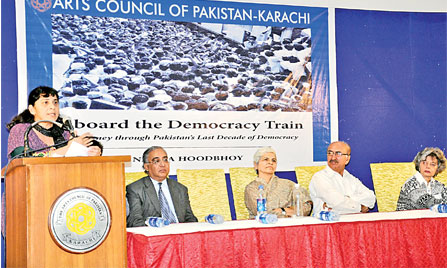
The author speaks at ATDT book launch in Karachi (Credit: thenews.com.pk)
Karachi, Feb 2: Speakers at the launching ceremony of the book titled: “Aboard the Democracy Train: a Journey through Pakistan’s Last Decade of Democracy”, authored by eminent journalist Nafisa Hoodbhoy, called for learning lessons from the derailment of democracy in the country in 1990s. The event was organised by the Arts Council of Pakistan (ACP) here on Saturday.
“We should learn lesson from the horrible consequences the country suffered owing to frequent interruptions in the nascent democratic process,” said Nafisa Hoodbhoy while speaking and answering questions from the audience.
“I am not fond of the present government but I do realise that it is also facing extreme difficult situation,” she added. Nafisa asked as to how stable policy and development would take place when the rulers would be concerned that they may be sent home tomorrow. To some extent, she agreed to the questioner that the democratic struggle during 1980s was linked with the struggle for the rights of women, minorities and human rights but “now the democratic question was linked merely with power politics”.
She, however, opined that much part of this blame should go to those forces which interrupted the democratic process from 1988 to 1999 as no regime was allowed to complete its tenure. She believed that the problems, which the country and particularly Karachi was facing today was the result of the war on terror and Pakistan’s role in it.
“There is a great deal of anti-US sentiments in Pakistan but we need to adopt political approach and objectivity towards the US,” suggested Nafisa.
She said that Washington could not be blamed for all the ills being faced by Islamabad. “There is absence of governance and lack of planning and Pakistan needs to blame itself for it,” she added.
About the book and herself, Nafisa said: “This is a book for the people who are interested in the inside story of Pakistan. It is one that I undertook to write because of my front line access to top politicians and exclusive information obtained while working as a political reporter in Karachi in the 1980s.”
She said she was the only woman reporter at a turning point in Pakistan’s history. “The event, still etched in the minds of millions of Pakistanis…Gen. Zia’s plane crash of August 1988… catapulted me to cover Benazir Bhutto’s bid to mobilize the masses,” she said.
“There are five main aspects of the book,” said eminent scholar Dr. Jaffar Ahmed.
Firstly, Nafisa has strong realization that Pakistani society happens to be patriarchic and in such society women have to launch “extra-ordinary struggle” for the rights and make their presence felt.
“She (Nafisa) had developed a longing for Benazir Bhutto because of her (BB’s) extra-ordinary struggle against the despot rule,” said Dr. Ahmed, head of Pakistan Study Centre of Karachi University.
She also realised that if women come out in the field they would find that there was a large number of people who would join their struggle.
“Nafisa broke the taboos and gender bias by working in the field as reporter,” said Prof. Ahmed.
Secondly, Nafisa belonged to what it is believed as “elite class” but despite this she had developed longing for the poor and deprived ones. This was evident from her visits to rural areas of Sindh. She was highly critical of the “classed society” of Sindh and this was very significant thing of her book.
Thirdly, another important aspect of Nafisa’s book was that she has described the ethnic question or ethnic hatred in Sindh objectively. She has stated as to how the “majority was turned into minority” and as to how the failure to manage it resulted in the polarization and fragmentation of society in Sindh.
“Nafisa’s approach is objective and without any bias,” said Prof Ahmed, adding that she has also presented “remedy of this polarization” in her book.
Fourthly, Nafisa loved Benazir Bhutto from the core of her heart and somewhere in her book she appears to be “obsessed” with her but despite this love and longing for the political leader she (Hoodbhoy) did not desist from criticizing the flaws and failures of the BB’s two tenures.
“This shows that she has a commitment with the democracy and not with any political leader,” believed Jaffar, adding that she was not willing to compromise on her democratic principles.
The fifth aspect of the book pertained to Nafisa’s criticism on the Pakistan’s role after 9/11 and geo-strategic situation in the region. Nafisa believed that whatever lawlessness Pakistan was facing today was the result of the country’s unstinted support to the US-led war on terror.
“The basic thing is that Hoodbhoy’s book is politically correct book, which is written from the democratic perspective,” concluded Dr. Jaffar Ahmed.
Journalist and novelist Muhammad Hanif said what struck him was that the book has been written as “first person” and he knew that it was a very difficult task but she managed to strike a balance in personal as well as political history of Pakistan.
He opined that the book was not the political history of Pakistan, instead it was a “reporter’s diary” about the events of last 20 years, which provide “brilliant perspective about today’s life as well”.
“Nafisa, a bright and hard working reporter chased the murder and rape cases and took them to the conclusion,” said Hanif.
He said the book was also partly a love story as Nafisa found her life partner through her journalistic work.
Rights activist Zohra Yousuf said that the book was being launched at an appropriate time as it was the first time that an elected government was completing its tenure without any interruption.
Though the democratic regime was marked by uncertainty and the rights abuses, it was quite an achievement in the history of Pakistan, she said.
Zohra opined that the democracy should not be taken in narrow sense and stressed for debating the quality of the democratic regime, specially its poor governance. At the same time, she also underlined the importance of assessing the role of what she called two big brothers namely the “army and now judiciary” under which, this government worked.
“The book starts with the transition in 1988 i.e. after the death of Gen. Zia in plane crash and it resonates with us and make us realize its tragic aftermath in the assassination of Benazir Bhutto,” said Zohra who also worked as journalist in 1980s.
Referring to perpetual act of sabotage in the shape of destruction of democracy thrice by the ambitious military generals, Ms Yousuf believed that lately the militancy was posing serious challenge to democracy.
“We did not exactly know who killed BB but at least officially it was said that the militants assassinated her,” she said, adding that the latest victim of the militancy was ANP leader Bashir Bilour.
About the book and its author, Zohra said that Nafisa’s approach was journalistic and not academic, and it makes very easy to read it.
“She (Nafisa) brings back memories and regrets such as things would have been much better today if the democracy had not been derailed,” said Zohra.
She also highlighted the “sordid events” which determined the democracy today.
“Though Ms Hoodbhoy had been close to the people in power, she is objective and she narrates democracy honestly and in straightforward and engaging manner,” she added.
Nafisa described the compromises through which the democracy was brought back such as NRO and departure of Gen. Pervez Musharraf that were not considered as happy developments.
She (Nafisa) also believed that Asif Zardari was the most unlikely person to lead the present democratic setup.
At the end of her speech, Zohra suggested Nafisa to “revisit the train to democracy”.
Eminent columnist Zubaida Mustafa, who chaired the book launching ceremony, recalled that she was inspired to see the determination and courage of Nafisa when she chose to become reporter of Dawn in Karachi in 1980s, as there were only two or three women journalists at that time.
Nafisa was humbled when Zubaida said that not only young generation but old generation like her learnt a lot from her reports. She said those were the difficult times for the reporters to collect news and bring truth to the readers. Zubaida also recalled the adverse situation which Nafisa faced while covering events in Karachi.
Editor Jang Nazir Leghari recalled the era of censorship and curbs on freedom of media during the military regime of Gen. Zia to the extent that reporters working in the head offices of the newspapers were not allowed covering the political gatherings of the MRD in other districts.
He also named such political personalities who were closed to the military ruler in 1980s but now their sons have become champions of democracy in both the PML-N and the PPP.
President ACP Muhammad Ahmed Shah and Dr. Ayub Sheikh also expressed their views at the largely attended ceremony.
The audience gave standing ovation to both Nafisa Hoodbhoy and Zubaida Mustafa for their work.
Earlier, one minute silence was observed for the departed soul of former editor, novelist and lawyer Siraj-ul-Haq Memon who passed away in the city on Friday night.
Arts Council, Karachi (Credit: artscouncil.com.pk)
The first edition of Aboard the Democracy Train in Pakistan will be launched at the Arts Council Karachi on Feb 2 at 6 pm (sharp).
Speakers include Syed Jaffer Ahmed, Director Pakistan Study Center, Karachi University, Mohammed Hanif, journalist and author, Nazir Leghari, editor daily Jangnewspaper and Zohra Yusuf, chairperson Human Rights Commission of Pakistan. Introduction by Zubeida Mustafa, former assistant editor of Dawn newspaper.
Published by Paramount Publishing Enterprise in a new hard cover design – the Pakistan edition of ATDT will be available for purchase and book signing by the author.
Aboard the Democracy Train was first published in the UK and USA in 2011 by Anthem Press, London. It was reprinted in India in October 2012. The world’s largest online bookseller, Amazon regularly lists it within the category of the 100 top selling books on `Pakistan history.’ The book has also reached that distinction, off and on, in the categories of `Indian History’ and `Democracy.’
Paramount Publishing Enterprise now owns the copyrights of Aboard the Democracy Train in Pakistan. The book may be purchased online from http://www.paramountbooks.com.pk and will shortly be available at Paramount’s book stores in Karachi, Lahore, Islamabad, Faisalabad, Peshawar and Abbotabad.
PESHAWAR: Pakistan is still a major destination for radicalised Muslims bent on a life of jihad, despite hundreds of US drone strikes, the death of Osama bin Laden and the fracturing of Al-Qaeda.
New battlegrounds have sprung up in Africa and the Middle East, but the number of foreign recruits smuggled into the northwestern tribal belt is increasing and they come from more diverse countries. Since the 1980s “jihad” to expel Soviet troops from Afghanistan, Muslim fighters from all over the world have lived and trained on the Afghan-Pakistan border, moulded into Al-Qaeda and a host of spin-off militant networks. After US-led forces in late 2001 evicted the Taliban in Kabul for sheltering Al-Qaeda, Afghan Taliban fled across the border into Pakistan.
But Washington and NATO will end their combat mission in Afghanistan next year and these days the Taliban say their foreign allies are drawn to other conflicts, despite their support networks in a region outside direct government control. “Al-Qaeda is shifting its focus to Syria, Libya, Iraq or Mali,” one member of the Afghan Taliban told AFP on condition of anonymity in northwest Pakistan. Local officials estimate the number of Arab fighters has fallen by more than a half or two thirds in the last 10 years, to below 1,000.
In the last two years, some Al-Qaeda Arabs, particularly Libyans and Syrians, left to take part in the civil war in Syria and the violent uprising that overthrew Libya’s dictator Moamer Khadhafi in 2011. Others migrated to Iraq in 2003, and others to Somalia and Yemen.
But Saifullah Khan Mehsud, executive director of the FATA Research Center, a think-tank focused on the tribal belt, says uprisings in the Middle East have had a minimal effect on the Arab presence in Pakistan. “Arab fighters are not leaving in big numbers,” he told AFP. “They have been there for 30 years and it continues,” he added. The number of fighters from other countries is also rising, say witnesses in Miranshah, the main town of North Waziristan — the district with the largest concentration of Taliban and Al-Qaeda fighters
“The overall number of foreign jihadis has increased in the last two years. Every week we see new faces,” says one regular visitor. There could be around 2,000 to 3,500 foreign fighters in the border areas from around 30 different countries. During the 1980s, the number was also estimated to have been several thousand.
Most of the current crop are Turkmens and Uzbeks, numbering between 1,000 and 3,000 fighters according to local officials, who have fled authoritarian secular regimes in their home countries to set up their own groups. The Islamic Jihad Union, which splintered from the Islamic Movement of Uzbekistan, is based in Pakistan’s border areas. It is committed to toppling the government in Uzbekistan, and fights alongside insurgents in Afghanistan. It has also plotted an attack in Germany, which was foiled.
US officials say covert drone strikes have played a huge role in destroying training camps and disrupting Al-Qaeda in Pakistan. According to the London-based Bureau of Investigative Journalism, 362 US drone strikes have been reported in Pakistan since 2004 — 310 of them since US President Barack Obama took office in 2009. Although North Waziristan locals say the strikes kill more Taliban than Al-Qaeda operatives, they have condemned foreign fighters to a life underground. “They are low profile, they dress like locals, they avoid big meetings and above all they move all the time,” a local journalist told AFP.
Mehsud says that foreigners are coming from a more diverse number of countries than in years past. “A few months ago, we even welcomed some (two or three) people from Fiji for the first time!” says the Taliban member who spoke with AFP. “There are more nationalities because they face the same problems. They tell us that they feel left aside by capitalism and discriminated by unfair laws, like the Swiss one on minarets or the French one on hijabs,” he adds.
Local and Western officials say the number of Western militants have fallen to dozens compared to the several hundreds of a few years ago. A Canadian, who uses the name Mohammad Ibrahim, told AFP that he had been in Pakistan for three years but was now preparing to leave to wage jihad at home.
“Foreigners are now afraid to come to Pakistan because of the drone strikes,” he says, putting the number of his compatriots at 14, compared to “60 to 85 three years ago”. A mechanical engineer by training, he says he works in “technical and logistic affairs” but does not elaborate further. “I often met British, Spanish, Italians, Algerians and Germans. But now… our movements have been limited because of the drone strikes,” he says.
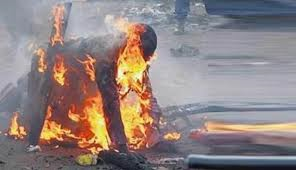
Blasphemy accused burnt in Sita village, Sindh (Credit: Samaa tv)
What is unfolding in today’s Pakistan has marked resemblance to the dark ages of Europe. Renaissance that shaped today’s Europe was actually a triumph of pragmatism over dogmatism. Defiant souls like Martin Luther, Copernicus, Galileo and Bruno liberated European society from clutches of clergy by challenging the hegemony of Church that kept the society fettered for nearly 1,500 years. When Copernicus challenged the geo-centrism of Ptolemy with his heliocentric interpretation of universe, he actually challenged the self-proclaimed divine wisdom of Church. Likewise, when Bruno revealed the continuum of universe, Roman Inquisition charged him with blasphemy and he was burnt at stake. After a long battle rationale prevailed over the faith and modern Europe evolved from the ashes of dark ages.
Obscurantism dominating today’s Pakistan has brought it to the brink of dark ages where enlightenment is starving and logic is trampled by faith-led dictums of the sanctimonious minds. The pervasive rumble of extremism in Pakistan took its roots during the formative years of its ideological stillbirth. Quaid’s vision for the future state oscillated between a secular progressive republic and a homeland for Muslims. However, he amply demystified his thoughts during his first presidential address on 11th August 1947 when he overtly detached religion from the state business.
Long before this, in 1934, Allama Iqbal rescinded the concept of Pakistan attributed to him. In his rejoinder to Prof. Thompson, he unequivocally mentioned that he was not the protagonist of the scheme called Pakistan as he envisioned it only as a Muslim province within Indian Federation. Maulana Maududi too was ferociously against creation of Pakistan. However, he was later escorted by the army to the newly-established country where somersault of his Shariat lobby assumed custodianship of self-righteous ideology of Pakistan. It is widely believed that Liaqat Ali Khan pronounced Objective Resolution in 1949 that eventually deflected the country from Quaid’s envisioned destiny.
Myopic policies of the cold war era also coddled orthodoxy in the country. Spook of “Red Scare” kept spigot of US and UK coffers loose for ultra right elements. Ironically, liberal and secular elements were termed traitors and religious zealots became darling of the right block. The then USIS office was assigned the task to promote Islamic ideology to contain ripples of communism. It was probably not in the wildest imagination of the anti-left forcers that one day they will fall in the trench dug with their own spade.
The same streak of self-centered policies led US and West to cajole every successive dictatorial regime in Pakistan and isolate relatively progressive and liberal leadership in the country. Quintessential victim was ZA Bhutto who was detested for his democratic and liberal policies. Beleaguered Bhutto was left with no choice but to capitulate before the fury of fanatics. In a bid to appease them, he went extra miles to declare Qadianis as non-Muslim, prohibited alcohol and made Friday a public holiday. Constitution of 1973 first time required a public office holder to take oath of striving to preserve the Islamic Ideology that was the basis for the creation of Pakistan. However, all this gamut yielded no fruit to him and he was left high and dry by the champions of today’s free world.
The deadly dye was cast by Zia. He injected venom of extremism in every vein of the society. Soviet invasion of Afghanistan became a heaven-sent opportunity for his despotic expediency. He along with his coterie sealed the fate of this country and descended it into the deep mire of religiosity. These bonanza years of extremism institutionalised the lunacy of religious and sectarian bigotry, which eventually stung its proponents after a decade.
Making Pakistan a surrogate battlefield of Afghan war mutilated the social fabric of the country beyond recognition. Gen Zia even distorted Quaid’s motto of Unity, Faith and Discipline by replacing it with Iman, Taqva and Jihad-fi-sabeelillah. According to Shuja Nawaz, the author of “Crossed Swords”, Zia even allowed fundamentalists to preach at Pakistan Military Academy. Tablighi Jamaat representatives would deliver Friday Sermon at PMA in routine. The practice was forbidden later by Major General Asif Nawaz. Zia smacked orthodox brand of religion in various forms. From retrogressive legislation to public retribution, he exercised every technique to debilitate minds of citizens. Profusion of religious seminaries injected orthodoxy among the young generation as well, which eventually harboured Taliban in the years to follow.
According to a report of the Crisis Group, the country had only 137 madrasas in 1947. The number increased to 1,745 in 1979 and by 1988 it rose to 3,000. The momentum sustained after Zia’s death, and in 2003 official estimates put the number of madrasas at 10,430. Number of unregistered seminaries is any one’s guess.
During Afghan war, these seminaries were converted into nurseries of crusaders. Little wonder that madrasa later earned the status of jihadi training camps. This madrasa boom was obviously not without the financial and technical patronisation of foreign powers — both Islamic and secular. An article by Joe Stephens and David B. Ottaway, “The ABC of Jihad in Afghanistan” appeared in The Washington Post, 23 March, 2002, revealed that special text books were published in Dari and Pashtu to promote jihadi values and militant training. These books were designed by the Centre for Afghanistan Studies at the University of Nebraska-Omaha. Over 13 million books were distributed at Afghan refugee camps and Pakistani madrasas. The jihad bequeathed this legacy to Pakistan.
Afghan war was over but the landmines of extremism remained strewn in Pakistan. Disengagement by US after the Soviet retreat was the shear mistake that America belatedly regretted.
The decades-long indoctrination of orthodoxy has now culminated into a society devoid of tolerance and abhorrence for other’s belief. The fault lines across religions and sects have now fragmented Pakistani society in all directions.
From a cowed war partner to option-less frontline fighter, Pakistani citizens have paid exorbitant price for shenanigans of obnoxious international interests, malevolent local dictators and anachronistic religiosity. The labyrinth of extremism has confounded every one. Political sagacity, social reforms and ameliorated economy can proffer solution to the conundrum. This in turn requires some breathing space for democracy in the country.
If international powers are sincerely committed to extricate this region from the millstone of extremism, democracy in Pakistan holds the key. After trying dictatorships for six decades, evolving democracy deserved a chance for couple of decades. Let people of this country decide their own destiny to make this country and region hospitable to humanity.
The writer is the chief executive of the Strengthening Participatory Organisation. nmemon@spopk.org)
‘Bhuladia’ is not the name of a factory. It is a sickness of the ruling class. Somewhat different from Alzheimer’s disease, it is more selective in choosing what must be forgotten and what must be remembered. A ‘Bhuladia’ patient is predisposed to forgetting the insignificant and the ordinary while remembering the rich and the powerful. A society suffering from ‘Bhuladia’ syndrome will forget the burning alive of 300 ordinary factory workers but remember to drop the murder charges against the two rich and exploitative factory owners. The rentally compromised Raja and his capitalist minister aptly named as ‘Mandiwala’, could not have demonstrated more perfectly the signs and symptoms of the ‘Bhuladia’ disease.
People do not go to work to be burnt alive, blown into smithereens, or trapped in death chambers. In any civilized country there are at least three ways in which employers can be held liable for harm done to employees. They owe a vicarious liability if one employee injures another, a statutory liability imposed by the law of the land and a personal duty under the common law to take reasonable care to prevent harm or injury to employees at work. How come the Islamic Republic suddenly regresses by a thousand years when it comes to the life and wellbeing of its ordinary citizens. Even five months after the tragic event, the toll continues to be vaguely and insensitively referred to as ‘about 300’ dead.
Now that the compensatory crumbs have been distributed to the poor and the rich have been protected from the problematic sections of the penal code, there seems a sense of urgency to forget the past and get on with life. After all, profit-making must not be held back for too long. Do we not need to ask ourselves if we learnt any lessons from the tragic events of 11 September 2012, or do we continue to be just as vulnerable? Even in the 11th century, William the Conqueror had the good sense to legislate fire protection measures. These required all fires to be extinguished at night using a metal cover called ‘couvre feu’ that was put over the fire to exclude the air. The word was gradually adopted as ‘curfew’ – a time beyond which an activity must cease.
So what really went wrong in the ‘Bhuladia’ Factory? The lack of fire extinguishers, the locked evacuation doors, the absence of emergency procedures, the electric wires that sparked, the chemicals that were inflammable, the workers who were not enrolled with the concerned departments, the safety inspectors who never inspected, the hazards that were never identified, the safety training that was never conducted or the safety system that was not in place.
Perhaps it is too embarrassing to admit that while Pakistan has nuclear weapons, it does not have even a basic statutory and administrative health and safety system for its workforce. The existing requirements for safety are obsolete, inadequate and for most part non-existent. The existing safety enforcement mechanisms are corrupt, incompetent and dysfunctional. Like all other civilized countries, Pakistan too needs to create, through an Act of Parliament, an autonomous Occupational Safety and Health Authority (OSHA) for establishing and enforcing Occupational Health and Safety standards throughout the country.
A national Occupational Safety and Health Authority derives its legitimacy and support from three interdependent elements. An Occupational Health & Safety (OHS) Statutory Act, OHS Operational Regulations and the supporting Reference Codes and Standards.
Take for example the Canadian Labour Code or Act (R.S.C., 1985) which is the primary statutory document for Occupational Health and Safety. It lays down requirements for OHS that must be complied by employers, employees and government functionaries. It makes it obligatory for employers to pro-actively identify hazards and institute preventive measures to eliminate or reduce risks.
The operational details of the statutory requirements in terms of application, installation, operation, maintenance, inspections and records are described in Canada Occupational Health and Safety Regulations (SOR/86-304). The Regulations in turn refer to Standards and Codes (such as B51-97, Boiler, Pressure Vessel, and Pressure Piping Code) that provide specifications for the correct methods and materials used in products, buildings or processes.
A reactive and compensatory approach is counterproductive in the business of OHS. Pakistan seems to show no interest or inclination towards developing its OHS statutory, regulatory and administrative infra-structure. For the uneducated and the fake degree-holding parliamentarians, this and such other serious issues are indeed Greek and totally incomprehensible. Only an absolutely callous, clueless and indifferent state could sit back and do nothing to improve these life-threatening death traps referred to as workplaces. Civil society needs to stand up for the 56 million adult and 10 million child workers who work under perilous conditions to earn their daily bread.
Can the Election Commission add a new requirement for every parliamentarian to undergo compulsory service as an industrial worker for at least one week every year?
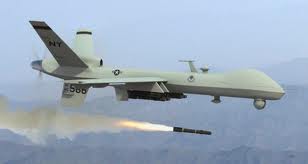
Drone strikes on display (Credit: thenewstribe.com)
The Obama administration is nearing completion of a detailed counterterrorism manual that is designed to establish clear rules for targeted-killing operations but leaves open a major exemption for the CIA’s campaign of drone strikes in Pakistan, U.S. officials said.
The carve-out would allow the CIA to continue pounding al-Qaeda and Taliban targets for a year or more before the agency is forced to comply with more stringent rules spelled out in a classified document that officials have described as a counterterrorism “playbook.”
The document, which is expected to be submitted to President Obama for final approval within weeks, marks the culmination of a year-long effort by the White House to codify its counterterrorism policies and create a guide for lethal operations through Obama’s second term.
A senior U.S. official involved in drafting the document said that a few issues remain unresolved but described them as minor. The senior U.S. official said the playbook “will be done shortly.”
The adoption of a formal guide to targeted killing marks a significant — and to some uncomfortable — milestone: the institutionalization of a practice that would have seemed anathema to many before the Sept. 11 , 2001, terrorist attacks.
Among the subjects covered in the playbook are the process for adding names to kill lists, the legal principles that govern when U.S. citizens can be targeted overseas and the sequence of approvals required when the CIA or U.S. military conduct drone strikes outside war zones.
U.S. officials said the effort to draft the playbook was nearly derailed late last year by disagreements among the State Department, the CIA and the Pentagon on the criteria for lethal strikes and other issues. Granting the CIA a temporary exemption for its Pakistan operations was described as a compromise that allowed officials to move forward with other parts of the playbook.
The decision to allow the CIA strikes to continue was driven in part by concern that the window for weakening al-Qaeda and the Taliban in Pakistan is beginning to close, with plans to pull most U.S. troops out of neighboring Afghanistan over the next two years. CIA drones are flown out of bases in Afghanistan.
“There’s a sense that you put the pedal to the metal now, especially given the impending” withdrawal, said a former U.S. official involved in discussions of the playbook. The CIA exception is expected to be in effect for “less than two years but more than one,” the former official said, although he noted that any decision to close the carve-out “will undoubtedly be predicated on facts on the ground.”
The former official and other current and former officials interviewed for this article spoke on the condition of anonymity because they were talking about ongoing sensitive matters.
Obama’s national security team agreed to the CIA compromise late last month during a meeting of the “principals committee,” comprising top national security officials, that was led by White House counterterrorism adviser John O. Brennan, who has since been nominated to serve as CIA director.
White House officials said the committee will review the document again before it is presented to the president. They stressed that it will not be in force until Obama has signed off on it. The CIA declined requests for comment.
The outcome reflects the administration’s struggle to resolve a fundamental conflict in its counterterrorism approach. Senior administration officials have expressed unease with the scale and autonomy of the CIA’s lethal mission in Pakistan. But they have been reluctant to alter the rules because of the drone campaign’s results.
The effort to create a playbook was initially disclosed last year by The Washington Post. Brennan’s aim in developing it, officials said at the time, was to impose more consistent and rigorous controls on counterterrorism programs that were largely ad-hoc in the aftermath of the Sept. 11 attacks.
Critics see the manual as a symbol of the extent to which the targeted killing program has become institutionalized, part of an apparatus being assembled by the Obama administration to sustain a seemingly permanent war.
The playbook is “a step in exactly the wrong direction, a further bureaucratization of the CIA’s paramilitary killing program” over the legal and moral objections of civil liberties groups, said Hina Shamsi, director of the American Civil Liberty Union’s National Security Project.
Some administration officials have also voiced concern about the duration of the drone campaign, which has spread from Pakistan to Yemen and Somalia where it involves both CIA and military strikes. In a recent speech before he stepped down as Pentagon general counsel, Jeh Johnson warned that “we must not accept the current conflict, and all that it entails, as the ‘new normal.’ ”
The discussions surrounding the development of the playbook were centered on practical considerations, officials said. One of the main points of contention, they said, was the issue of “signature strikes.”
The term refers to the CIA’s practice of approving strikes in Pakistan based on patterns of suspicious behavior — moving stockpiles of weapons, for example — even when the agency does not have clear intelligence about the identities of the targets.
CIA officials have credited the approach with decimating al-Qaeda’s upper ranks there, paradoxically accounting for the deaths of more senior terrorist operatives than in the strikes carried out when the agency knew the identity and location of a target in advance.
Signature strikes contributed to a surge in the drone campaign in 2010, when the agency carried out a record 117 strikes in Pakistan. The pace tapered off over the past two years before quickening again in recent weeks.
Despite CIA assertions about the effectiveness of signature strikes, Obama has not granted similar authority to the CIA or military in Yemen, Somalia or other countries patrolled by armed U.S. drones. The restraint has not mollified some critics, who say the secrecy surrounding the strikes in Yemen and Somalia means there is no way to assess who is being killed.
In Yemen, officials said, strikes have been permitted only in cases in which intelligence indicates a specific threat to Americans. That could include “individuals who are personally involved in trying to kill Americans,” a senior administration official said, or “intelligence that . . . [for example] a truck has been configured in order to go after our embassy in Sanaa.”
The playbook has adopted that tighter standard and imposes other more stringent rules. Among them are requirements for White House approval of drone strikes and the involvement of multiple agencies — including the State Department — in nominating new names for kill lists.
None of those rules applies to the CIA drone campaign in Pakistan, which began under President George W. Bush. The agency is expected to give the U.S. ambassador to Pakistan advance notice on strikes. But in practice, officials said, the agency exercises near complete control over the names on its target list and decisions on strikes.
Imposing the playbook standards on the CIA campaign in Pakistan would probably lead to a sharp reduction in the number of strikes at a time when Obama is preparing to announce a drawdown of U.S. forces from Afghanistan that could leave as few as 2,500 troops in place after 2014.
Officials said concerns about the CIA exemption were allayed to some extent by Obama’s decision to nominate Brennan, the principal author of the playbook, to run the CIA.
Brennan spent 25 years at the agency before serving as chief counterterrorism adviser to Obama for the past four years. During his White House tenure, he led efforts to impose a more rigorous review of targeted killing operations. But he also presided over a major expansion in the number of strikes.
CIA officials are likely to be “quite willing, quite eager to embrace” the playbook developed by their presumed future director, the former administration official said. “It’s his handiwork.”
Brennan’s confirmation hearing before the Senate Intelligence Committee is scheduled for Feb. 7.
Barack Obama’s election as America’s first black president in 2008 was historic on many levels, but the truth may be that Obama’s re-election in 2012 was a much bigger feat.
Visiting his young campaign staffers the morning after his re-election at his campaign headquarters in Chicago, a tearful Obama told the staffers that they had been part of the best campaign team in history.
“You’re smarter, you’re better organised, you’re more effective,” he said. “So I’m absolutely confident that all of you are going to do just amazing things in your lives.”
With a sluggish economy, unemployment teetering at around the eight per cent mark, and growing anti-Obama sentiment in some parts of the country, a second term seemed an uphill task for Obama and it was going to take an extraordinary campaign to make it happen.
Things were different in 2008. Back then he had the fortune of an electorate grown weary of the Bush presidency looking for change and with no real record to defend. His mercurial rise and the zeitgeist of the country at the time seemed to have coincided at the right time.
This time it was going to be harder, with a first term that had left some of his more ardent supporters with a tinge of disappointment given the promise of his first campaign, and the Republicans growing even more strident in their opposition. America hadn’t been so politically polarized in a long time.
But in a presidential campaign, the incumbent enjoys a few advantages and one of them is a strong organisational setup.
From the get-go David Axelrod, the brain behind the Obama campaign, recognised the role that data and information could play in the election. The process had been initiated in 2008 but databases were scattered and it wasn’t until the 2010 midterm elections that the Democratic Party, despite heavy losses, was able to streamline the data to accurately forecast results in a meaningful way.
Enter Rayid Ghani.
At first impression Ghani comes across as an affable person, who speaks in short, clipped sentences that don’t give away any more than he intends to. Right away you get the feeling that he knows what he’s talking about. But his unassuming manner belies the fact that he is one of the leading experts in the growing field of analytics and data mining.
An alum of Karachi Grammar School, he moved to the Unites States for college where he attended a small liberal arts school in Tennessee called Sewanee: University of the South.
There he studied computer science and mathematics, but as with many undergraduate experiences, he used his time there to find his true calling.
“What I really did there was explore and figure out what I wanted to do, which ended up being a research career in some form of artificial intelligence and machine learning,” Ghani said. “I was motivated by two goals: One was to study and understand how we (humans) learn and two: I wanted to solve large practical problems by making computers smarter though the use of data.”
That eventually led him to Carnegie Mellon University in Pittsburgh for graduate school where he studied Machine Learning and Data Mining.
It was during this period that he started working at Accenture Technology labs as chief scientist, before joining Obama For America.
At Accenture, Ghani mined mountains of private data of given corporations to find statistical patterns that could forecast consumer behavior.
“We were a small group of people who were kind of looking at the next generation of tools that would be beneficial for businesses,” he said. “We were trying to find new approaches to analysing data and see how we could apply it to businesses.”
In today’s data-centric world, the one-size-fits-all model is no longer an efficient use of a company’s resources. More and more, corporations are looking for increasingly targeted approaches to attract consumers.
Similar to how Facebook uses information from user profiles to target its advertising, Ghani helped businesses find patterns in consumer behavior so that his clients could develop different strategies that suit individual preferences. It’s what’s known as customer-relationship management or CRM in the corporate sector.
Having spent 10 years at Accenture, Ghani said he was looking for a move into the non-profit sector, which, serendipitously, is when the Obama campaign came knocking.
“I was always interested in politics,” he said. “Living in the US for 17 years, you tend to follow the politics of the country, because it does affect every person. You read about it, discuss it with co-workers and friends. So [the campaign] wasn’t a completely impossible direction to take.”
Jumping aboard the Obama campaign as chief scientist, Ghani’s job was essentially similar to what he’d done at Accenture — to make sense of huge amounts of information.
“The core of the work I was doing was looking at a large amount of data and making sense of it to help other people make better decisions,” he said.
The basic idea was to merge digital information with details gathered from voting records and interaction in order to provide a blueprint for efficient spending.
“Most of the data we had was from data that we collected either from interacting with people, which might mean either we called someone, someone donated money to us, or if they volunteered, or from voter registration records,” he said.
There’s a common misconception among people that among the data used was voters’ magazine subscriptions, shopping habits, and other specific behavioral data.
“A lot of the things you might have read on the internet are mostly not correct,” he said with a wry laugh. “We don’t care about what car you drive, or what magazines you read. For one thing we don’t have that data, and it’s not very useful. What car you drive doesn’t tell us which way you’ll be voting.”
The real advantage of data is that it helps in using the resources at your disposal as efficiently as you can, which in the case of political campaigns is money.
“How data helps you, is it makes you more efficient and it helps you spend your money carefully and in the right way,” Ghani said. “You could pick up the phonebook and just start calling everyone, but you’ll either waste calls on people who are already going to vote, or on people who can’t be persuaded to vote your way. But with a data-driven approach, you can target those voters who are much more likely be affected by that call and pick up voters you didn’t have.”
By discerning which voters are the most likely to be swayed, the campaign can then design its ad campaigns and alter its strategy for maximum effectiveness. It’s the smart-bomb method to political campaigning.
But the truth is that we’re still in the infancy of this data-based approach to political campaigns.
“My personal hope is that as campaigns get mature in the use of data,” he said. “Data isn’t a secret weapon but an enabler of better democracy and more public participation. I see the future use of data as enabling more personalised and relevant interactions with voters, to get them more education about issues, more involved in political discussions, and have them even participate in creating public policies.”
And it’s an approach that can be applied anywhere if tailored to the circumstances and realities of any given place — even Pakistan.
“A lot of this is certainly applicable in Pakistan but things have to start small,” Ghani said. “First, there is a lack of data, so political parties need to start collecting this data themselves. Then they need to use it to understand the voters and allocate resources more efficiently. Parties that focus more on grassroots organising are the ones most likely to collect and make more effective use of this data and as this process gets more mature and democratic, I hope it leads to a better educated public making informed voting decisions that are good for the country and its people.”
Being of Pakistani origin, it’s not a stretch to wonder what role Ghani’s own politics play in this, especially given the ups and downs the relationship between America and Pakistan has taken over the years. But for Ghani, whose family lives in London, while he works in the US, it’s a lot simpler.
“At this point I really don’t know what I am,” he said. “It’s less about country than about the larger world. For me it was a really easy decision, ‘Is Obama better for the world than (Mitt) Romney?’ Absolutely.”
What attracted Ghani to the campaign was Obama himself as a candidate.
“He is great at emotionally connecting with, motivating, and energising people but what was more important to me was what he had done in his first term and how much still remained to be done,” he said.
In addition to that, it was the diversity of the people on the campaign that was one of the great things about working for the Obama campaign Ghani said.
“There were so many people with different backgrounds and experiences, but they were all there for the same reason,” he said.
The campaign itself was an understandably grueling and exhausting experience.
“It’s unlike any other workplace,” he said. “We were, spending 15, 16, 18 hours a day together, with no weekends. It’s something you enjoy when it’s over, because when you’re in it, it’s not easy.”
So after a long and grueling, albeit rewarding, campaign, what’s next for him?
“Well the campaign’s over now,” Ghani said. “I’m looking at different things and trying to stay connected with the non-profit world, and trying to help non-profits use data to become more efficient and better.”
Ghani is one of a small number of tech wizards in a world that is becoming increasingly data oriented. If the 2008 campaign was about charisma and hope, the 2012 campaign was about science and data. Gone are the days when political campaigns were an art form run by people who played by gut instinct.
Now it’s run by people like Rayid Ghani.
The author is an assistant multimedia producer at Dawn.com.
For any system to survive, it must fulfil at least two minimum requirements. Meet the needs of its customers and have the capacity to improve itself.
The first requirement relates to the primary function and purpose of an organisation and the second to its ability to detect its own shortcomings and take actions to improve its performance.
When an organisation cannot meet both these requirements, it becomes a dead horse and a candidate for the tribal wisdom of the Dakota Indians. When you discover you are riding a dead horse, the best strategy is to dismount.”
Regrettably the Election Commission of Pakistan (ECP) is a perfect candidate for the tribal wisdom of the Dakota Indians.
The ECP failed completely to deliver on its primary function.
It conducted a sham election in 2008 that included 37 million fake votes. It also looked the other way and allowed hundreds of fake degree holders, dual nationals, tax avoiders and law violators to contest elections and become our ‘illegitimate’ lawmakers.
For five long years, the sleepy ECP could not detect that 70 percent of legislators do not file their tax returns. What can explain a misdemeanour of such magnitude: incompetence, corruption, connivance, political partisanship or simple cluelessness?
Sadly, there were no traces of remorse, no one was held accountable and it was ‘business as usual’ in the corridors of the ECP.
On June 23, 2010, two citizens of Pakistan requested the Supreme Court for suo motu action against two chief election commissioners.
Against Justice (r) Qazi Muhammad Farooq for his failure to scrutinise fake degrees and other credentials of the contestants.
And against Justice (r) Hamid Mirza for his failure to scrutinise the credentials of Jamshed Dasti in the 2010 Muzzafargarh by-elections.
Mr Dasti earlier having admitted to faking his degree could not be considered righteous, honest or ‘ameen’ as required by Article 62 of the constitution.
The application for suo motu notice pleaded that the two chief election commissioners be held accountable for the enormous loss of tax payers’ money in the form of salaries and perks paid to the bogus parliamentarians.
Come 2013 and the Pakistanis once again ponder with anxiety and nervousness at the prospects of impending polls. Will the ECP repeat its past performance? Will the ECP once again impose the same or similar set of questionably bogus parliamentarians?
Has the ECP been able to create processes to detect its own shortcomings? Has the ECP taken all corrective actions to prevent future errors? Regrettably, there is no evidence that the ECP has been able reform itself.
The ECP’s vulnerability was partly acknowledged when the government recently announced that the ECP be given one month to carry out scrutiny of the nomination papers against Article 62 and 63 of the constitution.
What appears to be a new and encouraging development, is in fact yet another placebo meant to provide paper ‘relief’ to the people of Pakistan.
The law always placed upon the ECP the responsibility to scrutinise the nomination papers. If the ECP did not do this before, why will it do so now? The problem is not with the law but with its implementation.
To be fair to ECP, its helplessness is partly by choice and partly by design. The CEC, a person of rare integrity, is practically unable to handle the complex and bureaucratic processes of the ECP.
The four members of the ECP are political nominees. A large number of senior ECP staff is on ‘extension’.
The election commissioner of Sindh who was removed for performance-related complaints was not sent home but made the election commissioner of Khyber Pakhtunkhwa.
The ECP does not have the muscle, the administrative skills and the wherewithal to harness or order numerous other departments who must directly support the ECP for performing key electoral verifications.
Our parliament has often moved at great speed to create legislation for its own benefits. Can it show only a reflection of this urgency to legislate new laws to revamp the ECP?
The CEC and its four members need not necessarily be serving or retired judges. They should all be less than 70 years of age. They should be chosen not by politicians but by a panel consisting of some of the most respected citizens, academics and other distinguished and non-controversial professionals of Pakistan.
All departments such as the FBR, FIA, NAB, Nadra, police, HEC, the State Bank of Pakistan and heads of utility companies must be legally bound to respond to the ECP’s requests to investigate and certify the relevant portions of the nomination papers.
The CEC ought to have powers to disqualify, if a violation of electoral rules is detected any time during the five year tenure of a legislator.
An ECP that can neither purge the past defaulters nor scrutinise the future offenders ought to be re-engineered, revamped and made more effective.
Can parliament legislate life and spirit into its much expressed desire for ‘free and fair’ elections?
The writer is a management systems consultant and writes on social issues.