Pakistan authorities block distribution of oldest newspaper

Distribution of the English-language daily Dawn, Pakistan’s oldest newspaper, is being disrupted in much of the country since it published an interview with former Prime Minister Nawaz Sharif.

Reporters Without Borders (RSF) condemns this latest attack on media freedom.

The interview, which reportedly displeased the Pakistani military, appeared in the 12 May (Saturday) issue and the blocking began on 15 May. According to RSF’s information, distribution is being disrupted in most of Baluchistan province, in many cities in Sindh province and in all military cantonments.

The Press Council of Pakistan has notified Dawn’s editor that the newspaper breached the ethical code of practice by publishing content that “may bring into contempt Pakistan or its people or tends to undermine its sovereignty or integrity as an independent country.”

“The unwarranted blocking of the distribution of one of the main independent newspapers has yet again shown that the military are determined to maintain their grip on access to news and information in Pakistan,” RSF said.

“It is clear that the military high command does not want to allow a democratic debate in the months preceding a general election. We call on the authorities to stop interfering in the dissemination of independent media and to restore distribution of Dawn throughout Pakistan.”

Last month, the military were said to have given unofficial instructions to cable TV operators to stop carrying the Geo TV network’s channels, including Geo News, in most of the country. One of the reasons was the airtime that the network had dedicated to Sharif, who was removed as prime minister by the supreme court in July 2017 in connection with a corruption case.

Pakistani ethnic rights group stages first rally in Karachi

KARACHI (Reuters) – A Pakistani ethnic Pashtun rights group on Sunday staged its first rally in the southern city of Karachi, the site of a killing in January that sparked the movement and led to nationwide protests and rallies.

The Pashtun Tahaffuz Movement (PTM) emerged after the January killing by police of Pashtun youth Naqibullah Mehsud in Karachi.

A crowd of several thousand people gathered for the rally on Sunday in Karachi’s outlying Sohrab Goth suburb.
The PTM has said several thousand such killings have been carried out since Pakistan joined the U.S.-led war on terror and launched major military operations in 2009 and 2014 targeting Pakistani Taliban strongholds in the Pashtun majority Federally Administered Tribal Areas (FATA) areas bordering Afghanistan.

Hundreds of thousands migrated to Karachi after the military operations, where the largest population of Pashtuns in Pakistan lives.

Among the crowd of protesters were families of missing persons, holding pictures of their loved ones who they say were taken by security officials.

The families say they have not received any information since the disappearances, some of them more than a decade ago.

The PTM estimates there are over 5,000 such cases.

“PTM was born out of the incident that happened in Karachi,” Mohsin Dawar, one of the group’s founders, told Reuters.

“The trauma and pain the Pashtuns of the FATA have experienced, the Pashtuns of Karachi have gone through a similar experience,” he said.

Officials from Pakistan’s paramilitary Rangers, which are part of the security forces, did not respond to request for comment.

The PTM leader Manzoor Pashteen’s popularity has surged amongst Pashtun youth. Some of the protesters wore the red and black patterned hat, which has become Pashteen’s trademark, as they waited for him to arrive at the rally.

But Pashteen did not board his flight from Islamabad to Karachi on Saturday morning and a representatives of local airline Serene Air said his booking had been canceled, Dawar said.

A Serene Air representative was not immediately available for comment.

Dawar said Pashteen and three other PTM leaders had started on the more than 20-hour drive from Islamabad to Karachi but they were stopped several times along the way.

“He has been stopped and detained for hours several times,” Dawar said.

Speakers at the rally said they would not leave until Pashteen arrived.

“We demand that security officials themselves bring Manzoor Pashteen here before our rally ends,” PTM member Sana Ejaz said.

After sunset, the protesters held up cellphone flashlights, refusing to move until Pashteen turned up.
Writing by Saad Sayeed. Editing by Jane Merriman

Plane returns from Rawalpindi leaving US diplomat in lurch

ISLAMABAD: An aircraft that arrived at the PAF’s Nur Khan Airbase in Rawalpindi to reportedly fly out Colonel Joseph Emanuel Hall of the United States’ embassy has returned after the diplomat failed to obtain clearance from pertinent authorities.

Sources told The Express Tribune that officials at the airbase reached the Federal Investigation Agency (FIA) to determine if the diplomat was allowed to leave the country. Hall, the defense and air attache at the US embassy, was jumping traffic lights when he hit a motorcyclist on April 7. 22-year-old Ateeq Baig died on the spot. Another was injured in the Margalla Road traffic accident.

US envoy placed on ‘blacklist’ for killing biker

The Ministry of Interior later placed Hall’s on a ‘blacklist’, prohibiting him from leaving the country without prior permission. FIA officials told The Express Tribune the prospects of Hall leaving Pakistan were remote. “His name is on the blacklist. He won’t be allowed to fly out,” an FIA official said.

Motorcyclist responsible for accident with US Embassy car: police
Muhammad Idrees, the father of the deceased motorcyclist, had earlier moved the Islamabad High Court in connection with the episode. Idrees petitioned the court to have Hall’s name placed on the ECL and a police probe conducted.

The IHC on Friday gave the Interior Ministry two weeks to reach a decision on placing the diplomat’s name on the ECL. The court also observed that Hall did not enjoy full diplomatic immunity.

Iranians fear the future after Trump exits Iran nuclear deal

TEHRAN, Iran — President Donald Trump’s withdrawal from the Iran nuclear deal has left a bitter taste in the mouths of many people here in the Islamic republic.

Many Iranians hoped the Obama-era pact would lead to prosperity and closer ties with the West.
But with the agreement now on the rocks, some Iranians feel double-crossed by America and say they are pessimistic about their country’s future.

Many Iranians feel they haven’t seen the economic benefits of the nuclear deal. While it allowed Tehran to sell its crude oil and natural gas on the international market, Iran’s economy remains weak with high unemployment and inflation.

Azita Moghadam, a 25-year-old student, described Trump as a “racist and dishonest person who doesn’t care about the people of Iran.”

She added: “Iran’s economy will take a hit by Trump’s decision. A poor sense of security and poor economy are my biggest fear for the future.”

Foreign firms doing business in Iran may face sanctions, U.S. warns
Hamid Salehi, 27, a car salesman, said he felt Iranians would face fewer opportunities to improve their livelihoods now that the nuclear deal was in doubt.

“We had high hopes of better relations with the world and easier business after the deal” he said. “That’s all gone now.”

Iran’s Supreme Leader, Ayatollah Ali Khamenei, also criticized Trump for his decision.

“This man will turn to dust and his body will become food for worms and ants, and the Islamic republic will still be standing,” he said, referring to the U.S. president. “I said many times from the first day: Don’t trust America.”

Seyed Hossein Mousavian, a Middle East security and nuclear policy specialist at Princeton University who is a former spokesman for Iran in its nuclear negotiations with the West, said it was inevitable that Iranians would lose trust in the U.S. because of Trump’s decision to violate the agreement.

He predicted that the country would no longer be prepared to “engage with the U.S. to negotiate on other disputed issues like weapons of mass destruction, terrorism and the regional conflicts.”

Mousavian also suggested that Iran is now likely to turn its back on the West and instead build closer diplomatic and trade ties with Russia and China.

Dr. Mohammed Marandi, a professor at Tehran University and a political analyst, agreed.

“No group, no political faction that once said we should talk to America holds that position anymore, as a result it strengthens the argument that Iran should move closer to Russia and China,” he said.

Marandi said there had been a huge rise in the number of Iranian students and business owners going to China, accompanied by an increasing number of direct flights between the two countries in recent years. More Mandarin language courses have also become available in the country, including a degree program at the University of Tehran.

What is the Iran nuclear deal?
Marandi said Trump’s withdrawal from the pact leaves America being seen as “dishonest and unreliable, and unwilling to abide by its own commitments.”

A telephone survey of 1,003 Iranians conducted in April by IranPoll, a Toronto-based firm, found 67 percent of respondents felt the country should “retaliate” if the U.S. violated the nuclear deal. The survey had a margin of error of 3.1 percent.

Iranian lawmakers set fire to a paper U.S. flag in the Parliament Wednesday, while shouting “Death to America!” They also burned a piece of paper representing the nuclear deal and stomped on the papers’ ashes.

Although the burning of U.S. flags is common in Iran and harsh criticism of America has been a staple of Iranian politics for years, that was the first time observers could remember anything being set alight inside the Parliament.

And while chants of “Death to America” are commonplace in Iran, most Iranians frequently interact with the West, even if only through online videos and illegally obtained movies.

Many also have family members abroad, with Los Angeles a popular destination for Iranian ex-pats.

Ali Arouzi reported from Tehran, Saphora Smith reported from London, and Rima Abdelkader reported from New York.

India, Pakistan Set for Counterterror Drills — Together, in Russia

Washington, May 3: In an unprecedented move, nuclear-capable South Asian rivals India and Pakistan are gearing up to take part in joint military drills.

Last week, Indian Defense Minister Nirmala Sitharaman confirmed that India would participate in anti-terrorism military drills alongside Pakistan.

The two nations, partitioned in 1947, agreed to train under the auspices of the eight-member Shanghai Cooperation Organization (SCO) in the Ural Mountains of Russia in August.

The SCO is an economic, security and political organization founded in Shanghai in 2001. China, India, Kazakhstan, Kyrgyzstan, Pakistan, Russia, Tajikistan and Uzbekistan are the member countries.

The founder of India’s Defense Intelligence Agency, Kamal Dawar, said that Pakistan’s participation in the drills should not be “merely symbolic.” He said that India and Pakistan had worked together as peacekeepers at the United Nations and that it would be a good thing to re-establish communications.
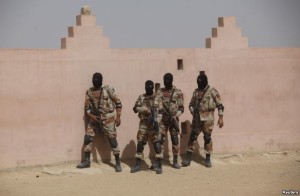
Pak Rangers

FILE – Pakistan Rangers stand before taking their positions during a counterterrorism training demonstration on the outskirts of Karachi, Feb. 24, 2015.

​Sincerity questioned
However, Dawar, author of Tryst with Perfidy: The Deep State of Pakistan, is skeptical about whether Pakistan’s army, intelligence agencies and “multiple terror organizations” would be sincere in working with India to defeat terrorism.

Retired Colonel Farooq Ahmed, former deputy director of the Pakistan military’s media wing, the Inter Services Public Relations (ISPR), told VOA that Pakistan was “very excited” to participate in the drills, but that “India needs to stop pointing fingers at Pakistan and resist interfering in its internal affairs.”

India and Pakistan, which have been feuding over Kashmir since the two nations were partitioned, will most likely keep fighting over the disputed territory, even if they line up on the same platform. The Kashmir region has been a flashpoint between the two countries and they have fought two wars over it.

Dawar had a visceral response at the bare mention of Kashmir. “Pakistan should forget about Kashmir. Kashmir is an integral part of India,” he said.

He said Pakistan’s “interference” in Kashmir was unwarranted and the reason why its “deep state” would never allow it to work with India.

But Brussels-based security analyst Khalid Farooqi said Pakistan’s “moral position” on Kashmir was recognized by the United Nations. In his words, the Kashmiris’ struggle for self-determination had resulted in 100,000 killed, 10,000 disappeared and thousands widowed.
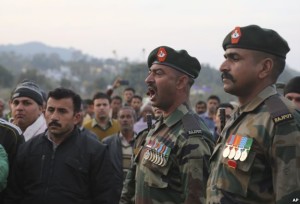
Indian soldiers

FILE – Indian army soldiers pay tribute to a colleague killed in cross-border firing with Pakistan, during his cremation at Nachlah village in Samba District of Jammu and Kashmir, India, Feb.5, 2018.

Indian Prime Minister Narendra Modi also recently met China’s President Xi Jinping and agreed to defer the Indo-China territorial dispute by joining China’s anti-terrorism drills in Russia

Pakistan acknowledges that it agreed to conduct military patrols alongside India after the Pakistan chief of army staff, General Qamar Bajwa, recently visited Russia.

Korean model
Mushtaq Mehar, Pakistan’s former ambassador to Turkey, said recent signs of a detente between North and South Korea could serve as a model for India and Pakistan and pave the way for a softening of tensions between the two countries.
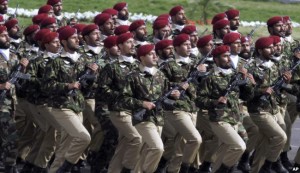
Pak commandos

FILE – Pakistani commandos from the Special Services Group march during a military parade in Islamabad, March 23, 2016.

According to him, America’s status as a superpower allows it to intervene in a “complicated matter” like the Korean Peninsula situation.

Mehar said the United States and Europe were also keen to see the militaries of India and Pakistan fight on the same side, not only to reduce tensions between the two nuclear-armed nations but also to curb the potential for terrorism exploding beyond the region.
Another $1 billion loan makes its way from China

ISLAMABAD: Desperate to boost foreign exchange reserves over the $11-billion mark, Pakistan has received another loan of $1 billion from the China Development Bank as authorities remain adamant, at least in public, not to read the writing on the wall.

Pakistan secured on Saturday financing of $1 billion, said Dr Miftah Ismail, the newly-appointed finance minister, while addressing a post-budget press conference. He did not officially disclose the name of the Chinese institution.

However, sources in the finance ministry said the China Development Bank has given $1 billion out of an estimated $1.5 billion. In its revised estimates, Pakistan has budgeted about $2 billion injection from Chinese financial institutions alone. This includes $1.5 billion from the China Development Bank and $500 million from the Industrial and Commercial Bank of China (ICBC).

With the fresh injection, Chinese financial institutions have so far given $2.2 billion to Pakistan to help the country steer through difficult times. Earlier, the ICBB gave $1 billion at three-month floating interest rate of London Interbank Offered Rate (Libor) plus 3.02%.

Earlier this month, the Bank of China also gave $200 million.

Disbursements of foreign loans remained at $7.53 billion from July through March of this fiscal year due to delay in release of some loans by Chinese financial institutions. The China Development Bank loan was initially expected to be disbursed in March.

Pakistan’s economy has come under pressure with external account worries remaining the focus of economic managers. With a widening current account deficit, foreign exchange reserves have slipped below $10.9 billion at the mid of this month. Chinese loans would temporarily stabilise reserves to close to a three-month import cover.

To a question, Ismail again said on Saturday that Pakistan would avoid knocking the doors of the International Monetary Fund (IMF). “We are trying our best to avoid the IMF package and today, have secured $1 billion financing from China,” said Ismail.

The government has been trying to contain the current account deficit and the increase in custom duty rates by another 1% is one such measure that will help control imports, said Ismail.

Independent economists predict that Pakistan will return to the IMF by September or October this year, as it cannot sustain the external account pressure without combined support of the IMF, the World Bank and the Asian Development Bank.

The government is so far navigating the crisis by taking expensive short-term foreign commercial loans. For the outgoing fiscal year, the government had budgeted $8 billion in loans that it has now officially revised upwards to $10.6 billion.

However, the finance ministry’s internal plans talk about $12.5 billion minimum foreign borrowings for this fiscal year, ending June 30.

The public debt to Gross Domestic Product ratio has estimated to peak to 70.1% by the end of fiscal year 2017-18. This is the highest level in the past 15 years and also in violation of the Fiscal Responsibility and Debt Limitation Act of 2005.

For the next fiscal year 2018-19, the finance ministry has budgeted $9.6 billion in external loans, which are $3.4 billion less than the foreign financing plan Pakistan shared this month with Moody’s International, said sources in the finance ministry.

For the next fiscal year, the government has budgeted $3 billion foreign commercial loans and $2 billion worth of Eurobonds, according to Estimates of Foreign Economic Assistance 2018-19 that the government shared with the National Assembly on Friday.

It also expects slightly over $1 billion from Islamic Development Bank and $1.4 billion from the ADB

The British find Allies in the Conquest of Sindh in 1843

After the conquest of Sind in 1259/1843, the British attempted to subjugate neighbouring Baluchistan, in which the Aga Khan again helped them militarily and diplomatically. From Jerruk, where the Aga Khan was staying after February, 1843, he contacted the various Baluchi chieftains, advising them to submit to the British rule. He also sent his brother Muhammad Bakir Khan together with a number of his horsemen to help the British against Mir Sher Khan, the Baluchi amir.

Soon afterwards, the Aga Khan I was given a post in Jerruk to secure the communications between Karachi and Hyderabad. Charles Napier writes in his diary on February 29, 1843 that, “I have sent the Persian Prince Agha Khan to Jherruk, on the right bank of the Indus. His influence is great, and he will with his own followers secure our communication with Karachi. He is the lineal chief of Ismailians, who still exist as a sect and are spread all over the interior of Asia.”

H.T. Lambrick writes in “Sir Charles Napier and Sind” (London, 1952, p. 157) that, “Bands of Baluchis had plundered most of the wood and coal stations on the Indus, interrupted the mail route to Bombay via Cutch, and also the direct road to Karachi, whence supplies and artillery had been ordered up. With a view to reopening communications with Karachi, Sir Charles sent the Agha Khan to take post at Jherruk with his followers, some 130 horsemen.”

On March 23, 1843, the Aga Khan and his horsemen were attacked by the Jam and Jokia Baluchis, who killed some 70 to 72 of his followers, and plundered 23 lacs of rupees worth of the Aga Khan’s property. Napier, in April and May, 1843, sent warnings to the Jam and Jokia Baluchis, asking to return the plunder of the Aga Khan and surrender. In May, 1843, Napier ordered his commander at Karachi to attack and recover the property of the Aga Khan, which was done.

The encounter of Jerruk had been equated by the Aga Khan I, according to the native informations, with that of the event of Karbala. In Jerruk, some 70 to 72 Ismaili fidais had sacrificed their lives in fighting with the enemies of their Imam, and their dead bodies were buried on that spot. According to the report of “Sind Observer” (Karachi, April 3, 1949), “Seventy dead bodies of Khojas buried 107 years ago at Imam Bara in Jherruck town, 94 miles by road north-east of Karachi, were found to be fresh on being exhumed recently in the course of digging the foundation for a new mosque for the locality, a Sind government official disclosed on Saturday. The bodies which lay in a common grave were again interred another site selected for the mosque. The Khojas were believed to have been murdered in a local feud 107 years ago according to local tradition in Jherruck.”

It was with the approval of the British government that in 1260/1844, the Aga Khan sent Muhammad Bakir Khan to capture the fortress of Bampur in Iranian Baluchistan. Later, he also sent his other brother, Sardar Abul Hasan Khan, who finally occupied Bampur and won other successes in Baluchistan, while Muhammad Bakir had been relieved to join the Aga Khan in India.

The Aga Khan built his residence at Jerruk, resembling the style that of the Mahallat. Jerruk, a town about 89 miles and 2 furlongs from Karachi via Gharo, Thatta and Soonda; is 150 feet high from the Indus level, having two hills blanketing the town from two sides. About 300 to 350 Ismailis lived in Jerruk, and the Aga Khan I made it his headquarters

http://www.ismaili.net/histoire/history08/history809.html

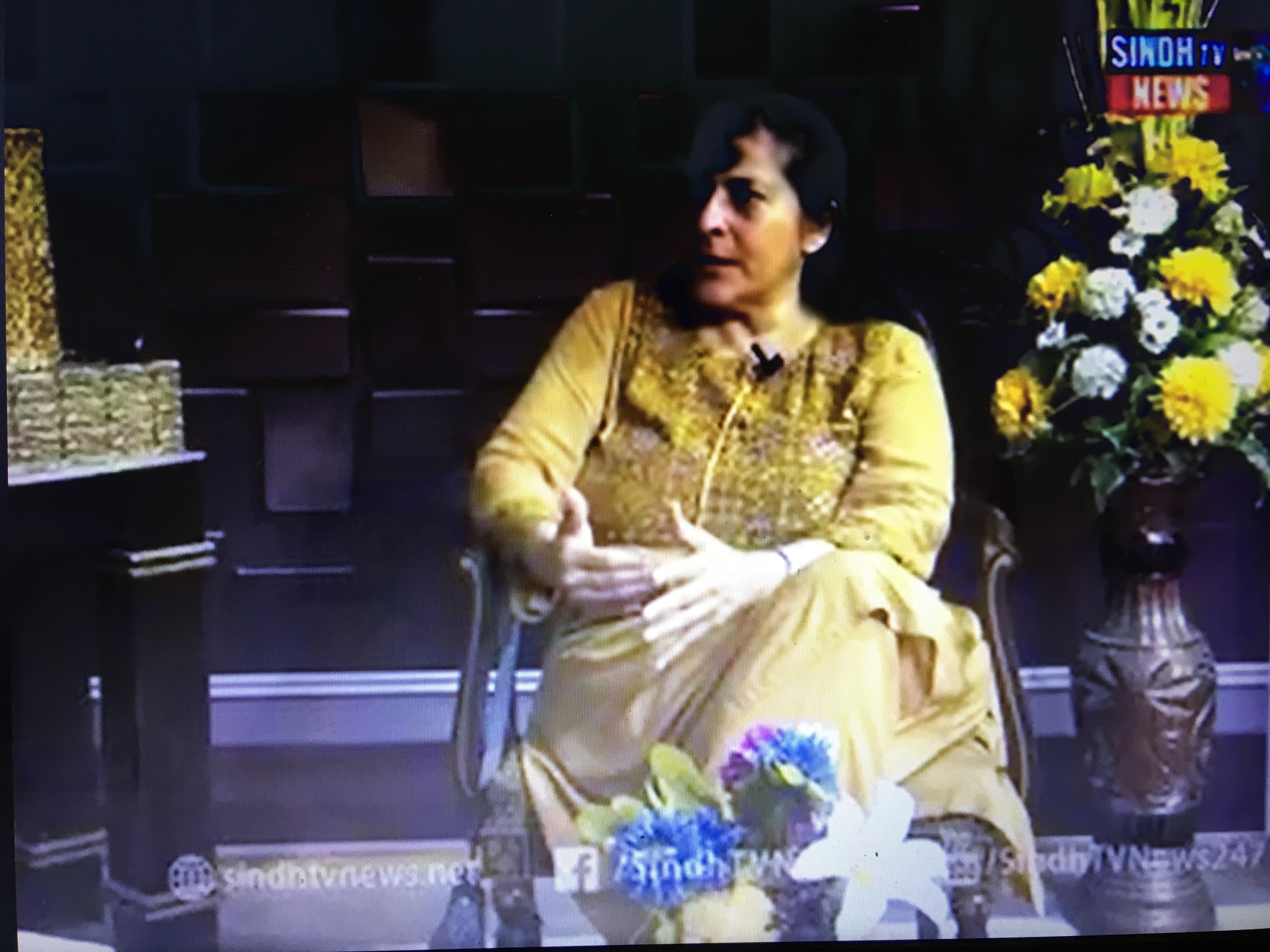
`Clouds of War Billowing from Attack on Syria’ – Sindh TV interview

In this current affairs program, the Washington based author speaks about how the US and European allies made a strategic decision to conduct a limited bombing of chemical weapons in Syria – with the express intent of regaining a foot hold in the Middle East.

Sindh TV anchor Fayyaz Naich interviews Nafisa Hoodbhoy on the US decision to intervene militarily in Syria and the impact this might have in expanding the theatre of war.

In the second segment, the author speaks on the domestic political situation. She talks about how Pakistan’s foreign policy failures have resulted in the establishment tightening its grip on political parties and which has according to her led to `one sided accountability’ against the ruling party.

Speaking from the lens of her book `Aboard the Democracy Train,’ she says that the Pakistan establishment’s failure to respect the mandate of the electorate has resulted in manipulation and corruption of political parties, without any benefit to the people.

The interview can be viewed as follows:

`PAKISTAN NEEDS TO BEFRIEND NEIGHBORS TO CUT DOMESTIC TENSIONS’

Jamshoro, SINDH: Zakia Ejaz from Dharti TV speaks to visiting journalist Nafisa Hoodbhoy about her background and what she experienced as the only woman reporter for Dawn under Gen. Zia ul Haq.

Now based in Washington DC, Hoodbhoy speaks about the draw of Pakistan and Sindh even while she lives and works overseas.

In particular, she analyzes the conditions for journalists today as compared to the single TV and newspaper medium of the 1980s.

She speaks about how she has a changed perception of Pakistan because of her work in anchoring daily radio talk shows to the region.

In this capacity, she recommends that Pakistan change its militaristic posture to one that conducts legitimate trade with its neighbors.

According to her, this would also win the confidence of people who claim that their resources are being siphoned off to Islamabad, while they are `disappeared,’ and treated as hostile subjects in their own territory.

`Pakistan Risks Total Alienation if its Policies don’t Change’ – Author

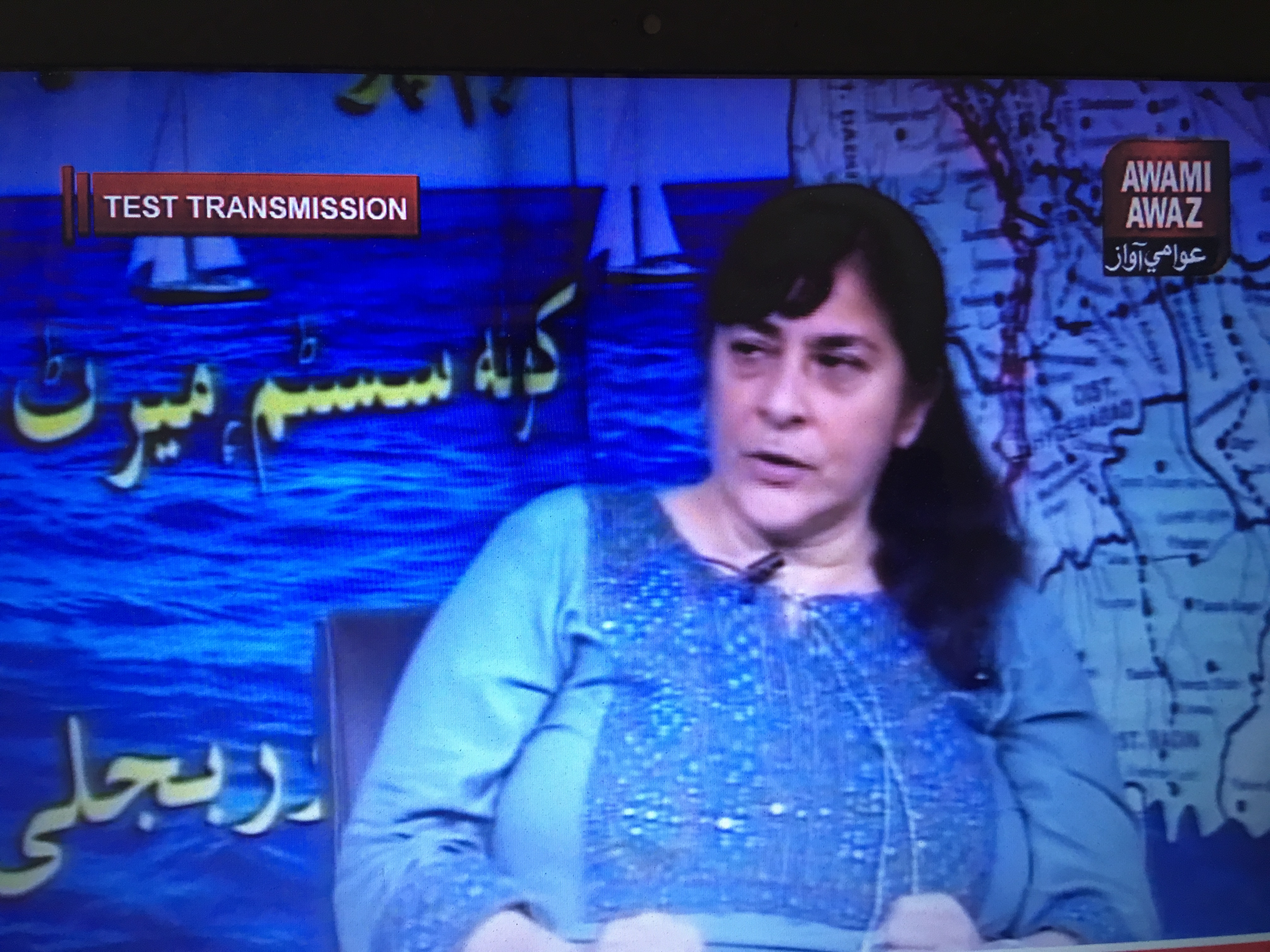
In an interview with Awami Awaz editor, Dr Jabbar Khattak, the author discusses why Pakistan has come to a turning point where it has to choose to revise its policies or face total alienation in the international community.

During the wide ranging interview on foreign policy, Nafisa Hoodbhoy speaks about how the Trump administration views Pakistan on account of the perceived role it has played vis-i-vis Afghanistan and how changing alliances in the Middle East are shrinking options for the country.

The candid hour long interview centers around a US motion to put Pakistan on the Financial Action Task Force list by June 2018, of nations that engage in money laundering and support terror outfits.

It advocates how the improvement of relations with neighboring countries could have a salutary effect on governance inside the nation as well.

The expanded edition of her book is also discussed during the interview.

The interview may be viewed at: http://awamiawaz.com/255735