US Foreign Policy Vis-i-Vis Pakistan – Interview on Awaz Television

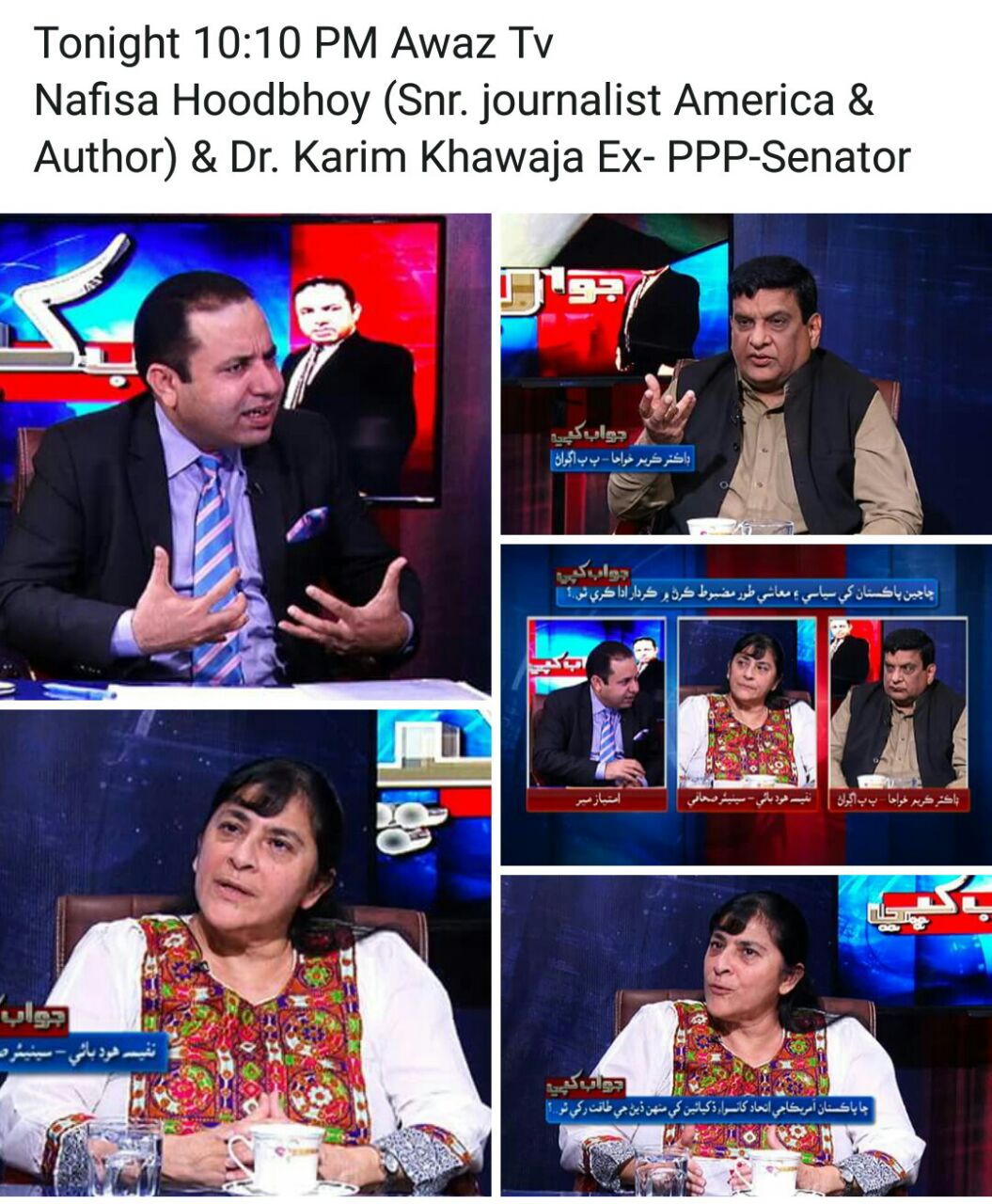
US foreign policy and regional realignments were discussed in a television show hosted by Imran Mir of Awaz Television, with journalist and author Nafisa Hoodbhoy and ex PPP Senator Dr Karim Khawaja on Monday in Karachi.

The program, Jawab Do (Give an Answer) was a conversation between a PPP politician and the visiting independent analyst about why Pakistan finds itself in its current day predicament.

The full program may be viewed at the link below:

https://m.facebook.com/story.php?story_fbid=1973600922668565&id=1634281783267149

Trump ousts Tillerson, will replace him as secretary of state with CIA chief Pompeo

President Trump has ousted Secretary of State Rex Tillerson and plans to nominate CIA Director Mike Pompeo to replace him as the nation’s top diplomat, orchestrating a major change to his national security team amid delicate outreach such as possible talks with North Korea, White House officials said Tuesday.

Trump last Friday asked Tillerson to step aside, and the embattled diplomat cut short a trip to Africa on Monday to return to Washington.

Tension between Trump and Tillerson has simmered for many months, but the president and his top diplomat reached a breaking point over the past week, officials said.

The reason for the latest rift was unclear, but Trump and Tillerson have often appeared at odds over policies such as the nuclear deal with Iran and the tone of U.S. diplomacy.

A spokesman for Tillerson said the secretary of state “had every intention of staying” in his job and was “unaware of the reason” for his firing.

Tillerson cut short his trip to Africa on Monday to return to Washington. “I felt like, look, I just need to get back,” he told reporters aboard his plane home. The White House, however, had told him the previous Friday that he would be dismissed, according to two administration officials.

The news was not conveyed in person by Trump.

At the White House on Tuesday, Trump said the move had been considered for “a long time.”
“We disagreed on things . . . the Iran deal,” Trump told reporters. “So we were not thinking the same. With Mike Pompeo, we have a similar thought process.”

Trump selected Gina Haspel — the deputy director at the CIA — to succeed Pompeo at the CIA. She would become the first woman to run the spy agency.

Both would need to be confirmed by the Senate at a time when the closely divided chamber has stalled on confirming dozens of Trump nominees.

In a statement issued to The Washington Post, Trump praised both Pompeo and Haspel.

“I am proud to nominate the Director of the Central Intelligence Agency, Mike Pompeo, to be our new Secretary of State,” Trump said. “Mike graduated first in his class at West Point, served with distinction in the U.S. Army, and graduated with Honors from Harvard Law School. He went on to serve in the U.S. House of Representatives with a proven record of working across the aisle.”

The president continued: “Gina Haspel, the Deputy Director of the CIA, will be nominated to replace Director Pompeo and she will be the CIA’s first-ever female director, a historic milestone. Mike and Gina have worked together for more than a year, and have developed a great mutual respect.”

Trump also had words of praise for Tillerson: “Finally, I want to thank Rex Tillerson for his service. A great deal has been accomplished over the last fourteen months, and I wish him and his family well.”

© Jonathan Ernst/Pool via AP U.S. Secretary of State Rex Tillerson boards his plane to depart at the end of a five-country swing through Africa from Abuja, Nigeria, Monday, March 12, 2018.

A spokesman for Tillerson said the secretary of state has not spoken directly with Trump about the move.

“The secretary had every intention of staying because of the critical progress made in national security and other areas,” Steve Goldstein, undersecretary of public diplomacy for the State Department, said in a statement.

“He will miss his colleagues greatly at the Department of State, and the foreign ministers he’s worked with throughout the world,” Goldstein continued. “The secretary did not speak to the president, and is unaware of the reason. He is grateful for the opportunity to serve, and believes strongly that public service is a noble calling.”

The president has long clashed with Tillerson, who he believes is “too establishment” in his thinking. Trump felt it was important to make the change now, as he prepares for possible high-stakes talks with North Korean leader Kim Jong Un, as well as upcoming trade negotiations, three White House officials said.

“I am deeply grateful to President Trump for permitting me to serve as Director of the Central Intelligence Agency and for this opportunity to serve as Secretary of State,” Pompeo said in a statement. “His leadership has made America safer and I look forward to representing him and the American people to the rest of the world to further America’s prosperity. Serving alongside the great men and women of the CIA, the most dedicated and talented public servants I have encountered, has been one of the great honors of my life.”

Haspel said in a statement that she was excited about her promotion.

“After 30 years as an officer of the Central Intelligence Agency, it has been my honor to serve as its Deputy Director alongside Mike Pompeo for the past year,” she said. “I am grateful to President Trump for the opportunity, and humbled by his confidence in me, to be nominated to be the next Director of the Central Intelligence Agency.”

On the flight from Nigeria, Tillerson appeared to break with the White House in his assessment of the poisoning of a former Russian spy in Britain. He singled out Russia as responsible for the attack, echoing the finger-pointing of the British government.

“It came from Russia,” Tillerson said, according to the Associated Press. “I cannot understand why anyone would take such an action. But this is a substance that is known to us and does not exist widely.”

Earlier Monday, White House press secretary Sarah Huckabee Sanders condemned the attack as “reckless, indiscriminate and irresponsible,” and expressed solidarity with Britain, but would not say whether the United States believes Russia was behind it.

Tillerson was especially frustrated when Trump last Thursday unilaterally agreed to the meeting with Kim while Tillerson was traveling abroad in Africa, according to officials familiar with his thinking.

Tillerson had long expressed interest in a diplomatic solution to the nuclear standoff with North Korea, and was upset to have been left totally out of the loop when Trump decided to move forward, according to a White House official.

Foggy Bottom was also acutely aware — and chagrined — that when Pompeo appeared on television shows this past Sunday to explain the North Korea developments, he did not mention Tillerson.

Pompeo long has been mentioned as Tillerson’s most likely replacement. As CIA director, the former Republican lawmaker from Kansas developed a warm relationship with Trump, often delivering the President’s Daily Brief to Trump in person and racing over to the West Wing at a moment’s notice to field the president’s queries on a range of topics.

Last November, the White House readied a plan to replace Tillerson with Pompeo, and Trump seriously considered making the move but was persuaded to keep the current team in place.
Pompeo often is found in a host of meetings that do not necessarily deeply involve his agency, simply because Trump likes him, said one White House official.

Sen. Tom Cotton (R-Ark.) was initially mentioned as a replacement for Pompeo, but Trump opted to promote from within by elevating Haspel.

Tillerson’s exit had been so widely expected that the rumors were given a nickname: Rexit. Speculation about his ouster has come in waves, including in October after NBC News reported that Tillerson had called Trump a “moron.”

Tillerson, 65, spent his career at ExxonMobil, climbing the ranks at the oil giant to become chief executive officer, where he cut deals across the Middle East and in Mexico. Having never worked in government before being named secretary of state, he struggled to adapt to Washington’s ways and the administration’s culture of backstabbing.

Tillerson emerged as one of the strongest voices in the administration critical of Russia. For months, he has been saying Russia clearly meddled in the 2016 U.S. election, even as Trump shied away from any critical remarks.

Trump seemed to resent pressure to stay the course on such issues as China’s trade practices, the war in Afghanistan and the Iran nuclear deal, those people said.

Tillerson pushed Trump to preserve the Iran nuclear deal, at least for now, with a July pronouncement that Iran was meeting its end of the bargain. Trump said in a Wall Street Journal interview that he regretted making that determination and strongly suggested he would not go along with another such certification of compliance due in October.

Although Tillerson supported the approach to the war in Afghanistan that Trump announced last week, he felt no need to frame U.S. goals in the same maximal terms as the commander in chief. Where Trump proclaimed on Aug. 21 that “our troops will fight to win,” Tillerson laid out a much more modest agenda.

Josh Dawsey, John Hudson and Carol Morello contributed to this report.
Instep Today Aurat March 2018: Freedom over fear

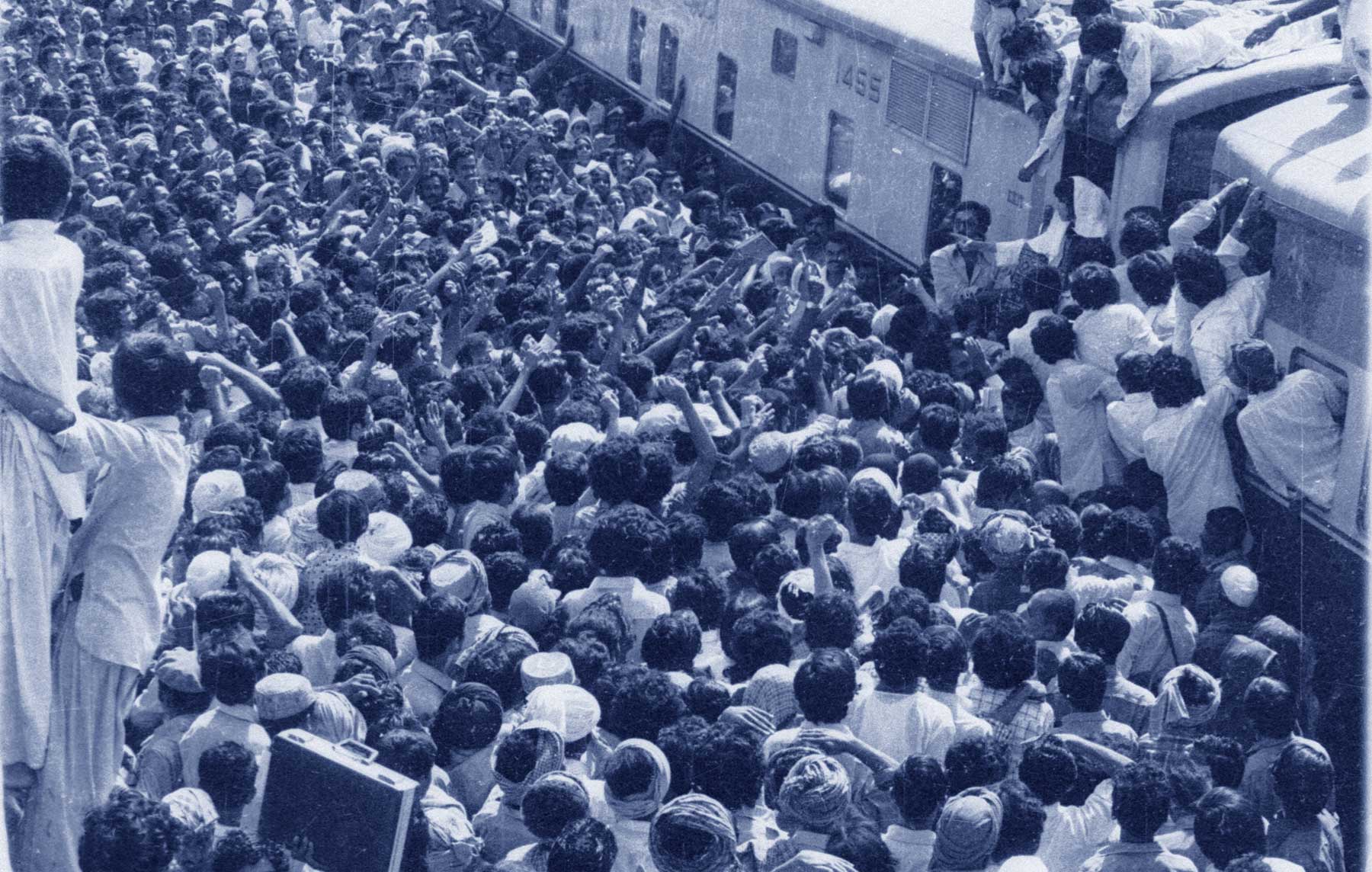
KARACHI, March 10: Thousands of women, men and transgender people gathered on Thursday to take part in the first ever Aurat March (Women’s March) held in Karachi to rally against discrimination and acts of violence towards women and other gender minorities in Pakistan.

The event marked the global celebration of International Women’s Day which is celebrated across the world to honour the daily struggles of women and pay tribute to their social, economic, cultural and political achievements.

Karachi’s Frere Hall, Lahore’s Lytton Road and Islamabad’s Press Club were meeting points for the women who came out to highlight these issues.

‘Aurat March’ was planned and organised entirely by a diverse group of women belonging to different ethnicities, classes and sections of society. The march itself was not linked to a particular organization, political party or group. In fact, it included representatives from the Awami Workers Party, the Feminist Collective, the Women’s Collective and Girls at Dhabas among others.

That’s what makes it more significant – it was a collective effort, not spearheaded by any one entity, making it a movement that all Pakistani women (and men who support women’s rights) can own.

The Aurat March, spearheaded by Sheema Kermani and the independent rights organization, ‘Hum Aurtain’ was originally meant for Karachi. The idea inspired similar women’s rights organizations and progressive forums in Lahore and Islamabad.

While the numbers were not as high in Islamabad and Lahore as they were in Karachi, there was still a significant presence that made its way to show their solidarity.

The crowd in each city grew as everyone kept marching on from the starting point till the crowds dispersed. Women (and men) held placards and banners and shouted slogans like ‘Ghar ka Kaam, Sab ka Kaam’ and ‘Women are humans, not honour’. They had placards that read ‘paratha rolls not gender roles’, ‘freedom not fear’ and ‘our rights are not up for grabs, neither are we’.

Women wore t-shirts that read ‘my favorite season is the fall (of patriarchy)’ and ‘girls just want fun-damental human rights’. Some wore masks of deceased social media celebrity Qandeel Baloch and one group held a charpoy that said ‘patriarchy’s janaza’ (funeral of patriarchy) on their shoulders.

A number of prominent personalities put out social media messages in solidarity with those who were marching. There was a video montage circulated of celebrities and activists saying ‘equal’ and ‘barabar’ – many of whom also participated in the walk.

According to the organisers of the event, the goal was to get women to come out on the streets and help them reclaim public spaces. Leena Ghani, one of the organisers of the Lahore march told Instep that Lahore’s march was in solidarity with Karachi’s.

“The Karachi march was much bigger because they had been planning it for longer but it was heartening to see that every woman felt it was inclusive.”

She shared how women were most happy about reclaiming public spaces and feeling safe on the streets.

The women said they were marching in solidarity with women all over the country and globally, as a promise to carry the torch of resistance until women were treated equally in the society.

The agenda was to start conversation around and demand fundamental rights as women, including an end to violence against women, labour rights, reproductive rights, environmental justice, anti-sexual assault laws, wage equality, fair political representation and opportunities, education equality, equality for the transgender community and an end to child marriage and honour killings.

The events in all three cities were open to the public and women from all walks of life came out.

There were also some men and a large representation from different schools, colleges and universities present on the occasion. The march was quite a landmark in Pakistan’s women’s rights movement and one can only hope it’s the beginning of change

In Peace Overture, Afghan President Offers Passports to Taliban

KABUL, Afghanistan — President Ashraf Ghani of Afghanistan renewed a call on Wednesday for the Taliban to join peace talks, offering to treat the insurgent group as a legitimate political party, though it has repeatedly rejected similar proposals.

In the latest overture, Mr. Ghani said his government would provide the Taliban with an office in the capital, Kabul; passports for its members; help resettling militants’ families; and assistance in scrubbing the names of top commanders from international terrorist blacklists.

“We believe in providing a peaceful and respectful life for all Afghans, including those Taliban who leave violence behind,” Mr. Ghani said. He spoke at a peace conference, called the Kabul Process, attended by more than 20 nations but not the Taliban.

There appears little chance of any breakthrough, but the Afghan government made the offer to demonstrate to an international audience that it is willing to negotiate, and to encourage those participating in the conference to pressure the Taliban to accept. The government is under pressure to offer incentives as the United States increases military pressure.

The Taliban’s main faction has insisted on direct negotiations with the United States and dismisses the American-backed government in Kabul as a puppet.

The Taliban has yet to respond to Mr. Ghani’s proposal. But in a statement on Monday, they said they had asked American officials to talk directly to their political office, and not through the Afghan government. The statement also said that “military strategies which have repeatedly been tested in Afghanistan over the past 17 years will only intensify and prolong the war.”

Under President Trump, the American strategy for ending the war has entailed expanding a campaign of airstrikes and putting pressure on Pakistan to force the Taliban to negotiate with the Afghan government.

American commanders have claimed progress, but only in measures that are classified. A Pentagon study made public this month showed that the Afghan government controlled 18 percent of the country’s districts at the end of last year and had influence over an additional 38 percent.

While the insurgents dominate only a sliver of the country, they still hold substantial sway. The Taliban collect taxes from businesses and run a shadow judicial system for settling disputes, preferred by some Afghans over the corrupt government courts.

In one measure of the Taliban’s reach, cellphone companies comply with the group’s request to halt service around 5 p.m. in parts of the country, including in Kunduz, a major city, lest the insurgents blow up transmission towers. The blackouts demonstrate influence, and the Taliban say they also serve a practical purpose of preventing government informants from calling in tips about their nighttime movements.

Around dusk on Tuesday, insurgents attacked a checkpoint in Kandahar, in southern Afghanistan, killing five police officers, and later stopped a bus and captured 19 passengers as hostages, according to a police spokesman.

The peace talks known as the Kabul Process began last year and are intended to demonstrate unity in the international community for negotiations between the Afghan government and the Taliban. The United Nations also backs this approach.

Documenting facts

In his latest book, Kaiser Bengali shows that there is systematic and wilful discrimination and apathy towards Balochistan with the express purpose of utilising its resources for benefit of others.

Rebellions and insurgencies do not occur in a vacuum but are reactions against political and economic injustices. A new book A Cry for Justice: Empirical Insights from Balochistan by Kaiser Bengali highlights the injustices perpetrated against Balochistan with help of irrefutable data. He has the advantage of being an advisor to Balochistan and Sindh governments but more than that he has his heart in the right place.

Bengali has summoned several witnesses to present his case. These are ‘crown witnesses’ as these are part of the official data and not a figment of imagination of the oppressed and aggrieved Baloch. The figures, they say, never lie so what he has presented in black and white goes a long way in reaffirming the justified resistance of Baloch people to their political and consequent economic repression, oppression and exploitation.

The evidence presented by Kaiser Bengali shows that there is systematic and wilful discrimination and apathy towards Balochistan with the express purpose of utilizing its resources for benefit of others.

The witness ‘Gas’ is most eloquent in exposing those injustices. Even though gas was discovered in Balochistan in 1952, “not a whiff of gas was supplied to Balochistan for nearly three decades till 1982”. This despite the fact that it was the sole provider of gas for two decades. Balochistan’s share of consumption was just 2 per cent but rose to 7 per cent with the 900 MW gas-fired power plant at Uch in Dera Murad Jamali. Though, according to Quesco’s figures, Balochistan provides 2,280 MW to the national grid, its share is only 700-800 MW.

The excise duty on gas which is transferred to provinces is also flawed and eaten away by inflation. The charts tell the entire story and indict the perpetrators of injustices in Balochistan. If money is any indicator of injustices, Balochistan has been deprived of Rs. 7.69 trillion just for gas which benefited other provinces at the cost of Balochistan.

The second witness that comes forward is ‘Chronic Development Deficit’. Bengali writes that in the first two decades Balochistan doesn’t figure meaningfully in any national economic plan or budget documents and the neglect continues. Today, the province is not only lagging behind other provinces; it is falling further behind. One of the tables shows GRP average growth rate of provinces from 2000- 2011 and naturally Balochistan with 2.8 growth is not only bottom but mostly half of all others’ growth rate. In another table, ranking of Districts by Development Rankings-1996: Bottom one third districts Balochistan beats all hands down.

The Public Sector Development Program (PSDP) for Balochistan is 0.15 per cent if Gwadar is excluded. Of the total allocations 78 per cent for federal PSDP for Physical Planning and Housing/ Housing and Works from 1990-2016 were for security agencies and federal civil administration offices and housing and 11 years of these 100 per cent was exclusively for them. The roads in general present a pathetic picture as their photographs on every other page amply illustrate. Depriving people of benefits and yet expecting praise and thankfulness is insanity.

Then he dwells on ‘Deficit in Social Protection’ and we see the story is not different. The Benazir Income Support Programme (BISP) was established in 2008 to assist economically stressed families. In 2014-15, a total of 5.046 families received Rs88.491 billion; of this only 188,949 families in Balochistan received Rs3.290 billion a meagre 3.7 per cent. Both Punjab and Sindh’s share was 36.5 and 34.0 per cent respectively. This cannot be explained away just by the smaller population it has; the system doesn’t quite take into consideration the factors which compound poverty in Balochistan. State provided social protection too is warped and hardly helps.

Next on the stand is ‘Services Imbalances’. There are detailed charts and also constitutional provisions that show how Balochistan is put at a disadvantage wilfully and consequently it has no say in its own or Pakistan’s affairs. Denying people authority is the best way of disempowering them. Balochistan gets a lot of officials from other provinces but few from Balochistan get posted here.

A digression here; the plea for imbalance that there aren’t highly educated people in Balochistan is flawed as nothing has been done to provide sound education to the people. All ‘education emergencies’ announced with fanfare are charades in fact. The Higher Education Commission (HEC) too neglects Balochistan; a 2013 report stated that from 2002-03 to 2012-13, it allocated 737 projects worth Rs157, 102 million. Out of these 737 projects, merely 48 projects worth Rs9, 433 million were assigned to Balochistan’s seven universities. Comparatively, the two top beneficiaries of the HEC largesse the National University of Science and Technology and Comsat Institute of Information Technology were granted Rs1,5205m (22 projects) and Rs7,373m (28 projects) respectively which incidentally was Rs13,145 million more than the total allotted to Balochistan.

The last one brought to attention is ‘Representational Imbalances’ and this too shows that Balochistan’s representation is inadequate because of the lesser number of members in the National Assembly and Balochistan Assembly compounded by the large constituencies which are 13 and 9 times, respectively, larger than the average of other three provinces combined. More seats need to be allocated and constituencies made smaller.

However, I do not see much hope in this as those routinely elected are more interested in perks than in serving people.

The evidence presented by Kaiser Bengali shows that there is systematic and wilful discrimination and apathy towards Balochistan with the express purpose of utilizing its resources for benefit of others. It is the seven decades of injustices, both political and economic that have led to insurgencies, and these will only strengthen and deepen because of the absolute absence of hope or that the sane recommendations of this book will be heeded.

There is a Cherokee proverb, “Pay attention to whispers, so we won’t have to listen to screams”. Those who refuse to hear the screams cannot be expected to pay attention to whispers. The irrefutable evidence presented passes the verdict of ‘guilty as charged’ against the state and its establishment for its injustices in Balochistan.

COMMENT: Trump’s India connect

There are few countries where the U.S. President’s business interests are so strong, and relations with the U.S. so robust.

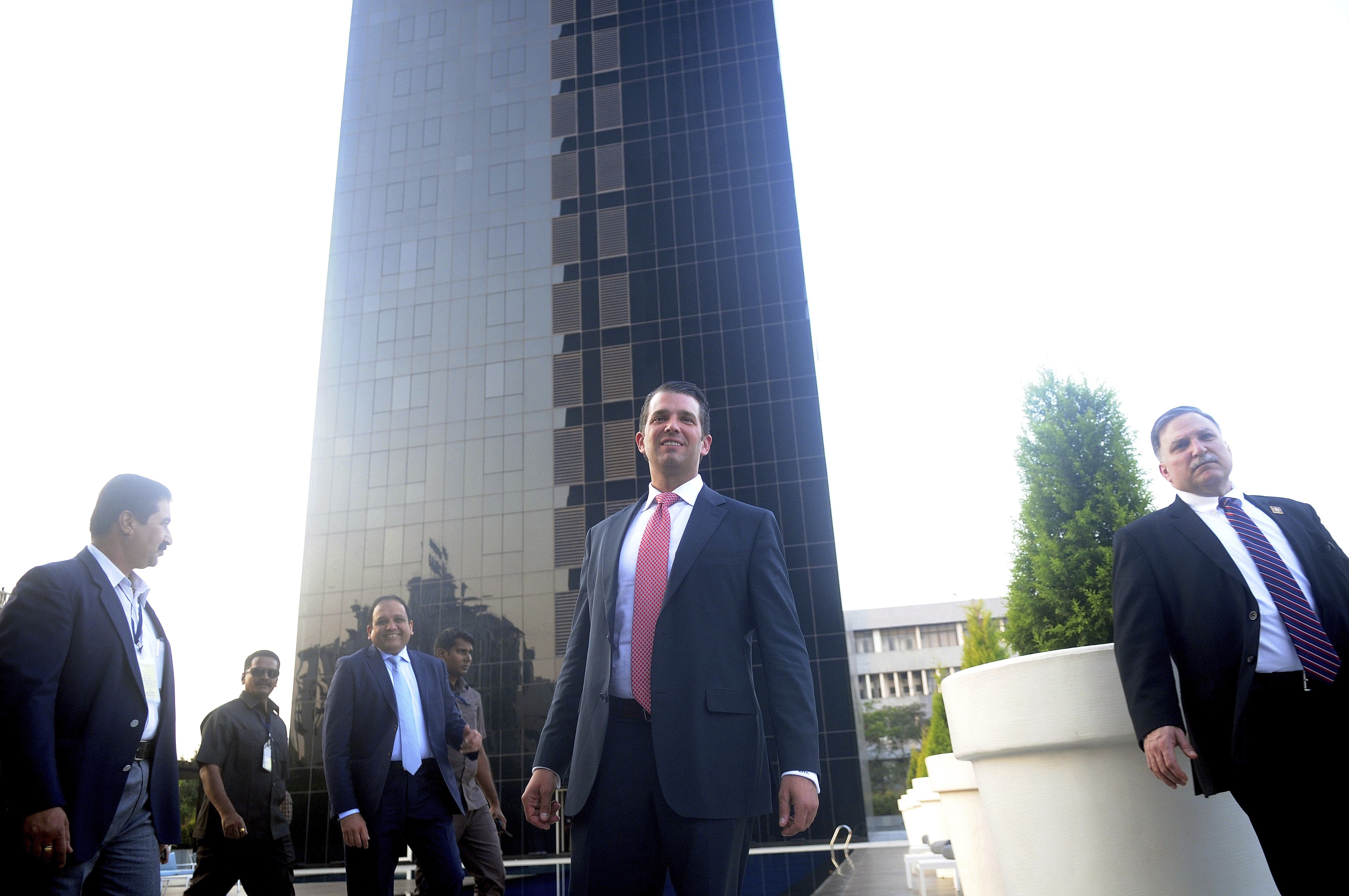
Donald Trump Jr. is in India for an extraordinary visit, to play the role of both businessman and diplomat. While mainly helping sell properties tied to the Trump Organization, where he serves as executive vice president, Mr. Trump Jr. is also delivering a policy address on “Reshaping Indo-Pacific ties”.

It’s hard to imagine this type of trip taking place in other countries. U.S. President Donald Trump and some of his progeny are personae non grata in many nations, including top allies such as the U.K. Aside from the issue of unpopularity is one of ethics. Many countries would be reluctant to host the U.S. President’s son for a visit that includes the opportunity for buyers of Trump-branded apartments to pay to meet with Mr. Trump Jr. The fact that India rolled out the red carpet for Mr. Trump Jr. amplifies the uniqueness of U.S.-India relations at this moment in time: There are few, if any, countries in the world where President Trump’s business interests are so strong, and relations with the U.S. so robust.

Business opportunities
Take the commercial side first. The Trump Organization features business dealings in more than two dozen countries, from Trump-branded condos in Seoul to a golf course in Ireland. And yet a Washington Post investigation has concluded that “the Trump Organization has more business entities in India than in any other foreign country.” The study, released in November 2016, contended that Mr. Trump is “involved in at least 16 partnerships or corporations” in India. Mr. Trump Jr. has himself said that India constitutes the largest market outside the U.S. for the type of real estate deals pursued by the Trump Organization.

It’s not just Mr. Trump and his family who value business opportunities in India; members of his cabinet do too. In 2006, Wilbur Ross, who is now Commerce Secretary, established a $300 million fund focussed on India and bought the textile company OMC India Ltd. In 2008, he bought $80 million in convertible bonds issued by the airline SpiceJet. (He subsequently sold it.) Goldman Sachs, the previous employer of Treasury Secretary Steven Mnuchin, boasts a significant presence in India and has provided support to the Indian renewable energy firm ReNew.

Now consider the diplomatic side. Since Mr. Trump took office, Washington’s relationships with traditional foes such as North Korea have worsened, while those that had enjoyed recent periods of relative détente (Pakistan, Iran) have regressed. Most strikingly, relations with some top allies (the U.K., Germany, and Australia) have taken tumbles.

Strengthening ties
By contrast, the U.S.-India relationship has continued to flourish under Mr. Trump. It’s easy to understand why. The two core strategic concerns that have long brought the two together — China’s growing influence and international terrorism — resonate strongly with the Trump administration. Also, arms sales and technology transfers — two main engines of the defence partnership that powers U.S.-India relations — are welcomed by a Trump administration that is unabashedly transactional in its foreign relations. Furthermore, President Trump and Prime Minister Narendra Modi share much in common, from their conservative politics to their fractious relationships with the mass media and strong embraces of social media.

To be sure, there are bones of contention, from the Trump administration’s immigration policies that could deleteriously affect Indian workers in America to Washington’s refusal to pull the plug on its problematic partnership with Pakistan. The two sides also fail to agree on what should constitute their strategic partnership. Washington wants New Delhi to participate in joint operations and other types of alliance behaviour to which India remains allergic. Yet, deep repositories of goodwill and sharp convergences of interests enable the U.S.-India relationship to weather these policy disconnects.

Essentially, Mr. Trump’s expansive business interests in India coupled with rock-solid bilateral relations help explain why New Delhi has pulled out all the stops for Mr. Trump Jr.’s tendentious trip. Could the First Son take his salesman-in-chief/senior diplomat double act elsewhere overseas? Only two possible destinations come to mind: Israel and Saudi Arabia. If he does venture to those locales, however, his achievements this week would be a hard act to follow. Mr. Trump Jr.’s visit to India coincided with that of Canadian Prime Minister Justin Trudeau. The son of the most controversial U.S. President in modern history has not only stolen the spotlight from one of the world’s most beloved and photogenic leaders, he has also enjoyed much warmer treatment.
Michael Kugelman is the deputy director of the Asia Program at the Woodrow Wilson International Centre for Scholars in Washington, DC

http://www.thehindu.com/opinion/op-ed/trumps-india-connect/article22818013.ece

Pakistan given three-month reprieve over terrorist financing watchlist: minister

ISLAMABAD (Reuters) – Pakistan has been given a three-month reprieve by a global watchdog over a U.S.-led motion to put the South Asian country on a terrorist financing watchlist, Pakistan’s Foreign Minister Khawaja Asif said late on Tuesday.

Pakistan has been scrambling in recent months to avoid being added to a list of countries deemed non-compliant with anti-money laundering and terrorist financing regulations by the Financial Action Task Force (FATF), a measure that officials fear could hurt its economy.

FATF member states have been meeting this week in Paris, where it was expected that they would decide on a U.S. motion, backed by Britain, France and Germany, to have Pakistan added to the so-called ‘grey list’ of countries which are not doing enough to comply with terrorist-funding regulations.

Asif, who is currently on a visit to Russia, tweeted late on Tuesday that Pakistan’s “efforts have paid (off)” during a Feb. 20 meeting on the U.S.-led motion, suggesting there was “no consensus for nominating Pakistan”.

He also suggested the meeting proposed a “three months pause” and asked for the Asia Pacific Group, which is part of FATF, to consider “another report in June”.

Pakistan earlier this year submitted a report about the progress it had made in curbing terrorist financing, but Washington submitted its motion before the Pakistan report could be discussed at the Paris hearing.

“Grateful to friends who helped,” Asif added.

Two other Pakistani officials confirmed Pakistan had received a reprieve of three months.

Washington has been threatening to get tough with Islamabad over its alleged ties with Islamist militants, and last month President Donald Trump’s administration suspended aid worth about $2 billion.

Islamabad, which denies assisting militants in Afghanistan and India, has reacted angrily to U.S. threats of further punitive measures.

However, Pakistan’s government is concerned the FATF decision could hurt its banking sector, causing real financial pain to the economy just as a national election looms.

Writing by Drazen Jorgic; Editing by Gareth Jones

`Council of Progressive Pakistanis’ Created in United States

A Council of Progressive Pakistanis has been created in the US, with the objective of contributing to building a progressive and liberal Pakistan.

A meeting of CPP affiliates was held in the greater metropolitan Washington area, Feb 10, 2018, where organizers espoused their vision of building a Pakistan, that would be in keeping with the speech delivered by its founder, Mohammed Ali Jinnah in 1947 before the nation’s constituent assembly.

In his speech Jinnah had said, `You may belong to any religion or caste or creed; that has nothing to do with the business of the State. You will find that in course of time Hindus will cease to be Hindus and Muslims would cease to be Muslims, not in the religious sense, because that is the personal faith of each individual, but in the political sense as citizens of the State.’

The participants, who included the future council members of the CPP discussed the need to work toward tolerance between religious and ethnic communities, including the removal of laws that discriminate on the basis of religion.

In this regard, they pledged to work against imprisonment, torture, disappearance and extrajudicial killings of their fellow brethren who became victims of intolerance inside Pakistan.

In January, the CPP organizers held a talk in St. Louis, Missouri on `Partition & its Effects,’ based on the early chapters of `Aboard the Democracy Train.’

There, the author made a presentation and answered questions from the audience relating to democracy, human rights, terrorism and the changing international scenario.

Excerpts from the talk & questions and answers can be viewed below:

https://www.facebook.com/vasudha.ravv/videos/544375912594230/

https://www.facebook.com/vasudha.ravv/videos/544394135925741/

Funeral bridges religious and ethnic divides

Asma Jahangir’s funeral was an emotionally draining yet an energising experience in unique ways. People of all ages, genders, ethnicities, religions, and social classes came to bid adieu to her. Only she could manage to amass such a wide spectrum of the society at such an occasion.

There were trans people, women, men, youngsters, older people, people descending from SUVs with their guards, people coming on motorbikes, as well as people pouring in on foot because public transport left them far from the venue owing to security arrangements. There were destitute women who had secured shelter because of Asma.

There were activists who had spent lifetime in struggling for people’s rights, under Asma’s guidance and leadership. There were people whose lives she had changed by merely being there when they needed help. There were people who found meaning in their lives while being with her.

There were people from practically all walks of life and widest possible range of classes. Religious scholars who admired her work were also in attendance. One Mufti sahib came looking for me from the thick crowd, and told me what a big fan of Asma Jahangir he was. Another cleric, who insisted he was not a mullah but just a deeply religious man, told me he hadn’t met a person more courageous, honest and upright as Asma.

The funeral prayer was led by Haider Farooq Maudoodi, who opposes Islamists and is considered closer to Marxists. His views against political Islam, mullahism and exploitation of religion for political power games are well known, just as his famous revolt from his father Maulana Abul A’ala Maudoodi. Farooq had a long-standing relationship with Asma’s family and he supported the values Asma stood for.

The striking feature of this unique funeral ceremony was the predominant presence of women and the role they played throughout the event. At 11:45am when the body arrived at Asma’s home from the mortuary, women took it from the ambulance to the drawing room, which had been emptied already by removing all furniture. Women of the family and Asma’s comrades from Women’s Action Forum were all clad in identical black dresses with yellow scarves inscribed with women empowerment slogans.

After almost three hours, when the body had to be shifted to the ambulance again for the funeral procession, it was these women who carried her to the ambulance.

While the close family, her husband, children, and siblings sat in the ambulance, other women escorted the slow moving ambulance to the venue on foot.

Defying another regressive tradition, women shouldered her funeral bed – a practice conventionally considered a strictly male domain.

It’s not very frequent that so many women are seen in public spaces on such occasions. Their presence gave an egalitarian look to the funeral ceremony. Afterwards, men and women made rows and said the prayers together.

This was a rare and unforgettable sight. Men and women from all religions – Hindus, Sikhs, Christians, and Muslims of all sects, arranged in rows like beautiful pearls of different colours in one thread.

Women defied the established code. After the prayers, they raised slogans reiterating their vows to carry forward the legacy of Asma Jehangir.

The Government of Pakistan decided not to respond to people’s demands of flying the national flag at half-mast or of arranging a state funeral for her. Asma was much bigger than a state funeral anyway. Activists making these demands had only hoped that the state of Pakistan would honour itself by acquiescing.

It was hardly a surprise that some institutions and organs of the state maintained radio silence on the occasion. No public condolance, message of solidarity or eulogy or even a prayer for the departed came from those corridors. Not to mention, this hasn’t impacted Asma’s stature one bit.

Expressing solidarity with the mourners would have elevated state’s own perception among the public.

The sentiments of love and respect that people demonstrated for Asma Jehangir are unprecedented in recent history of this country.

Her detractors and haters, on the other hand, remain inconsequential and unknown. No one would even know when they die. But here is Asma Jahangir – who went like the majestic queen of hearts she has been. This probably is her revenge! But her ultimate revenge would be in continuation of her mission with all the energies of her supporters combined. The attainment of a progressive, democratic, secular and peace-loving Pakistan will be the ultimate revenge.

Sindhis, Siraiki, Pakhtuns, Baloch, Hazaras, Gilgitis, Baltis and others from far-flung areas came to bid farewell to their comrade. A Pakhtun contingent was most conspicuous for their number and for their vibrancy. They were the last people who were addressed by Asma in a public setting during their recent sit-in in Islamabad.

If one word can describe the funeral procession, it is pluralism. That’s what Asma Jehangir lived for as well. Her funeral looked like Pakistan. A truly federal Pakistan with all communities represented.

Even in her death, she did not conform to the established code. Resistance, thy name is Asma.

Prominent Pakistani rights activist Asma Jahangir dies aged 66 Lawyer who was outspoken critic of country’s Islamist extremism had a heart attack in Lahore

Asma Jahangir, one of Pakistan’s most prominent human rights activists, has died of a heart attack aged 66.

She was rushed to hospital in Lahore on Saturday night and died the following day, her daughter Muneeze Jahangir said.

Friends, relatives, activists and journalists thronged to her residence in Lahore to express their grief. Local TV stations broadcast footage showing public figures and Jahangir’s friends sobbing and consoling each other outside her residence as her body was brought home from hospital.

The prime minister of Pakistan, Shahid Khaqan Abbasi, lauded her “immense contributions towards upholding rule of law, democracy and safeguarding human rights”.

Pakistan’s rulers must show an honest resolve to fight terrorism

Jahangir was the chair of the Human Rights Commission of Pakistan and respected for her outspoken criticism of the country’s militant Islamist groups and her record as an activist.

She was also the president of the supreme court bar association and had served as the UN special rapporteur on human rights in Iran since 2016.

Jahangir, a fierce defender of democracy who also regularly raised concerns about Pakistan’s military and intelligence services, was included in Time magazine’s list of the 100 most influential women.

She defended minority Christians charged with blasphemy, an offence that under Pakistan’s controversial law carries the death penalty.

She was repeatedly threatened by the country’s militant religious right whom she criticised loudly and often.

She was also placed under house arrest in 2007 for her part in a lawyers’ protest movement that helped lead to the military leader Pervez Musharraf stepping down from power.

A champion of human rights, Jahangir was unafraid to speak loudly against those attacking minority religions and women. She won scores of international awards. Several years ago, she briefly sent her family out of the country following threats from militant groups.

Zohra Yousuf, a former chair of the Human Rights Commission of Pakistan, said she lost a “great friend and great warrior of human rights.”

“No one can replace Asma … She was unmatched and unparalleled, we suffered a great loss today,” Yousuf said.
The activist Marvi Sarmad tweeted: “Today it’s not only Pakistan who will cry. The entire South Asia shall mourn Asma Jahangir.”

“’Speaking truth to power,’ a phrase we often use, Asma Jahangir lived, practiced till her last breath,” said another activist, Raza Ahmed Rumi.

Jahangir is survived by her husband, the businessman Tahir Jahangir, a son and two daughters. Her other daughter, Salima, lives in London. The funeral would take place after Salima’s return to Pakistan, the family announced.