Nawaz Sharif set to attend ‘Arab Nato’ summit in Riyadh

ISLAMABAD/WASH¬INGTON: Prime Minister Nawaz Sharif will travel to Riyadh on Sunday to attend the first-ever Arab-Islamic-American Summit being held to develop a security partnership against a growing threat of violent extremism.

Mr Sharif is among the 54 leaders who would join US President Donald Trump for the summit being held on Sunday.
On Friday, President Trump left Washington for Riyadh for a visit that he and his allies hope could lay the foundations for an “Arab Nato force” to push back Iran’s growing influence in the Middle East as well as combat terrorism.

The decision to choose the Muslim holy lands for Mr Trump’s first foreign visit has been noted with interest in Washington but his decision to speak about Islam in his address to the summit in Riyadh has generated even more interest, and some derisions too.

Saudi King Salman bin Abdulaziz invited Mr Sharif for the summit. The invitation was delivered by Saudi Information Minister Awwad bin Saleh al Awwad, who visited Islamabad last week.

The official website set up by the Saudi government in connection with President Trump’s trip, while explaining the objective of the summit, states: “US President Donald Trump and leaders of the world’s Islamic nations will meet to address ways of building more robust and effective security partnerships to counter and prevent the growing threat of terrorism and violent extremism around the globe through promoting tolerance and moderation.”

The Arab-Islamic-American summit is one of the three Riyadh has planned for President Trump’s visit. The other two summits being held on this occasion are the Saudi-US Summit, and Gulf Cooperation Council-US Summit. The purpose of the entire exercise, apparently, is to reassert the Kingdom’s position as the main political and security force in the region. The eager Saudis have been running a countdown clock on the website for the trip, which started late on Friday night.

‘Fantasy of Arab Nato’
Pakistan is one of the closest allies of the Kingdom. The two maintain a strong defence partnership. The Pakistani government granted special permission to the former army chief retired Gen Raheel Sharif to lead the multinational military force being created by the Saudis. British journalist Robert Fisk, an expert on Middle Eastern affairs, in his article in the Independent wrote that Mr Trump’s visit was for realising “the fantasy of an Arab Nato”.

Mr Sharif, while accepting the invitation for the summit, has reaffirmed Pakistan’s alliance with the Kingdom by recalling the commonality of views of two countries on most regional and international issues and their collaboration for achieving common interests and objectives.

It is unlikely that Prime Minister Sharif would get a one-on-one bilateral meeting with President Trump on the sidelines of the summit. At least, Mr Trump’s schedule does not show any possibility for such an interaction. The Foreign Office was silent on chances of a speculated meeting between the two.

The Washington-based Pakistani media, however, have learned that the Saudis are backing Pakistan’s request for a brief Sharif-Trump meeting before the US president flies out to Israel and then to Europe for more talks with America’s Nato allies.

Diplomatic sources in Washington say that since scores of world leaders are attending the summit, it would be difficult to arrange exclusive meetings between the US president and other leaders but “Americans are trying to find space for a very brief one-on-one between Mr Sharif and Mr Trump”.

“Unfortunately I don’t have anything for you,” a State Department official told Dawn when asked if the two leaders were going to have an exclusive meeting. Officials at the Pakistan Embassy said that since this matter was handled in Islamabad, they had no information about this.

The summit is being discussed at every forum in the US, from Congress to think tanks and the media. The US media and think tanks pointed out that days before the summit, the Trump administration announced two major arms deals: $1 billion worth of missiles for the UAE and a much larger, $100bn deal with Saudi Arabia.

Media reports pointed out that these weapons would be used to equip “a Muslim Nato army,” headed by Saudi Arabia. The reports also noted that Gen Raheel would lead this force.

An anti-Iran alliance?
Reports also pointed out that while 54 leaders from across the Arab and Muslim worlds had been invited to the summit, Iran has been kept out. Commentators in Washington noted that Iran’s absence made it look like an anti-Iranian alliance, despite its declared aim of fighting terrorism.

And President Trump’s meetings and conversations with Arab and Muslim leaders opposed to Iran’s growing influence in the region, particularly in Syria, consolidated this impression.

A readout of President Trump’s meeting with Crown Prince Mohamed bin Zayed al Nahyan of the United Arab Emirates at the White House said that the two leaders did talk about “the threat to regional stability posed by Iran.”
The US media reported that the UAE Crown Prince, who is also the Deputy Supreme Commander of his nation’s armed forces, is helping prepare Mr Trump for the summit. This was his second visit to the White House since Mr Trump took office.

They also discussed “steps to deepen our strategic partnership and promote stability and prosperity throughout the Middle East,” said the White House. “Bilateral defence cooperation, counterterrorism and resolving the conflicts in Yemen and Syria” were some of the other key issues that the two leaders discussed.
10 labourers killed in Gwadar as unidentified assailants open fire at construction site

At least 10 labourers were killed in Balochistan’s Gwadar district on Saturday as unidentified assailants opened fire at the construction site where they were working, Levies sources said.
Unidentified gunmen on motorcycles opened indiscriminate fire on a group of labourers working at a road in Gwadar’s Pishgan area, killing eight of them on the spot, Levies sources confirmed.

Key updates
• Two gunmen on motorbikes opened fire on group of labourers in Gwadar
• Baloch Liberation Army claimed responsibility of attack
• The road where labourers were working was not a specific CPEC-funded project

A spokesman for the separatist Baloch Liberation Army claimed responsibility for the incident in a telephone call to AFP.

Two of the injured labourers succumbed to gunshot wounds while they were being rushed to the District Headquarters Hospital, they added.

The tough road to corridor
Local administration official Munir Zamari told AFP there were two gunmen riding on motorbikes who opened fire on the construction workers at the site.

The assailants attacked the men at two separate construction sites three kilometres apart along the same road. They then fled the scene.

“All the labourers were shot at close range,” said senior levies official Muhammad Zareef.

A special military C-130 aircraft flew the remains of the slain labourers after funeral prayers to their hometown in Sindh’s Naushahro Feroze district.

Frontier Corps, police and levies personnel have reached the spot and an investigation is underway.

Security challenges facing Balochistan and CPEC
The shooting incident occurs as Pakistan and China inks agreements aimed at boosting cooperation in various sectors between the two countries on the sidelines of the Belt and Road Forum, which is underway in Beijing at the moment.

China is also developing the warm water Gwadar port, a prominent feature of the China–Pakistan Economic Corridor (CPEC) plan. The CPEC project — with an investment of $46 billion and the Gwadar port as its lynchpin — is billed to be a ‘game-changer’ and manifestation of strategic partnership between Pakistan and China.

Though the road where the labourers were working was not a specific CPEC-funded project, it was a part of a network of connecting roads that are part of the corridor ─ a common target for separatists militants who view construction projects as a means to take over their land.

Balochistan Home Minister Sarfaraz Bugti also confirmed the death toll while speaking to DawnNews. Condemning the incident, he said, “We will not bow down before terrorists.”

The government has deployed a Maritime Security Force (MSF) and Special Security Division (SSD) to protect projects under CPEC, including Gwadar and other coastal areas, and ensure safety of locals and foreigners working on CPEC projects.

’44 workers killed since 2014′
The need to tighten security in Balochistan has grown over the years as separatist militants continue to wage their campaign against the central government for decades, demanding a greater share of the gas-rich region’s resources.

Security officials have said previously that militants trying to disrupt construction on the economic corridor have killed 44 workers since 2014, all of whom were Pakistani but often hailing from other provinces.

Armed militants attacked at labourers camp in Turbat on April 11, 2015 killing 20 labourers. The defunct Baloch separatist organization Baloch Liberation Front had claimed the responsibility for the attack. Similarly, in April this year, four Sindhi labourers were gunned down by suspected militants while working on a road that was under construction in Kharan district.

Bomb attack kills at least 25 in Pakistan’s Balochistan. Explosion hits convoy of Senate deputy chairman Abdul Ghafoor Haideri south of Quetta.

Islamabad, May 12 – A bomb explosion targeting a senior politician in southwestern Pakistan has killed at least 25 people and wounded 37 others, medical officials say.

The blast took place in the town of Mastung, about 50km south of Balochistan provincial capital Quetta, shortly after the end of Friday prayers, according to a government spokesman.

Senate Deputy Chairman Abdul Ghafoor Haideri escaped the attack with light wounds, medical officials said, but his driver and another aide in the same vehicle were killed.

“He was wounded by the blast but someone who was sitting next to him, and his driver were both killed,” said Dr Sher Ahmed, the government’s district health chief in Mastung, while confirming the death toll.

Haideri received “light wounds from broken glass”, according to Dr Shafi Zaidi, chief of the local hospital where the senator was initially treated.

At least 37 people who received serious wounds from the blast were transferred to Quetta, said Dr Ahmed. They mainly suffered from shrapnel wounds, he said.

Television footage from the scene showed several badly damaged vehicles and motorcycles, with windscreens shattered and severe blast damage visible, as the police established a cordon around the site.

Haideri himself spoke to local media over the phone while en route to the hospital, saying he was not badly wounded.

“I am fine, thank God. I have been wounded. I am being taken to the [Combined Military Hospital in Quetta],” Haideri told Pakistan’s Geo News television channel.

“The explosion happened on my car … the glass from the front windscreen hit me, and the side door also buckled after the blast,” he added.

No group immediately claimed responsibility for the attack.
Anwar ul-Haq Kakar, spokesman for the Balochistan provincial government, told Al Jazeera that the attack occurred when Haideri was leaving a mosque after Friday prayers.
“As soon as they started the journey back there was an explosion,” Kakar said.
“Law enforcement personnel are collecting evidence at the site and examining the crime scene. It would be premature to say what kind of blast it was at this stage.”
Haideri is a member of the right-wing religious Jamaat Ulema Islam party’s Fazl faction (JUI-F), and has been a senator since 2008. He has been the deputy chairman of the Senate since 2015.
He has previously represented his native district of Kalat, also in Balochistan, in the lower house of parliament.
In February, Pakistan’s Senate boycotted a UN-sponsored event in the United States in protest against an “undue delay” by the US in issuing a visa to Haideri to attend.

Comey infuriated Trump with refusal to preview Senate testimony: aides

WASHINGTON, DC: The anger behind Donald Trump’s firing of FBI Director James Comey on Tuesday had been building for months, but a turning point came when Comey refused to preview for top Trump aides his planned testimony to a Senate panel, White House officials said.

Trump, Attorney General Jeff Sessions and deputy Attorney General Rod Rosenstein had wanted a heads-up from Comey about what he would say at a May 3 hearing about his handling of an investigation into former Democratic presidential candidate Hillary Clinton’s use of a private email server.

When Comey refused, Trump and his aides considered that an act of insubordination and it was one of the catalysts to Trump’s decision this week to fire the FBI director, the officials said.

“It gave the impression that he was no longer capable of carrying out his duties,” one official said. Previews of congressional testimony to superiors are generally considered courteous.

Comey, who testified for four hours before the Senate Judiciary Committee, said it made him feel “mildly nauseous” that his decision to make public his reopening of a probe into Clinton’s handling of classified information might have affected the outcome of the Nov. 8 presidential election. But he said he had no regrets and would make the same decision again.

Trump’s sudden firing of Comey shocked Washington and plunged Trump deeper into a controversy over his campaign’s alleged ties with Russia that has dogged the early days of his presidency.

Democrats accused the Republican president of firing Comey to try to undermine the FBI’s probe into Russia’s alleged efforts to meddle in the 2016 election and possible collusion with members of the Trump campaign, and demanded an independent investigation. Some of Trump’s fellow Republicans called his dismissal of Comey troubling.

The Trump administration said on Tuesday Comey was fired because of his handling of the Clinton email probe.
Before he axed Comey, Trump had publicly expressed frustration with the FBI and congressional probes into the Russia matter. Moscow has denied meddling in the election and the Trump administration denies allegations of collusion with Russia.

A former Trump adviser said Trump was also angry because Comey had never offered a public exoneration of Trump in the FBI probe into contacts between the U.S. ambassador to Russia, Sergei Kislyak, and Trump campaign advisers last year.

According to this former adviser, Comey’s Senate testimony on the Clinton emails likely reinforced in Trump’s mind that “Comey was against him.”

“He regretted what he did to Hillary but not what he did to Trump,” the former Trump adviser said of Comey.
Clinton has said that the Comey decision to announce the renewed inquiry days before the election was a likely factor in her loss to Trump.

Aides said Trump moved quickly after receiving a recommendation on Monday to terminate Comey from Rosenstein, who began reviewing the situation at the FBI shortly after taking office two weeks ago.

Trump’s move was so sudden that his White House staff, accustomed to his impromptu style, was caught off guard. Stunned aides scrambled to put together a plan to explain what happened.

White House spokesman Sean Spicer ended up briefing reporters about the move in the dark on Tuesday night near a patch of bushes steps away from the West Wing.

Comey, who was in Los Angeles meeting with FBI employees on Tuesday and returned later to Washington, has made no public comment on his firing.

Many questions remained about what caused Trump to move so quickly.

Two former senior Justice Department officials said it made little sense to fire Comey while the Justice Department Inspector General was still doing a review of the FBI’s handling of the Clinton email investigation.

“I take Rod (Rosenstein) at his word that be believed everything in that memo but he must know that it’s going to be used as a fig leaf to fire Comey,” one former official said.

U.S. Senator Dianne Feinstein, the top Democrat on the Senate Judiciary Committee, told reporters it was her “understanding” Comey had been seeking more resources for his investigation into the tangled Russia controversy.

White House spokeswoman Sarah Huckabee Sanders said Trump had pondered dumping Comey as soon as he took office on Jan. 20, but decided to stick with him.

Trump shrugged off the political firestorm he created with Comey’s dismissal as he met with former U.S. Secretary of State Henry Kissinger in the Oval Office on Wednesday.

Asked by reporters why he fired Comey, Trump said, “He wasn’t doing a good job, very simply. He wasn’t doing a good job.”

(Additional reporting by Joel Shectman, Julia Edwards Ainsley and Susan Cornwell; Editing by Caren Bohan and Frances Kerry)

50 Afghan soldiers killed in Pakistan border clashes Pakistan says that some 50 Afghan soldiers were killed in cross-border fire after days of fighting, but Afghanistan denies the claim.

At least five Afghan checkpoints near the border with Pakistan were destroyed and 50 security forces killed in fighting in recent days, Pakistan’s military said on Sunday, even as Afghan officials dismissed the claims as “baseless.”

The Pakistani and Afghan armies have been clashing at the Chaman border crossing in southwestern Baluchistan province since Friday. The latest round of clashes is a dangerous escalation in tensions between the two uneasy neighbours who share a 2,200 kilometre (1,375-mile) porous border.

Two Pakistani soldiers were killed in the fighting that began on Friday and another nine were wounded, Maj. Gen. Nadeem Ahmad told reporters at the Chaman border crossing. Another 100 Afghan security forces were wounded, he said.

Najib Danish, spokesman for the Afghan interior ministry, disputed the account, however, insisting no checkpoints were destroyed.

“That is completely baseless,” he said. He said two Afghan border police were killed in Spin Boldak on the Afghan side of the border and another 11 were wounded, adding that mostly civilians were harmed in the attack.

Census workers controversy
Officials in Islamabad say the fighting began after Afghan security forces fired on Pakistani census workers and the troops escorting them, killing nine civilians and wounding 42, including women and children.

Census workers were going door-to-door in villages located along the border and the Afghan government was informed, with exact coordinates of the areas shared with Kabul, Pakistan officials say.

Friday’s fighting ended when local commanders from the two armies de-escalated the situation over a hotline set up for such situations. However, hostilities reignited over the weekend over the centuries-old dispute between Islamabad and Kabul at the boundary, known as the Durand Line, which runs through villages on both sides.

Pakistan and Afghanistan routinely accuse each other of providing sanctuaries to their enemy insurgents, a charge both sides deny.

Pemra cancels channel’s licence after ministry rejects security clearance

ISLAMABAD, May 4: Pemra Authority has revoked the satellite TV licences of M/s Labbaik (Pvt) Ltd namely Bol News and Bol Entertainment (Pak News) after Interior Ministry rejected security clearance of the company’s directors Shoaib A Shaikh, Ayesha Shoaib Sheikh, Viqas Atiq and Sarwat Bashir.

In its 131st Authority meeting held at Pemra Headquarters Tuesday, the authority took this decision in the light of the recommendations by the Council of Complaints (CoC) Sindh. The council had rendered its opinion after hearing the channels.

The channels have been ordered to surrender the original licenses and clear all the outstanding dues. Instructions have been given to PakSat to immediately stop the transmission of channels, which are no more Pemra’s licensees.

Through a separate order, all distribution networks and cable operators have also been directed to take these two channels off air with immediate effect. Any violation of Pemra’s order would have legal consequences for the violators and Pemra would act against the violators according to law.

The meeting was attended by member Sindh Sarfaraz Khan Jatoi, member KP Shaheen Habibullah, Member Punjab Nargis Nasir, Secretary Information Sardar Ahmad Nawaz Sukhera, Chairman PTA Dr Syed Ismail Shah and was chaired by Pemra Chairman Absar Alam.

Meanwhile, according to a report from Karachi, the Pakistan Broadcasters Association (PBA) Wednesday expressed satisfaction over the step finally taken by Pemra to revoke the licenses being held by individuals who supervised fraud and extortion on an international scale.

In a statement it said: The PBA has always been in favour of freedom of expression but has been strongly opposed to allowing media to be used to further any illegal and criminal intent. Three years ago one of the biggest International Scams was exposed by New York Times. This exposed Axact and its owners of running a Fake Degree/Diploma Mill through which they raked in millions of dollars. This is the same money that was used to finance and launch the TV Channel Bol.”

PBA was shocked at the revelation that the proceeds of crime were being channelled to launch and finance media channels to buy influence and blackmail anyone who threatens to expose this criminal scam.

Hence, PBA decided to get involved to protect the integrity and sanctity of the Media Industry which is regarded as the 4th pillar of the state. Hence PBA moved the Islamabad High Court for revocation of licenses of the channels and has since been fighting to prevent entry of this criminal money into Pakistani media industry.

Finally, PBA on behalf of all electronic media industry of Pakistan, expresses satisfaction over the step finally taken by Pemra to revoke the licenses being held by individuals who supervised fraud and extortion on an international scale.

PBA wants to further specifically point out that the parent company of channel has been prosecuted in the US by the US Justice Department and a company employee has confessed to being part of a $140 million fake degree scam run through company’s Pakistan offices. And that evidence against the company has also been handed over to the FIA by FBI.

PBA has also earlier raised many important questions through a published Ad and had asked Pemra and Government to probe if the channel had customs receipts and NOC from Pemra for any of its broadcasting equipment that all other PBA members had to get as per law.

PBA had also appealed to the courts, Pemra and the government that the channels should also be investigated for their sources of funds. The channels have been on air for more than 6 months, saying themselves on air that they are not accepting any advertising due to their “patriotism”, but where are the expenses being paid from? The authorities in Pemra and SECP should ask through what is their source of income as their paid up capital is in millions, yet billions of rupees have been spent on infrastructure and other expenses, mostly all in cash.

Ch Nisar Ali Khan (Interior Minister), Dr. Atta Ur Rahman (Co-Chairman Science, Technology and Innovation Committee of United Nations Economic Social Commission for Asia and Pacific), Jehan Ara (President Pakistan Software House Association), Anushe Rahman (Minister of IT), Aitzaz Ahsan (Senator, PPP), Dr Arif Alvi (PTI), New York Times, Guardian, BBC and Pakistani media exposed the company as a fake degree company masquerading as an IT company.

The channel backed by this company was also the biggest proponent of hate speech and intolerance and a threat to free and independent media in Pakistan and has been condemned by Amnesty International, Human Rights Watch, PBA, APNS, CPNE and others. Pemra itself declared the channel as carrying hate speech again and again.

PBA calls on the government to prosecute all those responsible for committing these crimes so that things like this can be prevented in future. PBA also hopes that a proper inquiry would now be initiated to investigate the crimes committed, laws broken and how criminal money was generated, brought into Pakistan and used to finance media channels like this. This whole ugly scam has brought a bad name to Pakistan and to Pakistan’s IT and Media Industry.

PBA believes that freedom of speech is a critical element of any democracy. However unscrupulous elements enteringmedia in the guise of that freedom to whiten their black money and to blackmail the judiciary, bureaucracy, government and media to hide their own crimes, must not be allowed. On world press freedom day, this is a setback to those, who in the guise of freedom of speech were trying to get away with one of the most audacious international level criminal scams in the history of Pakistan.

Pakistan’s middle class continues to grow at rapid pace

KARACHI, May 2: The country’s middle class is experiencing a rapid growth, which is evident from the rising demand for consumer durables, education and health, according to the State Bank of Pakistan (SBP).
The central bank, in its latest report on the state of economy, said that the growth in the consumption pattern in the country is indicative of a budding economy.

“Several indicators show rising consumer demand in the country. These include a rise in consumer financing, an increase in the sale of consumer durables (automobiles and electronic goods) and a sharp growth in fuel consumption,” said the SBP.

“Furthermore, the IBA-SBP Consumer Confidence Index recorded its highest-ever level of 174.9 points in January 2017, showing an increase of 17 points from July 2016.”

While there are different parameters to count the number of people and households in the middle class or the middle-income group of an economy, consumer spending is one prominent barometer which provides a rough assessment.
According to prominent political economist S Akbar Zaidi, Pakistan’s middle class has grown rapidly in the last 15 to 20 years on the back of rising remittances sent home by expats and increase in foreign investment.

“The foreign investment, which came into the country after 2002, has had a trickledown effect on thousands of lives,” he said, adding that increased access to education and rising representation of people in political parties also reflected the growth in the middle class.

Zaidi said that Pakistan’s middle class is often referred to in the context of the number of consumer goods it purchases, ranging from washing machines to motorcycles.

Additionally, attempts to quantify the country’s middle class, largely based on income and the purchase of consumption goods, exhibit that 42% of the population belong to the upper and middle classes, with 38% counted as the middle class.

Middle class Pakistan
“If these numbers are correct, or even indicative in any broad sense, then 84 million Pakistanis belong to the middle and upper classes, a population size which is larger than that of Germany,” said Zaidi.

Meanwhile, Standard Chartered Middle East-North Africa and Pakistan Senior Economist Bilal Khan said that domestic consumption and consumer confidence are strong in the country.

“Monetary easing and lower energy prices can boost household discretionary incomes and, in this context, a strong and stable currency can also be expected to increase demand for imported consumer goods, both durables and non-durables,” he said.

On the other hand, in the central bank’s report, it was mentioned that electronic goods showed a sharp turnaround during first half (January-December) of current fiscal year, recording a growth of 14.5%, against a contraction of 8.2% during the same period of last year.

“Consumer durables like refrigerators (up 25%) and deep-freezers (up 54.4%) mainly contributed to this improved performance,” the report said.

“Furthermore, rise in energy supply in coming months, increase in consumer financing in a low interest rate environment, better market access for rural population, expansionary plans of leading players and foreign investment, all indicates a sustainable trajectory for the industry’s growth going forward,” it added.

Economic Bullshit
Separately, consumer financing posted an increase of Rs37.6 billion during first half of the current fiscal year. Auto finance continued to be the dominated segment, while personal loans showed a pickup as well.

“The net credit off-take of Rs13.7 billion of personal loans witnessed in first half of the fiscal year is the highest half-year figure in about a decade,” the report stated.

The SBP also highlighted a notable growth in the foods segment and a strong growth in the sub-segment of soft beverage.

Published in The Express Tribune, May 2nd, 2017.

Is Dawn Leaks notification an attempt to cover up truth?

LAHORE: While it appears that the report of the inquiry committee on Dawn Leaks has been secured somewhere, the notification issued with the signature of Prime Minister’s Principal Secretary Fawad Hasan Fawad says the premier has approved the panel’s recommendations.

The ink on the notification had not even dried when the military’s top spokesman rejected it as ‘incomplete’. Both the government and the army had promised that the report will be made public.

On October 3 last year, the political and military leadership held a meeting at the PM House which discussed various issues. Three days later, Dawn published a story claiming the government wanted to take action against terrorists but could not do so because of intelligence agencies.

The security establishment reacted strongly to this story and civil-military relations grew tense. The PM House refuted the story three times and an official communiqué termed it contrary to national interests.
Then information minister Pervaiz Rashid was removed from the post and the name of reporter Cyril Almeida, who filed the story, was briefly placed on the ECL.

A seven-member inquiry committee led by Justice (retd) Amir Raza Khan was set up to probe the matter. It did so over a period of five months and presented its report to the interior minister on Tuesday. He in turn presented the report to the prime minister, who approved the recommendations it contained on Saturday.

The military establishment’s rejection aside, one can only tell what recommendations the premier approved and why the notification was incomplete when the report is made public.

According to the recommendations that are known, Tariq Fatemi has been removed from his office like Pervaiz Rashid before him and the All Pakistan Newspaper Society (APNS) has been asked to deal with Dawn editor Zafar Abbas and Cyril Almeida, meaning the issue will be sorted ‘in house’ by the media fraternity.

The recommendation that requires the most attention is the one which suggested action against Principal Information Officer Rao Tehsin Ali under Efficiency and Discipline (E&D) Rules 1973. This creates the impression that Tehsin was the real culprit behind the scandal and means the weakest player of the game is being painted as the main accused.

Two former information ministers, Sheikh Rashid and Sherry Rehman, have vouched for Tehsin’s professionalism, with the former even announcing he will go to court for the PIO. During the record period of time he has served as the PIO, Tehsin has established good relations with editors as well as reporters.

It is also beyond comprehension that a PIO is being held responsible for failing to prevent stories from appearing in newspapers. The PIO can request better display for pro-government stories but it is for the editor to decide whether to entertain him or not. It is impossible for him to ensure even that happens, let alone whether stories are stopped or not.

As tensions emerge in the civil-military relations once again, sources have said the army is considering its own independent inquiry. If this happens, all the effort being made to save the skin of some will go in vain.

The government should immediately make the report public. Otherwise it will be suspected that the main character of the story was someone else and the purpose of the whole drill was to save that person. A few goats are being sacrificed to save some powerful persons sitting in the corridors of power.

140 Soldiers Killed in Taliban Attack on Afghan Base, Official Says

KABUL, Afghanistan — A day after a lethal Taliban assault on an army base in northern Afghanistan, an official said on Saturday that at least 140 soldiers had been killed, making it the single deadliest known attack on an Afghan military base in the course of the long war.

“Today, there was even a shortage of coffins,” said the official, Ibrahim Khairandish, a member of the provincial council in Balkh Province, where the attack occurred. Citing information from army officials, Mr. Khairandish said 60 soldiers had also been wounded in the attack.

The soldiers, most of them unarmed, were shot while eating lunch or emerging from a Friday Prayer service at the headquarters of the Afghan Army’s 209th Corps in Balkh by assailants in military uniforms who entered after another attacker had detonated explosives at a check post. The Taliban claimed responsibility for the assault.

“Most of those killed were in the mosque; some of them were in the dining facility,” Mr. Khairandish said.
Details were still emerging on Saturday, but other officials said the death toll had been staggeringly high.

Another Balkh official, who spoke on the condition of anonymity because he was not authorized to speak to the news media, said 137 soldiers had been killed. A Western military official in Kabul, who insisted on anonymity because of a policy against commenting on Afghan security forces’ casualty figures, put the death toll at more than 100.

Gen. Dawlat Waziri, a spokesman for the Afghan Ministry of Defense, said on Saturday that “more than a hundred soldiers were killed and wounded” in the attack, but he declined to discuss precise numbers.

“In continuing with their barbarism and criminality, the Taliban carried out a group attack in the 209th Corps mosque when our soldiers were standing for group prayers,” General Waziri said. “This was against all human and Islamic values.”

Among the dead was Qari Ahmad Khan, 22, who had joined the army after completing his studies at an Islamic school, where he specialized in memorizing the Quran, said his brother, Mohamed Khan, 43. Mr. Khan said he waited for hours near the base before army officials released his brother’s body.

“The army corps was not allowing anyone in — not even 100 meters close to the base,” Mr. Khan said. “Tens of people were waiting there, crying and wailing. Some were searching for the bodies of their martyrs, others didn’t know whether the person they were waiting for was dead or wounded.”

President Ashraf Ghani arrived in Balkh Province on Saturday to visit the army base.

The Taliban released the names and a picture of 10 men who they said had taken part in the assault. All were dressed in Afghan military uniforms, down to helmets and kneepads. A Taliban spokesman, Zabihullah Mujahid, said the assailants had been led inside the base by four soldiers who had long been working for the militants.

The attack came weeks after militants entered the Afghan Army’s main hospital in Kabul, the capital, and killed more than 50 people in a siege that lasted nearly seven hours. The Islamic State, also known as ISIS or ISIL, claimed responsibility for that assault. The militants had inside help in that attack, security officials said.
While the Islamic State has been getting attention in recent days because of the American military’s use of its largest conventional bomb against the group’s cave complex in eastern Afghanistan, the Taliban remain the biggest security threat to the country. The Taliban have expanded their territory over the past couple years and threaten several cities.

Such a major security breach in Balkh, even before the start of the insurgents’ spring offensive, is a major concern to Afghan forces who are already struggling in the fight against the Taliban.

In 2016, more than 6,700 Afghan service members were killed in battle. The repeated ability of a few militants to cause tremendous bloodshed in highly secure areas was an especially troubling sign.

Jawad Sukhanyar and Zahra Nader contributed reporting

Sleepy Pakistani Village Rises as China’s Gateway to Middle East

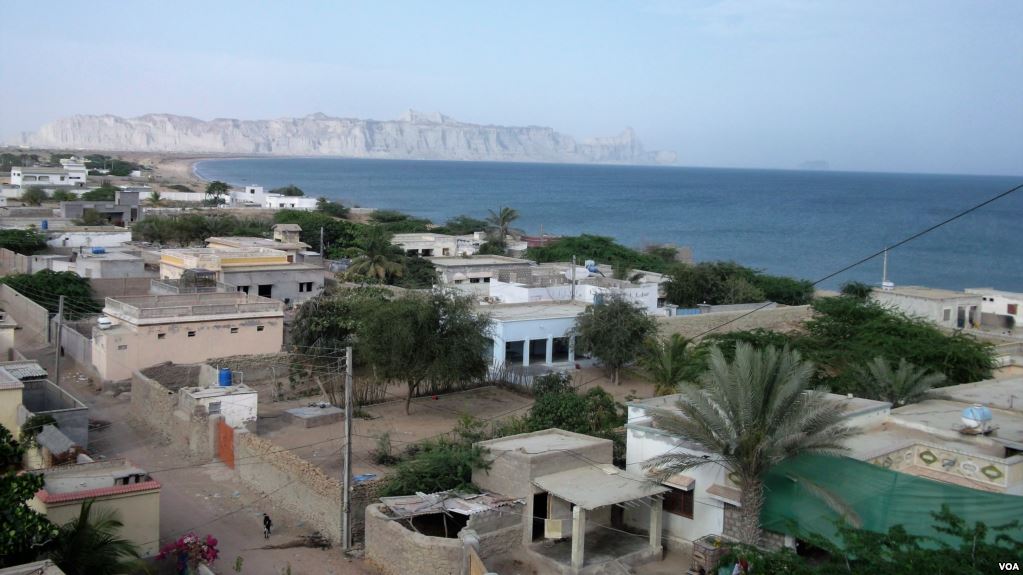
GWADAR, PAKISTAN — Over the last six months, the skyline over the sleepy fishing city of Gwadar has been transformed by machines that dredge the Arabian Sea and cranes that set up shipping berths in what is projected to become Pakistan’s biggest international port.

Infrastructure developments have enabled the hammer-shaped Gwadar peninsula to emerge as the centerpiece of China’s determined effort to shorten its trade route to the Persian Gulf and obtain access to the rich oil reserves there.

A mini-“Chinatown” has appeared, with prefabricated living quarters, a canteen and a karaoke center. After hours, the workers have the grounds to play their favorite game, badminton.

A spokesman for the Chinese team in Gwadar said in an interview that his government had invited employment bids in China, then brought the workers here.

He proudly touted the successful test run conducted by China in November when it used Pakistan’s land route from Kashgar to Gwadar to transport a convoy of 60 containers for export to the Middle East and North Africa.

Prior to that, he said, China had sailed materials through the South China Sea and the Indian Ocean to reach Gwadar.

The Chinese propose to cut down that 12,000-kilometer sea route by about one-fourth once they adopt the land route from the northwestern province of Xinjiang to Gwadar.

So eager is China to save on distance, time and expense — and the challenge posed by the U.S. Navy in the South China Sea — that it has weathered Pakistan’s unstable law-and-order situation to build its economic corridor.

Small wonder that the Chinese spokesman omitted an incident — related by locals to VOA — that the test convoy came under fire in Hoshab, Baluchistan, despite protection from a special security force.

Since then, Pakistan has enhanced its 12,000-plus security force to protect the Chinese. That has turned Gwadar into a military zone, with strict checks of vehicles and ID cards, plus an encampment of intelligence officials.

Still, Baluch insurgents use attacks on “soft targets,” like laborers from other provinces, to drive away investors from the China Pakistan Economic Corridor. On April 5, as road workers from Sindh were gunned down in Kharan in targeted killings claimed by the Baluchistan Liberation Front, former army Col. Farooq Ahmed said suspicion fell on militants operating from Afghanistan.

The Chinese, for their part, have taken heart from the security provided by Islamabad to plan ahead. A prefabricated coal plant will be brought from China to Gwadar to fire up its energy needs. Moreover, China will finance Gwadar international airport, according to the spokesman.

Distances inside Pakistan have shortened as the Frontier Works Organization builds a 3,000-km network of roads funded by Chinese investment.

4B95ACBB-2F93-40CB-B70D-43DA2818616C_w650_r0_s

Symbolizing skepticism

Despite Pakistan’s ongoing military operation against the Taliban, sporadic terror attacks are the biggest hurdle to the country’s development. After 9/11, when Pakistan allied with the U.S. in combating terrorism in Afghanistan, militant organizations put down their roots and threatened the nation from inside.

As social indicators fell and Pakistan became one of the world’s most food-insecure nations, it opened its doors to China — one of America’s rivals — to help fight poverty, a key factor in fundamentalism and terrorism.

When U.S. envoy Nikki Haley recently spoke of nations that use their United Nations veto to stop non-state actors from being designated as terrorists, it was seen as a reference to China’s refusal to let Kashmiri militant Masood Azhar be so named.

Pakistani analysts interpreted this to mean the U.S. would move closer to India, even while revisiting ties with Pakistan because of its key role in Afghanistan.

Now the road from Karachi to Gwadar is smooth and empty, with awe-inspiring, wind-carved hills and mysterious canyons that dip into golden sands that run for kilometers along the deep blue-green Arabian Sea. It has enabled locals to rediscover their country — even as some marvel at the speed of construction.

But in a country that suffers from grinding poverty, little industry and high unemployment, the benefits of China’s investment are still hard to sell to the average person.

Gwadar symbolizes the skepticism. A miniscule amount has been spent by Islamabad and Beijing on people’s welfare, including a vocational training center, a hospital and school. The peninsula’s natural beauty belies erratic electricity, scarce drinking water and lack of proper sewerage.

Gwadar Port Authority Chairman Dostain Jamaldini explains to delegations arriving daily from across the country that revenue generation is the key to uplifting the area.

He showed off a huge quadrangle in the center of Gwadar that “can even be seen on Google Earth.” There, he has recommended to Islamabad that a multipurpose lighthouse be constructed to guide incoming ships and generate revenue.

Until that happens, the fishermen who build wooden boats along Gwadar beach will likely lose their livelihood as their shanty homes are removed.

Already, the vacant plots in Gwadar’s Sinjhaar area overlooking the sea have been repossessed by the Pakistan Navy and earmarked for sale to military officials and politicians.

For the well-connected, a real estate boom is on the horizon. Trader Abbas Rashanwala said he waited for years for peace to come to Gwadar. Now his real estate business has taken off, with investors flocking in to buy land.

Many realtors are betting on Gwadar as on the stock market — making deals online or on the phone. Several sit in the Punjab, selling property they have never seen in Gwadar, all on speculation that prices will soon skyrocket.

Meanwhile, China’s investment in Gwadar is helping control maritime crime. Officials tell how traffickers from Africa and the Middle East used to dock on the beach at night to swap slaves for narcotics.

In February, 36 nations, including the U.S. and Russia, participated in the Pakistan Navy’s multinational patrolling of the Arabian Sea in a global recognition of China’s role in making the waterways safer.

Still, China’s emerging role in Pakistan has raised many questions. The most prominent criticism is that China will become Pakistan’s “East India Company” — a metaphor for the British empire’s plunder of India.

Notwithstanding the doomsayers, there also is a readiness to accept that development and peace are inextricably linked to Pakistan’s future.

http://www.voanews.com/a/pakistani-village-gwadar-china-gateway-to-middle-east/3816566.html?src=voa-editor-picks