The Nobel Peace Prize was awarded this Friday to India’s Kailash Satyarthi and Pakistan’s Malala Yousafzai for their struggles against the suppression of children and for young people’s rights, including the right to education. That is great news, and it might almost mean Nobel Peace Prize makes sense again, after being awarded to Barack Obama in 2009 “for his extraordinary efforts to strengthen international diplomacy and cooperation between peoples”, and to European Union in 2012 “for over six decades contributed to the advancement of peace and reconciliation, democracy and human rights in Europe”.
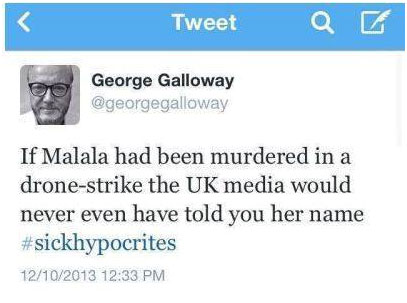
Still, there is something that really troubles me. How come we (meaning the West) always recognize the “devils” of the East, the torments children like Malala had to and have to go through (in her case, with the Taliban), but always fail to recognize our own participation in creating those “devils”? How come we never talk about the things our governments are doing to the children of Pakistan, or Syria, or Iraq, or Palestine, or Yemen? Let’s just take drone strikes as an example. Last year’s tweet by George Galloway might illustrate this hypocrisy.
Galloway is absolutely right. We would never even know her name. But, since Malala’s story fits into the western narrative of the oriental oppression (in which the context underlying the creation of the oppression is left out), we all know Malala’s name. Like Assed Baig writes:
“This is a story of a native girl being saved by the white man. Flown to the UK, the Western world can feel good about itself as they save the native woman from the savage men of her home nation. It is a historic racist narrative that has been institutionalised. Journalists and politicians were falling over themselves to report and comment on the case. The story of an innocent brown child that was shot by savages for demanding an education and along comes the knight in shining armour to save her. The actions of the West, the bombings, the occupations the wars all seem justified now, ‘see, we told you, this is why we intervene to save the natives.’”
The problem is, there are thousands of Malalas West helped create with endless wars, occupations, interventions, drone strikes, etc. InLast Week Tonight with John Oliver, one can hear how little we know about the drone strikes – its aims, targets, results. “Right now we have the executive branch making a claim that it has the right to kill anyone, anywhere on Earth, at any time, for secret reasons based on secret evidence, in a secret process undertaken by unidentified officials. That frightens me.” This is how Rosa Brooks, a Georgetown professor and former Pentagon official under President Obama, explained the US policy on drone strikes during a congressional hearing last year.
The following photo presents the piece that was installed in Khyber Pakhtunkhwa (KPK) province, close to Pakistan’s northwest border with Afghanistan, by an art collective that includes Pakistanis, Americans and others associated with the French artist JR. The collective said it produced the work in the hope that U.S. drone operators will see the human face of their victims in a region that has been the target of frequent strikes.
That is the reality we are not being presented with. Another reality is the story of Abeer Qassim Hamza al-Janabi, 14-year-old Iraqi girl, who was gang raped by five U.S. Army soldiers and killed in her house in Yusufiyah (Iraq) in 2006. She was raped and murdered after her parents and six-year-old sister Hadeel Qasim Hamza were killed. Also not irrelevant to mention is that Abeer was going to school before the US invasion but had to stop going because of her father’s concerns for her safety.
And while the West applauds Malala (as they should), I am afraid it might be for the wrong reasons, or with a wrong perspective. It feels like the West wants to gain an agenda that suits them or the policies they want. That is also why Malala’s views on Islam are rarely presented. She uses her faith as a framework to argue for the importance of education rather than making Islam a justification for oppression, but that is rarely mentioned. It also “doesn’t fit”.
So, my thoughts were mixed this Friday when I heard the news about the Nobel Peace Prize. On so many levels. They still are. We’ve entered a new war, and peace prize award ceremonies seem ridiculous after looking at this photo.
Sure, we must acknowledge the efforts of those who are fighting for a better world, but when it is done in a way that feels so calculated, unidimensional, loaded with secret agendas and tons of hypocrisy – I just can’t celebrate it.
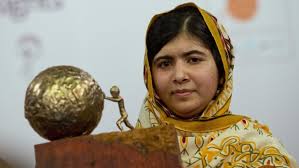
Malala wins Nobel peace prize (Credit: wiki-feet.com)
Take that, Islamic extremists, anti-Muslim bigots, Pashtun-bashers and misogynists! Malala Yousufzai has become the youngest person to win any Nobel prize and, fittingly, did not appear before the media to respond for several hours because it was a school day, and the girl’s got priorities.
A year ago the Guardian sent me to interview Malala in Birmingham, where she still lives, and I asked her why she thought the Taliban felt so threatened by her. At first she laughed. Then she said: “I don’t know, but many people say that they’re afraid of education,. They’re afraid of the campaign we’re doing for girls’ rights.”
But as she continued to speak – her ideas enlarging, in contradiction to my expectation of someone who would already have stock responses to all the obvious questions – she said: “I believe it’s my life and it’s my choice how to live it. The Taliban thinks that everyone should be in and under their control. I am not a slave. I am not their follower … I will use my mind.”
Listening to the interview again, I am more struck than previously by her understanding that the Taliban’s power comes from their ability to terrify those who oppose them. In the last few months Islamic State (Isis) has made it impossible to keep from thinking about how anyone is supposed to stand up to brutality instead of responding with acquiescence or flight. It’s a question to which Malala had to find an answer as a child.
When she was 13, two years before she was shot in the head, a Pakistani journalist asked her if she was frightened of the threats the Taliban directed at her. “Yes,” she said, “but I don’t let anyone see it.” When I put the same question to her, she said: “Fear was spread all over the valley of Swat, but we [she and her father] were not afraid of fear. At nights our hearts were beating fast, but in the morning we were like normal people, and we said we’ll continue our campaign. Our courage was stronger than fear.” She says a thing like that, and there’s no question of doubting her.
In Pakistan, news of the Nobel prize has led to an outpouring of accolades from official figures, led by the prime minister, Nawaz Sharif, who called her “the pride of Pakistan”.
Also among the praise-singers is the director general of Inter-Services Public Relations (ISPR), the public relations wing of the military. All this is as it should be. But officialdom has refrained from commenting on the fact that the pride of Pakistan is unable to return to Pakistan because the Taliban remain too great a threat.
As of June this year, Pakistan’s military has been engaged in an anti-Taliban offensive, during the course of which it captured 10 men who are allegedly members of the group that planned the attack on Malala.
But it’s hard to gauge the success of the operation, and difficult not to think about what Malala said to me about an earlier military operation against the Taliban: “In the military operation they didn’t target the Taliban leaders – they fled. But suppose a Talib went to a shop and asked for a comb – then the shopkeeper would become a [military] target, and be killed. They [the military] are doing nothing to the leaders.”
Malala isn’t the first Pakistani to win a Nobel – that accolade goes to Abdus Salam, joint winner of the 1979 physics prize.
Like Malala, Salam was in exile from Pakistan when the Nobel prize was announced. His was a self-imposed exile in protest at the Bhutto government’s decision to pass a law declaring members of the Ahmadiyya community, to which he belonged, non-Muslims. Salam never returned to live in Pakistan again.
When I listen to Malala talk about her home of Swat, it’s hard not to hope history will turn out differently this time.
It isn’t when she describes Swat as “paradise” that her heartbreak is evident, but later in the interview, when she remembers the river near her house. “I miss that river. It smelled a lot. It was full of garbage. But still, I miss it.”
QUETTA, Oct 12: The Human Rights Commission of Pakistan (HRCP) has expressed concern over rights violation in Balochistan, the country’s resource-rich but least developed province.
HRCP delegation, headed by chairperson Zohra Yusuf, held a series of meetings with journalists, lawyers, politicians and other members of civil society on Sunday.
Former president of the Supreme Court Bar Association (SCBA) Asma Jehangir was also part of the delegation that thoroughly discussed the prevailing situation in Balochistan with the intelligentsia and other stake holders.
Addressing a press conference at the Quetta Press Club later in the day, Yusuf stated that poverty was one of the underlying factors behind the increase in militancy and insurgency in the province.
She said although the situation had improved in comparison with the past, a lot needed to be done to improve the situation in Balochistan.
Yusuf stated that it was a matter of serious concern that different communities were being targeted in Balochistan. “Minorities feel insecure here”, she added.
The HRCP prepared different recommendations with regard to improvement of the human rights situation in Balochistan, which would be presented before the federal and provincial governments to ensure durable peace in the restive province.
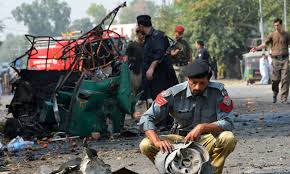
PESHAWAR, Oct 2 — Amid a wave of bombing attempts in this northwestern Pakistani city on Thursday, a bomb rigged to a timer exploded inside a passenger van, killing seven and wounding six, the police said.
Although the attack was the only one of eight attempted bombings to succeed here, the police said, the mass of attempts pointed to a concerted effort by militants to intensify their attacks on government targets.
“The bombs were intended to destroy an electrical tower, and to target police and a convoy of the law enforcement agencies,” said Shafqat Malik, the head of the Peshawar bomb disposal unit, noting that the bombs all had “a level of sophistication.”
“The bomb that went off was to target civilians. Imagine what would have happened, had they all gone off,” he said. “Today was the worst day in my professional career.”
The van that was bombed was set to carry passengers to Parachinar, the main town in the Kurram tribal region.
In an interview, a policeman investigating the case, Ejaz Khan, said that a man had left two bags in the van, then asked the driver to wait for him while he went to bring more passengers. The bomb, with roughly 10 pounds of explosives, went off after he left.
Although Kurram has in the past been a center of sectarian violence between Sunnis and minority Shiites, police officials said it was more likely that the bombing was a randomly chosen terrorist act rather than a targeted killing.
“People are heading home for Eid holidays,” Mr. Khan said, referring to the Eid al-Adha festival this weekend. “There is a lot of rush. No one could have known which passenger was heading where.”
A senior police superintendent, Najib Bhagvi, suspected that Pakistani Taliban militants were behind the attacks. That organization, along with some of its allies and splinter groups, has come under increasing pressure since the start of a military offensive against militant bases in North Waziristan in June.
“Peshawar is heating up, and this is the blow back of the operation in Waziristan,” Mr. Bhagvi said. “All the terrorist outfits, including Al Qaeda, have joined forces and are hitting back.”
Peshawar has seen a surge in militant attacks this year, particularly against the police. Twenty-five policemen have been killed since January, including a police inspector who was shot dead outside his house on Thursday.
Mr. Malik, the bomb squad commander, worried that more attacks were sure to come. “Tough days are ahead,” he said.
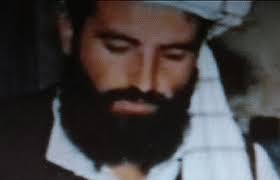
Nasiruddin Haqqani alias Zabiullah Mujahid (Credit: thenewstribe.com)
A senior Taliban official has denied he is in Pakistan after a Twitter gaffe saw his location tagged as “Sindh, Pakistan”.
Zabihullah Mujahid, whose location is supposed to be secret, has instead said on Twitter that the tagging of Pakistan as a location was an “enemy plot,” insisting he was in Afghanistan, according to the BBC.
The gaffe has added significance as Pakistan has been accused on many occasions of having secret links with the Taliban, which the country’s government denies.
After his followers alerted Mr Mujahid of the location tag, he tweeted: “My Twitter account has been manipulated – as part of weak efforts of enemy plot, it showed that I am based in Sindh of Pakistan, I call this attempt as fake and shame [sic].”
“Now the enemy’s fake act has been exposed, and with full confidence, I can say that I am in my own country.”
Twitter said its geo location data is based on latitude and longitude data, or other information that is provided by users at the time that they post their message.
The social media platform even includes a warning in its explanation of the geo location function, stating: “Remember, once you post something online, it’s out there for others to see.”
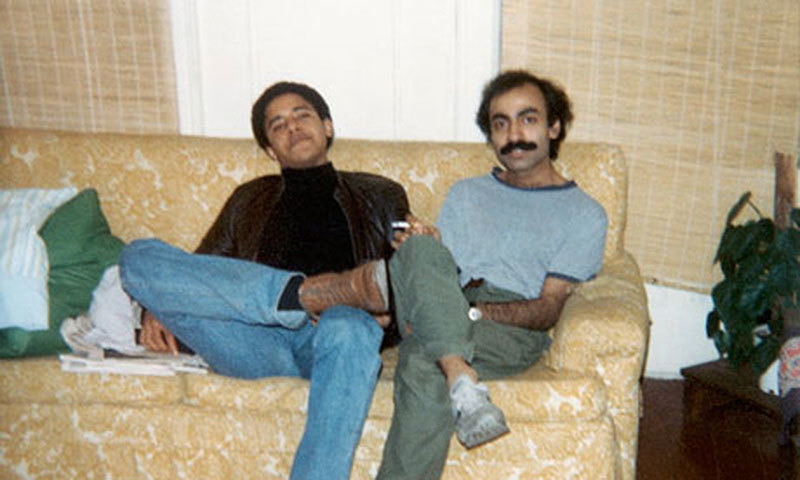
Visiting Karachi University student, US President Barak Obama (Credit: Dawn newspaper)
Karachi confuses people – sometimes even those who live in it.
The capital of Pakistan’s Sindh province, it is the country’s largest city – a colossal, ever-expanding metropolis with a population of about 20 million (and growing).
It is also the country’s most ethnically diverse city. But over the last three decades this diversity largely consists of bulky groups of homogenous ethnic populations that mostly reside in their own areas of influence and majority, only interacting and intermingling with other ethnic groups in the city’s more neutral points of economic and recreational activity.
That’s why Karachi may also give the impression of being a city holding various small cities. Cities within a city.
Apart from this aspect of its clustered ethnic diversity, the city also hosts a number of people belonging to various Muslim sects and sub-sects. There are also quite a few Christians (both Catholic and Protestant), Hindus and Zoroastrians.
Many pockets in the city are also exclusively dedicated to housing only the Shia Muslim sect and various Sunni sub-sects. Even Hindu and Christian populations are sometimes settled in and around tiny areas where they are in a majority, further reflecting the city’s clustered diversity.
Most of those belonging to clustered ethnicities, Muslim sects, sub-sects and ‘minority’ religions reside in their own areas of majority and they only venture out of these areas when they have to trade, work or play in the city’s more neutral economic and cultural spaces.
The survival and, more so, the economic viability of the neutral spaces depends on these spaces remaining largely detached in matters of ethnic and sectarian/sub-sectarian claims and biases.
Such spaces include areas that hold the city’s various private multinational and state organisations, factories, shopping malls and (central) bazaars and recreational spots.
Whereas the clustered areas have often witnessed ethnic and sectarian strife and violence mainly due to one cluster of the ethnic/sectarian/sub-sectarian population accusing the other of encroaching upon the area of the other, the neutral points and zones have remained somewhat conflict-free in this context.
The neutral points have enjoyed a relatively strife-free environment due to their being multicultural and also because here is where the writ of the state and government is most present and appreciated. However, since all this has helped the neutral zones to generate much of the economic capital that the city generates, these neutral spaces have become a natural target of crimes such as robberies, muggings, kidnapping for ransom, extortion, etc.
The criminals in this respect, usually emerge from the clustered areas that have become extremely congested, stagnant and cut-off from most of the state and government institutions, and ravaged by decades of ethnic and sectarian violence.
Though the ethnic, sectarian/intra-sectarian, economic and political interests of the clustered areas are ‘protected’ by various legal, as well as banned outfits in their own areas of influence, all these outfits compete with each other for their economic interests in the neutral zones because here is where much of the money is.
Just why does (or did) this happen in a city that once had the potential of becoming a truly cosmopolitan bastion of ethnic and religious diversity, and robust economic activity in South Asia?
This can be investigated by tracing the city’s political, economic and demographic trajectories and evolution ever since it first began to emerge as an economic hub more than a century and a half ago.
Birth of a trading post… and ‘Paris of Asia’
Karachi is not an ancient city. It was a small fishing village that became a medium-sized trading post in the 18th century. British Colonialists further developed this area as a place of business and trade.
‘Paris of Asia?’ – Karachi (in 1910). Karachi was always a city of migrants. Hindus and Muslims alike came here from various parts of India to do business and many of them settled here along with some British. In the early 1900s, encouraged by the city’s booming economy and political stability, the British authorities and the then mayor of Karachi, Seth Harchandari (a Hindu businessman), began a ‘beautification project’ that saw the development of brand new roads, parks and residential and recreational areas.
One British author described Karachi as being ‘the Paris of Asia.’
A group of British, Muslim and Hindu female students at a school in Karachi in 1910: Till the creation of Pakistan in 1947, about 50 per cent of the population of the city was Hindu, approximately 40 per cent was Muslim, and the rest was Christian (both British and local), Zoroastrian, Buddhist and (some) Jews.
Members of Muslim, Hindu and Zoroastrian families pose for a photograph before heading towards one of Karachi’s many beaches for a picnic in 1925: Karachi continued to perform well as a robust centre of commerce and remained remarkably peaceful and tolerant even at the height of tensions between the British, the Hindus and the Muslims of India between the 1920s and 1940s.
A British couple soon after getting married at a church in Karachi in 1927.
A group of traders standing near the Karachi Municipal Corporation (KMC) building in the 1930s.
Karachi Airport in 1943. It was one of the largest in the region.
Karachi’s Frere Hall and Garden with Queen Victoria’s statue in 1942.
A 1940 board laying out the Karachi city government’s policy towards racism.
Lyari in 1930 – Karachi’s oldest area (and first slum): Even though Karachi emerged as a bastion of economic prosperity (with a strategically located sea port); and of religious harmony in the first half of the 20th century, with the prosperity also came certain disparities that were mainly centred in areas populated by the city’s growing daily-wage workers. By the 1930s, Lyari had already become a congested area with dwindling resources and a degrading infrastructure.
Shifting sands: Karachi becomes part of Pakistan
Karachiites celebrate the creation of Pakistan (August 14, 1947) at the city’s Kakri Ground: The demography and political disposition of the city was turned on its head when the city became part of the newly created Pakistan. Though much of India was being torn apart by vicious communal clashes between the Muslims, Hindus and Sikhs at the time, Karachi remained largely peaceful.
To the bitter disappointment of Pakistan’s founder, Mohammad Ali Jinnah (a resident of Karachi), the city witnessed an exodus of its Hindu majority. Jinnah was banking on the Hindu business community of the city to remain in Karachi and help shape the new country’s economy.
As if overnight, the 50-40 ratio of the city’s population (50 Hindu, 40 Muslim) drastically changed after 1947. Now over 90 per cent of the city’s population was made up of Muslims with more than 70 per cent of these being new arrivals. A majority of the new arrivals were Urdu-speaking Muslims (Mohajirs) from various North Indian cities and towns. Since many of them had roots in urban and semi-urban areas of India and were also educated, they quickly adapted to the urbanism of Karachi and became vital clogs in the city’s emerging bureaucracy and economy.
Karachi’s rebirth as the ‘City of Lights’
Karachi’s Burns Road in 1963: It grew into a major Mohajir-dominated area. By the late 1950s, Karachi began to regenerate itself as a busy and vigorous centre of commerce and trade. It was also Pakistan’s first federal capital. It was the only port city of Pakistan and by the 1960s it had risen to become the country’s economic hub.
Karachi 1961: Brand new buildings and roads in the city began to emerge in the 1960s. The government of Field Martial Ayub Khan that came into power through a military coup in 1958 unfolded aggressive industrialisation and business-friendly policies, and Karachi became a natural city for the government to solidify its economic policies.
The II Chundrigarh Road in 1962: It was in the 1960s that this area began to develop into becoming Karachi’s main business hub. It began being called ‘Pakistan’s Wall Street.’
1963: Construction underway of the Habib Bank Plaza on Karachi’s II Chundrigarh Road. The building would rise to become the country’s tallest till the 2000s when two more buildings (also in Karachi) outgrew it.
Saddar area in 1965: Trendy shops, cinemas, bars and nightclubs began to emerge here in the 1960s and it became one of the most popular areas of Karachi. With Karachi’s regeneration as an economic hub, its traditional business and pleasure ethics too returned that consisted of uninterrupted economic activity by the day and an unabashed indulgence in leisure activities in the evenings.
Though the Ayub regime moved the capital to the newly built city of Islamabad, the economic regeneration enjoyed by Karachi during the Ayub regime’s first six years attracted a wave of inner-country migration to the city. A large number of Punjabis from the Punjab province and Pakhtuns from the former NWFP (present-day Khyber Pakhtunkhwa) began to arrive looking for work from the early 1960s onwards. But with the seat of power being moved from Karachi to Islamabad by the Ayub regime, the Mohajirs for the first time began to feel that they were being ousted from the country’s ruling elite.
It was during the Ayub regime that the term ‘City of Lights’ was first used (by the government) for Karachi as brand new buildings, residential areas and recreational spots continued to spring up. Karachi once again became a city of trade, business and all kinds of pleasures, and yet, the industrialisation that it enjoyed during the period and the continuous growth in its population began to create economic fissures that the city was largely unequipped to address. The economic disparities and the ever-growing gaps between the rich and the poor triggered by the Ayub regime’s lopsided economic policies became most visible in Karachi’s growing slums.
Many shanty towns sprang up in the outskirts of Karachi in the 1960s. Criminal mafias involved in land scams, robberies, muggings and drug peddling in such areas found willing recruits in the shape of unemployed and poverty-stricken youth residing in the slums.
Resentment against Ayub among the Mohajir middle and lower middle-classes (for supposedly side-lining the Mohajir community), and the growing economic disparities and crime in the city’s Baloch and Mohajir dominated shanty towns turned Karachi into a fertile ground for left-wing student groups, radical labour unions and progressive opposition parties who began a concentrated movement against the Ayub regime in the late 1960s (across Pakistan). Ayub resigned in 1969.
Sleaze city: Fun and fire in the time of melancholia
The PPP became the country’s new ruling party in 1972. After the end of the ‘One Unit’ (and separation of East Pakistan), Karachi became the capital of Sindh. Bhutto was eager to win the support of Karachi’s Mohajir majority. In various memos written by him to the then Chief Minister of Sindh, Bhutto expressed his desire to once again make Karachi the ‘Paris of Asia.’
Karachi’s ‘Three Swords’ area in 1974 was ‘beautified’ during the Bhutto regime but today has become a busy and congested artery connecting Clifton with the centre of the city. It was during the Bhutto government that the city’s first three-lane roads were constructed (Shara-e-Faisal), dotted with trees; the Clifton area was further beautified; foundation of the country’s first steel mill laid (in Karachi); and the construction of a large casino started (near the shores of the Clifton Beach) to accommodate the ever-growing traffic of European, American and Arab tourists.
A newspaper report on the 1972 ‘Language Riots’ in Karachi: Bhutto failed to get the desired support of the Mohajirs. This was mainly due to his government’s ‘socialist’ policies that saw the nationalisation of large industries, banks, factories, educational institutions and insurance companies. This alienated the Mohajir business community and the city’s middle-classes. Also, since Bhutto was a Sindhi and the PPP had won a large number of seats from the Sindhi-speaking areas of Sindh, he encouraged the Sindhis to come to Karachi and participate in the city’s economic and governing activities. This created tensions between the city’s Mohajir majority and the Sindhis arriving in Karachi after Bhutto’s rise to power.
The insomniac metropolis: The city that never slept
Karachi in the 1970s gave a look of a city in a limbo – caught between its optimistic and enterprising past and a decadent present. It behaved like a city on the edge of some impending disaster or on the verge of an existential collapse.
Most Karachiites would go through the motions of traveling to work or study by the day, and by night they would plunge into the various chambers of its steamy and colourful nightlife …
A badly managed economy (through haphazard nationalisation), and the reluctance of the private sector to invest in the city’s once thriving businesses strengthened the unregulated aspects of a growing informal economy that began to serve the needs of the city’s population. The flip side of this informal economic enterprise was the creeping corruption in the police and other government institutions that began to extort money from these unfettered and informal businesses.
The rupture
In 1977 the city finally imploded. After a 9-party alliance, the Pakistan National Alliance (PNA) – that was led by the country’s three leading religious parties – refused to accept the results of the 1977 election; Karachi became the epicentre of the anti-Bhutto protest movement.
The protests were often violent and the government called in the army. The protests were squarely centred in areas largely populated by the Mohajir middle and lower middle classes. Apart from attacking police stations, mobs of angry/unemployed Mohajir youth also attacked cinemas, bars and nightclubs; as if the government’s economic policies had been the doing of Waheed Murad films and belly dancers! The bars and clubs were closed down in April 1977.
As the PNA protests led to the toppling of the Bhutto regime (through a reactionary military coup by General Ziaul Haq in July 1977), within a year a group of young Mohajirs were already exhibiting their disillusionment with the ‘PNA revolution.’ In 1978 two students at the Karachi University – Altaf Hussain and Azim Ahmed Tariq – formed the All Pakistan Mohajir Students Organization (APMSO). They accused the religious parties of using the Mohajirs as ladders to enter the corridors of power while doing nothing to address the economic plight of the community.
Apart from the fact that Karachi’s university and college campuses exploded with protests against Zia (and then violent clashes between progressive student groups and the pro-Zia right-wing outfits), the city largely returned to normalcy and its status of being Pakistan’s economic hub was revived.
The continuous flow of aid helped the Zia regime stabilise the country’s economy. But underneath this new normalcy something extremely troubling was already brewing.
Since most of the sophisticated weapons from the US (for the Afghan Mujahideen) were arriving at Karachi’s seaport, a whole clandestine enterprise involving overnight gunrunners and corrupt police and customs officials emerged that (after siphoning off chunks of the US consignments), began selling guns, grenades and rockets to militant students (both on the left and right sides of the divide) and to a new breed of criminal gangs.
From the northwest of Pakistan came the once little known drug called heroin, brought into Pakistan and then into Karachi by Afghan refugees who began pouring into the country soon after the beginning of the anti-Soviet Afghan insurgency in Afghanistan…
Hell on Earth?
When the MQM was regenerating itself during the Musharraf regime, it did not completely dismantle its problematic wings – despite the fact that the party’s appeal began to cut across all ethnic groups in Karachi during Kamal’s mayorship.
However, by 2008, the growth in the city’s Pakhtun population managed to give the Pakhtun nationalist party, the ANP, a greater sense of power in Karachi. To ward off the perceived threat from MQM and the growing tussle between the city’s Mohajir and Pakhtun communities over Karachi’s economic resources, ANP too decided to compete with the MQM at its own game.
The PPP, the third major political power in the city already had violent elements in its midst and even though all three parties were in a coalition government, they often fought for political and economic control of Karachi. Many members of the parties’ wings also began getting involved in major crimes, so much so that it became tough for even their party bosses to rein them in.
The PPP tried to dismantle its wing but by then the wing had already gotten embroiled in the vicious ‘gang wars’ in Lyari. The gangs got involved in drug and gun running, kidnappings, theft, muggings and ‘target killing.’ They often fought one another and the police.
ANP’s wing was wiped out along with the party in the areas where they enjoyed influence. This was not done by MQM or PPP, but by various groups of extremist and sectarian outfits that had begun to establish themselves in Karachi from 2009 onwards. They right away got involved in the many illegal activities and crimes that witnessed a dramatic increase, making Karachi one of the most crime-infested city in South Asia.
ISLAMABAD: Over two thousand criminals have been arrested since the start of the Rangers-led operation in Karachi, an official of the Sindh Rangers told the Senate Standing Committee on Interior Affairs on Monday.
During a meeting of the committee today, Colonel Tahir Mehmood of the Sindh Rangers submitted a report detailing the progress of the operation against criminal elements in the metropolis.
According to sources, the report claimed that suspects arrested included those belonging to the outlawed Tehreek-i-Taliban Pakistan (TTP), the banned People’s Amn Committee, the Muttahida Qaumi Movement (MQM), Awami National Party (ANP), and hundreds belonging to banned outfits.
The Rangers report claims that around 2,251 criminals were arrested during the operation, said sources.
373 raids were carried out on MQM offices in which 560 MQM workers were arrested and a large cache of weapons was recovered.
18 raids were carried out on offices of the ANP in which 40 people were arrested and 21 weapons were recovered, he said.
396 raids were carried out against the banned Amn Committee, in which 539 people were arrested and 591 weapons were recovered.
403 raids were conducted against the outlawed Tehreek-i-Taliban Pakistan (TTP), in which 760 alleged terrorists were arrested and a large cache of weapons and explosives was recovered.
159 raids were carried out against other banned outfits, in which 352 suspects were arrested and 463 weapons were recovered.
2347 other raids were conducted in which 4584 other suspects were arrested, said sources privy to the meeting.
When contacted by Dawn, spokesman for the Sindh Rangers Major Sibtain declined to comment on the numbers. He confirmed that a report had been submitted to the standing committee, but he was not authorised to share the details with the media.
According to sources, Colonel Tahir Mehmood told the committee that the suspects arrested during a raid on Sept 24 also included three notorious target killers.
Mehmood claimed that a search operation was recently carried out in Karachi’s Gulshan-i-Maymar area after security personnel were fired upon.
Mehmood said that 23 people were arrested, including three notorious target killers whose names are also mentioned in a list of 143 most wanted criminals submitted to Governor Sindh Dr Ishratul Ibad.
Mehmood further claimed that eight of the detainees were proclaimed offenders involved in several crimes and have been handed over to the police.
The Rangers official further said that 12 of the 23 detainees were handed over to MPA Faisal Sabzwari and Dr Sagheer Ahmed of the MQM, said the sources.
MQM chief Altaf Hussain has recently lashed out against the Sindh Rangers claiming that only his party is being subjected to raids and arrests when the Supreme Court has ruled that all political parties in Karachi have militant wings.
Speaking to Dawn.com today, MQM MPA Faisal Sabzwari pointed out that the report claims security forces have arrested only 60 suspected terrorists belonging to the TTP, while 560 MQM workers have been picked up. He said that the numbers raise the question of misplaced priorities of the security forces in the Rangers-led operation.
About the allegation of target killers being arrested in the Gulshan-i-Maymar raid, Sabzwari said that the MQM would contest these claims in court. “If the Rangers or police have evidence, then the MQM will never support any criminals. But workers have been picked up solely on the basis of their affiliation with the MQM,” he said.
Contradicting the numbers, the MQM leader said that at least 700 MQM workers have been sent to jail, while thousands of party workers have been detained since the start of the operation.
He added that the low number of arrests of government-backed groups and other terrorist outfits “contradicts the claims of neutrality and impartiality” by the security forces.
The MQM recently carried out a number of protest sit-ins in Karachi claiming that 41 party workers have been missing since the start of the operation. MQM further claims that several party workers picked up by the Rangers have been tortured to death.
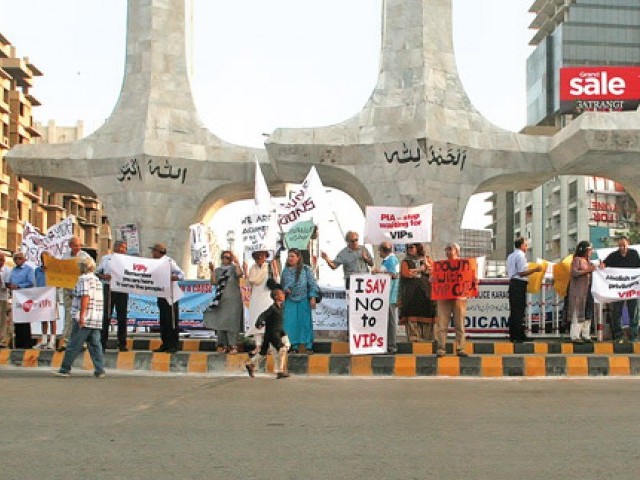
Citizens protesting VIP Culture in Clifton, Karachi (Credit: Athar Khan)
KARACHI, Sept 30: “VIP culture is a disease that has been inflicted upon us,” screamed an elderly man. “Don’t use such polite words for these vultures,” he told a young man, Dr Jahanzeb Effendi, who had been explaining why a group of around 80 young professionals and old-timers had taken to the streets to raise their voice against the status quo.
The protesters, armed with placards and banners, all screaming their resentment of the VIP culture, stood on the pavement of the landmark, Teen Talwar at around 5pm on Monday. They were ordinary citizens, giving voice to the millions who wish to fight the ‘Guns and Goons’ cult that has taken the country by storm. Each time a VIP motorcade passed the roundabout, the protesters shouted: “Shame, Shame”; rants that were met with cheeky, nonchalant grins from the armed escorts of the very people they were protesting against.
“We are sick and tired of bowing down in front of these vermin,” said Zafar Alam. “They will have to listen to us. Ehsaas,” he said, placing much emphasis on the last word. “Hundreds of people are killed in the city each day and these so-called elected representatives of the same victims roam around in their flashy cars with their 50-vehicle escorts.”
Sharmeen Usmani, the wife of a sitting Supreme Court judge, spoke from experience. She claimed she declined security escorts whenever she travelled. “I hate these guards screaming at people to move away from my vehicle whenever we are driving somewhere,” she said.
For Usmani, VIP culture had transcended into every aspect of Pakistani society. “It has so deeply ingrained into our psyche that we have come to accept it as part of our daily lives.” Only in Pakistan will you see an ambulance waiting for a VIP motorcade to pass, chipped her friend. Speaking from her knowledge of judicial affairs, Usmani lamented that laws were modified and altered to perpetuate the status quo. “These modified verdicts then set a precedent which are used later to benefit the VIPs again and again. What future are we leaving for our children?” she cried.
A retired naval officer, who identified himself as Captain Farooq, was also part of the protest. The elderly gentleman chose to speak about the ideological stance of the protest. “Remember: Evil prevails not because of the bad people but because of the silence of good people,” he said to the nods and murmurs of his compatriots.
Perhaps the most interesting feature of the protest was the innovative taglines inscribed on the placards and banners. It was obvious these posters had been given much thought. For example, the acronym, VIP, now stood for various connotations, such as as ‘Vultures in Pakistan’, ‘Vermin in Pakistan’ or ‘Very Incompetent People’.
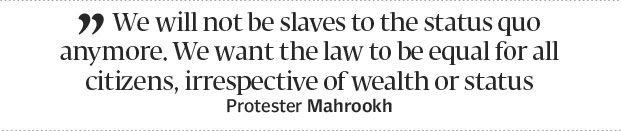
These protesters came out of their comfort zones to demand an end to the status quo. They were ordinary citizens; their agenda is to end the preferential treatment for anyone with a little money or clout. “We will not be slaves to the status quo anymore,” resolved one protester, Mahrookh, who described herself as the ‘mahrookh of Karachi-gone’. “We want the law to be equal for all citizens, irrespective of wealth or status.”
Clifton SHO Ghazala, who had by this time arrived at the scene of the protest, was all smiles for the protesters. She refused to comment, saying if she spoke her mind, her superiors would be displeased with her. The SHO did say, however, that in an ideal world, everyone would be equal before the law.
Shamma, one of the protesters, realised it would be a long and arduous journey before the mindset changed, but said it did have to start somewhere. “This is a start. One can only hope it goes on to achieve something,” she said, wistfully eyeing the traffic warden as he stopped the oncoming traffic for a motorcade to pass through.
The warden, Talat Mehmood, personified everything the protesters spoke against. “It is these government officials that pay us. It is our duty to serve them; to make way for them,” he said proudly.
On the hour, the protesters carefully folded their placards and made their way to their waiting cars. Thus ended the peaceful demonstration, but not before they pledged to return the next week, with even more people, to continue their struggle for the rights of the common citizen.
ISLAMABAD, Sept 22 — The Pakistani military chief, Gen. Raheel Sharif, on Monday appointed a close ally as head of the powerful Inter-Services Intelligence spy agency, consolidating his power at a time of sharp tension with the country’s civilian leaders and fluctuating policy toward the Taliban.
The new ISI chief, Lt. Gen. Rizwan Akhtar, had previously led the paramilitary Sindh Rangers based in Karachi. He will replace Lt. Gen. Zaheer ul-Islam, who has led the ISI since 2012 and is scheduled to step down on Nov. 7.
The army spokesman announced the promotion of General Akhtar, who was also promoted from the rank of major general, among a reshuffle of five major military posts. But it was the appointment of the ISI chief, considered the second most powerful position in the military, that attracted the most attention.
Always shrouded in controversy, the ISI has in recent months come under particularly sharp scrutiny amid accusations of political interference and brutal tactics to control the media.
Lt. Gen. Rizwan Akhtar Credit Pakistan Rangers, via Associated Press Under General Islam’s leadership, the spy agency was accused of trying to assassinate a senior journalist, Hamid Mir. And the military has been widely accused of supporting an opposition movement led by a former cricketer, Imran Khan, and a cleric, Muhammad Tahir-ul Qadri, that aimed to oust Prime Minister Nawaz Sharif. The military has publicly rejected both accusations.
Analysts said they expected that General Akhtar, who recently led a campaign against the Taliban in Karachi, was likely to shy away from such a prominent political role — at least initially. But there is little doubt that he inherits a strained relationship with the country’s civilian leadership, which was evident from the manner of his appointment.
Though the ISI chief theoretically answers to the prime minister, the fact that General Akhtar’s promotion was announced by the military was taken as a sign of the true line of authority.
Mutual paranoia is a central factor in poor relations among the military and civilian leaders, said Talat Masood, a retired general and commentator.
“The relationship has gone through a really bad patch, with all this speculation that elements in intelligence are supportive of Imran Khan and Qadri,” he added. “I think that will subside now.”
General Sharif and Mr. Sharif — they are not related — have been at odds over the fate of Geo, the television channel where Mr. Mir was the leading anchor before being attacked in April, and over street demonstrations.
Mr. Sharif’s supporters privately accuse the ISI of covertly playing a role in both dramas — possibly with a view to ousting Mr. Sharif, much as his last stint in power ended in 1999.
The ISI has a long history of undermining civilian governments in Pakistan. Although the previous army chief, Gen. Ashfaq Parvez Kayani, pledged to end the spy agency’s political role in 2008, it has continued to operate behind-the-scenes.
The ISI has also suffered several major embarrassments, including the American commando raid in May 2011 that killed Osama bin Laden near a major army training center in Abbottabad.
For American officials, though, General Akhtar may offer hope of an improved relationship. In a paper written during a period of study at the Army War College in Pennsylvania in 2008, he stressed the need to establish a stable democracy in Pakistan and to curb anti-Americanism in the country.
Later, he led anti-Taliban operations in the South Waziristan tribal agency, near the border with Afghanistan. In 2011, he became head of the Sindh Rangers, drawing praise from civilian leaders for his role in an operation against the Taliban and armed gangs linked to Karachi’s political parties.
“His role in maintaining peace in the city was remarkable,” said Sharfuddin Memon, an adviser to the home minister of Sindh Province. But human rights activists say the same period was marked by a rise in abuses by security forces, including abduction, torture and extrajudicial execution.
KABUL, Sept 21 — Their campaign workers traded blows over ballot boxes during an election widely seen as fraudulent. Some of the warlords backing them have muttered about starting a parallel government, a potential recipe for civil war in Afghanistan. And they’ve just come out of a vote so discredited that some officials don’t want the final tallies announced.
Now Ashraf Ghani, Afghanistan’s new president-elect, and his opponent, Abdullah Abdullah, have joined together in a national unity government in which they will share power.
After eight months of enmity over the protracted presidential election, with two rounds of voting, an international audit and power-sharing negotiations finally behind them, they will have to confront the challenges of jointly governing a country that in many ways is far worse off than it was before the campaign began last February.
The Taliban have had one of their most successful fighting seasons since the beginning of the war, and the security forces are reeling from heavy casualties, a high desertion rate and poor morale. The Afghan economy is battered by election uncertainty and rising unemployment, and in desperate need of emergency financing from the United States and other donors.
But both Mr. Ghani and Mr. Abdullah are expected to bring a welcome change from the confrontational relationship between the incumbent, President Hamid Karzai, and his American allies. Their relationship with the Americans will be one of the points of concord in what could well turn into a discordant and possibly unstable government.
In an interview with The New York Times last month, Mr. Ghani cited a parable to describe the problem confronting them. “Two people are riding in a boat and one of them took a chisel and started making a hole in the bottom and the other one said, ‘What are you doing? You’re going to drown us.’ And the other said, ‘I’m making the hole in my part of the boat.’ ”
“That captures it,” he said. “There are not two boats.”
The agreement forming the new government, brokered by Secretary of State John Kerry, who led an intense diplomatic effort over the past month, makes Mr. Abdullah or his nominee the chief executive of the government, with the sort of powers a prime minister normally has. While reporting to the president, the chief executive will handle the daily running of the government. At the same time, Mr. Ghani keeps all the powers granted to the president by the Afghan Constitution.
Already, supporters for each side have debated whether Mr. Ghani will have more power, or whether Mr. Abdullah will be an equal partner.
That does not bode well. Neither did the brief ceremony Sunday afternoon during which the two men signed the power-sharing agreement in front of President Karzai and their top supporters.
They hugged one another stiffly afterward, to decidedly tepid applause, and the entire event lasted less than a quarter-hour. They failed to show up for a planned joint news conference on Sunday, sending spokesmen instead.
While Mr. Ghani and Mr. Abdullah have known one another for many years, having served together in various positions in Afghan governments under Mr. Karzai, they have long had relations widely described as strained.
“They have created a fabricated national unity government, and I don’t think such a government can last,” said Wadir Safi, a political analyst at Kabul University.
At the same time, a national unity government is not a completely alien idea here. Mr. Karzai adroitly brought leaders from diverse ethnic and political groups into his government, and the security ministries especially — defense, interior and intelligence — were usually headed by northern Tajiks rather than Mr. Karzai’s fellow Pashtuns.
The two new leaders have plenty of common ground as well. Both are generally pro-American in their views; Mr. Ghani lived and worked there for many years, and Mr. Abdullah was a frequent visitor, and a close ally when the United States invaded Afghanistan alongside his Northern Alliance.
They both say they plan to sign the bilateral security agreement with the United States the moment they take office. Delayed a year because Mr. Karzai refused to sign it, the agreement is necessary if American troops are to remain in Afghanistan after the end of the current combat mission this year.
With 30,000 Americans and 17,000 other coalition troops still here, planning a sudden withdrawal by the end of the year would have been a challenge, but neither leader wants to renegotiate the agreement. Only a handful of Afghan military and police units are rated as completely self-sufficient without coalition support, which would potentially make a total pullout a disaster that neither leader wants.
There are strong indications, too, that the Taliban have taken advantage of the power vacuum caused by the long election imbroglio to step up their campaign, carrying out 700 ground offensives in the first six months of the current Afghan year, which began March 21, and killing 1,368 policemen and 800 soldiers, more than in any similar period.
Both Mr. Ghani and Mr. Abdullah have similar views on fighting the Taliban, agreeing that the country needs the sort of wartime commander in chief it has not had under Mr. Karzai, who has long seemed as if he simply wanted to wish the war away.
American diplomats who worked closely with both men in recent months, setting up and attending many meetings between the two, say their understanding of one another has grown greatly, and differences have increasingly been greater among some of their harder-line staff members than with each other.
A European official and a former Afghan official said that powerful backers of each candidate appeared to be making no moves to stand down the militias they control, preferring to see what happens in the coming months before sending home the gunmen they had raised over the summer.
“We’ve seen no moves in the north or outside Kabul or in eastern areas where these illegal armies are concentrated,” said the European official, who spoke on condition of anonymity because he did not want to further inflame tensions in Afghanistan.
“There are going to be lots of centers of power in the government. Who will dominate? Abdullah’s people are worried that he’s going to be relegated to being nothing more than a senior adviser, and they’ll all be shoved aside by Ghani’s supporters, who want to be able to protect their claims on power and businesses,” the European official said.
In addition to wartime concerns, their government will have to tackle an economy in deep crisis. The election impasse chased away investment, slowed economic activity and worsened an already growing unemployment problem as the military has been greatly reducing its presence.
By midyear, the Ministry of Finance was reporting net income of less than zero, as the cost of collecting taxes and customs duties exceeded the revenue raised. Afghanistan seemed unlikely to meet even its projected revenue goal of $2 billion this year, which already was $5 billion short of its needs, according to American officials. This month, teachers and other public workers were facing a payless payday, while the government asked donors for $537 million in emergency funding so it could meet its payrolls.
Less quantifiable would be the damage to the reputations of Afghanistan and its supporters in creating a viable democracy — although that, too, could have a price, since donor countries have made a free and fair election and a democratic, peaceful transfer of power the basis for continued aid. In Tokyo last year, for instance, donor nations made satisfactory elections a precondition for $16 billion in development assistance.
Despite as much as a half-billion dollars in international support for the elections and the audit (even the lowest estimates exceed $200 million), in the end the two candidates cut a political deal before the vote totals were even announced.
At the last minute, Mr. Abdullah had threatened to boycott the deal altogether unless the Independent Election Commission did not release the vote totals, and that is what happened Sunday. The commission merely announced that Mr. Ghani was the winner, without citing any numbers.
The European Union’s observer mission, which had more than 410 people here, called the United Nations-supervised audit “unsatisfactory” and expressed “regrets that no precise results figures have been published.”
“Many people risked their lives to vote, some lost their lives and this is a very bad precedent,” said Nader Nadery, the head of the Free and Fair Election Foundation of Afghanistan, a respected Afghan monitoring group. “To persuade people to come back and vote again will be very hard.”
Mr. Nadery, whose organization monitored the vote, said it had estimated that the final total would be about 54 percent to 45 percent in favor of Mr. Ghani, even after fraudulent votes were discounted. He said there was clearly large-scale fraud on both sides.
American officials were eager to portray Sunday’s outcome as an important milestone, and proof that the country could weather its first change of power peacefully and democratically.
It was emblematic of the confused ending to the election ordeal that no one was even sure when President-elect Ghani would be inaugurated. Under the deal, he is obliged to appoint Mr. Abdullah as chief executive at that inauguration, so they will both be in the same boat immediately.
Matthew Rosenberg contributed reporting from Washington.