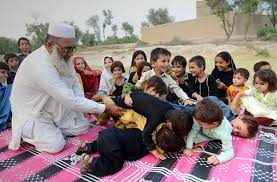
Gulzar Khan & children (Credit: hindustantimes.com)
BANNU: The ongoing military operation may be making headway in clearing militant hideouts, but it has shattered the dream of one father of 36 children — to take a fourth wife.
Gulzar Khan is one of hundreds of thousands of people who have fled the North Waziristan tribal area since the army moved in to clear longstanding bases of Taliban and other militants.
Escaping the military advance meant leaving the 35-room house he shares in the North Waziristan village of Shawa with around 100 family members, including wives, children and grandchildren.
The 54-year-old grumbled that paying to transport his brood used up the cash he had set aside for his fourth marriage.
“The money I had saved was consumed in relocating my family from Shawa to Bannu and now I have again started saving and waiting for the operation to conclude,” he told AFP.
After giving birth to a dozen children each, Khan said, his wives had told him enough was enough.
“I was planning to have a fourth marriage because now my wives have boycotted me and told me ‘no more children’,” Khan said.
“They do not allow me to go near them, but I have desires I want to fulfill.
Khan was 17 years old when he married his 14-year-old cousin in Shawa. They had eight daughters and four sons, but after eight years, Khan got married again, to a 17-year-old.
“I was not satisfied and needed more of it — I mean the love-making,” Khan told AFP at his 17-room house in the northwestern town of Bannu, where the bulk of people displaced by the military operation have taken refuge.
“I do not indulge in adultery and sinful acts so I satisfy my natural desires lawfully by marriage,” said Khan, who worked as a taxi driver in Dubai from 1976 to 1992.
Khan’s third wedding came when he married his brother’s widow when he was killed in a dispute just a month after tying the knot himself.
Two of his sons now work as drivers in Dubai and the money they send home helps support the extended family, along with income from Khan’s farmland in Bannu and Shawa.
“My sons send up to Rs50,000 every month from Dubai and we make ends meet with this money,” Khan added.
He said there were no disputes between his three wives, all living under the same roof, but he admitted he struggled to remember who was who’s mother.
“I can tell you that he or she is my child, but I cannot tell with all of them who is his or her mother,” Khan said.
As tribal custom forbids women from speaking to men outside their family, AFP’s reporter was unable to obtain the views of Khan’s wives on the matter.
Khan said he had no problem feeding and clothing his family, but with so many people around, there was little privacy.
“Often there are two to three kids lying around me when I go to sleep, so it’s difficult to have a private moment with my wives,” Khan said.
Asked if he used any drugs like Viagra to perform, Khan said that he never felt the need.
“I had a heart attack 12 years ago and also have an ulcer, and my doctor had advised me to stay happy,” Khan told AFP.
“I am happy only when I perform my conjugal rights.”
Pakistan’s 180 million-strong population is growing by more than two per cent a year, according to the United Nations Population Fund, which said in late 2012 that a third of Pakistanis have no access to birth control.
Some observers have warned that unless more is done to slow the growth, the country’s natural resources — particularly water — will not be enough to support the population.
But Khan’s 14-year-old son Ghufran has no such fears.
“God willing I will also have several marriages and produce even more kids than my father,” he told AFP.
Kabul/Islamabad, July 17: Pakistani troops in Miran Shah, North Waziristan amid a government operation to clear the area in north-western Pakistan of extremists. Photograph: Rebecca Santana/AP
Afghan officials have accused Pakistan of letting Afghan militants escape a complex crackdown on insurgent hideouts, after a massive truck bomb killed dozens of civilians in a crowded bazaar earlier this week.
The vehicle was packed with explosives across the border and driven into Afghanistan even as the Pakistani military battled to extend their control of North Waziristan beyond the administrative headquarters of Miran Shah, according to a spokesman for Afghanistan’s intelligence agency, the National Directorate of Security.
“The Haqqani network was behind this attack,” Abdul Haseeb Sadique said of the bombing on Tuesday. “It was planned and designed in Miran Shah. The aim of this attack was to inflict maximum casualties, regardless of whether they were civilians or military.”
The Haqqani network is perhaps the wealthiest and most ruthless of several Taliban-linked groups that operate out of western Pakistan; much of their support comes from their home province, Khost.
The Afghan government has long accused its neighbour’s intelligence service of supporting insurgents with money, arms, advice and safe havens. Islamabad says the accusations are groundless and it has no control over areas that were ceded long ago to groups fighting their own state.
Operation Zarb-e-Azb, a long-delayed effort to seize back the area from militant groups, began on 15 June. It has effectively emptied the area of civilians, with nearly a million fleeing within Pakistan and tens of thousands across the border into Afghanistan, raising worries that insurgents might be lying low among them.
The Pakistani army insists that all insurgents will be targeted and says more than 400 have been killed so far, but a senior Afghan intelligence official said he was not aware of any Afghans among the dead or captured.
“Haqqani network has planned and has managed to organise such a large, spectacular intelligence-led operation inside Waziristan … coordinate the transport to Afghanistan, cross the border, come to the attack area and blow it up,” the official said.
“It tells us a story that something is wrong, either the operation is a failure or there is an intention that the Haqqanis are not going to be the target.” The official said he had reports of Haqqani leaders evacuated to safety and small “safe havens” set up for lower-level fighters to escape the crackdown.
Tuesday’s attack was far beyond the capacities of local Taliban, and fits with a pattern of similar assaults and attempted attacks by Haqqani fighters. Authorities have intercepted five truck bombs in the past 16 months, mostly heading for Kabul, and one other reached its target in a province just south of Kabul, killing dozens in an attack on the governor’s compound.
On 11 June another massive truck bomb was destroyed by a US drone just 20km north of Miran Shah as it was travelling the short distance to the Afghan border, from where insurgents can easily reach major provincial capitals.
After just a month of operations, Pakistan does not yet fully control Waziristan, a large and partly mountainous region. However on Wednesday it was reported that leading Pakistani Taliban commander Adnan Rashid had been captured, although officials refused to confirm the arrest.
While Pakistan has been accused of colluding with militants vying for power in Kabul, Rashid, a former air force technician, is regarded as an arch member of the “bad Taliban” that Islamabad wants to uproot because they target Pakistan.
He was the mastermind of a 2003 suicide car bomb plot to kill former president Pervez Musharraf, and escaped from a prison near North Waziristan during a mass jailbreak organised by the Pakistani Taliban in 2012.
The Pakistani government has also complained to Afghanistan that it is providing shelter to militants in its own lawless border regions, and requested their eviction. It was a demand that many in Kabul found ironic after years of making similar pleas to no effect in Islamabad.
In 2006, veteran US army officer and a military strategist Ralph Peters penned an article “Blood Borders” that was published in “Armed Forces Journal”. The article created ripples among concerned circles. Some of them debunked it as a sinister scheme of superpowers and some others delved for logic inside the re-drawn map of Middle East and parts of Africa and South Asia, including Pakistan.
Ralph asserted that the borders drawn after the First World War were arbitrary and distorted that resulted in madcap boundaries in Middle East. He particularly referred to ethnic tapestry in Iraq, Syria, Turkey and Iran that eventually turned into a mishmash of fault lines in these countries.
His prophetic anticipation about dismemberment of Iraq is being witnessed toady by the whole world. A flabbergasting thunderbolt by Islamic State of Iraq and al-Sham (ISIS) has ravaged strategic cities of Iraq occupying one after the other and declaring an Islamic Caliphate. Iraq’s current geographic architecture surfaced in the wake of First World War when France and Britain glued splinters of the shattered Ottoman Empire. Oil reserves defined the new landscape of Syria, Iraq, Lebanon and Saudi Arabia.
After the 2nd World War, British Empire lost its sheen and paved way for American imperialism. Both USA and Britain, coddled Saddam lead Iraq during its war against Iran of post-Shah era. As long as Saddam had been serving imperial interests, he enjoyed complete impunity for using all kinds of weapons against Iran and Kurds. Saddam’s invasion of Kuwait resulted in twilight of its armory and Iraq was put under stifling scrutiny of UN.
By 2001 Iraq’s war power was almost completely eroded yet US decided to crumple it completely. American invasion sanitised it fully and brought the country under a stooge regime, which melted soon after departure of American forces. Next in line was Syria where in a stark hypocrisy, champions of war against terrorism are funneling resources in the coffers of Jihadi extremists to unravel its map.
Iran’s turn has been delayed by Bashar al Asad’s underestimated intransigence. Meanwhile, strides by jihadi extremists in Iraq have given a new twist to a premeditated scheme. Resultantly, Ralph’s map is being unfurled in Iraq. His prognosis of three parcels of Iraq and parturition of Kurdistan, Shia Arab State and Sunni Iraq proved prophetic.
Middle East is undergoing upheaval and may be sedated only after yielding several territorial flakes. Yet that will not be the end and Ralph’s curse would barrel towards new destinations. The protracted bloody conflicts in Afghanistan, Iran and Pakistan can maul their boundaries too.
The new jigsaw of Middle East is likely to include few splinters from Iran as well. The purported new Arab Shia state would also take a bite of Iran, where territory along Iraqi border in southwest is a home to some three million Arabs, predominantly Shias. The area, gripped by Sunni-Shiite tensions, has been pressing for greater autonomy in recent years. In the southern oil-rich province of Khuzestan, clashes erupted in March 2006 between police and pro-independence ethnic Arab Iranians, resulting in three deaths and more than 250 arrests.
Similarly, Iran has a sizeable population of 4 million Kurds, who are known to harbour separatist propensity. It triggered violence when Abdullah Ocalan, then-leader of the Kurdistan Workers’ Party, was arrested in Turkey in 1999. Both Iran and Turkey are in consternation that creation of an independent Kurdistan will eventually detach their Kurd territories.
Iran also has roughly 1.4 million Baloch, comprising 2 per cent of its population. They reside in the areas bordering restive Balochistan province of Pakistan. Like Pakistani Balochistan, southeastern province dominated by Baloch is the least developed part of Iran. Atrocities by law enforcement apparatus on both sides have been decried by Baloch.
Ralph’s map shows both sides of Baloch population ensconced into a free Balochistan. Turbat and adjoining areas bordering Iran in Southwest of Balochistan are a hotbed of Baloch insurgency. The proposition of a Baloch land comprising Baloch dominated areas in Iran and Pakistan also echoed during a session of House Foreign Affairs Subcommittee of the US Congress in 2012. Baloch representatives beseeched the US to support an independent Balochistan comprising contiguous Baloch areas in both countries.
Fragmentation of Iran would satiate the US by creating two client states of Kurdistan and Balochistan in the region where it has to confront a deep rooted terrorism and a strident military and economic power, China.
Ralph’s scissors then sneak eastward to Pakistan that had been in an ambivalent knot with the USA since its birth. His map shows a decapitated Pakistan sans Balochistan and Khyber Pakhtunkhwa provinces. The latter has been shown subsumed in Afghanistan where Pakhtun majority dominates the polity. Ethnic Pakhtuns straddle on both sides of Durand Line that separates the two countries with 2,640 kilometres long porous border. It was established after an 1893 agreement between Sir Mortimer Durand of British India and Afghan Amir Abdul Rahman Khan to demarcate their respective spheres of influence.
Pakhtuns always repudiated this line and freely roved on both sides of the border. The ongoing civil war in the area has further eroded sanctity of this blurry border. Although Pakhtuns on Pakistan side do not have a fervent tendency of secession anymore yet any territorial array desired by international forces can exploit this ethnic fault line to assemble vestiges of a highly polarised and unstable territory into new agglomerates.
Military and political developments in the country are rapidly making it fragile and the state power is gradually withering away owing to a medley of reasons. Whereas Balochistan and Khyber Pakhtunkhwa are mired in a war like situation, the state of affairs in other provinces, specially in Sindh, is not stable either.
A nascent democracy is continuously stalked by undemocratic forces and at the same time elected regimes also lack desired political acumen. A mounting public frustration emanating from lack of democratic dividends is depriving democratic forces from public props.
The country ranks poorly on almost every internationally recognized index. It is being perceived as a nest of terrorism. Isolation in the international community on various accounts is reaching ominous proportions. In a recently issued report of The Fund for Peace, Pakistan has been ranked among the ten most fragile states of the world. Out of 178 countries, the country stood at number ten, preceded by South Sudan, Somalia, Central African Republic, Congo, Chad, Afghanistan, Yemen and Haiti. Astonishingly Iraq and Syria are ranked at 13th and 15th number insinuating that Pakistan is exposed to even greater degree of fragility compared to these two countries tormented by catastrophic civil wars and at the brink of fragmentation.
Initiated in 2005 as “Failed State Index” and later replaced with a softer metonymy of “Fragile States Index”, the 10th report shows that this is fifth time that Pakistan has featured in the group of the ten most fragile states. The ten years’ trend shows that Pakistan has actually descended from 13th number in 2013 to 10th number in 2014. A cursory look at the basket of indicators elucidates the rationale behind such an alarming ranking. These indicators include demographic pressure, refugees and IDPs, uneven economic development, group grievances, human flight and brain drain, poverty and economic decline, state legitimacy, public services, human rights and rule of law, security apparatus, factionalized elites and external interventions. Bad situation against each indicator is at its peak.
The prevailing fragility of the state is a cumulative outcome of all the aforementioned aspects and is an accumulated deficit of six and a half decades. Before one prompts to blithely dismiss the report, one ought to take an unbiased account of our history. Ostrich approach will not help to extricate the country from this morass.
Ralph’s map may not necessarily see the light of day, yet resolving internal political conflicts through brinkmanship does not portend well for the country. The people at the helm of affairs should revisit the policies and strategies that have brought the country at this brink.
Nurturing militancy under a flawed foreign policy and a flagrant denial of rights of federating units under a detrimental internal policy has fatally wounded the ethos of federation. Stung by own strategic assets, the powers-that-be should shun their obstinacy and avoid further obfuscation of narrative of the state. Unless Frankenstein of extremism is unequivocally denounced in all its forms, it will be difficult to launder decades old taints.
Similarly, without respecting rights of federating units and allowing democracy to take roots, territorial integrity of state would reside on the razor’s edge. Course correction is already overdue and delaying it further may lead the country teetering on the brink of Ralph’s map; a sin that posterity will never forgive
Personal laws that govern matters related to marriage, divorce, custody of children and inheritance have been an issue of great concern and debate in Pakistan. There have been demands for decades now for new legislation because personal laws did not exist for some religious minorities, whereas for others they were outdated and incompatible with standards of gender equality and justice.
The UN Committee of Independent Experts, which monitors the implementation of the Convention on the Elimination of all forms of Discrimination against Women (Cedaw) reviewed the situation in Pakistan in March 2013. The Cedaw Committee specifically recommended that the impending legislation regarding the Hindu Marriage Act and the Christian Marriage Act should be adopted as early as possible. Pakistan’s National Commission on the Status of Women had prepared drafts on these laws after a consultative process involving legal experts from their respective communities in 2011.
Now that the bill concerning Hindu marriages – introduced by Dr Darshan Ramesh Lal – is being reviewed by the Standing Committee on Law, Justice and Human Rights of the National Assembly, it is important to ensure that it satisfies international standards of human rights. Although the bill primarily concerns one religious community yet it deserves broader consultation for technical and professional input due to its national importance and commitments under international human rights law.
The move is appreciable on the whole and the bill covers some important features like establishing a minimum age (18) for marriage, free consent for marriage and a ground for divorce and procedures for registration of marriage. However some parts of the bill need more attention to avoid criticism or complications that might come if the bill is passed in the present form.
For instance, Section 5, on conditions for marriage, bars marriage of a wife who “cannot conceive (a child) and medically declared to be so.” The proviso is objectionable, because one’s capacity to reproduce should not be a bar for contracting marriage. That would be a clear violation of the rights of individuals under Article 16 of the Universal Declaration of Human Rights, which states; “Men and women of full age, without any limitation due to race, nationality, or religion, have the right to marry and to found a family. They are entitled to equal rights as to marriage, during marriage and at its dissolution.”
The use of the word ‘wife’ places the intention of law in jeopardy because it implies that husbands suffering from impotency can be allowed to marry or remarry while women will be married only if they are fit for procreation. The proviso not only undermines the fundamental concept of marriage as a marital union of entitled and freely consenting parties but also has misplaced emphasis on procreation as the primary purpose of marriage. The choice of the term ‘wife’ together with mention of the word ‘conceive’ also suggests that it can be grounds for ineligibility for second marriage of women only.
Parts 3 and 4 (vii) of the Shaadi Pattar or marriage certificate given in the bill have four options to record the marital status of the bride and the bridegroom – single, married, widow/ widower or divorced. Allowing a married person remarriage is likely to attract complications if the first marriage is yet to be dissolved, therefore permissibility of a ‘married’ person’s marriage would mean allowing bigamy or polygamy, which I believe is not the intention of the law.
Another questionable proviso is about making “mental illness and virulent disease” as one of the grounds of dissolution of marriage. This proviso is not only susceptible to abuse but also portrays the bond of marriage as merely a utilitarian union undermining the profound meaning of marriage in human, religious and social ethos. Terms with such a broad application are exactly the deadwood that new legislation should avoid.
It would be useful to look at laws on this subject in other countries as well. In an amendment bill on Hindu marriage in India that has been passed by Rajya Sabha and is under review in the Lok Sabha, a liberal procedure for divorce is being considered – but with condition of guarantees for the protection of children, women and dependents who could be affected by the divorce irreparably.
Second, even though there can be separate laws for protecting the rights of divorced women and custody of children, yet it would be advisable to use the bill under consideration to include basic protections on these matters.
Moreover, the Qanoon-e-Shihadat (1984) law is a part of the basic law and the Islamic provisos of this law might create complication for non-Muslim litigants. Therefore, the procedures for evidence should be religiously neutral as far as their application on marriage laws for minorities is concerned.
On the whole the Standing Committee needs to ensure that community specific legislation meets international standards of human rights and gender equality and provide a just solution to marital issues. In a context that is marred by discrimination and marginalisation on the basis of sex, religion and class, the new legislation must add to the protection of rights, especially for women and children.
BANNU, July 6: Hundreds of Taliban fighters rushed to disguise themselves with new haircuts in the weeks before the launch of the North Waziristan operation, it has emerged, as refugees revealed details of life under the militants – and their taste for imported luxuries.
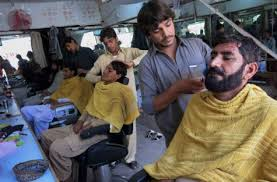
Azam Khan was one of the top barbers in Miramshah until he, like nearly half a million others, fled the long-awaited offensive unleashed by the military on the tribal area in June.
He told AFP his business boomed in the month leading up to the army assault as the militants sought to shed their distinctive long-haired, bearded look.
“I have trimmed the hair and beards of more than 700 local and Uzbek militants ahead of the security forces’ operation,” he said while cutting hair in a shop in Bannu, the town where most civilians fled.
For years he cut Taliban commanders’ hair to match the flowing locks of former Tehreek-i-Taliban Pakistan (TTP) leader Hakimullah Mehsud, killed by a US drone last November, but in May a change in style was called for.
“The same leaders came asking for trimming their beards and hair very short, saying that they were going to the Gulf and wanted to avoid problems at Pakistani airports,” Khan said.
Even Uzbeks and Tajiks with little knowledge of the local language came to him, he said.
“Knowing little Pashto, they used to utter four words: ‘mulgari (friend), machine, zero, Islamabad’,” said Khan — asking him to shave their beards to nothing so they could go to Islamabad.
French perfume
The military launched the offensive against militants in North Waziristan tribal area on June 15, vowing to wipe out the strongholds they have used to wreak countless deadly terror attacks across the country.
The rugged, mountainous area on the Afghan border has been a hideout for years for Islamist militants of all stripes – including Al Qaeda and the homegrown TTP as well as foreign fighters including Uzbeks and Uighurs.
For years people from North Waziristan remained tight-lipped about life in a Taliban fiefdom, scared of being kidnapped or even beheaded if they shared information about the militants.
But as the exodus of people has grown, some have found the confidence to tell their stories.
While the militants bombed and maimed thousands in their fight to install an austere sharia regime in Pakistan and publicly professed contempt for the West, in North Waziristan they indulged themselves with fancy imported goods.
Hikmatullah Khan, a shopkeeper in Miramshah, said that at the same time as commanders were insisting he pay 300 rupees a month “tax”, their fighters were stocking up on grooming products.
“They were very keen to buy foreign-branded shampoos, soaps and perfumed sprays,” Khan told AFP.
“They had a lot of eagerness for French and Turkish perfumes, body sprays and soaps. “Muhammad Zarif, a wholesale merchant in Datta Khel, near Miramshah, said fighters would buy large quantities of British detergent and American cooking oil, much of it smuggled from Dubai.
Militants gone?
Pakistan’s allies, particularly the United States, have long called for an operation to flush out groups like the Haqqani network, which use the area to target Nato troops in neighbouring Afghanistan and are thought to have links to Pakistani intelligence services.
The military has said it will target militants “of all hue and colour” but the scant resistance troops have encountered has led many to believe the insurgents fled before the offensive, limiting its effectiveness.
The army says the operation has killed nearly 400 militants and will rid North Waziristan of their bases, denying them the space to plan attacks and allowing investment to come to one of the country’s poorest areas.
But it remains to be seen what the long-term impact of the offensive will be. Local intelligence and militant sources told AFP that up to 80 per cent of fighters fled after rumours of an army assault emerged in early May, most over the porous border into Afghanistan.
These sources estimate the present number of militants as around 2,000, down from around 10,000 before the operation. The figures are uncertain and difficult to confirm.
The army has asked Afghanistan to crack down on TTP refuges across the border and this week top brass from both sides met in Islamabad to discuss the issue.
“It is clear that militants were aware that the offensive was coming before it started. Lots of them fled,” a Western diplomat told AFP.
“The big question is: after the offensive, will Pakistan allow the Haqqanis and others to come back?
Khwendo Kor & Omar Asghar Khan Foundation North Waziristan IDPs – A Humanitarian Response 1. Introduction
On 16th June 2014 a military operation, Zarb-e-Azb, commenced in the North Waziristan
Agency (NWA) of the Federally Administered Tribal Areas (FATA). The exodus of local
people accelerated, with an estimated 450,000 people fleeing their homes by end-June
2014. The numbers continue to rise. Men, women and children covered long distances
on foot to reach safety, carrying only bare essentials. Among the Internally Displaced
Persons (IDPs), the greatest number has taken refuge in the adjoining town of Bannu in
Khyber Pakhtunkhwa (KP). Rejecting the camps set up by the government on the
grounds that they violate their strict segregation codes, the NWA IDPs have gathered in
whatever serves as temporary shelter: private hujras (part of residence reserved for
guests), public schools, factory stores, and even cattle enclosures.
Government response to this humanitarian crisis is slow, inadequate and ineffective.
After the camps were forsaken by the IDPs, the government set up distribution points
from where they provide cash grants, food and essential non-food items with the help of
the UN and other agencies. But the disbursement mechanism is extremely tedious
resulting in long queues in which old and young men stand for hours under the blazing
sun. Many have to make several trips before they receive any relief. The situation is
worse for women who do not have any male family members. Though separate
arrangements are made for them, they find the paperwork even more difficult.
The government’s key problem appears to be: too many cooks. The federal government
has authorized the military operation, which is being carried out in FATA by the armed
forces, resulting in displacement of people, a large number of whom are taking refuge in
the adjoining settled areas of Khyber Pakhtunkhwa. The federal government, the
military, the FATA administration and the provincial government of KP are all involved.
Limited coordination and shifting blame is common.
The unfolding humanitarian crisis requires prompt action and input from as many
individuals and organizations as possible. To contribute to these efforts, Khwendo Kor
(pushto meaning Women’s Home) and Omar Asghar Khan Foundation initiated: NWA
IDPs – a humanitarian response. They are working collaboratively to reach displaced
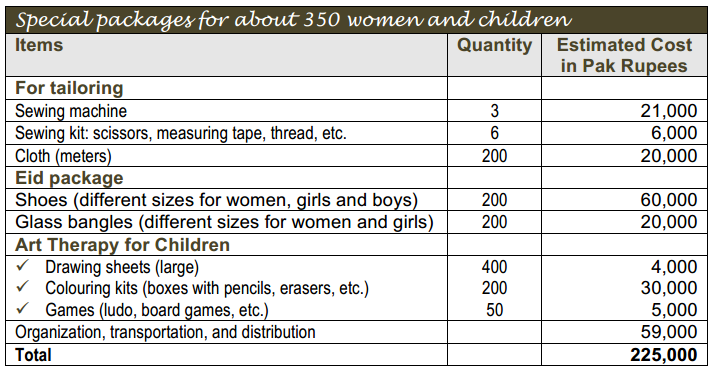
families taking refuge outside camps. They will provide food and non-food items, with
special emphasis on the needs of women. Tailored packages for children will also be
provided, helping them deal with the trauma of displacement and conflict.
In the following sections more details are provided. An outline on NWA is provided to
give a context. This is followed by information on: (a) the implementation capacity of KK
and the Foundation, (b) the specific relief packages they have drawn up and their costs,
and, (c) details on how an individual or an organization may send their contributions.
2. Context: North Waziristan
North Waziristan is one of the seven agencies that constitute FATA. The Governor of KP
is FATA’s chief executive, which has a distinct governance structure and an
administration that is independent from the provincial government of KP.
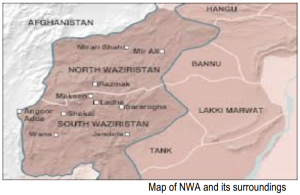
Spread across 4,707 km of rugged and mostly mountainous terrain, NWA borders Afghanistan on the west, South Waziristan on the south, and KP’s districts of Hangu and Bannu on the north and northeast. Government data showing an estimated population of about 400,000 appears unreliable as it is based on the out-of-date 1998 census, which was resisted by local people. Tribal customs reign, with the Wazirs being the dominant clan, and the reason the area is called Waziristan (land of the Wazirs).
NWA like the rest of FATA is poor. Livelihood opportunities are limited to agriculture, offfarm labour and mining. Blood feuds are common, with many lasting for many years,
with multiple generations caught in the conflict. Conditions over the past many years
have worsened. The presence of local and foreign militants has taken its toll, and further
eroded the writ of the state. Public services like education, health, clean drinking water,
or sanitation are poor or non-existent. Failing state control on governance and local
resistance to immunization led to FATA becoming the source of the greatest numbers of
polio cases in the country and the world.
Displacement has further impoverished the already poor, who have endured long
periods of local and foreign militant presence. Their interaction with the state was never
frequent, and became even less common after militants held sway in the area. They are
accustomed to FATA’s distinctive system of governance, but are largely unaware of the
working of provincial or federal governments.
3. Implementation Capacity: about us
KK and the Foundation are non-governmental organizations with demonstrated
experience of responding to disasters. They provided relief and rehabilitation assistance
to hundreds of thousands affected by the 2005 earthquake, the 2009 military action in
Malakand (including Swat) and the 2010 floods. Food and non-food items were
distributed, shelter in the form of tents and later using corrugated sheets were provided.
They initiated programmes for women and children – arranging medical camps, setting
up playgrounds and helping children deal with the trauma of conflict and displacement
with art and games.
3.1 Khwendo Kor
www.khwendokor.org.pk
KK was formed in 1993 and is registered under the Societies Act 1860 (#2614/5/2280).
Its head office is in Peshawar and it has seven regional offices in different districts of KP,
including one in Bannu that is functional since the past 11 years. KK also has a liaison
office in Islamabad. KK strives to empower women, with interventions in education,
health, economic opportunities and civil rights. Their programmes are implemented
across KP and also extend into FATA. They combine policy advocacy and service
delivery, which is effectively integrated in their efforts to build viable villages. Relief and
rehabilitation is considered a social responsibility, and included in all programmes. KK is
also registered as a charity organization in the United Kingdom under the name of UK
Friends of Khwendo Kor (UK-FROK) www.frok.org.uk.
3.2 Omar Asghar Khan Foundation
www.oakdf.org.pk
Established in 1999, the Foundation was registered in April 2000 under the Societies Act
1860 (#768/5/2873). The Foundation’s programme extends across Pakistan, with a
concentrated field presence in Khyber Pakhtunkhwa. It strives for a democratic and
peaceful society based on the values of equity, tolerance and justice in which all people
are assured a life of quality. It works with citizens, particularly the poor and the
vulnerable, to achieve human and livelihood security. The Foundation organizes citizens,
assists them in engaging with the state on policy and institutional reform, and supports
their livelihood strategies through skill-building, credit provision, and community
infrastructure development. The Foundation has a staff of 35 and offices in Islamabad
and Abbottabad.
4. NWA IDPs – A Humanitarian Response
In response to the unfolding human tragedy as hundreds of thousands of people flee the
conflict areas of the NWA, KK and the Foundation decided to work together and initiated
its: NWA IDPs – A Humanitarian Response.
4.1 Who will it reach?
The camps set up by the government are largely rejected by the IDPs, as the forced
close proximity is insensitive to their strict segregation codes. Most of the displaced
families have taken refuge in public schools and other shelters. The KK-Foundation
initiative will reach these off-camp IDPs. Initial assessments are being carried out to
identify schools and other shelters, and the number of displaced, in the town of Bannu,
which will be the programme’s immediate focus. Depending on emerging conditions and
resources, relief will be extended to other towns as well.
4.2 What support will it provide?
In each shelter the Foundation will provide food and other non-food essential items like
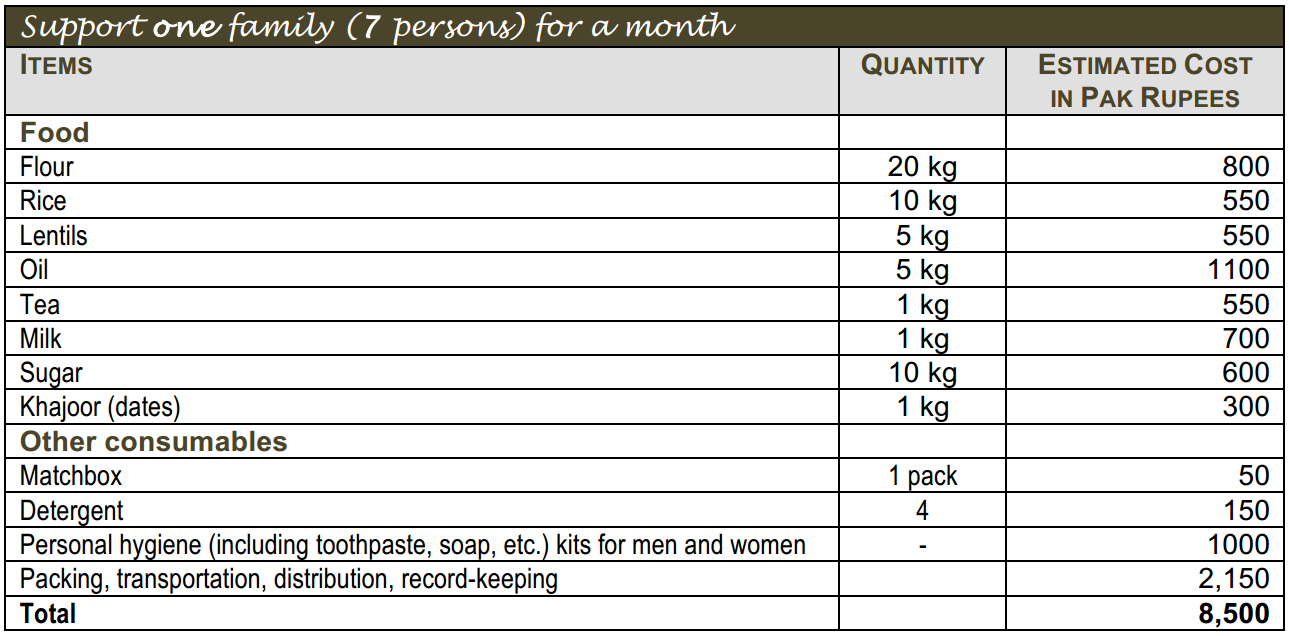
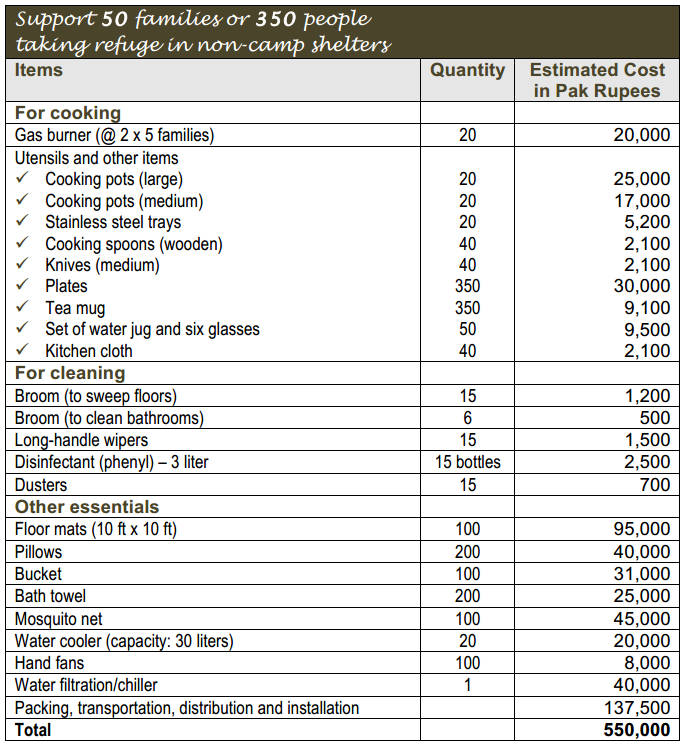
floor mats, hand fans, soaps, etc. The following are details of relief items per family
(average family size is 7) and per shelter (estimated 50 families per school):
5. How can you help?
You can donate cash, or give in-kind support, or volunteer your time. Cash contributions
can be made to: Account Title: Omar Asghar Khan Development Foundation Current Account #: 0102801010019288 Bank: MCB Bank (1028), Super Market, Islamabad-Pakistan SWIFT Code: MUCBPKKA IBAN#: PK11MUCB0102801010019288 All contributions are tax exempt Tax exemption #6043/RTO/ATD/2008-09 dated 12 May.2009
Islamabad, June 30: Pakistan launched a ground offensive against militant strongholds near the Afghan border on Monday after evacuating nearly half a million people from the region, the army said, in the most significant escalation of a two-week long operation to root out insurgents.
The ground offensive is the second phase of a long-awaited operation against militants in the North Waziristan tribal area, a lawless, mountainous stretch of land in northwest Pakistan. The military announced the operation mid-June but has mainly limited its tactics to airstrikes while giving hundreds of thousands of people time to pack up their belongings and leave for safer areas.
The US has long pushed for such an operation to go after militants that use the area as a safe haven from which to attack targets in Pakistan and Afghanistan.
But for years Pakistan has said its forces were too strung out battling militants in other areas of the northwest to go into North Waziristan. The military is also believed to have been reluctant to launch the operation without political support from the civilian government. Until recently the prime minister, Mian Nawaz Sharif, has been pushing for negotiations over military force as a way to end the years of bloodshed caused by militants.
The army began a house-to-house search in Miran Shah, the main town in North Waziristan, the army statement said. It said up to 15 militants were killed in the initial ground advance. The town is also the headquarters for a number of different militant groups such as the Pakistani Taliban. Al-Qaida and the Afghan Taliban also have a presence in North Waziristan.
The operation began days after militants attacked the main airport in the southern port city of Karachi, killing 26 people. Ten attackers died in the five-hour siege that shocked Pakistanis by showing how vulnerable the country’s institutions have become.
The siege of the country’s busiest airport became a turning point in the government’s willingness to negotiate with the militants. A week after the attack, the military announced its troops were starting the North Waziristan operation.
Pakistani forces killed 376 militants during the first 15 days of the offensive, the statement said, adding that 17 soldiers also died. North Waziristan has always been a challenging area for journalists to access but the operation has made it even more difficult to independently verify reports of casualties.
The military said infantry and commandos are leading the ground advance. Three soldiers were wounded in an exchange of fire, the statement said.
Mansur Mahsud, from the Fata research centre, which researches the tribal areas in northwest Pakistan, said they had been receiving reports that many militants had left for neighbouring Afghanistan or the more remote mountainous areas in the northwest after the airstrikes. But he said a ground offensive was still necessary to clear the area.
In the past, critics have accused Pakistan of playing a double game, supporting or tolerating some militants that it sees as useful in maintaining influence in neighbouring Afghanistan, and going after other militants that attack the Pakistani state. The military has said that this operation will pursue everyone equally, but many question how aggressive they will be.
The operation could take three to four months, and it isn’t likely to end militancy across the country immediately, said Mahsud. Militant groups still have a presence in places such as Karachi or Punjab province or other parts of the northwest.
But over time, Mahsud said it will significantly weaken the militants by denying them a place to headquarter their organisations and to train new recruits.
“It cannot end militancy 100% in Pakistan but it can have a significant effect,” he said. “Once this area is cleared the militants are forced to shift to Afghanistan or the mountains.”
About 468,000 people have poured out of North Waziristan, flooding the nearby Pakistani areas of Bannu and Dera Ismail Khan in anticipation of the ground offensive. An additional 95,000 went to Afghanistan, the UN reported.
The Pakistani army has already conducted several military operations in the tribal badlands along the Afghan border, including 2009 offensives in the scenic Swat valley and in South Waziristan, the one-time headquarters of the Pakistani Taliban.
The Pakistani Taliban is a loose network of several local militant groups who want to overthrow the country’s government in a bid to install their own harsh brand of Islamic law. In their decade-old deadly campaign of bombings, shootings and other attacks, they have killed thousands of Pakistanis.
Nawaz Sharif’s government has been trying to negotiate a peace deal with the militants since he took office last summer. The operation has effectively ended prospects of any such move in the near future
FAIRY MEADOWS, Pakistan June 29 — For more than five decades, locals have called it “Killer Mountain,” a reminder of the risks of trying to scale beautiful, snow-topped Nanga Parbat.
More than 100 climbers and porters have died on the steep, rocky ascent up the world’s ninth-highest mountain — a fact Pakistan once touted in a bid to lure thrill-seekers.
Now, however, local residents are frantically trying to scrub the word “killer” from a mountain that has become a symbol of the threat posed by the Pakistani Taliban.
One year ago this month, about a dozen heavily armed Pakistani Taliban militants executed 10 foreign mountain climbers, including a U.S. citizen, at the base of the mountain. It was one of the worst acts of violence to strike the international climbing community.
Terrorism is hardly unusual in Pakistan; at least 3,000 people died last year alone in the country in violence attributed to Islamist extremists. But the attack at Nanga Parbat was a major blow, horrifying citizens who view the majestic northern mountains as a source of national pride.
“As a Pakistani, I look at it as our Sept. 11,” said Nazir Sabir, who in 2000 became the first Pakistani to climb Mount Everest in Nepal. He now operates an Islamabad-based tour company. “We never, never, ever thought that this could happen.”
The attack also crushed the remnants of Pakistan’s international tourism industry, creating new hardship in a part of the country known for its tolerance and hospitality. The loss of foreign climbers was so distressing that Prime Minister Nawaz Sharif cited it as one reason he ordered a military offensive against the Pakistani Taliban in North Waziristan this month.
Pakistan is home to five of the world’s 14 highest peaks, including K2, the second-highest mountain in the world. Nanga Parbat, at 26,660 feet, is Pakistan’s second-highest mountain.
After the attack, the number of foreign mountain climbers collapsed.
“It may take years and years before they will consider going back to a place like Pakistan,” said Steve Swenson, past president of the American Alpine Club, who has been on 11 climbing expeditions in Pakistan over the past three decades. “I talked to a lot of people, even fairly knowledgeable people, about going there again, and their immediate response is: Is it safe? And then a not-unusual response is: Are you crazy?”
‘This is the day we take revenge’
According to local officials and residents, the Pakistani Taliban attackers hiked through the wilderness for three days to reach the base camp on the western side of the mountain, known as the Diamir Face, late on June 22, 2013.
“Taliban! Al-Qaeda! Surrender!” the militants shouted as they marched into the camp, where the climbers and about three dozen porters slept.
officials say security measures have been increased. (Max Becherer/Polaris Images For The Washington Post)
The assailants went looking for foreigners, slashing more than 40 tents with knives. They yanked people from their tents — one Lithuanian, three Ukrainians, two Slovakians, two Chinese, one American and one Nepali — tied their hands behind their backs and made them kneel in a row in the moonlight.
“Then, suddenly, we a heard a shot,” said one 31-year-old Pakistani climber, who was tied up by the militants nearby. He spoke on the condition of anonymity because he continues to fear for his safety.
“Then we heard hundreds of ‘brrr, brrr, brrr’ sounds,” like an automatic weapon might make, he said. “Then a leader of the group came and shot all the dead bodies one by one again.”
One militant then shouted, “This is the day we take revenge for Osama bin Laden,” the man recounted — an apparent reference to the United States’ killing of the al-Qaeda leader in Pakistan two years earlier.
Only one foreign climber — a Chinese man who hid in a steep trench clutching a pickax — survived. The attackers also killed a Pakistani cook, apparently because he was Shiite.
Pakistani police later arrested six people who reportedly confessed to the crime.
Before the Sept. 11, 2001, terrorist attacks, hundreds of thousands of tourists traveled each year to Pakistan’s Gilgit-Baltistan district, where the Himalayan, Karakoram and Hindu Kush mountain ranges meet.
There were 20,000 tourists in northern Pakistan on the day of the attacks on New York and the Pentagon alone, but afterward the country was lucky to attract half that number in an entire year, said Tayyab Nisar Mir, a manager at the Pakistan Tourism Development Corp.
Those who did come were almost exclusively mountain climbers and long-distance backpackers determined to explore some of the world’s most picturesque scenery.
Although there were about 150 climbing expeditions a year in the country in the 1980s and 1990s, and about 75 annually after 9/11, only about 30 are likely to occur this year, officials said. And no climbers are expected this summer at Nanga Parbat. (At least two climbers made an unsuccessful attempt this past winter; no one has made it to the peak of Nanga Parbat or K2 in the winter).
The number of backpackers has declined even more dramatically, Mir said.
“Nanga Parbat was the last nail in the coffin of tourism in Pakistan,” he said, adding that the loss of tourism is costing the country $100 million annually.
Officials in Gilgit-Baltistan stress that the massacre was an isolated tragedy. They have been going to great lengths to reassure visitors that the region is safe.
On a pull-off spot overlooking Nanga Parbat on the Karakoram Highway, a sign once read, “Look to your Left: Killer Mountain.”
But Qaria Amin, 33, who operates a gem store at the spot, said that a month after the massacre, a police officer made him paint over the word “killer.” The sign now reads, “Look to your Left: Mountain.”
Local government officials had part of the mountain’s nickname, ”Killer Mountain,” painted over on a sign. (Max Becherer/Polaris Images for The Washington Post)
Kareem’s climbing equipment shop saw a constant stream of customers before. Now, merchandise collects dust. (Max Becherer/Polaris Images for The Washington Post)
Amin says he is lucky if he makes a $100 a week now, compared with the $100 a day he used to bring in selling rubies, topazes and emeralds collected from the nearby hills.
At Fairy Meadows, a village that overlooks the northwest face of Nanga Parbat and the Raikot glacier, the tourism industry has “collapsed, causing hopelessness,” said Raji Rehmal, a resident.
The village of about 50 extended families is so remote that there are few other economic opportunities. To get there, visitors travel an hour by jeep up what locals call “the world’s most dangerous road,” a lane so narrow that vehicles’ tires are inches from the ledge. The road ends at an elevation of about 8,200 feet, and visitors then must hike to the village, elevation 11,154 feet.
Rehmal, who estimates that he is 50 years old, says he has walked at least 13,000 miles working as a guide or porter for foreigners. His work helped pay for the construction of a school for the village. A foreign climber came up with the name Fairy Meadows in the 1950s because the grassy plateau reminded him of a fairy tale, according to tour operators.
“In the good days, there were doctors who used to bring medicine, and Westerners who used to linger longer just to teach the local kids,” Rehmal said. “We would never, ever think of harming any tourist, any foreigner.”
Pakistani hikers in the area also said they miss the foreign visitors.
“We have so little to be proud of, so if there is something as impressive as this, and foreigners come praise it, it’s a psychological lift,” said Nashreem Ghori, a 41-year-old Karachi native who was hiking near Fairy Meadows.
There has also been a steep decline in the tourism business in the Hunza Valley, an oasis of cherry and apricot trees wedged between imposing snow-
covered mountains. The area is one of several Himalayan locations that have been mentioned as the possible inspiration for the mythical Shangri-La in James Hilton’s 1933 novel, “Lost Horizon.”
“Here, we have nice weather, nice mountains, nice people, but tourists are not coming, ” said Mohammad Karim, 34, a guide who also runs a camping store in Karimabad, a town in the valley.
Ghulam Nabi, owner of a campground at Fairy Meadows, said he fears that residents may resort to mining or logging to try to earn a living if the tourists stay away.
“The people of Gilgit-Baltistan have learned a lot from Western people,” Nabi said. “We were taught how to protect the environment, and how to balance tourism and nature.”
Authorities now assign an armed police officer to any foreigner who wants to go hiking near Nanga Parbat. Pakistanis are hopeful that such measures, and the stunning scenery, will eventually draw back tourists.
“Those mountains are not going anywhere,” said Iqbal Walji, a Pakistani tour operator. “Sooner or later the people will come back, because it’s one of the most beautiful places on earth.”
Pakistan’s military began a full-scale operation in the Taliban stronghold of North Waziristan, prompting insurgents to warn foreign investors, airlines and multinational companies to leave the country.
“We’re in a state of war,” Shahidullah Shahid, a spokesman for the Tehrik-e-Taliban Pakistan, or TTP, said in a statement yesterday. “Foreign investors, airlines, and multinational companies should cut off business with Pakistan immediately and leave the country or else they will be responsible for their damage themselves.”
The army said June 15 it would target local and foreign terrorists in North Waziristan, a tribal region near the Afghan border the U.S. has called the “epicenter” of terrorism. The operation, long sought by the U.S., comes a week after militants attacked the country’s biggest international airport.
As Islamic militants capture cities in Iraq and the U.S. draws up plans to withdraw from Afghanistan, public opinion in Pakistan is shifting in favor of stronger action against fighters who were previously seen locally as more of a threat to America’s interests. The Taliban wants to impose its version of Islamic Shariah law in Pakistan, which includes a ban on music and stricter rules for women.
Pakistan’s Future
“At stake is the future of Pakistan,” Mahmud Ali Durrani, a former national security chief and ex-ambassador to the U.S., said by phone. “Do we want a Talibanized Pakistan or do we want to live according to the constitution, democracy? If we want to live according to our constitution and democracy then we have to fight for it, because they are the kind of people who don’t believe in these things.”
Prime Minister Nawaz Sharif’s party won an election last year after pledging peace talks with the TTP, the group at the forefront of an insurgency that has killed 50,000 people since 2001. Negotiations that began in March collapsed over the TTP’s demands for prisoner releases even before progressing on issues such as Shariah law.
Meet al-Qaeda’s Heirs Fighting to Reshape the Arab World
“I am confident this operation will be a harbinger of peace and stability,” Sharif said in a speech in Parliament yesterday. “The decision on a decisive operation was taken with full consensus.”
After Taliban and Uzbek militants attacked Karachi’s international airport, killing 28 security officials and workers, U.S. drone strikes resumed in North Waziristan following a six-month pause.
Terrorist Hideouts
Pakistani jets yesterday destroyed six hideouts and killed 27 militants in the area, taking the toll to 167 in two days of air strikes, the military said in a statement. Another 10 insurgents were shot dead in a separate battle, it said. Six soldiers were killed and three were injured when an explosion hit the area, the military said.
Troops have cordoned off all militant strongholds, including the two main towns of Mir Ali and Miranshah, and have been deployed along the border with Afghanistan to prevent combatants from fleeing the country, the military said. Pakistan has also sought help of the Afghan security forces to seal the border, according to the statement.
North Waziristan residents such as Nur Rehman have fled over the past month in anticipation of a military offensive. The threat made life unbearable, and about a quarter of people in his village of Tappi have already left, he said on June 12 from the outskirts of Islamabad, Pakistan’s capital, where he was staying with his wife and three children.
“In the sky you have drones and on the ground there’s no safety,” Rehman said. “You don’t know when you’ll become a target.”
Air Strike
More than 61,000 people have fled North Waziristan through the town of Bannu since a military air strike that killed more than 60 militants on May 21, according to the local government in Bannu. Another 6,500 people from the area, including 1,500 children, fled to Afghanistan, Mobarez Mohammad Zadran, a spokesman for the border province of Khost, said by phone.
North Waziristan is an area roughly the size of Connecticut that sits near the Afghan border in a semi-autonomous tribal region. Michael Mullen, the U.S.’s former top military official, in 2010 called it the “epicenter of terrorism” and “where al-Qaeda lives.”
No mobile phone coverage is available, and residents make a living through farming or trading goods with Afghanistan. About half of the world’s polio cases this year have been reported in North Waziristan as militants target vaccination drives, part of the fallout from the U.S. spying operation that led to Osama bin Laden’s death in 2011.
Own Laws
The roughly 700,000 people living in North Waziristan are exempted from paying taxes and are governed by their own set of criminal laws. While traditions entrust village elders to solve disputes, feuds are often settled with guns.
After the U.S. invaded Afghanistan in 2001, North Waziristan became a safe haven for foreign militants like Uzbeks and Turks who fought alongside the fallen Taliban regime. Local tribes welcomed them in line with a culture of hospitality, according to Khalid Aziz, chairman of the Regional Institute of Policy Research and Training in Peshawar.
In 2007, militant groups in the area united to form the TTP, which went on an offensive toward Islamabad. After Pakistan’s army flushed them out of the Swat valley and most tribal regions, it resisted U.S. pressure to follow through with a push into North Waziristan, which was also home to the Haqqani network and Gul Bahadur, who were fighting American troops in Afghanistan.
Unable to convince Pakistan to take action, the Obama administration intensified its campaign of drone attacks that President George W. Bush started in 2004. More than 3,200 people died in drone strikes from June 2004 to December 2013, according to California-based Pitch Interactive, Inc., which cited data from The Bureau of Investigative Journalism.
About 70 percent of all drone strikes have been in the North Waziristan region, according to Washington-based The New America Foundation. Only 58 known militant leaders have been killed in drone strikes in Pakistan, representing 2 percent of the total deaths, it said.
The Dubai-based airline said flights have been suspended from June 25 until further notice due to the security situation at the Peshawar airport.
“Passengers booked to travel between June 25 and 27 can cancel their booking, rebook to travel at a later date, or fly to another Emirates destination in Pakistan,” the airline said in a brief statement on its website.
Emirates operate five weekly flights to Peshawar. Moreover, it has a schedule of 66 weekly flights to Pakistan. It could not be immediately confirmed when flights will resume.
Etihad Airways also suspended one of its Abu Dhabi to Peshawar flight on Wednesday citing security concerns. “The airline’s next flight to Peshawar, scheduled to depart from Abu Dhabi on Thursday night, June 26, is still under review.”
Senior CAA, security and administration officials were busy in a meeting late into the evening to discuss what measures could be taken to beef up monitoring around the airport.
A similar suspension followed a militant attack on the Peshawar airport in 2012 when besides Emirates, all Middle East carriers, including Qatar and Etihad Airways, had stopped their flights.
Pakistan’s Civil Aviation Authority (CAA) has allowed Emirates to operate additional flights to Islamabad to facilitate its passengers, a senior official of the aviation regulator told The Express Tribune.
“The last time these airlines stopped coming to Peshawar, the operations remained suspended for one month. We are not sure how long this latest episode will continue,” he said.
The CAA has come under immense pressure since the ferocious attempt by armed militants to take over Karachi airport ended in the death of over two dozen people and pushed a leading airline to roll back operations to Pakistan.
Hong Kong-based Cathay Pacific has already announced that its flight taking off from Karachi on June 29 would be the last, more than 13 years after it started flying to Pakistan.
Leading airlines, including British Airways, Singapore Airlines, Lufthansa and Malaysian Airlines, have scaled back their operations since 2012 in part due to concerns related to the security of their employees.
British Airways suspended operation following a deadly attack on Islamabad’s Marriott Hotel in 2008.
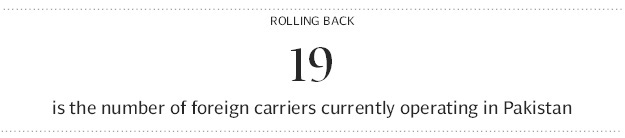
Currently, only 19 foreign carriers come to Pakistan.
The gun attack on PIA aircraft so near the runway is of particular concern especially when congested residential colonies have sprouted up around Peshawar, Karachi and Lahore airports.
“This was not the first time bullets were fired upon on a landing plane at the Peshawar airport,” said CAA officials. “Pilots have reported similar incidents before.”
Regarding the latest attack, Pakistan International Airlines (PIA) Managing Director Junaid Yunus praised senior pilot Captain Tariq Chaudhry who was commanding the Riyadh-Peshawar flight for ensuring a safe landing.
“It is very important for us to realise the fact that our pilot didn’t lose his nerves,” he said. “Things could have gone horribly wrong if the firing incident had confused him.”
Published in The Express Tribune, June 26th, 2014.