Why Pakistan Is a Bigger Threat to Israel than Iran

While the United States and Israel incessantly obsess with the possibility of a future nuclear Iran, they barely ever raise such concerns about Iran’s next door Islamic neighbour Pakistan that brandishes its nuclear weapons with Islamic zeal and barely concealed contempt for the “kufaar” — Jews, Christians, Hindus, atheists and other non-Muslims.

But there are others inside Pakistan who do not share America and Israel’s myopia. The country’s leading anti-nuclear activist, physicist Pervez Hoodbhoy in his book Confronting the Bomb, has this to say about Pakistan’s nukes:

“The fear of loose [nuclear] weapons comes from the fact that Pakistan’s armed forces harbour a hidden enemy within their ranks. Those wearing the cloak of religion freely walk in and out of top security nuclear installations every day … The fear of the insider is ubiquitous and well-founded.”

Prof. Hoodbhoy is able to see through the complexity of his country’s nuclear arsenal that both the White House and Jerusalem either choose to overlook or are grossly ignorant about. Hoodbhoy maintains that there are two Pakistani armies. One led by General Pervez Ashraf Kayani and the other by Allah. “It is difficult to find another example where the defence apparatus of a modern state has been rendered so vulnerable by the threat posed by military insiders.” Even non-fundamentalist elements are “soft Islamists,” he says. Hoodbhoy describes the Pakistani army as “a heavily Islamicised rank-and-file brimming with seditious thoughts.”

As a friend of the Jewish people as well as the Arabs, the thought of a nuclear devise exploding over Israel gives me the jitters. The fact is, millions of Arabs too will be eviscerated in a nuclear attack on the Jewish State.

In meeting with leading Jewish intellectuals and academia in North America and some in Israel itself, I am struck by the lack of knowledge they have about Pakistan, let alone its nuclear program. Few write about the internal dynamics of Pakistan that has emerged as the world’s number one source of jihadi suicide bombers and ground zero for the training of Islamic terrorists.

Pakistan is not an easy subject. It is a multi-ethnic country with a multi-lingual population dominated by Punjab; a civil war in Balochistan; a disputed border with Afghanistan; hundreds of thousands of troops on war footing at the Kashmir Line of Control against India; a slow slaughter of the country’s Shia population and China’s strategic interests at the mouth of the Straits of Hormuz.

All of this makes the study of Pakistan a daunting task for any outsider. Even Britain and the USA who helped create the country to install a buffer state between the advancing USSR and India after the Second World War, have not been able to read the tea leaves with any degree of accuracy.

As I write this essay, Pakistan produces more nuclear bombs than any other nuclear power while developing longer-range missiles. On paper, these nuclear warheads and missiles are India-centric and pointed towards the east. However, Pakistan’s nuclear arsenal is not at a static location and the warheads as well as missiles are constantly on the move, and if there is one country that the Pakistan’s politicians, both on the right as well as the left, hate more than India, it is Israel.

Are Israelis aware of the vulnerabilities in Pakistan’s nuclear program that make it possible for non-state jihadi actors to strike at the Jewish State? I doubt it.

Pakistan is a society based on the hatred of the “other.” Since its creation, the Hindu and the Jew, (“Hanood wa Yahood” in the popular street lexicon of the Urdu language) has been cultivated as the enemy of the country and Islam.

In a culture of violence, three million fellow Muslims were killed in genocide in 1971 in Bangladesh. With the liquidation of the Hindu population and the total absence of Jews, the addiction to killing the “other” is now consuming the Pakistanis from within.

Just in the three years leading up to the 2011 capture and death of Osama Bin Laden in Abbotabad, Pakistan, there were 225 suicide bombings in the country killing over 3,900 people, and all of them in politically motivated attacks by Sunni Muslim jihadis. All the victims — from Ahmadi Muslims to Shia Muslims — are accused of serving the Zionist cause and thus eliminated.

Shia vs. Sunni

The irony is that while Israel considers Shia Iran as its primary enemy and nurtures a cold peace with Jordan and Egypt, the Shias of Iran are often branded as a secret Jewish sect by Sunni Muslim clerics in both Egypt and Jordan. Jews around the world seem to oblivious to this fact as they read about the slaughter of Shias in Pakistan and the open hostility towards them from places as far apart as Indonesia to Indiana (home to America’s Islamist organisation ISNA ).

If one were to study the sources of Jew-hatred, they are invariably rooted in Pakistan and the Arab World. If it comes to terrorist attacks carried out around the globe, almost all of them have either originated in Pakistan, were carried out by young men of Pakistani ancestry or by jihadi terrorists who were trained on Pakistani soil. Else, they were planned and executed by Islamabad’s intelligence agency, the ISI and its sponsored terrorist organizations. Yet, in the eyes of Israel and the Jewish Diaspora, it is Iran that is the anti-Semitic capital of the world, hell-bent on destroying the Jewish State.

Let me catalogue the role Pakistan has played in international terrorism, long before its territory was used by Osama Bin Laden and Khaled Sheikh Mohammed to plan and execute the 9/11 attack on the United States.

International Terrorism linked to Pakistan

  1. September 1986: Armed men attempt to hijack a Pan Am jet on the tarmac of Karachi airport in which 20 people died. Among the arrested were five Palestinians belonging to the Abu Nidal group and seven Pakistanis.
  2. January 1993: The CIA headquarters in Langley, Virginia is attacked, killing two CIA employees and wounding three others. The perpetrator is a Pakistani, Ajmal Kansi. Four years later in 1997 he is captured by FBI agents in rendered back to the United States to stand trial and was executed by lethal injection in 2002.
  3. February 1993: The World Trade Centre is attacked using a truck bomb. The mastermind of the attack, Ramzi Yousef is later arrested in 1995 in Islamabad, Pakistan.
  4. August 1998: American embassies in Kenya and Tanzania are bombed, killing 223 people and wounding over 4,000 others. One of the planners of this terror attack,Ahmed Khalfan Ghailani is arrested in 2004 in Gujrat, Pakistan.
  5. October 2000: Jihadi terrorists carry out a suicide attack on the United States Navy guided-missile destroyer USS Cole while it is harboured and being refuelled in the Yemen port of Aden. Seventeen American sailors are killed, and 39 injured. The Saudi mastermind behind this attack, Walid Bin Attash is later captured on April 29, 2003 in Karachi, Pakistan.
  6. May 2002: A suicide bomber kills 11 French naval engineers outside The Sheraton Hotel in Karachi, Pakistan. Three years later the bomb maker, Mufti Muhammad Sabir is arrested 2005 in Karachi, Pakistan.
  7. October 2002: Jihadi terrorists attack the Indonesian tourist resort of Bali killing 202 people and injuring another 240. Nine years later, the chief suspect in the bombing, Umar Patek of the militant group Jemaah Islamiah is arrested in 2011 in Abbotabad, Pakistan.
  8. July 2005: Jihadi terrorists carry out the now infamous 7/7 suicide bombings in London, UK, killing 52 people and injuring 700 others. Three of the four suicide bombers are of Pakistani ancestry. In January 2009, one of the planners of the London 7/7 bombings, Saudi national Zabi uk-Taifi is arrested in a village just outside Peshawar, Pakistan.
  9. December 2008: Pakistani jihadi terrorists carry out a sea-borne suicide attack on Mumbai, India, killing 166 people including a rabbi and his pregnant wife at a Jewish Centre, and injuring 308 others. The mastermind of the Mumbai attack was the Pakistani-American David Coleman Headley (born Daud Sayed Gilani). His alleged Pakistani-Canadian accomplice, Muhammad Tahwwar Rana, was acquitted in the Mumbai attacks but convicted of working for the terror group, Lashkar-e-Taiba (LeT), long suspected of being supported by Pakistan’s ISI.
  10. May 2010: A bombing at New York Times Square is foiled when street vendors discover smoke coming from a vehicle and alert an NYPD patrolman. The bomb had ignited, but failed to explode, and was disarmed before it caused any casualties. Two days later federal agents arrest a man at John F. Kennedy International Airport after he tries to board an Emirate Airlines flight to Dubai. He is Faisal Shahzad, a 30-year-old Pakistani-American.

In addition to the above list of international jihadi terror attacks associated with Pakistan, the country has been home to most of the Al-Qaeda leadership, including Osama Bin Laden. They include the following five:

  • Abu Zubaydah, a Saudi citizen currently held in U.S. custody, was arrested in March 2002 in Faisalabad, Pakistan.
  • Ramzi bin al-Shibh, a Yemeni citizen being held by the United States as an enemy combatant detainee at Guantanamo Bay in Cuba. He was captured in September 2002, in Karachi, Pakistan.
  • Khalid Sheikh Mohammed is currently in U.S. military custody in Guantánamo Bay for acts of terrorism, including mass murder of civilians, as he has been identified as “the principal architect of the 9/11 attacks”. He was captured in March 2003 in Rawalpindi, Pakistan.
  • Abu Faraj al-Libbi is the nom de guerre of a Libyan who is a senior member of al-Qaeda. [His real name is thought to be Mustafa al-‘Uzayti.] Al-Labibi was arrested in May 2005 in Mardan, Pakistan.
  • Mustafa Nasar, also known as Abu Musab al-Suri is a Syrian-born leader of al-Qaeda who holds Spanish citizenship. He is wanted in Spain for the 1985 El Descanso bombing that killed 18 people, and in connection with the 2004 Madrid train bombings. Nasar too ended up in Pakistan where he was captured in October 2005 in the Pakistani city of Quetta.

Not to mention the fact that the only time Britons have been involved in a suicide bombing attack inside Israel, it has involved men of Pakistan ancestry. In May 2003 a suicide bomber and his accomplice murdered three people and wounded scores at a Tel Aviv bar. The 21-year-old bomber, Asif Mohammed Hanif died in the attack while his accomplice as Omar Khan Sharif failed to detonate his bomb. Both were born to Pakistani parents in the U.K.

Hanif was not the first Pakistani-Briton to commit terror against Jews. In 2002, Omar Saeed Sheikh of London masterminded the kidnap and murder of Wall Street Journal journalist Daniel Pearl in Pakistan.

Compared to the acts of international terror that have a Pakistani link, terrorism that originates in Iran is few and far between.

The first international atrocity that can be traced back to Iran was committed in 1994 when the Asociacion Mutual Israelita Argentina (AMIA) Jewish Centre in Buenos Aires, Argentinewas bombed, killing 85 people and wounding 300 more. There is little doubt that senior Iranian officials were behind the attack and that their Lebanese-based Hezbollah allies carried out the attack.

The only other major act of Iranian international terror was in February 2012 when a bomb explosion targeted an Israeli diplomat in New Delhi, India.

Why Iran? Why not Pakistan?

Why then is Israel so obsessed with Iran, but not Pakistan? One of the reasons may be the presence in Israel of an influential Persian Jewish community with roots in Iran, and who have a particularly nasty experience with the regime of the Ayatollahs compared to the era when a close relationship between Israel and Iran existed during the reign of The Shah until 1979.

Iranian Jews in Israel are estimated to be 200,000 to 250,000 strong and have a far greater role in the country’s public policy making then their numbers suggest. From Dan Halutz , the former chief of Staff of the Israel Defence Forces (IDF) to the now disgraced former president of the country Moshe Katsav, Iranian Jews in Israel pull more than their weight in the affairs of the country.

Today the former Israeli Minister of Transport Shaul Mofaz, leads the Kadima Party while Michael Ben-Ari and Mordechai Zar are members of the Knesset.

Compared to Iranian Jews in Israel, Pakistani Jews do not exceed 2,000 in number, and their claim to fame is restricted to the introduction of cricket inside Israel. They mostly live in the city of Ramla and do not have any prominent figure in the Israeli political discourse. Few of these Pakistanis have any links or even memories of Pakistan and unlike their Iranian counterparts, lack any insight into the current political nature of their former homeland.

While Israel Radio runs a daily Farsi language service since the 1950s, it has no such broadcast in Punjabi, Urdu, Balochi, Puhstu, or Sindhi, the languages of Pakistan. It is no wonder that in Israel there is such a dearth of scholarship on Pakistan and that country’s involvement in international jihadi terrorism.

While the 180-million population of Pakistan and its diaspora is almost universally anti-Semitic and hostile to Israel, the ordinary Iranian is neither obsessed with Jew hatred nor seeped in convoluted theories of Jewish conspiracies that are ubiquitous among its next door Pakistani neighbours.

Israelis are justifiably worried with the rabid rhetoric that emanates from the Iranian ayatollahs. However, they need to recognise that it is Pakistan that has 100 nuclear warheads and missiles that can reach Israel, not Iran.

Obsessing with Iran while shrugging off the threats posed by Pakistan and its jihadi sponsor Saudi Arabia, may be a mistake that Jerusalem can still correct while it has a chance.

Already there are reports that Saudi Arabia’s former intelligence chief Prince Turki al-Faisal is in support of cooperating secretly with Pakistan in developing a Saudi-based nuclear program. This initiative has the backing of the current director of Saudi intelligence agency, Prince Bandar Bin Sultan.

srael needs to realize that Iran and Syria may be the dogs that bark, but it is Saudi Arabia and Pakistan who are the ones most likely to bite.

U.S. Presses Taliban on Qatar Office in Bid to Save Talks

By ALISSA J. RUBIN and ROD NORDLAND The New York Times

KABUL, Afghanistan — In a diplomatic scramble to keep alive the possibility of peace talks with the Taliban, American officials on Wednesday pressed the insurgents to backtrack on their effort to present themselves as essentially an alternative government at the office they opened Tuesday in Qatar, Afghan officials said.

The Afghan government, furious that assurances from the Americans that the Taliban would not use the Doha office for political or fund-raising purposes had been flouted, suspended bilateral security talks with the Americans earlier Wednesday and said they would not send their peace emissaries to Qatar to talk to the Taliban until there was a change.

American officials, worried that painstaking efforts to restart the peace process after 18 months of deadlock were crumbling right at a breakthrough moment, moved quickly to try to resolve the Afghan government’s objections to what increasingly appeared to be a publicity coup by the Taliban.

Afghans of nearly every political stripe expressed outrage and concern at widely broadcast news images of insurgent envoys raising the white Taliban flag from their days in power and speaking as if they had set up an embassy for a government in exile — including raising a sign that described the office as the political office of the Islamic Emirate of Afghanistan, the formal name of the old Taliban government. Qatari-based news organizations, including Al Jazeera, later broadcast several interviews with the envoys making their case for international attention.

Hours after President Hamid Karzai canceled talks with the Americans over a post-2014 security agreement, accusing the Americans of saying one thing and doing another, and then boycotting the Qatar peace talks, his spokesman said that he had received assurances from Secretary of State John Kerry that the Taliban office would be curbed.

The State Department spokeswoman, Jennifer R. Psaki, confirmed that, saying that Mr. Kerry had spoken twice with Mr. Karzai, on Tuesday night and again on Wednesday.

Mr. Kerry told him that Qatar’s government had assured that the Taliban’s office in the capital, Doha, had removed the Islamic Emirate sign. “The office must not be treated as or represent itself as an embassy or other office representing the Afghan Taliban as an emirate government or sovereign,” she said.

However there was much to repair from the events of the last two days, and the Afghans said they felt betrayed by their American allies and by the Taliban.

In lashing out, Mr. Karzai again showed his willingness to unilaterally halt American initiatives when his allies displeased him, after reining in American detention operations and Special Operations missions earlier this year. It struck directly at two of the most critical parts of the Obama administration’s long-term vision for Afghanistan: entering peace talks with the Taliban to help dampen the insurgency as Western troops withdraw, and reaching an agreement to allow a lasting American military force past 2014.

At the same time, it became increasingly apparent that the Taliban, at little cost in binding promises or capital, were seizing the peace process as a stage for publicity.

The rapid-fire developments on Wednesday came a day after the American military formally handed over control of security in all of Afghanistan to Afghan forces, a development that was followed hours later with the three sides’ announcement that peace talks would begin in Doha.

The opening was hailed by American officials as a breakthrough after 18 months of stalled peace efforts, though they cautioned that a long road remained ahead.

Meanwhile, the Taliban played to the cameras.

Opening their Doha office with a lavish ceremony that included a ribbon-cutting and the playing of the Taliban anthem, insurgent officials said they intended to use the site to meet with representatives of the international community and the United Nations, interact with the news media, “improve relations with countries around the world” and, almost as an afterthought, meet “Afghans if there is a need.” They did not mention the Afghan government.

Some of the other language the Taliban used closely followed the American framework for peace talks. The insurgents seemed to agree to distance themselves from Al Qaeda and other terrorist groups, saying the Taliban’s aims were only within Afghanistan and that they did not support the use of Afghan soil to plot international attacks.

In one move, showing a sudden and surprising willingness to open an office after months of resistance, the insurgents could appear to accede to an exhaustive international effort to start peace talks, even while using Qatari territory — and its globally reaching news outlets — in a new bid for acceptance as a political force.

“The way the Taliban office was opened in Qatar and the messages which were sent from it was in absolute contrast with all the guarantees that the United States of America had pledged,” said the statement from President Karzai’s office.

The statement also seemed to lump in Qatar, for its active role in facilitating the Taliban office, with the United States. “Recent developments showed that there are foreign hands behind the opening of the Taliban office in Qatar. Unless the peace process is led by Afghans, the High Peace Council will not participate in the Qatar negotiations,” the statement said, referring to a body Mr. Karzai established in 2010 during earlier peace efforts.

“The Taliban cannot call themselves an Islamic emirate,” said Aminuddin Mozafari, a member of the High Peace Council and a former mujahedeen commander who fought the Russians. “They are just a group of insurgents with no legal status.”

American officials said the Taliban overture was relatively sudden, initially signaled by Qatari officials toward the end of May. The timing, too, offered some surprise. Taliban forces in Afghanistan had been stepping up their attacks as summer neared, bloodying Afghan Army and police forces who have been taking the lead in security operations as American troops stepped back to a support role.

Almost as a reminder that the Taliban, too, could borrow a page from the “fight and talk” American road map for diplomacy in Afghanistan, insurgents struck within hours of the Doha office opening. Insurgents tripped a deadly ambush on an American convoy near the Bagram Air Base north of the Afghan capital, killing four American soldiers, Afghan officials said.

Steven Lee Myers contributed reporting from Washington, and Sangar Rahimi, Sharifullah Sahak, and Habib Zahori from Kabul.

‘US secretly collected 13.5 bn reports from Pakistan in March’

NSA Whistleblower Edward Snowden (Credit: businessinsider.com)
LONDON, Jun 10: The United States National Security Agency (NSA) has intercepted 13.5 billion reports for intelligence purposes during a period of 30 days in March 2013 from Pakistan.

The UK’s Guardian newspaper has acquired top secret documents about the NSA data mining tool, called Boundless Informant, that details and even maps by country the voluminous amount of information it collects from computer and telephone networks.

Iran was the country where the largest amount of intelligence was gathered, with more than 14 billion reports in that period, followed by 13.5 billion from Pakistan. Jordan, one of America’s closest Arab allies, came third with 12.7 billion, Egypt fourth with 7.6 billion and India fifth with 6.3 billion.

The focus of the internal NSA intelligence agency tool is on counting and categorising the records of communications, known as metadata, rather than the content of an email or instant message.

The Boundless Informant documents show the agency collecting almost 3 billion pieces of intelligence from US computer networks over a 30-day period ending in March 2013. One document says it is designed to give NSA officials answers to questions like, “What type of coverage do we have on country X” in “near real-time by asking the SIGINT (signals intelligence) infrastructure.”

An NSA factsheet about the programme, acquired by the Guardian, says: “The tool allows users to select a country on a map and view the metadata volume and select details about the collections against that country.”

Under the heading “Sample use cases”, the factsheet also states the tool shows information including: “How many records (and what type) are collected against a particular country.” A snapshot of the Boundless Informant data, contained in a top secret NSA “global heat map” seen by the Guardian, shows that in March 2013 the agency collected 97bn pieces of intelligence from computer networks worldwide.

The disclosure of the internal Boundless Informant system comes amid a struggle between the NSA and its overseers in the Senate over whether it can track the intelligence it collects on American communications. The NSA’s position is that it is not technologically feasible to do so.

At a hearing of the Senate intelligence committee in March this year, Democratic Senator Ron Wyden asked James Clapper, the director of national intelligence: “Does the NSA collect any type of data at all on millions or hundreds of millions of Americans?”

“No sir,” replied Clapper. Judith Emmel, an NSA spokeswoman, told the Guardian in a response to the latest disclosures: “NSA has consistently reported — including to Congress — that we do not have the ability to determine with certainty the identity or location of all communicants within a given communication. That remains the case.”

Other documents seen by the Guardian further demonstrate that the NSA does in fact break down its surveillance intercepts which could allow the intelligence agency to determine how many of them are from the US. The level of detail includes individual IP addresses.

On Friday, in his first public response to the disclosures this week on NSA surveillance, Barack Obama said that that congressional oversight was the American peoples’ best guarantee that they were not being spied on.

“These are the folks you all vote for as your representatives in Congress and they are being fully briefed on these programmes,” he said. Obama also insisted that any surveillance was “very narrowly circumscribed”.

Emmel, the NSA spokeswoman, told the Guardian: “Current technology simply does not permit us to positively identify all of the persons or locations associated with a given communication (for example, it may be possible to say with certainty that a communication traversed a particular path within the internet. It is harder to know the ultimate source or destination, or more particularly the identity of the person represented by the TO:, FROM: or CC: field of an e-mail address or the abstraction of an IP address).

“Thus, we apply rigorous training and technological advancements to combine both our automated and manual (human) processes to characterise communications — ensuring protection of the privacy rights of the American people. This is not just our judgment, but that of the relevant inspectors general, who have also reported this.”

She added: “The continued publication of these allegations about highly classified issues, and other information taken out of context, makes it impossible to conduct a reasonable discussion on the merits of these programmes.”

Nawaz Sharif sworn in as Pak PM, asks US to end Drone Strikes

Nawaz Sharif takes oath (Credit: online.com.pk)

ISLAMABAD, June 5: Nearly 14 years after being deposed in a military coup and forced into exile, Nawaz Sharif was sworn in as Pakistan’s prime minister for a record third term, as he vowed to revive the country’s ailing economy and called for an end to the controversial US drone strikes.

63-year-old Sharif was sworn in by President Asif Ali Zardari at a function at the presidency this evening after being formally elected as prime minister by an overwhelming majority in Pakistan’s 342-member National Assembly.

Sharif is the 27th prime minister of Pakistan, which has witnessed three military coups in its 66-year history.

He became the first person to serve as prime minister for a third term.

Sharif, served as premier during 1990-1993 and 1997-1999 but was ousted from office before he could complete his term — once on corruption charges and later because of a military coup led by Pervez Musharraf.

After spending the past five years in the opposition, Sharif led his PML-N party to victory in the May 11 general elections.

“The economic position is very bad and I will not present a fanciful image of heaven,” Sharif said while addressing the National Assembly after his formal election as the premier.

He pledged that he would not “sit easy” or allow his “team to sit easy”.

Foreign policy issues, including relations with India, did not figure in Sharif’s speech though he said that US drone strikes in Pakistan’s tribal belt “must stop”.

Sharif was formally elected prime minister by the National Assembly after bagging 244 votes in the House.

Makhdoom Amin Fahim, the candidate of the Pakistan Peoples Party that led the previous government, got 42 votes.

Veteran politician Javed Hashmi, the candidate of Imran Khan’s Pakistan Tehrik-e-Insaf party, got 31 votes.

The swearing in ceremony in an ornate hall in the presidency was attended by top leaders of the PML-N, several Pakistan Peoples Party leaders, including former premiers Yousuf Raza Gilani and Raja Pervez Ashraf, former ministers, parliamentarians, bureaucrats, and diplomats.

The president warmly shook hands with Sharif, clad in a dark sherwani, at the conclusion of the brief ceremony as the new premier’s daughter, Maryam Nawaz, looked on with a smile.

The Drone War Is Far From Over

WHEN people in Washington talk about shrinking the drone program, as President Obama promised to do last week, they are mostly concerned with placating Pakistan, where members of the newly elected government have vowed to end violations of the country’s sovereignty. But the drone war is alive and well in the remote corners of Pakistan where the strikes have caused the greatest and most lasting damage.

Drone strikes like Wednesday’s, in Waziristan, are destroying already weak tribal structures and throwing communities into disarray throughout Pakistan’s tribal belt along the border with Afghanistan. The chaos and rage they produce endangers the Pakistani government and fuels anti-Americanism. And the damage isn’t limited to Pakistan. Similar destruction is occurring in other traditional tribal societies like Afghanistan, Somalia and Yemen. The tribes on the periphery of these nations have long struggled for more autonomy from the central government, first under colonial rule and later against the modern state. The global war on terror has intensified that conflict.

These tribal societies are organized into clans defined by common descent; they maintain stability through similar structures of authority; and they have defined codes of honor revolving around hospitality to guests and revenge against enemies.

In recent decades, these societies have undergone huge disruptions as the traditional leadership has come under attack by violent groups like the Taliban, Al Qaeda in the Arabian Peninsula and Somalia’s Al Shabab, not to mention full-scale military invasions. America has deployed drones into these power vacuums, causing ferocious backlashes against central governments while destroying any positive image of the United States that may have once existed.

American precision-guided missiles launched into Pakistan’s Pashtun tribal areas aim to eliminate what are called, with marvelous imprecision, the “bad guys.” Several decades ago I, too, faced the problem of catching a notorious “bad guy” in Waziristan.

It was 1979. Safar Khan, a Pashtun outlaw, had over the years terrorized the region with raids and kidnappings. He was always one step ahead of the law, disappearing into the undemarcated international border between Afghanistan and Pakistan, the very area where Osama bin Laden would later find shelter.

I was then the political agent of South Waziristan, a government administrator in charge of the area. When Mr. Khan kidnapped a Pakistani soldier, the commanding general threatened to launch military operations. I told him to hold off his troops, and took direct responsibility for Mr. Khan’s capture.

I mobilized tribal elders and religious leaders to persuade Mr. Khan to surrender, promising him a fair trial by jirga, a council of elders, according to tribal custom. Working through the Pashtun code of honor, Mr. Khan eventually surrendered unconditionally and the writ of the state was restored. The general who had argued for using force was delighted.

We were able to get Mr. Khan without firing a single shot by relying on the three pillars of authority that have traditionally provided stability in Pashtun tribal society: elders, religious leaders and the central government.

Over the past few decades, these pillars have weakened. And in 2004, with the Pakistani army’s unprecedented assault and American drones’ targeting suspected supporters of Al Qaeda in Waziristan, the pillars of authority began to crumble.

In the vacuum that followed, the Tehrik-e-Taliban Pakistan, or Pakistani Taliban, emerged. Its first targets were tribal authorities. Approximately 400 elders have been killed in Waziristan alone, a near-decapitation of traditional society.

Large segments of the tribal population were displaced to shantytowns surrounding large cities, bringing with them traditional tribal feuds and a desire for revenge against those they saw as responsible for their desperate situation.

As the pace of the violence in the tribal areas increased, the Pakistani Taliban sought to strike the central government. They kidnapped Pakistan’s ambassador to Afghanistan, stormed Army General Headquarters in Rawalpindi, and assaulted a naval base in Karachi. In 2009, fighters attacked a military mosque, killing 36 people, including 17 children. Taking hold of children’s hair and shooting them point-blank, they yelled “Now you know how it feels when other people are killed.”

For the first time tribesmen resorted to suicide strikes — in mosques, bazaars and offices in which women and children were often the victims — something categorically rejected by both Islam and the Pashtun tribal code.

The tribesmen of Waziristan have for years seen the Pakistani government as colluding on drone strikes with the Americans, against whom their tribal kin are fighting across the border in Afghanistan. Therefore, they take revenge against the military and other government targets for those killed by drones.

Their suspicions of Pakistan complicity proved correct. Former President Pervez Musharraf admitted to CNN last month that his government had secretly given permission to the United States to operate drones inside Pakistan.

Drone strikes have made Waziristan’s already turbulent conflict with the central government worse. Almost 3,500 people have been killed by drones in Waziristan, including many innocent civilians.

Those at the receiving end of the strikes see them as unjust, immoral and dishonorable — killing innocent people who have never themselves harmed Americans while the drone operators sit safely halfway across the world, terrorizing and killing by remote control.

Mr. Obama should not assume that his pledge to scale back the drone war will have an appreciable impact on America’s image or Pakistan’s security unless the strikes stop and the old pillars of tribal authority can gradually be rebuilt.

Until then, American policy makers would do well to heed a Pashto proverb: “The Pashtun who took revenge after a hundred years said, I took it quickly.”

Akbar Ahmed, the Islamic Studies chair at American University and the former Pakistani high commissioner to Britain, is the author of “The Thistle and the Drone: How America’s War on Terror Became a Global War on Tribal Islam.”

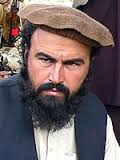
Drone Kills Tehrik-i-Taliban’s Second Senior Most Commander

Wali-ur-Rehman (rewardsforjustice.com)

At least six people were killed in a drone strike Wednesday in northwest Pakistan, reportedly including a top Pakistani Taliban official, in the first publicized US drone attack since President Barack Obama announced he was changing policy on such strikes.

According to multiple reports, Wali-ur-Rehman, the second in command of the Tehreek-e-Taliban Pakistan, was killed in the attack in North Waziristan, a militant stronghold. The drone reportedly fired two missiles into a mud house in the village of Chashma, killing at least six and wounding four others. Reuters reports that Mr. Wali-ur-Rehman had been poised to succeed TTP leader Hakimullah Mehsud.

“This is a huge blow to militants and a win in the fight against insurgents,” one security official told Reuters, declining further comment.

RECOMMENDED: How much do you know about Pakistan? Take this quiz.

The Pakistani Taliban are a separate entity allied to the Afghan Taliban. Known as the Tehreek-e-Taliban Pakistan (TTP), they have launched devastating attacks against the Pakistani military and civilians.

Reuters reports that the Pakistani Foreign Office expressed concern over the attack, stating that “Any drone strike is against the territorial integrity and sovereignty of Pakistan and we condemn it.” Reuters notes, however that the comment was made before Wali-ur-Rehman had been identified as a casualty.

Pakistani newspaper The News International reports that the TTP denied that Wali-ur-Rehman was killed.

The drone strike comes at a precarious time for both Washington and Islamabad. Last week, President Obama announced that the White House had codified new policy guidance on the use of lethal force against terrorists, including the use of drones, The Christian Science Monitor reported.

Generally speaking, the US government has to determine that a potential drone target poses a “continuing and imminent threat to the American people,” the president said.

Drones can be used only if the US can’t capture individual terrorists.

“Our preference is always to detain, interrogate, and prosecute them,” Obama said.

And finally, before any strike occurs, there must be “near certainty” that no civilians will be killed or injured, according to the president.

Experts note, however, that at least rhetorically, the president’s guidelines match what has been said before about US drone policies, and it is unclear whether this announcement marks a change in process – particularly as most of the relevant information on drone policy remains classified.

At the same time, Pakistan is in an interim period between its recent presidential election and the formation of a new government led by Nawaz Sharif, who “has made it very clear through the election campaign that he wants all drone strikes to stop all together,” reports the BBC’s Richard Galpin.

“The plain fact here is that the drone strikes are extremely unpopular, the vast majority of the population opposed to them – recent research showing two-thirds of them, of the population were opposed to them. Nawaz Sharif, I think is pretty much obliged to bring this issue up in negotiations with the American government to see if he can persuade them to stop the strikes.”

But at the same time, says the BBC’s M Ilyas Khan, “any strike against the Pakistan Taliban would be welcomed by the Pakistani authorities because the group has for several years been exclusively focused on pursuing Pakistani – rather than Afghan – military and civilian targets.”

Our correspondent says it comes on the same day that the newly-elected parliament of Khyber Pakhtunkhwa province – which adjoins North Waziristan – holds its first meeting.

The province is now being ruled by former cricketer Imran Khan’s PTI party, which has in recent months repeatedly spoken out against drone attacks, as has Prime Minister-elect Nawaz Sharif.

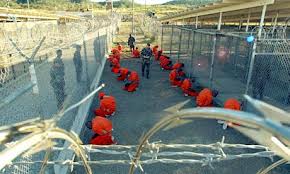
Obama to Seek Closing Amid Hunger Strike at Guantánamo

Guantanamo prison (Credit guardian.co.uk)

WASHINGTON — President Obama on Tuesday recommitted to his years-old vow to close the Guantánamo Bay prison following the arrival of “medical reinforcements” of nearly 40 Navy nurses, corpsmen and specialists amid a mass hunger strike by inmates who have been held for over a decade without trial.

“It’s not sustainable,” Mr. Obama said at a White House news conference. “The notion that we’re going to keep 100 individuals in no man’s land in perpetuity,” he added, made no sense. “All of us should reflect on why exactly are we doing this? Why are we doing this?”

Citing the high expense and the foreign policy costs of continuing to operate the prison, Mr. Obama said he would try again to persuade Congress to lift restrictions on transferring inmates to the federal court system. Mr. Obama was ambiguous, however, about the most difficult issue raised by the prospect of closing the prison: what to do with detainees who are deemed dangerous but could not be feasibly prosecuted.

Mr. Obama’s existing policy on that subject, which Congress has blocked, is to move detainees to maximum-security facilities inside the United States and continue holding them without trial as wartime prisoners; it is not clear whether such a change would ease the frustrations fueling the detainees’ hunger strike.

Yet at another point in the news conference, Mr. Obama appeared to question the policy of indefinite wartime detention at a time when the war in Iraq has ended, the one in Afghanistan is winding down and the original makeup of Al Qaeda has been decimated. “The idea that we would still maintain forever a group of individuals who have not been tried,” he said, “that is contrary to who we are, contrary to our interests, and it needs to stop.”

But in the short term, Mr. Obama indicated his support for the force-feeding of detainees who refused to eat.

“I don’t want these individuals to die,” he said.

As of Tuesday morning, 100 of the 166 prisoners at Guantánamo were officially deemed by the military to be participating in the hunger strike, with 21 “approved” to be fed the nutritional supplement Ensure through tubes inserted through their noses.

In a statement released earlier, a military spokesman said the deployment of additional medical personnel had been planned several weeks ago as more detainees joined the strike.

“We will not allow a detainee to starve themselves to death, and we will continue to treat each person humanely,” said Lt. Col. Samuel House, the prison spokesman.

The military’s response to the hunger strike has revived complaints by medical ethics groups that contend that doctors — and nurses under their direction — should not force-feed prisoners who are mentally competent to decide not to eat.

Last week, the president of the American Medical Association, Dr. Jeremy A. Lazarus, wrote a letter to Defense Secretary Chuck Hagel saying that any doctor who participated in forcing a prisoner to eat against his will was violating “core ethical values of the medical profession.”

“Every competent patient has the right to refuse medical intervention, including life-sustaining interventions,” Dr. Lazarus wrote.

He also noted that the A.M.A. endorses the World Medical Association’s Tokyo Declaration, a 1975 statement forbidding doctors to use their medical knowledge to facilitate torture. It says that if a prisoner makes “an unimpaired and rational judgment” to refuse nourishment, “he or she shall not be fed artificially.”

The military’s policy, however, is that it can and should preserve the life of a detainee by forcing him to eat if necessary.

“In the case of a hunger strike, attempted suicide or other attempted serious self-harm, medical treatment or intervention may be directed without the consent of the detainee to prevent death or serious harm,” a military policy directive says. “Such action must be based on a medical determination that immediate treatment or intervention is necessary to prevent death or serious harm and, in addition, must be approved by the commanding officer of the detention facility or other designated senior officer responsible for detainee operations.”

On Monday, Colonel House also said that some detainees on the “enteral feeding” list were drinking the supplement.

“Just because the detainees are approved for enteral feeding does not mean they don’t eat a regular meal,” he said. “Once the detainees leave their cell and are in the presence of medical personnel, most of the detainees who are approved for tube feeding will eat or drink without the peer pressure from inside the cellblock.”

Medical ethicists and the Pentagon also clashed during the Bush administration over hunger strikes at Guantánamo.

The current protest began in February and escalated after a raid this month in which guards confined protesting detainees to their cells. The impetus for it is disputed. The prisoners, through their lawyers, cite a search for contraband on Feb. 6, during which they say Korans were handled in a way they found offensive. The military says the Koran search followed routine procedures.

But both sides agree that the root cause is frustration over the collapse of President Obama’s effort to close the prison, which drew Congressional resistance, and the fact that no prisoners have been transferred because of restrictions on where they can be sent.

Congress has restricted the repatriation to countries with troubled security conditions, helping to jam up 86 low-level detainees who were designated for potential transfer three years ago; most are Yemeni. But since 2012, lawmakers have given the Pentagon the ability to waive most of those restrictions on a case-by-case basis, and it has not done so.

On Tuesday, Mr. Obama said he “I’ve asked my team to review everything that’s currently being done in Guantánamo, everything that we can do administratively.” It was not clear whether that was a signal that the administration may be considering using the waiver power to revive the transfer of low-level detainees.

Ramzi Kassem, a City University of New York law professor who represents several detainees, said he had talked to a Yemeni client, Moath Hamza Ahmed al-Alwi, who said a guard had shot him with rubber-coated pellets at close range during the raid. Since then, Mr. Kassem was told, the prisoners have been denied soap, toothbrushes, toothpaste and their legal papers.

Mr. Alwi said he had not eaten in 80 days and stopped drinking after the raid, Mr. Kassem said. He also said he was being force-fed twice a day after being tied to a restraint chair.

Mr. Kassem also quoted Mr. Alwi as saying: “I do not want to kill myself. My religion prohibits suicide. But I will not eat or drink until I die, if necessary, to protest the injustice of this place. We want to get out of this place. It is as though this government wishes to smother us in this injustice, to kill us slowly here, indirectly, without trying us or executing us.”

In his statement on Monday, Colonel House said the prisoners would not be allowed to die.

“Detainees have the right to peacefully protest, but we have the responsibility to ensure that they conduct their protest safely and humanely,” he said. “Detainees are given a choice: eat the hot meal, drink the supplement or be enteral fed.”


Rafia Zakaria: The Tragedies of Other Places

Rafia Zakaria (Credit: twitter.com)

As a weekly columnist for the Pakistani newspaper Dawn, I’ve become adept at writing about bombings. Pakistan suffered 652 of these last year; terrorist attacks took down everything from girls’ schools to apartment buildings and felled members of Parliament, singers, and school children—each person sentenced by coincidence to be at a given location in the moment it became a bomber’s target. Through my columns, I have offered up fumbled expressions of grief and comfort to Pakistani readers whose stores of empathy are bled daily without any promise of replenishment. I believe that these rituals of caring, made so repetitious in Pakistan by the sheer frequency of terror attacks, are crucial; in preventing the normalization of violence and senseless evil, they keep a society human.

The bombings in Boston on April 15, 2013 pose their own conundrum to those like me who are in the habit of writing about bloodier conflicts with more frequent conflagrations. There is an inherent cruelty in every terror attack—an undeniable reverberation of evil in the destruction of an ordinary moment and the forced marriage of that moment to sudden violence. Boston is no different, no more or less tragic than the bombings that have razed the marketplaces of Karachi, the school in Khost, the mosque in Karbala.

American tragedies somehow seem to occur in a more poignant version of reality… within minutes American victims are lifted from the nameless to the remembered.

And yet it seems so. Attacks in America are far more indelible in the world’s memory than attacks in any other country. There may be fewer victims and less blood, but American tragedies somehow seem to occur in a more poignant version of reality, in a way that evokes a more sympathetic response. Within minutes American victims are lifted from the nameless to the remembered; their individual tragedies and the ugly unfairness of their ends are presented in a way that cannot but cause the watching world to cry, to consider them intimates, and to stand in their bloody shoes. Death is always unexpected in America and death by a terrorist attack more so than in any other place.

It is this greater poignancy of attacks in America that begs the question of whether the world’s allocations of sympathy are determined not by the magnitude of a tragedy—the numbers dead and injured—but by the contrast between a society’s normal and the cruel aftermath of a terrorist event. It is in America that the difference between the two is the greatest; the American normal is one of a near-perfect security that is unimaginable in many places, especially in countries at war. The very popularity of the Boston Marathon could be considered an expression of just this. America is so secure and free from suffering that people have the luxury of indulging in deliberate suffering in the form of excruciating physical exertion; this suffering in turn produces well-earned exhilaration, a singular sense of physical achievement and mental fortitude. The act of running a marathon is supposed to be simple, individual—a victory of the will over the body, celebrated by all and untouched by the complicated questions of who in the world can choose to suffer and who only bears suffering.

The innocence of marathon runners and their expectations of a finish line, a well-earned victory, are markers of an America that still believes in an uncomplicated morality even while it is at war.

When terror hits the site of such faith in human fortitude, the impact is large. The innocence of marathon runners and their expectations of a finish line, a well-earned victory, are markers of an America that still believes in an uncomplicated morality even while it is at war. The runner runs, sweats, suffers, and deserves the prize; the messiness of the world has no place in that vacuum of earned achievement where victory is straightforward in a way that it can never be in actual life. The rest of the world is a more complicated place; its people are forced to digest more complicated truths whose vast gray areas rob every tragedy of the pathos available to Americans living and mourning in a universe of black and white.


Living Through Terror, in Rawalpindi and Boston

Chechen brothers identified in Boston massacre (Credit: sandrarose.com)

Boston, April 16: I WAS in the middle of having Chinese food with my wife and friends yesterday afternoon when we heard the dull and deathly reverb. The water in our plastic cups rippled. We looked at one another, and someone made a joke about that famous scene in “Jurassic Park.” We tried to drown the moment in humor. But then a rush of humanity descended upon us in the Prudential Center on Boylston Street, right across from where the second bomb blast had just occurred, near the marathon’s finish line.

People gushed across the hallway like fish in white water rapids. It was a blur of bright clothes and shiny sneakers, everyone dressed up for Patriot’s Day weekend on what was moments ago a beautiful spring day. Instantly, images of the shootings in Aurora, Colo., Newtown, Conn., and Tucson came to mind. I felt my thoughts reduced to singular flashes. My life, all of it, was the first. My wife, sitting across me, was the second. I yelled out to her to run, and we did, not knowing what had happened, only that it had to be something terrible.

We ran out of the food court and onto the terrace overlooking Boylston Street. We could see people fleeing from the finish line even as, in the distance, other weary marathoners kept running unknowingly toward the devastation. What was left of the food court was a land frozen in an innocent time, forks still stuck in half-eaten pieces of steak, belongings littered unattended. I felt fear beyond words.

This was not my first experience with terror, having grown up in Pakistan. But for some reason, I didn’t think back to those experiences. Looking onto to the smoked, chaotic Boylston Street, I forgot about cowering in my childhood bedroom as bombs and gunfire rained over the army headquarters in Rawalpindi, close to our house. My mind did not go back to when I stood on the roof of my dormitory in Karachi as the streets were overrun with burning buses and angry protesters after the assassination of Benazir Bhutto. None of the unfortunate experiences of growing up in the midst of thousands of victims of terror, personally knowing some of them, helped me in that moment. Nothing made it any easier.

Perhaps, if I had been thinking more clearly and hadn’t had my wife with me, I might have gone down to try to help the wounded. But at that moment all I could think about was getting us out of there. We lost our friends, then found them again. Our cellphones weren’t working. And then, as we worked our way through the dazed throngs in Back Bay, I realized that not only was I a victim of terror, but I was also a potential suspect.

As a 20-something Pakistani male with dark stubble (an ode more to my hectic schedule as a resident in the intensive-care unit than to any aesthetic or ideology), would I not fit the bill? I know I look like Hollywood’s favorite post-cold-war movie villain. I’ve had plenty of experience getting intimately frisked at airports. Was it advisable to go back to pick up my friend’s camera that he had forgotten in his child’s stroller in the mall? I remember feeling grateful that I wasn’t wearing a backpack, which I imagined might look suspicious. My mind wandered to when I would be working in the intensive care unit the next day, possibly taking care of victims of the blast. What would I tell them when they asked where I was from (a question I am often posed)? Wouldn’t it be easier to just tell people I was from India or Bangladesh?

As I walked down Commonwealth Avenue, I started receiving calls from family back home. They informed me about what was unfolding on television screens across the world. I was acutely conscious of what I spoke over the phone, feeling that someone was breathing over my shoulder, listening to every word I said. Careful to avoid Urdu, speaking exclusively in English, I relayed that I was safe, and all that I had seen. I continued to naïvely cling to the hope that it was a gas explosion, a subway accident, anything other than what it increasingly seemed to be: an act of brutality targeted at the highest density of both people and cameras.

The next step was to hope that the perpetrator was not a lunatic who would become the new face of a billion people. Not a murderer who would further fan the flames of Islamophobia. Not an animal who would obstruct the ability of thousands of students to complete their educations in the United States. Not an extremist who would maim and hurt the very people who were still recovering from the pain of Sept. 11. President Obama and Gov. Deval L. Patrick have shown great restraint in their words and have been careful not to accuse an entire people for what one madman may have done. But others might not be so kind.

Haider Javed Warraich is a resident in internal medicine at the Beth Israel Deaconess Medical Center.


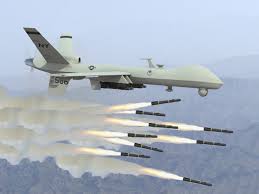
How Drone Attacks First Began in Pakistan

Drone strikes in Pakistan (Credit miskweenworld.blogspot.com)
On a hot day in June 2004, the Pashtun tribesman was lounging inside a mud compound in South Waziristan, speaking by satellite phone to one of the many reporters who regularly interviewed him on how he had fought and humbled Pakistan’s army in the country’s western mountains. He asked one of his followers about the strange, metallic bird hovering above him.

Less than 24 hours later, a missile tore through the compound, severing Mr. Muhammad’s left leg and killing him and several others, including two boys, ages 10 and 16. A Pakistani military spokesman was quick to claim responsibility for the attack, saying that Pakistani forces had fired at the compound.

That was a lie.

Mr. Muhammad and his followers had been killed by the C.I.A., the first time it had deployed a Predator drone in Pakistan to carry out a “targeted killing.” The target was not a top operative of Al Qaeda, but a Pakistani ally of the Taliban who led a tribal rebellion and was marked by Pakistan as an enemy of the state. In a secret deal, the C.I.A. had agreed to kill him in exchange for access to airspace it had long sought so it could use drones to hunt down its own enemies.

That back-room bargain, described in detail for the first time in interviews with more than a dozen officials in Pakistan and the United States, is critical to understanding the origins of a covert drone war that began under the Bush administration, was embraced and expanded by President Obama, and is now the subject of fierce debate. The deal, a month after a blistering internal report about abuses in the C.I.A.’s network of secret prisons, paved the way for the C.I.A. to change its focus from capturing terrorists to killing them, and helped transform an agency that began as a cold war espionage service into a paramilitary organization.

The C.I.A. has since conducted hundreds of drone strikes in Pakistan that have killed thousands of people, Pakistanis and Arabs, militants and civilians alike. While it was not the first country where the United States used drones, it became the laboratory for the targeted killing operations that have come to define a new American way of fighting, blurring the line between soldiers and spies and short-circuiting the normal mechanisms by which the United States as a nation goes to war.

Neither American nor Pakistani officials have ever publicly acknowledged what really happened to Mr. Muhammad — details of the strike that killed him, along with those of other secret strikes, are still hidden in classified government databases. But in recent months, calls for transparency from members of Congress and critics on both the right and left have put pressure on Mr. Obama and his new C.I.A. director, John O. Brennan, to offer a fuller explanation of the goals and operation of the drone program, and of the agency’s role.

Mr. Brennan, who began his career at the C.I.A. and over the past four years oversaw an escalation of drone strikes from his office at the White House, has signaled that he hopes to return the agency to its traditional role of intelligence collection and analysis. But with a generation of C.I.A. officers now fully engaged in a new mission, it is an effort that could take years.

Today, even some of the people who were present at the creation of the drone program think the agency should have long given up targeted killings.
Ross Newland, who was a senior official at the C.I.A.’s headquarters in Langley, Va., when the agency was given the authority to kill Qaeda operatives, says he thinks that the agency had grown too comfortable with remote-control killing, and that drones have turned the C.I.A. into the villain in countries like Pakistan, where it should be nurturing relationships in order to gather intelligence.

As he puts it, “This is just not an intelligence mission.”

From Car Thief to Militant
By 2004, Mr. Muhammad had become the undisputed star of the tribal areas, the fierce mountain lands populated by the Wazirs, Mehsuds and other Pashtun tribes who for decades had lived independent of the writ of the central government in Islamabad. A brash member of the Wazir tribe, Mr. Muhammad had raised an army to fight government troops and had forced the government into negotiations. He saw no cause for loyalty to the Directorate of Inter-Services Intelligence, the Pakistani military spy service that had given an earlier generation of Pashtuns support during the war against the Soviets.

Many Pakistanis in the tribal areas viewed with disdain the alliance that President Pervez Musharraf had forged with the United States after the Sept. 11, 2001, attacks. They regarded the Pakistani military that had entered the tribal areas as no different from the Americans — who they believed had begun a war of aggression in Afghanistan, just as the Soviets had years earlier.

Born near Wana, the bustling market hub of South Waziristan, Mr. Muhammad spent his adolescent years as a petty car thief and shopkeeper in the city’s bazaar. He found his calling in 1993, around the age of 18, when he was recruited to fight with the Taliban in Afghanistan, and rose quickly through the group’s military hierarchy. He cut a striking figure on the battlefield with his long face and flowing jet black hair.

When the Americans invaded Afghanistan in 2001, he seized an opportunity to host the Arab and Chechen fighters from Al Qaeda who crossed into Pakistan to escape the American bombing.

For Mr. Muhammad, it was partly a way to make money, but he also saw another use for the arriving fighters. With their help, over the next two years he launched a string of attacks on Pakistani military installations and on American firebases in Afghanistan.

C.I.A. officers in Islamabad urged Pakistani spies to lean on the Waziri tribesman to hand over the foreign fighters, but under Pashtun tribal customs that would be treachery. Reluctantly, Mr. Musharraf ordered his troops into the forbidding mountains to deliver rough justice to Mr. Muhammad and his fighters, hoping the operation might put a stop to the attacks on Pakistani soil, including two attempts on his life in December 2003.

But it was only the beginning. In March 2004, Pakistani helicopter gunships and artillery pounded Wana and its surrounding villages. Government troops shelled pickup trucks that were carrying civilians away from the fighting and destroyed the compounds of tribesmen suspected of harboring foreign fighters. The Pakistani commander declared the operation an unqualified success, but for Islamabad, it had not been worth the cost in casualties.

A cease-fire was negotiated in April during a hastily arranged meeting in South Waziristan, during which a senior Pakistani commander hung a garland of bright flowers around Mr. Muhammad’s neck. The two men sat together and sipped tea as photographers and television cameras recorded the event.
Both sides spoke of peace, but there was little doubt who was negotiating from strength. Mr. Muhammad would later brag that the government had agreed to meet inside a religious madrasa rather than in a public location where tribal meetings are traditionally held. “I did not go to them; they came to my place,” he said. “That should make it clear who surrendered to whom.”

The peace arrangement propelled Mr. Muhammad to new fame, and the truce was soon exposed as a sham. He resumed attacks against Pakistani troops, and Mr. Musharraf ordered his army back on the offensive in South Waziristan.

Pakistani officials had, for several years, balked at the idea of allowing armed C.I.A. Predators to roam their skies. They considered drone flights a violation of sovereignty, and worried that they would invite further criticism of Mr. Musharraf as being Washington’s lackey. But Mr. Muhammad’s rise to power forced them to reconsider.

The C.I.A. had been monitoring the rise of Mr. Muhammad, but officials considered him to be more Pakistan’s problem than America’s. In Washington, officials were watching with growing alarm the gathering of Qaeda operatives in the tribal areas, and George J. Tenet, the C.I.A. director, authorized officers in the agency’s Islamabad station to push Pakistani officials to allow armed drones. Negotiations were handled primarily by the Islamabad station.

As the battles raged in South Waziristan, the station chief in Islamabad paid a visit to Gen. Ehsan ul Haq, the ISI chief, and made an offer: If the C.I.A. killed Mr. Muhammad, would the ISI allow regular armed drone flights over the tribal areas?

In secret negotiations, the terms of the bargain were set. Pakistani intelligence officials insisted that they be allowed to approve each drone strike, giving them tight control over the list of targets. And they insisted that drones fly only in narrow parts of the tribal areas — ensuring that they would not venture where Islamabad did not want the Americans going: Pakistan’s nuclear facilities, and the mountain camps where Kashmiri militants were trained for attacks in India.

The ISI and the C.I.A. agreed that all drone flights in Pakistan would operate under the C.I.A.’s covert action authority — meaning that the United States would never acknowledge the missile strikes and that Pakistan would either take credit for the individual killings or remain silent.

Mr. Musharraf did not think that it would be difficult to keep up the ruse. As he told one C.I.A. officer: “In Pakistan, things fall out of the sky all the time.”

A New Direction
As the negotiations were taking place, the C.I.A.’s inspector general, John L. Helgerson, had just finished a searing report about the abuse of detainees in the C.I.A.’s secret prisons. The report kicked out the foundation upon which the C.I.A. detention and interrogation program had rested. It was perhaps the single most important reason for the C.I.A.’s shift from capturing to killing terrorism suspects.

The greatest impact of Mr. Helgerson’s report was felt at the C.I.A.’s Counterterrorism Center, or CTC, which was at the vanguard of the agency’s global antiterrorism operation. The center had focused on capturing Qaeda operatives; questioning them in C.I.A. jails or outsourcing interrogations to the spy services of Pakistan, Jordan, Egypt and other nations; and then using the information to hunt more terrorism suspects.

Mr. Helgerson raised questions about whether C.I.A. officers might face criminal prosecution for the interrogations carried out in the secret prisons, and he suggested that interrogation methods like waterboarding, sleep deprivation and the exploiting of the phobias of prisoners — like confining them in a small box with live bugs — violated the United Nations Convention Against Torture.

“The agency faces potentially serious long-term political and legal challenges as a result of the CTC detention and interrogation program,” the report concluded, given the brutality of the interrogation techniques and the “inability of the U.S. government to decide what it will ultimately do with the terrorists detained by the agency.”

The report was the beginning of the end for the program. The prisons would stay open for several more years, and new detainees were occasionally picked up and taken to secret sites, but at Langley, senior C.I.A. officers began looking for an endgame to the prison program. One C.I.A. operative told Mr. Helgerson’s team that officers from the agency might one day wind up on a “wanted list” and be tried for war crimes in an international court.

The ground had shifted, and counterterrorism officials began to rethink the strategy for the secret war. Armed drones, and targeted killings in general, offered a new direction. Killing by remote control was the antithesis of the dirty, intimate work of interrogation. Targeted killings were cheered by Republicans and Democrats alike, and using drones flown by pilots who were stationed thousands of miles away made the whole strategy seem risk-free.

Before long the C.I.A. would go from being the long-term jailer of America’s enemies to a military organization that erased them.

Not long before, the agency had been deeply ambivalent about drone warfare.

The Predator had been considered a blunt and unsophisticated killing tool, and many at the C.I.A. were glad that the agency had gotten out of the assassination business long ago. Three years before Mr. Muhammad’s death, and one year before the C.I.A. carried out its first targeted killing outside a war zone — in Yemen in 2002 — a debate raged over the legality and morality of using drones to kill suspected terrorists.

A new generation of C.I.A. officers had ascended to leadership positions, having joined the agency after the 1975 Congressional committee led by Senator Frank Church, Democrat of Idaho, which revealed extensive C.I.A. plots to kill foreign leaders, and President Gerald Ford’s subsequent ban on assassinations. The rise to power of this post-Church generation had a direct impact on the type of clandestine operations the C.I.A. chose to conduct.

The debate pitted a group of senior officers at the Counterterrorism Center against James L. Pavitt, the head of the C.I.A.’s clandestine service, and others who worried about the repercussions of the agency’s getting back into assassinations. Mr. Tenet told the 9/11 commission that he was not sure that a spy agency should be flying armed drones.

John E. McLaughlin, then the C.I.A.’s deputy director, who the 9/11 commission reported had raised concerns about the C.I.A.’s being in charge of the Predator, said: “You can’t underestimate the cultural change that comes with gaining lethal authority.

“When people say to me, ‘It’s not a big deal,’ ” he said, “I say to them, ‘Have you ever killed anyone?’
“It is a big deal. You start thinking about things differently,” he added. But after the Sept. 11 attacks, these concerns about the use of the C.I.A. to kill were quickly swept side.

The Account at the Time
After Mr. Muhammad was killed, his dirt grave in South Waziristan became a site of pilgrimage. A Pakistani journalist, Zahid Hussain, visited it days after the drone strike and saw a makeshift sign displayed on the grave: “He lived and died like a true Pashtun.”

Maj. Gen. Shaukat Sultan, Pakistan’s top military spokesman, told reporters at the time that “Al Qaeda facilitator” Nek Muhammad and four other “militants” had been killed in a rocket attack by Pakistani troops.

Any suggestion that Mr. Muhammad was killed by the Americans, or with American assistance, he said, was “absolutely absurd.”

This article is adapted from “The Way of the Knife: The C.I.A., a Secret Army, and a War at the Ends of the Earth,” to be published by Penguin Press on Tuesday.